Forum adverts like this one are shown to any user who is not logged in. Join us by filling out a tiny 3 field form and you will get your own, free, dakka user account which gives a good range of benefits to you:
No adverts like this in the forums anymore.
Times and dates in your local timezone.
Full tracking of what you have read so you can skip to your first unread post, easily see what has changed since you last logged in, and easily see what is new at a glance.
Email notifications for threads you want to watch closely.
Being a part of the oldest wargaming community on the net.
If you are already a member then feel free to login now.
The upcoming paints from GW are not inks (they're not even really paints, they're just hyper pigmented additives meant to affect the colour of the the paints their added to and not menat to be used on their own.)
FW's 'clear' paints are pretty much thin glazes that are meant to be painted over other paints (usually as a final stage process.)
.
As an artist, I tend to stay away from GW's paints (and mostly make my own) but I think this new line is a really interesting development for model paints and I think they'll have a major impact on what many model painters see as possible.
joseph_curwen wrote: FW's 'clear' paints are pretty much thin glazes that are meant to be painted over other paints (usually as a final stage process.)
That's not entirely true; clear paints behave nothing like a glaze. The only similarity between the two is the high translucency.
Otherwise you can use clear paints as far more than a final stage process. They can be used for blood and weathering effects, base colours (any "candy" style paint job will use a clear paint as the major colour), highlight colours, and pretty much anything in between.
Paints are emulsions. Which basically means it's a bunch of different things suspended inside of a base. The things inside of it do not actually blend to form a compound. They will separate over time. Paint all has 3 basic parts.
Base: Water/oil etc etc... It's what everything is suspended in.
Body: all the other chemicals in there that give the paint it's properties. Gloss agents are included here.
Pigment: what gives it color.
What GW calls a Base paint has a very high pigment count making it very opaque. (very little transparency in general.) Some pigments are better (blacks) others are worse (yellow). General rule, the brighter it is the worse it's transparency will be.
What GW calls a Ink is also commonly called a wash. It's paint with a very low pigment count. You can actually purchase stuff from other companies called varnish. For instance, Army Painter Matte Varnish. It's just paint without pigment. Likewise, Ard'Coat is just Gloss Varnish. Very expensive gloss varnish. If you add a bunch of varnish to a GW paint you will make a Ink out of it. You can do something similar by adding distilled water, but you are just adding to the base, diluting all the parts of the paint that make it paint instead of water. You might want that though. Some paints are thick and the distilled water can help it flow better.
It sounds like a Clear is liquid pigments used to adjust colors. If that is the case it's not paint and will not dry properly. Do not paint with it alone. Add it to other paints or varnishes.
These are my opinions. This is how I feel. Others may feel differently. This needs to be stated for some reason.
Lance845 wrote: What GW calls a Ink is also commonly called a wash. It's paint with a very low pigment count. You can actually purchase stuff from other companies called varnish. For instance, Army Painter Matte Varnish. It's just paint without pigment. Likewise, Ard'Coat is just Gloss Varnish. Very expensive gloss varnish. If you add a bunch of varnish to a GW paint you will make a Ink out of it. You can do something similar by adding distilled water, but you are just adding to the base, diluting all the parts of the paint that make it paint instead of water. You might want that though. Some paints are thick and the distilled water can help it flow better.
That's not quite right.
Inks traditionally are thin and have high colour density. This is how an acrylic ink behaves...
Washes are kind of a more recent addition to wargaming, they have much lower colour density than inks... but the confusing thing is some companies (like army painter) use the term "ink" for what we normally think of as a "wash". But traditionally, inks are much denser colour.
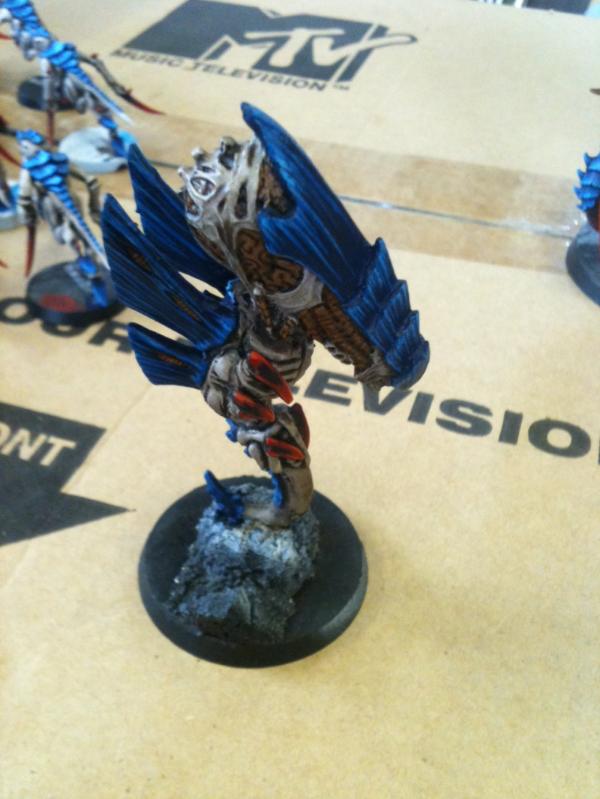
I posted this in the other thread, but I'll post it again here. If you look at this guy, the brains, tubes and fleshy bits are Rakarth Flesh with an old GW brown INK painted over the top. The skin areas areas are Rakarth Flesh with a newer GW wash painted over it. As you can see the area painted with the ink has completely changed the colour of the Rakarth Flesh while the washed area is only slightly altered the tone.
Of course it's complicated by the fact that a lot of companies now make wash-like products that they call inks but actually behave nothing like traditional artist inks.
If you add a bunch of varnish to a GW paint you will make a Ink out of it.
That's not really true either. Varnishes usually have much higher viscosity than inks and washes and also higher surface tension. Varnishes are typically "acrylic resin" or similar where as to make a wash you need to add some amount of "acrylic medium" (which includes a binder, not just the resin) and also some sort of "thinning medium" (which might just be water) and then something to lower the surface tension (something like a flow improver, or in the good old days a tiny touch of dish washing liquid). You can then add a matting agent to dull it down because acrylic mediums and flow improvers are often glossy.
If you want to make something akin to a traditional artists ink, you can't do that by mixing something in with regular paint because inks typically use a high density of very fine pigments and/or dyes.
So yeah, varnishes behave very different to washes and inks because they're made of fundamentally different building blocks. Some varnishes can work as thinners (Future for example, or Humbrol's Clear) but those are the exception rather than the rule because they are varnishes that are exceptionally thin to begin with, but even they often don't have the low surface tension that is desirable in a wash/ink.
EDIT: As for clears, clears are usually a vibrant pigment, but only a very small amount of it, mixed in with a large amount of acrylic medium. So a few coats of a "clear" will usually give you a very bright vibrant colour, but because the density is low the colour underneath will still be visible through it and also because of the large amount of acrylic medium or resin it will have some depth to it (areas that you view squarely will appear lighter than areas you view at an angle). I'd describe clears as being similar to traditional artist inks but with a higher viscosity, higher surface tension and lower colour density. It's what you'd imagine you'd get if you mixed a bit of paint in with a gloss varnish, BUT there's more to it than that (because I've never been able to create my own clears that look as good as commercially available clears like Tamiya's options).
If you look at some of Forge World's models, they use clears over metallics to create some candy effects, for example...
That's achieved by painting red clear over a silver basecoat, while this is achieved by painting a blue-green clear over a silver basecoat:
This message was edited 5 times. Last update was at 2016/10/25 06:42:08
Lance845 wrote: What GW calls a Ink is also commonly called a wash. It's paint with a very low pigment count. You can actually purchase stuff from other companies called varnish. For instance, Army Painter Matte Varnish. It's just paint without pigment. Likewise, Ard'Coat is just Gloss Varnish. Very expensive gloss varnish. If you add a bunch of varnish to a GW paint you will make a Ink out of it. You can do something similar by adding distilled water, but you are just adding to the base, diluting all the parts of the paint that make it paint instead of water. You might want that though. Some paints are thick and the distilled water can help it flow better.
That's not quite right.
Inks traditionally are thin and have high colour density. This is how an acrylic ink behaves...
Washes are kind of a more recent addition to wargaming, they have much lower colour density than inks... but the confusing thing is some companies (like army painter) use the term "ink" for what we normally think of as a "wash". But traditionally, inks are much denser colour.
I posted this in the other thread, but I'll post it again here. If you look at this guy, the brains, tubes and fleshy bits are Rakarth Flesh with an old GW brown INK painted over the top. The skin areas areas are Rakarth Flesh with a newer GW wash painted over it. As you can see the area painted with the ink has completely changed the colour of the Rakarth Flesh while the washed area is only slightly altered the tone.
Of course it's complicated by the fact that a lot of companies now make wash-like products that they call inks but actually behave nothing like traditional artist inks.
If you add a bunch of varnish to a GW paint you will make a Ink out of it.
That's not really true either. Varnishes usually have much higher viscosity than inks and washes and also higher surface tension. Varnishes are typically "acrylic resin" or similar where as to make a wash you need to add some amount of "acrylic medium" (which includes a binder, not just the resin) and also some sort of "thinning medium" (which might just be water) and then something to lower the surface tension (something like a flow improver, or in the good old days a tiny touch of dish washing liquid). You can then add a matting agent to dull it down because acrylic mediums and flow improvers are often glossy.
If you want to make something akin to a traditional artists ink, you can't do that by mixing something in with regular paint because inks typically use a high density of very fine pigments and/or dyes.
So yeah, varnishes behave very different to washes and inks because they're made of fundamentally different building blocks. Some varnishes can work as thinners (Future for example, or Humbrol's Clear) but those are the exception rather than the rule because they are varnishes that are exceptionally thin to begin with, but even they often don't have the low surface tension that is desirable in a wash/ink.
EDIT: As for clears, clears are usually a vibrant pigment, but only a very small amount of it, mixed in with a large amount of acrylic medium. So a few coats of a "clear" will usually give you a very bright vibrant colour, but because the density is low the colour underneath will still be visible through it and also because of the large amount of acrylic medium or resin it will have some depth to it (areas that you view squarely will appear lighter than areas you view at an angle). I'd describe clears as being similar to traditional artist inks but with a higher viscosity, higher surface tension and lower colour density. It's what you'd imagine you'd get if you mixed a bit of paint in with a gloss varnish, BUT there's more to it than that (because I've never been able to create my own clears that look as good as commercially available clears like Tamiya's options).
If you look at some of Forge World's models, they use clears over metallics to create some candy effects, for example...
That's achieved by painting red clear over a silver basecoat, while this is achieved by painting a blue-green clear over a silver basecoat:
This is a great explanation for the differences between the various products. I know since the citadel washes (now citadel shades) have been around my citadel inks have been almost entirely unused. I used up the black ink for shading and black lining but I've got brown blue and green inks that I don't have a satisfactory use for. I suppose using them over metallics with an airbrush could work but since they always left tide marks I've not bothered with them for a long time.
I love the look of that red on the Contemptor. I'll have to try doing that sometime.
Inks are definitely trickier to use IMO which is I think why GW swapped to "washes", inks have some more special uses I guess. The benefit of an ink is the higher colour density means you get a deeper colour when you apply it, it's not just shading but also adding a depth to it.
A wash is basically what you get when you thin an ink down using acrylic mediums and flow improver. So you could think of a wash as being like a pre-thinned ink.
From my experience, Vallejo's inks do behave like inks and they need to be thinned whereas what Army Painter calls an ink isn't like a traditional ink, it's more like the pre-thinned shade/wash.







 Thanks for all the info!

