Backspacehacker wrote: I get the old system was not the best, but its miles better then what it is now, because it worked and did not cause the multitude of problems we have now.
I have so many things to comment on....so many posts while i was away at work.
As somebody who still regularly plays 5th ed core rules with a few house rules (imported from other editions-nothing homemade) i am not going to go back and address every single reply directly but i will hit a few high points.
1. yes, it is a mess now because it is an arms race between damage and model survival. troopers have become harder and harder to kill (t5 2 or 3 wounds base etc..) to counter the fact the weapons have more and more damaged reduction and multiple damage dealing. As a side effect medium class high volume weapon that one would use on infantry are even better at killing vehicles. making dedicated AT weapons like a las cannon loose it's reason to exist.
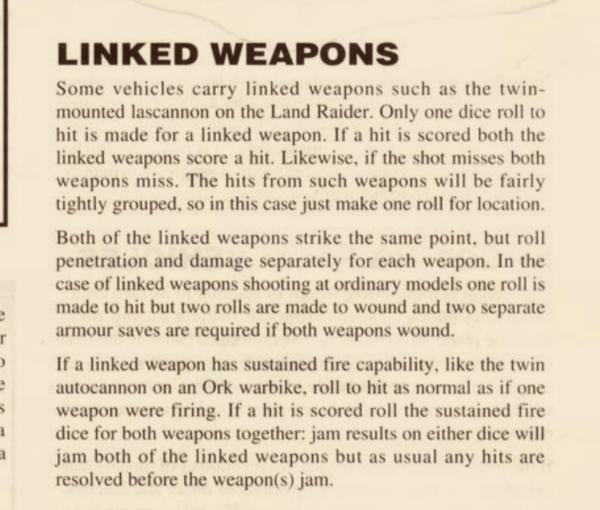
The old AP system works just fine specifically for narrative reasons because it provides immersion. as somebody noted previously a marine gets a 5+ save against a krak missle in 9th but nothing in 3rd-7th ed. It makes sense because even though marines are literally walking tanks in the lore you are firing a dedicated heavy anti-tank weapon at them. It is supposed to negate the armor as it was designed to do. The fact the game focused more on the tactical decisions you made in the actual game not just on list building (or gotcha card combos ala 9th) This is even more apparent with a properly terrain filled table allowing players to make use of maneuver to maximize hard cover or blocking LOS terrain.
Having more than 1 wound was a super HUGE thing in previous editions. the game had a lot less shots (incidentally adding in snap fire and overwatch are not that game breaking given this point which is why we added them into our 5th ed games). so characters with 2-4 wound, or some special infantry like obliterators having 2 wounds (with the aditional T5) could still be worn down by weight of numbers (My deathwing army fell mostly to massed las gun fire against imperial guard) but the threat of heavy AT weapons were a factor in the decisions you made in the battle.
It is the same with vehicles. immersivity damaging a vehicle (and armor facings) makes sense as you blow off pieces or knock the crew around. conversely because it is a vehicle it also made immersive sense that you could blow it up with a lucky hit. much of the debate about vehicle survival VS stun lock that began with the horribly design hull point system in 6th was easily fixed by adding in the snap fire mechanic. so even stunned vehicles can at least contribute, granted far less effectively, to the game while stunned/shaken (so long as they are not using blast/ordinance weapons since they cannot snap fire).
There was and always will be the WAAC minded tourney players who go to the things like AP 2 CCW in the previous edition instead of swords that were AP3, but for the narrative minded players who care about the lore, there are options. my dark angels would never use anything but a power sword for non-terminator equipped units because that is not the way they would fight in the setting.
Yes 9th is a very sterile setup with effectively identical battles for ease of pickup and tournament play, and some players desire that which is fine. but it is not "fun" to many of us in the way that older editions allowed players to build and play (and get rewarded for) the forces as they should according to the lore. pretty much every player who has only played 8th ed+ who we have taught to play 5th has had a great time. As long as they are having fun, it is the entire point of the exercise.
When we play our games i will gladly fight any army anybody puts on the table because even if it is a hard fight i know that i have a chance for a fun game and a win no matter what i am up against given the rule set and how scoring is done- to give you an idea here are a few of the regular lists that see some variation of play on the table at our FLGS every weekend when we are not playing non GW games-
.khorne berserkers 3.5 codex
.iron warriors 3.5 codex
.orks 4th ed codex
.tau 4th ed codex
.dark eldar 5th ed codex
.blood angels 5th ed codex
.imperial guard armored company-3rd ed chapter approved.
.imperial guard 5th ed codex
.crimson fists-5th ed codex
.black templar-4th ed codex
.necrons 5th ed codex
Except that AP 2 weapons were just as good at killing sv 3.
You say this like its a bad thing....
AP2 dominance over Sv3+ was a feature, not a bug. Same with AP5 dominating Sv5+.
The only correct interpretation of any "problem" here is that players failed to properly use cover against weapons that would negate saves, failed to screen with disposable units, failed to concentrate fire/lock/neuter dangerous enemy units, and/or failed to play objectives vs kills. For most MEQs, 'free" Power Armor was a crutch that they relied on excessively against basic weapons and basic attacks, and failed to adapt as the meta evolved to incorporate stronger anti-MEQ tactics and builds. Instead, they just kept charging forward like lambs to the slaughter, and then complained when the obviously effective weapons were actually effective. In short, most players, esp. MEQ players sucked. MEQs whining about AP2 being "too strong" simply needed to "git gud."
Not that any of it mattered outside of a paid tournament context with prizes on the line.
OTOH, if you were just playing to shoot the gak while chatting with your friends, whatever AP system is in place makes no difference whatsoever relative the importance of just playing a game.
Backspacehacker wrote: I get the old system was not the best, but its miles better then what it is now, because it worked and did not cause the multitude of problems we have now.
The old AP system works just fine specifically for narrative reasons because it provides immersion.
here are a few of the regular lists that see some variation of play on the table at our FLGS every weekend when we are not playing non GW games-
.iron warriors 3.5 codex
.orks 4th ed codex
.imperial guard armored company-3rd ed chapter approved.
The 3E AP system works great because it speeds the game by removing die rolls. It's to-hit & to-wound, pick up models, rather than the much slower & more tedious 'hit, wound, save, allocate, & pick' process. 3E was specifically designed to accelerate the leaden and plodding gameplay of 2E by removing rolls and simplifying mechanics.
The way 9E has gone, we might as well go back to the 2E Warp Spider rules, which had 2 full pages of rules covering how their Death Spinners worked [go ahead and click the links]. I'd kind of like that, simply to fething bury the opponent in mechanics such that they never get past the first couple turns. 9th Edition needs things like Virus Grenades and pre-game bombardment where you can potentially delete an army before the game even starts. Also, a counter phase where we randomly move On Fire models and Vortex Grenades to see what happens with them. At this point, why the feth not, right? In for a penny, in for a pound. /rant
Of the listed armies, there are only 3 that are potentially dangerous, of which the Orks might be the most dangerous of all!
ClockworkZion wrote: and hosting narrative events as part of the events they run.
They do. The Championships they hosted in Grapevine at the Citadel had an attached Narrative event. They even mentioned it in the WHC article about the event(as well as the 40K vs AoS game that was played there).
Forgive me for sounding like a nob or a bell end here but
A single narrative event at a single GW shop thats sandwiched between a good year tire and a family wine shop does not say much for the support GW provides to narrative campaigns.
When you have companies like pizao that can run multi party pathfinder society events all at the same time which effect each others party, yet GW can only throw the most barest of narrative bones our way, i dont see that as being a win.
GW has always run narrative events, mostly in Nottingham. Their new partnership with ITC will actually improve that since nearly every single ITC open event has narrative events(which most people forget because they're also "footnotes" in comparison to the main tournament) and there's a confirmed Narrative Council for the partnership. It's the only good thing to come from the partnership.
ClockworkZion wrote: and hosting narrative events as part of the events they run.
They do. The Championships they hosted in Grapevine at the Citadel had an attached Narrative event. They even mentioned it in the WHC article about the event(as well as the 40K vs AoS game that was played there).
Forgive me for sounding like a nob or a bell end here but
A single narrative event at a single GW shop thats sandwiched between a good year tire and a family wine shop does not say much for the support GW provides to narrative campaigns.
When you have companies like pizao that can run multi party pathfinder society events all at the same time which effect each others party, yet GW can only throw the most barest of narrative bones our way, i dont see that as being a win.
GW has always run narrative events, mostly in Nottingham. Their new partnership with ITC will actually improve that since nearly every single ITC open event has narrative events(which most people forget because they're also "footnotes" in comparison to the main tournament) and there's a confirmed Narrative Council for the partnership. It's the only good thing to come from the partnership.
Well color me surprised. Now we just need GW giving those kinds of events more press.
Backspacehacker wrote: I get the old system was not the best, but its miles better then what it is now, because it worked and did not cause the multitude of problems we have now.
Out of curiosity, what do you mean by "the moltitude of problems we have now" in terms of system? Because I can't find a single one that is directly related to the system. Maybe related to how it is implemented, like easy access to AP-1 or easy access to cumulative AP bonus, not to the system itself.
In the old system, which also had very different wounds values, power armour dudes and (even more) Terminators were extremely vulnerable to lasguns, now they can tank tons of those crappy shots. As they should. Same with vehicles: now weapons, even powerful but still common ones like meltas don't instant kill anything. But also single heavy bolter or autocannon shots don't instant kill anything, finally giving light vehicles a purpose beyond spamming them.
Backspacehacker wrote: I get the old system was not the best, but its miles better then what it is now, because it worked and did not cause the multitude of problems we have now.
Out of curiosity, what do you mean by "the moltitude of problems we have now" in terms of system? Because I can't find a single one that is directly related to the system. Maybe related to how it is implemented, like easy access to AP-1 or easy access to cumulative AP bonus, not to the system itself.
I agree. I feel like the old AP system's problems were fundamental to that system. The problems we have now with AP proliferation are more to do with the implementation. I think you could fix a lot of problems by resetting the baseline AP for everything in the game by just worsening every AP value by 1. The number of basic weapons that now have AP-1 is ridiculous. I'd also remove any strat or army-wide rule that improves AP.
Slipspace wrote: I'd also remove any strat or army-wide rule that improves AP.
I think army-wide rules should be dealt with, sure. But with strats, at least they are restricted to use by one unit per turn, which under most circumstances shouldn't break the game.
Backspacehacker wrote: I get the old system was not the best, but its miles better then what it is now, because it worked and did not cause the multitude of problems we have now.
Out of curiosity, what do you mean by "the moltitude of problems we have now" in terms of system? Because I can't find a single one that is directly related to the system. Maybe related to how it is implemented, like easy access to AP-1 or easy access to cumulative AP bonus, not to the system itself.
In the old system, which also had very different wounds values, power armour dudes and (even more) Terminators were extremely vulnerable to lasguns, now they can tank tons of those crappy shots. As they should. Same with vehicles: now weapons, even powerful but still common ones like meltas don't instant kill anything. But also single heavy bolter or autocannon shots don't instant kill anything, finally giving light vehicles a purpose beyond spamming them.
Not who you are responding too, but I'll bite...
With the abundance of -1 and -2 AP thrown around coupled with higher volume shooting at that AP, it's very often the case that marines are subject to a reduced armor save. The sense is that marines are failing armor saves more often than in the old system. Granted, AP1-3 weapons negated marines saves entirely before, but those weapons were relatively less common and were significant battle field threats to play around - rather than just being standard fare.
So, the thinking goes that under the newer modifier system, marines were hence dying too quickly, and that was one reason they were bumped to 2W.
The other thing is that people shouldn't isolate the AP and Armor Save interaction from the older cover save system. Sure, marines couldn't stand there a take a battle cannon or a krak missile in the face (and honestly, why should they be able to?). But get behind hard cover and they still get a 4+ cover save. Yes, marines had to use cover too. There were places and situations where you if you controlled the threats you could push across the open with relative impunity since you'd get your full armor save. But other times, and against certain armies (star cannon spam) you absolutely need to use cover.
The cover system in 9th is not as impactful as it was in prior editions, and when combined with AP using modifiers, it's led to an escalation of lethality.
Regarding AP2 and terminators - yes, mass fire was generally the answer to 2+ save units - and IMHO terminators were usually over-costed considering this weak point. You had to be judicious with where you deployed terminators to avoid mass light arms fire - which is ironic because that's what they should excel at dealing with. Then again, they had a 2+ save which is pretty damn good and you get it most of the time.
Having said all of this, the change ProHammer made to the AP system, and other homebrew rules have done the same, is that if the AP = Sv, then you take your save at a -1 instead of having it ignored outright. This helps Marines deal with starcannon spam, terminators deal with plasma spam, and everyone else sporting 4+ or 5+ saves to often get something still, even if just a 6+. And those saves can add up.
Backspacehacker wrote: I get the old system was not the best, but its miles better then what it is now, because it worked and did not cause the multitude of problems we have now.
Out of curiosity, what do you mean by "the moltitude of problems we have now" in terms of system? Because I can't find a single one that is directly related to the system. Maybe related to how it is implemented, like easy access to AP-1 or easy access to cumulative AP bonus, not to the system itself.
In the old system, which also had very different wounds values, power armour dudes and (even more) Terminators were extremely vulnerable to lasguns, now they can tank tons of those crappy shots. As they should. Same with vehicles: now weapons, even powerful but still common ones like meltas don't instant kill anything. But also single heavy bolter or autocannon shots don't instant kill anything, finally giving light vehicles a purpose beyond spamming them.
Not who you are responding too, but I'll bite...
With the abundance of -1 and -2 AP thrown around coupled with higher volume shooting at that AP, it's very often the case that marines are subject to a reduced armor save. The sense is that marines are failing armor saves more often than in the old system. Granted, AP1-3 weapons negated marines saves entirely before, but those weapons were relatively less common and were significant battle field threats to play around - rather than just being standard fare.
So, the thinking goes that under the newer modifier system, marines were hence dying too quickly, and that was one reason they were bumped to 2W.
The other thing is that people shouldn't isolate the AP and Armor Save interaction from the older cover save system. Sure, marines couldn't stand there a take a battle cannon or a krak missile in the face (and honestly, why should they be able to?). But get behind hard cover and they still get a 4+ cover save. Yes, marines had to use cover too. There were places and situations where you if you controlled the threats you could push across the open with relative impunity since you'd get your full armor save. But other times, and against certain armies (star cannon spam) you absolutely need to use cover.
The cover system in 9th is not as impactful as it was in prior editions, and when combined with AP using modifiers, it's led to an escalation of lethality.
Regarding AP2 and terminators - yes, mass fire was generally the answer to 2+ save units - and IMHO terminators were usually over-costed considering this weak point. You had to be judicious with where you deployed terminators to avoid mass light arms fire - which is ironic because that's what they should excel at dealing with. Then again, they had a 2+ save which is pretty damn good and you get it most of the time.
Having said all of this, the change ProHammer made to the AP system, and other homebrew rules have done the same, is that if the AP = Sv, then you take your save at a -1 instead of having it ignored outright. This helps Marines deal with starcannon spam, terminators deal with plasma spam, and everyone else sporting 4+ or 5+ saves to often get something still, even if just a 6+. And those saves can add up.
More or less this, the AP system using the rending style has caused a domino effect of problems
Because rending AP effects everyone, things died to quickly which is the main reason everything started getting 2 wounds
But because everything started having 2 wounds, all of sudden things were not killy enough, so we started to see multi damage weapons all over the palce
Then that go to far on the other end, then we started getting invulns on everything along with rules like "Can only be wounded on a 4+"
Well that made big guns really crappy, so now we are seeing them with rules and abilities that just outright bypass invuln saves.
And im telling you, we are going to see sooner rather then later rules where some units ignore ap of 1 and 2, or reduce the AP of weapons, or saves taht are even better then invuln saves.
And on that, i agree, i think the prohammer system using the impact hits where AP = save is just your save -1 is a far better system, mostly helping out the SV 4 and SV 5 armies
40k now has, imo, never been more boring to play, because they have standardized the game so much that basically anywhere i go, its the same match, the same table, the same ITC terrain, everything, 40k has been horribly sanitized and sterilized that every game feel like you are playing in a clean room, and its just a match to get ready for the next tournament.
Any more a game of 40k to me feels like a game of MTG, most of the time is spent on list building and making your deck/army, when you get to the table, you are mostly just there for the ride.
I think this is quite similar to how I've been feeling recently.
In theory, 9th offers more diversity and army-customisation than any other edition. You've got more special rules for your factions, you've got extra special rules to differentiate between loyal factions and ones making use of allies, you've got different subfactions with different bonuses, and there are no USRs so every single unit has bespoke rules . . .
. . . and yet armies feel more samey than in editions without any of those things.
I think there's a severe issue with the reprinting of mechanics - not just former-USRs like deep strike but stuff like rerolling 1s, inflicting Mortal wounds on 6s etc..
This really isn't helped by the bespoke aspect. So rather than having a bunch of USRs and using bespoke rules only for particularly unusual mechanics, you instead have these fluffy, evocative names for stale, uninspired mechanics:
Supreme Swordsman - When attacking, this model rerolls 1s to hit.
Unparalleled Accuracy - When attacking, this model rerolls 1s to hit.
Master Tactician - When attacking, this model rerolls 1s to hit.
Supreme Grand Champion of the Emperor's Might - When attacking, this model rerolls 1s to hit.
WIELDER OF THE DAEMON SWORD GODKILLER, WHOSE EVERY SWING CAN CLEAVE A WORLD IN TWAIN! - When attacking, this model rerolls 1s to hit.
And thats another issue im having.
GW is just recycling the same damn rule with the same name.
This is why, imo factual at this point, that the current rules are 10x worse then USR of the past, and people who say other wise are just makeing them out to be far worse then they really were.
Rerolling 1s when attacking just would have been a singel special rule that would have been known across the whole game, now here is the same rule with 10 different names you need to explain every time you use it on someone that has never seen it.
This whole debate of old vs new AP system and their flaws/merits very nicely shows fundamentally different and sometimes opposite experience narrative/casual and competitive players have.
In competitive 7th ed context S6 AP2 or high ROF S6 were spammed all around, so in the experience of Marine players, their boys had no save more often than not, so the new system is better.
In narrative context, S6 and AP2 weapons were relatively few and far apart, so Marines got their saves more often than not, so the new system with the abundance of AP-1 or better, is worse.
As to ProHammer version - for about a 100 games of 7th my group used the same solution, but with AP=Sv resulting in -2 modifier instead of -1 (with the exception of 5+ turning to 6+). This is as close to halving the save as you can get in a D6 based system and it worked extremely well. It also has an added bonus of the room for built in secondary Inv saves equal to -1 mod, which are useless in ProHammer.
I actually like the new AP system natratively because it feels like it's reflecting how armour penetration actually works in real.life (well other than oa system where everytime you pass a save you worsen your armour aave to represent the protective material taking damage and brcoming easier to penetrate) rather than an on and off switch.
nou wrote: This whole debate of old vs new AP system and their flaws/merits very nicely shows fundamentally different and sometimes opposite experience narrative/casual and competitive players have.
In competitive 7th ed context S6 AP2 or high ROF S6 were spammed all around, so in the experience of Marine players, their boys had no save more often than not, so the new system is better.
In narrative context, S6 and AP2 weapons were relatively few and far apart, so Marines got their saves more often than not, so the new system with the abundance of AP-1 or better, is worse.
Why does narrative context matter though? Some fluffbunny not giving their Windriders ANY heavy weapons doesn't change the fact they had access to one each. Fundamental problems are fundamental problems, even if the fluffbunny suddenly made that squad to show how cool and experienced THOSE Windriders were.
I like the current AP system more than the old one. No idea if this is a competitive, narrative or whatever reference. Deep down I think its 3rd edition feelings of envy that Marine players suddenly had a 3+ ward save versus anything lighter than a lascannon. While their bolters readily turned my guardians and gaunts into a fine mist.
Unfortunately I don't like GW handing out AP for free on everything just because they have to push codex creep at every opportunity. But tbh, that's what happened under the old system too.
nou wrote: This whole debate of old vs new AP system and their flaws/merits very nicely shows fundamentally different and sometimes opposite experience narrative/casual and competitive players have.
In competitive 7th ed context S6 AP2 or high ROF S6 were spammed all around, so in the experience of Marine players, their boys had no save more often than not, so the new system is better.
In narrative context, S6 and AP2 weapons were relatively few and far apart, so Marines got their saves more often than not, so the new system with the abundance of AP-1 or better, is worse.
Why does narrative context matter though? Some fluffbunny not giving their Windriders ANY heavy weapons doesn't change the fact they had access to one each. Fundamental problems are fundamental problems, even if the fluffbunny suddenly made that squad to show how cool and experienced THOSE Windriders were.
Because thats what this entire thread is about, thats why it matters.
Because 40k now is nothing like it was for the past editions since about 3rd all the way through 7th.
Hence the topic of what 40k should be vs what is.
With regard to the AP system, I don't think it's inherently worse than the old one but rather its issues stem from a combination of other factors. e.g.:
1) Mishandling of saves. For this AP system to work, there needed to be a good range of saves so that weapons could maintain their niches. Vehicles should have been rocking 2+ or even 1+ saves but instead many had only 4+ or 3+ saves, often supplemented by invulnerable saves. This meant that weapons like Meltas were paying for very high AP that they rarely ever got to make use of - even against the units they're supposedly built to destroy.
2) Misunderstanding the AP system in general. This partially goes back to the above but also relates to other weapons as well. In essence, there has been a tendency for high-AP weapons to be rarer and more expensive than lower-AP weapons. The issue here is that AP gets less valuable the more of it you have. AP-1 is a big difference over AP0 but AP-5 compared to AP-4 or even AP-2 is far less substantial. This becomes even more damning when weapons traded strength and/or damage for AP - there's a reason Power Swords were barely touched in 8th edition (which is ironic, given that this is one of the exact problems the new AP system was supposed to fix ). Anyway, the point here is that a little AP is enough to negate low saves, and to turn reliable saves into unreliable ones. However, higher AP values tend to be wasted because so many models either don't have enough armour or else have an invulnerable save that negates 'excess' AP.
3) No clear direction. The fact that the books aren't written at the same time means the game is left without a guiding philosophy in terms of how much AP is reasonable or what saves units should have. Especially as designers will often try to "fix" current issues with subsequent books, so if, say, Necrons are released early into an edition and it's realised they don't have enough AP, the designers won't bother retroactively trying to fix their book but will instead apply those lessons to the upcoming Eldar book. There's also a general lack of restraint and an apparent reluctance to dial back problematic elements - so an excess of AP is fixed by just adding more wounds everywhere, rather than dialing back AP. An overabundance of invulnerable saves limiting the effectiveness of high-AP weapons is not fixed by considering the role of invulnerable saves and what units really need them but instead just giving newer codices anti-vehicle weapons that ignore invulnerable saves outright.
(Not by any means an exhaustive list but you get the idea.)
nou wrote: This whole debate of old vs new AP system and their flaws/merits very nicely shows fundamentally different and sometimes opposite experience narrative/casual and competitive players have.
In competitive 7th ed context S6 AP2 or high ROF S6 were spammed all around, so in the experience of Marine players, their boys had no save more often than not, so the new system is better.
In narrative context, S6 and AP2 weapons were relatively few and far apart, so Marines got their saves more often than not, so the new system with the abundance of AP-1 or better, is worse.
Why does narrative context matter though? Some fluffbunny not giving their Windriders ANY heavy weapons doesn't change the fact they had access to one each. Fundamental problems are fundamental problems, even if the fluffbunny suddenly made that squad to show how cool and experienced THOSE Windriders were.
You have it right there in the post… Real life experience of players was so different, because it was not the AP system that had a fundamental flaw, but AP proliferation was the problem, same how it is today. And because those are real people, with their real life experience who are discussing here, you cannot dismiss it simply by throwing „fluffbunny” around with the clear intention of an insult.
The inability or unwillingness to understand the opposite game experience of narrative vs competitive is the root cause for this kind of recurring and unnecessary lengthy discussions. The world is not how many competitive players believe it is, that „what is good for competitive improves the game for everyone” and the whole talk about sterilization of 9th exactly about this issue. At the same time what is best for narrative is often seen as bloat or clunky mechanics (templates, facings, vehicle damage tables, assymetry, etc) by competitives and understandably so.
nou wrote: This whole debate of old vs new AP system and their flaws/merits very nicely shows fundamentally different and sometimes opposite experience narrative/casual and competitive players have.
In competitive 7th ed context S6 AP2 or high ROF S6 were spammed all around, so in the experience of Marine players, their boys had no save more often than not, so the new system is better.
In narrative context, S6 and AP2 weapons were relatively few and far apart, so Marines got their saves more often than not, so the new system with the abundance of AP-1 or better, is worse.
Why does narrative context matter though? Some fluffbunny not giving their Windriders ANY heavy weapons doesn't change the fact they had access to one each. Fundamental problems are fundamental problems, even if the fluffbunny suddenly made that squad to show how cool and experienced THOSE Windriders were.
You have it right there in the post… Real life experience of players was so different, because it was not the AP system that had a fundamental flaw, but AP proliferation was the problem, same how it is today. And because those are real people, with their real life experience who are discussing here, you cannot dismiss it simply by throwing „fluffbunny” around with the clear intention of an insult.
The inability or unwillingness to understand the opposite game experience of narrative vs competitive is the root cause for this kind of recurring and unnecessary lengthy discussions. The world is not how many competitive players believe it is, that „what is good for competitive improves the game for everyone” and the whole talk about sterilization of 9th exactly about this issue. At the same time what is best for narrative is often seen as bloat or clunky mechanics (templates, facings, vehicle damage tables, assymetry, etc) by competitives and understandably so.
ALl of this, which is why we are having the talk of, what should 40k be.
Right now its at its cross roads, of, Does it wanna chase that MTG tournament focused style rules? or does it want to retain its original intent of being a "Dramatic reenactment of battles of the 41st millennia"
Right now it went from the later to the former, and a lot of people that joined because of the later are feeling really really shafted right now because 40k as is, is not why they got into the hobby, and GW is more or less giving them the middle finger.
The only outlets they have, are basically fleeing back to either unsupported editions, which is very hard to maintain because in the eyes of GW and the current competitive scene you are bascially treated like a lepper.
OR go to 30k, which while supported is basically on life support and kept alive only by the fact that BL writers are taking their time with seige of terra, and HH with each passing day is looking more and more likely to be sent to the slaughter house once SoT is finished because GW is trying to move away from that style of grimdark and gore that HH still is.
nou wrote: This whole debate of old vs new AP system and their flaws/merits very nicely shows fundamentally different and sometimes opposite experience narrative/casual and competitive players have.
In competitive 7th ed context S6 AP2 or high ROF S6 were spammed all around, so in the experience of Marine players, their boys had no save more often than not, so the new system is better.
In narrative context, S6 and AP2 weapons were relatively few and far apart, so Marines got their saves more often than not, so the new system with the abundance of AP-1 or better, is worse.
Why does narrative context matter though? Some fluffbunny not giving their Windriders ANY heavy weapons doesn't change the fact they had access to one each. Fundamental problems are fundamental problems, even if the fluffbunny suddenly made that squad to show how cool and experienced THOSE Windriders were.
You have it right there in the post… Real life experience of players was so different, because it was not the AP system that had a fundamental flaw, but AP proliferation was the problem, same how it is today. And because those are real people, with their real life experience who are discussing here, you cannot dismiss it simply by throwing „fluffbunny” around with the clear intention of an insult.
The inability or unwillingness to understand the opposite game experience of narrative vs competitive is the root cause for this kind of recurring and unnecessary lengthy discussions. The world is not how many competitive players believe it is, that „what is good for competitive improves the game for everyone” and the whole talk about sterilization of 9th exactly about this issue. At the same time what is best for narrative is often seen as bloat or clunky mechanics (templates, facings, vehicle damage tables, assymetry, etc) by competitives and understandably so.
Games Workshop is like a government and competitive vs narrative players are like political parties. Enraged forum posters are lobbyists.
40k now has, imo, never been more boring to play, because they have standardized the game so much that basically anywhere i go, its the same match, the same table, the same ITC terrain, everything, 40k has been horribly sanitized and sterilized that every game feel like you are playing in a clean room, and its just a match to get ready for the next tournament.
Any more a game of 40k to me feels like a game of MTG, most of the time is spent on list building and making your deck/army, when you get to the table, you are mostly just there for the ride.
I think this is quite similar to how I've been feeling recently.
In theory, 9th offers more diversity and army-customisation than any other edition. You've got more special rules for your factions, you've got extra special rules to differentiate between loyal factions and ones making use of allies, you've got different subfactions with different bonuses, and there are no USRs so every single unit has bespoke rules . . .
. . . and yet armies feel more samey than in editions without any of those things.
Some of what's happening is that we're all getting fire-hosed by a deluge of detail dressed up as fancy bespoke rules, but it's really all the same stuff.
The fast majority of special rules, stratagems, faction traits/doctrines, etc. come down to simply adding re-rolls or modifiers to die rolls. And there are only so many different rolls in the game (to hit, to wound, to save, to charge, to break) and so many ways they can be modified. Every codex is playing around with the wording and nuanced conditions of when these re-rolls and modifiers apply.
Honestly, you could throw all of it in the dumpster and forget it, and the game would probably play out, in relative terms, the same. It would probably be a better game too. It would definitely be faster, have less gotcha moments, and have a lighter mental load (both for play and for list building).
A much higher proportion of older special rules and USR's were not about re-rolls or modifiers (heck 3rd and 4th edition barely had any modifiers in the game period!) and were far more focused around giving units unique asymmetric capabilities. These were often army specific and made different armies feel more thematic and differentiated to play. The vestiges of this is still around, sure, but its been completely dwarfed by the preponderance of re-rolling and die modifiers.
Add to this, that the older editions, with more complexity baked into the core rules, meant that special rules had more hooks / avenues into which they could apply and do something interesting. Now, with the core being so simplified, there are only so many levers you can pull - which is again why it defaults back to the easy way of re-rolls and die modifiers.
Games Workshop is like a government and competitive vs narrative players are like political parties. Enraged forum posters are lobbyists.
We would love to have the same degree of influence lobbyist have
To be honest, I do have an emotional gripe with the narrative mindset because that mindset was used to justify the horrible Tyranid 5th and 6th edition codexes. That is, that Tyranids are narratively the NPC faction and thus had to be weaker so the Space Marines players could get their narrative wins.
At least in a competitive mindset, being fethed over by balance changes feels more like incompetence than the sheer malice of the 5th and 6th books.
EDIT: Like sure, 9th has many deep issues I agree are issues and would love to fix, like morale mechanics (still) being useless, the absurd escalation of AP, Damage and the Toughness ceiling that is T8. And of course a migration to digital rules because we are in the 21th century FFS.
But the narrative mindset that 40k is a "pretzel and beer game" that dominated design during the 3rd to 7th era? that IMHO should stay very fething dead.
Games Workshop is like a government and competitive vs narrative players are like political parties. Enraged forum posters are lobbyists.
We would love to have the same degree of influence lobbyist have
To be honest, I do have an emotional gripe with the narrative mindset because that mindset was used to justify the horrible Tyranid 5th and 6th edition codexes. That is, that Tyranids are narratively the NPC faction and thus had to be weaker so the Space Marines players could get their narrative wins.
At least in a competitive mindset, being fethed over by balance changes feels more like incompetence than the sheer malice of the 5th and 6th books.
EDIT: Like sure, 9th has many deep issues I agree are issues and would love to fix, like morale mechanics (still) being useless, the absurd escalation of AP, damage and the Toughness ceiling that is T8. And of course a migration to digital rules because we are in the 21th century FFS.
But the narrative mindset that 40k is a "pretzel and beer game" that dominated design during the 3rd to 7th era? that IMHO should stay very fething dead.
HOld on, to clarify this, that had nothing to do with narrative players.
Narrative players were upset that nids lost like 18 of their options for war gear.
That was NOT narrative players doing that, that was crappy rules written by rob Cruddace, the milk toast of rule writers. Literally the opposite of matt ward.
Narrative players DONT want it to be a beer and pretzel game, they want the complicated rules that require consulting charts and dealing with damage tables. I would say most narrative players want more in depth rules not less that are more common to beer and pretzel games.
AoS, now thats a beer and pretzel game because of the lack of rule depth to it.
Beer and pretzel games usually means its a simplified game.
Games Workshop is like a government and competitive vs narrative players are like political parties. Enraged forum posters are lobbyists.
To be honest, I do have an emotional gripe with the narrative mindset because that mindset was used to justify the horrible Tyranid 5th and 6th edition codexes. That is, that Tyranids are narratively the NPC faction and thus had to be weaker so the Space Marines players could get their narrative wins.
[...]
But the narrative mindset that 40k is a "pretzel and beer game" that dominated design during the 3rd to 7th era? that IMHO should stay very fething dead.
That is really a peculiar view on what narrative gaming is... "Beer and pretzels" =/= narrative =/= casual and what is most important, narrative mindset requires no less game knowledge as competitive mindset does. I would even hazard an opinion, that it requires more.
Case in point - my most common matchup (100+ games) during 7th was Tyranids vs Eldar. It took an inside out knowledge of 7th ed and general balance and game design knowledge to ensure close games with such mismatched codices. But in the eyes of a typical competitive player I'm a "beer and pretzels fluffbunny" only because I use the game with a different goal in mind than chasing the meta and winning tournaments.
Narrative players DONT want it to be a beer and pretzel game, they want the complicated rules that require consulting charts and dealing with damage tables. I would say most narrative players want more in depth rules not less that are more common to beer and pretzel games. AoS, now thats a beer and pretzel game because of the lack of rule depth to it.
Oh the 5th and 6th Tyranid codexes had tables, tables whose only purpose was to screw over Tyranid players, aka Instinctive Behavior tables.
The best thing the 8th edition Tyranid design team ever did was to take all those charts and simplify them into a rule that we Tyranid players can ignore 99% of the time.
Narrative players DONT want it to be a beer and pretzel game, they want the complicated rules that require consulting charts and dealing with damage tables. I would say most narrative players want more in depth rules not less that are more common to beer and pretzel games.
AoS, now thats a beer and pretzel game because of the lack of rule depth to it.
Oh the 5th and 6th Tyranid codexes had tables, tables whose only purpose was to screw over Tyranid players, aka Instinctive Behavior tables.
The best thing the 8th edition Tyranid design team ever did was to take all those charts and simplify them into a rule that we Tyranid players can ignore 99% of the time.
Again, you can blame rob Cruddace for that, that had nothing to do with narrative players.
Rob was the one that gutted their codex and removed a bunch of stuff for nothing other then lol reasons.
It is often confused that narrative gaming is screwing off and banging plastic dollies together making pew pew noises.
Thats part of the conflict right there. In fact thats a major part of the conflict.
I kind of see the current game of both 40k and sigmar as masters of the universe dollies banging together without much if any strategic or tactical depth. Competitive OR narrative.
Narrative players DONT want it to be a beer and pretzel game, they want the complicated rules that require consulting charts and dealing with damage tables. I would say most narrative players want more in depth rules not less that are more common to beer and pretzel games.
AoS, now thats a beer and pretzel game because of the lack of rule depth to it.
Oh the 5th and 6th Tyranid codexes had tables, tables whose only purpose was to screw over Tyranid players, aka Instinctive Behavior tables.
The best thing the 8th edition Tyranid design team ever did was to take all those charts and simplify them into a rule that we Tyranid players can ignore 99% of the time.
You see - that is the crux right here. My Tyranid opponent loved the flavour IB gave to the army. It acted entirely different and required a different mindset than her other armies did. And have created a lot of memorable moments to both of us, good and bad for each side alike. But you hate it. Now who should GW listen to, given that according to the recent Goonhammer survey, it is fundamentally untrue, that majority of 40K games are played in a competitive fashion...
auticus wrote: It is often confused that narrative gaming is screwing off and banging plastic dollies together making pew pew noises.
Thats part of the conflict right there. In fact thats a major part of the conflict.
I kind of see the current game of both 40k and sigmar as masters of the universe dollies banging together without much if any strategic or tactical depth. Competitive OR narrative.
I mean, its common knowledge and a provable fact that no matter your play style, competitive, narrative, or other wise, making pew pew noises as you shoot increases your odds of rolling good.
That is really a peculiar view on what narrative gaming is... "Beer and pretzels" =/= narrative =/= casual and what is most important, narrative mindset requires no less game knowledge as competitive mindset does. I would even hazard an opinion, that it requires more.
True, but this brings a further issue I feel we have kind ignored
"Casual" pick-up games are competitive games. They involve people with no relation beyond the game, none of the compromise and negotiation required for narrative play. Casual pick-up games will always require competitive rulesets and a competitive mindset, for anything else to function you need way more than a spontaneous game can provide.
People don't want to call them competitive, but because of the requirements and limitations of pick-up games, they cannot be anything else but competitive.
That is really a peculiar view on what narrative gaming is... "Beer and pretzels" =/= narrative =/= casual and what is most important, narrative mindset requires no less game knowledge as competitive mindset does. I would even hazard an opinion, that it requires more.
True, but this brings a further issue I feel we have kind ignored
"Casual" pick-up games are competitive games. They involve to people with no relation beyond the game, none of the compromise and negotiation required for narrative play. Casual pick-up games will always require competitive rulesets and a competitive mindset, for anything else to function you need way more than a spontaneous game can provide.
True, and "competitive" rules create a frame work in which we can operate in across barriers. It acts as a common 'language' between players and unspoken agreements that allow you to walk into a store and go "Hey lets play a game."
This, is harder, but not impossible to do in narrative style rules. The issue i see with current 40k is that they went way to far into the "Competative" rules where flavor has been lost and things are all just shades of gray.
Like i was saying earlier, 40k now is the most bland its ever been because they have removed out every thing that would be considered "Narrative" the game got sterilized. Its so clean and sanitary now that most of the time the games run on auto pilot.
I have liked current 40k to MTG, most of the game is done off the table, and when you actually show up with your deck/army, you are pretty much along for the ride. You play in a clean room, on the same tables, same itc set ups, same games, same objectives. Its like every game is just a practice game for Tournaments.
THAT imo, is 9th going way to far in one direction.
To clarify and get it out there, as a narrative player, i love rules, i LOVE having a set of clearly defined rules. I ~THINK~ where the break down is, between "Competative" and "Narrative" players is that a lot of the narrative players want a lot more flavorful rules an actions that can be taken in the game that allow them more control over outcomes or to be able to take more chance in out comes.
One such example i always bring up, is the death and glory rule that we once had. This is a great example of a narrative action taht a player can take taht could have dire effects in the moment. This was a very clearly layed out rule with ridget requierments and outcomes, and was considered a very fluffy type of rule/action you could do
auticus wrote: It is often confused that narrative gaming is screwing off and banging plastic dollies together making pew pew noises.
Thats part of the conflict right there. In fact thats a major part of the conflict.
I kind of see the current game of both 40k and sigmar as masters of the universe dollies banging together without much if any strategic or tactical depth. Competitive OR narrative.
...and devolved into an absurd excercise in rolling and rerolling buckets of dice. Especially in competitive context, where the goal is to ensure that most of what you roll is as close to median result as you can.
Those whole buckets of dice can be replaced by just two dice and a simple table for ALL the rolls in the game, while preserving all the details and differences of result distribution between different units and weapons. That is 50-70% game time saved.
Eldarain wrote: With the size of the company there's no excuse not to put more resources into the on table experience for their customers.
I won't get into Matched balance as I feel they are correct in their approach in terms of making money. It's just not what I would want.
However Narrative as a game mode should get as much if not more attention.
Instead of "Matched but don't be a dick" with a sampling of Crusade etc. I'd completely rework how it functions. With the end result of Apocalypse or Epic 40,000 style combat mechanics with a TTRPG approach to the game.
Have games be more telling the story of the conflict with a mix of scripted/random generated elements.
I'd combo that with themed boxes that come with adventure modules and tilesets/terrain themed to that particular story.
There is a ton of narrative content. There's six Crusade mission packs kicking out there right now.
People seem to be ignoring the books in general. I'm guessing the success of those products are in the garage gamer arena and not really seen on the internet.
GW put up beta Maelstrom rules, but no one here ever talked about them again. I made a post about it and it was just crickets.
Eldarain wrote: With the size of the company there's no excuse not to put more resources into the on table experience for their customers.
I won't get into Matched balance as I feel they are correct in their approach in terms of making money. It's just not what I would want.
However Narrative as a game mode should get as much if not more attention.
Instead of "Matched but don't be a dick" with a sampling of Crusade etc. I'd completely rework how it functions. With the end result of Apocalypse or Epic 40,000 style combat mechanics with a TTRPG approach to the game.
Have games be more telling the story of the conflict with a mix of scripted/random generated elements.
I'd combo that with themed boxes that come with adventure modules and tilesets/terrain themed to that particular story.
There is a ton of narrative content. There's six Crusade mission packs kicking out there right now.
People seem to be ignoring the books in general. I'm guessing the success of those products are in the garage gamer arena and not really seen on the internet.
GW put up beta Maelstrom rules, but no one here ever talked about them again. I made a post about it and it was just crickets.
Goonhammer's article seems somewhat clairvoyant.
No one is ignoring these, and i dont think i know anyone that does NOT like the crusade books that are narrative player.
Where my gripe is, is that the core rules themselves are not narrative, and the core rules are balanced around the competitive scene, which then directly effects the outcome of people who want to play narrative games. Because they still are bound by the core rules of the game.
You see - that is the crux right here. My Tyranid opponent loved the flavour IB gave to the army. It acted entirely different and required a different mindset than her other armies did. And have created a lot of memorable moments to both of us, good and bad for each side alike. But you hate it. Now who should GW listen to, given that according to the recent Goonhammer survey, it is fundamentally untrue, that majority of 40K games are played in a competitive fashion...
And yet looking at the Goonhammer's article about the survey, what is really interesting is what it says about community:
What about the rest? Well 17% of you were competitive first, and for competitive players the most common second priority (38%) was hobby, followed by community (27%). And this is one of the most interesting parts of the whole survey to me:
27% of Competitive-first players list community as their second priority (rank: 2nd)
11% of Casual-first players list community as their second priority (rank: 4th)
There’s an entire book’s worth of things to write about this and what it suggests. Casual-first players were less likely than hobby-first players to prioritize community, and only Narrative-first players were less likely (6%). But why is that the case? I have two theories on this, which are not exclusive and likely both contribute:
Casual and Narrative players are more likely to retreat to small “in-groups” of friends to play with, favoring games at home over building communities in public spaces
Competitive play stands up much better to the rigor and stresses of playing against strangers with little pre-game communication
The net result here is that when local communities are built around a store, it may be more likely that they’ll be built around competitive play or semi-competitive play, such as a league. That’s pretty interesting – and something we’ll come back to later.
Competitive players are, on the whole, more concerned with building and expanding the community. This was a bit surprising to me but it makes sense when you consider how common it is for competitive players to start organizing events in their area. Competitive play tends to be a bit more resilient to the challenges of playing against strangers, in part because it settles (to some extent) the issues of mismatched expectations with regard to intent – if both players arrive at the table expecting the opponent to be trying their best to win, then they’ve removed at least one of the major areas of conflict in expectations from the game. Competitive players are good for expanding the game, creating events and communities that bring new players in and encourage existing players to play more games.
Competitive Play is the most visible aspect of the hobby. Because Competitive players focus on building competitive communities, because competitive play happens in public, and because casual play is more likely to happen in private at homes, competitive play ends up being the most readily visible aspect of the game. Which means it’s also the most likely aspect of the game to draw in new players. A strong competitive game that looks fun will naturally attract more players, and as a result, attract more casual, narrative, and hobby-focused players to the game as well. If you want to promote the game, you have to promote it where people can see it and as much as I love beerhammer at home, nobody sees those games.
So there you have it. Competitive players are simultaneously so small a portion of the GW audience that they don’t really matter, but at the same time, it’s still important that Games Workshop think about competitive play and build a game that works for competitive players and casual players alike. Ultimately, a game that’s competitively balanced will benefit players at all levels.
The strength of 40k is its community, its ability to facilitate games between strangers. Competitive players build communities, while narrative players favor isolated groups. Guess which one helps GW to grow its revenue?
That is really a peculiar view on what narrative gaming is... "Beer and pretzels" =/= narrative =/= casual and what is most important, narrative mindset requires no less game knowledge as competitive mindset does. I would even hazard an opinion, that it requires more.
True, but this brings a further issue I feel we have kind ignored
"Casual" pick-up games are competitive games. They involve to people with no relation beyond the game, none of the compromise and negotiation required for narrative play. Casual pick-up games will always require competitive rulesets and a competitive mindset, for anything else to function you need way more than a spontaneous game can provide.
People don't want to call them competitive, but because of the requirements and limitations of pick-up games, they cannot be anything else but competitive.
We haven't ignored it, just read mine and TangoTwoBravo posts on 10th page of this thread.
I think that you are conflating two meanings of the word competitive here - "to score as high in a tournament setting" and "adversarial". It might be a surprise to you, but narrative wargames are also adversarial in nature. Only game preparation is cooperative.
But it is also untrue, that most of the games of 40K played are pick-up games, which is usually assumed as a justification for over focussing on pick-up culture and competitive approach to the game. There is also one other silent assumption here - that because pick-up games are blind matchups with strangers, that they cannot be laid back and low power games. What really bothers me all this time is why competitive players fear low power games so much. I mean - games of two balanced armies on top power level require exactly the same tactical skill as two low power games of balanced armies. Heck, you can construct a low power army and a high power army which will have exactly same probabilities involved in the rolls, and this is even obvious when you look at the dreaded power creep within each edition - early balanced armies provide the same level of rivalry as two balanced late armies of an edition. But then any suggestion, that a pick-up culture could be vastly improved by pre-game power level negotiations is viewed as a heresy by many, many players, especially those with "git gud or GTFO" attitude.
Eldarain wrote: Do they alter the gameplay at all or is it just more things on top of core 9th?
Are you talking about crusade?
Yes. To Daedalus' point. I'm intrigued but my impression was more rules but not necessarily a different experience to matched. Just tracking quests, upgrades etc on top of it
Mezmorki wrote: Some of what's happening is that we're all getting fire-hosed by a deluge of detail dressed up as fancy bespoke rules, but it's really all the same stuff.
The fast majority of special rules, stratagems, faction traits/doctrines, etc. come down to simply adding re-rolls or modifiers to die rolls. And there are only so many different rolls in the game (to hit, to wound, to save, to charge, to break) and so many ways they can be modified. Every codex is playing around with the wording and nuanced conditions of when these re-rolls and modifiers apply.
But they don't always. Yet we're playing a game of dice, so, modifying stats and rolls is logical, right?
Anyway it seems like people are completely ignoring other stuff like...
Thousand Sons Cabal
GSC Crossfire, which in itself grants modifiers, but does so in a mechanically interesting way
Model resurrection
Anti-Fallback ( more and more crucial with T'au )
Fight First/Last
Manipulation of Obsec
Modifying movement status
Deepstriking into combat / Blocking Deepstrike
Strands of Fate, which modifies rolls, but does it in a narratively interesting way
Reroll blocking
GMDK's that can teleport when shot at and other teleport shunting
Actions and other abilities that fall within that umbrella
Redployment - both before and during battle
Interacting with other characteristics like reducing moves and charges
Pile-in/Consolidation mods
Transport strats
Eldarain wrote: Do they alter the gameplay at all or is it just more things on top of core 9th?
Are you talking about crusade?
Yes. To Daedalus' point. I'm intrigued but my impression was more rules but not necessarily a different experience to matched. Just tracking quests, upgrades etc on top of it
Yeah you can think of them like campaign books, they give you a setting for a series of pitched battles
You can do things like upgrade characters so they get better, there are unique starts that are just available to the missions in the books.
Bonus objectives, things like that.
auticus wrote: It is often confused that narrative gaming is screwing off and banging plastic dollies together making pew pew noises.
Thats part of the conflict right there. In fact thats a major part of the conflict.
I kind of see the current game of both 40k and sigmar as masters of the universe dollies banging together without much if any strategic or tactical depth. Competitive OR narrative.
I mean, its common knowledge and a provable fact that no matter your play style, competitive, narrative, or other wise, making pew pew noises as you shoot increases your odds of rolling good.
Backspacehacker wrote: No one is ignoring these, and i dont think i know anyone that does NOT like the crusade books that are narrative player.
Where my gripe is, is that the core rules themselves are not narrative, and the core rules are balanced around the competitive scene, which then directly effects the outcome of people who want to play narrative games. Because they still are bound by the core rules of the game.
Gotcha. I do hope we see Maelstrom make a return. There certainly seems to be a big enough group that's into it.
I don't imagine GW will make a narrative mission set outside Crusade, because they do love their books...
I dont disagree about the theory on competitive players. They do care about the community size because small tournaments suck and don't really showcase a lot of validity to who wins.
No one cares if you win a 4 man tournament.
Winning a 180 player GT brings all kinds of rewards from the community, from street cred to subs on their youtube and ad revenue.
Same with tournament organizers. Where I left, the tournament organizers were doing their damndest to making running tournaments profitable to them.
The more people they can attract to their events, the more money they pocket for themselves.
Growing the community is huge for them.
Narrative players more than likely to play at home? Yes and no. We had a large narrative group that played in the store and I ran narrative events regularly for the stores in my area. I acknowledge that these things are rarities though.
The conflict was when trying to run public narrative events, that the competitive players in my area did their damndest to turn those narrative events into ITC standard tournaments and were VERY aggressive when we would deviate from ITC standards and would go out of their way to crap on it publicly and try to dissuade people from playing in it because it wasn't "proper 40k".
That created the conflict and drama and instead of how it should be - people going "well your narrative scenario isn't for me, I prefer playing competitive standard ITC but good luck" - it was a number of people making an us vs you scenario.
That story is shared by several people in the communities and helps deepen the divide.
It would go so far to have GW stream and showcase narrative events that were NOT competitive based but were using asymmetrical scenarios and using forces that were not all about competitive optimization.
Backspacehacker wrote: No one is ignoring these, and i dont think i know anyone that does NOT like the crusade books that are narrative player.
Where my gripe is, is that the core rules themselves are not narrative, and the core rules are balanced around the competitive scene, which then directly effects the outcome of people who want to play narrative games. Because they still are bound by the core rules of the game.
Gotcha. I do hope we see Maelstrom make a return. There certainly seems to be a big enough group that's into it.
I don't imagine GW will make a narrative mission set outside Crusade, because they do love their books...
Oooo i loved maelstrom, and i loved open war card just because it made things so wild.
Funny enough one of the best systems GW ever had was the one the dropped like a hot potato in 7th, which was the old apoc expansion.
nou wrote: But it is also untrue, that most of the games of 40K played are pick-up games, which is usually assumed as a justification for over focussing on pick-up culture and competitive approach to the game. There is also one other silent assumption here - that because pick-up games are blind matchups with strangers, that they cannot be laid back and low power games. What really bothers me all this time is why competitive players fear low power games so much. I mean - games of two balanced armies on top power level require exactly the same tactical skill as two low power games of balanced armies. Heck, you can construct a low power army and a high power army which will have exactly same probabilities involved in the rolls, and this is even obvious when you look at the dreaded power creep within each edition - early balanced armies provide the same level of rivalry as two balanced late armies of an edition. But then any suggestion, that a pick-up culture could be vastly improved by pre-game power level negotiations is viewed as a heresy by many, many players, especially those with "git gud or GTFO" attitude.
Competitive games don't fear low power games. There was a guy who took a single titan to major tournaments. They guy just wanted to tool around with his awesome miniature. If you ever go to a big tournament there's players of so many stripes. The guys who put their heart and soul into a diorama, the fluff bunnies, the newbies, the laid back but super competitive, the just happy to be playing, and of course the ( rare ) cranky donkey-caves.
You see - that is the crux right here. My Tyranid opponent loved the flavour IB gave to the army. It acted entirely different and required a different mindset than her other armies did. And have created a lot of memorable moments to both of us, good and bad for each side alike. But you hate it. Now who should GW listen to, given that according to the recent Goonhammer survey, it is fundamentally untrue, that majority of 40K games are played in a competitive fashion...
And yet looking at the Goonhammer's article about the survey, what is really interesting is what it says about community:
What about the rest? Well 17% of you were competitive first, and for competitive players the most common second priority (38%) was hobby, followed by community (27%). And this is one of the most interesting parts of the whole survey to me:
27% of Competitive-first players list community as their second priority (rank: 2nd)
11% of Casual-first players list community as their second priority (rank: 4th)
There’s an entire book’s worth of things to write about this and what it suggests. Casual-first players were less likely than hobby-first players to prioritize community, and only Narrative-first players were less likely (6%). But why is that the case? I have two theories on this, which are not exclusive and likely both contribute:
Casual and Narrative players are more likely to retreat to small “in-groups” of friends to play with, favoring games at home over building communities in public spaces
Competitive play stands up much better to the rigor and stresses of playing against strangers with little pre-game communication
The net result here is that when local communities are built around a store, it may be more likely that they’ll be built around competitive play or semi-competitive play, such as a league. That’s pretty interesting – and something we’ll come back to later.
Competitive players are, on the whole, more concerned with building and expanding the community. This was a bit surprising to me but it makes sense when you consider how common it is for competitive players to start organizing events in their area. Competitive play tends to be a bit more resilient to the challenges of playing against strangers, in part because it settles (to some extent) the issues of mismatched expectations with regard to intent – if both players arrive at the table expecting the opponent to be trying their best to win, then they’ve removed at least one of the major areas of conflict in expectations from the game. Competitive players are good for expanding the game, creating events and communities that bring new players in and encourage existing players to play more games.
Competitive Play is the most visible aspect of the hobby. Because Competitive players focus on building competitive communities, because competitive play happens in public, and because casual play is more likely to happen in private at homes, competitive play ends up being the most readily visible aspect of the game. Which means it’s also the most likely aspect of the game to draw in new players. A strong competitive game that looks fun will naturally attract more players, and as a result, attract more casual, narrative, and hobby-focused players to the game as well. If you want to promote the game, you have to promote it where people can see it and as much as I love beerhammer at home, nobody sees those games.
So there you have it. Competitive players are simultaneously so small a portion of the GW audience that they don’t really matter, but at the same time, it’s still important that Games Workshop think about competitive play and build a game that works for competitive players and casual players alike. Ultimately, a game that’s competitively balanced will benefit players at all levels.
The strength of 40k is its community, its ability to facilitate games between strangers. Competitive players build communities, while narrative players favor isolated groups. Guess which one helps GW to grow its revenue?
Competitves do not "build communities" and narratives are not closing themselves in isolated groups because they wish to do so, but because they are driven away from said "communities" by competitive-at-all-times players. But let's not derail this thread with a topic, that has a thread of its own, and this goonhammer interpretation of data to praise competitve mentality is discussed at length there.
EDIT: the story that auticus wrote above is pretty much a common narrative players experience. I have even experienced this kind of powergaming in Necromunda campaigns (!). It is really not surprising, that narrative players keep away from competitive "communities".
auticus wrote: Winning a 180 player GT brings all kinds of rewards from the community, from street cred to subs on their youtube and ad revenue.
I am absolutely dumbfounded by the money people throw at 40K celebrities these days. One guy was tossing around $100 "super chats" on youtube on AoW and that guy is probably already paying them $30/mo for all their content.
I think it's great the community has successful business ventures around the hobby, but the spend some people do just confuses me.
There is a ton of narrative content. There's six Crusade mission packs kicking out there right now.
People seem to be ignoring the books in general. I'm guessing the success of those products are in the garage gamer arena and not really seen on the internet.
GW put up beta Maelstrom rules, but no one here ever talked about them again. I made a post about it and it was just crickets.
Goonhammer's article seems somewhat clairvoyant.
This right here.
If all you ever play is GT missions at the 2k level, it isn't that the game is dull; it's that the version of the game that you are playing is dull.
Now I know that many people are will say they are forced into playing 2k matched because that's all they play at your store, and the store is the only place you can play. I get that- I'm not saying "it's your fault." It isn't. It's the fault of the space in which you play for not creating opportunities to explore the facets of the game that go beyond the bare minimum play experience.
We are still at the very beginning of the Nachmund season. The War of Faith rules in White Dwarf 472 were decent, though there were some real power options in there. There are quite a few War of Faith Agendas in there that should mix up your games. The Nachmund Crusade Mission Pack has scenarios for every size of game, and contains some Crusade specific content. The Vigilus alone Campaign book contains even more rules about waging wars of faith.
If you are bored with 2k matched, the next time you go to the game store to play, ask all the other people who are there if any of them are interested in playing something outside the box and see if you can meet on a night that's not a regular pick-up game night to get a Crusade on. And truth be told, you don't have to go all the way down the crusade rabbit hole either- just play an asymmetric mission from the Crusade mission pack using a White Dwarf theatre of war as if it was a GT mission.
There is a ton of narrative material out there- more than there has ever been. But it doesn't have any impact on the game if you don't use it.
auticus wrote: Winning a 180 player GT brings all kinds of rewards from the community, from street cred to subs on their youtube and ad revenue.
I am absolutely dumbfounded by the money people throw at 40K celebrities these days. One guy was tossing around $100 "super chats" on youtube on AoW and that guy is probably already paying them $30/mo for all their content.
I think it's great the community has successful business ventures around the hobby, but the spend some people do just confuses me.
For sure! I remember reading a group that were all GT top placers that would make you army lists for $200-$300 a pop. And they were used quite a bit! I think a lot of that chasing the money thing has blown the community up even bigger because of the opportunity to cash in on the community, and size matters greatly in that regard.
Eldarain wrote: With the size of the company there's no excuse not to put more resources into the on table experience for their customers.
I won't get into Matched balance as I feel they are correct in their approach in terms of making money. It's just not what I would want.
However Narrative as a game mode should get as much if not more attention.
Instead of "Matched but don't be a dick" with a sampling of Crusade etc. I'd completely rework how it functions. With the end result of Apocalypse or Epic 40,000 style combat mechanics with a TTRPG approach to the game.
Have games be more telling the story of the conflict with a mix of scripted/random generated elements.
I'd combo that with themed boxes that come with adventure modules and tilesets/terrain themed to that particular story.
There is a ton of narrative content. There's six Crusade mission packs kicking out there right now.
People seem to be ignoring the books in general. I'm guessing the success of those products are in the garage gamer arena and not really seen on the internet.
GW put up beta Maelstrom rules, but no one here ever talked about them again. I made a post about it and it was just crickets.
Goonhammer's article seems somewhat clairvoyant.
No one is ignoring these, and i dont think i know anyone that does NOT like the crusade books that are narrative player.
Where my gripe is, is that the core rules themselves are not narrative, and the core rules are balanced around the competitive scene, which then directly effects the outcome of people who want to play narrative games. Because they still are bound by the core rules of the game.
Eldarain wrote: Do they alter the gameplay at all or is it just more things on top of core 9th?
Are you talking about crusade?
Yes. To Daedalus' point. I'm intrigued but my impression was more rules but not necessarily a different experience to matched. Just tracking quests, upgrades etc on top of it
It's progression for the sake of progression. But it's still hampered by the foundation it is laid upon.
Eldarain wrote: Do they alter the gameplay at all or is it just more things on top of core 9th?
Are you talking about crusade?
Yes. To Daedalus' point. I'm intrigued but my impression was more rules but not necessarily a different experience to matched. Just tracking quests, upgrades etc on top of it
The difference in terms of gameplay is that the MISSIONS themselves are quite a bit different and not nearly as much of a symmetrical stand-off - they have more interesting and varied primary objectives. Add to this are the AGENDAS that units can work towards within the game. The presence of agendas often creates a decision point for a player about whether they try to play to the mission objective or focus on agendas (or some blending of the two). The game is a little more multi-dimensional in that regard.
Plus then, you have the built-in meta and progression of seeing what everyone's lists started with and thinking through what units to add to best counter those forces, etc. It lends itself to using a different range and mix of units than you might otherwise in an open competition where you're likely to face known "meta" opposition.
That is really a peculiar view on what narrative gaming is... "Beer and pretzels" =/= narrative =/= casual and what is most important, narrative mindset requires no less game knowledge as competitive mindset does. I would even hazard an opinion, that it requires more.
True, but this brings a further issue I feel we have kind ignored
"Casual" pick-up games are competitive games. They involve to people with no relation beyond the game, none of the compromise and negotiation required for narrative play. Casual pick-up games will always require competitive rulesets and a competitive mindset, for anything else to function you need way more than a spontaneous game can provide.
People don't want to call them competitive, but because of the requirements and limitations of pick-up games, they cannot be anything else but competitive.
We haven't ignored it, just read mine and TangoTwoBravo posts on 10th page of this thread.
I think that you are conflating two meanings of the word competitive here - "to score as high in a tournament setting" and "adversarial". It might be a surprise to you, but narrative wargames are also adversarial in nature. Only game preparation is cooperative.
But it is also untrue, that most of the games of 40K played are pick-up games, which is usually assumed as a justification for over focussing on pick-up culture and competitive approach to the game. There is also one other silent assumption here - that because pick-up games are blind matchups with strangers, that they cannot be laid back and low power games. What really bothers me all this time is why competitive players fear low power games so much. I mean - games of two balanced armies on top power level require exactly the same tactical skill as two low power games of balanced armies. Heck, you can construct a low power army and a high power army which will have exactly same probabilities involved in the rolls, and this is even obvious when you look at the dreaded power creep within each edition - early balanced armies provide the same level of rivalry as two balanced late armies of an edition. But then any suggestion, that a pick-up culture could be vastly improved by pre-game power level negotiations is viewed as a heresy by many, many players, especially those with "git gud or GTFO" attitude.
If you bring the best list you can and I bring the best list I can, whether the game is even or not becomes a question of either player skill or GW's terrible balancing.
If you say 'bring a low power army' you're the only one who knows what that means. Is that a functional list but with some good stuff swapped out for meme stuff? Is that all meme stuff? If that a janky gimmick? Is that an entire army of footslogging assault marines?
If you bring footslog assault marines and I bring a Custodes netlist but I brought some sisters of silence instead of one of the bike units and an Allarus ShieldCaptain instead of Trajann, that's still technically two 'low power armies'.
Racerguy180 wrote: It's progression for the sake of progression. But it's still hampered by the foundation it is laid upon.
I'd say it depends on which army you're playing for Crusade. Space Marines and their Subtypes are bottom-tier garbage with the absolute bare minimum of Crusade content. GSC and T'au on the other hand have awesome systems for you to actually plan out a story and play it out with different outcomes depending on certain results. For example, the T'au annexation system has different rules for "winning" one of the planets you create. If you win diplomatically then you gain access to the bonuses the planet awards. However, if you win militarily, the planet is razed and you get no bonuses. It's a built-in system to prevent people from just steamrolling through and blowing everything up. Similarly, with GSC, you have to balance rapid expansion with staying undiscovered so the Path to Ascension can continue. If GW continues in the vein of GSC, T'au and Drukhari then Crusade will be great for everyone but Marines.
Sucks for my Salamanders. Unless Traitor guard gets something actually cool for crusade it, doesn't look like I'll be joining one for the foreseeable future.
I really want to like crusade as I'm about a narrative player as you can get, but the core mechanics just suck.
There is a ton of narrative content. There's six Crusade mission packs kicking out there right now.
People seem to be ignoring the books in general. I'm guessing the success of those products are in the garage gamer arena and not really seen on the internet.
GW put up beta Maelstrom rules, but no one here ever talked about them again. I made a post about it and it was just crickets.
Goonhammer's article seems somewhat clairvoyant.
This right here.
If all you ever play is GT missions at the 2k level, it isn't that the game is dull; it's that the version of the game that you are playing is dull.
Now I know that many people are will say they are forced into playing 2k matched because that's all they play at your store, and the store is the only place you can play. I get that- I'm not saying "it's your fault." It isn't. It's the fault of the space in which you play for not creating opportunities to explore the facets of the game that go beyond the bare minimum play experience.
We are still at the very beginning of the Nachmund season. The War of Faith rules in White Dwarf 472 were decent, though there were some real power options in there. There are quite a few War of Faith Agendas in there that should mix up your games. The Nachmund Crusade Mission Pack has scenarios for every size of game, and contains some Crusade specific content. The Vigilus alone Campaign book contains even more rules about waging wars of faith.
If you are bored with 2k matched, the next time you go to the game store to play, ask all the other people who are there if any of them are interested in playing something outside the box and see if you can meet on a night that's not a regular pick-up game night to get a Crusade on. And truth be told, you don't have to go all the way down the crusade rabbit hole either- just play an asymmetric mission from the Crusade mission pack using a White Dwarf theatre of war as if it was a GT mission.
There is a ton of narrative material out there- more than there has ever been. But it doesn't have any impact on the game if you don't use it.
I wish I could get enough games in to get bored of any of the mode of play. I don't even remember the last game I got to play outside of a tournament.
Part of the reason I don't care about crusade is because the system is built around the idea that you'll play multiple games over several weeks. That never works out, at least for me. I've joined leagues and always end up dropping within the first couple weeks because it's such a chore. You have to carve out time to devote to the games, you have to set up times with your opponent that match THEIR schedule, people absolutely suck at making plans (You wanna get our game in this week? Sure! ...Okay when? Oh, whenever's fine! Is Saturday good. Oh, no I have underwater basket weaving that day. ...I hate you so much.), life gets in the way, etc, etc.
TLDR, being bored of the game sounds like a 1st world problem and I have no sympathy for it. Being MAD at the game for how bad GW has been at balance, specifically in 2022, is much more relatable.
Part of the reason I don't care about crusade is because the system is built around the idea that you'll play multiple games over several weeks. That never works out, at least for me. I've joined leagues and always end up dropping within the first couple weeks because it's such a chore. You have to carve out time to devote to the games, you have to set up times with your opponent that match THEIR schedule, people absolutely suck at making plans (You wanna get our game in this week? Sure! ...Okay when? Oh, whenever's fine! Is Saturday good. Oh, no I have underwater basket weaving that day. ...I hate you so much.), life gets in the way, etc, etc.
I get this, for sure. And it is true that Crusade is at it's best when you have the capacity to play it this way- especially if you are using the campaign specific materials for the season.
You can still crusade casually, but I fully acknowledge it's not "the complete package" if you do. It also depends how good your bespoke crusade content is- if you are playing sisters, T'au, GSC or DE, your long term goals are so interesting and cool that you could just track that stuff yourself, though that alone won't really solve the issue of bland GT missions. And of course, if it's a pickup game, you may not be using all the Crusade advances you've earned either...
So I get that there are some hang-ups for a lot of players. And there should be a way to engage in an interesting pick-up style play experience.
I wish I could get enough games in to get bored of any of the mode of play. I don't even remember the last game I got to play outside of a tournament.
Part of the reason I don't care about crusade is because the system is built around the idea that you'll play multiple games over several weeks. That never works out, at least for me. I've joined leagues and always end up dropping within the first couple weeks because it's such a chore. You have to carve out time to devote to the games, you have to set up times with your opponent that match THEIR schedule, people absolutely suck at making plans (You wanna get our game in this week? Sure! ...Okay when? Oh, whenever's fine! Is Saturday good. Oh, no I have underwater basket weaving that day. ...I hate you so much.), life gets in the way, etc, etc.
TLDR, being bored of the game sounds like a 1st world problem and I have no sympathy for it. Being MAD at the game for how bad GW has been at balance, specifically in 2022, is much more relatable.
This is yet another difference in "gaming life experience" between players, that sets different expectations on what GW should focus on. When you have a time to play just a single game every few weeks, so around 10 games yearly, then what you expect is completely different than a person who plays a 100 games a year expects. But that's not all - if you play those 10 or 100 games on PUG nights with new people each time, so just two or three times with the same person with the same list, then your expectations on what GW should focus on to keep you entertained is completely different than expectations of a person who plays those same 10 or 100 games a year but always with the same people with their limited collections of models and factions. When I returned to 40k in the middle of 7th, I got bored of Eternal War missions in about a month, because when you play several times a week with the same two factions and a limited collection of minis you pretty much solve this kind of missions with the kind of lists you can build and terrain you own. But Maelstrom, so cursed upon by PUG players, have kept me and my group entertained for a long time. Same with additional content like IA campaigns or Pale Courts rules - you can have a very varied gaming life even with a limited collection of minis and limited number of opponents, because there is enough content to explore. The same content which PUG players would consider bloat and too much to memorise.
I dont disagree about the theory on competitive players. They do care about the community size because small tournaments suck and don't really showcase a lot of validity to who wins.
No one cares if you win a 4 man tournament.
Winning a 180 player GT brings all kinds of rewards from the community, from street cred to subs on their youtube and ad revenue.
Same with tournament organizers. Where I left, the tournament organizers were doing their damndest to making running tournaments profitable to them.
The more people they can attract to their events, the more money they pocket for themselves.
Growing the community is huge for them.
Narrative players more than likely to play at home? Yes and no. We had a large narrative group that played in the store and I ran narrative events regularly for the stores in my area. I acknowledge that these things are rarities though.
The conflict was when trying to run public narrative events, that the competitive players in my area did their damndest to turn those narrative events into ITC standard tournaments and were VERY aggressive when we would deviate from ITC standards and would go out of their way to crap on it publicly and try to dissuade people from playing in it because it wasn't "proper 40k".
That created the conflict and drama and instead of how it should be - people going "well your narrative scenario isn't for me, I prefer playing competitive standard ITC but good luck" - it was a number of people making an us vs you scenario.
That story is shared by several people in the communities and helps deepen the divide.
It would go so far to have GW stream and showcase narrative events that were NOT competitive based but were using asymmetrical scenarios and using forces that were not all about competitive optimization.
Exhalted. This 100%.
I honestly think we need to start explicitly calling these people "tourney players" because "competitive player" implies that any other play pattern is not also competitive, which is mostly a fiction pushed by tourney players themselves.
Both narrative and casual players are playing to win, but what changes is the way in which they want to achieve that win.
Casual players want to have fun with the units they like and, assuming they aren't a sore loser, just want to feel like they have a fair shake at winning. That means units should abstractly function similar to their lore/appearance and the game shouldn't feel wholly one-sided.
Narrative players want to win by achieving a specified objective while playing their army in a way that is authentic to the lore. So that means a victory doesn't involve scoring points or wiping out your opponent, but rather fielding a setting accurate force and completing a contextual objective like evacuating a VIP, sabotaging enemy supplies, defending a critical position or device, etc. And units should function exactly as described in the lore and be balanced through narrative means such as rarity or unwieldiness.
If someone doesn't understand Narrative gaming then go look up The Campaign for North Africa simulation board game. That's the narrative mood dialed up to 13, but is pretty representative of the difference in thought process compared to tourney gamers.
Daedalus81 wrote: ...There is a ton of narrative content. There's six Crusade mission packs kicking out there right now...
Crusade isn't "narrative content". Crusade is a tournament league format.
I disagree. It's a progression system like Mordhiem or Necromunda (minus the steamrolls due to mass casualties). Honestly the problem of Crusade is the lack of any formalization on creating campaigns, something they used to include in the core rule books such as in 3rd (which has a narrative progression system in the core book) and 5th (I don't know if 4th had that due to missing that edition). Giving Crusade missions is a start but they should have spent more time introducing campaigns and even how to design your own crusade missions.
vipoid wrote: ... Especially as designers will often try to "fix" current issues with subsequent books, so if, say, Necrons are released early into an edition and it's realised they don't have enough AP, the designers won't bother retroactively trying to fix their book but will instead apply those lessons to the upcoming Eldar book...
This is exactly what I mean about GW constantly changing horses mid-race.
They go through paradigm shifts during editions, sometimes more than once. We've already started to see this shift with the Jervisification of weapons in the Genestealer Cult book, soon with the upcoming Eldar book (Harli weapons) and then with Chaos with Chosen/Terminator weapons. GW are entering a "gak we wrote too many rules!" phase, but they're not applying this the game, they're just applying it to whatever book is next. Meanwhile, all the books prior to that shift get to continue with all their rules in tact because everything they do is designed in a vaccum.
vipoid wrote: ... Especially as designers will often try to "fix" current issues with subsequent books, so if, say, Necrons are released early into an edition and it's realised they don't have enough AP, the designers won't bother retroactively trying to fix their book but will instead apply those lessons to the upcoming Eldar book...
This is exactly what I mean about GW constantly changing horses mid-race.
They go through paradigm shifts during editions, sometimes more than once. We've already started to see this shift with the Jervisification of weapons in the Genestealer Cult book, soon with the upcoming Eldar book (Harli weapons) and then with Chaos with Chosen/Terminator weapons. GW are entering a "gak we wrote too many rules!" phase, but they're not applying this the game, they're just applying it to whatever book is next. Meanwhile, all the books prior to that shift get to continue with all their rules in tact because everything they do is designed in a vaccum.
Honetly the worst part of 8th was when i, as a tsons player, got my codex as one of the first to come out.
Daedalus81 wrote: There is a ton of narrative content. There's six Crusade mission packs kicking out there right now.
And has been stated dozens of times in multiple threads over the past couple of months, none of those matter in the world of pick-up games. The method of interaction for so many people in this hobby is pick-up games with people at stores. To these people that's just the norm when it comes to playing 40k. Pick-up games, by their very definition, are put together quickly using a set of generally agreed upon rules. You're not meant to spend a lot of time organising things, and narrative gaming requires organisation.
So while it's great there there is Crusade content out there (although every Crusade book is mostly just a reprint of the 40k rules, and the missions should have just been included in their accompanying campaign books... but that's another different discussion), it doesn't really mean much to a large section of the gaming community because the gaming community just plays matched play games, which means using the latest tournament packs, because they're the generally agreed upon rules.
GW tried to float the "You can play your Crusade army in matched play games, and your opponent just gets bonus CP!" idea, but c'mon, let's be real here: Who really does that on any appreciable scale?
vipoid wrote: ... Especially as designers will often try to "fix" current issues with subsequent books, so if, say, Necrons are released early into an edition and it's realised they don't have enough AP, the designers won't bother retroactively trying to fix their book but will instead apply those lessons to the upcoming Eldar book...
This is exactly what I mean about GW constantly changing horses mid-race.
They go through paradigm shifts during editions, sometimes more than once. We've already started to see this shift with the Jervisification of weapons in the Genestealer Cult book, soon with the upcoming Eldar book (Harli weapons) and then with Chaos with Chosen/Terminator weapons. GW are entering a "gak we wrote too many rules!" phase, but they're not applying this the game, they're just applying it to whatever book is next. Meanwhile, all the books prior to that shift get to continue with all their rules in tact because everything they do is designed in a vaccum.
Part of the issue is they are never working on all the books at once, merely in groups so the first half of the edition is done before the edition launches often causing issues as they get more comfortable with their design direction in the latter half of the edition.
It also leads to balance issues as lessons learned can't be applied immediately due to the way they rely on printed codexes for rules releases.
Crusade isn't "narrative content". Crusade is a tournament league format.
Okay, so I'm playing a battle. My army is in the lead ever so slightly, but it's neck and neck all game.
In turn 4, a unit of battle sisters is holding a critical objective, but they are gunned down by a unit of CSM, who then pile in to claim the objective for themselves, and the game is lost.
After the battle, when those battle sisters recover from their wounds, they swear a Penitent oath. In the following game, they return as sisters Repentia.
They must redeem themselves in the eyes of the Emperor- a feat they can only achieve by seeking units more powerful than their own and cutting them down beneath the teeth of their eviscerators. In the first battle, they seek out the Chaos Marines who shamed them and bestow the Emperor's judgement.
In the following battle, they take down a daemon prince.
In the third battle, the destroy a war machine.
At the end of the battle, they are called before their cannoness and their sisters, and they are told that they have redeemed themselves in the eyes of their Emperor. Their Cannoness has been so inspired by their penitence that she selects these sisters to become her elite Sacressants, so that their faith and persistence may serve as an example to their sisters of what it means to be brought low and redeem oneself in the crucible of war.
This story arc was created using the Penitent Path and Glorious Redemption requisitions and the Atonement in Battle Agenda, all of which appear in the Sisters dex.
I've told the story as a series of ongoing battles between two armies. But the exact same thing could be done with any four battles- the battles don't have to bee the same size, they aren't locked to a mission, or a campaign setting. There is no time limit.
So explain to me 1) how this is not narrative and 2) why this requires a league?
It may require a few opponents who are willing to play Crusade instead of matched, but there are ways for players to work around even this if they choose.
vipoid wrote: ... Especially as designers will often try to "fix" current issues with subsequent books, so if, say, Necrons are released early into an edition and it's realised they don't have enough AP, the designers won't bother retroactively trying to fix their book but will instead apply those lessons to the upcoming Eldar book...
This is exactly what I mean about GW constantly changing horses mid-race.
They go through paradigm shifts during editions, sometimes more than once. We've already started to see this shift with the Jervisification of weapons in the Genestealer Cult book, soon with the upcoming Eldar book (Harli weapons) and then with Chaos with Chosen/Terminator weapons. GW are entering a "gak we wrote too many rules!" phase, but they're not applying this the game, they're just applying it to whatever book is next. Meanwhile, all the books prior to that shift get to continue with all their rules in tact because everything they do is designed in a vaccum.
Part of the issue is they are never working on all the books at once, merely in groups so the first half of the edition is done before the edition launches often causing issues as they get more comfortable with their design direction in the latter half of the edition.
It also leads to balance issues as lessons learned can't be applied immediately due to the way they rely on printed codexes for rules releases.
Well, they have their balance dataslates now, so they can supposedly change balance by adjusting rules instead of just points. But they were very conservative with the latest one, and the CA that accompanied it. They'll need to be more aggressive with both if they intend to keep older codexes up to par with the newer ones.
vipoid wrote: ... Especially as designers will often try to "fix" current issues with subsequent books, so if, say, Necrons are released early into an edition and it's realised they don't have enough AP, the designers won't bother retroactively trying to fix their book but will instead apply those lessons to the upcoming Eldar book...
This is exactly what I mean about GW constantly changing horses mid-race.
They go through paradigm shifts during editions, sometimes more than once. We've already started to see this shift with the Jervisification of weapons in the Genestealer Cult book, soon with the upcoming Eldar book (Harli weapons) and then with Chaos with Chosen/Terminator weapons. GW are entering a "gak we wrote too many rules!" phase, but they're not applying this the game, they're just applying it to whatever book is next. Meanwhile, all the books prior to that shift get to continue with all their rules in tact because everything they do is designed in a vaccum.
Part of the issue is they are never working on all the books at once, merely in groups so the first half of the edition is done before the edition launches often causing issues as they get more comfortable with their design direction in the latter half of the edition.
It also leads to balance issues as lessons learned can't be applied immediately due to the way they rely on printed codexes for rules releases.
Well, they have their balance dataslates now, so they can supposedly change balance by adjusting rules instead of just points. But they were very conservative with the latest one, and the CA that accompanied it. They'll need to be more aggressive with both if they intend to keep older codexes up to par with the newer ones.
I feel those dataslates are only pushing out beta rules or possibly playtested rules for the next update early as a stop gap and not actively seeking to massive address power imbalances beyond nerfing outliers..
vipoid wrote: ... Especially as designers will often try to "fix" current issues with subsequent books, so if, say, Necrons are released early into an edition and it's realised they don't have enough AP, the designers won't bother retroactively trying to fix their book but will instead apply those lessons to the upcoming Eldar book...
This is exactly what I mean about GW constantly changing horses mid-race.
They go through paradigm shifts during editions, sometimes more than once. We've already started to see this shift with the Jervisification of weapons in the Genestealer Cult book, soon with the upcoming Eldar book (Harli weapons) and then with Chaos with Chosen/Terminator weapons. GW are entering a "gak we wrote too many rules!" phase, but they're not applying this the game, they're just applying it to whatever book is next. Meanwhile, all the books prior to that shift get to continue with all their rules in tact because everything they do is designed in a vaccum.
Part of the issue is they are never working on all the books at once, merely in groups so the first half of the edition is done before the edition launches often causing issues as they get more comfortable with their design direction in the latter half of the edition.
It also leads to balance issues as lessons learned can't be applied immediately due to the way they rely on printed codexes for rules releases.
Well, they have their balance dataslates now, so they can supposedly change balance by adjusting rules instead of just points. But they were very conservative with the latest one, and the CA that accompanied it. They'll need to be more aggressive with both if they intend to keep older codexes up to par with the newer ones.
I feel those dataslates are only pushing out beta rules or possibly playtested rules for the next update early as a stop gap and not actively seeking to massive address power imbalances beyond nerfing outliers..
Yeah, that's what it looks like. But they could use them to bring older codexes up to the "current paradigm". And I'm not just talking about the remaining 8th edition codexes, some of the early 9th edition codexes could use some updates. But they'd probably prefer to do that in a campaign book or something else they can charge money for.......
vipoid wrote: ... Especially as designers will often try to "fix" current issues with subsequent books, so if, say, Necrons are released early into an edition and it's realised they don't have enough AP, the designers won't bother retroactively trying to fix their book but will instead apply those lessons to the upcoming Eldar book...
This is exactly what I mean about GW constantly changing horses mid-race.
They go through paradigm shifts during editions, sometimes more than once. We've already started to see this shift with the Jervisification of weapons in the Genestealer Cult book, soon with the upcoming Eldar book (Harli weapons) and then with Chaos with Chosen/Terminator weapons. GW are entering a "gak we wrote too many rules!" phase, but they're not applying this the game, they're just applying it to whatever book is next. Meanwhile, all the books prior to that shift get to continue with all their rules in tact because everything they do is designed in a vaccum.
Part of the issue is they are never working on all the books at once, merely in groups so the first half of the edition is done before the edition launches often causing issues as they get more comfortable with their design direction in the latter half of the edition.
It also leads to balance issues as lessons learned can't be applied immediately due to the way they rely on printed codexes for rules releases.
Well, they have their balance dataslates now, so they can supposedly change balance by adjusting rules instead of just points. But they were very conservative with the latest one, and the CA that accompanied it. They'll need to be more aggressive with both if they intend to keep older codexes up to par with the newer ones.
I feel those dataslates are only pushing out beta rules or possibly playtested rules for the next update early as a stop gap and not actively seeking to massive address power imbalances beyond nerfing outliers..
Yeah, that's what it looks like. But they could use them to bring older codexes up to the "current paradigm". And I'm not just talking about the remaining 8th edition codexes, some of the early 9th edition codexes could use some updates. But they'd probably prefer to do that in a campaign book or something else they can charge money for.......
From what I understand from listening to the Honest Wargamer talk about GW internals this ties into the problem that GW wants the book and box department to turn a profit which may be why we have so much book bloat.
Racerguy180 wrote: I'm pretty confident they use the same core mechanics so it is kinda tourney league format...
The core rules aren't what makes the game "tourney league format"
It's the symmetrical GT missions with progressive primaries and selected secondaries that do that.
If battle one is an onslaught mission from the Tactical Deployment mission pack, the second battle is a three player 25PL fight in the Octarius sector, the third battle is an incursion battle fought on Vigilus as part of a war of Faith in cooperation with a Black Templars Patrol and a Battalion of Guard for support and the final battle is a strik force battle using a White Dwarf mission using theatre of war rules, can you explain to me how any of these games followed a tourney league format or used tournament style rules?
Part of the issue is they are never working on all the books at once, merely in groups so the first half of the edition is done before the edition launches often causing issues as they get more comfortable with their design direction in the latter half of the edition.
It also leads to balance issues as lessons learned can't be applied immediately due to the way they rely on printed codexes for rules releases.
I mean, you'd think they could manage writing the rules for all the books at the same time, even if they're not all released at once. The rest is mostly just taking the fluff from previous books and pressing Ctrl+C, Ctrl+V. Oh, and replacing the art with either worse art or pages from the webstore. None of which really requires a writer - just someone to edit and format it.
Alternatively, they could set some design parameters right at the start and make sure all writers actually stick to them.
I mean, 8th's index era even provided them with all the core rules and all the core elements for every army going forward . . . and they still ended up changing design philosophies half-way through the edition.
The other aspect is how much GW shoots itself in the foot with its design choices. For example, I'm sure many of you are reading what I said above and thinking that writing the rules for every army at once would take far too long. Okay, now imagine how much time could be saved if GW stopped trying to cram 40 different stratagems into every book. Think how much time could be saved if we went back to USRs, so that writers aren't compelled to think of 400 different names for the exact same rule. Not only would these things help development time, it also means the writers can more easily set parameters (as USRs mean they're all working with the same core framework), and that they're not trying to balance around all the possible stratagem combinations, in addition to everything else.
I think it should be noted that GW has a head rules writer position, but there is no one who serves as a rules editor to keep the team on track in terms of rules design or to serve as someone who ensures the rules language is as KISS as possible.
I think they start writing all rules at the same time. But as the codexes are released and issues are found and they come up with new ideas, the still unreleased books are modified to incorporate those changes.
And IIRC it isn't one team designing all the books, but each faction has a dedicated team (which often leads to escalation as those teams try to one-up each other).
Mezmorki wrote: this, the change ProHammer made to the AP system, and other homebrew rules have done the same, is that if the AP = Sv, then you take your save at a -1 instead of having it ignored outright. This helps Marines deal with starcannon spam, terminators deal with plasma spam, and everyone else sporting 4+ or 5+ saves to often get something still, even if just a 6+. And those saves can add up.
That's a massive boost to Sv2+ and Sv3+:
* Terminators get Sv2+/3++ instead of Sv2+/5++,
* regular SMs Sv3+/4++ instead of Sv3+/-.
And it's for FREE? They're not buying DE Shadowfields for every Terminator?
How is it balanced that Terminators are getting a better basic save against Lascannon than their Invulnerable would grant?
How is it balanced that ordinary SMs are getting a Sv4+ against Krak missiles?
The rules team are from the UK. The folks in the UK do not play games as aggressively or ruthlessly or powergamey as a lot of the tournament community in general does.
They are in general much more about the experience for both players.
So when they design rules that you can bust, their response was always "so dont do that why would you do that". (games day responses when they had those still were always filled with those responses when asked why such and such was allowed out of the design room in such a busted state)
Mezmorki wrote: this, the change ProHammer made to the AP system, and other homebrew rules have done the same, is that if the AP = Sv, then you take your save at a -1 instead of having it ignored outright. This helps Marines deal with starcannon spam, terminators deal with plasma spam, and everyone else sporting 4+ or 5+ saves to often get something still, even if just a 6+. And those saves can add up.
That's a massive boost to Sv2+ and Sv3+:
* Terminators get Sv2+/3++ instead of Sv2+/5++,
* regular SMs Sv3+/4++ instead of Sv3+/-.
And it's for FREE? They're not buying DE Shadowfields for every Terminator?
How is it balanced that Terminators are getting a better basic save against Lascannon than their Invulnerable would grant?
How is it balanced that ordinary SMs are getting a Sv4+ against Krak missiles?
Sorry, but that's nuts and completely wrong.
When you consider the creep of late editions its not that insane. A las canon is still brings a terminator to a 3+ which against a single wound model is stilla 33% to fail.
Think of the flip side to this, think of all the save that armies that have 4+ or worse now all of a sudden are not getting just vaporized by bolters.
auticus wrote: Something else that doesn't get enough talk...
The rules team are from the UK. The folks in the UK do not play games as aggressively or ruthlessly or powergamey as a lot of the tournament community in general does.
They are in general much more about the experience for both players.
So when they design rules that you can bust, their response was always "so dont do that why would you do that". (games day responses when they had those still were always filled with those responses when asked why such and such was allowed out of the design room in such a busted state)
IIRC, during one of the events' transmission in late 7th (probably LVO), soon after Rountree reign started, the GW staff was literally disgusted (IIRC it was Duncan or Peachy) by the kind of lists and general play style of tournament players of that era. Maybe someone with better memory can elaborate on that.
Mezmorki wrote: this, the change ProHammer made to the AP system, and other homebrew rules have done the same, is that if the AP = Sv, then you take your save at a -1 instead of having it ignored outright. This helps Marines deal with starcannon spam, terminators deal with plasma spam, and everyone else sporting 4+ or 5+ saves to often get something still, even if just a 6+. And those saves can add up.
That's a massive boost to Sv2+ and Sv3+:
* Terminators get Sv2+/3++ instead of Sv2+/5++,
* regular SMs Sv3+/4++ instead of Sv3+/-.
And it's for FREE? They're not buying DE Shadowfields for every Terminator?
How is it balanced that Terminators are getting a better basic save against Lascannon than their Invulnerable would grant?
How is it balanced that ordinary SMs are getting a Sv4+ against Krak missiles?
Sorry, but that's nuts and completely wrong.
When you consider the creep of late editions its not that insane. A las canon is still brings a terminator to a 3+ which against a single wound model is stilla 33% to fail.
Think of the flip side to this, think of all the save that armies that have 4+ or worse now all of a sudden are not getting just vaporized by bolters.
Justifying power creep with power creep is a bad take.
auticus wrote: Something else that doesn't get enough talk...
The rules team are from the UK. The folks in the UK do not play games as aggressively or ruthlessly or powergamey as a lot of the tournament community in general does.
They are in general much more about the experience for both players.
So when they design rules that you can bust, their response was always "so dont do that why would you do that". (games day responses when they had those still were always filled with those responses when asked why such and such was allowed out of the design room in such a busted state)
IIRC, during one of the events' transmission in late 7th (probably LVO), soon after Rountree reign started, the GW staff was literally disgusted (IIRC it was Duncan or Peachy) by the kind of lists and general play style of tournament players of that era. Maybe someone with better memory can elaborate on that.
It was LVO, and i know exactly which event it was.
They got completely murderized by the flying nid circus, it was directly after that LVO, flyrants got nerfed and rule of 3 went into effect.
IIRC it was actually directly quoted that "Americans play like animals"
auticus wrote: Something else that doesn't get enough talk...
The rules team are from the UK. The folks in the UK do not play games as aggressively or ruthlessly or powergamey as a lot of the tournament community in general does.
They are in general much more about the experience for both players.
So when they design rules that you can bust, their response was always "so dont do that why would you do that". (games day responses when they had those still were always filled with those responses when asked why such and such was allowed out of the design room in such a busted state)
IIRC, during one of the events' transmission in late 7th (probably LVO), soon after Rountree reign started, the GW staff was literally disgusted (IIRC it was Duncan or Peachy) by the kind of lists and general play style of tournament players of that era. Maybe someone with better memory can elaborate on that.
Cruddace didn't know about the 0" charge exploit until it was shown to him which lead to a lot of patching to try and prevent jank is one example I can think of.
Mezmorki wrote: this, the change ProHammer made to the AP system, and other homebrew rules have done the same, is that if the AP = Sv, then you take your save at a -1 instead of having it ignored outright. This helps Marines deal with starcannon spam, terminators deal with plasma spam, and everyone else sporting 4+ or 5+ saves to often get something still, even if just a 6+. And those saves can add up.
That's a massive boost to Sv2+ and Sv3+:
* Terminators get Sv2+/3++ instead of Sv2+/5++,
* regular SMs Sv3+/4++ instead of Sv3+/-.
And it's for FREE? They're not buying DE Shadowfields for every Terminator?
How is it balanced that Terminators are getting a better basic save against Lascannon than their Invulnerable would grant?
How is it balanced that ordinary SMs are getting a Sv4+ against Krak missiles?
Sorry, but that's nuts and completely wrong.
When you consider the creep of late editions its not that insane. A las canon is still brings a terminator to a 3+ which against a single wound model is stilla 33% to fail.
Think of the flip side to this, think of all the save that armies that have 4+ or worse now all of a sudden are not getting just vaporized by bolters.
Justifying power creep with power creep is a bad take.
Ill be honest, im playing with it in HH, where AP2 and AP3 are tossed around like candy and it feels really good there so.
auticus wrote: Something else that doesn't get enough talk...
The rules team are from the UK. The folks in the UK do not play games as aggressively or ruthlessly or powergamey as a lot of the tournament community in general does.
They are in general much more about the experience for both players.
So when they design rules that you can bust, their response was always "so dont do that why would you do that". (games day responses when they had those still were always filled with those responses when asked why such and such was allowed out of the design room in such a busted state)
IIRC, during one of the events' transmission in late 7th (probably LVO), soon after Rountree reign started, the GW staff was literally disgusted (IIRC it was Duncan or Peachy) by the kind of lists and general play style of tournament players of that era. Maybe someone with better memory can elaborate on that.
It was LVO, and i know exactly which event it was.
They got completely murderized by the flying nid circus, it was directly after that LVO, flyrants got nerfed and rule of 3 went into effect.
IIRC it was actually directly quoted that "Americans play like animals"
auticus wrote: Something else that doesn't get enough talk...
The rules team are from the UK. The folks in the UK do not play games as aggressively or ruthlessly or powergamey as a lot of the tournament community in general does.
They are in general much more about the experience for both players.
So when they design rules that you can bust, their response was always "so dont do that why would you do that". (games day responses when they had those still were always filled with those responses when asked why such and such was allowed out of the design room in such a busted state)
IIRC, during one of the events' transmission in late 7th (probably LVO), soon after Rountree reign started, the GW staff was literally disgusted (IIRC it was Duncan or Peachy) by the kind of lists and general play style of tournament players of that era. Maybe someone with better memory can elaborate on that.
Cruddace didn't know about the 0" charge exploit until it was shown to him which lead to a lot of patching to try and prevent jank is one example I can think of.
And its things like this that tell me, GW is staffed by people who write these rules but dont actively work to test them to the degree the average player is going to use them.
Another example being the loyal 32 going for as long as it did. In the EU mixing in guard was super common because it was super fluffy, but the loyal 32 was a concept that came from the states and was exploited to the extreme
Daedalus81 wrote: ...There is a ton of narrative content. There's six Crusade mission packs kicking out there right now...
Crusade isn't "narrative content". Crusade is a tournament league format.
Dingdingding and we have a winner....
No we don't - because even though you can use Crusade in that way if you want, he's got no idea what he's talking about.
Let me clarify. Crusade is "narrative content" if you, like PenitentJake, are lucky enough to be playing with a casual, narratively-minded group that both has the system mastery to avoid the many mission/matchup combinations that lead to one person getting casually curbstomped in a couple of turns, and doesn't take winning too seriously. These playgroups would probably be playing "narrative" missions on their own without GW's intervention. If you're not lucky enough to have that kind of group Crusade devolves almost immediately into a progression system stapled to a competitive league that just gives people one more thing to optimize. In my experience of trying to play Crusade it doesn't make a blind bit of difference to the game; if you were having fun without it you'll probably have fun with it, if you weren't it doesn't help.
Mezmorki wrote: this, the change ProHammer made to the AP system, and other homebrew rules have done the same, is that if the AP = Sv, then you take your save at a -1 instead of having it ignored outright. This helps Marines deal with starcannon spam, terminators deal with plasma spam, and everyone else sporting 4+ or 5+ saves to often get something still, even if just a 6+. And those saves can add up.
That's a massive boost to Sv2+ and Sv3+:
* Terminators get Sv2+/3++ instead of Sv2+/5++,
* regular SMs Sv3+/4++ instead of Sv3+/-.
And it's for FREE? They're not buying DE Shadowfields for every Terminator?
How is it balanced that Terminators are getting a better basic save against Lascannon than their Invulnerable would grant?
How is it balanced that ordinary SMs are getting a Sv4+ against Krak missiles?
Sorry, but that's nuts and completely wrong.
You're making a mistake thinking about this as a boost to particular units in the game. This is so fundamental change of the game space, that it simply creates a completely different system all around. Does some rebalance is in order after such change? Of course. Is it "nuts and completely wrong"? No, not at all. It is simply a design paradigm, good as any other when you are writing an in-depth rewrite of the game and not a simple patch. And it does result in way better feel of the game.
ClockworkZion wrote: I mean, fair I guess but I never like the excuse.of using power creep to justify adding more power creep.
Define "power creep". Because changes to durability are exact opposite to "power creep" if you then abstain from increasing the lethality back again...
It is worth mentioning here, that turn damage output exceeding 25% in ideal conditions is breaking the IGOUGO game intended to last 5 turns. If you want the loosing side to be able to score anything in turn 5, so that the game is not automatically resolved one turn earlier, you should keep the turn damage output below 20%. Otherwise an average game will end in tabling. Historically speaking, 40K has always been too lethal to be a good game, and this is also one of the reasons why early stages of the original Necromunda are considered well balanced - there the damage output of a typical turn on the planet bowling ball is about 20% and drops below 5% with a proper amount of terrain.
Such changes to durability, that is an universal Inv save also reduce the feel bad moments of having to remove your newly painted centerpiece mini in the first turn, which improves the game experience further. I have mentioned before, I played 100+ games with a similar rule and it is IMHO the best AP vs Sv system.
ClockworkZion wrote: Game scoring is built around holding points. Durability buffs improve the ability to score points.
In a game with a lethality through the roof, that ends in tabling more often than not, increasing the ability to actually play to the mission and score objectives is a good thing, is it not?
ClockworkZion wrote: Game scoring is built around holding points. Durability buffs improve the ability to score points.
In a game with a lethality through the roof, that ends in tabling more often than not, increasing the ability to actually play to the mission and score objectives is a good thing, is it not?
We're talking about only buffing the durability of 3+ and 2+ saves, so not really. It's not a "rising waters lifts all boats" situation when the buff only focuses on making elite more durable means only making them better at scoring points and winning games. That's power creep and not the kind that sorts the game properly.
ClockworkZion wrote: Game scoring is built around holding points. Durability buffs improve the ability to score points.
In a game with a lethality through the roof, that ends in tabling more often than not, increasing the ability to actually play to the mission and score objectives is a good thing, is it not?
We're talking about only buffing the durability of 3+ and 2+ saves, so not really. It's not a "rising waters lifts all boats" situation when the buff only focuses on making elite more durable means only making them better at scoring points and winning games. That's power creep and not the kind that sorts the game properly.
Wait, what? We are talking about increasing durability of everything. I have played this rule with -2 modifier (except for 5+ save, which was reduced to 6+), because this is the closest equivalent of halving the save when AP=SV. Everybody and their dog gets the increase except for 6+ save units. AP5 does leave you with a save, AP4 does leave you with a save. Large units of light infantry now get a save against basic weaponry, characters get a boost to their durability and can even survive on their own for a while, everything stays in the game longer.
I agree however, that a -1 modifier is worse change than -2 I've been using, but the general concept of AP=Sv only degrading the save, not cancelling it entirely is sound.
Or are we discussing something else now and I didn't notice the change of the subject?
And its things like this that tell me, GW is staffed by people who write these rules but dont actively work to test them to the degree the average player is going to use them.
Another example being the loyal 32 going for as long as it did. In the EU mixing in guard was super common because it was super fluffy, but the loyal 32 was a concept that came from the states and was exploited to the extreme
Define "average". Keep in mind that comp players are a minority in players who themselves are a minority in hobbyists.
And its things like this that tell me, GW is staffed by people who write these rules but dont actively work to test them to the degree the average player is going to use them.
Another example being the loyal 32 going for as long as it did. In the EU mixing in guard was super common because it was super fluffy, but the loyal 32 was a concept that came from the states and was exploited to the extreme
Define "average". Keep in mind that comp players are a minority in players who themselves are a minority in hobbyists.
It's apparently assumed that the "average" American player is an "animal", who exploits every possible loophole and opportunity to min-max for maximum WAAC shenanigans, fluff and their opponents fun completely unimportant to the equation. Apparently.
Daedalus81 wrote: There is a ton of narrative content. There's six Crusade mission packs kicking out there right now.
And has been stated dozens of times in multiple threads over the past couple of months, none of those matter in the world of pick-up games. The method of interaction for so many people in this hobby is pick-up games with people at stores. To these people that's just the norm when it comes to playing 40k. Pick-up games, by their very definition, are put together quickly using a set of generally agreed upon rules. You're not meant to spend a lot of time organising things, and narrative gaming requires organisation.
So while it's great there there is Crusade content out there (although every Crusade book is mostly just a reprint of the 40k rules, and the missions should have just been included in their accompanying campaign books... but that's another different discussion), it doesn't really mean much to a large section of the gaming community because the gaming community just plays matched play games, which means using the latest tournament packs, because they're the generally agreed upon rules.
GW tried to float the "You can play your Crusade army in matched play games, and your opponent just gets bonus CP!" idea, but c'mon, let's be real here: Who really does that on any appreciable scale?
I know, but I feel like you could extract the missions and play them. Then your problem is just awareness among players. With missions hidden in random books it gets really difficult, but with Waha...
Just so many of the features desired by people here are right in these missions:
Battlefield conditions:
Spoiler:
Digging for clues:
Spoiler:
Controlling bunkers:
Spoiler:
Interesting maps:
Spoiler:
Random events:
Spoiler:
Like there's some really cool gak in here and I would play the hell out of it if I had time. Probably with the kids when they're older. It's just easier for me to do monthly tournaments than weekly Crusades in my current life circumstances and travel to the store.
Let me clarify. Crusade is "narrative content" if you, like PenitentJake, are lucky enough to be playing with a casual, narratively-minded group that both has the system mastery to avoid the many mission/matchup combinations that lead to one person getting casually curbstomped in a couple of turns, and doesn't take winning too seriously. These playgroups would probably be playing "narrative" missions on their own without GW's intervention. If you're not lucky enough to have that kind of group Crusade devolves almost immediately into a progression system stapled to a competitive league that just gives people one more thing to optimize. In my experience of trying to play Crusade it doesn't make a blind bit of difference to the game; if you were having fun without it you'll probably have fun with it, if you weren't it doesn't help.
I think this is fair enough- it is true that if you're playing Crusade with people who game for advantage and exploit systems, Rake is dead on the mark- it can get ruthless- someone can steal a few early upgrades, min/max them just like a netlister and hammer everyone else until everyone just walks away.
Missions will still be more interesting, and are more likely to be more asymmetrical. Mixing subfactions is back on the table, there is no Ro3, and the biggest difference is still the absence of secondaries as victory conditions. But again, you still need a group who is willing to play the weird stuff.
The point does still remain though: if the problem is that there aren't people who are willing to play the parts of the current edition that are cool, what's the point of building a new edition? The min/maxers will still be there and they'll still do their too cool for school routine, and they'll still insist that everyone just play their way by default and everyone will because they think they have no choice.
And its things like this that tell me, GW is staffed by people who write these rules but dont actively work to test them to the degree the average player is going to use them.
Another example being the loyal 32 going for as long as it did. In the EU mixing in guard was super common because it was super fluffy, but the loyal 32 was a concept that came from the states and was exploited to the extreme
Define "average". Keep in mind that comp players are a minority in players who themselves are a minority in hobbyists.
It's apparently assumed that the "average" American player is an "animal", who exploits every possible loophole and opportunity to min-max for maximum WAAC shenanigans, fluff and their opponents fun completely unimportant to the equation. Apparently.
Daedalus81 wrote: Like there's some really cool gak in here and I would play the hell out of it if I had time. Probably with the kids when they're older. It's just easier for me to do monthly tournaments than weekly Crusades in my current life circumstances and travel to the store.
Those are all wonderful extras, and will never show up in pick-up games because they add to organisation.
The only way you get those sorts of rules for pick-up games would be if they were imposed by the venue, "During week of XX Date to YY Date, the following rules apply to games", and even then that's more a league thing (narrative or otherwise), and people playing pick-up games would probably ignore them.
Daedalus81 wrote: Like there's some really cool gak in here and I would play the hell out of it if I had time. Probably with the kids when they're older. It's just easier for me to do monthly tournaments than weekly Crusades in my current life circumstances and travel to the store.
Those are all wonderful extras, and will never show up in pick-up games because they add to organisation.
The only way you get those sorts of rules for pick-up games would be if they were imposed by the venue, "During week of XX Date to YY Date, the following rules apply to games", and even then that's more a league thing (narrative or otherwise), and people playing pick-up games would probably ignore them.
I think that's why they tried to make it work for pick up games by giving rules for playing versus matched play armies.
Daedalus81 wrote: Like there's some really cool gak in here and I would play the hell out of it if I had time. Probably with the kids when they're older. It's just easier for me to do monthly tournaments than weekly Crusades in my current life circumstances and travel to the store.
Those are all wonderful extras, and will never show up in pick-up games because they add to organisation.
The only way you get those sorts of rules for pick-up games would be if they were imposed by the venue, "During week of XX Date to YY Date, the following rules apply to games", and even then that's more a league thing (narrative or otherwise), and people playing pick-up games would probably ignore them.
Or more likely find a new store to play at if there are multiple options in the city in question. I think if a store tried to enforce some kind of store-rule that applied to pick up games, that store would quickly be abandoned.
Part of the reason I don't care about crusade is because the system is built around the idea that you'll play multiple games over several weeks. That never works out, at least for me. I've joined leagues and always end up dropping within the first couple weeks because it's such a chore. You have to carve out time to devote to the games, you have to set up times with your opponent that match THEIR schedule, people absolutely suck at making plans (You wanna get our game in this week? Sure! ...Okay when? Oh, whenever's fine! Is Saturday good. Oh, no I have underwater basket weaving that day. ...I hate you so much.), life gets in the way, etc, etc.
Yeah, this is how life goes when it's not all about you.
auticus wrote: Something else that doesn't get enough talk...
The rules team are from the UK. The folks in the UK do not play games as aggressively or ruthlessly or powergamey as a lot of the tournament community in general does.
They are in general much more about the experience for both players.
So when they design rules that you can bust, their response was always "so dont do that why would you do that". (games day responses when they had those still were always filled with those responses when asked why such and such was allowed out of the design room in such a busted state)
IIRC, during one of the events' transmission in late 7th (probably LVO), soon after Rountree reign started, the GW staff was literally disgusted (IIRC it was Duncan or Peachy) by the kind of lists and general play style of tournament players of that era. Maybe someone with better memory can elaborate on that.
And sometimes I'm disgusted with the lack of effort they put into the rules. So fair's far.
Part of the reason I don't care about crusade is because the system is built around the idea that you'll play multiple games over several weeks. That never works out, at least for me. I've joined leagues and always end up dropping within the first couple weeks because it's such a chore. You have to carve out time to devote to the games, you have to set up times with your opponent that match THEIR schedule, people absolutely suck at making plans (You wanna get our game in this week? Sure! ...Okay when? Oh, whenever's fine! Is Saturday good. Oh, no I have underwater basket weaving that day. ...I hate you so much.), life gets in the way, etc, etc.
Yeah, this is how life goes when it's not all about you.
"Scheduling sucks. It makes systems like Crusade hard to enjoy."
"Ah, I found a narcissist."
auticus wrote: Something else that doesn't get enough talk...
The rules team are from the UK. The folks in the UK do not play games as aggressively or ruthlessly or powergamey as a lot of the tournament community in general does.
They are in general much more about the experience for both players.
So when they design rules that you can bust, their response was always "so dont do that why would you do that". (games day responses when they had those still were always filled with those responses when asked why such and such was allowed out of the design room in such a busted state)
IIRC, during one of the events' transmission in late 7th (probably LVO), soon after Rountree reign started, the GW staff was literally disgusted (IIRC it was Duncan or Peachy) by the kind of lists and general play style of tournament players of that era. Maybe someone with better memory can elaborate on that.
It was LVO, and i know exactly which event it was.
They got completely murderized by the flying nid circus, it was directly after that LVO, flyrants got nerfed and rule of 3 went into effect.
IIRC it was actually directly quoted that "Americans play like animals"
Nice excuses from them not to improve their rules writing. Maybe if they did, Flying Nid Circus wouldn't be a problem! Instead they got a half assed codex with tons of trap options.
Daedalus81 wrote: Like there's some really cool gak in here and I would play the hell out of it if I had time. Probably with the kids when they're older. It's just easier for me to do monthly tournaments than weekly Crusades in my current life circumstances and travel to the store.
Those are all wonderful extras, and will never show up in pick-up games because they add to organisation.
The only way you get those sorts of rules for pick-up games would be if they were imposed by the venue, "During week of XX Date to YY Date, the following rules apply to games", and even then that's more a league thing (narrative or otherwise), and people playing pick-up games would probably ignore them.
Or more likely find a new store to play at if there are multiple options in the city in question. I think if a store tried to enforce some kind of store-rule that applied to pick up games, that store would quickly be abandoned.
Indeed. our FLGS is well established, and we have regulars and semi-regulars who play whatever they like. rather it is MTG, DnD, or other various miniature war games.
Some people still come in and play 9th ed 40K, but they are rare as there is a GW store a few miles away that draw that crowd. while a majority of our core group specifically will not play it and we are clear about it and the reasons why. We still do some 40K games like 5th ed, BFG, or epic because we love the setting (and have large collections of minis). that doesn't mean that we have anything against or prevent players of 9th from playing at the store. we also play a host of other games like the ones in my sig, as well as some i do not play that are still popular in the area like song of ice and fire, star wars legion and specter ops.
The idea of PUG games and building communities as per the previously mentioned survey are way off base in real world experiences. as casual non-tournament gamers the idea of building an active gaming community is a huge and important priority. especially for those of us who are there every week getting multiple games in on "game day". we want more active players who feel welcome and enjoy the experience. It is good for our hobby, our FLGS and the social experience.
Daedalus81 wrote: There is a ton of narrative content. There's six Crusade mission packs kicking out there right now.
And has been stated dozens of times in multiple threads over the past couple of months, none of those matter in the world of pick-up games. The method of interaction for so many people in this hobby is pick-up games with people at stores. To these people that's just the norm when it comes to playing 40k. Pick-up games, by their very definition, are put together quickly using a set of generally agreed upon rules. You're not meant to spend a lot of time organising things, and narrative gaming requires organisation.
So while it's great there there is Crusade content out there (although every Crusade book is mostly just a reprint of the 40k rules, and the missions should have just been included in their accompanying campaign books... but that's another different discussion), it doesn't really mean much to a large section of the gaming community because the gaming community just plays matched play games, which means using the latest tournament packs, because they're the generally agreed upon rules.
GW tried to float the "You can play your Crusade army in matched play games, and your opponent just gets bonus CP!" idea, but c'mon, let's be real here: Who really does that on any appreciable scale?
I know, but I feel like you could extract the missions and play them. Then your problem is just awareness among players. With missions hidden in random books it gets really difficult, but with Waha...
Just so many of the features desired by people here are right in these missions:
Battlefield conditions:
Spoiler:
Digging for clues:
Spoiler:
Controlling bunkers:
Spoiler:
Interesting maps:
Spoiler:
Random events:
Spoiler:
Like there's some really cool gak in here and I would play the hell out of it if I had time. Probably with the kids when they're older. It's just easier for me to do monthly tournaments than weekly Crusades in my current life circumstances and travel to the store.
I kind of agree, but I have bad news... we had an entire chapter in our current campaign dedicated to planetfall and it was a disaster. It's so horribly balanced, almost every single game is an automatic win for the attacker. Fortifications simply aren't durable enough to weather 9th's edition lethality so most games start with the attacker killing good portion of the enemy army with firestorm, blowing up two or three bastions (or equivalent) and then wipe the enemy straight of the table. The problem is that the attacker will always go first, will always be in charge range of any enemy unit they wish in turn 1 and will always have a clear shot at anything they wish because of how deployment works.
The FFA missions have similar issues, while there were a lot of great ideas, the general issue with three/four players taking turns hasn't been mitigated. The underdog feature simply can't compensate for taking the shooting of two 9th edition armies, because you lose so much that you can't possibly bounce back. Multiple of those missions have ended with players reduced to spectators or left with a single unit trying to archive agendas before even moving once.
The best narrative missions are those which force you to move a lot and perform actions or have some theatre of war in place that severely reduces lethality. Whenever anyone can shoot and fight as much as they want, even the most clever mission gets reduced to "kill everyone".
40k is getting too lethal to even play narrative with tuned-down lists, which is fairly bad news.
Mezmorki wrote: this, the change ProHammer made to the AP system, and other homebrew rules have done the same, is that if the AP = Sv, then you take your save at a -1 instead of having it ignored outright. This helps Marines deal with starcannon spam, terminators deal with plasma spam, and everyone else sporting 4+ or 5+ saves to often get something still, even if just a 6+. And those saves can add up.
That's a massive boost to Sv2+ and Sv3+:
* Terminators get Sv2+/3++ instead of Sv2+/5++,
* regular SMs Sv3+/4++ instead of Sv3+/-.
And it's for FREE? They're not buying DE Shadowfields for every Terminator?
How is it balanced that Terminators are getting a better basic save against Lascannon than their Invulnerable would grant?
How is it balanced that ordinary SMs are getting a Sv4+ against Krak missiles?
Sorry, but that's nuts and completely wrong.
When you consider the creep of late editions its not that insane. A las canon is still brings a terminator to a 3+ which against a single wound model is stilla 33% to fail.
Think of the flip side to this, think of all the save that armies that have 4+ or worse now all of a sudden are not getting just vaporized by bolters.
Yes, and that is incredibly bad House Rules within a 3E-5E context where the AP system is supposed to accelerate gameplay by removing models. The "ProHammer" rules writer doesn't understand the design intent of the system, and has made it vastly worse with this change by going directly against the original design intent of faster play. Adding new saves slows the game with saves that shouldn't be there, and subsequent action turns from models that should have died earlier. It's handing out a massive bonus that was never paid for in the MEQ statline and points costs. As for GEQ getting 6++ save against Bolters, int only reduces their losses by a mere 17%, whereas MEQs are suddenly reducing losses by at least 50%.
Unless ProHammer reduces SM points by at significant amount to compensate for their hugely increased durability, they have failed as game designers.
ClockworkZion wrote: I think that's why they tried to make it work for pick up games by giving rules for playing versus matched play armies.
You clearly have never seen a wannabe-competitive player lose their gak when a snazzwagon that rolled +1 to damage on their upgrade table started to shoot
A player freely picking their battle honors can easily ruin the game, and no amount of CP will compensate for that. Despite loving crusade, I have full sympathy for a matched player not wanting to play that.
nou wrote: You're making a mistake thinking about this as a boost to particular units in the game. This is so fundamental change of the game space, that it simply creates a completely different system all around. Does some rebalance is in order after such change? Of course. Is it "nuts and completely wrong"? No, not at all. It is simply a design paradigm, good as any other when you are writing an in-depth rewrite of the game and not a simple patch. And it does result in way better feel of the game.
It is an exceedingly uneven boost that strongly benefits MEQs and esp. TEQs without any significant boost to GEQs. As above, it's a huge change that would absolutely require a massive rebalance (ie. major cost increase) of any unit with Sv4+ or better.
As above, within the context of a game that purports to be based on 5E, it's definitely nuts and wrong because the change goes against the very precepts that underlie the 3E-5E system of removing die rolls (and models) to rapidly accelerate the game. It is not as good as any other, when it's basically a sop to MEQs who play poorly against enemies who take AP3 weapons.
Feel is entirely subjective. If I'm not watching SM players remove entire units when I'm shooting, the game feels bad.
EviscerationPlague wrote: I'm sorry but are you saying the survey is wrong? How many people took the survey?
That is a good question. also how were the questions phrased? how widely was it advertised? was it only for their site members?
Often times i hear about these types of surveys because the results are getting posted after they are done.
experiences vary from place to place. strong gaming communities exist in some places and in others they do not. it tends to be a very regional thing as to how game groups play.
I have been gaming (apparently much more than average for most people) in the same locality since late 3rd edition primarily at 2 different stores and at the current one for over 10 years. my experiences are completely different than what the survey says the majority of responders experience.
Being in an area with high turnover in gamers (we have 2 military bases right down the road that tend to bring in service members who are gamers) i have heard about all sorts of different gaming behavior from different states.
Jidmah wrote: It's so horribly balanced, almost every single game is an automatic win for the attacker.
Across 100 games you'll have a 50% win rate, perfectly balanced according to narrative players.
If your campaign is focused on single planet (like GW's campaign system they advice to use in concert with planet fall is) one faction will always be the attacker.
edit: I just realized that you were claiming that a single narrative player cares about a 50% win rate. Are you being sarcastic?
EviscerationPlague wrote: I'm sorry but are you saying the survey is wrong? How many people took the survey?
That is a good question. also how were the questions phrased? how widely was it advertised? was it only for their site members?
Often times i hear about these types of surveys because the results are getting posted after they are done.
experiences vary from place to place. strong gaming communities exist in some places and in others they do not. it tends to be a very regional thing as to how game groups play.
I have been gaming (apparently much more than average for most people) in the same locality since late 3rd edition primarily at 2 different stores and at the current one for over 10 years. my experiences are completely different than what the survey says the majority of responders experience.
Being in an area with high turnover in gamers (we have 2 military bases right down the road that tend to bring in service members who are gamers) i have heard about all sorts of different gaming behavior from different states.
Goonhammer's numbers match similar polls done here on dakka and in other communities. While they obviously vary depending on the audience, crusade absolutely is the second most popular game mode across people playing 9th, with GT/Matched Play clearly being more popular. It's probably safe to assume that for every two or three players playing ITC-style missions you have one player playing crusade in some way.
"But this doesn't match my personal experience!" - you aren't wrong, but that's how statistics work. A small enough sample size is very likely to vary massively from the average numbers, plus you have the bubble effect where a group that has always run highly competitive ITC games is unlikely to suddenly attract a bunch of narrative players and start playing crusade.
Crusade also clearly doesn't work well for pick-up games (though one might argue that narrative rarely ever does), so you are not that likely to walk into a store and see a crusade going on there. It also does get a lot less coverage from new media, as crusade games aren't comparable to each other, there aren't any organized events and no battle reports. So if you are in a competitive bubble, it's absolutely possible to get the impression that no one is playing crusade. However, despite all that, 20-30% of the people claim to be playing crusade in polls.
ClockworkZion wrote: I think that's why they tried to make it work for pick up games by giving rules for playing versus matched play armies.
You clearly have never seen a wannabe-competitive player lose their gak when a snazzwagon that rolled +1 to damage on their upgrade table started to shoot
A player freely picking their battle honors can easily ruin the game, and no amount of CP will compensate for that. Despite loving crusade, I have full sympathy for a matched player not wanting to play that.
I didn't say it did well, I said that was why they "tried" to make it work.
And yeah, Crusade has issues with how it can be power gamed.
It also does get a lot less coverage from new media, as crusade games aren't comparable to each other, there aren't any organized events and no battle reports.
Yeah, this drives me crazy!
The past year of White Dwarf, Tale of Four Gamers was supposed to be Crusade, but due to Covid, there weren't enough games happening. And even if there had been, a lot of folks have a hard time making a crusade batrep work. They don't talk as much about story and campaign goals as the could, often focusing specifically on the battle, rather than the units that fight it or the war as a whole.
Scaredcast has a Crusade series, and it isn't bad... but it's only a few games, and it isn't organized in a way that makes it easy to find all the episodes and put them in the right order. I have a guy from B&C I was following, and he was doing a pretty decent job, but it's been a while since I checked in and I'm not sure he's posted in some time.
I was hoping that WH+ Batrep would follow a Crusade campaign from 25PL - 150PL, but they don't broadcast frequently enough that they can dive that deep down that rabbit hole- they need to keep diversity in the show to attract numbers. The only way they could follow a Crusade is if they broadcast 2 batreps/ week every week... And while that doesn't seem unrealistic to me given the resources at their disposal, they are clearly unable or unwilling to make it happen.
nou wrote: You're making a mistake thinking about this as a boost to particular units in the game. This is so fundamental change of the game space, that it simply creates a completely different system all around. Does some rebalance is in order after such change? Of course. Is it "nuts and completely wrong"? No, not at all. It is simply a design paradigm, good as any other when you are writing an in-depth rewrite of the game and not a simple patch. And it does result in way better feel of the game.
It is an exceedingly uneven boost that strongly benefits MEQs and esp. TEQs without any significant boost to GEQs. As above, it's a huge change that would absolutely require a massive rebalance (ie. major cost increase) of any unit with Sv4+ or better.
As above, within the context of a game that purports to be based on 5E, it's definitely nuts and wrong because the change goes against the very precepts that underlie the 3E-5E system of removing die rolls (and models) to rapidly accelerate the game. It is not as good as any other, when it's basically a sop to MEQs who play poorly against enemies who take AP3 weapons.
Feel is entirely subjective. If I'm not watching SM players remove entire units when I'm shooting, the game feels bad.
And yet, playing more than a 100 games with a halving version of this system felt ways better and more in lore than „the original intent of 3rd”.
Also, it is flawed reasoning to apply 3rd ed design intent directly to 7th ed, because a lot of elements of 7th ed mission design simply did not work as intended due to increase of lethality. I have mentioned it earlier, but it got ignored - lethality above 20% breaks IGOUGO game.
Another thing you are ommiting in your reasoning - this 17% increase in survavibility of 4+/5+ save does not only result in game being longer, but also means, that those MEQs have to endure that much more of whatever firepower those 4+/5+ wield, offsetting this „huge increase of MEQ durability” which… doesn’t even apply in most of those cases - Marines have exactly same save pre- and post-change against anything with AP less than 3.
Really, it seems that I have the most experience with this kind of AP vs Sv among people in this thread, and based on what Erjak wrote, I might even have more experience with both original and modified AP vs Sv systems in practice and you are clearly mathhammering things in the void.
But again, I must stress, that my experience is with -2 system, not -1, which your original complain addressed, and I agree with you on the part, that -1 is not the best choice here as it produces a curve that requires more tweaking of the rest of the moving parts.
One more thing though, about „resolving saves that shouldn’t be there”. Late 7th saw a huge proliferation of secondary Inv saves (which are exactly the same mechanism) and FNP. This modification, when done thoroughly, that is in a full spinoff of 40k instead of a crude patch, lets you get rid of FNP entirely, simplifies and unifies the profiles and generally improves the game all around. Again, spoken from experience of more than a 100 games played with it.
We used versions of this AP = Sv adjustment way back when playing 3rd and 4th. And we've been using it for 2+ years in our many games of ProHammer. It's not an issue - it works well, and it's a case where the "math" doesn't really translate directly into the lived experience of playing - there are too many other factors at play, use of cover, etc.
What it does do, is increase the survivability of units across the board - which is exactly what we want to achieve. We don't like that most armies with masses of troops get no save against most standard guns. They get that now, and it's a difference maker. And we also (explicitly via ProHammer) are doing a great many things to tip the scales towards the defender. We WANT to keep models on the board (to hell with game length) because more models on the board later in the turn means more avenues for play and counter-player to emerge.
FWIW, regular tac marines and especially terminators in older editions (3rd and 4th) routinely felt over-costed and this rule change helps them out quite a bit. It hasn't required any major reworkig of codexes or whatever.
One potential way to tweak this more is to say this:
* If AP = Sv, it's a -1 to your saving throw.
* If the Strength vs. wounds causes a wound on a 2+, then it's another -1 to your save (e.g. high impact).
Stuff like star cannons would drop marines down to a 5+ save (-1 for equaling the armor, and another -1 for being S6 vs. T4). This would ALSO mean that something like autocannons, while not penetrating 3+ armor natively, would reduce the save by 1 since they are S7 vs T4 attacks, which is nothing to scoff at.
But honestly - it feels fine with just the -1. The above would screw Sv 4+ units over more, as heavy bolters vs. T3 would push the models to a 6+ save instead of 5+. Maybe you could make the high impact trigger if strength is double the toughness.
Mezmorki wrote: And we also (explicitly via ProHammer) are doing a great many things to tip the scales towards the defender. We WANT to keep models on the board (to hell with game length) because more models on the board later in the turn means more avenues for play and counter-player to emerge.
I've always had the impression that prohammer is somewhat beholden to its core principle of having all 3e-7e books playable against each other, and so doesn't have the luxury of tweaking the individual faction/codex balance to work better with the original AP system.
What it does do, is increase the survivability of units across the board - which is exactly what we want to achieve. We don't like that most armies with masses of troops get no save against most standard guns. They get that now, and it's a difference maker. And we also (explicitly via ProHammer) are doing a great many things to tip the scales towards the defender. We WANT to keep models on the board (to hell with game length) because more models on the board later in the turn means more avenues for play and counter-player to emerge.
This.
I think that people don't really appreciate enough just how much of a problem lethality is in a IGOUGO system is, and just how much it has to be kept in check. The player, who inflicts damage first, be it alpha, beta or any greek letter strike, has an advantage throughout the rest of the game. A few numbers. Assuming for a moment ideal conditions throughout the entire game (not really that abstract assumption given how 40k terrain looks and has looked historically, but the numbers work the same if both players can use terrain equally to mitigate raw power, just correct it for how much the terrain influences the output), equal damage output per point of both sides and 2000pts game, points remaining on the table at the end of fifth round depending on the total damage output look like this:
50% - tabling in turn 3, with nearly 1400 pts still on the table
40% - tabling in turn 4, with ~1250 pts still on the table
30% - tabling in turn 5, with ~1100 pts still on the table, but at least theoretically there is a 5th turn at all
28% - a first time we have a single loosing side model surviving the 5th turn
25% - ~ 1000 vs 200pts still left after 5th turn, the loosing side has the barest chance of scoring a VP in the last turn
24% - ~ 980 vs 265 pts and a slight chance for a seventh turn
23% - ~ 975 vs 330 pts and more than a squad of the loosing side makes it to the seventh round
22% - approaching 2:1 ratio of remaining forces and a chance for the game not ending in tabling in seven turns
...
15% - only now the game approaches a draw at the end of fifth turn.
10% - the game is typically close to a kill point draw after seven turns.
As you can see IGOUGO is very sensitive to damage output and this is why historically most of the time mission parameters were completely ignored in favour of raw power. And optimal conditions power output in 40K can be as ridiculous as 90% in the famous Orks vs Drukhari example.
Anything and everything that improves durability is good for the game. Period.
What it does do, is increase the survivability of units across the board - which is exactly what we want to achieve. We don't like that most armies with masses of troops get no save against most standard guns. They get that now, and it's a difference maker. And we also (explicitly via ProHammer) are doing a great many things to tip the scales towards the defender. We WANT to keep models on the board (to hell with game length) because more models on the board later in the turn means more avenues for play and counter-player to emerge.
This.
I think that people don't really appreciate enough just how much of a problem lethality is in a IGOUGO system is, and just how much it has to be kept in check. The player, who inflicts damage first, be it alpha, beta or any greek letter strike, has an advantage throughout the rest of the game. A few numbers. Assuming for a moment ideal conditions throughout the entire game (not really that abstract assumption given how 40k terrain looks and has looked historically, but the numbers work the same if both players can use terrain equally to mitigate raw power, just correct it for how much the terrain influences the output), equal damage output per point of both sides and 2000pts game, points remaining on the table at the end of fifth round depending on the total damage output look like this:
50% - tabling in turn 3, with nearly 1400 pts still on the table
40% - tabling in turn 4, with ~1250 pts still on the table
30% - tabling in turn 5, with ~1100 pts still on the table, but at least theoretically there is a 5th turn at all
28% - a first time we have a single loosing side model surviving the 5th turn
25% - ~ 1000 vs 200pts still left after 5th turn, the loosing side has the barest chance of scoring a VP in the last turn
24% - ~ 980 vs 265 pts and a slight chance for a seventh turn
23% - ~ 975 vs 330 pts and more than a squad of the loosing side makes it to the seventh round
22% - approaching 2:1 ratio of remaining forces and a chance for the game not ending in tabling in seven turns
...
15% - only now the game approaches a draw at the end of fifth turn.
10% - the game is typically close to a kill point draw after seven turns.
As you can see IGOUGO is very sensitive to damage output and this is why historically most of the time mission parameters were completely ignored in favour of raw power. And optimal conditions power output in 40K can be as ridiculous as 90% in the famous Orks vs Drukhari example.
Anything and everything that improves durability is good for the game. Period.
The alpha strike was the bane of 7th ed. A lot of people just outright suggest removing IGOUGO, but i dont really see that as fixing anything.
However most of the alpha strike issue is resolved when you actually use a proper table, and cover correctly. It was horrible in 7th because people were basically blasting each other across the table, if you just make all terrain LOS blocking unless you are in it, that alpha strike problem drops like a rock.
There is nothing inherently wrong with IGOUGO, its just taht first and second turn that it can be super decisive and even then, thats mitigated via terrain most of the time.
This is why I will largely only play alternate activation systems.
40k and AOS both showed me how awful IGOUGO are. Alpha striking in and of itself is not a fun experience.
There is no enjoyment sitting down to a game and then having it basically end after turn 1 because you or your opponent magically appeared where they wanted or charged across the table and wiped out half or more of your opponent's army before they could do anything.
Not even getting into AOS and its double turn mechanic.
The only way IGOUGO is in any form acceptable to me is if the lethality of the game is toned down quite significantly.
One thing i have always been interested in, is trying out bolt hammer system. Where you basically just use the bolt action alternating actions and dice pick method to pick a unit, then activate all of its phases in that turn then draw another die.
Becasue iirc early warhammer rules and bolt action were authored by the same guy, or at least one of the editions of warhammer was i want to remember, i might be thinking of another game.
As someone that started playing Warhammer Fantasy in the 90's. Played 3rd Warhammer 40K and pretty much every other GW game, here are my thoughts. (Note, I haven't even tried 9th yet but I plan to).
My Overall Impression of 40K: The game itself looks cooler than it plays. However it has the potential to also play well if you have people that want it to play well. What do I mean by that? It means you have players that want to enjoy playing the game (and telling a story) and not just have the "best" army that wins all the time.
Contrast that with the many side games, like BFG, Epic, even Aeronautica which I recently played one time (where the diversity of models is much less) and you don't have to make nearly as much of an effort for it to play well. But let's face it, they're cool looking, but NOT QUITE as cool looking as 40 K
Backspacehacker wrote: One thing i have always been interested in, is trying out bolt hammer system. Where you basically just use the bolt action alternating actions and dice pick method to pick a unit, then activate all of its phases in that turn then draw another die.
Becasue iirc early warhammer rules and bolt action were authored by the same guy, or at least one of the editions of warhammer was i want to remember, i might be thinking of another game.
Rick Priestley. And yes - I've done this with AOS (warlords of erehwon is the fantasy version of bolt action) and it was a lot of fun. Much more interactive. Thats a key fundamental I require. Interactivity. Not just standing there removing models wholesale.
GW managed to kill Alternate Player Turns
they managed to kill USRs they managed to kill Strategic Orders
and they managed to kill the concept of easy to learn, hard to master rules
why do you think it will be different with alternating unit activation?
Backspacehacker wrote: One thing i have always been interested in, is trying out bolt hammer system. Where you basically just use the bolt action alternating actions and dice pick method to pick a unit, then activate all of its phases in that turn then draw another die.
Becasue iirc early warhammer rules and bolt action were authored by the same guy, or at least one of the editions of warhammer was i want to remember, i might be thinking of another game.
Rick Priestley. And yes - I've done this with AOS (warlords of erehwon is the fantasy version of bolt action) and it was a lot of fun. Much more interactive. Thats a key fundamental I require. Interactivity. Not just standing there removing models wholesale.
The only thing i know that can get wishy washy is buffs in terms of "In the shooting phase" and or things like that.
Backspacehacker wrote: One thing i have always been interested in, is trying out bolt hammer system. Where you basically just use the bolt action alternating actions and dice pick method to pick a unit, then activate all of its phases in that turn then draw another die.
Becasue iirc early warhammer rules and bolt action were authored by the same guy, or at least one of the editions of warhammer was i want to remember, i might be thinking of another game.
Rick Priestley. And yes - I've done this with AOS (warlords of erehwon is the fantasy version of bolt action) and it was a lot of fun. Much more interactive. Thats a key fundamental I require. Interactivity. Not just standing there removing models wholesale.
The only thing i know that can get wishy washy is buffs in terms of "In the shooting phase" and or things like that.
Backspacehacker wrote: One thing i have always been interested in, is trying out bolt hammer system. Where you basically just use the bolt action alternating actions and dice pick method to pick a unit, then activate all of its phases in that turn then draw another die.
Becasue iirc early warhammer rules and bolt action were authored by the same guy, or at least one of the editions of warhammer was i want to remember, i might be thinking of another game.
Rick Priestley. And yes - I've done this with AOS (warlords of erehwon is the fantasy version of bolt action) and it was a lot of fun. Much more interactive. Thats a key fundamental I require. Interactivity. Not just standing there removing models wholesale.
The only thing i know that can get wishy washy is buffs in terms of "In the shooting phase" and or things like that.
Less ability to overbuff the better
Im more meaning along the lines like, an ability is designed to be active through out a whole phase, so how is that treated? is it just that units phase? or the phase of any unit that goes within its effect during that phase?
The other big ones are "During the enemies x phase." how does that get address?
The other really big problem is in 8th and 9th, how do you deal with characters? Normally that are attached to a squad.
I know bolt hammer can work in 7th/HH but with 8 and 9 kinda needs some monkeying around with.
Some of the most fundamental changes in ProHammer are the ways that it's retained the overall IGOUGO structure but, essentially, has built in a reaction system that starts to break down the structure where it matters. Specifically:
* Units can forgo moving + shooting to enter classic-style overwatch, which allows shooting at the start of your opponents shooting phase. It has some restrictions (you actually pick a forward arc to shoot into, so enemy forces have some counter-play, limited to 24" range, won't incur morale penalties).
* As a reaction to being shot, units can go to ground (ala 5th edition) or choose to take a Return Fire! reaction, shooting back simultaneously with your opponent. Return fire uses a mode of shooting called "Limited Fire" that applies some penalties to their shooting and subsequent effects (lose CC benefits for being in cover, subject to limited fire the following turn, etc.). Units can also take reactive fire when charged.
* Declared shooting and declared charging (all before measure ranges). This, while not strictly a turn order thing, does majorly break down the ability to optimize and squeeze out maximal damage output. Under shooting and overshooting targets is a thing that happens now, and results in lowered damage potential across the board.
* Suppression & Pinning. Also not strictly turn order related, but suppression system we're trial testing often results in extra temporary morale modifiers being in effect, which causes units to fail morale tests more often. Often, this has the effect of units falling back out of range and/or out of being a priority target for a turn or two -which ends up meaning they have a chance to stick around on the board a little longer (assuming they regroup).
We tested a few alternating activation systems during ProHammer's earlier development stage. While the results were interesting, it does, for better or worse, shift the focus of the game from bigger movements and army-wide maneuvers towards smaller tactical exchanges.
AA can certainly make for a deeper game, but it often ends up feeling like your spending more mental energy trying to work the turn order and sequence of activations to your advantage, than you are in thinking about what the actual moves should be. It makes the gameplay very procedural feeling, with a lot of micro "if, then" discussions. It doesn't feel as cinematic and ultimately doesn't feel like 40k anymore. This is one reason why we ended up moving towards a more robust reaction / overwatch system.
There is yet one other alternative to AA that gets rid of Alpha Strike problem, and it has been implemented in Apocalypse - end of round, simultaneous damage resolution. It creates a couple of problems itself (glass cannons make no sense in such system and there is a lot of book keeping involved if you want to preserve current 40k level of weapon vs armour interaction detail), but it also has the fast play aspect JohnHwangDD expects.
kodos wrote: GW managed to kill Alternate Player Turns
they managed to kill USRs they managed to kill Strategic Orders
and they managed to kill the concept of easy to learn, hard to master rules
why do you think it will be different with alternating unit activation?
I don't expect GW to do anything positive for gameplay that I enjoy because that doesn't make them money.
However I would in a heartbeat pick 40k and sigmar / warhammer back up if there was an alt activation mechanic put in officially and not something I had to houserule and fight to the bitter end to get people to use.
Backspacehacker wrote: One thing i have always been interested in, is trying out bolt hammer system. Where you basically just use the bolt action alternating actions and dice pick method to pick a unit, then activate all of its phases in that turn then draw another die.
Becasue iirc early warhammer rules and bolt action were authored by the same guy, or at least one of the editions of warhammer was i want to remember, i might be thinking of another game.
Rick Priestley. And yes - I've done this with AOS (warlords of erehwon is the fantasy version of bolt action) and it was a lot of fun. Much more interactive. Thats a key fundamental I require. Interactivity. Not just standing there removing models wholesale.
The only thing i know that can get wishy washy is buffs in terms of "In the shooting phase" and or things like that.
Less ability to overbuff the better
Im more meaning along the lines like, an ability is designed to be active through out a whole phase, so how is that treated? is it just that units phase? or the phase of any unit that goes within its effect during that phase?
The other big ones are "During the enemies x phase." how does that get address?
The other really big problem is in 8th and 9th, how do you deal with characters? Normally that are attached to a squad.
I know bolt hammer can work in 7th/HH but with 8 and 9 kinda needs some monkeying around with.
Anything that buffs a unit would take place on that unit's activation. Makes it important to also time when you buff them and activate the right buffer in the right time which I find desirable because it now gives a meaningful choice in the game.
During enemy x phase to me is just simply "During enemy x's activation".
Characters attached to a squad - you can do what conquest (the fantasy game does). The character activates with his unit. Oathmark does a similar thing where units near a COMMANDER type character (as opposed to a beatface character) can make another unit trigger activation.
nou wrote: There is yet one other alternative to AA that gets rid of Alpha Strike problem, and it has been implemented in Apocalypse - end of round, simultaneous damage resolution. It creates a couple of problems itself (glass cannons make no sense in such system and there is a lot of book keeping involved if you want to preserve current 40k level of weapon vs armour interaction detail), but it also has the fast play aspect JohnHwangDD expects.
The old battle tech model
It can work in 40K for sure, and the shooting side is pretty straightforward. It gets more complex with melee, but melee is already a quasi-AA / simultaneous resolution system - so really were just focused on shooting.
We tested a few alternating activation systems during ProHammer's earlier development stage. While the results were interesting, it does, for better or worse, shift the focus of the game from bigger movements and army-wide maneuvers towards smaller tactical exchanges.
AA can certainly make for a deeper game, but it often ends up feeling like your spending more mental energy trying to work the turn order and sequence of activations to your advantage, than you are in thinking about what the actual moves should be. It makes the gameplay very procedural feeling, with a lot of micro "if, then" discussions. It doesn't feel as cinematic and ultimately doesn't feel like 40k anymore. This is one reason why we ended up moving towards a more robust reaction / overwatch system.
There is a middle ground - alternative detachment activation - and it's how we play the game. Basically, each player has 3-5 "large chunk" activations to start with. The division of the army into detachments is mandatory, with rather tight brackets on the min/max size of each detachment, depending on the game size. It allows for both orchestrated plans and mid-round reactive decision making. On top of that, activation order is created via queue bidding on top of the turn, so you have to anticipate a lot of how the game will unfold and plan ahead. There is a lot of head scratching involved, so down time never feels like unproductive waiting.
auticus wrote: The only way IGOUGO is in any form acceptable to me is if the lethality of the game is toned down quite significantly.
It's speed and range that are often the problem.
You have to be a lot more durable when the whole table is able to pick and choose their targets, as compared to earlier editions of the game where getting stuck out of place combined with heavier penalties for moving and shooting greatly lessened firepower.
In early editions it wasn't out of the ordinary for the player going 2nd to have more of a shooting phase than the player going 1st, as the ranges had closed and the units had better positioning. Unless you were facing something like 5e guard anyway.
auticus wrote: The only way IGOUGO is in any form acceptable to me is if the lethality of the game is toned down quite significantly.
It's speed and range that are often the problem.
You have to be a lot more durable when the whole table is able to pick and choose their targets, as compared to earlier editions of the game where getting stuck out of place combined with heavier penalties for moving and shooting greatly lessened firepower.
In early editions it wasn't out of the ordinary for the player going 2nd to have more of a shooting phase than the player going 1st, as the ranges had closed and the units had better positioning. Unless you were facing something like 5e guard anyway.
huh.....i wonder if something as simple as. "Turn 1 all models have counted as moving onto the battlefield this turn, even if they did not move in the movement phase of turn 1" would help a lot.
I'd agree with that as a whole but things like terrain being an after thought also contribute to the lethality - especially when it comes to the cover rules and blocking line of sight.
EviscerationPlague wrote:So fix the outdated IGOUGO system
They did. they just had to do it after they left GW-both Rick Priestly who went to warlord games, and Andy Chambers who went freelance and did fantastic work with DUST.
Backspacehacker wrote:One thing i have always been interested in, is trying out bolt hammer system. Where you basically just use the bolt action alternating actions and dice pick method to pick a unit, then activate all of its phases in that turn then draw another die.
Becasue iirc early warhammer rules and bolt action were authored by the same guy, or at least one of the editions of warhammer was i want to remember, i might be thinking of another game.
I have watched many videos of bolt action games over on the gamemaster hobby channel, it looks cool, however i dislike the dice activation system (it is very much like SW legions card activation system). because it removes a level of control the player has as to when and where you can activate units as a battlefield commander should in a war game. i far prefer the DUST system with alternating unit activation where the active unit gets to choose 2 actions (it's full set of actions) in any combination it wishes and also has a range limited reaction mechanic.
Or classic battletech that works in 3 steps-
1. alternate activations for movement
2. simultaneous fire of weapons (and the immediate effects of damage)
3. simultaneous melee combat (followed by the immediate effects of damage)
Both systems prevent alpha strikes from ruining the game and also keep both players very actively involved beyond standing around waiting to see how many saves they have to roll.
I am sure you could try those systems (or bolt actions) out with 40K and it would work. however, finding players willing to step away from the IGOUGO mechanics may be hard to find since it is so ingrained in the 40K game.
aphyon wrote: however i dislike the dice activation system (it is very much like SW legions card activation system). because it removes a level of control the player has as to when and where you can activate units as a battlefield commander should in a war game.
I know hordes for courses and all that but I like a wargame that is built in such a way that elements of the game and your own army are outside of your control. To me this represents both fog of war and the chaos of the battlefield. A battlefield commander won't always be able to direct things like a conductor. Messengers are shot, radios short out, orders are misheard, or misunderstood, troops panic or go rage or even worse, inprovise or go off script. You can't always control everything and you won't always be able to get your troops to do what you want them to do when you want them to do it. You see it in a lot of historicals. And honestly being able to deal with this is what separates the good and the great, imo. It makes a far more interesting and less sterile game state.
I learned it from warlords great 'test of honour' game. I was useless at it. I struggled horribly with not having total control of my army whereas my friends just flowed with it. It taught me something of myself and my skills and frankly how much more I have to grow as a player. To the point that these days my preference is a game with a certain 'chaos' element.
It tests different skills and abilities than games like wmh where you have full control of every aspect of your army. It tests your ability to think on the fly and improvise with often less than ideal situations. Imo its a far more intriguing way of testing a players 'skill'.
It was Alessio Cavatore who wrote the Bolt Action rules, as well as took the lead on 40K 4th and 5th edition, though he was involved in many others.
I'm a fan of the Bolt Action rules set, and random activation in particular. The game feels very suspenseful and smooth. I'm not sure how great it would translate to 40K where there can be vast gulfs in quantity and quality of units. Definitely worth trying!
Warptide wrote: It was Alessio Cavatore who wrote the Bolt Action rules, as well as took the lead on 40K 4th and 5th edition, though he was involved in many others.
I'm a fan of the Bolt Action rules set, and random activation in particular. The game feels very suspenseful and smooth. I'm not sure how great it would translate to 40K where there can be vast gulfs in quantity and quality of units. Definitely worth trying!
It works pretty well for older editions, guy at the old shop near me used to play it all the time, not sure how it works in 8th and 9th.
aphyon wrote: however i dislike the dice activation system (it is very much like SW legions card activation system). because it removes a level of control the player has as to when and where you can activate units as a battlefield commander should in a war game.
I know hordes for courses and all that but I like a wargame that is built in such a way that elements of the game and your own army are outside of your control. To me this represents both fog of war and the chaos of the battlefield. A battlefield commander won't always be able to direct things like a conductor. Messengers are shot, rqdios short out orders, orders are misheard, or misunderstood, troops panic or go rage or even worse, inprovise or go off script. You can't always control everything and you won't always be able to get your troops to do what you want them to do. You see it in a lot of historicals. And honestly being able to deal with this is what separates the good and the great, imo. It makes a far more interesting and less sterile game state.
I learned it from warlords great 'test of honour' game. I was useless at it. I struggled horribly with not having total control of my army whereas my friends just flowed with it. It taught me something of myself and my skills and frankly how much more I have to grow as a player. To the point that these days my preference is a game with a certain 'chaos' element.
It tests different skills and abilities than games like wmh where you have full control of every aspect of your army. It tests your ability to think on the fly and improvise with often less than ideal situations. Imo its a far more intriguing way of testing a players 'skill'.
IMHO this is exactly what separates wargames from war themed games. Modern 40k is war themed game and has exactly zero connection to the roots of the genre - the actual officer training tool.
Marketing data that I have had to respond to shows that the vast majority of potential players desire war-themed GAMES more than they do wargames for a variety of reasons.
Wargames fell out of style and commercial profitability around the early 2000s.
That is sad, but makes sense and is not surprising. In my university students, I have noted that capacity for critical thinking seems on the decline alongside … well, anyways it makes sense. With eighth edition, I read and heard so many claims that the game went quicker so could play more games in an afternoon when I was happy to leave the models up for weeks until the battle was resolved. The hobby was more like a model train set back in the day, more model battle set than yeah, a themed boardgame
jeff white wrote: That is sad, but makes sense and is not surprising. In my university students, I have noted that capacity for critical thinking seems on the decline alongside … well, anyways it makes sense. With eighth edition, I read and heard so many claims that the game went quicker so could play more games in an afternoon when I was happy to leave the models up for weeks until the battle was resolved. The hobby was more like a model train set back in the day, more model battle set than yeah, a themed boardgame
And what makes it even worse is that, games now take just as long, if not longer then the hay days of 7th with all the bloat, and specials rules that 9th has now accrued.
So we managed to get the worst of both words. A war themed board game, that some how manages to take longer then when it was a wargame.
jeff white wrote: That is sad, but makes sense and is not surprising. In my university students, I have noted that capacity for critical thinking seems on the decline alongside … well, anyways it makes sense. With eighth edition, I read and heard so many claims that the game went quicker so could play more games in an afternoon when I was happy to leave the models up for weeks until the battle was resolved. The hobby was more like a model train set back in the day, more model battle set than yeah, a themed boardgame
Sometimes it feels that way to me too... And then I wonder if I'm just turning into the old man sitting on his porch and yelling "Get off my lawn!" to all the teenagers.
Because I'm not sure the thinking is less critical... It's different to be sure. When I grew up, you still had to memorize people's phone numbers, and I do believe the process created within my brain certain schema or neural pathways that don't exist in the brains of those who use their phones to do literally everything.
But then an equal number of times, I'm amazed when one of those people who my generational bias causes me to judge does something like check their home security cameras or other parts of the system from their phones, or creates a lightshow from their phone where I once spent hours acid etching home-made circuit boards to build a light organ for my stereo.
People tend not to memorize facts as much as I had to in my day, because it's all right there at their fingertips anyway. But they can boolean search and data-mine better than I will ever be able to, and they can kit bash a solution to quite a few problems by kitbashing five or six different apps to get a job done.
And that's kind of how I feel about the game too. 9th isn't better or worse- it's different. It cobbles together elements of a table-top wargame, a collectible card game and a roleplaying game, and binds all of that to what is arguably the best range of sci-fi models on the market in order to tap into the collector instinct as much as it does the gamer instinct.
When you want a table-top wargame, pure table-top wargames are better
When you want a collectible card game, pure collectible card games are better
When you want a roleplaying game, pure roleplaying games are better
But when all that purity gets boring, and you get to the point where none of those solutions quite scratch the itch because you're looking for something that is maybe more broad at the cost of some depth, well there's really nothing like Crusade.
And I came to the conclusion a year or two ago that I was never really a fan of pure table-top wargames at all- I always loved 40k because I sensed within it the potential to be more than a table top wargame. Wargames and simulations of any kind bore the $#!+ out of me. I was always bolting homebrewed progression systems and map based campaigns and home made wargear cards onto 40k because stand alone games were just never enough for me.
It doesn't mean that I'm right and anyone else is wrong; it doesn't mean that 9th is better than 5th or that 5th is better than 9th. It's a matter of taste, and it's okay for for our tastes and opinions to differ.
To make my motivation clear... I always play in map based campaigns and progressions. And I still love wargames. I like feeling like I'm commanding an army, not commanding a card deck and combos.
You can have pure wargames with rpg elements. Advanced Squad Leader has a lot of narrative / roleplay opportunity but is the most crunchy wargame I've ever played.
Battletech as well. Very wargame. Very narrative / progression / quirk system if you want plus hooks to their RPG so you can do both.
auticus wrote: To make my motivation clear... I always play in map based campaigns and progressions. And I still love wargames. I like feeling like I'm commanding an army, not commanding a card deck and combos.
You can have pure wargames with rpg elements. Advanced Squad Leader has a lot of narrative / roleplay opportunity but is the most crunchy wargame I've ever played.
Battletech as well. Very wargame. Very narrative / progression / quirk system if you want plus hooks to their RPG so you can do both.
If you have not played it, Herald of ruin, very good stuff.
auticus wrote: I wont play a game that is IGO UGO any longer personally barring some extreme exceptions like Blood Bowl or games like that.
I don't hate IGOUGO, but honestly the game has to be designed around it from the ground up and 40k is definitely not.
I mean, the igoyougo system in 40k or the more extreme igoyougo in warmachine can be problematic.
Aa is far from perfect though. Personally I often find aa (alternative activation) often jarring and immersion breaking unless it has other elements like in necromunda where you activate a boss or champion and you can activate other mooks too. And i say that whilst liking more than a handful of aa systems.
Where do you sit on more hydrid expressions of igoyougo like lotr sbg' 'broken phase' igoyougo' or infinity's 'interrupted turn' igoyougo.
Both are technically igoyougo but the turn structure is quite different and imo makes really interesting and dynamic immersive games (yes, sbg is gws best system. Fight me. :p)
the problem with 40k starts that it is not pure IGoUGo but a strange mix of several mechanics were not all armies have access to everything and that the fix to one problem creates many others
there are 2 kind of problems: long waiting times/non-dynbamic gameplay and Alpha Strike
first one comes not from IGoUGo but from alternating player turns, and as those turns take so much time various "Reactions" were included to the game to keep the other player involved
but this "fix" just made the turn taking even more time for less dynamic gameplay, it has the opposite effect
Infinity or Starship Troopers solve this problem by replacing the strict IGoUGo with Action/Reaction, while keeping Alternating Turn, were LotR keeps the strict IGoUGo but uses Alternating Phases
so both work because the "fix" was implemented correctly
Alpha Strike is now a very different one, as the first activation can cripple the opponent in a way that he has no chance to win after that
this has nothing to do with the gaming system, and also Alternating Unit Activation won't solve it by default
the problem is simple, one player can get all his units to do damage in the first turn without any risk
an easy fix would be first turn charges, which GW always try to remove, because exposing all units in first turn to kill halve of the enemy army, just to get wrecked in melee in return, is not something GW wants
other solutions like one player deploys everything first but also has to take the first turn, the possibility to let your whole army enter the game from reserve etc.
Alpha Strike is not there because of IGoUGo or Alternating Player Turns, but because GW wants it to be there
And I am sure, if the game switches to Alternating Unit Activations, GW will find a way to add Alpha Strike possibilities for some armies making the gameplay much worse than it used to be
any change to the core game mechanics will mean nothing as long as the design philosophy behind 40k won't change as well
auticus wrote: I wont play a game that is IGO UGO any longer personally barring some extreme exceptions like Blood Bowl or games like that.
I don't hate IGOUGO, but honestly the game has to be designed around it from the ground up and 40k is definitely not.
I mean, pure igoyougo like in 40k or the more extreme warmachine is problematic.
Aa is far from perfect though. Personally I often find aa (alternative activation) often jarring and immersion breaking unless it has other elements like in necromunda where you activate a boss or champion and you can activate other mooks too. And i say that whilst liking more than a handful of aa systems.
Where do you sit on more hydrid expressions of igoyougo like lotr sbg' 'broken phase' igoyougo' or infinity's 'interrupted turn' igoyougo.
Both are technically igoyougo but the turn structure is quite different and imo makes really interesting and dynamic immersive games (yes, sbg is gws best system. Fight me. :p)
Honestly I really like Apoc's system and wish they'd base the game system around that. Firstly: unit casualties are resolved at the end of the game turn (saves and removing of models/units) meaning both players hit with full force during the entire game turn and target priority becomes a judgement call on if you've done enough damage to force a unit to be wiped or not. Additionally you treat units as a singular whole instead of individual models which can lead to some cool modelling opportunities as long as the unit's footprint matches that of the original bases (cool scenic group shots anyone?), or just speed up movement as you move everyone in movement trays rather than needing to fiddle with individual model placement.
Secondly turn order is far better than 40k's as well. It goes Initiative Phase, Orders Phase, Action Phase, Damage Phase. To summarize each and how they could fit 40k proper:
The Initiative Phase gives turn priority and could result in someone going first multiple times, but since casualties are removed at end of turn and Apoc uses an AA style system this is less of an issue than in AoS.
The Orders Phase has players check for units out of command (more than 12" from their detachment's commander which puts them at risk for being routed), set up reinforcements, generate command assets, and issue orders. For 40k this could be the command phase, followed by the reinforcement step as well as a morale step if we want to bring in the out of command feature of Apoc as well
The Action Phase has players activate detachments where they can perform two actions in any sequence: move, shoot or fight. Movement works like regular 40k only charges are done by moving units into base contact with other units (upon reaching base contact the movement automatically ends) and not by declare a charge or dealing with reactions. Shoot actions follow the rules of 40k except a unit in combat can not shoot if it has any enemy units touching it. Melee combat is more simplified as one unit merely has to touch another unit and the whole unit gets to attack the opposing unit when chosen to fight. To bring this in line with 40k I think the detachment activation would need to be replaced with unit activation, but let characters activate themselves and a set number of units (say a Space Marine Lt activates 1 additional unit, a Captain actives 2 additional units a Chapter Master 3 additional units and something on a Primarch's level 4 additional units (obviously untested and just an example of how it could work). The removal of charges as a form of movement would slow the pace of alpha strike melee armies, but would also allow them to make contact with opposing units and attack in one go before the enemy tries to break away. Overwatch could be worked into this system by having units spend their shooting action to set to Overwatch or by leaving it as a stratagem that could be used sparingly. Additionally I'd argue for pistols being allowed to shoot in melee like regular 40k just so an engaged unit could choose to shoot then fall back, or shoot and then fight an enemy that's charged them for more interesting tactical decisions.
The Damage Phase has players check the command units (if there are any remaining after the movement phase) and remove them outright as destroyed units as they end up cut off from friendly forces and lose contact with their leadership. This is followed by rolling a d6 for each large blast maker and a d12 for each small blast marker and for each you roll under the unit's wound characteristic that unit gains a damage marker. If they gain damage markers equal to their wounds the unit is destroy (yes, that's right, the whole unit goes at once, not individual models). Additionally when the damage markers are equal to half the unit's total wounds count the unit becomes critically damaged and loses half it's attacks characteristics and take -1 to their hit rolls with heavy weapons. For 40k perhaps there could be a change to "out of command" to reflect if the unit still has a unit leader or is in a certain distance of an appropiate type character. Or it could be dropped for a morale system based on the number of damage markers a unit has and if they're within 12" of another friendly unit or not. Otherwise I don't want to change the actual damage mechanics because the ideas here are great. I honestly love this system and how it doesn't punish players caught out while still promoting smart positioning and play to ensure you don't lose a bunch of units every turn.
Now of course the biggest hurdle in using this system in 40k has to be moving everything over to a system that supports the changes, but Apoc did most of the work in 8th and it wouldn't take much to get the rest of the game onto the new datasheets (though as a rule is seems every 5 wounds in 40k is 1 wound in Apoc) but I feel this system would speed game play (as generally you use less dice), while rewarding smart positioning and even have room for theory crafting as elements from 40k modern are blended in and some of the fine wrinkles are flattened out (such at their being no limit in Apoc of a unit doing the same action twice).
Apoc was so good and appreciated by the community that it's been a dead game since launch Meanwhile 40K with its much hated IGOUGO system has been growing and growing in popularity. That should tell us something.
Aenar wrote: Apoc was so good and appreciated by the community that it's been a dead game since launch Meanwhile 40K with its much hated IGOUGO system has been growing and growing in popularity. That should tell us something.
People will consume absolute trash as long as it's easily accessible and low effort on their part?
Aenar wrote: Apoc was so good and appreciated by the community that it's been a dead game since launch Meanwhile 40K with its much hated IGOUGO system has been growing and growing in popularity. That should tell us something.
People will consume absolute trash as long as it's easily accessible and low effort on their part?
Aenar wrote: Apoc was so good and appreciated by the community that it's been a dead game since launch Meanwhile 40K with its much hated IGOUGO system has been growing and growing in popularity. That should tell us something.
People will consume absolute trash as long as it's easily accessible and low effort on their part?
Works on junk food and low quality tv shows .
Or just the 'cult of officialdom' has it that the main 40k rules set is 'proper' 40k, everything else is irrelevant.
Doesn't matter if its good or bad, 'official' trumps all. Gamers are often very conservative about 'following the dogma' and not stepping 'outside of the rules'.
That said sim-life isn't far off the money either. :p otherwise we wouldnt be swamped by forgettable pop-idols and brain killing reality TV either :p
Deadnight wrote: Aa is far from perfect though. Personally I often find aa (alternative activation) often jarring and immersion breaking unless it has other elements like in necromunda where you activate a boss or champion and you can activate other mooks too. And i say that whilst liking more than a handful of aa systems
IGOUGO also has the distinct advantage of being fast and having no paperwork or unit tracking involved.
Though i've wondered how 40k would feel with alternating force organisation slots, particularly with a properly restricted FoC - four alternating rounds per turn (elite, fast, troop, heavy) with the HQs as wildcards. It eliminates the need to track which individual units have and haven't been activated and has some room for variation (i.e. shuffling the elites round up and down the order turn by turn).
Deadnight wrote: Aa is far from perfect though. Personally I often find aa (alternative activation) often jarring and immersion breaking unless it has other elements like in necromunda where you activate a boss or champion and you can activate other mooks too. And i say that whilst liking more than a handful of aa systems
IGOUGO also has the distinct advantage of being fast and having no paperwork or unit tracking involved.
Though i've wondered how 40k would feel with alternating force organisation slots, particularly with a properly restricted FoC - four alternating rounds per turn (elite, fast, troop, heavy) with the HQs as wildcards. It eliminates the need to track which individual units have and haven't been activated and has some room for variation (i.e. shuffling the elites round up and down the order turn by turn).
It works great. As I mentioned before, my group uses alternative detachment activation with 3-5 activations per side, based on quite rigid FOC equivalent. Combined with end of round damage resolution this creates very engaging and fair game without problems typical for both pure IGOUGO and AA.
As to why Apoc failed - it is for two reasons. One is the „cult of officialdom” Deadnight mentioned, but second is no less important - Apoc has no room for „your dudes” and extensive customization which is a key feature of 40k for great many players. Any oversimplified 40k is bound to fail and a huge part of this very thread was exactly about oversimplification of 8th/9th. Yes, even with all the bloat and complexity of layers upon layers of special rules of 9th many players consider it oversimplified, because the complexity is not where it should be.
Apoc likely failed for a lot of reasons, but I think it has a lot of positive merits in it's core rule design that could be applied to 40k, even if changes need to be made to accommodate a more granular wargear selection and unit sizes.
Honestly I think it has one of the best turn mechanic systems GW ever designed, and solved a lot of the complaints we usually have about the game's lethality and even introduced a d12 for more viarance.
auticus wrote: I wont play a game that is IGO UGO any longer personally barring some extreme exceptions like Blood Bowl or games like that.
I don't hate IGOUGO, but honestly the game has to be designed around it from the ground up and 40k is definitely not.
I think 40k is fine in an IGOUGO system, but the issue became the lethality escaped reasonable levels. When you can loose half your army in the opening shots the game turns more into a civil war reenactment where you jsut fire volleys at each other.
As mentioned earlier, the IGOUGO issue really gets curbed in the game when you start filling the board up with LOS blocking items so you can just alpha strike.
Automatically Appended Next Post:
ClockworkZion wrote: Apoc likely failed for a lot of reasons, but I think it has a lot of positive merits in it's core rule design that could be applied to 40k, even if changes need to be made to accommodate a more granular wargear selection and unit sizes.
Honestly I think it has one of the best turn mechanic systems GW ever designed, and solved a lot of the complaints we usually have about the game's lethality and even introduced a d12 for more viarance.
Absolutely, a d12 system would be a god send to give us a far greater range of balance to work with.
Aenar wrote: Apoc was so good and appreciated by the community that it's been a dead game since launch Meanwhile 40K with its much hated IGOUGO system has been growing and growing in popularity. That should tell us something.
People will consume absolute trash as long as it's easily accessible and low effort on their part?
Main reason why Apoc is not the main game is because of the amount of units people think they need to play (and transport). Yes, you can play with smaller points and tables (IIRCApoc rulebook says take 300 power (5000points!) and a 4x8 table) than the rulebook says but then many will say: why not just play normal 40K? And if I don't like 40Ks rules and search for an alternative why not take grimdark future which is Apoc on squad Level.
The most traction we had for 40KAA system under the ProHammer ruleset was a system where you just split your force into 3 sub-detachments (each need to have ~25% minimum of your points) and players alternate activating those detachments, with all units in that detachment taking a full turn of move/shoot/charge/fight.
I'd like to nuance it a little bit such that, for example, you can still have some reactions built in. E.G, if you shoot a unit that hasn't been activated, that unit can return fire simultaneously and casualties are resolved at the same time for both sides, but then when the reacting unit is activated, it's already burned up it's shooting action (but could still move and charge).
auticus wrote: I wont play a game that is IGO UGO any longer personally barring some extreme exceptions like Blood Bowl or games like that.
I don't hate IGOUGO, but honestly the game has to be designed around it from the ground up and 40k is definitely not.
I mean, the igoyougo system in 40k or the more extreme igoyougo in warmachine can be problematic.
Aa is far from perfect though. Personally I often find aa (alternative activation) often jarring and immersion breaking
Bruh how is it not immersion breaking for Imperial Fists to sit twiddling their thumbs while Orks charge and only one units remembers they can Overwatch?
Backspacehacker wrote: Absolutely, a d12 system would be a god send to give us a far greater range of balance to work with.
fun fact, the original design with 3 D6 was to simulate the variation of a D20 but over time, the variation came down to a simply 3 times 3+ or 4+
just changing it now to a D12 won't do much, as if the designers don't even use the variation a D6 gives them, they won't use the possibilities of a D12 either
Bruh how is it not immersion breaking for Imperial Fists to sit twiddling their thumbs while Orks charge and only one units remembers they can Overwatch?
Because i didn't say it wasn't.
There's a reason I prefer the turn structure of lotr or infinity... I'll work with 9th ed (or anything from 2nd on...) but lets face it, it's a rough system and I can't say I've ever thought 40k was a 'good' system structure...
What I liked about the 'feel' of igoyougo (at least when I played wmh back in 2nd) that I didn't get from traditional aa is the feel of implementing sweeping movements via a plan for my whole army. It actuslly felt like I was in charge of my army. Swapping over one guy/unit at a time just broke that for me.
auticus wrote: I wont play a game that is IGO UGO any longer personally barring some extreme exceptions like Blood Bowl or games like that.
I don't hate IGOUGO, but honestly the game has to be designed around it from the ground up and 40k is definitely not.
I mean, the igoyougo system in 40k or the more extreme igoyougo in warmachine can be problematic.
Aa is far from perfect though. Personally I often find aa (alternative activation) often jarring and immersion breaking
Bruh how is it not immersion breaking for Imperial Fists to sit twiddling their thumbs while Orks charge and only one units remembers they can Overwatch?
Because any immersion has already been wrung out of the system?
I mean, this is an edition where you can shoot a forward pointing hull mounted weapon out the rear of your tank. Or shoot & kill things with the tips of your banner poles. So I'm long past the point of annoyance at only 1 unit being able to fire Overwatch....
nou wrote: It works great. As I mentioned before, my group uses alternative detachment activation with 3-5 activations per side, based on quite rigid FOC equivalent. Combined with end of round damage resolution this creates very engaging and fair game without problems typical for both pure IGOUGO and AA
I played around with it in my old simplehammer system but always seemed to run into edge cases such as assaults being spread out leading to combat resolution being delayed until end-turn leading to vehicles needing special case rules and so on. But then I never had end of round damage resolution in those.
nou wrote: It works great. As I mentioned before, my group uses alternative detachment activation with 3-5 activations per side, based on quite rigid FOC equivalent. Combined with end of round damage resolution this creates very engaging and fair game without problems typical for both pure IGOUGO and AA
I played around with it in my old simplehammer system but always seemed to run into edge cases such as assaults being spread out leading to combat resolution being delayed until end-turn leading to vehicles needing special case rules and so on. But then I never had end of round damage resolution in those.
That's why our system is action based instead of fixed phases. Each unit within activated detachment gets to perform two actions. Basically it is a large "chained activation" system.
aphyon wrote: however i dislike the dice activation system (it is very much like SW legions card activation system). because it removes a level of control the player has as to when and where you can activate units as a battlefield commander should in a war game.
I know hordes for courses and all that but I like a wargame that is built in such a way that elements of the game and your own army are outside of your control. To me this represents both fog of war and the chaos of the battlefield. A battlefield commander won't always be able to direct things like a conductor. Messengers are shot, rqdios short out orders, orders are misheard, or misunderstood, troops panic or go rage or even worse, inprovise or go off script. You can't always control everything and you won't always be able to get your troops to do what you want them to do. You see it in a lot of historicals. And honestly being able to deal with this is what separates the good and the great, imo. It makes a far more interesting and less sterile game state.
I learned it from warlords great 'test of honour' game. I was useless at it. I struggled horribly with not having total control of my army whereas my friends just flowed with it. It taught me something of myself and my skills and frankly how much more I have to grow as a player. To the point that these days my preference is a game with a certain 'chaos' element.
It tests different skills and abilities than games like wmh where you have full control of every aspect of your army. It tests your ability to think on the fly and improvise with often less than ideal situations. Imo its a far more intriguing way of testing a players 'skill'.
IMHO this is exactly what separates wargames from war themed games. Modern 40k is war themed game and has exactly zero connection to the roots of the genre - the actual officer training tool.
That would be because, at its original core, 40Kisn't a wargame, it's a mass RPG. The problem is that the studio is confused as to whether they want to keep it that way or make it a wargame.
Bruh how is it not immersion breaking for Imperial Fists to sit twiddling their thumbs while Orks charge and only one units remembers they can Overwatch?
Because i didn't say it wasn't.
There's a reason I prefer the turn structure of lotr or infinity... I'll work with 9th ed (or anything from 2nd on...) but lets face it, it's a rough system and I can't say I've ever thought 40k was a 'good' system structure...
What I liked about the 'feel' of igoyougo (at least when I played wmh back in 2nd) that I didn't get from traditional aa is the feel of implementing sweeping movements via a plan for my whole army. It actuslly felt like I was in charge of my army. Swapping over one guy/unit at a time just broke that for me.
Ymmv.
So it isn't that AA is immersion breaking, you just to do all your combos with no interference or forethought.
EviscerationPlague wrote: So it isn't that AA is immersion breaking, you just to do all your combos with no interference or forethought.
Yeah I don't buy it.
IGOUGO, when ranges and speeds are reasonable, does have it's own element of army-wide strategy that alternative activation lacks.
You have to commit your army to a course of action for the whole turn, estimating how many units you will need to achieve the task. If for example you move two units up to push a target off an objective and they don't manage it then it is too late for you to commit a third, whereas with alternating actions you can move up units one at a time until you have used exactly the minimum required to complete the task.
EviscerationPlague wrote: So it isn't that AA is immersion breaking, you just to do all your combos with no interference or forethought.
Yeah I don't buy it.
IGOUGO, when ranges and speeds are reasonable, does have it's own element of army-wide strategy that alternative activation lacks.
You have to commit your army to a course of action for the whole turn, estimating how many units you will need to achieve the task. If for example you move two units up to push a target off an objective and they don't manage it then it is too late for you to commit a third, whereas with alternating actions you can move up units one at a time until you have used exactly the minimum required to complete the task.
You can also have your plans interrupted by your opponent.
That can also be true of an IGOUGO system with a good reaction system, but 40k is not that.
So it isn't that AA is immersion breaking, you just to do all your combos with no interference or forethought.
That's a poor interpretation of what I said and worse projection of things I didn't say at all.
So I suppose the fact that I alluded to games structures like infinity and lotr as my preference sailed past you?
Both are igoyougo.
Both allow interference and require forethought and are dynamic.
And as a caveat, while I don't play it any more, when I played wmh competitively putting your turns together did require forethought as well as the ability to read/predict the board set up 2-3 turns in advance.
And yes, it very much is the 'one unit at a time/swap over' that I find immersion breaking. While its not a game-breaking aspect-I play plenty aa games (eg warcry, kill team, newcromunda, test of hobour, shadespire, bolt action(kinda!) etc) - I'm still allowed to find it jarring and to not like it. (And for the record, doing stuff with 'a chunk' of my army at a time instead of my whole army is something I'll accept without too many issues - because hey, as I alluded as well, i accept that pure igoyougo has its issues as well.):
Is it time for another AA vs IGOUGO argument where the only kind of AA that exists is pure one-to-one alternation, and the only kind of IGOUGO that exists is how it currently works in 40K? Love those. Very productive.
(Edit: Just to be clear, that's not directed at you, Deadnight)
Deadnight wrote: (And for the record, doing stuff with 'a chunk' of my army at a time instead of my whole army is something I'll accept without too many issues - because hey, as I alluded as well, i accept that pure igoyougo has its issues as well.)
Okay, now no snark: Check out Fireball Forward. The core activation mechanic is a 'chunk' system not unlike Bolt Action, but it's by squad, and you declare the activation order of your squads before you actually execute any actions. So you might arrange your cards and declare that the platoon leader is going to go (so that he can rally the MG team), then the MG team (so they can suppress the enemy once rallied), and then an infantry squad (so they can advance under machine gun cover)... and when the Plt Ld fails to rally the MG team, then you have to improvise. It also has an inherent overwatch/reaction system too, so your opponent can interfere as well.
I tend to think the best systems are the ones that aren't purely alternating or IGOUGO, but some blend of the two. Or at least IGOUGO with a robust reaction system.
We used versions of this AP = Sv adjustment way back when playing 3rd and 4th. And we've been using it for 2+ years in our many games of ProHammer. It's not an issue - it works well, and it's a case where the "math" doesn't really translate directly into the lived experience of playing - there are too many other factors at play, use of cover, etc.
What it does do, is increase the survivability of units across the board - which is exactly what we want to achieve.
If your house rules work for your house game, great; however, that doesn't make them good for anything else. You like a plodding game where units don't die? Fine, but that's just not how the game is supposed to work. It's stupid that Terminators get a FREE 3++ against Lascannon, and bog standard SMs get a FREE 4++ against Krak missiles - these are the ultimate anti-tank weapons of the game, so absolutely should be punching through infantry armor without any resistance.
I like a game where poorly-placed units die quickly. A failure to have or leverage cover should be punished accordingly, and that's precisely what the game is designed for. If someone is dumb enough to hang those units out in the open, they deserve to get cut down.
As for "fluff", The Iron Cage makes it perfectly clear that Commanders who are stupid enough deploy SMs in the open will see them die to a man.
Rolling tons of dice for little results is not an achievement. To reduce lethality reduce the dice rolling. Plain and simple.
Don't add layers of saves, tools to ignore/mitigate the AP or increase the wounds. Make units fire way less shots. Maybe reducing ranges as well.
I can't accept that a dakkajet fires 36-42 shots, an ork warbike has 10-12 shots and a megatrakk scrapjet has the chance to fire more than 30 during the speedwaagh (with an average of 25ish), using 4 different weapons profiles. And those are units that don't break the game and are fine as they are considering the state of 9th edition. But they shouldn't be, they should definitely break the game with that firepower available and nerfed to fire 30% of their shots at most.
catbarf wrote: Is it time for another AA vs IGOUGO argument where the only kind of AA that exists is pure one-to-one alternation, and the only kind of IGOUGO that exists is how it currently works in 40K? Love those. Very productive.
Would be much easier if we use Deadzone and Kings of War as base for talking about the advantages and disatvantages of different gaming systems to compare alt-activation with alt-player turns
Blackie wrote: Rolling tons of dice for little results is not an achievement. To reduce lethality reduce the dice rolling. Plain and simple.
Don't add layers of saves, tools to ignore/mitigate the AP or increase the wounds. Make units fire way less shots. Maybe reducing ranges as well.
I can't accept that a dakkajet fires 36-42 shots, an ork warbike has 10-12 shots and a megatrakk scrapjet has the chance to fire more than 30 during the speedwaagh (with an average of 25ish), using 4 different weapons profiles. And those are units that don't break the game and are fine as they are considering the state of 9th edition. But they shouldn't be, they should definitely break the game with that firepower available and nerfed to fire 30% of their shots at most.
Once again I point at Apoc as a solid system as it reduced how many individual dice need to be rolled. That said, it probably swung things too far by reducing die rolls by too much.
Yes, I do stand by it probably being GW's best version of 40k so far, though it needs further work so it can give people that crunchy granularity that tends to attract people since one of 40k's big selling points is folks customize squads and make them feel more like their personal army and not a copy of a historical army that has preset gear and units.
I tried 8th Apoc a couple of times as an epic substitute and it was fine. Which was kind of the problem, it was "fine". A solid wargame but not so much a fun one, which is what makes or breaks it for me. I just didn't really feel like much was happening and the moves/countermoves didn't seem to serve a purpose. It was also over waaaay to quickly. If I'm playing Apoc I'm taking the day to finish that sucker and getting pizza and snacks alongside it.
Gert wrote: I tried 8th Apoc a couple of times as an epic substitute and it was fine. Which was kind of the problem, it was "fine". A solid wargame but not so much a fun one, which is what makes or breaks it for me. I just didn't really feel like much was happening and the moves/countermoves didn't seem to serve a purpose. It was also over waaaay to quickly. If I'm playing Apoc I'm taking the day to finish that sucker and getting pizza and snacks alongside it.
Like I said, it's not perfect, but when it comes to balanced wargame systems it's probably the best we've ever seen from GW and honestly with more refinement I think it'd be a solid base for a proper 40k system that is actually balanced.
Honestly if GW doesn't go that route (which knowing them they're likely done writing codexes for 9th and have been tossing in ideas for 10th into the books to try them out before they go into 10th proper) the game needs a massive overhaul. As it stands it has too much stratagem bloat, the game is often decided by turn 3 due to them overcorrecting on past editions being too tanky, terrain is often a binary system of "can't shoot me" or "can shoot me" with no use for verticality, and cool modelling ideas are basically DOA since they went to "if you can see it, you can shoot it, even if it doesn't make sense".
Basically 10th feels like it needs to be another "from the ground up" overhaul like 8th way, only taken even further.
As for USRs, I think the biggest reason they dropped them was to make it easier to tweak specific units and how the rules work on them over others without rippling through the whole game everytime they want to adjust something, but in practice this has almost never been used to actually make changes (or at least I can't recall a time they took advantage of that perk) so it's probably time to bring them back and stop basing all rules interactions around +/- 1 to hit or re-rolls of some kind. The game can be deeper than that and should be deeper than that.
Like I said, it's not perfect, but when it comes to balanced wargame systems it's probably the best we've ever seen from GW and honestly with more refinement I think it'd be a solid base for a proper 40k system that is actually balanced.
It depends on what your goals are and what you expect from 40k. To me 9th is already very balanced.
My issues with lethality aren't related to balance, I don't seek to reduce it to get more balance. But to roll less dice and to have a game that is equally spread across the whole 5 turns. Halving all the ranges for example might not increase balance but transports would become more appealing and present on the table while first turns would be mostly invested in positioning rather than killing making 40k much more a 5 turns based game. Can't do a lot in turn 1 and 2 when units move 3'' and basic weapons have 9''-12'' range.
Now I know nothing about apocalypse, but being balanced alone isn't a quality. The game might be boring and not a fun one.
Blackie wrote: Rolling tons of dice for little results is not an achievement. To reduce lethality reduce the dice rolling. Plain and simple.
Don't add layers of saves, tools to ignore/mitigate the AP or increase the wounds. Make units fire way less shots. Maybe reducing ranges as well.
I can't accept that a dakkajet fires 36-42 shots, an ork warbike has 10-12 shots and a megatrakk scrapjet has the chance to fire more than 30 during the speedwaagh (with an average of 25ish), using 4 different weapons profiles. And those are units that don't break the game and are fine as they are considering the state of 9th edition. But they shouldn't be, they should definitely break the game with that firepower available and nerfed to fire 30% of their shots at most.
100% this. 40k has an absurd number of dice rolls right now, and mostly that's because of GW maintaining a 1-to-1 relationship between a unit's weapons and its attack dice. So units that have 6 models, each with an Assault 6 gun and another Assault D6 gun have to roll 6 times those number of dice (then they get to do it again because they fire twice!). A more elegant approach is something closer to Apocalypse, where units roll a number of dice to represent their attacks but not necessarily in a 1-to-1 ratio with the number of weapons they have. That would also get around the problem of things like the Repulsor having 6 different weapon system, many very similar, all having to be targeted and rolled separately. It's absolute madness.
I think once any unit gets above 15-20 dice you probably need to take a step back and ask whether there's a better way to do things, especially with all the re-rolls available in the game right now. I played against Tau last week and one unit of Crisis suits put out 66 burst cannon shots as well as a smaller number of other random shots. It would have been worse but they were just out of flamer range. Why does any unit need that many dice?
Slipspace wrote: I think once any unit gets above 15-20 dice you probably need to take a step back and ask whether there's a better way to do things, especially with all the re-rolls available in the game right now. I played against Tau last week and one unit of Crisis suits put out 66 burst cannon shots as well as a smaller number of other random shots. It would have been worse but they were just out of flamer range. Why does any unit need that many dice?
Oh dude, don't remind me. Since the new book came out I've seen pasting after pasting. All the complaining about Hammerheads when the real killers are the Suits, even Stealth Suits are cutting me to ribbons and I always viewed them as a bit lightweight. But a 2+ save in cover with -1 to hit? Pain.
Gert wrote: I tried 8th Apoc a couple of times as an epic substitute and it was fine.
Like I said, it's not perfect, but when it comes to balanced wargame systems it's probably the best we've ever seen from GW
Basically 10th feels like it needs to be another "from the ground up" overhaul like 8th way, only taken even further.
I didn't play much 8th Apoc, but I very strongly believe the most balanced version of 40k is 3rd Edition using the rulebook lists (NO Codices). 40k3 with rulebook lists is super clean, and a couple minor tweaks would make it almost perfect.
10th probably does need a full rewrite, but I have a sense that GW and the current crop of players want a badly-designed game grossly overladen with extra-chromey special rules. Witness the entire nonsense that is "Prohammer", where the designer thinks adding more house rules against the underlying design somehow fixes things instead of just bloating and slowing the game even further. A good designer has a clear concept of how to do more with less, building off a foundation that drives clarity over complexity.
You know, I'm reminded of a little comment from the 3rd edition rulebook. It was talking about the Assault Cannon and saying that they could have had you roll 16 dice that only hit on 6s (to get across how fast the thing actually fired), but that it seemed far more sensible to instead bring that down to 4 shots at the normal BS4.
(Bear in mind, too, that the Assault Cannon probably still had one of the highest rates-of-fire at the time.)
I bring this up because it seems we've gone in the opposite direction, with designers inventing weapons with increasingly stupid numbers of shots, in direct defiance of prior philosophy.
I think lethality is the biggest issue in 40k right now. The number of dice thrown is a function of that - but so is GW's inability to stop throwing out rerolls, AP or other bonuses just for turning up.
Unfortunately I can't see how you'd resolve it without a reset - and I don't see that happening.
Tyel wrote: I think lethality is the biggest issue in 40k right now. The number of dice thrown is a function of that - but so is GW's inability to stop throwing out rerolls, AP or other bonuses just for turning up.
Unfortunately I can't see how you'd resolve it without a reset - and I don't see that happening.
You're right, it's impossible without a reset. And at this point I just hope things don't escalate further, by starting with adding layers of saves or additional wounds in order to keep things alive longer just to compensate stuff that becomes more and more killy. Sticking with the current standards is better than releasing band aids that only increase the issue.
Blackie wrote: You're right, it's impossible without a reset. And at this point I just hope things don't escalate further, by starting with adding layers of saves or additional wounds in order to keep things alive longer just to compensate stuff that becomes more and more killy. Sticking with the current standards is better than releasing band aids that only increase the issue.
I feel its too late for that.
We are already at the point where a unit has to reliably "enter play" (having previously been off the board, or more likely out of LOS) and then inflict 60-150% of its points value in damage to be worth using.
And in turn the only way to protect against this ludicrous output is to stack a huge number of defenses - minus 1 to hit, invuls, minuses to damage, transhuman abilities etc.
As a result top end games can be this cagey (and undoubtedly skillful) system of cat and mouse. Which I think is why there doesn't seem to be that much outcry from that part of the community.
But more casual games are just indiscriminate slaughter that are often over bar the shouting in turn 2.
JohnHwangDD wrote: I like a game where poorly-placed units die quickly. A failure to have or leverage cover should be punished accordingly, and that's precisely what the game is designed for. If someone is dumb enough to hang those units out in the open, they deserve to get cut down.
I'd be fine with that too- except that when all cover amounts to is an extra point of save in a system where everyone is chocked to the brim with AP, units in cover die nearly as quickly as units in the open. Placing a unit 'well' does not mean in cover with a good field of fire; it means hidden out of LOS until you can step out and make back your points in one round of shooting or assault before getting vaporized.
And in the process you roll a lot of dice for every tangible outcome.
The Red Hobbit wrote: Yep, even a 1+ Save doesn't mean much when there's copious amounts of AP-4 and AP-3 to go around and rather cheap to field as well.
For all 8th did well, it never did fix special and heavy weapons being too cheap.
Once again this thread is a great example of why no single version of 40k will cater equally to all players. For me Index 3rd was the most bland and uninspiring version of the game, rivaling only Apocalypse. To the point where I rage quit 40k for a long time. On top of that, any version of the game in which models are removed in droves before they get to do anything is a bad game design for my taste. It is perfectly clear, that JohnHwangDD and I will never both enjoy 40k at the same time.
As to fixing lethality by increasing durability vs reducing amount of shots/dice - why not both? My group uses a system with just two dice for 'to hit' of all weapons of a unit. Two. That is enough random number generation to resolve any interaction. On top of that we use AP=Sv=>Sv halving and units are still punished by dumb placement. The context is key here - the fundamental goal of the game is to outperform the opponent by utilising all tools that are at your disposal. If the opponent can outperform you by using cover efficiently with his units, you must either do the same or find a way to strip him of cover advantage, otherwise you loose. It doesn’t matter how many SMs your opponent is removing from the board in absolute numbers, what does matter is that he is removing more SMs than you do.
As I’ve tried to show earlier in the thread, you can’t have an IGOUGO game in which you remove models in droves and expect it to not end in tabling turn 3 and leave one player with a bad aftertaste. That is simple math.
You have to also contend with one of the core pillars of Games Workshop design for their games.
Faster. Faster! FASTER!!!!
Games need to be as fast as possible so you can get as many games in an afternoon as you can.
This caters to the tournament scene, getting in more games and being able to finish those games in the time allocated, and to the pickup scene where players often head to the store and are looking for 2-3 games in an afternoon.
The lethality of the game is a direct response to FASTER FASTER FASTER.
and yet GW games take longer and longer with every tweak they try to get them faster
is not like 3rd was so much slower than 9th and all the changes were needed to make it faster
but more like the games were already fast so they got bigger and more detailed, with more dice rolling and more interaction and now the 2 hour games takes 4 hours
auticus wrote: You have to also contend with one of the core pillars of Games Workshop design for their games.
Faster. Faster! FASTER!!!!
Games need to be as fast as possible so you can get as many games in an afternoon as you can.
This caters to the tournament scene, getting in more games and being able to finish those games in the time allocated, and to the pickup scene where players often head to the store and are looking for 2-3 games in an afternoon.
The lethality of the game is a direct response to FASTER FASTER FASTER.
Funny thing is a 2k game in 3rd was a 3 hour game and in 9th it's a 3 hour game. Only change is more models on the table.
auticus wrote: You have to also contend with one of the core pillars of Games Workshop design for their games.
Faster. Faster! FASTER!!!!
Games need to be as fast as possible so you can get as many games in an afternoon as you can.
This caters to the tournament scene, getting in more games and being able to finish those games in the time allocated, and to the pickup scene where players often head to the store and are looking for 2-3 games in an afternoon.
The lethality of the game is a direct response to FASTER FASTER FASTER.
Which would be fine were it not for the fact I find the game has got progressively slower over time. Whereas previous editions had lots of fiddly little rules involving templates and scatter and deep strike and so on, the sheer number of dice being rolled in 40k nowadays just leads to everything taking forever.
40k definitely needs a streamlining. Reducing volume of fire (with each die representing a group of shots instead of needing a die for every shot) would help a lot.
I think if we reduced the number of shots and melee attacks (but not the damage characteristic) the game wouldn't feel like it's trying to rush to end at turn 3 while still offering enough firepower to let people leverage weapons at the appropiate targets for maximum damage.
ClockworkZion wrote: 40k definitely needs a streamlining. Reducing volume of fire (with each die representing a group of shots instead of needing a die for every shot) would help a lot.
I think if we reduced the number of shots and melee attacks (but not the damage characteristic) the game wouldn't feel like it's trying to rush to end at turn 3 while still offering enough firepower to let people leverage weapons at the appropiate targets for maximum damage.
Reduce :
Ranges
Number of shots
Number of stratagems
amount of AP
Raise :
Wounds on Tanks
Armor saves and Tanks
would be a start to getting a better game thats less killy
Speaking of ranges, night fighting should return as a mechanic.
That or we could crib from WFB and bring back "short, long, extra long" ranges and bring back uncapped to-hit modifers but remove them from being unit rules.
ClockworkZion wrote: Funny thing is a 2k game in 3rd was a 3 hour game and in 9th it's a 3 hour game. Only change is more models on the table.
Cynically, given how players have varied the number of points used over the 20+ years, and could vary them now, - I'd say the playerbase on average just seem to like games being about 2.5-3 hours long.
auticus wrote: You have to also contend with one of the core pillars of Games Workshop design for their games.
Faster. Faster! FASTER!!!!
Games need to be as fast as possible so you can get as many games in an afternoon as you can.
This caters to the tournament scene, getting in more games and being able to finish those games in the time allocated, and to the pickup scene where players often head to the store and are looking for 2-3 games in an afternoon.
The lethality of the game is a direct response to FASTER FASTER FASTER.
That's what rolling only two dice for any resolution step and getting entirely rid of rerolls and FNP takes care of. GW would drastically speed up the game if they changed the horrid dice rolling sequence, not only amount of dice rolled. Up to 8 rolls for a single resolution is absurd. They started with 4 in 2nd, reduced it to 2-3 in 3rd, then gradually increased it to the modern insanity.
The Red Hobbit wrote: Yep, even a 1+ Save doesn't mean much when there's copious amounts of AP-4 and AP-3 to go around and rather cheap to field as well.
It matters if the weapon matches the wounds and the quantity of shots matches the quantity of models. T'au probably have the most heavy AP in their lists right now, but they also have a ton of low AP weapons and that plink adds up especially with reroll full wounds.
Custodes aren't exactly bristling with AP and do considerably well right now.
JohnHwangDD wrote: Witness the entire nonsense that is "Prohammer", where the designer thinks adding more house rules against the underlying design somehow fixes things instead of just bloating and slowing the game even further. A good designer has a clear concept of how to do more with less, building off a foundation that drives clarity over complexity.
"ProHammer" "Designer" here.
I should ignore this comment, as we clearly have a philosophical difference of opinion regarding what we want from 40K, but...
I don't appreciate ProHammer being disparaged as "nonsense" and the resulting insinuation that the designer (aka me) is a bad designer. I'm all for criticism - but I'd appreciate that criticism to be remotely constructive and within the spirit of what ProHammer is trying to achieve.
FWIW, 95% of ProHammer is just reworking mechanics that already existed across the classic (3rd-7th edition) era core rules. It's really not adding a lot to the rules overhead. And, moreover, in comparison to the bloat and overly complex layering of codex-level rules like we have in 9th, ProHammer feels remarkably clean and easy to process to me. But to each their own.
auticus wrote: You have to also contend with one of the core pillars of Games Workshop design for their games.
Faster. Faster! FASTER!!!!
Games need to be as fast as possible so you can get as many games in an afternoon as you can.
This caters to the tournament scene, getting in more games and being able to finish those games in the time allocated, and to the pickup scene where players often head to the store and are looking for 2-3 games in an afternoon.
The lethality of the game is a direct response to FASTER FASTER FASTER.
Wow, I'm impressed anyone can get in 2-3 pickup games of 40k in a single afternoon. 2000pt games typically run 3 hours at our shop and 1000pt games are usually 90 minutes, but sometimes as short at 45min when one side gets off an Alpha strike.
auticus wrote: You have to also contend with one of the core pillars of Games Workshop design for their games.
Faster. Faster! FASTER!!!!
Games need to be as fast as possible so you can get as many games in an afternoon as you can.
This caters to the tournament scene, getting in more games and being able to finish those games in the time allocated, and to the pickup scene where players often head to the store and are looking for 2-3 games in an afternoon.
The lethality of the game is a direct response to FASTER FASTER FASTER.
Whats funny though, is faster faster faster, has resulted with the issues we have now. The game was TO fast and TO lethal. No one likes setting models on the table that they spent hours building and painting only to pick them back up 2 min later after the first round of shooting is done.
Kanluwen wrote: Or you could crib from AoS and bring "Realm Rules" in...
Not going to lie with how varied worlds are in 40k that would be nice. Like imagine rules for high (or low) grav planets, deathworlds, ice worlds, ect.
auticus wrote: You have to also contend with one of the core pillars of Games Workshop design for their games.
Faster. Faster! FASTER!!!!
Games need to be as fast as possible so you can get as many games in an afternoon as you can.
This caters to the tournament scene, getting in more games and being able to finish those games in the time allocated, and to the pickup scene where players often head to the store and are looking for 2-3 games in an afternoon.
The lethality of the game is a direct response to FASTER FASTER FASTER.
Funny thing is a 2k game in 3rd was a 3 hour game and in 9th it's a 3 hour game. Only change is more models on the table.
Points went up. There are fewer models on the table. On average there might be more with fewer Castellans or Centurions roaming around and more bias towards multi-model units to hold objectives and do actions.
Those already exist though with the Warzone and Battlezone rules. There are quite a few but they're spread out all over the campaign books and White Dwarf. Vigilus Ablaze, for example, has 6 Battlezones reflecting environments and 5 Warzones for recreating specific locations within the Vigilus campaign that can easily be used in a general manner.
auticus wrote: You have to also contend with one of the core pillars of Games Workshop design for their games.
Faster. Faster! FASTER!!!!
Games need to be as fast as possible so you can get as many games in an afternoon as you can.
This caters to the tournament scene, getting in more games and being able to finish those games in the time allocated, and to the pickup scene where players often head to the store and are looking for 2-3 games in an afternoon.
The lethality of the game is a direct response to FASTER FASTER FASTER.
Wow, I'm impressed anyone can get in 2-3 pickup games of 40k in a single afternoon. 2000pt games typically run 3 hours at our shop and 1000pt games are usually 90 minutes, but sometimes as short at 45min when one side gets off an Alpha strike.
i swapped to OnePageRules, takes about 1h/1000pts, so theoretically you could play 3 games of it in an afternoon.
Its much more enjoyable, especially since its 2h per game with full player participation (theres no "wait around with a thumb up your ass while your opponent balsts you" phase)
auticus wrote: You have to also contend with one of the core pillars of Games Workshop design for their games.
Faster. Faster! FASTER!!!!
Games need to be as fast as possible so you can get as many games in an afternoon as you can.
This caters to the tournament scene, getting in more games and being able to finish those games in the time allocated, and to the pickup scene where players often head to the store and are looking for 2-3 games in an afternoon.
The lethality of the game is a direct response to FASTER FASTER FASTER.
Funny thing is a 2k game in 3rd was a 3 hour game and in 9th it's a 3 hour game. Only change is more models on the table.
Points went up. There are fewer models on the table. On average there might be more with fewer Castellans or Centurions roaming around and more bias towards multi-model units to hold objectives and do actions.
Points went up relative to 8th, but they are still way down from 3rd where a Tactical Marine (who could have a bolter OR a bolt pistol/chainsword) ran 18 points if you took the grenades he now gets for free.
And Marines have dropped the least in terms of points over the years. Some armies have basically doubled in size due to massive points drops.
I tend to follow r/warhammercompetitive as I enjoy the tourney scene, and I have to admit that the setting is feeling rather precarious at this moment. A lot of armies are slowly going under the 45% winrate(45-55% is optimal) and the last MFM and FAQ more or less obliterated mid-tier armies into the sub-40% winrates(Death Guard sits at 37% and Deathwing at 38%).
All while Custodes and Tau appear to be taking top place as the reigning champions after a year of consecutive nerfs to Drukhari.
So with a game that is running full speed off the tracks, and increasing prices, GW really needs to up their game in many ways. The sad part is that I fear they won't do anything about it and will continue to sell people MFM books that are almost a year too late along with expensive models.
I enjoy the setup of 9th edition and the Matched Play system, but the slow and nonsensical updates are killing what I like.
What clockwork said.
Points in 9th are way below what points in 3rd was, the games just run the same time because it takes longer to move all those models and deal with all the results, all be it faster now in 9th on a per model bases.
The rules might have gotten simpler but when you have to apply them to 3x the model count, you are jsut exchanging one delay for another.
Automatically Appended Next Post:
Racerguy180 wrote: The points costs need to be around 20-30% higher for pretty much everything in the game.
Controversial but there needs to be fewer things on the table.
But then you just get back to the same issue, people will just make the standard game be a higher point cost until the game length averages out about 3 hours.
Same thing happened in 6th and 7th when a standard game was 1850.
this has to do with the GW business model, by selling more models to the same people, those want to play with all of them
hence points per model need to go down and army points need to go up
GW got you into buying 3 Predators, 3 Vindicators and 9 Rhinos, you now want all of them on the table in a standard sized game because otherwise it would be wasted money and you feel cheated by GW
Kanluwen wrote: Or you could crib from AoS and bring "Realm Rules" in...
Not going to lie with how varied worlds are in 40k that would be nice. Like imagine rules for high (or low) grav planets, deathworlds, ice worlds, ect.
They're called Theatre of War rules. There were 20 or so in PA and they are all still applicable (Pariah is the best book in the set for ToW rules- it collects many if not all of them from the series); there's been at least one in every White Dwarf since the first Flashpoint article (September 2020 I think?) and they're also in the campaign booklet with every vs. box.
Some are pretty over the top- not gonna lie. Others are bland. But many hit the sweet spot.
They can really change up the game, so of course, some people avoid them for balance reasons. But given some of the comments that have been made in this thread celebrating some of the weird whackiness and unpredictability of previous iterations, I'm surprised that those who remember those aspects of the game fondly don't lean more heavily into Theatres of War.
Backspacehacker wrote: What clockwork said.
Points in 9th are way below what points in 3rd was, the games just run the same time because it takes longer to move all those models and deal with all the results, all be it faster now in 9th on a per model bases.
The rules might have gotten simpler but when you have to apply them to 3x the model count, you are jsut exchanging one delay for another.
Automatically Appended Next Post:
Racerguy180 wrote: The points costs need to be around 20-30% higher for pretty much everything in the game.
Controversial but there needs to be fewer things on the table.
But then you just get back to the same issue, people will just make the standard game be a higher point cost until the game length averages out about 3 hours.
Same thing happened in 6th and 7th when a standard game was 1850.
Looking at Space Marines, most units cost more in 9th edition than they did in 3rd edition. As someone stated upthread, Tactical Marines were 15 points each at the start of 3rd Ed. They were 30 points each in 2nd Ed. The shift from 2nd to 3rd was the most dramatic points drop to basically double the model count. I took a real quick look at Astra Militarum: Infantry were 5 points per model at the start of 3rd and a Leman Russ costed a little less than an equivalently equipped tank in 9th.
GTs in 2nd Ed that I was tracking/attended were at 1500 points. Games at a GW store were usually 1000 points in 2nd Ed. For the first bit of 3rd Ed the game nights shifted to 500 points, but then crept up. People seem to like having more of their models on the table, and it would seem that GW is happy to oblige!
Kanluwen wrote: Or you could crib from AoS and bring "Realm Rules" in...
Not going to lie with how varied worlds are in 40k that would be nice. Like imagine rules for high (or low) grav planets, deathworlds, ice worlds, ect.
I'm surprised that those who remember those aspects of the game fondly don't lean more heavily into Theatres of War.
I think its because players want to control how random things are. I loved the randomness of Skaven and 8th Ed Daemons in WHFB but how much randomness is present is based on MY choices rather than just a "wacky stuff happens" table outside of my control (8th Ed Daemons random table of magical silliness not withstanding).
Racerguy180 wrote: The points costs need to be around 20-30% higher for pretty much everything in the game.
Controversial but there needs to be fewer things on the table.
If you want fewer things on the table, try any of these solutions;
1) play smaller games - less pts = playing with less stuff you know.
2) Build your armies differently. You can make lower to very low count forces.
3) PLAY A DIFFERENT GAME! Games designed for fewer models exist you know. Kill Team comes to mind....
Kanluwen wrote: Or you could crib from AoS and bring "Realm Rules" in...
Not going to lie with how varied worlds are in 40k that would be nice. Like imagine rules for high (or low) grav planets, deathworlds, ice worlds, ect.
I'm surprised that those who remember those aspects of the game fondly don't lean more heavily into Theatres of War.
I think its because players want to control how random things are. I loved the randomness of Skaven and 8th Ed Daemons in WHFB but how much randomness is present is based on MY choices rather than just a "wacky stuff happens" table outside of my control (8th Ed Daemons random table of magical silliness not withstanding).
See, I'm aware of the Theaters of War. I like them!
But I've never once seen someone actually play them outside of my little casual club. The reasons you gave about the randomness are why...but also because it messes with the mathhammer.
Backspacehacker wrote: What clockwork said.
Points in 9th are way below what points in 3rd was, the games just run the same time because it takes longer to move all those models and deal with all the results, all be it faster now in 9th on a per model bases.
The rules might have gotten simpler but when you have to apply them to 3x the model count, you are jsut exchanging one delay for another.
Automatically Appended Next Post:
Racerguy180 wrote: The points costs need to be around 20-30% higher for pretty much everything in the game.
Controversial but there needs to be fewer things on the table.
But then you just get back to the same issue, people will just make the standard game be a higher point cost until the game length averages out about 3 hours.
Same thing happened in 6th and 7th when a standard game was 1850.
Looking at Space Marines, most units cost more in 9th edition than they did in 3rd edition. As someone stated upthread, Tactical Marines were 15 points each at the start of 3rd Ed. They were 30 points each in 2nd Ed. The shift from 2nd to 3rd was the most dramatic points drop to basically double the model count. I took a real quick look at Astra Militarum: Infantry were 5 points per model at the start of 3rd and a Leman Russ costed a little less than an equivalently equipped tank in 9th.
GTs in 2nd Ed that I was tracking/attended were at 1500 points. Games at a GW store were usually 1000 points in 2nd Ed. For the first bit of 3rd Ed the game nights shifted to 500 points, but then crept up. People seem to like having more of their models on the table, and it would seem that GW is happy to oblige!
People tend to forget that it is the playerbase that tends to up the point size of games to fit more of their stuff on the table. It's somewhat killed the ease of entry into WHFB as the old grognards just wanted large and epic games, something that new players couldn't easily match.
In other words, as you mentioned, GW is more reacting to the demands of players than anything else. I do hope people remember the 1999+1 shenanigan in 7th(if I recall the edition correctly).
Racerguy180 wrote: The points costs need to be around 20-30% higher for pretty much everything in the game.
Controversial but there needs to be fewer things on the table.
If you want fewer things on the table, try any of these solutions;
1) play smaller games - less pts = playing with less stuff you know.
2) Build your armies differently. You can make lower to very low count forces.
3) PLAY A DIFFERENT GAME! Games designed for fewer models exist you know. Kill Team comes to mind....
How often do you find someone with a 1500pt list ready to go @ a pick up game? I can tell you that it's a NO even in my permissive play environment. It is extremely difficult for me to schedule games ahead of time as my schedule is fluid. So I play 2k pickup when I can, but love it when I can preplan a game with a like-minded player. It just happens far too infrequently for me.
I'm not really interested in skirmish 40k(other than RT), Necromunda otoh is my jam.
1500pts on an 8x4 with appropriate amount of terrain is where I think 40k works best but that doesn't fit in with the need to play as many tourney games as possible in a day play mode.
Backspacehacker wrote: The game was TO fast and TO lethal. No one likes setting models on the table that they spent hours building and painting only to pick them back up 2 min later after the first round of shooting is done.
Apparently JohnHwangDD thinks this is exactly how 40k should work and anything done to prevent this is "bad game design".
I can speak for my own anecdotal evidemce on how hard it is to get people to play smaller games. One of my friends locally has been bery vocal that he's tired of 3 hour games, the repetetive GT missions and all the book keeping of secondaries but trying to get him to even try smaller games or playing narrative missions with simpler scoring gets him all wound up about how it's not the most "balanced" version and not worth playing despite him being largely someone who focuses on campaigns and not playing tournaments.
There is an innate reaction players have to taking stuff out of the game that is much like trying to take a bome from a dog. If points got upped and the game size got shrunk I expect people to just jump to the next points bracket just to keep using all their toys and insist it's GW's fault that the game isn't better balanced around the 3k meta.
Kanluwen wrote: Or you could crib from AoS and bring "Realm Rules" in...
Not going to lie with how varied worlds are in 40k that would be nice. Like imagine rules for high (or low) grav planets, deathworlds, ice worlds, ect.
They already did rules for low gravity (or zero gravity) games of 40k in one of the circa 3rd ed Chapter Approved books. Made for some very very interesting games with everything moving as jump infantry but also having -1 to their saves (to represent how dangerous a single breach of your armour was in the void of space). Of course certain players would hate it nowadays as unit's efficiencies are now thrown out of whack.
Of course certain players would hate it nowadays as unit's efficiencies are now thrown out of whack.
1000%.
Using those rules is fun as hell but a good chunk of the player base would rage at them if they had to use those because it shatters the current meta and what they built their armies around.
I have used things like that before, and the Imperial Armor campaigns - and loved them, but by using them I also garnered a community-wide reputation as "making up my own rules as I go" and "replacing the rulebook with my own rulebook and pasting in new rules in the rulebook and saying they were official" because I used those for my campaigns and it really enraged a good chunk of my community.
They are great fun but use things like that at your own peril if you are doing public games.
The Open War deck offers Twists. There is nothing stopping two like-minded players from using Open War to change things up, or come up with their own special rules about the environment.
My own experience is that these are not everyone's cup of tea, so to speak, and most folks prefer Matched Play. In 8th, for instance, I used the Open War deck in basement hammer a fair bit but only once at the FLGS. I also don't think that there is anything wrong with people preferring Matched Play. I certainly do! Doesn't mean I don't ever play "narratively", but my preference is Matched Play for a Saturday afternoon at the FLGS.
TangoTwoBravo wrote: The Open War deck offers Twists. There is nothing stopping two like-minded players from using Open War to change things up, or come up with their own special rules about the environment.
My own experience is that these are not everyone's cup of tea, so to speak, and most folks prefer Matched Play. In 8th, for instance, I used the Open War deck in basement hammer a fair bit but only once at the FLGS. I also don't think that there is anything wrong with people preferring Matched Play. I certainly do! Doesn't mean I don't ever play "narratively", but my preference is Matched Play for a Saturday afternoon at the FLGS.
The open war deck is wonderful and I try to use it as often as I can, nice thing is 3 or 4 players locally have no problem playing with it and have had enuff fun to continue with it.
Eldarsif wrote: People tend to forget that it is the playerbase that tends to up the point size of games to fit more of their stuff on the table. It's somewhat killed the ease of entry into WHFB as the old grognards just wanted large and epic games, something that new players couldn't easily match.
In other words, as you mentioned, GW is more reacting to the demands of players than anything else. I do hope people remember the 1999+1 shenanigan in 7th(if I recall the edition correctly).
Escalating game size is really not a thing you can blame players for. Players have always had the option to play higher-points-level games if they so desired.
It's GW that wants you putting more models on the table for a 'standard' game, and favors balance adjustments that make people feel excited (points cuts) rather than annoyed (points increases). Plus for GW's bottom line, it's better if a 'standard' game requires a gakload of expensive models but the game officially supports smaller games as well so you can work your way up. Part of WHFB's problem was that it never handled low-points games particularly well, so there was that massive barrier to entry.
GW's not the only company to push game size beyond what might really be optimal for the ruleset or minis scale. Flames of War I've observed frequently has parking lot battlefields because the scale of the game is too much for the scale of the models. Companies that aren't simultaneously publishing rules and their own minis for those rules seem to have the issue less.
Eldarsif wrote: People tend to forget that it is the playerbase that tends to up the point size of games to fit more of their stuff on the table. It's somewhat killed the ease of entry into WHFB as the old grognards just wanted large and epic games, something that new players couldn't easily match.
In other words, as you mentioned, GW is more reacting to the demands of players than anything else. I do hope people remember the 1999+1 shenanigan in 7th(if I recall the edition correctly).
Escalating game size is really not a thing you can blame players for. Players have always had the option to play higher-points-level games if they so desired.
It's GW that wants you putting more models on the table for a 'standard' game, and favors balance adjustments that make people feel excited (points cuts) rather than annoyed (points increases). Plus for GW's bottom line, it's better if a 'standard' game requires a gakload of expensive models but the game officially supports smaller games as well so you can work your way up. Part of WHFB's problem was that it never handled low-points games particularly well, so there was that massive barrier to entry.
GW's not the only company to push game size beyond what might really be optimal for the ruleset or minis scale. Flames of War I've observed frequently has parking lot battlefields because the scale of the game is too much for the scale of the models. Companies that aren't simultaneously publishing rules and their own minis for those rules seem to have the issue less.
Yet the jump from 1500 to 1750 and to 2000 was never something GW actively promoted. If anything it's only in 8th they started promoting 1000 and 2000 pt games with their mission book. I would also argue that balancing for 2000 pt is a myth because as it stands 40k isn't really balanced in 2000 games so I am not sure how much more imbalanced it can get in 1000 points except with titanic exceptions(Knights).
Take for example Age of Sigmar 3.0. The game is currently a mess with the game becoming Dragonlance: The Miniature Game with all the Stormcast dragons. I have played the game at 2000 points and the power discrepancies between books is terrifying. Then one day I convinced my friend to play 1000 point AoS games and suddenly the game was a fun thing again and I had much more engaging games than at 2000 points. I now actively only play 1000 pt AoS games to my enjoyment. So I would argue that AoS wasn't explicitly balanced for 2000 pt games anymore than it was balanced for 1000 pt games.
Now, I am not saying GW isn't happy that players are stuck at 2000 as it means more models to sell, but let us not forget that they also offered parameters for 3000 point games that have not become standard. If anything the player base has refused the 1000 pt and 3000 pt versions so ultimately I would argue that the player base is at fault for sitting pretty at 2000. Although it is perhaps a bit harsh to say it is their "fault". It is, after all, just a majority decision of what people like more.
I would also add that when 9th was announced with point hikes across the board there were quite a few people arguing that players would have to up the point size to 2500 or 3000 to make up for the "units lost" in the point hike. In the end people want to play with their toys.
catbarf, that isn't true at all. Bigger game size is definitely the one area where I will blame players forever.
GW held onto 1500 points almost religiously for decades, barring special group events or big narrative battles. WD battle reports, event games, GW store games (the better to cycle the small number of small tables), GW pushed 1500 hard, and for a long time just outright ignored players who pushed for 2000/ or the horrid 2250 on the fantasy side, or 1750 and the weird 1850 on the 40k side.
It was a huge disconnect for a long time, no matter how hard some players lobbied for bigger games. It was one of the major reasons that GW didn't even understand some of the imbalance problems, because they literally didn't exist at the game size they considered 'standard' (especially under percentage based force composition, you just couldn't build some of the game-breaker armies).
On the fantasy side too, game points came down after 3rd edition, and Jervis, Rick and company started treating warhammer rules more like a formal game than a garage hobby. The warhammer armies book (with all the army lists), happily showed off 3K or even 4K armies, but once that edition passed, those basically never existed again outside of special event games).
---
Of course, for 9th edition specifically, this became a problem when they were talked into wiping 1500 out of the standard game sizes. I still think the mindset is there in their heads, and what they're designing for, but the game assumes you're playing either 1000 (and dealing with that mess of imbalance, where some armies just lack tools for what they'll face) or 2000 and anything goes all the time. Its been a huge detriment to the game, and I don't think the designers even understand why.
Racerguy180 wrote: The points costs need to be around 20-30% higher for pretty much everything in the game.
Controversial but there needs to be fewer things on the table.
If you want fewer things on the table, try any of these solutions;
1) play smaller games - less pts = playing with less stuff you know.
2) Build your armies differently. You can make lower to very low count forces.
3) PLAY A DIFFERENT GAME! Games designed for fewer models exist you know. Kill Team comes to mind....
Racerguy180 wrote: How often do you find someone with a 1500pt list ready to go @ a pick up game? I can tell you that it's a NO even in my permissive play environment.
Of the people I play with, it depends upon wich of two circles is in question.
Circle #1 - Whatever the game - 40k, Sigmar, WHFB, Flames of War, Bolt action, etc - everyone has multiple default lists. Typically 500/1000/1500/2k pts. Already printed out, already in the pocket of the minis case. And our cases are large enough to transport about 3kpts of stuff.
Circle #2 - these are the people I only ever play with at the local shops. Some have copied us old dogs & carry multiple lists & big enough cases. Others? Much less organized. But all of them are capable of making a list to x pts on the spot. Besides, if you can't spare 10 minutes so the other guy can make a list then you don't have enough time to play anyways.
Racerguy180 wrote: It is extremely difficult for me to schedule games ahead of time as my schedule is fluid. So I play 2k pickup when I can, but love it when I can preplan a game with a like-minded player. It just happens far too infrequently for me.
You could just as easily draw up several lists ahead of time, see what someone else wants to play, & give them a few minutes if necessary. Afterall you're walking in blind expecting to spend 2+ hours on a larger game anyways. But you expect me to believe you don't have the time for someone to adjust a 2k list down to 1500pts?
Expecting GW to change course and offer the game you want is insane.
Nah. Expecting people to jump ship to something else just because you like it is the insane thing. The mass majority of the community hasn't heard of OnePageRules, nor will jump ship to them.
I think the real take away from this thread is that GW needs to accept that Matched Play is the core of the game as most people see it and should be working around that. I'd love it if they also pushed for smaller official game sizes through their partnership with the ITC (I mean you can have more rounds when the rounds are shorter and played at a tighter points level that doesn't let people just cover all the gaps in their army in one list) as well as their own events. I get that people want to put all their toys on the table, but at minimum the competitive scene should be looking to run tighter lists that require more tactical choices to be taken to a high level.
From an earlier discussion (here or in one of the other recent threads), I liked the idea of having games be smaller and then give players sideboards. It could be a way for GW to still push larger "armies" and more forces (heck, they could bump it up to 2,500 points) but then have it so that players are limited to say only fielding 1,500 points at any given time. Force players to make strategic choices about what reserves to bring and how to manage their army around that. Would be great for reducing the number of units on the table at the start of the game.
Agreed. Even though those are good questions to ask and could have been constructive criticism if you think that wasn't something well tapped into in their design instead of an aggressive browbeating.
I'm not a fan of Prohammer's changes either, but then again that's more because I think that the game by the time it hit 7th was already massively bloated and needed a heavy trimming and clean up, not more rules layered on top.
TangoTwoBravo wrote: The Open War deck offers Twists. There is nothing stopping two like-minded players from using Open War to change things up, or come up with their own special rules about the environment.
My own experience is that these are not everyone's cup of tea, so to speak, and most folks prefer Matched Play. In 8th, for instance, I used the Open War deck in basement hammer a fair bit but only once at the FLGS. I also don't think that there is anything wrong with people preferring Matched Play. I certainly do! Doesn't mean I don't ever play "narratively", but my preference is Matched Play for a Saturday afternoon at the FLGS.
Yep, I love the twists. Been using those decks since 8th edition, always been a lot of fun.
Mezmorki wrote: From an earlier discussion (here or in one of the other recent threads), I liked the idea of having games be smaller and then give players sideboards. It could be a way for GW to still push larger "armies" and more forces (heck, they could bump it up to 2,500 points) but then have it so that players are limited to say only fielding 1,500 points at any given time. Force players to make strategic choices about what reserves to bring and how to manage their army around that. Would be great for reducing the number of units on the table at the start of the game.
Yeah, this is one of the things I currently like about 9E game size mechanics and roster-based escalation.
I figure you grow your force via escalation (Crusade or otherwise) and build it fluffy- with all the pieces you need to tell the story. Sometimes it's liking the models, or rule of cool or whatever. The point is at this level, you aren't running math hammer to render everything down to damage per point- you're taking the models you actually want.
But then, by playing at a lower point value, you can tune for meta if the urge strikes you to participate in an event or play competitively. Now the default size being 2k means your fluffy roster is into onslaught territory, but that's cool too.
That's how I plan to do it anyway... Not that I ever really care too much about crunching the numbers for competitive play. It is nice to have that option though.
I like the 30/40k universe but I avoided GW stuff since getting out of 40k due to the squattening and necromunda cuz local scene dried up. I gave GW a second glance with 8th...my stupidity.
I love Titanicus, Aeronautica and current Necromunda. But 40k can die a firey death if 9th & the Meta chasers have their way.
30k was kind of a bastion of a granular medium but I'm tepid to the handling of Heresy/Siege of Terra stuff(since Ceraxus never materialized).
kodos wrote: this has to do with the GW business model, by selling more models to the same people, those want to play with all of them
hence points per model need to go down and army points need to go up
GW got you into buying 3 Predators, 3 Vindicators and 9 Rhinos, you now want all of them on the table in a standard sized game because otherwise it would be wasted money and you feel cheated by GW
I never wanted to bring my entire collection to a game, I always bought new models to field different lists and to expand my collection. I never understood those who buy, assemble and paint an army that is just about the game's most popular format.
kodos wrote: this has to do with the GW business model, by selling more models to the same people, those want to play with all of them
hence points per model need to go down and army points need to go up
GW got you into buying 3 Predators, 3 Vindicators and 9 Rhinos, you now want all of them on the table in a standard sized game because otherwise it would be wasted money and you feel cheated by GW
I never wanted to bring my entire collection to a game, I always bought new models to field different lists and to expand my collection. I never understood those who buy, assemble and paint an army that is just about the game's most popular format.
Kanluwen wrote: See, I'm aware of the Theaters of War. I like them!
But I've never once seen someone actually play them outside of my little casual club. The reasons you gave about the randomness are why...but also because it messes with the mathhammer.
We stopped using theatres of war for the worst reason possible... because it's yet another layer of rules on top of all those layers some people are already handling. Especially the marine players are already struggling with their chapter tactics, doctrine, super doctrine, prayers, unit upgrades (master of <foo> ), stratagems, battle honors, agendas picked from up to four books, mission pack rules (for example planet strike) and the mission itself.
Genuinely cool ideas GW has written into their campaign books like theatres of war, battlefield assets and the campaign master's edicts are regularly serving as the straw that is breaking the camel's back. People just give up to understand it all and either ignore or forget about the extra layer of rules.
Kanluwen wrote: Or you could crib from AoS and bring "Realm Rules" in...
Not going to lie with how varied worlds are in 40k that would be nice. Like imagine rules for high (or low) grav planets, deathworlds, ice worlds, ect.
I'm surprised that those who remember those aspects of the game fondly don't lean more heavily into Theatres of War.
I think its because players want to control how random things are. I loved the randomness of Skaven and 8th Ed Daemons in WHFB but how much randomness is present is based on MY choices rather than just a "wacky stuff happens" table outside of my control (8th Ed Daemons random table of magical silliness not withstanding).
See, I'm aware of the Theaters of War. I like them!
But I've never once seen someone actually play them outside of my little casual club. The reasons you gave about the randomness are why...but also because it messes with the mathhammer.
Yeah right. If they had one where it was a world that messed with Lasgun shots and made them only only shot no matter what, you'd throw a fit because it messed with your little army.
Randomness for the sake of randomness is tedious and that has little to do with mathhamer.
Not all randomness is done purely to be random. Low gravity worlds were mentioned earlier in the thread. Likewise imagine playing in a world in perpetual night. Those don't inflict randomness, but they change the way the game plays which still throws off the mathhammer and makes crunch players less likely to pick them up as rules.
Part of the issue though is that GW didn't put these sorts of things into the core rules. Battlefields affecting game play would do a lot to break up the repetitive nature of 9th's mission sets. Even just 6 battlefields (or say 4 and 2 results that don't add any rules that are rolled for) would go a long way of shaking up the missions.
They don't even have to be drastic differences, but frankly I'd still like to see the mission have a bit more depth than just deployments and rules for scoring.
Randomness for the sake of randomness is tedious and that has little to do with mathhamer.
I agree. I mean I couldn't stand things like the old bubblechukka or shokk attack gun with totally random profiles for example. But I do like more randomness in terms of throwing less dice and having less way to modify the results. Averagehammer, aka warhammer with guaranteed expected results, is just as boring that randomness for the sake of randomness.
Randomness for the sake of randomness is tedious and that has little to do with mathhamer.
I agree. I mean I couldn't stand things like the old bubblechukka or shokk attack gun with totally random profiles for example. But I do like more randomness in terms of throwing less dice and having less way to modify the results. Averagehammer, aka warhammer with guaranteed expected results, is just as boring that randomness for the sake of randomness.
I think that hits the nail on the head a fair bit with what's wrong with 9th. With people throwing so many dice and having so many ways to improve their odds the probability curve on every action is basically a set thing you can rely on so much that it often doesn't feel like any one die roll is as impactful as it used to feel. And while I'm sure that makes 40k a better sport, it makes it less thrilling and doesn't provide as many stories to chat about later.
I think there needs to be a balance between randomness and averages. We've all had bad turns where the dice just don't go our way and it really sucks and with how lethal 40k is now a bad turn will basically result in an auto-lose. You need some kind of mitigation in the system so that you can adjust the odd in your favor when you need to. Even if it was just something as simple as using CP to roll two dice and choose one.
A (small) boost to the odds is ok, a guaranteed result is not.
One of the reasons Necromunda is my favorite GW game is that pretty much everything fires a single shot with no re-rolls. Modyfiers are present to mess with the odds, but every faction has access to them in the same ways (cover, aim, etc..). This way outcomes are quite swingy and far from expected results in the short period, still leaning to averages in the long run. Which is fun.
Van Saars shouldn't hit everytime for granted just because they are the best marksmen, and with single shot rolls it is possible to fail a couple of shots in a row. Which is a catastrophic result, 30% of the army that misses and does nothing, maybe even the guys armed with the most powerful weapons. The equivalent in 40k can't happen, we roll so many dice and we have so many ways to enhance the results that is impossible to go much lower from the expected results.
This is turning 40k into texas poker, where everything is just an exercise in calculating the odds, to sell 40k as some kind of e-sport and attract even more competitive players and in my opinion this is the game's biggest flaw. Possibly even the only thing I currently don't like about 40k.
Sim-Life wrote: I think there needs to be a balance between randomness and averages. We've all had bad turns where the dice just don't go our way and it really sucks and with how lethal 40k is now a bad turn will basically result in an auto-lose. You need some kind of mitigation in the system so that you can adjust the odd in your favor when you need to. Even if it was just something as simple as using CP to roll two dice and choose one.
I think we have too many re-roll abilities as it is and is making the edition too solved and slows the game down with too many dice being rolled and then re-rolled. Some re-roll or innate bonuses is fine (like how the old BS 6+ used to give re-rolls but the models who had access to that level of to-hit rolls in their shooting were few and far between) but when basically every model gets access to some form of re-roll on every attack is a problem. I know 9th walked it back a bit with CORE but it hasn't really solved the problem.
Over the editions GW has been layering on more and more dice into what units can output in terms of attacks at both range and melee, and then adding in so many re-rolls has only caused more issues. If we saw a lot less dice per model (say most models only getting a single shot or melee attack instead of a handful) it'd be less of a problem, but honestly re-rolls should be a highly limited resource.
I loved the fact that the old BS chart has BS6+ and it never mattered since there was always a source of rerolling to hit or old Twin Linked. I think maybe only one model off the top of my head ever used it and that was the Vindicare to the best of my recollection.
EviscerationPlague wrote: I loved the fact that the old BS chart has BS6+ and it never mattered since there was always a source of rerolling to hit or old Twin Linked. I think maybe only one model off the top of my head ever used it and that was the Vindicare to the best of my recollection.
I mean Celestine was BS7 but she had an auto-hitting shooting attack.
I think there were some Phoenix Lords that might qualify, but the point was more that the game worked alright with a much more limited amount of re-rolls and less dice being rolled.
EviscerationPlague wrote: I loved the fact that the old BS chart has BS6+ and it never mattered since there was always a source of rerolling to hit or old Twin Linked. I think maybe only one model off the top of my head ever used it and that was the Vindicare to the best of my recollection.
Until 5e GK it was just the top eldar and DE characters, and Telion.
The Autarch and Archon were the only non-named BS6+ models IIRC.
5e GK had no less than seven BS6+ models. As ClockworkZion mentions the 5e celestine (not the WH one) also had BS 7, but didn't have a gun.
EviscerationPlague wrote: I loved the fact that the old BS chart has BS6+ and it never mattered since there was always a source of rerolling to hit or old Twin Linked. I think maybe only one model off the top of my head ever used it and that was the Vindicare to the best of my recollection.
Until 5e GK it was just the top eldar and DE characters, and Telion.
The Autarch and Archon were the only non-named BS6+ models IIRC.
5e GK had no less than seven BS6+ models. As ClockworkZion mentions the 5e celestine (not the WH one) also had BS 7, but didn't have a gun.
I did forget about the Eldar characters, but they often didn't utilize it due to mostly using pistols.
EviscerationPlague wrote: I loved the fact that the old BS chart has BS6+ and it never mattered since there was always a source of rerolling to hit or old Twin Linked. I think maybe only one model off the top of my head ever used it and that was the Vindicare to the best of my recollection.
I mean Celestine was BS7 but she had an auto-hitting shooting attack.
I think there were some Phoenix Lords that might qualify, but the point was more that the game worked alright with a much more limited amount of re-rolls and less dice being rolled.
I guess you could rebuild the system to work around that, so you could have a BS/WS range with 12 possible values, with only the highest value allowing you to hit on 2+ and the re-roll also hitting on a 2+. You could then do a lot more +-1 hit interaction and mitigate issues like orks losing half their shooting if there is a forest on the board.
I knew 1-2 of the rules team members when I was active on twitter. I know they try REALLY hard and themselves are sometimes frustrated with trying to keep up with the meta and new models/armies/etc
However, I miss 8th. I miss silly old rules that made armies unique like the GSCDS table. Now everything is just more ap, more shots, more damage. That and adding layers of rules to make sure everyone has doctrines. Its annoying to keep up with. I have 10 armies over here and 4 I'll never touch because of it.
Kya_Vess wrote: I knew 1-2 of the rules team members when I was active on twitter. I know they try REALLY hard and themselves are sometimes frustrated with trying to keep up with the meta and new models/armies/etc
However, I miss 8th. I miss silly old rules that made armies unique like the GSCDS table. Now everything is just more ap, more shots, more damage. That and adding layers of rules to make sure everyone has doctrines. Its annoying to keep up with. I have 10 armies over here and 4 I'll never touch because of it.
I mean welcome to the sanitized game that is warhammer 40k 9th ed.
It feels really batman.
Kya_Vess wrote: I knew 1-2 of the rules team members when I was active on twitter. I know they try REALLY hard and themselves are sometimes frustrated with trying to keep up with the meta and new models/armies/etc
I'm trying to remain diplomatic here, but if they truly are trying "really hard" then they need to hire better rules writers. I can understand if there are pressures from other parts of the business interfering with their work or if timescales for production are so tight they can't test properly, but if the excuse is essentially "we're trying but we're not good enough" then that's more worrying.
As for struggling to keep up with the meta...that's part of their job. You need to accept you can't catch everything in testing but that just means as a designer you need to be keeping an eye on what happens once your work is out in the wild. Looking at how players use and abuse a new Codex should literally be scheduled into their weekly diaries. If they're not having meetings at least every couple of weeks to look at the prevailing meta trends they're failing to do their job.
Kya_Vess wrote: I knew 1-2 of the rules team members when I was active on twitter. I know they try REALLY hard and themselves are sometimes frustrated with trying to keep up with the meta and new models/armies/etc
I'm trying to remain diplomatic here, but if they truly are trying "really hard" then they need to hire better rules writers. I can understand if there are pressures from other parts of the business interfering with their work or if timescales for production are so tight they can't test properly, but if the excuse is essentially "we're trying but we're not good enough" then that's more worrying.
As for struggling to keep up with the meta...that's part of their job. You need to accept you can't catch everything in testing but that just means as a designer you need to be keeping an eye on what happens once your work is out in the wild. Looking at how players use and abuse a new Codex should literally be scheduled into their weekly diaries. If they're not having meetings at least every couple of weeks to look at the prevailing meta trends they're failing to do their job.
One of the biggest issues was definitely Covid. Like we've seen them start to write better rulesets that were more cleanly defined and better internally balanced only for Covid to hit and a bunch of stuff to start coming out recently that would have been worked on largely when the UK was in lockdown and playtesting was likely nigh impossible to do properly.
Mezmorki wrote: I guess you are just going to have to think less of me and my so-called "ProHammer." I will not be engaging with you anymore. Cheers.
You are not alone.
I have a lot of respect for your project - takes dedication. You have been completely open and generous with your time explaining the rationale behind your rules set. I have not been able to use them, no gaming here, but someday I hope to try them out.
Automatically Appended Next Post:
Mezmorki wrote: From an earlier discussion (here or in one of the other recent threads), I liked the idea of having games be smaller and then give players sideboards. It could be a way for GW to still push larger "armies" and more forces (heck, they could bump it up to 2,500 points) but then have it so that players are limited to say only fielding 1,500 points at any given time. Force players to make strategic choices about what reserves to bring and how to manage their army around that. Would be great for reducing the number of units on the table at the start of the game.
I am Still interested in this approach. People can bring their 2k collection and list, and the scenario can then force some on the spot decision making... tough choices!
Eldarain wrote: I liked how 2nd had it. Normal number of shots but if you hit both weapons hit.
IIRC 2nd edition was like 8th - 'linked' weapons shot together as a single attack but you still rolled for each of them.
While the 3e twinlinked does add rerolls it did reduce the overall number of dice and pulled in damage by a fair amount. The early books also replaced a number of twin-linked weapons with alternate profiles (i.e. twin handflamers were treated as a flamer).
Eldarain wrote: I liked how 2nd had it. Normal number of shots but if you hit both weapons hit.
IIRC 2nd edition was like 8th - 'linked' weapons shot together as a single attack but you still rolled for each of them.
While the 3e twinlinked does add rerolls it did reduce the overall number of dice and pulled in damage by a fair amount. The early books also replaced a number of twin-linked weapons with alternate profiles (i.e. twin handflamers were treated as a flamer).
Eldarain wrote: This is not correct (sorry couldn't help it )
Ah, i'd only read the previous page under vehicle armament where linked weapons were described as "two or more linked weapons are operated by a single action and fire together at the same target", and didn't think to turn over.
Racerguy180 wrote: Lemme be clearer, individual model points cost can remain the same, but weapons, upgrades etc should cost way more than currently.
This biases special and heavy weapons to more durable platforms as the units become too glass cannon and their death becomes more painful. If the unit is still "efficient" then people will use whatever tools available to make sure they strike without taking casualties first -- deepstrike, pods, etc.
Tyran wrote: Speaking of twinlinked, one of the things I do genuinely enjoy of 8th/9th is that twinlinked simply became double shoots.
It was weird that you had these clearly double barreled guns, or even two guns stiched together, and that only gave you re-roll to hit.
This was not introduced in 8th/9th. This was in 6th when TL turned from reroll hit into double shots
Did they revert it back, then? HH has TL providing a re-roll and GW still has previews of 8th Ed up where they talk about TL changing from re-roll to double shots.
Edit: And man, is it ironic to read early overviews of 8th praising how the elimination of re-rolls for TL sped up the game...
Tyran wrote: It was weird that you had these clearly double barreled guns, or even two guns stiched together, and that only gave you re-roll to hit.
In our rules that we did ages ago, Twin-Linked weapons kept their re-roll, but if the first To Hit roll was a natural 6, you got two hits. It was a nice little boost.
Kya_Vess wrote: I knew 1-2 of the rules team members when I was active on twitter. I know they try REALLY hard and themselves are sometimes frustrated with trying to keep up with the meta and new models/armies/etc
I'm trying to remain diplomatic here, but if they truly are trying "really hard" then they need to hire better rules writers. I can understand if there are pressures from other parts of the business interfering with their work or if timescales for production are so tight they can't test properly, but if the excuse is essentially "we're trying but we're not good enough" then that's more worrying.
As for struggling to keep up with the meta...that's part of their job. You need to accept you can't catch everything in testing but that just means as a designer you need to be keeping an eye on what happens once your work is out in the wild. Looking at how players use and abuse a new Codex should literally be scheduled into their weekly diaries. If they're not having meetings at least every couple of weeks to look at the prevailing meta trends they're failing to do their job.
I'll never defend GW as a whole but I do feel for those particular people. Only because I've been a part of growing companies who went from small to very large a few times, and the results are almost always the same. The designers are stuck dealing with other moving parts, moving parts that have more say, and they're mixed between justifying anything, especially rules with $. 2 years ago they were trying to balance but were stuck at having to do updates with all those little prophecy booklets. Now it looks like they got their way to finally do updates online. But lets face it. It's VERY apparent there's a push to up the rules with new model lines to get people excited.
I'm just saying the rules team is stuck behind bosses with entirely different focuses, and thats not changing ANY time soon. That's our reality until sales go down.
I have removed some heated discussion and booped some snoots, please remember that if you really dislike something or someone's comment, there's an ignore feature and report button. Thank you to those who utilized it. Carry on.
Tyran wrote: Speaking of twinlinked, one of the things I do genuinely enjoy of 8th/9th is that twinlinked simply became double shoots.
It was weird that you had these clearly double barreled guns, or even two guns stiched together, and that only gave you re-roll to hit.
No weirder than, say, exactly 3 rounds, no more, no less, always coming out of a heavy bolter when fired.
I have no preference between the two options, but, as ever, people are super-selective when they start talking about what does or doesn't feel realistic in the game.
H.B.M.C. wrote: I mean, yeah. It's an abstraction. It's not firing exactly 3 shots every time anymore than regular Squaddies are firing 1 shot at a time.
H.B.M.C. wrote: I mean, yeah. It's an abstraction. It's not firing exactly 3 shots every time anymore than regular Squaddies are firing 1 shot at a time.
Who honestly would think that?
Whoever designed the Repulsor?
Nah, that thing is using the time honored tactic of Death Blossom.







 ). Anyway, the point here is that a little














 )
)