106383
Post by: JNAProductions
I was making a proposed rules thread, about designing missions for factions that emphasize their skills and are more accurate to what they'd be doing in the lore... But I realized, the only one I had a solid idea for was Marines.
Obviously some factions are great for pitched battles (Guard, Nids, Orks) but of the factions that probably SHOULDN'T be fighting like happens on the tabletop, what should they be doing instead?
87834
Post by: KingGarland
This already exists.
We call it Kill Team.
121430
Post by: ccs
What factions shouldn't be fighting pitched battles?
And how do you define "pitched battle" - as it applies to the tabletop?
59054
Post by: Nevelon
In my (probably unpopular) opinion a lot of factions should not even be full armies to fight pitched battles, but just a squad and/or character allied into a main force.
Kill Team is the obvious answer for doing things not on the epic armies clashing scale.
Crusade is another option. With agendas you have army-specific reasons for what they are doing there. Taking slaves, bioforming the planet, twisting the strands of fate. You are not just standing in circles to gain points, or meatgrindering the enemy. You have a plan.
721
Post by: BorderCountess
 Nevelon wrote: Nevelon wrote:In my (probably unpopular) opinion a lot of factions should not even be full armies to fight pitched battles, but just a squad and/or character allied into a main force.
Kill Team is the obvious answer for doing things not on the epic armies clashing scale.
Crusade is another option. With agendas you have army-specific reasons for what they are doing there. Taking slaves, bioforming the planet, twisting the strands of fate. You are not just standing in circles to gain points, or meatgrindering the enemy. You have a plan.
...and your plan doesn't necessarily line up with the mission objectives which, for the record, I'm okay with. Sometimes, the battle isn't the point. Maybe it's a distraction to cover for taking slaves, for example.
106383
Post by: JNAProductions
Kill Team doesn't really fit the vibe I'm going for. I do get your point, but Kill Team is still symmetrical-Marines, as the most well known ones, would have a decapitation strike mission. So you'd have the other side have a decent chunk of models, with a VIP that the Marines have to take down. Bonus points for the Marines surviving long enough to be extracted.
77922
Post by: Overread
I think you first have to specify which factions you're thinking of to get an idea of what story/structure might work with them.
I can think of a few outliers; but often as note GW has already rolled them back into main forces. It also ignores the fact that most factions we see, even small ones, are still Galactic Small; which means they can still operate a huge standing army by modern day Earth standards.
Even the Eldar - the classic dying race - still have untold billions in population and that's before you get to their wraith constructs that they can call on.
If you drop down to Imperial Agents and Harliquins I can agree but they've also (at least right now) rolled back into being subfactions of main factions. Both still rely (typically) on allies from their core faction to build full armies; with it being rarer/niche to field a pure army
120048
Post by: PenitentJake
While GW suggests that 500 point games are exclusive to Boarding Actions, I've had fun with regular 40k at 500 points.
That said, I am a Crusader, and those are the missions I use. Agreed about the mention of Agendas above BTW- Agendas are one of the best parts of Crusade- they absolutely can be used as the building blocks of campaigns.
Map based campaign play (whether matched or Crusade) can be sweet with multiple 500 point armies- especially 500 point armies that can ally.
91640
Post by: Wyldhunt
ccs wrote:What factions shouldn't be fighting pitched battles?
And how do you define "pitched battle" - as it applies to the tabletop?
I believe JNA is referring to factions that generally avoid "fair fights" or battles where they're likely to take a high number of casualties. So for example, craftworlders would rather operate through cat's paws, manipulation, etc. And when they do have to use violence, they'd prefer to throw an overwhelming force against a horribly out-matched enemy to ensure victory and minimize how much it costs the eldar. Alpha Legion also come to mind. Sure, they'll take to the field of battle as needed, but ideally the enemy should be at a massive disadvantage, starting the fight with half their tanks demolished by booby traps, half their soldiers killed at the "top of turn 1" by a well-executed ambush, etc.
I think it's hard to represent most of these scenarios in a game of 40k even with a modified mission because it's hard to make it fun for your opponent to take on your 2k army with their 1k army because your eldar successfully outmaneuvered them or because the alpha legion sabotage efforts went off without a hitch. Those sorts of interactions can be cool, but people don't want to spend 2 irl hours getting their butts kicked to resolve them. Those sorts of things maybe make more sense as part of some kind of campaign-level quick interaction. Like playing your "Alpha Legion Sabotage" card and spending 10 seconds resolving it instead of 2 hours.
So with the above in mind, I think on-the-table representations of those sorts of things have to avoid being represented as some sort of massive points advantage or some other benefit that makes the game un-fun for one side. Instead, you have to focus on making the game play *differently* while still giving people the core experience of pew pewing eachothers' armies in a relatively even fashion.
So for eldar, maybe you do the BFG thing. That is, you give them missions where they're trying to engage the enemy and then withdraw in a hit & run style offensive. So they show up, have to kill specific enemy assets (warlords/characters/the most expensive non-character unit, etc.) and then have to get off the table, and you compare how many points of designated non-eldar were destroyed vs how many points of eldar were destroyed.
Or maybe you frame the mission as being innately one-sided in the enemy's favor with whatever asymmetrical tricks the "tricky" army has up their sleeve merely being a way to even the odds to give them a chance in the first place. So maybe the Alpha Legion army needs to kill a VIP at all costs. So maybe they start the game with some advantage (mass scout, weakened infiltrate, turn 1 reserves, whatever), but the enemy gets infinite respawns for their units. So the AL *must* fight their way through to an extremely defended VIP unit and end the game before they're inevitably drowned in reinforcements.
Basically, whatever cool trickery you give the tricky army has to be less or equally as advantageous as whatever huge benefit you give the non-tricky player. The starting premise has to be that the trickky army is using tricky tactics because they can't afford to just bully the enemy with overwhelming power.
I think Jake is right to call out Agendas and campaigns in general. Some Agendas let you accumulate some kind of resource or advantage that can be used to make future battles easier. And in the context of a style of campagin that allows armies to "power up" over time, this can essentially translate into short-term disadvantages for long-term advantages. So my sneaky alpha legion can spend a few missions focusing on harvesting blackstone, effectively keeping some units out of the fight as they hide and perform actions to achieve some of the pariah nexus agendas. And then once I'm ready for my efforts to pay off, they can show up sporting some big, flashy relics or other advantages and suddenly have a marked power advantage over opponents who weren't focusing on the long-game as much.
Campaigns that have a decent injury and retreat system can achieve something similar. If we're playing an attrition campaign where units can become permanently removed from your roster over time, then having my eldar show up, go for some easy kills, and then run away off the table before they take too many casualties in return can be a winning strategy in the long-term without any special mission being needed. It still makes them feel like they're "avoiding" a pitched battle in that they're just sort of poking at the enemy and prioritizing their own safety, even though they're bringing a 2k army to fight a 2k army.
61850
Post by: Apple fox
I think a big reason it’s hard to represent this in 40K is that terrain is so awful rules wise, and the current game has stripped a lot of tactical depth to trip up on.
40K was never particularly good at it, but it could be used.
Most of this edition has been for us redoing our home rules to make it far better for narrative. But it becomes a point where we just are not playing current 40K half the time at all.
But I think every faction has the ability and when forced too play the pitched battle at the scale 40K is at.
And it can represent a lot of battles that come from attempts at gaining the advantage.
I actually wish apocalypse had been given a better chance, rather than turned into a joke event to just put everything on the table.
4042
Post by: Da Boss
I suppose my problem with this sort of thing is that every military force is always trying to give themselves these kinds of advantages, so I can't really see why it should be limited to just some factions.
Old School Kill Team, where you had a protagonist Kill Team up against antagonist mooks and bosses was a good model for this sort of thing, and a game mode that resolved quickly so you could swap sides and let the other person be the protagonist for round 2.
But in reality most battles in history and the present are heavily asymmetric, and stand up fights are rare.
If we went back to the roots of wargaming, fighting with unbalanced forces is much more common in Historical wargaming.
Another answer is to have these games run with a GM who designs the scenario and can tweak it in play to ensure a fun experience for all involved.
But doing this in the pick up game environment where both players expect a fair shot at winning and they also want a pre-written scenario that will structure a fool proof game of that nature - I just don't think it really works all that well.
That said, you can also look at some of the missions in older editions of 40K. 3rd edition had awesome Raid missions that represented the sort of thing you're talking about - but hard to do it in modern 40K with no force org.
39309
Post by: Jidmah
 PenitentJake wrote: PenitentJake wrote:While GW suggests that 500 point games are exclusive to Boarding Actions, I've had fun with regular 40k at 500 points.
Another thing I've also found fun is using the boarding action rules and then just stack a ton of terrain onto a 4'x4' or 44"x44"your table. The more restrictive targeting rules and small units give a nice close quarter feeling, without playing the corridor/blastdoor/chokepoint game. Automatically Appended Next Post:  Da Boss wrote: Da Boss wrote:That said, you can also look at some of the missions in older editions of 40K. 3rd edition had awesome Raid missions that represented the sort of thing you're talking about - but hard to do it in modern 40K with no force org.
I used one of the raid missions (the one where where you democharge an objective) as the final mission of a crusade I organized this edition. There were six buildings in the imperial stronghold and they would lose if the last building was demolished. We also placed down some extra walls (think wall of martyrs, but self made) which could also be demolished if someone wanted to make a hole somewhere.
It worked really well.
The convoy has been in pretty much every edition, but never works too well. From 5th to 10th, game has always been to lethal to allow units under fire to escape. Arks of Omen had one which worked OKish because it had auto-turrets to prevent the attack from blocking the escape route.
The last one was the about destroying fortifications. If you give the "bunker" the stat line of the fortress of redemption it tends to work well enough. Another crusade I organized ended this way - an Imperal command bunker in the middle with Magnus approaching it form one side and Mortarion from the other.
FOC really isn't needed to make these scenarios work. People will naturally take the "right" units when they are told to attack or defend a position in advance.
551
Post by: Hellebore
I think there is also an aspect here that's not really discussed.
Marines physically cannot fight pitched battles. A real pitched battle would have millions of troops on the opposite side. Even a whole chapter of marines is not fighting a pitched battle against those numbers.
If marines are ever lined up and charging across no mans land like they're guardsmen, their mission has either gone horrendously awry and they're about to be gunned down by the superior numbers of their enemy, or they've found the unicorn moment where the only force they're facing is of the same size and also charging across no man's land.
No amount of marine armour and organs survives heavy bombardment and any frontal pitched assault is going to have far more heavy weapons then there are marines.
Marines are only designed for decapitation strikes and there is no good way to represent them fighting like guardsmen that doesn't give them ungodly amounts of ridiculous plot armour.
If craftworlders are caught in a pitched battle, things have gone wrong. None of their advantages are being used and they will suffer for it. they can still fight more conventional battles compared to marines, but even then on the scale of 40k their best position is an asymmetric one, even if not a super targeted decapitation strike ala marines.
Custodes are worse than marines at this and should never have been made an army.
Harlequins rarely actually fight wars in general and are more likely to show up as surprise allies to another faction that didn't expect it.
The armies that can line up with massed troops and charge at one another across no mans land are - orks, nids, guard, necrons, tau. Maybe Votann.
No other army has enough troops to do it.
The scale of a pitched battle is going to be dictated by the size of the biggest force - because pitched battles are massed troop deployments. and whoever has the most troops uses them.
The other side of this which is entirely unsatisfying but meets the technical demands, is the 'fog of war' effect where your 'clearly too small a force to ever fight a real pitched battle' faction is a zoomed in point on the total war map that's fighting their decapitation strike in the middle of a larger war.
It allows for a seemingly pitched battle for a faction that would never actually do it. But it means that your hero boys are not even a blip on the real battlefield. Marines are always playing second fiddle to the real war, so they aren't the protagonists of their own battle because they're stepping into someone else's.
4042
Post by: Da Boss
Da Boss wrote:That said, you can also look at some of the missions in older editions of 40K. 3rd edition had awesome Raid missions that represented the sort of thing you're talking about - but hard to do it in modern 40K with no force org.
I used one of the raid missions (the one where where you democharge an objective) as the final mission of a crusade I organized this edition. There were six buildings in the imperial stronghold and they would lose if the last building was demolished. We also placed down some extra walls (think wall of martyrs, but self made) which could also be demolished if someone wanted to make a hole somewhere. It worked really well. The convoy has been in pretty much every edition, but never works too well. From 5th to 10th, game has always been to lethal to allow units under fire to escape. Arks of Omen had one which worked OKish because it had auto-turrets to prevent the attack from blocking the escape route. The last one was the about destroying fortifications. If you give the "bunker" the stat line of the fortress of redemption it tends to work well enough. Another crusade I organized ended this way - an Imperal command bunker in the middle with Magnus approaching it form one side and Mortarion from the other. FOC really isn't needed to make these scenarios work. People will naturally take the "right" units when they are told to attack or defend a position in advance.
That's cool! I liked the Force Org because it immediately sets you thinking on a different track and gives it a different "feel", like having limited Elites for example gives you the idea that this is not the front lines where all the really good troops are. But you're right, players with a decent sense of things can easily do that without the guardrails. In that context though, you were acting as a GM, which is honestly the best way to do this sort of thing.
551
Post by: Hellebore
Copping out with 'players figure it out' is my least liked form of rules design. That's a given on literally anything that exists, you don't need permission.
But when it's written in as if it's the designers giving you their ring to kiss for the special favour of allowing your own input into the game is just blegh.
And tournament players will loudly complain that the rules need to be balanced so they can have a fair game. And we accept that.
the same should hold true for non tournament players, expecting the game to provide you a fair base to play something more interesting that L - terrain DDR action zones is not unreasonable.
39309
Post by: Jidmah
I didn't really do anything beyond setting up the mission and the table though. The games played out by themselves under the editions respective crusade rules without me interfering.
While 9th was still lacking in many ways, 10th edition's crusade has proven to support narrative play naturally without jumping through any extra hoops or artificial restrictions.
And yes, terrain is a fairly big part of the making a narrative game work. Rocks, containers, walls, stackable crates and solid buildings with platforms on them are direly needed as part of your terrain collection to get out the "DDR action zone" trap.
135362
Post by: Calbear
Yeah, it really highlights the issue with more specialized armies that, lore‑wise, shouldn’t be fighting pitched battles. Warhammer 40K rules force everything into the same kind of engagement, so factions like Space Marines, Adeptus Custodes, Genestealer Cults, Aeldari, etc., all end up playing the same style of game.
Instead of the current 40K setup—where you generally win by standing on certain points and performing certain actions—it would make more sense to have a more asymmetrical game. One side could be the attacker, the other the defender, with the attacker getting special bonuses, and the match built around acting out specific lore‑based scenarios.
Of course, there are huge issues with that approach. First, most 40K players only own a handful of armies, which greatly limits the scenarios they’d be able to play. Second, it’s extremely difficult to make asymmetrical missions both balanced and fun for both sides.
There’s also a logistical problem: if the game were more accurate to the lore, Astra Militarum or Tyranids would need ten times as many models as they do now, while Space Marines would only need a fraction of the models they currently field for a complete game.
61850
Post by: Apple fox
 Calbear wrote: Calbear wrote:Yeah, it really highlights the issue with more specialized armies that, lore‑wise, shouldn’t be fighting pitched battles. Warhammer 40K rules force everything into the same kind of engagement, so factions like Space Marines, Adeptus Custodes, Genestealer Cults, Aeldari, etc., all end up playing the same style of game.
Instead of the current 40K setup—where you generally win by standing on certain points and performing certain actions—it would make more sense to have a more asymmetrical game. One side could be the attacker, the other the defender, with the attacker getting special bonuses, and the match built around acting out specific lore‑based scenarios.
Of course, there are huge issues with that approach. First, most 40K players only own a handful of armies, which greatly limits the scenarios they’d be able to play. Second, it’s extremely difficult to make asymmetrical missions both balanced and fun for both sides.
There’s also a logistical problem: if the game were more accurate to the lore, Astra Militarum or Tyranids would need ten times as many models as they do now, while Space Marines would only need a fraction of the models they currently field for a complete game.
Ideally a standard game of 40K represents where two sides are focusing forces to complete an objective on a front line of the battlefield (this is actually what warmachine used as its narrative. The place where focus was places ether as offensive or defensive of a position.) weather 40K represents that well is a bit up for debate, but I think it does personally. It’s not that custodes are the only force in the battle, it’s just this is where they are at this moment, and without going to like 6mm scale for 40K you probably can’t do wider fronts on a tabletop. Apocalypse could do it, but I think that’s been such a joke that any value to narrative there is lost.
I also think terrain being so meh in 40K makes the battlefield itself feel off, from a visual often it’s just fighting over some rocks that maybe at some stage was some buildings, there isn’t the narrative of defending a city with civilians in it, or a base that absolutely needs defending at all costs. The rules make that awkward.
8042
Post by: catbarf
Wyldhunt wrote:And when they do have to use violence, they'd prefer to throw an overwhelming force against a horribly out-matched enemy to ensure victory and minimize how much it costs the eldar.
That's not how Eldar uniquely fight. That's how anyone fights, if they're not an idiot. The rule of thumb in the real world is a 3:1 force advantage for offensive operations, combined with whatever other assets (artillery, air support, psyops, sabotage, etc) can be leveraged to weaken the adversary's combat power.
Evenly matched pitched battles represent something going wrong. The enemy is much stronger than anticipated, the objective must be captured at any cost and there are no alternatives, miscommunication sends the Light Brigade off after the wrong target, and so on.
A fair fight is never the goal, but wargaming intrinsically focuses on the edge cases. Those are the battles that have drama and significance and happen for narratively interesting reasons. It's not fun to play one side slowly amassing forces and then sweeping an objective with no fanfare, or special forces conducting a well-prepped raid where they shoot five guys and extract the VIP in thirty seconds. It's fun to play the dramatic climactic battles, the ones that are significant because they were in contention despite the best efforts of the generals to avoid a fair fight.
I don't think the issue is that nobody ever fights a pitched battle. It's more that racking up magic victory points by standing on five tokens is so narratively abstract that it doesn't provide good 'hooks' to contextualize why you're fighting a pitched battle.
 Apple fox wrote: Apple fox wrote:I also think terrain being so meh in 40K makes the battlefield itself feel off, from a visual often it’s just fighting over some rocks that maybe at some stage was some buildings, there isn’t the narrative of defending a city with civilians in it, or a base that absolutely needs defending at all costs. The rules make that awkward.
And that ties in with the above, which is that it's hard to make a narratively thematic battlefield when the game relies on prescriptive terrain setups choked with LOS blockers to constrain lethality and maintain balance.
The scale of 40K is small enough that a Marine task force deploying to the enemy's command bunker to capture/kill the general (against great odds) is something that you can plausibly represent on the tabletop- provided you have a mission type for capturing VIPs, and rules that can support a thematically-arranged battlefield focused on a command bunker without going up in flames turn 1 for lack of L-shaped ruins.
91640
Post by: Wyldhunt
 catbarf wrote: catbarf wrote:Wyldhunt wrote:And when they do have to use violence, they'd prefer to throw an overwhelming force against a horribly out-matched enemy to ensure victory and minimize how much it costs the eldar.
That's not how Eldar uniquely fight. That's how anyone fights, if they're not an idiot. The rule of thumb in the real world is a 3:1 force advantage for offensive operations, combined with whatever other assets (artillery, air support, psyops, sabotage, etc) can be leveraged to weaken the adversary's combat power.
Evenly matched pitched battles represent something going wrong. The enemy is much stronger than anticipated, the objective must be captured at any cost and there are no alternatives, miscommunication sends the Light Brigade off after the wrong target, and so on.
A fair fight is never the goal, but wargaming intrinsically focuses on the edge cases. Those are the battles that have drama and significance and happen for narratively interesting reasons. It's not fun to play one side slowly amassing forces and then sweeping an objective with no fanfare, or special forces conducting a well-prepped raid where they shoot five guys and extract the VIP in thirty seconds. It's fun to play the dramatic climactic battles, the ones that are significant because they were in contention despite the best efforts of the generals to avoid a fair fight.
Sure. I pretty much agree with all that. I think the distinction for eldar, alpha legion, etc. is that the smarty pants manipulative sneaky tactics are both a big selling point of the faction and also not usually represented very well on the tabletop.
So like, the power fantasy of World Eaters is (to be reductive) to basically just charge across the table and stab your way through whatever is in front of you. This is pretty easy to represent on the table with good melee stats, surge moves, etc. The power fantasy of my Alpha Legion is more the "You Activated My Trap Card!"[b] feeling of seeing a more obviously powerful enemy caught unawares or debuffed in a way that leaves them vulnerable to your smaller force, etc. And stuff like infiltrating a marine unit forward pre-game doesn't necessarily capture that feeling particularly well.
Understandable. Because starting every battle inside of a trap would be really unfun and frustrating for the opponent, but it feels like one of these factions gets to see their faction's gimmick on the tabletop and the other kind of doesn't. Or doesn't to the same degree.
If 40k were built around some sort of campaign system, I feel like the obvious answer would be to give factions like alpha legion or eldar big edges in the zoomed-out "campaign phase" but then make them less overtly powerful on the tabletop in a vacuum. But obviously that's not feasible with the 40k we have right now.
I don't think the issue is that nobody ever fights a pitched battle. It's more that racking up magic victory points by standing on five tokens is so narratively abstract that it doesn't provide good 'hooks' to contextualize why you're fighting a pitched battle.
I'm not sure how closely connected magic circles are to the topic at hand, but I do agree that they kind of take me out of the narrative of the game. (Despite being better mechanically than end of game scoring was back in the day.)
18249
Post by: Charax
I remember having conversations like this back in the 90s
Broadly speaking, you have "Raider" factions and you have "Massed Battle" factions
Raider factions are Eldar (all types), Genestealer cultists, awakening Necrons, the Leagues, things like that
If these forces are engaged in a massed battle it's because something has gone very wrong for them.
These armies should be engaging in hit-and-run tactics. Their objectives should be tied to reaching areas within an enemy's deployment zone, assassinating targets, etc. They either do not have the numbers or the resilience to be engaging in large-scale pitched battles. Every Eldar life lost is a tragedy of generational proportions, and Genestealer Cult uprisings are goiing to be vastly outnumbered by the forces coming to quell them.
Massed Battle factions are the ones that have the resources, logistics and staying power to withstand a protracted conflict. These are your Astra Militarum, Orks, fully awakened Necrons, Tyranids, etc.
These forces can afford to engage in long drawn out sieges or bloody melees and weather numerous casualties, either because individual losses are cheap, or they have methods to revive them. They set up somewhere and either hold it, or march onwards and steamroller whatever they face
Space Marines and equivalent elite forces occupy an awkward middle ground in that they are small, but they project a force that far exceeds their number and they have enough staying power to withstand attacks. They are usually going to be fighting alongside other forces (one more capable of holding ground or weathering protracted conflicts) and they are deployed to give a Massed Battle force the mobility and ability to strike deep into enemy territory of a Raider force. Astartes operate on a scale between the two that vacillates depending on the particular forces involved.
The Death Guard are known for their massed Infantry assaults, but the majority of those infantry are not (in 40k at least) going to be the Marines themselves, they're going to be Cultists and Poxwalkers and a variety of infected beasts and nurglings that push ahead of the main advance. Iron Warriors are renowned for siege warfare but they aren't marching a thousand warriors into enemy gunfire, they're also using mortal forces to dig their trenches and weather the storm while they coordinate and perform strikes. Depending on their methods the Astartes (and Custodes, and sisters of silence) can operate either as a raider force or a massed battle force, depending on the size of the conflict and who they have to aid them.
When these forces face off against each other they may be operating with wildly divergent objectives and their win conditions may not even be mutually exclusive. A massive Imperial Guard force deployed to defend a manufactorum from an incoming Eldar attack may be completely unaware that the Eldar's actual objective is to eliminate a particular platoon leader fated to become a great foe, or to recapture a relic the Guard didn't know even existed. Asymmetric missions was something I loved about 2nd edition, where half the metagame was trying to figure out what your opponent was trying to do while keeping your own objective close to your chest.
106383
Post by: JNAProductions
After some thought and this thread, I think I’d like to design asymmetric and hidden scenarios. Notably for Eldar and Marines, given their proclivities, but ideally for every faction.
I’m at work, but expect a Proposed Rules thread later.
91640
Post by: Wyldhunt
@Charax: That reminds me of a joke. How do you play a fluffy eldar army? Play orks and say you were tricked into krumping the enemy because you were chasing pointy-ears.
@JNA: Looking forward to seeing them!
106383
Post by: JNAProductions
Got two done so far. Plus some special rules for use.
135032
Post by: BanjoJohn
eldar, dark eldar, space marines, gray knights, sisters of battle
120048
Post by: PenitentJake
BanjoJohn wrote:eldar, dark eldar, space marines, gray knights, sisters of battle
Sisters of Battle are almost as numerous and ubiquitous as Guard. They ABSOLUTELY should fight pitched battles, and absolutely have in existing codex-based lore. The reason OoOML have the red in their colour scheme is because of the sheer number that died in one of the Armageddon Wars.
While I sort of agree about the others, I'd say that Drukhari CAN muster large forces... They just don't tend to stick around after surgically striking. So yeah... They don't fight pitched battles often... But not because they're incapable of it, but because it rarely serves their interest.
Grey Knights, similarly COULD fight a large battle, but they only ever would against a huge daemonic incursion.
But yeah, change the thread title to "Factions that usually don't Fight Pitched Battles..." and I'd agree on everyone, except Sisters.
61850
Post by: Apple fox
PenitentJake wrote:BanjoJohn wrote:eldar, dark eldar, space marines, gray knights, sisters of battle
Sisters of Battle are almost as numerous and ubiquitous as Guard. They ABSOLUTELY should fight pitched battles, and absolutely have in existing codex-based lore. The reason OoOML have the red in their colour scheme is because of the sheer number that died in one of the Armageddon Wars.
While I sort of agree about the others, I'd say that Drukhari CAN muster large forces... They just don't tend to stick around after surgically striking. So yeah... They don't fight pitched battles often... But not because they're incapable of it, but because it rarely serves their interest.
Grey Knights, similarly COULD fight a large battle, but they only ever would against a huge daemonic incursion.
But yeah, change the thread title to "Factions that usually don't Fight Pitched Battles..." and I'd agree on everyone, except Sisters.
Factions that avoid pitched battles is probably a good way to look at it, because even orks would move around to try and get an advantage. Tyranids as a hive move there force In which ever way it believes its forces will best serve.
All the eldar seem to be able too, but would avoid it. And then factions like tau seem to consider losses quite important as a factor.
It really does to me seem like when considering all the factions, the table top should represent a specific place on a battlefield that’s exciting for players to play. And push GW to make it as accessible to the theme as possible.
I actually think it’s where the rules of 40K sort of slide off where a lot of other games don’t. I have done recently several attacking and defensive scenarios in Battletech and even with odds stack against me, it was still a close game thanks to the way so many of the rules interact.
Warmachine I also think does well, or infinity.
But GW has gamify a lot of there games, to try and use a word to describe it. Very much like a boardgame, that really requires there specific set of circumstances to get feeling right.
101163
Post by: Tyel
This might sound like special pleading - but 40k doesn't really simulate a pitched battle.
The armies are too small.
The game instead represents a small force aiming to achieve some fairly limited objective tied up with the "magic victory points". Or I guess "Kill Team+".
That might be gathering/uploading intelligence or a technovirus.
Or finding an STC.
Or activating/deactivating some satellite based weapon platforms.
Or carrying out a ritual - or stopping a ritual.
Or holding the line for a small time so reinforcements can arrive/people can escape. Or in turn seizing a point so you can then break through and/or kill/capture all the civilians.
Most factions could fight a pitched battle - but the armies would be far larger. Guard for instance don't fight "battles" with say 100 guys and 3 tanks. Orks and Tyranids the same.
77922
Post by: Overread
Honestly whenever you try and argue what the game on tabletop simulates it hits a brick wall. Fundamentally it doesn't represent anything and people head-cannon all kinds of arguments.
Consider that you have artillery, aircraft, rifles, snipers, close combat, infantry, tanks all squished into a space on terrain that basically often simulates a couple of buildings (which oddly enough are about the size of a few garden sheds or a very small house).
Does one model represent one thing; or a dozen; or a thousand? Is that even uniform?
It's a mishmash because its a game not a simulation. You can head canon everything from it being smallscale skirmishes up to huge wars
101163
Post by: Tyel
 Overread wrote: Overread wrote:It's a mishmash because its a game not a simulation. You can head canon everything from it being smallscale skirmishes up to huge wars
That's fair.
I guess the issue is that at a certain point head canon can have issues. If you want the game to simulate an effect you'd see in a battle between a million soldiers, its probably not going to be represented by moving one squad 6" forward and round a garden shed.
77922
Post by: Overread
Yep and at the same time 20 guardsmen should have no ability what so ever at taking down something like a Phoenix Lord, or the Swarmlord or a Mega-boss
And yet in the game they can. Lore wise that would be a one in a trillion or more situation that would happen. However we all know its just a regular *insert game night day* battle.
It again swings round to the fact that at its core, 40K isn't trying to simulate. It's trying to be a game pure and simple in the very same way that Chess isn't a simulation of battle.
It's very different to things like historical or WorldWar games where often they are trying to be both a wargame and a simulation of real word events.
18249
Post by: Charax
I think some of the Epic Armageddon designer's notes or an article around that time said that a single round of combat between two Epic detachments roughly represented a whole 40k battle, that seems about right to me
91640
Post by: Wyldhunt
Overread wrote:Honestly whenever you try and argue what the game on tabletop simulates it hits a brick wall. Fundamentally it doesn't represent anything and people head-cannon all kinds of arguments.
Consider that you have artillery, aircraft, rifles, snipers, close combat, infantry, tanks all squished into a space on terrain that basically often simulates a couple of buildings (which oddly enough are about the size of a few garden sheds or a very small house).
Does one model represent one thing; or a dozen; or a thousand? Is that even uniform?
It's a mishmash because its a game not a simulation. You can head canon everything from it being smallscale skirmishes up to huge wars
Yeah. This is part of why my preferred versions of 40k skew towards smaller armies. A skirmish between 4 or 5 squads and a couple of vehicles per side feels like a skirmish between 4 or 5 squads and a couple of vehicles per side. Whereas a 2k game of 10th edition feels like it's trying to either be a zooomed in snapshot of a larger battle or a condensed abstraction of a larger battle. Having three riptides and 6 leman russes duking it out in the Walmart parking lot is a bit wonky, and the amount of detail in the mechanics for representing each member of a squad just feels out of place at that point.
120048
Post by: PenitentJake
This is why I'm a campaign player. Now matter the size of the board or the size of an army, a single game is NEVER more than a battle.
A campaign is the war.
61850
Post by: Apple fox
Overread wrote:Yep and at the same time 20 guardsmen should have no ability what so ever at taking down something like a Phoenix Lord, or the Swarmlord or a Mega-boss
And yet in the game they can. Lore wise that would be a one in a trillion or more situation that would happen. However we all know its just a regular *insert game night day* battle.
It again swings round to the fact that at its core, 40K isn't trying to simulate. It's trying to be a game pure and simple in the very same way that Chess isn't a simulation of battle.
It's very different to things like historical or WorldWar games where often they are trying to be both a wargame and a simulation of real word events.
I actually really don’t like this position, it makes 40K feel more cartoon like and silly. When I think a keypart of the grimdark is just that the warfare is nasty, brutal and any lucky moment can swing things.
It’s unlikely that the swarm lord gets felled by a squad of guard that get caught off guard, out of position or just damn unlucky. But in position with plasma or melta, good training and little luck puts one of those shots through something important and the swarm lord goes down.
Space marines I think just amplify it, they are not supposed to be near unstoppable badasses, but there training armor and weapons push luck in there favour more often than without everything.
It’s one reason I liked warmachine as a replacement for 40K, it’s got that and even some of the lowest units could change the battle with some a little luck and good positioning. (Now everything I used to read about how warmachine tables supposedly looked is what 40K tables look like now. )
Infinity game I rember was an Asura holding a side of the table against all odds, position in cover and able to stand on an objective long enough for me to take the other side.
40K sorta just doesn’t have that like other games do, but it seems really good at trying to make it seem like it does with its heroes and everything.
I also had been thinking that ties into it, one thing I noticed in 40K especially is that so many players don’t like the first turns being wasted. But I think so many of the other games I enjoy the first turns being wasted is so important for positioning and movement, even if there is so little action compared to the turns after.
21358
Post by: Dysartes
One might argue that just because the first turns aren't filled with casualties, they aren't being wasted.
39309
Post by: Jidmah
In my experience, players who try (and usually fail) to maximize their damage in turn 1 tend to lose the game right then and there.
101163
Post by: Tyel
Charax wrote:I think some of the Epic Armageddon designer's notes or an article around that time said that a single round of combat between two Epic detachments roughly represented a whole 40k battle, that seems about right to me
I seem to remember reading this in some 1990s/early 00s White Dwarf.
23306
Post by: The_Real_Chris
Charax wrote:I remember having conversations like this back in the 90s
Broadly speaking, you have "Raider" factions and you have "Massed Battle" factions
Raider factions are Eldar (all types), Genestealer cultists, awakening Necrons, the Leagues, things like that
Already I would disagree...
Eldar have titans, they fight pitch battles. GC take over a worlds military and the scale of insurgency in just one country in the modern day involves tens of thousands of fighters.
I would think of it more what scale of forces can a faction field.
Platoon - a few dozen men. Custodies max deployment size outside of the webway war, and even then they would have operated in small groups. Harlequins.
Company - 100-200 men. Max Grey knight deployment size to fight something like a primarch, a lot of SoB orders.
Battalion - 3-6 companies. Typical max single chapter deployment, a larger SoB order. Dark Elder could do this if they really cared? Knight order perhaps. A full precint of Arbites might be this though I would say they are company size.
Brigade - Something like a CSM and mortal allies raiding force. Votann.
Division - would a titan legion deployment be considered this? Prob a max Elder deployment outside of a craftworld invasion. Wonder if Necrons tend to muster this
Army - Multiple divisions. Stealer Cult, Imperial Guard, Ad Mech, Orks, Nids, Tau.
Miss anyone who isn't a navy, or kill team sized force? Automatically Appended Next Post: Tyel wrote:Charax wrote:I think some of the Epic Armageddon designer's notes or an article around that time said that a single round of combat between two Epic detachments roughly represented a whole 40k battle, that seems about right to me
I seem to remember reading this in some 1990s/early 00s White Dwarf.
Epic 40k (3rd edition) and repeated for 4th. A firefight between two formations was meant to be a 40k battle, though perhaps more with the custom formations in 3rd.
In terms of games GW has done
Board games (a few guys)
Kill team (a squad)
500 point games/original rogue trader (a platoon)
40k 2nd ed (company)
Modern 40k sits between company and Battalion (3-6 companies)
Epic A Battalion
Epic 2nd ed half way between Battalion and brigade
Old GW card and counter games like Armageddon or horus heresy at army(s) level
Then stuff like BFG which I suppose would be division+ level in a typical 1500 point game. Don't know much about naval classifications!
105897
Post by: Tygre
Personally I think that 40k should be based on Company sized fights and missions should be based on missions Company sized formations would do.
In addition as a random thought on that every battle is a fair (unrealistic) fight. Maybe fight two games at once. Agree on the points value for both battles together and then Allocate Points how you want. Build an army for each game using those points. I.e. Game A = 1027pts and Game B = 2973pts. Will you weaken one side to strengthen another. What happens when the defensive force you made for your weaker force is greater than your opponent and your aggressive stronger force is weaker than your opponents. When I say two battles at once I mean two tables/battlefields. When one side has there movement phase in Game A the other has there movement phase in Game B.
Just a fun thought.
121430
Post by: ccs
Tygre wrote:Personally I think that 40k should be based on Company sized fights and missions should be based on missions Company sized formations would do.
What exactly is a company sized formation of, well, anything besides Marines (loyalist) & Guard?
105897
Post by: Tygre
ccs wrote:Tygre wrote:Personally I think that 40k should be based on Company sized fights and missions should be based on missions Company sized formations would do.
What exactly is a company sized formation of, well, anything besides Marines (loyalist) & Guard?
I get your point. I was thinking about formations equivalent to IRL company size. So a points value equivalent to ~100 to ~150 guard. Roughly 3 infantry platoons + supporting elements and command. That might be too low for some, but that is my preference.
120048
Post by: PenitentJake
Tygre wrote:Personally I think that 40k should be based on Company sized fights and missions should be based on missions Company sized formations would do.
See, I think it's a trillion times better when
40k is based on small patrols WHEN THAT'S WHAT PLAYERS WANT.
40k is based on tactical battlegroups WHEN THAT'S WHAT PLAYERS WANT.
40k is based on Company sized battles WHEN THAT'S WHAT PLAYERS WANT.
40k is based on massive, multi-detachment armies WHEN THAT'S WHAT PLAYERS WANT.
You could give me a PERFECT game where I play only at the Company Level and it would SUCK compared to the choices that we have right now.
Variety is ALWAYS better than limiting player choice, even if it means we never get perfect balance.
106383
Post by: JNAProductions
PenitentJake wrote:Tygre wrote:Personally I think that 40k should be based on Company sized fights and missions should be based on missions Company sized formations would do.
See, I think it's a trillion times better when
40k is based on small patrols WHEN THAT'S WHAT PLAYERS WANT.
40k is based on tactical battlegroups WHEN THAT'S WHAT PLAYERS WANT.
40k is based on Company sized battles WHEN THAT'S WHAT PLAYERS WANT.
40k is based on massive, multi-detachment armies WHEN THAT'S WHAT PLAYERS WANT.
You could give me a PERFECT game where I play only at the Company Level and it would SUCK compared to the choices that we have right now.
Variety is ALWAYS better than limiting player choice, even if it means we never get perfect balance.
Would not a couple of different, more focused games be better than one game that stretches too hard?
120048
Post by: PenitentJake
 JNAProductions wrote: JNAProductions wrote: PenitentJake wrote:Tygre wrote:Personally I think that 40k should be based on Company sized fights and missions should be based on missions Company sized formations would do.
See, I think it's a trillion times better when
40k is based on small patrols WHEN THAT'S WHAT PLAYERS WANT.
40k is based on tactical battlegroups WHEN THAT'S WHAT PLAYERS WANT.
40k is based on Company sized battles WHEN THAT'S WHAT PLAYERS WANT.
40k is based on massive, multi-detachment armies WHEN THAT'S WHAT PLAYERS WANT.
You could give me a PERFECT game where I play only at the Company Level and it would SUCK compared to the choices that we have right now.
Variety is ALWAYS better than limiting player choice, even if it means we never get perfect balance.
Would not a couple of different, more focused games be better than one game that stretches too hard?
No, because the best game is the escalation campaign that starts small and grows. If you aren't interested in playing a 500-3k point escalation campaign, that's fine. But maybe stop making suggestions that make it impossible for people who think that's the best way to play to get what they want out of the game.
Also no because GW can't be counted to not make a stupid mistake like keeping models from game A from being usable in game B. The stupidest thing about Horus Heresy as a game ISN'T that it doesn't include Xenos (though that's a close second)- it's that awesome HH models can't also be used in 40k. GW could make a PILE of money of me if I could play a 30k Admech army in 40k, or use a Kharon Pattern Acquisitor. I can't imagine I'm the only person who feels this way.
Also no because 4 games instead of one would screw the release schedule.
Also no because every time a dex drops, updating four games instead of one is the definition of stupid. Just look at Boarding Actions: every dex that dropped since Boarding Actions book has undermined that rules set.
Also no because I don't want to buy four rulebooks just to make you slightly more comfortable.
106383
Post by: JNAProductions
You can dip into multiple systems for one campaign-Kill Team and 40k for example.
I do agree that I wouldn't trust GW to do it well (or at a reasonable price), but that's not the same as saying it can't or shouldn't be done.
120048
Post by: PenitentJake
JNAProductions wrote:You can dip into multiple systems for one campaign-Kill Team and 40k for example.
I do agree that I wouldn't trust GW to do it well (or at a reasonable price), but that's not the same as saying it can't or shouldn't be done.
Well if we're going to remove GW incompetence from the equation, why not just hope for GW to make one game that can be played at four sizes so that no one has to buy four rule books?
Right?
I mean, you'd rather dream of GW making four perfect games instead of one, so that even if you get what you want we all spend four times as much money on rules that last for 3 years?
And speaking of which: expecting all four of your hypothetical four game systems to drop at the same time? Or "Oh, the 1k version of the game is out... But that's all I've got until 6 months when the 500 point book comes out? Maybe next year the 2k book. And then for maybe a year I have all four at the same time?
Seriously dude. This ain't an argument you can win.
Fix whatever you think is wrong with 10th and we've already got a game that works well enough at four sizes. 9th did it even better before Boarding Actions screwed up 500 point games. And this is coming from a guy who doesn't mind Boarding Actions.
106383
Post by: JNAProductions
PenitentJake wrote: JNAProductions wrote:You can dip into multiple systems for one campaign-Kill Team and 40k for example.
I do agree that I wouldn't trust GW to do it well (or at a reasonable price), but that's not the same as saying it can't or shouldn't be done.
Well if we're going to remove GW incompetence from the equation, why not just hope for GW to make one game that can be played at four sizes so that no one has to buy four rule books?
Right?
I mean, you'd rather dream of GW making four perfect games instead of one, so that even if you get what you want we all spend four times as much money on rules that last for 3 years?
And speaking of which: expecting all four of your hypothetical four game systems to drop at the same time? Or "Oh, the 1k version of the game is out... But that's all I've got until 6 months when the 500 point book comes out? Maybe next year the 2k book. And then for maybe a year I have all four at the same time?
Seriously dude. This ain't an argument you can win.
Fix whatever you think is wrong with 10th and we've already got a game that works well enough at four sizes. 9th did it even better before Boarding Actions screwed up 500 point games. And this is coming from a guy who doesn't mind Boarding Actions.
There's an area between incompetent and hypercompetent.
I don't think 40k should be fixed at 2,000 points, no more no less. I think it can reasonably play at 500 to around 3,000 and still be fine.
But if I'm playing a game that's the equivalent of 200 points in 40k?
It needs a lot more detail than 40k provides. Kill Team does this well.
And if I'm playing what would be a 20,000 point game?
Some things don't matter as much. What weapons the Titan has matter, whether the Tactical Squad is packing a Lascannon or a Missile Launcher doesn't so much.
Could you design a game that works from 200 to 200,000 points?
You could. But it is WORLDS easier to design a few different, related games tailored to their size.
120048
Post by: PenitentJake
JNAProductions wrote:
I don't think 40k should be fixed at 2,000 points, no more no less. I think it can reasonably play at 500 to around 3,000 and still be fine.
Perhaps my original game size post from this morning wasn't clear that I was advocating for 500, 1000, 2000 and 3000 point games since I used descriptions, not point values... But it's exactly what I was talking about.
It's a lazy Sunday and I didn't have anything better to do anyway, so not really complaining... But both of us could have saved some time and energy.
61850
Post by: Apple fox
Personally I think you could do a slightly special rules for 500 point games, something like infantry and light vehicles. So players can say that’s the game they want and everyone has a similar baseline.
Then at 4000 points you build as two detachments off 2000. Or play 4 players each at 2000. Then 6000 points is three detachments. With how to alternate between players/sides between detachments.
As well as reasonable table sizes for each, mostly width. To spread them out a little bit.
This also could work for super heavy and apocalyptic detachments that could be special and always be 1000/2000 points for the silly big titans and such.
Even if it doesn’t work perfectly at higher numbers, it gives a good baseline to work with for players and lowers mental load partially for the larger points for players who want that once a year apocalypse game.
I think it still comes down to 40K being clunky rules set that could have easy been modified if they cared, but they keep sticking with some really annoying rules that mostly just makes more rolling.
39309
Post by: Jidmah
It's worth noting that very few people noticed that GW has essentially stopped supporting 3000 point games in 10th.
I don't think rules for that game mode are necessary. If you area going to house-rule the mission anyways, why bother with GW's badly refined rules with a game mode they neither have experience nor data for?
Is anyone here aware of this game mode?
https://playontabletop.com/king-of-the-colosseum/
It has become a very popular way of playing 500 points recently.
77922
Post by: Overread
Typically the "3K" point game support is little more than a simple table that shows victory points or another few modifiers going up. Often by the same amount they went up between 1K and 2K.
So its rather like how "open play" is an "officially supported game mode" in that yes its in the book, but it really doesn't have to be in the book. Players can do it themselves.
121430
Post by: ccs
PenitentJake wrote:9th did it even better before Boarding Actions screwed up 500 point games. And this is coming from a guy who doesn't mind Boarding Actions.
For Boarding Action to screw up anything, 1st people have to pay attention to the fact it even exists....
Then they have to choose to use it.
120048
Post by: PenitentJake
Yes and no: in 9th edition, 500 point games were a part of the core rules.
In 10th, GW said "ALL 500 point games are now Boarding Action games." There are no longer Crusade missions designed specifically for 500 point games as result.
Obviously, I don't HAVE TO obey that official rule... But the game as written was a better fit for my personal needs before that rule existed.
Edit: Again, the problem is MY shorthand: I SAID "Boarding Actions screwed up 500 point games" but what I MEANT was "GW insisting that all 500 point games use the boarding action rules made 500-3k escalation campaigns more complicated than they were in 9th."
One day I'll learn not to shorthand my posts.
26412
Post by: flamingkillamajig
JNAProductions wrote:I was making a proposed rules thread, about designing missions for factions that emphasize their skills and are more accurate to what they'd be doing in the lore... But I realized, the only one I had a solid idea for was Marines.
Obviously some factions are great for pitched battles (Guard, Nids, Orks) but of the factions that probably SHOULDN'T be fighting like happens on the tabletop, what should they be doing instead?
Dark Eldar or any Eldar/Aeldari faction shouldn't be fighting a pitched battle. If they are something has either gone horribly wrong for them or they are after something that has a lot of defense and in general would probably be doing something to misdirect the enemy to prevent a direct attrition war.
77922
Post by: Overread
 flamingkillamajig wrote: flamingkillamajig wrote: JNAProductions wrote:I was making a proposed rules thread, about designing missions for factions that emphasize their skills and are more accurate to what they'd be doing in the lore... But I realized, the only one I had a solid idea for was Marines.
Obviously some factions are great for pitched battles (Guard, Nids, Orks) but of the factions that probably SHOULDN'T be fighting like happens on the tabletop, what should they be doing instead?
Dark Eldar or any Eldar/Aeldari faction shouldn't be fighting a pitched battle. If they are something has either gone horribly wrong for them or they are after something that has a lot of defense and in general would probably be doing something to misdirect the enemy to prevent a direct attrition war.
But there's more Eldar than there are any individual Space Marine Chapter.
If the Craftworlds can't mount major engagements for 40K then neither can the Ultramarines
Thing is when you talk about a dying race on a galactic scale you are still talking about a race that can number easily in the billions if not trillions. They just no longer number in the mega-trillions of a faction like the Imperium, Orks or Tyranids. Eldar are fallen, dying and decaying, but they still have a vast population by what we'd consider in today's modern world. They can still conduct huge military exercises, conquer worlds and so forth.
They just can't do so on the same scale as larger factions like the Imperium.
They also cannot (and choose not too somewhat) hold into territory in the same way either.
So yes on the one hand they are raiders and manipulators. They will read the future and attempt to save themselves from large military operations as much as the possibly can; but they can still conduct large scale warfare. It's just much more rare. Just like the tiny numbers of Ultramarines in the setting are super rare to the point where on many worlds any Space Marine is basically like a myth/legend/story that the old guy who was in the Guard who retired here talks about - but no one really believes its true that they fought side by side with an angel against demons.
71547
Post by: Sgt_Smudge
PenitentJake wrote:Seriously dude. This ain't an argument you can win.
Politely, this is an incredibly rude comment, and just as incorrect as you believe JNA's to be. It's matter of opinion and personal taste - which you ought to recognise.
Your whole diatribe about "no, 40k shouldn't be 4 games instead of one game in a trenchcoat because XYZ" is *entirely* subjective and opinion based. I didn't agree with any one of the opinions you presented as factual reasons there (especially the "I don't want to buy four books to make you comfortable", what an absolutely terribly phrased comment), but you don't see anyone coming in and making the kind of comments you've been making to JNA here. "The best game is the escalation campaign that starts small and grows"? - Bull. That's a personal opinion, not an objective statement, and you did not present it as such.
As someone who, for the most part, seems and tries to come off reasonable, you really dropped the ball on this one.
Yes, 40k *is* just fine when both (or all) players at the table agree that they want to use 40k to represent it. The issue comes from when both players agree that they don't believe 40k 10th edition is capable of replicating what they want out of 40k. What do you suggest then, given that you don't even know what they want yet from 40k?
26412
Post by: flamingkillamajig
Overread wrote: flamingkillamajig wrote: JNAProductions wrote:I was making a proposed rules thread, about designing missions for factions that emphasize their skills and are more accurate to what they'd be doing in the lore... But I realized, the only one I had a solid idea for was Marines.
Obviously some factions are great for pitched battles (Guard, Nids, Orks) but of the factions that probably SHOULDN'T be fighting like happens on the tabletop, what should they be doing instead?
Dark Eldar or any Eldar/Aeldari faction shouldn't be fighting a pitched battle. If they are something has either gone horribly wrong for them or they are after something that has a lot of defense and in general would probably be doing something to misdirect the enemy to prevent a direct attrition war.
But there's more Eldar than there are any individual Space Marine Chapter.
If the Craftworlds can't mount major engagements for 40K then neither can the Ultramarines
Thing is when you talk about a dying race on a galactic scale you are still talking about a race that can number easily in the billions if not trillions. They just no longer number in the mega-trillions of a faction like the Imperium, Orks or Tyranids. Eldar are fallen, dying and decaying, but they still have a vast population by what we'd consider in today's modern world. They can still conduct huge military exercises, conquer worlds and so forth.
They just can't do so on the same scale as larger factions like the Imperium.
They also cannot (and choose not too somewhat) hold into territory in the same way either.
So yes on the one hand they are raiders and manipulators. They will read the future and attempt to save themselves from large military operations as much as the possibly can; but they can still conduct large scale warfare. It's just much more rare. Just like the tiny numbers of Ultramarines in the setting are super rare to the point where on many worlds any Space Marine is basically like a myth/legend/story that the old guy who was in the Guard who retired here talks about - but no one really believes its true that they fought side by side with an angel against demons.
My point is a lot of them don't fight directly. The dark eldar/drukhari generally don't fight protracted battles against a fair footed enemy.
Eldar/aeldari is a mix because they may have to force a craftworld against a hive fleet that'll overwhelm some large swathe of space otherwise.
Regardless i was just saying in general eldar of any stripe usually don't like to fight protracted battles which is true and i wasn't saying space marines can or can't but space marines can take on a force directly or be a quick insertion force. Eldar don't want to do that.
Then there are others like tau which are also sort of a mix but absolutely do fight direct battles but with high tech and movement shenanigans.
--------
Anyway point being eldar esp. dark eldar are a glass cannon/sword whereas tau are just a cannon. Dark eldar generally don't fight an enemy at a strongpoint. Vect's rise to power happened partly because he allowed space marines to kill adversaries in commorragh. If the dark eldar are facing a normal prepared battle line and they operate anywhere over a day or two weeks possibly they lose the element of surprise and lose. It's much different than imperial guard or orks which may operate on a planet for a long time esp. imperial guard which wins in attrition wars against opponents that last years.
Pretty much the only time dark eldar fight protracted battles is in the dark city which they are normally just fighting themselves or possibly daemons spewing out of the center of the dark city (god i pray gw doesn't permanently kill off dark eldar).
39309
Post by: Jidmah
PenitentJake wrote:Yes and no: in 9th edition, 500 point games were a part of the core rules. In 10th, GW said "ALL 500 point games are now Boarding Action games." There are no longer Crusade missions designed specifically for 500 point games as result. Obviously, I don't HAVE TO obey that official rule... But the game as written was a better fit for my personal needs before that rule existed. Edit: Again, the problem is MY shorthand: I SAID "Boarding Actions screwed up 500 point games" but what I MEANT was " GW insisting that all 500 point games use the boarding action rules made 500-3k escalation campaigns more complicated than they were in 9th." One day I'll learn not to shorthand my posts.
Are you, by any chance, confusing boarding action for combat patrols? Boarding action is a separate game mode which requires an extra book and very specific terrain to play. Combat patrol is the 500 point format with changed datasheets. Automatically Appended Next Post: Overread wrote:Typically the "3K" point game support is little more than a simple table that shows victory points or another few modifiers going up. Often by the same amount they went up between 1K and 2K. So its rather like how "open play" is an "officially supported game mode" in that yes its in the book, but it really doesn't have to be in the book. Players can do it themselves.
It's not in the book right now though. Outside of the first three crusade books there has not been any 3k mission to play in 10th - and no one noticed, apparently including you.
77922
Post by: Overread
Yeah but as I said its typically nothing more than a copy-paste of the same value changes between 1K and 2K.
It's up there with playing games with multiple players or house rules. The book doesn't have to tell you can play at 3K or 4K or 5K points; you just kinda do it on your own.
87834
Post by: KingGarland
flamingkillamajig wrote:
My point is a lot of them don't fight directly. The dark eldar/drukhari generally don't fight protracted battles against a fair footed enemy.
Eldar/aeldari is a mix because they may have to force a craftworld against a hive fleet that'll overwhelm some large swathe of space otherwise.
Regardless i was just saying in general eldar of any stripe usually don't like to fight protracted battles which is true and i wasn't saying space marines can or can't but space marines can take on a force directly or be a quick insertion force. Eldar don't want to do that.
Then there are others like tau which are also sort of a mix but absolutely do fight direct battles but with high tech and movement shenanigans.
--------
Anyway point being eldar esp. dark eldar are a glass cannon/sword whereas tau are just a cannon. Dark eldar generally don't fight an enemy at a strongpoint. Vect's rise to power happened partly because he allowed space marines to kill adversaries in commorragh. If the dark eldar are facing a normal prepared battle line and they operate anywhere over a day or two weeks possibly they lose the element of surprise and lose. It's much different than imperial guard or orks which may operate on a planet for a long time esp. imperial guard which wins in attrition wars against opponents that last years.
Pretty much the only time dark eldar fight protracted battles is in the dark city which they are normally just fighting themselves or possibly daemons spewing out of the center of the dark city (god i pray gw doesn't permanently kill off dark eldar).
If the battles that the Eldar/Dark Eldar fight are 99.9% hit and run encounters the point of a tabletop battle is that it is the 0.1% of the time when they do have to stand and fight. The reason can be for you to decide.
120048
Post by: PenitentJake
 Jidmah wrote: Jidmah wrote:
Are you, by any chance, confusing boarding action for combat patrols?
Boarding action is a separate game mode which requires an extra book and very specific terrain to play.
Combat patrol is the 500 point format with changed datasheets.
No I am not confusing anything. Check page 55 of the 10th Ed core rules. You will notice that game sizes are 1k, 2k and 3k.
If you want a 500 point game in 10th as written, your option is Boarding Actions.
Combat Patrol is NOT a 500 point game. It is a game of one unpointed, ready-made army vs another.
As for whether or not there is support for the 3k game, I just checked my Tyrannic War book- it's the only Campaign book I bought this edition, and none of the missions in it are actually organized by game size- I can't testify to the others; 10th ed campaign books were so light on rules compared to 9th that they didn't suit my personal taste. But I know that the Maelstrom campaign set has Apocalypse rules, which start at 3k, so that's something.
@Smudge:
Initially, when I saw your response to my post, I had a knee-jerk, angry response cued up and ready to be fired in your general direction, but the voice of sober second thought prevailed. Maybe you're right: maybe I was heavier handed than usual, and possibly even approaching rude.
Let me say it this way, so that the anger is not directed at a person, but rather at an idea:
If a version of this game is ever published where the BRB explicitly states that these rules are only for 2k games, and they then release a separate rules set for 1k games and another for 3k, I personally will have no choice but to walk away from the game until such a time as the pendulum swings back the other way, because at that point everything I like about the game will cease to exist.
As such, I take the suggestion as an existential threat to the hobby... But of course, as you point out, it's really only an existential threat to my enjoyment of the hobby. While that FEELS like the same thing to me, it isn't.
I also though of putting up a poll to ask whether people in general prefer 4 separate rule sets for 4 separate game sizes, or one rule set that makes escalation campaigns possible by offering games at all sizes. I really thought it was a no brainer, because I've seen HUNDREDS of complaints on Dakka from dozens of players who HATE needing more than two books ( BRB + Dex) to play. I didn't think anyone using the forum could have missed those hundreds of posts... ANd to be fair, they were more common in 9th than 10th. Maybe I'm wrong.
If someone else wants to make the poll and find out, go ahead. Maybe I'm wrong.
121430
Post by: ccs
PenitentJake wrote:Yes and no: in 9th edition, 500 point games were a part of the core rules.
In 10th, GW said "ALL 500 point games are now Boarding Action games."
I'm sure you won't mind supplying the actual rules quote for your claim.
And if that quote comes from the Boarding actions book itself? Then I will again point out that one must first be aware Boarding Action is even a thing.
39309
Post by: Jidmah
PenitentJake wrote:As for whether or not there is support for the 3k game, I just checked my Tyrannic War book- it's the only Campaign book I bought this edition, and none of the missions in it are actually organized by game size- I can't testify to the others; 10th ed campaign books were so light on rules compared to 9th that they didn't suit my personal taste. But I know that the Maelstrom campaign set has Apocalypse rules, which start at 3k, so that's something.
Check playing a crusade mission => determine mission.
The last three missions are onslaught, the others either incursion or strike force.
Tyrannic war is the most bland one of the four books, they get more complex in order. If you want complete rule insanity, check the rules for Armageddon. Automatically Appended Next Post: Overread wrote:Yeah but as I said its typically nothing more than a copy-paste of the same value changes between 1K and 2K.
It's up there with playing games with multiple players or house rules. The book doesn't have to tell you can play at 3K or 4K or 5K points; you just kinda do it on your own.
I think we agree on this. I honestly prefer not having rules for such games, as you can change it to your tastes without someone waving a book in your face.
120048
Post by: PenitentJake
@ Jidmah- Thanks... I was sure it was there somewhere; I just quickly flipped through the missions themselves and the game size isn't labeled on the mission page itself. Now I know where to find it. Appreciated.
@ CCS- Maybe you didn't read the post immediately before yours: to reiterate-
On page 55 of the core rules for 10th edition WH40k, the three game sizes listed are Incursion (1k), Strikeforce (2k), and Onslaught (3k).
While true that it doesn't specifically say "Games smaller than 1k MUST be Boarding Actions" (as I had intitially stated erroneously), saying that games of 40k CAN'T BE LESS THAN 1k, having no 500 point missions, and saying that Boarding Actions ARE 500 points, while removing points altogether from the Combat Patrol variant of the game functionally ammounts to the same thing.
(My short hand getting me in trouble again)
I do think in one of the very early articles about 10th on Warcom, they specifically mentioned removing 500 point games from the regular 40k ruleset/ mission rules.
And yes, I know the same Warcom article would have mentioned Combat Patrol as a substitute, but it ISN'T a 500 point game. Units in Combat Patrols are not individually pointed- you don't select units for Combat Patrol, you select an entire premade army which cannot be modified in any way. It also can't escalate to a larger game size without changing the special game-mode specific rules that are used to "balance" Combat Patrol armies against each other.
Which leaves us with one choice of rules for playing an actual, player composed 500 point army: Boarding Actions.
And again, I like Boarding Actions- some of you might remember I played with my Drukhari in a Boarding action League from July-November last year. You CAN actually incorporate the Crusade Progression System into Boarding Action games (and I did).
That doesn't change the fact that in 9th (Prior to Arks of Omen), 500 points was a GAME SIZE called Combat Patrol, not a GAME MODE called Combat Patrol, which made it easier to escalate from 500 point to 3k and provided actual 40k missions designed for 500 point games.
135032
Post by: BanjoJohn
Space Marines. They shouldn't be fighting pitched battles, they should be doing drop-pod or thunderhawk incertions into battles that are already happening between Imperial Guard and the threat they are facing. Or they should be using rhinos and other transports to rapidly re-deploy to strike the flanks or rearguard of the enemy or to take out the leadership of the enemy so they become disorganized.
Gray Knights. They should be deployed to stop demon cults and fight against demon invasions, throwing them against orks or whatever only makes sense if the orks are being manipulated into defending the demon summoning or whatever.
Dark Eldar. They don't seem interested on conquest of territory, I typically read them as only wanting to do slave raids on populations to fuel their hedonism and sadism.
You could make arguments for or against other factions, but sisters of battle and deathwatch are the other two that come to mind as "not pitched battle" kind of factions.
59054
Post by: Nevelon
As much as I’d like a smooth transition of 40k on all points, different point scales let you focus on different things.
In KT the style of boltrife makes a difference. You might want one guy with the autobolt rifle on point, one with the sniper variant to hang back and cover, and a few flexible normal models. What sidearm the sarge is packing is relevent.
At 500 points, that level of granularity is not slowing down the game significantly.
But in a 2k game? Having that level of detail for every squad on the table is going to bog things down.
On the pitched battle front, I like the snapshot of a larger war idea. That 2k eldar raider force might be the only eldar on the planet, full of hundreds of thousands points of imperial warmachine. But the 2k vs. 2k matched play is their surgical strike. Would they like better odds? Yes, but that’s what the fates allowed. Critical points are guarded well, after all.
121430
Post by: ccs
PenitentJake wrote:
@ CCS- Maybe you didn't read the post immediately before yours: to reiterate-
On page 55 of the core rules for 10th edition WH40k, the three game sizes listed are Incursion (1k), Strikeforce (2k), and Onslaught (3k).
While true that it doesn't specifically say "Games smaller than 1k MUST be Boarding Actions" (as I had intitially stated erroneously), saying that games of 40k CAN'T BE LESS THAN 1k, having no 500 point missions, and saying that Boarding Actions ARE 500 points, while removing points altogether from the Combat Patrol variant of the game functionally ammounts to the same thing.
(My short hand getting me in trouble again)
I do think in one of the very early articles about 10th on Warcom, they specifically mentioned removing 500 point games from the regular 40k ruleset/ mission rules.
No, I read it.
And then I went and re-read the Core Rules on GWs community site (I don't have the app). As well as all the errata, faqs, data slates etc. Including the page of errata for BA.
And then I went & read my physical copy of BA.
You know what I found? Not one word of what you're saying about the only way to play 500pt games being BA.
They don't even include the RULES for BA on the Community downloads section, just the errata. (Maybe on the App??)
The book is also "Temporarily Out Of Stock" on GWs site* - but to even realize its a thing (that you can't get)? You have to look under the Ways To Play tag.
You know what that tells me? That its of no importance to general play. So clearly not the only way to play sub-1k games.
*No idea how long it's had this status.
PenitentJake wrote:Which leaves us with one choice of rules for playing an actual, player composed 500 point army: Boarding Actions.
No, it doesn't. The core rules are quite sufficient & you know it.
91640
Post by: Wyldhunt
 KingGarland wrote: KingGarland wrote: flamingkillamajig wrote:
My point is a lot of them don't fight directly. The dark eldar/drukhari generally don't fight protracted battles against a fair footed enemy.
Eldar/aeldari is a mix because they may have to force a craftworld against a hive fleet that'll overwhelm some large swathe of space otherwise.
Regardless i was just saying in general eldar of any stripe usually don't like to fight protracted battles which is true and i wasn't saying space marines can or can't but space marines can take on a force directly or be a quick insertion force. Eldar don't want to do that.
Then there are others like tau which are also sort of a mix but absolutely do fight direct battles but with high tech and movement shenanigans.
--------
Anyway point being eldar esp. dark eldar are a glass cannon/sword whereas tau are just a cannon. Dark eldar generally don't fight an enemy at a strongpoint. Vect's rise to power happened partly because he allowed space marines to kill adversaries in commorragh. If the dark eldar are facing a normal prepared battle line and they operate anywhere over a day or two weeks possibly they lose the element of surprise and lose. It's much different than imperial guard or orks which may operate on a planet for a long time esp. imperial guard which wins in attrition wars against opponents that last years.
Pretty much the only time dark eldar fight protracted battles is in the dark city which they are normally just fighting themselves or possibly daemons spewing out of the center of the dark city (god i pray gw doesn't permanently kill off dark eldar).
If the battles that the Eldar/Dark Eldar fight are 99.9% hit and run encounters the point of a tabletop battle is that it is the 0.1% of the time when they do have to stand and fight. The reason can be for you to decide.
The problem with this, I think, is that it means eldar/dark eldar always end up feeling like they're out of their element or failing to show off some of their iconic traits/behaviors.
My instinct is to say thatthere should be some kind of mechanic nodding to what their normal modus operandi is. So back in the day, dark eldar ships being able to move crazy fast and take chain snares to help them scoop up victims as they flew by helped convey this idea that they were raiders. They felt like they were equipped to travel to the least protected location and pick up some relatively unprotected individuals. They had night vision that let them ignore the downsides of Night Fighting and used said night fighting to be less prone to getting wiped out in the first turn meaning they had time to get into position or start hitting the foe unawares.
Whereas now, they're just squishy trading pieces who can pounce a little farther than some armies.
Old Battle Focus for eldar (move-shoot-move) encouraged you to hide units after they shot, which conveyed this hit & run guerilla warfare style of doing things. This both gave them a form of speed-as-defense and emphasized their reluctance to waste lives if they could avoid it. Whereas now they are *also* just a trading pieces army that can pounce a little farther than some armies.
47547
Post by: CthuluIsSpy
Perhaps there should be an extraction mechanic to represent hit and run / surgical precision type missions.
Where instead of staying to fight over objectives like in conventional warfare, the mission is to take out a specific target and then bail.
What's sad is that 4th ed used to have missions like that. I forgot what they were called, but they were meant to represent those sort of operations, complete with guard movements.
The point is that is that there should be more asymmetric objectives and mission types.
The default missions are great for simplified gameplay as everyone is on the same page, but they don't do a good job in representing the fluff and how each faction actually operates.
Would Orks and Tyranids really care about sitting down on a point and holding it?
Would Craftworld Eldar really want risk their incredibly precious soldiers trying to defend territory when they are essentially a ship born civilization?
The missions just don't match their MO. Orks and nids wouldn't care about holding specific points on the map, they just want to kill and eat. CWE and DE wouldn't want to engage in static, defensive warfare because they don't have the manpower or gear to engage in such doctrine, and would rather deny the enemy such advantages by destroying them so they can move on and not waste time and soldiers.
What if instead of the mission having objectives it just determines map type and maybe some unique conditions and modifiers, and the objectives actually comes from what the faction wants to do?
Like, Imperial Guard would want to hold an objective for a certain number of turns, but CWE and Space Marines would want to kill leaders and sabotage equipment and leave after achieving those objectives. DE would want to harvest lives (Individual models slain in close quarters to represent captives) and similarly extract, and Orks, Necrons and Nids would want to kill as many units as possible and still be on the board. Chaos would want to do rituals, I suppose, by corrupting objectives that have to be "cleansed" by the opposing player to deny the Chaos player points and be worth something to a faction who wants it.
551
Post by: Hellebore
The_Real_Chris wrote:Charax wrote:I remember having conversations like this back in the 90s
Broadly speaking, you have "Raider" factions and you have "Massed Battle" factions
Raider factions are Eldar (all types), Genestealer cultists, awakening Necrons, the Leagues, things like that
Already I would disagree...
Eldar have titans, they fight pitch battles. GC take over a worlds military and the scale of insurgency in just one country in the modern day involves tens of thousands of fighters.
EPIC described that the eldar don't fight for ground the same way other armies do. Having titans doesn't mean they fight conventionally, it means they have titans. Which are twice as fast as other titans and work more like armoured cavalry than the virtually immobile imperial and ork weapon batteries with feet.
EPIC did a good job of explaining how the different armies fought battles differently.
This keeps coming back to the fact that any army can fight in any way, but none of them try to fight pitched battles except the orks and guard. Because numbers are part of their tactics - the human wave tactic is legitimately a guard tactic so they don't try to outnumber the enemy 3:1 when they fight.
We can argue that every time a marine force, eldar, custodes, et al appear in a pitched battle they have either just inserted themselves into the a narrow slot of a larger battle, or they've been caught in an unfavourable position. There is no reasonable justification for marines to ever treat pitched battles as valid strategies.
Someone mentioned death guard using massed infantry - even at 50,000 strong, massed infantry isn't massed infantry. It's a guard regiment. And being more resilient than a normal human doesn't mean anything when in a pitched battle those 'massed' infantry are still going up against 'massed artillery' which will kill a marine no matter how tough.
The death guard didn't fight pitched battles, they fought battles like all marines do, they just used more infantry to do it than everyone else. They don't have enough troops to do anything more than other marines.
A war is fought at a scale larger than EPIC and at that scale 2 hearts is virtually meaningless. Marines can only function in highly controlled scenarios where they know the weapons that can kill them aren't present or not in enough quantities to be a threat.
No amount of marine glazing will make one tactical marine with a bolt rifle capable of firing a 1000 rounds and replacing a regiment. They can't march across no mans land like massed infantry and expect to do anything unless their enemy has no anti marine weapons of any kind.
91640
Post by: Wyldhunt
CthuluIsSpy wrote:
What if instead of the mission having objectives it just determines map type and maybe some unique conditions and modifiers, and the objectives actually comes from what the faction wants to do?
Like, Imperial Guard would want to hold an objective for a certain number of turns, but CWE and Space Marines would want to kill leaders and sabotage equipment and leave after achieving those objectives. DE would want to harvest lives (Individual models slain in close quarters to represent captives) and similarly extract, and Orks, Necrons and Nids would want to kill as many units as possible and still be on the board. Chaos would want to do rituals, I suppose, by corrupting objectives that have to be "cleansed" by the opposing player to deny the Chaos player points and be worth something to a faction who wants it.
Something I keep half-heartedly starting to work on before losing motivation and setting it aside is a form of mission where one player chooses a primary mission (including deployment) from a short list (like 2 maybe 3 options per side), and then the other player chooses a twist and/or secondary objective from a similarly short list.
So in an ork vs drukhari match, the drukhari player might choose the mission from a list that looks something like:
* Krump Da Boss: Earn points at the end of the game based on the percentage of ork characters that are still alive.
* Contain the Horde: Progressively earn points for keeping orks out of board quadrants.
* Slave Raid: Earn points for finishing off units in melee, or with poison weapons, or near transports.
* Strike and Fade: Kill points, but drukhari can leave the game starting on round 3 if they begin a movement phase wholly within 6" of the table edge. So the goal is to strike fast and early, then gtfo.
Then the ork player would choose a twist from a list like:
* Good Lootin': Vehicles drop objective tokens that can be looted as an action for bonus VP.
* Orky Dust Cloud: Vehicles provide cover to non-vehicle units within 6" of them.
* Dusk/Dawn Strike: Units become harder to target in either the first or second half of the game.
* Slave Pits: Several objective markers spread through the drukhari deployment zone empower drukhari that stand near them, but opponents can spend an action to remove these tokens for bonus VP.
The overall idea being to get something similar to 5th edition Battle Missions style missions, but with some of the flavor of the other player's faction mixed in. It would maybe be easier/less work to just come up with a list of traits that can be applied to multiple factions, let people choose a couple of traits that they feel represent their army, and tie the missions/twists to those. So instead of having to come up with options for every codex, you just come up with options for "Mighty," "Swift," "Tricky," etc. armies.
Hellebore wrote:[This keeps coming back to the fact that any army can fight in any way, but none of them try to fight pitched battles except the orks and guard. Because numbers are part of their tactics - the human wave tactic is legitimately a guard tactic so they don't try to outnumber the enemy 3:1 when they fight.
I think the issue is less that no faction *tries* to fight pitched battles outside of a few rare exceptions and more that *not* fighting pitched battles is a bigger, more iconic part of some factions' identities than others. When World Eaters or necrons get stuck in a messy fight, that just feels like those factions doing their thing. But when every single 40k game involving a craftworld army is a messy, fair fight, it feels like the type of battle that should be the exception rather than the norm.
"Oops. Guess my eldar failed to predict the future well enough and also couldn't leverage their extremely mobile technology to muster an overwhelming force again. "
551
Post by: Hellebore
This is where the disappointment in marine survivability or eldar shenanigans comes in.
It's all vaguely unfulfilling because you're not playing your army in a way its sold.
You line your guard or orks up and you feel satistifed that you're playing them 'right'. No cognitive dissonance there. Or swarming with nids.
It's bland for everyone else.
Bespoke scenarios that showcase those fighting styles explicitly gives the opportunity for you to feel what those factions feel by playing the way they're supposed to.
Marines fighting a pitched battle is like guard fighting an ambush where they have only infantry, because neither are how they prefer to prosecute a war.
91640
Post by: Wyldhunt
 Hellebore wrote: Hellebore wrote:This is where the disappointment in marine survivability or eldar shenanigans comes in.
It's all vaguely unfulfilling because you're not playing your army in a way its sold.
You line your guard or orks up and you feel satistifed that you're playing them 'right'. No cognitive dissonance there. Or swarming with nids.
It's bland for everyone else.
Bespoke scenarios that showcase those fighting styles explicitly gives the opportunity for you to feel what those factions feel by playing the way they're supposed to.
Marines fighting a pitched battle is like guard fighting an ambush where they have only infantry, because neither are how they prefer to prosecute a war.
Yep. Exactly. If 40k revolved around campaigns rather than one-off battles, it would probably be easier to represent this sort of thing by having eldar and marines do something fancy between major battles. Like letting marines take away campaign-level assets through surgical strikes or letting eldar maneuver and reposition in ways that let them avoid a lot of conflicts or influence the mission/deployment/twist of a given battle, etc.
I know a couple of editions back, Kill Team tried experimenting with a pre-game phase where units could scout things out, plant booby traps, etc. I wonder if it would be feasible to do something along those lines with 40k. Pre-battle, players have access to various assets depending on their warlord and detachment. Some of those assets are things like access to extra strats, free fortifications, etc. Others could be things like Intelligence that let you veto/redraw a primary mission or deployment card in matched play representing your seers and kill teams influencing the events leading up to the inevitable main clash.
551
Post by: Hellebore
It's one of the things I liked most about the 3-5 ed era, they put a lot of effort into mission design and suggestions of how to build campaigns by telling stories with the types of missions you're playing.
The current tournament balance paradigm has pushed a lot of that mission design out, so that they just aren't different enough to really evoke the feel of a marine drop assault, or an eldar manipulated crossfire.
120048
Post by: PenitentJake
ccs wrote:[
No, I read it.
And then I went and re-read the Core Rules on GWs community site (I don't have the app). As well as all the errata, faqs, data slates etc. Including the page of errata for BA.
And then I went & read my physical copy of BA.
You know what I found? Not one word of what you're saying about the only way to play 500pt games being BA.
The Page 55 I quoted IS from the digital download- here's the screen shot:
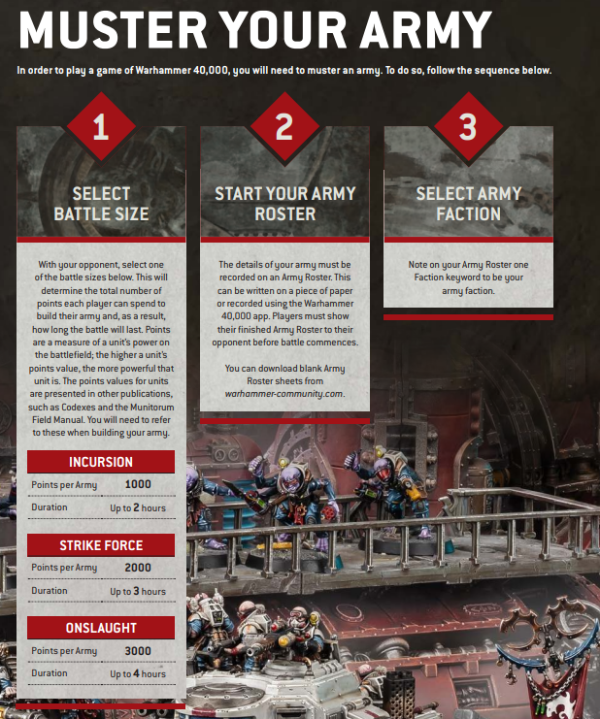
500 points does not appear on this page because it is not a playable game size. The book doesn't have to say that it ISN'T allowed. If the book doesn't say it IS allowed, that automatically means that it isn't, without anyone needing to be told.
Now, your point might be that nothing can stop me from house ruling a 500 point game if I can find an opponent willing to play, and IF that's your point, I 100% agree- in fact, I've done it.
BUT as the rules are written, the only place (to my knowledge) where the rules say you ARE allowed to play a 500 point game is in the Boarding Actions Supplement. Also possibly in White Dwarf special scenarios, and possibly some of the campaign books I don't own and can't check... Though I think missions across the entire range of products are described as Incursion, Strikeforce and Onslaught, which are clear references back to this core rule, which does not include 500 point games.
551
Post by: Hellebore
The first sentence says 'select one of the battle sizes below'.
None of those are 500 points, so the game is telling you you can only choose one of those 3 point levels to play. It's not an inference, it's an instruction to pick 1000, 2000, or 3000. Those are your only points level options the game offers to pick from.
39309
Post by: Jidmah
 CthuluIsSpy wrote: CthuluIsSpy wrote:Would Orks and Tyranids really care about sitting down on a point and holding it?
Would Craftworld Eldar really want risk their incredibly precious soldiers trying to defend territory when they are essentially a ship born civilization?
The missions just don't match their MO. Orks and nids wouldn't care about holding specific points on the map, they just want to kill and eat. CWE and DE wouldn't want to engage in static, defensive warfare because they don't have the manpower or gear to engage in such doctrine, and would rather deny the enemy such advantages by destroying them so they can move on and not waste time and soldiers.
The ork lore is weak in this one.
Orks are extremely possessive of things, and get into fights with their own to defend scrap, fuel or useful tech from other warbands. We have quotes of imperial commanders, tech priests, drukhari archons and even necrons who dread the thought of orks fortifying a defensible position because those fortifications can only be taken back at great costs. More often than not those costs are obliterating everything that was worth defending in the first place, because it's just that hard to remove,
In addition, if you start a fight to clear an objective, more orks will flock to that objective, just because there might be something worth fighting for. This behavior played a major role in the downfall of the ad mech forgeworld Hephaesto, where the Tech-Priest Dominus' carefully calculated feints backfired because his heavily defended positions didn't funnel the orks into apparently less defended choke points. Instead it caused more and more orks pile onto the well defended positions until they were overwhelmed.
Most members of other species struggle to understand ork logic, but orks are not irrational at all.
If you are interested in this, I suggest reading Da Big Dakka or finding the specific excerpt of the chapter online. There is a discussion where an Ork Warboss explains orks to a Drukhari Archon, obviously resulting in neither one understanding the other and then both assuming the other is stupid. Automatically Appended Next Post: PenitentJake wrote:500 points does not appear on this page because it is not a playable game size. The book doesn't have to say that it ISN'T allowed. If the book doesn't say it IS allowed, that automatically means that it isn't, without anyone needing to be told.
I'd like to point out that you are arguing semantics here.
And if we are arguing semantics already, a game of 500 points is just a game of incursion, just like a game of 1500 points is a game of strike force.
There is no rule requiring you to play the maximum amount of points possible for those battle sizes.
47547
Post by: CthuluIsSpy
Jidmah wrote: CthuluIsSpy wrote:Would Orks and Tyranids really care about sitting down on a point and holding it?
Would Craftworld Eldar really want risk their incredibly precious soldiers trying to defend territory when they are essentially a ship born civilization?
The missions just don't match their MO. Orks and nids wouldn't care about holding specific points on the map, they just want to kill and eat. CWE and DE wouldn't want to engage in static, defensive warfare because they don't have the manpower or gear to engage in such doctrine, and would rather deny the enemy such advantages by destroying them so they can move on and not waste time and soldiers.
The ork lore is weak in this one.
Orks are extremely possessive of things, and get into fights with their own to defend scrap, fuel or useful tech from other warbands. We have quotes of imperial commanders, tech priests, drukhari archons and even necrons who dread the thought of orks fortifying a defensible position because those fortifications can only be taken back at great costs. More often than not those costs are obliterating everything that was worth defending in the first place, because it's just that hard to remove,
In addition, if you start a fight to clear an objective, more orks will flock to that objective, just because there might be something worth fighting for. This behavior played a major role in the downfall of the ad mech forgeworld Hephaesto, where the Tech-Priest Dominus' carefully calculated feints backfired because his heavily defended positions didn't funnel the orks into apparently less defended choke points. Instead it caused more and more orks pile onto the well defended positions until they were overwhelmed.
Most members of other species struggle to understand ork logic, but orks are not irrational at all.
Heh, fair enough then.
That sounds really funny as a game rule too. Maybe something like orks getting bonus movement towards a contested objective.
39309
Post by: Jidmah
GW seems to think so, too. Some units, like lootas, already have rules related to this behavior and the most recent detachment they release is solely focused on fighting on objectives.
18249
Post by: Charax
Hellebore wrote:The first sentence says 'select one of the battle sizes below'.
None of those are 500 points, so the game is telling you you can only choose one of those 3 point levels to play. It's not an inference, it's an instruction to pick 1000, 2000, or 3000. Those are your only points level options the game offers to pick from.
So you read the "select one of the battle sizes below" part and then just kind of lost interest after that, drifted off, had a snack or something? because it's immediately followed by:
"This will determine the total number of points each player can spend to build their army"
CAN
Not MUST
No minimums are listed, so if you are playing at 500pts, or 750pts, or 999pts, then you can use the Incursion rules
I mean hell, you can play 500pt games using Onslaught rules if you really want to, because the game size is the total number of points you can spend, not the number of points you must spend.
47547
Post by: CthuluIsSpy
Jidmah wrote:GW seems to think so, too. Some units, like lootas, already have rules related to this behavior and the most recent detachment they release is solely focused on fighting on objectives.
Yeah, but having an entire army rushing B amuses me 
If Games Workshop were Russian, the Orks would be Gopniks and someone would have made them Bandits from Stalker by now.
23306
Post by: The_Real_Chris
I think it is worth at this point highlighting what a pitched battle is.
https://en.wikipedia.org/wiki/Pitched_battle
That is a battle both sides expect to fight. Very rare these days but rife in warhammer fiction. It isn't the same as a really big battle.
120048
Post by: PenitentJake
I'm happy one other Hellebore understands that rules function by telling you what you CAN do... Not by listing the thousands of things that you can't. When the rules say pick 1k, 2k or 3k, that is explicitly what is allowed by the rules.
Anything not explicitly allowed by the rules, by definition is forbidden. Therefore, by the rules AS WRITTEN, 500 point games using standard 40k rules (ie. not Boarding Action rules) are forbidden.
I have already acknowledged that we can easily ignore the prohibition, and I've admitted to doing so myself. That does not change the fact that doing so is against the rules AS WRITTEN. But a more salient point to the discussion at hand, is that SINCE GW has excluded 500 point games of standard 40k from their design, Incursion missions were created with the assumption that 1k forces would be used.
Contrasting this with 9th, there WERE missions in core books that were specifically designed for 500 point matches. It is THAT distinction, more than the exclusion of these battles from explicitly written rules, that matters. Because those missions specifically designed for 500 point matches were better for these small army/ subfaction lists.
A 9th edition Combat Patrol sized mission (ie. a Mission specifically designed for a 500 point game) was GREAT for an Inquisition force... Or any of the other forces that don't have a lot of units.
Could you find an 10th ed Incursion mission designed for 1k forces and play it with 500 point forces? Sure- absolutely. The rules don't say you can, so it's technically "not allowed," but that doesn't mean you can't do it... It just counts as houseruling if you do. Whether or not it will lead to a satisfying game is another question- the Mission isn't designed for 500 point games, so you might, for example, find that you have too few units to have a realistic chance to complete all of the listed objectives.
In 9th, you were less likely to be in that situation because there WERE missions designed specifically for 500 point games.
In 10th, the only Missions designed specifically for 500 point forces are Boarding Action missions... And the Boarding Action rules do limit some of the armies you might want to bring. When I play an Ordo Xenos Army, a pair of Inquisitors, each leading a 5 man DW Kill Team all packed into a Blackstar is a great little army... Even leaves me with 10 points for an Enhancement.
Ain't legal in Boarding Actions, and unlike 9th (or even 8th), there are no 10th edition 40k missions designed specifically for a battle that size, regardless of whether or not you agree that 500 point games of 40k aren't allowed by the rules as written.
I'll have to check my Boarding Actions book when I get home- I forget whether the Cavalry units in the Kroot army are allowed in Boarding Actions.
8725
Post by: Mad Doc Grotsnik
On relative raiding forces? Craftworld Eldar may well get themselves involved in a massive fight, because their objectives (ok, not so much in-game) are more esoteric.
Guided as they are by their Farseers, the whole intent may be to eliminate, or potentially preserve, a given individual foreseen to be the key to some coming disaster for the Craftworld.
So in a sense? They operate like the Astartes. Get in quickly, kill what needs killing and anyone else you think you can get away with, then get back out again.
So what we’re seeing on the board may be the totality of the Craftworld strike force, concentrated against a portion of an opponent’s far larger army.
Likewise Dark Eldar. We could argue that what we see are Raids gone a bit wrong, where the resistance was stronger than anticipated. Or, a calculated risk against a thornier foe to ensure the captives taken are combat trained, and so more interesting Arena Fodder than a bunch of farmers.
109034
Post by: Slipspace
PenitentJake wrote:I'm happy one other Hellebore understands that rules function by telling you what you CAN do... Not by listing the thousands of things that you can't. When the rules say pick 1k, 2k or 3k, that is explicitly what is allowed by the rules.
Anything not explicitly allowed by the rules, by definition is forbidden. Therefore, by the rules AS WRITTEN, 500 point games using standard 40k rules (ie. not Boarding Action rules) are forbidden.
As are 1500 point games, or 2250 point games? Seems like needlessly nit-picky semantics to me. According to your definition, anyone playing 1500 point games isn't actually playing 40k "properly".
When it comes to different versions of 40k for different size games, I think having 4 completely independent sets of rules is probably overkill. However, if the core 40k rules had more depth I could easily see a set of modified rules for different points values being a thing. We used to have Kill Team in the rulebook in earlier editions (5th? Maybe 4th?) and I could see a set of rules streamlined to work better at 3000 points being a useful addition. Four completely different sets of rules with different rulebooks, Codices, etc, would be a terrible idea though.
39309
Post by: Jidmah
Jake, your train of though would assume that an army of 1995 points is illegal to play in incursion. It's clearly not, therefore your entire argumentation falls apart.
120048
Post by: PenitentJake
Jidmah wrote:Jake, your train of though would assume that an army of 1995 points is illegal to play in incursion. It's clearly not, therefore your entire argumentation falls apart.
You are correct: this is the greatest weakness in the argument, and at this point, I'll concede. My most recent post was half-way there anyway: I'm not longer concerned about whether or not 500 games are forbidden due to a lack of explicit permission to use them. In fact, I even did a search on the Warcom site to find an article from 10th's release, and it DOES explicitly state that 500 point games ARE possible, undermining my initial argument even further. So yeah, abandonning ship.
However, the larger point, that 10th ed Incursion Missions are designed for 1k armies, not 500 point armies is still valid, and the Warcom Article mentioned above explicitly confirms that as well. I think if you look at each Incursion Mission, you can decide individually whether not it is as good a fit for a 500 point army as the 8th and 9th Missions that were specifically designed for armies of that size. I would imagine some work better than others.
87834
Post by: KingGarland
Jidmah wrote:
Orks are extremely possessive of things, and get into fights with their own to defend scrap, fuel or useful tech from other warbands. We have quotes of imperial commanders, tech priests, drukhari archons and even necrons who dread the thought of orks fortifying a defensible position because those fortifications can only be taken back at great costs. More often than not those costs are obliterating everything that was worth defending in the first place, because it's just that hard to remove,
In addition, if you start a fight to clear an objective, more orks will flock to that objective, just because there might be something worth fighting for. This behavior played a major role in the downfall of the ad mech forgeworld Hephaesto, where the Tech-Priest Dominus' carefully calculated feints backfired because his heavily defended positions didn't funnel the orks into apparently less defended choke points. Instead it caused more and more orks pile onto the well defended positions until they were overwhelmed.
Most members of other species struggle to understand ork logic, but orks are not irrational at all.
If you are interested in this, I suggest reading Da Big Dakka or finding the specific excerpt of the chapter online. There is a discussion where an Ork Warboss explains orks to a Drukhari Archon, obviously resulting in neither one understanding the other and then both assuming the other is stupid.
Also Orks are known to do things just because it will lead to a good fight. So if a Warboss understands that the Space Marines want to take a fort or something that Warboss is likely to hold on to it, even if he doesn't really care for it, just because he knows others will come a try to take it from him.
39309
Post by: Jidmah
Orks in general yes, a warboss much less so. Orks at warboss level are usually quite intelligent, often more so than imperial field commanders or low ranking space marines.
A warboss would most likely assume that just because the marines want it, it's worth holding onto. Giving the lads a good fight in the process is just the cherry on top.
Larger orks are often more concerned with their standing within an ork Waaagh!, how to keep potential rivals in check, or with getting the best loot. Throwing themselves into a fight without reason is quite unlikely, though the reason might be "got nothing better to do, might as well go fight something".
77922
Post by: Overread
I'd argue that a Warboss has a major interest in giving the lads a good fight.
See without a good scrap every now and then, orks fall into internal fighting. So a Warboss who doesn't provide ample fights for their horde will see it turn in on itself which could mean that they lose command.
OF course really smart Warbosses realise that they can do more than just seek out fights. They can engineer situations to result in favourable fights. Heck they've even saved favoured opponents so that their opponent can go away; rebuild and provide a fun fight later.
The more fights the bigger the waaagh grows
The bigger the waaagh the more fights it needs
Deliver and the waaagh grows; fail to deliver and it shatters.
551
Post by: Hellebore
Charax wrote: Hellebore wrote:The first sentence says 'select one of the battle sizes below'.
None of those are 500 points, so the game is telling you you can only choose one of those 3 point levels to play. It's not an inference, it's an instruction to pick 1000, 2000, or 3000. Those are your only points level options the game offers to pick from.
So you read the "select one of the battle sizes below" part and then just kind of lost interest after that, drifted off, had a snack or something? because it's immediately followed by:
"This will determine the total number of points each player can spend to build their army"
CAN
Not MUST
No minimums are listed, so if you are playing at 500pts, or 750pts, or 999pts, then you can use the Incursion rules
I mean hell, you can play 500pt games using Onslaught rules if you really want to, because the game size is the total number of points you can spend, not the number of points you must spend.
I have no dog in this fight, I was merely pointing out what the rules say.
I would say Can is being used as 'is allowed' to spend in order to avoid exactly the issue brought up about not having exactly 2000pt armies. That's deliberately legal language to prevent arguments over having 1995pts being illegal.
Ive no issue with it being used to evidence different points maximums for armies, but I will say the single use of can to open up what is otherwise pretty clearly written to describe the flat numbers emphasised in the graphics is about as poor a way to provide players that instruction as you can get, which is at odds with the legalese and nit picky way in which gw writes their rules these days.
I can't think of another rule in the game that would rest on the use of a single word to allow you to do something other than what they've specified in everything around that one word.
Maybe that's what it's for but I'd vote it as the absolute worst rules implementation in this edition. They could have written 1-1000, 1001-2000 and 2001-3000 to explicitly say this in a way that doesn't rely on the use of a single word without changing the graphics design at all.
The fixed battle sizes to me match their fixed unit costs in design aesthetics so it doesn't see at all odd.
39309
Post by: Jidmah
Overread wrote:I'd argue that a Warboss has a major interest in giving the lads a good fight.
See without a good scrap every now and then, orks fall into internal fighting. So a Warboss who doesn't provide ample fights for their horde will see it turn in on itself which could mean that they lose command.
OF course really smart Warbosses realise that they can do more than just seek out fights. They can engineer situations to result in favourable fights. Heck they've even saved favoured opponents so that their opponent can go away; rebuild and provide a fun fight later.
That's just a regular warboss, they are way more intelligent than imperial propaganda gives them credit for. There is a reason why the Deathwatch keeps tabs on all the Waaagh!s out there.
A really smart warboss like Thrakka, Badrukk or Ufthak makes multi-stage long-term plans AND has the ability to make the other orks actually follow those plans.
Deliver and the waaagh grows; fail to deliver and it shatters.
It has been described to be more of a "fail to deliver, and someone might backstab you because they think they would make a better boss". These kind of back-stabbings than often result in mass front-stabbings because a bunch of nobz who were kept in check by one big boss suddenly think they should be the boss. Also more back-stabbings if bloodaxes are involved.
The novel "warboss" does a great job at describing what happens when the big boss sudden has a gargant's head dropped on it.
61850
Post by: Apple fox
There is comando orks, so ork tactics are quite advanced when needed to be.
47547
Post by: CthuluIsSpy
Aren't Kommandos looked down on though for being too sneaky? I remember reading in the 4th ed codex that Kommandos are seen as kind of odd by most orks for wanting to use stealth first.
8725
Post by: Mad Doc Grotsnik
Orks are a weird one like that.
Yes, on the whole they’re predictable and can be baited. But, they’re also wildly unpredictable. You can’t really cover all possible Orky Tactics, because they fight largely from instinct. But they also adapt rapidly to new ways of fighting demonstrated by their foes.
Kommandos work because standard doctrine says Orks don’t do sneak attacks.
I’ve previously speculated such Orky specialists are just particularly niche Oddboyz. Not as generally useful and essential to Orky Kultur as Doks, Meks and Runtherdz etc. But still an expression of Ork Society’s Self Sufficient Programming. A way to provide specialist troops so when specialist troops are Just The Ticket, there they are, ready to go. Even if their specialism is something most Orks find distasteful.
101163
Post by: Tyel
I'm a bit confused as to where the various strands of argument in the thread are going.
I guess to be objectionable, I'd ward against this idea that Space Marines and Eldar etc are somehow special, and that all games need to accommodate for this.
I mean yes, neither faction probably should fight a conventional trench fight engagement where thousands of guys are hurled into a meat grinder. (Although its equally easy to come up with scenarios where they'd do precisely that). Both should be launching some lightning assault to seize a strong point, assassinate a leader or hold a point while some wider strategic maneuver is taking place. But this effectively makes Marines and Eldar the "real armies", while other factions are NPCs that blunder around being maneuvered on. Which I'd contend isn't exactly fun in a two player game.
Its in turn why people hate move-shoot-move. You may think its the high point of skill - and indeed arguably it is. For your opponent however its just an exercise in frustration. If you "play well", they don't get to play at all. Which is fine versus a computer which doesn't have feelings (for now), but not so much a human player.
8725
Post by: Mad Doc Grotsnik
But it does suit them thematically if you view the game itself as part of a wider engagement. Then, the smaller, highly specialised forces are on a highly specific mission.
For Marines, it’s the old pressure point shtick. Their actions in-game can be translated as creating a gap in the enemy line for others to follow up, decapitation of enemy high command (however localised) and so on.
Of course, this isn’t necessarily matched by the actual missions. Which is a different issue. Or is it? I’m really not sure.
For the theatre of my mind’s eye, I’d prefer objectives to be something more than “just that spot there”. It should represent something tangible. An asset to be seized, a tool to be dismantled etc.
|
|


