Welcome, R-Oak. Preliminary research never goes amiss, so hopefully we can fill in the blanks for you.
1) Easy, but important.

2) I've used Krylon Indoor/Outdoor primer and have no complaints. Follow the instructions and it should treat you well. As for color... The model is predominantly brown, so starting with a brown spray will certainly save you time, if that's a factor (less common for a skirmish-scale game). In doing so, though, you won't be able to use the two-tone priming method ("zenithal highlighting" of the undercoat, effectively). If these are truly your first models, I might suggest starting from black primer (since it's a dark color scheme - white is better for bright, vivid schemes). While grey and colored primers are gaining traction, most of us start with straight black and/or white. You'll find more advice and tutorials working from black and a broader range of painters will be able to help you troubleshoot issues if you start on common ground. There's also the issue of the zenithal priming requiring translucent overcoats to show through. Paint thinning takes practice, so, as cool as the technique is, you may have issues with evenness of coverage and opacity control, just starting out.
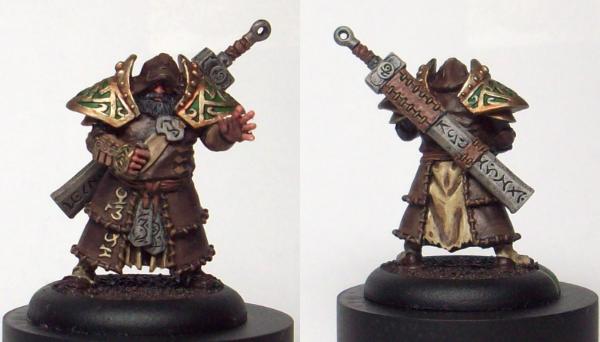
3) I'd recommend both... and more. Believe me, you'll use them. Looking at the model you posted, I can see what I would assume to be black (sword), brown (definitely cloth, almost definitely leather), and red-brown (gold (on the first model - second uses green) and flesh) washes. Washes are generally regarded as "liquid talent" for beginners and maintain their usefulness, even for experienced painters. Generally speaking, black and brown are probably the most useful, though.
4) I've never worked on WarmaHordes models, so I don't know if they use slotted ("slotta" in common/
GW parlance) bases. Regardless, attaching painted models to separately painted bases is quite common. Generally, the process involves pinning (drilling matching holes in the foot and base, then bridging them with a glued-in length of wire/brass rod/paperclip to mechanically assist the adhesive bond), if the model wasn't designed to slot into a base directly. Whether the model was attached to the initial base via a slot or pinning, it definitely possible to remove it and change out the basing. There's a potential for damage to the original base, but it would take a very crude job to pose much risk to the model, itself.