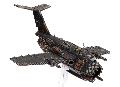
Review:
The book in terms of plot revolves around the prelude and actual Battle of Dûriel (known to humans as Valedor), which is detailed in the Eldar Codex and Iyanden supplement. While the broad outlines of the plot and its eventual outcome therefore are known, the details are not and this is what is fleshed out.
There are multiple POV in the book, some major and some minor. The major ones are Yriel, Farseer Taec Silvereye, Spiritseer Iyanna Arienal, and a male Eldar named Ariadien who has a female twin. Lelith Hesperax makes a cameo but as a whole hers is a minor role despite some parts being from her POV. There is also a cameo by a Solitaire from the
Path of the Eldar books by Gavin Thorpe. The Phoenix Lords make a cameo but their introduction appears rushed and not much is shown about them beyond their initial intro.
As an author Guy Haley certainly is more eloquent with his words and vocabulary than Gavin Thorpe or Andy Chambers. At times skirting into purple prose, Guy nonetheless arguably portrays the elaborate Craftworld Eldar society better than the more dry prose of Gavin Thorpe. However other sentences in the book are notable for their relative terseness as if they were written in a hurry or with no attempt at a smoother transition.
The more interesting points of the book are actually the earlier stages depicting the societies of Iyanden and Biel-Tan and the Harlequins, rather than the latter half which is more about the battle, and which I found tended to drag.
Overall Guy did do most of his research. The two areas of background weakness which I spotted were the space fleets/battles and the numbers/scale. Yriel's flagship was portrayed as a Void Stalker instead of a Dragonship, and Eldar ships were shown with shields that flash, like void shields. Also there was description of broadsides being fired, which again from
BFG background is inaccurate, and there is an example given of a cruiser scale warship descending into the atmosphere, to the point of landing or low enough to where Revenants can jump aboard (
BFG states nothing bigger than escort size can land without being destroyed). The issue of scale pertains the the size of the armies deployed. Iyanden's living armies deployed to the battle was explicitly totaled to be 4900, and this was supposed to be 2/3 of all of Iyanden's remaining living armed forces. This would mean Iyanden as of 999.M41 would only be able to field the ridiculously small number of 7,350 living Eldar combatants. Later, they re-implant a quarter of the ghost warriors back into the Infinity Circuit and these number 800, meaning 3,200 dead sent on the expedition. That is a grand total of 7,100 total living and dead Iyanden Eldar participating in the battle. In other words, less than a
single Imperial Guard regiment if we use the example of Creed's Cadian 8th as a standard.
Iyanden was described in previous
GW sources as losing 4/5 of its population and in the novel as 70% of its population. Using the 70% as an example, by proportion, this would mean pre-Kraken Iyanden could field only 24,500 Eldar, which is still ridiculously tiny given Iyanden was supposed to be the largest of the major Craftworlds. This is also in conflict with the Iyanden Supplement which states billions of Eldar died to the Kraken attack. A pre-Kraken Iyanden of billions of Eldar only fielding a few tens of thousands of combatants? The scenes and descriptions of apocalyptic warfare and the massive weeping and mourning contrast with then the low casualty numbers. Even billions for Iyanden would be a tiny amount and still in keeping with the Eldar as a dying race considering how vast the galaxy is and the teeming quadrillions of the Imperium (see my estimate below of Imperial population):
Iracundus wrote:Actually we do have some data that allows for estimation.
The Hive Worlds of the Imperium are classed as having upper limit population of 500 billion (3rd edition
40K rulebook, p. 114). The 5th edition rulebook on p. 115 estimates there to be 3.238 * 10^4 or 32,380 hive worlds in the Imperium. If all 1,000,000 worlds of the Imperium were hive worlds with 500 billion people that is 5 * 10^17. That is an UPPER limit for the Imperium's population because we know that not all worlds are maximum population hive worlds.
Minea from that page in the 5th edition rulebook is described as a typical example of a hive world, and it has 154 billion population, well under the 500 billion maximum. Assume we are still generous and give all hive worlds a population of 250 billion to account for less populated worlds elsewhere in the Imperium. 32,380 hive worlds of 250 billion population each is 8.095 * 10^15.
That is more than "500 trillion" for the hive worlds alone.
In other words, this novel suffers from
http://tvtropes.org/pmwiki/pmwiki.php/Main/SciFiWritersHaveNoSenseOfScale
The ending is partly lifted straight from the Iyanden Supplement, with some slight modification. There seems to be a loose thread with the Biel-Tan Autarch and Iyanna, either as lead-in to sequel or just dangling. There is an awkward friendship/platonic romance between Iyanna and her Exarch Wraithlord (itself an anomaly if one knows standard Eldar background since Wraithlords are normally drawn from the Infinity Circuit, and Exarchs are not in there). Iyanna's behavior with her Wraithlord contrasts with her behavior towards everyone else, and while this might have been the intent, the execution of this could have been better.
Overall though, this was still an entertaining and worthwhile read mostly for the new elements it introduced or expanded upon with the Eldar. It shows that Black Library's old "no xenos books or stories ever" policy is truly a thing of the past. The actual collation of the expanded Eldar background will be in posts below, sorted by category.
Automatically Appended Next Post:
General Eldar
The pre-Fall Eldar language was "indulgently phrased and sensuous" and these were features that had been deliberately cut away with the adoption of the Path system in order to save the speakers from temptation.
Aside from the Craftworld Eldar, Dark Eldar, Exodites, Corsairs, there is a passing reference to other communities that never adopted the Path or abandoned it.
The Iyanden Eldar find a destroyed and abandoned port-city in the webway built into a nexus in the Webway tunnels. The nexus is as wide as a planet's orbit from its sun, and the city is built like a ringworld.
Some port-cities were even built post-Fall.
Pre-Fall, all Eldar could commune with each other mentally without any special training. Post-Fall, only Eldar twins or triplets do so naturally. Everyone else needs machine shielding or training on the Path of the Seer to do so safely.
Iyanden:
Roughly kite-shaped.
The walls of the Fortress of the Red Moon are carnelian colored.
The various Houses of Iyanden are more like mini-countries. House Haladesh for example is shown as having multiple cities (since it has a "main city" of Urhaithanalish there must be non-main cities), and multiple domes.
Post-Kraken, there are so many empty homes though that an Eldar could pick a palace for themselves if they chose but the Iyanden Eldar have tended to huddle together in more densely packed settlements in order to be closer to living Eldar and to preserve the illusion of life going on as before. This results in some areas being sort of like how they were before the attack, while others are deserted. More Eldar however have taken up "escapist" Paths like that of Mourning, Solitude, Wandering, Lament, Eulogy, Forgetting, Remembrance, Dreaming. The Path of Solitude seems to mean they retreat to live in a tent by themselves and some Iyanden Eldar do that in a desert dome.
Iyanden's Chamber of Autarchs is dimly lit and soberly appointed, in acknowledgement of the bleak realities of warfare and the effect on the Eldar mind. This is contrasted with Biel-Tan's Chamber of Autarchs.
After creating enough wraithbone, Iyanden's bonesingers shape it into a Wraithguard. This takes a tenth-cycle (i.e. roughly an hour as a cycle is about a day). Then those on Vaul's Path on the sub-branches of weaponsmith and pseudo-life add the finishing touches and this takes another half tenth-cycle. Then finally Iyanna inserts the spirit stone (which fits into the head). So it takes roughly 1.5 tenth-cycles to make a new Wraithguard from scratch, though the number of workers is not stated.
Kelmon believes the Eldar gods and the souls of every Eldar ever consumed by Slaanesh since the Fall live on within Slaanesh, and wait to break free. Kelmon believes Ynnead will do this.
A certain Farseer at the moment of death and right before he is consumed by Slaanesh, looks far into the future to see what happens to the Eldar race and what he sees makes him joyful. This suggests the Eldar hope for a renewal of their race and empire might not be a total pipe dream.
Iyanna's Fire Dragon Exarch Wraithlord became Wraithlord due to his shrine and armor being utterly destroyed by the attack that also destroyed House Arienal. Iyanden's communal memory preserves every detail of the shrine and the volcanic habitat of its dome, so the bonesingers rebuild it. The book shows an early stage of rebuilding where it is little more than an empty dome and the central shrine ziggurat. Later it is finished, and there have been sharp volcanic rocks and cliffs added, hot steaming mudholes, and dangerous basilisk creatures re-created from stored biological databanks. The Exarch's armor is re-created.
A Wraithlord's animating spirit (or spirits in the case of Iyanna's Exarch Wraithlord) is housed in the head. The head can split open along its long axis and has multi-layered armor with some being ablative gels.
Biel-Tan
More dart-shaped compared to Iyanden and has a symmetrical swallow tail shaped stern.
The weapons on its fortresses are not concealed unlike those of other craftworlds.
In the Webway, just before going through Biel-Tan's stern Webway gate into realspace above Biel-Tan, there is a nexus called the Nexus of Remembered Supremacy To Be Regained. There is a monolithic gateway with hidden weapon emplacements and a statue of Khaine and Asuryan on either side. Asuryan holds a pair of scales that are off-balance, and it is said that they move, and that when they are level again the time will be right for the Eldar to reclaim their empire. In the time of the story, the balance is askew.
The Iyanden Eldar view the Biel-Tan Eldar as regimented and militaristic and note that the Biel-Tan all dress alike in green and white with often thorn patterns as opposed to more individualistic Eldar clothing on other craftworlds. They similarly think Biel-Tan architecture is conformist, with a preference for symmetry.
Biel-Tan's Dome of Crystal Seers is a series of 23 interconnected habitats forming a series of gardens and lakes. Scattered through them are the crystal forms of past Farseers.
Biel-Tan has an immense avenue running just over half its length called Avenue of Lost Glories Remembered (noticing a trend in Biel-Tan naming). Described as 500 paces wide and 3,000 high with galleries and open walkways on either side. The supporting wraithbone pillars shaped like trees with interlinking branches forming the roof. Plants and trees grow in pots and along the sides of the galleries forming a vertical garden, and aerial creatures nest in them.
Biel-Tan's Chamber of Autarchs is celebratory with an overhead crystal mosaic forming Khaine's roaring face and walls with bas-reliefs of victories or trophies of lesser races. This is contrasted with Iyanden's Chamber of Autarchs.
Biel-Tan has nearly 20 Autarchs at the time of the story.
Harlequins
Above the level of Troupe is Great Troupe, and the greatest of the Great Harlequins are called Harlequin King.
While waiting with a Halequin King, Lelith Hesperax wonders whether she can take a Harlequin King on in combat. She suspects he might be one of the few individuals in the galaxy able to beat her. She catches his gaze while thinking this and he seems to know what she is thinking and wags a warning finger, shaking his head slowly. Lelith actually fears a small rush of fear, but finds this exciting.
The Harlequins know of secret passages in the Webway that Craftworld Eldar and Dark Eldar do not know and cannot sense. A Shadowseer opens one, seemingly stepping through a wall of the Webway. The passage is barely taller than an Eldar and narrow enough that elbows brush the walls.
A Farseer asks why the Harlequins do not share this knowledge as it may help drive the Eldar kindreds closer together. The Shadowseer says it may also drive them apart and that the Harlequins guard this knowledge from other Eldar until maybe a strong new generation of Eldar and the time of renewal is upon them.
The Harlequin Troupe (or is it Great Troupe?) dance the Dance Without End. Unlike the traditional ending (see past
WD for description), this time they add a new act. The new act depicts the Laughing God distracting Slaanesh while Ynnead (shown in book as goddess and referred to always as female) grows and awakes. End scene of Slaanesh triumphantly tripping the Laughing God and about to deliver final blow but then Laughing God pointing and laughing at the awakened Ynnead advancing from behind upon Slaanesh, who turns and shows fear.