|
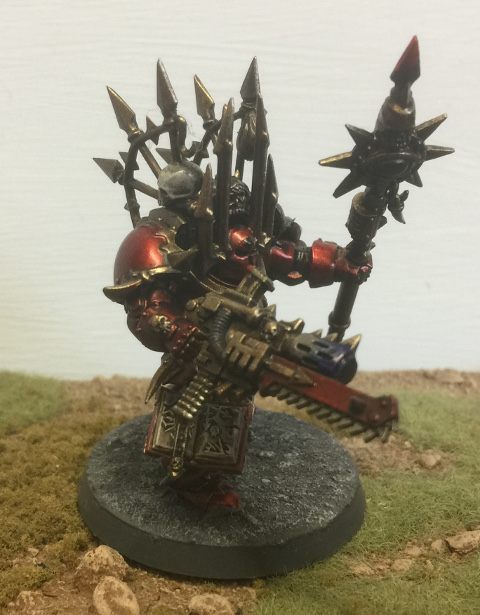
I think they're pretty good, but I personally prefer the Vallejo texture paste. In the past, I've been experimenting with the acrylic texture pastes you can buy in art stores, which you typically paint over, but for the purpose of basing miniatures, I've found that the Vallejo texture paste to be really good.
Lately I've been using the Vallejo Dark Earth paste, which is really easy to apply, unlike Stirland Mud and Stirland Battlemire, which are typically slightly viscous and often difficult to work with.
I was planning to use the Dark Earth paste as it was, but I found I preferred painting over it with a dark brown paint (Vallejo 70.872) and drybrush the surface with two lighter brown shades (70.874 and 70.819), then washing it brown. I suppose I could have used a colourless, white paste, since I'm just painting it anyway, but I didn't know that at the time when I purchased the 200 ml container.
Painting it has the benefit that I can mix in a variety of small stones and grit, to make the surface uneven and varied but with a uniform texture, like lumps of dirt and mud coated stones. I also pick out the most prominent stones in a contrasting grey colour (70.830), highlighted with a nearly white grey (70.883), to imitate granite or basalt. I would have used different colours if I was going to imitate sandstone.
To answer your question, it really depends on the theatre you want to portray, like Vraks or Mars or Italy in WW2, and the scale of your miniatures. Smaller scales like 15 mm looks better with a fine grain texture paint, or the miniatures will look like they're standing in brown gravel.
As for the base surface, I prefer it looking at least slightly different than the models. I had an IG army once that I painted grey, standing on grey gravel bases, and it really didn't look good when viewed at a metres distance. Grey is not an easy colour to work with. As a rule I try to make the colours of hard surfaces and the ground less saturated than the models that are supposed to look alive.
|


 374th Mechanized 195pts