I'm new here and I wanted to ask some things about 8th edition. My primary focus in this hobby always was painting the models I liked and reading the backstory, which I really love for the most part. I've dabbled with gaming in earlier editions, but never played a lot. I was however always interested in how the rules of the editions evolved and changed. The first rulebook I got and the first codices I collected were 3rd edition all those years ago.
Now 8th edition has come along and some of my closest friends and I decided to get into actually playing the game more frequently instead of only collecting and painting stuff here and there. So I wanted to ask how you like 8th edition so far and what things you might not like.
Also, since I have somewhat caught up to the rules of 8th, I wanted to bring up some things about it that I have some reservations about and wanted to ask your opinion on those points. 8th edition has obviously been streamlined quite a bit compared to previous editions, which makes it easier for new and returning players to pick up the game. This is a good thing generally in my opinion, but games workshop might have overcorrected a little bit with simplifying things (surely not as bad as Age of Sigmar but lets not get into that...).
Like I said in the beginning the fluff in 40k is really important to me and I like to see that fluff represented on the tabletop, at least in some parts and some changes in 8th really dont make sense in that regard, at least in my opinion. What kinda bothers me in 8th is the removal of the specific weapon- and ballisticskill values for a unit, as well as the removal of initiative values.
The introduction of to-hit values from 2+ to 6 make things easier, no doubt about that, but the in game comparison between different units suffers fluff-wise from this. What I mean by that is, that a normal guardsman should not hit an ork and a freakin bloodthirster on the same value. It makes no sense fluff wise and it sort of devalues elite units.
Which brings me to my next point. The lethality of the game as it is now is quite staggering. The maybe then time consuming higher complexity of earlier editions was replaced by the time consuming act of rolling and rerolling a million dice every shooting phase. The "everything can wound everything" rule is not a bad idea in principle in my opinion, but not in its current form.
Since Games Workshop most likely will not revert the unit statlines to those of earlier edition, I nonetheless think that you could make things more interesting and immersive if you gave units more special rules that represent the fluff in some subtle way. Like giving a unit that is known for its combat ability in melee some sort of melee overwatch when they are charged or have them block incoming attacks on 6s. I am not a game designer so those suggestions probably suck balancewise, but you get my point.
Most of the issues you described were present in earlier editions to one degree or another.
On specific WS/BS values: BS above 5 (2+) was effectively nonexistent, and when it did exist there were to-hit rerolls from other sources that rendered it irrelevant (ex. 30k (7th edition rules) Custodians have BS5 vehicles with twin-linked weapons, which are effectively BS10 since they hit on 2+ and reroll failures). Similarly the WS stat-comparison table had some nonsensical holes, namely that same Bloodthirster could never manage to hit those same Guardsmen on anything better than a 3+ no matter how hard he tried. The irrational bits where the rules break with the fluff have been moved around rather than added with respect to those.
On lethality: The issue isn't usually everything-can-wound-everything; worst-case attacks like lasguns shooting Land Raiders might get a wound through if they're lucky. The lethality of this edition comes with overly-efficient crossover weapons that have moderately high stats in all of rate of fire/S/AP/damage and can be spammed as an effective tool against all targets; battle cannons, plasma weapons, Knight guns, etc. However it is worth noting that this is a problem that's been around since at least 5e brought psybolt autocannons and psycannons to the table, it isn't a new one. In some ways 8e is less lethal than earlier editions; Guardsmen get their saves more often, cover improves armour rather than giving you a fallback if your armour doesn't work, and vehicles get saves against more attacks.
Rolling and rerolling a million dice is still a problem, but if that bugs you I find avoiding pure Guard armies and playing games at around 1,000pts does avoid it reasonably well.
As to adding more special rules I have to disagree; I find a lot of problems with 40k emerge from GW trying to make everything obviously unique instead of subtly unique. Their decision to drop universal keywords in favour of writing more unique rules on everyone's datasheets may have made units more unique but it also makes it a lot harder to know what everyone's stuff does, a lot easier to get blindsided by a rule you didn't know was there, and a lot easier to have missed the one-sentence tweak that changes the meaning of the whole thing in amongst the mountains of FAQs required for all the unique special rules. It's not a problem of balance as much as it is one of making the game usable/playable without legal counsel.
I do not think strategems were a good idea. The command point rerolls and such in the main book were fine, but the quality of strategems is so widely varied that it just guaranteed balance issues.
Also, I really like alternating activations and GW needs to find a way to get them into regular 40k.
I really don't like 8th. I dislike the lack of WS/BS, I find stratagems a bit silly in how you can just magic up something different, Initiative needs to return.and mortal wounds are a bit awful in my opinion and I could go on about the many things I dislike.
But with all that aside it's still an alright game, just not my cup of tea and it does seem I'm a minority in disliking it so much.
Disclaimer: I enjoyed 2nd edition and quit after 3rd/4th just became dull. Checked back in around 7th and saw it was still the same (but getting worse), and only returned via 8th.
What you see in 8th is largely derived from AoS, the concentration being on easier rules (the game is just as complicated but it's now been shifted to other parts of the game instead of the core rules) and killing more units = more models on the table. The interest in a quality tabletop game hasn't existed probably since 2nd (when the company was run by geeks and was nearly bankrupt). 3rd was dumbed down incredibly in order to attract sales, push more models and make entering the game easier/faster.
3rd through 7th was the same skeleton under all of the editions and none of it was particularly good.
8th has a better and more solid core...but is already a victim of its bloat and very poor subsequent rules writing in codices, etc. The rules benefit bodies more than ever before. It's a fundamental problem of the game if you ask me. You mentioned fluff, but we can skip that - I've never seen 40K represent the fluff accurately in over 20 years. Ditch that expectation.
Tactical game play (which in reality has never been strong in any edition of 40K) has been replaced with Strategic game play. In essence your maneuvering to shoot a tank in the back, has now been transformed into combining a stratagem with a particular unit within a certain range to create a special effect. So the thought is there still, but just a different type. It's not any less "deep" as people like to insist. If anything the card-game style combos require more thought and planning than most of the editions of 40K.
Is that good? Eh. Up to you. While I enjoyed 8th at the start, the rules have gone full slow now and I'm enjoying it less and less. It's become bloated and produces some things which are laughably pointless in a table top game. You will not find another game in the world where you can generate 200-300 dice rolls for a single unit (in one friggin' attack!). The sexy and sleek core of 8th we enjoyed in the early days of Index 40K (which had its own flaws) are now simply stepping into the absurd. This wildly exaggerated bizarro land of 40K makes it very tough for gamers to meet up and play a like-minded game. The gulf between a weak and strong list has probably never been this present. That's a design flaw.
On the plus side...GW is selling a bajillion models and raking in the dough. So you'll never struggle to find a game and you'll have loads of cool new models to play with. I'll continue to play 8th with my buddies but I'm no longer following 40K forward. I will not be replacing armies, buying new armies, etc. I can have a lot of fun with 8th (it is the most narrative-friendly version they've done since 2nd), but the plot has been lost.
I won't play 8th. I dislike nearly everything about the edition: IGOUGO, fixed to-hit rolls, instead of USRS they gave units "bespoke" special rules that are really just slight tweaks under different names to maybe a dozen mechanics, and "everything can hit everything" doesn't make sense/breaks immersion in a game with such a wide variety of units. The reliance on increasing or decreasing an existing stat, allowing a unit to take a basic action an extra time, random shots and random damage as core gameplay elements just aren't fun. I like choice-based rulesets with a high degree of player agency.
I have to ask Blastaar...from what you said, why have you played any edition of 40K? 8th edition is not "that" different from any other edition of the game. You sound like you're just whinging to whinge? Do you have anything constructive to add?
I ultimately find 8th to be tactically void and instead relies on stratagems and buff auras to give the illusion of depth. Games of 8th (win or lose) are just boring and it feels like a step or two away from just mashing toy figures together until one side has all their guys knocked over. GW sucked the soul out of the game in the name of balance and we are left with a blank husk of a game.
8th edition is a bad game that only looks good in comparison to the unplayable disaster of 7th. IGOUGO still exists, terrain is a joke, positioning and movement are devalued, poorly skilled children are pandered to at every opportunity, excessive randomness is everywhere, dice optimization in list construction is by far the most important factor in who wins, soup has destroyed any concept of faction identity, and the CP/stratagem mechanic makes the game into even more of a CCG with really expensive "cards". In short, 8th edition has the strategic depth of a puddle while simultaneously having a higher word count than several other games combined.
Automatically Appended Next Post:
Elbows wrote: Van, similar question - what edition of 40K did you find tactically amazing? I'm curious.
5th edition was not the deepest game ever but it was still much better. Things like vehicle facings/arcs, only troops being able to score objectives, more LOS blocking terrain, and harsher penalties for mistakes made 5th edition a game with more interesting strategic choices. 8th edition plays much more like a CCG where you line up all of your "cards" and exchange attacks until someone runs out of HP.
There is good and bad in 8th, at the start it felt more "balanced" than 7thm, but now it feels like we are moving more and more towards the mess that 7th was (looking at you Vigilus).
Things that bug me is as other people stated the difference in Stratagems. Some are just to good to avoid and others are never used.
Same with "<chapter>" traits, why take Dark Creed when Prophets of Flesh have all the good stuff?
Then we have the issue that armies gain the "traits" for all units except Marines sine the "traits" don't work on vehicles.
Even worse I would say are the relics. Some armies have relics like a pistols that deal 2D or items that gives +movement/fly and then we have knight relics that gives all weapons +1D (+2D vs titanic) or Cawls Wrath wich is a +1d +1d super plasma, these relics all cost 0/1/3cp... How can you even compare them?!
Re-rolls are all over the place. Add to this with most good ranged units having BS3+ with buffs to hit like spells/auras/etc some units could just skip the to hit rolls. Then its the same thing once again with the wound rolls.
But for my biggest issue in 8th it must be random shots and random damage.
Take for exampe 2d6 shots, 2 shots or 12 shots is night and day. To many games go so far that win of defeat hinges on you rolling high.
Add to that random damage like d6, making it so four lascannons have the same odds to either outright kill a Knight or deal a wooping 4 damage.
Sure it is a dice game and good rolls are important, but when things like damage and number of shoots (something that have nothing to do with skill or planning) can solely make or break a game its becomes a big issue since it adds way to much randomness.
How do you even determine the point value for 2d6 shots?, adding that some units can reroll the amount of shots (tank commanders) wich suddenly make the price screwed in their favor.
I would like to se a drop in wounds, removal of everything can wound everything and more flat damage/shots.
No more or atleast less aura re-rolls, make it more like Necrons where your Characters select a unit and buff them for that turn.
I felt that in 4th and 5th edition of 40K a game could swing either way each turn, with games often going to the final turn and being generally pretty fun and exciting with a few exceptions.
With 8th, pretty much every game I've played of this edition has been decided by the end of turn two. There is no back and forth. First player has a very distinct advantage due to the increased lethality of all armies in the game. You no longer bring an 'all-comers' list; you simply spam the best thing in your favorite three armies and hope that you can deal more damage over two turns than the other player that has the same game plan.
That said, 8th is great for non-competitive play where youre just throwing dice with friends and everyone can police themselves not to bring the ultra-competitive lists and have a good time. If you fall into that category, you'll probably enjoy your time in 8th edition!
Blastaar wrote: I won't play 8th. I dislike nearly everything about the edition: IGOUGO, fixed to-hit rolls, instead of USRS they gave units "bespoke" special rules that are really just slight tweaks under different names to maybe a dozen mechanics, and "everything can hit everything" doesn't make sense/breaks immersion in a game with such a wide variety of units. The reliance on increasing or decreasing an existing stat, allowing a unit to take a basic action an extra time, random shots and random damage as core gameplay elements just aren't fun. I like choice-based rulesets with a high degree of player agency.
All the stuff you named is the reason why I have been spending money on this game like made and having more fun this edition than all other editions previous. 8th is amazing! Best iteration of the game in its entire history!
I've pretty much completely lost interest in 8th edition. There is a lot I could say about it, and most of my criticisms have already been posted, but most of all I just find it to be boring. I occasionally play it, when someone asks me to, but I always kinda regret it by turn 2 and wish we were doing something else.
One the flip side, it got me into Horus Heresy and I've been having an amazing time playing and building my army for it. It's honestly my favorite version of Warhammer, though I've only been playing since 6th edition.
AnomanderRake wrote: Most of the issues you described were present in earlier editions to one degree or another.
On specific WS/BS values: BS above 5 (2+) was effectively nonexistent, and when it did exist there were to-hit rerolls from other sources that rendered it irrelevant (ex. 30k (7th edition rules) Custodians have BS5 vehicles with twin-linked weapons, which are effectively BS10 since they hit on 2+ and reroll failures). Similarly the WS stat-comparison table had some nonsensical holes, namely that same Bloodthirster could never manage to hit those same Guardsmen on anything better than a 3+ no matter how hard he tried. The irrational bits where the rules break with the fluff have been moved around rather than added with respect to those.
On lethality: The issue isn't usually everything-can-wound-everything; worst-case attacks like lasguns shooting Land Raiders might get a wound through if they're lucky. The lethality of this edition comes with overly-efficient crossover weapons that have moderately high stats in all of rate of fire/S/AP/damage and can be spammed as an effective tool against all targets; battle cannons, plasma weapons, Knight guns, etc. However it is worth noting that this is a problem that's been around since at least 5e brought psybolt autocannons and psycannons to the table, it isn't a new one. In some ways 8e is less lethal than earlier editions; Guardsmen get their saves more often, cover improves armour rather than giving you a fallback if your armour doesn't work, and vehicles get saves against more attacks.
Rolling and rerolling a million dice is still a problem, but if that bugs you I find avoiding pure Guard armies and playing games at around 1,000pts does avoid it reasonably well.
As to adding more special rules I have to disagree; I find a lot of problems with 40k emerge from GW trying to make everything obviously unique instead of subtly unique. Their decision to drop universal keywords in favour of writing more unique rules on everyone's datasheets may have made units more unique but it also makes it a lot harder to know what everyone's stuff does, a lot easier to get blindsided by a rule you didn't know was there, and a lot easier to have missed the one-sentence tweak that changes the meaning of the whole thing in amongst the mountains of FAQs required for all the unique special rules. It's not a problem of balance as much as it is one of making the game usable/playable without legal counsel.
I completely agree with you on the WS/BS values on earlier editions, but I also said I think GW overcorrected with 8th. I think the removal of the values was not a good idea because you could have expanded the old table so units could hit on 2+. I agree that in previous edition the comparison between WS of two units in combat did not make a big enough difference, but they could have tweaked the old system a little instead of just flat out removing it. You mentioned the custodes, who represent the best humanity can field in the fluff. So for example make a new WS comparison table and give them WS6 and BS5 for example, so on the new table they would hit WS3 on 2+ and WS4 on 3+....so they would wound a guardsman on 2+ and a space marine on 3+ which kinda makes sense. Now again I'm not a game designer and this is probably not the best example, but you get my point.
On the point of more special rules and making units more subtly unique. What would be a subtle change in your opinion to make a certain unit more unique?
Elbows wrote: Van, similar question - what edition of 40K did you find tactically amazing? I'm curious.
I wouldn't say it's tactically amazing but 7th had a lot more depth under the hood. Unit types and USRs gave models a lot more characteristics in how they operated. Blast weapons, cover saves from terrain, vehicle facings, and closest casualties made model placement matter a lot more than just bubble wrapping with chaff units. The previous system of Toughness and AV made it so certain weapons where useless against hard targets and gave weapons more defined roles. Psychic phase was garbage but it at least had some risk involved with how many dice you rolled. Deepstriking was also a high risk high reward mechanic that could turn games around if you pulled off a danger close drop. A lot more actions/situations resulting in diminished unit performance such as jinking, going to ground, falling back, snap shots, etc plus again a proper cover save meant that units tended to have fewer opportunities to deal their maximum potential damage.
7th had it's horrible game balance (no thanks to GW cranking it up to 11 with the decurion era codexes) but despite GW's lack of any effort to balance things. If you played a game with two armies that where relatively even in strength then you could have a very engaging battle which was far more likely to come down to objectives than anything you see in 8th. With 8th it feels like a game of mathhammer where the army with the most dakka wins and the environment plays a far less role in the flow of gameplay.
The barebones rulebook was a complete mistake as they accounted for absolutely no depth of mechanics or universal operations in the game so everything is crammed into the codexes. Instead of just having basic mechanic concepts that all armies know exist, anything special is codex specific. It just makes for very bland gameplay and without stratagems you really don't have a lot of interesting things going on with all these units. Personally I don't like how stratagems work in the game and it gives the game a slight bit of a MtG feel to it. Stratagems are as bad as trying to learn formation bonuses because they are codex specific. Unless it's a super popular stratagems or with an army you also play, it tends to create more "gotcha" moments due to being uninformed than out playing your opponent.
Elbows wrote:Disclaimer: I enjoyed 2nd edition and quit after 3rd/4th just became dull. Checked back in around 7th and saw it was still the same (but getting worse), and only returned via 8th.
What you see in 8th is largely derived from AoS, the concentration being on easier rules (the game is just as complicated but it's now been shifted to other parts of the game instead of the core rules) and killing more units = more models on the table. The interest in a quality tabletop game hasn't existed probably since 2nd (when the company was run by geeks and was nearly bankrupt). 3rd was dumbed down incredibly in order to attract sales, push more models and make entering the game easier/faster.
3rd through 7th was the same skeleton under all of the editions and none of it was particularly good.
8th has a better and more solid core...but is already a victim of its bloat and very poor subsequent rules writing in codices, etc. The rules benefit bodies more than ever before. It's a fundamental problem of the game if you ask me. You mentioned fluff, but we can skip that - I've never seen 40K represent the fluff accurately in over 20 years. Ditch that expectation.
Tactical game play (which in reality has never been strong in any edition of 40K) has been replaced with Strategic game play. In essence your maneuvering to shoot a tank in the back, has now been transformed into combining a stratagem with a particular unit within a certain range to create a special effect. So the thought is there still, but just a different type. It's not any less "deep" as people like to insist. If anything the card-game style combos require more thought and planning than most of the editions of 40K.
Is that good? Eh. Up to you. While I enjoyed 8th at the start, the rules have gone full slow now and I'm enjoying it less and less. It's become bloated and produces some things which are laughably pointless in a table top game. You will not find another game in the world where you can generate 200-300 dice rolls for a single unit (in one friggin' attack!). The sexy and sleek core of 8th we enjoyed in the early days of Index 40K (which had its own flaws) are now simply stepping into the absurd. This wildly exaggerated bizarro land of 40K makes it very tough for gamers to meet up and play a like-minded game. The gulf between a weak and strong list has probably never been this present. That's a design flaw.
On the plus side...GW is selling a bajillion models and raking in the dough. So you'll never struggle to find a game and you'll have loads of cool new models to play with. I'll continue to play 8th with my buddies but I'm no longer following 40K forward. I will not be replacing armies, buying new armies, etc. I can have a lot of fun with 8th (it is the most narrative-friendly version they've done since 2nd), but the plot has been lost.
On your point regarding representing the fluff on the tabletop: I think it was a little bit better in earlier editions, but generally I agree with you, it was never that well represented. Then again they could have done something about this in 8th instead of overcorrecting this much.
I am actually really curious if 8th only turned out to be like it is now because market research told GW that they need to dumb down they game because then kids would play it more and buy their models more. So one CEO said f*** those nerds they will buy our sh*t anyway, no matter how much we dumb down our game!
I think kids are not too dumb to play a game that has a bit more tactical depth and even if they were, I think they would still want to own the shiny, pretty new models GW pumps out. It is interesting to me that such desicions always seem to severly overcorrect instead of refining what was already there. Best example for me is AoS, where they had a rich and decades old lore and they just chucked it out of the window and spat in the face of every warhammer fantasy fan who liked the lore of the old world. I just hope they don't take a similar direction with 40k going forward, because then I'd have to turn my back on GW for good.
I'm new here and I wanted to ask some things about 8th edition.
I think you'll find that Dakka's primary propose is to convince you that 40k is a horrible waste of time and you'd be a moron for investing in it.
Well maybe it is, but like I said I am a sucker for the lore and the models primarily. It would be nice though if the game was also interesting to play.
The WS mechanic of prior editions was one of the best examples of the unnecessary rules bloat they suffered from. The way the profiles were written 90% of the units in the game had WS 3 or 4, with all other values being reserved for special characters, basically (and Tau with 2). The way the Chart worked meant that in 99% of cases you hit or were hit on 3+ or 4+. 8th Edition has a much wider spread. Prior editions had to move around the WS Chart by adding loads of USRs on every unit that was meant to be good in CC.
With the introduction of hull points the whole armor value mechanic fell apart as well. As vehicles didn't have an armor save they were ironically the only units that could be wounded automatically. And it meant that against an autocannon or similar weapons a Rhino died faster than a Marine. Firing arcs and movement shenanigans added to the fact that "Tank" actually meant "this is a very squishy unit that also suffers from a lot of negatives to its weapons", while Monsters having none of these downsides.
8th does it much better. Tanks now feel like tanks, and the WS value actually has a meaning.
Same goes for the AP chart. In prior editions the only important AP values were 3 -1. With 3 and one being a rare sight. Everything else either didn't penetrate most armors or getting a cover Safe of 4+ was that easy that AP 4/5 never mattered.
yet the only tanks that do get used are those that break the rules with flying, shoting twice, stacking - to hit etc. Your not going to see a normal tank like a predator or a land raider being used.
Sgt. Cortez wrote: The WS mechanic of prior editions was one of the best examples of the unnecessary rules bloat they suffered from. The way the profiles were written 90% of the units in the game had WS 3 or 4, with all other values being reserved for special characters, basically (and Tau with 2). The way the Chart worked meant that in 99% of cases you hit or were hit on 3+ or 4+. 8th Edition has a much wider spread. Prior editions had to move around the WS Chart by adding loads of USRs on every unit that was meant to be good in CC.
With the introduction of hull points the whole armor value mechanic fell apart as well. As vehicles didn't have an armor save they were ironically the only units that could be wounded automatically. And it meant that against an autocannon or similar weapons a Rhino died faster than a Marine. Firing arcs and movement shenanigans added to the fact that "Tank" actually meant "this is a very squishy unit that also suffers from a lot of negatives to its weapons", while Monsters having none of these downsides.
8th does it much better. Tanks now feel like tanks, and the WS value actually has a meaning.
Same goes for the AP chart. In prior editions the only important AP values were 3 -1. With 3 and one being a rare sight. Everything else either didn't penetrate most armors or getting a cover Safe of 4+ was that easy that AP 4/5 never mattered.
Do you think removing the WS chart and replacing it with the current unit stats was ultimately the better desicion than tweaking it and making it matter more in combat? Something like the example I gave a couple of posts before. I am genuenly curious.
Elbows wrote: I have to ask Blastaar...from what you said, why have you played any edition of 40K? 8th edition is not "that" different from any other edition of the game. You sound like you're just whinging to whinge? Do you have anything constructive to add?
The question was asked, and I answered it. 8th is pretty different in execution of mechanics, if perhaps not in spirit. I enjoyed the game at the time when I played pre-8th, but I always had issues with each edition I played, and the poor balance of 7th and extreme simplicity of 8th were the last straw for me. If GW ever fixes the issues I have with the game, I'll be happy to pick it up again.
Overall I like 8th. I do think they over corrected to an extent though and they didnt go bold enough with stats once they decided to go past 10 on toughness and strength. They should have decompressed the stats. As an example catachans are strength 4 and so are marines. That flies against the fluff and does spoil my immersion. Marines could have been str and tough 5, imperial guard str and tough 3 and catachans 4 etc. Now this is just an example and would need much more thought than I have given for it to work properly and more importantly be balanced.
I do miss armour facings. The old system had flaws but the new system feels like vehicles are just tough infantry. I think there should be a separate system for wounding and damaging vehicles so they feel different to infantry.
Having ws go is another over simplification imo and not a good change. It isnt like its complicated before hand but I do think more granularity was needed.
Cover and terrain in general needs a rework.
I do miss templates. I dont mind the current system but it needs to scale. A flamer on a 20 man squad should be getting more than d6 hits. As a base a flamer should be rolling 2d3. Then scaling depending on unit size.
They largely failed (both chaos and imperial) to balance marines against cheaper infantry. A guardsman is the most cost effective infantry there is. There should be better balance for taking elites over chaff. But then again it needs to be balanced.
I do miss armour facings. The old system had flaws but the new system feels like vehicles are just tough infantry. I think there should be a separate system for wounding and damaging vehicles so they feel different to infantry.
That is about the one thing I do miss - vehicle armour and weapon facing. 8th does make things like flyers more useful, but it does feel a little weird that I can shoot stuff behind me with my front-mounted, forward-facing guns. And who didn't like deep-striking in behind a Land Raider with a bunch of melta guns???
Comand points regens, farms, and batteries just broke it for me. At the begining of 8th, i faced like 2 tfg who essentially had unlimited CP and it was broken af. Dont know it they FAQ or errata it b4 i rage quit the game n sold my entire army being salty af.
Or, if you prefer: it isn't the edition we need, it's the edition we deserve.
The bones to build a good game are there. But the flesh on them is a grotesque approximation of a strategical game.
The more I think about it, the more I agree with this sentiment. I don't feel that 8th edition is a particularly stellar game. Instead, it seems like more of a start of an edition, and 8th edition has been a testing grounds of sorts, with continuous rules changes and modifications for when the real game is finished and released. 8th just doesn't have enough meat to it for me, and seems more like a skeleton the game should be built on rather than the game itself.
Or, if you prefer: it isn't the edition we need, it's the edition we deserve.
The bones to build a good game are there. But the flesh on them is a grotesque approximation of a strategical game.
That may be true but the question I am asking myself is how the players can tell GW in a meaningful way that 8th may have been a step in the right direction in very broad terms, but was still an overcorrection and that many aspects of older edition should not be thrown out, but refined. I know giving GW any feedback and hoping to be heard is VERY optimistic, but I fear if the community just lets them be we will eventually end up with some sort of 40k Age of Sigmar variant...completely devoid of the original aspects and charm of 40k (have I mentioned how much i loathe AoS).
8th got our group back into playing after we stopped in 6th/7th due to dissatisfaction with the rules. It has numerous flaws and is becoming bloated and confusing due to all the supplements and FAQ, but I think the core is good. Have strategy and tactics (other than list building which is always supreme) been dumbed down? - a bit, but worth the cost in my opinion to make the rules simpler to understand and faster to play.
If you are familiar with the evolution of Dungeons and Dragons, this is 40k's equivalent to 4th edition D&D.
I liked every single edition from 2nd till 8th. And as long as you don't have the most competitive scene you definitely can enjoy 8th too.
What I really miss are good terrain rules.
And I think missing the armour facings is more nostalgic than objective. We had so many problems with tank spam in 5th. I don't want it back. I like the fact that in 8th you can wound everything. I think you just have to get used to those changes...
I think 8th is pretty good, but not perfect. Some of the complaints in the original post I find interesting because they are largely something that could be better represented in 8th (they may not be but they could be) and did not feel fluffy at all in previous editions based on the reality of the mechanics.
Sgt. Cortez wrote: The WS mechanic of prior editions was one of the best examples of the unnecessary rules bloat they suffered from. The way the profiles were written 90% of the units in the game had WS 3 or 4, with all other values being reserved for special characters, basically (and Tau with 2). The way the Chart worked meant that in 99% of cases you hit or were hit on 3+ or 4+. 8th Edition has a much wider spread. Prior editions had to move around the WS Chart by adding loads of USRs on every unit that was meant to be good in CC.
With the introduction of hull points the whole armor value mechanic fell apart as well. As vehicles didn't have an armor save they were ironically the only units that could be wounded automatically. And it meant that against an autocannon or similar weapons a Rhino died faster than a Marine. Firing arcs and movement shenanigans added to the fact that "Tank" actually meant "this is a very squishy unit that also suffers from a lot of negatives to its weapons", while Monsters having none of these downsides.
8th does it much better. Tanks now feel like tanks, and the WS value actually has a meaning.
Same goes for the AP chart. In prior editions the only important AP values were 3 -1. With 3 and one being a rare sight. Everything else either didn't penetrate most armors or getting a cover Safe of 4+ was that easy that AP 4/5 never mattered.
Do you think removing the WS chart and replacing it with the current unit stats was ultimately the better desicion than tweaking it and making it matter more in combat? Something like the example I gave a couple of posts before. I am genuenly curious.
Yes because you cannot effectively do that without changing either how stats work (1-6 and use all values not higher values), or drop a D6 for a D10 or 12 (my preference have stats go from 1-10, use a D12, Take the difference of Your stat and your opponents , subtract it from 7, if you roll over that value it is a success. 1s always fail, 12s always succeed. Then recenter stats around 5/6 being the average/MEQ line. So if you are WS 5 and your opponent is WS 2, you hit on a 7-(5-2) = 4+ (Equivalent to a current 3+), if you are WS 3 and your opponent is WS 10 then 7 - (3-10) = 14+ so you would need a 12+ to hit.)
BS - was basically the same as it is now, you just needed to have a chart to tell you the value instead of just referring to the stat line. Sure BS 6-10 were slightly better than BS5, but were either so rare as to be irrelevant, or already getting re-rolls. IT also made little sense that the difference between BS4 and BS 5 was statistically more relevant (~17% improvement) than the difference between 5 and 10(14% improvement)
WS - you could never hit on a 2+, even if you were WS 10 and you were swinging at WS 2, never made sense, and almost everything hit on 3s or 4s
The stat comparison idea is a good idea, but in a D6 system you cannot really have stats go from 1-10 and have that comparison really feel meaningful
I've found 8th to be a good drink-n-pretzels edition and a good edition for newcomers to sink their teeth into the hobby.
That's about it.
I miss the actual strategy and tactics and maneuvering of previous editions- particularly for vehicles.
I believe 5th to be a good rule set but I didn't like the missions as they were heavily focused on killing. 6th, 7th and especially 8th now, have all stepped away from the killing focus of games and have some good missions. 8th just lacks that depth in the game itself to compliment that.
I do miss armour facings. The old system had flaws but the new system feels like vehicles are just tough infantry. I think there should be a separate system for wounding and damaging vehicles so they feel different to infantry.
That is about the one thing I do miss - vehicle armour and weapon facing. 8th does make things like flyers more useful, but it does feel a little weird that I can shoot stuff behind me with my front-mounted, forward-facing guns. And who didn't like deep-striking in behind a Land Raider with a bunch of melta guns???
You mean as opposed to deepstriking, in front of, or on the side of a land raider with melta guns, which had the exact same effect as dropping behind the vehicle? The problem with facings and vehicle rules is that they make vehicles function as worse than monsters, and in every edition their rules have either made them too good (5th) or not good (4th, 6th, 7th) I think they still have some problems in 8th, but that is largely due to random damage and multi-wound models.
Breng77 wrote: I think 8th is pretty good, but not perfect. Some of the complaints in the original post I find interesting because they are largely something that could be better represented in 8th (they may not be but they could be) and did not feel fluffy at all in previous editions based on the reality of the mechanics.
Sgt. Cortez wrote: The WS mechanic of prior editions was one of the best examples of the unnecessary rules bloat they suffered from. The way the profiles were written 90% of the units in the game had WS 3 or 4, with all other values being reserved for special characters, basically (and Tau with 2). The way the Chart worked meant that in 99% of cases you hit or were hit on 3+ or 4+. 8th Edition has a much wider spread. Prior editions had to move around the WS Chart by adding loads of USRs on every unit that was meant to be good in CC.
With the introduction of hull points the whole armor value mechanic fell apart as well. As vehicles didn't have an armor save they were ironically the only units that could be wounded automatically. And it meant that against an autocannon or similar weapons a Rhino died faster than a Marine. Firing arcs and movement shenanigans added to the fact that "Tank" actually meant "this is a very squishy unit that also suffers from a lot of negatives to its weapons", while Monsters having none of these downsides.
8th does it much better. Tanks now feel like tanks, and the WS value actually has a meaning.
Same goes for the AP chart. In prior editions the only important AP values were 3 -1. With 3 and one being a rare sight. Everything else either didn't penetrate most armors or getting a cover Safe of 4+ was that easy that AP 4/5 never mattered.
Do you think removing the WS chart and replacing it with the current unit stats was ultimately the better desicion than tweaking it and making it matter more in combat? Something like the example I gave a couple of posts before. I am genuenly curious.
Yes because you cannot effectively do that without changing either how stats work (1-6 and use all values not higher values), or drop a D6 for a D10 or 12 (my preference have stats go from 1-10, use a D12, Take the difference of Your stat and your opponents , subtract it from 7, if you roll over that value it is a success. 1s always fail, 12s always succeed. Then recenter stats around 5/6 being the average/MEQ line. So if you are WS 5 and your opponent is WS 2, you hit on a 7-(5-2) = 4+ (Equivalent to a current 3+), if you are WS 3 and your opponent is WS 10 then 7 - (3-10) = 14+ so you would need a 12+ to hit.)
BS - was basically the same as it is now, you just needed to have a chart to tell you the value instead of just referring to the stat line. Sure BS 6-10 were slightly better than BS5, but were either so rare as to be irrelevant, or already getting re-rolls. IT also made little sense that the difference between BS4 and BS 5 was statistically more relevant (~17% improvement) than the difference between 5 and 10(14% improvement)
WS - you could never hit on a 2+, even if you were WS 10 and you were swinging at WS 2, never made sense, and almost everything hit on 3s or 4s
The stat comparison idea is a good idea, but in a D6 system you cannot really have stats go from 1-10 and have that comparison really feel meaningful
Very interesting point. Like I said I agree that in previous editions the comparison between WS did not represent the fluff well, but 8th does a worse job in my opinion. The stat balancing from 1-10 with a d6 to hit is difficult, but you could make the comparison more meaningful if you expand the WS comparison table so you are actually able to hit on 2+ and adjust the stats of some units. In previous edition most units were in the 3-5 WS range and very few units made a huge jump to 8-10, which was mostly cosmetic. But if you make more use of the 5-7 WS range (not only for hero characters but normal units) you might get comparisons to be meaningful and more in concordance with the fluff.
So lets say a normal guardsman has WS 3, a space marine stays at WS 4, normal terminators and grey knights at WS5 and really elite stuff like harlequins and custodes get WS6 for the normal units, and a bloodthirster gets WS10. So with an expanded an tweaked WS-comparison table a normal guardsman would hit a bloodthister on 6s in melee if he gets no to-hit modifiers, which would kinda make sense. Now I dont presume that this would be the most awsome thing ever balance-wise, but I think the general idea would make unit stats more meaningful and interesting than just having a fixed to-hit value no matter what unit you face.
The removal of initiave has also not really been discussed up until now. In 8th it is really crucial who gets the charge. If you get the charge and have enough volume of attack dice, you can kill most things, which is kind of uninteresting. Now I think that you have to pay attention to charge ranges is a good thing, but if you would add initiative into the mix it would be more interesting.
Or other small things, like have a unit that is supposed to be good at guarding stuff in the fluff get some melee overwatch on 5s and 6s when they get charged while holding an objective.
I just feel like they had every opportunity to make small changes like that, that would have made things so much more interesting.
Edit: I just bring this up again because while I really like your D12/D10 idea, I have no hope that GW would ever adopt something like this unfortunately
Yes they would never adopt a different dice system.
I don't disagree with you on a different comparison chart, but I never liked having different S V T and WS v WS charts
I think they could have essentially gone to the S v T chart for the weaponskill comparison (just let 6s always hit, so there are not units that are immune).
As to initiative I have always felt that perhaps it should be like toughness and get swapped out for speed.
Then essentially have 1 chart that is offensive Stat vs Defensive stat, things that are faster are harder to hit, and larger things like vehicles, or Titans might have a lower stat in this area to represent being larger and easier to hit.
So to hit for shooting would be BS v Speed, to hit for melee would be WS vs either WS or Speed (this would let you make units that are evasive and hard to hit, but not good at fighting themselves, I think something Tau Drone might fall into this category, or something slow but good at fighting say a Great Unclean one)
This also allows more use of the stat range, which I would like to see, GW really sticks to 3s and 4s, we really should be using 1-10. I'd like to see them start with units that are the weakest in each category and make those Stats a 1. So if Grots are meant to be the least tough things, then they should be T1, if humans are 1 step up from that then they should be a 2 etc. If you have a 10 point scale but you only use 3-6 for most things, why bother having a 10 point scale.
I think initiative for deciding order of combat presents a lot of problems, so I like the idea of the unit that charges getting the first strike, faster units typically have better movement, and are more likely to get the charge, but allowing a slower unit to charge them when perhaps they are engaged and strike first adds tactics to the game. Perhaps initiative/speed should decide (to some extent) order of combat on non-charge turns. SO a faster unit is both more likely to get the charge, but also has that speed as a built in defense. SO say 50 guardsman get the charge on 10 Harlequins. If those harlequins are Ws6 or Speed 7, vs the Humans being WS 3. Then Maybe now they are hitting on 5s and wounding on 4s. So those 50 attacks (if they all get to swing) now kill only 4-5 Harlequins who have gotten swamped by the initial charge, If those remaining Harlequins are now hitting on 2s and wounding on 4s with 15 attacks kill 4 guardsman back, and then strike first in the second round killing another 4. The guardsmand still end up winning, in the end because there are so many, but I feel like you should be rewarded for getting the charge. It is also a balance of how good units compare in combat, and making use of the stats to make it such that bad melee units benefit from a charge, but it is still a desperation move. SO if guardsman are instead WS 2 and S2, and Harlies are WS 7, we end up with say Guardsman hitting on 6s and wounding on 5s, now that charge kills 2 harlequins, and the 8 strike back hitting on 2s and wounding on 3s with 24 attacks killing 9 guardsman, and more with morale, and then get to strike first in round 2 killing another 9. SO they may well have killed 25 guardsman. SO it really depends on how you work things within the game.
Peregrine wrote: 8th edition is a bad game that only looks good in comparison to the unplayable disaster of 7th. IGOUGO still exists, terrain is a joke, positioning and movement are devalued, poorly skilled children are pandered to at every opportunity, excessive randomness is everywhere, dice optimization in list construction is by far the most important factor in who wins, soup has destroyed any concept of faction identity, and the CP/stratagem mechanic makes the game into even more of a CCG with really expensive "cards". In short, 8th edition has the strategic depth of a puddle while simultaneously having a higher word count than several other games combined.
Automatically Appended Next Post:
Elbows wrote: Van, similar question - what edition of 40K did you find tactically amazing? I'm curious.
5th edition was not the deepest game ever but it was still much better. Things like vehicle facings/arcs, only troops being able to score objectives, more LOS blocking terrain, and harsher penalties for mistakes made 5th edition a game with more interesting strategic choices. 8th edition plays much more like a CCG where you line up all of your "cards" and exchange attacks until someone runs out of HP.
Well shucks this about sums up all of my thoughts on the subject. 8th to me feels like attack of the blob edition. It's mindless and more like a magic the gathering card game with stratagems as real tactics and strategy have no effect. Both players just get a blob of units they shove across the table with pointless re-rolls and other nonsense dragging out game times. IMO ALL rerolls need to be canned out of the game as unnecessary nonsense, along with strats. All leaders should do is provider leadership buffs (y'know, lead), increase the potency of morale, add suppression tactics, smoke, shaken status, etc.
Frankly 8e is just trash. If you want a proper wargame you need to dustoff a copy of epic.
Breng77 wrote: I think 8th is pretty good, but not perfect. Some of the complaints in the original post I find interesting because they are largely something that could be better represented in 8th (they may not be but they could be) and did not feel fluffy at all in previous editions based on the reality of the mechanics.
Sgt. Cortez wrote: The WS mechanic of prior editions was one of the best examples of the unnecessary rules bloat they suffered from. The way the profiles were written 90% of the units in the game had WS 3 or 4, with all other values being reserved for special characters, basically (and Tau with 2). The way the Chart worked meant that in 99% of cases you hit or were hit on 3+ or 4+. 8th Edition has a much wider spread. Prior editions had to move around the WS Chart by adding loads of USRs on every unit that was meant to be good in CC.
With the introduction of hull points the whole armor value mechanic fell apart as well. As vehicles didn't have an armor save they were ironically the only units that could be wounded automatically. And it meant that against an autocannon or similar weapons a Rhino died faster than a Marine. Firing arcs and movement shenanigans added to the fact that "Tank" actually meant "this is a very squishy unit that also suffers from a lot of negatives to its weapons", while Monsters having none of these downsides.
8th does it much better. Tanks now feel like tanks, and the WS value actually has a meaning.
Same goes for the AP chart. In prior editions the only important AP values were 3 -1. With 3 and one being a rare sight. Everything else either didn't penetrate most armors or getting a cover Safe of 4+ was that easy that AP 4/5 never mattered.
Do you think removing the WS chart and replacing it with the current unit stats was ultimately the better desicion than tweaking it and making it matter more in combat? Something like the example I gave a couple of posts before. I am genuenly curious.
Yes because you cannot effectively do that without changing either how stats work (1-6 and use all values not higher values), or drop a D6 for a D10 or 12 (my preference have stats go from 1-10, use a D12, Take the difference of Your stat and your opponents , subtract it from 7, if you roll over that value it is a success. 1s always fail, 12s always succeed. Then recenter stats around 5/6 being the average/MEQ line. So if you are WS 5 and your opponent is WS 2, you hit on a 7-(5-2) = 4+ (Equivalent to a current 3+), if you are WS 3 and your opponent is WS 10 then 7 - (3-10) = 14+ so you would need a 12+ to hit.)
BS - was basically the same as it is now, you just needed to have a chart to tell you the value instead of just referring to the stat line. Sure BS 6-10 were slightly better than BS5, but were either so rare as to be irrelevant, or already getting re-rolls. IT also made little sense that the difference between BS4 and BS 5 was statistically more relevant (~17% improvement) than the difference between 5 and 10(14% improvement)
WS - you could never hit on a 2+, even if you were WS 10 and you were swinging at WS 2, never made sense, and almost everything hit on 3s or 4s
The stat comparison idea is a good idea, but in a D6 system you cannot really have stats go from 1-10 and have that comparison really feel meaningful
Very interesting point. Like I said I agree that in previous editions the comparison between WS did not represent the fluff well, but 8th does a worse job in my opinion. The stat balancing from 1-10 with a d6 to hit is difficult, but you could make the comparison more meaningful if you expand the WS comparison table so you are actually able to hit on 2+ and adjust the stats of some units. In previous edition most units were in the 3-5 WS range and very few units made a huge jump to 8-10, which was mostly cosmetic. But if you make more use of the 5-7 WS range (not only for hero characters but normal units) you might get comparisons to be meaningful and more in concordance with the fluff.
So lets say a normal guardsman has WS 3, a space marine stays at WS 4, normal terminators and grey knights at WS5 and really elite stuff like harlequins and custodes get WS6 for the normal units, and a bloodthirster gets WS10. So with an expanded an tweaked WS-comparison table a normal guardsman would hit a bloodthister on 6s in melee if he gets no to-hit modifiers, which would kinda make sense. Now I dont presume that this would be the most awsome thing ever balance-wise, but I think the general idea would make unit stats more meaningful and interesting than just having a fixed to-hit value no matter what unit you face.
The removal of initiave has also not really been discussed up until now. In 8th it is really crucial who gets the charge. If you get the charge and have enough volume of attack dice, you can kill most things, which is kind of uninteresting. Now I think that you have to pay attention to charge ranges is a good thing, but if you would add initiative into the mix it would be more interesting.
Or other small things, like have a unit that is supposed to be good at guarding stuff in the fluff get some melee overwatch on 5s and 6s when they get charged while holding an objective.
I just feel like they had every opportunity to make small changes like that, that would have made things so much more interesting.
Edit: I just bring this up again because while I really like your D12/D10 idea, I have no hope that GW would ever adopt something like this unfortunately
In my opinion the 8th edition WS version is just a tweaking of the prior system. Yes, it got rid of a mechanic that makes you hit worse against some targets - but I wonder if that is even necessary. That aspect is already represented by the Toughness or attack value or by negatives to hit-modifiers that some units have.
In the same way Initiative isn't really lost, it has been transfered to the movement stat that is much more important and Eldar and other stuff that had I5 before (so always hit first) now have a rule that simply lets them hit first. Yes, Orks and Necrons don't hit last anymore and aren't overrun that easily, but it never really made sense for the Orks anyway and Necrons with their LD 10 didn't really care most of the time. Basically Initiative had the same problem as WS: 90% of the units had 3 or 4 and it usually only mattered if you were 1 point higher. Yes, for overrunning it also mattered, but morale had the same problem it has in 8th: It hardly ever mattered because everything where it could have been important had a way to be fearless or some other rule. The only change that has happened is that Chaos cult Marines aren't fearless anymore.
Peregrine wrote: 8th edition is a bad game that only looks good in comparison to the unplayable disaster of 7th. IGOUGO still exists, terrain is a joke, positioning and movement are devalued, poorly skilled children are pandered to at every opportunity, excessive randomness is everywhere, dice optimization in list construction is by far the most important factor in who wins, soup has destroyed any concept of faction identity, and the CP/stratagem mechanic makes the game into even more of a CCG with really expensive "cards". In short, 8th edition has the strategic depth of a puddle while simultaneously having a higher word count than several other games combined.
Automatically Appended Next Post:
Elbows wrote: Van, similar question - what edition of 40K did you find tactically amazing? I'm curious.
5th edition was not the deepest game ever but it was still much better. Things like vehicle facings/arcs, only troops being able to score objectives, more LOS blocking terrain, and harsher penalties for mistakes made 5th edition a game with more interesting strategic choices. 8th edition plays much more like a CCG where you line up all of your "cards" and exchange attacks until someone runs out of HP.
Well shucks this about sums up all of my thoughts on the subject. 8th to me feels like attack of the blob edition. It's mindless and more like a magic the gathering card game with stratagems as real tactics and strategy have no effect. Both players just get a blob of units they shove across the table with pointless re-rolls and other nonsense dragging out game times. IMO ALL rerolls need to be canned out of the game as unnecessary nonsense, along with strats. All leaders should do is provider leadership buffs (y'know, lead), increase the potency of morale, add suppression tactics, smoke, shaken status, etc.
Frankly 8e is just trash. If you want a proper wargame you need to dustoff a copy of epic.
Pretty much this from me too. 8th is okay from a non-competitive point of view, but you really need to go in with a "turn your brain off" mentality. If you're playing to watch cool thing happen then sure, I guess. If you want tactical depth, play an earlier edition, or a different system altogether. Hell, play Shadow War or something. If you want a strategic game, play Magic, Yugioh, Risk, Monopoly...
To put it another way, I don't use any of my 8th edition resources when I'm working on my own games. I'll reference 4th, 5th, Shadow War, ME and occasionally Warmahordes, but 8th stays on the shelf. I even reference 7th (though that's more on what not to do). It isn't that 8th is horrendously bad, it's just sort of bad / really mediocre.
My point is, there are better options for games that make you think. Honestly, there are better games just for scratching that 40K itch like 5th, 3rd, Necromunda or even Dawn of War if you're into that. Play 8th if you want, and if you enjoy it then that's great. But I can't think of an honest reason to recommend 8th because there's always a better alternative. Unless you're playing exclusively in a GW store, in which case you're gonna be playing 8th until 9th drops.
Breng77 wrote: I think 8th is pretty good, but not perfect. Some of the complaints in the original post I find interesting because they are largely something that could be better represented in 8th (they may not be but they could be) and did not feel fluffy at all in previous editions based on the reality of the mechanics.
Sgt. Cortez wrote: The WS mechanic of prior editions was one of the best examples of the unnecessary rules bloat they suffered from. The way the profiles were written 90% of the units in the game had WS 3 or 4, with all other values being reserved for special characters, basically (and Tau with 2). The way the Chart worked meant that in 99% of cases you hit or were hit on 3+ or 4+. 8th Edition has a much wider spread. Prior editions had to move around the WS Chart by adding loads of USRs on every unit that was meant to be good in CC.
With the introduction of hull points the whole armor value mechanic fell apart as well. As vehicles didn't have an armor save they were ironically the only units that could be wounded automatically. And it meant that against an autocannon or similar weapons a Rhino died faster than a Marine. Firing arcs and movement shenanigans added to the fact that "Tank" actually meant "this is a very squishy unit that also suffers from a lot of negatives to its weapons", while Monsters having none of these downsides.
8th does it much better. Tanks now feel like tanks, and the WS value actually has a meaning.
Same goes for the AP chart. In prior editions the only important AP values were 3 -1. With 3 and one being a rare sight. Everything else either didn't penetrate most armors or getting a cover Safe of 4+ was that easy that AP 4/5 never mattered.
Do you think removing the WS chart and replacing it with the current unit stats was ultimately the better desicion than tweaking it and making it matter more in combat? Something like the example I gave a couple of posts before. I am genuenly curious.
Yes because you cannot effectively do that without changing either how stats work (1-6 and use all values not higher values), or drop a D6 for a D10 or 12 (my preference have stats go from 1-10, use a D12, Take the difference of Your stat and your opponents , subtract it from 7, if you roll over that value it is a success. 1s always fail, 12s always succeed. Then recenter stats around 5/6 being the average/MEQ line. So if you are WS 5 and your opponent is WS 2, you hit on a 7-(5-2) = 4+ (Equivalent to a current 3+), if you are WS 3 and your opponent is WS 10 then 7 - (3-10) = 14+ so you would need a 12+ to hit.)
BS - was basically the same as it is now, you just needed to have a chart to tell you the value instead of just referring to the stat line. Sure BS 6-10 were slightly better than BS5, but were either so rare as to be irrelevant, or already getting re-rolls. IT also made little sense that the difference between BS4 and BS 5 was statistically more relevant (~17% improvement) than the difference between 5 and 10(14% improvement)
WS - you could never hit on a 2+, even if you were WS 10 and you were swinging at WS 2, never made sense, and almost everything hit on 3s or 4s
The stat comparison idea is a good idea, but in a D6 system you cannot really have stats go from 1-10 and have that comparison really feel meaningful
Very interesting point. Like I said I agree that in previous editions the comparison between WS did not represent the fluff well, but 8th does a worse job in my opinion. The stat balancing from 1-10 with a d6 to hit is difficult, but you could make the comparison more meaningful if you expand the WS comparison table so you are actually able to hit on 2+ and adjust the stats of some units. In previous edition most units were in the 3-5 WS range and very few units made a huge jump to 8-10, which was mostly cosmetic. But if you make more use of the 5-7 WS range (not only for hero characters but normal units) you might get comparisons to be meaningful and more in concordance with the fluff.
So lets say a normal guardsman has WS 3, a space marine stays at WS 4, normal terminators and grey knights at WS5 and really elite stuff like harlequins and custodes get WS6 for the normal units, and a bloodthirster gets WS10. So with an expanded an tweaked WS-comparison table a normal guardsman would hit a bloodthister on 6s in melee if he gets no to-hit modifiers, which would kinda make sense. Now I dont presume that this would be the most awsome thing ever balance-wise, but I think the general idea would make unit stats more meaningful and interesting than just having a fixed to-hit value no matter what unit you face.
The removal of initiave has also not really been discussed up until now. In 8th it is really crucial who gets the charge. If you get the charge and have enough volume of attack dice, you can kill most things, which is kind of uninteresting. Now I think that you have to pay attention to charge ranges is a good thing, but if you would add initiative into the mix it would be more interesting.
Or other small things, like have a unit that is supposed to be good at guarding stuff in the fluff get some melee overwatch on 5s and 6s when they get charged while holding an objective.
I just feel like they had every opportunity to make small changes like that, that would have made things so much more interesting.
Edit: I just bring this up again because while I really like your D12/D10 idea, I have no hope that GW would ever adopt something like this unfortunately
In my opinion the 8th edition WS version is just a tweaking of the prior system. Yes, it got rid of a mechanic that makes you hit worse against some targets - but I wonder if that is even necessary. That aspect is already represented by the Toughness or attack value or by negatives to hit-modifiers that some units have.
In the same way Initiative isn't really lost, it has been transfered to the movement stat that is much more important and Eldar and other stuff that had I5 before (so always hit first) now have a rule that simply lets them hit first. Yes, Orks and Necrons don't hit last anymore and aren't overrun that easily, but it never really made sense for the Orks anyway and Necrons with their LD 10 didn't really care most of the time. Basically Initiative had the same problem as WS: 90% of the units had 3 or 4 and it usually only mattered if you were 1 point higher. Yes, for overrunning it also mattered, but morale had the same problem it has in 8th: It hardly ever mattered because everything where it could have been important had a way to be fearless or some other rule. The only change that has happened is that Chaos cult Marines aren't fearless anymore.
Comes down to what I've said before I think. Yes, I agree the WS comparison chart in earlier editions did not matter enough, but it could have been tweaked to be more engaging and matter more. On the point that the comparison is already taken care of in strength/toughness comparison: I can only speak for myself, but that is not enough for me. I like and want the different combat skills of units represented as well as how hard they hit in comparion on how tough the target is and 8th does only one of the two...which is a shame.
On the matter of initiative and movement: I say, why not both? Keep the engaging movements and charge mechanic as it is and add initiative for combat turns where the charge is over and they are in full on combat.
I largely approve of GW's latest "broken" game system but it has utility as my 40k "what if" war simulator.
OP, looking at your preferences I think 8th meets your needs.
I started in 2nd edition and it was more skirmish based which Kill-team and the new Necromunda try to fill that role nicely within the 8th edition framework.
8th seems to work best in the "Armageddon" type larger battles, my friends and I have large armies so it has fulfilled that need fairly well.
The formations help push for people to have more of a structure to their large armies all to dole-out the command points for getting those mentioned "stratagems".
The keeping track of rules is just a bit better than 6th/7th where we have the Codex, FAQ and then the Chapter Approved. We got some extra rules due to the campaign books.
It still seems easier than the multitude of supplements in prior editions or the dreaded formation rules for product on special order for that "pay to win" thing GW did.
I have even made use of the power level system for fast and dirty large game play, it works ok when playing with friends but we still lean toward points used where possible.
The terrain and cover values in general are not ideal, we started using some of the "City Fight" rules in the Chapter Approved to make it a bit more interesting.
I agree for interesting complexity, 5th edition was about the best GW got but it was a bit fussy compared to the relatively simple play of 8th.
I really like Bolt Action, it uses similar rules but it always seems to me how 40k should have been.
The I-go-you-go method is what I think really holds back the game.
It desperately needs a somewhat alternating unit activation, but this has been around since the beginning of the game.
I would say now the biggest draw is all the units you kept reading about in the fluff have models.
You can bring out big angry gods of war vehicles and critters to tear into each other or a handy squad.
The story has been furthered and 40k has been brought to the "2 minutes to midnight" edge where the grim-dark got a little darker.
I hope you enjoy it, GW as a company seems at this time to genuinely try to help the hobbyist get into the game with the least amount of pain and almost seem downright friendly... very shocking for us old cynical folk.
Considering their tabletop play is competing with the multitude of electronic gaming they need to be as accessible as possible.
Enjoy the game, I too stopped playing since 5th until 8th came out.
Can't say this enough. Compared with 6th edition and 7th edition, 8th edition is great.
I played 6th and basically boycotted 7th, it was like they took everything questionable from 6th and made it worse in 7th. The rules were too onerous and the differences in strength of various armies were way too extreme. My CSMs would lose to Eldar and Tau almost every game.
8th edition has the same problems, perhaps to a lesser degree, but there are ways to compensate. The differences between competitive Eldar and CSM lists are not as severe as they used to be, I have a reasonable chance of winning against any army. My army's weaknesses can be addressed by playing to mission objectives, there aren't as many scenarios that rely on kill points. Also, there's no single playstyle that trumps everything, my lists include a variety of units and I don't feel like I'm ever forced to take anything bad.
Wyzilla's point about this becoming a blob edition makes sense, but there's a fundamental mechanical issue that makes blob surpremacy possible. In terms of points, 8th edition overvalues defense and undervalues offense. What you have to pay for a power armor model compared to a Cultist or Guardsman is too much. You can't justify paying 3x as much for a unit for a better save unless you get 3x performance on the tabletop (which doesn't happen.) The best example of this is Grey Knights infantry, they are just so expensive compared to what they can do.
That said, I can live with the points discrepancies. Other mechanics like universal split fire, move + shoot heavy weapons, charge after deep strike, Stratagems, etc, make the game much more enjoyable.
I honestly envy everyone that can enjoy 8th. I seriously cannot enjoy the game and find it just boring to play. Jumping back into a game of 7th is fantastic fun so it's not a case of being burned out of 40k but 8th being what it is.
Ultimately, 8E is decidedely and markedly better than the preceding edition in almost every way, but tries to encompasse far more than is appropriate for its scale, resulting in a game that doesn't really know what it wants to be, allowing it to be anything without doing any of it particularly well.
Basically, its a framework for allowing people to use any plastic army man or toy tank GW makes, in whatever numbers they care to muster, trying to be able to do everything frm skirmish to epic scales in the same ruleset.
There are a few things that GW took to far that if kept under control would have allowed this edition to shine even brighter.
My grievances are:
1. The AP system is out of control. Not every weapon needs to have a save modifier.
2. Stratagems. This whole concept should have been kept in check to be a more limited in its use and application.
3. Bespoke rules are out of control. Not everything needs to have 3+ abilities and special rules associated with it. While 8th edition's core rules may be more simplified the extended rules (i.e. Codexes and supplements) have made 8th edition the most rules heavy edition ever.
4. You need a fething library of books and documents to play. Get yourself a large backpack to haul the 5+ books and 6+ Errata printouts you'll need to play just ONE army.
GW has been trying to cram 2nd Ed. back into the rules since 5th, and it broke the game. 8th is them trying to bring it back again, but with CCG synergies/activations. That's about the size of it.
And I think if you look at the more emphatic supporters of this edition, they were also 2nd Ed. hardcores as well...
8th is bad. It's an example of throwing the baby out with the bath water.
Everything being able to hurt everything basically destroys the concept and dare I say necessity of combined arms warfare. The climax of saving private ryan would be nonsensical with 8th ed's misguided everything hurting everything concept. "these may as well be spit-wads if they come at us with tanks, which is fine, because spit-wads hurt tanks now".
When you destroy the sometimes unforgiving hierarchy of weaponry, the next to go entirely is unit type. You basically only have 2 units in 8th, units that fly and units that don't. And there's basically no downside to the ones that fly, unlike past editions that would dare possibly require a difficult or dangerous terrain test.. the horror. Flying units get all the advantages of ignoring what little terrain there is an none of the disadvantages, plus other silly crap like how they deal with combat. To top that off, in a game that actually used to do a decent job of separating effective anti air weapons from the rest now sees flamethrowers being choice number one for anti-air... who designed this?
Amping up the firepower without proper contextual gradients like the every controversial "models having to be in range and or line of sight" destroyed any nuance to terrain and line of sight, either you're totally safe or seeing that one dude somehow screws the whole unit. Low cover is a bad joke, something apparently now exclusively relegated to kill team. -heavy sigh-
Instead of factions having to stand on their own, soup as always has made a mockery of any attempt at faction play. This started back in the day with in prior editions with allies and all the apoc crop and it never went away. You need a core game and then you need expansions and the expansions can have all the crazy crap. It needs to get back to a time where at skirmish level (1500 and below) stuff like super heavies just aren't possible. They want a game that works but somehow allows a knight at 500pts... trying to please everyone just destroys any standards.
The lack of usr's has not helped much, bespoke is just a nice way to spell bloat at this point. I don't want to play a damn card game, past editions are proof positive of how effective usr's can be to the effective function of the game. Instead you just want to sell cards and crap.
I go you go deployment... just no. Massive time waster and adds nothing.
Building alpha strikes into the game just made it much worse and also destroyed even having to purchase drop pods or similar units. I'd rather have some armies do it better than other but at a cost and with a real reserve system like past editions. No one enjoys every game being decided by turn 2.
Complete throwing out all vehicle rules instead of simply tweaking monstrous creature rules, again, baby with the bath water. Now you have a moronic system where valkyries can assault bastions and single grots can stop baneblades dead in their tracks. Worse still with the los system for weapons thrown out you can shoot all your weapons from an antenna... great
went from something like this
Spoiler:
to this...
Spoiler:
Flyers used to be frustrating but many of them were still easy to mitigate because of their limited fire arcs and angle of attack. That all went away in 8th, early 8th quickly saw silly lists with maxed out storm ravens.
God forbid you'd want to use maneuver to try and gain advantage against enemy armour, that's just silly says 8th.
I miss firing arcs. It made vehicles feel different than infantry which felt a bit more realistic than what we have now. A guardsmen with a lasgun can flip around a lot quicker than a tank or a fighter jet and the rules should reflect that.
The main problem was GW screwed up by giving MCs the best of both worlds and walkers the worst of both.
Everything hurting everything is a necessary part of the game when the game allows for extreme lists. As soon as the game allowed for armies with nothing but Titans, or nothing but T8 MC, or Nothing but tanks, everything hurting everything becomes a must. Essentially the less restrictive list building becomes the more necessary it is to account for skew lists. If I can build a list where you can realistically only hurt anything with 1 or 2 units, and I kill those 2 units the game ceases to be fun. As an example back in 5th Ed I played a 1k point Kill points game in a league with an army consisting of 2 tactical squads in Land raiders, and Sammiel in his AV 14 land speeder. My opponent had 1 or 2 melta guns ( cannot quite remember) in his army, and a bunch of plasma. Turn 1 I killed the only squads that could hurt my army, The rest of the game was entirely meaningless.
If a game forces you into balanced lists you can have some units that cannot hurt other units. If you can skew then all the sudden stopping it makes some games terrible.
8th would be great if they hired competent rules writers.
Fix the broken rules, close the battery battalion loopholes and restrict TITANIC units in matched play to 3000 points or more and we have a good start.
I don't know how well to fix the problem of Elite units being decimated by AP and Damage without swapping to a D12 system though. Perhaps they need to just up the wound count of all Space Marine units by 1 across the board?
BaconCatBug wrote: 8th would be great if they hired competent rules writers.
Fix the broken rules, close the battery battalion loopholes and restrict TITANIC units in matched play to 3000 points or more and we have a good start.
I don't know how well to fix the problem of Elite units being decimated by AP and Damage without swapping to a D12 system though. Perhaps they need to just up the wound count of all Space Marine units by 1 across the board?
Just my opinion, but the amount of wounds units have in this edition is already quite ridiculous. I think they already somewhat tried what you suggested, to just give elite units more wounds and a bit better saving rolls...but if the most probable solution is to just slap more and more wounds on a unit, you are dealing with a broken system and more fundamental issues.
I find the responses so far very interesting, since you get opinions from both spectrums. Also I am new here so I don't know the general tone of discussion on this forum, but I am really impressed how civil this discussion has gone down so far.
Edit: do you think 9th edition is more likely to bring back some more depth by incorporating some forms of the things that were suggested here, or do you believe it is more likely that GW will water down the rules even more?
Everything hurting everything isn't a necessity of the game. It's an unnecessary waste of time. When needing to hit on a 5+ and wound on a 6+ and then a 3+ save is ~1.8% chance.
There really just needs to be an auto-wound mechanism that gives slightly better odds than rolling in order to speed things up because otherwise you have to deal with people who will stand there and roll 300 dice so with the hope that MAYBE they can take 12 wounds off a tank.
eg: if rolling 40+ dice - consult a chart for your number if hits, wounds, etc
I played in 3rd, and 8th it was good enough to get me back in the game, but right away it came off as stupidly simple and unbalanced and all of the bloat has just made it worse.
BaconCatBug wrote: 8th would be great if they hired competent rules writers.
Fix the broken rules, close the battery battalion loopholes and restrict TITANIC units in matched play to 3000 points or more and we have a good start.
I don't know how well to fix the problem of Elite units being decimated by AP and Damage without swapping to a D12 system though. Perhaps they need to just up the wound count of all Space Marine units by 1 across the board?
Just my opinion, but the amount of wounds units have in this edition is already quite ridiculous. I think they already somewhat tried what you suggested, to just give elite units more wounds and a bit better saving rolls...but if the most probable solution is to just slap more and more wounds on a unit, you are dealing with a broken system and more fundamental issues.
I find the responses so far very interesting, since you get opinions from both spectrums. Also I am new here so I don't know the general tone of discussion on this forum, but I am really impressed how civil this discussion has gone down so far.
Edit: do you think 9th edition is more likely to bring back some more depth by incorporating some forms of the things that were suggested here, or do you believe it is more likely that GW will water down the rules even more?
So far it is highly unlikely that we will ever see a 9th edition. GW said that 8th is supposed to be the final edition, and until now they have put a system in place to maintain it, so they are actually following that statement with investments.
Somewhere down the line we could see a consolidated rulebook, but i wouldn't put my bet on a completely new edition for at least 5 years.
As for my opinion, i have to say that 8th got me back in the game. If i use the numbers of miniatures painted per month as a meter, then 8th edition is about 8-9 times better than 7th.
There are a few things that could have been done better, especially in the allies/soup area, but in general i find the game to be more balanced, more fun and more tactically rewarding.
My impression is GW goes in waves of simplify the system, then add more rules to add complexity, remove or simplify, add more... cyclical.
I think they are thrashing around a bit trying to figure our what "magic" thing they can add that we all would think is cool.
I keep thinking unit activation...
6-7th was a bit of a rules glut plus "closest" shooting targets made things bog down terribly.
They may have to go a few steps further and have "40k Basic" and "40k Advanced" rulesets, basically the "casual play" / power levels / scenario / lighter rules vs "competitive" / points / balance based rules (rule of 3, etc.).
My thoughts having played every version of 40k (6th and 7th I played but set it down fairly quickly as things progressed).
8th edition is the best edition of the game yet. Are there weak points to it? Sure. There always will be in a game. However, I think the pros vastly outweigh the cons.
Here's what I would say are amazing points that 8th edition has over any previous edition:
#1 - Troops aren't a tax. They're an investment
More than in any previous edition of the game, Troops are the backbone of your list. The reason is clear; Command Points. This gives another angle for players to "game" the system from. Stratagems are a big part of the game, and are able to turn lackluster units into golden units, and golden units in bonkers broken units. Regardless of what you're using them for, Stratagems are a big deal, but you'll only have access to a good number of them if you bring Battalions or Brigades, and for that you need the humble Troop. Troops aren't a tax any longer, they're points you're spending for a return on investment.
#2 - Anything can hurt anything. No action is completely wasted.
It really sucks when you just can't hurt something no matter what. Having a sliver of a chance is better than none. The current to-wound system is better than any other edition yet. It has its losers (sorry Multilasers & Heavy Bolters), but most guns feel like winners.
#3 - All hail modifiers.
A 6+ to hit is nearly impossible to make, but how about a 5+? Thanks to the wonderfulness of the to-wound and to-hit system they're using, modifiers have a big place in the game. +1 to wound doesn't sound much when you first hear it, but when you consider that in some cases it's increasing your damage output by 33% of something that already might deal a lot... and the effects add up fast. Previous systems just went all or nothing with instant buff to 2+, or instant drop to 6+.
#4 - Movement matters.
Getting across the table quickly has never been so important, and by opening up the movement options for all factions, the game really does feel like you're in the thick of it instantly. Anything that isn't crazy fast can feel slow as molasses by comparison, which can be really interesting in its own right!
#5 - Character rules work.
They may not always make sense ("But I can't even see any other target!! why can't I shoot the Farseer?"), but they are highly functional, with pros and cons for all sorts of positions and locations. Heroic intervention doesn't come up often, but is clutch when it does, and you can use that small movement to really bully some models out of an area. Auras may be a little over-plentiful at times, but they super helpful and really help make the character a central point to an army.
#6 - Mortal wounds are AWESOME.
Love these. I was really worried stepping into this edition and thinking of how it'd be like stomp, but it really hasn't been. Again, there's investment that needs to happen to make mortal wound spamming a thing. It's generally so hard that most armies don't do it. As such, the few instances where you can are amazing, and help knock over and keep in check units that are just really amazingly resilient.
#7 - Psychic Powers are a challenge, and the system to counteract them works.
You can make a psychic army (see; Smite), but a lot of previous psychic systems only ever seemed to make psychic powers odder and odder. Now it's a straight 2d6 roll against a target number. Beat it, it goes off. Don't get double 1's or 6's, or bad stuff happens. If your opponent has psykers nearby, they may snuff the power. Simple, clean, fast, effective, and fun.
#8 - Tournament systems are helping games be better.
Regardless of whether or not you play in tournaments, the fact that there are so many now, and these tournaments are getting support or even just recognition from a bigger community and GW helps everyone. It's because of tournies that GW can get the help to find really broken combinations that might be swept under the rug in previous editions. Being committed to making tournaments better helps keep GW involved, which helps all participants in the hobby. Yes, even you Mr. "I only collect 40k to paint the miniatures" guy! Look at the new Contrast Paints coming out. What's the big theme? Making the models Battle Ready. Ready for what? For tournaments! That's what!
#9 - GW is a more involved.
The biggest thing over other editions is just how involved GW is in their game. Because they've been involved, GW has been able to correct course on a bunch of things that were not fun. They fixed the character targeting rules. They fixed Smite Spam. They fixed Flyer Spam (twice!). They fixed infinitely regenerating CP. They're done a lot, and they will continue to help make the game better.
Pretty happy with 8th. The Strategem system is a far better version of the kind of unique mechanics a magic/psychic system should add to an army. There are too many strategems in general and would benefit from cutting to a more streamlined approach, but its a good mechanic overall.
Really fond of the way detachments work. I think they could be improved with scaling rewards (Battalion for example, could give 3 and +2 if you have 3 of any combo of Heavy/FA/Elite or something). I still like it overall and it does a good job of consolidating the game's faction bloat and giving every codex a place without abandoning a sense of a structured army all-together.
I have my nits to pick, but I'm overall pretty happy with the edition. As long as GW continues to adjust it, I think its only going to get better.
Now that the new game smell has worn off, I'm extremely meh about 8th and honestly miss 7th a lot. 8th in the process of streamlining everything has made the game far to simple and the list of viable units has shrunk a lot and the margin or armies that are good is also very small. 7th had it's problems yes, but it felt like a far more engaging game and I look back at it with sadness not playing it. I'm starting to play 30k simply because I enjoy the more complex rule set and army building
8E has its issues, a rather impressive number of them, but nothing like Invisibility shenanigans, rerollable 2++ invuls, dealing with Hull Points, or egregious codex balance issues to the levels we saw of stuff like the Scatterbike.
Yeah, 8E hs less detailed mechanics in some respects, but a lot of those either didnt add much most of the time or were inappropriate to the scale of the game or were inconsistently applied in previous editions anyway (e.g. tanks vs mc's).
Backspacehacker wrote: Now that the new game smell has worn off, I'm extremely meh about 8th and honestly miss 7th a lot. 8th in the process of streamlining everything has made the game far to simple and the list of viable units has shrunk a lot and the margin or armies that are good is also very small. 7th had it's problems yes, but it felt like a far more engaging game and I look back at it with sadness not playing it. I'm starting to play 30k simply because I enjoy the more complex rule set and army building
I do have to say that 6th-7th was the first edition I did not get all the Codex and rule books.
There were too many and some only came with special purchases.
Unless you were not legal on all your books and made a spreadsheet you had no way of knowing all the rules (sorry, or you are terribly rich).
I liked that they initially commonized all the main universal rules in the BRB, then they started getting special rule creep.
8th still has that to an extent but they typically say all the rules you need for that unit is in the unit card/entry (of course there is FAQ and Chapter Approved but typically that is a points tweak).
This is only my observation but the people that most liked 6th and 7th were the ones that liked it no-one knew all the rules and they could take some..."artistic license" with interpretation.
8th is "so simple" you can call people on these loose rules interpretations much easier.
Breng77 wrote: Everything hurting everything is a necessary part of the game when the game allows for extreme lists. As soon as the game allowed for armies with nothing but Titans, or nothing but T8 MC, or Nothing but tanks, everything hurting everything becomes a must. Essentially the less restrictive list building becomes the more necessary it is to account for skew lists. If I can build a list where you can realistically only hurt anything with 1 or 2 units, and I kill those 2 units the game ceases to be fun. As an example back in 5th Ed I played a 1k point Kill points game in a league with an army consisting of 2 tactical squads in Land raiders, and Sammiel in his AV 14 land speeder. My opponent had 1 or 2 melta guns ( cannot quite remember) in his army, and a bunch of plasma. Turn 1 I killed the only squads that could hurt my army, The rest of the game was entirely meaningless.
If a game forces you into balanced lists you can have some units that cannot hurt other units. If you can skew then all the sudden stopping it makes some games terrible.
Any list that is skewed like the two above (one banking entirely on heavy armor to do all the work and the other having essentially no real anti tank) are going to bump into hard counters. That is simply the nature of list building. Imagine the LR players next game was against someone who took a drop pod and speeder heavy marine army with melta out the ass, it would also get wrecked.
The real issue is that GW needs a scoring system that would allow you to make up points some how with smart play even if your against a list you can't directly fight all that well.
Subjectively, I enjoy 8th more than 6/7th edition.
Objectively, it is not a good game. But then again 40K has never really been a good game.
I understand they wanted to streamline the game, but IMO they went way too far.
Problems with 8th:
-Lack of USR's. Their removal was needless. Their rules are cluttered and disorganized. You need to check a million books and data sheets just to find all the rules. Bespoke rules is not how any sane person would organize a game. This has had the opposite effect of "streamlining". I can't keep track of where anything is anymore. Theres a reason people use Battlescribe...because all the rules are in one place and organized. All the points values and options are there. You don't have to flip through a hundred books, erratas, faq's online commentary from GW. You'd have to be schizophrenic to organize the game the way they did, no professional company would do this.
-Cover: This needs a lot more than half a page to cover in depth. Why can't unit gain cover from hiding behind tanks...etc. Cover is also meaningless for anything with a 2+ save.
-Morale: Another bad idea ported over from AoS, if you're going to dumb it down so much why not just eliminate it all together? What happened to pinning, and fear and breaking from combat? Those were awesome and added much needed depth to the game. All they had to do was not make every army immune to psychology and they could have kept the system the same.
-Random dice for explosions and templates: There's too much randomness involved now. Just bring templates back, eliminate scatter and roll for ballistic skill to hit everyone under the template. If you want to keep the dice rolls make it 2d3 for blasts, 3d3 for templates, and 4d3 for large blasts.
-Flyers: Hey look, they had to add rules for flyers because their original mechanic was absolutely stupid. I could have told them that 2 years ago.
-Psychic Phase: Boring and predictable. Introduce power dice management system like the old 8th ed fantasy rules. (no not the 7th ed fantasy ones, no not 7th ed 40K either, both of those were terrible) This adds skill to the psychic phase rather than dumb luck. This eliminates issues with the psychic phase as well, such as spamming smite without that tacked on -1 modifier and only being able to use psychic powers once per phase. Also, stop with the mortal wounds garbage. Use some creativity with your powers, not everything has to be a mortal wound on 6+ or d3 mortal wounds. Use strength values and AP.
-Character Auras and Independent Character removal: This was a terrible idea. It's forced all characters into a force multiplier situation. Characters that should be fighting on the front lines like Guilliman are instead put in the back rank behind a line of tanks simply to provide buffs. Not only is this bad for the game because it promotes gun lines, but it's also flies in the face of the established lore of 40K. If anything, character buffs should only be able to affect one unit per turn, not an area of effect. The inability to put characters into units is absurd. Now we have buff auras that exacerbate the death star problem we had in 7th by providing buffs to almost entire armies instead of a single unit, and we have completely ridiculous targeting restrictions on characters.
-Dice Rolling and Modifiers: Why on earth did they decide to make modifiers work the way they do with re-rolls. It's so counter intuitive it's unreal. It actually slows down the game. I thought the whole point was to streamline, not make it unbelievably frustrating. Just make it how it used to be. If you need a 3+ to hit and you have a -1 modifier, now you need a 4+. Thats it. Not, you actually rolled a 3, but then you gotta subtract, but then you have to re-roll failed, which the 3 wasn't etc...feth, its so frustrating.
-Stratagems: These should be once per game only. They should be game changing plays made at the right time to win, not spammable. Using the right stratagem at the right time should be a tough decision to make.
-Command Point generation: Command points should not be able to be generated through number of detachments. Detachments outside of the standard brigade, battalion and patrol should cost command points...not give them. Allied detachments should cost command points too. Command point generation should occur in game by killing enemy units, warlords, and grabbing objectives.
-Relics: Stop tying them to command points. Just allow them to be purchasable for points.
-IGOUGO: This needs to be changed to an alternating system. It's an antiquated mechanic that benefits first turn and shooting way too much. At the very least something along the lines of the Kill Team turn sequence should be adopted. Until 40K changes to alternating activations or even alternating sub-phases, the game will always be mediocre at best.
GW, please. Stop using AoS as a template for 40K, its an absolutely terrible game on almost every conceivable level. Organize your game in a way that makes sense for people. Stop using power levels, use points. Stop streamlining your game into nonsense. Just use the appropriate number of pages to build a game that functions properly.
40k has for a long time been pretty confused as to what scale of game it wants to be.
It mixes detailed rules suited for a small skirmish game, with highly abstract rules more suited for a company level battle. This is mostly just due to the size of games increasing over time, from back in the day when 40kwas a small skirmish game.
There's still plenty of scale mix-up. But I see a lot of the changes made with 8th edition as a push towards cleaning this up, and setting the scale of the game more firmly towards company sized battles.
I don't think the game is ever going to entirely get there. Too much skirmish level cruft that the players want to keep, like being able to customise a squad leaders sidearm. But I believe that's the thinking behind the direction the game has gone.
Brutus_Apex wrote: -Cover: This needs a lot more than half a page to cover in depth. Why can't unit gain cover from hiding behind tanks...etc. Cover is also meaningless for anything with a 2+ save.
Just Tony wrote: GW has been trying to cram 2nd Ed. back into the rules since 5th, and it broke the game. 8th is them trying to bring it back again, but with CCG synergies/activations. That's about the size of it.
And I think if you look at the more emphatic supporters of this edition, they were also 2nd Ed. hardcores as well...
Second Edition was a great edition and 8e doesn't have much in common with it beyond superficial stuff like save modifiers. 2e had deeper morale mechanics, smoke grenades, flashbangs, etcetc (really a ton of grenade variety), and would highly reward tactical movement of your units while keeping them in cover/creating cover. Plus it didn't have dice pool nonsense either and had good 'ol templates for everything, especially grenades. It's also probably the best 'Marine' edition because Marines are a unique army in 2e because of the tactical modifiers they provide. Sure they're durable, but what allows marines to shine in 2e is being able to shrug off flash grenades, see and shoot straight through smoke, or resist the effects of morale. They don't often get shot to pieces because 2e gives you the tools to prevent you from getting shot to pieces.
Plus it was probably the only edition that Terminators weren't gak besides TH/SS deathstars.
BaconCatBug wrote: 8th would be great if they hired competent rules writers.
Fix the broken rules, close the battery battalion loopholes and restrict TITANIC units in matched play to 3000 points or more and we have a good start.
I don't know how well to fix the problem of Elite units being decimated by AP and Damage without swapping to a D12 system though. Perhaps they need to just up the wound count of all Space Marine units by 1 across the board?
I've been toying around with experiments myself in TTS and IMO boosting marines across the board by 1 wound and 1 attack while giving terminators 3 wounds and toughness 5 does a lot to make them 'not gak' as unit choices. Boltguns still suffer from having no AP but what really shines about boosting marines wounds and attacks is that it makes them much better at assaulting. Compared to now where you don't really want to charge a squad of guardsmen in melee, changing a couple things suddenly makes tactical marines super effective no-AP assault troops to maul an enemy squad and swiftly cause a rout so long as they're T3. It also actually makes Assault Marines worth bringing and an Eviscerator not suck.
Bolt action's turn system is another thing I was messing around with, where each unit on both sides gets an activation die shuffled into a bag and randomly drawn to simulate the fluctuating initiative of war. It also makes deep strikes REALLY effective by allowing them to do a two-turn wombo combo if you get lucky. Only deep strike at the end of the first 'phase', followed by immediately activating them the next 'phase', makes anything with melta scary as hell.
Yarium wrote: #1 - Troops aren't a tax. They're an investment
More than in any previous edition of the game, Troops are the backbone of your list. The reason is clear; Command Points. This gives another angle for players to "game" the system from. Stratagems are a big part of the game, and are able to turn lackluster units into golden units, and golden units in bonkers broken units. Regardless of what you're using them for, Stratagems are a big deal, but you'll only have access to a good number of them if you bring Battalions or Brigades, and for that you need the humble Troop. Troops aren't a tax any longer, they're points you're spending for a return on investment.
Err, what? What you just described with CP is a textbook troops tax. You aren't taking troops because the units themselves have value, you're taking them because you need to fill mandatory FOC slots. And all of these CP battery detachments take them as MSU with minimal upgrades to keep the tax as cheap as possible.
#2 - Anything can hurt anything. No action is completely wasted.
It really sucks when you just can't hurt something no matter what. Having a sliver of a chance is better than none. The current to-wound system is better than any other edition yet. It has its losers (sorry Multilasers & Heavy Bolters), but most guns feel like winners.
This is a bad thing! It panders to people who are bad at math and say things like "I have a chance" even when the attack is extremely unlikely to accomplish anything, encourages extra time wasted on rolling dice, and the intent behind it over-homogenizes the game and takes away strategic depth.
#4 - Movement matters.
Getting across the table quickly has never been so important, and by opening up the movement options for all factions, the game really does feel like you're in the thick of it instantly. Anything that isn't crazy fast can feel slow as molasses by comparison, which can be really interesting in its own right!
Err, what? 8th edition is the opposite of having movement matter. When so much stuff is so fast movement ceases to be relevant. You aren't planning out moves over several turns to get where you need to go, you just cast "plasma deep strike" like a CCG card and roll your attack dice. 8th edition, through a combination of excessive movement distance and minimizing the relevance of terrain, has made movement matter less than at any time I can remember.
Breng77 wrote: Everything hurting everything is a necessary part of the game when the game allows for extreme lists. As soon as the game allowed for armies with nothing but Titans, or nothing but T8 MC, or Nothing but tanks, everything hurting everything becomes a must. Essentially the less restrictive list building becomes the more necessary it is to account for skew lists. If I can build a list where you can realistically only hurt anything with 1 or 2 units, and I kill those 2 units the game ceases to be fun. As an example back in 5th Ed I played a 1k point Kill points game in a league with an army consisting of 2 tactical squads in Land raiders, and Sammiel in his AV 14 land speeder. My opponent had 1 or 2 melta guns ( cannot quite remember) in his army, and a bunch of plasma. Turn 1 I killed the only squads that could hurt my army, The rest of the game was entirely meaningless.
If a game forces you into balanced lists you can have some units that cannot hurt other units. If you can skew then all the sudden stopping it makes some games terrible.
Any list that is skewed like the two above (one banking entirely on heavy armor to do all the work and the other having essentially no real anti tank) are going to bump into hard counters. That is simply the nature of list building. Imagine the LR players next game was against someone who took a drop pod and speeder heavy marine army with melta out the ass, it would also get wrecked.
The real issue is that GW needs a scoring system that would allow you to make up points some how with smart play even if your against a list you can't directly fight all that well.
At 1k points in 5th the army you describe wasn’t a thing. Especially given I knew who I work be playing and it was Dark Angels. But against a reasonable list expecting to face a balanced force taking an extreme force always causes issues with game enjoyment for one part of the other.
I played a ton(100+) of games in RT & early 2nd(maybe 4 games), quit with the end of new models(squattening). Wanted to come back a couple if times but rules sucked until 8th.
I love the game and if they just refine the rules writing & make an effort(which they hadn't in a while) with the community engagement we should all be happy.(well maybe not certain people).
I do love all the "40k has never been a good game comments." Why are you spending $$ and playing something that isn't good? Its not like there are no other options out there. This isnt 1989 where it was warhammer or bust the market is flooded with wargames now.
The Salt Mine wrote: I do love all the "40k has never been a good game comments." Why are you spending $$ and playing something that isn't good? Its not like there are no other options out there. This isnt 1989 where it was warhammer or bust the market is flooded with wargames now.
Because the only thing that matters is what other people play. It's an annoying habit of the wider market where people sheepishly only follow what's 'new' so it becomes incredibly hard just to convince people to just play older editions.
Also, people play 40k because of the lore and aesthetic primarily. Take both of those away and you would just have a fairly godawful wargame with zero redeeming facets. What makes warhammer is using its fluff as a crutch, otherwise it'd just be a broken and unfair system against games with far better balancing for fair pickup play. Or hell just Warhammer Epic, which is honestly just objectively superior to 40k in terms of depth of mechanics.
BaconCatBug wrote: 8th would be great if they hired competent rules writers.
restrict TITANIC units in matched play to 3000 points or more and we have a good start.
Yeah sure, nerf monoliths even more. They are already hardly used, all we need is a legal reason to not use them I mean, you're not wrong, its just something to consider.
CadianGateTroll wrote: Comand points regens, farms, and batteries just broke it for me. At the begining of 8th, i faced like 2 tfg who essentially had unlimited CP and it was broken af. Dont know it they FAQ or errata it b4 i rage quit the game n sold my entire army being salty af.
Damn man....if that's true that's some interesting decision making…. FYICP farming has been greatly FAQ as you can only ever regain 1Cp per battle round.
I have been playing since second, and I love 8th. I think it is the best rule set, and while not prefect, I like it better than all previous editions. Now, if GW was as active during 5th or early 6th as they are now those might have been better games, but alas that is not what history holds.
I agree with some of the comments above, 8th could be a really great game with a few minor changes (alternative activation would be a completely different game and require a major change so that is not something I think you can just jam into 8th edition, but would require a rewrite of the whole game, which we just had in 8th).
I think stratagems should be one use per game for all of them. Some of them are spammed endlessly (VotLW, Command re-roll) and some never used. Making it a choice when to use something as good as VotLW would add some tactical depth (I play Chaos by the way)
Relics should cost points. The really bad ones should be really cheap, but the CP regen, or the knight ones that are really effective need points to account for their effectiveness.
Outside of Titanic vehicles and Aircraft, basically all vehicles need +2-4 more wounds, and some elite units probably need to be 3 wounds, like terminators.
You should be able to move and summon, which would make it actually usable.
Cover needs better rules, although if you use enough terrain this is not as much of a problem.
I think with these modest changes that the game would be better, but I still like it now.
BaconCatBug wrote: 8th would be great if they hired competent rules writers.
restrict TITANIC units in matched play to 3000 points or more and we have a good start.
Yeah sure, nerf monoliths even more. They are already hardly used, all we need is a legal reason to not use them I mean, you're not wrong, its just something to consider.
I started playing in 3rd, and I've hardly gotten any games in in 7th or 8th (more Shadow War Armageddon, Necromunda, and Kill Team), so discount this as you will.
I regret the 'details' moving from the model to the rules. That sounds weird, so let me unpack it. I don't feel like the game has gotten any less complex, but things like armor facing, maneuvering, armor penetration, line of sight have been simplified or removed, so they don't matter in the game, and things that are entirely abstract, like auras and command points and strategems have become much more important. 3rd was a PITA for WYSIWYG, but I feel like the pendulum has swung too far the other way.
Let me illustrate this with the only army I've retained, Orks. In 3rd, Orks could upgrade units to be Ardboys, or Skarboys, and Kommandos could have tankbusta bombs. The metal Kommando models eventually producted were all equipped with Tankbusta bombs. To take Skarboys or Ardboys, the models had to be represented in some way (I did all my skarboys with chain-choppas and all my ardboys with two shoulder pads and a helmet or iron gob, while the regular 6+ guys got ONE of those options.
Tankbusta bombs, Skarboyz, and Ardboys all dropped out of editions somewhere between 4th and 7th. They just weren't a thing. So in one way, I'm happy that they are back there again in 8th.
But 8th, while embracing more stuff, still doesn't get it right.
Kommandos are still ALL modeled with tankbusta bombs, yet only 1 in 5 can take them, and in most cases, you can remove any model from the unit for casualties. So the presence of tankbusta bombs (and many pieces of equipment) is more 'did you pay the points' than "is it on the model?"
Skarboys and Ardboys are back, but they are a strategem, that costs commmand points. So it doesn't matter what the models look like, their game performance depends on how you constructed your army, and spent abstract points on abstract rules before the game. You can't look at the orks and see that these guys have a better armor save; you have to pay attention to what card someone played.
Strategems are, in my own opinion, but with very limited experience, a really good idea with a really inconsistent application. I really, really like the idea of rewarding people for constructing thematic lists, but in practice, it seems to lead to taking certain IG detachments to provide CP. I really, really like the idea of being able to spend CP on clever strategems and tactics, like outflanking the enemy, or calling in airstrikes, but instead, the CP are used to just alter game perfomance, like letting you attack twice, or take more of ''one only" items.
Every little plastic blob doesn't have to have game rules (speaking as the guy who scraped the purity seals off his Space Wolves and modeled the characters with wolf tooth necklaces and wolf tail talismans for the rules benefits), but Warhammer is a miniature war game, and the models should function as more than counters to denote position.
I've been playing 40k since early 3rd and I've got to say 8th is the most fun I've had in the hobby since the early days. Like all editions, it has its issues but overall I think it's a really good edition of the game.
The fixed WS/BS rolls is actually a really minor change. For the most part having a high BS never really done anything past a certain point, and the WS comparison chart was never really too impactful - everything was usually hitting on a 3+ or 4+ in melee anyway, so now there's more scope to expand that to a 2+ to 6+ range. At first I found the removal of Initiative a bit jarring, but after playing a few games I was glad it had gone.
In terms of the "lethality" of the game, I find it no worse than 6th/7th edition. My vehicles definitely survive longer now than they did then. MEQ still die in droves, which is what I think the main "lethality" complaint is. There's a saturation of widely-available anti-MEQ weapons that make life tough for power armoured units, but again this has been happening for a long time now. In a group with friends I found this to be a non-issue, we just had a gentleman's agreement to not spam plasma or grav, but for pickup games at a LGS or tournament play it's just a reality we all have to deal with.
I like stratagems, but I don't like how many command points people can rack up with minimal investment. I feel that the CPs generated by detachments need to be toned back to what they originally were, and that the stratagems in some of the earlier books need to be revised. Otherwise I love them!
Terrain is still an issue. As long as a Leman Russ can fire all its weapons through a single window of a ruined building to hit something on the other side with no penalty then terrain is having less impact than it should. If you have big blocky Line of Sight blocking terrain or use the Cities of Death ruleset it's a bit better but still needs work. I don't hate it as much as other people seem to though.
Err, what? What you just described with CP is a textbook troops tax. You aren't taking troops because the units themselves have value, you're taking them because you need to fill mandatory FOC slots. And all of these CP battery detachments take them as MSU with minimal upgrades to keep the tax as cheap as possible.
I disagree with you here. If they were useless, you wouldn't see them at all. The value of what they allow you to bring (CPs) combined with their presence means they are worthwhile. Yes, the best ones in a tournament are like that, but if we look at tournaments in the past editions, troops were as devoid as possible. Now they have a place. Maybe you don't like that place, but it's there, and smart players make use of these units to great effect such that they take MORE than the minimum. Since there's so much reward to having more CP's, they CHOOSE to pay for even another 3 units of Troops to get even more CP. Then they use those troops so that the points are also not wasted. By your definition, any unit which you take for any reason other than "it shoots good" is a tax. This isn't a tax, it's an investment. You put points in, you get CP's out, but how much you put in is up to you - not up to the game.
This is a bad thing! It panders to people who are bad at math and say things like "I have a chance" even when the attack is extremely unlikely to accomplish anything, encourages extra time wasted on rolling dice, and the intent behind it over-homogenizes the game and takes away strategic depth.
Says you. Sure, it's a bad chance, but that doesn't matter if it feels right, and this feels right. The game has enough knobs and dials such that it's very rare that you can win off this strategy, but it makes the game more compelling for both sides when nothing is completely safe. You think this is bad because it takes away strategic depth, but I think it's good because it adds FUN to the game. As for strategy - it's up for you to figure out the best path with the tools you got and the restrictions of the system. You can't make up new moves in chess - you work with what you got, and the limitations that each piece has. Well, anything being wounded on a 6+ is a limitation that you have to work around, and there's a lot of strategic and tactical decisions that come with that. The existence or not of a rule isn't what makes a game strategic - it's how the system as a whole allows for worth while decisions. It's pretty rare that throwing some units in against a big tough thing will produce results, but the fact that it can may actually make the game MORE strategic, not less.
Peregrine wrote: Err, what? 8th edition is the opposite of having movement matter. When so much stuff is so fast movement ceases to be relevant. You aren't planning out moves over several turns to get where you need to go, you just cast "plasma deep strike" like a CCG card and roll your attack dice. 8th edition, through a combination of excessive movement distance and minimizing the relevance of terrain, has made movement matter less than at any time I can remember.
Very much disagree. Not sure how much you're playing, but where you are, and where you plan to go, matter a ton. With lots of units having high movement values, this makes planning more difficult to do, and allows more chances to react and adapt. The game is more likely to take place over a larger area of the table. It gets to be more strategic because you need to consider the whole table; not just the small part where you units get to and then stay there. You can plan around deep strike - there's lots of ways to counter-act and counter-play it, and it's only one piece of the puzzle that is defeating your opponent's army. I can't think of a time that movement has mattered MORE than now. Often, where I need to be to deal damage, where I need to survive counter attacks, where I need to counter-act my opponent's next moves, and where I need to be to score points, are 4 entirely different places on the table. That, to me, sounds like something that makes movement matter a LOT.
Because the only thing that matters is what other people play. It's an annoying habit of the wider market where people sheepishly only follow what's 'new' so it becomes incredibly hard just to convince people to just play older editions.
Also, people play 40k because of the lore and aesthetic primarily. Take both of those away and you would just have a fairly godawful wargame with zero redeeming facets. What makes warhammer is using its fluff as a crutch, otherwise it'd just be a broken and unfair system against games with far better balancing for fair pickup play. Or hell just Warhammer Epic, which is honestly just objectively superior to 40k in terms of depth of mechanics.
I would disagree that the fluff is the only thing holding the game up. Just look at the gak show that 6th and 7th. It doesn't matter how good the fluff is if you have a bad game no one is going to play it. Which is exactly what happened in 6th and 7th people were leaving the game in droves. I also disagree that more mechanics make for a better game. There reaches a point where you have so many stupid situational mechanics where you spend more time reading a rule book and arguing over obscure interactions than actually playing the game. This is the first addition of the game I have been able to play where myself or my opponents do not have to reference the rule book almost every single game. 8th has just the right amount of simplicity and it still allows for a surprising amount of tactical depth. If 8th had no tactical depth anyone who can net list an army could win a major tournament. However, I constantly see certain names at top tables which leads me to believe skill and tactical thinking are still a major part of this game.
8th edition is the best edition of the game yet. Are there weak points to it? Sure. There always will be in a game. However, I think the pros vastly outweigh the cons.
Here's what I would say are amazing points that 8th edition has over any previous edition:
#1 - Troops aren't a tax. They're an investment
More than in any previous edition of the game, Troops are the backbone of your list. The reason is clear; Command Points. This gives another angle for players to "game" the system from. Stratagems are a big part of the game, and are able to turn lackluster units into golden units, and golden units in bonkers broken units. Regardless of what you're using them for, Stratagems are a big deal, but you'll only have access to a good number of them if you bring Battalions or Brigades, and for that you need the humble Troop. Troops aren't a tax any longer, they're points you're spending for a return on investment.
#2 - Anything can hurt anything. No action is completely wasted.
It really sucks when you just can't hurt something no matter what. Having a sliver of a chance is better than none. The current to-wound system is better than any other edition yet. It has its losers (sorry Multilasers & Heavy Bolters), but most guns feel like winners.
#3 - All hail modifiers.
A 6+ to hit is nearly impossible to make, but how about a 5+? Thanks to the wonderfulness of the to-wound and to-hit system they're using, modifiers have a big place in the game. +1 to wound doesn't sound much when you first hear it, but when you consider that in some cases it's increasing your damage output by 33% of something that already might deal a lot... and the effects add up fast. Previous systems just went all or nothing with instant buff to 2+, or instant drop to 6+.
#4 - Movement matters.
Getting across the table quickly has never been so important, and by opening up the movement options for all factions, the game really does feel like you're in the thick of it instantly. Anything that isn't crazy fast can feel slow as molasses by comparison, which can be really interesting in its own right!
#5 - Character rules work.
They may not always make sense ("But I can't even see any other target!! why can't I shoot the Farseer?"), but they are highly functional, with pros and cons for all sorts of positions and locations. Heroic intervention doesn't come up often, but is clutch when it does, and you can use that small movement to really bully some models out of an area. Auras may be a little over-plentiful at times, but they super helpful and really help make the character a central point to an army.
#6 - Mortal wounds are AWESOME.
Love these. I was really worried stepping into this edition and thinking of how it'd be like stomp, but it really hasn't been. Again, there's investment that needs to happen to make mortal wound spamming a thing. It's generally so hard that most armies don't do it. As such, the few instances where you can are amazing, and help knock over and keep in check units that are just really amazingly resilient.
#7 - Psychic Powers are a challenge, and the system to counteract them works.
You can make a psychic army (see; Smite), but a lot of previous psychic systems only ever seemed to make psychic powers odder and odder. Now it's a straight 2d6 roll against a target number. Beat it, it goes off. Don't get double 1's or 6's, or bad stuff happens. If your opponent has psykers nearby, they may snuff the power. Simple, clean, fast, effective, and fun.
#8 - Tournament systems are helping games be better.
Regardless of whether or not you play in tournaments, the fact that there are so many now, and these tournaments are getting support or even just recognition from a bigger community and GW helps everyone. It's because of tournies that GW can get the help to find really broken combinations that might be swept under the rug in previous editions. Being committed to making tournaments better helps keep GW involved, which helps all participants in the hobby. Yes, even you Mr. "I only collect 40k to paint the miniatures" guy! Look at the new Contrast Paints coming out. What's the big theme? Making the models Battle Ready. Ready for what? For tournaments! That's what!
#9 - GW is a more involved.
The biggest thing over other editions is just how involved GW is in their game. Because they've been involved, GW has been able to correct course on a bunch of things that were not fun. They fixed the character targeting rules. They fixed Smite Spam. They fixed Flyer Spam (twice!). They fixed infinitely regenerating CP. They're done a lot, and they will continue to help make the game better.
Isn't all of that true for only some armies though? Am sure that if an army come out with a balanced codex all or most of those things can help the quality of the game. But having everything wounds everything, facing ton of normal smite or very fast armies with modifires when GW gave no such rules for your own army is not very fun. Same with GW involvment, if GW involvment in to your army is them nerfing you every FAQ, it doesn't realy help to enjoy the game.
Err, what? What you just described with CP is a textbook troops tax. You aren't taking troops because the units themselves have value, you're taking them because you need to fill mandatory FOC slots. And all of these CP battery detachments take them as MSU with minimal upgrades to keep the tax as cheap as possible.
I disagree with you here. If they were useless, you wouldn't see them at all. The value of what they allow you to bring (CPs) combined with their presence means they are worthwhile. Yes, the best ones in a tournament are like that, but if we look at tournaments in the past editions, troops were as devoid as possible. Now they have a place. Maybe you don't like that place, but it's there, and smart players make use of these units to great effect such that they take MORE than the minimum. Since there's so much reward to having more CP's, they CHOOSE to pay for even another 3 units of Troops to get even more CP. Then they use those troops so that the points are also not wasted. By your definition, any unit which you take for any reason other than "it shoots good" is a tax. This isn't a tax, it's an investment. You put points in, you get CP's out, but how much you put in is up to you - not up to the game.
Problem is that some troops are useful beyond filling mandatory FOC slots, while others are not. The tactical SM is useless, genestealers are OP². Plaguebearers are excellent, necron warriors/immortals are not.
8th edition is the best edition of the game yet. Are there weak points to it? Sure. There always will be in a game. However, I think the pros vastly outweigh the cons.
Here's what I would say are amazing points that 8th edition has over any previous edition:
#1 - Troops aren't a tax. They're an investment
More than in any previous edition of the game, Troops are the backbone of your list. The reason is clear; Command Points. This gives another angle for players to "game" the system from. Stratagems are a big part of the game, and are able to turn lackluster units into golden units, and golden units in bonkers broken units. Regardless of what you're using them for, Stratagems are a big deal, but you'll only have access to a good number of them if you bring Battalions or Brigades, and for that you need the humble Troop. Troops aren't a tax any longer, they're points you're spending for a return on investment.
#2 - Anything can hurt anything. No action is completely wasted.
It really sucks when you just can't hurt something no matter what. Having a sliver of a chance is better than none. The current to-wound system is better than any other edition yet. It has its losers (sorry Multilasers & Heavy Bolters), but most guns feel like winners.
#3 - All hail modifiers.
A 6+ to hit is nearly impossible to make, but how about a 5+? Thanks to the wonderfulness of the to-wound and to-hit system they're using, modifiers have a big place in the game. +1 to wound doesn't sound much when you first hear it, but when you consider that in some cases it's increasing your damage output by 33% of something that already might deal a lot... and the effects add up fast. Previous systems just went all or nothing with instant buff to 2+, or instant drop to 6+.
#4 - Movement matters.
Getting across the table quickly has never been so important, and by opening up the movement options for all factions, the game really does feel like you're in the thick of it instantly. Anything that isn't crazy fast can feel slow as molasses by comparison, which can be really interesting in its own right!
#5 - Character rules work.
They may not always make sense ("But I can't even see any other target!! why can't I shoot the Farseer?"), but they are highly functional, with pros and cons for all sorts of positions and locations. Heroic intervention doesn't come up often, but is clutch when it does, and you can use that small movement to really bully some models out of an area. Auras may be a little over-plentiful at times, but they super helpful and really help make the character a central point to an army.
#6 - Mortal wounds are AWESOME.
Love these. I was really worried stepping into this edition and thinking of how it'd be like stomp, but it really hasn't been. Again, there's investment that needs to happen to make mortal wound spamming a thing. It's generally so hard that most armies don't do it. As such, the few instances where you can are amazing, and help knock over and keep in check units that are just really amazingly resilient.
#7 - Psychic Powers are a challenge, and the system to counteract them works.
You can make a psychic army (see; Smite), but a lot of previous psychic systems only ever seemed to make psychic powers odder and odder. Now it's a straight 2d6 roll against a target number. Beat it, it goes off. Don't get double 1's or 6's, or bad stuff happens. If your opponent has psykers nearby, they may snuff the power. Simple, clean, fast, effective, and fun.
#8 - Tournament systems are helping games be better.
Regardless of whether or not you play in tournaments, the fact that there are so many now, and these tournaments are getting support or even just recognition from a bigger community and GW helps everyone. It's because of tournies that GW can get the help to find really broken combinations that might be swept under the rug in previous editions. Being committed to making tournaments better helps keep GW involved, which helps all participants in the hobby. Yes, even you Mr. "I only collect 40k to paint the miniatures" guy! Look at the new Contrast Paints coming out. What's the big theme? Making the models Battle Ready. Ready for what? For tournaments! That's what!
#9 - GW is a more involved.
The biggest thing over other editions is just how involved GW is in their game. Because they've been involved, GW has been able to correct course on a bunch of things that were not fun. They fixed the character targeting rules. They fixed Smite Spam. They fixed Flyer Spam (twice!). They fixed infinitely regenerating CP. They're done a lot, and they will continue to help make the game better.
I honestly thought this was satire at first. Troops are taken to generate CP, except in those cases where you happen to have decent troops, which seems to be more a product of luck than design. People absolutely take Troops as tax, with the desired outcome being CPs rather than having lots of Troops. Yes, Troops have some use simply due to their existence but I find armies with lots of Troops are the ones who just happen to have viable ones.
Movement is largely irrelevant. Speed is what matters, which is different. Positioning isn't important enough beyond a simple requirement to get in range. The myriad ways units can Deep Strike mean lots of units don't even care about their actual Movement stat. Meanwhile, some units are now so ridiculously fast they can be in combat turn one, which allows for very little counterplay, if any. The character rules feed into the lack of importance of movement since for most armies the most important thing is clumping up around your character auras. There's no strategy involved in being within 6" of a couple of characters and re-rolling your 80+ dice a turn. Making characters so difficult to target is one of the biggest failings of 8th edition, IMO. Added to that, so many of them also get really good protection even when you can target them, which even further reduces the importance of good manoeuvring.
The Psychic phase and Mortal Wound spam is a joke too. There's no tactics or counterplay involved in such a simple system. I may want to stop my opponent getting one specific power off but I have no real say over whether that happens. A system more similar to WH's magic system would be much superior - something that allows both players to make decisions about which powers to cast and stop. Then we have all the armies that don't have psykers and therefore lack psychic defence. Mortal Wounds are about the least fun mechanic in the game when you just sit there and watch your opponent do guaranteed damage over and over again without you having any ability to react and without your stats meaning anything at all. MW are a clumsy mechanic that might have been fine if they were kept to rare circumstances, as GW initially promised when previewing 8th.
GW being more involved is good but what's frustrating me the most about 8th so far is how close it is to being a very good game. I don't think it would take major changes to the system and the Codices to fix a lot of the problems but I fear we're stuck with the system as is now and may even see GW double down on some of the worst parts of the system.
Wow, so I think I am like, one of the three people who actually like this game.
8th edition is the best the game has ever been in my view. There is a lot of talk comparing it to 2nd edition. I also played in the second edition, and it was a mess of chart after chart after chart, and the AP system was something...really something...using every different die under the sun. It was a fun game, but this was also the edition with the jump pack apothecary with a vortex grenade that came in at exactly 49 points so he wasn't worth a VP if he died, but a vortex grenade could kill anything...or super exarchs with a bionic leg, warp jump generator, web of skulls, and a host of other stuff, that was impossible to kill and murdered everything...don't get me started on virus bombs, rad grenades, or the elusive ablative armor wargear card...
the point is, is that every edition has its ridiculous things, but 8th edition has been good enough to revitalize the game in a lot of areas and GW has really done a pretty good job. yeah, problems exist, but the game is getting better and better, and with GW actually taking a position on competitive play and getting involved in balancing the game, I think this edition is shaping up nicely.
then again I'm weird, I like to enjoy my hobby and not mourn it.
My first impression has been absolutely negative.
After several games I have gained confidence that the game is better than I have thought.
In the meanwhile I think its quite a good approach to a simplified game when compared with the 7th ed.
What I still dislike is the overall rule of cover for vehicles and the generation of CP's in a pool accessible to other detachments.
8th edition is the best edition of the game yet. Are there weak points to it? Sure. There always will be in a game. However, I think the pros vastly outweigh the cons.
Here's what I would say are amazing points that 8th edition has over any previous edition:
#1 - Troops aren't a tax. They're an investment
More than in any previous edition of the game, Troops are the backbone of your list. The reason is clear; Command Points. This gives another angle for players to "game" the system from. Stratagems are a big part of the game, and are able to turn lackluster units into golden units, and golden units in bonkers broken units. Regardless of what you're using them for, Stratagems are a big deal, but you'll only have access to a good number of them if you bring Battalions or Brigades, and for that you need the humble Troop. Troops aren't a tax any longer, they're points you're spending for a return on investment.
#2 - Anything can hurt anything. No action is completely wasted.
It really sucks when you just can't hurt something no matter what. Having a sliver of a chance is better than none. The current to-wound system is better than any other edition yet. It has its losers (sorry Multilasers & Heavy Bolters), but most guns feel like winners.
#3 - All hail modifiers.
A 6+ to hit is nearly impossible to make, but how about a 5+? Thanks to the wonderfulness of the to-wound and to-hit system they're using, modifiers have a big place in the game. +1 to wound doesn't sound much when you first hear it, but when you consider that in some cases it's increasing your damage output by 33% of something that already might deal a lot... and the effects add up fast. Previous systems just went all or nothing with instant buff to 2+, or instant drop to 6+.
#4 - Movement matters.
Getting across the table quickly has never been so important, and by opening up the movement options for all factions, the game really does feel like you're in the thick of it instantly. Anything that isn't crazy fast can feel slow as molasses by comparison, which can be really interesting in its own right!
#5 - Character rules work.
They may not always make sense ("But I can't even see any other target!! why can't I shoot the Farseer?"), but they are highly functional, with pros and cons for all sorts of positions and locations. Heroic intervention doesn't come up often, but is clutch when it does, and you can use that small movement to really bully some models out of an area. Auras may be a little over-plentiful at times, but they super helpful and really help make the character a central point to an army.
#6 - Mortal wounds are AWESOME.
Love these. I was really worried stepping into this edition and thinking of how it'd be like stomp, but it really hasn't been. Again, there's investment that needs to happen to make mortal wound spamming a thing. It's generally so hard that most armies don't do it. As such, the few instances where you can are amazing, and help knock over and keep in check units that are just really amazingly resilient.
#7 - Psychic Powers are a challenge, and the system to counteract them works.
You can make a psychic army (see; Smite), but a lot of previous psychic systems only ever seemed to make psychic powers odder and odder. Now it's a straight 2d6 roll against a target number. Beat it, it goes off. Don't get double 1's or 6's, or bad stuff happens. If your opponent has psykers nearby, they may snuff the power. Simple, clean, fast, effective, and fun.
#8 - Tournament systems are helping games be better.
Regardless of whether or not you play in tournaments, the fact that there are so many now, and these tournaments are getting support or even just recognition from a bigger community and GW helps everyone. It's because of tournies that GW can get the help to find really broken combinations that might be swept under the rug in previous editions. Being committed to making tournaments better helps keep GW involved, which helps all participants in the hobby. Yes, even you Mr. "I only collect 40k to paint the miniatures" guy! Look at the new Contrast Paints coming out. What's the big theme? Making the models Battle Ready. Ready for what? For tournaments! That's what!
#9 - GW is a more involved.
The biggest thing over other editions is just how involved GW is in their game. Because they've been involved, GW has been able to correct course on a bunch of things that were not fun. They fixed the character targeting rules. They fixed Smite Spam. They fixed Flyer Spam (twice!). They fixed infinitely regenerating CP. They're done a lot, and they will continue to help make the game better.
1. Troops weren't just a tax in 7th. It ultimately came down to which units where good in an individual codex. Fire Warriors, Necron Warriors, Eldar Jetbikes, Ork Boyz (hamstrung by Mob Rule being hot garbage but thats less an issue with the Boyz and more of an all Orks thing), etc where quite useful. I would argue that Tac Marines saw far more use in 6th and 7th than they do in 8th, scouts where quite useful in 7th as well. 8th still has this issue.
2. If you have a bolt action rifle and you see a tank, sorry but unless you also have a panzerfaust then your better of not trying to engage the bloody tank. There was tactics and gameplay to having units like AV14 tanks rolling around immune to all but the hard hitting AT weapons in the game. Your guys with rifles, machine guns, sniper rifles, flame throwers, frag grenades, etc are there to deal with infantry and light skin vehicles while you leave the tank killing to units with AT weapons. Its still sorta the same (need a thousand shots to kill a land raider with guardsmen) but you also get wonky garbage like Tau's best answer to Knights to be combo stacking buff auras and stratagems with a ton of Fire Warriors to kill it with small arms fire.
3. Modifers on a d6 system and the way GW uses them leads to wonky math (see pulse rifle spamming down IKs). It turns into mathhammer the game more than anything about tactics.
4. Movement matters WAY MORE in past editions. Spacing for blast templates, vehicle facings, directional casualties, proper intervening terrain rules, etc all made your movement matter a lot. Now its mostly just using chaff screens to eat up deep strike possible locations and block charges. Also herding units around your buff auras.
5. Auras are too abundant now which leads to deathballs. It was fine on a select few units like an Ethereal or sometimes with certain Psyker powers but now (with the removal of templates) means you just cram those models in around your aura guy. Unrelated to auras is how the math works these days, melee characters generally aren't quite as impactful as they use to be. A PK Warboss in 7th was a zogging killing machine who could rip apart the enemy ranks but now that character who is suppose to be a bloody beast just struggles to kill a Rhino in 2-3 turns of combat.
6. Works in certain situations (ex: Tau Rail Rifles. That rail slug just blew a hole in not only the guy it hit but his buddy behind him) while being really zogging dumb in others (my trukk exploded, mortal wounds to that Mega Armored Warboss, Stompa, and Dakkajet).
7. Challenge? You literally roll a 2d6 and see your result. There is very little decision making or counter play going on. For all of 7th's horribly flawed problems with psykers, the whole mechanic of using more dice to increase the chance to get the power off at the risk of higher chance to perils was a good risk reward system (risk mitigation abilities like the one Farseers had ruined it). Nothing about 8th's system is risk reward other than the choice of "do you cast at all or not".
8. Tournaments are in some ways about finding the most broken mechanics and exploit them. Nothing inherently wrong with that but its more of a mentality of maximizing power to win rather than making well rounded or fun games. GW is just using those results to act as a source of play test data but GW has to be careful with how they use that data because its skewed to a very narrow slice of gameplay enviornment. I think earlier edition changes showed the dangers of their knee jerk reactions and using tournament data to fix game wide concerns.
9. This is the big one. This is why everyone IMO loves 8th and hates 7th because GW realized they can't sit in their ivory tower and dump their slop on the unwashed peasants living outside their window. They are actively engagng in marketing and are making an attempt to make adjustments to the game. Problem is they are using maybe the 2nd most stripped down version of the game outside of 3rd edition and they still have the same caliber of rule writers working for them. Frankly if GW actually gave a feth back in 6th, produced 7th with the intent of focusing on balance, and most importantly actually fixed their mistakes (like how bloody broken invisibility was) then 7th would of been one hell of an edition. The core rules where deep and interesting and if they did the whole formations thing with a focus on theme and moderation instead of Decurion power ramp stupidity then things would of been 10 times better. Tragically we have what i would call a subjectively bad rule set getting objectively better marketing and FAQ/Update support (community outreach).
I'm glad my post generated some good discussion. However, I think I can mostly answer all of you together here; the problems mentioned here absolutely can be problems. However, those are problems with specific armies or units, and I would say isn't a problem of the system as a whole. Troops have a use outside being required to play the game. You can field armies without troops, or with minimal troops, or with tons of troops. Doing so changes your plan. To say that they're a tax because they help you get something so good that you can't really do without (CPs) is like saying that a Space Marine Captain is a tax for your army because he helps give you something so good that you can't really do without (reroll 1's to hit).
The thing is that LEARNING that these things are so good is a great first step in learning how 40k works as a game and getting better. I've had lots of newer opponents that didn't properly value their troops, just as I've had opponents that didn't take Space Marine Captains for their Space Marine lists. Once they tried with these things, their eyes opened to new aspects of the game they hadn't considered before. Yeah, this is pretty ankle-deep stuff - such that most players will be taught it before they make their first purchase, but not all players, and many players won't really learn it until they try to go without.
So, yes, Troops aren't tax. They're investments. Some are a better investment than others.
As for Slipspace's comments on Movement and the Psychic Phase, all I can say is that a friend of mine has really gotten deep into 40k and tourney games lately. He's realizing how important movement is, not just turn 1 or 2, but every turn of the game. Literally to the point of "Why haven't I been playing like this before? I'm use the same stuff, but my army feels like it's so much stronger!". And yes, while the Psychic Phase is simple, it gets a whole lot more complicated when two armies whom both need their psychics to work play against each other. You can stop an opponent from being able to even have a chance to deny by just being further away, but then you get this game of "bullying" units and psychic forces around so that you are trying to control where their psychics are and aren't, and what units they're buffing or not. Very tricky to properly execute.
I started with 8e, so I can't really comment on the earlier editions, but one thing I like about it is that it's pretty easy to learn. There's not a lot of complicated rules, and each unit has a datasheet that will tell you 99% of what you need to know yo play it. But I can understand how some folks feel like it was "dumbed down". I feel like GW missed an opportunity by not including "advanced rules" in a sidebar. Keep the current rules as the "basic rules" then have all the neat stuff that people miss in these sidebars. Maybe the data sheets could have a little section on the side with the "missing" characteristics. I dunno. I ain't a game dev. I just feel like it wouldn't have taken too much more time or money, and it would have made their fanbase much happier about buying their product.
How is it not a problem of the system, when the problems come from the fact that GW designs a system to work in a specific way, with first turn deep strike, no rule of 3, and supposed assumption that smite spam is not going to be a thing. Designs armies to fit such a system and then after 3 codex decides to revert everything. It is not the armies that get changes it is how the system works or suppose to work.
Not going to post all my thoughts on 8th, but I'd like to weigh in on a couple of points:
Weapon Immunity
I don't think it's necessarily a bad thing for certain units to be immune to weapons. e.g. for tanks to be immune to small-arms fire. However:
- 6th and 7th edition 40k buggered this concept entirely - most notably with the concept of Knight Armies. Basically, you could have armies that would be entirely immune to huge swathes of enemy weapons. That's not a fun game.
- There was also the issue of units being made immune to weapons that should be their weakness. In 7th, we had the Wraithknight being made virtually immune to Poison, which completely invalidated the main strength of DE and what is supposed to be a weakness of monstrous creatures. In 8th we have a similar issue with many large vehicles and monsters being given invulnerable saves, which invalidates the high AP value on weapons that are supposed to be effective against such.
- Also, there were many weapons that were supposed to be effective against vehicles but which just weren't. Dark Lances and Blasters were utterly abysmal in 7th, made worse by the fact that DE had almost no access to alternate anti-vehicle weapons.
- There was also an addition issue of units being virtually immune to many weapons. e.g. in 7th Necron Wraiths could technically be wounded by lasguns, but the odds of doing so were so awful that killing a Wraith without needing a completely ridiculous volume of guardsmen was a laughable affair.
Put simply, I can theoretically get behind some units being immune to certain weapons, but after past debacles I simply don't trust GW to actually execute it well. I also don't think it's viable in an edition where you can make an army out of basically anything.
Regarding the psychic phase, please, for the love of God, don't bring back the 7th edition version. It was one of the least fun mechanics I've ever seen in a game. People talk about risk vs. reward but that's a complete lie. The rewards were so game-changing and the risks so pitiful that it barely even constituted a decision. Not to mention the fact that armies able to spam psykers could simply steamroll armies unable to do so by sheer volume of psychic dice. It was a terrible system from every angle and one we should be grateful is dead and buried.
I don't think it's necessarily a bad thing for certain units to be immune to weapons. e.g. for tanks to be immune to small-arms fire. However:
- 6th and 7th edition 40k buggered this concept entirely - most notably with the concept of Knight Armies. Basically, you could have armies that would be entirely immune to huge swathes of enemy weapons. That's not a fun game.
Agreed but can we agree an army built entirely of knights sorta flies in the face of "normal" army construction ie combined arms, a mixture of infantry, jump infantry, vehicles, monsters, artillery, bikes, jetbikes and so on. Like mono build armies comprised of armour are the problem, not having an unforgiving hierarchy of firepower. I have no problem with a knight in an army as long as the point levels seem reasonable but entire knight armies has always seemed designed to empty wallets, not improve the quality of the rules.
I don't think it's necessarily a bad thing for certain units to be immune to weapons. e.g. for tanks to be immune to small-arms fire. However:
- 6th and 7th edition 40k buggered this concept entirely - most notably with the concept of Knight Armies. Basically, you could have armies that would be entirely immune to huge swathes of enemy weapons. That's not a fun game.
Agreed but can we agree an army built entirely of knights sorta flies in the face of "normal" army construction ie combined arms, a mixture of infantry, jump infantry, vehicles, monsters, artillery, bikes, jetbikes and so on. Like mono build armies comprised of armour are the problem, not having an unforgiving hierarchy of firepower. I have no problem with a knight in an army as long as the point levels seem reasonable but entire knight armies has always seemed designed to empty wallets, not improve the quality of the rules.
Oh I completely agree there.
What I was saying was that if certain units are going to be immune to small-arms-fire, then you really shouldn't be able to create armies that consist of nothing but those units.
It doesn't help that infantry in 40k has no real role beyond killing things. I kinda miss 5th's system where only troops could capture Objectives. Far from a perfect solution but at least it gave them something to do beyond mere firepower.
I don't think it's necessarily a bad thing for certain units to be immune to weapons. e.g. for tanks to be immune to small-arms fire. However:
- 6th and 7th edition 40k buggered this concept entirely - most notably with the concept of Knight Armies. Basically, you could have armies that would be entirely immune to huge swathes of enemy weapons. That's not a fun game.
Agreed but can we agree an army built entirely of knights sorta flies in the face of "normal" army construction ie combined arms, a mixture of infantry, jump infantry, vehicles, monsters, artillery, bikes, jetbikes and so on. Like mono build armies comprised of armour are the problem, not having an unforgiving hierarchy of firepower. I have no problem with a knight in an army as long as the point levels seem reasonable but entire knight armies has always seemed designed to empty wallets, not improve the quality of the rules.
Oh I completely agree there.
What I was saying was that if certain units are going to be immune to small-arms-fire, then you really shouldn't be able to create armies that consist of nothing but those units.
It doesn't help that infantry in 40k has no real role beyond killing things. I kinda miss 5th's system where only troops could capture Objectives. Far from a perfect solution but at least it gave them something to do beyond mere firepower.
Completely agree, the all knight faction shouldn't be a thing.
As for Slipspace's comments on Movement and the Psychic Phase, all I can say is that a friend of mine has really gotten deep into 40k and tourney games lately. He's realizing how important movement is, not just turn 1 or 2, but every turn of the game. Literally to the point of "Why haven't I been playing like this before? I'm use the same stuff, but my army feels like it's so much stronger!". And yes, while the Psychic Phase is simple, it gets a whole lot more complicated when two armies whom both need their psychics to work play against each other. You can stop an opponent from being able to even have a chance to deny by just being further away, but then you get this game of "bullying" units and psychic forces around so that you are trying to control where their psychics are and aren't, and what units they're buffing or not. Very tricky to properly execute.
I've seen a lot of people say this, or something similar, and I'm just not buying it. At the very least the concepts you're talking about here are so simplistic they barely qualify as tactics. Again, the game doesn't help when it has no tactical depth. There's no strategy in the Psychic phase because there's no player agency at all. You pick a power and roll 2D6, hoping for a decent roll. That's not tactics and it's not strategy. It's entirely possible it's just that all of us plebs who don't play enough tournaments are simply too inexperienced and naïve to understand the true complexity of the game, but I think it's much more likely that some people like to make this game out to be much more complex and nuanced than it actually is.
Movement has pretty much never been more basic. Before you had things like difficult and dangerous terrain and vehicles had firing arcs and av facings. Additionally were casualties came from and what a unit could fire at in a given turn was far more restricted. Even deep striking used to have a good amount of risks unless you had certain items on the board before you did it.
Now units just appear, a tank with ten guns can fire through a cracked window slit and vehicles don't have to worry about position. Add that to the worst terrain rules in general from any addition and movement is pretty much boiled down to did I bubble wrap my heavy hitting unit with enough weak chaff units.
I don't think it's necessarily a bad thing for certain units to be immune to weapons. e.g. for tanks to be immune to small-arms fire. However:
- 6th and 7th edition 40k buggered this concept entirely - most notably with the concept of Knight Armies. Basically, you could have armies that would be entirely immune to huge swathes of enemy weapons. That's not a fun game.
Agreed but can we agree an army built entirely of knights sorta flies in the face of "normal" army construction ie combined arms, a mixture of infantry, jump infantry, vehicles, monsters, artillery, bikes, jetbikes and so on. Like mono build armies comprised of armour are the problem, not having an unforgiving hierarchy of firepower. I have no problem with a knight in an army as long as the point levels seem reasonable but entire knight armies has always seemed designed to empty wallets, not improve the quality of the rules.
Oh I completely agree there.
What I was saying was that if certain units are going to be immune to small-arms-fire, then you really shouldn't be able to create armies that consist of nothing but those units.
It doesn't help that infantry in 40k has no real role beyond killing things. I kinda miss 5th's system where only troops could capture Objectives. Far from a perfect solution but at least it gave them something to do beyond mere firepower.
Completely agree, the all knight faction shouldn't be a thing.
Also agree on troops scoring.
I've mentioned in previous posts in this thread that the "everything can wound everything" rule is not necessarily a bad thing in general, just in its current form. Regarding your point: do you think it would make for a good or at least better system, when a unit that would be normally immune to small arms fire can still be wounded by a normal guardsman with a flashlight, but only ever on 6s (and make those 6s not modifiable). So that a small guy can still wound a big unit if he's really lucky.
TheFleshIsWeak wrote: Regarding the psychic phase, please, for the love of God, don't bring back the 7th edition version. It was one of the least fun mechanics I've ever seen in a game. People talk about risk vs. reward but that's a complete lie. The rewards were so game-changing and the risks so pitiful that it barely even constituted a decision. Not to mention the fact that armies able to spam psykers could simply steamroll armies unable to do so by sheer volume of psychic dice. It was a terrible system from every angle and one we should be grateful is dead and buried.
This is one of those things where the direction you look at with the issue gives a very different result. For me the core mechanic of "more dice gives better chance but higher risk" is interesting and compelling. I'm not talking about how BS invisibility or fortune was because in my mind they are two separate issues. There is so many things wrong with the 7th psychic phase and I don't think anybody can actually say it was a perfect or even good system but it required some calculated risk reward management which can be fun gameplay. The thing is that lessons could be learned from 7th's psychic phase abuse and be used to correct it (clearly GW didn't because CP batteries are the new warp dice batteries). Make it about meaningful gameplay (decision making, risk reward, counter play potential), find ways to curtail extreme edge cases from breaking the system, and don't write broken powers that ruin the game. Instead 8th made it a flat 2d6 roll with a static chance to perils, each power having basically a static chance to go off, and if an enemy psyker is nearby its a roll off with very little downside to attempting to deny.
A lot of the arguments about 7th vs 8th seem to always come down to how you look at it. For me with 7th I try to see the ingredients that went into making the thing, figure out what works, what didn't, and what could of been if things where done differently. With digging down into 7th a lot, I saw a lot of things that where really good with the core rules of the game that created a lot of fun gameplay experiences. I am also quite aware of a lot of the edition's short comings, especially the abysmal attempts at balance and lack of consistency between codex strengths (see Dark Eldar vs Craftworld). The thing is that its the core elements of 7th that made the game fun but it was GW's incompetence and apathy that resulted in a wildly unstable balance that required the players to police themselves to keep the game being fun (Don't bring an optimized Tau list vs anything Dark Eldar for example). So many things could get in the way of a fun time but the potential for fun was there and with the right pairing of lists and player mentalities. A lot of fun games could be had (I know I sure as hell did have fun with 7th). Now on the other hand 8th is the opposite where for me the end result every time is a boring game. A lot of the elements that people talk about as being good might very well be good but when everything is put together the end result is boring (win or lose). The game lacks a fundamental depth to it and I don't think any amount of piled on rules from codexes, supplements, FAQs, CAs, White Dwarf whatevers, etc can deepen this wading pool of an edition.
I don't think it's necessarily a bad thing for certain units to be immune to weapons. e.g. for tanks to be immune to small-arms fire. However:
- 6th and 7th edition 40k buggered this concept entirely - most notably with the concept of Knight Armies. Basically, you could have armies that would be entirely immune to huge swathes of enemy weapons. That's not a fun game.
Agreed but can we agree an army built entirely of knights sorta flies in the face of "normal" army construction ie combined arms, a mixture of infantry, jump infantry, vehicles, monsters, artillery, bikes, jetbikes and so on. Like mono build armies comprised of armour are the problem, not having an unforgiving hierarchy of firepower. I have no problem with a knight in an army as long as the point levels seem reasonable but entire knight armies has always seemed designed to empty wallets, not improve the quality of the rules.
The issue is that GW has made list building less and less restrictive so you don’t end up with combined arms forces, you end up with all tanks, all knights, all light infantry (horde) as lists that negate large portions of your opponents effectiveness. Such free form armies should have always been left to narrative or fun games and not to standard (matched play) lists. I remember when playing your 1500 point army against 3 Baneblades was a for fun mission in the Battle Missions book, now that is a standard legal matches play game. Without a move back to more restrictive lists forcing a more combined arms approach everything hurts everything is a necessary evil
Slipspace wrote: There's no strategy in the Psychic phase because there's no player agency at all. You pick a power and roll 2D6, hoping for a decent roll. That's not tactics and it's not strategy.
The psychic phase is an interesting one. I certainly agree that the current version lacks tactical depth but then so has every previous version.
Maybe we could salvage the least-worst parts of 7th's psychic phase? For example, rather than all psykers pooling their resources (plus the result of a random dice), what if every psyker generated a set number of psychic dice each turn (based roughly on their mastery level)? e.g. a Primaris Psyker could generate 3 psychic dice, a Shadowseer 6, a Farseer 7.
They can spend those dice to try and cast spells, but with increased risk of perils. Also, there should either be an upper limit to how many dice they can spend on a given spell or else the risk substantially increases after a certain number (e.g. if a Psyker spends more than 5 psychic dice to cast a spell, any Perils result they incur will inflict twice the normal damage).
Not sure whether the check needed to cast a spell should be based on the overall total or on getting a number of 4+ rolls.
Lastly, unspent psychic dice are used to attempt to Deny the Witch in the opponent's turn (giving it more of a resource-management component). Armies without psykers would generate psychic dice to Deny the Witch by other means.
Just spitballing here but I'm trying to think of a system that's more involved and tactical than the current one, whilst still containing the randomness and risk associated with harnessing warp energies, and also not devolving into the absolute nonsense that was 7th's psychic phase.
This is one of those things where the direction you look at with the issue gives a very different result. For me the core mechanic of "more dice gives better chance but higher risk" is interesting and compelling. I'm not talking about how BS invisibility or fortune was because in my mind they are two separate issues.
Except that they're not because that was one of the major issues with 7th's system - the "risk" was completely negligible compared to the reward so there was no tactic beyond just spamming psychic dice to guarantee casting the strongest powers.
A lot of the arguments about 7th vs 8th seem to always come down to how you look at it. For me with 7th I try to see the ingredients that went into making the thing, figure out what works, what didn't, and what could of been if things where done differently. With digging down into 7th a lot, I saw a lot of things that where really good with the core rules of the game that created a lot of fun gameplay experiences. I am also quite aware of a lot of the edition's short comings, especially the abysmal attempts at balance and lack of consistency between codex strengths (see Dark Eldar vs Craftworld). The thing is that its the core elements of 7th that made the game fun but it was GW's incompetence and apathy that resulted in a wildly unstable balance that required the players to police themselves to keep the game being fun (Don't bring an optimized Tau list vs anything Dark Eldar for example). So many things could get in the way of a fun time but the potential for fun was there and with the right pairing of lists and player mentalities. A lot of fun games could be had (I know I sure as hell did have fun with 7th). Now on the other hand 8th is the opposite where for me the end result every time is a boring game. A lot of the elements that people talk about as being good might very well be good but when everything is put together the end result is boring (win or lose). The game lacks a fundamental depth to it and I don't think any amount of piled on rules from codexes, supplements, FAQs, CAs, White Dwarf whatevers, etc can deepen this wading pool of an edition.
I don't disagree. I think perhaps too much of 7th (and 40k in general) was thrown out for 8th.
e.g. I much preferred the Initiative system to 8th's combat system.
Slipspace wrote: I've seen a lot of people say this, or something similar, and I'm just not buying it. At the very least the concepts you're talking about here are so simplistic they barely qualify as tactics. Again, the game doesn't help when it has no tactical depth. There's no strategy in the Psychic phase because there's no player agency at all. You pick a power and roll 2D6, hoping for a decent roll. That's not tactics and it's not strategy. It's entirely possible it's just that all of us plebs who don't play enough tournaments are simply too inexperienced and naïve to understand the true complexity of the game, but I think it's much more likely that some people like to make this game out to be much more complex and nuanced than it actually is.
So you feel the same way about the shooting phase and the movement phase? Or the charge phase, for that matter?
I don't think it's necessarily a bad thing for certain units to be immune to weapons. e.g. for tanks to be immune to small-arms fire. However:
- 6th and 7th edition 40k buggered this concept entirely - most notably with the concept of Knight Armies. Basically, you could have armies that would be entirely immune to huge swathes of enemy weapons. That's not a fun game.
Agreed but can we agree an army built entirely of knights sorta flies in the face of "normal" army construction ie combined arms, a mixture of infantry, jump infantry, vehicles, monsters, artillery, bikes, jetbikes and so on. Like mono build armies comprised of armour are the problem, not having an unforgiving hierarchy of firepower. I have no problem with a knight in an army as long as the point levels seem reasonable but entire knight armies has always seemed designed to empty wallets, not improve the quality of the rules.
The issue is that GW has made list building less and less restrictive so you don’t end up with combined arms forces, you end up with all tanks, all knights, all light infantry (horde) as lists that negate large portions of your opponents effectiveness. Such free form armies should have always been left to narrative or fun games and not to standard (matched play) lists. I remember when playing your 1500 point army against 3 Baneblades was a for fun mission in the Battle Missions book, now that is a standard legal matches play game. Without a move back to more restrictive lists forcing a more combined arms approach everything hurts everything is a necessary evil
Agreed, they have to clamp down and force combined arms. It's funny seeing gw tease apocalypse, like everyone hasn't been playing it all along with all the big models in normal play.
Slipspace wrote: There's no strategy in the Psychic phase because there's no player agency at all. You pick a power and roll 2D6, hoping for a decent roll. That's not tactics and it's not strategy.
The psychic phase is an interesting one. I certainly agree that the current version lacks tactical depth but then so has every previous version.
Maybe we could salvage the least-worst parts of 7th's psychic phase? For example, rather than all psykers pooling their resources (plus the result of a random dice), what if every psyker generated a set number of psychic dice each turn (based roughly on their mastery level)? e.g. a Primaris Psyker could generate 3 psychic dice, a Shadowseer 6, a Farseer 7.
Or you just co-opt 8th edition WH's magic phase, which included all of the elements you need. That's what makes this so frustrating - GW have already developed an interesting system for this and rejected it. Yes, the 8th edition magic phase had problems, just like 7th edition 40k's psychic phase, but a lot of those issues were with specific spells/powers, not the mechanics of the phase itself.
solkan wrote:
Slipspace wrote: I've seen a lot of people say this, or something similar, and I'm just not buying it. At the very least the concepts you're talking about here are so simplistic they barely qualify as tactics. Again, the game doesn't help when it has no tactical depth. There's no strategy in the Psychic phase because there's no player agency at all. You pick a power and roll 2D6, hoping for a decent roll. That's not tactics and it's not strategy. It's entirely possible it's just that all of us plebs who don't play enough tournaments are simply too inexperienced and naïve to understand the true complexity of the game, but I think it's much more likely that some people like to make this game out to be much more complex and nuanced than it actually is.
So you feel the same way about the shooting phase and the movement phase? Or the charge phase, for that matter?
It's roughly the same depth throughout the game.
The problem with the psychic phase is the reliance on Mortal Wounds means Toughness and armour save don't matter and some of the powers can be pretty game-breaking with no counter-play at all. The way Denying works is indicative of a lot of the rules GW writes - pointless a lot of time but apparently if it provides a possibility for something to happen, regardless of how unlikely or out of a player's control it is, it's a good rule. But broadly, yes, I think one of 40k's biggest problems right now is a general lack of depth. The Psychic phase is worse than the other phases in many ways, but I don't think there's much depth in the shooting or movement phases either, due to the high lethality and extreme mobility in the game and the relative uselessness of terrain.
I like 8th a lot. I wish I could play it more, but sadly I'm swamped atm. It's up there with 4th and 2nd, for me. It's a pretty smooth system overall.
My biggest beef with 8th are the terrain rules, which are inadequate.
2nd Beef is the Aura mechanic. Esp. for Marines. I would prefer less re-rolling, as it gets very tedious. I'd also don't like feeling like I have to clump my elite solders up as much as I do. It feels wrong.
My 3rd beef is the whole Stratagem paradigm. It's a little distracting, I think. It's not bad, just not something I like.
Or you just co-opt 8th edition WH's magic phase, which included all of the elements you need.
Or we could cast psychic powers by dipping our hands into tubs of sulphuric acid, which would be significantly less painful than 8th edition WHFB's godawful magic system.
Or you just co-opt 8th edition WH's magic phase, which included all of the elements you need.
Or we could cast psychic powers by dipping our hands into tubs of sulphuric acid, which would be significantly less painful than 8th edition WHFB's godawful magic system.
The basic mechanics were fine. The execution was not because GW is terrible at balancing things in general and the spells in 8th were all over the place.
The big improvement in 8th is in how much easier it is to actually play a game. I remember as a kid playing 4th how a 2,000 point game could easily take 5 or 6 hours with less-experienced players who hadn't memorized everything. It was agonizing, and bad for the game because as people grow up into adults they don't have uninterrupted stretches of time that long to sink into it anymore. I stopped playing for years because a game of 40K was too big a time investment.
The bones of 8th edition are pretty good and I expect 9th to be a reasonable refinement, the way 4th edition was for the wildly unbalanced 3rd.
I'm most dissatisfied with the uselessly minimal terrain and line-of-sight rules that means everything can shoot everything else. Strategems are also a poor replacement for richness and depth in the core rules, and re-orient the game around pulling off and countering sick combos (and mostly the same ones, too; this is no MTG where the good options are practically limitless). Balance was already a problem, and strategems added another dimension that needs to be balanced properly, and currently is not. If those problems get fixed, a lot will be improved IMO.
Other minor irritations include riskless ubiquitous deep strike, transport vehicles being useless, blast and flamer weapons having no real niche and not being worthwhile to take, and the to-wound table making high shot mid-strength weapons best against everything. I don't really mind all the re-rolls because games are still plenty fast.
But otherwise, the game is fun. And if we're honest with ourselves, every edition of 40K has had stupid and broken rules that encouraged stupid strategies, like the infamous Rhino Rush and HQ deathballs. Remember going 30" a turn and killing multiple units with Sweeping Advance? Remember how incredibly fragile and slow vehicles used to be? Remember the proliferation of D-weapons? Remember frag grenades being literally worthless unless you're assaulting into cover? LOL!
Pointed Stick mentioned the most important element here. 40K, in any edition has never been a particularly good game. Despite people saying otherwise, it's never been heavily strategic or deeply tactical. If you think that, you may have never played an actual military wargame (which I don't really equate to 40K).
While I completely appreciate people not enjoying 8th, or not liking the rules designs...I think you're full of gak if you say any other edition of 40K was strategic and tactical or was particularly deep. The only one that approached any of that was perhaps 2nd, a game so complex (and enjoyable) that most people used about 70% of the rules because you couldn't remember all of them.
There isn't a single edition of 40K that accurately reflects the general nature of how combat or strategy/tactics work - let's not kid ourselves.
Elbows wrote: Pointed Stick mentioned the most important element here. 40K, in any edition has never been a particularly good game. Despite people saying otherwise, it's never been heavily strategic or deeply tactical.
Good enough to sell bundles for decades, and "strategic" enough for high skill players to win consistently.
Its not a very good game at all, that i think lives mostly on it being 40k rather than any good design.
Its not really that simple at all, with mostly just a super simple basic rules and then piles and piles of other stuff to learn.
It certainly would not have gotten a second look if not for nostalgia around here, The new story i do not think is much a draw ether at this point.
With most players still hanging on mostly enjoying the older stuff, rather than the new.
Its not something i would recommend at this point. It is a shame that GW has never really been able to clean up the issues over what has been far to many editions at this point. Just shift them around.
I would also say that previous editions over the years have been better and more tactical based purely on the reach and damage output of a lot of the units in the factions being lower, and that the factions themselves where designed to be playing the same style of game. With the outliers being less extreame in power, and more to give fun alternative game types and missions.
Or you just co-opt 8th edition WH's magic phase, which included all of the elements you need.
Or we could cast psychic powers by dipping our hands into tubs of sulphuric acid, which would be significantly less painful than 8th edition WHFB's godawful magic system.
The basic mechanics were fine. The execution was not because GW is terrible at balancing things in general and the spells in 8th were all over the place.
Alright, let's take this a different direction - which of the 8th edition's magic system's mechanics would you consider core or basic?
I'd consider the dice generation and the general casting/dispelling mechanics to be the core of the system. Something closer to that would be vastly superior, IMO. It involved both players making decisions about what to stop and what to allow through. There's probably need to be some modification of how many powers psykers know and can cast if you adopted this system but the groundwork has already been laid.
Seabass wrote: Wow, so I think I am like, one of the three people who actually like this game.
8th edition is the best the game has ever been in my view. There is a lot of talk comparing it to 2nd edition. I also played in the second edition, and it was a mess of chart after chart after chart, and the AP system was something...really something...using every different die under the sun. It was a fun game, but this was also the edition with the jump pack apothecary with a vortex grenade that came in at exactly 49 points so he wasn't worth a VP if he died, but a vortex grenade could kill anything...or super exarchs with a bionic leg, warp jump generator, web of skulls, and a host of other stuff, that was impossible to kill and murdered everything...don't get me started on virus bombs, rad grenades, or the elusive ablative armor wargear card...
the point is, is that every edition has its ridiculous things, but 8th edition has been good enough to revitalize the game in a lot of areas and GW has really done a pretty good job. yeah, problems exist, but the game is getting better and better, and with GW actually taking a position on competitive play and getting involved in balancing the game, I think this edition is shaping up nicely.
then again I'm weird, I like to enjoy my hobby and not mourn it.
Apothecary wearing a jump pack and tossing vortex grenades around the place? For 49 pts.
Dude, have you ever played 2nd? I guess not and you just spout nonsense here which you have read somewhere on the interwebz. So let´s enlighten you, how the cookie crumbled back in those days.
Apothecary costs 40 pts, the grenade 50 pts. and the jump pack costs 10 pts. Total is 100 pts. Which is NEARLY identical with 49 pts.
Next issue with your example would be that the grenade and jump pack was equipment which came along in the form of wargear cards. How many of those cards could the Apothecary have? Just ONE. So the equipped Apothecary in your op example is illegal.
And finally the dreaded vortex grenade was a 1.5´´ template and for it to kill ANYTHING it had to cover the WHOLE model in question. Hmm, how big was a Rhino or Land Raider in those days?
Chart after chart? You mean the vehicle damage chart? Geez, an average army list would include two vehicles. And all those different dice were only used when you tried to damage vehicles. Oh, it was so difficult!
I love when people who try to bash 2nd have absolutely no idea what they are talking about and just make a fool of themselves when posting such trash. I would like to know from you why your example with the “op Exarch” is also complete bogus.
Seabass wrote: Wow, so I think I am like, one of the three people who actually like this game.
8th edition is the best the game has ever been in my view. There is a lot of talk comparing it to 2nd edition. I also played in the second edition, and it was a mess of chart after chart after chart, and the AP system was something...really something...using every different die under the sun. It was a fun game, but this was also the edition with the jump pack apothecary with a vortex grenade that came in at exactly 49 points so he wasn't worth a VP if he died, but a vortex grenade could kill anything...or super exarchs with a bionic leg, warp jump generator, web of skulls, and a host of other stuff, that was impossible to kill and murdered everything...don't get me started on virus bombs, rad grenades, or the elusive ablative armor wargear card...
the point is, is that every edition has its ridiculous things, but 8th edition has been good enough to revitalize the game in a lot of areas and GW has really done a pretty good job. yeah, problems exist, but the game is getting better and better, and with GW actually taking a position on competitive play and getting involved in balancing the game, I think this edition is shaping up nicely.
then again I'm weird, I like to enjoy my hobby and not mourn it.
Apothecary wearing a jump pack and tossing vortex grenades around the place? For 49 pts.
Dude, have you ever played 2nd? I guess not and you just spout nonsense here which you have read somewhere on the interwebz. So let´s enlighten you, how the cookie crumbled back in those days.
Apothecary costs 40 pts, the grenade 50 pts. and the jump pack costs 10 pts. Total is 100 pts. Which is NEARLY identical with 49 pts.
Next issue with your example would be that the grenade and jump pack was equipment which came along in the form of wargear cards. How many of those cards could the Apothecary have? Just ONE. So the equipped Apothecary in your op example is illegal.
And finally the dreaded vortex grenade was a 1.5´´ template and for it to kill ANYTHING it had to cover the WHOLE model in question. Hmm, how big was a Rhino or Land Raider in those days?
Chart after chart? You mean the vehicle damage chart? Geez, an average army list would include two vehicles. And all those different dice were only used when you tried to damage vehicles. Oh, it was so difficult!
I love when people who try to bash 2nd have absolutely no idea what they are talking about and just make a fool of themselves when posting such trash. I would like to know from you why your example with the “op Exarch” is also complete bogus.
+1 for callout on bogus 2nd edition stories. I saw that 49 pt. Apothecary too and said "Nope!"
My personal favorite tool against "un-hittable" Exarchs was to light them on fire and watch them dance around.
Seabass wrote: Wow, so I think I am like, one of the three people who actually like this game.
8th edition is the best the game has ever been in my view. There is a lot of talk comparing it to 2nd edition. I also played in the second edition, and it was a mess of chart after chart after chart, and the AP system was something...really something...using every different die under the sun. It was a fun game, but this was also the edition with the jump pack apothecary with a vortex grenade that came in at exactly 49 points so he wasn't worth a VP if he died, but a vortex grenade could kill anything...or super exarchs with a bionic leg, warp jump generator, web of skulls, and a host of other stuff, that was impossible to kill and murdered everything...don't get me started on virus bombs, rad grenades, or the elusive ablative armor wargear card...
the point is, is that every edition has its ridiculous things, but 8th edition has been good enough to revitalize the game in a lot of areas and GW has really done a pretty good job. yeah, problems exist, but the game is getting better and better, and with GW actually taking a position on competitive play and getting involved in balancing the game, I think this edition is shaping up nicely.
then again I'm weird, I like to enjoy my hobby and not mourn it.
Apothecary wearing a jump pack and tossing vortex grenades around the place? For 49 pts.
Dude, have you ever played 2nd? I guess not and you just spout nonsense here which you have read somewhere on the interwebz. So let´s enlighten you, how the cookie crumbled back in those days.
Apothecary costs 40 pts, the grenade 50 pts. and the jump pack costs 10 pts. Total is 100 pts. Which is NEARLY identical with 49 pts.
Next issue with your example would be that the grenade and jump pack was equipment which came along in the form of wargear cards. How many of those cards could the Apothecary have? Just ONE. So the equipped Apothecary in your op example is illegal.
And finally the dreaded vortex grenade was a 1.5´´ template and for it to kill ANYTHING it had to cover the WHOLE model in question. Hmm, how big was a Rhino or Land Raider in those days?
Chart after chart? You mean the vehicle damage chart? Geez, an average army list would include two vehicles. And all those different dice were only used when you tried to damage vehicles. Oh, it was so difficult!
I love when people who try to bash 2nd have absolutely no idea what they are talking about and just make a fool of themselves when posting such trash. I would like to know from you why your example with the “op Exarch” is also complete bogus.
+1 for callout on bogus 2nd edition stories. I saw that 49 pt. Apothecary too and said "Nope!"
My personal favorite tool against "un-hittable" Exarchs was to light them on fire and watch them dance around.
You are welcome.
Yeah, setting people on fire would ruin their day unless they had a few buddies around to douse the flames. The Exarch in question would benefit immensely from either a power field (2++ save vs. shooting only) or a displacer field (3++ save & scatter). These dudes were nasty but people forget that even a humble heavy bolter could inflict multiple wounds from only a single shot and the Exarch had only two wounds and 3+ save. One unlucky save against such weapons and the tree hugger was usually toast.
Slipspace wrote: I'd consider the dice generation and the general casting/dispelling mechanics to be the core of the system. Something closer to that would be vastly superior, IMO. It involved both players making decisions about what to stop and what to allow through. There's probably need to be some modification of how many powers psykers know and can cast if you adopted this system but the groundwork has already been laid.
I could potentially get behind that, albeit with a dozen or so qualifiers.
8th ed WHF actually had the best magic system GW has ever devised. It gets a bad rap from 6th level uber spells. But the mechanics are sound.
The only issue was that it didn't scale with the game size and some of the spells were absurdly powerful. Something that could be changed.
It would actually benefit 40K more because not every army has access to psychers, and this system put a hard cap on number of power dice able to be used per turn, and gave the defender on average more dispel dice to protect their army, and even use dispel dice regardless of whether or not they had a magic user.
This system would allow players to decide what powers would be more beneficial to them per round, and allot a number of dice to each spell in an attempt to get them through, or dispel them successfully.
It also forces you to make tough decisions about what needs to be cast and what doesn't through dice management and the high risk/high reward nature of the system.
If that were what GW was to do, I would think it would need to encompass not only actual Psyker Powers, but Canticles and other "pseudo" Psykery stuff as well. Part of the risk and reward of Canticles is that while you can't Deny any Psyker Powers, your own abilities cannot be Denied either. Allowing these Factions to Deny, without also giving others the chance to Deny them, would make for lopsided play.
Yeah, magic in 8th ed was pretty solid, its just that the spells weren't well thought out.
Purple Sun of Xerxes, for example, was just insulting to lizardmen players.
"Oh, that's a nice regiment of Saurus you have there...and its gone"
Brutus_Apex wrote: 8th ed WHF actually had the best magic system GW has ever devised. It gets a bad rap from 6th level uber spells. But the mechanics are sound.
The only issue was that it didn't scale with the game size and some of the spells were absurdly powerful. Something that could be changed.
Those weren't the only issues.
- High-level wizards had a ridiculous advantage over lower-level wizards in terms of casting and dispelling which was never reflected in their cost.
- Although the odds of getting a Miscast increased with power dice used, the actual Miscast result was entirely unrelated to the number of dice used. So a wizard could throw 10 dice at a spell, Miscast, and basically get nothing more than a light slap. Meanwhile, another wizard plays it safe with 2 dice, gets unlucky, and is killed outright along with everything around him.
- It had similar issues to 7th edition 40k in that any sort of disparity between wizards basically eliminated one player from the magic phase, as his opponent could practically auto-dispel him at no cost or risk.
Put simply, 8th edition's magic system was a little more involving than that of the current 40k system, but it was also horribly flawed even in terms of its core mechanics.
flandarz wrote: If that were what GW was to do, I would think it would need to encompass not only actual Psyker Powers, but Canticles and other "pseudo" Psykery stuff as well. Part of the risk and reward of Canticles is that while you can't Deny any Psyker Powers, your own abilities cannot be Denied either. Allowing these Factions to Deny, without also giving others the chance to Deny them, would make for lopsided play.
Piggy-backing on this. I've always wondered (I have only played in 8th. always isn't very long) how Tau playstyles would change if Markerlights and ethereal abilities were treated as a psychic phase ability.
flandarz wrote: If that were what GW was to do, I would think it would need to encompass not only actual Psyker Powers, but Canticles and other "pseudo" Psykery stuff as well. Part of the risk and reward of Canticles is that while you can't Deny any Psyker Powers, your own abilities cannot be Denied either. Allowing these Factions to Deny, without also giving others the chance to Deny them, would make for lopsided play.
Easy. Just treat them like Bound spells that things like Warrior Priests had. They are auto cast at a set power level and can be dispelled as normal. Back in the day these were the ones you waited until the end to cast when your opponent had ran out of dispel dice.
To go even further with it, the ad mech would be perfect to put it the old hieratic heirachy thing the old tomb kings had with them having similar dogmatic processes done the same way over millennia.
As an adition to what I said earlier, 8th is simple enough that I was able to teach my 9y/o nephew how to play with relative ease. Which is good, cause he's really in to collecting and assembling, too.
- High-level wizards had a ridiculous advantage over lower-level wizards in terms of casting and dispelling which was never reflected in their cost.
- Although the odds of getting a Miscast increased with power dice used, the actual Miscast result was entirely unrelated to the number of dice used. So a wizard could throw 10 dice at a spell, Miscast, and basically get nothing more than a light slap. Meanwhile, another wizard plays it safe with 2 dice, gets unlucky, and is killed outright along with everything around him.
- It had similar issues to 7th edition 40k in that any sort of disparity between wizards basically eliminated one player from the magic phase, as his opponent could practically auto-dispel him at no cost or risk.
Put simply, 8th edition's magic system was a little more involving than that of the current 40k system, but it was also horribly flawed even in terms of its core mechanics.
Actually high level wizards only got 2 more spells to cast and +2 to their casting and dispelling rolls. Thats literally it.
Additionally, you could throw a maximum of 6 dice at a spell to cast not 10.
Have you read the miscast table at all? Those miscasts were insanely punishing, one of them could destroy half of a unit and then suck your caster into the warp.
And it was more punishing for high level casters because they were usually a huge points investment, and occasionally your army general. Lord help you if it was your Vampire Lord.
Have you read the miscast table at all? Those miscasts were insanely punishing, one of them could destroy half of a unit and then suck your caster into the warp.
Yes, I know one of them could destroy half a unit and then suck your caster into the warp. I literally reference that very miscast result.
However, some were far less punishing - e.g. there's one that does a little damage to the wizard's unit but which leaves the wizard himself completely untouched, and another couple that made a single attack against the wizard (a negligible penalty, given the power of available spells).
My point was that the severity of the miscast had absolutely nothing to do with the risk taken. A wizard who miscasts is just as likely to get the worst miscast result if he rolled 2 power dice as if he rolled 6 power dice.
I think the Miscast table should have actually taken into account the number of dice used to cast (e.g. 1d6 + power dice spent to cast) - with the really bad results only possible if you spent 4+ dice.
And it was more punishing for high level casters because they were usually a huge points investment, and occasionally your army general.
Except that it wasn't. Because the spells included nonsense like bowling a back hole through the enemy army. Who cares if a 200pt wizard dies if he just obliterated ~800pts of the enemy army?
If anything, the Miscast table actively encouraged you to throw as many dice as possible at the most powerful spell available. There was actually an advantage ti miscasting - because it made it impossible for your opponent to dispel, and there was a good chance your wizard would survive anyway (because, as above, the Miscast table didn't care if you threw 6 dice at a spell or 2).
These would be a noteworthy exception (and, not to put too fine a point on it, one I was all too aware of), being one of the few wizards that you absolutely couldn't afford to lose. However, these also tie into my point about the miscast table. Even casting with a mere 2 power dice could result in your 500+pt Vampire Lord being sucked into the warp and there would be absolutely nothing you could do to prevent it.
Half the stratagems should be brought back as buyable equipment.
Especially AA missiles, infact csm and sm missile launchers should just have them considering the pricetag.
Grenadiers should be an upgrade for guardsmen, etc.
The movement orientated stratagems i don't mind, as do i with morale or Reserve (recycling) ones, but why the feth aa missiles are a stratagem and other such nonsense is beyond me.
Not Online!!! wrote: Half the stratagems should be brought back as buyable equipment.
Especially AA missiles, infact csm and sm missile launchers should just have them considering the pricetag.
Grenadiers should be an upgrade for guardsmen, etc.
The movement orientated stratagems i don't mind, as do i with morale or Reserve (recycling) ones, but why the feth aa missiles are a stratagem and other such nonsense is beyond me.
Honorary mention of ard boyz, just stupid...
This is also what kept me from really loving kill team, it's a game where given the scale wargear should matter far more, instead they farm everything on to cards.
Not Online!!! wrote: Half the stratagems should be brought back as buyable equipment.
I can definitely get behind this.
Same goes for artefacts.
I mean mechanized IG regiments that are heavily armored do exist yet i can't field them because gw thought it nice making the grenadier stratagem completely useless and not a better armor upgrade?
Csm an army that heavily lacks AA capability has to use stratagems to get missiles for aa use?
Imagine the champion of the havocs running back and forth to ask the Lord or head honcho if he is allowed TO FIRE ONE BLOODY MISSILE? To do his damn Job.
Also daemonengines need permission to go full overheat Mode now..... You know a former usr off all daemonengines
Ard boyz same with the grenadiers, why am I not allowed to run a Troop option with a 4+ armor anymore?
Why is a Daemonic bolt ammo a stratagem? Also are we sure non Warpsmiths should handle such delicate equipment?
Why the feth does take cover exist? Shouldn't that be an upgrade for a light infantry doctrine army?
Why is doubling a attacks of any kind a stratagem, yet pre battle bombardments, are not available for all armies?
______
As for reliques: they can off without a bloody point cost, how come the AL CHAINSWORD is equal in "cost" to the new BL one?
My opinion is that I only really like the models, but I enjoy the company of my friends at my local club and 40k is the easiest way to get games and interaction due to its ubiquity. The game itself is a bit of a mess, with far too many different rules sources, located in far too many different places.
But it's a bit like the Marvel films of tabletop gaming: you can generally have a good time provided you are suspending the right amount of disbelief, or in 40k's case, the right amount of expectation management.
Although I and others have attempted to introduce other games here and there, the 40k parasite is alive and well; suckling on the metaphorical teat of money and time that might be better spent elsewhere.
Though I've had some good headway with one or two other games lately, so there is some hope.
My opinion is that 8th started in a great place with their simple rules and the indexes.
It's gone exponentially down hill from there. The sheer volume of documents needed to play a currently legal game is staggering and draconian and confusing as feth for anyone just getting started. GWs poor rules writing has only exacerbated the issues and there is no end in sight. 8th is an ever bloating mess at this point that has grown to large and unwieldy to actually fix.
Seriously. There was a reason why no one ever passed up the chance to fully upgrade wizards.
I frequently took multiple level 2 wizards just for utility, and I played pretty competitively. The level 4's were desired more because you had a better chance of getting the highest level spell.
think the Miscast table should have actually taken into account the number of dice used to cast (e.g. 1d6 + power dice spent to cast) - with the really bad results only possible if you spent 4+ dice.
This is a change i could get behind.
Except that it wasn't. Because the spells included nonsense like bowling a back hole through the enemy army. Who cares if a 200pt wizard dies if he just obliterated ~800pts of the enemy army?
But again, thats because of the 6th level uber spells. Not because of the design of the magic phase. This wouldn't be a problem if the spells were toned down.
Seabass wrote: Wow, so I think I am like, one of the three people who actually like this game.
8th edition is the best the game has ever been in my view. There is a lot of talk comparing it to 2nd edition. I also played in the second edition, and it was a mess of chart after chart after chart, and the AP system was something...really something...using every different die under the sun. It was a fun game, but this was also the edition with the jump pack apothecary with a vortex grenade that came in at exactly 49 points so he wasn't worth a VP if he died, but a vortex grenade could kill anything...or super exarchs with a bionic leg, warp jump generator, web of skulls, and a host of other stuff, that was impossible to kill and murdered everything...don't get me started on virus bombs, rad grenades, or the elusive ablative armor wargear card...
the point is, is that every edition has its ridiculous things, but 8th edition has been good enough to revitalize the game in a lot of areas and GW has really done a pretty good job. yeah, problems exist, but the game is getting better and better, and with GW actually taking a position on competitive play and getting involved in balancing the game, I think this edition is shaping up nicely.
then again I'm weird, I like to enjoy my hobby and not mourn it.
Apothecary wearing a jump pack and tossing vortex grenades around the place? For 49 pts.
Dude, have you ever played 2nd? I guess not and you just spout nonsense here which you have read somewhere on the interwebz. So let´s enlighten you, how the cookie crumbled back in those days.
Apothecary costs 40 pts, the grenade 50 pts. and the jump pack costs 10 pts. Total is 100 pts. Which is NEARLY identical with 49 pts.
Next issue with your example would be that the grenade and jump pack was equipment which came along in the form of wargear cards. How many of those cards could the Apothecary have? Just ONE. So the equipped Apothecary in your op example is illegal.
And finally the dreaded vortex grenade was a 1.5´´ template and for it to kill ANYTHING it had to cover the WHOLE model in question. Hmm, how big was a Rhino or Land Raider in those days?
Chart after chart? You mean the vehicle damage chart? Geez, an average army list would include two vehicles. And all those different dice were only used when you tried to damage vehicles. Oh, it was so difficult!
I love when people who try to bash 2nd have absolutely no idea what they are talking about and just make a fool of themselves when posting such trash. I would like to know from you why your example with the “op Exarch” is also complete bogus.
+1 for callout on bogus 2nd edition stories. I saw that 49 pt. Apothecary too and said "Nope!"
My personal favorite tool against "un-hittable" Exarchs was to light them on fire and watch them dance around.
You are welcome.
Yeah, setting people on fire would ruin their day unless they had a few buddies around to douse the flames. The Exarch in question would benefit immensely from either a power field (2++ save vs. shooting only) or a displacer field (3++ save & scatter). These dudes were nasty but people forget that even a humble heavy bolter could inflict multiple wounds from only a single shot and the Exarch had only two wounds and 3+ save. One unlucky save against such weapons and the tree hugger was usually toast.
This exchange is the coolest thing that I have read all day and I read all day.
Bravo.
I frequently took multiple level 2 wizards just for utility, and I played pretty competitively. The level 4's were desired more because you had a better chance of getting the highest level spell.
I don't deny that Lv2s had some utility. Usually because you could only take 1 Arcane Item on a given caster, so Lv2s tended to be the ones carrying Dispel Scrolls.
What I said was that Lv4 Wizards were worth far more over Lv2 wizards than they actually cost.
Hell, even with regard to more minor wizards, you explicitly took Lv2 wizards, not Lv1 wizards. This was part of what I was getting at - extra wizard levels (especially 1-->2 and 3-->4) were so trivially costed compared to their benefit that they were basically an auto-take.
Well, that's the main thing I'd argue for. If you're fine with that (and with toning down some of the 8e spells that I think we both agree are nonsense), I'd be happy enough using this as the basis for 40k's psychic phase.
But again, thats because of the 6th level uber spells. Not because of the design of the magic phase. This wouldn't be a problem if the spells were toned down.
Sure, but those spells were as much as part of the 8th edition magic phase as the Miscast Table and can't just be ignored when judging it.
Seabass wrote: Wow, so I think I am like, one of the three people who actually like this game.
8th edition is the best the game has ever been in my view. There is a lot of talk comparing it to 2nd edition. I also played in the second edition, and it was a mess of chart after chart after chart, and the AP system was something...really something...using every different die under the sun. It was a fun game, but this was also the edition with the jump pack apothecary with a vortex grenade that came in at exactly 49 points so he wasn't worth a VP if he died, but a vortex grenade could kill anything...or super exarchs with a bionic leg, warp jump generator, web of skulls, and a host of other stuff, that was impossible to kill and murdered everything...don't get me started on virus bombs, rad grenades, or the elusive ablative armor wargear card...
the point is, is that every edition has its ridiculous things, but 8th edition has been good enough to revitalize the game in a lot of areas and GW has really done a pretty good job. yeah, problems exist, but the game is getting better and better, and with GW actually taking a position on competitive play and getting involved in balancing the game, I think this edition is shaping up nicely.
then again I'm weird, I like to enjoy my hobby and not mourn it.
Apothecary wearing a jump pack and tossing vortex grenades around the place? For 49 pts.
Dude, have you ever played 2nd? I guess not and you just spout nonsense here which you have read somewhere on the interwebz. So let´s enlighten you, how the cookie crumbled back in those days.
Apothecary costs 40 pts, the grenade 50 pts. and the jump pack costs 10 pts. Total is 100 pts. Which is NEARLY identical with 49 pts.
Next issue with your example would be that the grenade and jump pack was equipment which came along in the form of wargear cards. How many of those cards could the Apothecary have? Just ONE. So the equipped Apothecary in your op example is illegal.
And finally the dreaded vortex grenade was a 1.5´´ template and for it to kill ANYTHING it had to cover the WHOLE model in question. Hmm, how big was a Rhino or Land Raider in those days?
Chart after chart? You mean the vehicle damage chart? Geez, an average army list would include two vehicles. And all those different dice were only used when you tried to damage vehicles. Oh, it was so difficult!
I love when people who try to bash 2nd have absolutely no idea what they are talking about and just make a fool of themselves when posting such trash. I would like to know from you why your example with the “op Exarch” is also complete bogus.
+1 for callout on bogus 2nd edition stories. I saw that 49 pt. Apothecary too and said "Nope!"
My personal favorite tool against "un-hittable" Exarchs was to light them on fire and watch them dance around.
OK, so I did play in second, and if I have conflated the cost of an apothecary with the cost of the wargear card together, then so be it, I was 17 years old when I played and I am 41 years old now, hell, I can barely remember what wargear cards came in expansions and which ones came out of white dwarfs (which is why I mentioned the incredibly hard to get and often wanted ablative armor). WHOOPS, I'm so goddamned sorry I don't remember identically what those rules are. But it gues it's just easier to insult people. I don't think, even then, that it changes much. I mean, we could go on and point to the Wolfguard terminators with assault cannons and cyclones, and yeah, a host of other things. Also, the stupid super exarch was just dumb, having a ton of attacks, damn near unhittable, it was just bonkers. Or, just look no further than the black codex assassin, or that, at least in my area, after dark millennium came out, no one wanted to play with it because the stupid psychic phase took too long and no one wanted to play a mini card game inside of their game of 40k, so events in my area and players just didn't use it. chart after chart? in the rule book for the core game, i remember there being like 3 or 4 different psychology charts for failing morale checks depending on whether the unit caused terror, or just fear, or other psychological effects, or the hallucinogen grenade (i may have some of the names wrong, im so fething sorry if i do, i dont have it all completely committed to memory like you two clearly do, as the gods of 2nd edition you are/were) which had a d6 result for model after model.
hell, just using jump packs was long and laborious, with scatter for every model, or my personal favorite, the smart ass space wolf player who took 20 blood claws, gave them all jump packs and smoke grenades and then jumped in, and popped smoke, which ended up with about 60+ hours of rolling scatter, and then rolling scatter for the grenade, and then, yup, you guessed it, on the next turn, you had to roll on yet another chart to see what happened with the 20 smoke grenades (whether they went away, drifted (which then incured another scatter check i think. again, not a god of 2nd edition unlike the pantheon that now stands in judgment apparently) so yeah, chart after fething chart. that was a thing. sorry, you don't remember that. i do...wait... did you actually...nevermind...
The point of all of this was that I have seen a lot of pointing to 2nd edition as some hallmark of good game design and it just wasn't. It was a fun game. The story and models brought a lot of my friends into it, as well as myself, (i can still remember being completely enthralled by the last story on the inside of the dark millennium rulebook, which was the first introduction to mckachen and stern) but it wasn't a golden age relic of excellent gameplay and design that so many seem to point it up.
Sure, I've probably conflated a lot more about that edition in my head, but who cares, it was 23 years ago, That doesn't negate my original point. Removed - BrookM
Seabass wrote: Wow, so I think I am like, one of the three people who actually like this game.
8th edition is the best the game has ever been in my view. There is a lot of talk comparing it to 2nd edition. I also played in the second edition, and it was a mess of chart after chart after chart, and the AP system was something...really something...using every different die under the sun. It was a fun game, but this was also the edition with the jump pack apothecary with a vortex grenade that came in at exactly 49 points so he wasn't worth a VP if he died, but a vortex grenade could kill anything...or super exarchs with a bionic leg, warp jump generator, web of skulls, and a host of other stuff, that was impossible to kill and murdered everything...don't get me started on virus bombs, rad grenades, or the elusive ablative armor wargear card...
the point is, is that every edition has its ridiculous things, but 8th edition has been good enough to revitalize the game in a lot of areas and GW has really done a pretty good job. yeah, problems exist, but the game is getting better and better, and with GW actually taking a position on competitive play and getting involved in balancing the game, I think this edition is shaping up nicely.
then again I'm weird, I like to enjoy my hobby and not mourn it.
Apothecary wearing a jump pack and tossing vortex grenades around the place? For 49 pts.
Dude, have you ever played 2nd? I guess not and you just spout nonsense here which you have read somewhere on the interwebz. So let´s enlighten you, how the cookie crumbled back in those days.
Apothecary costs 40 pts, the grenade 50 pts. and the jump pack costs 10 pts. Total is 100 pts. Which is NEARLY identical with 49 pts.
Next issue with your example would be that the grenade and jump pack was equipment which came along in the form of wargear cards. How many of those cards could the Apothecary have? Just ONE. So the equipped Apothecary in your op example is illegal.
And finally the dreaded vortex grenade was a 1.5´´ template and for it to kill ANYTHING it had to cover the WHOLE model in question. Hmm, how big was a Rhino or Land Raider in those days?
Chart after chart? You mean the vehicle damage chart? Geez, an average army list would include two vehicles. And all those different dice were only used when you tried to damage vehicles. Oh, it was so difficult!
I love when people who try to bash 2nd have absolutely no idea what they are talking about and just make a fool of themselves when posting such trash. I would like to know from you why your example with the “op Exarch” is also complete bogus.
+1 for callout on bogus 2nd edition stories. I saw that 49 pt. Apothecary too and said "Nope!"
My personal favorite tool against "un-hittable" Exarchs was to light them on fire and watch them dance around.
OK, so I did play in second, and if I have conflated the cost of an apothecary with the cost of the wargear card together, then so be it, I was 17 years old when I played and I am 41 years old now, hell, I can barely remember what wargear cards came in expansions and which ones came out of white dwarfs (which is why I mentioned the incredibly hard to get and often wanted ablative armor). WHOOPS, I'm so goddamned sorry I don't remember identically what those rules are. But it gues it's just easier to insult people. I don't think, even then, that it changes much. I mean, we could go on and point to the Wolfguard terminators with assault cannons and cyclones, and yeah, a host of other things. Also, the stupid super exarch was just dumb, having a ton of attacks, damn near unhittable, it was just bonkers. Or, just look no further than the black codex assassin, or that, at least in my area, after dark millennium came out, no one wanted to play with it because the stupid psychic phase took too long and no one wanted to play a mini card game inside of their game of 40k, so events in my area and players just didn't use it. chart after chart? in the rule book for the core game, i remember there being like 3 or 4 different psychology charts for failing morale checks depending on whether the unit caused terror, or just fear, or other psychological effects, or the hallucinogen grenade (i may have some of the names wrong, im so fething sorry if i do, i dont have it all completely committed to memory like you two clearly do, as the gods of 2nd edition you are/were) which had a d6 result for model after model.
hell, just jump into something was long and laborious, with scatter for every model, or my personal favorite, the smart ass space wolf player who took 20 blood claws, gave them all jump packs and smoke grenades and then jumped in, and popped smoke, which ended up with about 60+ hours of rolling scatter, and then rolling scatter for the grenade, and then, yup, you guessed it, on the next turn, you had to roll on yet another chart to see what happened with the 20 smoke grenades (whether they went away, drifted (which then incured another scatter check i think. again, not a god of 2nd edition unlike the pantheon that now stands in judgment apparently) so yeah, chart after fething chart. that was a thing. sorry, you don't remember that. i do...wait... did you actually...nevermind...
The point of all of this was that I have seen a lot of pointing to 2nd edition as some hallmark of good game design and it just wasn't. It was a fun game. The story and models brought a lot of my friends into it, as well as myself, (i can still remember being completely enthralled by the last story on the inside of the dark millennium rulebook, which was the first introduction to mckachen and stern) but it wasn't a golden age relic of excellent gameplay and design that so many seem to point it up.
Sure, I've probably conflated a lot more about that edition in my head, but who cares, it was 23 years ago, That doesn't negate my original point. Removed - BrookM
In response to all this, I'd like to chime in that 2nd Ed. gaming was pretty damn sparse when 3rd hit, and the shift in # of games being played at local stores was dramatic. We had to fight for table space then, and you'd be lucky to find more than 1 game of 2nd running at a store before 3rd dropped.
Seabass wrote: Wow, so I think I am like, one of the three people who actually like this game.
8th edition is the best the game has ever been in my view. There is a lot of talk comparing it to 2nd edition. I also played in the second edition, and it was a mess of chart after chart after chart, and the AP system was something...really something...using every different die under the sun. It was a fun game, but this was also the edition with the jump pack apothecary with a vortex grenade that came in at exactly 49 points so he wasn't worth a VP if he died, but a vortex grenade could kill anything...or super exarchs with a bionic leg, warp jump generator, web of skulls, and a host of other stuff, that was impossible to kill and murdered everything...don't get me started on virus bombs, rad grenades, or the elusive ablative armor wargear card...
the point is, is that every edition has its ridiculous things, but 8th edition has been good enough to revitalize the game in a lot of areas and GW has really done a pretty good job. yeah, problems exist, but the game is getting better and better, and with GW actually taking a position on competitive play and getting involved in balancing the game, I think this edition is shaping up nicely.
then again I'm weird, I like to enjoy my hobby and not mourn it.
Apothecary wearing a jump pack and tossing vortex grenades around the place? For 49 pts.
Dude, have you ever played 2nd? I guess not and you just spout nonsense here which you have read somewhere on the interwebz. So let´s enlighten you, how the cookie crumbled back in those days.
Apothecary costs 40 pts, the grenade 50 pts. and the jump pack costs 10 pts. Total is 100 pts. Which is NEARLY identical with 49 pts.
Next issue with your example would be that the grenade and jump pack was equipment which came along in the form of wargear cards. How many of those cards could the Apothecary have? Just ONE. So the equipped Apothecary in your op example is illegal.
And finally the dreaded vortex grenade was a 1.5´´ template and for it to kill ANYTHING it had to cover the WHOLE model in question. Hmm, how big was a Rhino or Land Raider in those days?
Chart after chart? You mean the vehicle damage chart? Geez, an average army list would include two vehicles. And all those different dice were only used when you tried to damage vehicles. Oh, it was so difficult!
I love when people who try to bash 2nd have absolutely no idea what they are talking about and just make a fool of themselves when posting such trash. I would like to know from you why your example with the “op Exarch” is also complete bogus.
+1 for callout on bogus 2nd edition stories. I saw that 49 pt. Apothecary too and said "Nope!"
My personal favorite tool against "un-hittable" Exarchs was to light them on fire and watch them dance around.
OK, so I did play in second, and if I have conflated the cost of an apothecary with the cost of the wargear card together, then so be it, I was 17 years old when I played and I am 41 years old now, hell, I can barely remember what wargear cards came in expansions and which ones came out of white dwarfs (which is why I mentioned the incredibly hard to get and often wanted ablative armor). WHOOPS, I'm so goddamned sorry I don't remember identically what those rules are. But it gues it's just easier to insult people. I don't think, even then, that it changes much. I mean, we could go on and point to the Wolfguard terminators with assault cannons and cyclones, and yeah, a host of other things. Also, the stupid super exarch was just dumb, having a ton of attacks, damn near unhittable, it was just bonkers. Or, just look no further than the black codex assassin, or that, at least in my area, after dark millennium came out, no one wanted to play with it because the stupid psychic phase took too long and no one wanted to play a mini card game inside of their game of 40k, so events in my area and players just didn't use it. chart after chart? in the rule book for the core game, i remember there being like 3 or 4 different psychology charts for failing morale checks depending on whether the unit caused terror, or just fear, or other psychological effects, or the hallucinogen grenade (i may have some of the names wrong, im so fething sorry if i do, i dont have it all completely committed to memory like you two clearly do, as the gods of 2nd edition you are/were) which had a d6 result for model after model.
hell, just jump into something was long and laborious, with scatter for every model, or my personal favorite, the smart ass space wolf player who took 20 blood claws, gave them all jump packs and smoke grenades and then jumped in, and popped smoke, which ended up with about 60+ hours of rolling scatter, and then rolling scatter for the grenade, and then, yup, you guessed it, on the next turn, you had to roll on yet another chart to see what happened with the 20 smoke grenades (whether they went away, drifted (which then incured another scatter check i think. again, not a god of 2nd edition unlike the pantheon that now stands in judgment apparently) so yeah, chart after fething chart. that was a thing. sorry, you don't remember that. i do...wait... did you actually...nevermind...
The point of all of this was that I have seen a lot of pointing to 2nd edition as some hallmark of good game design and it just wasn't. It was a fun game. The story and models brought a lot of my friends into it, as well as myself, (i can still remember being completely enthralled by the last story on the inside of the dark millennium rulebook, which was the first introduction to mckachen and stern) but it wasn't a golden age relic of excellent gameplay and design that so many seem to point it up.
Sure, I've probably conflated a lot more about that edition in my head, but who cares, it was 23 years ago, That doesn't negate my original point. Removed - BrookM
In response to all this, I'd like to chime in that 2nd Ed. gaming was pretty damn sparse when 3rd hit, and the shift in # of games being played at local stores was dramatic. We had to fight for table space then, and you'd be lucky to find more than 1 game of 2nd running at a store before 3rd dropped.
yup. we experienced the same thing in my store. some of the 2nd edition players stopped playing because "its not my warhammer" but we gained so many new players because the rules were far more simple and were quick and people could play meaningful games in half the time that we had to put in new tables in our local store.
A LOT of new tables, like 4 new tables to accommodate the new player rush, whereas they had two tables before. (also, the shift to a 4X6 instead of a 4X8 really helped too)
I like 8th a lot for your average beerhammer casual games. It's relatively quick, easy to play and a lot of fun. But two years since release, it badly needs a rules consolidation. Either in the form of a free updated set of online core rules (yeah right...) or a new big rule book. The state of the current FAQ bloat is obnoxious
I do not like 8th in competitive terms, especially at the highest level. All of the fun is sucked out and it just devolves into who can create the most gamey lists and best abuse the lackluster aspects of the game design. I used to enjoy watching top table matches but now they are utterly boring
Top level play is all about chaff spam, smite spam, area denial and high volume shooting. Seeing 50 Guardsmen or Poxwalkers daisy chained all over the board in single file so they can contest as many objectives as possible and screen their entire deployment zone is the norm. And I'm sorry but it looks ridiculous
Seabass wrote: Wow, so I think I am like, one of the three people who actually like this game.
8th edition is the best the game has ever been in my view. There is a lot of talk comparing it to 2nd edition. I also played in the second edition, and it was a mess of chart after chart after chart, and the AP system was something...really something...using every different die under the sun. It was a fun game, but this was also the edition with the jump pack apothecary with a vortex grenade that came in at exactly 49 points so he wasn't worth a VP if he died, but a vortex grenade could kill anything...or super exarchs with a bionic leg, warp jump generator, web of skulls, and a host of other stuff, that was impossible to kill and murdered everything...don't get me started on virus bombs, rad grenades, or the elusive ablative armor wargear card...
the point is, is that every edition has its ridiculous things, but 8th edition has been good enough to revitalize the game in a lot of areas and GW has really done a pretty good job. yeah, problems exist, but the game is getting better and better, and with GW actually taking a position on competitive play and getting involved in balancing the game, I think this edition is shaping up nicely.
then again I'm weird, I like to enjoy my hobby and not mourn it.
Apothecary wearing a jump pack and tossing vortex grenades around the place? For 49 pts.
Dude, have you ever played 2nd? I guess not and you just spout nonsense here which you have read somewhere on the interwebz. So let´s enlighten you, how the cookie crumbled back in those days.
Apothecary costs 40 pts, the grenade 50 pts. and the jump pack costs 10 pts. Total is 100 pts. Which is NEARLY identical with 49 pts.
Next issue with your example would be that the grenade and jump pack was equipment which came along in the form of wargear cards. How many of those cards could the Apothecary have? Just ONE. So the equipped Apothecary in your op example is illegal.
And finally the dreaded vortex grenade was a 1.5´´ template and for it to kill ANYTHING it had to cover the WHOLE model in question. Hmm, how big was a Rhino or Land Raider in those days?
Chart after chart? You mean the vehicle damage chart? Geez, an average army list would include two vehicles. And all those different dice were only used when you tried to damage vehicles. Oh, it was so difficult!
I love when people who try to bash 2nd have absolutely no idea what they are talking about and just make a fool of themselves when posting such trash. I would like to know from you why your example with the “op Exarch” is also complete bogus.
+1 for callout on bogus 2nd edition stories. I saw that 49 pt. Apothecary too and said "Nope!"
My personal favorite tool against "un-hittable" Exarchs was to light them on fire and watch them dance around.
OK, so I did play in second, and if I have conflated the cost of an apothecary with the cost of the wargear card together, then so be it, I was 17 years old when I played and I am 41 years old now, hell, I can barely remember what wargear cards came in expansions and which ones came out of white dwarfs (which is why I mentioned the incredibly hard to get and often wanted ablative armor). WHOOPS, I'm so goddamned sorry I don't remember identically what those rules are. But it gues it's just easier to insult people. I don't think, even then, that it changes much. I mean, we could go on and point to the Wolfguard terminators with assault cannons and cyclones, and yeah, a host of other things. Also, the stupid super exarch was just dumb, having a ton of attacks, damn near unhittable, it was just bonkers. Or, just look no further than the black codex assassin, or that, at least in my area, after dark millennium came out, no one wanted to play with it because the stupid psychic phase took too long and no one wanted to play a mini card game inside of their game of 40k, so events in my area and players just didn't use it. chart after chart? in the rule book for the core game, i remember there being like 3 or 4 different psychology charts for failing morale checks depending on whether the unit caused terror, or just fear, or other psychological effects, or the hallucinogen grenade (i may have some of the names wrong, im so fething sorry if i do, i dont have it all completely committed to memory like you two clearly do, as the gods of 2nd edition you are/were) which had a d6 result for model after model.
hell, just using jump packs was long and laborious, with scatter for every model, or my personal favorite, the smart ass space wolf player who took 20 blood claws, gave them all jump packs and smoke grenades and then jumped in, and popped smoke, which ended up with about 60+ hours of rolling scatter, and then rolling scatter for the grenade, and then, yup, you guessed it, on the next turn, you had to roll on yet another chart to see what happened with the 20 smoke grenades (whether they went away, drifted (which then incured another scatter check i think. again, not a god of 2nd edition unlike the pantheon that now stands in judgment apparently) so yeah, chart after fething chart. that was a thing. sorry, you don't remember that. i do...wait... did you actually...nevermind...
The point of all of this was that I have seen a lot of pointing to 2nd edition as some hallmark of good game design and it just wasn't. It was a fun game. The story and models brought a lot of my friends into it, as well as myself, (i can still remember being completely enthralled by the last story on the inside of the dark millennium rulebook, which was the first introduction to mckachen and stern) but it wasn't a golden age relic of excellent gameplay and design that so many seem to point it up.
Sure, I've probably conflated a lot more about that edition in my head, but who cares, it was 23 years ago, That doesn't negate my original point. Removed - BrookM
Hey man, this is the internet. If you're going to cite specifics in a strong opinion, be sure you get the specifics right.
Yeah, 2nd did have alot of charts. (I used assault squads tossing Blind Grenades, and fired Plasma Missiles a lot for maximum disruption). It did have some crazy combos, etc. But to be fair, I've never held it particularly highly in terms of design within the 40k pantheon. But it's very different than everything since, and for a lot of us older folk, the first 40k we played.
It is distinctly different in terms of it's fidelity, and I think many people prefer it for the nitty gritty details in squad interactions that were possible.
I frequently took multiple level 2 wizards just for utility, and I played pretty competitively. The level 4's were desired more because you had a better chance of getting the highest level spell.
I don't deny that Lv2s had some utility. Usually because you could only take 1 Arcane Item on a given caster, so Lv2s tended to be the ones carrying Dispel Scrolls.
What I said was that Lv4 Wizards were worth far more over Lv2 wizards than they actually cost.
Hell, even with regard to more minor wizards, you explicitly took Lv2 wizards, not Lv1 wizards. This was part of what I was getting at - extra wizard levels (especially 1-->2 and 3-->4) were so trivially costed compared to their benefit that they were basically an auto-take.
Well, that's the main thing I'd argue for. If you're fine with that (and with toning down some of the 8e spells that I think we both agree are nonsense), I'd be happy enough using this as the basis for 40k's psychic phase.
But again, thats because of the 6th level uber spells. Not because of the design of the magic phase. This wouldn't be a problem if the spells were toned down.
Sure, but those spells were as much as part of the 8th edition magic phase as the Miscast Table and can't just be ignored when judging it.
But the whole point of this part of the discussion is that nobody's asking for the whole 8th edition magic system to be ported in and everyone's acknowledged it was by no means perfect, with those ridiculous spells being a major contributor to that. So you can ignore them in this context. A lot of the other stuff you're talking about here are details that miss the overall point. The WH magic system was interactive and involved real player decisions, while the current psychic phase is the complete opposite. Even the decision to take a level 4 wizard came with the drawback of restricting what other characters you could take, and I often found it was a perfectly valid approach to just take a single defensive wizard and spend the points you saved on other characters or more units. Of course, it also helped that WH had actual restrictions on army selection so you had to make decisions about what to take and what to leave out based on more than just the available points.
So we can see from this that just chanigng the pyschic phase would help a little bit, but the real problems are a bit more deep-rooted than that. I think army selection also needs to be looked at in 40k right now. There aren't enough meaningful restricitons on army selection right now, which makes pretty much every decision about what to take come down to points, with the occasional concession to battlefield role to fill out a detachment. Having reflected on a few tournament reports I've seen recently I think what would also be good for 40k are more missions with disruptive deployment - scenarios where you can't guarantee being able to deploy your whole army exactly how you want to. It's just too easy at the moment to come up with a basic deployment plan with all your auras and abilities nicely overlapping and never have it disrupted due to the scenario, which makes game play out in the same way far too often.
But the whole point of this part of the discussion is that nobody's asking for the whole 8th edition magic system to be ported in and everyone's acknowledged it was by no means perfect, with those ridiculous spells being a major contributor to that. So you can ignore them in this context. A lot of the other stuff you're talking about here are details that miss the overall point. The WH magic system was interactive and involved real player decisions, while the current psychic phase is the complete opposite.
And this is why the uber-spells can't be ignored - because they entirely defeat your point. They made the 8th edition magic phase point-and-click. It did a good job of *appearing* tactical, but all it really was was a lot of false-choices.
Yes, you could use 6 dice to almost guarantee the casting of a minor spell and at the same time risking blowing your wizard's head off . . . but why would you want to?
Yes, you could use too few dispel dice to possibly counter an enemy spell . . . but why would you want to?
Yes, you could abstain from taking Lv4 wizards . . . but why would you want to?
The actual """tactics""" were, quite frankly, no better than those of the current 40k psychic phase - i.e. almost nonexistent.
Also, if you want me to stop talking about the uber-spells and similar, perhaps you should stop praising the 8th edition magic phase in the full context of that game?
Slipspace wrote: Even the decision to take a level 4 wizard came with the drawback of restricting what other characters you could take, and I often found it was a perfectly valid approach to just take a single defensive wizard and spend the points you saved on other characters or more units.
A decision that, strangely, never made it into any tournament lists. Because, whilst a wizard did indeed cost points, those points were utterly negligible compared to the power and utility he brought.
So we can see from this that just chanigng the pyschic phase would help a little bit, but the real problems are a bit more deep-rooted than that. I think army selection also needs to be looked at in 40k right now. There aren't enough meaningful restricitons on army selection right now, which makes pretty much every decision about what to take come down to points, with the occasional concession to battlefield role to fill out a detachment. Having reflected on a few tournament reports I've seen recently I think what would also be good for 40k are more missions with disruptive deployment - scenarios where you can't guarantee being able to deploy your whole army exactly how you want to. It's just too easy at the moment to come up with a basic deployment plan with all your auras and abilities nicely overlapping and never have it disrupted due to the scenario, which makes game play out in the same way far too often.
Lance845 wrote: My opinion is that 8th started in a great place with their simple rules and the indexes.
It's gone exponentially down hill from there. The sheer volume of documents needed to play a currently legal game is staggering and draconian and confusing as feth for anyone just getting started. GWs poor rules writing has only exacerbated the issues and there is no end in sight. 8th is an ever bloating mess at this point that has grown to large and unwieldy to actually fix.
Put it out of it's misery and try again.
Precisely how I, and most of my friends still playing, feel.
We're currently thinking of just going back to the indices, with a few home-tweaks.
Lance845 wrote: My opinion is that 8th started in a great place with their simple rules and the indexes.
It's gone exponentially down hill from there. The sheer volume of documents needed to play a currently legal game is staggering and draconian and confusing as feth for anyone just getting started. GWs poor rules writing has only exacerbated the issues and there is no end in sight. 8th is an ever bloating mess at this point that has grown to large and unwieldy to actually fix.
Put it out of it's misery and try again.
Precisely how I, and most of my friends still playing, feel.
We're currently thinking of just going back to the indices, with a few home-tweaks.
Yeah even I have to admit the indices weren't that bad and absolutely superior to the gakshow that was 7e. But 8e as of right now is starting to feel more or less even with 6e, although still superior to 7e's plug and play formations.
Wyzilla wrote: Yeah even I have to admit the indices weren't that bad and absolutely superior to the gakshow that was 7e. But 8e as of right now is starting to feel more or less even with 6e, although still superior to 7e's plug and play formations.
Good, succinct summary of 8th.
I am feeling that 8th is due for a 2nd edition update since the document creep is getting to be a bit much.
They may have had the right idea with the Chaos Codex.
I am just trying to get my AM/IG army painted fully before some major reboot of them kicks in.
The nerf hammer is working pretty good with them so-far.
Seabass wrote: Wow, so I think I am like, one of the three people who actually like this game.
8th edition is the best the game has ever been in my view. There is a lot of talk comparing it to 2nd edition. I also played in the second edition, and it was a mess of chart after chart after chart, and the AP system was something...really something...using every different die under the sun. It was a fun game, but this was also the edition with the jump pack apothecary with a vortex grenade that came in at exactly 49 points so he wasn't worth a VP if he died, but a vortex grenade could kill anything...or super exarchs with a bionic leg, warp jump generator, web of skulls, and a host of other stuff, that was impossible to kill and murdered everything...don't get me started on virus bombs, rad grenades, or the elusive ablative armor wargear card...
the point is, is that every edition has its ridiculous things, but 8th edition has been good enough to revitalize the game in a lot of areas and GW has really done a pretty good job. yeah, problems exist, but the game is getting better and better, and with GW actually taking a position on competitive play and getting involved in balancing the game, I think this edition is shaping up nicely.
then again I'm weird, I like to enjoy my hobby and not mourn it.
Apothecary wearing a jump pack and tossing vortex grenades around the place? For 49 pts.
Dude, have you ever played 2nd? I guess not and you just spout nonsense here which you have read somewhere on the interwebz. So let´s enlighten you, how the cookie crumbled back in those days.
Apothecary costs 40 pts, the grenade 50 pts. and the jump pack costs 10 pts. Total is 100 pts. Which is NEARLY identical with 49 pts.
Next issue with your example would be that the grenade and jump pack was equipment which came along in the form of wargear cards. How many of those cards could the Apothecary have? Just ONE. So the equipped Apothecary in your op example is illegal.
And finally the dreaded vortex grenade was a 1.5´´ template and for it to kill ANYTHING it had to cover the WHOLE model in question. Hmm, how big was a Rhino or Land Raider in those days?
Chart after chart? You mean the vehicle damage chart? Geez, an average army list would include two vehicles. And all those different dice were only used when you tried to damage vehicles. Oh, it was so difficult!
I love when people who try to bash 2nd have absolutely no idea what they are talking about and just make a fool of themselves when posting such trash. I would like to know from you why your example with the “op Exarch” is also complete bogus.
+1 for callout on bogus 2nd edition stories. I saw that 49 pt. Apothecary too and said "Nope!"
My personal favorite tool against "un-hittable" Exarchs was to light them on fire and watch them dance around.
OK, so I did play in second, and if I have conflated the cost of an apothecary with the cost of the wargear card together, then so be it, I was 17 years old when I played and I am 41 years old now, hell, I can barely remember what wargear cards came in expansions and which ones came out of white dwarfs (which is why I mentioned the incredibly hard to get and often wanted ablative armor). WHOOPS, I'm so goddamned sorry I don't remember identically what those rules are. But it gues it's just easier to insult people. I don't think, even then, that it changes much. I mean, we could go on and point to the Wolfguard terminators with assault cannons and cyclones, and yeah, a host of other things. Also, the stupid super exarch was just dumb, having a ton of attacks, damn near unhittable, it was just bonkers. Or, just look no further than the black codex assassin, or that, at least in my area, after dark millennium came out, no one wanted to play with it because the stupid psychic phase took too long and no one wanted to play a mini card game inside of their game of 40k, so events in my area and players just didn't use it. chart after chart? in the rule book for the core game, i remember there being like 3 or 4 different psychology charts for failing morale checks depending on whether the unit caused terror, or just fear, or other psychological effects, or the hallucinogen grenade (i may have some of the names wrong, im so fething sorry if i do, i dont have it all completely committed to memory like you two clearly do, as the gods of 2nd edition you are/were) which had a d6 result for model after model.
hell, just using jump packs was long and laborious, with scatter for every model, or my personal favorite, the smart ass space wolf player who took 20 blood claws, gave them all jump packs and smoke grenades and then jumped in, and popped smoke, which ended up with about 60+ hours of rolling scatter, and then rolling scatter for the grenade, and then, yup, you guessed it, on the next turn, you had to roll on yet another chart to see what happened with the 20 smoke grenades (whether they went away, drifted (which then incured another scatter check i think. again, not a god of 2nd edition unlike the pantheon that now stands in judgment apparently) so yeah, chart after fething chart. that was a thing. sorry, you don't remember that. i do...wait... did you actually...nevermind...
The point of all of this was that I have seen a lot of pointing to 2nd edition as some hallmark of good game design and it just wasn't. It was a fun game. The story and models brought a lot of my friends into it, as well as myself, (i can still remember being completely enthralled by the last story on the inside of the dark millennium rulebook, which was the first introduction to mckachen and stern) but it wasn't a golden age relic of excellent gameplay and design that so many seem to point it up.
Sure, I've probably conflated a lot more about that edition in my head, but who cares, it was 23 years ago, That doesn't negate my original point. Removed - BrookM
I played 2nd 40K 17 years ago It doesn´t matter when you played 2nd 40K. What matters is that you posted a bunch of nonsense and I called you red-handed while doing so.
Op Exarch You still didn´t answer my question why your example of the op exarch was also totally wrong.
Psychic phase, jump packs and smoke grenades took too long Well, there is one universal truth to all tabletop rules: If you know what you are doing then it takes only a slight amount of time. It seems that this wasn´t the case in your games.
Who cares that I post stuff about 2nd 40K that isn´t true I can´t speak for every dakka dakka member but I CERTAINLY DO.
Vile language You have been reported. And another thing: Consider yourself ignored.
Not Online!!! wrote: Half the stratagems should be brought back as buyable equipment.
Especially AA missiles, infact csm and sm missile launchers should just have them considering the pricetag.
Grenadiers should be an upgrade for guardsmen, etc.
The movement orientated stratagems i don't mind, as do i with morale or Reserve (recycling) ones, but why the feth aa missiles are a stratagem and other such nonsense is beyond me.
Honorary mention of ard boyz, just stupid...
Situational gear - AA missiles, anti-pysker weapons, anti-demon ammo, melts bombs and the like I think are best done as stratagems. Relics though - those ought to cost points, especially since some are more useful than others - and some are just plain must-haves.
Can’t comment on ‘ard boys, but if all it does is give a +1 bonus to armor, that’s silly.
I've watched some battle reports from 8th recently and correct me if I am wrong here, but seems to me that getting first turn is always a massive advantage, especially with shooting armies.
I know it also depens on what terrain is on the board, but the staggering amount of damage first turn shooting can do seems a little unbalanced to me or am I missing something here?
Not Online!!! wrote: Half the stratagems should be brought back as buyable equipment.
Especially AA missiles, infact csm and sm missile launchers should just have them considering the pricetag.
Grenadiers should be an upgrade for guardsmen, etc.
The movement orientated stratagems i don't mind, as do i with morale or Reserve (recycling) ones, but why the feth aa missiles are a stratagem and other such nonsense is beyond me.
Honorary mention of ard boyz, just stupid...
Situational gear - AA missiles, anti-pysker weapons, anti-demon ammo, melts bombs and the like I think are best done as stratagems. Relics though - those ought to cost points, especially since some are more useful than others - and some are just plain must-haves.
Can’t comment on ‘ard boys, but if all it does is give a +1 bonus to armor, that’s silly.
I disafree vehemently on the equipment.
Csm an army that heavily lacks AA capability has to use stratagems to get missiles for aa use?
Imagine the champion of the havocs running back and forth to ask the Lord or head honcho if he is allowed TO FIRE ONE BLOODY MISSILE? To do his damn Job.
Especially because gamewise SMaswell as CSM lack basic AA capability, spending CP especially for Chaos is no no considering that you also need to spend CP to stand a decent fighting chance.
SO scuse, me situational Equipment should be part of the models, and or weapons they use (sometimes with a small pricetag) .
Also just a mention ONE AA stratagem costs for Chaos in the best case 36.125 pts due to CP / point.
Automatically Appended Next Post:
Tiberias wrote: I've watched some battle reports from 8th recently and correct me if I am wrong here, but seems to me that getting first turn is always a massive advantage, especially with shooting armies.
I know it also depens on what terrain is on the board, but the staggering amount of damage first turn shooting can do seems a little unbalanced to me or am I missing something here?
At this point i have rarely place enough for a Leman russ to maneuvre through the map because of that.
THe new cover rules are also bad.
Added salt in the wounds, double attack phase shenanigan stratagems.
I don't want to quote the giant wall of text but I will say that I've watched a bunch of 8th ed batreps and every army(that had a snowballs chance of actually winning) had a level 4 sorceror and that every player had the exact number of dice they were going to devote to casting/unbinding every spell set in stone the moment they rolled them. It REALLY wasn't tactical or interesting.
My own 2 cents? The psychic phase SHOULDN'T be complex or intricate in 40k because of how radically different the ways each army participates in it are. In 8thed fantasy, every army had wizards except dwarves who had enough 'wizard like' stuff that they were still plenty involved.
In 40k you have necrons, tau, DE, admech, etc who have NOTHING in the psychic phase, up through Guard, orkz, and marines who have some psychic presence sometimes, tjrough Eldar who have a fair amount of psychic reliably, into armies like Chaos and SoB who have like 20 spells or Denies respectively. With that gamut, keeping the psychic phase simple is just better.
I like 8th a lot more than 7th where you either bought the right models or lost. I also like that the main rules are free and they update points regularly. I just hate Imperial Knights no matter which edition so...
ERJAK wrote: I don't want to quote the giant wall of text but I will say that I've watched a bunch of 8th ed batreps and every army(that had a snowballs chance of actually winning) had a level 4 sorceror and that every player had the exact number of dice they were going to devote to casting/unbinding every spell set in stone the moment they rolled them. It REALLY wasn't tactical or interesting.
My own 2 cents? The psychic phase SHOULDN'T be complex or intricate in 40k because of how radically different the ways each army participates in it are. In 8thed fantasy, every army had wizards except dwarves who had enough 'wizard like' stuff that they were still plenty involved.
In 40k you have necrons, tau, DE, admech, etc who have NOTHING in the psychic phase, up through Guard, orkz, and marines who have some psychic presence sometimes, tjrough Eldar who have a fair amount of psychic reliably, into armies like Chaos and SoB who have like 20 spells or Denies respectively. With that gamut, keeping the psychic phase simple is just better.
The psychic system does need work though, at least in terms of counters. Dwarfs had no wizards, but they had really good anti-magic defense to compensate. You don't see that in 40k. Tau got nothing against Psykers, and necron and Dark Eldar psi-defense is just pathetic. You'd think it would be common sense to give the races with no psykers some sort of actual counter so they can do something in the psychic phase instead of watching their opponents buff/smite at will.
Tau need Nicassar or some other sort of psychic auxiliary race.
Crypteks need to come stock with gloom prisms because why wouldn't they? There's a bit in the 5th edition codex about Crypteks protecting their work with warp blocking tech, so you'd think they would have a personal psychic countermeasure. Hell, give the C'tan deny too, because they are the reasons why the Necrons won the war against the Old Ones. How it would work is the Psyker would try to manipulate reality with the warp, the C'tan would go "yeah, no" and try to use its natural physics manipulation ability to counteract it.
Dunno what Dark Eldar would get. Apparently experimenting with psychic powers is forbidden by Vect, so no Haemonculi abominations.
I think the Psyker phase would be fine if they just let Ethereals, Tech Priests, and whatever the other non-Psykers have, operate as Psykers. Have Canticles and that Sense of Stone thing that Tau get work like Psyker Powers, able to be Denied, requiring a roll, etc. But the units that can use them would also be allowed to Deny Psyker Abilities. Seems easy peasy to me.
Psychic phase, jump packs and smoke grenades took too long Well, there is one universal truth to all tabletop rules: If you know what you are doing then it takes only a slight amount of time. It seems that this wasn´t the case in your games.
Jump packs did take too long, deviating 10 models individually was a little irritating. Deviating all 10 with one roll would have been better.
I miss psychology. I miss Close Combat swarming. I don't miss 9+2D6-1D8+1D10-1D12+3 Armor Pen + 5 different location charts (And yes I'm exaggerating. A little.).
I REALLY miss Terminator Armor on 2D6 instead of 2+ potentially even without an invuln. I don't miss Instant Death on characters.
8th edition has a lot of 2nd Edition to it. It could use a little more.
8th edition at top end of competitive is about as crap garbo as 40k has always been at the highest levels. Bland flavorless lists smashing each other for glory.
Only difference from now till the most recent edition prior, is instead of formations, we have stratagems and now detachments, which basically will end up morphing into formations in time.
Now on the flip side, on the casual end the game is a whole lot of fun as someone else mentioned. Depends on where and how you play, you either love it, or it's just as bad as its ever been in all new ways.
Dunno what Dark Eldar would get. Apparently experimenting with psychic powers is forbidden by Vect, so no Haemonculi abominations.
I think DE are supposed to use the stored screams of tortured psykers to inflict great pain and disruption on enemy psykers. However, in the current rules it's represented as a once-per-game stratagem that lightly tickles nearby psykers.
To be honest, I'd prefer DE getting their own psykers and using an equivalent of the Lore of Dark Magic (or whatever the Dark Elves used to use in WHFB). I know I'm dreaming here but still.
Dunno what Dark Eldar would get. Apparently experimenting with psychic powers is forbidden by Vect, so no Haemonculi abominations.
I think DE are supposed to use the stored screams of tortured psykers to inflict great pain and disruption on enemy psykers. However, in the current rules it's represented as a once-per-game stratagem that lightly tickles nearby psykers.
Yeah, that's not great. I really don't understand GW's obsession with stratagems. There should be fewer stratagems, but more unit upgrades. Ditto with the free relics. And the free squad leaders. There are quite a few design choices in terms of army building that don't feel right in 8th, really.
To be honest, I'd prefer DE getting their own psykers and using an equivalent of the Lore of Dark Magic (or whatever the Dark Elves used to use in WHFB). I know I'm dreaming here but still.
Maybe a Lore of Pain would fit. Like, they get all of that pain energy (or whatever its called) and use it as a weapon. Technically its not using the warp as its using some weird arcane empathetic tech, so it wouldn't break Vect's laws. There would have to be a special gimmick to differentiate it from standard Physic powers though. C'tan Powers gimmick is that its used in the movement phase, it can't be denied, there's no casting value, but they can only use one power per turn, there is a roll you have to make to see if it goes off on a D6 (mathetically I think psi powers have a higher success chance on average), there's no buffs and they are fairly short ranged.
Maybe Pain Powers wouldn't need casting values and they go off automatically, but every target has a chance to resist them with a leadership test. Buffs cannot be resisted, but has a chance to deal damage to the receiving unit due to sensory overload. Users of Pain Powers get deny, but risk taking a wound. The idea is that they hurt themselves to generate the will power needed to combat the warp. Or something like that, idk, magic is weird. C'tan are easier to understand and explain.
Having a whole phase dedicated to Psychic stuff was always a bit weird. Magic is intrinsic to Fantasy as a genre but Psychic powers are certainly not as important for Sci Fi. The 3rd edition solution of making them interesting weapons or buffs used in the shooting phase is my favourite solution. Making an entire phase and set of systems is needless overcomplication in my view. (And yeah I was playing in 2e)
Yeah, that's not great. I really don't understand GW's obsession with stratagems. There should be fewer stratagems, but more unit upgrades.
Ditto with the free relics. And the free squad leaders. There are quite a few design choices in terms of army building that don't feel right in 8th, really.
Definitely agreed about fewer stratagems, more unit upgrades.
I'm usually not so bothered about free squad leaders, as they were so overpriced in past editions that no one took them unless forced to.
However, it is rather odd when you have Exarchs and other squad leaders who are markedly better than the other squad members (much more than the standard +1A +1Ld).
Oh, and I'd much prefer that Relics go back to being equipment you pay for normally.
Maybe a Lore of Pain would fit. Like, they get all of that pain energy (or whatever its called) and use it as a weapon.
Technically its not using the warp as its using some weird arcane empathetic tech, so it wouldn't break Vect's laws. There would have to be a special gimmick to differentiate it from standard Physic powers though.
C'tan Powers gimmick is that its used in the movement phase, it can't be denied, there's no casting value, but they can only use one power per turn, there is a roll you have to make to see if it goes off on a D6 (mathetically I think psi powers have a higher success chance on average), there's no buffs and they are fairly short ranged.
Maybe Pain Powers wouldn't need casting values and they go off automatically, but every target has a chance to resist them with a leadership test. Buffs cannot be resisted, but has a chance to deal damage to the receiving unit due to sensory overload.
Users of Pain Powers get deny, but risk taking a wound. The idea is that they hurt themselves to generate the will power needed to combat the warp. Or something like that, idk, magic is weird. C'tan are easier to understand and explain.
I like the idea of Pain Powers being resisted by the target's Ld, rather than having a cast value.
I wonder if this could also be tied into Power from Pain somehow, as I think the current rules are lacklustre, to say the least. Not necessarily bad (though they're pretty awful for Kabalites and not much better for characters) but very boring.
Da Boss wrote: Having a whole phase dedicated to Psychic stuff was always a bit weird. Magic is intrinsic to Fantasy as a genre but Psychic powers are certainly not as important for Sci Fi. The 3rd edition solution of making them interesting weapons or buffs used in the shooting phase is my favourite solution. Making an entire phase and set of systems is needless overcomplication in my view. (And yeah I was playing in 2e)
Yeah, I thought 5th edition's method of just having psychic powers cast at appropriate times during the turn (movement phase for buffs, shooting phase for psychic shooting attacks, Assault phase for melee-buffs, Force Weapons etc.) worked fine.
I never liked 8th in the first place. I hate current vehicle and morale rules. They are too generalized and now 40k feels like an abstracted, RTS-style game, instead of actual battle with actual explonsions, wrecks, people running away in terror.
8th pretty much killed 40k in my small subarea. It was ailing already towards end of 7th because of all the stupid codices GW was churning out. Some of my friends greeted 8th with enthusiasm at first, but in reality they haven't played it. It is too bland and boring.
Backfire wrote: I never liked 8th in the first place. I hate current vehicle and morale rules. They are too generalized and now 40k feels like an abstracted, RTS-style game, instead of actual battle with actual explonsions, wrecks, people running away in terror.
The rts example is pretty good, and I share your sentiment. Why take all the time to play a game that involves interacting with dozens or possibly hundreds of models if none of the detail is going to matter?
Also I REALLY hate Command points. Such mechanics always come up like contrived and unintuitive attempt to add 'depth' to the game. I bet that they were added as an afterthought, at some point during the test games they realized that the game had become too shallow, oh we need to add some new mechanism here so we can have actual skill element.
AngryAngel80 wrote: 8th edition at top end of competitive is about as crap garbo as 40k has always been at the highest levels. Bland flavorless lists smashing each other for glory.
Only difference from now till the most recent edition prior, is instead of formations, we have stratagems and now detachments, which basically will end up morphing into formations in time.
Now on the flip side, on the casual end the game is a whole lot of fun as someone else mentioned. Depends on where and how you play, you either love it, or it's just as bad as its ever been in all new ways.
I actually see it the other way around, I do not really think a poorly thought out list that follows some dubious fluff that mostly comes down to hope it works on the battlefield is much fun.
And I think it’s just where GW has a lot of poor design. They spent a lot of time trying to make 40k fit kill team and apoc that it’s scale is all way off. And often the casual games just end up being as little fun as the competive is at times.
I would say I am fairly casual and a narrative player, GW should still be upping its game design. The shake up of 8th should have been them setting up for long term improvements.
AngryAngel80 wrote: 8th edition at top end of competitive is about as crap garbo as 40k has always been at the highest levels. Bland flavorless lists smashing each other for glory.
Only difference from now till the most recent edition prior, is instead of formations, we have stratagems and now detachments, which basically will end up morphing into formations in time.
Now on the flip side, on the casual end the game is a whole lot of fun as someone else mentioned. Depends on where and how you play, you either love it, or it's just as bad as its ever been in all new ways.
I actually see it the other way around, I do not really think a poorly thought out list that follows some dubious fluff that mostly comes down to hope it works on the battlefield is much fun.
And I think it’s just where GW has a lot of poor design. They spent a lot of time trying to make 40k fit kill team and apoc that it’s scale is all way off. And often the casual games just end up being as little fun as the competive is at times.
I would say I am fairly casual and a narrative player, GW should still be upping its game design. The shake up of 8th should have been them setting up for long term improvements.
Well I can only speak for what I've seen and experienced but they've all been fairly tight games. I mean bad lists still aren't going to do well casual or competitive but mostly I've seen really tight games in the casual venue and ones that went to the wire. I even really tested the system by taking lists that would be pretty bad vs certain ones and while the outcome wasn't surprising they could have gone either way at points in the game.
I feel like the game suffers the most at the bleeding edge of list design. Though to be honest at this point I don't think GW is capable of an actual balanced rules either by choice or by inability to do it with the skills they have.
TheFleshIsWeak wrote: Not going to post all my thoughts on 8th, but I'd like to weigh in on a couple of points:
Weapon Immunity
I don't think it's necessarily a bad thing for certain units to be immune to weapons. e.g. for tanks to be immune to small-arms fire. However:
- 6th and 7th edition 40k buggered this concept entirely - most notably with the concept of Knight Armies. Basically, you could have armies that would be entirely immune to huge swathes of enemy weapons. That's not a fun game.
- There was also the issue of units being made immune to weapons that should be their weakness. In 7th, we had the Wraithknight being made virtually immune to Poison, which completely invalidated the main strength of DE and what is supposed to be a weakness of monstrous creatures. In 8th we have a similar issue with many large vehicles and monsters being given invulnerable saves, which invalidates the high AP value on weapons that are supposed to be effective against such.
- Also, there were many weapons that were supposed to be effective against vehicles but which just weren't. Dark Lances and Blasters were utterly abysmal in 7th, made worse by the fact that DE had almost no access to alternate anti-vehicle weapons.
HUGE problem in 6th and 7th edition was that stupid Codex designers began to add models like Riptide and Wraithknight which were vehicles in all aspects, but were implemented in Monstrous Creature rules, which made them immensely more powerful with no logical reason.
Hey, I shoot your tank with my Railgun, a weapon which fires hyperfast projectiles which go through almost any armour and destroy vital subsystems of the target. You cower in fear, knowing that your tank might blow up, or it might lose a track, or a gun, or get stunned for a round, all which present you different challenges.
Hey, I shoot your Monstrous Creature with my Railgun, a weapon which fires hyperfast projectiles which go through almost any armour and destroy vital subsystems of the target. You laugh at my puny weapon, knowing that at best, I might knock out 1 wound which does not handicap your unit in any fashion. Regardless of dice rolls, your MC is guaranteed to move, shoot and attack next turn with full power.
This was usually presented as a knock on core rules, but in reality it was inability of the Codex writers to maintain any semblance of common sense and internal logic in their game system.
Regarding the psychic phase, please, for the love of God, don't bring back the 7th edition version. It was one of the least fun mechanics I've ever seen in a game. People talk about risk vs. reward but that's a complete lie. The rewards were so game-changing and the risks so pitiful that it barely even constituted a decision. Not to mention the fact that armies able to spam psykers could simply steamroll armies unable to do so by sheer volume of psychic dice. It was a terrible system from every angle and one we should be grateful is dead and buried.
Personally I found 7th edition Psychic rules improvement over previous ones (which had really got out of control), if they had fixed 2 things:
-random Psychic powers - in a way this was cool and I see what they were going with this, but this slowed down a game a lot and was generally a huge annoyance when playing psychic-heavy armies like Eldar.
-Perils of the Warp table - this was really pointless, again slowed down the game and Perils seldom seemed to actually do anything.
That was the problem for me that started back with the introduction of large flyers and making Knight sized miniatures part of the core game.
They are just out of scale for the size of game 40K is when played on a normal battlefield. Cool for special scenarios, awesome models for collectors, but I think innappropriate for the size of battlefield used in the standard game of 40K. It starts to look like a kid in a sandpit or a playpen, and it breaks my immersion in the game.
The decision is made now (and not just GW but also Privateer Press went down this route) and the genie is not going back in the bottle, but I wish they had shown more restraint in this regard.
That is not really a problem with 8th though, just a big part of the reason why I never got into 6th and onwards.
HUGE problem in 6th and 7th edition was that stupid Codex designers began to add models like Riptide and Wraithknight which were vehicles in all aspects, but were implemented in Monstrous Creature rules, which made them immensely more powerful with no logical reason.
Hey, I shoot your tank with my Railgun, a weapon which fires hyperfast projectiles which go through almost any armour and destroy vital subsystems of the target. You cower in fear, knowing that your tank might blow up, or it might lose a track, or a gun, or get stunned for a round, all which present you different challenges.
Hey, I shoot your Monstrous Creature with my Railgun, a weapon which fires hyperfast projectiles which go through almost any armour and destroy vital subsystems of the target. You laugh at my puny weapon, knowing that at best, I might knock out 1 wound which does not handicap your unit in any fashion. Regardless of dice rolls, your MC is guaranteed to move, shoot and attack next turn with full power.
This was usually presented as a knock on core rules, but in reality it was inability of the Codex writers to maintain any semblance of common sense and internal logic in their game system.
That was also an issue. It seemed that the designers were aware (at least on some level) that there was a disparity between monstrous creatures and vehicles. However, rather than trying to fix it, they just made the new, shiny units monstrous creatures (regardless of whether doing so made the slightest bit of sense).
That said, there was also an issue of power-creep. Compare the Trygon and Mawloc (the biggest monstrous creatures in 5th) with the Riptide or Wraithknight. There was a massive increase in power and durability.
Personally I found 7th edition Psychic rules improvement over previous ones (which had really got out of control), if they had fixed 2 things:
-random Psychic powers - in a way this was cool and I see what they were going with this, but this slowed down a game a lot and was generally a huge annoyance when playing psychic-heavy armies like Eldar.
-Perils of the Warp table - this was really pointless, again slowed down the game and Perils seldom seemed to actually do anything.
I really hope that you've mentally added 'tone down the host of ridiculous nonsense that passed for psychic powers'. I can't be the only one who remembers Invisibility and other such joys.
That said, speaking for myself I found the 7th edition psychic phase to be an exercise in time-wasting, rather than any sort of interesting tactical affair. Maybe if every army had the same number of psychic dice. However, speaking as someone who didn't play Daemons or GKs, i'd frequently find myself facing a player with 30 psychic dice and various casting bonuses, whilst I had 1 psyker (if I was lucky) and maybe 1/6th the number of psychic dispel dice to cast or dispel.
If I had a psyker, my powers were auto-dispelled without effort through sheer weight of dice. And regardless of whether or not I had a psyker, my opponents would have so many dice that the odds of my dispelling anything at all (let alone anything meaningful) were remote.
That would have been bad enough, but what made things even worse was that, even if i threw all my dispel dice away against the first spell my opponent cast, I'd still have to sit through the remainder of the phase. It basically boiled down to 10 minutes of my opponent faffing about with dice. I might as well have just gone and made a sandwich while I waited. Put simply, it was not an experience that I would recommend, nor one I would wish future editions would emulate.
I really hope that you've mentally added 'tone down the host of ridiculous nonsense that passed for psychic powers'. I can't be the only one who remembers Invisibility and other such joys.
Oh yeah, I didn't include that as I thought it was for granted. Power creep in Space Magic was really something to behold. In early 5th edition, Psychic powers were like small guns or tricks to tinker with, then came Space Wolves codex and it was downhill from there.
That said, speaking for myself I found the 7th edition psychic phase to be an exercise in time-wasting, rather than any sort of interesting tactical affair. Maybe if every army had the same number of psychic dice. However, speaking as someone who didn't play Daemons or GKs, i'd frequently find myself facing a player with 30 psychic dice and various casting bonuses, whilst I had 1 psyker (if I was lucky) and maybe 1/6th the number of psychic dispel dice to cast or dispel.
If I had a psyker, my powers were auto-dispelled without effort through sheer weight of dice. And regardless of whether or not I had a psyker, my opponents would have so many dice that the odds of my dispelling anything at all (let alone anything meaningful) were remote.
That would have been bad enough, but what made things even worse was that, even if i threw all my dispel dice away against the first spell my opponent cast, I'd still have to sit through the remainder of the phase. It basically boiled down to 10 minutes of my opponent faffing about with dice. I might as well have just gone and made a sandwich while I waited. Put simply, it was not an experience that I would recommend, nor one I would wish future editions would emulate.
I agree with the above in principle, but I remind you that it was WORSE in the end of 6th when Psychic powers were already insanely powerful and could be used in any phase. With Psycher-heavy armies it was pain to keep track of what powers you were going to use in which phase, and whether you had already used up your allowance in earlier phases. Also powerful armies already had plenty of Psychic counters which had to be taken account of. People complained how Psychic phase took time, but doing all those powers separately in Movement, Shooting, Assault and whatnot phases took much more time.
Oh yeah, I didn't include that as I thought it was for granted. Power creep in Space Magic was really something to behold. In early 5th edition, Psychic powers were like small guns or tricks to tinker with, then came Space Wolves codex and it was downhill from there.
Da Boss wrote: Having a whole phase dedicated to Psychic stuff was always a bit weird. Magic is intrinsic to Fantasy as a genre but Psychic powers are certainly not as important for Sci Fi. The 3rd edition solution of making them interesting weapons or buffs used in the shooting phase is my favourite solution. Making an entire phase and set of systems is needless overcomplication in my view. (And yeah I was playing in 2e)
But 40kis a fantasy setting. It is just one that is set in the far future.
Yeah, I'm pretty sure one can define sci-fi as "fantasy with space ships." They're both forms of speculative fiction, its just one is set in a low-tech setting and the other is in a high tech setting. That's pretty much it. I never understood the distinction. It seems strange to me. I mean, what happens if you introduce a UFO in a game of dungeons and dragons? Does it suddenly become sci-fi? Or a warlock in a hard sci-fi story? Is it now fantasy?
Da Boss wrote: *shrug* It has laser guns, killer robots, spaceships and aliens. It also has space magic, but 40K is a sci fi game in many ways.
40k is a fantasy setting that just happens to be set in the far future. It has Orcs, Elves, Dwarves, Undead, Ogres etc. all reskinned for a futuristic setting, but it is still a fantasy setting at heart.
Da Boss wrote: That was the problem for me that started back with the introduction of large flyers and making Knight sized miniatures part of the core game.
They were introduced, though, because many people were quite vocal wanting them in the game. People who warned that they would not work were distinct minority (at least when it came to making noise) even though they were proven right.
Da Boss wrote: Having a whole phase dedicated to Psychic stuff was always a bit weird. Magic is intrinsic to Fantasy as a genre but Psychic powers are certainly not as important for Sci Fi. The 3rd edition solution of making them interesting weapons or buffs used in the shooting phase is my favourite solution. Making an entire phase and set of systems is needless overcomplication in my view. (And yeah I was playing in 2e)
Yeah, I thought 5th edition's method of just having psychic powers cast at appropriate times during the turn (movement phase for buffs, shooting phase for psychic shooting attacks, Assault phase for melee-buffs, Force Weapons etc.) worked fine.
It worked fine - in the 5th edition when armies had at most 2 Psychers in the field who had 1, or maybe 2, different powers and there was not much to choose from. Back then Space Magic was, as Da Boss said, just a small flavour in the game.
By end of 6th, whole system was hopelessly broken and Psychic phase was introduced to make it slightly less broken. Which it did, in a way. It would have been better, of course, simply to tone things down again but that's not how 40k (or most continuous release games, indeed) works.
Da Boss wrote: *shrug* It has laser guns, killer robots, spaceships and aliens. It also has space magic, but 40K is a sci fi game in many ways.
40k is a fantasy setting that just happens to be set in the far future. It has Orcs, Elves, Dwarves, Undead, Ogres etc. all reskinned for a futuristic setting, but it is still a fantasy setting at heart.
On the flipside, you can take golems or warforged and say they're robots reskinned for fantasy.
You can't really fit 40k into sci-fi or fantasy because it has so much of everything that any attempt to pin it down would just break apart. 40k is 40k. Its not your archetypical sci-fi or fantasy setting, it just is.
Da Boss wrote: *shrug* It has laser guns, killer robots, spaceships and aliens. It also has space magic, but 40K is a sci fi game in many ways.
40k is a fantasy setting that just happens to be set in the far future. It has Orcs, Elves, Dwarves, Undead, Ogres etc. all reskinned for a futuristic setting, but it is still a fantasy setting at heart.
On the flipside, you can take golems or warforged and say they're robots reskinned for fantasy.
You can't really fit 40k into sci-fi or fantasy because it has so much of everything that any attempt to pin it down would just break apart. 40k is 40k. Its not your archetypical sci-fi or fantasy setting, it just is.
Science Fantasy is a large and surprisingly common genre.
I'm enjoying it, it may be as easy to min/max and bend the rules as earlier editions but you fix that by changing who you play against - wishing for the quality of the rule writing to improve is futile.
I had a few games of 6th & one of 7th, felt like a passenger, far to many "ahh but I play this special rule and now you can't do anything" or "but you can't actually hit me" stuff, combined with a lot of dice rolling that seemed to do basically nothing.
in 8th I've lost a lot but it feels like I've contributed to my own downfall, I've even won a few games, previously largely unheard of, as the removal of rubbish like "invisibility" and the general lowering of 2++ (with re-roll) type saves have helped, upping the wound count allowing death by paper cuts etc
its far from perfect but it allows me to run models I enjoy building, in a background that can be so wonderfully dark and silly at the same time (I started in 1st edition days) and so far it seems all my armies can actually be made to work.
critically the game seems to scale a lot better, have had a lot of fun with 750 point games for example.
its never going to be a perfect game, I doubt honestly any game made by a company also pushing models ever will be, but with the right people its entertaining and a way to spend time with friends laughing and joking at each others disasters and failings.
Take the game for what it is and its fun, try to expect it to be something it isn't and you may as well play other games
Da Boss wrote: *shrug* It has laser guns, killer robots, spaceships and aliens. It also has space magic, but 40K is a sci fi game in many ways.
40k is a fantasy setting that just happens to be set in the far future. It has Orcs, Elves, Dwarves, Undead, Ogres etc. all reskinned for a futuristic setting, but it is still a fantasy setting at heart.
On the flipside, you can take golems or warforged and say they're robots reskinned for fantasy.
You can't really fit 40k into sci-fi or fantasy because it has so much of everything that any attempt to pin it down would just break apart. 40k is 40k. Its not your archetypical sci-fi or fantasy setting, it just is.
Wrong. What makes something sci fi is that its based on science. A modern day detective story is fiction. A set in the future story based on science is science fiction.
There have been some wonderful "Sci-fi" stories set in the past as well.
doesn't even really need to be based on science either, just taking the world around us and asking "what if...?" and then weaving a story around the consequences of that.
a lot of fantasy stuff goes that way in theory "What if there really were dragons?", but in practice doesn't end up as Sci-Fi because there is nothing really about what the implications of that are, there are just "dragons" and thats basically it.
the line between fantasy and sci-fi is painted using a contrast paint and not a marker pen
CthuluIsSpy wrote: Yeah, I'm pretty sure one can define sci-fi as "fantasy with space ships."
They're both forms of speculative fiction, its just one is set in a low-tech setting and the other is in a high tech setting. That's pretty much it.
I never understood the distinction. It seems strange to me. I mean, what happens if you introduce a UFO in a game of dungeons and dragons? Does it suddenly become sci-fi? Or a warlock in a hard sci-fi story? Is it now fantasy?
The distinction is "High Fantasy" and "Sci-Fi" people just drop the High part. High Fantasy is a genre just like Sci Fi... High Fantasy is LOTR, King Arthur, Merlin and the Knights of the Round Table and so on.
Da Boss wrote: That was the problem for me that started back with the introduction of large flyers and making Knight sized miniatures part of the core game.
They were introduced, though, because many people were quite vocal wanting them in the game. People who warned that they would not work were distinct minority (at least when it came to making noise) even though they were proven right.
The problem isn't that they were introduced. Look at the complaint - that in itself shows the problem. The problem is the scale they were introduced. Scale has always been wonky in the game. Look at a Rhino. Tell me how 10 Space Marine 1.0s fit in the whole thing let alone in the back half. Look at a Drednaught and it's sarcophagus. Does that look like it fits a Space Marine? That one is at least closer. And the Dreads have been creeping up in size more or less with each "new" version, so that's something as well. I'm assuming we all know the vehicles are not on the same scale as the infantry? Well an additional problem is the vehicles are not on the same scale with the other vehicles. Compare a Redemptor and a Knight. Compare a Repulsor that can transport Primaris, and a Land Raider that cannot but can transport terminators with a giant cyclone missile launcher on their head.. Measure those doors, and interior height. Well, don't I'm being facetious especially as the Repulsor doesn't have an interior modeled. - The Flyers especially were modeled at ground level size. Well size-ish. The Flyers should have been modeled smaller with the explanation they're modeled to represent their size at altitude to the boots on the ground. They also - or most - should have been more fragile and far more hard to hit by non-AA ground forces.
Aye. Though I think mini-knights would also look silly and would have annoyed players, just in a different way. It is a difficult problem to solve. Perhaps if they had managed to keep Epic alive, people would have had an outlet for that kind of stuff.
Making the tables bigger would help, but is impractical for gaming and space reasons.
Flyers shouldn't be in 40k at all. Why the hell is a hypersonic aircraft that is supposed to supply air support for hundreds of acres of space focusing on a tiny strip of land and slowly floating over it while flying low enough to even get shot at? They should have never had models, just been airstrikes a guy with a radio could call in and drop blast tempaltes.
Wyzilla wrote: Flyers shouldn't be in 40k at all. Why the hell is a hypersonic aircraft that is supposed to supply air support for hundreds of acres of space focusing on a tiny strip of land and slowly floating over it while flying low enough to even get shot at? They should have never had models, just been airstrikes a guy with a radio could call in and drop blast tempaltes.
Yeah but then why have long range Arty on the field then either ? Some smaller flyers for close air support is fine, as is the Arty, though large aerial units shouldn't be there, like bombers, and large long range arty like Deathstrikes and Bassies, etc.
It's why I loved the Master of Ord, and now the Naval Fleet officer, calling in air strikes and Arty strikes is very flavorful. I do mostly like the models though on the field.
I'm not and never been a fan of the very large units in the standard game, like knights, titans, etc. They can kind of render standard lists pointless in many instances.
Wyzilla wrote: Flyers shouldn't be in 40k at all. Why the hell is a hypersonic aircraft that is supposed to supply air support for hundreds of acres of space focusing on a tiny strip of land and slowly floating over it while flying low enough to even get shot at? They should have never had models, just been airstrikes a guy with a radio could call in and drop blast tempaltes.
Yeah but then why have long range Arty on the field then either ? Some smaller flyers for close air support is fine, as is the Arty, though large aerial units shouldn't be there, like bombers, and large long range arty like Deathstrikes and Bassies, etc.
It's why I loved the Master of Ord, and now the Naval Fleet officer, calling in air strikes and Arty strikes is very flavorful. I do mostly like the models though on the field.
I'm not and never been a fan of the very large units in the standard game, like knights, titans, etc. They can kind of render standard lists pointless in many instances.
Because a mortar vehicle might be on the frontline or an artillery gun could get ambushed and be forced to act as an AT gun. But planes are too fast and shoudln't even be on the bloody board. Every single aircraft in TT could cross the board in less than a second because of how small it is. Even CAS is extremely fast for 'subsonic' (and 40k CAS isn't subsonic, but hypersonic) and thus shouldn't even be visible.
Yes but aside from the rare game played where the arty battery is ambushed they would rarely be on the field.
Lower range mortar tanks would be there, or mortars in general, but not such long range arty at least not in most battles.
Perhaps but then the units that can VTOL should be able to be on the board, so maybe rules for fly bys and others for if they drop into hover which most imperial flyers tend to be able to do.
I get where you are coming from though, just some arguments could be made for some flyers, maybe not flyers going super sonic but the models none the less could be there. Wish the rule set was robust enough to explain such.
Even a VTOL craft akin to a helicopter would still be moving so fast it would zip off of the board. Issue is that VTOL's only make sense on something the scale of Epic.
They ruined the visual of the battle for me, dominating the scene too much. Same with the Knights and Wraithknights and Riptides and so on.
I think those things are really cool and exciting for a special one off game or big event, don't get me wrong. The sort of thing that is at the right scale. When the Stompa originally came out it was for Apocalypse games only, basically a collectors item. Same with the Baneblade.
It was the decision to make them a standard part of basic 40K that I dislike. If you are playing on a 6' by 4' table, only Epic scale minis can really capture that feeling properly.
Da Boss wrote: They ruined the visual of the battle for me, dominating the scene too much. Same with the Knights and Wraithknights and Riptides and so on.
I think those things are really cool and exciting for a special one off game or big event, don't get me wrong. The sort of thing that is at the right scale. When the Stompa originally came out it was for Apocalypse games only, basically a collectors item. Same with the Baneblade.
It was the decision to make them a standard part of basic 40K that I dislike. If you are playing on a 6' by 4' table, only Epic scale minis can really capture that feeling properly.
Agree 100%. Just remove them from the standard game. I frankly don't give a feth if people have invested money in them (because let's face it we know who is going to chime in with this counter argument...) models are deleted from the game all the time, and not just in 40k. Suck it up homeboy. They have damaged the game for worse by making the whole game have to fit around them. Stick them in Apocalypse where they should have stayed and stop making 40k into Epic in 28mm.
Da Boss wrote: They ruined the visual of the battle for me, dominating the scene too much. Same with the Knights and Wraithknights and Riptides and so on.
I think those things are really cool and exciting for a special one off game or big event, don't get me wrong. The sort of thing that is at the right scale. When the Stompa originally came out it was for Apocalypse games only, basically a collectors item. Same with the Baneblade.
It was the decision to make them a standard part of basic 40K that I dislike. If you are playing on a 6' by 4' table, only Epic scale minis can really capture that feeling properly.
Agree 100%. Just remove them from the standard game. I frankly don't give a feth if people have invested money in them (because let's face it we know who is going to chime in with this counter argument...) models are deleted from the game all the time, and not just in 40k. Suck it up homeboy. They have damaged the game for worse by making the whole game have to fit around them. Stick them in Apocalypse where they should have stayed and stop making 40k into Epic in 28mm.
An Apocalypse game type would probably have been much more useful than the 3 game types GW actually gave us.
Da Boss wrote: They ruined the visual of the battle for me, dominating the scene too much. Same with the Knights and Wraithknights and Riptides and so on.
I think those things are really cool and exciting for a special one off game or big event, don't get me wrong. The sort of thing that is at the right scale. When the Stompa originally came out it was for Apocalypse games only, basically a collectors item. Same with the Baneblade.
It was the decision to make them a standard part of basic 40K that I dislike. If you are playing on a 6' by 4' table, only Epic scale minis can really capture that feeling properly.
Agree 100%. Just remove them from the standard game. I frankly don't give a feth if people have invested money in them (because let's face it we know who is going to chime in with this counter argument...) models are deleted from the game all the time, and not just in 40k. Suck it up homeboy. They have damaged the game for worse by making the whole game have to fit around them. Stick them in Apocalypse where they should have stayed and stop making 40k into Epic in 28mm.
Eh, better for it to be an option for people want it than not at all? Just comes across a bit spiteful otherwise. Each to their own I guess!
Units are removed pretty rarely if you don't count ones that didn't have an official kit anyway.
I want to play with Knights and Flyers, but have no interest in playing over 2k (outside of special events). However I do understand wanting to play an infantry focused game with limited vehicles sometimes. Maybe that needs to be the alternative play mode? Something that feels more like 2e in scale.
You know, a simple switch to having Apocalypse and standard 40K like before would solve tons of problems. Peoples' lists would also be geared towards dealing with threats that not everyone prepares for in a standard game.
Da Boss wrote: They ruined the visual of the battle for me, dominating the scene too much. Same with the Knights and Wraithknights and Riptides and so on.
I think those things are really cool and exciting for a special one off game or big event, don't get me wrong. The sort of thing that is at the right scale. When the Stompa originally came out it was for Apocalypse games only, basically a collectors item. Same with the Baneblade.
It was the decision to make them a standard part of basic 40K that I dislike. If you are playing on a 6' by 4' table, only Epic scale minis can really capture that feeling properly.
Agree 100%. Just remove them from the standard game. I frankly don't give a feth if people have invested money in them (because let's face it we know who is going to chime in with this counter argument...) models are deleted from the game all the time, and not just in 40k. Suck it up homeboy. They have damaged the game for worse by making the whole game have to fit around them. Stick them in Apocalypse where they should have stayed and stop making 40k into Epic in 28mm.
An Apocalypse game type would probably have been much more useful than the 3 game types GW actually gave us.
Has anyone ever used Open Play?
The vast majority of us only use open play.
Every time you are unsure of a rule and make up your own it's open. When you decide to play ITC rules it's open. When you decide to make up new terrain rules it's open.
Open is the thing you are playing when you are not strictly playing Matched and/or Narrative RAW.
Just because it's 99% matched doesn't mean it isn't 100% open.
Every time you are unsure of a rule and make up your own it's open. When you decide to play ITC rules it's open. When you decide to make up new terrain rules it's open.
Open is the thing you are playing when you are not strictly playing Matched and/or Narrative RAW.
Just because it's 99% matched doesn't mean it isn't 100% open.
That's a... creative interpretation of Open Play. Reductive to the point of pointlessness in fact.
Every time you are unsure of a rule and make up your own it's open. When you decide to play ITC rules it's open. When you decide to make up new terrain rules it's open.
Open is the thing you are playing when you are not strictly playing Matched and/or Narrative RAW.
Just because it's 99% matched doesn't mean it isn't 100% open.
Yes, apparently I am the only person in existence that plays Matched Play then!
Every time you are unsure of a rule and make up your own it's open. When you decide to play ITC rules it's open. When you decide to make up new terrain rules it's open.
Open is the thing you are playing when you are not strictly playing Matched and/or Narrative RAW.
Just because it's 99% matched doesn't mean it isn't 100% open.
That's a... creative interpretation of Open Play. Reductive to the point pointless in fact.
No, it's what it says in the book.
Open play is the place where you do what you want. Want to use points or Power levels? Open lets you do both. Wanna play matched rules with narrative missions? Thats in the Open section of the book. Narrative has specific rules. Matched has even more specific rules. If you are not following the specific rules then you immediately shift into open. Open doesn't mean NO rules. It means any rules you feel like that match.
Just calling an apple an apple and an orange and orange.
Every time you are unsure of a rule and make up your own it's open. When you decide to play ITC rules it's open. When you decide to make up new terrain rules it's open.
Open is the thing you are playing when you are not strictly playing Matched and/or Narrative RAW.
Just because it's 99% matched doesn't mean it isn't 100% open.
That's a... creative interpretation of Open Play. Reductive to the point pointless in fact.
No, it's what it says in the book.
Open play is the place where you do what you want. Want to use points or Power levels? Open lets you do both. Wanna play matched rules with narrative missions? Thats in the Open section of the book. Narrative has specific rules. Matched has even more specific rules. If you are not following the specific rules then you immediately shift into open. Open doesn't mean NO rules. It means any rules you feel like that match.
I'm of the opinion that words mean what people use them to mean, not what a book tells you they mean. So matched play is actually quite a bit broader than that.
Every time you are unsure of a rule and make up your own it's open. When you decide to play ITC rules it's open. When you decide to make up new terrain rules it's open.
Open is the thing you are playing when you are not strictly playing Matched and/or Narrative RAW.
Just because it's 99% matched doesn't mean it isn't 100% open.
That's a... creative interpretation of Open Play. Reductive to the point pointless in fact.
No, it's what it says in the book.
Open play is the place where you do what you want. Want to use points or Power levels? Open lets you do both. Wanna play matched rules with narrative missions? Thats in the Open section of the book. Narrative has specific rules. Matched has even more specific rules. If you are not following the specific rules then you immediately shift into open. Open doesn't mean NO rules. It means any rules you feel like that match.
I'm of the opinion that words mean what people use them to mean, not what a book tells you they mean. So matched play is actually quite a bit broader than that.
In conversational speech sure. In a rules document no.
I get that when YOU say you play matched what you actually mean is you like points, strict list building rules, and MAYBE a certain set of missions? But you might be playing other missions made up by the house rules of ITC or your friends instead? Or maybe you use different ways to determine first player? Or deployment? Or terrain? Or anything really.
See? And thats why what you are actually playing is Open. Even if you like most of Matched.
You really don't need a special "game mode" to run special scenarios and so on. That is crazy. You can do what you want with your stuff.
The "basic" rules should be pretty tight and clear, and then people can go nuts outside of that. I always felt Apocalypse was a really weird supplement, because if we wanted to special one off battles we just did it, we did not need a big hardback book to give us permission.
A force org chart for the basic game would solve a lot of this. But I doubt it will ever happen. People bought a bunch of this stuff as soon as it was "allowed" in normal games, and GW made a bunch more money than they had been off of this kind of minis when they were for special scenarios only.
And the game seems more popular than ever, so it seems that people they lost like me who dislike this direction were more than made up for by people who think it is great.
But every time I think about getting back into 40K the idea of setting up my 180 Ork boyz or whatever only to pack a third to a quarter of them away on turn one due to crazy powerful weaponry bombing the absolute crap out of my lines makes me think "What is the point?"
That and the bloat on Imperial factions has hit an even more insane level, and I dislike so obviously being a "foil" to the main protagonists just because I play Orks.
I guess it is not the game for me any more. Shame, the models are looking really nice these days, a lot better than some of the nonsense from back in 5e.
Every time you are unsure of a rule and make up your own it's open. When you decide to play ITC rules it's open. When you decide to make up new terrain rules it's open.
Open is the thing you are playing when you are not strictly playing Matched and/or Narrative RAW.
Just because it's 99% matched doesn't mean it isn't 100% open.
That's a... creative interpretation of Open Play. Reductive to the point pointless in fact.
No, it's what it says in the book.
Open play is the place where you do what you want. Want to use points or Power levels? Open lets you do both. Wanna play matched rules with narrative missions? Thats in the Open section of the book. Narrative has specific rules. Matched has even more specific rules. If you are not following the specific rules then you immediately shift into open. Open doesn't mean NO rules. It means any rules you feel like that match.
I'm of the opinion that words mean what people use them to mean, not what a book tells you they mean. So matched play is actually quite a bit broader than that.
In conversational speech sure. In a rules document no.
I get that when YOU say you play matched what you actually mean is you like points, strict list building rules, and MAYBE a certain set of missions? But you might be playing other missions made up by the house rules of ITC or your friends instead? Or maybe you use different ways to determine first player? Or deployment? Or terrain? Or anything really.
See? And thats why what you are actually playing is Open. Even if you like most of Matched.
I get what you're saying. You're technically correct, congratulations. Now we'll go back to using matched play to mean something that's useful in practical sense.
I get what you're saying. You're technically correct, congratulations. Now we'll go back to using matched play to mean something that's useful in practical sense.
You see, you say that the definition is so specific that it looses all meaning.
On the other hand, the way you use the term Matched is so broad as to be meaningless as well. What game exactly are you playing? I bet it's different from mine. And we can all be sure it's different from BCBs. So great, you play "matched". And nobody here knows what that actually means.
Every time you are unsure of a rule and make up your own it's open. When you decide to play ITC rules it's open. When you decide to make up new terrain rules it's open.
Open is the thing you are playing when you are not strictly playing Matched and/or Narrative RAW.
Just because it's 99% matched doesn't mean it isn't 100% open.
That's a... creative interpretation of Open Play. Reductive to the point pointless in fact.
No, it's what it says in the book.
Open play is the place where you do what you want. Want to use points or Power levels? Open lets you do both. Wanna play matched rules with narrative missions? Thats in the Open section of the book. Narrative has specific rules. Matched has even more specific rules. If you are not following the specific rules then you immediately shift into open. Open doesn't mean NO rules. It means any rules you feel like that match.
Just calling an apple an apple and an orange and orange.
The rules for Matched Play, for what its worth, say that "some tournaments or events apply extra rules..." Saying that a tournament or game will be "1,000 Points, Matched Play rules but No Lords of War and no Unique Characters" is not Open War. Its still Matched Play. You've just added restrictions. How players or TOs interpret the terrain does not make it Open. Even a set of distinct Victory Conditions does not automatically make it Open if the intent is for a balanced game with no advantage to Attacker and Defender.
Now, I agree that some formats might stretch the game so far as to be truly Open. I was in a tournament with a game featuring an NPC Warhound Titan that marched across the board shooting everything. I think that we had left Matched Play by that point. Perhaps it was a Narrative Play tournament with Matched Play lists. Saying that first floor ruins block line of sight, though, is still Matched Play if you are using battle-forged armies to set points levels and Matched Play scenarios.
The vast majority of games I play and see played at the store are Matched Play. Games played with battle-forged lists at set points values and Matched Play missions. We get the odd spurt of Narrative Play when somebody gets a campaign going (maybe two weeks a year). I only see Open play in teaching games or the odd "lets have an Apoc!"
To test your theory, show up to a tournament advertising Matched Play with whatever models you like. Tell us how open the TO and your opponents are to your list (or lack thereof).
Every time you are unsure of a rule and make up your own it's open. When you decide to play ITC rules it's open. When you decide to make up new terrain rules it's open.
Open is the thing you are playing when you are not strictly playing Matched and/or Narrative RAW.
Just because it's 99% matched doesn't mean it isn't 100% open.
That's a... creative interpretation of Open Play. Reductive to the point pointless in fact.
No, it's what it says in the book.
Open play is the place where you do what you want. Want to use points or Power levels? Open lets you do both. Wanna play matched rules with narrative missions? Thats in the Open section of the book. Narrative has specific rules. Matched has even more specific rules. If you are not following the specific rules then you immediately shift into open. Open doesn't mean NO rules. It means any rules you feel like that match.
Just calling an apple an apple and an orange and orange.
The rules for Matched Play, for what its worth, say that "some tournaments or events apply extra rules..." Saying that a tournament or game will be "1,000 Points, Matched Play rules but No Lords of War and no Unique Characters" is not Open War. Its still Matched Play. You've just added restrictions.
Adding a restriction doesn't fundamentally change the rules of the game. I agree that if a tourney disallows LoW that the game is still matched.
How players or TOs interpret the terrain does not make it Open. Even a set of distinct Victory Conditions does not automatically make it Open if the intent is for a balanced game with no advantage to Attacker and Defender.
Disagree. Entirely.
Now, I agree that some formats might stretch the game so far as to be truly Open. I was in a tournament with a game featuring an NPC Warhound Titan that marched across the board shooting everything. I think that we had left Matched Play by that point. Perhaps it was a Narrative Play tournament with Matched Play lists. Saying that first floor ruins block line of sight, though, is still Matched Play if you are using battle-forged armies to set points levels and Matched Play scenarios.
Yeah? Define that. Make the line clear as glass so we all know exactly what is matched and what is open to you.
The vast majority of games I play and see played at the store are Matched Play. Games played with battle-forged lists at set points values and Matched Play missions. We get the odd spurt of Narrative Play when somebody gets a campaign going (maybe two weeks a year). I only see Open play in teaching games or the odd "lets have an Apoc!"
To test your theory, show up to a tournament advertising Matched Play with whatever models you like. Tell us how open the TO and your opponents are to your list (or lack thereof).
Being a TO doesn't grant any inherent righteousness. A TO is just some feth that decided to volunteer that day. I don't actually care what a TO has to say on the matter. Their event can be listed as whatever they want to call it with whatever rules they want to use. You can too. Call it matched! Good on you. You're wrong. But, you are allowed to be wrong.
BaconCatBug wrote: Matched Play should restrict Flyers and LOW to 2500+ or 3000+ games.
Only problem with flyers is they can be used to restrict movement which is stupid. The new rule basically does nothing. Smart players can still place flyers to restrict movement as you need to have enough movement to move past the base. They can still be used to create a wall that can't be charged through. The rule should have stated models without fly ignore flyer bases for the purposes of movement they can end their movement on the base if they do not have enough movement to make it through. Or they should just take away the whole air born rule and make them in permanent hover mode like the Helldrake.
Da Boss wrote: They ruined the visual of the battle for me, dominating the scene too much. Same with the Knights and Wraithknights and Riptides and so on.
I think those things are really cool and exciting for a special one off game or big event, don't get me wrong. The sort of thing that is at the right scale. When the Stompa originally came out it was for Apocalypse games only, basically a collectors item. Same with the Baneblade.
It was the decision to make them a standard part of basic 40K that I dislike. If you are playing on a 6' by 4' table, only Epic scale minis can really capture that feeling properly.
Agree 100%. Just remove them from the standard game. I frankly don't give a feth if people have invested money in them (because let's face it we know who is going to chime in with this counter argument...) models are deleted from the game all the time, and not just in 40k. Suck it up homeboy. They have damaged the game for worse by making the whole game have to fit around them. Stick them in Apocalypse where they should have stayed and stop making 40k into Epic in 28mm.
An Apocalypse game type would probably have been much more useful than the 3 game types GW actually gave us.
Has anyone ever used Open Play?
The vast majority of us only use open play.
Every time you are unsure of a rule and make up your own it's open. When you decide to play ITC rules it's open. When you decide to make up new terrain rules it's open.
Open is the thing you are playing when you are not strictly playing Matched and/or Narrative RAW.
Just because it's 99% matched doesn't mean it isn't 100% open.
Lol, no. That's not how matched vs open vs narrative works at all. GW left wiggle room even in matched play for customizing the rules to suit your individual needs. That's why most of the rules like rule of 3 are 'suggestions' or 'recommendations'.
Open play is when you don't use points and don't bother with army construction rules, the 1 spell per turn rule, or the 1 strategem per phase rule and that's all it is.
Every time you are unsure of a rule and make up your own it's open. When you decide to play ITC rules it's open. When you decide to make up new terrain rules it's open.
Open is the thing you are playing when you are not strictly playing Matched and/or Narrative RAW.
Just because it's 99% matched doesn't mean it isn't 100% open.
That's a... creative interpretation of Open Play. Reductive to the point pointless in fact.
No, it's what it says in the book.
Open play is the place where you do what you want. Want to use points or Power levels? Open lets you do both. Wanna play matched rules with narrative missions? Thats in the Open section of the book. Narrative has specific rules. Matched has even more specific rules. If you are not following the specific rules then you immediately shift into open. Open doesn't mean NO rules. It means any rules you feel like that match.
Just calling an apple an apple and an orange and orange.
The rules for Matched Play, for what its worth, say that "some tournaments or events apply extra rules..." Saying that a tournament or game will be "1,000 Points, Matched Play rules but No Lords of War and no Unique Characters" is not Open War. Its still Matched Play. You've just added restrictions.
Adding a restriction doesn't fundamentally change the rules of the game. I agree that if a tourney disallows LoW that the game is still matched.
How players or TOs interpret the terrain does not make it Open. Even a set of distinct Victory Conditions does not automatically make it Open if the intent is for a balanced game with no advantage to Attacker and Defender.
Disagree. Entirely.
Now, I agree that some formats might stretch the game so far as to be truly Open. I was in a tournament with a game featuring an NPC Warhound Titan that marched across the board shooting everything. I think that we had left Matched Play by that point. Perhaps it was a Narrative Play tournament with Matched Play lists. Saying that first floor ruins block line of sight, though, is still Matched Play if you are using battle-forged armies to set points levels and Matched Play scenarios.
Yeah? Define that. Make the line clear as glass so we all know exactly what is matched and what is open to you.
The vast majority of games I play and see played at the store are Matched Play. Games played with battle-forged lists at set points values and Matched Play missions. We get the odd spurt of Narrative Play when somebody gets a campaign going (maybe two weeks a year). I only see Open play in teaching games or the odd "lets have an Apoc!"
To test your theory, show up to a tournament advertising Matched Play with whatever models you like. Tell us how open the TO and your opponents are to your list (or lack thereof).
Being a TO doesn't grant any inherent righteousness. A TO is just some feth that decided to volunteer that day. I don't actually care what a TO has to say on the matter. Their event can be listed as whatever they want to call it with whatever rules they want to use. You can too. Call it matched! Good on you. You're wrong. But, you are allowed to be wrong.
You should really try to have even the most basic understanding of what the rules actually are before you get so aggressive about them.
All 3 of the 3 ways to play are guidelines, even matched. Read the book, GW very rarely say you MUST do anything.
Here's some food for thought, where in the Matched play section does it say I CAN'T have the first floor of ruins count as being opaque? Where does it say I CAN'T run a different mission than the book ones? Nowhere? Ya don't say.
I was going to quote you, but your original vulgarity appeared in the quote box.
Once again, I invite you to show up to a Matched Play event that uses modified victory conditions with whatever you want in your list since its, by your definition Open Play. I am struggling to figure out what your point is. What is the "so what" of your assertion that 99% of games are "Open"? If its that players and TOs have control over how they play then sure. The point of Matched Play, though, is that it further establishes a common gaming language (a lingua franca if you will) that allows players to have a good game without prior coordination. Its one of the great strengths of 40K, and why it has been on top for so long.
I also note that Open Play, as described by the 40K rulebook and indeed the AoS rulebook is quite rare because it takes prior coordination to have a satisfying experience. That the irony of Open Play and why it hasn't really caught on. I have had the equivalent of Open Play games on occasion, but only by prior arrangement and with close friends and family (and I am including using the Open War deck in this). At the FLGS on Saturday afternoon? I bring 2000 points prepared for a Matched Play game.
I am not telling you how to play, and neither is GW or a TO unless you are at their tournament. You can choose to play in tournaments or not. I believe, however, that the majority of games in the wild between two people without prior arrangement are Matched Play using the Matched Play rules and subsequent tweaks found in the various FAQ. Interpretations of the terrain don't change that at all.
Lol, no. That's not how matched vs open vs narrative works at all. GW left wiggle room even in matched play for customizing the rules to suit your individual needs. That's why most of the rules like rule of 3 are 'suggestions' or 'recommendations'.
Open play is when you don't use points and don't bother with army construction rules, the 1 spell per turn rule, or the 1 strategem per phase rule and that's all it is.
Incorrect. You should go read the thing about open play. It is not about power levels, or army construction rules It's about playing your way. Whatever that means. Matched has specific rules you can plug and play. But they are only THOSE specific rules. Like cities of death or advanced terrain rules. That doesn't mean you are ever given permission to do what ever you want. It means you have permission to use THOSE rules or not. Not ANY rules.
You should really try to have even the most basic understanding of what the rules actually are before you get so aggressive about them.
All 3 of the 3 ways to play are guidelines, even matched. Read the book, GW very rarely say you MUST do anything.
I am sorry you find definitive statements to be aggressive. You also should read the book. The 3 ways to play are defined. The one that allows anything is Open. The other 2 have missions and rules. Narrative left quite a bit more open than matched. But matched gets pretty strict about what is and is not allowed even though some of what is allowed is optional.
Automatically Appended Next Post:
TangoTwoBravo wrote: I am struggling to figure out what your point is. What is the "so what" of your assertion that 99% of games are "Open"? If its that players and TOs have control over how they play then sure. The point of Matched Play, though, is that it further establishes a common gaming language (a lingua franca if you will) that allows players to have a good game without prior coordination. Its one of the great strengths of 40K, and why it has been on top for so long.
If you scroll up to my first post on this page that mentions it you will see that I was responding to someone who asked ...
I also note that Open Play, as described by the 40K rulebook and indeed the AoS rulebook is quite rare because it takes prior coordination to have a satisfying experience. That the irony of Open Play and why it hasn't really caught on. I have had the equivalent of Open Play games on occasion, but only by prior arrangement and with close friends and family (and I am including using the Open War deck in this). At the FLGS on Saturday afternoon? I bring 2000 points prepared for a Matched Play game.
I am not telling you how to play, and neither is GW or a TO unless you are at their tournament. You can choose to play in tournaments or not. I believe, however, that the majority of games in the wild between two people without prior arrangement are Matched Play using the Matched Play rules and subsequent tweaks found in the various FAQ. Interpretations of the terrain don't change that at all.
Isn't that mudding the terms though. This way every game would be open, because one store may have 1 hour time limits for games and another may not. Even language used durning the games could make the games not just matched play. Sounds very unclear to me, and based on how people feel and now how the rules are.
Karol wrote: Isn't that mudding the terms though. This way every game would be open, because one store may have 1 hour time limits for games and another may not. Even language used durning the games could make the games not just matched play. Sounds very unclear to me, and based on how people feel and now how the rules are.
Yup. GW sucks ass at writing rules. The end result is most people end up playing Open. If the rules were concise and clear then I am sure most people would just be very happy to play Matched and that would be great. As it stands 2 people get together and go "Matched but ITC terrain and missions?" and that sets up the expectations for playing the Open Play game they are about to do.
Every time you are unsure of a rule and make up your own it's open. When you decide to play ITC rules it's open. When you decide to make up new terrain rules it's open.
Open is the thing you are playing when you are not strictly playing Matched and/or Narrative RAW.
Just because it's 99% matched doesn't mean it isn't 100% open.
That's a... creative interpretation of Open Play. Reductive to the point pointless in fact.
No, it's what it says in the book.
Open play is the place where you do what you want. Want to use points or Power levels? Open lets you do both. Wanna play matched rules with narrative missions? Thats in the Open section of the book. Narrative has specific rules. Matched has even more specific rules. If you are not following the specific rules then you immediately shift into open. Open doesn't mean NO rules. It means any rules you feel like that match.
I'm of the opinion that words mean what people use them to mean, not what a book tells you they mean. So matched play is actually quite a bit broader than that.
In conversational speech sure. In a rules document no.
I get that when YOU say you play matched what you actually mean is you likepoints, strict list building rules, and MAYBE a certain set of missions? But you might be playing other missions made up by the house rules of ITC or your friends instead? Or maybe you use different ways to determine first player? Or deployment? Or terrain? Or anything really.
See? And thats why what you are actually playing is Open. Even if you like most of Matched.
You summed it up in your reply! So you agree there is a fairly well defined common interpretation of Matched Play in the community.
points, strict list building rules, and MAYBE a certain set of missions
Add into that Matched Play specific special rules like you can't use the same psychic power more than once and paying reinforcement points for summoned units and such.
Yeah, there'll be variations on it. That doesn't stop a broad understanding of what is meant in the community by Matched Play from arrising and also being useful as a baseline for discussion.
Frankly you have chosen bizarre hill to die on defending this position.
This "what people call Matched Play isn't actually Matched Play" discussion is going to get the thread locked, and is unrelated to the original topic. I recommend we get back to the original topic.
Its all being pretty polite. Nobody seems to actually be upset with anyone AND it relates directly to the topic of what 8th is and how we feel about it.
There is no reason for a mod to come in here and lock it.
Lance845 wrote: Its all being pretty polite. Nobody seems to actually be upset with anyone AND it relates directly to the topic of what 8th is and how we feel about it.
There is no reason for a mod to come in here and lock it.
I'm happy to agree to disagree with you here and let others talk to be honest. I think if we were going to sway each other it would have happened by now!
TangoTwoBravo wrote: I am struggling to figure out what your point is. What is the "so what" of your assertion that 99% of games are "Open"? If its that players and TOs have control over how they play then sure. The point of Matched Play, though, is that it further establishes a common gaming language (a lingua franca if you will) that allows players to have a good game without prior coordination. Its one of the great strengths of 40K, and why it has been on top for so long.
If you scroll up to my first post on this page that mentions it you will see that I was responding to someone who asked ...
I also note that Open Play, as described by the 40K rulebook and indeed the AoS rulebook is quite rare because it takes prior coordination to have a satisfying experience. That the irony of Open Play and why it hasn't really caught on. I have had the equivalent of Open Play games on occasion, but only by prior arrangement and with close friends and family (and I am including using the Open War deck in this). At the FLGS on Saturday afternoon? I bring 2000 points prepared for a Matched Play game.
I am not telling you how to play, and neither is GW or a TO unless you are at their tournament. You can choose to play in tournaments or not. I believe, however, that the majority of games in the wild between two people without prior arrangement are Matched Play using the Matched Play rules and subsequent tweaks found in the various FAQ. Interpretations of the terrain don't change that at all.
Cheers
To your last point, again, disagree. Prove it.
For what it is worth, you are being quite aggressive in your tone. I'm not sure what your axe to grind is. I've been following the thread, and I am still not sure what the point of your interesting definition of Open Play is.
So you think that most people in FLGS/GW stores who meet up for a random game use Open Play? Really? Doesn't mean it doesn't happen, but I've never seen it in the last two years (I play pretty much every weekend at the FLGS). Its always points with a Matched Play mission. My statement was about games without prior arrangement. So the original question that you bit on still stands. I don't need to take a poll of every gamer in the world, but has anybody here used Open Play in a pick-up game? How often do people here use Open Play as opposed to Matched Play in any format? How many people play without points or power level? Now, there is absolutely Narrative Play out here in the wild.
I play with folks from a number of gaming communities - some from the same town, some from other cities. The only real distinction is that some towns/groups use ITC. That is still Matched Play. You can take your Matched Play list for a BRB Eternal War mission and play in an ITC Matched Play tournament. The list might not be optimized, but its functional nonetheless.
Lance845 wrote: Its all being pretty polite. Nobody seems to actually be upset with anyone AND it relates directly to the topic of what 8th is and how we feel about it.
There is no reason for a mod to come in here and lock it.
Your biggest obstacle is many on Dakka have spent a lot time gaking on Open play as a concept and thus will refuse to admit any game they have played would be considered open play.
TangoTwoBravo wrote: I am struggling to figure out what your point is. What is the "so what" of your assertion that 99% of games are "Open"? If its that players and TOs have control over how they play then sure. The point of Matched Play, though, is that it further establishes a common gaming language (a lingua franca if you will) that allows players to have a good game without prior coordination. Its one of the great strengths of 40K, and why it has been on top for so long.
If you scroll up to my first post on this page that mentions it you will see that I was responding to someone who asked ...
I also note that Open Play, as described by the 40K rulebook and indeed the AoS rulebook is quite rare because it takes prior coordination to have a satisfying experience. That the irony of Open Play and why it hasn't really caught on. I have had the equivalent of Open Play games on occasion, but only by prior arrangement and with close friends and family (and I am including using the Open War deck in this). At the FLGS on Saturday afternoon? I bring 2000 points prepared for a Matched Play game.
I am not telling you how to play, and neither is GW or a TO unless you are at their tournament. You can choose to play in tournaments or not. I believe, however, that the majority of games in the wild between two people without prior arrangement are Matched Play using the Matched Play rules and subsequent tweaks found in the various FAQ. Interpretations of the terrain don't change that at all.
Cheers
To your last point, again, disagree. Prove it.
For what it is worth, you are being quite aggressive in your tone. I'm not sure what your axe to grind is. I've been following the thread, and I am still not sure what the point of your interesting definition of Open Play is.
So you think that most people in FLGS/GW stores who meet up for a random game use Open Play? Really? Doesn't mean it doesn't happen, but I've never seen it in the last two years (I play pretty much every weekend at the FLGS). Its always points with a Matched Play mission. My statement was about games without prior arrangement. So the original question that you bit on still stands. I don't need to take a poll of every gamer in the world, but has anybody here used Open Play in a pick-up game? How often do people here use Open Play as opposed to Matched Play in any format? How many people play without points or power level? Now, there is absolutely Narrative Play out here in the wild.
I play with folks from a number of gaming communities - some from the same town, some from other cities. The only real distinction is that some towns/groups use ITC. That is still Matched Play. You can take your Matched Play list for a BRB Eternal War mission and play in an ITC Matched Play tournament. The list might not be optimized, but its functional nonetheless.
Again, itc is not matched play. Itc is a whole packet of house rules. House rules are open play. They might be widley accepted house rules but the house is itc and they are not matched.
Lance845 wrote: Its all being pretty polite. Nobody seems to actually be upset with anyone AND it relates directly to the topic of what 8th is and how we feel about it.
There is no reason for a mod to come in here and lock it.
Your biggest obstacle is many on Dakka have spent a lot time gaking on Open play as a concept and thus will refuse to admit any game they have played would be considered open play.
Yup. Matched is no more or less valid a way to play than open but people have decided to assign a value to it and they will fight to defend that imaginary value.
In my experience, most of the RAW vs RAI arguments tend to get locked not because people are being rude to each other, but because the argument gets so circular and repetitive that the thread has devolved to just that debate.
On the topic of Matched Play, I will say that I tend to agree with the others. One thing I've noticed is that a lot of these RAW arguments tend to revolve around "this is what the rules say, so anything else is wrong". Which, I guess, is fine. It's true that you have to parse the rules in English, and that 40k is a rule set that only allows the things it says it allows. But at the same time, we also have to apply these rules to the "real world". We can't isolate them in a contained system, because that doesn't exist anywhere but within our minds.
So, in the case of "is this Matched Play or Open", maybe by strict RAW it isn't. But, in reality, if you're playing a game that's 99.9% similar to the RAW Matched Play rules, then it's not unreasonable to say "I'm playing Matched Play". Coming up to that person and saying "Well, technically, you're not." seems like kind of a jerk move, specifically done just to irk them. At the same time, it seems kinda silly to bother arguing back about it. Just shrug it off, let that person have their opinion, and get back to playing the game.
flandarz wrote: In my experience, most of the RAW vs RAI arguments tend to get locked not because people are being rude to each other, but because the argument gets so circular and repetitive that the thread has devolved to just that debate.
On the topic of Matched Play, I will say that I tend to agree with the others. One thing I've noticed is that a lot of these RAW arguments tend to revolve around "this is what the rules say, so anything else is wrong". Which, I guess, is fine. It's true that you have to parse the rules in English, and that 40k is a rule set that only allows the things it says it allows. But at the same time, we also have to apply these rules to the "real world". We can't isolate them in a contained system, because that doesn't exist anywhere but within our minds.
So, in the case of "is this Matched Play or Open", maybe by strict RAW it isn't. But, in reality, if you're playing a game that's 99.9% similar to the RAW Matched Play rules, then it's not unreasonable to say "I'm playing Matched Play". Coming up to that person and saying "Well, technically, you're not." seems like kind of a jerk move, specifically done just to irk them. At the same time, it seems kinda silly to bother arguing back about it. Just shrug it off, let that person have their opinion, and get back to playing the game.
Okay, I know it really doesn't matter but GW makes 'it doesn't say I can't do it' rules. They might WANT to write rules that only allows things the things it allows, but their actual content is pretty much universally not concise or complete enough to actually do that.
Lance845 wrote: Its all being pretty polite. Nobody seems to actually be upset with anyone AND it relates directly to the topic of what 8th is and how we feel about it.
There is no reason for a mod to come in here and lock it.
Your biggest obstacle is many on Dakka have spent a lot time gaking on Open play as a concept and thus will refuse to admit any game they have played would be considered open play.
Most games aren't open play. Open play is the narrowest descriptor of any of the modes of play (hilariously enough).
Most games fall somewhere between matched and narrative. You really have to go out of your way for something to actually be 'open'.
1) this isnt a raw vs rai argument. We are not debating if what gw wrote is what they intended. At best we are asking the question "when i do x does it fall under y rule or z rule?"
2) open is not the narrowest definition. Its the broadest. Its has the least amount of rules and those rules are so open ended that they are nigh all encompassing. Matched and narrative are only not included because they are specifically defined as being other.
Lets reverse a question posed to me. Whats your axe to grind against open? Why is it bad to call the games you play what they are? Are you earning some kind of status for calling it matched?
It really is the narrowest. Open play is defined specifically by not using the army construction rules. Build a list to a set PL following faction limits? You're not playing open play anymore. So while matched and narrative can cover a wide range of game types open play really only applies to "throw whatever models on the table, structure is for losers" nonsense.
Whats your axe to grind against open?
Because it's an idiotic idea, and it's even worse that GW treats it as a legitimate third way to play that is equal to the other two.
(Also idiotic is GW defining narrative vs. matched play primarily by which point system you use, not by whether your approach to the game emphasizes story concepts or symmetrical army/scenario design.)
Automatically Appended Next Post:
Crimson Devil wrote: Your biggest obstacle is many on Dakka have spent a lot time gaking on Open play as a concept and thus will refuse to admit any game they have played would be considered open play.
No game of 40k I have ever played, outside of maybe an early teaching game years ago, could possibly be considered open play. Every game has used a point system and/or FOC restrictions that are explicitly not part of open play.
Open play is the most flexible system – where you can use any models you like in a game to achieve any sort of objective you like. You can play archetypal scenarios like raids, ambushes or desperate last-stands with “What If” themes, set up races between vehicles, or even use the classic “who would win in a fight between…” as a catalyst for a game with undeniable appeal.
This is also the type of game that lends itself best to team play or multiplayer battles, and is especially useful for those just getting started with Warhammer 40,000 or as a way to try out new models as you are building your way to a larger force. If there is some sort of challenge that can’t be fit into a narrative or matched play game, open play is where it’s at.
Narrative
Narrative play is just what it sounds like – fighting battles based on stories from the far future, whether from campaign books, Black Library novels or legends of your own creation. Perhaps they even form part of an ongoing campaign, or are set in the notorious war zones of the 41st Millennium, such as Armageddon, Cadia, Fenris, Baal… the list goes on. Playing games that tell part of a larger story is what narrative play is all about.
Suggestions for missions that can form the basis of open or narrative play games (including the return of the classic Warhammer 40,000 battle “Meatgrinder”), as well as suggestions on historical and campaign games are all available in the new edition.
Matched
Matched play is the final type of play-style. This system will be very familiar to those of you who play Warhammer 40,000 regularly now. Like the game today, it is based around one of two mission tables of 6 possible battles – either Eternal War, or Maelstrom of War, though the missions briefs have all been updated a little.
Your armies for matched play games will always be Battle-forged (more on that in future) and use points values to help ensure a balanced game. Rules and points for every single model in the game are being realigned for the new edition – so expect to see many units that might have been absent from competitive play make a welcome return. Army selection is still quite open though, and if you have a Battle-forged army for the current edition of Warhammer 40,000, you’ll be able to build a Battle-forged army for the new edition as well.
Matched play also has a few extra rules that impact the game itself, mostly to do with things like deploying reserves, summoning or generating reinforcements, using psychic powers and limiting how often you can use your army’s Stratagems (more on those soon).
BRB
Open
Brilliant ideas are some times the simplest, and open play games of Warhammer40,000 epitomise this.Open play is a style of gaming that allows you to take to the battle field with any army, made up of any Citadel Miniatures from your collection–no restrictions. It’s as straight forward and streamlined as war gaming gets, and it’s a great way to begin.Many players love the deep and complex rules that have traditionally defined table top war gaming, and if that’s your preferred style, then you'll find plenty of support and guidance right here in this book. However, there’s also a lot of fun to be found in a more flexible approach.
...
You can add extra dimensions to your open play games by incorporating any of the rules or guidelines that appear in this and other Warhammer40,000 books, such as rules for Detachments, battle zones and battlefield terrain. Alternatively, you can devise your own missions, creating entirely new objectives or special rules, or you could adapt any existing mission to better suit your needs. The flexible nature of open play means that you can spend as much or as little time as you like reading rules, and it’s a great introduction to the world of table top games.
...
While there are no restrictions or requirements placed on the models you can use in open play games, it’s best to have a chat with your opponent before the game begins to discuss what models you will each be taking in your armies. You can even make use of elements of matched play, like points, if you wish, but it is entirely up to you.
Page 188-189. Prove me wrong.
ITC is house rules that falls under open. If you don't play Matched as matched says you should be playing then you are adapting the rules to suit your needs and you are playing open. If you make up your own terrain rules it's open. If you make up your own missions or play missions made up by someone else it's open.
The BROADEST definition that allows you to do the most things.
Peregrine, in every conceivable way you are wrong. You don't have a single leg to stand on. You don't have to "like" Open play, but unless you are playing pure RAW matched or narrative then that is exactly what you are doing.
Lance845 wrote: If there is some sort of challenge that can’t be fit into a narrative or matched play game, open play is where it’s at.
And this is exactly why it's the narrowest. The vast majority of games fit perfectly into matched play or narrative, leaving only the tiny handful of "LOL MY SPACE MARINES HAVE A TYRANID HQ" nonsense for open play.
ITC is house rules that falls under open. If you don't play Matched as matched says you should be playing then you are adapting the rules to suit your needs and you are playing open. If you make up your own terrain rules it's open. If you make up your own missions or play missions made up by someone else it's open.
That is utter nonsense. Not playing by strict RAW does not mean that it isn't a matched play game. An ITC game is played entirely in the style of matched play: TAC armies built to a fixed and equal point limit, symmetrical mission design that emphasizes creating an even playing field, and a focus on competition and skill over cooperative roleplaying. Please don't turn into BCB and derail the thread into arguing over absurd RAW nitpicks that have nothing to do with the way the game is played between real people.
I don't have an axe to grind against Open Play. It is humorous that you describe ITC as Open Play. A format with defined points and missions geared for balance (whether they achieve it or not) is the very essence of Matched Play. The players at an ITC tournament (or any format tournament) don't just decide on the mission, victory conditions and what models they can use when they rock up to the table. It's true that ITC scoring deviates from GW. So what? The players approach the game from a Matched Play frame with all of those restrictions.
Its true that Open Play can incorporate rules from other methods, but lets see where that goes. So you decide to have an Open Play night with 2,000 points, three Detachment limits, Rule of Three, Psychic Focus etc. Are you still playing Open? I can say that we are having Matched Play 2,000 points on Saturdays and everybody knows what to do.
The essence of Open Play from the BRB is "While there are no restrictions or requirements placed on the models you can use in open play games, it's best to have a chat with your opponent before the game begins to discuss what models you will each be taking." There is nothing wrong with that, I just have not seen it happen in the real world. In the real world I have seen players use the Matched Play section of the BRB with the subsequent FAQs and Chapter Approved to frame their games. I figure I could go to any FLGS on 40K night with a 2,000 point list and find a Matched Play game quite quickly. Open play? Not so much.
Have a look at the boards/threads here. How many are about open play? They are pretty much focused on Matched Play. Battle reports on Youtube? Matched play.
Open play allows GW to publish the core rules in a pamphlet and have a complete game for beginners. The rules for Matched Play are about three times as long as the core rules. It's fine if you enjoy open play. Play away!
Again, I agree that you like Matched and you think of what you do as Matched. But if you were to ever decide to crack open your rule book and actually read it you would find out that what you are doing is Open.
Nothing about Open says you CAN'T get competitive and gear it towards balance. That is a pre-concieved notion that the community has developed probably because of the early days of AoS.
Geared for balanced competitive play is not mutually exclusive from Open. But deviating from the published rules to create your own terrain and missions is mutually exclusive from Matched. It is however fully encouraged in Open.
If any of you have ANY sources to cite that say you are free to just make up your own rules for matched play I am happy to read them. Until then I cited my sources. At this point you are arguing with the rule book.
Lance845 wrote: If there is some sort of challenge that can’t be fit into a narrative or matched play game, open play is where it’s at.
And this is exactly why it's the narrowest. The vast majority of games fit perfectly into matched play or narrative, leaving only the tiny handful of "LOL MY SPACE MARINES HAVE A TYRANID HQ" nonsense for open play.
I like that you picked the single line from the community article before the game came out and not all the quoted text from the actual rule book. THAT part you ignored.
Matched has the most rules that you HAVE to follow in addition to the 8 page rules. Any optional rules for Matched are the most codified and structured. There is no permission in matched to make up rules that have not been provided for you.
Open allows you to do all of that... or not. And make up anything else.
Narrow... broad.... narrow... broad. Some might even call it open?
ITC is house rules that falls under open. If you don't play Matched as matched says you should be playing then you are adapting the rules to suit your needs and you are playing open. If you make up your own terrain rules it's open. If you make up your own missions or play missions made up by someone else it's open.
That is utter nonsense. Not playing by strict RAW does not mean that it isn't a matched play game. An ITC game is played entirely in the style of matched play: TAC armies built to a fixed and equal point limit, symmetrical mission design that emphasizes creating an even playing field, and a focus on competition and skill over cooperative roleplaying. Please don't turn into BCB and derail the thread into arguing over absurd RAW nitpicks that have nothing to do with the way the game is played between real people.
It actually does mean just that. Unless you can quote the BRB saying you are allowed to make up your own missions and rules for matched then the only thing anyone has to go on here is you. Whats your official status again?
Wow this thread derailed twice, but anyway I'll try to be on topic to try and put it back on track.
What are my thoughts on 8th?
Well firstly I'll put a disclaimer: As part of my hobby specifically I make a copious amount of time on custom rules, making my own games, etc. I have made groups on social media for specific games for custom rules which have proven to be popular. I have spent many years doing this so I tend to think of things from a games dev's perspective as well as a players. I will also be recounting player experiences of my own and maybe observations of others. Know I hold no grudges nor malicious intent towards any player, person, army or list choice, these are just my thoughts and perspectives, not a critique on personality be it personal or people I don't know.
Ok so with that in mind, my thoughts have to go from my experience in a chronological order of the longevity of the 8th.
I really enjoyed 8th ed. at the start. All the index's were released and everything appeared on point. There were powerful units and a few combo's here and there but nothing that took me too out of the game, I felt as though I had a sense of agency and reaction to other peoples lists and armies when playing my CSM. I didn't feel as though my night lord choices were 'wrong' choices.
When the codex's were initially released I didn't feel they were too bad, there wasn't anything that screamed in my face that was broken so I rolled with it. My average games still felt as though I could react to my opponents moves and tactics.
It was halfway through the codex releases that I felt GW had went back to their old clutches of power creep. Eldar changed from invisible waithknights to just play on the negative modifiers, Tau went from markerlight spam to shield drones: The Codex (Don't get me wrong Markerlights are still a pain but I find shield drones a much more pressing issue). Imperium is Imperium now. Gradually I felt my agency, or my own choices, slowly erode. Not only just from external balance but also from FAQ's and such.
This then puts me in modern day of the game. Do I still have fun? For me it's a yes and no. I still enjoy the game to a degree but once again I have to pick and choose my opponent and I have to know what sort of game I'm going into. I thought this was something 8th ed. was trying to fix?
So what went 'wrong?' Well I can only bullet point my exact thoughts.
1) Player Agency: The most important part of a game is to make sure all players feel as though they add something that contributes to the battle. From this people can value a match more positively than negatively. At the start all you had were three strats, the power of a unit and maybe the odd aura buff. This was expanded, which is not inherently a bad choice but they way it was executed was poor. The expanded strats, subfaction traits, and aura buffs have stopped really trying to make a flavorful army but rather now build momentum of an probability race to turn as much probability factor to 0% as possible. This isn't healthy externally because it takes away your options on how you fight a specific match and creates mismatches that aren't fun. In some cases you just can't fight certain lists because some armies can play to this and some can't. it then creates an atmosphere of 'faux' options which can make players feel 'cheated' out of just buying models they preferred.
Take one experience I had recently. I played my Night Lords (In that game I changed them to Alpha Legion, because my stores tournament rules allows us to use whatever subfaction rules for our forces as long as it's all uniform) along with Red Corsairs against Shadowsuns T'au sept. The board was very open so everything could really see everything. They took the first turn and then proceeded to markerlight everything up and decimate half of my army. In my turn I couldn't really retaliate because anything that could damage major parts of my opponents army could just be shrugged off on shield drones. Turn 2 I was tabled. We then proceeded to play another game on a board with more LoS blocking terrain and I was still tabled but the game lasted until turn 6. What i felt was that I had a major disadvantage because I don't have tools in my CSM force as efficient as Markerlights and shield drones. Back in older editions Markerlights were another economy for Tau. Now it's more like gardening where you just 'Grow your own' and then just get point blank buffs that other armies at most have to spend CP on. While I enjoyed the second game more than my first both games still left a slight bad aftertaste in my mouth per say, and only cemented my view that in early game you need to rename one shooting phase to "destroy ALL the drones, then lick your wounds phase". A game shouldn't create this feeling of absolution.
2) Amount of Hard counters: With this race to make probability to 0% presents a lot of hard counters which can make players feel frustrated during gameplay. In my turn to provide my own case of dickery (because I am no saint) on how I reacted to my area, I now play (with AL trait) three Oblits with a Jump Lord and Jump Sorc. The Sorc had prescience and Death Hex and the Oblits have Mark of Slannesh. The case is simple. I drop them down 12" away from my target(s), I take away their InvSv (if they have one) and make my Oblits hit on 2+ with prescience. My Lord re-roll's 1's for the unit. I then point and click a unit out of existence, then shoot again with strat and right-click another unit out of existence. While I certainly have reacted to the competitive shift in my area well, from a design point of view I shouldn't be able to do this. My opponent know what's coming and they know that unless they have something short of a 2+ inv. They can't react against this unit. once again providing a negative player experience, this time for my opponent.
In addition to hard counters there is also the case that with my Night Lords I can never really play them anymore as what they should be because Morale is a bloated phase for most armies. What incentive for me as a Night lords player should I play against Tyranids or Dark Angels? They get their sub-faction trait a special rule to get rid of mine and also all their toys to boot! Soft counters like And they shall know no fear is ok because the morale is still affected but hard counters only serve to provide frustrating play which only makes one to refuse games. A game should not make any player feel or make choices as fundamental as that. The whole 'Tiers' with codex's makes once gain a frustrating experience for many a player because it only serves as some gambling wheel of fortune and you're the one praying for a good codex release. Some of my opponent's just say that to win this edition, depending on what your facing is to just 'win the die roll' (within context of the die roll to deploy) which I can't really say that's wrong anymore.
Similarly another example from My Night Lords is that all my jump units now just sit on a shelf, because functionally they are unplayable. They FAQ had restricted them far too much with measuring in charge distance and so what looked like common sense (like the unit of raptors jumping from rooftops to close in on their prey) is practically undo-able, because from understanding, one player got smug with the game dev at a GT with their smash captain on a 0" charge. These hard counters just provide even more of an frustrating experience which shouldn't happen in a game.
3) 8th wanted to be new but ultimately has succumbed to old editions:
Probably my most controversial view. When 8th was released GW presented it to be revolutionary. this was the all-new edition, with an all-new simpler and more 'fun' experience. But as the edition has aged, I can see the old editions problems seep in. The new stat line isn't really all that new. From a designers perspective, they could have had much more fun with this. I refuse to believe an Guardsman moves as fast as a Marine and an Eldar. Why does a standard Marine have as many wounds as a Guardsman? Imo Guardsmen and equivalents should have had 4" of movement. Marines should have had 5" and Primaris and Eldar should have had 6". How much would this edition change with that in mind? Imagine Marines having 2-3 wounds and Primaris just an extra +1 to whatever a marines had. Terminators having 5-6 wounds a piece? This might sound ludicrous and to a degree I would agree but it would have certainly solved the elite Vs. Horde issue the game has and make marines feel like marines imo in GW's more streamlined approach. Why does armies special rules for arrival from reserves need to be standardised? why can't a unit of Warp Talons arrive by 6" a drop pod by 7"?
This to me would have meant that they could have had wider variables to play with which meant less hard counters by strats and such. They wanted a new edition but clutched to elder stat lines from editions before, but I don't blame entirely the dev's for going this route as I feel the playtesters have an equal part to play. From what I understand is that the playtesters (forming a microcosm of the wider playerbase) wanted more incentives than restrictions. This I can understand as the older editions were restricting, bit now the pendulum has swung the other way and it's either incentive the players or don't bother. We need more restrictions so we can have player agency return to the game. Nothing really, well, changed in regards to the power creep. They experiment with early codex's then get carried away in an edition halfway through. This is just bad practice that they only get away with because their the largest company out there.
To conclude, do I hate this edition? No, there are some things they added that I wanted two editions ago, like a Damage characteristic and a streamlined WS/BS chart. But the power creep that early editions had still persist in this edition. They wanted to make something new but still clutched on to the old which to me has bled through in this edition, so could I say I enjoy this edition? I can't really say that I do anymore, just that I take what I can get. I don't view any edition with rose-tinted glasses and I've been playing since 2007. The edition I feel is neither better or worse, but exactly the same as elder editions.
The essence of Open Play from the BRB is "While there are no restrictions or requirements placed on the models you can use in open play games, it's best to have a chat with your opponent before the game begins to discuss what models you will each be taking."
See, I would argue that instead of that single sentence taken from the 6th paragraph on the second page speaking directly about building lists in open play as it's "essence", that instead this line from closer to it's conclusion better encapsulates what open play is all about.
You should feel free to tinker with any aspect of playing a game of Warhammer 40,000 that appeals to you.
And this is why I said it's another RAW vs RAI argument. The two sides are: "You're only playing Matched if you go strictly by the book" and "You're playing Matched if the spirit of the game is in line with Matched Play rules, even if you add caveats and additional/less rules".
Just going off the rules you posted, I'm not even sure if you're correct that they aren't playing Matched. Here are the restrictions required to make a Matched Play game, directly from the rules you quoted.
1) based around one of two mission tables of 6 possible battles – either Eternal War, or Maelstrom of War
2) armies for matched play games will always be Battle-forged
3) has a few extra rules that impact the game itself, mostly to do with things like deploying reserves, summoning or generating reinforcements, using psychic powers and limiting how often you can use your army’s Stratagems
From what I can see, as long as your game follows those three things, you're playing a Matched Play game, regardless of anything extra you include or do not include.
flandarz wrote: And this is why I said it's another RAW vs RAI argument. The two sides are: "You're only playing Matched if you go strictly by the book" and "You're playing Matched if the spirit of the game is in line with Matched Play rules, even if you add caveats and additional/less rules".
Just going off the rules you posted, I'm not even sure if you're correct that they aren't playing Matched. Here are the restrictions required to make a Matched Play game, directly from the rules you quoted.
1) based around one of two mission tables of 6 possible battles – either Eternal War, or Maelstrom of War
2) armies for matched play games will always be Battle-forged
3) has a few extra rules that impact the game itself, mostly to do with things like deploying reserves, summoning or generating reinforcements, using psychic powers and limiting how often you can use your army’s Stratagems
From what I can see, as long as your game follows those three things, you're playing a Matched Play game, regardless of anything extra you include or do not include.
That Matched play quote is from the community article show casing the 3 ways to play before the game came out. If you want to see rules for what Matched play is dig into the BRB and find a quote that gives you permission to just make gak up.
Pages 212-213 is a good place to start. Just read them now myself. Know whats interesting? Points are not required for Matched. Neither is Power Levels. 2 opponents can agree to x number of units and it would still be considered matched as long as those units fit into detachments.
Considering those were the points you quoted to support your case, I felt it was fine to use them in a counterargument. Unless you're saying that other people need to support their argument with BRB quotes, but you do not.
flandarz wrote: Considering those were the points you quoted to support your case, I felt it was fine to use them in a counterargument. Unless you're saying that other people need to support their argument with BRB quotes, but you do not.
I supported mine with both. A overview of the 3 ways to play from the community article and the direct quotes from the BRB about open play.
Also, be aware that you're trying to convince them that they are not playing Matched Play, while they maintain the position that they are. As such, the burden of proof rests on your shoulders, not on theirs.
flandarz wrote: Also, be aware that you're trying to convince them that they are not playing Matched Play, while they maintain the position that they are. As such, the burden of proof rests on your shoulders, not on theirs.
Incorrect. They are arguing that the game gives them permissions to do a thing under a specific rule set. If that was true they could quote and reference a page. I am not seeing any yet.
Yes, you quoted the Open Play rules. But without the context of the Matched Play rules, they're without meaning. Like telling someone what a banana peel is without first describing what is a banana. Your goal is to describe what the difference between the two types of play are. If you only provide information on one of them, then you can't adequately present your case.
flandarz wrote: Yes, you quoted the Open Play rules. But without the context of the Matched Play rules, they're without meaning. Like telling someone what a banana peel is without first describing what is a banana. Your goal is to describe what the difference between the two types of play are. If you only provide information on one of them, then you can't adequately present your case.
I will not quote the entirety of the matched play section of the rule book onto the forums. Not only is it against the rules of the forum, you all could just claim I left something out.
No thank you. I am not doing your homework for you.
If you think Matched play gives you permissions to do something, find the relevant text and post a quote and page reference.
Yes, they are. And unless you can provide proof that it does not, then they will not be convinced otherwise. Their argument isn't that YOU are playing wrong. YOUR argument is that they are playing wrong. In this debate, you are the aggressor and they are the defenders. As such, again, the burden of proof lies with you. If you feel they are wrong, you must present an irrefutable case for it.
flandarz wrote: Yes, they are. And unless you can provide proof that it does not, then they will not be convinced otherwise. Their argument isn't that YOU are playing wrong. YOUR argument is that they are playing wrong. In this debate, you are the aggressor and they are the defenders. As such, again, the burden of proof lies with you. If you feel they are wrong, you must present an irrefutable case for it.
You cannot prove a negative. Things that don't exist don't leave evidence. I cannot provide a page reference for a line of text that doesn't exist.
If that is the case, then I would highly suggest you just drop the argument. It obviously isn't worth your time to convince them, and they're unlikely to back down without convincing proof. At this point, it's an exercise in futility and a waste of everyone's time. Just brush it off and allow them to use what terms they like and play in the way that they want.
flandarz wrote: If that is the case, then I would highly suggest you just drop the argument. It obviously isn't worth your time to convince them, and they're unlikely to back down without convincing proof. At this point, it's an exercise in futility and a waste of everyone's time. Just brush it off and allow them to use what terms they like and play in the way that they want.
I already told them they could. They are 100% in their rights to be wrong. Nobody could stop them if they wanted to. If they want to keep arguing that they are right then they should provide some proof.
Automatically Appended Next Post: Maybe the realization that Matched play is not what they thought it was, both because it does not require points AND because it is nowhere near as flexible as they thought will impact their opinions on the current edition of 40k.
For me, I understand what Open play is and that we have been playing it. My opinions on this edition are taken on the edition as a whole. I continue to think it's a bloated mess that need to be put down and started over. Things were relatively great at launch. It's been down hill from there.
I dunno. Kinda seems to me like you're actively provoking them into an argument when you say they're "allowed to be wrong". And, again, their role isn't to prove to you that they're right. It's to defend their position that they are right. It's a subtle difference, but the main thing is that because of their role, the burden of proof is on you to prove that they are wrong. I know you said you can't find proof that doesn't exist and that you can't quote all the rules for matched play. That's fine. So you need to go about it in a different manner then.
I utilized the evidence you provided to give a counterargument, for example. That being that as long as they do the three things I outlined (Battle-forged, Missions, Matched Play rules such as 1 Stratagem per Phase), they are following Matched Play rules. Now, if there are additional caveats that are required to be followed for a game to be considered Matched Play, then it would be on you to provide them, rather than say "do your research". It isn't the burden of the defender to provide evidence to support your case, no more than it is your burden to provide evidence to support your opponents. But, if you can't find additional rules that they are not following when they claim they're playing Matched Play, then you cannot say that they're wrong.
After giving it a really good and solid go. The best way I can sum up 8th Ed is:
"8th edition is like the RC cola of coke. Some people like it, but ultimately is a less flavorful knock off version of Coca-Cola."
8th did not really deliver as the savior of 40k it simply resolved the problems of 7th and made a bunch of new ones, or simply put a new mask or existing problems. For example.
No more USR, yet we now have how many different ways to say atsknf, and DS No more arguing about blast templates, instead we get to argue about super ambiguous keywords and rules.
No more death star units, instead we just have 30 man plus meat shields to characters that are buffing the whole army.
Ontop or all of this, 8th managed to loose more flexibility in the game. Now I'd you want to have any sense of chance with an army you have to run that armies gimmick or your super handy capped.
For all it's flaws I enjoyed the depth 7th brought over the blandness of 8th where no army really feels unique anymore.
Lance845 wrote: Nothing about Open says you CAN'T get competitive and gear it towards balance.
Nothing, except the way GW presents it. The primary thing they mention with open play is the freedom to do whatever you want without the restrictions (points, detachments, etc) of matched or narrative play. Throw a random tyranid unit in with your space marines, etc. The use of the more restrictive rules of the other systems is a minor and vague footnote about "by the way, you can use more rules if you want". You can argue absurd BCB-style RAW all you want if you're obsessed with "winning" a forum argument, but in the real world when someone says "open play" they are expecting a game that removes the restrictions of matched play and is not in any way concerned with competition.
But deviating from the published rules to create your own terrain and missions is mutually exclusive from Matched.
No, it is simply a variant of of strict RAW matched play. The style of play is entirely in line with the matched play concept and opposed to the concept of open play. This is a fact that everyone understands, other than you and BCB apparently.
Open allows you to do all of that... or not.
Except, again, open play permits the most things but most of those things are nonsense or better covered by matched or narrative play. If GW deleted every single reference to open play from the rulebook hardly anyone would notice its absence, something you can't say about matched or narrative play. That's because matched and narrative play cover the vast majority of 40k games played by real people, while open play is only useful for a tiny minority of weird scenarios.
flandarz wrote: I dunno. Kinda seems to me like you're actively provoking them into an argument when you say they're "allowed to be wrong". And, again, their role isn't to prove to you that they're right. It's to defend their position that they are right. It's a subtle difference, but the main thing is that because of their role, the burden of proof is on you to prove that they are wrong. I know you said you can't find proof that doesn't exist and that you can't quote all the rules for matched play. That's fine. So you need to go about it in a different manner then.
No, you are just wrong about this. I only need to defened my position, which I have done. They need to defend theirs. Which they have not. This pseudo-legislative nonsense you are saying has no basis in anything. Why don't YOU do them a favor and find us a quote?
I utilized the evidence you provided to give a counterargument, for example. That being that as long as they do the three things I outlined (Battle-forged, Missions, Matched Play rules such as 1 Stratagem per Phase), they are following Matched Play rules. Now, if there are additional caveats that are required to be followed for a game to be considered Matched Play, then it would be on you to provide them, rather than say "do your research". It isn't the burden of the defender to provide evidence to support your case, no more than it is your burden to provide evidence to support your opponents. But, if you can't find additional rules that they are not following when they claim they're playing Matched Play, then you cannot say that they're wrong.
Again, wrong.
But just for the sake of argument. Matched play rules does not include ITC missions. There fore ITC cannot be Matched... by your own logic at least.
The simple fact here is that strict RAW is irrelevant if that's not how people are playing the game in the real world. You can quote RAW all you want and everyone will collectively ignore you because you have nothing useful to say. No amount of "BUT RAW" is going to change the fact that there is a virtually unanimous understanding of the three systems and a set of expectations for them.
If you say "open play" the expectation is minimal, if any, limits on what models you bring and a casual attitude towards the game. If you show up with your latest ITC list and annihilate some newbie with a space marine starter box you will be labeled TFG and nobody will play with you. If you propose using the ITC tournament rules and playing a competitive "open play" game the few people who do have any interest in open play will look very confused and suggest that you go find some of the tournament players for a matched play game.
If you say "narrative play" the expectation is cooperative scenario and army design where the focus is on a particular story concept. If you say "show me the rules that allow you to make up your own terrain or characters" the fact that nobody can provide a RAW citation for doing so is going to have exactly zero relevance, and the narrative players will go back to playing their narrative game while you sit in the corner and cuddle your rulebook.
If you say "matched play" the expectation is the full structure for army construction, balanced and symmetrical mission design, and a focus on a competitive test of skill. If you say "THAT'S NOT MATCHED PLAY, TELL ME WHAT RULES SAY YOU CAN DO THAT" because a group is using the ITC rules they're just going to tell you to GTFO and stop wasting their time, they have a tournament to practice for.
Automatically Appended Next Post:
Lance845 wrote: Matched play rules does not include ITC missions.
Matched play, just like narrative and open play, is an approach to playing the game. It is not a comprehensive set of every single rule that must be followed with absolute obedience to avoid being labeled "open play". Arguing that strict RAW does not contain the ITC missions is missing the point entirely.
Again Peregrine. I understand that you feel that way. Your feelings are noted. Your feelings are also wrong and founded on nothing.
There is a rule book that we all bought that apparently you never bothered to actually read. You can decide to use the terms however you feel like. Thats fine. Enjoy it. Fact: you are still playing open and have been probably every game of 8th you have ever played. Maybe that makes you mad for some reason? It's irrational but apparently it does.
You would be defending your position if it was: "this is what the rules say Matched Play is." But your position thus far has been "you are not playing Matched Play". Again, a subtle difference, but one that clearly makes you the aggressor party. As evidenced by saying "you are wrong". However, even in the case of the former, you have not defended your position, as you have failed to provide rules for what Matched Play is. You've provided a quote which you then claimed to not fully encompass the rules, and you've provided rules for Open Play.
Psuedo-legislative or no, I'm trying to help you out here. If your evidence fails to convince your target of your point, then you've failed to provide a cohesive argument. If your goal is to prove that they are not playing Matched Play, then you have to provide evidence of this. Thus far, it seems you haven't managed to do this. That's why I recommended that you drop the argument. If you are unable to provide enough support for your position to persuade your opponents, then continuing to argue the point becomes an exercise in futility. Unfortunately, GW isn't the best when it comes to rules writing and this board has restrictions on just how much of the rules you can quote.
If I am wrong, it would be nice to know in what way. Just saying "you're wrong" isn't a very good argument. However, I appreciate that you provided the additional information as to what would constitute a Matched Play situation. If 40k is a permissive ruleset (which, to be fair, is RAI as no rule in the book says "you can only do the things we say you can do"), then yes. ITC would technically be Open Play, because you are not given permission to use the rules of ITC in Matched Play. However, I would argue that by RAI, it would be Matched Play. But, again, RAW vs RAI arguments never turn out well, so I'll leave that there.
Again, nobody cares about your over-literal RAW nitpicking. It isn't how the game is played in the real world, and no amount of "BUT SHOW ME A RULEBOOK CITATION" is going to change the fact that in the real world everyone understands what is meant by the three different ways to play the game. This is just a pointless exercise in forum argument masturbation, even if you "win" the victory is meaningless because in the real world people will continue to ignore anything you have to say. So fine, label things in whatever way makes you happy. But please take your derailment somewhere else and leave this thread for discussion of how the game is actually played. I hear YMDC and BCB would love to have your insights.
And that's my last word on this ridiculous tangent unless you can come up with an argument that has anything to do with how the game is played in the real world. I'm done responding to pointless attempts to "win" with an exercise in absurdist nonsense that makes the flat earthers look reasonable.
Just ignore him, I have only been reading the last few posts and it's really clear the guy is making the argument of
"Your not hobbying my way there for you are wrong"
You could present a mountain of information that supports our position and it would not be enough.
Automatically Appended Next Post:
Peregrine wrote: Again, nobody cares about your over-literal RAW nitpicking. It isn't how the game is played in the real world, and no amount of "BUT SHOW ME A RULEBOOK CITATION" is going to change the fact that in the real world everyone understands what is meant by the three different ways to play the game. This is just a pointless exercise in forum argument masturbation, even if you "win" the victory is meaningless because in the real world people will continue to ignore anything you have to say. So fine, label things in whatever way makes you happy. But please take your derailment somewhere else and leave this thread for discussion of how the game is actually played. I hear YMDC and BCB would love to have your insights.
And that's my last word on this ridiculous tangent unless you can come up with an argument that has anything to do with how the game is played in the real world. I'm done responding to pointless attempts to "win" an exercise in absurdist nonsense that make the flat earthers look reasonable.
This, and also, dat casual bcb Brun, some one call the police there has been a murder and they were not even here to defend themselves!
See, if something is going to get the thread locked it's going to be this kind of pettiness while slinging insults. You could just acknowledge the rules, say how you wish they were/how you choose to ignore them, be on topic with how that makes you feel about the current edition of the game, and mention your wishes for the next edition.
Your mean spirited bs is the actual derailment of the thread.
Might wanna check the BRB page 173 matched play: this section includes a further 12 missions that are designed to compliment the rules of battle forged armies and creat a gaming experience where both players have as equal a chance of securing victory.
Turning to page 212:
there are several ways to choose an army for matched play typically you and your opponent will build an army to an agreed point limit but you could also for example build armies that have a set number of units alternatively you could use the wound characteristics or the power rating of each unit either setting up an upper limit for each unit or a fixed total for both armies these are just a few examples of ways you can organize an army fort matched play you and your opponent can use any system you like as long as you both agree.
Page 213
...some tournaments or events apply extra rules which may affect the armies you can choose creating new challenges for players for example they might limit battleforge armies to breed attachments or introduce exclusive attachments for you to use.
Raw literally says I can use any system I want and it's considered matched play so long as I find a balancing mechanic. Get wrecked nerd books literal raw say that I can do it how ever I want as long as both sides agree, and it's still considered matched play.
Might wanna check the BRB page 173 matched play: this section includes a further 12 missions that are designed to compliment the rules of battle forged armies and creat a gaming experience where both players have as equal a chance of securing victory.
Turning to page 212: there are several ways to choose an army for matched play typically you and your opponent will build an army to an agreed point limit but you could also for example build armies that have a set number of units alternatively you could use the wound characteristics or the power rating of each unit either setting up an upper limit for each unit or a fixed total for both armies these are just a few examples of ways you can organize an army fort matched play you and your opponent can use any system you like as long as you both agree.
Raw literally says I can use any system I want and it's considered matched play so long as I find a balancing mechanic. Get wrecked nerd books literal raw say that I can do it how ever I want as long as both sides agree, and it's still considered matched play.
Ergo ITC is matched play.
Shout out to the text to speech creator.
I actually pointed out that points was not a requirement to Peregrine who was dead set that matched required points and battle forged (battleforged is still a requirement). Nothing lets you pick ITC missions. pg 173 directs you to the 12 missions in the matched play section of the book. I.E. the only 12 missions allowed in the brb (actually it's 16: there is one mission for each of the bonus rules types like cities of death if you are playing with those rules). Some more missions have been added since in other books. Nothing lets you make up new terrain rules.
So this thread has now become Lance basically saying "My opinions are right. Your opinions may be based on fact and literal interpretation of the rules, but they are still wrong because they are not MY opinions. Last word!!!", correct?
This should get entertaining at least before the lock...
Just Tony wrote: So this thread has now become Lance basically saying "My opinions are right. Your opinions may be based on fact and literal interpretation of the rules, but they are still wrong because they are not MY opinions. Last word!!!", correct?
This should get entertaining at least before the lock...
Reverse that bit. Ive provided rule book references to support my arguments. I am not arguing opinion. Again, I don't actually care what you go home and do. Presenting your opinions as facts will get disputed by facts. If you have facts to support your argument I am happy to see them. Please, by all means, prove me wrong. Happy to be proven wrong.
Just Tony wrote: So this thread has now become Lance basically saying "My opinions are right. Your opinions may be based on fact and literal interpretation of the rules, but they are still wrong because they are not MY opinions. Last word!!!", correct?
This should get entertaining at least before the lock...
Reverse that bit. Ive provided rule book references to support my arguments. I am not arguing opinion. Again, I don't actually care what you go home and do. Presenting your opinions as facts will get disputed by facts. If you have facts to support your argument I am happy to see them. Please, by all means, prove me wrong. Happy to be proven wrong.
Soooo.. Where about did the OP ask about RAW Vs. RAI from the rulebook about definitions of Matched play Vs. Open play? Pretty sure this was meant to be opinions of 8th ed and not Who's right or wrong on semantics....
Really dislike the game right now and Peregrine summed my thoughts up on page 1. This is my first edition too and my group has now moved onto different things. All I do is paint and collect minis now.
I think that GW should have taken a page from WotC with their rulebook and included a passage similar to this one: "the rules that follow are meant to be guidelines to ensure all players have a basic understanding of the game. However, your group may decide to deviate from the rules printed here, and that is perfectly fine. The important part is that everyone has a good time." Then maybe include some sidebars with some example "alternative rules". I believe a good tabletop game gives you the framework you need to play, while also allowing you the leeway to adapt it to fit your group's playstyle. It's why 40kRAW vs RAI always seem so intense; because the ruleset is so rigid in what you can and cannot do. It's why so many people deviate from the ruleset already. It's just not flexible enough (or well written enough) to fit every single group's idea of the ideal 40k experience.
TangoTwoBravo wrote: I don't have an axe to grind against Open Play. It is humorous that you describe ITC as Open Play. A format with defined points and missions geared for balance (whether they achieve it or not) is the very essence of Matched Play. The players at an ITC tournament (or any format tournament) don't just decide on the mission, victory conditions and what models they can use when they rock up to the table. It's true that ITC scoring deviates from GW. So what? The players approach the game from a Matched Play frame with all of those restrictions.
Its true that Open Play can incorporate rules from other methods, but lets see where that goes. So you decide to have an Open Play night with 2,000 points, three Detachment limits, Rule of Three, Psychic Focus etc. Are you still playing Open? I can say that we are having Matched Play 2,000 points on Saturdays and everybody knows what to do.
The essence of Open Play from the BRB is "While there are no restrictions or requirements placed on the models you can use in open play games, it's best to have a chat with your opponent before the game begins to discuss what models you will each be taking." There is nothing wrong with that, I just have not seen it happen in the real world. In the real world I have seen players use the Matched Play section of the BRB with the subsequent FAQs and Chapter Approved to frame their games. I figure I could go to any FLGS on 40K night with a 2,000 point list and find a Matched Play game quite quickly. Open play? Not so much.
Have a look at the boards/threads here. How many are about open play? They are pretty much focused on Matched Play. Battle reports on Youtube? Matched play.
Open play allows GW to publish the core rules in a pamphlet and have a complete game for beginners. The rules for Matched Play are about three times as long as the core rules. It's fine if you enjoy open play. Play away!
The essence of open play is that anything goes and that it is on the players to make that an enjoyable experience - with great power comes great responsibility.
As for open play using points/detachments etc. We had a real run of games at one point where we used the open play cards to generate the games but were always still using either PL or points to build our armies, mostly points in the end. This was still very much open play because the highly skewed results you can get out of the open play deck really do force you to behave like grownups and make sure that what you are doing is fun (or at least a useful learning experience) for both participants.
While we had most of the paraphernalia of matched play nobody would call all of those matches evenly balanced due to the effects of the cards, they are a particular form of open play.
As for why anyone would do that - it is the best way to learn the game I have seen so far. It makes you think on your feet and build some resilience to keep playing in seemingly doomed positions - skills you need to do well in tournaments. The lack of online commentary on this stuff is IMO a reflection of the lack of wider understanding of how to actually learn to play a game well and the processes you might use to achieve that. When I coached soccer we did not just pick teams and play a match every coaching session, we conditioned the games with special rules to get the kids to think differently, play differently and actually learn skills rather than just use the ones they already had to win games. Over time that makes them much better players than just playing matches. Similarly just playing tournament missions all the time does not make you a great player - it is a very poor way to learn the game with low payback per hour expended.
flandarz wrote: I think that GW should have taken a page from WotC with their rulebook and included a passage similar to this one: "the rules that follow are meant to be guidelines to ensure all players have a basic understanding of the game. However, your group may decide to deviate from the rules printed here, and that is perfectly fine. The important part is that everyone has a good time." Then maybe include some sidebars with some example "alternative rules". I believe a good tabletop game gives you the framework you need to play, while also allowing you the leeway to adapt it to fit your group's playstyle. It's why 40kRAW vs RAI always seem so intense; because the ruleset is so rigid in what you can and cannot do. It's why so many people deviate from the ruleset already. It's just not flexible enough (or well written enough) to fit every single group's idea of the ideal 40k experience.
There is a passage, and its called the most important rule. Whenever an unclear situation comes up, have a quick chat with your opponent, and apply the solution that makes most sense, or seems the most fun.
Well there has been some really interesting discussion since I started this thread, from close combat rules to terrain and cover an lots of other things.
Now we seem to have been stuck in a rather pointless discussion on what open and matched play is
.
Maybe we could go back to the interesting stuff?
flandarz wrote: I think that GW should have taken a page from WotC with their rulebook and included a passage similar to this one: "the rules that follow are meant to be guidelines to ensure all players have a basic understanding of the game. However, your group may decide to deviate from the rules printed here, and that is perfectly fine. The important part is that everyone has a good time." Then maybe include some sidebars with some example "alternative rules". I believe a good tabletop game gives you the framework you need to play, while also allowing you the leeway to adapt it to fit your group's playstyle. It's why 40kRAW vs RAI always seem so intense; because the ruleset is so rigid in what you can and cannot do. It's why so many people deviate from the ruleset already. It's just not flexible enough (or well written enough) to fit every single group's idea of the ideal 40k experience.
If I wanted to play a wishy-washy overpriced roleplaying game, I'd play a wishy-washy overpriced roleplaying game instead of a poorly written overpriced "wargame".
You wouldn't have that clause in Chess, so why have it in 40k? The entire point of a wargame is to pit two armies against each other and utilise the rule system to achieve a win state.
flandarz wrote: I think that GW should have taken a page from WotC with their rulebook and included a passage similar to this one: "the rules that follow are meant to be guidelines to ensure all players have a basic understanding of the game. However, your group may decide to deviate from the rules printed here, and that is perfectly fine. The important part is that everyone has a good time." Then maybe include some sidebars with some example "alternative rules". I believe a good tabletop game gives you the framework you need to play, while also allowing you the leeway to adapt it to fit your group's playstyle. It's why 40kRAW vs RAI always seem so intense; because the ruleset is so rigid in what you can and cannot do. It's why so many people deviate from the ruleset already. It's just not flexible enough (or well written enough) to fit every single group's idea of the ideal 40k experience.
If I wanted to play a wishy-washy overpriced roleplaying game, I'd play a wishy-washy overpriced roleplaying game instead of a poorly written overpriced "wargame".
You wouldn't have that clause in Chess, so why have it in 40k? The entire point of a wargame is to pit two armies against each other and utilise the rule system to achieve a win state.
Nice strawman. I'm in no way defending 40k's rules, as frankly they do need a cleanup but they are far more complicated (sometimes needlessly so) than Chess and you know it. Chess' rules are simple and deeply complex whilst almost all wargames due to the nature of rules bloat are incredibly complicated and need "most important rule" clauses as every single eventuality will simply not be covered.
I do remember GW had this Golden Rule as it was written. Not anymore ? In the very beginning of the rulesbook.
The most important thing is to have fun blablabla
godardc wrote: I do remember GW had this Golden Rule as it was written. Not anymore ? In the very beginning of the rulesbook.
The most important thing is to have fun blablabla
Because a mortar vehicle might be on the frontline or an artillery gun could get ambushed and be forced to act as an AT gun. But planes are too fast and shoudln't even be on the bloody board. Every single aircraft in TT could cross the board in less than a second because of how small it is. Even CAS is extremely fast for 'subsonic' (and 40k CAS isn't subsonic, but hypersonic) and thus shouldn't even be visible.
Meanwhile A-10's and Apache helicopters would never fly any sort of Combat Air Patrol around a general who is also the head of state for an entire planet? If you're willing to narrative up a reason for back line artillery to be on the front line, you should be willing to narrative up a reason for aircraft to be there too, and the stories of flyers providing close air support to main characters with heavy plot armor far outnumber the 10 miles back artillery getting stuck on the front line.
If a space marine is 8 feet tall. And the model is 2" tall - that means 1 inch is 4 feet. so the 48" by 72" table represents 192 feet by 288 feet. And that tube artillery with a range of 120" actually has a range of.. 480 feet. Anyone want to guess what the range on an M109A6 Paladin Self Propelled Howitzer is? I'll give you a hint, the MINIMUM range is reported to be about 4000 meters - which translates to 13,000 feet - about 2.5 miles. Want to guess the range of your basic battle rifle? The comparison for the ubiquitous bolter with a 24" range, 12" rapid fire? The M4 with 5.56 NATO maximum effective range is ~500-600 meters - 1600+ feet. 3+ Long Table Edges. The M1911 pistol which would be comparable to the bolt pistol has an effective range of about 80 feet. 20 inches on the table top.
An American football field is 54 feet by 360 feet. 19,440 square feet. A Soccer Pitch for the Brits is 150-300 feet by 300-390 feet. Manchester United's pitch - where only 22 people run around playing soccer - is 76,870 square feet. Our 4x6 board represents 55,296 square feet.
That Forgeworld Space Marine Whatever of Battle table tile where the entire 6th of the board is one tile terrain piece representing a Space Marine base at 24 by 24 inches is 9216 square feet. The average square footage of a house built in 2013-2014 was 2600 square feet. Just the house, not the yard. Take four good sized houses and place them wall to wall, and you have that Space Marine base. Except it's not all house, it has a giant open square. And houses something like 50 7+ foot tall men with guns. Who have to practice.
I guess what I'm saying is - the first problem with scale goes far beyond flyers and artillery.
Ground scale =/= model scale. This is the case with almost every wargame ever written; pointing it out as a flaw specifically of 40k is unfair or betrays one's lack of knowledge. That's why buildings are always oddly tall and skinny, because their footprint is scaled to the ground scale while their height is scaled to the model scale.
AndrewGPaul wrote: Ground scale =/= model scale. This is the case with almost every wargame ever written; pointing it out as a flaw specifically of 40k is unfair or betrays one's lack of knowledge. That's why buildings are always oddly tall and skinny, because their footprint is scaled to the ground scale while their height is scaled to the model scale.
Comparing the ground scale to the model scale is exactly what was being done. Nor was I pointing it out specifically for 40K. If X model types don't belong because of the issues with ground scale/model scale on movement and ranges, the issue isn't X model types, its the mismatch between ground and model scale. If we're supposed to look at it more cinematically and those models represent 10 space marines and ROUGHLY where they are, but not really how big they are because of scale distortion - and less literally, then scale matters little as long as everything is of relatively similar scale i.e. 28mm or whatever scale 40K is.
One could argue/imagine/interpret that one flyer model represents an entire air wing, spread out so one model is always over the current target area, and the one before it is the next target area, the one behind it in the previous target area.
flandarz wrote: I think that GW should have taken a page from WotC with their rulebook and included a passage similar to this one: "the rules that follow are meant to be guidelines to ensure all players have a basic understanding of the game. However, your group may decide to deviate from the rules printed here, and that is perfectly fine. The important part is that everyone has a good time." Then maybe include some sidebars with some example "alternative rules". I believe a good tabletop game gives you the framework you need to play, while also allowing you the leeway to adapt it to fit your group's playstyle. It's why 40kRAW vs RAI always seem so intense; because the ruleset is so rigid in what you can and cannot do. It's why so many people deviate from the ruleset already. It's just not flexible enough (or well written enough) to fit every single group's idea of the ideal 40k experience.
I think the problem with that is, in many wargames and especially in 40k, passages like that tend to get ignored. There's been similar text in almost all GW rulebooks that I can remember and the fact is that in most practical situations the ability to come up with your own rules or scenarios, modify army selection and so on just isn't popular or commonplace at all. The biggest thing people want from 40k is a common enough set of rules that they can play the game with more or less anyone, at least theoretically. Just look at all the dissatisfaction in this thread, yet a lot of those people still play the game. Why? Because it is by far the most popular game on a worldwide basis.
You can see an example of this with Narrative play. GW calls out Narrative play as one of their "3 ways to play" and their big rulebook provides some examples for narrative games. It's so poorly defined that I've never actually seen anyone using it.
You don't have that rule in chess because chess is a LOT simpler in design. Both players have the same units, which have the same abilities. They're both placed on the "field of battle" in the same way, aside from a swap of the Queen and King for one side. In essence, chess doesn't have the customizability of 40k, so it doesn't need a "change the rules as needed to make this fun for everyone" clause.
That's where a lot of the imbalance in 40k derives from. We got a dozen or so Factions, atleast half of which have a half-dozen or so sub-Factions. They each have 50 or so Units, a couple dozen Stratagems, and tons of wargear options. And, of course Psyker Powers and other similar things. Because every one of these things tend to be "unique", it's incredibly hard to balance. There are practically infinite possibilities, especially once you get into Missions, Objectives, and Maps.
And I'm not saying that this level of customization is a bad thing. I doubt anyone wants Ork Boyz with the same datasheet as Guardsmen, or vice versa, nor would they care to have to field only one kind of Army every game. The appeal of 40k is in how unique each Faction is from each other. It WOULD reduce rule bloat and make balancing a whole lot simpler. In the absence of a viable means to balance all of these possibilities, something like "the golden rule" is necessary.
If it was used appropriately, GW could cut a lot of the rules bloat out, while still allowing people who want a "complex strategy game" the leeway to make rules to do so. I totally missed that it was already in the book. Honestly, I feel like it needs to be right there at the top of Page 1. It's probably the most important thing you should have in mind when playing the game.
Imbalance between armies isn't a problem, as long as it isn't too big and all armies get to do what they are good at. It is one thing for faction X to be the very best, it is another to have lets say a melee army that can't reach melee or sneaky army can't be snreaky etc.
Specialy in non tournament settings people would probably be able to deal with above avarge lists or units, but they can't really deal with game mechanics not working without rewriting entire codex and the whole rulebook. No impossible, but hard to implement world wide.
flandarz wrote: I think that GW should have taken a page from WotC with their rulebook and included a passage similar to this one: "the rules that follow are meant to be guidelines to ensure all players have a basic understanding of the game. However, your group may decide to deviate from the rules printed here, and that is perfectly fine. The important part is that everyone has a good time." Then maybe include some sidebars with some example "alternative rules". I believe a good tabletop game gives you the framework you need to play, while also allowing you the leeway to adapt it to fit your group's playstyle. It's why 40kRAW vs RAI always seem so intense; because the ruleset is so rigid in what you can and cannot do. It's why so many people deviate from the ruleset already. It's just not flexible enough (or well written enough) to fit every single group's idea of the ideal 40k experience.
If I wanted to play a wishy-washy overpriced roleplaying game, I'd play a wishy-washy overpriced roleplaying game instead of a poorly written overpriced "wargame".
You wouldn't have that clause in Chess, so why have it in 40k? The entire point of a wargame is to pit two armies against each other and utilise the rule system to achieve a win state.
To be fair, there is a strong tradition of adjudication and games masters going back to the Prussian Kriegspiel, one of the first close to modern non chess Wargames, that GW games owe plenty to in terms of design paradigm.
Lots of old school wargamers play with a games master who makes those sorts of calls, to keep the simulation realistic and prevent unreal outcomes. Dungeons and Dragons evolved from this sort of play.
I tend to agree that GW is not selling that sort of product really, but I think a lot of the designers really WISH they were. I wish they would go all the way one way or another, it would make for a better game. But they are trying for mass appeal, which means slightly disappointing a lot of us out on the fringes.
flandarz wrote: I think that GW should have taken a page from WotC with their rulebook and included a passage similar to this one: "the rules that follow are meant to be guidelines to ensure all players have a basic understanding of the game. However, your group may decide to deviate from the rules printed here, and that is perfectly fine. The important part is that everyone has a good time." Then maybe include some sidebars with some example "alternative rules". I believe a good tabletop game gives you the framework you need to play, while also allowing you the leeway to adapt it to fit your group's playstyle. It's why 40kRAW vs RAI always seem so intense; because the ruleset is so rigid in what you can and cannot do. It's why so many people deviate from the ruleset already. It's just not flexible enough (or well written enough) to fit every single group's idea of the ideal 40k experience.
If I wanted to play a wishy-washy overpriced roleplaying game, I'd play a wishy-washy overpriced roleplaying game instead of a poorly written overpriced "wargame".
You wouldn't have that clause in Chess, so why have it in 40k? The entire point of a wargame is to pit two armies against each other and utilise the rule system to achieve a win state.
To be fair, there is a strong tradition of adjudication and games masters going back to the Prussian Kriegspiel, one of the first close to modern non chess Wargames, that GW games owe plenty to in terms of design paradigm.
Lots of old school wargamers play with a games master who makes those sorts of calls, to keep the simulation realistic and prevent unreal outcomes. Dungeons and Dragons evolved from this sort of play.
I tend to agree that GW is not selling that sort of product really, but I think a lot of the designers really WISH they were. I wish they would go all the way one way or another, it would make for a better game. But they are trying for mass appeal, which means slightly disappointing a lot of us out on the fringes.
There is still a strong, if not exactly mainstream, culture of that type of play in the roleplaying world. OSR (Old School Reneissance) enthusiasts are very active in keeping that style alive and creating excellent products that grab industry awards from broader mass appeal games many years running. Same applies somewhat to the miniature world beyond the obvious player overlap, as the Oldhammer movement seems to be doing pretty well too. The "gamesmaster as a referee" culture might be less systematic there than it is among the OSR folks, but same principles are very much in effect when games are actually played.
It is somewhat tragic that the current GW style isn't grungy enough to promote that style properly, but damn if I wouldn't be amused if they released a 3rd edition (WHFB) style guide for more Kriegspiel-y gaming (that isn't the utterly unplayable horror that was Inquisitor. Cool concept and 150% full of awesome inspiration, failed miserably as an actually playable system )
40K 8th edition is in a really good place. They took a chance boiling down the rules and I think it paid off. The game is streamlined without being overly simplified. I thought I would miss fire arcs, templates and blast markers but that has not been the case. The game is also more accessible - I see the results in new people joining our local gaming community. The designers are also remaining engaged with the game "in the wild" and have been making adjustments. I started in 2nd Edition, started losing interest in 6th Edition and walked away for 7th.
Having said all that, I think they need to look at LOS and cover. They should also reconsider some baseline armour save values (Astra Militarum infantry are too high for example or Bolters need an AP modifier). While I don't miss templates, I do think that flamers and the like could use a rework. Marines could use an overhaul. The stunning new models could use some more competitive rules.
Regarding your original post, I did like the 2nd Edition fight phase with individual duals. I didn't really like initiative based activations in later editions. At least 8th Ed rewards getting the charge in - perhaps an AOS style fight activation system could be considered to mitigate the feeling of getting swamped. I do not miss WS charts - I quite like the new method.
I don't reckon we will see a 9th ed for some time given the complete Codex reboot- maybe an 8.1 to enshrine some tweaks? Perhaps we are already at 8.2 given the big FAQs?






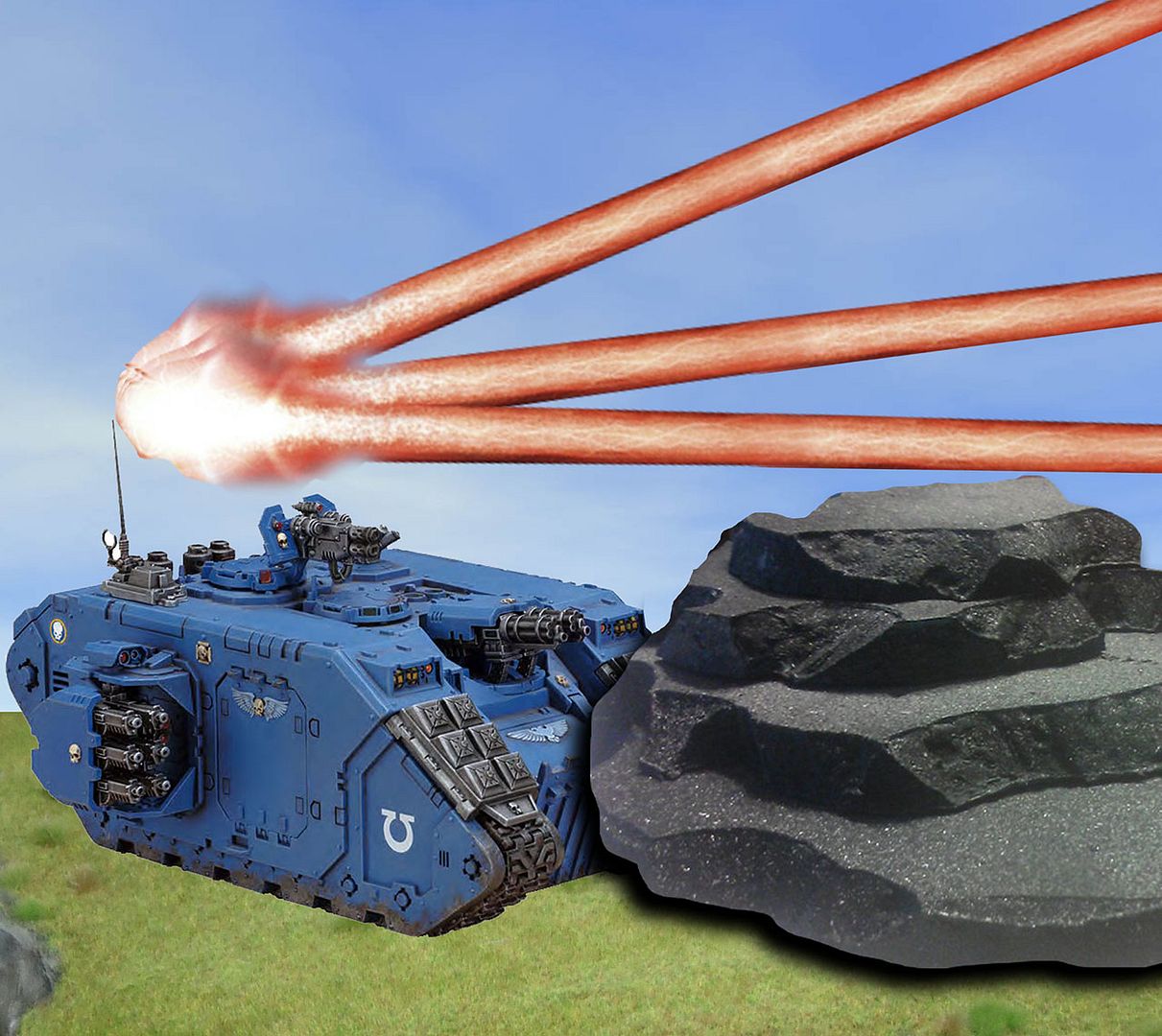












 off without a bloody