132557
Post by: Leopold Helveine
So we have Necron who are practically metallic human skeletons, we have Tyranids that are space insects, plants or aquatic tentacloids such as jellyfish, squid or octopus inspired things, Tau are humanoids without a nose, wearing native american culture somewhat amalgamate with asian inspired whatnot (granted, which is much related historically but that aside), Orks are green monkeyesque people despite having a whacky lore of again earthly plantlife (mushrooms), still bipedal and indestinguishable from humans for the most part, Eldar/Drukhari are technically just humans with pointy ears/elfs and even their robots and vehicles are human-inspired tech, Kroot are like porcupine.. yet fully humanoid, perhaps a bit spacelizard' which is still earthly.. and the Votann as much as the demiurg are all humanoid aswell with earthly droid tech sporting the same humanoid appearance.
Is this because the idea of xenos/alien/something-that-is-strange as in different to us' is not understood or by choice to keep design still in the realm of "relatability"? (I would think the second?)
If I would have to think of an actual xenos/alien design I would avoid everything that is biological in the first place, as in everything that has a relation to any earthly biome. Something truly strange should as its bedrock be something that resonates with a law different to that of nature which is earthly.
Life-form that is for instance composed of a different chemical makeup, perhaps silicon life, aetheric life or sulfur life that is distinct and disconnected from carbon based life. Granted that on earth we do have some abyssal (under the sea) species that are self luminant for instance, boneless, sometimes senseless' (and the inspiration for many a cthulu deity) but these are still carbon based.
Why would any (fiction) planet removed from the source of carbonization which is char-(coal)-ization' being.. the Sun' have carbon based form?
Where are the crystaline Xenos, the luminary Xenos (elementals anyone?) or atleast any type of non-comparable Xenos (like a floppy gelatin/slime like species or something) that doesn't wear humanoid armor and uses humanoid flipping weaponry such as rifles, cannons, swords knifes maces, bows, pikes or african throwing javelins (I see you, Kroot).
I feel like this is a huge missed oppertunity that makes 40k come off as limited in terms of inspiration. It's also something I've noticed within the paradigm of Xenos all having political and hierarchical systems, which are human' systems.
https://en.wikipedia.org/wiki/Hypothetical_types_of_biochemistry
Anyway that's what was griping me when I was thinking about 40k a bit yesterday.
-Helveine.
93557
Post by: RaptorusRex
I don't know, dude. Were you expecting a Stanislaw Lem work?
132557
Post by: Leopold Helveine
Not the best example considering many of his alien species are exactly in the same field of earthly inspired and compatible with human technological capability. (I do have to say I very much enjoyed the film the congress based on his book)
https://www.imdb.com/title/tt1821641/ (It's a must see for those who haven't yet)
105694
Post by: Lord Damocles
Umbra are hard to sculpt.
93557
Post by: RaptorusRex
 Leopold Helveine wrote: Leopold Helveine wrote:
Not the best example considering many of his alien species are exactly in the same field of earthly inspired and compatible with human technological capability. (I do have to say I very much enjoyed the film the congress based on his book)
https://www.imdb.com/title/tt1821641/ (It's a must see for those who haven't yet)
When I think Lem, I think Solaris and its ineffable, uncategorizable world-intelligence. I had a liberal education in the classical sense, and Lem was very much of the postmodernist school that interrogated our assumed epistemology.
That said:
I'm not sure you understand that any fictional alien must be conceived by a human brain and if it's a popular fictional work, likely easily grasped by it.
26613
Post by: El Torro
Leopold Helveine wrote:Is this because the idea of xenos/alien/something-that-is-strange as in different to us' is not understood or by choice to keep design still in the realm of "relatability"? (I would think the second?)
Exactly, keeping things relatable.
Warhammer 40K made its success by taking real world influences and shoe horning them into the 40K Universe. Just look at Space Marines as one example: Space Wolves are Vikings, Blood Angels are vampires, Ultramarines are Romans, etc...
The same applies to the Xenos in the game. Tyranids are not only insects, they're heavily influenced by the Xenomorph in the Alien series. Orks (apart from being fungus) are essentially British football hooligans of the 1980's. This is what makes 40K work. Although it's a sci fi setting thousands of years into the future it's conceived by real world ideas.
GW have unapologetically borrowed from many other sources to make their own little mixing pot. This isn't a coincidence, it's by design. Making aliens which are truly alien would go against this ethos.
132557
Post by: Leopold Helveine
 RaptorusRex wrote: RaptorusRex wrote:
When I think Lem, I think Solaris and its ineffable, uncategorizable world-intelligence. I had a liberal education in the classical sense, and Lem was very much of the postmodernist school that interrogated our assumed epistemology.
That said:
I'm not sure you understand that any fictional alien must be conceived by a human brain and if it's a popular fictional work, likely easily grasped by it.
I have to say that I look at this from the Etymological field in that alien is defined as something that is different' from that human brain's conceptualization, which doesn't mean it cannot be conceptualized, but optimally' as distant possible from human familiarities, so not merely consisting of a warped function (like having more than two arms etc).
Considering I wasn't necessarily speaking of human' (while detecting Xenos as mostly being humanoid) but rather of earthly' and therefor carbon-based' I would remind of the link I posted concerning hypothetical types of (bio) chemistry, alternate lifeforms are not an idea limited to the brain's own chemistry (carbon) but include that of other chemistry such as' again'; silicon, sulfuric etc (the latter is hard to imagine, perhaps some lifeform that is practically a dust/particle construct which ventilates fumes or so.
I think the most alien species we have here are some of the microscopic entities such as snottites, bristle worms and tardigrades, yet fiction writers still use human-sense-surface level carbon based creatures as inspiration, sadly. (mostly insects or aquatic life)
I mean look this; https://en.wikipedia.org/wiki/Polychaete
El Torro wrote: Leopold Helveine wrote:Is this because the idea of xenos/alien/something-that-is-strange as in different to us' is not understood or by choice to keep design still in the realm of "relatability"? (I would think the second?)
Exactly, keeping things relatable.
Warhammer 40K made its success by taking real world influences and shoe horning them into the 40K Universe. Just look at Space Marines as one example: Space Wolves are Vikings, Blood Angels are vampires, Ultramarines are Romans, etc...
The same applies to the Xenos in the game. Tyranids are not only insects, they're heavily influenced by the Xenomorph in the Alien series. Orks (apart from being fungus) are essentially British football hooligans of the 1980's. This is what makes 40K work. Although it's a sci fi setting thousands of years into the future it's conceived by real world ideas.
GW have unapologetically borrowed from many other sources to make their own little mixing pot. This isn't a coincidence, it's by design. Making aliens which are truly alien would go against this ethos.
Yes I suspected that 40k in particular is a sort of compendium of nostalgic' easter eggs wether or no for selling-value/success, it does look like Spacemarine chapters are fashioned after each distinct culture and people. Which isn't that strange considering the whole unified mankind (under a sum of all its hopes and fears made into a non human AI, aside)..
Tyranids indeed have that alien(trademark) vibe since its conception, and squats/votann are ofcourse just dwarfs going to the moon to delve moonpotatoes because we all love dwarfs, even in science fiction theme.
I mean, I have a complica(ting)ted mind and WH is for all ages, kids should be able to look at these species and go "I want to be that when I grow up" heh.
(inb4 they say that about genestealers.. -_- )
But the exotophile in me would like to be suprised with something new too.
92650
Post by: stroller
Assuming you come with a genuinely alien Xeno, how do you model it and exclude anything earthly?
Take a puddle or a blob or a cube - they all exist on earth...
76888
Post by: Tyran
A puddle, blob or cube would also be infinitely boring.
It isn't just about coming up with something entirely alien, but also making it as complex as macroscopic "earthly species" so it can be distinguishable, memorable and recognizable.
8725
Post by: Mad Doc Grotsnik
Things can be too alien.
Things are scary when we can see a bit of ourselves or our world in them.
Tyranids, arguably, represent the natural order of things ramped up to Eleventy. A manifestation of the evolutionary struggle, where each race must constantly adapt to new challenges or face extinction. They also represent rampant consumption without forethought of “hey, maybe store some for later”. They also look a bit like Dinosaurs.
Orks are as said, ‘Ooligans. A race simply devoted to fighting, and loving every second of it. They’re anarchy incarnate. And the represent the classical Barbarian Hordes that have been the fall of many an empire which, at least on paper, outclassed them in purely militaristic terms.
The Sentient Blobs Of Yuck? Not so much. They’re just blobs, and not terribly visually interesting.
121430
Post by: ccs
It's not really that hard to figure out why 40k has Humans/Elves/Dwarves/Halflings/orks, goblins, etc
It's because in the beginning (early-mid 80s) there was Warhammer Fantasy Battle. A game very prominently featuring all your typical Tolkien/D&D stuff. + assorted undead. The Slann (Aztec themed frogmen) were the oddest faction. Oh. And add in the demons!
It sold very well.
So the company decided to do a Sci-Fi game with similar rules.
And so they just made sci-fi versions of all that stuff
Thus you have Eldar (space elves), Squats (now called Votann as your space dwarves), rstlings = halflings, etcWorld's....
For the "bad guys"? They just made evil versions of the humans & ported in the demons.
And it sold well!
So then they started taking inspiration from other existing sci-fi properties.
●Ever see Terminator?
Why do you think necron warriors look like T-800s? They even started out with a rule called "We"ll be back". Sure, they also went on to borrow cues from GWs own recent Egyptian themed Tomb Kings & then some re-boot Cylons (just look at they're flyers!) & then some War of the Worlds.... But the heart of the Necrons is the T-800 endo-skeleton.
●Tyranids?
As others have pointed out. You've got GW borrowing cues from Alien/Aliens. And then later there's a nice flavoring of Starcraft.... Add in other creepy crawly insect/tenticle things....
●Tau?
Take some Martian Gray's, give them a hefty dose of animae inspired mecha, and then borrow the Droid tank from SW hantom Menace. Paint studio army droid brown... oh. And add the winged aliens from Attack of the Clones a few years later.
GW doesn't create its own xenos from scratch for mass sale because it's much easier to sell you "thier" version of something you're already familiar with.
(Or something that was popular near when the xeno in question came out).
That's why 40k xenos look like they do.
551
Post by: Hellebore
There is an interesting discussion in the 'how alien is alien' area, in regards to earth biology and forms.
I used scoff a little at the star trek ridge nose style of alien, but when you look at a few factors, it's not AS far fetched as it appears.
the hydrocarbons that make up life are common products of natural forces. The nucleotides that make up DNA molecules form just as often and easily. We can detect them in the ice of comets. So it's not entirely far fetched to consider that most life is going to form around this chemistry, it's just very common and practical.
organisms that can get to a far future level of technology will require a set of solutions the same problems of construction, like large brains and manipulators. Whether these are hands, tentacles, telekinesis etc. There are only so many ways to have fine motor/manipulatory capability. Coupled with this will be some form of light sense, a good depth of field to be able to see the things you're making.
you will also need some form of locomotion to move to the areas that have the materials you need to make stuff.
You will need a culture in which knowledge is collected and shared, which requires cultural structures to form. It requires cooperation at a level that a civilisation can form.
There are only 3 methods of energy consumption that we know of on earth and I don't think you can invent many more. Solar energy directly (autotrophs), indirectly through the consumption of other life (heterotrophs) and chemical energy (chemotrophs). in 40k you could add warp energy (ectotroph?).
But life will need energy to survive and there are only so many places to get it. The chance of an autotroph becoming like us is relatively low because of how low the energy consumption is. Hetertrophs let other organisms concentrate energy and then consume them as a short cut. A tree would need to be massive to consume the equivalent.
Heterotrophs require a means if ingesting that energy, so that's some form of mouth or absorber system.
tldr, to be a space faring technological organism you are very likely going to have:
the same chemical building blocks as earth
a brain, manipulators, light senses, energy consumption system and locomotion.
Plus culture and gregarious cohesion for continual knowledge building and sharing.
Which will make you somewhat similar to us and to earth life, by dint of practicality.
21358
Post by: Dysartes
Leopold Helveine wrote:Kroot are like porcupine.. yet fully humanoid, perhaps a bit spacelizard' which is still earthly
Porcupine? Try avian-inspired.
El Torro wrote:GW have unapologetically borrowed from many other sources to make their own little mixing pot. This isn't a coincidence, it's by design. Making aliens which are truly alien would go against this ethos.
How dare you, sir? We have them on court record in the US saying their design team never lifts anything from popular culture, and you wouldn't want to accuse them of perjury, now, would you? Even if they were trying to defend their claim over the use of Roman numerals (amongst other things) at the time...
109034
Post by: Slipspace
On top of not wanting to be too alien, in order to provide something relatable for the audience, there's also the fact that you need to be able to sculpt this stuff. The background serves the game, so developing an alien race that is an amorphous blob, or pure energy doesn't directly lead to the visual spectacle you want. You could do something like the Vorlons in B5, but then they'd likely be contained within their biomechanical suits, making them just another "typical" alien species, visually.
That's also why most sci-fi has humanoid aliens, often with random bits of rubber attached to their faces - they're cheap, quick and fairly easy to depict on-screen, compared to doing a full CGI race. It's not so much that the writers lack imagination, they just have certain limitations imposed by the medium.
8725
Post by: Mad Doc Grotsnik
Also, it’s really hard to imagine a functional body plan other than those we see in nature.
Winged, bipedal, quadruped, insectoid, arachnid. Those are mostly it, barring slugs and other molluscs.
You could upscale a bacteria or virus, but it’s just gonna look odd, not weird. Because we’ve little to no point of reference.
And in terms of sculpting a convincing anatomy, that matters. GW have various non-insectoid six limbed gribbles, from various Tyranids to Slaanesh daemons.
Speaking of Slaaneshi Daemons? The Fiends are essentially centaur inspired. Bestial, four legged body, and a humanesque torso with a further two limbs. But look at the layout, especially the rear legs. Not only is it overall an unnatural, if mythologically familiar body plan? Those rear legs have their own pelvis, and it’s facing backwards, adding to the overall wrongness of it, without going into “what the hell is that” territory.
77922
Post by: Overread
Warhammer 40K is quite literally "Warhammer In Space". So for 40K a big reason is that a lot of the races were lifted right from fantasy and put into a sci-fi setting.
As for why its common in general within a lot of fantasy I'd argue there's a few reasons
1) Familiarity. The same reason fantasy often has orks, goblins, elves and so forth is that common tropes and elements are much easier to convey and for the audience to grasp. Reading especially you can spend pages upon pages describing really wild crazy things; or you can say "elf". One aspect most of your readers will grasp very quickly and continue with the story; another and they might feel lost, confused or like you're bombarding them with worldbuilding. Not inherently bad, but it might lose traction compared to those that rely on more common elements.
2) Monkey see monkey do. A LOT of creative work is derived from other creative work and from reality. So often as not people are inspired by similar things to create further things.
Both 1 and 2 basically mean that you get a lot of repetition and derivative ideas. That is not a bad thing; its just a thing. It also means that if you get some landmark creation it can change it. Lord of the Rings created a lot of the foundations for many fantasy races today - it was a huge inspirational landmark.
3) As slipspace says in creative works there's often barriers on complexity. Even in video games you've still got animation work and other aspects that make it a lot easier to work with a known design of animal/creature and adapt it rather than starting fresh with something that might be super creative; but which is very hard to animate because there's no real world elements you can draw from or library you can dip into.
4) Understanding. A great example of this is the new bioficers faction from Dropfleet Commander. They use a very alien design to their ships and some who dislike them have noted that part of the issue is they can't always see the functionality of something.
If the audience can't understand what a thing is or what it does or how it might do something then their ability to engage with it is reduced.
The same is true of alien creatures. If they are vastly different it can be harder to engage with them and understand; which can mean that whilst they might be really cool; people might just not latch onto them
132557
Post by: Leopold Helveine
 Mad Doc Grotsnik wrote: Mad Doc Grotsnik wrote:Things can be too alien.
Things are scary when we can see a bit of ourselves or our world in them.
Tyranids, arguably, represent the natural order of things ramped up to Eleventy. A manifestation of the evolutionary struggle, where each race must constantly adapt to new challenges or face extinction. They also represent rampant consumption without forethought of “hey, maybe store some for later”. They also look a bit like Dinosaurs.
Orks are as said, ‘Ooligans. A race simply devoted to fighting, and loving every second of it. They’re anarchy incarnate. And the represent the classical Barbarian Hordes that have been the fall of many an empire which, at least on paper, outclassed them in purely militaristic terms.
The Sentient Blobs Of Yuck? Not so much. They’re just blobs, and not terribly visually interesting.
I would think a blob with needles or pores is pretty scary, I recall a (likely fake.. possibly some amalgamate thing) video of a sewer that had a slimy thing moving that had such needles (don't recall where I ever found it, probably somewhere obscure) and it really gave me the jeebies.
https://cryptidz.fandom.com/wiki/The_Cameron_Village_Sewer_Blob (only decent source I can still find which has the video as the YT page seems to be blocked these days, not sure why)
Same with how a lot of people had the jeebies when that image of a photoshopped skin condition went around, looking like seeds inside of holes, theres a word for the fobia; trypofobia.
https://www.iflscience.com/this-photo-deeply-disgusts-some-people-and-scientists-are-trying-to-understand-why-42474
(that's the same plant that was eventually used for a memetic rampage)
NSFW/not-for children or faint of heart; google this prompt; "trypophobia photoshopped image"
109034
Post by: Slipspace
Leopold Helveine wrote: Mad Doc Grotsnik wrote:Things can be too alien.
Things are scary when we can see a bit of ourselves or our world in them.
Tyranids, arguably, represent the natural order of things ramped up to Eleventy. A manifestation of the evolutionary struggle, where each race must constantly adapt to new challenges or face extinction. They also represent rampant consumption without forethought of “hey, maybe store some for later”. They also look a bit like Dinosaurs.
Orks are as said, ‘Ooligans. A race simply devoted to fighting, and loving every second of it. They’re anarchy incarnate. And the represent the classical Barbarian Hordes that have been the fall of many an empire which, at least on paper, outclassed them in purely militaristic terms.
The Sentient Blobs Of Yuck? Not so much. They’re just blobs, and not terribly visually interesting.
I would think a blob with needles or pores is pretty scary
Sure, and there were some deathworld plants with rules back in 3rd edition that were like that. The problem isn't so much coming up with a single thing that's very alien (spore mines fit the bill here too). You also have to extend that to an entire army, or at least a sub-faction of an army. Then you get into the issues Overread mentions about function and recognisability. There's value in being able to identify what you're looking at in a general sense, especially talking about gaming. When you have vaguely humanoid things carrying weapons of various types you can easily vary that within a design language and maintain intelligibility even for people unfamiliar with an army. Once you have to start identifying units base don the number of spikes on the main blob, it becomes much more difficult.
For an effective example of something "alien" working well, consider the Borg cube. It's about as simple a design as you can get, but it was jarring when first encountered because every other ship had a fore and aft, something usually recognisable as a bridge and some identifiable means of propulsion. Take that away and you get something disconcerting. But you have to be careful, because if you go too far, you get something that's just too confusing.
94437
Post by: Crispy78
Leopold Helveine wrote: Mad Doc Grotsnik wrote:Things can be too alien.
Things are scary when we can see a bit of ourselves or our world in them.
Tyranids, arguably, represent the natural order of things ramped up to Eleventy. A manifestation of the evolutionary struggle, where each race must constantly adapt to new challenges or face extinction. They also represent rampant consumption without forethought of “hey, maybe store some for later”. They also look a bit like Dinosaurs.
Orks are as said, ‘Ooligans. A race simply devoted to fighting, and loving every second of it. They’re anarchy incarnate. And the represent the classical Barbarian Hordes that have been the fall of many an empire which, at least on paper, outclassed them in purely militaristic terms.
The Sentient Blobs Of Yuck? Not so much. They’re just blobs, and not terribly visually interesting.
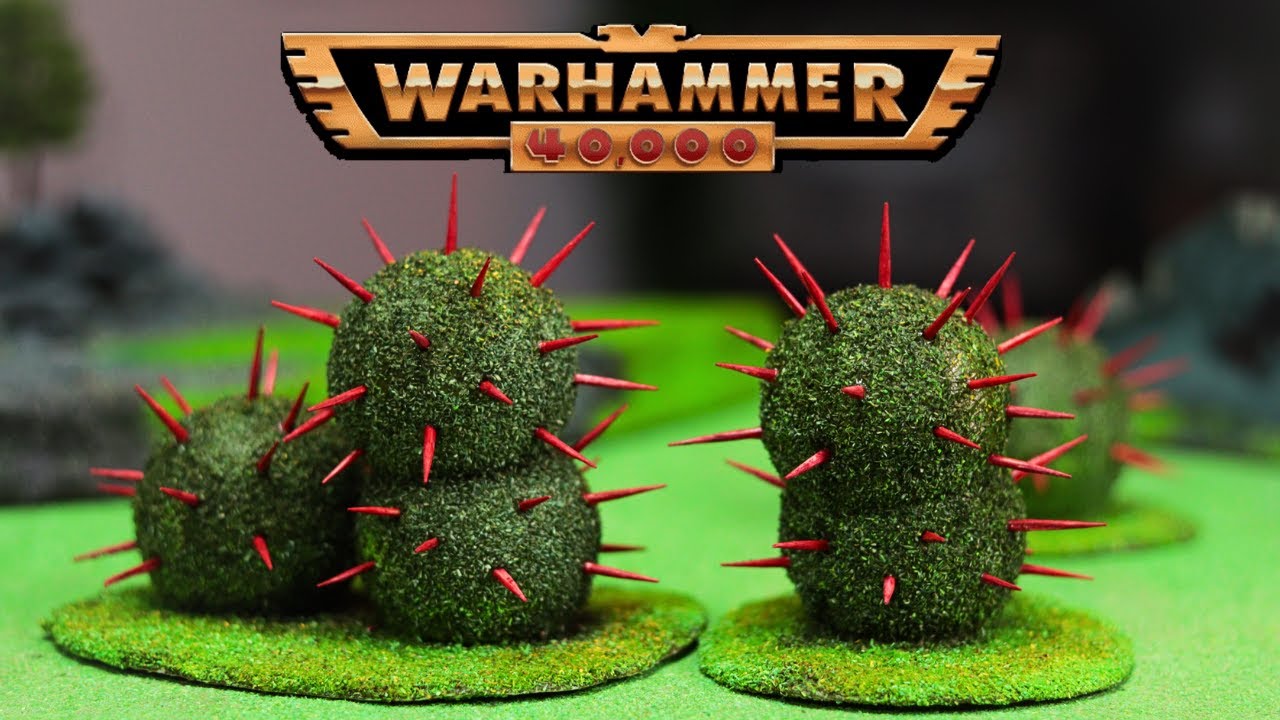
I would think a blob with needles or pores is pretty scary
Boo!
77922
Post by: Overread
Model wise another good example is Starwars.
The actual spaceship models for them in games have very few actual guns visible on most of the larger craft. You get a few big turbolasers here and there, but most of the actual pew-pew guns are invisible.
And yet you know the Star Destroyer is going to be pew-pewing loads of shots* all over the place. Not because of visual language on the model, but from the films.
I think that's one area where if you want to go really wild; films do let you achieve some elements of it whilst conveying a lot of visual information very quickly. The Borg Cube is much the same.
If you just saw it with zero context it looks like an industrial box. Throw it in films with its green lasers, tractorbeams; the knowledge of what's inside etc... and it works.
*all aimed by cross-eyed donkey-caves
3309
Post by: Flinty
Daemons rather than aliens, but I have a soft spot for this bit of low-fi army building
https://www.dakkadakka.com/dakkaforum/posts/list/0/355017.page
120048
Post by: PenitentJake
Perhaps my favorite species of creature is the Tardigrade or Waterbear. These things are crazy- they are the ultimate survivors, and if humans ever get to the point where we are looking into terraforming technologies, Cyanobacteria and Tardigrades will be our greatest allies in those efforts.
Thing is, the biggest Tardigrade you're ever going to encounter would be 1.5 mm- obviously that can't be represented on a table- you'd just have to move around bases and say "There's a bunch of Tardigrades on this base, they're just too small to see. You have a slim chance of killing them with a torrent or blast weapon, but they're so small that's the only thing that can target them.
107281
Post by: LunarSol
I find Nids suitably alien, though I really hate their bio rifles and would far prefer such things be implemented more organically into them rather than held in hands.
77922
Post by: Overread
 LunarSol wrote: LunarSol wrote:I find Nids suitably alien, though I really hate their bio rifles and would far prefer such things be implemented more organically into them rather than held in hands.
Interesting observation - early Tyranid models were nearly all very much holding their weapons. Whilst many guns had pipes to connect them to the body as well, they still held them in claws.
Today a lot more weapons are fused with the arm/body.
That said I've always found it interesting that weapons like Fleshborers have magazines and pipes connected to the body
For me I like it with Tyranids because it kind of shows that they have this sort of internal battle with themsleves in being living bioweapons and yet not being just a gun. A Termagaunt is trapped with a core design and elements that mean its not just a gun with legs. It has to hold a separate gun
134248
Post by: StudentOfEtherium
it's also worth considering: until very recently, all models made for the game had to be crafted by hand. even in the era of digital modeling, there are pretty strict restraints. so even if someone made the most out-there unfathomable concept art ever, there would still be difficulties at the stage where you turn it into something on the table
furthermore, for as much as I like to think that humans are too limited in what we consider "life", and that if we looked for something that didn't just match us... as far as human conceptions go, we can only imagine what we have basis for. even viruses or ancient life can be understood in the context of other life they're related to. to come up with something truly unearthly, we've probably have to find it first
120227
Post by: Karol
Leopold Helveine wrote:
Not the best example considering many of his alien species are exactly in the same field of earthly inspired and compatible with human technological capability. (I do have to say I very much enjoyed the film the congress based on his book)
https://www.imdb.com/title/tt1821641/ (It's a must see for those who haven't yet)
But that is because Lem assumes that we can ONLY communicate with rational humanoid beings who have "an intellectual imagination that is able to set tasks and model them. [Reason] must have the ability to imagine the universe as a whole in which intelligence participates - and the certainty that its image is inevitably incomplete, that it (this reason) can only model the chaossphere for itself.". People don't really look for things, they look for other people. That is why they make animals, things, feelings everything in to a human. A toy given by your parents becomes a human, just as well a god has to become a human too for people to want to interact with him, never mind try to understand. Which is always trying to give the god traits, ways of thinking etc of a human. The moment something becomes really abstract or not human it loses interest to majority of people.
31121
Post by: amanita
Just for fun I made an alien race for our local gaming group, with models and rules. They are energy shapeshifters that manifest themselves into 3 physical combat types, essentially equivalent to infantry, cavalry and artillery. They are radially symmetrical blobs with 5 tentacles of various sizes, with the infantry being the smallest (monads). The monads are also building blocks which can with enough numbers turn into the other two types. The other types must turn into monads first before further alteration.
The army has very unique deployment rules and is very dependent on the loci, or leader units. The monads also may grow in numbers if they are near enough enemy casualties. Anyway, the whole point is an alien race can be made with a little creativity beyond making something that is very similar to human beings and still work as a table top army. If GW doesn't quite scratch that itch, there's no harm in creating something of your own.
106383
Post by: JNAProductions
 amanita wrote: amanita wrote:Just for fun I made an alien race for our local gaming group, with models and rules. They are energy shapeshifters that manifest themselves into 3 physical combat types, essentially equivalent to infantry, cavalry and artillery. They are radially symmetrical blobs with 5 tentacles of various sizes, with the infantry being the smallest (monads). The monads are also building blocks which can with enough numbers turn into the other two types. The other types must turn into monads first before further alteration.
The army has very unique deployment rules and is very dependent on the loci, or leader units. The monads also may grow in numbers if they are near enough enemy casualties. Anyway, the whole point is an alien race can be made with a little creativity beyond making something that is very similar to human beings and still work as a table top army. If GW doesn't quite scratch that itch, there's no harm in creating something of your own.
Got images?
They sound hecking neat!
91640
Post by: Wyldhunt
I'm late to the discussion, but...
* In-universe, I think it's suggested if not outright stated that a lot of species in the galaxy were seeded by the Old Ones doing the Ancient Astronauts thing. So it's possible that the similarities in body plans between species is due at least in part to a lot of life using the same starter dough.
* As Hellebore pointed out, convergent evolution is a thing. Look at how many times Earth has attempted to make crabs. It's maybe a little human-centric to assume that bipedal humanoids are such a "good" body plan that that specific layout would become the galactic norm, but... *shrug*.
* The "real" answer is, as others have pointed out, that 40k is meant to be Warhammer Fantasy in Spaaaaaace, and the fantasy versions of various species are bipedal humanoids because reasons. Also, the general vibe of 40k is dudes chainsawing eachother on motorcycles, and it's tricky to get that Heavy Metal vibe with an amorphous slime blob or a nebulous collection of sapient triangles. Automatically Appended Next Post:  Overread wrote: Overread wrote: LunarSol wrote:I find Nids suitably alien, though I really hate their bio rifles and would far prefer such things be implemented more organically into them rather than held in hands.
Interesting observation - early Tyranid models were nearly all very much holding their weapons. Whilst many guns had pipes to connect them to the body as well, they still held them in claws.
Today a lot more weapons are fused with the arm/body.
That said I've always found it interesting that weapons like Fleshborers have magazines and pipes connected to the body
For me I like it with Tyranids because it kind of shows that they have this sort of internal battle with themsleves in being living bioweapons and yet not being just a gun. A Termagaunt is trapped with a core design and elements that mean its not just a gun with legs. It has to hold a separate gun
I'm with LunarSol on this one. Especially the way they're usually painted, 'nid guns feel too much like they're rifles that were picked up somewhere. They're basically what I would expect a chaos marine fused to his bolter to look like.
I feel like termagaunts should be a little more like the exocrine. Some sort of back/chest/mouth/tail gun that makes the entire gaunt feel like it exists to be a projectile delivery system. The fluff about how the gun is its own organism "piloting" the gaunt is a cool way to justify the "held rifle" design, but it ultimately still feels like a retrofitted justification.
117719
Post by: Sunny Side Up
LunarSol wrote:I find Nids suitably alien, though I really hate their bio rifles and would far prefer such things be implemented more organically into them rather than held in hands.
Maybe. But Nid bio-weapons arguably make them more unique / "alien" than most variants of space bugs/swarms/hives/insects from sci-fi literature/film/etc...
62565
Post by: Haighus
Leopold Helveine wrote:
I have to say that I look at this from the Etymological field in that alien is defined as something that is different' from that human brain's conceptualization, which doesn't mean it cannot be conceptualized, but optimally' as distant possible from human familiarities, so not merely consisting of a warped function (like having more than two arms etc).
Considering I wasn't necessarily speaking of human' (while detecting Xenos as mostly being humanoid) but rather of earthly' and therefor carbon-based' I would remind of the link I posted concerning hypothetical types of (bio) chemistry, alternate lifeforms are not an idea limited to the brain's own chemistry (carbon) but include that of other chemistry such as' again'; silicon, sulfuric etc (the latter is hard to imagine, perhaps some lifeform that is practically a dust/particle construct which ventilates fumes or so.
I think the most alien species we have here are some of the microscopic entities such as snottites, bristle worms and tardigrades, yet fiction writers still use human-sense-surface level carbon based creatures as inspiration, sadly. (mostly insects or aquatic life)
I mean look this; https://en.wikipedia.org/wiki/Polychaete
I think this highlights the issue. To give an example of an otherworldly, exotic creature... you point to Earthly, carbon-based lifeforms that actually exist.
The breadth of life that does and has existed on Earth is so great that it is actually quite hard to create plausible designs that don't have a comparable analogue on Earth. Plus, we know that the various Earth forms are practical, functional designs that did survive at some point.
Would we expect silicon-based life to look dramatically different in body form? Silicon is very similar to carbon, hence why it is the most commonly proposed hypothetical.
As it happens, I do think there is scope for more bizarre aliens in 40k. I'd like to see Enslavers and Umbra and Slaught (the latter is a version of the classic "bunch of worms in a trenchcoat" concept so not truly humanoid, only appearing so when infiltrating human society). Thyrrus would also be neat as (probable) Slaanesh worshippers.
132557
Post by: Leopold Helveine
Pretty cool.
Anyway, as to the thread'
I think its now established that all the xenos are humanoid with humanoid clothing and humanoid tech/guns/crafts/painted fingernails' because of readibility and familiarity.
I hope its also established that alien CAN BE alien when you lower that familiarity but it shouldn't be at too much cost of readibility.
Like when imagining a sort of anorganic creature such as a jelly or a particle-morph there can still be non-human tech/weaponry applied, take for instance the psyker or for one perhaps a mode of chemistry which affects the atmosphere to conjure up elemental auras (as we know from for instance fantasy games having aoe elemental effects etc as "magic".. but I mean it more like from the pressence of said alien), it doesn't have to be a "this weapon is furnished and produced industrially for this "alien race"..."
It could simply be that a particle' race can release the tension of its form to lash at their enemy an erroding throw of their particles, instead of shooting and by doing so reduce its own hitpoints.
It could be that a jelly creature has a distinct form which it can use to throw its entire half at the enemy as a sort of catapult and while doing so multiply..
All sorts of interesting mechanics could surface from such -non familiar- makeups, I'd like to one day see a truly Xenos added. Right now Tzeench is probably the most alien of all these, tyranids aren't really strange and could easily live on earth in our actual reality if some scientist was crazy enough to lab grow some.
31121
Post by: amanita
 JNAProductions wrote: JNAProductions wrote: amanita wrote:Just for fun I made an alien race for our local gaming group, with models and rules. They are energy shapeshifters that manifest themselves into 3 physical combat types, essentially equivalent to infantry, cavalry and artillery. They are radially symmetrical blobs with 5 tentacles of various sizes, with the infantry being the smallest (monads). The monads are also building blocks which can with enough numbers turn into the other two types. The other types must turn into monads first before further alteration.
The army has very unique deployment rules and is very dependent on the loci, or leader units. The monads also may grow in numbers if they are near enough enemy casualties. Anyway, the whole point is an alien race can be made with a little creativity beyond making something that is very similar to human beings and still work as a table top army. If GW doesn't quite scratch that itch, there's no harm in creating something of your own.
Got images?
They sound hecking neat!
I've never had much luck posting pics on this site for some reason, lol! 
I could give it a try maybe when I get home. They are mostly aluminum wire armatures coated in hot glue painted black.
131359
Post by: Uptonius
The answer is quite simple. All the other types of aliens were exterminated in the Great Crusade.
The game of 40k is about battles between warrior races. The Jigglypuffs of Beta-9 aren't much for fighting. They don't breathe oxygen or eat organic matter. They have no interest in conflict because they don't value the same resources as the other races. They don't have hands, they use telekinesis. Because they can move things with their minds they never needed to create physical tools or protective clothing. The lack of predators on their homeworld allowed them to evolve in relative safety. So they don't move very much if at all. They just soak up background radiation and sing to each other in mind song. Early visitors to Terra weren't even recognized as a living creature, They were simply bottled and labeled Marshmallow Fluff.
132557
Post by: Leopold Helveine
Uptonius wrote:The answer is quite simple. All the other types of aliens were exterminated in the Great Crusade.
The game of 40k is about battles between warrior races. The Jigglypuffs of Beta-9 aren't much for fighting. They don't breathe oxygen or eat organic matter. They have no interest in conflict because they don't value the same resources as the other races.
haha, I like your mind, but there's a lot of logic to this, when human armies compete to resources they only compete with those who also need those resources, that's flawless. So very good post. They don't have hands, they use telekinesis. Because they can move things with their minds they never needed to create physical tools or protective clothing. The lack of predators on their homeworld allowed them to evolve in relative safety. So they don't move very much if at all. They just soak up background radiation and sing to each other in mind song. Early visitors to Terra weren't even recognized as a living creature, They were simply bottled and labeled Marshmallow Fluff.
I bow to this post.
124276
Post by: Pyroalchi
That was also something that incredibly bothered me about the movie Avatar (only watched the first one though) they had a biosphere with all the vertebrae following the bodyplan "6limbs-4eyes". The "horses" the giant "birds" the "monkeys" - everything. And it made sense just like all terrestral vertebrae on earth following the "4limbs-2eyes" bodyplan.
And then you get the Na'Vi (or whatever the humanoids were called) with two legs and arms and two eyes... I understand that it was for better viewer reception, but from an evolutionary point of view it was incredibly dumb.
551
Post by: Hellebore
 Pyroalchi wrote: Pyroalchi wrote:That was also something that incredibly bothered me about the movie Avatar (only watched the first one though) they had a biosphere with all the vertebrae following the bodyplan "6limbs-4eyes". The "horses" the giant "birds" the "monkeys" - everything. And it made sense just like all terrestral vertebrae on earth following the "4limbs-2eyes" bodyplan.
And then you get the Na'Vi (or whatever the humanoids were called) with two legs and arms and two eyes... I understand that it was for better viewer reception, but from an evolutionary point of view it was incredibly dumb.
I think you discount the variety of life on earth. Yes making them explicitly human shaped was slightly contrived but the idea that evolution wouldn't be able to do that is not accurate. It would be more artificial to show a single body plan across all things with no changes. The form meets the function as set by the environment and they won't all be under identical environmental pressures that require the maintenance of the same body plan. What's more far fetched is that they didn't show a species like the monkey with smaller secondary limbs or vestigial ones, to show the relatedness to the navi and the path down limblessness. But even then that's not unusual. There are no other hominin species alive today, we are the only ones that show the hairless upright body plan. So singular lines can still appear.
Cetaceans and pinipeds both show that the mammalian form can lose limbs. Legless lizards and snakes have both lost limbs independently. Some fossil flightless birds have almost entirely lost their forelimbs.
77922
Post by: Overread
 Hellebore wrote: Hellebore wrote: Pyroalchi wrote:That was also something that incredibly bothered me about the movie Avatar (only watched the first one though) they had a biosphere with all the vertebrae following the bodyplan "6limbs-4eyes". The "horses" the giant "birds" the "monkeys" - everything. And it made sense just like all terrestral vertebrae on earth following the "4limbs-2eyes" bodyplan.
And then you get the Na'Vi (or whatever the humanoids were called) with two legs and arms and two eyes... I understand that it was for better viewer reception, but from an evolutionary point of view it was incredibly dumb.
I think you discount the variety of life on earth. Yes making them explicitly human shaped was slightly contrived but the idea that evolution wouldn't be able to do that is not accurate. It would be more artificial to show a single body plan across all things with no changes. The form meets the function as set by the environment and they won't all be under identical environmental pressures that require the maintenance of the same body plan. What's more far fetched is that they didn't show a species like the monkey with smaller secondary limbs or vestigial ones, to show the relatedness to the navi and the path down limblessness. But even then that's not unusual. There are no other hominin species alive today, we are the only ones that show the hairless upright body plan. So singular lines can still appear.
Cetaceans and pinipeds both show that the mammalian form can lose limbs. Legless lizards and snakes have both lost limbs independently. Some fossil flightless birds have almost entirely lost their forelimbs.
It stands out because the Navi are unique on the world, showing not vestigial parts; nor do we see any cousin species or such. Whilst you can argue Earth is similar; even humans have other Great Apes that clearly share very similar morphology elements to us.
Honestly the Navi are closer to Dragons in fantasy, where we often openly accept them having 6 limbs even though nothing else shares that morphology in many fantasy settings. Or might do but is wildly different (eh unicorns). Though often fantasy settings lean into "last of an ancient race" and "lost golden age" as well as magic as means by which they can often explain how the dragons are unique.
Navi don't really get that backstory to them. We know they are somewhat unique on the world, but we don't really get a how/why. In fact considering the mental unity going on on the planet its even more a puzzle
551
Post by: Hellebore
I stand corrected, the monkeys actually do demonstrate a unique design:
https://james-camerons-avatar.fandom.com/wiki/Prolemuris
They have reduced their limbs to single upper with double lower, which would be suggestive of them fusing their limbs as a precursor to reducing to a single limb. They also only have a single nerve cluster and one set of eyes like the navi.
tHe above link provides theorising, but these features certainly would have had linnaeus putting them and navi together.
Their shape is to navi what realworld monkeys are to humans, so the relationships are there, the navi aren't that out of place.
the whole one ecosystem gaia connectedness thing is the most far fetched of the biology in pandora, but within that paradigm they seem to have followed relatively similar earth evolutionary patterns.
134248
Post by: StudentOfEtherium
Hellebore wrote:I stand corrected, the monkeys actually do demonstrate a unique design:
https://james-camerons-avatar.fandom.com/wiki/Prolemuris
They have reduced their limbs to single upper with double lower, which would be suggestive of them fusing their limbs as a precursor to reducing to a single limb. They also only have a single nerve cluster and one set of eyes like the navi.
tHe above link provides theorising, but these features certainly would have had linnaeus putting them and navi together.
Their shape is to navi what realworld monkeys are to humans, so the relationships are there, the navi aren't that out of place.
the whole one ecosystem gaia connectedness thing is the most far fetched of the biology in pandora, but within that paradigm they seem to have followed relatively similar earth evolutionary patterns.
okay wait that's really interesting. guess it goes to show just how much thought they put into this. can you imagine if this work had been done for a good movie?
124276
Post by: Pyroalchi
Could have sworn those monkeys had 4 eyes... fair enough, I conceed my point.
Still, even if earths fauna is diverse we see very few other body types. And if so it usually comes down to total loss (snakes, whales, a hand full of blind species) and even those often have disfunctional parts of the lost appendices or eyes left.
Its a bit hard to imagine as we can hardly picture terrestrial animals with reduced but not missing number of limbs without getting into assymetrical bodyplans. But to put it that way: if there was a single mamal species that had two bones in their upper leg part and 1 in the lower instead of the other way around like ALL other mamals and vertebrae with legs, that would feel kind of strange.
Also why would an arboreal species like those "monkeys" habe an advantage from reducing its limb-count? That one-upper-arm-two-lower-arms design severely reduces tue movement range of the hands
3309
Post by: Flinty
Evolution is complicated. Whilst it’s not really relevant here as all the species are actually designed, there are drivers such as resource use (more arms takes more energy) vs needs to fit in their niche (does having more arms actually provide sufficient benefit to offset the extra energy). Maybe Pandora is currently just post-cataclysm and the surviving species are rapidly diversifying into new niches.
8725
Post by: Mad Doc Grotsnik
Could be the extra set of legs helps with endurance when hanging from the canopy, each pair taking it in turns.
Or, if the tree branches are comparatively spindly, five potential anchoring limbs (four legs, prehensile tail) reduces fall risk compared to be two legs and a prehensile tail.
124276
Post by: Pyroalchi
I meant it more in the direction: what can one-upper-two-lower arms do, that either 1-1 or 2-2- can't do better. 1-1 could be more massive, 2-2 would allow more ancorpoints in a wider range. 1-2 limites the range of the hands severely compared to 2-2 while not being stronger than 1-1
77922
Post by: Overread
Evolution is rarely as straightforward. The whole "one gene for each thing" isn't really true either, there's a whole bunch that affect each property of a body and they all intermingle.
So it might not necessarily be that 1-2 is the evolutionary benefit, but its a side effect of another part of the creatures genetic makeup that does provide a gain. Whatever loss they have from 1-2 is counterbalanced by a greater gain in the other property(ies).
127131
Post by: Cyel
In general it is hard (impossible) for our brains to imagine something entirely disconnected from what they know.
It is possible to think of species that are pretty alien and unlike earthly species, though, but for this you need some talented sf writers, like Peter Watts (read his Blindsight!) or Alastair Reynolds for example.
77922
Post by: Overread
Or the aid of visual media mass marketed enough that its "common understanding". Even then I think that there's certain ideas that carry across better in different mediums.
Eg books often convey mental/mind talking aspects better than films. Or at least can do more of it without it feeling like its putting everything on pause*; whilst films can often convey more complex structures/designs quicker and in a more clear manner.
Even then the more outlandish you get the greater the chance that the work might end up niche instead of mass market. Which is the other aspect to consider. Creations that are easily identifiable are much easier to market to people who are not already invested in a setting.
I think that's why sometimes with games you'll see the more outlandish things start to appear later on whilst the starting elements are often much more standard. Heck most wargames in fantasy and scifi nearly always go for human factions first because they are often what many casual people identify with very quickly and readily.
*or in an animation feeling like they are trying to fill time because they can't afford more animation
59054
Post by: Nevelon
I was going to come to this tread to post that link, was pleased to see it had already been done.
Such a great concept, well executed. And very on topic for this discussion.
134248
Post by: StudentOfEtherium
Overread wrote:Or the aid of visual media mass marketed enough that its "common understanding". Even then I think that there's certain ideas that carry across better in different mediums.
Eg books often convey mental/mind talking aspects better than films. Or at least can do more of it without it feeling like its putting everything on pause*; whilst films can often convey more complex structures/designs quicker and in a more clear manner.
Even then the more outlandish you get the greater the chance that the work might end up niche instead of mass market. Which is the other aspect to consider. Creations that are easily identifiable are much easier to market to people who are not already invested in a setting.
I think that's why sometimes with games you'll see the more outlandish things start to appear later on whilst the starting elements are often much more standard. Heck most wargames in fantasy and scifi nearly always go for human factions first because they are often what many casual people identify with very quickly and readily.
*or in an animation feeling like they are trying to fill time because they can't afford more animation
yeah, the difference between writing and visuals is very stark. there's a reason, for example, why the writing of lovecraft can have such a mysterious feeling in writing, even when its characters are faced with such unspeakable horrors, versus the difficulty of translating those horrors into something visual without having it be boiled down to weird fish guys. if you wanted to make a Lovecraft model game, for example, how would you go about turning intentionally difficult to parse ideas into something visual? after a point, it just doesn't work
105713
Post by: Insectum7
Pyroalchi wrote:
Still, even if earths fauna is diverse we see very few other body types. And if so it usually comes down to total loss (snakes, whales, a hand full of blind species) and even those often have disfunctional parts of the lost appendices or eyes left.
I think the above statement is skipping the many many many forms of invertebres of the animal kingdom, which includes 6 legs (insects), 8 legs (spiders, octipi), 10 legs/limbs (crabs/lobsters/squid), and many more limbs like centipedes and milipedes, certain starfish, jellyfish etc.
And given given the clever nature of octopi, one has to wonder what could have happened if octopi were more social and lived longer, forming packs/tribes, communicating through color patterns and using tools.
As for 40k, one fairly obvious issue aside from the common humanoid forms, is that all the major races seem to thrive in the same gravity, air-chemistry and atmospheric pressures . . . somehow.
102719
Post by: Gert
I mean when you actually dig into the background it's not as silly.
Humans are as varied as the planets they inhabit. Longshanks, Ogryns, Squats, and Ratlings are all human variants (maybe not so much all Squats but enough of them) and have all evolved to suit their environments or even adapted their own genetics to do so. I mean you have an entire subtype of humanity that swaps their meat with machines as well.
The Aeldari are a crafted species and Orks are fungal life and adapt to pretty much any environment they can find themselves in.
Tyranids are hyperadative species that do whatever.
Necrons are nanomachine robots.
T'au seem to be the only race that struggles with all sorts of planets but has the culture to adapt and improvise ways of colonising worlds that don't quite suit their home. Also, the Air Caste clearly shows the T'au didn't all live in the same environments even on their homeworld.
Humanity and the Aeldari also had huge empires during their periods of dominion in the galaxy and both could very easily have terraformed thousands of worlds to be what they needed it to be.
124276
Post by: Pyroalchi
 Insectum7 wrote: Insectum7 wrote: Pyroalchi wrote:
Still, even if earths fauna is diverse we see very few other body types. And if so it usually comes down to total loss (snakes, whales, a hand full of blind species) and even those often have disfunctional parts of the lost appendices or eyes left.
I think the above statement is skipping the many many many forms of invertebres of the animal kingdom, which includes 6 legs (insects), 8 legs (spiders, octipi), 10 legs/limbs (crabs/lobsters/squid), and many more limbs like centipedes and milipedes, certain starfish, jellyfish etc.
And given given the clever nature of octopi, one has to wonder what could have happened if octopi were more social and lived longer, forming packs/tribes, communicating through color patterns and using tools.
As for 40k, one fairly obvious issue aside from the common humanoid forms, is that all the major races seem to thrive in the same gravity, air-chemistry and atmospheric pressures . . . somehow.
=> Invertebrates, yes, and I purposely omitted them. Invertebratea are more diverse in their bodyplan, because it is easier to gradually change without seriously compromising functionality.
The way evolution works, limps don't vanish over night. A 10 limb-crab that has 8 normal and 2 slightly shorter legs still has a good chance to be successful and maybe even successful enough to have a living offspring with 2 even shorter legs etc. until you have 8 legged crabs.
For Vertebrae that is much more difficult with their bones, one of the reasons why limbs here only seem to be lost, when they get completely useless.
Note that in all of recorded evolution we have not one terrestrial vertebrae that not falls into the categories: 4 legs OR 2 legs and severely reduced arms (not aware of fossils that completely lost the arms, even ostriches etc. still have them) and 2 eyes or dysfunctional eyes (I'm currently not aware of vertebrae that completely lost their eyes.)
anyway, I try to not be pedantic about it... but I kind of am, I know
105713
Post by: Insectum7
^Well you said "fauna", not "vertebrates".
I still wonder why that would make a difference, really. I don't see why modification of an internal skeleton would be harder than that of an exoskeleton. I'd think that there's more diversity among invertebrets simply because the vast majority of species are invertebrets. Like by 20 to 1 or maybe even more.
8725
Post by: Mad Doc Grotsnik
 Gert wrote: Gert wrote:I mean when you actually dig into the background it's not as silly.
Humans are as varied as the planets they inhabit. Longshanks, Ogryns, Squats, and Ratlings are all human variants (maybe not so much all Squats but enough of them) and have all evolved to suit their environments or even adapted their own genetics to do so. I mean you have an entire subtype of humanity that swaps their meat with machines as well.
The Aeldari are a crafted species and Orks are fungal life and adapt to pretty much any environment they can find themselves in.
Tyranids are hyperadative species that do whatever.
Necrons are nanomachine robots.
T'au seem to be the only race that struggles with all sorts of planets but has the culture to adapt and improvise ways of colonising worlds that don't quite suit their home. Also, the Air Caste clearly shows the T'au didn't all live in the same environments even on their homeworld.
Humanity and the Aeldari also had huge empires during their periods of dominion in the galaxy and both could very easily have terraformed thousands of worlds to be what they needed it to be.
Particularly the terraforming.
We know the Eldar had Maiden Worlds, planets kept in a pristine condition. And we can look to the Haemonculus Covens for evidence at least some ancient Eldar might’ve been up for quite severe body modification. Was that ever cultural and widespread? Who knows. In terms of the span of the Eldar civilisation, it may have only cropped up immediately prior to The Fall, as another example of how indulgent they had become. Or, it could be a corruption of a more wholesome approach. Consider the difference between getting your ears pierced as a body modification, and those who have fingers, hands, limbs and Rude Bits removed, also as body modification, often done in the underground.
Humankind? Two extremes of approach. First, genetic stuff to adapt the colonist to the colony world. Second, terraforming to adapt the colony world to the colonist. And I can easily see some mix of the two being in play at anyone time. And which might come first may depend on the world.
For instance, a mineral rich world with an atmosphere utterly inimical to human life may have seen terraforming first, and once that atmosphere is partially processed, the gene science would be enough to provide sufficient adaptation to the colonists so they could tolerate it. It might’ve stopped there as a “good enough, and we’ll have this bugger strip mined in a couple of centuries anyway”. Or the terraforming might’ve continued, with or without ongoing refinement of the genetic adaptations. Some worlds may have just needed the genetic tinkering.
Some of the genetic tinkering, ala House Goliath, may have been to create an indentured sub-species which would breed true. Perhaps the origin of the Ogryn.
Yet, those we have documentation of still follow the “two legs, two arms, one bonce” body plan. The shape and design may differ (Squats, Beastmen), but outside of the four legged ones that cropped up in Inferno! we don’t tend to see massively dramatic changes. Presumably because, as all 8bn or so of us smelly hoomans can attest? It works pretty well for our purposes.
Likewise, we can look at the diversity of life on Earth and see various other successful body plans. Insects for instance. Exoskeleton, breathing through spiracles, multiple locomotive limbs. Size however limited by oxygen availability. Vertebrates? Four limbs, with varying adaptations (odd toed ungulates, Birbs, apes, monkies) and a single bonce. Not a lot in the way of organ redundancy.
All successful in their own ways, to the point extant species have surprisingly limited body plans. And some features, such as binocular vision to give greater depth perception, can suit certain ecological niches. And so it’s bloody hard to first imagine, let alone make look convincing, anything not at least loosely based on those body plans.
132557
Post by: Leopold Helveine
Anyone has any ideas about the warp/immaterium? Nothing in that realm could possibly be carbon based unless of immigrant nature'
Same with the webway which equally has no Sun(s) to cause carbonization. (charcoalization)
The first can only exhale ethereal life, the second excludes even that..
It would be a good basis for entirely new species, its right there.
I mean the warp is the cause of Tzeench demons right? Ever changing ex-pression that can therefor hold no form.
8725
Post by: Mad Doc Grotsnik
Ultimately, nobody really knows what a Daemon looks like. Their manifestation in real-space is informed by the beholder, and essentially forces a given form upon them.
133575
Post by: ultimaratio
They're mostly based on fantasy tropes, which are based on earth people, history, and pop culture. I understand the need for reference points, but I do think fantasy writers in general go too hard trying to make X race the idealized version of some race or culture on earth. It gets kind of silly, and what's cool changes, but the silliness is endearing. "These lizardmen are pre-columbian americans" or "These space elves are even edgier versions of these elves". It gets really bad with space marine chapters imo, then again there are so many flavors of them, that I don't see the problem.
134248
Post by: StudentOfEtherium
 ultimaratio wrote: ultimaratio wrote:They're mostly based on fantasy tropes, which are based on earth people, history, and pop culture. I understand the need for reference points, but I do think fantasy writers in general go too hard trying to make X race the idealized version of some race or culture on earth. It gets kind of silly, and what's cool changes, but the silliness is endearing. "These lizardmen are pre-columbian americans" or "These space elves are even edgier versions of these elves". It gets really bad with space marine chapters imo, then again there are so many flavors of them, that I don't see the problem.
but what else are they supposed to be based on? are you suggesting that anyone making a fantasy world has to make all new cultures from scratch? not even Tolkien did that
77922
Post by: Overread
Tolkien created entire languages from the ground up.
That said he wasn't trying to create new races, his entire objective was to base his Middle Earth on Norse Legends/folklore. That was a core part of his approach and why you can find a lot of elements of his stories within them.
Many other authors have done likewise and used mythology as the foundation for their stories.
As for why - consider that the more outlandish you create something the more pages and space you've got to devote to explaining it to your readers. It also becomes more complicated and difficult the more you develop your story because you have to add even more layers to your peoples.
Furthermore even if you achieve it people will latch onto key elements that line up with their real world impressions on things. They'll even make connections that either you didn't realise you'd made yourself; or that were never intended.
In the end basing things on real world counterparts can help. It gives you a fleshed out model/structure to work from; it gives you the ability to lean on tropes/common impressions to speed up delivery of the lore to the reader to let them get on with the story etc....
It's the same reason fantasy stories often lean on words like elf and orc even if their story isn't based on anything to do with Norse legends or linguistics at all. Because its WAY faster to say elf and most readers instantly have a mental impression.
134248
Post by: StudentOfEtherium
Overread wrote:Tolkien created entire languages from the ground up.
That said he wasn't trying to create new races, his entire objective was to base his Middle Earth on Norse Legends/folklore. That was a core part of his approach and why you can find a lot of elements of his stories within them.
Many other authors have done likewise and used mythology as the foundation for their stories.
As for why - consider that the more outlandish you create something the more pages and space you've got to devote to explaining it to your readers. It also becomes more complicated and difficult the more you develop your story because you have to add even more layers to your peoples.
Furthermore even if you achieve it people will latch onto key elements that line up with their real world impressions on things. They'll even make connections that either you didn't realise you'd made yourself; or that were never intended.
In the end basing things on real world counterparts can help. It gives you a fleshed out model/structure to work from; it gives you the ability to lean on tropes/common impressions to speed up delivery of the lore to the reader to let them get on with the story etc....
It's the same reason fantasy stories often lean on words like elf and orc even if their story isn't based on anything to do with Norse legends or linguistics at all. Because its WAY faster to say elf and most readers instantly have a mental impression.
yeah, my point was, Tolkien put a lot of effort into his worldbuilding, more than anyone else in the field, and even he used real world cultures as some kind of basis
definitely agree with what you're saying here. having some kind of basis helps significantly for the audience to connect with your story
551
Post by: Hellebore
The irony here is just how parochial humanity is that it would prefer continual recycling of its stories and history than anything actually otherworldly and alien...
of course we are looking through a western lens to discuss it. I doubt that an indonesian reader would be able to appreciate using western cultural short cuts to impart lore.
Tolkien's work wouldn't see anywhere near as profound - it would look like any other fiction with made up concepts without that context.
Which makes it even more parochial, not even for humans in general, but one specific group that gets all that culturally specific context.
3309
Post by: Flinty
I think there is a limit to which a story can be made otherworldly before it just doesn’t apply to humans any more. It’s like Pratchett and his Octarine. If you can’t actually see it, then all you can do is have it described to you as being vaguely purplish.
If the central experiences of a story are ultimately unknowable, then how does the author come up with them in The first place, and how do they then make it compelling story for others to follow. If the characters share identifiably human traits, then why not make them more rather than less identifiably human to help the reader along?
134248
Post by: StudentOfEtherium
Hellebore wrote:The irony here is just how parochial humanity is that it would prefer continual recycling of its stories and history than anything actually otherworldly and alien...
of course we are looking through a western lens to discuss it. I doubt that an indonesian reader would be able to appreciate using western cultural short cuts to impart lore.
Tolkien's work wouldn't see anywhere near as profound - it would look like any other fiction with made up concepts without that context.
Which makes it even more parochial, not even for humans in general, but one specific group that gets all that culturally specific context.
Indonesia still has animals, and knows of other cultures. some associations exist beyond cultural boundaries— insects, for example, like are one of the inspirations for the tyranids, are given negative associations across the world, so while an Indonesian take on "evil space bugs" might look different, an Indonesian person creating a 40k-like setting would likely stumble onto similar concepts
oh, and Indonesia also has elves (the Orang bunian), and also they have access to western culture, so something like elves, or even space elves, wouldn't be that strange
551
Post by: Hellebore
 StudentOfEtherium wrote: StudentOfEtherium wrote: Hellebore wrote:The irony here is just how parochial humanity is that it would prefer continual recycling of its stories and history than anything actually otherworldly and alien...
of course we are looking through a western lens to discuss it. I doubt that an indonesian reader would be able to appreciate using western cultural short cuts to impart lore.
Tolkien's work wouldn't see anywhere near as profound - it would look like any other fiction with made up concepts without that context.
Which makes it even more parochial, not even for humans in general, but one specific group that gets all that culturally specific context.
Indonesia still has animals, and knows of other cultures. some associations exist beyond cultural boundaries— insects, for example, like are one of the inspirations for the tyranids, are given negative associations across the world, so while an Indonesian take on "evil space bugs" might look different, an Indonesian person creating a 40k-like setting would likely stumble onto similar concepts
oh, and Indonesia also has elves (the Orang bunian), and also they have access to western culture, so something like elves, or even space elves, wouldn't be that strange
Blood angels, space wolves, dark angels, black templars, ultramarines all use very western cultural shortcuts to impart what they are that will not be obvious to someone for whom knights templar, the renaissance or romans are not common cultural touch stones.
I'm not claiming absolutely everything, I'm just saying that what we consider generic cultural touch stones are often no where near as universal as many people might think (because people conflate their perception of general with a universal one and discuss it that way).
A very simple example would be the colour red being lucky in china, which will have an unconscious impact on how they perceive red armies in 40k when that's not at all what the colour is doing. The inverse - where a chinese scifi depicts something like a harlequin type alien that follows a luck god always appearing in red, would have the same issue with a western reader. It may not be explicitly called out so they will miss that facet as a result.
The orang bunian are also not really that similar to elves as the west understands them at all. So if you tried to analogise them with eldar/aelves you'd be giving the read a very weird expectation...
77922
Post by: Overread
And yet it can evolve. Western fantasy has been dipping into other cultures for decades - Earthsea being a prime example. Of course stuff that's Tolkien based often gets a bias from publishers and is more easily picked up by the masses.
So yes within different major cultural groups there will be different things that rise to the top because of the cultural background. That doesn't prevent other cultural stuff from rising up and honestly I'd say that Western is steadily getting more and mother other mythos and elements into it over time.
It's not a fast process; its often held back because large firms try to avoid risk and often adjust things in translation to fit - Hollywood and US cinema being a prime example where they will adapt things like Anime (series and films) and make massive changes to the stories and structure and content to "westernise" it for their audiences. And yet its the more faithful Ghibli film adaptations that are soaring in popularity not the original adjusted versions (which honestly are likely like golddust to find now).
Also nothing stops a creator explaining things. "Red ones gofasta" is not a thing that's really in any culture*. Yet its 100% part of Warhammer 40K Ork Culture. It's explained, its supported in the narrative and its part of the setting.
You could easily explain red as lucky - sure a western reader might think its just part of the fantasy world not part of an adoption of Chinese cultural/mytho background. Indeed there's likely loads of bits of fantasy stories that we read which ARE lifted right from other cultures that we are blind too because we don't know the original cultural source.
*I guess you could kind of hint that classic formula 1 and Ferrari cars were often red, but even that isn't really true now.
132557
Post by: Leopold Helveine
Overread wrote:
As for why - consider that the more outlandish you create something the more pages and space you've got to devote to explaining it to your readers.
This is def. a good point. As a novel fantasy writer I also am aware of making use of some recognicable concepts, albeit tweaking them into my own shape and form to atleast be a refreshing boon or threat' in the worldbuilding. But considering Warhammer also has a library of lore (which is ever increasing) and not exactly groundbreaking writers, it is somewhat necessary to keep to existing concepts as an engine.
Also, mythology (universal) is a great field of inspiration, and the more varied building blocks one has, the more intricate one can design his castle.
127131
Post by: Cyel
 Flinty wrote: Flinty wrote:I think there is a limit to which a story can be made otherworldly before it just doesn’t apply to humans any more. It’s like Pratchett and his Octarine. If you can’t actually see it, then all you can do is have it described to you as being vaguely purplish.
If the central experiences of a story are ultimately unknowable, then how does the author come up with them in The first place, and how do they then make it compelling story for others to follow. If the characters share identifiably human traits, then why not make them more rather than less identifiably human to help the reader along?
It is an intellectual challenge. I have already recommended "Blindsight" in this topic. The idea there is that the author uses our knowledge of neurology and cognition and their limits (the idea that "reality" constructed by our brains is very incomplete) to explore things that our cognition and perception is unable to experience. The incredible neurological phenomenon that gave the book its name is an example of that.
Aliens in the book dwell exactly in the areas that our cognition and perception considers unavailable. A bit as if they were exactly where the blind spot of our eye is - we never know what really is there, but our brain fills in the blank space on its own so that we still see something there. The aliens of Blindsight work like that, but not for just seeing, but all senses and all cognition.
I've never encountered a concept of a creature that is more alien than that.
3309
Post by: Flinty
Not to denigrate the idea, but you could tell the same story by saying "stealth field". In fact it sounds a bit derivative of Douglas Adam's idea of the Somebody Else's Problem Field, or the way Pratchett's characters interact with Death.
While the mechanism of invisibility may be novel, what are the aliens actually interacting wit the human characters about? If they are after resources or living space, or competition for the use of Earth in some way, then we are back into a quite comfortable human-centric story.
134248
Post by: StudentOfEtherium
the concept of "something so weird that you can't see or perceive it" goes back to Lovecraft, and in that case was inspired by scientific discoveries of his day*, in which our understanding of everyday life was changing rapidly and it seemed like the boundaries of science were limitless. even the guy known for incomprehensible horrors had very contemporary and earthly inspirations (and that's without getting into how every visual depiction of Lovecraft's writing seems to turn into some kind of fish)
*can't forget the racism, tho. that was also a big influence to his portrayal of unfathomable others
127131
Post by: Cyel
Flinty wrote:Not to denigrate the idea, but you could tell the same story by saying "stealth field". In fact it sounds a bit derivative of Douglas Adam's idea of the Somebody Else's Problem Field, or the way Pratchett's characters interact with Death.
While the mechanism of invisibility may be novel, what are the aliens actually interacting wit the human characters about? If they are after resources or living space, or competition for the use of Earth in some way, then we are back into a quite comfortable human-centric story.
Oh, it is much more than stealth field, Adam's Somebody Else's Problem Field actually hits much closer, although I doubt it was based on discoveries in neurology and neuropsychology.
Basically it stems from a change in approach to what the human brain does. It used to be considered a tool that accurately translates reality, but further research provides evidence that it has mechanisms explicitely designed to feed us fake information, for example to save energy expenditure. If you are familiar with the concept of cognitive biases then you know what I mean.
The comparison with Lovecraft is also apt. As human brain evolved to deal with earthly challenges, it lacks the tools necessary to even attempt to process something that alien. So even if senses perceive this thing, the brain just fills in the space with whatever strikes its fancy, just like it does with the blind spot in our eye. The thing is real, just unavailable to the brain, not dissimilar to how half of the world in front of the patients with a damaged hemisphere or hemispheroctomy feels unavailable to them (impossible to interact with), even when they are aware of its existance.
Some weird examples of that:
https://www.asrs.org/patients/retinal-diseases/38/charles-bonnet-syndrome
https://www.moodyneuro.org/what-is-left-neglect/
3309
Post by: Flinty
I was trying to draw a distinction between technology/skills that we currently do not have (and therefore are effectively magic) and aliens that are intrinsically unknowable, in response to Hellebore's comment above.
Using magic macguffins to achieve certain plot purposes is used extensively and can be used to great effect to explore human responses to situations. Writing a story about a truly unknowable alien would be difficult to make relevant to the reader, as we would have no frame of reference as to the motivation of the subject. Everything would kind of be random and I'm not sure if that leads to a satisfying narrative.
132557
Post by: Leopold Helveine
I now wonder wether there 'can be something that holds form that is unknown to us considering the paradigm of form is wholly cymatic ..and therefor sensory. It requires physical re-sonance'.
107281
Post by: LunarSol
Also, just as a reminder, they need to make phsycial toys of this stuff to sell. 
127131
Post by: Cyel
LunarSol wrote:Also, just as a reminder, they need to make phsycial toys of this stuff to sell.
When, one day, they manage to sell me a model that cannot be perceived by my brain, I will have to admit they deserve my money for being unstoppable marketing overlords
92650
Post by: stroller
They did sort of try ... ring wearing Frodo anyone?
132557
Post by: Leopold Helveine
133575
Post by: ultimaratio
StudentOfEtherium wrote: ultimaratio wrote:They're mostly based on fantasy tropes, which are based on earth people, history, and pop culture. I understand the need for reference points, but I do think fantasy writers in general go too hard trying to make X race the idealized version of some race or culture on earth. It gets kind of silly, and what's cool changes, but the silliness is endearing. "These lizardmen are pre-columbian americans" or "These space elves are even edgier versions of these elves". It gets really bad with space marine chapters imo, then again there are so many flavors of them, that I don't see the problem.
but what else are they supposed to be based on? are you suggesting that anyone making a fantasy world has to make all new cultures from scratch? not even Tolkien did that
I don't think Tolkien, Wolfe, or Bakker based their worlds on tropes but on special knowledge and experience that BL wouldn't have time or interest to coalate, between all their writers. I simply stated what I see as the problem with pigeon-holing factions into tropes, take it or leave it.
132557
Post by: Leopold Helveine
ultimaratio wrote:
I don't think Tolkien, Wolfe, or Bakker based their worlds on tropes but on special knowledge and experience that BL wouldn't have time or interest to coalate, between all their writers. I simply stated what I see as the problem with pigeon-holing factions into tropes, take it or leave it.
I agree, its generally knowledge of ancient pagan mythology and cosmogony. Atleast as far as Tolkien goes, don't know the other writers work personally.
This is a very niche mythology as most people think that mythology starts with either greece, rome or some northern (nordic) regions, while european mythology started with the gael (wild) celts (hidden, because they did not -write anything down- until ogham script which is technically pretty young) and branched into the baltic regions (estonian mythology such as the tharapita recording for one) and then through hallstatt celts spread into the taurus region while through seafarers spread into kemet (egyptaland, hungary is also called egypt in ancient documents btw, because it just refers to nomadic peoples; gypsies) and then the persian gulf (eridu founding named after eriu) and then into the Indus (using port magan to reach it).
It all is concerned with a middle earth region consisting of four islands with at the middle of it a magnetic mount; a pole', or simply a leafless branchless tree; terrible horse (yg drassil) or black rock (rupus negra) on which the Sun was throned (dhero), an Oak (dru) with a burning eye (see the fall of tharapita) which fell' to which its light diminished (also accounted in the kabbalah).
I'm sure the correlation with the eye of sauron (this word means serpent at its root' and the serpent is the universal ancient symbol for light, so it translates to the eye of light) on top of the barad dur (dark tower), do note the language to this word barad dur is sindarin, which despite its fictional translation also translates to 'present sun' in our ancient languages. Sin comes from Su.En which means sun' (like the germanic sonde/zonde or english syn, hebrew hata equating to asiatic qin equating to the word for moon Iah' or simply the akkadian Sin' (sungod portrayed as a moongod, which equates to the sungod Thoth (solar disk holding baboon) that is portrayed later as a moongod (ibis symbology).
All in all Tolkien used this -fall of the Sun from its tree- mythology, basing the races on many a saka/geta or asiatic branch' people. It is in the adress of races aswell, as Uruk/Orcus refers to a certain (vilified) city(ur) dwelling people one could specify as Akkadian centric, Hittite cultured' and (post neo hittite state migrations) spread into the asiatic north to become the militarized mongol horde. Such potamian asiatics were mythologized as trol in the baltic region, as culturally they adopted and often appropriated other culture's solar reverence warping it into moon reverence, they were dwellers, not steppe peoples like the Saka/Geta (roamers) of gaelic culture; moving along with the seasons.
But ok, enough about this. It's a subject one can write entire books about.
105713
Post by: Insectum7
The issue with the terraforming argument is that the galaxy is simply just too friggin big. Even if thousands of worlds have been terraformed, that's still basically nothing in a galaxy of 100 billion stars. And even though the Imperium is "galaxy spanning", it's still stated that it holds roughly one million worlds, which is again, basically nothing. We also know that it doesn't hold all the human-habitable worlds either, since Orks, Eldar, Tau, any anybody else have their own territories as well. We have the data point that Eldar had a "galaxy spanning empire" at the same time that humans had also spread across the galaxy prior to the age of strife as well. The galaxy is so roomy that two pan-galactic civilizations were basically right on top of one another, and they either didn't notice or didn't care enough to make any historical note. 100 billion stars is enough to fit all of those human-esque habitable worlds for all of those entities, but still have plenty (more than plenty) of space in it to also have very non-humanoid life.
While there are abhumans noted to evolve on non-standard human-habitable worlds, they still suffer from the limitation of just being humans (I've heard of no ab-Orks, for example), as well as suffering from the contrivance that they're all still incredibly narrow in their environmental requirements. Similar atmosphere, similar pressure, etc.
The old Rogue Trader book at least makes an attempt to fill some of the "unused space" with a reasonable bestiary, and it throws some warp entities in there for some lovecraftian 40k flavor. RT also gets a shout out for giving some rules and equipment for fighting in a vacuum, a material acknowledgment that non-terrestrial worlds are part of the setting.
There's just so much space (pun intended) that is unused in 40k. It's an easy thing to say that most of 40k involves fairly terrestrial worlds because those are the places that are valuable to humans, eldar, etc. But the amount of unexplored potential outside of "earth-ish" is disappointing. Heck, even "earthish" but underwater would be something. (thinking the Orz from Star Control, if anybody knows that reference.)
8725
Post by: Mad Doc Grotsnik
Depends what you’re doing, I guess.
In theory, a habitable world or two in a solar system gives you a solid base. A local hub for logistics, food production and manufacturing, with work crews of vast size being rotated in and out to plunder the material value of nearby, normally uninhabitable worlds. Stuff like Gas Giants, or Rocky worlds not in the Goldilocks Zone.
And so, terraforming may be reserved for just those sorts of worlds, or perhaps to turn a moon into an agri-world for additional food production.
The genetic tinkering as I speculated could be used as an outright solution (for instance, you can’t terraform your way round stronger gravity, so it’s the people you have to adapt), or as a way to get things going before the Terraforming is complete.
But both would have their limitations, as they’re not universal answers to galactic problems.
The relatively new knowledge that Kin, and by extension perhaps all Abhumans are the result of gene crafting, and not natural evolution, also raises the interesting question of What Is Human Anyway in 40K.
There’s a measure of that in Alien Romulus, which makes the good point that colonising new worlds is hard. Novel diseases, unstable mines, deleterious environments. And so, adapting colonists to the world, and not the world to the colonists, might be the answer. Make humanity more robust and flexible, expand its horizons and speed up colonisation.
Even if it was relatively basic stuff which might leave no outward physical trace (perhaps greater tolerance for short rations, increased resistance to ionising radiation) could’ve been very common. And since those days, the enhancement have entered the general gene pool, quite possibly to the degree any of us might not be recognised as Actually A Human At All within the modern Imperium.
76888
Post by: Tyran
There is a lot of unused lore potential, but the issue is that regardless of how big the galaxy may be, the whole thing still rotates around the tabletop.
105713
Post by: Insectum7
 Tyran wrote: Tyran wrote:There is a lot of unused lore potential, but the issue is that regardless of how big the galaxy may be, the whole thing still rotates around the tabletop.
And unfortunately these days the tabletop rotates more closely around just models GW sells.
77922
Post by: Overread
Insectum7 wrote: Tyran wrote:There is a lot of unused lore potential, but the issue is that regardless of how big the galaxy may be, the whole thing still rotates around the tabletop.
And unfortunately these days the tabletop rotates more closely around just models GW sells.
I mean that's been true since what 2nd edition? At least so far as full factions and races is concerned. Sure in previous editions we'd have some unique characters or weapon optoins that wouldn't have a model, but by and large (every faction that isn't Tau) they'd be the same species as the core faction anyway.
Though even in lore GW mostly only sticks to subfactions of existing armies who get repeat mentions now and then. eg the Exodites for Eldar or the Genestealer Cults (before they got their more recent army since there was a long gap with them not having models) or the Votann (squats).
So yeah it makes sense, GW doesn't want to make loads of art and lore and stories about forces that they aren't selling models of when they can make lore and art of factions that they do. That's part of the limit you get with almost any game based lore. The creators want to focus on what they've got and honestly the majority of customers want lore and art of the faction(s) they are interested in and play with.
551
Post by: Hellebore
The classic alien possession/infestation trope isn't really being mined much.
It's a cheap way to add new factions - just make an upgrade sprue or even just a colour scheme and say that any army using those upgrades or colours is actually infested by yerk/goauld/starro aliens that have taken them over and fighting to keep their species alive.
It also allows for mixing of units from any army, with new stats reflecting the infestation, like WS/BS 5+ for all units and half speed or something.
Or you could literally just counts as that now with no rules changes and just do it yourself.
77922
Post by: Overread
That was the Genestealer Cults when they launched. A few new models; upgrade pack and heavily reliance on Imperial Guard models.
It was also Yinnari which was two factions mashed together around 3 hero models
It's also every marine army that isn't Ultra Marines.
It's been done, but outside of Space Marines it never seems to gain traction half as much as an actual unique looking new army.
Thing is its not really giving players anything "new" or fresh. It's the same models that they had yesterday with a few bits of flavouring. So its less likely to attract lots of new buyers because anyone with an interest in the core of the army was already a customer before.
It works with Marines, but they are an exception in the whole market and GW has never managed to recapture their magic.
62565
Post by: Haighus
It can be a gateway to creating a whole army though. A couple of characters, a unit or two, and an upgrade sprue to start with, a full unique range a few years down the line. That is what has happened with GSCs.
I could very much envisage similar with Slaught or Enslavers (especially the former).
105713
Post by: Insectum7
Overread wrote: Insectum7 wrote: Tyran wrote:There is a lot of unused lore potential, but the issue is that regardless of how big the galaxy may be, the whole thing still rotates around the tabletop.
And unfortunately these days the tabletop rotates more closely around just models GW sells.
I mean that's been true since what 2nd edition? At least so far as full factions and races is concerned. Sure in previous editions we'd have some unique characters or weapon optoins that wouldn't have a model, but by and large (every faction that isn't Tau) they'd be the same species as the core faction anyway.
The link between what you can field and what you can purchase has become tighter over time. During 2nd and through at least 4th, many units and options could be taken in various armies which didn't have specific corresponding models, and players were expected to convert. These days unit options are shrinking further to often only include wargear in the specific amounts that come in the kit.
Though even in lore GW mostly only sticks to subfactions of existing armies who get repeat mentions now and then. eg the Exodites for Eldar or the Genestealer Cults (before they got their more recent army since there was a long gap with them not having models) or the Votann (squats).
So yeah it makes sense, GW doesn't want to make loads of art and lore and stories about forces that they aren't selling models of when they can make lore and art of factions that they do. That's part of the limit you get with almost any game based lore. The creators want to focus on what they've got and honestly the majority of customers want lore and art of the faction(s) they are interested in and play with.
My reaction to that is to say you have been well trained.
I'm no expert in alternate systems, but I recall RPGs like D&D or Star Wars having extensive lore for which no models were sold, early Battletech having Mechs that were given stats and unmade into models, and of course early 40k. I'm sure others can chime in on examples.
And even if many players are only interested in lore for their army, there are loads of people who are interested in the lore outside of their immediate forces. (See: the popularity of the Horus Heresy series prior to any model releases). And I know several people who engage with the lore and don't collect at all.
When you say "the creators want to focus" I'm inclined to think it's less the "creators" and more the suits, with an emphasis on bean counters and lawyers.
105694
Post by: Lord Damocles
 Haighus wrote: Haighus wrote:It can be a gateway to creating a whole army though. A couple of characters, a unit or two, and an upgrade sprue to start with, a full unique range a few years down the line. That is what has happened with GSCs.
That's not what happened with Genestealer Cults. The full codex release was clearly planned out even at the point of Deathwatch: Overkill being released.
Necrons in 2nd edition would be a better example.
551
Post by: Hellebore
I think they are talking about the kit bash concept for a new faction.
You could have made genestealer cults with purestrains and the guard, without any additions. only the hybrids would need to be converted.
There was a Citadel Journal army list for 3rd that looked like this.
'Another example would be the chaos mutants from the Eye of Terror list which was a bunch of ork, zombie and cadian (?) sprues in a bag.
62565
Post by: Haighus
 Lord Damocles wrote: Lord Damocles wrote: Haighus wrote:It can be a gateway to creating a whole army though. A couple of characters, a unit or two, and an upgrade sprue to start with, a full unique range a few years down the line. That is what has happened with GSCs.
That's not what happened with Genestealer Cults. The full codex release was clearly planned out even at the point of Deathwatch: Overkill being released.
Necrons in 2nd edition would be a better example.
So, the initial 7th edition release for GSC was 2 unit kits, a character, a repackaged character set from the boardgame, an upgrade sprue for Brood brother infantry and vehicles, and a vehicle kit. Admittedly I completely forgot they released the Goliath in the first wave, but otherwise that is pretty much the level of kits I said above?
Other infiltrative xenos could be introduced with a similar level of investment IMO.
Meanwhile Necrons in 2nd were standalone and not infiltrative...?
132557
Post by: Leopold Helveine
As long as GW doesn't do "timetravel" I think we are ok with potentials.
Such an intellectual-copout whenever fantasy writers go that route, same with bringing people back from the dead or the equally boring memory loss thing.
(I've been rewatching gotham (the series) sigh, because Penguin has been so good and I craved the atmosphere)
I notice whenever writers look for something novel they abuse the idea of dimensions and mechanics over composition. (as I said in our earthly case being carbon, which should be abandoned in the generating of actual alien ideas, which doesn't mean necessarily that aliens therefor cannot have form, because form is, again, ultimately cymatic' and that can apply to other medium than just water)
77922
Post by: Overread
GW has done timetravel for ages because the Warp technically has no linear time. It's one of the risks of Warp Travel that you could get spat out at the wrong time, not just the wrong location.
That said GW has never openly abused it. Partly because GW has never really tried to "reboot/softreboot" itself*. They have reconned things and shifted a few bits around, but they've never tried rebooting their own entire setting.
That's more a DC/Marvel/hollywood thing. DC and Marvel love the heck out of rebooting and these days they seem to want to avoid outright reboots and instead make everything "soft" reboots by using the multiverse and timetravel. Mostly as an excuse to let them link things that sell well to things that are new/reboots or that aren't selling well.
IF the latest superman isn't doing great just multiverse him with a previous one that did; or bring in Batman etc...
They've been doing it for ages, but it feels that right now they are in their golden age of loving it all over the place.
Hollywood loves it too, Startrek used it to do a reboot of the original series; they also used it in Enterprise to do a huge Temporal war and such.
I do agree its often used as a way to explore ideas, but often feels lazy. Or its used to try and link and old franchise to a new one so you can get the suits and beancounters to approve the budget because "Oh its linked to this really popular series that's got a huge fanbase"
*at least not since around Rogue Trader days way back in the past. And I think many see that as less of a reboot and more of a firm establishing its lore and structure in an ever more formal and functional manner.
132557
Post by: Leopold Helveine
Overread wrote:GW has done timetravel for ages because the Warp technically has no linear time. It's one of the risks of Warp Travel that you could get spat out at the wrong time, not just the wrong location.
If so, why do harlequins never show up during 30K or Fantasy?
62565
Post by: Haighus
Leopold Helveine wrote: Overread wrote:GW has done timetravel for ages because the Warp technically has no linear time. It's one of the risks of Warp Travel that you could get spat out at the wrong time, not just the wrong location.
If so, why do harlequins never show up during 30K or Fantasy?
It isn't controllable, it just sometimes happens randomly.
3309
Post by: Flinty
Leopold Helveine wrote: Overread wrote:GW has done timetravel for ages because the Warp technically has no linear time. It's one of the risks of Warp Travel that you could get spat out at the wrong time, not just the wrong location.
If so, why do harlequins never show up during 30K or Fantasy?
The trivial answer is that Harlequins use the webway, which is protected from such nonsense.
The old skool answer is that Rogue Trader had explicit rules for primitive weapons that could be used to field Fantasy models in 40k. Also, some of the Daemon/Chaos Champion models that were packaged for Fantasy had plasma weapons from 40k IIRC 
Examples here armed with "Tech Weapons" one of which is clearly an autopistol:
http://www.solegends.com/citcat1991b/cat1991bp264rcchkhorne-01.htm
The time travel answer is that it gets mentioned quite a bit, from the Fallen being scattered through space and time via a warp rift, and there is some Ork warboss that killed a time travelling version of themselves for a shiny Klaw. There also appears to be an Ordo Chronos
https://wh40k.lexicanum.com/wiki/Ordo_Chronos
94437
Post by: Crispy78
Flinty wrote:
The old skool answer is that Rogue Trader had explicit rules for primitive weapons that could be used to field Fantasy models in 40k. Also, some of the Daemon/Chaos Champion models that were packaged for Fantasy had plasma weapons from 40k IIRC
Examples here armed with "Tech Weapons" one of which is clearly an autopistol:
http://www.solegends.com/citcat1991b/cat1991bp264rcchkhorne-01.htm
It was in the rules as one of the hundreds of available chaos mutations in the Slaves To Darkness book. There were pages and pages of them - I think you rolled a d1000 to determine what mutations you got, and it could be anything from a plasma cannon to a silly voice. The chaos gods giveth, and the chaos gods taketh away...
I legit rolled a missile launcher for my lord on juggernaut, but I never got to finish building and fielding the army as it was around the time my friends all drifted away from playing.
|
|