136765
Post by: OldeSword
I got into the hobby at the tail end of 9th edition and never actually made an army with those rules, so I found the discussion about Force Organization Charts in the "11th Edition Core Rule Reactions" thread to be fascinating. I don't want to hijack that thread so...
If you were to use a FOC in 11e, what would it look like? Which FOCs worked better and why?
I happen to also think that armies are cooler with more balanced forces, and, after it was mentioned someone on the forum, I looked at the Squat army in the 2e Codex Army List book. There it imposed restrictions on Squat armies of up to 50% characters, up to 50% support, and at least 25% troops. Even that would shake up the composition of my (imagined) armies. I am not trying to propose a rule but consider a mechanism for fluffier armies. If those armies are also more effective, that'd be a nice bonus.
And how would you decide which units go where? What characteristics make a unit fill a particular role? The initial release of Leagues of Votann units had slots assigned to them in 9e, but everything that came later does not.
59054
Post by: Nevelon
One thing that the FOC struggled with is support characters. A lot of them got punted to elites, which was generally a hotly contested slot. Which is why in some versions of the FOC it got extra space.
Elites was also one of the more fuzzy slots on what belonged there.
Troops are for holding ground.
Fast Attack is mobility
Heavy Support is generally slow firepower.
Of course, each faction had different opinions on what when where, and different competitive slots.
And you had issues with multiple FOCs, faction specific ones, slot swapping, etc. And the idea evolved over the years.
77922
Post by: Overread
The idea of the old FoC was to create armies that had a certain composition.
At its most basic it allowed for more troops than anything else; with most other slots being restricted. You "had" to have a leader and at least 2 troops in a single FoC; after that there were upper limits on all things.
If you wanted to take 3 landraiders you could' but that would use all your heavy support slots up so you couldn't take any other heavy vehicles.
It attempted to balance the game and also make armies appear a certain "army" way instead of allowing unit spam or such.
The issue with the FoC was it was made in 2nd-3rd edition and worked ok there. However as armies grew the FoC didn't really grow to compensate. So you would up with, as noted above, things like the Elite slot where a LOT of specialist model were put.
Your psychers; snipers; support units; buff and debuf and so forth.
The issue is that quickly became very limiting.
For the longest time most armies were one FoC; then I think around 7 or 8th you could take several as standard. This is about when we almost wound up with paint being enforced as a subfaction defining element. Becuase you could take multiple FoC people would take the subfactions that benefitted units and build a close combat FoC for their army with the closecombat subfaction; then their ranged would be in another and so on. So 1 "army" might be 2 or 3 different subfaction armies at once.
It got messy and GW, instead of rebuilding a new FoC; did away with it. Eventually introducing the "rule of 3" and a few others as very light limits on unit army composition. This easily helped deal with armies having big and diverse model ranges; but also left the game open to a much wider variety of unit spams.
118486
Post by: Andykp
FOC sucked when they were first imposed and carried on sucking until they died with 9th edition. Just my opinion but I never liked them. Clunky, restrictive, units being shoe horned into slots, characters being rare and they ended up making rules that broke them. U couldn’t make fun armies they were there to stop competitive types spamming stuff.
62565
Post by: Haighus
I really liked the FOC and thought it was best implemented in 3rd-4th edition. This is for the simple reason that GW designed missions to interact with the FOC in those editions, which both made the FOC feel more thematic and encouraged balanced armies if playing a variety of missions. There were also FOC variants for particular mission types.
The example that sticks with me was a White Dwarf battle report with a 3.5th Chaos Iron Warriors list with a lot of heavy support... on the defence in a Bunker Assault mission. The Bunker Assault mission represented an attack on prepared defenses in a previously-quiet area of the frontline. As such, it was initially fairly lightly defended by troops and a HQ only, with the heavier hitting units in reserve moving in to stabilise the front.
The 3.5th Iron Warriors list was very strong in normal symmetrical games at the time. It got dominated in this bunker defense because it was very light on troops, and most of the heavy support units arriving from reserve could not fire the turn they arrived.
That said, even the standard symmetrical games had units deploying by FOC type in order, slowest first (so heavy support). That meant a force big on heavy units had a deployment disadvantage to one composed of fast units.
Basically, there was quite a lot of thought into how the FOC could be used as both a composition restriction and a thematic element.
It got watered down from there to become basically irrelevant in later editions.
121430
Post by: ccs
Andykp wrote:FOC sucked when they were first imposed and carried on sucking until they died with 9th edition. Just my opinion but I never liked them. Clunky, restrictive, units being shoe horned into slots, characters being rare and they ended up making rules that broke them. U couldn’t make fun armies they were there to stop competitive types spamming stuff.
Clearly it did not stop anyone spamming things.
Then GW went & intentionally altered the charts for specific forces.
As for the 9e charts preventing fun armies?
They did not. That was the players themselves refusing to spend CP to use the Elite/Fast/Heavy & extra charts.
And now here we are in 11e & the genius idea is to charge more pts for 3rd (sometimes 2nd) copies of something.
Guess what? Its not going to work.
105694
Post by: Lord Damocles
It's not like the replacement system to the FOC isn't/wasn't also clunky and arbitrarily restrictive.
You can take anything you want!
Except you can only have three of any particular unit (unless having a different gun arbitrarily makes it a different unit - cry more, xenos!)
Or you can only have two, depending on the points level.
And you can only have two flying units total, regardless of how good they actually are.
Or you can have six if they've been decreed to be 'battleline' (largely unrelated to how common a unit is, or how it was previously classified).
Anything can take a dedicated transport. But you have to deploy inside it, because you're not actually supposed to give anything a dedicated transport.
77922
Post by: Overread
Andykp wrote:FOC sucked when they were first imposed and carried on sucking until they died with 9th edition. Just my opinion but I never liked them. Clunky, restrictive, units being shoe horned into slots, characters being rare and they ended up making rules that broke them. U couldn’t make fun armies they were there to stop competitive types spamming stuff.
Characters had nothing to do with the FoC that was just a different approach to characters. In earlier edition named characters were basically designed as boutique models. They were given pretty broken stats because they were designed to be broken powerful to really impact the game because they weren't designed to be in regular matches. You played them "with opponents permission" so you both went in knowing that at least one, or both of you, were taking silly overpowered stuff.
At the time regular leader roles were taken on by regular leader units.
GW just shifted characters from outside of regular balance to inside. That just means changing the numbers on them not anything that would have impacted the FoC.
As for spamming, you could; it was just restricted. For example some units like Leman Russ and Carnifex went from one per slot to being taken in groups. So now you could take 6 carnifex in three pairs. The difference is that it was a measured and controlled increase. Ergo in theory you could balance and check it and know it as an option. Yes you could still spam stuff, but what you could spam was more limited. In theory this improved the balance potential because it reduces variables. In practice it hit the wall that ALL structural systems hit with GW's approach to balance. Made worse in earlier editions because GW was much slower at creating codex and back then big updates online weren't really as much of a thing. So a lot of armies could fall out of date for a long while. Back then a new codex nearly always meant a good chunk of new models - as opposed to today where GW is happy to bash out codex much faster and give you just one new leader model and that's it.
4042
Post by: Da Boss
I'll echo Haigus, it worked really well in 3e and 4e to have alternate FOCs for different missions with attackers and defenders. Instant feeling of narrative from the list planning stage, and different tactical challenges.
Back then you also just didn't have the absurd unit variety that exists now in the game, so it wasn't as overloaded with choices for the different slots. It was common to have armies that had 3 HQ choices including special retinue squads that were taken as part of the HQ, 2-3 Troops choices, and then 3-4 Fast Attack, Elites and Heavy Support choices.
I agree that later on, the Elite slot got overloaded mainly because they wanted to put Walkers in there a lot of the time rather than have them compete with full battle tanks in Heavy Support.
We did a fun map campaign back in early 4th where different territories on the map allowed for extra slots, I thought it was a lot of fun. And players playing different lists would target specific slots that were good for them - I remember wanting Fast Attack slots to fit more Warbikers into my regular Ork list because they were really good, whereas others wanted more Heavy Support.
The FOC started to strain in 5e when lots of new units started to get introduced and it essentially broke in 6e and 7e as the game continued to balloon outward. I was pretty disgusted by what the FOC became by 7e and dropped out of the game in large part due to that.
With modern 40K I feel that to have a reasonable FOC based approach you'd need to cull units from armies with really large rosters. Armies with more than 20 units would need to be consolidated down. I don't think this is impossible though - you can combine units by making loadouts options instead of being fixed, but that requires points costs for options and so on. It'd need a thoughtful redesign, which I think 3e was and then 4e was a refinement on that.
As an aside, I'm not opposed to the percentage based systems either, but I think it works better in Fantasy where "basic troops" is more of a meaningful term. The earlier and last editions of fantasy worked with percentages for characters, regiments and support. The middle editions of Fantasy had a slot based system which allowed more characters than 40K usually had, and also demanded more basic troops than in 40K. It then split units into Special and Rare, and generally you could have 4 Specials and 2 Rares at a standard game size. It allowed them to play around a bit too, small cheap units were often two for one slot, and specialist lists could move things around into different slots to create different army themes. It added a bit of an extra dimension to list building over "What is the most points efficient unit for this role, okay I am taking 3 of them" though of course this still existed to an extent.
99475
Post by: a_typical_hero
I liked the FOC before formations in 7th. It is a simple mechanic to give structure to an army, which can be altered to enable specific themes.
I do think, however, that players should not be able to just play with whatever units/models they want to either. Armies should be subject to some kind of comp that at least tries to not break the immersion.
Personal example:
Having an army only consisting of Guilliman, 3 Captains and 9 Land Raiders is not something you should be able to field in a standard game. (Regardless wether or not the unit composition is problematic or underperforming)
77922
Post by: Overread
I don't think you need to cull whole chunks of armies to make them work.
What you just need is a very different FoC that accounts for a larger force diversity in general. That was the main issue with the early one; it was only a few different unit types that got overloaded with too few slots. That the FoC tried to remain the same from 2nd to 7th edition just didn't work.
The structure needed a big overhaul. GW however decided to throw the structure out the wall. Considering that they've also tried to throw points out the wall and costed items we are generally seeing them try to simplify the game down a LOT. Mostly to allow more of a casual "take whatever you want" approach; whilst at the same time trying to appease balance people by doing rapid updates; monitoring even win rates and so forth. It's a strange situation.
Now I do agree that we are seeing some steady reduction in armies; but its mostly the likes of once toolbox units that had a billion parts to build units that could do any role; being cut down to fit only one or two roles.
Eg I can see logic in Tyranid Warriors dropping a lot of close combat profiles because there are other close combat medium weight units in the army now. Though of course GW tends to overcompensate and stripped them all out  Automatically Appended Next Post: Automatically Appended Next Post:  a_typical_hero wrote: a_typical_hero wrote:
I do think, however, that players should not be able to just play with whatever units/models they want to either. Armies should be subject to some kind of comp that at least tries to not break the immersion.
That's basically what the FoC was aiming to do. At the same time limits within squads allowed some degree of twisting on a model by model basis. Eg Tyranids being able to take more Carnifex in elite slots and in groups of two to allow for a "nidzilla" type list. Basically sanctioned spam that allowed thematic forces to be fielded; but always something intentionally put into the army.
62565
Post by: Haighus
 Da Boss wrote: Da Boss wrote:I'll echo Haigus, it worked really well in 3e and 4e to have alternate FOCs for different missions with attackers and defenders. Instant feeling of narrative from the list planning stage, and different tactical challenges.
I think the really key thing is that mission design didn't only interact with the FOC through which FOC was used.
As I mentioned above, the Bunker Assault mission only had the Defender deploying HQ and Troops, because the mission represented a quiet front coming under sudden attack. Compare to the Blitz mission with an otherwise very similar set up with an attack into prepared defences and a bunker line, and the Defender deployed HQ, Troops, and Heavy Support because it was a more expected, major attack, with only Elites and Fast Attack as a mobile reserve. Missions with the Sustained Attack rule allowed the attacker to recycle Troops specifically as the commonest units available to an army being thrown into the assault.
The standard missions deployed units in the following order: Heavy Support, Troops, Elites, HQ, Fast Attack, with units towards the end of deployment therefore getting a slight deployment advantage as they were better able to react to the opponent.
Back then you also just didn't have the absurd unit variety that exists now in the game, so it wasn't as overloaded with choices for the different slots. It was common to have armies that had 3 HQ choices including special retinue squads that were taken as part of the HQ, 2-3 Troops choices, and then 3-4 Fast Attack, Elites and Heavy Support choices.
I agree that later on, the Elite slot got overloaded mainly because they wanted to put Walkers in there a lot of the time rather than have them compete with full battle tanks in Heavy Support.
We did a fun map campaign back in early 4th where different territories on the map allowed for extra slots, I thought it was a lot of fun. And players playing different lists would target specific slots that were good for them - I remember wanting Fast Attack slots to fit more Warbikers into my regular Ork list because they were really good, whereas others wanted more Heavy Support.
The FOC started to strain in 5e when lots of new units started to get introduced and it essentially broke in 6e and 7e as the game continued to balloon outward. I was pretty disgusted by what the FOC became by 7e and dropped out of the game in large part due to that.
With modern 40K I feel that to have a reasonable FOC based approach you'd need to cull units from armies with really large rosters. Armies with more than 20 units would need to be consolidated down. I don't think this is impossible though - you can combine units by making loadouts options instead of being fixed, but that requires points costs for options and so on. It'd need a thoughtful redesign, which I think 3e was and then 4e was a refinement on that.
As an aside, I'm not opposed to the percentage based systems either, but I think it works better in Fantasy where "basic troops" is more of a meaningful term. The earlier and last editions of fantasy worked with percentages for characters, regiments and support. The middle editions of Fantasy had a slot based system which allowed more characters than 40K usually had, and also demanded more basic troops than in 40K. It then split units into Special and Rare, and generally you could have 4 Specials and 2 Rares at a standard game size. It allowed them to play around a bit too, small cheap units were often two for one slot, and specialist lists could move things around into different slots to create different army themes. It added a bit of an extra dimension to list building over "What is the most points efficient unit for this role, okay I am taking 3 of them" though of course this still existed to an extent.
I don't think culling is strictly needed if the 3rd edition approach is used. It is actually surprising how many modern units existed in some form in 3rd, only to disappear for several editions to be reintroduced later.
The reason the army lists didn't usually feel overloaded in 3rd was more due to the fact they were carefully divided up into multiple lists in the same overall faction, with overlap between lists but not full sharing of units.
For example, the standard Codex: Orks army list represented the common, mixed warband of Orks and the equipment they typically used. This essentially covered standard warbands without a strong clan affiliation and freebooterz. You could take large amounts of infantry, the list had some mechanised elements, it was fairly mobile.
Then the Speed Freakz army list in Codex: Armageddon adds a variant hyper-focused on those addicted to the Kult of Speed. No infantry that is not mechanised, some units are shifted into new roles (bikes as troops), the slow units are cut, and there are some new units unique to Speed Freakz- notably deffkopters and gun trukks.
Then Feral Orkz in Chapter Approved added a whole roster of new units, focused mainly around early Ork infantry like huntaz and trappas, with some retained examples like lobba big gun batteries, gretchin, warboss and nobz and so on. Mechanised units are essentially absent with the one example a neutered version of trukk boyz and they are replaced with beasts of burden- boarboyz and squiggoths.
Finally, Chapter Approved also added 6 variant lists for Ork warbands dedicated to a particular clan, but not addicted to a particular way of war like the Speed Freakz. These essentially reshuffled the relevance of the units in the main Ork army list, with some becoming troops but compulsory, and others moving to being more restricted. They also added a bit of unique equipment for each clan. The Evil Sunz got a unit from the Speed Freakz list (warboss on bike), and the Snakebites got some units from the feral Orks list (boarboyz, huntas), to show how these two clans tend to align with those specific forms of Orkiness a bit more.
Overall, you end up with a huge roster of Ork units and available army themes, but no single list is that big in options. Orks are probably the best example alongside Space Marines. Imperial Guard are close behind but moved to the Doctrines system which was a bit freer, and Chaos had similar variations once the 3.5th codex hit. Eldar also had similar, with a basic list, 5 "Craftworld" lists, and the extra Ulthwe list, all of which altered what units were available and added some new units, and you could argue Dark Eldar were an alternative eldar list at this early stage of their development (there was also an experimental Harlequin list in Citadel Journal).
Third also had restrictions on how often certain units could be taken, which I think also helped to shape lists thematically. I think the key thing is that GW then was not afraid to limit options, and say that, in general, forces use this equipment and organisation, not this other equipment and organisation, or that a particular unit was rare.
All of this taken together with the FOC and mission design pushed lists to be constructed in a way that was more thematic overall. That said, I think the poor internal and external balance, a persistent GW issue, combined with the tendency of many areas to default to a "tournament standard" where they only played the core missions hampered this thematic approach and meant there were a few obviously better lists rather than the true variety available. Also the very inconsistent availability and affordability of models... making a Space Marine variant list was generally fairly easy and relatively cheap, converting a full feral Ork army or unusual Imperial Guard force could be far more expensive, especially if relying on large numbers of metal models.
Just adding a FOC back in now wouldn't work, it was the overall intertwined system that made sense.
8725
Post by: Mad Doc Grotsnik
FOC was a good idea, as it helped encourage a theme to your army.
But, Codex to Codex and Edition to Edition? Some armies struggled with it.
The main example that comes to my mind is Tyranids. Sometimes, Warriors were Troops (2-6 slots) and so competed with Termagants and Hormogaunts, and sometimes Genestealers. Other times? They moved to Elites where they rubbed all six shoulders with a lot of other bugs. At the right (wrong?) time, this really forced your hand,
Essentially. It was all too easy for one or more Categories to be horribly oversubscribed. Add to that Rules and Points Wonk in a given Codex? Some units just never got a look in, and some thematic concepts just couldn’t be satisfyingly realised. And if you were really, really unlucky on an edition change? Your existing preferred army build just couldn’t be fielded under a single FOC.
So, a nice idea. And compared to 2nd Ed’s much less limited army building rules arguably necessary. But I don’t think they ever really nailed the application of it.
The main issue was sticking to a One Size Fits All FOC. That is, every Codex and every player had exactly the same slot options (1-2 HQ, 2-6 Troops, 0-3 Elites, 0-3 Fast Attack and 0-3 Heavy Support). Except, it never did really Fits All. Background wise, some armies have a preponderance of Elite Units. For instance, Middle Sized Tyranids and Aspect Warriors of all stripes. And so the FOC offered unfair restrictions on some Codexes.
Then there was the issue of not all Troops Units being equal in appeal. A Marine Tactical Squad for instance, by design, offered greater utility than say, Guardian Defenders. Space Marine Scouts (the cheaper option) brought more to the table than Grots (the Orks cheaper option).
This lead to the concept of Tax Units. That means units you only take because something has to fill your Troops slots, and you tried to save your points for the tastier stuff. And by no means did every army consider that a Tax. Space Marines of pretty much any stripe for instance. Whether Scouts, Taccies or CSM, you were buying a perfectly capable unit which stood a decent chance of really impacting a game.
Automatically Appended Next Post:
I’ve not played since probably 2012 or so, so I can’t and won’t offer an opinion on whether the current Rule of 3 is better or has ever been a partial solution.
But I do prefer it as a concept. It helps prevent unit spam (as does 11th’s multiple tax), yes. But one suspects the true benefit of that is still tied to the rules in your Codex. But it does at least offer Tyranids and Eldar the thematic options the old FOC all too often denied you.
43573
Post by: vict0988
Ask your opponent nicely to bring some basic grunts for your battles and do the same yourself. Don't build skew lists, if most of your list has T11 or T3 instead of a range of Toughness, you're doing it wrong. This creates gameplay where your army has different weaknesses and strengths and regardless of what you come up against you will be weak to some things and strong against some things. People broke the old system, people break the new system, trying to invent a system is silly if you and your opponent can come to a gentlemans agreement to play a fair game of 40k.
 Lord Damocles wrote: Lord Damocles wrote:It's not like the replacement system to the FOC isn't/wasn't also clunky and arbitrarily restrictive.
You can take anything you want!
Except you can only have three of any particular unit (unless having a different gun arbitrarily makes it a different unit - cry more, xenos!)
Or you can only have two, depending on the points level.
And you can only have two flying units total, regardless of how good they actually are.
Or you can have six if they've been decreed to be 'battleline' (largely unrelated to how common a unit is, or how it was previously classified).
Anything can take a dedicated transport. But you have to deploy inside it, because you're not actually supposed to give anything a dedicated transport.
Rule of 3 is very simple, rule of 2 is not any less simple. Battleline units were troops, if you could take 6 in 5th, you can probably still take 6 now.
Aircraft create a structural problem for the game, it's not a question of being OP, it's a question of creating bad gameplay. Even if the relatively overcosted ones are spammed, a flying circus in 8th-10th would not be fun to play against because of movement shananigans and not caring about cover.
Vehicle units with 1-3 break both the current and former system restricting how many of a unit you can take. 5th edition had units that could borrow slots from other units, not much different than splitting up datasheets to allow spam. But let's remember why datasheets have been split up, it was because of the casual crowd didn't want to do math and loved power level so now everyone has to play power level.
Dedicated Transports are dumb, but I don't see how that rule has anything to do with the newer editions. It is unecessary now and GW could have had that rule in 5th as well, would have been equally stupid.
136765
Post by: OldeSword
I appreciate everyone chiming in so far. This has given me a lot to think about and is an interesting glimpse into the game's history.
Haighus wrote:I really liked the FOC and thought it was best implemented in 3rd-4th edition. This is for the simple reason that GW designed missions to interact with the FOC in those editions, which both made the FOC feel more thematic and encouraged balanced armies if playing a variety of missions. There were also FOC variants for particular mission types.
Haighus wrote:I don't think culling is strictly needed if the 3rd edition approach is used. It is actually surprising how many modern units existed in some form in 3rd, only to disappear for several editions to be reintroduced later.
The reason the army lists didn't usually feel overloaded in 3rd was more due to the fact they were carefully divided up into multiple lists in the same overall faction, with overlap between lists but not full sharing of units.
This sounds really cool, but I am having a hard time finding information about the 3rd-4th edition FOC. Would you or someone else be able to point me at some resources?
vict0988 wrote:Ask your opponent nicely to bring some basic grunts for your battles and do the same yourself. Don't build skew lists, if most of your list has T11 or T3 instead of a range of Toughness, you're doing it wrong. This creates gameplay where your army has different weaknesses and strengths and regardless of what you come up against you will be weak to some things and strong against some things. People broke the old system, people break the new system, trying to invent a system is silly if you and your opponent can come to a gentlemans agreement to play a fair game of 40k.
This is essentially what I am looking to do and why I didn't post this in Proposed Rules. I'm not trying to make anyone else bring whatever, so not a rule, but I would like to look at my army with some more nuance. FOCs seem like a way to do that while tapping into the game's history. I want other people to see what I deploy and say to themselves, "That looks like an army," or even just, "That looks like Warhammer 40,000," instead of a bunch of cheese.
In some ways, it feels like the current detachment system touches upon the spirit of the FOC but without going so far as to actually provide mechanics for it. For example, the LoV codex includes a bit of fluff about Graf01 being "the standard strategic designations employed by kindreds," and "Most kinhosts assemble into oathbands, adaptable formations capable of forging victory in many situations." It roughly outlines structures for oathbands, prospects, harvests, and forgebands. Unfortunately, oathbands, prospects, harvests, and forgebands can generally all bring the same things; what the oathband calls "Einhyr Hearthguard covenenants" the others call "Einhyr bonds." Though I am seeing some differences where not everything mentions Kapricus squadrons, Earthshaker grand batteries, or Steeljacks.
There are detachments for three oathbands, a prospect, a harvest (Delve Assault Shift), and a forgeband (Hearthfyre Arsenal). All are 2 DP. Then there are three 1 DP detachments (one boosts Sagitaurs, one boosts Hernkyn, one boosts Hearthguard) for augmenting those forces, which I figure is analogous to the little detachments in 9e that would add more units. There is one 3 DP detachment, Hearthband, which focuses on elites.
Maybe it could be as simple as treating each 2 DP detachment like a Battalion from 9e (or a better alternative from an earlier edition) with 2-3 HQ, 3-6 troops, 0-6 elites, and 0-3 each of fast attack and heavy support.
The 1 DP detachments augment that with 1 HQ and 3-6 of the appropriate units. Though Hernkyn do not have what I would consider an HQ option.
The 3 DP detachment is like a Brigade with 3-5 HQ, 6-12 troops, 3-8 elites, 3-5 fast attack, and 3-5 heavy support since it's all-encompassing.
In any case, a common complaint that I am seeing is that nobody brings enough troops to realistically comprise an army, so it sounds like I could go a long way towards a fluffier army by just bringing more Battleline units (Hearthguard Warriors unless I'm running the Delve Assault Shift which makes Beserks battleline) than is common. And I could add some self-imposed restrictions where, for example, a prospect doesn't bring Steeljacks and a harvest doesn't bring Hernkyn.
4042
Post by: Da Boss
https://www.belloflostsouls.net/wp-content/uploads/2025/07/40k-force-org-3rd-1998.jpg
This is a picture of the chart. How it works is that the army list is broken down into sections for each type of unit. Each unit chosen from that section takes up one slot on the chart.
HQ - Usually characters with retinue squad options. Often 3 or so choices per army - Captain, Chaplain, Librarian for example.
Elites - Units that are tougher or do more damage than other units. Usually but not always infantry of some sort. Terminators, Veteran Space Marines, sometimes Dreadnaughts depending on edition.
Troops - Your core units. Space Marine Tactical Squads, Scout squads.
Fast Attack - Highly mobile but usually lightly armoured units. Space Marine bikes, land speeders, assault marines.
Heavy Support - Units with a lot of firepower, often also a lot of armour. Space Marine Devastator squads (marines with heavy weapons), tanks of all kinds.
If you're looking at Leagues of Votan, they never fit into this scheme so you'd have to assign the units to the relevant sections yourself. It might help to download some old codices if you can find them and look at how they did it for ideas.
101163
Post by: Tyel
Not a fan of the FOC and prefer things as they are today.
With that said I feel Votann would probably be:
All characters: HQ.
Hearthkyn: Troops.
Hearthguard: Elites.
Beserks: Elites.
Melee Steeljacks: Elites
Shooty Steeljacks: Probably Elites as well if we say they are akin to Wraithguard
Yaegirs: Probably Elites. Could arguably be turned into Troops (like Eldar Rangers in certain editions) if GW decided "thy must always include 2-3 units of Hearthkyn to have a legal army" would be too restrictive.)
Pioneers: Fast Attack
Kapricus Defenders: Fast Attack
Hekaton: Heavy Support.
Thunderkyn: Heavy Support
Earthshakers: Heavy Support.
50541
Post by: Ashiraya
Da Boss wrote:https://www.belloflostsouls.net/wp-content/uploads/2025/07/ 40k-force-org-3rd-1998.jpg
The sacred texts!
71547
Post by: Sgt_Smudge
I, for one, really like the 30k Rites of War system (take an overarching "theme" which allows you to "skew" your list, but outright prevents certain options/forces certain ways of fighting) - it would need to be made bespoke for *every* faction, and would require some pretty hefty penalties, but if people want themed lists which look like what they're trying to display, then I really liked RoW.
Somewhat controversially, I also really liked Formations. I did not like the buffs and arms race that also came with them. But the idea of "here's these building blocks of how this faction fights, fill them up with cohesive groupings of units which often fight together, there's your army". Again, would require a lot of customisation for each faction, but there's something very cool about actually taking a demi-company of Space Marines, complete with command staff and support elements.
136765
Post by: OldeSword
That FOC actually looks really similar to the 9e one except the amounts vary. That one sits somewhere between the Patrol Detachment and the Battalion Detachment.
The initial Leagues of Votann range did have categories assigned to it.
HQ: Uthar the Destined, Kahl, Einhyr Champion, Grimnyr, Brokhyr Iron-Master
Troops: Hearthkyn Warriors
Elites: Einhyr Hearthguard, Cthonian Beserks
Fast Attack: Hernkyn Pioneers, Sagitaurs
Heavy Support: Brokhyr Thunderkin, Hekaton Land Fortress
The new stuff, of course, did not get anything assigned. Tyel's list seems like a good start... but I see what you all mean by some of the categories not fitting well. A Hernkyn Yaegir seems like a very different sort of Elite than a Steeljack; Yaegirs are softer than Hearthkyn Warriors and not very shooty, but they do have some special abilities.
It seems silly that four of the ten new units are characters, two of them named characters, that would all go into HQ. I don't mean characters going into HQ is silly. I mean it's silly that the release was that heavily skewed towards characters. That said, in addition to bringing more troops, really clamping down on the number of characters seems like another way to make a fluffier list.
What makes something a Dedicated Transport? Sagitaurs can carry six infantry models, but they are Fast Attack. Kapricus Carriers can carry five Yaegirs. Unlike a Sagitaur, it has firing deck but no special weapons, and I'm not sure why you would carry one without some Yaegirs to put in it.
4042
Post by: Da Boss
Generally a dedicated transport is something that is only really good for transporting units and not much else. There's some wiggle room - both Rhinos and Razorbacks are Dedicated Transports even though the Razorback still has decent shooting ability.
I'm not well informed about League vehicles, but if you're thinking "I'd never take this without a squad to go in it" then it's a dedicated transport.
8725
Post by: Mad Doc Grotsnik
The Saggitaur falls into that category, and in terms of application is closest to a Razorback. But, you can (or could) take two to cart about a single squad. Whereas I’ve never heard of being able to do that with Razorbacks.
Also whilst I’m here and citing Votann units?
I note their vehicle names (Kapricus, Sagitaur) have their roots in Greek mythological words. And being essentially a lost colony of mankind? I’m now convinced it’s a nod to Battlestar Galactica.
50541
Post by: Ashiraya
 Mad Doc Grotsnik wrote: Mad Doc Grotsnik wrote:The Saggitaur falls into that category, and in terms of application is closest to a Razorback. But, you can (or could) take two to cart about a single squad. Whereas I’ve never heard of being able to do that with Razorbacks.
You can, in the sense that what you describe is what Sagitaurs, Immolators, Archaeopters and so on have because their passengers don't have the Combat Squads rule whereas the Razorback's cargo did. Combat Squads came first, the unit-split was an attempt to compensate for not having it, rather than Space Marines lacking the Sagitaur trick. Combat Squads are no longer thing, but then, I don't think Razorbacks have much hope in 40k either.
105897
Post by: Tygre
Personally I liked the idea of 7th ed Formations. Like IRL TO&E. Imagine a company of infantry looking like a company of infantry. Just its implementation and balance was poor. Like take three of the best units in your codex and get a power boost. Scrap those.
91640
Post by: Wyldhunt
OldeSword wrote:
In some ways, it feels like the current detachment system touches upon the spirit of the FOC but without going so far as to actually provide mechanics for it. For example, the LoV codex includes a bit of fluff about Graf01 being "the standard strategic designations employed by kindreds," and "Most kinhosts assemble into oathbands, adaptable formations capable of forging victory in many situations." It roughly outlines structures for oathbands, prospects, harvests, and forgebands. Unfortunately, oathbands, prospects, harvests, and forgebands can generally all bring the same things; what the oathband calls "Einhyr Hearthguard covenenants" the others call "Einhyr bonds." Though I am seeing some differences where not everything mentions Kapricus squadrons, Earthshaker grand batteries, or Steeljacks.
There are detachments for three oathbands, a prospect, a harvest (Delve Assault Shift), and a forgeband (Hearthfyre Arsenal). All are 2 DP. Then there are three 1 DP detachments (one boosts Sagitaurs, one boosts Hernkyn, one boosts Hearthguard) for augmenting those forces, which I figure is analogous to the little detachments in 9e that would add more units. There is one 3 DP detachment, Hearthband, which focuses on elites.
Maybe it could be as simple as treating each 2 DP detachment like a Battalion from 9e (or a better alternative from an earlier edition) with 2-3 HQ, 3-6 troops, 0-6 elites, and 0-3 each of fast attack and heavy support.
The 1 DP detachments augment that with 1 HQ and 3-6 of the appropriate units. Though Hernkyn do not have what I would consider an HQ option.
The 3 DP detachment is like a Brigade with 3-5 HQ, 6-12 troops, 3-8 elites, 3-5 fast attack, and 3-5 heavy support since it's all-encompassing.
What you're describing sorta kinda vaguely sounds like the "decurion" style detachments we had in 7th. (So named for the necron version of this particular form of army building.) In brief, you basically built an army by choosing:
* At least one core formation. This tended not to have your tastier units and usually required you to bring a lot of troops (aka battleline) units.
* Some number of non-core formations that represented more specialized groupings of units.
Each formation gave the units within that formation some benefit or other (vaguely comparable to how detachments work today), and building your army in this way meant that you got whatever your army's "decurion bonus" was on top of the formation-specific benefits.
So an eldar army might have a core formation that required I take a million guardian units, and then I'd slap an aspect host formation on top of it that let me take a few aspect warrior squads.
People seemed to kind of like the high concept of this approach. A lot of codices included somewhat detailed breakdowns of what could go into each of these formations and lore on what a typical force of such and such type looked like, and it did a pretty good job of making you feel like you were defining the core of your army and then appending more specialist forces onto your core.
This kind of fell down in a few places though:
1. It was part of 7th edition, which suffered horribly from unclear core rules, poor balance, etc.
2. Formations themselves were kind of a problem for balance. They pretty much never came with downsides and didn't really use up an opportunity cost slot the way a 10th edition detachment does. So you were just piling bonus rules onto whatever units you took in the formation. Which then raised the question: do you assign a points cost to that unit under the assumption that it does or does not have the benefits of a formation? For instance, do you charge points for aspect warriors assuming they're hitting on 3s, or assuming they're hitting on 2s in an aspect host?
3. The charts for army composition just... kind of forgot that 40k was usually played at 2,000 points or less. So you'd have this big chart of all these formations a "typical" in-universe army might be composed of, and then you'd realize you only had enough points to fill out like, half a core detachment and one or two optional detachments.
And point 3 is relevant, I think. Often times when people talk about wanting the army they put on the table to "feel like a real army," I think they end up basing that on their mental image of their entire force on the planet; all the random battle line guys and every bit of support behind them, all in one place. But 40k battles are (depending on who you ask) really more of a smaller-scale conflict. Or at most, a zoomed-in portion of a much wider battlefield. Sure, the Salamanders chapter isn't 90% terminators, but if you're zooming in on the portion of the battlefield where 1st company launched a teleporter assault on the enemy headquarters, you might be looking at mostly terminators with minimal other support. or if you point your camera at the skirmishes happening outside of town, you might see mostly fast attack/elite units that specialize in recon/stealth duking it out.
It's fine to want your army to have a healthy number of troops and to prefer thinking of your army as one that strives to have a bunch of basic dudes at the heart of every clump of forces. But there's a tendency among some players (not you) to think that troop spam is the one true way to assemble your 40k army because, "Well, there are way more troops than specialists!" And I feel like this view really fails to consider the question of exactly what story is being told, where the camera is focusing, etc.
(It also fails to account for how poorly the old FOC represented certain factions, how the fluff of some factions suggests that certain units should be troops even though they typically aren't, etc. But I've been very good and avoided launching into my usual anti- FOC rant so far, and I'm trying to keep that up.  )
In any case, a common complaint that I am seeing is that nobody brings enough troops to realistically comprise an army, so it sounds like I could go a long way towards a fluffier army by just bringing more Battleline units (Hearthguard Warriors unless I'm running the Delve Assault Shift which makes Beserks battleline) than is common. And I could add some self-imposed restrictions where, for example, a prospect doesn't bring Steeljacks and a harvest doesn't bring Hernkyn.
106383
Post by: JNAProductions
In Force Org editions, I sometimes brought as many as four Daemon Princes.
Now, with no Force Org, I take maximum allotted amount of Plaguebearers and never more than two Princes. With any points reduction making me drop the winged one first thing.
The goal should be for any given unit to be desirable in its own right.
91640
Post by: Wyldhunt
 JNAProductions wrote: JNAProductions wrote:In Force Org editions, I sometimes brought as many as four Daemon Princes.
Now, with no Force Org, I take maximum allotted amount of Plaguebearers and never more than two Princes. With any points reduction making me drop the winged one first thing.
The goal should be for any given unit to be desirable in its own right.
For sure. Theoretically, force orgs were sort of trying to accomplish a couple of main things:
A.) Prevent skew.
B.) Prevent spam (semi-distinct from skew in that it's more about taking the same unit a million times whereas skew is more about leaning into a certain type of profile to make it harder to deal with how durable or numerous that profile is.)
C.) Enforce a theme.
They largely failed at A (at least by the time I started playing in 5th, and continued to fail until the FOC went away) because they didn't actually target skew. If your army had a vehicle in more force org slots than not, you could field a skew list. You just also got screwed if you happened to want to field a bunch of different units that all happened to be Fast Attacks, for instance.
It technically succeeded at B for the most part (assuming you didn't have a very similar unit in a different force org slot or the ability to turn the unit you want to spam into a troop somehow.) But even so, I'd argue it didn't shut down spam much more successfully than the rule of 3 does.
It mostly failed at C because it failed to identify what theme it actually wanted to represent, failed to allow a bunch of canonical themes, and also allowed some armies to bend the rules and field their themes just because. Iybraesil fielding banshees as the backbone of their army? Only if you don't want to take literally any other elite slot unit! Saim-Hann wanting to field more than one unit of both vypers and shining spears? How dare you? Marines fielding endless bikes? Sure. Just stick a captain on a bike first, and then you can take you 6 bike squads plus some additional Fast Attack options while you're at it.
132744
Post by: mithril2098
i feel like the later editions of warhammer fantasy had a good solution to the FOC issue. it just had its own issues due to WHFB's army building.
in WHFB 8th ed, your army building did the FOC by % of the total points, with the different categories having upper limits by %. you had to have a minimum number of units for HQ's and basic troops with the basic troops having a minimum % you had to spend, but had no max number of units in any catagory so long as you didn't exceed the max % limit for their type.
(they broke the army down into lords (1 mandatory, up to 50%), heros (up to 50%), core units (3 mandatory, minimum 25%, no upper limit), special units (up to 50%), and rare units (up to 25%),
the problem WHFB had was they didn't have any upper limits on the individual unit sizes. so you could take a block of infantry and two blocks of cav to meet your minimum, and just cram 200 figures into that infantry block to create a deathstar.
honestly when WHFB 8th came out i expected a similar way of doing the FOC would be applied to 40k when 6th dropped. where the fact that 40K's units had hard limits on the number of figures you could take per unit would have allowed for more flexibility than the 3/6/3/3/3 setup but avoided the "lump everything into one huge unkillable unit" issue WHFB had. it would also have let you keep the catagories, you could just tweak the %'s to limit the cheese some.
8042
Post by: catbarf
I'm not sure I understand the argument that the greater diversity of models in modern 40K is an issue for the force org chart. If you're going to assert that an army should be limited to no more than three tanks, then it shouldn't matter whether the codex has two tanks to pick from or ten.
Having said that, I've long felt that the FOC was a clunky solution and I don't think I'd like to see it return, but there were two things it did that I miss.
First, it helped ensure that any army was 'well-rounded', not all tanks or all bikes or all characters or skipping troops entirely. It was way harder to build a skew list with that limit of three Elites, FA, or HS.
(GW, in traditional GW fashion, then completely gutted this concept by spreading similar options across multiple slots and adding squadrons. The 5th Ed Guard codex allowing 9 Leman Russes broke the FOC as a concept)
The second was that it allowed GW to provide sanctioned alternatives to that 'well-rounded' archetype while imposing appropriate disadvantages. Armored Company is the classic example, where a list was written that did allow all tanks, but imposed a bunch of drawbacks to try to balance it.
In years since I have come to prefer something more akin to the WHFB model mentioned above, employing a more straightforward concept of how rare a unit is. Backbone units appear in every force, impossibly rare relics don't comprise three quarters of your army. Simple, and very easy to create bespoke exceptions to for specific themes.
But all of this is now pretty irrelevant because the gameplay context it was created for no longer exists. Skew is less impactful as the former differences between unit types are gone. Missions and objectives have been simplified, homogenized, and streamlined such that it no longer makes sense to have certain units deploying differently or uniquely able to carry out objectives. Army theming is out the window and the idea that you can't bring Gaunt's Ghosts, Death Korps Engineers, and Kasrkin in the same army would be met with uproar.
So what's the point? There aren't any problems that bringing back the FOC would solve- save a nostalgic desire to return to 3rd/4th wholesale.
135032
Post by: BanjoJohn
Modern army selection is clunky and random, FOC is the true way to make armies from a more sophisticated age.
Missions determined the kind of FOC you could use, and may or may not change based on whether you were attacker or defender.
Many armies had some kind of sub-faction that changed the units available in different FOC slots, or changed the total number of FOC slots you could take (deathwing, ravenwing, saim han, etc).
The system worked, it worked for more than 15 years, it wasn't clunky, it wasn't broken. The only things that were broken were the same things that are broken now, GW pushing sales of new miniatures/kits so they get better points or rules or whatever, old units getting ignored for balancing or updates or more options for that unit because they don't want to sell those minis any more.
Plus, many units had 0-1 restrictions, or requirements for another unit to be taken, when it made sense. You didn't have 3 c'tan being spammed, they were 0-1. You could take 0-1 archon lord, the archon is jealous and won't fight along side other archons, you could have drachons or lesser wyches join you.
The system just needed some thought put into how minor characters/support characters needed to be handled, and ironically space wolves had a somewhat good example to be based on that could have been used for other factions, the 3rd edition space wolf codex said you needed to take 1 hq for each 750 points in your army (i think it was 750 points), so instead of the normal 1-2 HQ total, the points for your game determined how many HQ you had to take, an approach like that for sub-characters could be a good way to start.
106383
Post by: JNAProductions
BanjoJohn wrote:Modern army selection is clunky and random, FOC is the true way to make armies from a more sophisticated age.
Missions determined the kind of FOC you could use, and may or may not change based on whether you were attacker or defender.
Many armies had some kind of sub-faction that changed the units available in different FOC slots, or changed the total number of FOC slots you could take (deathwing, ravenwing, saim han, etc).
The system worked, it worked for more than 15 years, it wasn't clunky, it wasn't broken. The only things that were broken were the same things that are broken now, GW pushing sales of new miniatures/kits so they get better points or rules or whatever, old units getting ignored for balancing or updates or more options for that unit because they don't want to sell those minis any more.
Plus, many units had 0-1 restrictions, or requirements for another unit to be taken, when it made sense. You didn't have 3 c'tan being spammed, they were 0-1. You could take 0-1 archon lord, the archon is jealous and won't fight along side other archons, you could have drachons or lesser wyches join you.
The system just needed some thought put into how minor characters/support characters needed to be handled, and ironically space wolves had a somewhat good example to be based on that could have been used for other factions, the 3rd edition space wolf codex said you needed to take 1 hq for each 750 points in your army (i think it was 750 points), so instead of the normal 1-2 HQ total, the points for your game determined how many HQ you had to take, an approach like that for sub-characters could be a good way to start.
I do not agree with this.
I just made a 2,000 point 11th Edition list, for my Nurgle Daemons. It has...
GUO [Warlord]
Daemon Prince
Six Heralds, one for each Plaguebearer squad
Six units of Plaguebearers
Two units of Nurglings
Three units of Plague Drones
That feels pretty reasonable to me. Big horde of character-supported Battleline/Troops, two big boys, some boys on bugs, and a couple of Nurglings to taste.
If Nurglings are Troops (as they are Battleline now) I have 8 Troops. That's more than the Force Org allowed.
If Nurglings are Fast Attack, I have 5 FA, since Plague Drones would be too.
I also have 8 total characters-each one would've been an HQ choice in some editions, and I think they most they ever might've gotten was two Heralds per HQ pick.
What is unthematic about this list?
135032
Post by: BanjoJohn
JNAProductions wrote:BanjoJohn wrote:Modern army selection is clunky and random, FOC is the true way to make armies from a more sophisticated age.
Missions determined the kind of FOC you could use, and may or may not change based on whether you were attacker or defender.
Many armies had some kind of sub-faction that changed the units available in different FOC slots, or changed the total number of FOC slots you could take (deathwing, ravenwing, saim han, etc).
The system worked, it worked for more than 15 years, it wasn't clunky, it wasn't broken. The only things that were broken were the same things that are broken now, GW pushing sales of new miniatures/kits so they get better points or rules or whatever, old units getting ignored for balancing or updates or more options for that unit because they don't want to sell those minis any more.
Plus, many units had 0-1 restrictions, or requirements for another unit to be taken, when it made sense. You didn't have 3 c'tan being spammed, they were 0-1. You could take 0-1 archon lord, the archon is jealous and won't fight along side other archons, you could have drachons or lesser wyches join you.
The system just needed some thought put into how minor characters/support characters needed to be handled, and ironically space wolves had a somewhat good example to be based on that could have been used for other factions, the 3rd edition space wolf codex said you needed to take 1 hq for each 750 points in your army (i think it was 750 points), so instead of the normal 1-2 HQ total, the points for your game determined how many HQ you had to take, an approach like that for sub-characters could be a good way to start.
I do not agree with this.
I just made a 2,000 point 11th Edition list, for my Nurgle Daemons. It has...
GUO [Warlord]
Daemon Prince
Six Heralds, one for each Plaguebearer squad
Six units of Plaguebearers
Two units of Nurglings
Three units of Plague Drones
That feels pretty reasonable to me. Big horde of character-supported Battleline/Troops, two big boys, some boys on bugs, and a couple of Nurglings to taste.
If Nurglings are Troops (as they are Battleline now) I have 8 Troops. That's more than the Force Org allowed.
If Nurglings are Fast Attack, I have 5 FA, since Plague Drones would be too.
I also have 8 total characters-each one would've been an HQ choice in some editions, and I think they most they ever might've gotten was two Heralds per HQ pick.
What is unthematic about this list?
Here's the solution, take two FOC's in your army. For example, in 3rd edition, one FOC was one "detachment" which was part of your army, you needed one minimum detachment, but could have as many as you wanted as long as you met minimum requirements for each detachment.
GOC leading one detachment, daemon prince leading another detachment, plague drones are fast attack, plague bearers and nurglings are troops, and heralds can be/could be HQ, or Elite, or you could have them as unit upgrades (basically like veteran sergeants) for the plague bearers.
136765
Post by: OldeSword
Da Boss wrote:Generally a dedicated transport is something that is only really good for transporting units and not much else. There's some wiggle room - both Rhinos and Razorbacks are Dedicated Transports even though the Razorback still has decent shooting ability.
I'm not well informed about League vehicles, but if you're thinking "I'd never take this without a squad to go in it" then it's a dedicated transport.
Mad Doc Grotsnik wrote:The Saggitaur falls into that category, and in terms of application is closest to a Razorback. But, you can (or could) take two to cart about a single squad. Whereas I’ve never heard of being able to do that with Razorbacks.
That is why I asked. I see Sagitaurs as transports, since I wouldn't take them if I didn't have a unit to put in them, yet the 9e codex classified them as Fast Attack and not Dedicated Transports.
Both Sagitaurs and Kapricus Carriers split the squads that they are carrying into two five-model units. That led to people taking Sagitaurs just to split Hearthkyn Warriors up since that doubled the amount of warrior units that could be used for screening or even farming judgement tokens. It's not my favorite idea. I think that I would prefer it if Sagitaurs came in groups of two and disgorged intact squads.
Wyldhunt wrote:The charts for army composition just... kind of forgot that 40k was usually played at 2,000 points or less. So you'd have this big chart of all these formations a "typical" in-universe army might be composed of, and then you'd realize you only had enough points to fill out like, half a core detachment and one or two optional detachments.
And point 3 is relevant, I think. Often times when people talk about wanting the army they put on the table to "feel like a real army," I think they end up basing that on their mental image of their entire force on the planet; all the random battle line guys and every bit of support behind them, all in one place. But 40k battles are (depending on who you ask) really more of a smaller-scale conflict. Or at most, a zoomed-in portion of a much wider battlefield. Sure, the Salamanders chapter isn't 90% terminators, but if you're zooming in on the portion of the battlefield where 1st company launched a teleporter assault on the enemy headquarters, you might be looking at mostly terminators with minimal other support. or if you point your camera at the skirmishes happening outside of town, you might see mostly fast attack/elite units that specialize in recon/stealth duking it out.
It's fine to want your army to have a healthy number of troops and to prefer thinking of your army as one that strives to have a bunch of basic dudes at the heart of every clump of forces. But there's a tendency among some players (not you) to think that troop spam is the one true way to assemble your 40k army because, "Well, there are way more troops than specialists!" And I feel like this view really fails to consider the question of exactly what story is being told, where the camera is focusing, etc.
That is a good point. It raises the question of what is appropriate for that particular force / snapshot. Then again, if this battle is the headquarters assault or the reconnaissance element getting into a skirmish, why is my entire command element here in this one battle? Or maybe you just wave both questions away by saying the miniatures are a representative sample of the actual force because throwing down with an actual company of guys would take way too long.
I've sometimes thought about another or maybe a related problem: How often would a small unit of Deathwing Knights really show up to boost this random platoon somewhere? Aren't they out there with more important things to do? I would expect to see Deathwing Knights alongside a larger force of Deathwing Terminators.
mithril2098 wrote:in WHFB 8th ed, your army building did the FOC by % of the total points, with the different categories having upper limits by %. you had to have a minimum number of units for HQ's and basic troops with the basic troops having a minimum % you had to spend, but had no max number of units in any catagory so long as you didn't exceed the max % limit for their type.
(they broke the army down into lords (1 mandatory, up to 50%), heros (up to 50%), core units (3 mandatory, minimum 25%, no upper limit), special units (up to 50%), and rare units (up to 25%),
the problem WHFB had was they didn't have any upper limits on the individual unit sizes. so you could take a block of infantry and two blocks of cav to meet your minimum, and just cram 200 figures into that infantry block to create a deathstar.
honestly when WHFB 8th came out i expected a similar way of doing the FOC would be applied to 40k when 6th dropped. where the fact that 40K's units had hard limits on the number of figures you could take per unit would have allowed for more flexibility than the 3/6/3/3/3 setup but avoided the "lump everything into one huge unkillable unit" issue WHFB had. it would also have let you keep the catagories, you could just tweak the %'s to limit the cheese some.
That is a really interesting idea too. Is the problem that I have a lot of things that go fast on my reconnaissance force? Or is the problem that what should be special or rare is instead the entire list?
Using the terminator example again, for a First Company army, terminators would be core units, but Deathwing Knights would be special or rare.
BanjoJohn wrote:Plus, many units had 0-1 restrictions, or requirements for another unit to be taken, when it made sense. You didn't have 3 c'tan being spammed, they were 0-1. You could take 0-1 archon lord, the archon is jealous and won't fight along side other archons, you could have drachons or lesser wyches join you.
The system just needed some thought put into how minor characters/support characters needed to be handled, and ironically space wolves had a somewhat good example to be based on that could have been used for other factions, the 3rd edition space wolf codex said you needed to take 1 hq for each 750 points in your army (i think it was 750 points), so instead of the normal 1-2 HQ total, the points for your game determined how many HQ you had to take, an approach like that for sub-characters could be a good way to start.
The 0-1 restrictions or requirements speak to the same problem as special and rare units, I think, but with finer-grained controls. Don't bring units that shouldn't mix, and, before you can bring a unit of the really elite guys, you have to commit to some of the more regular guys first.
This conversation is giving me a lot to consider. I'm going to have to try putting this into practice soon, but it sounds like there are a few things for me to consider to avoid making a funky list:
1. More troops/core units than I might otherwise consider. This will probably be battleline with how 11e works.
2. Don't bring too many characters.
3. Don't bring a bunch of supposedly rare units. I'll have to think more about what would be considered rare.
4. Exclude units that are off-theme for my detachments.
Most of these are constraints, but creativity is born from constraints. I'm already liking how point #4 creates a real difference between an oathband, a prospect, and a harvest.
91640
Post by: Wyldhunt
BanjoJohn wrote:
Plus, many units had 0-1 restrictions, or requirements for another unit to be taken, when it made sense. You didn't have 3 c'tan being spammed, they were 0-1.
Well, the only playable C'tan back then were named characters, so you could have 2 of them rather than 3. Today using just the named C'tan you could hit that same number. I suppose GW could make generic c'tan 0-1 to cut down on the total number, but at that point we're having a wider discussion about how many "rare" units you should be allowed to have in the same army. Which is kind of just a matter of fluff preference. Some people may love the idea of multiple types of c'tan coordinating together as a sort of joint prison break or as a flex from their 'cron overlord.
Similarly, if I want to recreate some of the drukhari battles from the Lukas the Trickster novel, I may want to field multiple archons to represent Maly sand Sliscus. (Ignoring the fact that Malys finally has her own model and has her own rules again today.)
The system just needed some thought put into how minor characters/support characters needed to be handled, and ironically space wolves had a somewhat good example to be based on that could have been used for other factions, the 3rd edition space wolf codex said you needed to take 1 hq for each 750 points in your army (i think it was 750 points), so instead of the normal 1-2 HQ total, the points for your game determined how many HQ you had to take, an approach like that for sub-characters could be a good way to start.
I'm not sure what you're going for here. If you're opposed to having multiple "rare" units (like archons) in one place, then why would you want to force people to take additional rare units in a given list? Feels like you may have slipped into thinking about a different goal without mentioning it?
Also, my brain immediately goes to this creating an " HQ tax" for any faction that doesn't have particularly valuable HQs or whose HQs need specific additional units to make them work that you may not be excited about fielding en masse.
Automatically Appended Next Post:
BanjoJohn wrote:
Here's the solution, take two FOC's in your army. For example, in 3rd edition, one FOC was one "detachment" which was part of your army, you needed one minimum detachment, but could have as many as you wanted as long as you met minimum requirements for each detachment.
GOC leading one detachment, daemon prince leading another detachment, plague drones are fast attack, plague bearers and nurglings are troops, and heralds can be/could be HQ, or Elite, or you could have them as unit upgrades (basically like veteran sergeants) for the plague bearers.
Were you really able to take multiple force orgs back in the day? I don't/ remember that being a thing post-4th edition until 7th edition.
But also, I feel like this being your solution is kind of telling. Your solution is to essentially break most of the restrictions of the force org chart, but at the cost of an additional hq/troop tax. Which obviously runs into the problem of screwing over factions with less desirable HQ or troop options. But also consider that you're suggesting a system that sets up limitations, has a workaround to break those limitations, will create new problems (the tax thing), all to facilitate recreating a perfectly fluffy and thematic list that JNA was able to create in the modern rule of 3/rule of 6 rules. In other words, you're creating problems and jumping through hoops just to end up worse off than where we already are.
That is a good point. It raises the question of what is appropriate for that particular force / snapshot. Then again, if this battle is the headquarters assault or the reconnaissance element getting into a skirmish, why is my entire command element here in this one battle? Or maybe you just wave both questions away by saying the miniatures are a representative sample of the actual force because throwing down with an actual company of guys would take way too long.
It kind of depends on the army in question. Generally, if you're putting together, say, a 1500 point list and you want it to represent your little recon force, my instinct is to tell you to avoid fielding someone super rare and important. So if I specifically want my "recon list" to feel like it's a bunch of relative nobodies, maybe I avoid bringing a captain or farseer. Maybe I stick to lieutenants and warlocks instead.
But also, this is the grimdark future of the 41st millennium where chainswords and power fists are a surprisingly common weapon for no good reason. Having important, fancy commander types leading from the front is, to at least some extent, kind of just a conceit of the setting. The same a guard army will find excuses to have to reclaim cities instead of just glassing the problem from orbit.
And also also, a thing that I think about in the context of my phoenix lords a lot, is that named characters shouldn't be everywhere, but they're busy people who are frequently somewhere. It probably doesn't make sense for a captain to be personally leading a small recon force most of the time, but it might make sense for him to hitch a ride on his way to rejoin the main force he's meant to be leading. But oops! Those pesky orks attacked the recon force as they were trying to sneak their way through hostile territory, and here we are.
Taste, when it comes to such things, is on a spectrum. Some people will look at a triple riptide list and just see something cheesy that takes them out of the narrative. Some people will field that same list and love how it represents the fluff of their army representing an earth caste facility that was in the process of putting these freshly-manufactured riptides through their initial calibration tests when the enemy attacked. Some people won't care if you have three riptides but will insist that 75% of your list should just be fire warriors and kroot carnivores because "troops."
Personally, I try to lean away from telling people they're enjoying their army's fluff wrong, at which point the goal becomes finding a way to maximize freedom of list creation while still factoring in balance. Or alternatively, I swing in the opposite direction and think that if we're going to impose GW's vision of what a "thematic list" is onto the rules, we should really lean into it. Create a bunch of relatively specific detachments each with their own force org chart that allows more of certain thematic units and makes less thematic units harder to field en masse. Almost Boarding Action style.
551
Post by: Hellebore
In the 3rd ed necron codex at least, the 0-1 applied to ctan in general, not to each ctan specifically. Your army could only include 1 ctan. Army, Rather than FOC. Because they hated each other and don't work together.
As for the using multiple FOC is a break or work around. That's no more true than the battle line keyword changing how the normal 0-3 units rule works.
It wasn't a work around it was built into the FOC rules in 3rd ed. The only mandatory units were 1 hq and 2 troops in an FOC. you were told to take multiple FOC if you wanted to.
As for the idea of a tax - that's like saying the US army has a tax on infantry units rather than just deploying tanks. That's how armies work. There are limited numbers of some units, and there are units that are the core fighting force of the army.
If there was no limitations on units existing, real armies wouldn't rely on cheap infantry. Army comp free for all is like a general saying his army is just all nukes.
When the FOC interacts with the scenarios being played it also helps outline what the kind of force would actually be involved, rather than whatever composition you came up with.
FOC was a simulation mechanic to reflect that just because you the general may only want to deploy 10 shadow swords, you the general are lucky to get 1 leman Russ to go with your 10,000 conscripts.
If the logistics of your faction's men and materiel are not part of the army equation, then what are you even playing?
The fact that space Marines can take 15 captains show how divorced the game is from the setting it's supposedly representing.
Why would guard ever deploy basic guardsman if their generals could build armies out of whatever they wanted, no logistics limitations, no costs issues. No imperial guard general has the freedom to build an army as absurdly as a 40k player does, so which guard general are you actually playing then?
If you are playing the game in a way that none of the leaders running your army ever could, but you can because the rules allow it, well you aren't really playing 40k at that point.
76888
Post by: Tyran
No real army ever has taken 2 squads of tax infantry so they can spend their rest of their points in tanks and aircraft.
Yes real armies have limitations in the numbers and compositions of what they can deploy, but the FOC never simulated that. You took your 2 infantry tax and the rest could be ups all dreadnoughts and tanks.
91640
Post by: Wyldhunt
 Hellebore wrote: Hellebore wrote:In the 3rd ed necron codex at least, the 0-1 applied to ctan in general, not to each ctan specifically. Your army could only include 1 ctan. Army, Rather than FOC. Because they hated each other and don't work together.
Fair enough! I didn't start playing until 5th and didn't play 'crons until some time after that.
As for the using multiple FOC is a break or work around. That's no more true than the battle line keyword changing how the normal 0-3 units rule works.
It wasn't a work around it was built into the FOC rules in 3rd ed. The only mandatory units were 1 hq and 2 troops in an FOC. you were told to take multiple FOC if you wanted to.
To be clear about what I meant, I was saying that taking multiple FOCs "broke" the FOC in the sense that having multiples of them essentially removes the cap on having more than 3 of a given unit or more than 3 heavy supports, fast attacks, etc. Basically, the ability to take multiple force orgs makes it so that you would need to pay the hq/troop tax an extra time, but the FOC would essentially stop limiting your ability to spam a bunch of heavy supports or elites or whatever at that point.
Which, would mean that the FOC wasn't really trying to put an actual limit on how many of such units you could take; it was just paywalling them behind the number of HQs and Troops you took. I don't necessarily point that out to condemn it but to ask whether or not limiting the number of units of a certain battlefield role is actually something proponents of the FOC want to see, or if they instead simply care about having a certain ratio of troops-to-non-troops. Which then becomes important if we get into the discussion of what makes something a troop and how troops ought to be designed...
As for the idea of a tax - that's like saying the US army has a tax on infantry units rather than just deploying tanks. That's how armies work. There are limited numbers of some units, and there are units that are the core fighting force of the army.
So there are a few directions we could go with this point. I'm tired as I write this, so I'll try to be coherent and not ramble too much.
First, I want to point out that the following are all semi-distinct ideas:
1. Troops as a "tax" because they're designed in a way that makes them mechanically undesirable compared to other options.
2. Troops as a "tax" because they don't fit your army's theme and have to be taken to "unlock" the units that actually fit your theme.
3. The notion that troops should be mandatory in a given 40k army.
In regards to 1, I'd point out that while I pretty much never felt good about taking guardians in editions with an FOC, I was frequently taking them in index 10th edition because GW gave them a role that made me want to field at least one unit. So ideally, if GW wants us to be spamming certain units (and spending hundreds of dollars on those mandatory units), they should be giving those units rules that encourage and reward us for fielding a bunch of those units. The way many troops were handled in the past was that they were intentionally designed to be less impressive than the flashier options, and you essentially had to sign on to fielding however many dollars worth of those units in every list if you wanted to play their faction at all. If there's a reason unit X is the most common sight in army Y, give them rules that make you want to fielda bunch of unit X in most army Y lists.
If there was no limitations on units existing, real armies wouldn't rely on cheap infantry. Army comp free for all is like a general saying his army is just all nukes.
I feel like talking about "real armies" always ends up leading to unproductive tangents. One person will say it's more "realistic" for the space army to do X, and then the other person will point out that the space army has wizards and lightning swords, and it ends up way off topic and not particularly helpful. So I suggest that we steer clear of that, but I'll address the idea that armies should have more than just specialists or tanks or whatever, which I think is the point you were trying to get at.
Basically, this comes back to the point I made earlier about whether you're framing your list as the entirety of your faction's presence on the planet, or if you're assuming that your list represents a subset of your faction. As I said earlier, having an entire chapter of terminators would be odd, but having a bunch of your chapter's terminators together in one place for a coordinated teleportation strike on the enemy base? That seems reasonable enough. The game has a pretty long history of encouraging the notion that more specialized forces or forces with unconventional units making up their bulk are valid in 40k. Your Death Wing type armies can reasonably show up with oops all terminators. Your white scars can reasonably show up with oops all bikes and not a single scout or tactical marine in sight. Mandatory troops essentially prevent you from fielding armies that tell those stories. Whether or not such armies should be valid and appear on the tabletop is probably getting into its own topic of discussion.
As for the "oops all nukes" part, that's why I said this:
Personally, I try to lean away from telling people they're enjoying their army's fluff wrong, at which point the goal becomes finding a way to maximize freedom of list creation while still factoring in balance.
I'm probably not going to tell my opponent that their homebrew fluff justifying why they exclusively have nukes is bad/wrong. However, balancing the all nuke army is probably going to be quite the challenge for the designers.
When the FOC interacts with the scenarios being played it also helps outline what the kind of force would actually be involved, rather than whatever composition you came up with.
Now this is an interesting point and seems to touch on something that was before my time. Was the norm back in the day to determine which mission you'd play, then write your list based on the restrictions the mission had put in place? Honestly, I'd love that. But it obviously runs into some issues for both pickup games and players with small collections.
FOC was a simulation mechanic to reflect that just because you the general may only want to deploy 10 shadow swords, you the general are lucky to get 1 leman Russ to go with your 10,000 conscripts.
Kind of covered by what I said above, but my issue with that is that it basically prevents players from running certain thematic armies by trying to make every army fit the same mold. If we did the Boarding Actions thing, you could maybe get around this by having different FOCs depending on which theme (detachment) the player had chosen.
If the logistics of your faction's men and materiel are not part of the army equation, then what are you even playing?
See above about your list on the table not representing the entirety of your force on the planet. If someone wants to play an armored company list, it doesn't mean that all guard everywhere in the warzone/planet/galaxy exclusively use tanks and no infantry squads. (If you'll excuse the hyperbole.) Rather, it means that the small force the camera is pointing at during the course of your game happens to be a tank company.
The fact that space Marines can take 15 captains show how divorced the game is from the setting it's supposedly representing.
Well. Partially agree. I'm going to risk muddying the waters here by adding additional subtopics to the discussion. First, yeah, it's kinda weird that you can do that sort of thing. And obviously most people aren't fielding 15 captains and 15 captains probably wouldn't be a particularly strong list, but I realize that's not the point you're making. Triptides are maybe a decent example here. Supposedly riptides are so rare that seeing three of them in one battlefield should be absolutely bizarre. And there's probably a case to be made for limiting certain units for narrative reasons.
That said... Once upon a time my buddy who had flirted wtih 40k off and on over the years bemoaned that what he really wanted to do was just run a whole army of canoness models so that each model could be especially badass. Obviously he didn't actually want to think of each such model as an actual canoness in terms of fluff. He just wanted a movie marines sisters army. All of which is to say, while literal interpretations of what units are can lead to some wonky fluff/crunch dissonance, it's also worth pointing out that your listbuilding options are a toolbox that can be used unconventionally to tell stories sometimes. Maybe those captains aren't actually captains. Maybe you just want your marines to feel more like movie marines, and you fluff them each as being sergeants or whatever.
Why would guard ever deploy basic guardsman if their generals could build armies out of whatever they wanted, no logistics limitations, no costs issues. No imperial guard general has the freedom to build an army as absurdly as a 40k player does, so which guard general are you actually playing then?
If you are playing the game in a way that none of the leaders running your army ever could, but you can because the rules allow it, well you aren't really playing 40k at that point.
I'm probably repeating myself too much here, but you wouldn't be playing a commander who exclusively has access to whatever units they want; you'd be playing a commander who happens to have access to enough units across the war zone that he could concentrate some of his more lethal assets into one place as part of an important mission. Sure, 99% of his forces on the planet are guardsmen, but he scraped together a bunch of tanks that happened to be helping mixed regiments throughout the area so that he could successfully hold an important bridge or whatever. Not every salamander wears terminator armor, but the captain got a bunch of terminators together for this mission because the intense heat and radiation of this battlefield would have overwhelmed conventional power armor. The hive fleet invading this planet is full of gaunts and other little gribblies, but the hive mind has called together a force with an unusually high concentration of siege beasts to bust down a wall so that the next wave of bugs have a way to access the hive city. Etc. Etc.
Or to shorten all that up, my 1500 list doesn't need to represent the entirety of my faction in microcosm. Automatically Appended Next Post:  Tyran wrote: Tyran wrote:No real army ever has taken 2 squads of tax infantry so they can spend their rest of their points in tanks and aircraft.
Yes real armies have limitations in the numbers and compositions of what they can deploy, but the FOC never simulated that. You took your 2 infantry tax and the rest could be ups all dreadnoughts and tanks.
Also this, yeah. Even if we agreed that every battle in the galaxy should be fought between forces that are comprised heavily of "troops", the FOC didn't really enforce that either. It kind of just limited what you could spend the first X points of your army on.
(And made X a higher number for some factions than others depending on how cheap their mandatory units were.)
8824
Post by: Breton
OldeSword wrote:I got into the hobby at the tail end of 9th edition and never actually made an army with those rules, so I found the discussion about Force Organization Charts in the "11th Edition Core Rule Reactions" thread to be fascinating. I don't want to hijack that thread so...
If you were to use a FOC in 11e, what would it look like? Which FOCs worked better and why?
I happen to also think that armies are cooler with more balanced forces, and, after it was mentioned someone on the forum, I looked at the Squat army in the 2e Codex Army List book. There it imposed restrictions on Squat armies of up to 50% characters, up to 50% support, and at least 25% troops. Even that would shake up the composition of my (imagined) armies. I am not trying to propose a rule but consider a mechanism for fluffier armies. If those armies are also more effective, that'd be a nice bonus.
And how would you decide which units go where? What characteristics make a unit fill a particular role? The initial release of Leagues of Votann units had slots assigned to them in 9e, but everything that came later does not.
The 50/50/50 rule you're talking about was pre-force org. Sort of. it was closer to what we have today just more crude and unrefined. Force Org Charts started with W-X-Y-Z slots. 2 HQ, a few Elite, a bunch of Troops, a couple fast attack and a couple heavy support. Basically a Space Marine Company with just a little wiggle room. Towards the end of Force Org 1 you ended up with nested org charts. As your HQ you could take this sub-force Org that included a WhositWhatsit, and secondary Whositwhatsists (think one captain - and the captain could add another HQ called a Command Squad for free - plus one lieutenant, and one banner bearer etc) Then they reset the editions and we went back to just the basic company structure - and it failed because your Force Org didn't cap Dets, but Dets did give you spending points. So Imperials "souped" the "Loyal 32" the bare minumum guard squads and leaders to field a legal Det - and then they bought the army they really wanted to play with in another Det.
The next iteration had the same Spending Points vs Det Cost problem just reversed. Everyone started with X points, and had to buy their Dets out of it. Which punished the people who had to buy more Dets to get more slots because they ran out of slots faster than they ran out of points. But they DID add more different types of Dets. There was the Elite Det where you get the 6 extra Elite Slots (made up number for example I don't have the book here), there was the Fast Attack Det where you had 6 FA slots and the Heavy Support Det where you had 6 Heavy Support Slots. There was a Supreme Commander Det that just allowed you to take a Supreme Commander (Primarchs, and a couple few other named super characters) There was the Super Heavy Auxilliary Det that let you have one Super Heavy (Allied Knights, wraith knights, other giant walkers, thunderhawks, the ginormous Super-Heavy guard tanks,and so on (there was a separate Det for taking all Knights) It was a step in the right direction, but still flawed.
551
Post by: Hellebore
Tyran wrote:No real army ever has taken 2 squads of tax infantry so they can spend their rest of their points in tanks and aircraft.
Yes real armies have limitations in the numbers and compositions of what they can deploy, but the FOC never simulated that. You took your 2 infantry tax and the rest could be ups all dreadnoughts and tanks.
It's a false dichotomy. Of the two designs, the FOC is closer to modelling army behaviour. Was it perfect? No. Did I claim it was? But it provides a slightly less abstract form of game than the current free for all. And that's all we're doing, comparing the two.
As for the idea that no real army took. 2 tax squads, well no army is composed of 50 men either. Your complaint is directed at the part of the game that's true across all versions of 40k. But the fact that the core units of the army are present is the important bit.
I am firmly of the opinion that if you are going to play a game of an IP, then you are agreeing to take the possibilities with the limitations. How those limitations are modelled is less important than that they are. And for some reason people are fine with limitations like space.marine captains can't wear crisis suits, or Orks can't put their spirits in wraithguard, but guard colonels can't just make armies out of sentinels or artillery tanks it suddenly becomes negotiable
They're all part of the same fiction. You are absolutely telling people they're playing the game wrong when you won't let them use a crisis suit commander as their marine Captain.
But apparently telling them they can't deploy 15 marine captains and 9 land raiders is just really not on. You're told no about plenty of things, saying no to a free for all army list is no different.
76888
Post by: Tyran
Hellebore wrote: Of the two designs, the FOC is closer to modelling army behaviour.
Is it? No one is playing around with 15 captains and 9 Land Raiders. Hell the mission and scoring requirements plus rule of 3 means most armies are a mixed force of Battleline/Troops and specialist units. For all the issues modern 40k has, spamming Captains and Land Raiders is not one of it even if it is technically possible.
62565
Post by: Haighus
I think, for clarity, it is probably worth showing some of the FOCs from 3rd and 4th (they remained the same, as did most the missions, more-or-less). These images and descriptions are from 4th, but there isn't much in it.
This was the standard FOC as posted above, for meeting engagements:
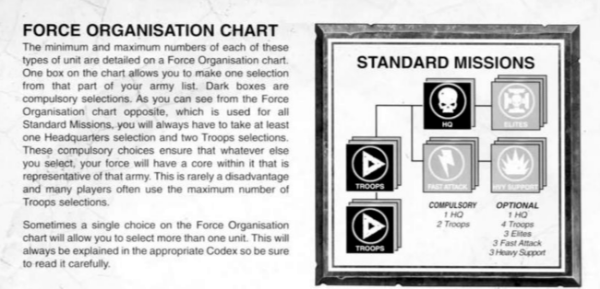
Essentially, it represented a fairly balanced force on manouevre. The associated core missions were Cleanse (sweeping an area of opposing troops), Secure and Control (recovering important things scattered across the battlefield- equipment, wounded comrades etc.), Seek and Destroy (attrition- aiming to kill as many of the enemy as possible), Recon (essentially reconnaissance in strength probing the enemy in prep for a major attack), and Take and Hold (a vanguard trying to secure an important point prior to the arrival of the main force). The central conceit is that both sides were launching a force into no-mans-land at the same time, of roughly equal strength (a fairly rare event in war), because this makes for easy pick-up games.
The other three missions using this FOC were Rescue (both sides trying to retrieve a key something), Night Fight (basically the same as Cleanse but at night), and Patrol (two patrols encounter each other and bring in reinforcements).
Then there is the alternative charts:
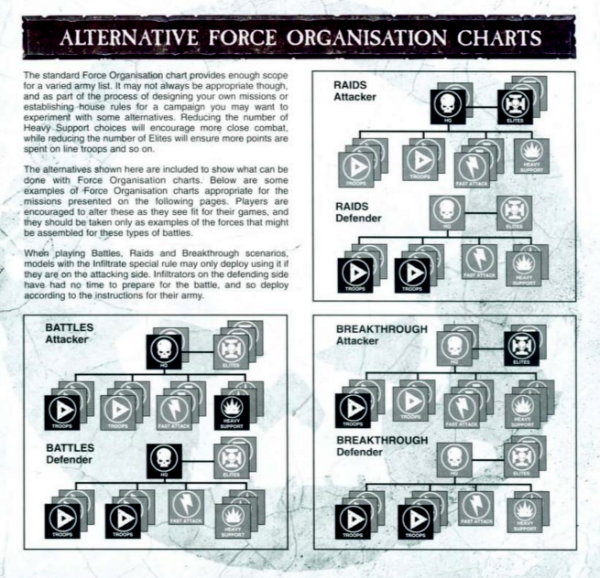
The associated Battles missions were Bunker Assault (enemy unexpectedly attacks fairly quiet part of fortification line, defender reserves rush to reinforce), Hold at All Costs (similar to Bunker Assault, but no fortifications and focused on a particular objective), and Meat Grinder (attritional assault with large reserves by the attacker outnumbering the defender).
The Raid missions were Sabotage (attacker sneaks up to important thing to blow it up, defender is on guard duty), Ambush (attacker ambushes the defender travelling in a column, who then has to break through the ambush), and Strongpoint Attack (attacker sneaks up to a fortification line to take out one or more bunkers and break the line).
The Breakthrough missions were Rearguard (heavily outnumbered defender tries to hold off waves of attackers as long as possible), Blitz (prepared attack trying to break through heavy enemy fortifications), and Breakout (attacker has been trapped in a pocket and is surrounded, objective is to break out of the defenders and escape).
The main exception to this was the Wild Rider FOC used by Craftworld Eldar bike armies (themed around Saim-Hann, but not limited to them):
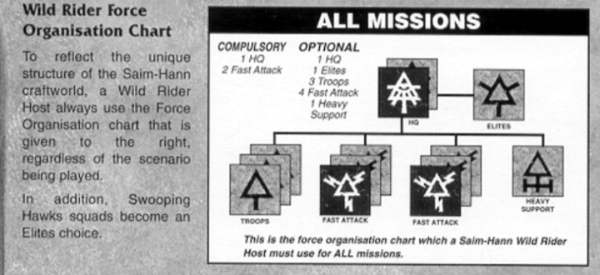
They used this in all circumstances because that is how they fought. This was a bit different to other "fast" variants, who got a specific army list shuffling round the options in the FOC, like Speed Freakz, White Scars, or Ravenwing.
There were other slight variations, normally on the vein of two extra troops slots (Alaitoc could take two rangers squads as troops extra) or swapping a fast attack for a heavy support and vice versa (Iron Warriors and Night Lords).
Mid-level characters were not common yet, but they usually had a work-around where either several could be taken for the same slot (Lost and the Damned Aspiring Champions), or they didn't take a FOC slot at all (like Commissars), or were models that were part of a HQ retinue (which usually took the same FOC slot as their commander) that are now separate today. Banner bearers and apothecaries are the clearest example of the latter. Worth noting there were just a lot less mid-level characters, GW realised these sell well awhile ago and really churn them out now. I suspect they are so popular in part as painting exercises for collectors as much as their utility in games.
Expansions could also add FOCs- this one was from Cities of Death in 4th edition:
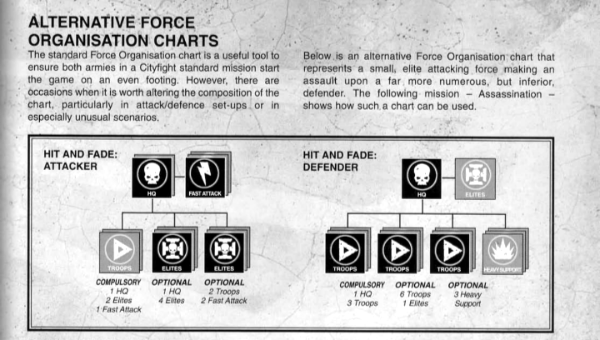
It was for an Assassination mission deep behind enemy lines, where the attacker has an elite, hard-hitting force and the target commander just has a bodyguard of mainly basic infantry because they were not expecting an attack on them directly.
There were other, special missions floating around, and a Combat Patrol mission for beginners with forces of 400pts maximum (which basically had its own FOC, but there was no pretty picture of this...).
I do think the overall goal here was for heavily themed forces for a given mission, with people tailoring their force somewhat for the situation they were fighting in. Unfortunately, that requires forward planning and does not work for pick-up games, so most people just played the core missions. Plus a lot of the extra missions required specific terrain to play, which increased the upfront preparation even more. I think the concept was very sound for a group regularly playing together in campaigns and so on, but never lived up to its potential for the majority of players who only did casual games. For them it then fell more into a chore to be worked around. Automatically Appended Next Post: Overall, I think this gets to the core of where somebody wants a given wargame to fall on the spectrum from actual military wargaming trying to approximate reality as close as possible to just going pew pew with toy soldiers.
The FOC was from an era trying to be a bit more simulationist in how forces were expected to be structured by the writers than today (and trying to be more simulationist in general to be honest, a lot more is abstracted out now). Special cases were expected to be houseruled for a given narrative if you couldn't fit them into the options above.
99475
Post by: a_typical_hero
Tyran wrote: Hellebore wrote:
Of the two designs, the FOC is closer to modelling army behaviour.
Is it?
No one is playing around with 15 captains and 9 Land Raiders.
Hell the mission and scoring requirements plus rule of 3 means most armies are a mixed force of Battleline/Troops and specialist units.
For all the issues modern 40k has, spamming Captains and Land Raiders is not one of it even if it is technically possible.
Which is more due to the units in question not being meta. If, for example, this composition would be able to table/outscore any opponent within 1-2 turns, you would see it frequently and it would be possible by the rules. Which is why I would keep balance related issues away from the core of the discussion. The pendulum can swing anytime and suddenly every Imperial army has a Knight, 32 Guardsmen and a bunch of Blood Angel Captains.
128381
Post by: KidCthulhu
I loved the force org chart because it made me a better player.
I started in 2E and I was terrible at list building. I played Eldar and wanted all the heroes and all the fun models, so I had things like "Maugan Ra and the bare minimum 3 Dark Reapers" as one squad, "bare minimum 10 Guardians because Guardian Tax" as another, "Karandras and 4 bare minimum Striking Scorpions" as another, and war machines, etc.
It was legal based on points percentage, but it also lead to each squad being summarily deleted by concentrated Marine fire.
However, when we all switched to the new 3E and my Dark Eldar had to use a force org, I learned to make viable armies. I'm still a lousy player, but I wasn't getting tabled so badly as I was in 2E.
105694
Post by: Lord Damocles
a_typical_hero wrote: Tyran wrote: Hellebore wrote:
Of the two designs, the FOC is closer to modelling army behaviour.
Is it?
No one is playing around with 15 captains and 9 Land Raiders.
Hell the mission and scoring requirements plus rule of 3 means most armies are a mixed force of Battleline/Troops and specialist units.
For all the issues modern 40k has, spamming Captains and Land Raiders is not one of it even if it is technically possible.
Which is more due to the units in question not being meta. If, for example, this composition would be able to table/outscore any opponent within 1-2 turns, you would see it frequently and it would be possible by the rules. Which is why I would keep balance related issues away from the core of the discussion. The pendulum can swing anytime and suddenly every Imperial army has a Knight, 32 Guardsmen and a bunch of Blood Angel Captains.
'Nobody would make an army of just flying Hive Tyrants!'
91640
Post by: Wyldhunt
Hellebore wrote:
It's a false dichotomy. Of the two designs, the FOC is closer to modelling army behaviour. Was it perfect? No. Did I claim it was? But it provides a slightly less abstract form of game than the current free for all. And that's all we're doing, comparing the two.
As for the idea that no real army took. 2 tax squads, well no army is composed of 50 men either. Your complaint is directed at the part of the game that's true across all versions of 40k. But the fact that the core units of the army are present is the important bit.
If we're talking about fluff/theme rather than balance (I think we all agree that balance is a good thing), then I'd argue that the "core units" being present isn't actually a good thing if your army's fluff specifically calls out the idea that they make less or no use of such units. To me, unit selection is a big part of how I represent my fluff. So if I'm trying to represent Iybraesil (known for fielding lots of banshees as the core of their army), then I want to include howling banshees where other armies might normally field guardians. If I field guardians as well as banshees, it waters down this idea and makes it feel like I just happen to be fielding banshees along with guardians the same way any other craftworld might. Sometimes jazz in the units you don't take.
I am firmly of the opinion that if you are going to play a game of an IP, then you are agreeing to take the possibilities with the limitations. How those limitations are modelled is less important than that they are. And for some reason people are fine with limitations like space.marine captains can't wear crisis suits, or Orks can't put their spirits in wraithguard, but guard colonels can't just make armies out of sentinels or artillery tanks it suddenly becomes negotiable
They're all part of the same fiction. You are absolutely telling people they're playing the game wrong when you won't let them use a crisis suit commander as their marine Captain.
I know people who have taken stabs at writing fluff for renegade marines that end up working for the tau, and while they're not wraithguard, I've played against orks that have plugged wires into the brains of carnifex to ride them into battle (used deff dread stats.) So my concern if someone wanted to field a crisis suit unit with his marine army isn't primarily fluff; it's crunch. My concern would be that if you're giving every army access to every unit, you risk some serious balance issues. But if someone homebrewed their custom marine character went around piloting a battlesuit because reasons, I'd give it a look and probably be fine playing against it if the rules were reasonable and they were excited about it.
I feel like there's kind of a spectrum of how okay people are with avoiding using troops, and where they stop being okay with it is telling. Putting it in eldar terms, it might look something like:
Ulthwe - Thematically emphasizes the use of troops and HQs. Very FOC compliant.
Iyanden - Emphasizes the use of wraithguard (normally elites). Usually has a rule to bend the FOC a little to make it easier to field wraiths in place of Troops. Well-known subfaction.
Iybraesil - Emphasizes the use of howling banshees as the core of their army. A canon but relatively minor craftworld. Not as wel known as Iyanden.
Craftworld Scorpius - Made-up fan craftworld. Like Iybraesil, they too emphasize the use of an aspect warrior as the heart of their army, but they prefer to use scorpions instead of banshees.
Craftworld Prismo - Made-up craftworld. They're like Iybraesil, except instead of howling banshees, they like to use fire prisms as their basic troops. (A more serious variant of this might be someone making the case that a machine-centric subfaction like Iron Hands would field this army or that their army happens to be an armored company, etc.)
Craftworld Wraithknighticus - Made-up craftworld that just fields wraith knights and the avatar in every single skirmish.
When discussions like this have come up before, it's not uncommon for someone to tell me that Iybraesil should maybe get a special exception so it can field banshees as troops. And then when asked about Scorpius, they get a little more iffy or they start to struggle to explain why there shouldn't be an exception for scorpions the way there are for banshees. Prismo is where most people (including myself) tend to draw a pretty firm line. And in my case, I'm drawing that line for balance reasons rather than fluff reasons. Because an all-tank army would be a skew list and come with the problems of all skew lists. I'm not necessarily opposed to some sort of armored company, but I'd want the rules to somehow acknowledge that that style of army is challenging some of the implied assumptions about the game, and I'd want it to include mechanics that make that matchup more interesting for an opponent with a conventional list.
And that circles back to why I don't much care for the FOC. It doesn't do much to address the balance issues, but it does make it harder to represent certain canonical, perfectly fluffy armies. So it's failing as a balance mechanic and it's failing as a tool for representing fluff. It doesn't even really convey the idea that troops make up the bulk of a given force very well because you can take your minimum troop tax worth of units and then have those two troop squads surrounded by elitse and heavy supports and fast attacks. Rather than conveying the idea that troops make up the bulk of a force, it instead conveys this idea that every single force regardless of their goals and theme will always have a tiny number of troops hanging around somewhere. Like the aftermath of a glitterbomb that you can't quite get rid of.
76888
Post by: Tyran
a_typical_hero wrote:Which is more due to the units in question not being meta. If, for example, this composition would be able to table/outscore any opponent within 1-2 turns, you would see it frequently and it would be possible by the rules. Which is why I would keep balance related issues away from the core of the discussion. The pendulum can swing anytime and suddenly every Imperial army has a Knight, 32 Guardsmen and a bunch of Blood Angel Captains.
Funny thing you mention, but 8th edition still used a FOC system. The FOC system only died until 10th.
That aside, you cannot separate it from balance discussions because the FOC was often part of the balancing issues. Did a faction have overcrowded slots? Were their troops cheap or efficient to the point they weren't a tax? Did they have ways to modify the FOC?
All that and probably more I cannot even remember were balance issues from back then.
136765
Post by: OldeSword
OldeSword wrote:Da Boss wrote:Generally a dedicated transport is something that is only really good for transporting units and not much else. There's some wiggle room - both Rhinos and Razorbacks are Dedicated Transports even though the Razorback still has decent shooting ability.
I'm not well informed about League vehicles, but if you're thinking "I'd never take this without a squad to go in it" then it's a dedicated transport.
Mad Doc Grotsnik wrote:The Saggitaur falls into that category, and in terms of application is closest to a Razorback. But, you can (or could) take two to cart about a single squad. Whereas I’ve never heard of being able to do that with Razorbacks.
That is why I asked. I see Sagitaurs as transports, since I wouldn't take them if I didn't have a unit to put in them, yet the 9e codex classified them as Fast Attack and not Dedicated Transports.
I poked at the app last night, and, in 11e, both Kapricus Carriers and Sagitaurs are under "Dedicated Transports" now instead of "Other Datasheets," so it sounds like the designers now agree with us. And, even if we don't have Elites, Fast Attack, or Heavy Support anymore, Dedicated Transports lives on.
Haighus wrote:Essentially, it represented a fairly balanced force on manouevre. The associated core missions were Cleanse (sweeping an area of opposing troops), Secure and Control (recovering important things scattered across the battlefield- equipment, wounded comrades etc.), Seek and Destroy (attrition- aiming to kill as many of the enemy as possible), Recon (essentially reconnaissance in strength probing the enemy in prep for a major attack), and Take and Hold (a vanguard trying to secure an important point prior to the arrival of the main force). The central conceit is that both sides were launching a force into no-mans-land at the same time, of roughly equal strength (a fairly rare event in war), because this makes for easy pick-up games.
<snip>
I do think the overall goal here was for heavily themed forces for a given mission, with people tailoring their force somewhat for the situation they were fighting in. Unfortunately, that requires forward planning and does not work for pick-up games, so most people just played the core missions. Plus a lot of the extra missions required specific terrain to play, which increased the upfront preparation even more. I think the concept was very sound for a group regularly playing together in campaigns and so on, but never lived up to its potential for the majority of players who only did casual games. For them it then fell more into a chore to be worked around.
Overall, I think this gets to the core of where somebody wants a given wargame to fall on the spectrum from actual military wargaming trying to approximate reality as close as possible to just going pew pew with toy soldiers.
The FOC was from an era trying to be a bit more simulationist in how forces were expected to be structured by the writers than today (and trying to be more simulationist in general to be honest, a lot more is abstracted out now). Special cases were expected to be houseruled for a given narrative if you couldn't fit them into the options above.
This whole post was super informative. Thank you.
This makes me look at the detachments in 11e in a new light. The detachments now come with Force Dispositions that sound a lot like those core missions: "Purge the Foe" instead of Cleanse or maybe Seek and Destroy, "Priority Assets" instead of Secure and Control, Reconnaissance is still Recon, Take and Hold is the same, and Disruption is new.
But now, instead of having to work out a different themed force for each mission, which as you pointed out was a real burden for people, people take their Force Disposition with them and have worked out their armies in advance. The only thing that's missing is an actual structure around which units go with each detachment. I wonder if GW is trying to encourage one. It shouldn't take too much imagination to think about how the different force dispositions would affect army structure, and the alternate FOCs you posted should help there.
KidCthulhu wrote:I loved the force org chart because it made me a better player.
I started in 2E and I was terrible at list building. I played Eldar and wanted all the heroes and all the fun models, so I had things like "Maugan Ra and the bare minimum 3 Dark Reapers" as one squad, "bare minimum 10 Guardians because Guardian Tax" as another, "Karandras and 4 bare minimum Striking Scorpions" as another, and war machines, etc.
It was legal based on points percentage, but it also lead to each squad being summarily deleted by concentrated Marine fire.
However, when we all switched to the new 3E and my Dark Eldar had to use a force org, I learned to make viable armies. I'm still a lousy player, but I wasn't getting tabled so badly as I was in 2E.
This was one of the things that prompted me to start this thread. Another user said, roughly paraphrasing, "Has anyone else noticed that the placing armies in 10e were generally balanced armies that could fit in the old FOC?" And that made me wonder what I was missing.
91640
Post by: Wyldhunt
Tyran wrote: a_typical_hero wrote:Which is more due to the units in question not being meta. If, for example, this composition would be able to table/outscore any opponent within 1-2 turns, you would see it frequently and it would be possible by the rules. Which is why I would keep balance related issues away from the core of the discussion. The pendulum can swing anytime and suddenly every Imperial army has a Knight, 32 Guardsmen and a bunch of Blood Angel Captains.
Funny thing you mention, but 8th edition still used a FOC system. The FOC system only died until 10th.
That aside, you cannot separate it from balance discussions because the FOC was often part of the balancing issues. Did a faction have overcrowded slots? Were their troops cheap or efficient to the point they weren't a tax? Did they have ways to modify the FOC?
All that and probably more I cannot even remember were balance issues from back then.
I think it's possible to discuss how well FOCs represent fluff as a semi-distinct conversation from balance. I'd argue that regardless of how broken or not banshees as troops would be, forcing an Iybraesil player to field other troops instead of/in addition to banshees is a mark against it as a tool for fluff. Or for a less obscure comparison, the FOC gets in the way of people fielding Death Wing armies or White Scars bike spam armies. Which is why there were workarounds to facilitate those lists pretty early on.
136765
Post by: OldeSword
Wyldhunt wrote:I feel like there's kind of a spectrum of how okay people are with avoiding using troops, and where they stop being okay with it is telling. Putting it in eldar terms, it might look something like:
Ulthwe - Thematically emphasizes the use of troops and HQs. Very FOC compliant.
Iyanden - Emphasizes the use of wraithguard (normally elites). Usually has a rule to bend the FOC a little to make it easier to field wraiths in place of Troops. Well-known subfaction.
Iybraesil - Emphasizes the use of howling banshees as the core of their army. A canon but relatively minor craftworld. Not as wel known as Iyanden.
Craftworld Scorpius - Made-up fan craftworld. Like Iybraesil, they too emphasize the use of an aspect warrior as the heart of their army, but they prefer to use scorpions instead of banshees.
Craftworld Prismo - Made-up craftworld. They're like Iybraesil, except instead of howling banshees, they like to use fire prisms as their basic troops. (A more serious variant of this might be someone making the case that a machine-centric subfaction like Iron Hands would field this army or that their army happens to be an armored company, etc.)
Craftworld Wraithknighticus - Made-up craftworld that just fields wraith knights and the avatar in every single skirmish.
When discussions like this have come up before, it's not uncommon for someone to tell me that Iybraesil should maybe get a special exception so it can field banshees as troops. And then when asked about Scorpius, they get a little more iffy or they start to struggle to explain why there shouldn't be an exception for scorpions the way there are for banshees. Prismo is where most people (including myself) tend to draw a pretty firm line. And in my case, I'm drawing that line for balance reasons rather than fluff reasons. Because an all-tank army would be a skew list and come with the problems of all skew lists. I'm not necessarily opposed to some sort of armored company, but I'd want the rules to somehow acknowledge that that style of army is challenging some of the implied assumptions about the game, and I'd want it to include mechanics that make that matchup more interesting for an opponent with a conventional list.
I think the distinction between those two groups - or where the line might be drawn for many people - is the difference between "I am trying to make my army represent the fluff" and "I invented some fluff to justify my ridiculous army." Like, if someone wanted to roll their own craftworld but it played like Ulthwe, I doubt that anyone would object. Scorpius is "iffy" because it's not a canonical craftworld, but its desired mechanics is so similar as those of Iybraesil that it is probably okay - unless scorpions are just innately superior to banshees or something. I'd probably let it fly because I usually see such things in other games with people who are really enthusiastic about the lore and their part of it without any sort of ill intent.
The other two feel like cheese with a paper-thin layer of "lore" wrapped around it to try and justify the cheese. It doesn't pass the sniff test. And people know it.
Wyldhunt wrote:And that circles back to why I don't much care for the FOC. It doesn't do much to address the balance issues, but it does make it harder to represent certain canonical, perfectly fluffy armies. So it's failing as a balance mechanic and it's failing as a tool for representing fluff. It doesn't even really convey the idea that troops make up the bulk of a given force very well because you can take your minimum troop tax worth of units and then have those two troop squads surrounded by elitse and heavy supports and fast attacks. Rather than conveying the idea that troops make up the bulk of a force, it instead conveys this idea that every single force regardless of their goals and theme will always have a tiny number of troops hanging around somewhere. Like the aftermath of a glitterbomb that you can't quite get rid of.
I think you've made the best case against a strict FOC. Not that my opinion matters for anything.
Personally, I am a thematic/narrative player. The thing that really got me excited about 9e and 10e was the idea of Crusade, and, when inspiration for an army strikes, it immediately comes with lore. I then try to find an army, detachment, or whatever to make those line up. So my goals are:
1. Field a fluffy or thematic army. I want my army to be my army and not the same as the next army. I like chess, but this isn't chess.
2. Ensure everyone has fun. (Why people hate fighting all bikes or all tanks or just knights in general, apparently, is of interest to me. Especially knights since I have an idea for a Freeblad Company kicking around in my notes).
3. Be competent at it. Winning isn't everything, but I don't enjoy getting obliterated.
So I would be looking for the FOC - or something like it - to serve all three points.
9708
Post by: Orkeosaurus
There is no legitimate way to reconcile the idea of forcing armies to conform to a FoC while keeping armies like Deathwing, Armored Company, Kult of Speed, Knight Titans, and Green Tide as core cannon army concepts that players are entitled to use. If these armies are unfair and make for bad play experiences then you can't allow people to play them. If they don't then the FoC is just causing people problems without justification.
This discussion always goes the same way: Person 1 says he wants to bring back the FoC to prevent cheesy skew lists. Then Person 2 says that he plays a skew list and likes it, so he opposes FoC. Then Person 1 immediately starts coming up with a bunch of special exceptions, carve-outs, alternate subfactions, or whatever that ensures Person 2 is able to take his skew list unchanged. Never once have I seen Person 1 tell Person 2 "well that's too bad, the line has to be drawn somewhere"; the new never-explicitly-defined FoC system will only ever affect The Other Guy's army, never mine. Because there will always be a loophole for whatever I want to play.
Apparently we only need the FoC to protect us from unviable joke-armies, like 20 Primaris Lieutenants. Because anything besides a joke-army will have players who want to use it, and they won't accept the FoC if it inhibits them in some way. Do I also need the Tau codex to have rules that prohibit me from running them up the table to charge bloodletters in melee? Or that prohibit them from shooting their railguns at grots and their pulse riles at the stompa? That's also stupid and unfluffy but it doesn't cause problems because it isn't effective. The game doesn't need rules that prohibit players from doing silly stuff as a joke when they don't care about winning. To claim that you only want FoC to prevent that from happening strikes me as dishonest.
Restrictions restrict people, who then feel restricted by them. That's their purpose. The FoC would exist to prevent some people from playing the army that they want to play and they would have to suck it up and possibly buy new models. Or else it would just be pointless annoying busywork, where I have to register my terminators as Deathwing in the Cayman Islands who happen to be painted blue. Which is what FoC quickly turned into in real-life, because everyone demanded a special loophole for the skew army they wanted to play.
105694
Post by: Lord Damocles
 Orkeosaurus wrote: Orkeosaurus wrote:Never once have I seen Person 1 tell Person 2 "well that's too bad, the line has to be drawn somewhere"
Imperial/Chaos Knights shouldn't be factions in standard 40K (at least without a fundamental re-design on how suerheavies and vehicles generally work mechanically). There you go.
The rest you can play with specific HQs making different units Troops (Tank Commander makes Leman Russes Troops choices, but you have to take at least three, or something).
136765
Post by: OldeSword
Orkeosaurus wrote:There is no legitimate way to reconcile the idea of forcing armies to conform to a FoC while keeping armies like Deathwing, Armored Company, Kult of Speed, Knight Titans, and Green Tide as core cannon army concepts that players are entitled to use. If these armies are unfair and make for bad play experiences then you can't allow people to play them. If they don't then the FoC is just causing people problems without justification.
This discussion always goes the same way: Person 1 says he wants to bring back the FoC to prevent cheesy skew lists. Then Person 2 says that he plays a skew list and likes it, so he opposes FoC. Then Person 1 immediately starts coming up with a bunch of special exceptions, carve-outs, alternate subfactions, or whatever that ensures Person 2 is able to take his skew list unchanged. Never once have I seen Person 1 tell Person 2 "well that's too bad, the line has to be drawn somewhere"; the new never-explicitly-defined FoC system will only ever affect The Other Guy's army, never mine. Because there will always be a loophole for whatever I want to play.
I'd be willing to say that. If an canonically fluffy army is oppressive and therefore Not Fun, I think it is appropriate to say, "Sorry. This game was designed for and balanced around the idea of small forces of combined arms, and all tanks/infantry/whatever overwhelms the other players' ability to respond. You can only skew your army as far as the FOC allows." At the end of the day, this is a game, and it's supposed to be fun. Oppressive armies are bad for the tournament scene, as it upsets the meta until everyone is doing the same thing, and it's bad for casual games as my friends aren't going to want me around to throw dice, drink beer, and make sound effects if my army consistently tables theirs.
This could also be a good use of the spam tax (or a related skew tax)? It sounds like a prescribed FOC for fluffy skew lists wouldn't really work as, unless there was a single canonical army that people could field, people would find ways to push the wiggle room to the max. And people want to be able to customize their armies. If, instead, you could skew the list but each unit of X type became increasingly expensive, someone could maybe bring an "oops all tanks" list but the army would be smaller than if it was a combined arms force. That wouldn't overwhelm the opponents' anti-tank quite as much, and the rest of the army would have more options to maneuver around the tanks or even overwhelm them through volume of less-than-ideal fire.
62565
Post by: Haighus
 Wyldhunt wrote: Wyldhunt wrote: Hellebore wrote:
It's a false dichotomy. Of the two designs, the FOC is closer to modelling army behaviour. Was it perfect? No. Did I claim it was? But it provides a slightly less abstract form of game than the current free for all. And that's all we're doing, comparing the two.
As for the idea that no real army took. 2 tax squads, well no army is composed of 50 men either. Your complaint is directed at the part of the game that's true across all versions of 40k. But the fact that the core units of the army are present is the important bit.
If we're talking about fluff/theme rather than balance (I think we all agree that balance is a good thing), then I'd argue that the "core units" being present isn't actually a good thing if your army's fluff specifically calls out the idea that they make less or no use of such units. To me, unit selection is a big part of how I represent my fluff. So if I'm trying to represent Iybraesil (known for fielding lots of banshees as the core of their army), then I want to include howling banshees where other armies might normally field guardians. If I field guardians as well as banshees, it waters down this idea and makes it feel like I just happen to be fielding banshees along with guardians the same way any other craftworld might. Sometimes jazz in the units you don't take.
I am firmly of the opinion that if you are going to play a game of an IP, then you are agreeing to take the possibilities with the limitations. How those limitations are modelled is less important than that they are. And for some reason people are fine with limitations like space.marine captains can't wear crisis suits, or Orks can't put their spirits in wraithguard, but guard colonels can't just make armies out of sentinels or artillery tanks it suddenly becomes negotiable
They're all part of the same fiction. You are absolutely telling people they're playing the game wrong when you won't let them use a crisis suit commander as their marine Captain.
I know people who have taken stabs at writing fluff for renegade marines that end up working for the tau, and while they're not wraithguard, I've played against orks that have plugged wires into the brains of carnifex to ride them into battle (used deff dread stats.) So my concern if someone wanted to field a crisis suit unit with his marine army isn't primarily fluff; it's crunch. My concern would be that if you're giving every army access to every unit, you risk some serious balance issues. But if someone homebrewed their custom marine character went around piloting a battlesuit because reasons, I'd give it a look and probably be fine playing against it if the rules were reasonable and they were excited about it.
I feel like there's kind of a spectrum of how okay people are with avoiding using troops, and where they stop being okay with it is telling. Putting it in eldar terms, it might look something like:
Ulthwe - Thematically emphasizes the use of troops and HQs. Very FOC compliant.
Iyanden - Emphasizes the use of wraithguard (normally elites). Usually has a rule to bend the FOC a little to make it easier to field wraiths in place of Troops. Well-known subfaction.
Iybraesil - Emphasizes the use of howling banshees as the core of their army. A canon but relatively minor craftworld. Not as wel known as Iyanden.
Craftworld Scorpius - Made-up fan craftworld. Like Iybraesil, they too emphasize the use of an aspect warrior as the heart of their army, but they prefer to use scorpions instead of banshees.
Craftworld Prismo - Made-up craftworld. They're like Iybraesil, except instead of howling banshees, they like to use fire prisms as their basic troops. (A more serious variant of this might be someone making the case that a machine-centric subfaction like Iron Hands would field this army or that their army happens to be an armored company, etc.)
Craftworld Wraithknighticus - Made-up craftworld that just fields wraith knights and the avatar in every single skirmish.
When discussions like this have come up before, it's not uncommon for someone to tell me that Iybraesil should maybe get a special exception so it can field banshees as troops. And then when asked about Scorpius, they get a little more iffy or they start to struggle to explain why there shouldn't be an exception for scorpions the way there are for banshees. Prismo is where most people (including myself) tend to draw a pretty firm line. And in my case, I'm drawing that line for balance reasons rather than fluff reasons. Because an all-tank army would be a skew list and come with the problems of all skew lists. I'm not necessarily opposed to some sort of armored company, but I'd want the rules to somehow acknowledge that that style of army is challenging some of the implied assumptions about the game, and I'd want it to include mechanics that make that matchup more interesting for an opponent with a conventional list.
And that circles back to why I don't much care for the FOC. It doesn't do much to address the balance issues, but it does make it harder to represent certain canonical, perfectly fluffy armies. So it's failing as a balance mechanic and it's failing as a tool for representing fluff. It doesn't even really convey the idea that troops make up the bulk of a given force very well because you can take your minimum troop tax worth of units and then have those two troop squads surrounded by elitse and heavy supports and fast attacks. Rather than conveying the idea that troops make up the bulk of a force, it instead conveys this idea that every single force regardless of their goals and theme will always have a tiny number of troops hanging around somewhere. Like the aftermath of a glitterbomb that you can't quite get rid of.
I want to point out that both the Iybrasil and Scorpius examples you give could be comfortably played in 3rd (the edition that added FOCs) using the Swordwind list in Codex: Craftworld Eldar (this swapped near enough all Aspects into troops, except Shining Spears and Swooping Hawks). Whilst the list was named after Biel-Tan, the codex specifically mentioned all the lists were archetypes that could be found in any Eldar craftworld.
Looking at it, the only Aspect that couldn't be used as troops in any list was Swopping Hawks, so I suppose a homebrew Craftworld specifically focusing on Swooping Hawks would require some other units to fill the Troops slot.
71547
Post by: Sgt_Smudge
Wyldhunt wrote:Or alternatively, I swing in the opposite direction and think that if we're going to impose GW's vision of what a "thematic list" is onto the rules, we should really lean into it. Create a bunch of relatively specific detachments each with their own force org chart that allows more of certain thematic units and makes less thematic units harder to field en masse. Almost Boarding Action style.
I strongly support this. Let's go back to Formations as a hypothetical. Specifically, Space Marines, because they're incredibly well documented in terms of the sorts of armies they deploy in. We have the "standard" deployment for nearly all Space Marine strikeforces: the demi-company. This comprises of: - A commander (nominally a Captain, the company Chaplain, one of the two Lieutenants of the company, or maybe even a Librarian or Techmarine perhaps) - this is your 1 mandatory HQ in the old FOC - Three Battleline squads (in the pre-Indomitus era, this was just Tactical Squads - with Primaris, it becomes Intercessors, Heavy Intercessors, and Infiltrators). This is your 2 mandatory Troops in the old FOC, plus one more. Note that Scouts, even though they were Troops in pre-7th (I want to say 7th is when they moved to being Elites?), are not part of the demi-company. More on this later. - A Close Support squad (in the pre-Indomitus era, this was Assault Squads, Bike Squads, Assault Centurions, and Attack Bikes/Land Speeders if requisitioned. With Primaris, it opens up to Assault Intercessors of both kinds, Outriders, Inceptors, Incursors, Infernus Squads, Reivers, Invaders and Storm Speeders, the latter two treated like Attack Bikes and Land Speeders respectively). This is a single Fast Attack choice in the old FOC (except, representing a common concern about how units were categorised awkwardly in the FOC, I believe that Assault Centurions were considered as Elites?) - A Fire Support squad (Devastators and Devastator Centurions in Firstborn, now including Desolators, Eliminators, Hellblasters, Suppressors, Eradicators, Aggressors). This is a single Heavy Support choice in the old FOC (nowithstanding that Aggressors were considered Elites when they first came out? And Suppressors were Fast Attack?) So, this is a barebones FOC, with one of the Troops, Fast Attack, and Heavy Support slots each filled. Common features of a demi-company might also include one of the Company's Dreadnoughts (usually an Elites slot), so that takes us to a mandatory FOC, with an extra unit filling every other role except HQ (unless the player took a support HQ to back up the Captain/Chaplain who normally leads the demi-company). Throw in the options for an Apothecary and Company Heroes and that's a pretty solid demi-company! This demi-company could be augmented by individual units or formations requisitioned from across the Chapter. Say, it has "3 auxiliary slots" which can accompany it. This could range from, say: - Reserve Company Auxiliaries (say, 1-3 Battleline/Close Support/Fire Support units, and a Lieutenant, representing a smaller-than-demi-company detachment sent from another company to provide an extra niche) - Recon Auxiliaries (1-3 units with either the Phobos or Scouts keywords and an optional Lieutenant, representing 10th Company assets) - Veteran Auxiliaries (1-3 Terminator Squads, Sternguard, Vanguard, or Bladeguard Veterans, and an optional Lieutenant, representing 1st Company assets) - Armoured Support (1-3 Tanks, not including Rhinos, Razorbacks, Drop Pods, Impulsors, or Repulsors, as those could be bought as Dedicated Transports anyways for their corresponding unit - plus an optional Techmarine, this representing an armoured division being deployed in support). - Chapter Command (a single high up HQ, something like a Chapter Master, Chief Librarian, Reclusiarch, Master of the Forge, Chief Apothecary, so on, and a retinue for them - a single Infantry (or Mounted!) unit which they *must* join, which represents their elite bodyguard. I could have suggested that they could ONLY have a bodyguard drawn from the Veteran Auxiliaries list but, eh, customisation?) Because there's only 3 of these "auxiliary" detachments, you sort of need to nail down cohesive groupings of extra support units. BUT, if you wanted more, you could expand the core of the army into a full Battle Company, which might unlock more auxiliary detachments (by this point, this is mostly for much larger games, but you'd be able to fill out a demi-company and 3 auxiliary detachments easily by 2k anyways if you committed to them). So far, so good! But what if you're one of those "weird" ways that Space Marines also fight in? A Terminator teleport strikeforce? The 10th Company taking the field in force? Armies like the Blood Angels who bring jump pack troops in their battle companies, or White Scars who may sometimes bring more bikes than usual, or even just a Codex Chapter's 8th Company, deploying en masse? An Armoured Spearhead? Well, that could be arranged! Instead of picking the demi-company to start with, you pick from a different core formation. That formation might only allow for very specific units - a 10th Company one might force 3 units of "battleline" Phobos/Scout squads, a "close support" Phobos squad, and a "fire support" Phobos squad, and only allow for Phobos HQs. A 1st Company one might force you to take 5 Veteran units (described above). And you might only get 2 auxiliary slots to augment it (and no taking auxiliary detachments which are like the core one - no Veteran Auxiliaries for a 1st Company core!) - so you need to really double down on the choices you started with! Maybe even insert additional gameplay restrictions into those "skewed" formations - perhaps the 1st Company force loses VP from their final total if X% of their units are destroyed/battleshocked. Perhaps the 10th Company need to accomplish an additional objective, or they lose VP. Something - something to say "hey, you CAN skew into this fluffy detachment, but you need to commit to it, and it'll be made harder in some ways to win". This is just for Space Marines. I'm sure that the same could be done for the other armies - Imperial Guard with their platoon structure, Orks following bosses in smaller splinter warbands, etc. This is the sort of stuff I liked about formations - scrap all the "if I take these units I was already taking, I get extra buffs" nonsense.
99475
Post by: a_typical_hero
Wyldhunt wrote: Tyran wrote: a_typical_hero wrote:Which is more due to the units in question not being meta. If, for example, this composition would be able to table/outscore any opponent within 1-2 turns, you would see it frequently and it would be possible by the rules. Which is why I would keep balance related issues away from the core of the discussion. The pendulum can swing anytime and suddenly every Imperial army has a Knight, 32 Guardsmen and a bunch of Blood Angel Captains.
Funny thing you mention, but 8th edition still used a FOC system. The FOC system only died until 10th.
That aside, you cannot separate it from balance discussions because the FOC was often part of the balancing issues. Did a faction have overcrowded slots? Were their troops cheap or efficient to the point they weren't a tax? Did they have ways to modify the FOC?
All that and probably more I cannot even remember were balance issues from back then.
I think it's possible to discuss how well FOCs represent fluff as a semi-distinct conversation from balance. I'd argue that regardless of how broken or not banshees as troops would be, forcing an Iybraesil player to field other troops instead of/in addition to banshees is a mark against it as a tool for fluff. Or for a less obscure comparison, the FOC gets in the way of people fielding Death Wing armies or White Scars bike spam armies. Which is why there were workarounds to facilitate those lists pretty early on.
@Tyran
I think the FOC in 8th is a completely different beast than how it used to be from 3rd to 5th (possibly 6th, didn't play that long enough and 7th used formations most of the time) and you won't see me defending that one because of it. I don't want to talk about balance because it is a mood point.
The old FOC sucks if your faction does not have good Troops and sees those two mandatory units as tax. The modern rule of 3 sucks if an army has multiple busted units that would fall into the same classic battlefield role, as now you won't just face 3 Elite, but 3x unit A, 3x unit B and so on. Unit and mission balance happen besides both those rules for army composition.
@Wyldhunt
I think the classic FOC with liberal ways to change what consitutes as "Troops" for your chosen theme would be a good thing. That Iybraesil list could for example be represented with something like
"Aspect Focus
- <Aspect> units can be taken as Troops.
- Non-<Aspect> Troops become Elite choices."
Ideally, no themed list would be better than the default and would come with some kind of drawback.
Orkeosaurus wrote:There is no legitimate way to reconcile the idea of forcing armies to conform to a FoC while keeping armies like Deathwing, Armored Company, Kult of Speed, Knight Titans, and Green Tide as core cannon army concepts that players are entitled to use. If these armies are unfair and make for bad play experiences then you can't allow people to play them. If they don't then the FoC is just causing people problems without justification.
This discussion always goes the same way: Person 1 says he wants to bring back the FoC to prevent cheesy skew lists. Then Person 2 says that he plays a skew list and likes it, so he opposes FoC. Then Person 1 immediately starts coming up with a bunch of special exceptions, carve-outs, alternate subfactions, or whatever that ensures Person 2 is able to take his skew list unchanged. Never once have I seen Person 1 tell Person 2 "well that's too bad, the line has to be drawn somewhere"; the new never-explicitly-defined FoC system will only ever affect The Other Guy's army, never mine. Because there will always be a loophole for whatever I want to play.
...
Knight and tank only armies don't belong into the (standard) game. No exceptions or themed lists for them. There, I said it.
50541
Post by: Ashiraya
I think tank only armies have some flavour, but also like, the way people portray them as aren't -that- much of a thing in the lore either?
Tanks without infantry support are vulnerable, and as mad as 40k is, even GW seems to realise that on some level, because there is a serious focus on combined arms. The biggest tank battle in Imperial history was Tallarn where they -had- to fight unsupported because the toxic environment was unsurvivable for infantry. They don't really do that otherwise.
You could compromise by letting people tank spam with specialised armies, but also factoring in how vulnerable such an unsupported formation is. Often they have done that by being unable to claim objectives, for example.
118486
Post by: Andykp
It’s basically a subjective choice, some like them some don’t. There’s no way of saying one is better than the other. I really like army design now, and we seem to less BS than we did in the past with loyal 32 or flyrant armies. Considering there is more choice and freedom now, lists seem to me more varied and fluffy than before. But that’s maybe my experience and my preference giving me a confirmation bias. But I’ve played all 11 editions of 40K and the FOC was the worst for army design no matter how they tried to tweak it or break it.
9708
Post by: Orkeosaurus
OldeSword wrote:I'd be willing to say that. If an canonically fluffy army is oppressive and therefore Not Fun, I think it is appropriate to say, "Sorry. This game was designed for and balanced around the idea of small forces of combined arms, and all tanks/infantry/whatever overwhelms the other players' ability to respond. You can only skew your army as far as the FOC allows." At the end of the day, this is a game, and it's supposed to be fun. Oppressive armies are bad for the tournament scene, as it upsets the meta until everyone is doing the same thing, and it's bad for casual games as my friends aren't going to want me around to throw dice, drink beer, and make sound effects if my army consistently tables theirs.
I do respect that position, to be honest I wouldn't allow Knight Titans to exist as their own codex, I think that's absurd. There simply isn't enough to interact with to make the game fun, whether they're powerful or not. I would probably combine them with AdMech or something.
But what I hate is this:
 Haighus wrote: Haighus wrote:I want to point out that both the Iybrasil and Scorpius examples you give could be comfortably played in 3rd (the edition that added FOCs) using the Swordwind list in Codex: Craftworld Eldar (this swapped near enough all Aspects into troops, except Shining Spears and Swooping Hawks). Whilst the list was named after Biel-Tan, the codex specifically mentioned all the lists were archetypes that could be found in any Eldar craftworld.
Then why is it restricted for everyone else? GW tells me that it's not unbalanced to have 9 squads of scorpions, because that's why Biel-Tan is allowed to have it. Okay I accept that. So why am I forced to call my Craftworld Scorpius army "Biel-Tan" in order to take the scorpions that my fluff says they're entitled to? Why do I have to awkwardly explain to my opponent that my purple and orange eldar models are "counts-as Biel-Tan" but are actually my own craftworld from my blog, but they need to take a bunch of scorpions and only "Biel-Tan" are allowed to do that?
If anything the system should be reversed: the FoC should only be imposed on named subfactions, while if you have a custom army you can take whatever you want (subject to game balance (but not subject to fluff)). A custom craftworld could be all scorpions, or all jetbikes, or a mix of both. Biel-Tan would (probably) not field all jetbikes. Biel-Tan is more restricted by the fluff, not less, because they're a single defined craftworld rather than any one of hundreds. The only exception would be things like unique named characters or relics, that truly don't exist outside of that subfaction.
Predefined named subfactions should be for: A) new or casual players who want a "pre-built" army and paint scheme that works well out-of-the-box B) players who really like the fluff of the subfaction and would willingly take on extra restrictions (explicit or implicit) to be faithful to it or C) players who wanted to play that exact army-type and find it more convenient to say "White Scars" than "bike-heavy space marines". There's nothing wrong with any of those but what I don't accept is imposing unnecessary, arbitrary, and unfluffy restrictions on custom armies for the sole purpose of making predefined subfactions "feel more special". That is all the FoC turned into, and that's why I'm glad it's gone. Automatically Appended Next Post: Hellebore wrote:As for the idea of a tax - that's like saying the US army has a tax on infantry units rather than just deploying tanks. That's how armies work. There are limited numbers of some units, and there are units that are the core fighting force of the army.
If there was no limitations on units existing, real armies wouldn't rely on cheap infantry. Army comp free for all is like a general saying his army is just all nukes.
When the FOC interacts with the scenarios being played it also helps outline what the kind of force would actually be involved, rather than whatever composition you came up with.
FOC was a simulation mechanic to reflect that just because you the general may only want to deploy 10 shadow swords, you the general are lucky to get 1 leman Russ to go with your 10,000 conscripts.
Frankly I think this kind of "limited resources" argument is cherry-picked to justify the FoC retroactively.
An ork waaagh has more MANs than the entire Imperium has space marines. One splinter fleet has more carnifexes. I would assume Cadia had more Kasrkins. To say nothing of the ultra-rare Grey Knights, titans, primarchs, and one-of-a-kind relics that the game is full of. Compared to a land raider full of grey knight terminators nearly anything in the game is common as hell. And concentrating a bunch of tanks into an armored company or a bunch of stompas into a dread-mob is common, again way more common than concentrating 50 space marines in one place is. In large-scale games like Epic you see a bunch of that, and you could easily zoom-in on part of an Epic game and call that a game of 40k.
Why would guard ever deploy basic guardsman if their generals could build armies out of whatever they wanted, no logistics limitations, no costs issues. No imperial guard general has the freedom to build an army as absurdly as a 40k player does, so which guard general are you actually playing then?
Ursula Creed can't get 10 Leman Russ tanks to a single battle? Or 30 scout sentinels? Ghazghkull can't surround himself with nothing but nobs? How many monoliths does the Silent King own? Those are all valid warlord options in 40k, people who command millions if not billions of soldiers with equivalent tank and artillery support.
Games of 40k represent relatively elite forces clashing over vital objectives. That's why they're battles of annihilation, that's why space marines and eldar are there at all, that's why important named characters can take to the battlefield. It isn't Necromunda or Gorkamorka or something centered around regular grunts. And it never can be because space marines are the most popular army. They would either need to be completely changed in the fluff to a common trooper or be relegated to a limited "elite slot" choice in a mostly- IG "Imperial" army. Both are a non-starter for GW, obviously.
Ultimately the Space Marine army is itself a sort of "skew" list, into "elites", that was just so ubiquitous that it went without saying. A "troop" tactical marine was always more elite than a stormtrooper or a flashgit or even a dire avenger. And Nazdreg could much more freely send 100 flashgits into a fight than any Imperial commander could send a company of Ultramarines.
551
Post by: Hellebore
Your argument is because you can conceive of some combos they are possible and should be accessible. I can conceive of a 4 cornered triangle, doesn't give it any value. Having an idea and that idea being possible are 2 separate things.
every player has their own definition of what's acceptable from the 'lore' and plenty of power gamers used the lore to justify their broken armies because it's subjective.
The FOC or something like it is the game saying that this setting and IP has a freedom within this scope, rather than letting player fiat dictate.
No other part of the game allows player fiat and this particular part of the game is one of the most heavily tied to IP where there are actual limitations.
I can make up and bs to justify an army of marine scouts carrying plasma cannons, or Gretchin with kustom forcefields and a shock attack gun each.
The ability to invent crap to justify your army is the easiest part of the conversation. Words are cheap
9708
Post by: Orkeosaurus
No my argument is that a company of only Leman Russes is in no way difficult or unrealistic for Ursula Creed to deploy.
And on an aesthetic level I also think it's perfectly fine. It looks cool on the table, it's a classic tank company like WW2. The problem is neither fluff nor aesthetics, it's the gameplay issue of having an entire army that most of the opponent's models can barely interact with.
But if you tell me there is no gameplay issue when the all-Russ army is painted green, then don't prohibit me from playing an all-Russ army painted tan. Or tell me that I can only play an all-Russ army if Sergeant Tankius from the Cadian 123rd Armored Company is leading it. That's what the 4e and 5e FoC amounted to in reality.
Automatically Appended Next Post:
How about another example: 1 ork warboss + 500 grots
Is this a cool thematic army? No, except in the sense that it's funny.
Is this something that a warboss could choose to deploy? Yes, easily.
Is this something that you would be likely to encounter in the setting? This is actually mixed, it would be strange but I can come up with scenarios where it would happen. (Deposed by a rival and given an "army" of grots as a joke while marooned, for example). Statistically you would still be more likely to encounter this than an army of custodes, which players are allowed to field freely.
Would this be overpowered? No it would suck, they would just get pushed off the objectives because they lack any killing power.
Would this be fun to play against? No, it would be an amusing novelty at first but get really annoying if played out.
Should GW write rules specifically to prevent someone from playing this army? My answer is actually no, for the same reason that GW doesn't need to right rules forcing you to ever move a unit outside of your deployment zone. The rules are for a game in which both players are trying to win, if one player is trolling the other by deliberately losing in some absurd way then that's a sportsmanship issue.
Should GW write their rules to specifically ensure that this army can be played? My answer is also no, because this is a goofy joke-army and effort isn't needed to preserve it.
136765
Post by: OldeSword
Lord Damocles wrote:Imperial/Chaos Knights shouldn't be factions in standard 40K (at least without a fundamental re-design on how suerheavies and vehicles generally work mechanically).
a_typical_hero wrote:Knight and tank only armies don't belong into the (standard) game. No exceptions or themed lists for them. There, I said it.
Orkeosaurus wrote:I do respect that position, to be honest I wouldn't allow Knight Titans to exist as their own codex, I think that's absurd. There simply isn't enough to interact with to make the game fun, whether they're powerful or not. I would probably combine them with AdMech or something.
I've seen this sentiment in other threads too. What makes knights such a problem? I can hazard a guess, but I'm not aware of them dominating the tournament scene or anything.
My two favorite archetypes are knights and dwarves, so, when I learned about actually chivalrous warriors doing battle in giant robots, I was all for that idea. The only reason I haven't painted any yet is that I haven't developed my abilities enough yet to not mess them up. Yet it sounds like they are very Not Fun to play against, which would put a real dampener on things.
Orkeosaurus wrote:Ursula Creed can't get 10 Leman Russ tanks to a single battle? Or 30 scout sentinels? Ghazghkull can't surround himself with nothing but nobs? How many monoliths does the Silent King own? Those are all valid warlord options in 40k, people who command millions if not billions of soldiers with equivalent tank and artillery support.
Games of 40k represent relatively elite forces clashing over vital objectives. That's why they're battles of annihilation, that's why space marines and eldar are there at all, that's why important named characters can take to the battlefield. It isn't Necromunda or Gorkamorka or something centered around regular grunts. And it never can be because space marines are the most popular army. They would either need to be completely changed in the fluff to a common trooper or be relegated to a limited "elite slot" choice in a mostly-IG "Imperial" army. Both are a non-starter for GW, obviously.
Ultimately the Space Marine army is itself a sort of "skew" list, into "elites", that was just so ubiquitous that it went without saying. A "troop" tactical marine was always more elite than a stormtrooper or a flashgit or even a dire avenger. And Nazdreg could much more freely send 100 flashgits into a fight than any Imperial commander could send a company of Ultramarines.
I think your description of games of 40k is on point, which helps put some of the other questions into perspective.
Orkeosaurus wrote:No my argument is that a company of only Leman Russes is in no way difficult or unrealistic for Ursula Creed to deploy.
And on an aesthetic level I also think it's perfectly fine. It looks cool on the table, it's a classic tank company like WW2. The problem is neither fluff nor aesthetics, it's the gameplay issue of having an entire army that most of the opponent's models can barely interact with.
But if you tell me there is no gameplay issue when the all-Russ army is painted green, then don't prohibit me from playing an all-Russ army painted tan. Or tell me that I can only play an all-Russ army if Sergeant Tankius from the Cadian 123rd Armored Company is leading it. That's what the 4e and 5e FoC amounted to in reality.
This is closely linked to the previous quote, which is why I included both, and I think it's a fair point: In a clash of elite forces, Ursula Creed, Roboute Guilliman, the Lord Solar, the Silent King, Belisarius Cawl, or whoever else can probably field whatever they want. If any of those people are bothering to personally take to the field, they are bringing their choice of units. At least canonically. There's that whole game-balance thing.
It seems to me that GW is flirting with the idea of FOCs again what with detachments having Force Dispositions that map onto the previous core missions, Battleline units, the already existing Rule of Three, the spam tax, and even the modest return of wargear points. FOCs may not be their preferred or intended solution, but they've recognized some sort of problem and are looking to fix it. From what I've read in this discussion so far, there are lots of issues with previous implementations (When is there not a lot of issues with something?) including the proliferation of special FOCs that broke the system, the Rule of Three not doing anything for faction that have multiple units that fit the same role, and some of the restrictions feeling arbitrary.
What if there was one FOC per force disposition (easy and consistent across factions yet gives each force disposition its own flavor) or one per detachment (more nuanced, more fluffy, individual detachments could be balanced)?
Now... What if you could take more than your allotted number of X group - not Rule of Three unit but group - by paying a percentage tax on all the units of that group?
And this applied across the board so that everyone could choose to break the FOC for their fluffy bike squadron or tank company or whatever but they would have to pay for it?
The idea being that, if the FOCs represent balanced forces designed to play against each other, the FOCs establish the baseline for that force disposition / detachment, so they are "at cost." However, if you really want to color outside the lines, you can, but, since skew lists become increasingly difficult for other armies to handle, the lists are smaller the more that they are skewed to make them easier to handle.
If you want a thematic justification for it, sure, Ursula Creed can bring 10 Leman Russes into battle. She can pull three from this local depot and three from that local depot pretty easily. The next three have to come from that depot waaay over there, and, even though she is Ursula Creed and everyone does what she says, she can't overcome the logistics of moving those tanks that distance. And they actually had to reroute an orbital drop to get the tenth one, which was a real nightmare and got some bureaucrat at the Munitorum shot.
So it was expensive, and you didn't get as many tanks as you would have infantry for the same amount of logistics. But, if you really, really want to deploy nothing but tanks, you can.
8824
Post by: Breton
Wyldhunt wrote: Tyran wrote: a_typical_hero wrote:Which is more due to the units in question not being meta. If, for example, this composition would be able to table/outscore any opponent within 1-2 turns, you would see it frequently and it would be possible by the rules. Which is why I would keep balance related issues away from the core of the discussion. The pendulum can swing anytime and suddenly every Imperial army has a Knight, 32 Guardsmen and a bunch of Blood Angel Captains.
Funny thing you mention, but 8th edition still used a FOC system. The FOC system only died until 10th.
That aside, you cannot separate it from balance discussions because the FOC was often part of the balancing issues. Did a faction have overcrowded slots? Were their troops cheap or efficient to the point they weren't a tax? Did they have ways to modify the FOC?
All that and probably more I cannot even remember were balance issues from back then.
I think it's possible to discuss how well FOCs represent fluff as a semi-distinct conversation from balance. I'd argue that regardless of how broken or not banshees as troops would be, forcing an Iybraesil player to field other troops instead of/in addition to banshees is a mark against it as a tool for fluff. Or for a less obscure comparison, the FOC gets in the way of people fielding Death Wing armies or White Scars bike spam armies. Which is why there were workarounds to facilitate those lists pretty early on.
Deathwing or Ravenwing. White Scar Armies combined Troops in Transports with Bikes. Ravenwing (and Deathwing) Armies absolutely did not drag around two tactical squads of Green Wing who were not sufficiently indoctrinated into the Chapter hierarchy to see the secret mission they were on to find The Fallen. The other problem you had was just generic armies doing valid theme stuff - the all Phobos army doing a Recon mission - especially now that there are no Phobos units that count as Battleline. Right now you can't make the 10th Company because you can't get 60 Battle Line Phobos marines nor can you get 20 Heavy Support Phobos (though you can fudge the Heavy Support with Warsuits, and such. Automatically Appended Next Post: OldeSword wrote:
I've seen this sentiment in other threads too. What makes knights such a problem? I can hazard a guess, but I'm not aware of them dominating the tournament scene or anything.
The problem with knights is something that makes them worse not better. They have a harder time playing the mission lacking infantry to capture objectives in terrain they can't walk into. They don't have "action monkeys" either. They were designed for the earlier game - the I Kill You Before You Kill Me game, and that's no longer how its played.
121430
Post by: ccs
Breton wrote:
The problem with knights is something that makes them worse not better. They have a harder time playing the mission lacking infantry to capture objectives in terrain they can't walk into. They don't have "action monkeys" either. They were designed for the earlier game - the I Kill You Before You Kill Me game, and that's no longer how its played.
You are 100% wrong about Knights not having access to infantry/action monkeys.
Imperial Knights can dip into Agents of the Imperium for cheap bodies.
And they might(?) have some detachment that grants access to some sort of infantry? (I dont recall, I dont play Imperial Knights as a faction so dont really oay attention to them)
Chaos Knights can dip into Demons.
And they most definitely DO have a detachment that allows infantry from CSM - units with the Damned KW. This one i play.
I'm the odd (chaos) Knights player in that i do play with infantry tag alongs.
And if I had to, or I felt like it, I'd dip into demons.
Everyone else? Loyalist or traitor?
They seem quite content to just spend all their points on more Knights....
99475
Post by: a_typical_hero
OldeSword wrote:Lord Damocles wrote:Imperial/Chaos Knights shouldn't be factions in standard 40K (at least without a fundamental re-design on how suerheavies and vehicles generally work mechanically).
a_typical_hero wrote:Knight and tank only armies don't belong into the (standard) game. No exceptions or themed lists for them. There, I said it.
Orkeosaurus wrote:I do respect that position, to be honest I wouldn't allow Knight Titans to exist as their own codex, I think that's absurd. There simply isn't enough to interact with to make the game fun, whether they're powerful or not. I would probably combine them with AdMech or something.
I've seen this sentiment in other threads too. What makes knights such a problem? I can hazard a guess, but I'm not aware of them dominating the tournament scene or anything.
My two favorite archetypes are knights and dwarves, so, when I learned about actually chivalrous warriors doing battle in giant robots, I was all for that idea. The only reason I haven't painted any yet is that I haven't developed my abilities enough yet to not mess them up. Yet it sounds like they are very Not Fun to play against, which would put a real dampener on things.
Knights and tanks should feel almost invulnerable to standard infantry weapons, whether that means only being wounded on 6s or not being woundable at all unless the attacker has sufficient Strength (Armor Values).
The problem is that this can make the game very uninteractive for a typical TAC list. Many of your units are suddenly reduced to blocking movement, holding objectives, and trying to survive while being hammered every turn.
I do not want to remove that immersive feeling just to balance around a pure, high-toughness vehicle list. For that reason, I do not think such a list should be part of the standard game.
62565
Post by: Haighus
Orkeosaurus wrote:OldeSword wrote:I'd be willing to say that. If an canonically fluffy army is oppressive and therefore Not Fun, I think it is appropriate to say, "Sorry. This game was designed for and balanced around the idea of small forces of combined arms, and all tanks/infantry/whatever overwhelms the other players' ability to respond. You can only skew your army as far as the FOC allows." At the end of the day, this is a game, and it's supposed to be fun. Oppressive armies are bad for the tournament scene, as it upsets the meta until everyone is doing the same thing, and it's bad for casual games as my friends aren't going to want me around to throw dice, drink beer, and make sound effects if my army consistently tables theirs.
I do respect that position, to be honest I wouldn't allow Knight Titans to exist as their own codex, I think that's absurd. There simply isn't enough to interact with to make the game fun, whether they're powerful or not. I would probably combine them with AdMech or something.
But what I hate is this:
Haighus wrote:I want to point out that both the Iybrasil and Scorpius examples you give could be comfortably played in 3rd (the edition that added FOCs) using the Swordwind list in Codex: Craftworld Eldar (this swapped near enough all Aspects into troops, except Shining Spears and Swooping Hawks). Whilst the list was named after Biel-Tan, the codex specifically mentioned all the lists were archetypes that could be found in any Eldar craftworld.
Then why is it restricted for everyone else? GW tells me that it's not unbalanced to have 9 squads of scorpions, because that's why Biel-Tan is allowed to have it. Okay I accept that. So why am I forced to call my Craftworld Scorpius army "Biel-Tan" in order to take the scorpions that my fluff says they're entitled to? Why do I have to awkwardly explain to my opponent that my purple and orange eldar models are "counts-as Biel-Tan" but are actually my own craftworld from my blog, but they need to take a bunch of scorpions and only "Biel-Tan" are allowed to do that?
If anything the system should be reversed: the FoC should only be imposed on named subfactions, while if you have a custom army you can take whatever you want (subject to game balance (but not subject to fluff)). A custom craftworld could be all scorpions, or all jetbikes, or a mix of both. Biel-Tan would (probably) not field all jetbikes. Biel-Tan is more restricted by the fluff, not less, because they're a single defined craftworld rather than any one of hundreds. The only exception would be things like unique named characters or relics, that truly don't exist outside of that subfaction.
Predefined named subfactions should be for: A) new or casual players who want a "pre-built" army and paint scheme that works well out-of-the-box B) players who really like the fluff of the subfaction and would willingly take on extra restrictions (explicit or implicit) to be faithful to it or C) players who wanted to play that exact army-type and find it more convenient to say "White Scars" than "bike-heavy space marines". There's nothing wrong with any of those but what I don't accept is imposing unnecessary, arbitrary, and unfluffy restrictions on custom armies for the sole purpose of making predefined subfactions "feel more special". That is all the FoC turned into, and that's why I'm glad it's gone.
Automatically Appended Next Post:
Hellebore wrote:As for the idea of a tax - that's like saying the US army has a tax on infantry units rather than just deploying tanks. That's how armies work. There are limited numbers of some units, and there are units that are the core fighting force of the army.
If there was no limitations on units existing, real armies wouldn't rely on cheap infantry. Army comp free for all is like a general saying his army is just all nukes.
When the FOC interacts with the scenarios being played it also helps outline what the kind of force would actually be involved, rather than whatever composition you came up with.
FOC was a simulation mechanic to reflect that just because you the general may only want to deploy 10 shadow swords, you the general are lucky to get 1 leman Russ to go with your 10,000 conscripts.
Frankly I think this kind of "limited resources" argument is cherry-picked to justify the FoC retroactively.
An ork waaagh has more MANs than the entire Imperium has space marines. One splinter fleet has more carnifexes. I would assume Cadia had more Kasrkins. To say nothing of the ultra-rare Grey Knights, titans, primarchs, and one-of-a-kind relics that the game is full of. Compared to a land raider full of grey knight terminators nearly anything in the game is common as hell. And concentrating a bunch of tanks into an armored company or a bunch of stompas into a dread-mob is common, again way more common than concentrating 50 space marines in one place is. In large-scale games like Epic you see a bunch of that, and you could easily zoom-in on part of an Epic game and call that a game of 40k.
Why would guard ever deploy basic guardsman if their generals could build armies out of whatever they wanted, no logistics limitations, no costs issues. No imperial guard general has the freedom to build an army as absurdly as a 40k player does, so which guard general are you actually playing then?
Ursula Creed can't get 10 Leman Russ tanks to a single battle? Or 30 scout sentinels? Ghazghkull can't surround himself with nothing but nobs? How many monoliths does the Silent King own? Those are all valid warlord options in 40k, people who command millions if not billions of soldiers with equivalent tank and artillery support.
Games of 40k represent relatively elite forces clashing over vital objectives. That's why they're battles of annihilation, that's why space marines and eldar are there at all, that's why important named characters can take to the battlefield. It isn't Necromunda or Gorkamorka or something centered around regular grunts. And it never can be because space marines are the most popular army. They would either need to be completely changed in the fluff to a common trooper or be relegated to a limited "elite slot" choice in a mostly- IG "Imperial" army. Both are a non-starter for GW, obviously.
Ultimately the Space Marine army is itself a sort of "skew" list, into "elites", that was just so ubiquitous that it went without saying. A "troop" tactical marine was always more elite than a stormtrooper or a flashgit or even a dire avenger. And Nazdreg could much more freely send 100 flashgits into a fight than any Imperial commander could send a company of Ultramarines.
I do actually agree with you and vastly prefer generic archetypes over named variants. So to use the Eldar example- I prefer a "Swordwind" list over a "Biel-Tan" list. Granted, since that codex the name Swordwind has also become heavily associated with Biel-Tan exclusively but hey ho. Likewise for Guard, I prefer "Mechanised Guard" list over "Armageddon Steel Legion" list.
Incidentally, that is mostly how GW did it then. The list in Codex Armageddon was the Mechanised Company list, not the Steel Legion. They did make some rules for the Armageddon PDF specifically for the campaign though.
Even the Craftworld Eldar codex said this:
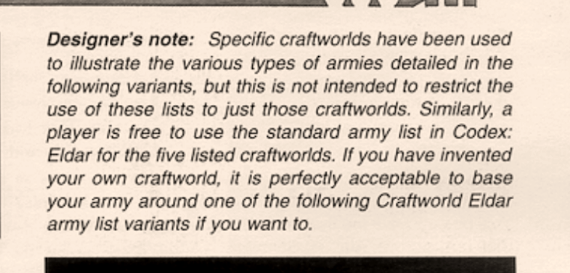
Essentially pointing out they'd used the big names for recognition, but any Craftworld fielded forces organised in this way at least sometimes.
Really only Space Marines were actually somewhat named-faction-locked, rather than being archetypes in how they were presented. Again though, successor Chapters were encouraged for homebrews. I think it only got a bit sticky if you tried to play your (named faction) Ultramarines as (named faction) Blood Angels just because you prefered the rules, rather than doing a blue Blood Angels successor Chapter.
551
Post by: Hellebore
Orkeosaurus wrote:No my argument is that a company of only Leman Russes is in no way difficult or unrealistic for Ursula Creed to deploy.
And on an aesthetic level I also think it's perfectly fine. It looks cool on the table, it's a classic tank company like WW2. The problem is neither fluff nor aesthetics, it's the gameplay issue of having an entire army that most of the opponent's models can barely interact with.
But if you tell me there is no gameplay issue when the all-Russ army is painted green, then don't prohibit me from playing an all-Russ army painted tan. Or tell me that I can only play an all-Russ army if Sergeant Tankius from the Cadian 123rd Armored Company is leading it. That's what the 4e and 5e FoC amounted to in reality.
Automatically Appended Next Post:
How about another example: 1 ork warboss + 500 grots
Is this a cool thematic army? No, except in the sense that it's funny.
Is this something that a warboss could choose to deploy? Yes, easily.
Is this something that you would be likely to encounter in the setting? This is actually mixed, it would be strange but I can come up with scenarios where it would happen. (Deposed by a rival and given an "army" of grots as a joke while marooned, for example). Statistically you would still be more likely to encounter this than an army of custodes, which players are allowed to field freely.
Would this be overpowered? No it would suck, they would just get pushed off the objectives because they lack any killing power.
Would this be fun to play against? No, it would be an amusing novelty at first but get really annoying if played out.
Should GW write rules specifically to prevent someone from playing this army? My answer is actually no, for the same reason that GW doesn't need to right rules forcing you to ever move a unit outside of your deployment zone. The rules are for a game in which both players are trying to win, if one player is trolling the other by deliberately losing in some absurd way then that's a sportsmanship issue.
Should GW write their rules to specifically ensure that this army can be played? My answer is also no, because this is a goofy joke-army and effort isn't needed to preserve it.
You're over simplifying Ursula. She could only deploy extra Russes if she could actually get access to them , her being famous and important is only part of the story. It also ignores that she wouldn't be the CNC of an armoured company.
The point is that you just can't deploy an army of say a bunch of Russes and commissars, that's not how they work. If you want an armoured company you have to accept the consequence of deploying an armoured company. Once you get to a certain size of the force, other factors come into play.
Which is how multiple focs are used. Ursula would have her own troops directly under her, her body guard, hq support etc. and then she would have called in a chunk of an armoured company with its own hq and troops.
The troops are only part of the equation, the hq is also important.
Those 500 grots have to come with grot herds, or they aren't sticking around. The warboss needs bully boys to force them into the fight, him being by himself isn't enough.
Every army composition is acted on by a range of factors beyond the biggness of the HQs name. Those factors absolutely affect what a force they deploy will look like, no matter their personal fantasies. Even inquisitors only have nominally infinite power, until someone says no to them with enough force to back it up.
Freedom to build your army is one thing, withi ln constraints..the current game's constraints have nothing to do with the setting and everything to do with restricting your combo counts which is a problem of their own making.
101163
Post by: Tyel
OldeSword wrote:I've seen this sentiment in other threads too. What makes knights such a problem? I can hazard a guess, but I'm not aware of them dominating the tournament scene or anything.
I think you've got to separate most posts about the FOC (or lackthereof) being a problem/competitively good, with bugbears of the community.
The general issue with Knights isn't that they are necessarily good/competitively broken, its that they don't feel like "proper 40k".
1. Every model (unless they take agents/daemons allies etc as advertised) is relatively tough. Yes people flag up how you can hose down tanks with bolters, but in reality you need either tons of stacking buffs, extreme luck, or a phenomenal amount of shots to do much more than take the odd wound. If you only have a few dedicated anti-tank units this can be frustrating - especially if they are targetted and killed early.
2. This results in it being quite easy to completely fluff a turn and kill nothing. People as a rule hate this. You can decisively lose a game on victory points - but if you killed 70% of the opponents list, it may not "feel" like it was a waste of time. This is in turn I think why people have often liked fighting armies like Orks and Tyranids (ignoring relative balance issues) - because there's often "stuff you can kill". People disliked it when Custodes had a 3++ because if they got lucky, they just walked through all your attacks and there wasn't much you could do about it.
3. The combination of both can result in uninteractive - or at least predictable - games. The Knight player stomping around trying to crush your guys like bugs, while you just run around maxing out objectives. You can argue 40k doesn't have "that much" variety, but I find after you've played Knights once or twice, you tend not to want to play them again for a while.
What goes for Knights tends to go for "Knight-style" armies with a small number of very powerful units.
I can't say why for example "all bikes" bother people - since bikes in the old rules were often just guys but a bit faster. There were issues with wound allocation rules on things like nob bikers. Eldar Jetbikes became broken in 7th. Ravenwing 2++ rerollable saves were obviously obnoxious (maybe with invisibility, I forget tbh 7th sucked). But these were examples of crap GW balancing. I don't remember anyone complaining about Saim-Hann lists with lots of regular shuriken catapult jetbikes and vypers in the previous editions because they weren't great. (This being the internet there's bound to be someone somewhere. But this is like someone on Reddit saying their mass Ork buggy list was proving OP against their friends in 10th, while the competitive scene found it largely non-viable.)
4042
Post by: Da Boss
Knights just don't fit the scale of a 28mm game played on a 6'x4' gaming board to me. They're better for special scenario battles on bigger boards. And the boards are even smaller these days, which makes the problem even worse.
I feel the same about Flyers, which I think should be doing bombing runs over the table and then leaving the other side at most, and I think the game is generally better without them, even if the models are nice.
The game was designed around a few squads and a couple of vehicles and I think that's where it works best. It's already making loads of scale compromises to make that work on a standard table, Knights and Flyers are just pushing it too far for my suspension of disbelief.
Not opposed to them existing but I've no interest in collecting them or playing against them at that scale - much better for a 6mm game imo.
108295
Post by: kirotheavenger
Ultimately I think it's an important principle of the game that any legal army can be played against any other legal army and be a fun evening.
Balance isn't so important for your casual game, except insofar as it affects the fun.
"Oops, all [blank]" armies can be fun, but sometimes they won't be. Which usually depends more on the nature of the units being spammed.
Spamming an entire army of heavy armour is particularly egregious because a typical "TAC" army list will find probably about half of their army rendered completely ineffective, and the other half quite vulnerable to simply being focus--fired and removed.
Can these sorts of armies be lore-friendly? Yes. But fielding a lore-friendly army is secondary to *both* players having a fun evening.
I think this sort of army should only ever be legal "with opponent's permission" type thing.
That's where the concept of FOC comes in, it physically limits a player and forces them to bring a reasonable spread of units.
However, GW hasn't really used it properly previously.
As soon as they throw out character/faction special rules like "due to lore reasons, you're allowed to spam Leman Russ" - you've just removed literally the entire reason for the FOC to exist.
Or "There's a version of this in every slot, so it basically doesn't matter" is similar.
I like the videogame Steel Division, it's a WW2 tactical battle game. It has a FOC that I think works a lot better.
You've got "recon", "infantry", "anti-tank", "tank", "artillery", and "aircraft".
The specifics are obviously unique to the game and the period, but the idea of having stuff split along those lines forces you to field an army not skewed too heavily into a single "defensive profile" but also forces you to bring an army with a reasonable "TAC" level of offensive output.
Some armies will push the ratios around but you're never getting more than like 2/3rds one "thing".
And I do think pretty much any army you want to run can easily justify diversifying the portfolio a bit.
Leman Russ tank company? Well they should really have some supporting infantry.
Knights are the same. GW has clearly tried to reduce to effect of "oops, all superheavies" by introducing Armigers, but it's not really enough.
IMO Knights should have household infantry. It certainly used to be a thing in the lore until GW introduced the knights faction and lore aligned to the codex. But even then it still kinda is a thing as we're often told in lore an unsupported knight is vulnerable to infantry ambushes (very true) so we should see the supporting infantry reflected on the table.
4042
Post by: Da Boss
It'd be a great chance to make some infantry with a really strong Space-Feudalism aesthetic as well, so I don't know why they don't go for it!
77922
Post by: Overread
I think the problem is that functionally on the table if you want to take knights as a support with regular infantry you'd just take Mechanicus or Imperial Guard.
Meanwhile if GW wanted to change Knights to include that with their own unique units they'd likely have to either bite the bullet and annoy Knight players a lot by adding the new models and then seriously restricting how many knights they can take; or by slowly phasing it in through several editions of creeping "Oh my knights keep costing more and more"
108295
Post by: kirotheavenger
Hasn't GW already done that? Aren't Armigers compulsory per Knight?
But also I have limited sympathies for "but all I want to play is big stompy Knights!" And I want to run an army of just Hammerheads but we can't all get what we want.
I don't enjoy playing against all-knights, but also I don't want to spend £10 on a table and bus fee just to turn around and go home if I find myself meeting a Knights player, plus the social faux par of leaving a well meaning person with a legitimate army high and dry.
If GW released some awesome Household Infantry I think that'd really add to the faction.
77922
Post by: Overread
The thing is GW created the problem by allowing and encouraging all knight armies. Going back on that is tricky because they've got fans who have spent lots of money on a knight focused army.
Telling them "ok so we are taking away half your knights from the table now and you have to replace them with infantry" can backfire and be a negative experience for people who did just want to play with big stompy robots*.
*who will then point at tyranids and say "they've been playing with big stompy monster armies for decades"
94119
Post by: the Signless
GW has a tool that they use to encourage people to bring balanced lists: the missions.
Most missions in 10th (I haven't played 11th yet) require the player to use a variety of tools to max out points. The want you to be able to move around quickly to threaten different board positions early (fast attack), hold positions (elite), kill the enemy off of their objectives (heavy support and elite), and have cheap mooks that can complete actions or sit on a safe objective (troop). While you can deviate from this formula, a lot of winning lists follow these rough guidelines. This naturally pushes armies towards a balanced composition while not stopping people from trying out wilder, more thematic versions. It is usually not optimal to forgo all of your troops to only take elite units, but some playstyles and detachment rules can compensate for this and reward it.
A player that wants to build a list outside of the balance of the missions is either playing some fun homebrew scenario with friends, in which case discussion and common sense serve to regulate the lists, is intentionally throwing, which is regulated by them gaining a reputation as a person not fun to play against and is not stopped by a FOC, or has found some rule imbalance, which GW has been generally good at pointing and balancing out. For the hypothetical 15 SM Lieutenants list, if they are playing with friends in a stupid custom scenario, the have probably already thrown out so much of what makes 40k balanced that trying to then impose the FOC makes little sense and would have already been thrown out if it had existed. A player trying to troll with this stupid, meme list would be stopped from taking this list, but they still do other nonsense. The FOC will force troop taxes on the player, but they can still make a game miserable with their remaining slots. Finally, the FOC has not prevented broken units from existing in the past. The current (I have yet to play 11th) three defiler spam simply translates into three heavy support slots filled.
An example that I have played is in Sisters it is usually correct to take a list that roughly follows the FOC with possibly a few extra elite units depending on how celestians are placed. However, sometimes in Army of Faith I replace the troop choices with units of jump pack infantry, trading bodies and sticky objectives for speed and the ability to combo with the detachment rule better. While we could spend time looking up alternative FOC to account for this (I don't think any specialised in elite and fast attack picks) or try to come up with rules about how certain detachments make certain units troops, the current system lets me build a balanced list. It's a workable solution to the problem.
8725
Post by: Mad Doc Grotsnik
There have been other army selection methods down the years.
1st Ed - I’ll be honest, I’ve never really figured that one out! Probably because it’s really 2.5 editions in a trench coat pretending to be a single game.
2nd Ed - Characters, Units, Support with different percentage minimums and maximums. Some units also required a specific character to unlock them (no Tanks without a Techmarine for instance).
3rd Ed of course introduced the FOC.
But? Oddities still existed.
2nd Ed Imperial Guard allowed one support units for each Infantry unit.
5th (maybe 6th?) Ed WHFB Chaos had my personal favourite. Pick, equip and pay points for a character. Then buy them a retinue of at least equal value, comprised of non-character units. Then rinse and repeat until you’ve met the points threshold.
2nd Ed Space Marine (the game, not the army) used a Card System. First select a Company Card. That then opens up 0-5 Detachment Cards and 0-1 Special Card.
Legions Imperialis has formations with set detachment options. Some compulsory, some optional, some optionals an “either/or” choice.
Epic 40K had another take, but I hated that game so have erased all knowledge other than it sucked from my mind.
As ever, it’s swings and roundabouts. You need to offer some restrictions to prevent abusive lists. But not at the price of denying someone’s personal vision of an army theme.
And there’s always going to be relative winners and losers in any system. What matters most is closing the gap between Good, Average and Cack as much as possible. I’d say if you can get it down to a matter of perspective and opinion over fact? You’re doing about as well as any system can.
108295
Post by: kirotheavenger
 Overread wrote: Overread wrote:The thing is GW created the problem by allowing and encouraging all knight armies. Going back on that is tricky because they've got fans who have spent lots of money on a knight focused army.
Telling them "ok so we are taking away half your knights from the table now and you have to replace them with infantry" can backfire and be a negative experience for people who did just want to play with big stompy robots*.
*who will then point at tyranids and say "they've been playing with big stompy monster armies for decades"
Armies have come into and out of legality for longer than Knights have existed, and many of those armies have been completely fine to play.
135032
Post by: BanjoJohn
I skipped a lot of posts because I was gone all weekend and just got back to the board.
I will say that I have never seen any Troops units as "Bad" so they don't feel like a "Tax" to me.
If you wanted a specific sub-faction or force, then having a different army list for that sub-faction which lays out what count as Troops for them is the way you'd play it.
For example, bike squads are "Troops" for Raven Wing, Terminators are "Troops" for Death Wing.
FOC is a good system, anything broken about it is just as broken with modern 40k.
As for "Super Heavies", the way the rules worked in 3rd edition for Super Heavy vehicles was this: For each Detachment you have in your army, you can take one Super Heavy Detachment.
A Super Heavy Detachment may contain 1-3 Super Heavy vehicles of the same or similar type. For example you could have like... 2 bane blades and another similar tank, or 1 thunderhawk gunship and a thunderhawk transporter.
Since I have been steeped deep in 3rd edition for the better part of a year and a half now, reading the rulebook and all the supplements and stuff, I can say that if you read the 3rd edition rulebook from cover to cover and understand the rules, you will see that the rules say that you build your army using 1 or more detachments, each detachment needing to fill the minimum requirements for the force org chart you are using for the mission that you are playing.
Somewhere along the line the word "detachment" started to mean something else though and it still confuses me.
But really, whats so wrong with FOC? All arguments I have seen against it feel paper thin. Maybe you don't like that a specific sub-faction got their own army list detailing what units count as for that sub faction? that's a legitimate complaint, but you know what 3rd edition rulebook says to do? Make your own house rules/armies.
You feel like you want to run a space marine 9th company of devastators? Use devastator squads as troops.
7th assault company? use assault squads as troops.
There were like... 4 sub-faction army lists based around the 3.0 imperial guard codex, 5 if you count codex catachans. space marines had 8 sub-faction lists for their 3rd edition codex, some of which were their own codex.
chaos had about 7 sub-faction army lists for their 3.0 codex
108295
Post by: kirotheavenger
BanjoJohn wrote:
If you wanted a specific sub-faction or force, then having a different army list for that sub-faction which lays out what count as Troops for them is the way you'd play it.
For example, bike squads are "Troops" for Raven Wing, Terminators are "Troops" for Death Wing.
I think this completely defeats the point of the FOC though.
If the point of the FOC is to impose some lore-accurate forces and thus you give every Tom Dick & Harry a special exception to the FOC - why even bother? You might as well have open list building then, and you have the added bonus that I can run whatever lore-friendly army I want without first needing GW to okay it. The FOC isn't doing anything useful if used in this way.
Conversely, if we look at the FOC as a means of preventing unfun skew - you're not doing anyone any favours by enabling it for SoAndSo Faction. Is a wall of Terminators any less skewed because they're painted bone? Not really.
121890
Post by: Selfcontrol
FOC is pointless because all factions have sub-factions that justify exceptions to it. Once a general rule has 36 432 exceptions ("my sub-faction can take bikes as Troops !", "mine gets extra Heavy Support slots !", etc.), it loses its meaning entirely. You might as well remove the general rule and replace it with something else (or not, the current abstract system is fine).
99475
Post by: a_typical_hero
 kirotheavenger wrote: kirotheavenger wrote:BanjoJohn wrote:
If you wanted a specific sub-faction or force, then having a different army list for that sub-faction which lays out what count as Troops for them is the way you'd play it.
For example, bike squads are "Troops" for Raven Wing, Terminators are "Troops" for Death Wing.
I think this completely defeats the point of the FOC though.
If the point of the FOC is to impose some lore-accurate forces and thus you give every Tom Dick & Harry a special exception to the FOC - why even bother? You might as well have open list building then, and you have the added bonus that I can run whatever lore-friendly army I want without first needing GW to okay it. The FOC isn't doing anything useful if used in this way.
Conversely, if we look at the FOC as a means of preventing unfun skew - you're not doing anyone any favours by enabling it for SoAndSo Faction. Is a wall of Terminators any less skewed because they're painted bone? Not really.
By moving around battlefield roles for themed lists, you are also able to build in drawbacks, like not allowing "slow" units in a Biker list unless they start the game in a transport or requiring a minimum amount of slots filled with unit x.
135032
Post by: BanjoJohn
kirotheavenger wrote:BanjoJohn wrote:
If you wanted a specific sub-faction or force, then having a different army list for that sub-faction which lays out what count as Troops for them is the way you'd play it.
For example, bike squads are "Troops" for Raven Wing, Terminators are "Troops" for Death Wing.
I think this completely defeats the point of the FOC though.
If the point of the FOC is to impose some lore-accurate forces and thus you give every Tom Dick & Harry a special exception to the FOC - why even bother? You might as well have open list building then, and you have the added bonus that I can run whatever lore-friendly army I want without first needing GW to okay it. The FOC isn't doing anything useful if used in this way.
Conversely, if we look at the FOC as a means of preventing unfun skew - you're not doing anyone any favours by enabling it for SoAndSo Faction. Is a wall of Terminators any less skewed because they're painted bone? Not really.
Selfcontrol wrote:FOC is pointless because all factions have sub-factions that justify exceptions to it. Once a general rule has 36 432 exceptions ("my sub-faction can take bikes as Troops !", "mine gets extra Heavy Support slots !", etc.), it loses its meaning entirely. You might as well remove the general rule and replace it with something else (or not, the current abstract system is fine).
kirotheavenger wrote:BanjoJohn wrote:
If you wanted a specific sub-faction or force, then having a different army list for that sub-faction which lays out what count as Troops for them is the way you'd play it.
For example, bike squads are "Troops" for Raven Wing, Terminators are "Troops" for Death Wing.
I think this completely defeats the point of the FOC though.
If the point of the FOC is to impose some lore-accurate forces and thus you give every Tom Dick & Harry a special exception to the FOC - why even bother? You might as well have open list building then, and you have the added bonus that I can run whatever lore-friendly army I want without first needing GW to okay it. The FOC isn't doing anything useful if used in this way.
Conversely, if we look at the FOC as a means of preventing unfun skew - you're not doing anyone any favours by enabling it for SoAndSo Faction. Is a wall of Terminators any less skewed because they're painted bone? Not really.
Built in to the FOC for specific sub-faction army lists is not only the benefit of having certain units as troops, but limiting certain units as well. For example, you can't take 3 predators, 3 whirlwinds, 3 demolishers and 3 land raiders in your army, all of them take 1 Heavy Support choice, unless you have 4 detachments.
Flexibility to represent specific factions, limitations for that faction.
62565
Post by: Haighus
a_typical_hero wrote: kirotheavenger wrote:BanjoJohn wrote: If you wanted a specific sub-faction or force, then having a different army list for that sub-faction which lays out what count as Troops for them is the way you'd play it. For example, bike squads are "Troops" for Raven Wing, Terminators are "Troops" for Death Wing.
I think this completely defeats the point of the FOC though. If the point of the FOC is to impose some lore-accurate forces and thus you give every Tom Dick & Harry a special exception to the FOC - why even bother? You might as well have open list building then, and you have the added bonus that I can run whatever lore-friendly army I want without first needing GW to okay it. The FOC isn't doing anything useful if used in this way. Conversely, if we look at the FOC as a means of preventing unfun skew - you're not doing anyone any favours by enabling it for SoAndSo Faction. Is a wall of Terminators any less skewed because they're painted bone? Not really.
By moving around battlefield roles for themed lists, you are also able to build in drawbacks, like not allowing "slow" units in a Biker list unless they start the game in a transport or requiring a minimum amount of slots filled with unit x.
This is the key part, although I think it does highlight the challenge with the FOC in trying to achieve two things at once- improve balance, and make lists fit lore themes better. If you have lists for each archetype, it does make the FOC worse at balancing, although maintains its function for theming by, as you say, restricting options. Whilst restricting the options can also keep the balance better, by definition some thematic lore forces like armoured companies are just going to trend towards skew and making that not become a list that either wins big or loses badly is tough. I think the key is mission design, which someone mentioned above. You can build in extra mission requirements for thematic skew lists to balance them, like the Siege Objective for Siege Assault Vanguard lists in 5th edition. Regardless of the rest of the mission being played, if the Siege Assault Vanguard didn't hold the Siege Objective at the end of the game they couldn't win. That said, this does run into the other problem already mentioned in which a lot of people don't find wargaming satisfying if they can't destroy enemy units, so winning through surviving and objective management does not make for an enjoyable game for many. I don't think it is possible to balance all of these concerns. Not everyone wants the same thing out of a wargame. I like FOCs accompanied by multiple missions that interact with the FOC in different ways and don't rely on destruction to win, and multiple themed lists per faction representing archetypes that fill the FOC in a way that makes sense for each archetype. Others do not.
121890
Post by: Selfcontrol
Built in to the FOC for specific sub-faction army lists is not only the benefit of having certain units as troops, but limiting certain units as well. For example, you can't take 3 predators, 3 whirlwinds, 3 demolishers and 3 land raiders in your army, all of them take 1 Heavy Support choice, unless you have 4 detachments.
No it won't be.
Your entire point about FOC is disconnected from reality. The reality is that, in order to allow certain sub-factions to build themed army lists, it will be circumvented by GW through other means, exactly as has happened before. A Tank Commander will become an HQ choice, a Leman Russ will become a Troop choice (which can convinently be also put into a Heavy Support slot so that the player can double down on Leman Russes), with only artillery vehicles being the units filling only the Heavy Support slots, thereby distorting the FOC until it becomes little more than an empty shell.
The FOC is a rigid system that only works if the rules writers strictly adhere to that rigidity. We live in the real world, and we all know that GW's writers will not maintain that level of strictness (which is exactly what happened to the FOC in the past).
The FOC is a fun, casual rule set for games with friends where they all agree to abide to it in order to achieve a specific gaming experience. That's it. Everything else is pure fantasy.
62565
Post by: Haighus
Selfcontrol wrote:Built in to the FOC for specific sub-faction army lists is not only the benefit of having certain units as troops, but limiting certain units as well. For example, you can't take 3 predators, 3 whirlwinds, 3 demolishers and 3 land raiders in your army, all of them take 1 Heavy Support choice, unless you have 4 detachments.
No it won't be.
Your entire point about FOC is disconnected from reality. The reality is that, in order to allow certain sub-factions to build themed army lists, it will be circumvented by GW through other means, exactly as has happened before. A Tank Commander will become an HQ choice, a Leman Russ will become a Troop choice (which can convinently be also put into a Heavy Support slot so that the player can double down on Leman Russes), with only artillery vehicles being the units filling only the Heavy Support slots, thereby distorting the FOC until it becomes little more than an empty shell.
The FOC is a rigid system that only works if the rules writers strictly adhere to that rigidity. We live in the real world, and we all know that GW's writers will not maintain that level of strictness (which is exactly what happened to the FOC in the past).
The FOC is a fun, casual rule set for games with friends where they all agree to abide to it in order to achieve a specific gaming experience. That's it. Everything else is pure fantasy.
If we are expecting continuity from GW rules writing as a prerequisite for discussing rules mechanics we may as well not bother. GW doesn't reliably stick to any paradigm. They explicitly churn through a 3 year edition cycle nowadays, and happily alter the game wholesale when they feel like it.
91640
Post by: Wyldhunt
Playing catchup on the thread, so sorry if this ends up being kind of a long one. (Well. Longer than my rambling posts already are by default.)
Sgt_Smudge wrote:Wyldhunt wrote:Or alternatively, I swing in the opposite direction and think that if we're going to impose GW's vision of what a "thematic list" is onto the rules, we should really lean into it. Create a bunch of relatively specific detachments each with their own force org chart that allows more of certain thematic units and makes less thematic units harder to field en masse. Almost Boarding Action style.
I strongly support this.
...
Maybe even insert additional gameplay restrictions into those "skewed" formations - perhaps the 1st Company force loses VP from their final total if X% of their units are destroyed/battleshocked. Perhaps the 10th Company need to accomplish an additional objective, or they lose VP. Something - something to say "hey, you CAN skew into this fluffy detachment, but you need to commit to it, and it'll be made harder in some ways to win".
...
This is just for Space Marines. I'm sure that the same could be done for the other armies - Imperial Guard with their platoon structure, Orks following bosses in smaller splinter warbands, etc. This is the sort of stuff I liked about formations - scrap all the "if I take these units I was already taking, I get extra buffs" nonsense.
Yeah. This is more or less what I picture. You don't necessarily have to give the more specialized army themes drawbacks if they're balanced enough without them, but the lever is there if you need it. So if GW really wanted to make the armored company an option, you'd make it one of the core detachments available, but then you'd give it some additional, more vehicle-y rules to make it more interactive in a random pickup game. Maybe you add a mechanic that defines "rear armor" so you can nod to the old armor facing system, but in a "bad way" that gives all those tanks a weak spot for S4 weapons to interact with. Stuff like that. I think you can keep some amount of buffs as part of your core detachments as a way of helping to lean into a theme and creating an opportunity cost. So the oops all terminators detachment can get less appealing buffs than the vanilla demi company detachment or whatever, but now you have a slot for doing something fluffy with a teleportation strike, or that armored company can have a place to put some rules that nod to the old Defensive Weapons thing or whatever.
I like the idea of thematic detachments that have you take thematic units. If we're not going to give people the freedom to take the units they want and define that theme for themselves, then some tighter restrictions to help make the army feel like it fits the theme makes a certain amount of sense. Basically, don't pretend the FOC is good at representing most/any thematic army. Instead, explicitly state what themes of army are available and support them while putting unit restrictions in place. Now you don't have to worry about skew lists outside of the detachment designed to make them play nice with the rest of the game.
Orkeosaurus wrote:
But what I hate is this:
Haighus wrote:I want to point out that both the Iybrasil and Scorpius examples you give could be comfortably played in 3rd (the edition that added FOCs) using the Swordwind list in Codex: Craftworld Eldar (this swapped near enough all Aspects into troops, except Shining Spears and Swooping Hawks). Whilst the list was named after Biel-Tan, the codex specifically mentioned all the lists were archetypes that could be found in any Eldar craftworld.
Then why is it restricted for everyone else? GW tells me that it's not unbalanced to have 9 squads of scorpions, because that's why Biel-Tan is allowed to have it. Okay I accept that. So why am I forced to call my Craftworld Scorpius army "Biel-Tan" in order to take the scorpions that my fluff says they're entitled to? Why do I have to awkwardly explain to my opponent that my purple and orange eldar models are "counts-as Biel-Tan" but are actually my own craftworld from my blog, but they need to take a bunch of scorpions and only "Biel-Tan" are allowed to do that?
To be fair, this is just a presentation issue. If you're fine with the "Biel-Tan rules" but don't want to call them that, they could just as easily be called the "Aspect Host rules" instead. At which point, the idea is basically that you can choose for your army's "theme" or "detachment" or whatever we're claling it to be that they field aspect warriors where most eldar lists field guardians.
Hellebore wrote:Your argument is because you can conceive of some combos they are possible and should be accessible. I can conceive of a 4 cornered triangle, doesn't give it any value. Having an idea and that idea being possible are 2 separate things.
every player has their own definition of what's acceptable from the 'lore' and plenty of power gamers used the lore to justify their broken armies because it's subjective.
The FOC or something like it is the game saying that this setting and IP has a freedom within this scope, rather than letting player fiat dictate.
No other part of the game allows player fiat and this particular part of the game is one of the most heavily tied to IP where there are actual limitations.
I can make up and bs to justify an army of marine scouts carrying plasma cannons, or Gretchin with kustom forcefields and a shock attack gun each.
The ability to invent crap to justify your army is the easiest part of the conversation. Words are cheap
Respectfully, Hellebore, I'm having a little trouble pinning down what your position is. Earlier, it seemed like you were making the case that the FOC was good because it was "fluffy" for forcing people to take some number of troops. Now it seems like you're acknowledging that the fluff can vary wildly and shouldn't be used to justify army building rules.
So are you saying that balance rather than fluff should be the driving factor in army creation rules? If so, then that means the FOC probably wasn't a very good system, right?
Or are you saying that even though fluff (including the fluff of many canon subfactions) shouldn't be a driving factor for the army creation rules, you still want to impose a certain flavor of fluff-based restrictions that happen to force everyone to take some number of troops?
Or am I missing your point entirely?
101163
Post by: Tyel
I don't think GW ever really considered the FOC a balancing tool. At best it was a mechanism for encouraging people to buy a bit of everything. Although really in this era I think GW's approach to balance was... questionable at best.
FWIW I think the FOC sort of worked in 3rd edition when rosters were much smaller than today, and the theoretical scope for shaping an army was smaller because you were usually playing with fewer points.
Something like Space Marines might have been:
HQ: Commander with Command Squad+Librarian.
Troops: 2 units of Tactical Marines, maybe Rhinos. Unit of Scouts.
Elites: Unit of Terminators. Dreadnought
FA: Unit of Assault Marines. Unit of Bikes+Attack Bike. Land Speeder
Heavy Support: Unit of Devastators, a Predator and maybe a Vindicator.
Dare I say it - but this is a reasonably balanced soft-highlander list of the style you'd read about in that era's White Dwarf and GW would try to sell you in both the codex and stores.
I think this would be quite a large army in 3rd edition - pushing towards 2k points or more when fully blinged out without a single duplicate choice beyond the 2nd tactical squad.
IIRC 1500 was standard towards the start of 3rd, drifting up later in the edition? You might even play just 1000 points (cos stuff was expensive, and you were only 14). So you can sort of "make a theme" by ditching stuff rather than the other way round. If you scrapped say the tanks and terminators, and took a second unit of bikes over the Land Speeder, its starting to look like quite a Bike Heavy army.
Consider say an army of
1 Farseer
Some Warlocks
20 Guardians
10 Wraithguard
2 Wraithlords
Again - blinged out that's probably getting towards 1000 points - and the Wraith theme is quite obvious. For a 1500 point game you aren't getting to add much more.
To be fair its roughly 1000 points today too. But the game is much more clearly written for a 2k points standard.
91640
Post by: Wyldhunt
OldeSword wrote:
I've seen this sentiment in other threads too. What makes knights such a problem? I can hazard a guess, but I'm not aware of them dominating the tournament scene or anything.
It's the same issue as an armored company list: they're automatically a skew list because they have no units other than big chonky vehicles. Which means that any units your opponent fielded that aren't geared for killing tanks are reduced to action monkeys and sacrificial bodies. If I took, say, some striking scorpions because I wanted to see my cool ninja sneak up on some enemy infantry and get in a sword fight with them, I'm out of luck. The knight army has no infantry to sneak up on. Instead of getting into sword fights, those scorpions are going to spend all game standing around on objectives waiting for an imperial knight to decide to step on them while their S4 swords and pistols bounce off of Their high Toughness bodies.
Which just kind of feels bad. A vanilla game of 40k generally features hyped-up units getting to show off their cool moves as they clash against eachother. Imperial knights turn anyone who isn't a tank killer into just some shmuck standing around waiting to get stepped on. That unit of legendary duelists? They won't cross steel with anyone. That unit of guerilla harrassment units shooting and scooting around cover? You can fish for 6s, but you probably won't do any damage worth mentioning.
118765
Post by: A.T.
Tyel wrote:I don't think GW ever really considered the FOC a balancing tool. At best it was a mechanism for encouraging people to buy a bit of everything. Although really in this era I think GW's approach to balance was... questionable at best.
I always thought of it as a 'skew limiter', or more often than not a pie plate limiter.
Also forced choices between flexibility and redundancy and limited the total number of targets in a game without split fire. Though a lot of books tended to be 'best unit' and 'not taken' regardless of FoC.
91640
Post by: Wyldhunt
Haighus wrote:
This is the key part, although I think it does highlight the challenge with the FOC in trying to achieve two things at once- improve balance, and make lists fit lore themes better. If you have lists for each archetype, it does make the FOC worse at balancing, although maintains its function for theming by, as you say, restricting options. Whilst restricting the options can also keep the balance better, by definition some thematic lore forces like armoured companies are just going to trend towards skew and making that not become a list that either wins big or loses badly is tough.
Well put. I might be making assumptions here, but I think that what a lot of defenders of the FOC are actually defending is the notion of a system that forces an army to fit into a broad, well-rounded shape. They want a system that prevents you from fielding oops-all-tanks, encourages you to take at least a few infantry units for your bolters to point at, etc. A lot of the defenders of the FOC seem to be okay with the idea of having a million exceptions to move force org roles around and make things troops so long as it isn't anything too crazy.
And all that makes me think that maybe what they want is a system that doesn't actually restrict theme per se, but instead just promotes balance and helps make random matchups more likely to be satisfyingly close games. Which means they don't actually want the FOC. They want something that targets and prevents/disincentivizes skew. They want something that checks an army list once it's written and goes:
"Ah. I see you're spamming tanks. Let's do something about that."
"Ah. I see that less than X% of your list is T4 or less. Let's make sure your opponent's bolters have something to do."
"Ah. I see that your list contains more models than is recommended for this game size. Here are some rules to avoid turning your game into a stat check."
The FOC doesn't actually do any of that, but I get the impression that this is essentially what FOC defenders hope it will accomplish in a roundabout way.
I think the key is mission design, which someone mentioned above. You can build in extra mission requirements for thematic skew lists to balance them, like the Siege Objective for Siege Assault Vanguard lists in 5th edition. Regardless of the rest of the mission being played, if the Siege Assault Vanguard didn't hold the Siege Objective at the end of the game they couldn't win. That said, this does run into the other problem already mentioned in which a lot of people don't find wargaming satisfying if they can't destroy enemy units, so winning through surviving and objective management does not make for an enjoyable game for many.
I don't think it is possible to balance all of these concerns. Not everyone wants the same thing out of a wargame. I like FOCs accompanied by multiple missions that interact with the FOC in different ways and don't rely on destruction to win, and multiple themed lists per faction representing archetypes that fill the FOC in a way that makes sense for each archetype. Others do not.
While I do think mission design can be a big help (10th was actually pretty successful in making people want to take a mix of units), I'm reluctant to put too much of the burden on mission design. Partly because it's a big ask to get right in the first place, partly because it's hard to make a mission for every general sort of matchup (this seems to be sorta kinda what 11th is going for?) and partly because playing the same mission against your opponent with the limited collection every game would get dull.
108295
Post by: kirotheavenger
I don't think mission design can really help. Winning doesn't make a naff evening fun.
It's like Necrons in Battlefleet Gothic - incredibly obscenely powerful fleet, but they had a special rule that if they suffered enough damage they automatically lost.
So they'd run rings around their opponents and beat the holy snot out of them, but still "lose" because their opponent doing half as much in return was considered a victory.
That didn't make the Necrons fun to fight though, it just feels like a cheap pity victory.
Automatically Appended Next Post: Wyldhunt wrote:
And all that makes me think that maybe what they want is a system that doesn't actually restrict theme per se, but instead just promotes balance and helps make random matchups more likely to be satisfyingly close games. Which means they don't actually want the FOC. They want something that targets and prevents/disincentivizes skew. They want something that checks an army list once it's written and goes:
"Ah. I see you're spamming tanks. Let's do something about that."
"Ah. I see that less than X% of your list is T4 or less. Let's make sure your opponent's bolters have something to do."
"Ah. I see that your list contains more models than is recommended for this game size. Here are some rules to avoid turning your game into a stat check."
The FOC doesn't actually do any of that, but I get the impression that this is essentially what FOC defenders hope it will accomplish in a roundabout way.
I think I'd agree with the characterisation... but what system would you propose? How would the game control what forces you bring unless it has some kind of structure about your force organisation?
A force organisation chart can absolutely do all of those things.
"You can't spam tanks, you've only got 4 tank slots", "you need to bring some infantry, there's a compulsory slot/you don't have enough tanks not to", "You can't bring that many conscript blobs, there aren't enough slots for that" -- or whatever.
I wonder if there's some confusion of terms here?
When I say "force organisation chart" I mean the general concept. But I wonder if others are using it to mean literally GW's exact implementation from prior editions?
I also think GW's previous tendency to hand out special rules undermining their FOC is a slightly separate matter, and certainly in no way inherent to the FOC.
1st edition Horus Heresy had a much better approach to themed armies than just "you're now allowed Leman Russes as troops". It had Rites of War that often came with some real brutal restrictions
62565
Post by: Haighus
Wyldhunt wrote: Haighus wrote:
This is the key part, although I think it does highlight the challenge with the FOC in trying to achieve two things at once- improve balance, and make lists fit lore themes better. If you have lists for each archetype, it does make the FOC worse at balancing, although maintains its function for theming by, as you say, restricting options. Whilst restricting the options can also keep the balance better, by definition some thematic lore forces like armoured companies are just going to trend towards skew and making that not become a list that either wins big or loses badly is tough.
Well put. I might be making assumptions here, but I think that what a lot of defenders of the FOC are actually defending is the notion of a system that forces an army to fit into a broad, well-rounded shape. They want a system that prevents you from fielding oops-all-tanks, encourages you to take at least a few infantry units for your bolters to point at, etc. A lot of the defenders of the FOC seem to be okay with the idea of having a million exceptions to move force org roles around and make things troops so long as it isn't anything too crazy.
And all that makes me think that maybe what they want is a system that doesn't actually restrict theme per se, but instead just promotes balance and helps make random matchups more likely to be satisfyingly close games. Which means they don't actually want the FOC. They want something that targets and prevents/disincentivizes skew. They want something that checks an army list once it's written and goes:
"Ah. I see you're spamming tanks. Let's do something about that."
"Ah. I see that less than X% of your list is T4 or less. Let's make sure your opponent's bolters have something to do."
"Ah. I see that your list contains more models than is recommended for this game size. Here are some rules to avoid turning your game into a stat check."
The FOC doesn't actually do any of that, but I get the impression that this is essentially what FOC defenders hope it will accomplish in a roundabout way.
Almost. I think it is more that some people wanted the FOC to prevent skew as you say. I'd hazard these peoplecwere generally fine with alternative methods of achieving the same. Those people are probably also the ones that didn't like skew army lists that fundamentally rearranged options within the FOC, like biker lists or armoured companies.
Whereas other people want the FOC to keep typical forces structured a bit closer to what you might expect in the lore. This applies equally to the skew lists- an armoured company should have Leman Russes as the core with limited mechanised infantry support when they are operating in their own formations. The FOC then maintains that by shifting Russes to Troops and Armoured Fist mechanised infantry to Fast Attack (well, in some versions of the list). So you can take various different themes, but the themes are still structured internally into something approaching typical.
These two ideas are not mutually exclusive, but they do come into tension for themes that naturally translate into skew lists. The "balance" folk would prefer to exclude skew themes with FOC (or other mechanisms), the "theme" folk prefer to allow the skew with its own restrictions in the FOC.
I think the key is mission design, which someone mentioned above. You can build in extra mission requirements for thematic skew lists to balance them, like the Siege Objective for Siege Assault Vanguard lists in 5th edition. Regardless of the rest of the mission being played, if the Siege Assault Vanguard didn't hold the Siege Objective at the end of the game they couldn't win. That said, this does run into the other problem already mentioned in which a lot of people don't find wargaming satisfying if they can't destroy enemy units, so winning through surviving and objective management does not make for an enjoyable game for many.
I don't think it is possible to balance all of these concerns. Not everyone wants the same thing out of a wargame. I like FOCs accompanied by multiple missions that interact with the FOC in different ways and don't rely on destruction to win, and multiple themed lists per faction representing archetypes that fill the FOC in a way that makes sense for each archetype. Others do not.
While I do think mission design can be a big help (10th was actually pretty successful in making people want to take a mix of units), I'm reluctant to put too much of the burden on mission design. Partly because it's a big ask to get right in the first place, partly because it's hard to make a mission for every general sort of matchup (this seems to be sorta kinda what 11th is going for?) and partly because playing the same mission against your opponent with the limited collection every game would get dull.
The approach of missions encouraging a mix of units is what I mean. You can take skew, but it will not perform well in some missions that it cannot do effectively. If missions are selected randomly, on-the-whole people will naturally make their lists more balanced. Equally, skew lists can be given conditions to balance them in missions they might otherwise dominate. I think the funniest example of this was the 3rd edition Grey Knight rules. They had a bunch of buffs against daemons specifically, so to make it so they didn't just steamroll Chaos players the Chaos player also got buffs to their daemon units like recycling killed units of lesser daemons. Obviously if the Grey Knights were there it was a particularly massive warp rift...
91640
Post by: Wyldhunt
I wonder if there's some confusion of terms here?
When I say "force organisation chart" I mean the general concept. But I wonder if others are using it to mean literally GW's exact implementation from prior editions?
I also think GW's previous tendency to hand out special rules undermining their FOC is a slightly separate matter, and certainly in no way inherent to the FOC.
Good catch. When I use the term " FOC," I'm generally referring to the whole 1-2 HQ, 2-6 Troop, 0-3 of other stuff setup we had for the longest time, though I sometimes use the term to refer to the idea of a series of "slots" that can/must be filled by certain types of units.
kirotheavenger wrote:
Wyldhunt wrote:
And all that makes me think that maybe what they want is a system that doesn't actually restrict theme per se, but instead just promotes balance and helps make random matchups more likely to be satisfyingly close games. Which means they don't actually want the FOC. They want something that targets and prevents/disincentivizes skew. They want something that checks an army list once it's written and goes:
"Ah. I see you're spamming tanks. Let's do something about that."
"Ah. I see that less than X% of your list is T4 or less. Let's make sure your opponent's bolters have something to do."
"Ah. I see that your list contains more models than is recommended for this game size. Here are some rules to avoid turning your game into a stat check."
The FOC doesn't actually do any of that, but I get the impression that this is essentially what FOC defenders hope it will accomplish in a roundabout way.
I think I'd agree with the characterisation... but what system would you propose? How would the game control what forces you bring unless it has some kind of structure about your force organisation?
A force organisation chart can absolutely do all of those things.
"You can't spam tanks, you've only got 4 tank slots", "you need to bring some infantry, there's a compulsory slot/you don't have enough tanks not to", "You can't bring that many conscript blobs, there aren't enough slots for that" -- or whatever.
A few high-concept approaches that I think would work:
A.) Largely free form unit selection, but with some sort of additional cost or downside to taking certain combinations of options. So imagine something like 10th's army building rules, but you have X% fewer points if more than Y% of your army has a toughness greater than Z. Or the "Aim for their weak spots!" rules kick in if X% of your army points is put into monsters/vehicles which gives models with low strength weapons ways to use their gear effectively against tougher targets, etc. I'm being intentionally vague here, but the idea is basically just to say that people are allowed to field more or less whatever they want, but that there's enough of a cost to doing so that everything balances out. You saw something sorta kinda like this in a tournament format that existed back in 7th where someone had essentially gone through and created a massive list of units and combinations of units that added to a score representing how powerful/meta a list was and imposed penalties if your score was too much higher than your opponent's.
B.) Basically option A, but instead of trying to balance everything out with penalties/rewards, you just straight up say that an army is only allowed to take a certain level of spice. So building a skew list adds to your spice level. Taking meta units adds to your spice level. Taking units with particularly good synergy together increases your spice level. Your list can only have up to X spice points. More than that, and it's no longer a valid list. Of course, this still isn't a perfect approach. Lists that happen to have very low spice levels are arguably at a disadvantage for not incorporating more spice, and some army themes might still not be playable under this approach. My Iybraesil list that fields banshees and not guardians could probably fit within a given spice limit. An armored company that uses leman russes instead of guardsmen might not.
C.) The "Boarding Actions Approach." Basically, have a somewhat extensive list of detachments representing various broad army themes. Then give each of those detachments their own bespoke force org chart. Some of the mandatory slots in those charts will be for units that closely fit the theme, essentially requiring you to take a certain number of "on brand" units based on your selected detachment. Other (optional) slots in those detachments let you take pretty much any unit in your codex, possibly with a few exceptions.
So the "sneaky marine" detachment might have a few mandatory slots requiring me to take either some phobos armor units (infilitrators/whatever the other option that kit builds are called) or some scouts. Then it would have a number of non-mandatory slots that could be filled by pretty much anything, but might not allow me to bring something like a dreadnought or heavy tank under the premise that such big, loud war machines would ruin whatever stealth my army was trying to employ. Or it might allow those units, but in very limited numbers. So the detachment might look something like:
1+ Sneaky characters
3-9 Sneaky units (infiltrators, reivers, eliminators, scouts, etc.)
0-2 Loud and Clumsy units (dreads, tanks, etc.)
0-5 Anything else.
This creates structure the same way people like to say the traditional FOC does (but arguably doesn't), but that structure is tailored for a specific theme. So the Saim-Hann (speedy craftworld) version of this would be able to fit plenty of jetbikes of various flavors and vypers together in the same list, but it might not let you field many (or any) wraith lords because of their slow and land-bound nature.
This is sorta kinda what the 10th edition detachment rules were going for except they attempted to bribe you into taking lots of thematic units by giving you an extra layer of buffs instead of just saying, "Hey. Your army needs to look like it fits your chosen theme."
8042
Post by: catbarf
Wyldhunt wrote:They want something that checks an army list once it's written and goes:
"Ah. I see you're spamming tanks. Let's do something about that."
"Ah. I see that less than X% of your list is T4 or less. Let's make sure your opponent's bolters have something to do."
"Ah. I see that your list contains more models than is recommended for this game size. Here are some rules to avoid turning your game into a stat check."
I believe there are two ideal ways to incentivize diversity and discourage skew.
The first is to give those units diverse and mutually supporting roles on the battlefield, while also implementing strong hard-counters. Skew works because you can overwhelm your opponent's ability to counter any particular threat, but if you start from the premise that three scissors should lose to one rock, it gets much harder to overwhelm the enemy's rocks by just spamming scissors. And if taking all scissors means you can't hold objectives or fight effectively in terrain, your army is functionally non-mission-capable.
If the game is set up such that you feel incentivized to take a variety of units, if you have multiple different roles you need filled, then you have natural reason to deliberately avoid skew without the rules needing to impose artificial limitations or penalties. I actually think this is one area where modern 40K has done well- you want some melee to take objectives, some anchors to hold them, some shooting to do damage early, some board presence to screen out deep strike, some fast units to block the enemy and hit their vulnerable points. It's much harder to win with Oops, All Gunline like you could in 8th and earlier.
Regardless, the second method is to move away from the listbuilding-in-a-vacuum structure to the game. If a sideboard mechanic meant that you could, when faced with all tanks, swap out all your specials and heavies for anti-tank weapons before the battle begins, that would help a lot with keeping skew from becoming overwhelming. If the designers were smart about allocating options, they could even create a game state where all those whizzbang elite/fast/heavy units have relatively little flexibility, while humble troops have the most capacity to tailor to match the threat, and that would inherently favor taking some regular dudes as a backbone to any force.
One other point of comparison, which I know I've mentioned in the past, is Dust Warfare's battle builder. Rather than determining the objectives and deployment at random, you and your opponent bid on various conditions. The more of a one-trick-pony your army is, the easier it is for your opponent to bid the conditions into something that really screws you over. So sure, you can take a static gunline and plan on shooting the enemy off the board, but it'll be trivially easy for your opponent to ensure the objective requires a lot of mobility, or that you'll be deploying very close to each other, or fighting in limited visibility.
But as always, the main question should be what problem we're trying to solve. With the homogenization of unit profiles, compression of board size, and decent mission/objective design, I don't feel 40K is in as much need of this sort of hard-correction as it used to be.
Wyldhunt wrote:So the "sneaky marine" detachment might have a few mandatory slots requiring me to take either some phobos armor units (infilitrators/whatever the other option that kit builds are called) or some scouts. Then it would have a number of non-mandatory slots that could be filled by pretty much anything, but might not allow me to bring something like a dreadnought or heavy tank under the premise that such big, loud war machines would ruin whatever stealth my army was trying to employ. Or it might allow those units, but in very limited numbers. So the detachment might look something like:
1+ Sneaky characters
3-9 Sneaky units (infiltrators, reivers, eliminators, scouts, etc.)
0-2 Loud and Clumsy units (dreads, tanks, etc.)
0-5 Anything else.
This is why I'm partial to the WHFB Core/Special/Rare system for thematic listbuilding, since it essentially followed that pattern. Later editions also used points percentages rather than numbers of slots, so it didn't have the issue of some factions or units being more points-dense per slot than others.
So then you just need each archetype to define which units are considered Core, Special, or Rare, maybe prohibit some units altogether or require certain characters, and off you go.
118765
Post by: A.T.
Wyldhunt wrote:So imagine something like 10th's army building rules, but you have X% fewer points if more than Y% of your army has a toughness greater than Z. Or the "Aim for their weak spots!" rules kick in if X% of your army points is put into monsters/vehicles...
Ages back we played around with something borrowed in part from spearhead.
After armies were revealed each player could take one upgrade per full 500 pts IIRC, only on basic troop units and only one per unit. Anti-psychic, anti-transport, anti-deepstrike, etc. It had mixed results but it did make footsloggers more attractive.
551
Post by: Hellebore
Wyldhunt wrote:
Respectfully, Hellebore, I'm having a little trouble pinning down what your position is. Earlier, it seemed like you were making the case that the FOC was good because it was "fluffy" for forcing people to take some number of troops. Now it seems like you're acknowledging that the fluff can vary wildly and shouldn't be used to justify army building rules.
So are you saying that balance rather than fluff should be the driving factor in army creation rules? If so, then that means the FOC probably wasn't a very good system, right?
Or are you saying that even though fluff (including the fluff of many canon subfactions) shouldn't be a driving factor for the army creation rules, you still want to impose a certain flavor of fluff-based restrictions that happen to force everyone to take some number of troops?
Or am I missing your point entirely?
I am saying personal headcanon can be invented at the drop of a hat for someone to justify making an army list with ridiculous things in it. I am saying 40k has a scope within set limits and your freedom is to be found inside that. The game gets to determine what that scope is, you get to determine what variations you want within that scope.
So:
40k has a scope limitation. The game creates army building design that allows you to work within that scope, but not outside it. You can't have gretchin carrying plasma cannons, you can't deploy nothing but commissars and sentinels.
Different armies work in different ways, and thus their scope is different. The game gives you that scope for that faction and your freedom is found working within it. The game is balanced alongside that. It's not a freedom to play a deathwing force with nothing but scouts in it.
The FOC rearranging units meant some things were now troops, but also some things were either missing or reduced. It wasn't just now you can take elites as troops while your friends are suckers stuck with a boring FOC. It was also 'now this unit is 0-1 or just not available, these units are heavy support causing more competition etc'. Because the army fought within a scope that was unique to it which included advantages and drawbacks. Haighus posted a bunch of examples.
If you wanted to use a unique army list, you had to take the drawbacks. And as I've said before, it wasn't perfect but at least it made 40k armies look like 40k and not magic the gathering decks in 3d.
I feel like this thread has a bit of a strawman going about what the FOC actually was and how it worked when it was introduced in 3rd ed. I notice people take the approach if GW dropped a rule then obviously it was bad and tar it, and then act like it was the second coming if they add it back in again 10 years later (not aimed at you).
Challenge also comes from limitations and the FOC provided that. How do you work within your limitations to overcome the enemy. The game still uses limitations but they are absolutely disconnected from the setting the game is set in and their only consideration is whether you have too many sets of uber rules combos on the table.
You can make a game that represents the setting more accurately and is balanced. It's not an either/or. And in the setting. no amount of big name clout lets you just magic random combinations of units together without their own CNC, or limited access, or cost restriction. That's just as much a part of the setting as whether marines should be able to punch on 3+ instead of 4+.
76888
Post by: Tyran
At this point there is plenty of lore and rules to support skew lists.
Deathwing, armoured companies, crusher stampedes, two whole Knight codexes.
If the FOC were to come back tomorrow, it would do little to limit skew, because most skew lists already have detachment support and thus are within the scope of the IP.
Maybe that would work? Everyone gets half a dozen or more FOCs to replace the current detachment system. But at the same time as many have said before I struggle to see the actual practical benefit.
551
Post by: Hellebore
Skew lists are only a problem if they don't have downsides built into them.
When they released the WD armoured company, they had special rules that helped balance fighting them.
When they first did codex daemonhunters, they allowed the opponent to take daemon units as a counter balance. You can argue whether that was good or not, but having downsides built into the list is part of the design balance.
Skew lists are only a problem when you're using a generic system not designed to deal with skew, and when the list building allows you to fill in your weaknesses with free selection of other units.
An FoC like system gives you hard downsides you can't list build your way out of. Some previous implementations have been more or less successful at that.
With the current strategem paradigm, you've actually got a built in balancing mechanic already in place - if you deliver a skew FoC, one of the downsides is a set of strategems your opponent gets acccess to that are good at taking on that list.
similarly to how cities of death, where strategems were born, created the ecosystem with the advantages of cities and then the specialist opposing abilities you could use there.
91640
Post by: Wyldhunt
catbarf wrote: I actually think this is one area where modern 40K has done well- you want some melee to take objectives, some anchors to hold them, some shooting to do damage early, some board presence to screen out deep strike, some fast units to block the enemy and hit their vulnerable points. It's much harder to win with Oops, All Gunline like you could in 8th and earlier.
Agreed, and this is one of the things that makes the idea of returning to the classic FOC feel really undesirable to me. The FOC made me take troops that I frequently wasn't excited about. 10th edition made me excited to take troops even when I didn't technically have to.
Regardless, the second method is to move away from the listbuilding-in-a-vacuum structure to the game. If a sideboard mechanic meant that you could, when faced with all tanks, swap out all your specials and heavies for anti-tank weapons before the battle begins, that would help a lot with keeping skew from becoming overwhelming. If the designers were smart about allocating options, they could even create a game state where all those whizzbang elite/fast/heavy units have relatively little flexibility, while humble troops have the most capacity to tailor to match the threat, and that would inherently favor taking some regular dudes as a backbone to any force.
One other point of comparison, which I know I've mentioned in the past, is Dust Warfare's battle builder. Rather than determining the objectives and deployment at random, you and your opponent bid on various conditions. The more of a one-trick-pony your army is, the easier it is for your opponent to bid the conditions into something that really screws you over. So sure, you can take a static gunline and plan on shooting the enemy off the board, but it'll be trivially easy for your opponent to ensure the objective requires a lot of mobility, or that you'll be deploying very close to each other, or fighting in limited visibility.
Side boards and pre-game "strategic phases" both sound cool to me!
But as always, the main question should be what problem we're trying to solve. With the homogenization of unit profiles, compression of board size, and decent mission/objective design, I don't feel 40K is in as much need of this sort of hard-correction as it used to be.
Agreed. I'm largely coming at this thread from the position of griping about the flaws of yesteryear and enjoying discussing hypotheticals for how things could be done better.
Hellebore wrote:
I am saying personal headcanon can be invented at the drop of a hat for someone to justify making an army list with ridiculous things in it. I am saying 40k has a scope within set limits and your freedom is to be found inside that. The game gets to determine what that scope is, you get to determine what variations you want within that scope.
So:
40k has a scope limitation. The game creates army building design that allows you to work within that scope, but not outside it. You can't have gretchin carrying plasma cannons, you can't deploy nothing but commissars and sentinels.
Different armies work in different ways, and thus their scope is different. The game gives you that scope for that faction and your freedom is found working within it. The game is balanced alongside that. It's not a freedom to play a deathwing force with nothing but scouts in it.
I don't want to be reductive, but it kind of sounds like you're just pointing out that list building rules exist. Which, yes, they do/did. But I think what the rest of us are saying is that the specific of those list building rules left a lot of room for improvement. And for the reasons laid out by plenty of people earlier in this thread, the classic FOC kind of fell down both in terms of being a source of balance and in terms of representing lore-friendly armies.
The FOC rearranging units meant some things were now troops, but also some things were either missing or reduced. It wasn't just now you can take elites as troops while your friends are suckers stuck with a boring FOC. It was also 'now this unit is 0-1 or just not available, these units are heavy support causing more competition etc'. Because the army fought within a scope that was unique to it which included advantages and drawbacks. Haighus posted a bunch of examples.
Well, sort of. It depends on which edition and codex you're talking about. In some editions, the big drawback of getting to spam bike marines instead of tactical squads was that you had to field a bike character that you probably wanted to take anyway both for mechanical and thematic purposes. In some editions, you could take more of slot X at the cost of slot Y, which wasn't really a drawback if you weren't planning on using all of your Y slots to begin with.
I agree that, in theory, if a variant army (bike marines, armored company, whatever) has an innate advantage over other ways of building your army that it should probably come with some kind of trade-off. However, I think where we might be diverging is that I question whether many of the styles of army that the default FOC rendered impossible actually needed to be non-options/restricted/have drawbacks in the first place. So to use one of the examples I keep harping on, the classic FOC prevented fielding my Iybraesil list that features banshees instead of guardians. Banshees are probably better than guardians in most editions, but I'm not sure they're so much better that you necessarily need some kind of baked-in nerf to account for me not paying the troop tax.
And as I've said before, it wasn't perfect but at least it made 40k armies look like 40k and not magic the gathering decks in 3d.
I mean, I partly agree, but now you're just kind of shaming people for disagreeing with your aesthetic/fluff preferences, right? Even when people have pointed out that there's plenty of lore supporting certain types of armies that wouldn't work with the classic FOC.
Challenge also comes from limitations and the FOC provided that. How do you work within your limitations to overcome the enemy. The game still uses limitations but they are absolutely disconnected from the setting the game is set in and their only consideration is whether you have too many sets of uber rules combos on the table.
How good you are at beating opponents isn't really relevant to this discussion though, right? No one has actually been making the case that they want to be allowed to field oops-all-tanks because they want to steamroll opponents. The modern system has the issue of hypothetically letting you field 9 captains or whatever, but it also has the strength of letting Iybraesil players field their banshees without forcing them to field guardians. Neither system is perfect, but I'm struggling to see much of a case for the classic FOC. If 9 captains bug me, I can just not field 9 captains. If my opponent really likes the idea of fielding 9 captains, I'm probably not going to yuck his yum. And in the meantime, I can field my banshees without needing to field guardians.
Hellebore wrote:Skew lists are only a problem if they don't have downsides built into them.
When they released the WD armoured company, they had special rules that helped balance fighting them.
...
Skew lists are only a problem when you're using a generic system not designed to deal with skew, and when the list building allows you to fill in your weaknesses with free selection of other units.
An FoC like system gives you hard downsides you can't list build your way out of. Some previous implementations have been more or less successful at that.
I'm wondering if we're perhaps both thinking of very specific and very different versions of the FOC. Because reading the quoted portion above, my head goes to the leafblower list. It used the FOC. It was a skew list. The FOC was itself a "generic system not designed to deal with skew," and the closest thing to a "hard downside" for the leafblower was that you had to take a few dirt cheap units to unlock the rest of the FOC.
Whereas my understanding of the WD armoured company rules (I think I read them once and I certainly don't remember them well) is that they actually changed some mechanics around, added new rules to provide the drawbacks you're describing. Which is the sort of thing I would expect to see with something like the "Boarding Actions" approach I described earlier rather than something you'd see in the classic FOC system.
Tyran wrote:
Maybe that would work? Everyone gets half a dozen or more FOCs to replace the current detachment system. But at the same time as many have said before I struggle to see the actual practical benefit.
Well, as I kind of laid out before, if you went with the Boarding Actions approach (perhaps with % based limitations instead of slots as catbarf suggested), then the practical benefit is that you have tighter control on the types of interactions you see within the detachment, and you can have more control around what a player's army looks like when they use a given theme. Which, YMMV on whether or not you consider that a good thing. You also open the door for having more elaborate detachment rules because you have a clearer idea of what the army using those rules might look like. So if you wanted to include an Armored Company detachment, you could use the detachment rules to bake in some of the drawbacks Hellebore is talking about while also making it possible to field oops all tanks.
Basically, the hope would be that you'd trade some amount of freedom in your unit selection, but you'd end up with an army that both looked and played in a way that fit the theme you'd selected. All while avoiding the pitfalls of the one-size-fits-all approach that was the classic FOC system.
8824
Post by: Breton
ccs wrote:Breton wrote:
The problem with knights is something that makes them worse not better. They have a harder time playing the mission lacking infantry to capture objectives in terrain they can't walk into. They don't have "action monkeys" either. They were designed for the earlier game - the I Kill You Before You Kill Me game, and that's no longer how its played.
You are 100% wrong about Knights not having access to infantry/action monkeys.
Imperial Knights can dip into Agents of the Imperium for cheap bodies.
And they might(?) have some detachment that grants access to some sort of infantry? (I dont recall, I dont play Imperial Knights as a faction so dont really oay attention to them)
Chaos Knights can dip into Demons.
And they most definitely DO have a detachment that allows infantry from CSM - units with the Damned KW. This one i play.
I'm the odd (chaos) Knights player in that i do play with infantry tag alongs.
And if I had to, or I felt like it, I'd dip into demons.
Everyone else? Loyalist or traitor?
They seem quite content to just spend all their points on more Knights....
Those aren't Knight units. They have access to (Something Else) that has access to Infantry. They are specifically allowed to soup as a band-aid for the problem with their own design. This doesn't negate the fact that they have a problem in their own design. Automatically Appended Next Post: BanjoJohn wrote:
I will say that I have never seen any Troops units as "Bad" so they don't feel like a "Tax" to me.
If you have good troops they're not a tax, but rarely did armies have good troops. A TROOPS unit should be a Jack-of-all-trades-master-of-none - meaning Troops should be (some level) effective against all targets. Its ok if this troops unit is shooty and that troops unit is fighty, but they should all be able to damage a tank, a swarm, and everything in between at some bare minimum level. The Elites, FA, and HS should be Master of SOME or ONE as they specialize in a role - with the rare unit being Just more expensive all-rounder-better-troops.
43573
Post by: vict0988
I want to build a list that spams Canoptek Wraiths, I take the super duper fast detachment, but oh no, I cannot take Monoliths in that detachment, except that limitation is meaningless because I wasn't trying to include Monoliths.
I want to spam Flyers, I'm not allowed to take C'tan in the Flying Circus Detachment, oh no except I wasn't trying to take C'tan in the first place.
Ditto for rules that make Monoliths/C'tan weaker in some way. Going back to 4th edition to find a skew detachment with a real downside has shown that GW have done a piss poor job of managing things. Riptide spam formations when the lore still said they were developmental, they should have been 1 per army if you really want to talk about lore coherence. Blood Angels did not have more Assault Marines than Ultramarines, oh no, I have to take a vehicle support HQ before I can spam infinite vehicles? The horror /sarcasm.
Necrons are forced to take Tomb Blades to get a magical +1 to their FNP... Because... Tomb Blades were a new kit that needed selling. Feth right off and let me decide myself whether I want Tomb Blades or Battleline units in my list, start by giving the units a fair price and fun rules and there's no reason why I wouldn't take fluffy and diverse armies. Show me dioramas with Tomb Blades and troops, put them in starter boxes, that's how minis should be sold, not with detachments that force units or worse skew on you.
118765
Post by: A.T.
Wyldhunt wrote:Because reading the quoted portion above, my head goes to the leafblower list. It used the FOC. It was a skew list. The FOC was itself a "generic system not designed to deal with skew," and the closest thing to a "hard downside" for the leafblower was that you had to take a few dirt cheap units to unlock the rest of the FOC
Leafblower is a good example of a system not working when the different designers aren't on the same page about it.
At 2500pts it only used a dozen FOC slots and the codex had elites in troops, artillery in elite, heavy weapons in fast, and double/triple/multi-stacked units. With the earlier 3e booked you'd have likely run out of slots half way through trying to make the same list.
108295
Post by: kirotheavenger
 catbarf wrote: catbarf wrote:
The first is to give those units diverse and mutually supporting roles on the battlefield, while also implementing strong hard-counters. Skew works because you can overwhelm your opponent's ability to counter any particular threat, but if you start from the premise that three scissors should lose to one rock, it gets much harder to overwhelm the enemy's rocks by just spamming scissors. And if taking all scissors means you can't hold objectives or fight effectively in terrain, your army is functionally non-mission-capable.
This is absolutely the ideal way of doing things. But I just don't think 40k has the bandwidth of mechanics to make it happen, Nor can it reasonably get that being a 32mm scale wargame played on a dining table in an afternoon.
Videogames do this well where you're basically required to bring multiple unit types to have any success. Common reasons are;
1. You need infantry because there are large areas of the board that tanks cannot operate in (eg woodland)
2. You need infantry because tanks are bad at spotting, so need help finding targets and avoiding threats
3. You need tanks because they bring much heavier weaponary than infantry
4. You need tanks because map sizes are so large infantry can't cover the ground sufficiently
etc
But 40k can't really use 1 because boards aren't big enough for that level of terrain diversity. It can't use 2 at all because spotting mechanics are basically impossible in a tabletop wargame without an umpire. You can't use 3 because we already have established and entrenched many infantry squads with firepower comparable or even exceeding the typical firepower of a tank. And you can't use 4 because, again, boards are too small and turn-limits too short.
Your skew detachment giving the enemy strategems would probably be the best way in keeping with the current paradigm, although you'd probably need some form of force organisation system to determine when a list is skewing to grant those!
135032
Post by: BanjoJohn
Breton wrote:
BanjoJohn wrote:
I will say that I have never seen any Troops units as "Bad" so they don't feel like a "Tax" to me.
If you have good troops they're not a tax, but rarely did armies have good troops. A TROOPS unit should be a Jack-of-all-trades-master-of-none - meaning Troops should be (some level) effective against all targets. Its ok if this troops unit is shooty and that troops unit is fighty, but they should all be able to damage a tank, a swarm, and everything in between at some bare minimum level. The Elites, FA, and HS should be Master of SOME or ONE as they specialize in a role - with the rare unit being Just more expensive all-rounder-better-troops.
Troops that I have seen in 3rd:
Space marine: Tactical squads and scouts, both good
Chaos: Chaos marines (of various types) and daemons, I think they're all good
Orks: Shoota boys, slugga boys, burna boys, stikk bombs, tankbustas, all good
Tau: Fire warriors & Kroot, both good
Dark Eldar: Warriors or wyches, both good
Necrons: Warriors, quite good
Tyranids: Genestealers, hormagaunts, termagants, all good
Eldar: Gaurdians/dire aventers, or even aspect warriors for biel tan, tons of good choices
Imperial guard: infantry platoons & armored fist squads, quite good
Sisters of battle: Battle sisters squads, quite good
Witch hunters: Inquisitor stormtroopers/sisters squads, both good
Daemonhunters: Inquisitor stormtroopers/ grey knight squads, both good
There's no bad troops in 3rd edition, or at least, from my point of view none of them are bad, they all seem useful to me, they don't feel like a tax for having to take them.
77922
Post by: Overread
"Troop Tax" is often not a fixed concept but one based on perception.
It's basically a term for unwanted models based on a presupposition of how someone wants to build an army. Maybe they want and all tank force and they only take 2 units of infantry because they have too - now its a tax. Doesn't matter if those troops are good or even better than the tanks - its a tax.
Troops don't perform on paper as good as other choices - its a tax.
Keeping in mind even performance isn't a fixed concept and can vary a lot on player skill; tactics; opponent army choice and so forth.
So you might well see niche or situational units called a "tax" because they aren't "generically good"
99475
Post by: a_typical_hero
If I remember correctly, troops were usually kept to a minimum (5 man las plas anyone?) to have more points for deadlier stuff.
Which is a different issue to discuss and tackle. Troops can be made desirable in various ways, if the game surrounding them allows it.
135032
Post by: BanjoJohn
a_typical_hero wrote:If I remember correctly, troops were usually kept to a minimum (5 man las plas anyone?) to have more points for deadlier stuff.
Which is a different issue to discuss and tackle. Troops can be made desirable in various ways, if the game surrounding them allows it.
If you were doing MSU ( multiple small units), then having six 5-man tactical squads with say... a lascannon, and a razorback transport with a lascannon, then that would be a form of... min-maxing, instead of minimizaing the "tax" you pay, you maximize the lascannons per points, because lascannons were cheaper in a tactical squad than they were in devastator squads.
EDIT: OR 6 scout squads with either a missile launcher, or autocannon (scouts could have autocannons in 3rd)
118765
Post by: A.T.
a_typical_hero wrote:If I remember correctly, troops were usually kept to a minimum (5 man las plas anyone?) to have more points for deadlier stuff.
A mix of three reasons, not always applicable - better non-troop stuff, more benefits for more/smaller units, and some troops choices were just poor.
With las/ plas there was no real benefit to having more bodies to protect the special weapons as the weapons themselves were relatively cheap and you could have twice as many with two squads - covering two objectives, two firing lanes, only one could be shot at a time and marines didn't particularly care about being above half unit strength.
That said even with expensive weapon squads like devastators they were often taken without ablative wounds. I think the effectiveness of pieplates discouraged massing up of anything that wasn't chaff or which benefitted from the numbers (like big resurrecting necron blobs)
BanjoJohn wrote:Daemonhunters: Inquisitor stormtroopers/ grey knight squads, both good
There's no bad troops in 3rd edition, or at least, from my point of view none of them are bad
I think this may be the first time since 3rd edition was launched that I have seen DH-era power armoured grey knights called 'good' :p I mean relative to the BS3 transportless 3e battle sisters perhaps.
107281
Post by: LunarSol
ccs wrote:
You are 100% wrong about Knights not having access to infantry/action monkeys.
Imperial Knights can dip into Agents of the Imperium for cheap bodies.
And they might(?) have some detachment that grants access to some sort of infantry? (I dont recall, I dont play Imperial Knights as a faction so dont really oay attention to them)
Chaos Knights can dip into Demons.
And they most definitely DO have a detachment that allows infantry from CSM - units with the Damned KW. This one i play.
I'm the odd (chaos) Knights player in that i do play with infantry tag alongs.
And if I had to, or I felt like it, I'd dip into demons.
Everyone else? Loyalist or traitor?
They seem quite content to just spend all their points on more Knights....
Part of me would love to see Agents and Daemons/Cultists rolled into a codex with their Knight counterparts. Both stand to really benefit from the other, though of them I think Daemons and Chaos Knights have the strongest individual identities that we would be in danger of losing if they were put in the same codex.
50541
Post by: Ashiraya
I am so surprised they haven't added Household Guard yet. They exist in canon, they're there.
https://wh40k.lexicanum.com/wiki/Knight_Household_Guard
I wonder if GW is afraid Knight players will feel the army loses some of its character if it's no longer just big stompies?
101163
Post by: Tyel
At least as I remember it Guardians were quite bad in 3rd edition and stayed bad for the whole of Middle-Hammer. While they'd eventually get BS3+, right now they are expensive Guardsmen with a 12" range gun. Yeah you can bring 20 of them and try to melt some Space Marines. But you better roll well, because there's a very real risk of a Marine Sergeant charging you next turn, winning the combat and proceeding to run down the whole squad.
I didn't play DE in 3rd edition, but I can't remember warriors being much good. Said it before - but flashbacks to my first 3rd edition game and being told the marines functionally had a 3+ ward save. Whereas the DE didn't get a save at all against bolters. "yeah, seems balanced..."
Pretty sure Hormagaunts and Termagants were also kind of bad and in some editions losing Synapse was crippling.
Pretty sure base CSM were kind of... meh on release, and it was 3.5 edition and a bunch of extra options that made them interesting. (And even then you were probably keeping it minimal to harvest the good stuff.)
91640
Post by: Wyldhunt
Tyel wrote:At least as I remember it Guardians were quite bad in 3rd edition and stayed bad for the whole of Middle-Hammer. While they'd eventually get BS3+, right now they are expensive Guardsmen with a 12" range gun. Yeah you can bring 20 of them and try to melt some Space Marines. But you better roll well, because there's a very real risk of a Marine Sergeant charging you next turn, winning the combat and proceeding to run down the whole squad.
I didn't play DE in 3rd edition, but I can't remember warriors being much good. Said it before - but flashbacks to my first 3rd edition game and being told the marines functionally had a 3+ ward save. Whereas the DE didn't get a save at all against bolters. "yeah, seems balanced..."
Pretty sure Hormagaunts and Termagants were also kind of bad and in some editions losing Synapse was crippling.
Pretty sure base CSM were kind of... meh on release, and it was 3.5 edition and a bunch of extra options that made them interesting. (And even then you were probably keeping it minimal to harvest the good stuff.)
I didn't play until 5th, but my experience has been that guardians (specifically defenders) were always kind of bad until 10th. If you wanted to spam shuriken attacks, dire avengers did it better. If you wanted an MSU squad, guardians were one of the few units in the book that had to be taken in squads of 10 instead of 5. If you wanted a heavy weapon, you were paying about 100 points (varies by edition) for a single gun and then a bunch of weaker guns that would be and should be out of range and which couldn't shoot at a different target than the big gun until 8th edition. BS3+ closed the gap with avengers somewhat, but they were still the less good shuriken squad and still more expensive on the low end than other units.
10th made them desirable in the index by finally giving them a special rule that helped the rest of your army (fate dice generation on objectives) rather than trying to carve out a niche for them in terms of offense/defense. I would probably be down on them again now post-codex except that 10th made it so that guardians are the only units most of our non-phoenix lord characters can join, and it gave us the guardian battle host. So guardians have a niche as a unit that isn't baseline as good as other options but which you can turn into an expensive (but decent) death blob with lots of support shoved into it. Which feels like cheating in terms of game design, but it works.
DE warriors were pretty decent when I played them in 5th both before and after they got their 5e codex. They weren't amazing, but they essentially gave your raider a bunch of extra splinter attacks, an extra blaster attack, and maybe an extra dark lance if you felt like holding still long enough to shoot it. I don't think I ever took the raiderless version that could bring an extra lance but couldn't bring a boat.
118765
Post by: A.T.
Tyel wrote:I didn't play DE in 3rd edition, but I can't remember warriors being much good. Said it before - but flashbacks to my first 3rd edition game and being told the marines functionally had a 3+ ward save. Whereas the DE didn't get a save at all against bolters. "yeah, seems balanced..."
3e DE were BS4 and piled high with anti-marine weaponry.
Their problem is that the better part of the FOC could run out before their points did, though not quite as rough as some of the smaller factions (i.e. GK who had one fast attack choice... which was their troops choice, but not scoring)
135032
Post by: BanjoJohn
If you really really hated Eldar troops in 3rd edition, you could take two units of 3 Eldar Rangers (6 rangers total, 114 points total) to fill in your 2 troops in 3rd edition.
Dire avengers were 5-10
Storm guardians were 5-20
Guardian defenders were 5-20
Rangers 3-10
Granted, shuriken catapults should have been 18" for all Eldar.
For dark eldar, you can have a 10 man warriors squad with 2 dark lances (100 points total)
Or a 5 man raider squad (in a raider), 95 points before upgrades but you'll probably take a blaster (5 points) and splinter cannon (10 points) so that your dark eldar can keep firing while the raider zooms around)
Grey Knights/Daemonhunters were an odd duck, you basically had a lot of upgrades/wargear forced onto you, a justicar was 50 points, but if you look at a space marine sergeant (15 points) that is veteran (+15 points) with power sword (+15 points) and storm bolter (+5 points), you're the same points cost as a regular space marine veteran sergeant, except you gain +1 strength in combat, you are fearless, you have true grit, you have the aegis, you have the shrouding, and you have a squad of other grey knights with storm bolters going along with you instead of a squad of marines with regular bolters. Grey knight troops were really good, they just cost a lot of points.
50541
Post by: Ashiraya
Tyel wrote:Pretty sure Hormagaunts and Termagants were also kind of bad and in some editions losing Synapse was crippling.
I remember how comically badly Slugga Boyz beat down Hormagaunts around 4-5e despite being the same price. They had better stats in basically everything. The Hormagaunts were kinda faster but only really when Waaagh wasn't up. I spammed Boyz back then and Gaunts did not have a good time, it felt blatantly unfair.
107281
Post by: LunarSol
Wyldhunt wrote:
10th made them desirable in the index by finally giving them a special rule that helped the rest of your army (fate dice generation on objectives) rather than trying to carve out a niche for them in terms of offense/defense. I would probably be down on them again now post-codex except that 10th made it so that guardians are the only units most of our non-phoenix lord characters can join, and it gave us the guardian battle host. So guardians have a niche as a unit that isn't baseline as good as other options but which you can turn into an expensive (but decent) death blob with lots of support shoved into it. Which feels like cheating in terms of game design, but it works.
Giving units something to do other than kill and not die has been very good for the game.
101163
Post by: Tyel
A.T. wrote:Tyel wrote:I didn't play DE in 3rd edition, but I can't remember warriors being much good. Said it before - but flashbacks to my first 3rd edition game and being told the marines functionally had a 3+ ward save. Whereas the DE didn't get a save at all against bolters. "yeah, seems balanced..."
3e DE were BS4 and piled high with anti-marine weaponry.
Their problem is that the better part of the FOC could run out before their points did, though not quite as rough as some of the smaller factions (i.e. GK who had one fast attack choice... which was their troops choice, but not scoring)
Does seem like you could tool them up with darklight. I just have no memory of it. Its possible the few people who dabbled in DE never got the metal blisters to add such weapons - and games tended to be WYSIWYG back then.
551
Post by: Hellebore
Wyldhunt wrote:
Hellebore wrote:
I am saying personal headcanon can be invented at the drop of a hat for someone to justify making an army list with ridiculous things in it. I am saying 40k has a scope within set limits and your freedom is to be found inside that. The game gets to determine what that scope is, you get to determine what variations you want within that scope.
So:
40k has a scope limitation. The game creates army building design that allows you to work within that scope, but not outside it. You can't have gretchin carrying plasma cannons, you can't deploy nothing but commissars and sentinels.
Different armies work in different ways, and thus their scope is different. The game gives you that scope for that faction and your freedom is found working within it. The game is balanced alongside that. It's not a freedom to play a deathwing force with nothing but scouts in it.
I don't want to be reductive, but it kind of sounds like you're just pointing out that list building rules exist. Which, yes, they do/did. But I think what the rest of us are saying is that the specific of those list building rules left a lot of room for improvement. And for the reasons laid out by plenty of people earlier in this thread, the classic FOC kind of fell down both in terms of being a source of balance and in terms of representing lore-friendly armies.
And as I've said, it's better than the current one in regards to lore. Which is what the comparison has been about. I have also repeatedly made it clear I am not claiming it was perfect. But the current system has 0 connection to the setting. and even 0.1% better representation is still better.
The basic statement is that the game has a setting where things work a certain way, and rules that at least attempt to model that are better than abstract rules with no grounding at all and rely entirely on combo management, is a comparatively superior system. Not perfect, not must immediately go back to, but simply better at being used in a game representing an IP.
Wyldhunt wrote:
Well, sort of. It depends on which edition and codex you're talking about. In some editions, the big drawback of getting to spam bike marines instead of tactical squads was that you had to field a bike character that you probably wanted to take anyway both for mechanical and thematic purposes. In some editions, you could take more of slot X at the cost of slot Y, which wasn't really a drawback if you weren't planning on using all of your Y slots to begin with.
I agree that, in theory, if a variant army (bike marines, armored company, whatever) has an innate advantage over other ways of building your army that it should probably come with some kind of trade-off. However, I think where we might be diverging is that I question whether many of the styles of army that the default FOC rendered impossible actually needed to be non-options/restricted/have drawbacks in the first place. So to use one of the examples I keep harping on, the classic FOC prevented fielding my Iybraesil list that features banshees instead of guardians. Banshees are probably better than guardians in most editions, but I'm not sure they're so much better that you necessarily need some kind of baked-in nerf to account for me not paying the troop tax.
But you see how you're arguing from implementation though right? It's the equivalent of saying because devestating wounds was broken, the whole gun mechanics in 40k are broken. Poor implementation of an FoC system attempting to model at least notionally the IP it is being used to play, doesn't then = FoCs are bad.
Wyldhunt wrote:
And as I've said before, it wasn't perfect but at least it made 40k armies look like 40k and not magic the gathering decks in 3d.
I mean, I partly agree, but now you're just kind of shaming people for disagreeing with your aesthetic/fluff preferences, right? Even when people have pointed out that there's plenty of lore supporting certain types of armies that wouldn't work with the classic FOC.
Well no. Pointing out that there are facts about the 40k IP is no more shaming people for their preferences than pointing out a speed limit to someone who wants to speed. Fact's don't care about your feelings. And the 'plenty of lore supporting' argument is usually headcanon, which isn't lore. When GW has explicitly described an unusual army composition in past versions of the game, they then made an FoC to represent it. But the current unit restriction rules are not present in any 40k general's manual, nor do they reflect even a little of how armies are formed and fight.
And you're ignoring that the classic FoC allowed multiple FoCs to be taken in one army as a deliberate feature of the system and not a rules lawyery work around. But to come back to my previous point, whether the FOC was perfect or not is less important than whether it did the job of making a game that represented 40k (the setting we are playing in) better than 'only get 3 of each unit in your army' does. and to me that is a big yes.
Wyldhunt wrote:
Challenge also comes from limitations and the FOC provided that. How do you work within your limitations to overcome the enemy. The game still uses limitations but they are absolutely disconnected from the setting the game is set in and their only consideration is whether you have too many sets of uber rules combos on the table.
How good you are at beating opponents isn't really relevant to this discussion though, right? No one has actually been making the case that they want to be allowed to field oops-all-tanks because they want to steamroll opponents. The modern system has the issue of hypothetically letting you field 9 captains or whatever, but it also has the strength of letting Iybraesil players field their banshees without forcing them to field guardians. Neither system is perfect, but I'm struggling to see much of a case for the classic FOC. If 9 captains bug me, I can just not field 9 captains. If my opponent really likes the idea of fielding 9 captains, I'm probably not going to yuck his yum. And in the meantime, I can field my banshees without needing to field guardians.
Sure but then what game are you playing? If you think 40k can be anything, you aren't playing 40k. That's not an opinion any more than me turning up to X WIng with B5 ships demanding I get to use Vorlons is an opinion.
The disagreement here seems to me that you have a weird quantum uncertainty around what 40k is. It has definite limitations and rules when you want it to, but then around this one particular area of the setting, it's a free for all no rules? I see 0 difference between an ethereal leading custodes as I do that an army can be 3 commissars and 10 hellhounds. Just because you can conceive of the idea, doesn't mean that idea ever appears in the setting.
And yet I also love the freedom to be super creative in my modelling and personal lore. It's just I'm happy to work within the constraints of the setting as they are provided. People who feel the need to step out of those constraints IMO are a little too ego driven for my liking. It's like turning up to a DND game with someone demanding their custom build with the most egregious Marty Stu background get to be used and take up centre stage.
It just strikes me as a real personal fiat that people are happy with being limited by the Fluff to not using culexus assassins in necron armies, not having sisters of silence with pet blood thirsters, not allowing gretchin to carry plasma cannons, but somehow the in-universe limitations that make it impossible to equip gretchin with plasma cannons don't apply when I want to equip my army with nothing but 15 captains a 9 land raiders.
91640
Post by: Wyldhunt
Tyel wrote:A.T. wrote:Tyel wrote:I didn't play DE in 3rd edition, but I can't remember warriors being much good. Said it before - but flashbacks to my first 3rd edition game and being told the marines functionally had a 3+ ward save. Whereas the DE didn't get a save at all against bolters. "yeah, seems balanced..."
3e DE were BS4 and piled high with anti-marine weaponry.
Their problem is that the better part of the FOC could run out before their points did, though not quite as rough as some of the smaller factions (i.e. GK who had one fast attack choice... which was their troops choice, but not scoring)
Does seem like you could tool them up with darklight. I just have no memory of it. Its possible the few people who dabbled in DE never got the metal blisters to add such weapons - and games tended to be WYSIWYG back then.
The bigger issue was probably just that you straight up couldn't use dark lances if you moved, and your defense depended on things like keeping the raiders moving. At least in 5th edition. Which is why I ran (and saw others run) plenty of blasters (assault), but whether or not to spend points on a dark lance was a real question.
91640
Post by: Wyldhunt
Hellebore wrote:
And as I've said, it's better than the current one in regards to lore. Which is what the comparison has been about. I have also repeatedly made it clear I am not claiming it was perfect. But the current system has 0 connection to the setting. and even 0.1% better representation is still better.
The basic statement is that the game has a setting where things work a certain way, and rules that at least attempt to model that are better than abstract rules with no grounding at all and rely entirely on combo management, is a comparatively superior system. Not perfect, not must immediately go back to, but simply better at being used in a game representing an IP.
But to come back to my previous point, whether the FOC was perfect or not is less important than whether it did the job of making a game that represented 40k (the setting we are playing in) better than 'only get 3 of each unit in your army' does. and to me that is a big yes.
I want to first say that I hear you, and that I hope none of the following comes off as disrespectful!
I think I just simply disagree with you on some of this. Which is fine. You obviously get something out of ye olde FOC that I just don't. To me, the FOC was annoying because the limitations it put in place not only didn't represent certain armies very well but also actively got in the way of representing some canon armies. If you wanted to play something like Deathwing, you needed a special rule to work around the problems that the FOC itself introduced. Whereas the 10th edition approach gives you more freedom to build a lot of those flavorful (often canonical) armies, and if your group wants to include troops, they're free to do so. So to me, the option that lets you build the army that matches your fluff is preferable to the option that gets in the way.
All of this is of course setting aside the issue of balance, where I still feel like the FOC got in the way more than helped, but it sounds like balance isn't really part of the point you're making.
But you see how you're arguing from implementation though right? It's the equivalent of saying because devestating wounds was broken, the whole gun mechanics in 40k are broken. Poor implementation of an FoC system attempting to model at least notionally the IP it is being used to play, doesn't then = FoCs are bad.
That's fair. As I've been saying with the Boarding Actions examples, I'm open to some form of army building rules that utilize a form of force org chart. I'm mostly arguing against the "classic" one-size-fits-all force-org approach of yester-year.
Wyldhunt wrote:
And as I've said before, it wasn't perfect but at least it made 40k armies look like 40k and not magic the gathering decks in 3d.
I mean, I partly agree, but now you're just kind of shaming people for disagreeing with your aesthetic/fluff preferences, right? Even when people have pointed out that there's plenty of lore supporting certain types of armies that wouldn't work with the classic FOC.
Well no. Pointing out that there are facts about the 40k IP is no more shaming people for their preferences than pointing out a speed limit to someone who wants to speed. Fact's don't care about your feelings. And the 'plenty of lore supporting' argument is usually headcanon, which isn't lore. When GW has explicitly described an unusual army composition in past versions of the game, they then made an FoC to represent it. But the current unit restriction rules are not present in any 40k general's manual, nor do they reflect even a little of how armies are formed and fight.
I feel like I may be missing what you're trying to communicate. Using the Iybraesil example, I think the option to take banshees as troops was missing after whatever point the Crafworld Eldar book from 3rd edition stopped being valid. So 4th edition onward? A version of this didn't really come back until like, 7th edition when one of the Forge World(?) books gave you the option to pick an aspect warrior to act as troops in your army again. So there was a significant portion of time there where the FOC was kind of getting in the way of conveying the idea of a craftworld that uses banshees in the places that other craftworlds would instead use other troops.
Basically, there's nothing stopping a person in 10th edition from running an army that would have fit into the oldschool FOC. So while I understand that you might dislike someone running 9 captains (not that anyone is really doing that), that dislike is based more in your personal sensibilities than in any restriction from the lore or any concern about balance, right? 9 captains in a land raider sounds like the chapter master called a very unusual meeting to discuss something important, and the enemy took advantage of this opportunity to make an assassination attempt. It's certainly unusual to see 9 captains in one place, but it's not exactly impossible either. So to me, disapproving of how many captains someone takes is kind of just a less extreme version of complaining that someone has the wrong number of, idk, devastator squads in what's meant to be a gladius strike force or whatever.
And you're ignoring that the classic FoC allowed multiple FoCs to be taken in one army as a deliberate feature of the system and not a rules lawyery work around.
Oh. I thought I had acknowledged that a while back. In case I didn't, I'm happy to do so now. However, while multiple FOCs make it possible to open up additional force org slots, it still comes with the other problems related to the troop tax that I've brought up.
Sure but then what game are you playing? If you think 40k can be anything, you aren't playing 40k. That's not an opinion any more than me turning up to X WIng with B5 ships demanding I get to use Vorlons is an opinion.
The disagreement here seems to me that you have a weird quantum uncertainty around what 40k is. It has definite limitations and rules when you want it to, but then around this one particular area of the setting, it's a free for all no rules? I see 0 difference between an ethereal leading custodes as I do that an army can be 3 commissars and 10 hellhounds. Just because you can conceive of the idea, doesn't mean that idea ever appears in the setting.
And yet I also love the freedom to be super creative in my modelling and personal lore. It's just I'm happy to work within the constraints of the setting as they are provided. People who feel the need to step out of those constraints IMO are a little too ego driven for my liking. It's like turning up to a DND game with someone demanding their custom build with the most egregious Marty Stu background get to be used and take up centre stage.
It just strikes me as a real personal fiat that people are happy with being limited by the Fluff to not using culexus assassins in necron armies, not having sisters of silence with pet blood thirsters, not allowing gretchin to carry plasma cannons, but somehow the in-universe limitations that make it impossible to equip gretchin with plasma cannons don't apply when I want to equip my army with nothing but 15 captains a 9 land raiders.
I'm kind of struggling with how to address this portion because I don't want to be rude, but it kind of feels like you're strawmanning people here. I don't think anyone has been making the case that they want to be able to take datasheets regardless of faction or wargear regardless of datasheet. But the main reason that I personally would be reluctant to allow that sort of thing is because of my concerns about how it would impact gameplay and balance; not so much because of the impact on fluff.
Your other points seem to be rooted mainly in fluff and how the gameplay represents that fluff rather than a discussion of balance. So I'm hesitant to bring crunch into a fluff discussion. But the distinction here seems to be important to the point at hand. The reason I don't want a culexus (and presumably any other non-cron datasheet) to be available to a cron army is because I worry that that would break the internal balance and because (and I think we agree on this part) having certain limitations on your army creation is part of how you shape both the mechanical and narrative "feel" of your army/faction.
But based on the arguments you've made so far, it seems like it would be logically consistent to say that you don't mind the idea of a culexus hanging out with 'crons so long as you have to take a troop tax first and take Named Overlord Scarabmandius who specializes in mindshackle scarabs. Not saying that's actually what you believe, but pointing out that it would be consistent with the idea that you don't mind changing up the force org chart provided there's some hoop to jump through while simultaneously being adamant that a troop tax must be charged.
551
Post by: Hellebore
I'm trying to say that the setting limits army formations just as much as gretchin weaponry, but people are arbitrarily giving army formation a freedom they won't give gretchin. It's not a consistent approach. Either the setting has limitations and you work within them or you don't. But to come from the perspective that it does have limitations except when it's not convenient smacks of hypocrisy.
If the game was set up as using the aesthetic of 40k but not trying to represent the setting meaningfully, and your ability to build an army was solely based on what models and personal fiat you have, well that's a position but at least a consistent one. ie, if you think your army should be as freefrom to build as it currently is, you can't then intellectually also agree that gretchin can't have plasma guns. If you can do what you want to your army, it doesn't stop arbitrarily at the number or type of units you can have.
If however, it's supposed to be representing the setting of 40k, then, neither stupid army design nor gretchin plasma cannons should be allowed. Those concepts sit within the same thematic limitations - the setting doesn't allow them. Either personal preference is paramount or it's not. Anything else is one person's personal preference gets to take precedence.
are the setting's IP and limitations relevant to the game? Then you can't just do what you want. Are they not relevant to the game? Then you can do what you want. Currently you can only do what you want if you only want ip restrictions on some parts of your game, which are arbitrary. Your culexus example fits into the 'ip is un important and just their for flavour' position.
I also don't think there's a problem bringing in balance to the discussion, just so long as it's dealt with fairly. which is to say, it's falacious to start from 'you can have fluff or balance but not both'. You can make a game that does a better job of representing the setting and is balanced. Those are not mutually exclusive. The objective is not to be 100% accurate, but to be more accurate than not.
And the current army formation rules aren't more accurate at all.
136765
Post by: OldeSword
a_typical_hero wrote:Knights and tanks should feel almost invulnerable to standard infantry weapons, whether that means only being wounded on 6s or not being woundable at all unless the attacker has sufficient Strength (Armor Values).
The problem is that this can make the game very uninteractive for a typical TAC list. Many of your units are suddenly reduced to blocking movement, holding objectives, and trying to survive while being hammered every turn.
I do not want to remove that immersive feeling just to balance around a pure, high-toughness vehicle list. For that reason, I do not think such a list should be part of the standard game.
Tyel wrote:The general issue with Knights isn't that they are necessarily good/competitively broken, its that they don't feel like "proper 40k".
1. Every model (unless they take agents/daemons allies etc as advertised) is relatively tough. Yes people flag up how you can hose down tanks with bolters, but in reality you need either tons of stacking buffs, extreme luck, or a phenomenal amount of shots to do much more than take the odd wound. If you only have a few dedicated anti-tank units this can be frustrating - especially if they are targetted and killed early.
2. This results in it being quite easy to completely fluff a turn and kill nothing. People as a rule hate this. You can decisively lose a game on victory points - but if you killed 70% of the opponents list, it may not "feel" like it was a waste of time. This is in turn I think why people have often liked fighting armies like Orks and Tyranids (ignoring relative balance issues) - because there's often "stuff you can kill". People disliked it when Custodes had a 3++ because if they got lucky, they just walked through all your attacks and there wasn't much you could do about it.
3. The combination of both can result in uninteractive - or at least predictable - games. The Knight player stomping around trying to crush your guys like bugs, while you just run around maxing out objectives. You can argue 40k doesn't have "that much" variety, but I find after you've played Knights once or twice, you tend not to want to play them again for a while.
What goes for Knights tends to go for "Knight-style" armies with a small number of very powerful units.
Wyldhunt wrote:It's the same issue as an armored company list: they're automatically a skew list because they have no units other than big chonky vehicles. Which means that any units your opponent fielded that aren't geared for killing tanks are reduced to action monkeys and sacrificial bodies. If I took, say, some striking scorpions because I wanted to see my cool ninja sneak up on some enemy infantry and get in a sword fight with them, I'm out of luck. The knight army has no infantry to sneak up on. Instead of getting into sword fights, those scorpions are going to spend all game standing around on objectives waiting for an imperial knight to decide to step on them while their S4 swords and pistols bounce off of Their high Toughness bodies.
Which just kind of feels bad. A vanilla game of 40k generally features hyped-up units getting to show off their cool moves as they clash against eachother. Imperial knights turn anyone who isn't a tank killer into just some shmuck standing around waiting to get stepped on. That unit of legendary duelists? They won't cross steel with anyone. That unit of guerilla harrassment units shooting and scooting around cover? You can fish for 6s, but you probably won't do any damage worth mentioning.
Thank you all (and everyone else who chimed in but whom I didn't quote) for the insight. I suspected it might be something like that - but it sounds even worse than I thought. The idea that my opponent's army should have always have something to do is an interesting one for list-building, but the overarching goal remains that everyone should have fun.
I did say earlier that I think that an oppressive albeit fluffy army should not be allowed. It stings when it is something that I like, but it still applies. I guess they'll be a cool painting project or something to pull out for doubles or 3000-point games where there's room for an allied detachment of super heavies. Is there even a way to add an allied Lord of War in 11e?
kirotheavenger wrote:IMO Knights should have household infantry. It certainly used to be a thing in the lore until GW introduced the knights faction and lore aligned to the codex. But even then it still kinda is a thing as we're often told in lore an unsupported knight is vulnerable to infantry ambushes (very true) so we should see the supporting infantry reflected on the table.
Da Boss wrote:It'd be a great chance to make some infantry with a really strong Space-Feudalism aesthetic as well, so I don't know why they don't go for it!
Household infantry could be interesting. I just hope that GW would make any household infantry look cool; I am not a fan of the whole "downtrodden peasant" aesthetic that makes me hesitate to play Bretonnia in the Old World. Duncan Rhodes painted up a Solar Auxilia to be a House Griffith infantryman, and it looked pretty good.
GW is at least flirting with the idea of Imperial Knights and Chaos Knights having supporting infantry as the Questor Forgepact detachment gives Imperial Knights up to 500 points of tech-priests and skitarii and the Iconoclast Fiefdom detachment gives Chaos Knights up to 500 points of Damned units.
Wyldhunt wrote:Well put. I might be making assumptions here, but I think that what a lot of defenders of the FOC are actually defending is the notion of a system that forces an army to fit into a broad, well-rounded shape. They want a system that prevents you from fielding oops-all-tanks, encourages you to take at least a few infantry units for your bolters to point at, etc. A lot of the defenders of the FOC seem to be okay with the idea of having a million exceptions to move force org roles around and make things troops so long as it isn't anything too crazy.
And all that makes me think that maybe what they want is a system that doesn't actually restrict theme per se, but instead just promotes balance and helps make random matchups more likely to be satisfyingly close games. Which means they don't actually want the FOC. They want something that targets and prevents/disincentivizes skew. They want something that checks an army list once it's written and goes:
"Ah. I see you're spamming tanks. Let's do something about that."
"Ah. I see that less than X% of your list is T4 or less. Let's make sure your opponent's bolters have something to do."
"Ah. I see that your list contains more models than is recommended for this game size. Here are some rules to avoid turning your game into a stat check."
The FOC doesn't actually do any of that, but I get the impression that this is essentially what FOC defenders hope it will accomplish in a roundabout way.
This is a game, and I want everyone to have fun. Ideally, we can have both balanced and thematic armies, since the theme is part of the fun and why we're playing 40k and not some other game, but, if one has to give, I think it's appropriate to sacrifice a bit of fluff to make the game work better. I don't care whether it is one of the old FOCs, a new FOC, or something completely different (though I think what you described could be a FOC since it's just a list of rules). The goal for me, like you said, is that two people should be able to bring their armies to their FLGS, an official tournament, or their buddy's house and play a game without either of them feeling like the whole thing was a waste of time.
Haighus wrote:
The approach of missions encouraging a mix of units is what I mean. You can take skew, but it will not perform well in some missions that it cannot do effectively. If missions are selected randomly, on-the-whole people will naturally make their lists more balanced. Equally, skew lists can be given conditions to balance them in missions they might otherwise dominate. I think the funniest example of this was the 3rd edition Grey Knight rules. They had a bunch of buffs against daemons specifically, so to make it so they didn't just steamroll Chaos players the Chaos player also got buffs to their daemon units like recycling killed units of lesser daemons. Obviously if the Grey Knights were there it was a particularly massive warp rift...
That does sound like a fun example. Both sides get to do their thing.
catbarf wrote:Regardless, the second method is to move away from the listbuilding-in-a-vacuum structure to the game. If a sideboard mechanic meant that you could, when faced with all tanks, swap out all your specials and heavies for anti-tank weapons before the battle begins, that would help a lot with keeping skew from becoming overwhelming. If the designers were smart about allocating options, they could even create a game state where all those whizzbang elite/fast/heavy units have relatively little flexibility, while humble troops have the most capacity to tailor to match the threat, and that would inherently favor taking some regular dudes as a backbone to any force.
The sideboard idea is intriguing. The challenge, I think, would be figuring out points on the fly. Otherwise, it could perhaps be a variation on the "powerful and slow units deploy first, fast attack deploys last" idea where each person takes turns picking a unit from his or her sideboard to counter the other person's as the reconnaissance comes in - or maybe each person deploys a group/category/type at a time.
91640
Post by: Wyldhunt
Hellebore wrote:I'm trying to say that the setting limits army formations just as much as gretchin weaponry, but people are arbitrarily giving army formation a freedom they won't give gretchin. It's not a consistent approach. Either the setting has limitations and you work within them or you don't. But to come from the perspective that it does have limitations except when it's not convenient smacks of hypocrisy.
...
If however, it's supposed to be representing the setting of 40k, then, neither stupid army design nor gretchin plasma cannons should be allowed. Those concepts sit within the same thematic limitations - the setting doesn't allow them. Either personal preference is paramount or it's not. Anything else is one person's personal preference gets to take precedence.
I think part of your stance that I'm hung up on is this notion that the old FOC system represented armies more accurately. Because while the mandatory troops sorta kinda nodded to the idea of troop units being common and represented certain armies somewhat well, it actively got in the way of things like Death Wing or Iybraesil armies. Like, I'll grant you that making most armies take some guardsmen or tactical marines had some merit, but I think that merit is then countered by needing special exceptions to play some armies (Death Wing) and risking not getting those exceptions for years at a time (Iybraesil).
I don't really mind the idea of gretchin with plasma guns from a fluff angle. Surely somewhere in the great wide galaxy there are some grots that got their hands on some weaponry they probably shouldn't have. Heck, gretchin with hazardous weapons feels strangely on-brand. My objection to that unit would be more along the lines that:
A.) They should cost an appropriate amount of points, which might be a challenge.
B.) I'd hope that appropriately-costed plasma gretchin wouldn't steal the niche of some other shooty unit.
So to me, it's consistent to be okay with plasma gretching from a fluff angle but still be apprehensive about adding them to the game from a mechanical angle.
So coming at your argument from a narrative approach, I feel like the FOC's pros (making troops a more common sight) are kind of outweighed by the cons (plenty of subfactions, even canonical ones, are better represented by not being forced to take troops, and hoping that GW remembers to give your subfaction an exception to bypass the FOC is fraught.)
Coming at it mechanically, mandatory troop units were a pretty mixed bag, arguably leaning towards more of a problem than a benefit.
But I think you and I might agree that a hypothetical system that used some form of FOC that covered a wide range of army themes without forcing people to take units that didn't make sense for a given theme could probably work out. At that point, it's just the subfactions that GW forgets about that end up feeling bad.
9708
Post by: Orkeosaurus
Hellebore wrote:
It just strikes me as a real personal fiat that people are happy with being limited by the Fluff to not using culexus assassins in necron armies, not having sisters of silence with pet blood thirsters, not allowing gretchin to carry plasma cannons, but somehow the in-universe limitations that make it impossible to equip gretchin with plasma cannons don't apply when I want to equip my army with nothing but 15 captains a 9 land raiders.
I think our only real point of disagreement is that I don't believe army restrictions should be written specifically to prevent people from taking stupid but unviable armies. 15 captains in 9 land raiders, Ghaz with 500 grots, and silly stuff like that all falls in that category; I don't see this as a problem because the only time you'll see it on the table is friends doing it for laughs or someone trolling their opponent by losing on purpose. And the addition of restrictions on army-building increases the complexity of the game and often has unintended consequences; the set of rules that you added to prevent a ridiculous joke-army might inadvertently prevent someone from playing an unusual but fluffy and balanced army, and I don't think that risk is worth it.
That's not to say I think the list-building rules should be changed to accommodate these armies either, I think they should just be ignored from a rules-standpoint. So I'm fine with the fact that Rule of 3 doesn't allow Ghaz with 500 grots, but I'm equally fine if Rule of 3 does allow 15 captains in 9 land raiders because to me neither is a serious army played in a serious game.
The problem arises when, say, changes to the mission rules suddenly make 15 captains in 9 land raiders a decent pick for winning games. Now the stupid and unthematic army might reasonably appear in serious games, which hurts the fun of the players who enjoy the fluff (or even just the visuals of an army that doesn't look dumb on the table). Now I would say the rules must change, either to restrict list-building or change the mission-rules until this sort of army is no longer usable/viable. Automatically Appended Next Post: catbarf wrote:Regardless, the second method is to move away from the listbuilding-in-a-vacuum structure to the game. If a sideboard mechanic meant that you could, when faced with all tanks, swap out all your specials and heavies for anti-tank weapons before the battle begins, that would help a lot with keeping skew from becoming overwhelming. If the designers were smart about allocating options, they could even create a game state where all those whizzbang elite/fast/heavy units have relatively little flexibility, while humble troops have the most capacity to tailor to match the threat, and that would inherently favor taking some regular dudes as a backbone to any force.
You could make it simpler than that: the datasheets that comprise your army are static but all options within a datasheet are selected at deployment. So you always have your 4 squads of guard infantry but you can select flamers or meltaguns at the deployment step. (Obviously if options cost points you cannot take a more expensive one, though you could probably take a cheaper one.)
That would bolt-on very easily to the current set-up, only speedbump would be the need for extra models (though a sideboard would require that too).
120227
Post by: Karol
If we didn't play a tournament/mass model game, a good way of fixing the one weapon too good or tank/knights invunerable to all weapons is to hand out "anti infantry/anti vehicle/anti monster" to more weapons. Let melta and Lascanons "kill" vehicles but be worthless vs infantry by most elite of elite (custodes, most veteran of veteran terminators/HQs), give hvy bolters (and other factions version of the gun) anti infantry, give anti tank to Autocanons, make "rocket launchers" the middle weapon with both traits, but with a damage that would be more chip. Create (those could be faction/special unit specific) over spill weapons, str 4 D4 ap1, but if it ain't saved it kills two 2wound guys. Give weapons more non damage effect (for melee weapons too). Enhance battleshocks, lower M (the suppresor autocanon is a good example of a rule, maybe all autocanons should have), if weapon Xs hit/ wound/ kill someone from the squad the next batch of damage from same type of weapon or same weapon group is either/or +XD,+XAP. Would help differentiate weapons, and move us away from "always take only weapon X, because all other are mechanicaly inferior in every way". What if swords would hit faster and axes got an extra AP on charge? and then on top of that add even more rare weapons, but with actual rules that work and non of that on +6 (meaning without re-rolls and 4+ attacks the rule may as well not exist ).
But we are in a tournament game era. Meaning that the optimal list is almost always a highlander .A nd if it isn't for some reason, GW will make it so, after enough of the models that cause the 3 or more spam, are sold. I hate how samey armies felt in 10th, how certain detachments were clones of each other. Now we moved on to "we fix units with 1DP detachments", and while better, it does make me wonder, why not just (I know why because some people would not buy 3 or more of a unit) put the rules on the models data card. Why can't the Emp Champion just have the rules of his detachment, or why can't custodes dreads just have +2M?
The unit costs more for taking X number of it is a good idea, but the as with many ideas it is brought to life with the usual GW proficiancy. Because units X in army Y, have Z extra points for 2-3, then in army A the same will happen to unit B. Now this may not make sense for army A (because it has fewer unit options, the unit B isn't/wasn't a problem), while at other times you get the confusing (and clearly linked to new model sells) things like venetari or custodes jetbikes having not extra point cost for taking 3.
In general I expect the same stuff we had in 9th and 10th. The same (maybe faster) turn over of units. Same "OP release" go buy 3, followed by a nerf. Popular ways to play an army getting nerfed, without being given anything in return. Faction defining ways of playing (DWK will pay whole edition for 10th ed "sins") being relegated to very bad or worse. And also the more emotional one linked to despositions, when army X gets the right desposition (powerful, and the way the list&players want to play), while others wonder why they have to play assets, or worse recon, with a highly elite army.
99475
Post by: a_typical_hero
A similar, but maybe more natural and immersive way (instead of gating the effectiveness of a weapon behind a keyword) would be to make "horde" armies actually hordy, so you would need to bring Flamers and Heavy bolters and such things in a balanced TAC list.
You only get 2,67 Termagants for 1 Intercessor. This doesn't scream "horde" to me. And please correct me, as I haven't played 10th edition, but this isn't enough to justify taking a Flamer over a Lascannon, where possible.
50541
Post by: Ashiraya
There's a lot more to it than that. Units that kill big stuff are often also good at killing small stuff on top. Beefy melee monsters who can crack tanks get sweep profiles to ensure hordes can't pin them down. Light guns often come essentially for free on top of heavy guns, like the myriad peashooters on a Repulsor Executioner.
Also, beefy stuff gets better detachment support. Horde detachments get nerfed quickly if they get remotely strong.
101163
Post by: Tyel
At the danger of white knighting, there is an argument that horde-meta (typically a Jail list) breaks the game arguably worse than Knights for casuals just as much as the pro-scene.
I agree the crying from pro's can be a bit false. "Nothing can be done about this, theatrical raising of hand to forehead." "But couldn't you just take lots of anti-horde options?" "No, because me and all my friends want to run a 7 unit deathstar Purge the Foe lists, not deal with your 200+ model 28 units nonsense".
But for casual games... this can be oppressive.
Fighting something like:
1 Tervigon (I know they kind of suck, but it fits the theme.)
1 Deathleaper
1 Lictors
1 Lictors
3 Von Ryan’s Leapers
3 Von Ryan’s Leapers
3 Von Ryan’s Leapers
10 Genestealers
10 Genestealers
10 Gargoyles
10 Gargoyles
10 Gargoyles
10 Termagants
10 Termagants
10 Termagants
10 Termagants
10 Termagants
10 Termagants
10 Hormagaunts
10 Hormagaunts
10 Hormagaunts
10 Hormagaunts
11 Neurogants
11 Neurogants
11 Neurogants
3 Venothropes
3 Venothropes
3 Venothropes
Might be fun - because a lot of that army will die to a stiff breeze and most of it can't really punch its way out of a paper bag. But if your army winds up stuck in your deployment zone the whole game so they score 100 points to your sub 50.... you might be a bit annoyed.
Tbh the "your unit must stay within a 9" circle" probably undermines jail lists enough to the point they aren't an issue (since you can just jog past them) - but the fear goes on.
53939
Post by: vipoid
I liked the FoC in theory.
I think part of the issue was that it didn't scale with either game size or expanding rosters.
On the latter, 2 HQs and 3 elites per army was fine when many armies only had 3-4 elite units. However, when they started to introduce a lot of demi-characters then it became much more difficult to fit them (along with the army-leader type HQs and the actual elite units you'd want). There were some workarounds (e.g. some demi-HQs were 3+ to an HQ slot), but overall it was still clunky. Feels like a better fix might have been to let you take 1-2 demi-HQs for each 'main' HQ in your army.
There was also the issue that the FoC never changed or expanded. It was the same at 500pts and 3000pts. One feels that both the maximum and minimum unit requirements should have scaled with the point value. e.g. minimum 1HQ and 1 Troop at 500pts, 1 HQ and 2 Troops at 1000pts, 1 HQ and 3 troops at 1500pts, 2 HQs and 4 troops at 2000pts etc. (with e.g. the maximums for Elites, FA and HS being 1 for every 500pts - and Max Troops being double that).
Still not perfect but might have helped a bit.
You can argue for other variants for specific armies (e.g. the various biker/jetbiker subfactions), but I think this version of the FoC would have been a more solid scaling core.
8042
Post by: catbarf
Orkeosaurus wrote: catbarf wrote:Regardless, the second method is to move away from the listbuilding-in-a-vacuum structure to the game. If a sideboard mechanic meant that you could, when faced with all tanks, swap out all your specials and heavies for anti-tank weapons before the battle begins, that would help a lot with keeping skew from becoming overwhelming. If the designers were smart about allocating options, they could even create a game state where all those whizzbang elite/fast/heavy units have relatively little flexibility, while humble troops have the most capacity to tailor to match the threat, and that would inherently favor taking some regular dudes as a backbone to any force.
You could make it simpler than that: the datasheets that comprise your army are static but all options within a datasheet are selected at deployment. So you always have your 4 squads of guard infantry but you can select flamers or meltaguns at the deployment step. (Obviously if options cost points you cannot take a more expensive one, though you could probably take a cheaper one.)
That would bolt-on very easily to the current set-up, only speedbump would be the need for extra models (though a sideboard would require that too).
Yeah, that's pretty much exactly what I had in mind. If they're really against putting points on wargear, might as well make leverage the concept that wargear options are interchangeable and make it part of the gameplay.
As a bonus, it means they don't actually have to make, say, a plasma gun and a flamer equally appealing for a TAC list. It's okay if you'll pick the plasma gun most of the time and the flamer only when it's situationally useful, because now you've made it a tactical decision during deployment rather than a trap choice during listbuilding.
But I think this would require forgoing WYSIWYG because expecting players to have lots of alternate sculpts (or magnetized arms) is a bit much.
a_typical_hero wrote:A similar, but maybe more natural and immersive way (instead of gating the effectiveness of a weapon behind a keyword) would be to make "horde" armies actually hordy, so you would need to bring Flamers and Heavy bolters and such things in a balanced TAC list.
You only get 2,67 Termagants for 1 Intercessor. This doesn't scream "horde" to me.
Personally, I like when the designers remember that these are not ephemeral videogame characters, but physical models that cost money and take a lot of time and effort to put on the table. If I'm going to spend an hour painting a model I'd like it to be more than a 3pt speed bump to fulfill Marine power fantasies, especially when said model represents a 400lb bioengineered killing machine.
Besides, what makes a horde army a horde army isn't just how cheap the basic infantry are in relation to those of other factions, it's the fact that you're spending more points on basic infantry than elite stuff. For the cost of a Captain, 10 Intercessors, and a Redemptor I can nearly field 80 Termagants. That seems plenty horde-y to me.
106383
Post by: JNAProductions
An issue with sideboards and equipment swapping is factions that don’t have variety, especially in gear.
91640
Post by: Wyldhunt
JNA beat me to it. But I think sideboards are still a good idea. You can always make part of your sideboard be an alternate loadout for a unit you're already taking if you want, but armies that don't really do marine style loadout variety can swap in new units entirely instead.
Personally, I like when the designers remember that these are not ephemeral videogame characters, but physical models that cost money and take a lot of time and effort to put on the table. If I'm going to spend an hour painting a model I'd like it to be more than a 3pt speed bump to fulfill Marine power fantasies, especially when said model represents a 400lb bioengineered killing machine.
I might be in the minority, but I actually kind of liked respawn mechancis for horde lists. It kept your opponent from having more than X models on the table at a given time, but it still captured that feeling of the enemy being "endless." It also sort of indirectly conveyed this idea that the enemy was *so* numerous they couldn't help but arrive piecemeal. It forged that narrative pretty effectively.
53939
Post by: vipoid
Wyldhunt wrote:JNA beat me to it. But I think sideboards are still a good idea. You can always make part of your sideboard be an alternate loadout for a unit you're already taking if you want, but armies that don't really do marine style loadout variety can swap in new units entirely instead.
Personally, I like when the designers remember that these are not ephemeral videogame characters, but physical models that cost money and take a lot of time and effort to put on the table. If I'm going to spend an hour painting a model I'd like it to be more than a 3pt speed bump to fulfill Marine power fantasies, especially when said model represents a 400lb bioengineered killing machine.
I might be in the minority, but I actually kind of liked respawn mechancis for horde lists. It kept your opponent from having more than X models on the table at a given time, but it still captured that feeling of the enemy being "endless." It also sort of indirectly conveyed this idea that the enemy was *so* numerous they couldn't help but arrive piecemeal. It forged that narrative pretty effectively.
It's cool in theory.
However, a lot of the time it just means you bring on some melee units from your table edge far too late in the game for them to actually get across the board and accomplish anything.
77922
Post by: Overread
Sideboards I think work great BUT they need a good delivery system into the game
GW has kind of done this already with things like drop pods; tunnels; teleporting; air transports and so forth. Though right now they are fixed compositions already present in your army. You can't switch up from termagaunts to genestealers emerging from your tunnels.
The benefit of a sideboard system in my view is that
1) It can allow you to bring more niche/situational models. The models that don't make it into the 2K list because they are not generalists; but which are great in specific matchups.
2) It lets you bring more of a collection to a game even if you're not getting to play with it all
This assumes that the sideboard is always larger than what you could deploy through the entire game; thus having slots/points within it that are free choice.
However I think that GW would need some big changes to how they do stats, unit loadouts and points. Sideboards in my view, work best with a simpler stats system and very few unit upgrades. This keeping the points and slots simple so that its easier to swap things in and out.
GW's current style is just a touch too complex and open to abuse right now..
4042
Post by: Da Boss
Generally people who are not playing the horde list like recycling hordes because it's not very good.
101163
Post by: Tyel
I feel recycling works for GSC - which would suggest the issue could be mitigated by giving the recycling units deepstrike.
I'm a bit cynical on sideboards from a practicality perspective. First of all it feels a bit pay to win in that you obviously benefit if you have thousands of extra points of models that you can "swap to". And as JNA says, you clearly create a balance issue in how "good" your sideboard options are and how effective this potential list tailoring can be by faction. The second issue is bringing all these extra models along to a store/tournament/even just your friend's house isn't a trivial matter. (I think this another reason why Hordes are largely disdained by the pro-scene. Its generally easier to transport a small elite army.)
Now I'm sure you could say "if we reduced the game size down to 1500 with a 500 point sideboard you'd only need to own/transport a 2k points army like now". But I'm still not sure I'd like it.
53939
Post by: vipoid
Tyel wrote:I feel recycling works for GSC - which would suggest the issue could be mitigated by giving the recycling units deepstrike.
Yeah, it might be better if the new units have a viable way onto the board.
Otherwise, it's probably only going to be useful for Infantry Guard or other shooty-horde lists.
77922
Post by: Overread
Recycling needs two things to work
1) Be a universal concept for the whole game. Otherwise you run the risk that the recycled units are just wasted chaff that "do nothing but die" and people don't like building huge numbers of pure chaff like that.
2) Have means to enter the mid-table region at the very least. Ideally being able to pop up all over the place works. This just keeps the game flowing well and allows those fresh units to get stuck into the fight instead of spending 1-2 turns just getting to it.
With a game lasting only around 6 turns that is not very long at all for a unit to appear; move; engage; perform in the game. Especially when the are more likely to appear in turn 2 or 3 and thus already a good half way through the game.
I do like the idea of recycling; it introduces tactics like sacrificial units which changes a lot of meta-theory and unit value calculations. It also introduces the idea of not killing your opponents unit (can't recycle that which isn't dead yet).
However I also feel like it works in a game with a greater number of total turns and perhaps more of a skirmish/small battle approach. Big wargames I think can work with it; but might get very messy to play/might slow down game pace considerably.
118765
Post by: A.T.
Overread wrote:1) Be a universal concept for the whole game. Otherwise you run the risk that the recycled units are just wasted chaff that "do nothing but die" and people don't like building huge numbers of pure chaff like that.
Regenerating units perhaps. Blobs of gaunts and the like regaining numbers unless wiped out.
Tervigons kind of did it but ended up with a whole load of randomly sized mini-units tied to MCs. Crons had their own variations on the theme. Daemons didn't but could have.
Guard and orks feel a bit more like board-edge spawners - while it's not great for units getting up into the combat it does encourage an aggressive style of not keeping units back to hold objectives knowing that you'll get a second wave into your table quarter as the game goes on.
8042
Post by: catbarf
A.T. wrote:while it's not great for units getting up into the combat it does encourage an aggressive style of not keeping units back to hold objectives knowing that you'll get a second wave into your table quarter as the game goes on.
I have to agree with the others. This sounds nice and thematic, but it didn't work in editions that had scoring at the end (and a respawning unit could grab an objective or table quarter) of a six-turn game, let alone now that we have progressive scoring and one less turn to work with.
I think it was 5th Ed where you could buy... Without Number, I think it was called, to make a unit of Gaunts respawn when destroyed. Problem was, even if you were really aggressive and got the unit wiped out by turn 2, you were optimistically looking at turn 4 before the replacement unit could get in a position to do anything useful- and both the original unit and replacement were, of course, weaker than just spending those points on more bodies. It just wasn't worth losing capability in turns 1-2 to be more relevant in turns 4-6.
In general though I would be interested in seeing other ways to make horde armies feel 'horde-y'. In Spearhead (for AOS) most factions have at least one unit that can be brought back after it gets wiped out, and it's a fun mechanic that makes the game feel less alpha-strike-dominated. But it works there because the board is 22x17, so you regularly see units getting wiped out turn 1, brought back turn 2, and immediately charging back into combat where they can remain relevant for the rest of the game.
Not sure about regeneration either; when a basic Marine averages killing almost 2 Gaunts or Guardsmen on his own it's just not hard to take out a squad of 20 in one turn.
93557
Post by: RaptorusRex
I wouldn't mind a FOC system similar to what Heresy has now, where you have to take 'commander' characters to get the 'good stuff', relatively speaking.
77922
Post by: Overread
A.T. wrote: Overread wrote:1) Be a universal concept for the whole game. Otherwise you run the risk that the recycled units are just wasted chaff that "do nothing but die" and people don't like building huge numbers of pure chaff like that.
Regenerating units perhaps. Blobs of gaunts and the like regaining numbers unless wiped out.
Tervigons kind of did it but ended up with a whole load of randomly sized mini-units tied to MCs. Crons had their own variations on the theme. Daemons didn't but could have.
Guard and orks feel a bit more like board-edge spawners - while it's not great for units getting up into the combat it does encourage an aggressive style of not keeping units back to hold objectives knowing that you'll get a second wave into your table quarter as the game goes on.
Thing is every single army can justify reinforcements appearing mid-game even into the board. Because that's what real armies do in the setting and its what real world armies do as well. Especially in a sci-fi setting where the concept of things like transports/transportation is very well established.
So pretty much every faction in the game has ways to bring stuff on table. From birthing; teleporting; demonic summoning; tunnelling; drop pods; aircraft; webways; stealthed deployment and a bunch of other methods. They can all pull stuff into the battle in various ways - heck most armies have access to more than one potential method too. The key is if its part of the games mechanics or not; which is purely a game design choice.
50541
Post by: Ashiraya
 RaptorusRex wrote: RaptorusRex wrote:I wouldn't mind a FOC system similar to what Heresy has now, where you have to take 'commander' characters to get the 'good stuff', relatively speaking.
You just need to ensure to not fall into the pitfalls Age of Sigmar did when it tried the same thing! It's had a lot of trouble due to foot heroes generally being weak, and there being an incentive to take as few "detachments" as possible, encouraging the fielding of god models who can bring a kitchen sink of a retinue.
118765
Post by: A.T.
catbarf wrote:I think it was 5th Ed where you could buy... Without Number, I think it was called, to make a unit of Gaunts respawn when destroyed.
4th edition. +3 points per model on gaunts worth no more than 8 points each.
They came in automatically on the next turn but had to be wiped out to trigger (you couldn't disband a mauled unit), your table edge only, and your opponent got full victory points each time.
5e nids could create new spawn-points up the table but didn't have without number (and a whole bunch of other reasons why it didn't work). They had the 3d6 bonus gaunts per tervigon per turn mechanic which was wildly unpredictable and was all about getting more units in early rather than having a second wave in reserve.
Perhaps the weirdest respawner of the older editions was Celestine who had the full package of rapid respawn, choice of spawn location, and immediate effectiveness. Killing her just let her teleport across the board and attack something valuable.
-----
I think the 5e nids was my worst experience of respawning models throughout the various editions. It never felt like you were making any progress - either you were on top of the spawning and just spent every turn shooting the same handful of guant models back into the box or you weren't and the opponent was playing a 2000pt game with 3000pts of models by the end of it (roughly the result of a one-off doubles game that saw a generic all-comers lists run against five termigaunts and nine spyders).
53939
Post by: vipoid
I think it's also important to remember that the Tervigon doesn't actually solve the problem we were discussing.
The (theoretical) benefit of respawn mechanics is that a player needs fewer models to have a horde army because some of their units will be recycled, rather than starting play on the table.
Things like Tervigons are the opposite - they need additional models so that they can generate an unknown number of extra gaunts during the game.
In terms of respawn mechanics in general, I think most are doomed to fail because they don't account for the fact that having models on the board immediately is usually far more valuable than having them arrive later (missing turns of movement, shooting, combat, objective holding etc.).
Generally, the units you want to arrive later are ones that make up for it by being able to bring considerable firepower on the turn they arrive. Ideally also having a useful deployment method - e.g. Scions arriving by deep strike to immediately get within optimum range for Plasma/Meltas.
There is rarely any advantage to having units of melee infantry slog on from your own board edge, 3-4 turns too late.
I do wonder, though, if something between respawning gaunts and the Tervigon would work? e.g. if gaunts had to respawn but could do so from a Tervigon or perhaps from a Mawloc hole. Definitely not without issue, but would potentially allow them to return much closer to the action, rather than having to slog all the way from a board edge.
4042
Post by: Da Boss
It also just bugs me because I feel like the design of my army is being warped to fit the power fantasy of my enemy killing bucket loads of my dudes who are endlessly respawning.
It feels like a mechanic designed to make my opponent feel cool, rather than me.
118765
Post by: A.T.
 vipoid wrote: vipoid wrote:Generally, the units you want to arrive later are ones that make up for it by being able to bring considerable firepower on the turn they arrive. Ideally also having a useful deployment method - e.g. Scions arriving by deep strike to immediately get within optimum range for Plasma/Meltas.
Alpha strike from reserves needs counter-play though.
Teleport beacons, icons, gateways, etc. Every other book seemed to have a different set of rules tied to it, most of them in oldhammer hampered by the fact that the units held back could randomly be pushed into the game before their time or be unavailable when needed.
91640
Post by: Wyldhunt
vipoid wrote:
I do wonder, though, if something between respawning gaunts and the Tervigon would work? e.g. if gaunts had to respawn but could do so from a Tervigon or perhaps from a Mawloc hole. Definitely not without issue, but would potentially allow them to return much closer to the action, rather than having to slog all the way from a board edge.
That would be cool!
What was wrong with the early 10th approach exactly? I know that several of the "horde" detachments had strats for respawning units, and they all got nerfed a while back to be once per game. But spending some CP to stick a bunch of guardsmen or gaunts into strategic reserves after they died seemed like a solid way to represent the fantasy of a horde of dudes on paper. It meant they had a way of returning to the game from mid-field (or from the enemy deployment zone if you were late enough into the game), but it also had a CP cost as a balancing factor. And because you got more bang for your buck using it on a large unit, it encouraged you to field big squads, which in turn helped add to the general vibe of being surrounded by lots and lots of swarmy critters. I imagine that there was a balance concern at the time, but I'm struggling to recall what that would have been. Was it just the ability to dump a hard-to-remove blob on an objective late game? Because we have enough uppy-downy for me to question how big a deal that would have been at the end of 10th.
Da Boss wrote:It also just bugs me because I feel like the design of my army is being warped to fit the power fantasy of my enemy killing bucket loads of my dudes who are endlessly respawning.
It feels like a mechanic designed to make my opponent feel cool, rather than me.
I hear you. What would you like them to do instead in order to make a horde style of army feel satisfying for the horde player?
Personally, I like playing horde-ish armies from time to time, but I have to adopt a different mentality when piloting them compared to one of my more elite armies. First, a horde is sort of like a "tanky" build. But instead of shrugging off damage entirely, you simply have so many "hit points" (bodies) that you can laugh as your opponent puts a bunch of work into removing only a fraction of your force. And second, I have to think of losing a bunch of bodies as a feature rather than a bug. When I'm running something like my tyranids, letting my opponent see a massive deadpileat the end of the game is a feature rather than a bug. It makes me feel good to know that they got to do the power fantasy of chewing through a horde. But if I win, it means I get the power fantasy of controlling this massive army that simply can't be stopped from achieving its goals (scoring points) even as my enemies bury themselves in expendable corpses. And the neat thing about horde lists is that those two power fantasies aren't mutually exclusive. You can feel good about overwhelming your opponent and winning the game even as they feel good about killing a million models.
Side tangent: The opposite of this is kind of one of the reasons knights as an army can be annoying. The non-knight player usually struggles to kill models making his supposedly elite force feel impotent even if they do eventually drag down a handful of giant stompy robots. A knight army looks at an army of eldar or marines and goes, "You wanted the power fantasy of controlling a horde, right?" When the person who wrote the marine/eldar list probably wanted the power fantasy of controlling a small, elite force instead.
53939
Post by: vipoid
Da Boss wrote:It also just bugs me because I feel like the design of my army is being warped to fit the power fantasy of my enemy killing bucket loads of my dudes who are endlessly respawning.
It feels like a mechanic designed to make my opponent feel cool, rather than me.
Entirely fair.
But then, I'd argue that line was crossed when Marines were made W2.
A.T. wrote: vipoid wrote:Generally, the units you want to arrive later are ones that make up for it by being able to bring considerable firepower on the turn they arrive. Ideally also having a useful deployment method - e.g. Scions arriving by deep strike to immediately get within optimum range for Plasma/Meltas.
Alpha strike from reserves needs counter-play though.
Teleport beacons, icons, gateways, etc. Every other book seemed to have a different set of rules tied to it, most of them in oldhammer hampered by the fact that the units held back could randomly be pushed into the game before their time or be unavailable when needed.
I'm fine with counterplay for reserve units.
My point was more about the type of units that you want to hold back to enter later, and how they differ significantly from the units that would be returning with 'without number' type rules.
50541
Post by: Ashiraya
Da Boss wrote:It also just bugs me because I feel like the design of my army is being warped to fit the power fantasy of my enemy killing bucket loads of my dudes who are endlessly respawning.
It feels like a mechanic designed to make my opponent feel cool, rather than me.
I do get that, though it does lets you up the ceiling a bit. I can only paint so many Hormagaunts before my brain turns to mush, and respawns let the models get a bit more time on the table.
551
Post by: Hellebore
There are a couple of ways to represent a horde.
You can literally make lots of models a requirement for the army, so the orks are always outnumbering everyone 3:1 or more. that could get expensive given GW's sales policy.
you could do the recycle units thing. Which could be like they come from a board edge, or they teleport into a place within D6" of where the previous unit died. Abstractify what it represents.
you could provide abstract rules to your units that make it harder to remove models, to reflect that 20-ork mobs reflect a lot more orks, so 'killing' some doesn't reduce the effective number of them. It could be any number of things, but a 'mob X' rule that lets you ablatively tank the first X number of wounds per battle round could work. But those tanked wounds could still be used to affect Battleshock, so it's not completely ignored.
You could do a necron style reanimation rule where it reflects that another boy has shown up for the fight to replace the dead one.
I think GW doesn't want to go down the true horde route anymore due to the cost and barrier to entry.
|
|


