| Author |
Message |
 |
|
|
|
|
Advert
|
Forum adverts like this one are shown to any user who is not logged in. Join us by filling out a tiny 3 field form and you will get your own, free, dakka user account which gives a good range of benefits to you:
- No adverts like this in the forums anymore.
- Times and dates in your local timezone.
- Full tracking of what you have read so you can skip to your first unread post, easily see what has changed since you last logged in, and easily see what is new at a glance.
- Email notifications for threads you want to watch closely.
- Being a part of the oldest wargaming community on the net.
If you are already a member then feel free to login now. |
|
 |
2026/06/21 02:17:45
Subject: Force Organization Charts?
|
|

Humming Great Unclean One of Nurgle
|
BanjoJohn wrote:Modern army selection is clunky and random, FOC is the true way to make armies from a more sophisticated age.
Missions determined the kind of FOC you could use, and may or may not change based on whether you were attacker or defender.
Many armies had some kind of sub-faction that changed the units available in different FOC slots, or changed the total number of FOC slots you could take (deathwing, ravenwing, saim han, etc).
The system worked, it worked for more than 15 years, it wasn't clunky, it wasn't broken. The only things that were broken were the same things that are broken now, GW pushing sales of new miniatures/kits so they get better points or rules or whatever, old units getting ignored for balancing or updates or more options for that unit because they don't want to sell those minis any more.
Plus, many units had 0-1 restrictions, or requirements for another unit to be taken, when it made sense. You didn't have 3 c'tan being spammed, they were 0-1. You could take 0-1 archon lord, the archon is jealous and won't fight along side other archons, you could have drachons or lesser wyches join you.
The system just needed some thought put into how minor characters/support characters needed to be handled, and ironically space wolves had a somewhat good example to be based on that could have been used for other factions, the 3rd edition space wolf codex said you needed to take 1 hq for each 750 points in your army (i think it was 750 points), so instead of the normal 1-2 HQ total, the points for your game determined how many HQ you had to take, an approach like that for sub-characters could be a good way to start.
I do not agree with this.
I just made a 2,000 point 11th Edition list, for my Nurgle Daemons. It has...
GUO [Warlord]
Daemon Prince
Six Heralds, one for each Plaguebearer squad
Six units of Plaguebearers
Two units of Nurglings
Three units of Plague Drones
That feels pretty reasonable to me. Big horde of character-supported Battleline/Troops, two big boys, some boys on bugs, and a couple of Nurglings to taste.
If Nurglings are Troops (as they are Battleline now) I have 8 Troops. That's more than the Force Org allowed.
If Nurglings are Fast Attack, I have 5 FA, since Plague Drones would be too.
I also have 8 total characters-each one would've been an HQ choice in some editions, and I think they most they ever might've gotten was two Heralds per HQ pick.
What is unthematic about this list?
|
Clocks for the clockmaker! Cogs for the cog throne! |
|
|
 |
|
2026/06/21 02:31:17
Subject: Force Organization Charts?
|
|
Focused Dark Angels Land Raider Pilot
|
 JNAProductions wrote: JNAProductions wrote:BanjoJohn wrote:Modern army selection is clunky and random, FOC is the true way to make armies from a more sophisticated age.
Missions determined the kind of FOC you could use, and may or may not change based on whether you were attacker or defender.
Many armies had some kind of sub-faction that changed the units available in different FOC slots, or changed the total number of FOC slots you could take (deathwing, ravenwing, saim han, etc).
The system worked, it worked for more than 15 years, it wasn't clunky, it wasn't broken. The only things that were broken were the same things that are broken now, GW pushing sales of new miniatures/kits so they get better points or rules or whatever, old units getting ignored for balancing or updates or more options for that unit because they don't want to sell those minis any more.
Plus, many units had 0-1 restrictions, or requirements for another unit to be taken, when it made sense. You didn't have 3 c'tan being spammed, they were 0-1. You could take 0-1 archon lord, the archon is jealous and won't fight along side other archons, you could have drachons or lesser wyches join you.
The system just needed some thought put into how minor characters/support characters needed to be handled, and ironically space wolves had a somewhat good example to be based on that could have been used for other factions, the 3rd edition space wolf codex said you needed to take 1 hq for each 750 points in your army (i think it was 750 points), so instead of the normal 1-2 HQ total, the points for your game determined how many HQ you had to take, an approach like that for sub-characters could be a good way to start.
I do not agree with this.
I just made a 2,000 point 11th Edition list, for my Nurgle Daemons. It has...
GUO [Warlord]
Daemon Prince
Six Heralds, one for each Plaguebearer squad
Six units of Plaguebearers
Two units of Nurglings
Three units of Plague Drones
That feels pretty reasonable to me. Big horde of character-supported Battleline/Troops, two big boys, some boys on bugs, and a couple of Nurglings to taste.
If Nurglings are Troops (as they are Battleline now) I have 8 Troops. That's more than the Force Org allowed.
If Nurglings are Fast Attack, I have 5 FA, since Plague Drones would be too.
I also have 8 total characters-each one would've been an HQ choice in some editions, and I think they most they ever might've gotten was two Heralds per HQ pick.
What is unthematic about this list?
Here's the solution, take two FOC's in your army. For example, in 3rd edition, one FOC was one "detachment" which was part of your army, you needed one minimum detachment, but could have as many as you wanted as long as you met minimum requirements for each detachment.
GOC leading one detachment, daemon prince leading another detachment, plague drones are fast attack, plague bearers and nurglings are troops, and heralds can be/could be HQ, or Elite, or you could have them as unit upgrades (basically like veteran sergeants) for the plague bearers.
|
|
|
|
|
|
2026/06/21 02:47:23
Subject: Force Organization Charts?
|
|
Steady Dwarf Warrior
|
Da Boss wrote:Generally a dedicated transport is something that is only really good for transporting units and not much else. There's some wiggle room - both Rhinos and Razorbacks are Dedicated Transports even though the Razorback still has decent shooting ability.
I'm not well informed about League vehicles, but if you're thinking "I'd never take this without a squad to go in it" then it's a dedicated transport.
Mad Doc Grotsnik wrote:The Saggitaur falls into that category, and in terms of application is closest to a Razorback. But, you can (or could) take two to cart about a single squad. Whereas I’ve never heard of being able to do that with Razorbacks.
That is why I asked. I see Sagitaurs as transports, since I wouldn't take them if I didn't have a unit to put in them, yet the 9e codex classified them as Fast Attack and not Dedicated Transports.
Both Sagitaurs and Kapricus Carriers split the squads that they are carrying into two five-model units. That led to people taking Sagitaurs just to split Hearthkyn Warriors up since that doubled the amount of warrior units that could be used for screening or even farming judgement tokens. It's not my favorite idea. I think that I would prefer it if Sagitaurs came in groups of two and disgorged intact squads.
Wyldhunt wrote:The charts for army composition just... kind of forgot that 40k was usually played at 2,000 points or less. So you'd have this big chart of all these formations a "typical" in-universe army might be composed of, and then you'd realize you only had enough points to fill out like, half a core detachment and one or two optional detachments.
And point 3 is relevant, I think. Often times when people talk about wanting the army they put on the table to "feel like a real army," I think they end up basing that on their mental image of their entire force on the planet; all the random battle line guys and every bit of support behind them, all in one place. But 40k battles are (depending on who you ask) really more of a smaller-scale conflict. Or at most, a zoomed-in portion of a much wider battlefield. Sure, the Salamanders chapter isn't 90% terminators, but if you're zooming in on the portion of the battlefield where 1st company launched a teleporter assault on the enemy headquarters, you might be looking at mostly terminators with minimal other support. or if you point your camera at the skirmishes happening outside of town, you might see mostly fast attack/elite units that specialize in recon/stealth duking it out.
It's fine to want your army to have a healthy number of troops and to prefer thinking of your army as one that strives to have a bunch of basic dudes at the heart of every clump of forces. But there's a tendency among some players (not you) to think that troop spam is the one true way to assemble your 40k army because, "Well, there are way more troops than specialists!" And I feel like this view really fails to consider the question of exactly what story is being told, where the camera is focusing, etc.
That is a good point. It raises the question of what is appropriate for that particular force / snapshot. Then again, if this battle is the headquarters assault or the reconnaissance element getting into a skirmish, why is my entire command element here in this one battle? Or maybe you just wave both questions away by saying the miniatures are a representative sample of the actual force because throwing down with an actual company of guys would take way too long.
I've sometimes thought about another or maybe a related problem: How often would a small unit of Deathwing Knights really show up to boost this random platoon somewhere? Aren't they out there with more important things to do? I would expect to see Deathwing Knights alongside a larger force of Deathwing Terminators.
mithril2098 wrote:in WHFB 8th ed, your army building did the FOC by % of the total points, with the different categories having upper limits by %. you had to have a minimum number of units for HQ's and basic troops with the basic troops having a minimum % you had to spend, but had no max number of units in any catagory so long as you didn't exceed the max % limit for their type.
(they broke the army down into lords (1 mandatory, up to 50%), heros (up to 50%), core units (3 mandatory, minimum 25%, no upper limit), special units (up to 50%), and rare units (up to 25%),
the problem WHFB had was they didn't have any upper limits on the individual unit sizes. so you could take a block of infantry and two blocks of cav to meet your minimum, and just cram 200 figures into that infantry block to create a deathstar.
honestly when WHFB 8th came out i expected a similar way of doing the FOC would be applied to 40k when 6th dropped. where the fact that 40K's units had hard limits on the number of figures you could take per unit would have allowed for more flexibility than the 3/6/3/3/3 setup but avoided the "lump everything into one huge unkillable unit" issue WHFB had. it would also have let you keep the catagories, you could just tweak the %'s to limit the cheese some.
That is a really interesting idea too. Is the problem that I have a lot of things that go fast on my reconnaissance force? Or is the problem that what should be special or rare is instead the entire list?
Using the terminator example again, for a First Company army, terminators would be core units, but Deathwing Knights would be special or rare.
BanjoJohn wrote:Plus, many units had 0-1 restrictions, or requirements for another unit to be taken, when it made sense. You didn't have 3 c'tan being spammed, they were 0-1. You could take 0-1 archon lord, the archon is jealous and won't fight along side other archons, you could have drachons or lesser wyches join you.
The system just needed some thought put into how minor characters/support characters needed to be handled, and ironically space wolves had a somewhat good example to be based on that could have been used for other factions, the 3rd edition space wolf codex said you needed to take 1 hq for each 750 points in your army (i think it was 750 points), so instead of the normal 1-2 HQ total, the points for your game determined how many HQ you had to take, an approach like that for sub-characters could be a good way to start.
The 0-1 restrictions or requirements speak to the same problem as special and rare units, I think, but with finer-grained controls. Don't bring units that shouldn't mix, and, before you can bring a unit of the really elite guys, you have to commit to some of the more regular guys first.
This conversation is giving me a lot to consider. I'm going to have to try putting this into practice soon, but it sounds like there are a few things for me to consider to avoid making a funky list:
1. More troops/core units than I might otherwise consider. This will probably be battleline with how 11e works.
2. Don't bring too many characters.
3. Don't bring a bunch of supposedly rare units. I'll have to think more about what would be considered rare.
4. Exclude units that are off-theme for my detachments.
Most of these are constraints, but creativity is born from constraints. I'm already liking how point #4 creates a real difference between an oathband, a prospect, and a harvest.
|
|
|
|
|
|
2026/06/21 04:21:37
Subject: Force Organization Charts?
|
|
Fixture of Dakka
|
BanjoJohn wrote:
Plus, many units had 0-1 restrictions, or requirements for another unit to be taken, when it made sense. You didn't have 3 c'tan being spammed, they were 0-1.
Well, the only playable C'tan back then were named characters, so you could have 2 of them rather than 3. Today using just the named C'tan you could hit that same number. I suppose GW could make generic c'tan 0-1 to cut down on the total number, but at that point we're having a wider discussion about how many "rare" units you should be allowed to have in the same army. Which is kind of just a matter of fluff preference. Some people may love the idea of multiple types of c'tan coordinating together as a sort of joint prison break or as a flex from their 'cron overlord.
Similarly, if I want to recreate some of the drukhari battles from the Lukas the Trickster novel, I may want to field multiple archons to represent Maly sand Sliscus. (Ignoring the fact that Malys finally has her own model and has her own rules again today.)
The system just needed some thought put into how minor characters/support characters needed to be handled, and ironically space wolves had a somewhat good example to be based on that could have been used for other factions, the 3rd edition space wolf codex said you needed to take 1 hq for each 750 points in your army (i think it was 750 points), so instead of the normal 1-2 HQ total, the points for your game determined how many HQ you had to take, an approach like that for sub-characters could be a good way to start.
I'm not sure what you're going for here. If you're opposed to having multiple "rare" units (like archons) in one place, then why would you want to force people to take additional rare units in a given list? Feels like you may have slipped into thinking about a different goal without mentioning it?
Also, my brain immediately goes to this creating an " HQ tax" for any faction that doesn't have particularly valuable HQs or whose HQs need specific additional units to make them work that you may not be excited about fielding en masse.
Automatically Appended Next Post:
BanjoJohn wrote:
Here's the solution, take two FOC's in your army. For example, in 3rd edition, one FOC was one "detachment" which was part of your army, you needed one minimum detachment, but could have as many as you wanted as long as you met minimum requirements for each detachment.
GOC leading one detachment, daemon prince leading another detachment, plague drones are fast attack, plague bearers and nurglings are troops, and heralds can be/could be HQ, or Elite, or you could have them as unit upgrades (basically like veteran sergeants) for the plague bearers.
Were you really able to take multiple force orgs back in the day? I don't/ remember that being a thing post-4th edition until 7th edition.
But also, I feel like this being your solution is kind of telling. Your solution is to essentially break most of the restrictions of the force org chart, but at the cost of an additional hq/troop tax. Which obviously runs into the problem of screwing over factions with less desirable HQ or troop options. But also consider that you're suggesting a system that sets up limitations, has a workaround to break those limitations, will create new problems (the tax thing), all to facilitate recreating a perfectly fluffy and thematic list that JNA was able to create in the modern rule of 3/rule of 6 rules. In other words, you're creating problems and jumping through hoops just to end up worse off than where we already are.
That is a good point. It raises the question of what is appropriate for that particular force / snapshot. Then again, if this battle is the headquarters assault or the reconnaissance element getting into a skirmish, why is my entire command element here in this one battle? Or maybe you just wave both questions away by saying the miniatures are a representative sample of the actual force because throwing down with an actual company of guys would take way too long.
It kind of depends on the army in question. Generally, if you're putting together, say, a 1500 point list and you want it to represent your little recon force, my instinct is to tell you to avoid fielding someone super rare and important. So if I specifically want my "recon list" to feel like it's a bunch of relative nobodies, maybe I avoid bringing a captain or farseer. Maybe I stick to lieutenants and warlocks instead.
But also, this is the grimdark future of the 41st millennium where chainswords and power fists are a surprisingly common weapon for no good reason. Having important, fancy commander types leading from the front is, to at least some extent, kind of just a conceit of the setting. The same a guard army will find excuses to have to reclaim cities instead of just glassing the problem from orbit.
And also also, a thing that I think about in the context of my phoenix lords a lot, is that named characters shouldn't be everywhere, but they're busy people who are frequently somewhere. It probably doesn't make sense for a captain to be personally leading a small recon force most of the time, but it might make sense for him to hitch a ride on his way to rejoin the main force he's meant to be leading. But oops! Those pesky orks attacked the recon force as they were trying to sneak their way through hostile territory, and here we are.
Taste, when it comes to such things, is on a spectrum. Some people will look at a triple riptide list and just see something cheesy that takes them out of the narrative. Some people will field that same list and love how it represents the fluff of their army representing an earth caste facility that was in the process of putting these freshly-manufactured riptides through their initial calibration tests when the enemy attacked. Some people won't care if you have three riptides but will insist that 75% of your list should just be fire warriors and kroot carnivores because "troops."
Personally, I try to lean away from telling people they're enjoying their army's fluff wrong, at which point the goal becomes finding a way to maximize freedom of list creation while still factoring in balance. Or alternatively, I swing in the opposite direction and think that if we're going to impose GW's vision of what a "thematic list" is onto the rules, we should really lean into it. Create a bunch of relatively specific detachments each with their own force org chart that allows more of certain thematic units and makes less thematic units harder to field en masse. Almost Boarding Action style.
|
|
This message was edited 4 times. Last update was at 2026/06/21 04:42:08
ATTENTION. Psychic tests are unfluffy. Your longing for AV is understandable but misguided. Your chapter doesn't need a separate codex. Doctrines should go away. Being a "troop" means nothing. This has been a cranky service announcement. You may now resume your regularly scheduled arguing.
|
|
|
|
|
2026/06/21 05:12:21
Subject: Force Organization Charts?
|
|

Longtime Dakkanaut
|
In the 3rd ed necron codex at least, the 0-1 applied to ctan in general, not to each ctan specifically. Your army could only include 1 ctan. Army, Rather than FOC. Because they hated each other and don't work together.
As for the using multiple FOC is a break or work around. That's no more true than the battle line keyword changing how the normal 0-3 units rule works.
It wasn't a work around it was built into the FOC rules in 3rd ed. The only mandatory units were 1 hq and 2 troops in an FOC. you were told to take multiple FOC if you wanted to.
As for the idea of a tax - that's like saying the US army has a tax on infantry units rather than just deploying tanks. That's how armies work. There are limited numbers of some units, and there are units that are the core fighting force of the army.
If there was no limitations on units existing, real armies wouldn't rely on cheap infantry. Army comp free for all is like a general saying his army is just all nukes.
When the FOC interacts with the scenarios being played it also helps outline what the kind of force would actually be involved, rather than whatever composition you came up with.
FOC was a simulation mechanic to reflect that just because you the general may only want to deploy 10 shadow swords, you the general are lucky to get 1 leman Russ to go with your 10,000 conscripts.
If the logistics of your faction's men and materiel are not part of the army equation, then what are you even playing?
The fact that space Marines can take 15 captains show how divorced the game is from the setting it's supposedly representing.
Why would guard ever deploy basic guardsman if their generals could build armies out of whatever they wanted, no logistics limitations, no costs issues. No imperial guard general has the freedom to build an army as absurdly as a 40k player does, so which guard general are you actually playing then?
If you are playing the game in a way that none of the leaders running your army ever could, but you can because the rules allow it, well you aren't really playing 40k at that point.
|
|
|
|
|
|
2026/06/21 06:30:49
Subject: Force Organization Charts?
|
|

Towering Hierophant Bio-Titan
Mexico
|
No real army ever has taken 2 squads of tax infantry so they can spend their rest of their points in tanks and aircraft.
Yes real armies have limitations in the numbers and compositions of what they can deploy, but the FOC never simulated that. You took your 2 infantry tax and the rest could be ups all dreadnoughts and tanks.
|
|
|
|
|
2026/06/21 06:42:23
Subject: Force Organization Charts?
|
|
Fixture of Dakka
|
 Hellebore wrote: Hellebore wrote:In the 3rd ed necron codex at least, the 0-1 applied to ctan in general, not to each ctan specifically. Your army could only include 1 ctan. Army, Rather than FOC. Because they hated each other and don't work together.
Fair enough! I didn't start playing until 5th and didn't play 'crons until some time after that.
As for the using multiple FOC is a break or work around. That's no more true than the battle line keyword changing how the normal 0-3 units rule works.
It wasn't a work around it was built into the FOC rules in 3rd ed. The only mandatory units were 1 hq and 2 troops in an FOC. you were told to take multiple FOC if you wanted to.
To be clear about what I meant, I was saying that taking multiple FOCs "broke" the FOC in the sense that having multiples of them essentially removes the cap on having more than 3 of a given unit or more than 3 heavy supports, fast attacks, etc. Basically, the ability to take multiple force orgs makes it so that you would need to pay the hq/troop tax an extra time, but the FOC would essentially stop limiting your ability to spam a bunch of heavy supports or elites or whatever at that point.
Which, would mean that the FOC wasn't really trying to put an actual limit on how many of such units you could take; it was just paywalling them behind the number of HQs and Troops you took. I don't necessarily point that out to condemn it but to ask whether or not limiting the number of units of a certain battlefield role is actually something proponents of the FOC want to see, or if they instead simply care about having a certain ratio of troops-to-non-troops. Which then becomes important if we get into the discussion of what makes something a troop and how troops ought to be designed...
As for the idea of a tax - that's like saying the US army has a tax on infantry units rather than just deploying tanks. That's how armies work. There are limited numbers of some units, and there are units that are the core fighting force of the army.
So there are a few directions we could go with this point. I'm tired as I write this, so I'll try to be coherent and not ramble too much.
First, I want to point out that the following are all semi-distinct ideas:
1. Troops as a "tax" because they're designed in a way that makes them mechanically undesirable compared to other options.
2. Troops as a "tax" because they don't fit your army's theme and have to be taken to "unlock" the units that actually fit your theme.
3. The notion that troops should be mandatory in a given 40k army.
In regards to 1, I'd point out that while I pretty much never felt good about taking guardians in editions with an FOC, I was frequently taking them in index 10th edition because GW gave them a role that made me want to field at least one unit. So ideally, if GW wants us to be spamming certain units (and spending hundreds of dollars on those mandatory units), they should be giving those units rules that encourage and reward us for fielding a bunch of those units. The way many troops were handled in the past was that they were intentionally designed to be less impressive than the flashier options, and you essentially had to sign on to fielding however many dollars worth of those units in every list if you wanted to play their faction at all. If there's a reason unit X is the most common sight in army Y, give them rules that make you want to fielda bunch of unit X in most army Y lists.
If there was no limitations on units existing, real armies wouldn't rely on cheap infantry. Army comp free for all is like a general saying his army is just all nukes.
I feel like talking about "real armies" always ends up leading to unproductive tangents. One person will say it's more "realistic" for the space army to do X, and then the other person will point out that the space army has wizards and lightning swords, and it ends up way off topic and not particularly helpful. So I suggest that we steer clear of that, but I'll address the idea that armies should have more than just specialists or tanks or whatever, which I think is the point you were trying to get at.
Basically, this comes back to the point I made earlier about whether you're framing your list as the entirety of your faction's presence on the planet, or if you're assuming that your list represents a subset of your faction. As I said earlier, having an entire chapter of terminators would be odd, but having a bunch of your chapter's terminators together in one place for a coordinated teleportation strike on the enemy base? That seems reasonable enough. The game has a pretty long history of encouraging the notion that more specialized forces or forces with unconventional units making up their bulk are valid in 40k. Your Death Wing type armies can reasonably show up with oops all terminators. Your white scars can reasonably show up with oops all bikes and not a single scout or tactical marine in sight. Mandatory troops essentially prevent you from fielding armies that tell those stories. Whether or not such armies should be valid and appear on the tabletop is probably getting into its own topic of discussion.
As for the "oops all nukes" part, that's why I said this:
Personally, I try to lean away from telling people they're enjoying their army's fluff wrong, at which point the goal becomes finding a way to maximize freedom of list creation while still factoring in balance.
I'm probably not going to tell my opponent that their homebrew fluff justifying why they exclusively have nukes is bad/wrong. However, balancing the all nuke army is probably going to be quite the challenge for the designers.
When the FOC interacts with the scenarios being played it also helps outline what the kind of force would actually be involved, rather than whatever composition you came up with.
Now this is an interesting point and seems to touch on something that was before my time. Was the norm back in the day to determine which mission you'd play, then write your list based on the restrictions the mission had put in place? Honestly, I'd love that. But it obviously runs into some issues for both pickup games and players with small collections.
FOC was a simulation mechanic to reflect that just because you the general may only want to deploy 10 shadow swords, you the general are lucky to get 1 leman Russ to go with your 10,000 conscripts.
Kind of covered by what I said above, but my issue with that is that it basically prevents players from running certain thematic armies by trying to make every army fit the same mold. If we did the Boarding Actions thing, you could maybe get around this by having different FOCs depending on which theme (detachment) the player had chosen.
If the logistics of your faction's men and materiel are not part of the army equation, then what are you even playing?
See above about your list on the table not representing the entirety of your force on the planet. If someone wants to play an armored company list, it doesn't mean that all guard everywhere in the warzone/planet/galaxy exclusively use tanks and no infantry squads. (If you'll excuse the hyperbole.) Rather, it means that the small force the camera is pointing at during the course of your game happens to be a tank company.
The fact that space Marines can take 15 captains show how divorced the game is from the setting it's supposedly representing.
Well. Partially agree. I'm going to risk muddying the waters here by adding additional subtopics to the discussion. First, yeah, it's kinda weird that you can do that sort of thing. And obviously most people aren't fielding 15 captains and 15 captains probably wouldn't be a particularly strong list, but I realize that's not the point you're making. Triptides are maybe a decent example here. Supposedly riptides are so rare that seeing three of them in one battlefield should be absolutely bizarre. And there's probably a case to be made for limiting certain units for narrative reasons.
That said... Once upon a time my buddy who had flirted wtih 40k off and on over the years bemoaned that what he really wanted to do was just run a whole army of canoness models so that each model could be especially badass. Obviously he didn't actually want to think of each such model as an actual canoness in terms of fluff. He just wanted a movie marines sisters army. All of which is to say, while literal interpretations of what units are can lead to some wonky fluff/crunch dissonance, it's also worth pointing out that your listbuilding options are a toolbox that can be used unconventionally to tell stories sometimes. Maybe those captains aren't actually captains. Maybe you just want your marines to feel more like movie marines, and you fluff them each as being sergeants or whatever.
Why would guard ever deploy basic guardsman if their generals could build armies out of whatever they wanted, no logistics limitations, no costs issues. No imperial guard general has the freedom to build an army as absurdly as a 40k player does, so which guard general are you actually playing then?
If you are playing the game in a way that none of the leaders running your army ever could, but you can because the rules allow it, well you aren't really playing 40k at that point.
I'm probably repeating myself too much here, but you wouldn't be playing a commander who exclusively has access to whatever units they want; you'd be playing a commander who happens to have access to enough units across the war zone that he could concentrate some of his more lethal assets into one place as part of an important mission. Sure, 99% of his forces on the planet are guardsmen, but he scraped together a bunch of tanks that happened to be helping mixed regiments throughout the area so that he could successfully hold an important bridge or whatever. Not every salamander wears terminator armor, but the captain got a bunch of terminators together for this mission because the intense heat and radiation of this battlefield would have overwhelmed conventional power armor. The hive fleet invading this planet is full of gaunts and other little gribblies, but the hive mind has called together a force with an unusually high concentration of siege beasts to bust down a wall so that the next wave of bugs have a way to access the hive city. Etc. Etc.
Or to shorten all that up, my 1500 list doesn't need to represent the entirety of my faction in microcosm. Automatically Appended Next Post:  Tyran wrote: Tyran wrote:No real army ever has taken 2 squads of tax infantry so they can spend their rest of their points in tanks and aircraft.
Yes real armies have limitations in the numbers and compositions of what they can deploy, but the FOC never simulated that. You took your 2 infantry tax and the rest could be ups all dreadnoughts and tanks.
Also this, yeah. Even if we agreed that every battle in the galaxy should be fought between forces that are comprised heavily of "troops", the FOC didn't really enforce that either. It kind of just limited what you could spend the first X points of your army on.
(And made X a higher number for some factions than others depending on how cheap their mandatory units were.)
|
|
This message was edited 1 time. Last update was at 2026/06/21 06:45:22
ATTENTION. Psychic tests are unfluffy. Your longing for AV is understandable but misguided. Your chapter doesn't need a separate codex. Doctrines should go away. Being a "troop" means nothing. This has been a cranky service announcement. You may now resume your regularly scheduled arguing.
|
|
|
|
|
2026/06/21 06:46:19
Subject: Force Organization Charts?
|
|
Ancient Ultramarine Venerable Dreadnought
|
OldeSword wrote:I got into the hobby at the tail end of 9th edition and never actually made an army with those rules, so I found the discussion about Force Organization Charts in the "11th Edition Core Rule Reactions" thread to be fascinating. I don't want to hijack that thread so...
If you were to use a FOC in 11e, what would it look like? Which FOCs worked better and why?
I happen to also think that armies are cooler with more balanced forces, and, after it was mentioned someone on the forum, I looked at the Squat army in the 2e Codex Army List book. There it imposed restrictions on Squat armies of up to 50% characters, up to 50% support, and at least 25% troops. Even that would shake up the composition of my (imagined) armies. I am not trying to propose a rule but consider a mechanism for fluffier armies. If those armies are also more effective, that'd be a nice bonus.
And how would you decide which units go where? What characteristics make a unit fill a particular role? The initial release of Leagues of Votann units had slots assigned to them in 9e, but everything that came later does not.
The 50/50/50 rule you're talking about was pre-force org. Sort of. it was closer to what we have today just more crude and unrefined. Force Org Charts started with W-X-Y-Z slots. 2 HQ, a few Elite, a bunch of Troops, a couple fast attack and a couple heavy support. Basically a Space Marine Company with just a little wiggle room. Towards the end of Force Org 1 you ended up with nested org charts. As your HQ you could take this sub-force Org that included a WhositWhatsit, and secondary Whositwhatsists (think one captain - and the captain could add another HQ called a Command Squad for free - plus one lieutenant, and one banner bearer etc) Then they reset the editions and we went back to just the basic company structure - and it failed because your Force Org didn't cap Dets, but Dets did give you spending points. So Imperials "souped" the "Loyal 32" the bare minumum guard squads and leaders to field a legal Det - and then they bought the army they really wanted to play with in another Det.
The next iteration had the same Spending Points vs Det Cost problem just reversed. Everyone started with X points, and had to buy their Dets out of it. Which punished the people who had to buy more Dets to get more slots because they ran out of slots faster than they ran out of points. But they DID add more different types of Dets. There was the Elite Det where you get the 6 extra Elite Slots (made up number for example I don't have the book here), there was the Fast Attack Det where you had 6 FA slots and the Heavy Support Det where you had 6 Heavy Support Slots. There was a Supreme Commander Det that just allowed you to take a Supreme Commander (Primarchs, and a couple few other named super characters) There was the Super Heavy Auxilliary Det that let you have one Super Heavy (Allied Knights, wraith knights, other giant walkers, thunderhawks, the ginormous Super-Heavy guard tanks,and so on (there was a separate Det for taking all Knights) It was a step in the right direction, but still flawed.
|
My WHFB armies were Bretonians and Tomb Kings. |
|
|
|
|
2026/06/21 07:11:26
Subject: Force Organization Charts?
|
|
Longtime Dakkanaut
|
Tyran wrote:No real army ever has taken 2 squads of tax infantry so they can spend their rest of their points in tanks and aircraft.
Yes real armies have limitations in the numbers and compositions of what they can deploy, but the FOC never simulated that. You took your 2 infantry tax and the rest could be ups all dreadnoughts and tanks.
It's a false dichotomy. Of the two designs, the FOC is closer to modelling army behaviour. Was it perfect? No. Did I claim it was? But it provides a slightly less abstract form of game than the current free for all. And that's all we're doing, comparing the two.
As for the idea that no real army took. 2 tax squads, well no army is composed of 50 men either. Your complaint is directed at the part of the game that's true across all versions of 40k. But the fact that the core units of the army are present is the important bit.
I am firmly of the opinion that if you are going to play a game of an IP, then you are agreeing to take the possibilities with the limitations. How those limitations are modelled is less important than that they are. And for some reason people are fine with limitations like space.marine captains can't wear crisis suits, or Orks can't put their spirits in wraithguard, but guard colonels can't just make armies out of sentinels or artillery tanks it suddenly becomes negotiable
They're all part of the same fiction. You are absolutely telling people they're playing the game wrong when you won't let them use a crisis suit commander as their marine Captain.
But apparently telling them they can't deploy 15 marine captains and 9 land raiders is just really not on. You're told no about plenty of things, saying no to a free for all army list is no different.
|
|
|
|
|
|
2026/06/21 07:28:26
Subject: Force Organization Charts?
|
|
Towering Hierophant Bio-Titan
Mexico
|
Hellebore wrote: Of the two designs, the FOC is closer to modelling army behaviour.
Is it? No one is playing around with 15 captains and 9 Land Raiders. Hell the mission and scoring requirements plus rule of 3 means most armies are a mixed force of Battleline/Troops and specialist units. For all the issues modern 40k has, spamming Captains and Land Raiders is not one of it even if it is technically possible.
|
|
This message was edited 2 times. Last update was at 2026/06/21 07:32:08
|
|
|
|
|
2026/06/21 07:39:47
Subject: Re:Force Organization Charts?
|
|

Heroic Senior Officer
|
I think, for clarity, it is probably worth showing some of the FOCs from 3rd and 4th (they remained the same, as did most the missions, more-or-less). These images and descriptions are from 4th, but there isn't much in it.
This was the standard FOC as posted above, for meeting engagements:
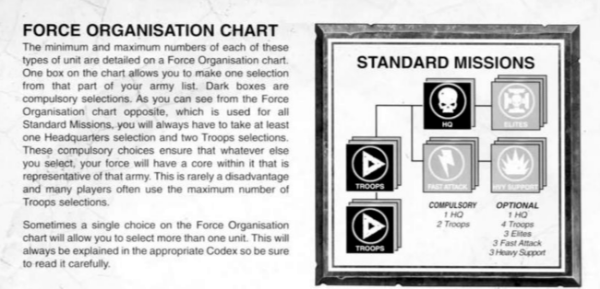
Essentially, it represented a fairly balanced force on manouevre. The associated core missions were Cleanse (sweeping an area of opposing troops), Secure and Control (recovering important things scattered across the battlefield- equipment, wounded comrades etc.), Seek and Destroy (attrition- aiming to kill as many of the enemy as possible), Recon (essentially reconnaissance in strength probing the enemy in prep for a major attack), and Take and Hold (a vanguard trying to secure an important point prior to the arrival of the main force). The central conceit is that both sides were launching a force into no-mans-land at the same time, of roughly equal strength (a fairly rare event in war), because this makes for easy pick-up games.
The other three missions using this FOC were Rescue (both sides trying to retrieve a key something), Night Fight (basically the same as Cleanse but at night), and Patrol (two patrols encounter each other and bring in reinforcements).
Then there is the alternative charts:
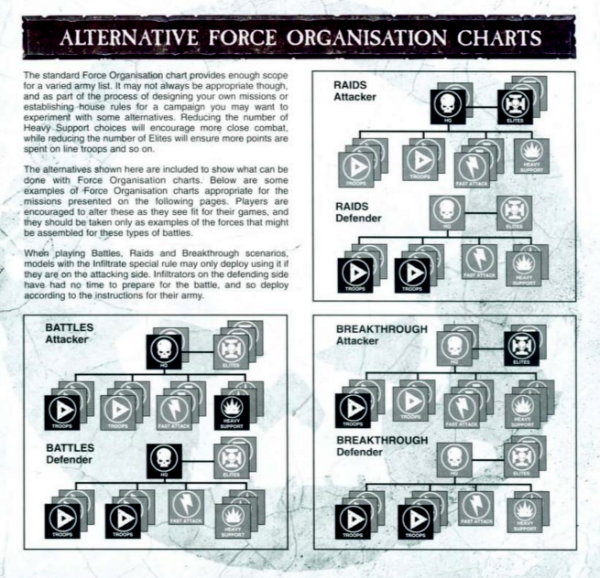
The associated Battles missions were Bunker Assault (enemy unexpectedly attacks fairly quiet part of fortification line, defender reserves rush to reinforce), Hold at All Costs (similar to Bunker Assault, but no fortifications and focused on a particular objective), and Meat Grinder (attritional assault with large reserves by the attacker outnumbering the defender).
The Raid missions were Sabotage (attacker sneaks up to important thing to blow it up, defender is on guard duty), Ambush (attacker ambushes the defender travelling in a column, who then has to break through the ambush), and Strongpoint Attack (attacker sneaks up to a fortification line to take out one or more bunkers and break the line).
The Breakthrough missions were Rearguard (heavily outnumbered defender tries to hold off waves of attackers as long as possible), Blitz (prepared attack trying to break through heavy enemy fortifications), and Breakout (attacker has been trapped in a pocket and is surrounded, objective is to break out of the defenders and escape).
The main exception to this was the Wild Rider FOC used by Craftworld Eldar bike armies (themed around Saim-Hann, but not limited to them):
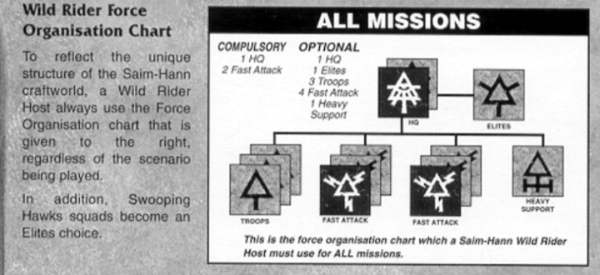
They used this in all circumstances because that is how they fought. This was a bit different to other "fast" variants, who got a specific army list shuffling round the options in the FOC, like Speed Freakz, White Scars, or Ravenwing.
There were other slight variations, normally on the vein of two extra troops slots (Alaitoc could take two rangers squads as troops extra) or swapping a fast attack for a heavy support and vice versa (Iron Warriors and Night Lords).
Mid-level characters were not common yet, but they usually had a work-around where either several could be taken for the same slot (Lost and the Damned Aspiring Champions), or they didn't take a FOC slot at all (like Commissars), or were models that were part of a HQ retinue (which usually took the same FOC slot as their commander) that are now separate today. Banner bearers and apothecaries are the clearest example of the latter. Worth noting there were just a lot less mid-level characters, GW realised these sell well awhile ago and really churn them out now. I suspect they are so popular in part as painting exercises for collectors as much as their utility in games.
Expansions could also add FOCs- this one was from Cities of Death in 4th edition:
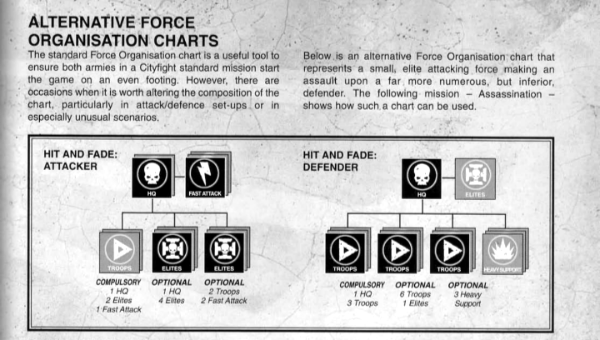
It was for an Assassination mission deep behind enemy lines, where the attacker has an elite, hard-hitting force and the target commander just has a bodyguard of mainly basic infantry because they were not expecting an attack on them directly.
There were other, special missions floating around, and a Combat Patrol mission for beginners with forces of 400pts maximum (which basically had its own FOC, but there was no pretty picture of this...).
I do think the overall goal here was for heavily themed forces for a given mission, with people tailoring their force somewhat for the situation they were fighting in. Unfortunately, that requires forward planning and does not work for pick-up games, so most people just played the core missions. Plus a lot of the extra missions required specific terrain to play, which increased the upfront preparation even more. I think the concept was very sound for a group regularly playing together in campaigns and so on, but never lived up to its potential for the majority of players who only did casual games. For them it then fell more into a chore to be worked around. Automatically Appended Next Post: Overall, I think this gets to the core of where somebody wants a given wargame to fall on the spectrum from actual military wargaming trying to approximate reality as close as possible to just going pew pew with toy soldiers.
The FOC was from an era trying to be a bit more simulationist in how forces were expected to be structured by the writers than today (and trying to be more simulationist in general to be honest, a lot more is abstracted out now). Special cases were expected to be houseruled for a given narrative if you couldn't fit them into the options above.
|
|
This message was edited 1 time. Last update was at 2026/06/21 07:44:48
 ChargerIIC wrote: ChargerIIC wrote:If algae farm paste with a little bit of your grandfather in it isn't Grimdark I don't know what is.
|
|
|
|
|
|
|
|


