| Author |
Message |
 |
|
|
|
|
Advert
|
Forum adverts like this one are shown to any user who is not logged in. Join us by filling out a tiny 3 field form and you will get your own, free, dakka user account which gives a good range of benefits to you:
- No adverts like this in the forums anymore.
- Times and dates in your local timezone.
- Full tracking of what you have read so you can skip to your first unread post, easily see what has changed since you last logged in, and easily see what is new at a glance.
- Email notifications for threads you want to watch closely.
- Being a part of the oldest wargaming community on the net.
If you are already a member then feel free to login now. |
|
 |
2011/02/24 18:51:11
Subject: Casting
|
|

Hardened Veteran Guardsman
|
Hey guys,
I know the question has been asked an enormous number of times, but precisely for this reason I find an enormous number of answers...
So here is my question: I'm doing my own bases for my army, and since there are quite a lot of guys (around 130), I plan on focusing on around 10, maybe 12 bases, and then casting them.
Problem is, I've never casted before. I won't ask how to do it, I just would like some info about where to find casting materials? (basically, I need everything, I just moved in the country, so I don't have anything at home ^^) And what do I need exactly?
Bonus question, is it possible to flock before casting, or is it better to flock after? (They are trenches like bases, basically I'm making balsa planks, some half crates and/or sandbags, maybe hands or something, and then add mud everywhere (I love bases with a lot of stuff on it  ))
|

 Vanguard Crossbone Crusade: 150/2000 Vanguard Crossbone Crusade: 150/2000
 I love the smell of brush soap in the morning I love the smell of brush soap in the morning |
|
|
 |
|
2011/02/24 20:16:24
Subject: Re:Casting
|
|

Longtime Dakkanaut
|
If casting in resin you'll need silicone that is heat resistant; you should be able to get a small can of it from an art/craft shop. I'd suggest Alumilite which is a casting plastic that sets in three minutes. I made a mould of bases and by the end of the day I had about sixty. Warning; expect airbubbles. Alumilite does not need to be primed, you can paint on it straight out of the mould. Same applies to Alumilite as resin;it gets hot while curing.
|
|
|
|
|
|
2011/02/24 22:24:18
Subject: Casting
|
|
40kenthus
|
Casting your own bases is pretty easy. These two links will provide a bit of information.
http://chicagoterrainfactory.wordpress.com/resin-casting/
http://chicagoterrainfactory.wordpress.com/2007/03/21/bases-making-an-rtv-mold/
I use Smooth-On for my Resin/RTV needs - if you buy the sample size it will run you about $70 total for the product you'll need. You may as well come up with a few extra projects - the sample size contains enough RTV for 4-5 molds and there is enough resin for hundreds of bases.
And no - its not possible to flock before casting. Any material in the mold cavity will be swallowed up by the resin.
|
|
|
|
|
|
2011/02/25 15:37:32
Subject: Casting
|
|
Hardened Veteran Guardsman
|
Ok, thanks, that's exactly what I needed 
Do you know if it's possible to keep the bases bottom hollow? I would like to magnetize them if possible
|
Vanguard Crossbone Crusade: 150/2000
I love the smell of brush soap in the morning |
|
|
|
|
2011/02/25 15:48:41
Subject: Casting
|
|
40kenthus
|
Casting with a cavity in the bottom of the base would require a 2 part mold. Certainly possible to do, but more work than a simple 1 part dump mold.
You could try just putting the magnet into the mold when you pour the resin. Would be a little tricky because the magnet might move around during the pour. If you move quick, a tooth pick could push it back in place before the resin starts setting.
|
|
|
|
|
|
2011/02/25 15:56:51
Subject: Casting
|
|
Dakka Veteran
|
A two part mold also increases the chances that the mold will need a pressure chamber to avoid airbubbles.
Two part pouring is your best bet for magnetizing. (pour a little bit, let it cure, place the magnet, then pour the rest).
The resin I use (smooth cast 300) is also soft for the first half hour after it sets, makes it easy to cut up whatever you have, could carve a hole for a magnet.
|
|
This message was edited 1 time. Last update was at 2011/02/25 15:58:56
|
|
|
|
|
2011/02/25 16:11:50
Subject: Casting
|
|
Krazy Grot Kutta Driva
|
I use a small sheet of plexiglass with 4 scrap pieces of square molding silicon about 2" square attached to each corner to keep it raised. Duct tape a small off balance electric motor or your GF's best friend to the bottom of the sheet. Then cast your molds on the plexi. After the poor run the motor for 30 seconds and most of the air bubbles come to the surface from the vibrations. Also help the casting material work completely into the molds.
|
Poor orks... Why can't they be the good guys for once?
All they've ever really wanted is whatever you have... 
|
|
|
|
|
2011/02/25 16:32:56
Subject: Re:Casting
|
|

[MOD]
Anti-piracy Officer
Somewhere in south-central England.
|
I casted all my Termagant bottom halves with a one piece mould. I just made sure there weren't any major undercuts. Where I did want some undercut, at the front of the body, I put it opposite the completely not undercut piece of the model, and popped the finished castings out from that side.
I put a bit of texture on the base -- hopefully you can see I moulded the base with a tail and abdomen on it. The top half of the Termagants were easily chopped up and cemented on to the resin piece. I put a bit of sand on the finished bases.
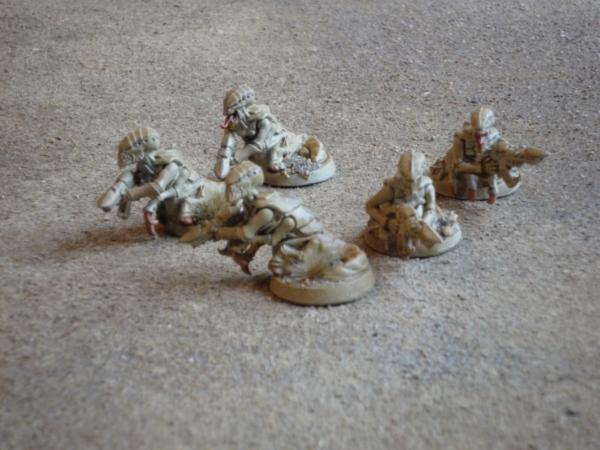
The moulds were easy to make. Superglue the master sculpt to the bottom of a high density polythene plastic tub. Mix and pour the mould rubber on top. When the rubber is cured, you just pop the master sculpt out and use it for another mould. When you come to our the resin, the shape of the mould is already very well adapted to let the fluid flow in easily.
The resin I used was a very low viscosity type which you mix by weight. You need an electronic kitchen scales. If you weigh out 20g of each component, it is close enough to cure properly. This is 40g of mixed resin which did five moulds with a bit left over. Obviously the amount per mould will differ depending on your design.
The low viscosity resin pretty much eliminates air bubbles. It cures within 30 minutes, so you cast a lot of pieces quickly. You need to be organised about filling your moulds starts to cure after five minutes.
One piece moulds are much easier than two piece so they are worth doing if you can manage it.
|
|
|
|
|
|
|
|


