| Author |
Message |
 |
|
|
|
|
Advert
|
Forum adverts like this one are shown to any user who is not logged in. Join us by filling out a tiny 3 field form and you will get your own, free, dakka user account which gives a good range of benefits to you:
- No adverts like this in the forums anymore.
- Times and dates in your local timezone.
- Full tracking of what you have read so you can skip to your first unread post, easily see what has changed since you last logged in, and easily see what is new at a glance.
- Email notifications for threads you want to watch closely.
- Being a part of the oldest wargaming community on the net.
If you are already a member then feel free to login now. |
|
 |
2013/10/22 20:20:21
Subject: Skylanders: The Living Room Adventures- TTG
|
|

Battlefield Tourist
MN (Currently in WY)
|

Greetings,
I wan't sure where to put this, so MODs move as appropriate.
As many of you know, I like to make my own games. In the past I have completed Aquanautica Imperialis Naval Battles in the 40K Universe and Aquanautica Imperialis: Battle for the Depths a game of 40K submarine warfare. In addition, I have done lots of rules upgrades and work on various 40K and 40k universe themed games. Lately, I have been working on two projects JUGS: The Game of Big Stompy Robots and Aeronautica Imperialis Blood and Irongard campaign. Blood and Irongard is up and running, and JUGS has hit a stall on the JUG construction rules (and lack of interest on just about anyone’s part, including my own). I have also mad ea few kids games for my family to play. If you are looking for examples of my previous work PM me and I will set you up with the links.
This thread is designed to give me something to work on that is intended to be a little bit lighter fare. My daughter and I like to play Necromunda and Gorkamorka for tabletop games. However, we are looking for something a bit different, requires less set-up and takedown, and is quicker and easier to play. In addition, we already have a number of Skylander figurines to use with the video game of the same name. We have all of the Series 1 models, and all the new ones from Series 2. However, we have completed playing the games long ago. Instead of spending the money and buying the new Skylanders 3 stuff, we decided to do something different.

Instead, we are going to create TTG rules to use our existing Skylander Model collections on the Tbaletop. All Skylander toys come with a model, a stat card, and a sticker. Each Stat Card indicates the Skylanders "Type"; such as fire, undead, water, life, etc. It also has a 0-100 measure of their abilities in the following areas; Fighting, Defense, Speed, and Luck. The intention is to create a d10 system utilizing these Stat Cards for taking bands of Skylanders against each other on the living room floor.

This thread will detail the creation of the game, play-testing, and rules development. As such, it will be a different thread than you normally see in the project Logs. Instead, it will be a running set of designer notes and play-testing blog.
Here are the areas that are intended to be covered:
1. The Living Room Adventures- This includes some backstory for why the Skylanders are fighting in your living room and not in the Skylands. This game is intended to be played anywhere; the living room floor; the kitchen table, the sidewalk, etc. These domestic spaces, and the items that clutter it will become the battle field and terrain.
2. Moving across the Floor- How the Skylander models interact with the types of terrain Or "Stuff" they come across. Things like carpet, grass, a shoe, foot stool, etc. It will also detail how different models can traverse terrain such as winged creatures flying, jumping, moving stuff, etc.
3. Beating other Skylanders- This will cover how you banish a Skylander from Earth and send them back to the Skylands. It will need to cover things like hand-to-hand, range attacks (Spyro shoots fireballs after all), defending, and how the stats interact to determine who does what.
4. End Game- How to determine who wins and losses, upgrades, special abilities, etc. This will cover all of the miscellaneous stuff not covered so far but important for the game to work. This also includes creating Quests/Missions to play.
5. Expansion and Upgrades- Right now Giants and Swap Force models are out of scope, but they may come in the future.
This project has no clear timeframe or deadline. I imagine it will proceed at a leisurely pace. It is going to be free and open to all, and no copyright or claim to copyright is intended on the Skylanders products. It is just another way to use the already great Skylander figures.
In addition, as this project develops, I am completely open to feedback and suggestions. Feel free to post up your own ideas, comments, and games. I look forward to see how you participate in the development of this game. I appreciate your support and comments.
Thanks!

|
Support Blood and Spectacles Publishing:
https://www.patreon.com/Bloodandspectaclespublishing |
|
|
 |
|
2013/10/23 03:43:35
Subject: Re:Skylanders: The Living Room Adventures- TTG
|
|
Tough Traitorous Guardsman
Philadelphia, PA
|
Good luck brother, my son loves skylanders.
|
|
|
|
|
2013/10/24 18:20:02
Subject: Skylanders: The Living Room Adventures- TTG
|
|
Battlefield Tourist
MN (Currently in WY)
|
Hopefully, this can be a good gateway game into other tabletop fun!

So, one of the most important things to choose when deciding a game is the Game Turn or Turn Sequence. This will dictate the flow of the game, and how the models will interact with each other. Therefore, when designing a game this is a decision not to be taken lightly. Let’s take a look at some of the options.
1. IGUG (I-Go-You-Go)
This is a method we are all very familiar with if you play any GW game. One side does all the moving, shooting, and other actions for all of their models before switching to let the other player complete all of their models options.
I-Go-You-Go can also be broken down into sub-phases like moving, shooting, etc. of the models can complete all their actions at once. Either way, one player completes all of their sides’ actions before the other player can respond.
Pros: This is rather tidy system that has served Wargamers well for decades. It is straight forward and easy to play. It also allows the opponent to leave the area of play to do other stuff.
Cons: Not as interactive, and opponents will spend long stretches of time not doing anything. It is possible that the second player will lose key parts of his battle plan before being able to respond.
2. Alternate Activation
This method allows a player to choose to use one Unit and complete all of its actions, and then allow the opponent to choose one of their units and do the same. General each activation will be broken down into actions or sub-groups such as moving, shooting, fighting, etc.
Some variants include Unit Choice vs. Initiative Order. Initiative Order uses a pre-set order for which Units can be activated and used in what order. For Example: Spyro is faster than Gill Grunt so Spyro must be activated and used first. Unit Choice means the player can choose which Unit is used when.
Pros: This method keeps both players engaged in the game, as they will be asked to use one of their units. It allows a player to react to what the other player is doing quickly. This can also lead to tactical play as Units are activated in a way that supports other units.
Cons: This method may require book-keeping as to who has done what. In addition, sometime the order of activation leads to actions/reactions that are not realistic. Would a unit simply stand in place while his friends move forward and fight?
3. Alternating Phases
This method is a hybrid activation system of Alternate Activation and IGUG. In such a method, the game turn is usually broken into sub-categories such as moving, shooting, fighting, searching, etc. The players take turn selecting and activating a Unit to complete only the sub-category of the turn that is currently being played.
For Example; Spyro and Hot Dog are playing each other. During the Movement Phase, Spyro activates and jogs forward. Then, Hot Dog’s player takes over, and has Hot Dog run behind a sneaker. Now that the Movement Phase is over, the shooting phase begins. The Spyro player activates Spyro and shoots some fireballs. When all of the first players shooting is done, Hot Dog’s player can choose to have Hot Dog shoot.
Pros: Both players are engaged in the game play at all times. Players can react to their opponents and plan ahead to future phases and how models will interact in the future parts of the turn.
Cons: The game is very segmented and sometimes does not flow naturally.
4. Interrupts
Interrupts use an activation or Alternating Phases as a basis for the rules. One player selects a Unit and begins to use it. An interrupt allows the other player to try to stop the other player from completing its own actions, and start completing actions of their own. Often, an interrupt must be “triggered” by some other action such as entering LOS, Attacking, failing a dice roll, etc.
There are two types of interrupts. Version one is a Turn Ender; where the activating players turn ends completely when the Interrupt is triggered. The other is a Reaction, where player two’s Unit can react to what Player one’s unit is doing. Once the interrupt is over, player reverts back to the first player who is being interrupted.
Pros: Creates a very free flowing game. Actions must be thought out and planned ahead of time.
Cons: Sometimes it can be hard to keep track of who should be doing what.
Besides the options I talked about here, I’m sure there are other Turn Sequence types that I am missing. Feel free to add on to my list, and give me an idea of what types of turn sequence you prefer in your games.
|
|
This message was edited 1 time. Last update was at 2013/10/24 18:25:56
Support Blood and Spectacles Publishing:
https://www.patreon.com/Bloodandspectaclespublishing |
|
|
|
|
2013/10/24 18:22:12
Subject: Skylanders: The Living Room Adventures- TTG
|
|
Badass "Sister Sin"
|
|
|
|
|
|
|
2013/10/28 12:53:55
Subject: Skylanders: The Living Room Adventures- TTG
|
|
Battlefield Tourist
MN (Currently in WY)
|
Thanks for the move...
My daughter and I sat down and started hashing out the basic ideas for the rules. However, my first orde rof concern was the Turn Sequence.
For this one, we choose a modified I-Go-U-Go system. Essentially, one player would get the initiative at the beginning of the game. Then, that player with initiative would move all of their characters, then the othe rplayer would move all of theirs. Then the player with Initiative would do their shooting, the second player would then complete all their shooting. This would continue until all major actions were resolved.
The player with initiative would be determined by a single game of Paper-Rock-Scissors prior to set-up. This was my daughter's idea and I thought it perfectly illustrated how a child approaches "rules Probelms" vs. how I would. A simple, elegant, and unique solution to determine who goes first.
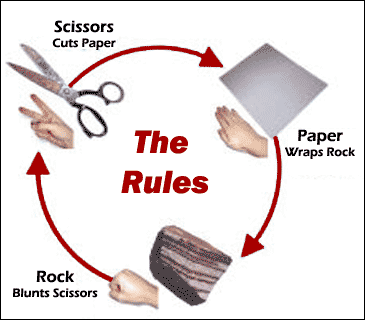
We also thought about : Youngest Player goes first, person with the closest birthday, person with the Skylanders, person to roll the highest on a d10. However, all of these were dismissed in favor of Paper-Rock-Scissors.
We also spent time hashing out some of the basic mechanics from the stat cards. However, I will save that until I can get some pictures of the Stat cards we talked through.
|
Support Blood and Spectacles Publishing:
https://www.patreon.com/Bloodandspectaclespublishing |
|
|
|
|
2013/11/13 15:56:22
Subject: Skylanders: The Living Room Adventures- TTG
|
|
Battlefield Tourist
MN (Currently in WY)
|
we haven't had a ton of time to work on this. Stupid school and work. However, after a quick review of the Stat cards, we found Giants and some Wave 2 items are 0-150 instead othe 0-100. Hmmm, I guess that means a simple d100 test is out. Might have to think about opposed skill tests.
|
Support Blood and Spectacles Publishing:
https://www.patreon.com/Bloodandspectaclespublishing |
|
|
|
|
2013/11/21 13:53:51
Subject: Skylanders: The Living Room Adventures- TTG
|
|
Battlefield Tourist
MN (Currently in WY)
|
My daughter picked out 4 Skylanders for us to play around with as we worked the game up. I will include their stats below if you don't have the cards. They are:
Spyro- Magic Type
Fight= 60
Shield= 50
Speed= 90
Luck=60
Misc Stuff- In the game he can fly, shoot fireballs, and has a ram attack.
Sonic Boom- Air Type
Fight= 50
Shield= 60
Speed= 60
Luck= 55
Misc Stuff- In the game he can fly, uses a short range sonic attack, and can spawn baby griffons that attack and can use the sonic attack. I have no idea how that will work in the TTG!
Hot Dog- Fire Type
Fight= 85
Shield=50
Speed=70
Luck= 80
Misc Stuff- In the game he creates a wall of fire, and shoots fireballs. Fire guys can walk on fire.
Jade Flashwing- Earth Type
Fight= 40
Shield= 80
Speed=80
Luck= 80
Misc Stuff- In game she shoots energy bolts from her tail and has a spinning close combat attack.
Hot Dog and Jade Flashwing use the 0-150 scale.
|
Support Blood and Spectacles Publishing:
https://www.patreon.com/Bloodandspectaclespublishing |
|
|
|
|
2013/11/26 14:00:14
Subject: Skylanders: The Living Room Adventures- TTG
|
|
Battlefield Tourist
MN (Currently in WY)
|
So, I really like your ideea of splitting it up into Bash and Zap. It fits the theme of the game. I also like the idea of moving/acgting in the order of highest to lowest speed. Makes sense. Here is a quick breakdown of how I see the stats possibly interacting.
Each character has a primary attack and a secondary attack. This is consistent witht he gameplay. The primary/secondary attack can either be Zap, Bash, or Wall. Zap is used to shoot, Bash to hit things, and wall to block. The Primary ability will be the more powerful ability, and the secondary ability will use reduced stats, possibly half of the normal stat.
Fight- This is used to "Bash" an opponent. It will be an opposed skill role between the attacker and defender. The "tens" place will determine how many hits a single Bash can cause.
Shield- This will be used as a secondary save to ward off hits, and also the "Tens" place will be used to determine how many "hits" a Skylander can take before being banished.
Speed- This will determine action order, and the "tens" place can be used to determine how many inches a Skylander can move maximum.
Luck- This will be an opposed test to determine if a Zap shot hits a target. In addition, the "tens" place will be used to determine how many hits a Zap can do. Luck will also be used to determine all Non-attackign actions such as openign doors, puzzle locks, etc.
Rolls will be made using a D12. The goal is to roll below the "tens" place of the stat. The player who rolls lower than his stat succeeds, and if the attacker succeeds by a larger amount than his opponent; he wins the opposed test. In an attack, each point of success adds an additional "hit". Each additional success reduces the potential hits when making the defense test.
Any 5, such as 55, allows the player to automatically win tied opposed success tests.
That's what I have skeletoned out so far. I like the idea of power crystals and such, since in the game you can pick-up coins, hats, and other stuff. I'm not sure how I will use those.
In addition, I know I want terrain to be 1 to 1 in this game. Therefore, if you are fighting on a kitchen table, and the table has a centerpiece, the centerpiece acts as blocking terrain and must be moved around. Flying chracters will have some limited ability to move over some low obstacles based on their Speed stat.
In the game, when a Skylander is in an area that promotes his "Type" he gets bonuses to his abilities and some healing. My daughter also thought it would be fun if Skylanders of a certain type got bonuses when they were standing on/in terrain that used the same color as their element. For example, Tech Skylanders have a gold color, Fire Red, Magic Purple, Life Green, Air clear, water blue, etc. That could add some fun tactical nuance to the game.
|
Support Blood and Spectacles Publishing:
https://www.patreon.com/Bloodandspectaclespublishing |
|
|
|
|
2014/03/17 17:12:15
Subject: Skylanders: The Living Room Adventures- TTG
|
|
Battlefield Tourist
MN (Currently in WY)
|
I have actually started codifying the rules. Here is the core mechanic for resolving actions....
Draw Tests
A Draw Test is the core mechanic used to determine if a Skylander can properly complete and action in the game. So, can your Skylander push through a thick carpet, does he bite his foe, can he jump over the remote control? Well, to find out they will need to pass a Draw Test.
To perform a Draw Test, the player controlling the Skylander simply draws the top card from the Draw Pile. You flip it over and determine what card you drew.
Look at the relevant Stat in the Skylanders Card or Profile. Look at the number in the Tens place. If the number of the card you pulled is the same or lower than the Stat, the test is passed successfully.
Versus Draw Test
There are times when a two players will be in competition to see if one succeeds and the other fails. Typically, this is when one is trying to Zap or Bash the other one. However, there are other situations as well.
This is called a Versus Draw Test or Versus Test. In this scenario each player draws a card, with the active player drawing first. Both players then compare the card they drew to the Stat being used. A Skylander passes the Draw Test like ordinary, by having a number the same or lower than the number in the Stats Tens place.
If both Skylanders fail, they both fail. If one Skylander passes the test and the other one fails; the one that passed is successful. However, what happens if both Skylanders pass?
In that scenario, both players have to determine how successful they were. Subtract the number on the card from the Skylanders Stat to see the difference. Each point of difference is called a Success. The Skylander with the most successes is the winner and is considered to have “won” the Versus Draw Test.
Tie-Breakers
Some Skylanders have a Stat that is not a n even or round number. Instead it ends with a 5, such as 55. This is known as a Tie-Breaker.
If during a Versus Draw Test, both players have the same number of successes, the Skylander with the uneven Stat will automatically win the tie.
Automatic Success
If a player pulls a Joker card during his Draw Test, that player will automatically considered to have passed the test.
If the player pulls a Joker while participating in a Versus Draw Test, the players Skylanders is automatically considered to have won the Versus Draw Test regardless of the number of successes the opposing Skylander had earned.
If both players pull a Joker during a Versus Draw Test, then both players are assumed to pass. However, neither player wins, unless one of the players has a Tie-Breaker in their Stats.
|
Support Blood and Spectacles Publishing:
https://www.patreon.com/Bloodandspectaclespublishing |
|
|
|
|
|
|
|


