| Author |
Message |
 |
|
|
|
|
Advert
|
Forum adverts like this one are shown to any user who is not logged in. Join us by filling out a tiny 3 field form and you will get your own, free, dakka user account which gives a good range of benefits to you:
- No adverts like this in the forums anymore.
- Times and dates in your local timezone.
- Full tracking of what you have read so you can skip to your first unread post, easily see what has changed since you last logged in, and easily see what is new at a glance.
- Email notifications for threads you want to watch closely.
- Being a part of the oldest wargaming community on the net.
If you are already a member then feel free to login now. |
|
 |
2013/11/01 18:33:32
Subject: Painting inner edges - important or dangerous?
|
|

Been Around the Block
|
So, most models have "inner edges" all over them. What I mean by inner edge is:
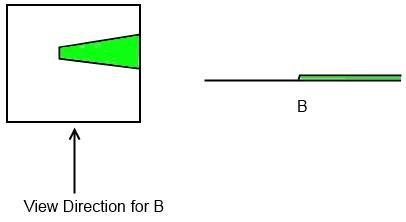
Inner edge is picture B.
Some of these inner edges are major-ish, like the raised lip on space marine pauldrons. Others are pretty tiny. My question is this - for a high quality paintjob is it more important to attempt to paint these inner edges or more important not to (leaving it the basecoat color) and just let the wash blur away the fact that you haven't?
The reasons for it is obvious - it's part of the surface and you're making a more complete model. But there's some good reasons against it - you're likely (if you're me anyway) to flub it and get paint on the adjoining surface (which could be shaded and therefore much more problematic to fix) - it can be time consuming which gets you more tired and likely to screw up going forward.
There's also considerations for "is it a microscopic edge" or "a somewhat pronounced edge" (space marine pauldrons again)
Anyway, looking for general advice and wisdom. I suspect if I skipped this while doing my detail pass on models, I'd be like 1/3 faster or something.
|
|
This message was edited 1 time. Last update was at 2013/11/01 18:38:51
|
|
|
 |
|
2013/11/01 19:24:56
Subject: Painting inner edges - important or dangerous?
|
|

Rampaging Carnifex
|
I wash models heavily, so haven't needed to paint that area generally. If I tried to, I would probably mess up the other parts. So it's just as well. 
|
|
|
|
|
|
2013/11/01 19:36:46
Subject: Re:Painting inner edges - important or dangerous?
|
|
Gargantuan Gargant
|
Shouldn't be too difficult to avoid overstepping, with a bit of care and a reasonably fine-tipped brush - I've found that more of my edgelining mishaps were due to improper paint consistency or a splayed tip/stray hairs than a jerk of the hand. Using dilute paints or adding a drying retarder gives you enough open time that missteps can be cleaned up before they dry in place (scrub thicker paint off with a damp brush or, for thinner missteps, flood the area, dry your brush, and wick the problem paint/water away), should you botch a section. In any case, it will mean more time spent.
Whether you think the time/effort savings is more important than the completeness of highlighting... that's really your call to make. Those extra minutes per model would likely mean much more to a commission painter who needs to balance his results with time spent (to properly determine cost and potential output) or a tournament player with a hard deadline than your average hobbyist who just wants an attractive army. I have no idea where you fall on that spectrum, but I imagine you would have a decent handle on that, yourself.
Personally, I wouldn't want to distinguish between "types" of edges, but I'm more concerned about the final look than the fiddliness of any given painting task (not to say I won't take shortcuts, if available  ). When highlighting, I choose to hit or ignore hard edges based on their facing, not their precariousness while painting. If I had trouble painting inner edges, I'd simply practice. Thinking of the lines of a Space Marine, I'd say the inner edges outnumber the outer ones by a pretty wide margin - ignoring those is going to have a more dramatic impact than skipping a few raised detail panels on the various faces of a much boxier Dreadnought.
TLDR: Unless you're on a very tight schedule or a commission painter looking specifically to fill the "cheaper, faster, less detailed" niche, "it looks better" trumps "I might mess up" and/or "it takes longer." Looking at the dread in your gallery, it appears that you're perfectly capable. Practice will increase your speed and reduce annoying flubs - in no time, you'll forget that this was ever even an issue.
|
The Dreadnote wrote:But the Emperor already has a shrine, in the form of your local Games Workshop. You honour him by sacrificing your money to the plastic effigies of his warriors. In time, your devotion will be rewarded with the gift of having even more effigies to worship.
|
|
|
|
|
2013/11/01 19:57:34
Subject: Re:Painting inner edges - important or dangerous?
|
|
Been Around the Block
|
Thanks for the reply. Yeah, I think for me the ol' OCD tendencies would probably prevent me from not doing the inner edges, but I was curious if maybe it was something the real experts might have some surprising insights on.
This is one of the areas where brush type really seems to make a big difference for me. Generally speaking, I use el-cheapo synthetic 3/0 brushes you can get for 2/$1. But I've started using one of these for edge highlights and precarious inside edges
http://www.amazon.com/Da-Vinci-Series-Strong-Synthetic/dp/B006D9RMGM/ref=sr_1_4?ie=UTF8&qid=1383335745&sr=8-4&keywords=da+vinci+forte
(although I use a 3/0, the one above is a 5/0). The bristles are very very stiff, which helps me considerably. And as long as I reserve it for these special cases, the bristles remain nice and pointy. In contrast, I basically end up throwing out the aforementioned cheapo synthetic 3/0 after every major unit I complete.
|
|
|
|
|
2013/11/01 21:22:37
Subject: Painting inner edges - important or dangerous?
|
|
Gargantuan Gargant
|
You'll have to wait for a real expert, then! 
I've actually had the opposite experience with brushes for edgelining, actually. I now prefer something with very soft, springy bristles and a somewhat larger belly (and a fine point, obviously). With the soft, fine point, the spring sort of acts like a shock absorber, keeping minor hand tremors from flexing the whole length of the bristles and seriously changing the pressure being applied and the angle of contact. The larger belly isn't for holding more paint, it's for keeping the head damp, which keeps tiny quantities of paint from drying on the tip within seconds, as they did with my tiny synthetics. I find myself using a 0 or 2 quite comfortably, now, where I was using either a 5/0 or 10/0 (there was literally no difference in size, between those, and very little from the 3/0 I used elsewhere), before, and fighting with paint consistency.
The feeling (the lack thereof, actually) is very different - I basically just sweep the tip closer and closer to the edge until I see a line start forming. There's practically no physical feedback, due to the flex, but trying to work off of that tends to mean you apply too much pressure and lose a degree of control. Took a bit of getting used to, but I'm much happier with both my technique and the results, now. Have you tried using something softer (on the "nice brush" end of the spectrum, that is)? You might find the task less odious with a better brush and a change in technique.
For reference, if you care, I'm using Rosemary & Co. brushes. Series 33 is their high-end Kolinsky round line, but even the cheaper red sable S.99 behave beautifully. Shipping from the UK adds to cost, but the brushes themselves are so inexpensive that ordering a single <0 size brush would be barely more than the cost of the brush you linked, alone. Well worth it, in my opinion, both generally and for your specific task. They would require a bit more care than you're used to providing, though, if you're burning through synthetics that quickly.
|
The Dreadnote wrote:But the Emperor already has a shrine, in the form of your local Games Workshop. You honour him by sacrificing your money to the plastic effigies of his warriors. In time, your devotion will be rewarded with the gift of having even more effigies to worship.
|
|
|
|
|
2013/11/02 08:08:17
Subject: Re:Painting inner edges - important or dangerous?
|
|
Douglas Bader
|
The exact answer of course depends on your paint style, but if your only reason for not doing something is "it's hard and I might mess up" then yes, you want to learn to do it well and then do it on every model.
|
There is no such thing as a hobby without politics. "Leave politics at the door" is itself a political statement, an endorsement of the status quo and an attempt to silence dissenting voices. |
|
|
|
|
2013/11/02 20:56:15
Subject: Painting inner edges - important or dangerous?
|
|
Stern Iron Priest with Thrall Bodyguard
|
it fits my paint style, so i line pretty much everything...
the trick, over the years, has been to make it sharper and more subtle, so as not to dominate the mini...
for me, though, i am influenced by tattoos and comics, so i like a lined style...
the french do some lovely subtle work, which reminds me of the tattoos without outlines...
i like 'em, but it's not my style...
also, if you think black is too heavy, try umber instead...
cheers
jah
|
Paint like ya got a pair!
Available for commissions.
|
|
|
|
|
|
|
|


