| Author |
Message |
 |
|
|
|
|
Advert
|
Forum adverts like this one are shown to any user who is not logged in. Join us by filling out a tiny 3 field form and you will get your own, free, dakka user account which gives a good range of benefits to you:
- No adverts like this in the forums anymore.
- Times and dates in your local timezone.
- Full tracking of what you have read so you can skip to your first unread post, easily see what has changed since you last logged in, and easily see what is new at a glance.
- Email notifications for threads you want to watch closely.
- Being a part of the oldest wargaming community on the net.
If you are already a member then feel free to login now. |
|
 |
2014/11/11 09:30:05
Subject: Painting Black Tanks
|
|

Daemonic Dreadnought
|
Looking for advice on techniques for painting black tanks.
I am preparing to paint several Black Legion tanks and want to get them 'right.' The standard I am looking to reach is similar to common pictures of the Vindicator seen in this photo:
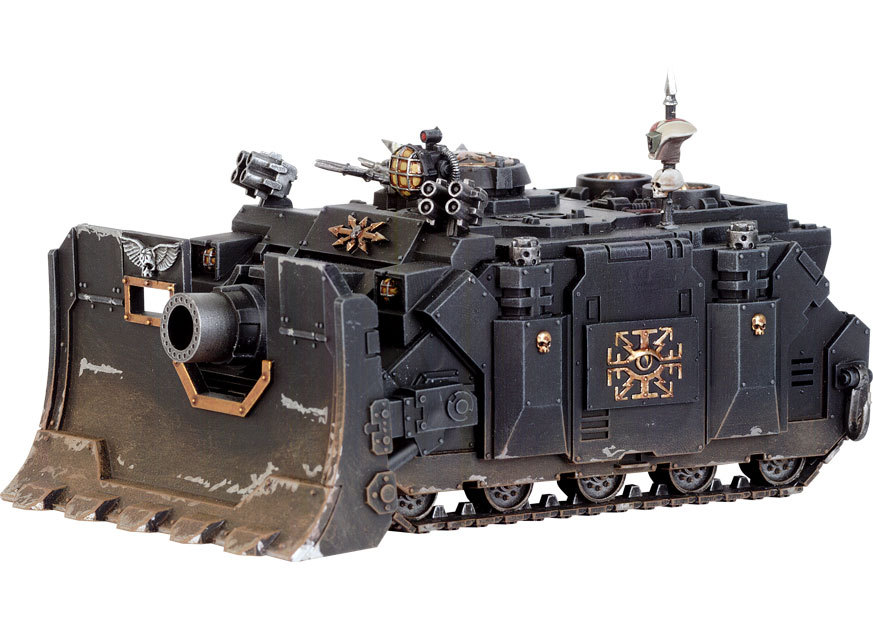
I have tried to do this in the past with mixed results. What gives me problems is the surface area, it stands out compared to the black colors used for the base. My guess is that the surface is being drybrushed with a very light gray applied evenly to the model.
For whatever reason, this is hard for me to do. I don't have a problem with drybrushing and have done similar things with other models, but whenever I try this on a Rhino or a Land Raider it comes out blotchy. I typically use a large brush for it with very little paint, and I regularly change the angle of my strokes to get it right.
Any advice on how to pull this off effectively? Otherwise, any tutorials on painting black tanks out there? I would love to compare techniques with other artists and haven't been finding many in my various searches.
|
|
|
 |
|
2014/11/11 09:50:31
Subject: Painting Black Tanks
|
|

Fixture of Dakka
|
I think it would be very hard (impossible?) to drybrush that consistent a texture on the entire model. This is always the problem with drybrush, and the reason I dislike it on surfaces that should be homogenous (like armor plates). For the same reason, it's why I like it for fur.
How to achieve it: perhaps there is a medium that can be applied, but frankly, if I wanted to get similar to that, I'd airbrush on a very dark grey metallic -- something close to Vallejo Model Air Black Metallic, or a shade up to one of the very dark gunmetals (it's hard to tell with the lighting how black the paint on that Vindicator is)..
I think the weathering (the dirt and chipping) is done with a sponge, not a brush. I think that before the weathering, the painter did a medium-light grey edge highlight (like Dawnstone), and then after the weathering, they used a highlighted the edges with the same dirt color that they sponged on.
The metallic is nothing gold special -- it looks like a pretty standard GW 5-step gold treatment (Balthazar, Gehenna, Sepia wash, Auric, Runefang Steel)
At least, that's how I would do it.
|
|
|
|
|
2014/11/11 11:49:22
Subject: Painting Black Tanks
|
|

Longtime Dakkanaut
|
To get large surfaces right, you may want to try with an airbrush instead.
Or, you could sand your model on the big surfaces to generate some texture that your drybrushing will catch.
|
|
|
|
|
2014/11/11 11:58:03
Subject: Painting Black Tanks
|
|

Grizzled Space Wolves Great Wolf
|
That model doesn't looked drybrushed at all (except maybe the dirt). I'm not sure what they did do, but what I'd personally do, paint it a dark grey that is pretty close to black, wash it black, then do an edge highlight with lighter greys. One trick to black is layer your edge highlights, don't just do all edges one colour, pick out the areas on different edges that you want to be brighter (maybe near exposed corners and such) and build up 3 or 4 layers of edge highlights that work toward those bright spots. Hit it with a satin varnish when you're done to tie the wash, the base colour and the edge highlights together. Automatically Appended Next Post: Talys wrote:I think the weathering (the dirt and chipping) is done with a sponge, not a brush. I think that before the weathering, the painter did a medium-light grey edge highlight (like Dawnstone), and then after the weathering, they used a highlighted the edges with the same dirt color that they sponged on.
Actually I think the chipping weathering on that was done with a brush. It looks more controlled, less random splotches. Here's an example of paint chipping done with a brush, start at 4:20. http://youtu.be/7gWAFBreb-k?t=4m24s The dirt looks like it was just drybrushed with a large soft brush.
|
|
This message was edited 3 times. Last update was at 2014/11/11 12:23:19
|
|
|
|
|
2014/11/11 14:38:27
Subject: Painting Black Tanks
|
|
Longtime Dakkanaut
|
I think you missed the texture on the flat panels.
There is something there which you will not get with your instructions, that something breaks up the monotony of a flat black panel, which is what I believe the OP is after.
In other words: How to paint tanks without them looking unnaturally flat (which is what you would get with your method of just 4 layers of edge highlight with zero attention to texture or surface) ?
There are quite a few tutorials on that topic already.
|
|
|
|
|
2014/11/12 02:11:53
Subject: Painting Black Tanks
|
|
Willing Inquisitorial Excruciator
|
 techsoldaten wrote: techsoldaten wrote:
I have tried to do this in the past with mixed results. What gives me problems is the surface area, it stands out compared to the black colors used for the base. My guess is that the surface is being drybrushed with a very light gray applied evenly to the model.
I'm pretty sure that's exactly what is going on. I paint my SoB Rhinos with the same technique. It just takes a really light touch and being very mindful of the amount of paint on your brush. Adjust your pressure based upon the contours of the vehicle, and come at each side from multiple angles to get every edge evenly. Do not buff the flat surfaces (I.e., swirl the brush or make circles). To put it in Mr. Miyagi terms: "Show me, paint the fence" NOT "Wax on, wax off." 
For whatever reason, this is hard for me to do. I don't have a problem with drybrushing and have done similar things with other models, but whenever I try this on a Rhino or a Land Raider it comes out blotchy. I typically use a large brush for it with very little paint, and I regularly change the angle of my strokes to get it right.
I use a soft, natural fiber #10 Round for drybrushing large flat surfaces (I think it's identical to GW's Tank brush). The paint should appear as a dry, colored powder on the brush and each bristle should be separate. If you see a wet sheen or the bristles are clumped together, keep wiping the brush on your paper towel.
|
|
|
|
|
2014/11/12 06:38:03
Subject: Painting Black Tanks
|
|
Grizzled Space Wolves Great Wolf
|
morgoth wrote:In other words: How to paint tanks without them looking unnaturally flat (which is what you would get with your method of just 4 layers of edge highlight with zero attention to texture or surface) ?
I think if you follow through doing both the wash and also finish it with a satin varnish it won't look unnaturally flat (I am thinking Vallejo's satin varnish sprayed through an airbrush, which I find to be more on the matte side, maybe something like army painter's matte spray varnish would be equivalent). If you want to drybrush it to give it more depth, you could spray it black then hit it with a matte varnish before drybrushing. This creates a structure of tiny little ridges that will drybrush easier. Finish it off with a satin varnish if you want to bring back some of the sheen that you lost when you sprayed it matte varnish. One trick to painting black vehicles that I know aircraft modellers sometimes use is to hit the model with a nice flat matte coat then locally spray satin or gloss varnish in some areas to break up the monotony, but I think that'd be hard to do without an airbrush.
|
|
This message was edited 3 times. Last update was at 2014/11/12 06:45:00
|
|
|
|
|
2014/11/12 19:54:33
Subject: Painting Black Tanks
|
|
Daemonic Dreadnought
|
 the_Armyman wrote: the_Armyman wrote: techsoldaten wrote:
I have tried to do this in the past with mixed results. What gives me problems is the surface area, it stands out compared to the black colors used for the base. My guess is that the surface is being drybrushed with a very light gray applied evenly to the model.
I'm pretty sure that's exactly what is going on. I paint my SoB Rhinos with the same technique. It just takes a really light touch and being very mindful of the amount of paint on your brush. Adjust your pressure based upon the contours of the vehicle, and come at each side from multiple angles to get every edge evenly. Do not buff the flat surfaces (I.e., swirl the brush or make circles). To put it in Mr. Miyagi terms: "Show me, paint the fence" NOT "Wax on, wax off."
Yeah, the reason I assumed this was being done via drybrush is that someone at a GW store demonstrated the technique to me once. He took a flat brush and some dark gray paint, got almost all the paint off the brush, then ran it very quickly over the model. It was just about perfect for that particular side, but I had a hard time replicating the results.
If I was to apply a satin matte ahead of time, do you think that would create enough surface tension for the drushbrushed paint to really catch on?
the_Armyman wrote:For whatever reason, this is hard for me to do. I don't have a problem with drybrushing and have done similar things with other models, but whenever I try this on a Rhino or a Land Raider it comes out blotchy. I typically use a large brush for it with very little paint, and I regularly change the angle of my strokes to get it right.
I use a soft, natural fiber #10 Round for drybrushing large flat surfaces (I think it's identical to GW's Tank brush). The paint should appear as a dry, colored powder on the brush and each bristle should be separate. If you see a wet sheen or the bristles are clumped together, keep wiping the brush on your paper towel.
That sounds really nice. I have only ever used GW's tank brush, basically because I have like 5 of them sitting around. Do the natural fibers make for a better experience? Is it worth investing in one?
|
|
|
|
|
2014/11/13 22:38:03
Subject: Painting Black Tanks
|
|
Willing Inquisitorial Excruciator
|
 techsoldaten wrote: techsoldaten wrote:
If I was to apply a satin matte ahead of time, do you think that would create enough surface tension for the drushbrushed paint to really catch on?
A varnish wouldn't hurt, but it isn't necessary. I think it's really about less paint and less pressure on the brush.
That sounds really nice. I have only ever used GW's tank brush, basically because I have like 5 of them sitting around. Do the natural fibers make for a better experience? Is it worth investing in one?
I think a soft brush makes it easier to judge the pressure you're applying. Heck, some really good, soft brushes can be found in the cosmetics aisle. The same brushes women use to apply makeup usually do a pretty good job when it comes to drybrushing and weathering.
|
|
|
|
|
2014/11/14 01:24:27
Subject: Painting Black Tanks
|
|
Changing Our Legion's Name
|
Seems to me that the black was airbrushed onto the model. The highlights were fethered onto the edges with the wear painted on.
Thats how I see it any way, as I dont seem to see too much evidence of drybrushing except for where the dirt/mud is.
|
|
This message was edited 1 time. Last update was at 2014/11/14 01:26:45
|
|
|
|
|
2014/11/14 01:34:08
Subject: Painting Black Tanks
|
|
Grizzled Space Wolves Great Wolf
|
the_Armyman wrote: techsoldaten wrote: If I was to apply a satin matte ahead of time, do you think that would create enough surface tension for the drushbrushed paint to really catch on?
A varnish wouldn't hurt, but it isn't necessary. I think it's really about less paint and less pressure on the brush.
It really depends what the original black surface is like. Drybrushing a smooth surface that is on the satin to glossy side doesn't work nearly as well as drybrushing something with a more matte finish. On a glossy surface the paint will only pick up on the edges, if you want it to pick up on the actual flat areas it will tend to streak more. A matte surface gives a bit more texture so that the drybrushing has something to catch on. When you initially spray the model, if you spray from further away and doing light coats that don't let wet paint pool, you can achieve a rougher surface that is more conducive to drybrushing as well.
|
|
This message was edited 1 time. Last update was at 2014/11/14 01:35:56
|
|
|
|
|
|
|


