Forum adverts like this one are shown to any user who is not logged in. Join us by filling out a tiny 3 field form and you will get your own, free, dakka user account which gives a good range of benefits to you:
No adverts like this in the forums anymore.
Times and dates in your local timezone.
Full tracking of what you have read so you can skip to your first unread post, easily see what has changed since you last logged in, and easily see what is new at a glance.
Email notifications for threads you want to watch closely.
Being a part of the oldest wargaming community on the net.
If you are already a member then feel free to login now.
Marv has the way of it. Despite the at times ludicrously legendary status applied to Japanese sword makers, all that folding and craftsmenship was really about turning utterly terrible quality iron into something useable. Iron on the Japanese Isles is really low quality, and getting the impurities out practically impossible. Japanese weapons were actually quite brittle. It's partly why the blades were so thick on the back end. Any thinner and they'd risk being snapped on impact.
Orlanth I think is right about the quick draw bit. It's not that the technique is impractical. It's just overstated by modern culture. It's was a very practical skill in Japan at the time it was invented. But it ain't that time anymore.
This message was edited 1 time. Last update was at 2015/02/07 16:16:54
Now I wonder what happened to Mail Call guy. I tend to image that Ancient Aliens guy came into the office and Mail Call guy just couldn't stand being second fiddle to that radical hair. So Mail Call guy just said 'feth this gak I'm going home.'
Automatically Appended Next Post:
Grey Templar wrote: Its rather sad how bad that test was. They claim the katana wins because it got slightly more penetration. However the katana didn't hit the same spot as the longsword and got a slightly better spot. And neither weapon would have so much as scratched the guy inside. But the broadsword could cause internal damage due to its greater weight. Plus the katana is in danger of snapping every time it tries to actually stab someone in armor like that.
Reminds me of the ISU-152 (I did like tanks more than swords ). That 152mm Howitzer didn't pierce the armor of a Tiger. It didn't have to. the sheer force of the shell's explosion would turn the crew into Swiss cheese (and could even blow the turret clean off the tank body).
The same fundamental applies. Blunt force trauma is often worse (especially prior to modern medicine) than cut wounds. Blunt force trauma breaks bones. Causes internal bleeding. In a battle there is little meaningful difference between the two. A guy with broken ribs is just as incapacitated as a guy with a gash from shoulder to thigh. Broken ribs are easier to achieve vs armor.
This message was edited 1 time. Last update was at 2015/02/08 03:12:08
Grey Templar wrote: Because the troops the spanish had were Rodeleros. A very specific type of soldier who used a rapier and a buckler. They were used in conjunction with pikemen as well, their purpose being protecting against troops who closed to within the pikes effective range.
I'd be skeptical of that. Rodeleros were phased out of the Spanish military by the mid 16th century. The primary Spanish infantry formation in 1582 (and the one that the linked Wiki article seems to describe) is the Tercio. While there were swordsmen in the Tercio, there weren't many. The primary power of the formation came from a organized and disciplined pike wall protecting a block of musketeers.
david choe wrote: Just the best at it's niche. This claim is very different.
It's a really silly thing to be best at though. By their nature niche means being high specialized. Being highly specialized isn't a very good thing for a weapon in real combat. Despite how games and min-max tends to work out, real life tends to prefer versatility to specialization. The Katana works great for the Samurai in Tokugawa Era Japan. I don't think anyone has really disputed that in thread.
The problem is that that's not really much to be best at. The Long Sword was a much more versatile weapon (though, it probably wouldn't work great for a Samurai in Tokugawa Era Japan , It would simply be too long for their needs as well as illegal). If you were on a battlefield, a Long Sword would without much doubt function better. It was a field weapon, designed for battle. The Katana was not a field weapon, but a personal defense weapon with very specific characteristics derived for a unique situation. The more traditional field swords of the Samurai were much longer and straighter edged blades like the Nodachi (A weapon that was banned by the Tokugawa Shogunate after the Warring States Period).
This message was edited 2 times. Last update was at 2015/02/08 05:39:36
Warhammers were not common in history, so it's not really a relevant question. A Warhammer is much like a Battle Ax. An improvised weapon. A lot of people confuse other weapons with a hammer, like the Hook and Bill, which was designed by the English for a specific battlefield purpose. It wasn't so much a weapon of war as a tool of war. A tool for yanking a knight off his horse.
So why do I get so much haters when I say katana is one of the best cutting blade?
You confuse people trying to dispel a myth with hate. A cutting blade isn't just about cutting. Katanas could hold very sharp edges. Brittle steel is a lot like glass. If can be sharp as feth but it shatters easily. Katanas were very brittle weapons and broke easily. They worked however in an environment where no one was wearing armor and fights tended to end in a few moves. There was no need for the blade to be durable or hold it's edge. In a field battle or a prolonged fight, a Katana would quickly lose its razor edge and become dulled due to the nature of its construction. Durability, flexibility, they matter as much as the edge itself. The very properties that allowed the Katana to hold such a sharp edge, also left it as a brittle (i.e. inflexible) weapon with very little durability. Those weakness meant little to a Tokugawa Samurai though.
Fundamentally this leads to the next big question. Considering the sacrifices the Katana made to hold that edge, is it really the best? No. Not in a practical sense. There were many other weapons like the Kilij, Scimitar, or Jian, that had excellent cutting power but were far more durable and flexible weapons. In a practical sense these weapons can be considered superior to a Katana because they carrying it's same core advantage (sharpness) but make fewer sacrifices to hold it. The Kilij is itself the ancestor to later European sabers and probably one of the most well designed bladed weapons in history. It is just as sharp as a Katana, but has a much sturdier and durable design.
The think that makes the Katana impressive isn't it's cut, but that the engineering behind it. There were a lot of engineering challenges that needed to be mastered for the Katana to be made. As a weapon, the Katana suffered serious draw backs and while it could cut, its ability to cut is often wildly overstated. In many ways effective cutting isn't even about sharpness of the edge but the design of the blade curve and the balance of the weight behind the edge.
david choe wrote: That is the whole reason what make Katana special.
It's special in the same way any other sword is special, which isn't really saying anything.
A true Katana made by master of the forge will bend instead of break.
All swords bend to a degree, but the way the metal is forged (and the material used as well) effects how much. The Katana is a very inflexible sword. Super bending is in the realm of some of the fancier Jians and Rapiers XD Those things can go beyond a 90 degree angle and still not break XD
The weapon must be maintain so is consider very expensive for an army standard, but if your army can afford such a tool... the advantage of sharp blade is better.
Well barring the Imperial Army, the Katana was never used as the weapon of a standing army. And really, issuing swords to soldiers as a weapon probably entered the realm of sheer stupidity around 1880.
Again, I encourage you to study the Katana a bit more.
I encourage you to study something other than YouTube, the History Channel, and Movies.
retain the durability.
Except it couldn't, which has been stated multiple times. A sharper edge is inherently a more brittle edge. Brittle is not durable.
I know about this
Every post you've made has kind of said that you don't. It's like everything you think you know was taken from The Last Samurai (how awesome was Ken Watanabe in that movie and wtf was Tom Cruis in top billing?) and a bunch of other movies that rant on and on about how cool the Samurai were. The entire idea that the Katana is some how 'special' among swords comes straight out of Hollywood (or whatever the Japanese equivalent is anyway).
If you are really interested in this subject, I suggest moving away from YouTube and the History Channel (where the truth is history!). Hell, a Cracked article, is more informative.
Plate armor were not a common thing you see or use
That's a joke right? Ignore for a moment that this isn't even just a matter of plate armor (Mail armor was better against swords*), but plate armor was a very common form of protection throughout Europe and Asia in the Early Modern Period.
*Plate primarily developed because of changes in projectile weapons, namely the Longbow and the Crossbow, which went right through mail and various forms of layered armor, and eventually the very heaviest plate was developed to try and ward off the first firearms.
This message was edited 2 times. Last update was at 2015/02/08 10:57:45
Except that's not what it's designed for. Its more accurate to say "a sword designed to not break the laws of the Shogunate concerning blade weight and length but that we can still use to protect ourselves from our political opponents."
No double edge strait blade will ever have any hope of having and effective cut as a single edge curve blade.
That's just plain nonsense... Double edged or straight edged has no relevance to the sharpness of the edge. The only reason the Katana itself has a single edge is because it was a design needed to have a thicker back blade to maintain what little durability the blade had.
I do respect the forging technique. Turning iron so bad that no one else in the world ever used it to make a weapon into a useable material is damned impressive. And not only did they make something useable, but it looked pretty sweet too.
What I won't do is pretend the technique was some kind of magic. I might put it in a fiction novel, but facts don't belong in fiction
and what I stated above as fact..
I can't respect fiction as fact. I know I'm from America where we kind of do that as a national past time, but I have principles damn it!
stop the personal insult.
Telling you that your information is incorrect is not a personal insult. Suggesting that you expand your base knowledge if anything is helpful advice
Now I used to insult people for refusing to abandon very factually flawed positions, but mods have told me I'm not allowed to do it anymore
This message was edited 2 times. Last update was at 2015/02/08 11:28:54
daedalus wrote: Caveman clubs were better weapons than Katanas because they could kill other cavemen in their period, which was what they were designed to do. Also, they didn't require ANY forging and considerably little upkeep. Therefore, it must have had the sharpest cutting edge.
Clubs did work pretty well for those blasted giants;
This message was edited 1 time. Last update was at 2015/02/08 11:40:24
This is the internet. No one agrees to disagree. At most, they just stop talking because they're tired of trying
You keep saying that the technique is not important
This is a straw man argument. I've never once said this.
Dude, again with the debate of single and double edge. Strait vs curve, the PROS for single and curve blade is the ability of the blade to have shaper edge and cutting power.
Whether or not the blade is straight or curved has nothing to do with whether it is single edged or double edged. I know that in short hand for people who really like swords, these two things are interchangeable, but there are many single edged straight swords in history (Japan itself made them prior to the development of the Tachi). A double edged curved sword is virtually nonexistent but some do exist like the Thracian Falx (Maybe the Xiphos as well, no idea if that counts as straight or curved) which did come in a double edged variant. A curved sword with two edges is not a physical impossibility, it's just utterly pointless (get it? Pointless).
Further, the Katana is not the only curved blade ever made, so the advantage of curved blade geometry is not its alone.
This message was edited 2 times. Last update was at 2015/02/08 12:21:53
Maybe in swordsmanship, but I'll bet you can't jump good.
a product of Damascus and certain parts of India
Minor clarification; Wootz steel has 0 to do with Damascus. Europeans just called it Damascus Steel because Crusaders first encountered it while attacking the city.
http://www.myarmoury.com/feature_jpn_armour.php
This is a nice find. I've never managed to find cohesive content of Japanese armor throughout the ages. You'd think it would be simple.
This message was edited 1 time. Last update was at 2015/02/08 13:39:05
david choe wrote: I would have to look up about this PSI and other pig test outside of Deadliest warrior.
There is no pig test. That's just something Deadliest Warrior did, and now anyone with access to a pig carcass and a camera puts their own up on YouTube, cause everyone knows pigs are the best substitute for people (which even that I am skeptical of simply because it seems to be one of those things that people repeat after hearing someone else repeat it).
Researchers at Cornell have better things to do than play with swords. Like curing cancer. Though they'd probably be funner to be around if they did play with swords.
But seriously what would you consider a TV test fair?
Factors that matter that are never made clear by Deadliest Warrior;
Weight of the carcass (they didn't even use a full carcass on their episode with the Katana, just a pig leg, many later episodes like the Kilij used a full carcass).
Type of pig (because for all I know it matters )
Level of prepardness for the blade prior to cutting, materials in its construction, the authenticity of manufacture
Factors that the show just entirely ignores
The person swinging the sword (size, muscle strength, skill)
It's not a reliable test. It's not even scientific. It's "how cool would it be if we got a bunch of old weapons and wacked stuff with them?"
Please look at it from science point of view.
Please do. Most of your posts are anecdotal or based on YouTube videos.
NO double edge blade can be sharper than single edge because of the design of the blade allows a longer and stronger sharper edge. A double edge will break if both side of the blade were this razor sharp.
Again, this doesn't make any sense. Whether or not a blade had two edges is irrelevant to the sharpness of the edges.
david choe wrote: The key to why it works is the craftsmanship by combining the soft "inferior" metal body and use the "superior" small amount to the edges and tip.
This is not accurate.
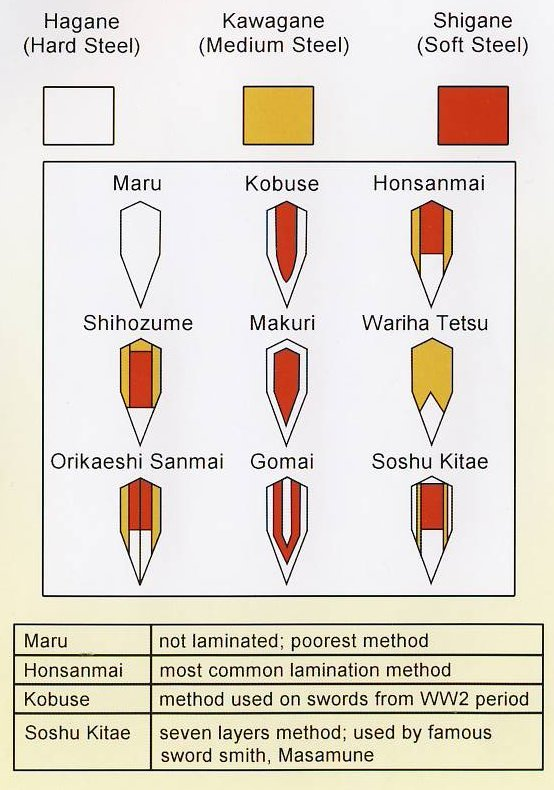
Wiki has had a good Infographic for some time;
There were several different methods used (as shown above) to make the blade but the most common by far was Maru, a single piece. The other methods took much more time and effort (i.e. more money) and were much rarer, though more of the higher quality blades have survived to today for obvious reasons. But this is not unique to Japan. The natural processes that manufacture steel produce multiple types of it which sword smiths from around the world utilized in various ways. A soft body with hardened edges was very common in European and Middle Eastern crafting. For more common than can be observed from traditionally Japanese forged blades. This is because of the need to fold Japanese Iron a lot to remove impurities. It left them with a lot less steel of the softer varieties.
the sword will break.
Long swords were extremely flexible. Breaking them was extremely uncommon. Europeans had been using the method you describe for centuries. Long before the rise of the long sword.
This message was edited 1 time. Last update was at 2015/02/08 16:58:12
Which granted, Deadliest Warrior used them time to time.
I honestly don't think the 'closeness to human flesh' matters. I think it's more important to ensure uniformity in the target and for that a dummy is superior to a carcass.
All I'm saying is that you ask for proof, I show proof of how Katana did in cutting test.
Yeah but there are lots of videos like that.
So obviously, Kilijs are the best cutters ever cause some youtube videos and a TV show says so.
It just doesn't mean much. It's showmanship and opinion. There is no science involved.
A katana will cut 1 to 3 pigs on average.
If you can cut through one soft target, cutting through 2 more ain't gonna be much difference.
All sharp blade start out from fat to thin right?
There are numerous ways to sharpen an edge and its more complicated than that.
When you have fat part in the back and thin in the front...
And? A sword having two edges doesn't prevent it from having a fat center for the stress to be focused down. What you're describing literally makes no physical sense.
it cause the weight to press in more so the single edge would have a fat back side as weight to chuck the cut in deeper.
Whether the back is fat doesn't change weight. You can made a single edge and double edge blade weigh the same amount.
You can disagree just about everything with me, but don't disagree about the pros and cons of single vs double and strait vs curve when it comes to cutting. Single and curve will always win.
I disagree with your conflation of these two factors into one. Single & double and curved & straight are two different factors that have limited barring on each other.
What are you talking about? That picture shows what I've been telling you. Soft body and strong edges?
I don't know what picture you're reading. There are nine different methods of making a Katana on that picture. It's not as simple as 'soft body strong edges.'
You always try to nit pick with me.
The devil is in the details.
Soft body and hard edges to make this sword.
It made lots of swords. The use of multiple 'hardness' steels was common in sword crafting.
No, the european sword standard quality were just pour into a mold and then shape it.
So you learned about swords from Conan the Barbarian?
No one made swords this way after the Bonze age. Literally. NO ONE. During the Bronze age, molds were used pretty much around the world and to a limited extent the early iron age. However once we start getting into the age of steel, no one used molds anymore because it just doesn't work. No one. Middle Eastern. European. Chinese. No one ever forged a combat weapon made of steel from a mold.
The folding steel and mixing of hardness is very difficult.
No it's not. Folding isn't even necessary if the steel is of a suitable quality. The purpose of folding is to purge carbon from a blade, something Japanese smiths absolutely had to do because iron on Japan has far too high a carbon content to make a sword from without folding it. Mixing hardness is also very easy. EDIT: in the sense that any of this is easy. Mixing hardness was such a simple practice that the idea only two cultures on earth would ever use it is laughable.
The thing that was really complicated about Japanese blades was the heat treating as different parts of the blade would be treated differently which is very uncommon. In most parts of the world, the blade was heat treated as one piece, but most parts of the world weren't using iron from Japan so it wasn't really necessary.
Didn't I point this out about soft body and hard edges?
Problem is that doesn't really mean much of anything. It's like saying a gun is all about a trigger and a barrel.
This message was edited 6 times. Last update was at 2015/02/08 17:31:17
david choe wrote: And this is why sometime it is bit annoying with you.
I'm American. My life is empty if I'm not annoying someone from another continent.
That you keep making nonsense statements couldn't possibly be connected. Nope. Not at all
anybody who have read my post will know that David Choe has been screaming about this special forging all day.
Anyone who has ever read about sword smithing knows that it's not special. It's typical. Just like they know no one in the world casted a steel sword from a mold and that different hardness' were utilized by smiths around the world.
Some where better than other and that is because there are over 300 years of history to this blade
And?
This message was edited 1 time. Last update was at 2015/02/08 17:51:22
Your flag says Thailand. Now I have to go elsewhere to pursue my quota :( Brobama ain't gonna be happy about this.
and some how I am embarrassed that I have this long discussion with you....
Half the reason I even post in OT is to have conversation with people like you
Don't act like this man...
Like someone whose actually read a book about the subject matter at some point in time? Yeah I can see how that might inconvenience you
I didn't serve this country so you can act like this
That was your mistake! With all this freedom, I learned how to read, studied history, learned how swords were made, and can now tell people on the internet when they need to watch less TV!
I thank you sir for giving me such an opportunity!
EmilCrane wrote: In addition while the spanish in the colonies certainly used tercio like tactics I doubt they were real tercio soldiers. The men in the tercios were considered an elite fighting force used for fighting wars usually on mainland Europe. I don't think many tercio units went out to the colonies.
I'd definitely agree with that. My guess (as I don't study colonial Spanish stuff) is that the force described in the wikiarticle may have been an adhoc Tercio some military governor threw together to fight the pirates rather than a proper one. The governor likely had military experience (or someone on staff who did) who knew how the formation functioned and could get something similar going in the lack of a trained or experienced force.
This message was edited 1 time. Last update was at 2015/02/09 21:16:32
It's also not true that the farm tool scythe is a myth. Scythes were converted into make shift pole arms. Take the blade off the scythe and use it as a spear tip. Not ideal, but it's still pointy and it saves you the time of having to make spear tips from scratch.
The Japanese Kama is a similar such weapon, though due to it's smaller hand held size, it didn't need much conversion to be made useable.
Swords likely had their start way back when being developed from the sickle or other bladed farming tools.
This message was edited 1 time. Last update was at 2015/02/10 06:24:48
There's nothing to debunk. Some farmers took the blades off their farm scythes and stuck them onto some sticks to make a spear (later purpose built weapons of a similar design were later made). It's rather simple Peasant uprisings have to arm themselves you know (in a similar manner, Tridents and Partisans were likely developed from various kinds of farming forks and hoes).
This message was edited 2 times. Last update was at 2015/02/10 06:36:01
I don't subscribe to the YouTube school of history. I went to real school for that
The farm tool were too thin.
Yeah which is probably why someone decided to make a fully weaponized version of an improvised weapon Improvised weapons are rarely perfect. It's why they're called 'improvised.' You know. Like Molotov Cocktails, Kamas, the Monk's Spade, Axes, and Bo staffs
The guy in the video debunk
If by debunked you mean misrepresented then yes. I've seen that video before and I've had this argument before. The War Scythe was originally developed as an improvised weapon by peasant farmers in Denmark and the Netherlands. That's not really an aspect of history up for contention.
This message was edited 1 time. Last update was at 2015/02/10 06:50:10
david choe wrote: Sorry to destroyed your myth... don't watch the clip.
I find it more comical that you're still throwing around youtube videos.
That you seem to miss the distinction I drew between the farming implemented and how it was converted into a weapon (despite my use of plain English) is just icing
Automatically Appended Next Post:
Ensis Ferrae wrote: No farmer, if he was part of a revolt/uprising would take his scythe into battle without some alterations.
They were actually pretty smart. Cavalry were a dominate force at the time, and axes and knives weren't going to help you get a trained soldier off his horse. If I was a farmer, I'd grab any sharp object I could find and put it on the end of a stick
This message was edited 1 time. Last update was at 2015/02/10 07:00:23
Given that it's been in use for thousands of years, I think it's a pretty good farming tool
I mean we are men right,
Damn straight.
And men love bacon. Literally, and figuratively
you don't know about this part of the history and stand corrected.
It isn't even one part of history. Ancient Greek sources describe the Hittites as forcibly conscripting farmers into the armies who carried nothing but farming implements (including scythes) into battle. Granted the 'scythe' the Greeks described was basically this thing;
And it probably wasn't much longer than a short sword but the Hittites didn't really care if their slave army was properly equipped. They were just there to die anyway
This message was edited 2 times. Last update was at 2015/02/10 07:23:56


 Jian's are gorgeous.







 )
)