|
How many Kestros armed troops were there in an army?
If I recall, it was just one small unit.
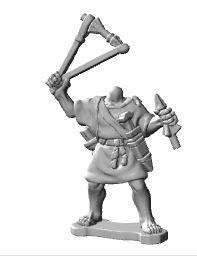
The depiction of the Kestros you have in the image above looks very unlikely, as there seems to be no way to release the dart without the dart veering off its intended path.
If you look at how the dart would need to be launched, the forward part of your design of the Kestros would be pushed back into they dart's tip as the firer accelerated the dart to be launched.
This would require some means of removing this connection before the dart is actually launched, or else it would remain fixed, and the dart would simply follow forward in the arch of this point of attachment.
This is why others have proposed that the sling arrangement with the sling going around the dart, rather than over its tip.
With the sling going around the dart, the Kestros can be whirled around like a normal sling, and when the sling end is released, the dart can then fly free of the sling without anything needing to be forcibly removed from its path.
Also, with then long wrapped around the dart, when it is released, this will impart a spin to the dart, increasing its accuracy.
I can see what is intended here, as it is sort of like a lawn dart. But the construction shows a rather flawed understanding of physics.
MB
Automatically Appended Next Post:
Also.... There was no specific "Macedonian" haircut, per se.
The Macedonians were basically an offshoot of the Greeks, culturally, and they had some influence from the Thracians, whose hair was not too terribly different from the Greeks.
Both Macedonians and Greeks (especially Alexandrian or Successors) would have worn their hair and beards similarly, with the locks in plaited curls, or brushed and cut straight.
If we are talking Alexandrian Successors, then most retained Alexander's command to have troops clean-shaved. Some returned to more classical styles (such as Phyrros's troops had many who returned to native Greek Styles).
But, culturally, from around 300BC, the "civilized" portions of the Mediterranean all took their stylistic queues from Greece, with only Rome rising to challenge that aesthetic in the 3rd - 1st Centuries BC (as Rome built toward Empire).
MB
|