|
WOW! Talk about Synchronicity!
I just recently started adding a covering of toilet tissue to my banners for my LotR armies.
Doing this creates a "cloth" surface texture and appearance.
You put a wash of a color over the surface to be made into a banner, and then lay the tissue over it.
Then you apply a thick coat of paint over that.
When it has completely dried, you give it a spray coating of Gloss Sealer (important that it is gloss sealer), and then "sand" it using a very fine sandpaper or burnishing compound (minimum of 1200, but preferable 1800 - 2000).
This will flatten the surface a bit, and give a flatter surface to paint a pattern upon. You then give it another coat of clear (flat will work this time), and paint your device, or pattern on the banner.
Another way of doing this is to have the banner pattern printed on silk cloth used for covering model airplanes (the flying, radio-controlled variety). And then cut out the banner, and use the exact same method to apply it to the banner, but use clear medium to fix it to the banner, rather than a color (make sure to prime the blank banner backing white).
But you can find all manner of means of creating banners that look more cloth-like.
There is a guy who goes to Historicon every year, who goes by the name "The Standard Guy" who has some tutorials for doing standards.
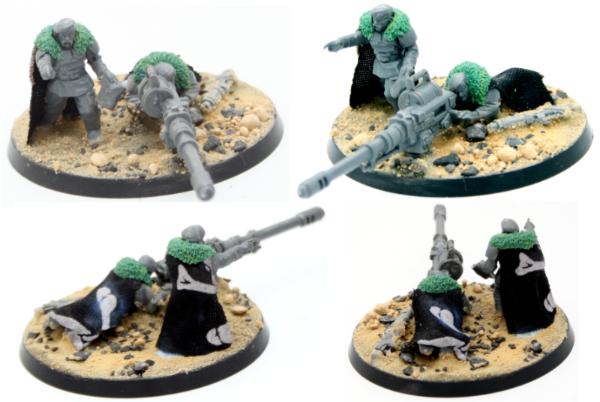
As for doing "robes" in cloth... You would need to use the same aircraft silk.
You need something with an INCREDIBLY FINE thread, and insane thread count, so that the robes do not look like burlap.
For a banner, they were usually woven with something with very thick threads, like Canvas, so the use of facial tissues (toilet paper), or normal silk will be OK, because the grain of banners is usually heavier than that of the robes on people anyway.
But on gaming figures, you are going to have trouble finding an inexpensive cloth to use that will look appropriate, and will be easy to use.
And, in ALL CASES with robes, you will need to put the cloth on a backing of some sort (lead foil is what professional miniature painters typically use for this).
The reason is that the edges of the cloak or robe would need to be hemmed to keep the weave of the fabric from coming undone at the corners or edges where the warp and weave will be open (and thus threads can just drop right off the ends).
You CAN use superglue on the edges, but it will still leave a funny texture on the edges.
By using a backing, the edges of the cloth texture do not show, and can be smoothed back into the backing to keep them from coming unravelled.
But once you get the hang of using tissue or silk to simulate fabrics, you will find that it produces stunning effects, and makes banners, especially, look very realistic.
MB
|