Please Note: while the purpose of these post mortem reviews is to answer (to the best of my ability) the question “what happened during this campaign?” it would be remiss for me to not point out my great esteem for John Regule and the staff of Spiral Arm Studios. That said, it is my belief that there are specific elements of the Maelstrom’s Edge campaign that negatively impacted the campaign’s success, elements which I will explore below.
"Of each particular thing, ask: What is it in itself? What is its nature?" Marcus Aurelius,
by way of Hannibal Lecter.
Proposed: The Maelstrom’s Edge (ME hereafter) campaign
underperformed relative to other campaigns of its type, owing to a variety of factors.
Discussion: the discussion will be divided into four parts;
-
What’s Going On? Is there an actual problem? What does the data show about how Maelstrom’s Edge performed?
-Aesthetics Uber Alles. Or,
Let’s Do The Time Warp Again!
-
Make Me One With Everything: the Peril and Promise of Add-Ons.
-
Who are you? How can
SAS find their market and should they even try to change?
What’s Going On?
The first and most obvious question to ask is: did Maelstrom’s Edge
actually underperform?
The answer, of course, depends on what you are comparing it to. As was pointed out during the campaign, Kickstarter has a much better track record as a platform for board games (even when those games are really
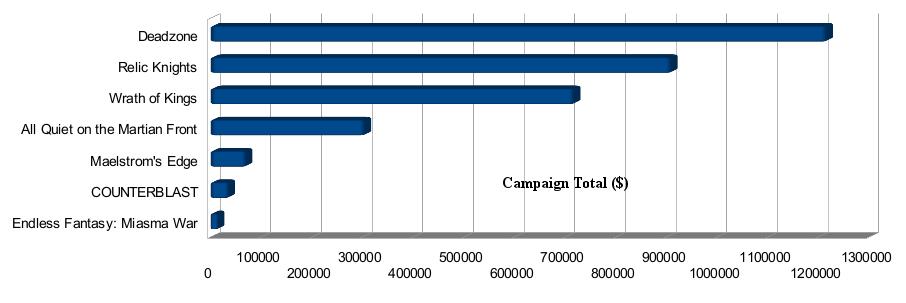
miniature games in board game drag) as opposed to miniature games. That said, there have been a number of successful table top games, most notably All Quiet on the Martian Front, Wrath of Kings, Relic Knights and Deadzone, as well as more modest games such as Patrick Keith’s COUNTERBLAST and On the Lamb Games’ Endless Fantasy. In such company, the matter quickly becomes clear, as you can see;
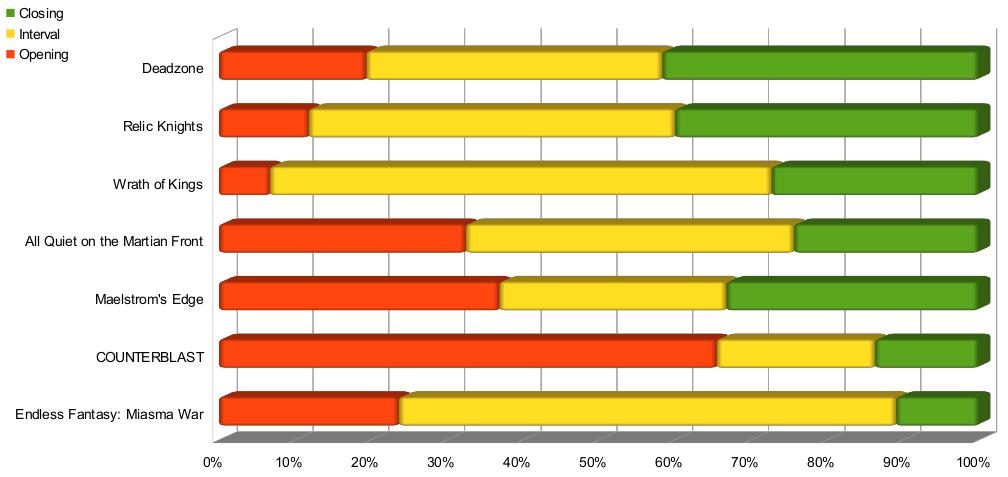
While the total amount of money raised is substantially less than other, seemingly similar games in a high state of development, the distribution of funding during the campaign does not reveal any immediate red flags.
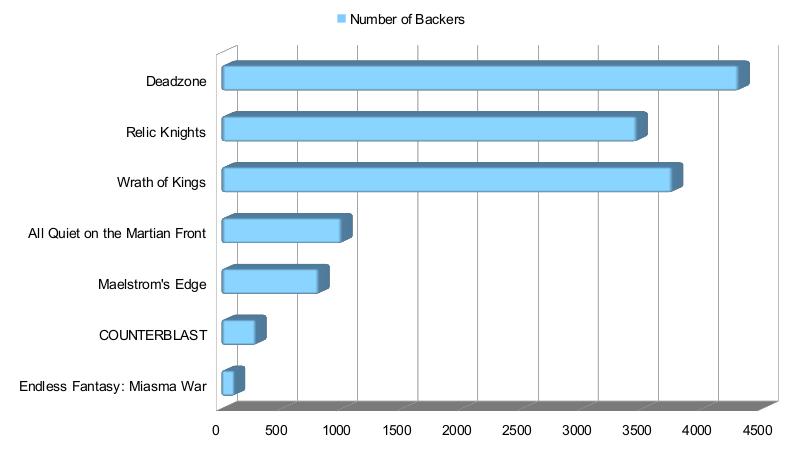
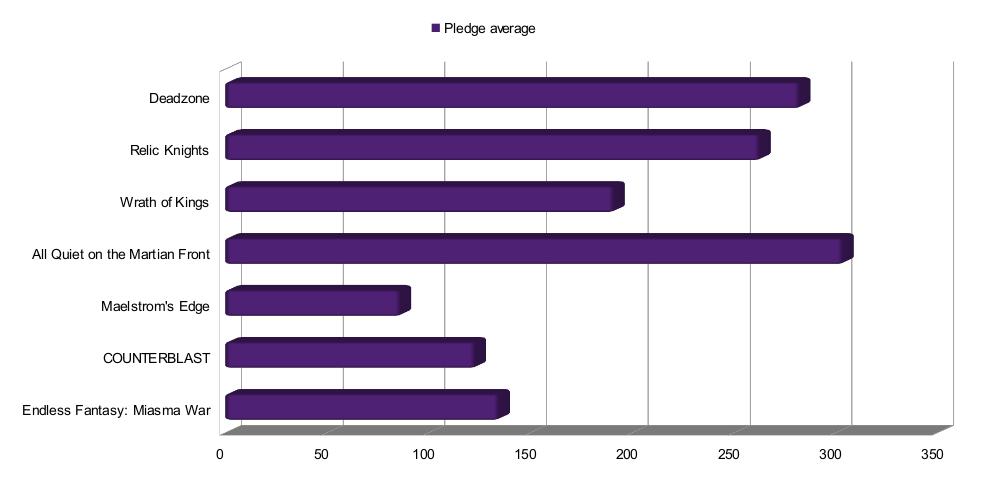
The Maelstrom’s Edge campaign has a seemingly healthy ratio, with a near ⅓ opening, ⅓ interval and ⅓ closing distribution of funds. So how can we explain the relatively low overall numbers? Two graphs tell the tale;
What we see above is that the ME campaign seemingly fell short in two different ways: 1) it failed to attract a large backer base, and 2) the base that was attracted had a significantly lower average pledge amount than other, similar campaigns. I will diagnose what I believe underlies these two shortcomings in the next two sections.
Aesthetics Uber Alles! Or, Let’s Do The Time Warp Again!
It is my belief that the single greatest negative for the campaign were the aesthetic choices that defined the product. Previous post mortems have convinced me that nothing is so important in Kickstarter campaigns as being able to arrest the attention of the browser with visuals. In this regard I believe that the fate of the campaign was, in very large part, determined when too many potential backers first looked at the campaign main page and came away saying “looks dated to me,” or some variation thereof.
It’s important to realize what I am saying here is not that there is a lack of
quality in the product: quality and aesthetics are entirely separate. A product may have fantastic quality but be staid and uninteresting, and the most flamboyant and visually interesting product may be insultingly cheaply and poorly made.
Instead, it is my contention that there has been a gradual evolution in the field of tabletop games away from the conventions of ‘heroic scale’ 28mm that chiefly characterized miniatures made by Games Workshop (
GW) in their Warhammer Fantasy Battle and Warhammer 40,000 games. The conventions of ‘heroic scale’ are by no means the property of
GW (though they might protest this in court…), and were nearly ubiquitous in the tabletop market in the early 2000’s and common in the industry even a few years ago. However, improved manufacturing techniques for mass market models, increased proficiency and availability of digital sculpting and a growing sophistication on the part of consumers looking for ‘something different’ have led to a general drift away from heroic scale.
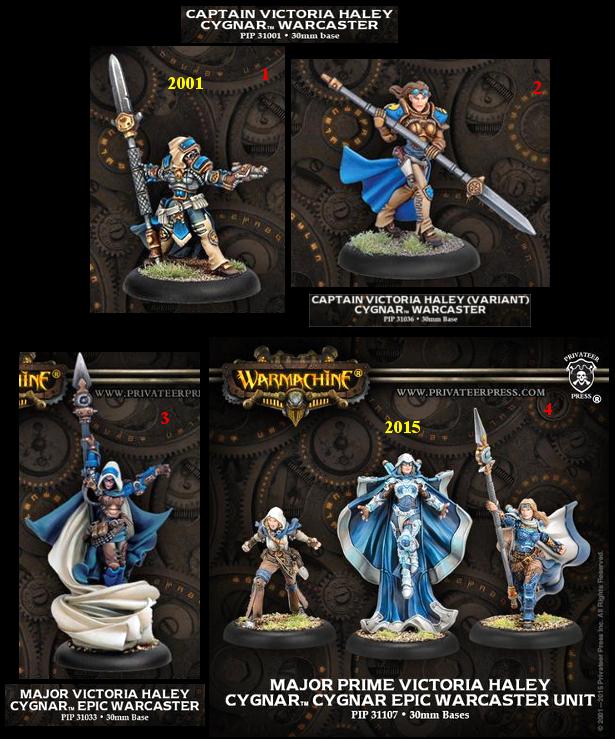
As an example, consider the evolution of a character from the Privateer Press (
PP) game Warmachine: the Warcaster Victoria Haley. Haley has existing in Warmachine since the launch (or very nearly) and has three different in-game incarnations and four different sculpts over the course of approximately fifteen years.
I believe the visual and stylistic evolution is quite clear here. The first sculpt, probably produced around 2000-2001, is very reminiscent of the ‘heroic scale’ aesthetic: blocky and distorted, with a premium paid to game silhouette over sculptural quality. By contrast, the most recent sculpt was only just released this weekend and is an exercise in flowing lines, details and more elegant proportions*. I believe this not only represents increased proficiency with the tools of sculpting, but a growing comfort on the part of the game maker in the consumer’s sophistication: the maker trusts the consumer enough to indulge sculptural elements.
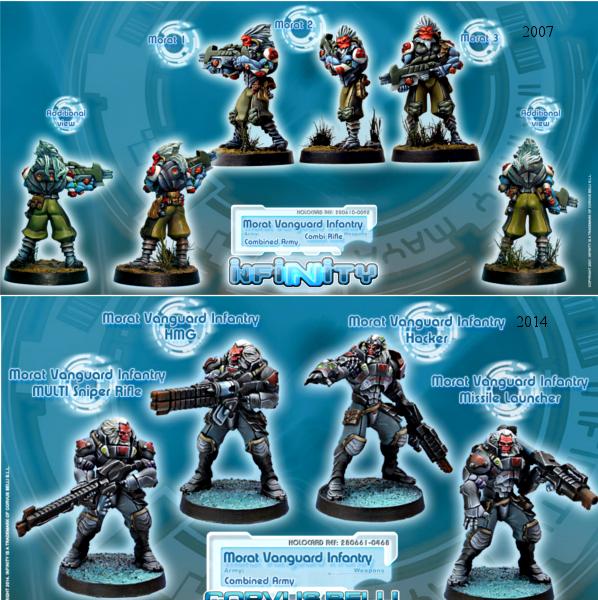
A similar example can be seen in the revisions to the Morat Vanguard unit for the Covus Bell game Infinity;
Once again we see an evolution away from the exaggerated proportions towards a more ‘naturalistic’ sculpting style.
Now, obviously, there is no single aesthetic that the market is moving towards: rather there is a huge variety of individual styles being explored, from the anime-influenced style of Infinity, the voluptuous but naturalistic body horror of Kingdom Death, the heavy armored realism of Dreamforge Games, the resurgence of chibi-styles in board games like Arcadia Quest and Super Dungeon Explore, and ‘European’ (i.e. Rackham influenced) stylings such as Wrath of Kings and (idiosyncratic) Raging Heroes. The constant in all this is change: a movement away from the satisfied aesthetic ecosystem inhabited by
GW (and to a certain extent, Mantic).
With all that said, the question then becomes: what about the styling of the miniatures in ME? I contend that while ME is not
identical in style to previous lines, it is very much
informed by the ‘heroic scale’ of styling, and reflects the sentiments that underpinned the heroic scale, such as placing a premium on silhouette as opposed to sculptural expressiveness.
Replace, rather than Displace: what I mean by this is that there are miniature lines that are clearly meant to act as a supplement, and others that are meant to act as a complete replacement. Consider, as an illustration, the difference between Dreamforge Games’s Eisenkern line of models and Victoria Miniatures’ Arcadian male and female lines.
One can, and indeed is intended to, slot Arcadian figures into an existing army composed of
GW or
GW styled figures: there is no aesthetic break between Arcadian males and females and the corresponding
GW lines. There is a shared heroic scale sensibility, even if one is (as I am) inclined to consider the Victoria Miniatures’ models of a superior level of craft and design.
The Dreamforge model, however, cannot be so used: one would not replace a single figure in a
GW army with a
DFG trooper, nor would one replace a unit of, for example, heavy weapon Space Marine Devastators with a unit of Eisenkern Heavy Support models. There is a clear aesthetic difference between these lines, and it would be visually jarring to have a force composed of a mixture of
GW/Victoria models and
DFG models.
How then do we judge ME figures? I would argue that they, like Victoria Miniatures, replace rather than displace: one could easily imagine using ME models in a
GW army, the Epirian contractors especially.
Again, this is by no means to be taken as an insult to the
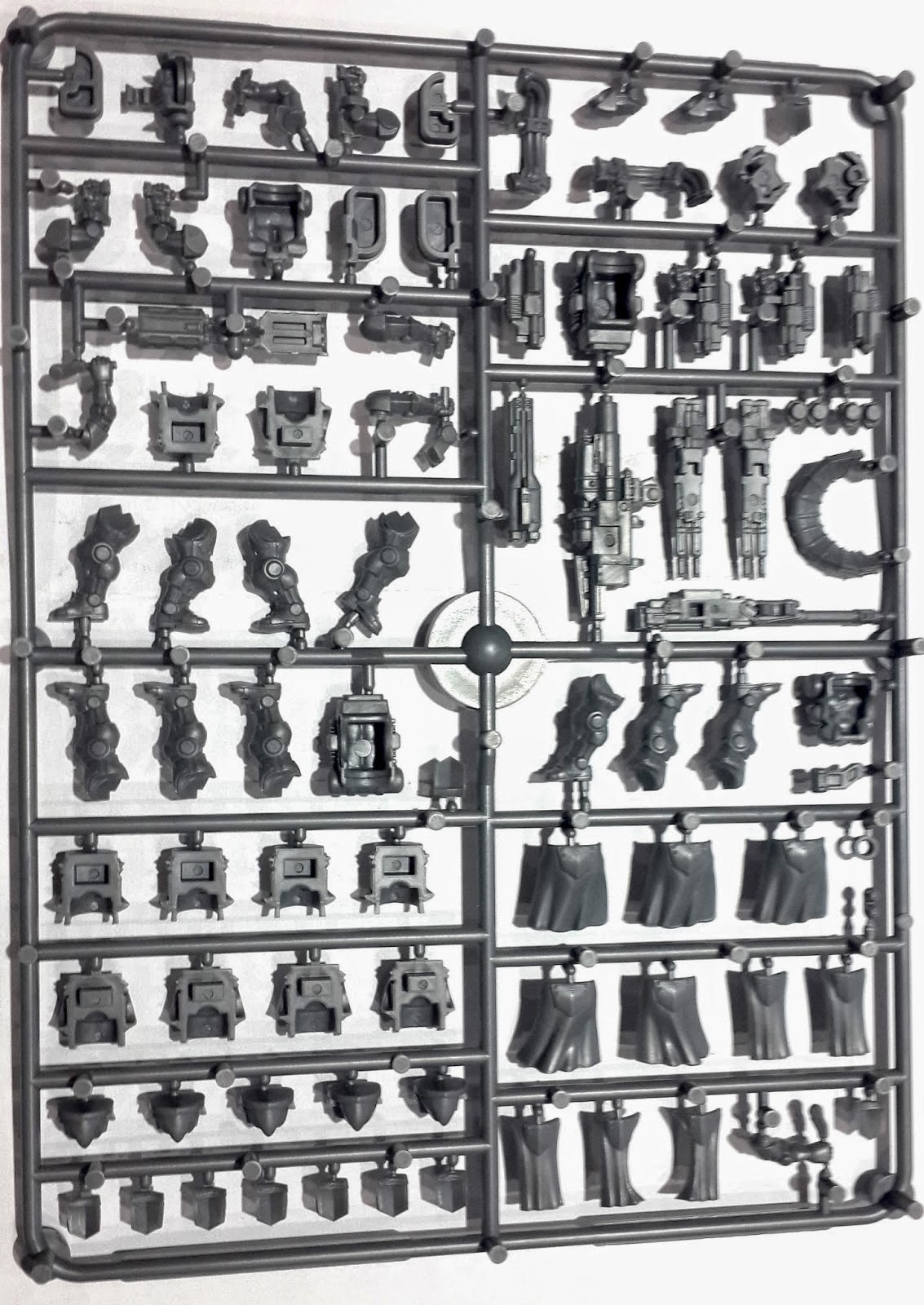
quality of the miniatures, only an evaluation of the choices that went into their styling. I must also point out, the Karist Enclave standard troopers are noticeably less heroic scale then the Epirian Contractors. However, this isn’t a great plus, since it creates a situation where the very few human sculpts in the game appear to be following two different aesthetic schemes. This is often seen in established games as the developers change in response to market forces or increased technical ability, but it is jarring to see when both units are in the same box.
All of which leads to an uncomfortable maxim allegedly derived from marketing: “it doesn’t matter how much you try to sell it if the dog just won’t eat the dog food”. Up to now, I’ve been trying to establish that there is a trend in miniature gaming, and that the decisions that ME made ended up locating their miniatures on one particular side of that trend line. But that isn’t the same thing as saying it’s
bad: the fact is that
GW is, even now, selling far, far more than all of the kickstarter backed games, and indeed all of them plus
CB and possibly
PP as well.
The problem is that selling, as Victoria Miniatures does, miniatures intended for use in a particular game system, is very different than using miniatures to generate excitement for a brand
new game system.
Looking at the graph of average backer pledges (the purple bars), one thing may not be immediately obvious: the average backer of ME had a pledge of $86. This is enormously significant because this is less than the $90 minimum pledge level to get the complete box set. Of the backers of ME that selected reward levels (some did not), only 575 backers selected levels that included miniatures, while 197
(25%!) backers were at
levels that had no miniatures.
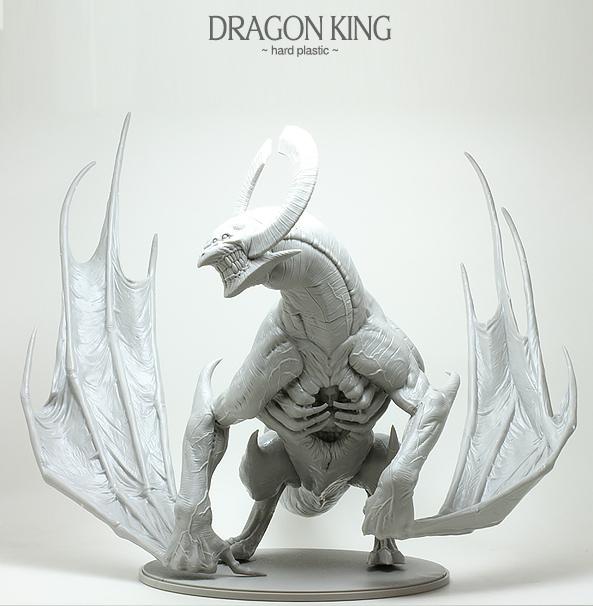
Consider the comparison between two large, monstrous creatures that were born on Kickstarter: the Karist Angel from Maelstrom's Edge, and the Dragon King from
Kingdom Death: Monster.
N.B. N.B. I am
not claiming these are
comparable products: the Dragon King was the centerpiece of a $30 (MSRP $50+) expansion and is comprised of five sprues by himself, while the Angel is a single sprue component of the main ME box
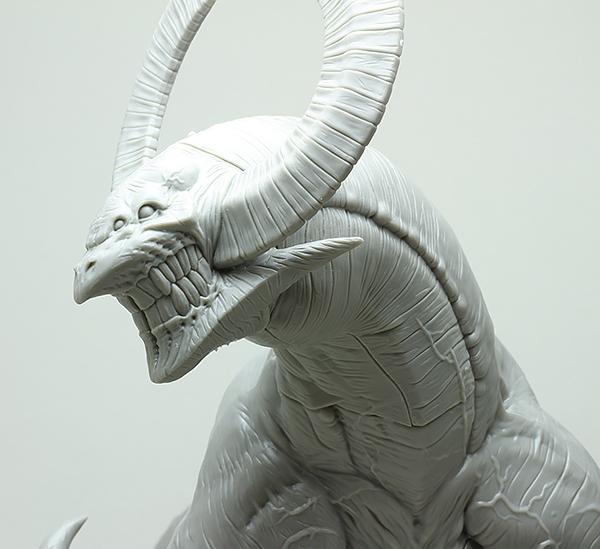
Large centerpiece models can have a huge amount of aesthetic and emotive weight: just look for a moment at the close-up of the Dragon King and then take stock of how you feel, both about it, and about the universe it would inhabit;
Again, my point is not ‘the dragon king is
better”, but that the Dragon King succeeds in conveying… something. An emotion, a sense of disquiet perhaps, it is
evocative. It’s entirely reasonable to say that a figure for a skirmish level tabletop miniature war game shouldn’t be asked to do that, but it does beg the question: when you look at the Karist Angel, what do you think of?
Personally, I think of liquorice.
Make Me One With Everything: the peril and Promise of Add-Ons.
A second problem is apparent when you compare the graphs of number of backers with the overall totals: why is it that All Quiet on the Martian Front has 25% more backers, but over 400% more total for the campaign? The answer is primarily the presence of Add-Ons. As mentioned above, the average ME backer contributed
less than the basic box pledge. The dirty little secret of miniature games on kickstarter is the up-sell: get someone to make basic box or even a nominal pledge, and over the course of the campaign a backer’s $10 pledge may morph into an amazing amount of money. Consider this well laid out menu of additional purchases from Wrath of Kings;
Whether it is board games of tabletop games, a common element of the most successful kickstarter campaigns is providing, as the campaign progresses, a mixture of pledge incentives and paid add-ons. Pledge incentives are those things that ‘sweeten the deal’, as it were: additional models to the base game pledge, digital art books, improvements to the base game. The purpose of all of these elements is to motivate the casual viewer to regard the campaign as “too good to pass up”, and make a base game pledge. Almost all very successful campaigns share this feature, but the Platonic example may have to be the Bones campaign run by Reaper Miniatures, where the ‘Vampire’ base pledge, well;
During the ME campaign we saw the use of pledge incentives:
Update 13 dramatically increased the contents of the base game box, and there was a steady stream of free additions. This doubtless had an effect on the closing days’ total (48 hours before close the “Remind Me” function brings back people who were interested before, but not motivated to pledge), but, as the incentives are by definition free, don’t help the bottom line save to attract more backers.
To understand the value of add-ons, it’s worth pointing out that if ME’s average backer amount been equal to Wrath of Kings ($191), it would have earned over $155,000 (over $80,000 more than ME), with the same number of backers. Paid add-ons also allow a manner of ‘double-dip’: development costs are covered by the campaign’s general costs, but unlike pledge incentives, add-ons don’t constantly eat into the profit margin. That is, most pledge incentives, such as additional sprues or new model types, increase the cost of the base set, even if only by a marginal amount (a problem that digital incentives do not share, one will note). By contrast, once a price point has been set for a paid add-on, that price point stands.
With all that said, why didn’t ME include paid add-ons? The simplest answer is that for all the benefits of add-ons, there is an underappreciated danger to lots and lots of add-ons: logistics. Selling a single boxed product (as ME did) allows the boxes to all be packed at a single centralized facility. A single box presents the simplest possible solution for shipping, as even a single add-on requires the creation of an entire layer of personnel to sort and pack individual orders. In larger campaigns this is then compounded by the need for Quality Assurance and then Customer Service to sort out the inevitable packing mix-ups.
The math of add-ons greatly favors companies like CMoN; established companies that can use their pre-existing merchant infrastructure to process the additional logistics add-ons generate. As a practical matter it seems that add-ons are something either avoided entirely, or embraced fully.
Who are you? How can SAS find their market and should they even try to change?
Where does all of the above leave us? In my opinion, Maelstrom’s Edge suffers from some very significant deficits for a new game: the single most important deficit being the lack of a clear aesthetic identity.
When I began writing this
post mortem, I had planned on addressing what I regarded as the shortcoming and inappropriate nature of the setting. While I may yet do so, I have come to the conclusion that whatever literary shortcomings may be present, they are so insignificant as to be nearly irrelevant.
Like the card game and novels that were added to the boxed set during the campaign, the setting and universe are things that hold, rather than recruit, players: people who are inclined to do so delve deeper into the background and ancillary products.
Trite as the conclusion may be, it is my frank evaluation that ME suffered most from having uninspiring miniatures. Without interesting and attention grabbing miniatures, everything else went for naught: all the well regarded authors and deep background can’t sell a product to someone that never looks past the first page of the campaign.
So what’s the future? Assuming, for the sake of argument, that the current slate of miniatures are the ones that the boxed set will launch with,
SAS would seem to have no choice but to sell hard on everything but the miniatures. The situation is analogous to when
PP initially began promoting
WM/Hordes: the slogan ‘Game like you got a pair’ announced to prospective players that this was a new system, one that was not beholden to the fuzziness of
GW’s “beer and pretzel” style of soft rules.
Such a campaign can work again, albeit with a different focus: ME is not intended to target the same audience as
WM/Hordes, but… well, there’s the rub.
Who exactly is ME intended to cater to? This is not 2005; there are several tabletop games at the skirmish level on the market. Wrath of Kings is targeted at almost precisely the same 10-50 model per side game level, Infinity and Relic Knights a bit smaller scale even then that and, of course, Warmachine and Hordes are far more entrenched and developed then they were even five years ago.
For the moment, analytics seems to be the task facing
SAS: who
exactly is ME intended to appeal to? Is there a population out there of people that didn’t know about the campaign, or was there something intrinsic to the campaign that discouraged people from pledging?
I’m sure that there is more that will be said (and probably plenty of typos waiting to be pointed out…), but for the meantime, I do hope that this analysis is of some use to both
SAS, and others that are hoping to launch their own crowdfunding campaigns. As ever, I am interested to hear other’s thoughts on my analysis.
*For a closer look at the work of this sculptor (Javier Garcia Ureña), who also produces digital sculpts for Corvus Bell’s Infinity game, see
his deviantArt page.