| Author |
Message |
 |
|
|
|
|
Advert
|
Forum adverts like this one are shown to any user who is not logged in. Join us by filling out a tiny 3 field form and you will get your own, free, dakka user account which gives a good range of benefits to you:
- No adverts like this in the forums anymore.
- Times and dates in your local timezone.
- Full tracking of what you have read so you can skip to your first unread post, easily see what has changed since you last logged in, and easily see what is new at a glance.
- Email notifications for threads you want to watch closely.
- Being a part of the oldest wargaming community on the net.
If you are already a member then feel free to login now. |
|
 |
2023/05/21 10:02:18
Subject: Do Commissars Really Fit In The 40K Universe?
|
|

Calculating Commissar
|
The Roman Empire does have a huge impact on the 40k lore (as big as the medieval era in my opinion), but it is framed in a manner that feels familiar to Brits with the way we are taught history- the shining Roman empire collapsing and giving way to the medieval dark ages.
The Imperium during the Great Crusade and Horus Heresy heavily references the Roman empire, the principal military forces are even legions at the command of the Emperor. The later Imperium carries vestiges of this, with people harking back to the early days to shore up their own authority (similar to, for example, the Holy Roman Empire or Sultanate of Rum).
This does what references are supposed to do- provide a cultural shorthand metaphor for understanding the themes of the setting- hope dashed into despair. As 40k was made in Nottingham, England, it naturally uses references familiar to its creators and target audience of the time. If 40k had originated elsewhere, its main references would be different in keeping with those cultures.
|
|
|
|
2023/05/24 10:39:38
Subject: Do Commissars Really Fit In The 40K Universe?
|
|
Calculating Commissar
|
 Eilif wrote: Eilif wrote:Commissar von Toussaint wrote:Deadnight wrote:If any period was more 'central' to 40k, its the reality that was the grim 1970s to 80s post-industrial thatcherite UK. And 80s pop culture.
Yes, this is probably the only "indigenous" element to the game that wasn't outright pilfered - post-industrial cities rules by violent gangs who are periodically beaten down by pitiless police forces while the elites hang out in the spires. The whole Ork aesthetic is also very punk British.
Maybe. While it did reflect certain realities, there's a good argument to be made that they stole that wholesale from AD2000 comics. Judge Dread = Adeptus Arbites etc....
I think both are applicable here, with 2000AD working off the same source theme of 70's-80's Britain. 40k Orks in particular seem to be genre-spawning for that type of Orc and probably the most original major concept in 40k. Basing an alien race on football firms is certainly something...
|
|
|
|
2023/05/26 08:51:11
Subject: Do Commissars Really Fit In The 40K Universe?
|
|
Calculating Commissar
|
NapoleonInSpace wrote: Haighus wrote: Haighus wrote:The Roman Empire does have a huge impact on the 40k lore (as big as the medieval era in my opinion), but it is framed in a manner that feels familiar to Brits with the way we are taught history- the shining Roman empire collapsing and giving way to the medieval dark ages.
The Imperium during the Great Crusade and Horus Heresy heavily references the Roman empire, the principal military forces are even legions at the command of the Emperor. The later Imperium carries vestiges of this, with people harking back to the early days to shore up their own authority (similar to, for example, the Holy Roman Empire or Sultanate of Rum).
This does what references are supposed to do- provide a cultural shorthand metaphor for understanding the themes of the setting- hope dashed into despair. As 40k was made in Nottingham, England, it naturally uses references familiar to its creators and target audience of the time. If 40k had originated elsewhere, its main references would be different in keeping with those cultures.
I get that, and don't discount it, but, really, I think that the closer fit is to the HRE, and, if anybody specifically, Charlemagne and his paladins, rather than the ancient Roman Empire. I see a lot more of the paladins in the primarchs than I do any parallel to the Roman Empire. I think I even see a little of Horus in Ganelon.
If you want toe drag it across the English Channel, Arthur, the Knights of the Round Table and Mordred, but certainly after the fall of Rome, with the Emperor trying to rebuild it.
My thoughts.
Eh, I think a set of mighty generals with independent power bases commanding their legions with personal loyalty, which then choose sides in an empire-shaking civil war, is archetypical Roman Empire.
Deadnight wrote:The empire in warhammer fantasy battle is a better analogy for the holy roman empire- the Imperium is far broader in scope and source.
the primarchs too represent/are sourced from loads of other areas too - Russ was a viking, Khan was a mongol, horus was a gang leader plucked out of 'the warriors', gully and dorn are absolutely romans, angron was Spartacus etc. You can argue sanguinius and fulgrim lean towards the renaissance etc. And corvus snuck out of an Edgar Allan poe novel.
I'd argue that Dorn is more of a medieval knight than a Roman. The aesthetic of the Imperial Fists in 30k is much more crusader-knight, and is where the Black Templars are spawned from. The Roman aspects of the IFs always felt more like dutiful compliance with the wider Imperium, especially after the implementation of the Codex Astartes.
I wonder if Fulgrim is a little later in theme, more Baroque than Renaissance?
|
|
This message was edited 1 time. Last update was at 2023/05/26 08:57:16
|
|
|
|
2023/05/30 09:13:21
Subject: Re:Do Commissars Really Fit In The 40K Universe?
|
|
Calculating Commissar
|
 AtoMaki wrote: AtoMaki wrote: alextroy wrote: alextroy wrote:The Imperium of Man is not one thing. It is many, contradictory things. The Commissar is just one example of those contradictory things.
I wouldn't say it is contradictory but exists as its own island: the concept is there, it is just strange that it is supposed to work in a world where a bolt round in the head is usually a quick and easy way out compared to the alternatives like getting your soul munched by daemons. So in the context of the setting, the Commissar is not punishing the guardsmen, he is mercy-killing them. But then as per the lore he is clearly punishing them, so how the hell should I imagine it? Do the guardsmen really fear getting headshot by a dude in a sharp dress more than unspeakable eternal torment by whatever galactic horror they are facing?
Well, Commissars do have other punishments available.
I think the main thing though is guaranteed death from the Commissar vs probable death from the foe. Guard units do still retreat against orders sometimes, so clearly the Commissars sometimes fail. Even a Krieg regiment was noted to break during the Vraks war and lynched their Commissars- the survivors were sentenced to a penal legion or executed.
I don't think the average trooper knows what threat a daemon actually holds beyond the instinctive dread they instil. A bolt round to the head of the one faltering most seems to be used as a way to focus minds.
The 13th Penal Legion books highlight this interaction very well IMO.
|
|
|
|
2023/05/30 09:48:54
Subject: Re:Do Commissars Really Fit In The 40K Universe?
|
|
Calculating Commissar
|
AtoMaki wrote: Haighus wrote:I think the main thing though is guaranteed death from the Commissar vs probable death from the foe.
By the time the Commissar starts shooting people that death is not probable but imminent. And I don't think many Guardsman would look at an Ork and unironically think that the beast would only shower them with hugs or something if you know what I mean. But again, I'm willing to accept it as a kind of feature.
Of course not, but they have the opportunity to kill that Ork first, to win. Whereas the Commissar is standing behind and unlikely to miss... Even if they know winning is impossible, they may be able to accept that a death delaying the Ork attack is aiding colleagues elsewhere, a death at the hands of the Commissar is not. The Imperium is, generally speaking, a religiously-indoctrinated cult and Commissars call out spiritual aspects as much as physical ones.
Gert wrote:With the Krieg, Commissars are there to do the same job they are in a normal Regiment, enforce the orders of the commanding officer, and punish those who disobey.
Kriegers generally don't do most of the things regular Guardsmen would get punishment detail for like laziness, use of banned or restricted substances, and blasphemy. Kriegers get in hot water because they are zealously suicidal to a man and Commissars ironically step in when Kriegers don't retreat. They often have to remind their charges that their lives belong to the Emperor and it is not their right to waste those lives in a last stand when they can be made useful elsewhere.
Yes, but even the Krieg will still break and fall back against orders on occasion, just at a lower rate than most other regiments. Commissars fulfil their more common purpose in these cases.
The Vraks example is an entire DKoK regimental attack (as many as 200,000 guardsmen) breaking in the face of enemy fire, and resulted in the entire surviving regiment being punished for their failure.
|
|
|
|
2023/06/12 05:59:00
Subject: Do Commissars Really Fit In The 40K Universe?
|
|
Calculating Commissar
|
 Kanluwen wrote: Kanluwen wrote:Cadians, in the better iterations of their lore, literally did not have Commissars.
Officers instead were trained to watch for warp taint and authorized to execute cowards on the spot.
When was that, 2nd edition?
Edit: no lore about Cadia not having Commissars in the 2nd and two 3rd edition Imperial Guard codices (which state that every regiment has at least one) with Commissars being shown as part of the command staff of the Cadian 8th, and Codex: Eye of Terra has Commissars in the Cadian army list and a lore exerpt from a Commissar being assigned to a Cadian regiment.
When did Cadian lore have them Commissar-less? Were Cadians mentioned in Rogue Trader?
|
|
This message was edited 3 times. Last update was at 2023/06/12 08:25:23
|
|
|
|
2023/06/12 20:45:12
Subject: Do Commissars Really Fit In The 40K Universe?
|
|
Calculating Commissar
|
Kanluwen wrote:I don't care enough to dig out the White Dwarf articles on this.The long and short of it is that Commissars were meant to be a "counts as" thing more than anything else, at least in the Cadian side of things, since that "Iron Discipline" doctrine was present for officers in the 3.5 book and EoT codex.
The excerpt you reference from the Eye of Terror codex even alludes to this. They didn't tolerate outsiders.
ADB's "Cadian Blood" novel built off this lore, with commissars being considered a punishment as they're not Cadians.
That... doesn't hold up very well. Plenty of regiments have iron discipline and commissars, notably the DKoK. Codex: Eye of Terror is explicit when a unit is counts as. It says things like Kasrkin squads (use the stormtrooper entry in Codex: Imperial Guard)* or Gibbering hordes (counts as Nurglings). Commissars are just straight included in the army list in the same manner as, say, infantry platoons. The codex also includes a commissar in the section on Cadian models. The 3.5th Guard codex (released a few months after Eye of Terror) includes a commissar in the Cadian 8th command staff.
The excerpt straight up confirms commissars attached to Cadian regiments, consistent with other Guard lore. It takes pretty significant mental gymnastics to read a quote attributed to a commissar attached to a Cadian regiment and then claim that shows commissars are not attached routinely to Cadian regiments...  Commissars not being well tolerated is hardly unusual, loads of worlds produce regiments suspicious of them and part of the training commissars receive is to help them integrate into hostile regiments. Cadians have nothing on, say, Catachans, who still get commissars assigned despite routinely fragging them in "accidents".
Meanwhile, the 3rd edition codices also state every Guard regiment has at least one Commissar. Nothing I have found so far suggests that Cadian regiments have an exception, and the codices from this era suggest that Cadians do use commissars.
The Warhammer + vault has only reached October 2003. Over the next few weeks it will extend back across the 3.5th IG codex release and the Eye of Terror campaign. I strongly suspect the White Dwarf articles you refer to are from this time period, so I may be able to confirm what you are referencing about Cadian regiments sometimes or often not having commissars once I have access to the magazines.
But to put it more succinctly?
There's room for commissars...but it really shouldn't be as a permanent fixture in every single regiment.
We have Tempestus Scions, that's a good spot for them. There's a really really good option as well for reframing Tempestus to be the "Suicide Squad" of the Guard(especially if you've read the codex they had, and the items available in their medikits), with Commissars as the minder.
We could have Conscripts or Planetary Militia, and again that's a good spot for them.
You don't think every regiment should have at least one commissar? That is hardly too many, for many regiments that is one commissar for thousands of men. The Cadian 8th example above has one commissar for 4000 troopers! Plenty of room to have forces without commissars on the tabletop. It has also been established lore for at least 28 years...
*This is for the elites Kasrkin entry. There is a new entry for Kasrkins used as grenadiers in the troops slot.
|
|
This message was edited 1 time. Last update was at 2023/06/12 20:48:19
|
|
|
|
2023/06/12 21:42:39
Subject: Do Commissars Really Fit In The 40K Universe?
|
|
Calculating Commissar
|
Kanluwen wrote:No, I think there should be zero commissars. It's a boring trope in 40k and it's been boring as hell for Guard. We have too many different types of "...and then they executed Bill for heresy" types of characters in the lore.
Fit them into the Tempestus side of things, if they must stick around. "Reveal" that the Tempestus is effectively Suicide Squad with Commissars playing the role of Rick Flagg.
You lot want so badly to have this "iconic" image of a political officer(which isn't even what a commissar was, prior to the Soviets and their distaste for terms tied to the Imperial rule) in there. If it's got to be a thing? Go the full distance. Remember that Commissars were poorly trained, but highly connected within the Party. They had to bring in trainees and non-military "militia" from the Party for all intents just to prevent from being "accidentally" shot in the field at the big battles they're renowned for.
Eh, commissars are about more than field executions. They are what ties a regiment in to the Departmento Munitorum, what turns a planetary fighting force into an Imperial fighting force. Bad trigger-happy commissars exist, but they tend to go missing quickly in warzones...
This extract sums them up best:
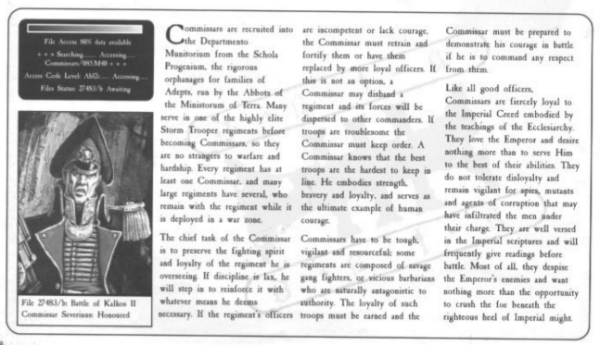
Fair enough if you don't like them, but they are solidly part of Guard lore and the stuff about Cadians above increasingly sounds like headcanon extrapolated from some snippets.
|
|
|
|
2023/06/13 08:23:25
Subject: Do Commissars Really Fit In The 40K Universe?
|
|
Calculating Commissar
|
Kanluwen wrote:
Could have fooled me. They are what ties a regiment in to the Departmento Munitorum, what turns a planetary fighting force into an Imperial fighting force.
Er no, that's the Departmento Munitorum. Yeah, Gaunt showed up and "whipped a planetary fighting force into shape"---but it was because he was an officer not a Commissar.
Right... and who does the Departmento Munitorum attach to a newly-founded regiment as their representative...?
Commissars are intended to bring regiments in line with the Imperium as a whole.
Bad trigger-happy commissars exist, but they tend to go missing quickly in warzones...
And yet we have people insisting that they must be a defining factor of the Guard?
You know what's more of a defining factor? The Guardsmen.
This extract sums them up best:
None of which matters, because they're a one-note character. Nothing of what that summary features is actually present.
Fair enough if you don't like them, but they are solidly part of Guard lore
So is Sergeants and officers with lasguns, and yet...
...and yet this is the lore subforum, where those sergeants still exist! Where sergeants and officers with stormbolters and combi-weapons still exist! Current rules and model ranges have no bearing on the scope of the lore. In the same vein, commissars in the lore are regimental advisors who maintain discipline and adherence to standards, raise morale, and enforce punishments if necessary. There are plenty of lore examples of commissars doing much more than shooting guardsmen, and explicit lore that commissars which are overdisciplinarian tend to encounter "accidents" in their first combat engagement. Commissars are a core part of Guard lore, bad commissars are a subset of that and far from the totality.
Wait, is your distaste of commissars partly due to their rules?! Most of the excerpt above is never going to be reflected on the tabletop by the commissar model, because it is already represented by the regiments other soldiery being incorporated into the Imperial Guard machine.
and the stuff about Cadians above increasingly sounds like headcanon extrapolated from some snippets.
It's not, but whatever. Good luck finding it though!
If you want a non-primary source? It's printed in black & white in "Cadian Blood" about how the Commissar who was assigned to them was a punishment from the non-Cadian command cadre of the overall battle group.
I need to read the Black Library novel. The White Dwarfs apparently contradicting established Guard lore from the time that you cannot be bothered to find I shall keep an eye out for, although are not a very compelling argument...
Additionally, as a closing aspect?
Commissars "fit" when they're used well. They "fit" in the novels, they "fit" in the overall background scheme.
They don't fit in a game when we now have a world where we have people who seem to believe that the Commissars are the "Good Guys" of the story. Where people don't understand the supposed satire behind them. Where people don't understand that the only examples we get are the aberrations rather than the norm.
Right... I think anyone who thinks commissars are the good guys has bigger problems than a lore discussion. They probably also struggle with the satire of the rest of the setting, but maybe we shouldn't change the whole setting because of Poe's law?
|
|
|
|
2023/06/13 10:51:09
Subject: Do Commissars Really Fit In The 40K Universe?
|
|
Calculating Commissar
|
AtoMaki wrote: Kanluwen wrote:No, I think there should be zero commissars. It's a boring trope in 40k and it's been boring as hell for Guard. We have too many different types of "...and then they executed Bill for heresy" types of characters in the lore.
I disagree. In fact, I'm on the exact opposite opinion: the people in the setting are way too soft and angsty and it completely undercuts the tone. Characters like Gaunt and Cain are straight Nobledark and should have much role other than getting introduced at the end of a chapter, hyped as the Big Dang Heroes through it, then unceremoniously killed off at the end of the same chapter. I want monsters and psychos everywhere, even in the role of the protagonist, because that's literally half the point of having a Grimdark setting. And it shouldn't go just for characters of note like commissars but everyone including guardsmen. Especially guardsmen.
Sounds like Colonel Schaeffer is more your kind of character- a "hero" who is willing to sacrifice all the troops under his command to achieve the mission objective, and an unshakeable faith that his orders are infallible and worth any cost.
|
|
|
|
2023/06/13 12:06:53
Subject: Do Commissars Really Fit In The 40K Universe?
|
|
Calculating Commissar
|
AtoMaki wrote: Haighus wrote: AtoMaki wrote: Kanluwen wrote:No, I think there should be zero commissars. It's a boring trope in 40k and it's been boring as hell for Guard. We have too many different types of "...and then they executed Bill for heresy" types of characters in the lore.
I disagree. In fact, I'm on the exact opposite opinion: the people in the setting are way too soft and angsty and it completely undercuts the tone. Characters like Gaunt and Cain are straight Nobledark and should have much role other than getting introduced at the end of a chapter, hyped as the Big Dang Heroes through it, then unceremoniously killed off at the end of the same chapter. I want monsters and psychos everywhere, even in the role of the protagonist, because that's literally half the point of having a Grimdark setting. And it shouldn't go just for characters of note like commissars but everyone including guardsmen. Especially guardsmen.
Sounds like Colonel Schaeffer is more your kind of character- a "hero" who is willing to sacrifice all the troops under his command to achieve the mission objective, and an unshakeable faith that his orders are infallible and worth any cost.
Yeah, Schaeffer was decent, tho him and his Last Chancers were specifically not the norm and that of course kinda blunts the edge. Having the compulsory special-snowflake-totally-anti-hero does not make the Nobledark setting any less noble, so to speak. And even THEN he quickly disappeared in the lore.
Penal legions are common though, the exceptional part of Schaeffer is that he gets sent against high-value targets and somehow keeps surviving. Penal legions are usually used as straight-up cannon fodder to protect more valuable troops.
He is also still present in the lore- the last book was in 2019. Shame he no longer has rules though.
I agree 40k is a bit too nobledark in its main presentation in recent years though. Space Marines are very prone to this issue.
|
|
|
|
2023/06/13 12:35:23
Subject: Do Commissars Really Fit In The 40K Universe?
|
|
Calculating Commissar
|
AtoMaki wrote:
But they are not the standard. I could have taken Schaeffer more seriously if he had been just a standard IG officer leading his standard IG unit. Yeah, they are all psychos. Welcome in the Imperial Guard.
Eh, you need light and shadow, or the shadow won't have enough contrast.
Normal guardsmen are just trying to do their best in a galaxy of horrors, and one of those horrors is being sentenced to a penal legion if they mess up. The contrast makes the punishments feel worse.
|
|
|
|
2023/06/19 12:59:59
Subject: Do Commissars Really Fit In The 40K Universe?
|
|
Calculating Commissar
|
I have now read Cadian Blood.
The regiment in question, the Cadian 88th, indeed has no commissar at the beginning of the book, and is assigned one as a punishment. However, the book does confirm that Cadian regiments do have commissars. The regiment is stated to have last had a commissar 17 years ago, and that commissars assigned to Cadian regiments are normally of Cadian birth. Cadia being a world that provides many orphans to the Schola Progenium, these are still true commissars, but in contravention to standard policy are assigned to their birth world. Off-worlder commissars are rare.
It is unclear if having a 17 year stint without any commissar is unusual. However, the 88th Cadian is a highly non-standard veteran formation. At the start of the book, it is understrength at 1000 troopers (Cadian regiments being 4000-8000 strong at muster) due to recent fighting on Cadia. The regiment is divided into 3 large companies of ~300 troopers each (not unusual), but oddly the companies, or at least the company commanded by the protagonist, have very few platoons. Captain Thade's company has just 3 oversized platoons of 100 soldiers each, and apparently divided into just 15 squads (suggesting squads of 20). Captain Thade directly commands one of the infantry platoons rather than a HQ platoon with just two infantry lieutenants under his command. A company of this size would ordinarily have 5 or 6 infantry platoons with as many lieutenants, and the captain leading a separate command platoon. In short, the 88th during the events of the book is not a standard Cadian regiment with standard organisation, and not a good proxy for other Cadian forces.
In addition (spoilered):
|
|
This message was edited 2 times. Last update was at 2023/06/19 13:05:09
|
|
|
|
2023/07/12 15:58:01
Subject: Re:Do Commissars Really Fit In The 40K Universe?
|
|
Calculating Commissar
|
White Dwarf 284 (August 2003), contemporaneous to the Eye of Terror global campaign.
Lore snippet about a platoon of the Cadian 175th regiment, which has an attached commissar without any note about it being unusual.
Nothing about Cadians not having commissars that I can find in this issue.
|
|
|
|
|
|
|


