 Compel wrote:
I believe the game you might be more looking for is Starfleet Battles.
Have fun...
In all seriousness, I enjoyed the computer game version of it, Starfleet Command. Though I've never seen the actual game played, I imagine it would take a year to do....
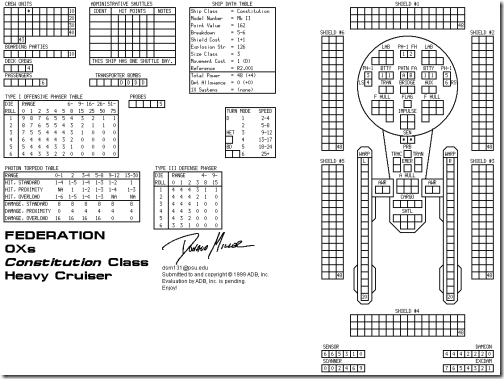
I did play it. Anything past 1-2 ships would take all afternoon. The game was micro-management at it's best. You would count up how many Warp Boxes, impulse engines, Auxiliary Power Boxes, and Battery Boxes (if you decided to use them). Then, you would start subtracting from that- Life Support, Shields, Sensors, transporters, launching shuttle craft, etc. Then, you would have to calculate how fast you wanted to move- the game was played on a Hex Mat, and
IIRC, it was pretty much a 1 power = 1 hex, and depending on how fast you were moving would define how many 60 degree turns you could make and when. Oh, and there was acceleration and deceleration. You couldn't change your acceleration by more then 2 modes between turns? Something like that. The play area was a hex map- a 2'x3' sheet of hexes, and you would typically string two of them together for a 4'x6' play area. Everything was represented by a cardboard 'chit' or token/counter the size of a hex.
Each turn was divided up into a series of impulses- typically 32, though sometimes you could play 16, or even 8 if you were doing the Early War with only sub-light engines (no Warp Power). Sometimes, though, when you stepped up to the Advanced Cruisers, the so-called 'X-Ships', you would have to use 64 impulses. Looking at the SSD for this X-ship, if I used 20 points for power, I'd be using turn mode 5, or for every five hexes I moved, I could turn one hex facing. This SSD is lacking the arcs on the weapons, but if you look close, you will see on the diagram PH-1 FH, which was a Phaser 1, that had the Forward Half arc. on the sides are PH-1's with
LS and RS. Get it? Heavy weapons required power to "Charge Up". A Photon required two turns, but things like Plasma Torpedoes required multiple turns and the damage would be based on the total energy spent. More on that in a second. Photon's required at least 2 turns, and could then be held with a "holding charge" or Overloaded, in which case they had to be fired or "ejected" and the energy lost. PH-1's were the standard ship armament. PH-2's were a "Poor Man's Phaser" and found on Destroyers, Frigates, Q-ships. PH-3 were a self defense phasor that you could use to shoot at incoming objects (like drones and torpedoes). PH-4's were mounted on Star Bases and big, big ships, like Dreadnaughts. Damage was a
d6, then you looked at the hex range between ships, and the target ship would take that much damage on it's shields. If the shields on a facing were down, then they were all internals and you would roll on a special hit location chart that also had critical hits. You would mark off what ever boxes the chart told you, and Bad Things would happen as a system was destroyed.
Everything depended on how you allocated your energy. Forget Life Support and your crew dies. Forget to raise shields and, well, you have what they called "running shields" which were basically nothing. Forget to allocate power to a particular phaser bank and you wouldn't be able to fire that phaser.
There were two ways to play the game. One was to pre-plot all your movement writing down each hex you would move into, and when you would turn, shoot weapons, etc. during the 32 impulse turn. I.e.; I could look at my "Planner" and see on Impulse 18, I'd move from hex #654 to #554, turn 1 hex face to the left facing "north", and fire my bow PH-1 at any targets (I wouldn't have to fire the phaser, but the energy was still expended and lost).
The other, more popular version, was a more "free form" style without each impulses plotted, and as long as you met the turn restriction for your ship, you could turn when you wanted to. You could fire when you wanted to as well- as long as you allocated the energy. Then there were shuttle craft- Drone boats, Wild Weasels, Bombers, transporters (in case your transporter was down and you wanted to move crew from one ship to another, or everyone had boarding parties...). There were also Drones (basically, ICBM's that could be ship guided, self guided, etc), Plasma Torpedoes that would follow you around on the board as you maneuvered until they hit- and yeah, it was possible to out-run a plasma torp (and always funny when you did it).
Races and common traits:
Feds, Phasers/Photons, lots of shields, very poor maneuverability but excellent fire arcs, excellent energy management
Kilingon- Phasers/Disruptors, weak shields, but built like bricks, extremely maneuverable, best fire arcs in the game (FX, RX, FRA, LRA, RRA- BOOYAH!). Weak energy management.
Romulans- Phasers, Plasma Torps, cloaking (so very poor shields even when up). Cloaking was a pain in the ass... don't make me try to explain it. Basically, it took all your power, you would phase in and phase out, etc. etc. Very poor energy management
Kizinti- Tiger people, phasers, disruptors, and DRONES. OMG, SO MANY DRONES... ok everywhere else.
Lyran- Lion people, hate the Kzinti and vice versa. Phasers, Disruptors, and the ESG- Expanding Sphere Generator- think a shield that could do damage if you hit it. Ships where much like Klingons otherwise.
Gorn- Phasers, "Quick firing" Plasma, poor shields, brick ships, poor maneuverability, ok arcs, more energy then they knew what to do with.
Hydrans- Phasers, Disruptors, drones, and shuttles/fighters. Like, every Hydra ship was a mini-carrier of so many shuttlecraft/fighters...
I won't list the rest and their abilities, but there was the Intersteller Concordiam (think an anti- Federation from the far side of the Galaxy), WYN (refugees from a Kzinti/Klingon war), Lyran Democratic Republic (best ships in the game
IMHO), Tholians, and the Andromedians. Oh boy, those guys... no shields, but instead, they would convert any energy shot at them, then use it. They had a VERY interesting play style totally different from any other race.
Anyways, typical game was between two ships, and would take about 2 hours. More ships, more time. I remember doing a fleet action once- 6 players, about 50 ships on each side, six hex maps taped together. We played in a friends basement, all weekend, and the next weekend, and the next weekend, until his daughter messed up the table. We all said "ah, man! That sucks..." but inwardly we all jumped for glee.
A note about the rulebook- it read like a technical manual, and was about 200 pages (basic game). If you used ALL the rules and addendum, it was about 800 pages. Incredibly detailed game, with rules that covered EVERYTHING. And I mean EVERYTHING. And if you ever had a question, you could write to Amarillo Design Bureau, they would answer the question, or add an addendum to the rules giving you credit for it and releasing it during the next quarter (they had quarterly updates to the game).
The only bad thing about the game was the two dimensionality- there was only an X and Y axis, no Z (thank God, I'd hate to even thing about how hard that would have been to play...).
So yeah, that was Star Fleet Battles. Still around if you want to play it.




 .
.