| Author |
Message |
 |
|
|
|
|
Advert
|
Forum adverts like this one are shown to any user who is not logged in. Join us by filling out a tiny 3 field form and you will get your own, free, dakka user account which gives a good range of benefits to you:
- No adverts like this in the forums anymore.
- Times and dates in your local timezone.
- Full tracking of what you have read so you can skip to your first unread post, easily see what has changed since you last logged in, and easily see what is new at a glance.
- Email notifications for threads you want to watch closely.
- Being a part of the oldest wargaming community on the net.
If you are already a member then feel free to login now. |
|
 |
2099/02/07 00:10:20
Subject: Painting temperature/conditions ?
|
|

Walking Dead Wraithlord
|
Hi All,
So while ive been doing painting Ive nticed that my pallet is drying up very quickly and also my paints seem to be rapidly changing in consitency if leave open for a couple minutes.
Cos its winter my room is quite cozy and hot... Could it be because its too hot and dry ?
Or do paints dry quite quick on the pallet(even watered down quite a bit).. ? 
Optimum conditions for painting ?
|
|
|
|
 |
|
2015/01/07 07:17:54
Subject: Re:Painting temperature/conditions ?
|
|
Snord
|
I have the same problem. I paint in an icy garage with a fan heater on and the paint does dry out very quickly.
I try not to leave pots open, but then I transferred most of my GW paints to dropper bottles.
Sometimes I will add more water as the pallette dries out, but this is a bit hit or miss as it is hard to judge the right amount.
Or I will break out the wet pallette which pretty much solves this problem. Wet pallettes do require a little maintenance though - they can turn mouldy after a while so will need proper cleaning.
I would be interested to hear of how others deal with this problem.
Good luck!
|
Is no fun, is no Blinsky! |
|
|
|
|
2015/01/07 08:32:27
Subject: Painting temperature/conditions ?
|
|

Grizzled Space Wolves Great Wolf
|
If it's very hot then it can definitely be a problem. My painting area is upstairs in my house, in summer it can get up to 35C (95F) before I get too hot and decide to turn the air conditioner on  It's very hard to paint with fast drying acrylics in those conditions because the paint starts to dry and goes gummy on my brush quickly. Also airbrushing gets totally screwed up because the paint starts drying in mid air.
Winter here rarely gets cold enough for me to bother turning on the heater and if I do I only put it on low, I've never had a problem painting in winter other than spraying rattle cans (which I always do outside) you have to be more careful with paint pooling because it doesn't dry as fast so you can't lay down the paint as quickly.
|
|
|
|
|
2015/01/07 18:20:55
Subject: Painting temperature/conditions ?
|
|

Gargantuan Gargant
|
Wet palette. 'nuff said.
|
The Dreadnote wrote:But the Emperor already has a shrine, in the form of your local Games Workshop. You honour him by sacrificing your money to the plastic effigies of his warriors. In time, your devotion will be rewarded with the gift of having even more effigies to worship.
|
|
|
|
|
2015/01/07 18:32:09
Subject: Painting temperature/conditions ?
|
|
Grizzled Space Wolves Great Wolf
|
Doesn't stop it drying on the brush I forgot to mention my fix for hot weather painting is just to add a bit of drying retarder 
|
|
|
|
|
2015/01/07 23:37:43
Subject: Re:Painting temperature/conditions ?
|
|
Walking Dead Wraithlord
|
|
|
|
|
|
|
2015/01/07 23:43:04
Subject: Re:Painting temperature/conditions ?
|
|
Lord Commander in a Plush Chair
|
No it's a real product, vallejo do one.
|
|
|
|
|
2015/01/08 00:21:46
Subject: Re:Painting temperature/conditions ?
|
|
Grizzled Space Wolves Great Wolf
|
Yep, the Vallejo one is the one I've been using...
http://www.acrylicosvallejo.com/en_US/model-paints/auxiliary-products/3

Drying Retarder
To delay drying time of Model Color, mix a few drops with the color, or dip brush into retarder on the palette. Colors will not change their consistency. Useful for “wet on wet” techniques and reducing skin formation on the palette.
Presentation:
70.597 Medium Retarder 17 ml.
73.597 Medium Retarder 60 ml.
You can use it with any acrylics.
|
|
This message was edited 1 time. Last update was at 2015/01/08 00:22:26
|
|
|
|
|
2015/01/08 23:04:10
Subject: Painting temperature/conditions ?
|
|
Walking Dead Wraithlord
|
Ohhh very intersting.. Thanks, will be ordering one of those to try it out.
|
|
This message was edited 1 time. Last update was at 2015/01/08 23:07:24
|
|
|
|
|
2015/01/09 00:13:23
Subject: Painting temperature/conditions ?
|
|

Fixture of Dakka
|
Use a wet palette. The P3 one is cheap, is decent, and will fix all of your paint drying problems.
Don't use medium retarder to keep your paint from drying on the palette. That's awfully expensive, and not even an ideal solution. But, if you are using a retarder, go with Liquitex. it costs a tiny fraction of Vallejo or Reaper. if you're using medium retarder for wet blending, Reaper's is the most watery one (good thing). The Vallejo medium retarder is like a gel, which I personally find awful to work with. Liquitex makes a gel-type one, and a liquidy one (Slo-Dri or something like that).
For the wet palette, you can use an expensive fine arts one too (I think mine is Mastersons or some such). I have the smallest one that they make, but I tend not to use it because it's just too large for miniature painting. The material for the paper is much thicker and fibrous, and it's a superior product in terms of keeping your paint from bleeding (overnight).
|
|
This message was edited 1 time. Last update was at 2015/01/09 00:14:31
|
|
|
|
|
2015/01/09 00:54:48
Subject: Re:Painting temperature/conditions ?
|
|
Walking Dead Wraithlord
|
I've never used a "wet" pallet before so not really sure what the mechanics are. Or where to get one
Is it made of wood(wood like fiber) you soak or something? Or is it a special material that's been treated ?
|
|
|
|
|
|
2015/01/09 06:55:16
Subject: Painting temperature/conditions ?
|
|
Grizzled Space Wolves Great Wolf
|
Talys wrote:Use a wet palette. The P3 one is cheap, is decent, and will fix all of your paint drying problems. Don't use medium retarder to keep your paint from drying on the palette. That's awfully expensive, and not even an ideal solution.
Say wha? Expensive? Not an ideal solution? It's hardly expensive, even the Vallejo one costs as much as a pot of paint and you only use a fraction of a drop for each drop of paint, maybe 5:1 or 10:1 mix, it lasts for ages. You can get cheaper ones but I'm still on my first pot The only time you use a lot (like a 1:1 mix with paint) is if you want something that doesn't dry for a LONG time, like, an hour or more, which I mostly find useful for weathering (apply a bunch of brown paint as mud and you have quite a long time to manipulate it and clean up excess, etc). Not an ideal solution? Even if you use a wet palette, in very hot weather paint drying on the palette is only half the problem, the other half is paint drying on your brush or going claggy as you apply it, that's why drying retarder is my preferred solution, it actually fights the more annoying problem of paint drying on your brush as well as drying on your palette. Not saying wet palette isn't useful, but in the situation of paint drying because it's too hot and dry like the OP is talking about, I think drying retarder is a pretty good solution. The Vallejo medium retarder is like a gel, which I personally find awful to work with.
The first time I used it I found it a bit odd that it was thick and goopy. By the 2nd or 3rd time I was used to it. You just have to thin it like you thin anything else. Now I kind of prefer the gel consistency.
|
|
This message was edited 2 times. Last update was at 2015/01/09 06:57:51
|
|
|
|
|
2015/01/09 08:51:15
Subject: Re:Painting temperature/conditions ?
|
|
Fresh-Faced New User
|
 Argive wrote: Argive wrote:I've never used a "wet" pallet before so not really sure what the mechanics are. Or where to get one
Is it made of wood(wood like fiber) you soak or something? Or is it a special material that's been treated ?
You probably have some of the materials to make one at home!
This is the video I used to make my wet palette:
https://www.youtube.com/watch?v=96mjmqWTPfM
(He actually starts building the palette at the 4 minute mark)
The palette should keep the paint the paint wet on the palette longer, but if it's drying on the brush, you'll probably need the retarder like everyone is suggesting. Or a humidifier.
|
|
|
|
|
2015/01/09 17:52:11
Subject: Painting temperature/conditions ?
|
|
Gargantuan Gargant
|
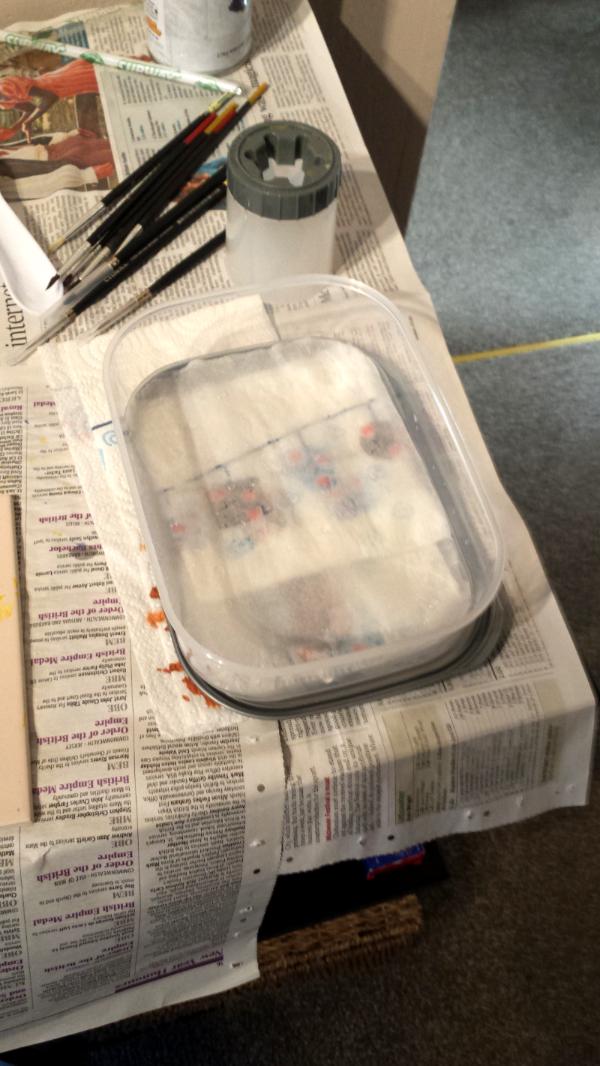
Wet palette mechanics are pretty simple - a semi-permeable membrane is placed over a water reservoir, allowing osmosis to replace moisture in the paint at roughly the same rate as it's lost to evaporation. Thin it down, leave it thick - the palette keeps it at the consistency you mix it to (unless you seal it, at which point osmosis surpasses the now greatly reduced rate of evaporation, thinning the paint over time). All it takes is some parchment paper (the grease-proof baking stuff) and a wet sponge/stack of paper towels, sat in a water-tight dish. A disposable foam dinner plate works, but most (myself included) prefer a resealable container (Tupperware, or the like), which can keep acrylics workable over multiple painting sessions.
On the brush-drying issue: Yeah, a wet palette won't really help that. Even when my painting area was absolutely sweltering in the summer, though, I rarely had that issue. Are you using tiny brushes and thicker paint? That's a sure-fire recipe for gloopy paint, if not an outright lack of brush to model transfer. With even slightly dilute paint, a brush with a larger belly keeps enough moisture around to delay the drying to workable levels. For that very reason, I had a hell of a time trying to dot eyes with a 10/0 brush. With no addition of drying retarder, I solved the issue by switching to a nicely pointed 0 and loading (but not applying) more paint.
|
The Dreadnote wrote:But the Emperor already has a shrine, in the form of your local Games Workshop. You honour him by sacrificing your money to the plastic effigies of his warriors. In time, your devotion will be rewarded with the gift of having even more effigies to worship.
|
|
|
|
|
2015/01/09 19:37:59
Subject: Painting temperature/conditions ?
|
|
Grizzled Space Wolves Great Wolf
|
Maybe the on brush drying issue is unique to me because I let my painting room get stupidly hot in the summer and summers are reasonably dry over here
I do use a number 1 brush even for fine detail stuff and thin my paint reasonably far.
|
|
|
|
|
2015/01/09 21:50:10
Subject: Re:Painting temperature/conditions ?
|
|
Walking Dead Wraithlord
|
@ Polecat - Dude, I owe ya one. Many thanks that video was very informative. 1 exalt for you! I'm going to pop into shop on my way home tomorrow and get the stuff to make this!! I think it should help solve some of the issues I'm having. What about the "flow extenders" he talks about?
|
|
This message was edited 1 time. Last update was at 2015/01/09 21:50:58
|
|
|
|
|
2015/01/10 14:05:57
Subject: Re:Painting temperature/conditions ?
|
|
Walking Dead Wraithlord
|
Well. I made my first wet pallet today. Time to test the bad boy out 
|
|
|
|
|
|
2015/01/10 18:01:12
Subject: Painting temperature/conditions ?
|
|
Gargantuan Gargant
|
Flow extender (AKA Flo-Aid, flow improver, etc) is just a surfactant. Adding a bit to paint lowers the surface tension, allowing for smoother application of layers, the creation of washes, etc. Shouldn't have much of an effect on drying time.
|
The Dreadnote wrote:But the Emperor already has a shrine, in the form of your local Games Workshop. You honour him by sacrificing your money to the plastic effigies of his warriors. In time, your devotion will be rewarded with the gift of having even more effigies to worship.
|
|
|
|
|
2015/01/10 20:05:41
Subject: Re:Painting temperature/conditions ?
|
|
Walking Dead Wraithlord
|
OK so i have been using the wet pallet today. And, Thanks a lot guys it really does help enormously!!!! Not to mention the paint I'm not wasting  But as I am doing this system of "layers" (I assume everyone waters down their paint to do this?) I find that the paint "pools" on certain flat areas and when I try and spread it more ti get an even coat (or dry the brush slightly to do so)I get tiny bubbles and also it behaves more like a wash then paint... Is this normal? Would the flow extender thing help ? P.S. If anyone is reading this and trying out the wet pallet I suggest using a couple layers of paper towels to give it a nice bedding and be very generous with the water.  Also you guys are great with ya'll tips. EXALTS FOR ALL !!!!
|
|
This message was edited 2 times. Last update was at 2015/01/10 20:08:09
|
|
|
|
|
2015/01/10 20:23:54
Subject: Painting temperature/conditions ?
|
|
Fixture of Dakka
|
AllSeeingSkink wrote:Say wha? Expensive? Not an ideal solution? It's hardly expensive, even the Vallejo one costs as much as a pot of paint and you only use a fraction of a drop for each drop of paint, maybe 5:1 or 10:1 mix, it lasts for ages. You can get cheaper ones but I'm still on my first pot The only time you use a lot (like a 1:1 mix with paint) is if you want something that doesn't dry for a LONG time, like, an hour or more, which I mostly find useful for weathering (apply a bunch of brown paint as mud and you have quite a long time to manipulate it and clean up excess, etc). Not an ideal solution? Even if you use a wet palette, in very hot weather paint drying on the palette is only half the problem, the other half is paint drying on your brush or going claggy as you apply it, that's why drying retarder is my preferred solution, it actually fights the more annoying problem of paint drying on your brush as well as drying on your palette. Not saying wet palette isn't useful, but in the situation of paint drying because it's too hot and dry like the OP is talking about, I think drying retarder is a pretty good solution. The Vallejo medium retarder is like a gel, which I personally find awful to work with.
The first time I used it I found it a bit odd that it was thick and goopy. By the 2nd or 3rd time I was used to it. You just have to thin it like you thin anything else. Now I kind of prefer the gel consistency.
Well, water = free... drying retarder = same price per mL as paint. And no matter what drying retarder you're using, if you're painting in weather so hot that your paint dries up (I'm guessing, 30C+?).. .and you have no A/C... I think you'd need a wet palette no matter what. You can use a water bottle with a hooked tip like you use for cleaning airbrushes, and keep the bottom part of your wet palette moist. As long as water wicks up, the paint will be ok. To each their own, I guess. I have never had a problem with paint drying on my brush, except, I guess, ultra fine brushes -- but then, the paint I use is very thinned down, or an acrylic ink. I can't imagine painting with a drying retarder for base coating/layering/detail. Usually, I am impatient enough as it is for paint to dry so that I can get another layer onto it.  oadie wrote: oadie wrote:Flow extender (AKA Flo-Aid, flow improver, etc) is just a surfactant. Adding a bit to paint lowers the surface tension, allowing for smoother application of layers, the creation of washes, etc. Shouldn't have much of an effect on drying time.
In my experience, I find that Flo-Aid is not very good to make washes -- you end up with paint on the entire surface (instead of just the recesses). It does extend drying time, though not nearly as much as retarder -- it even says on the product "increase the fluidity and open (drying) time of the paint." I often just use flo-aid when doing lettering. It may not be much, but a few seconds, I find, does the trick. Besides, after the paint hits the surface, I want it to dry quickly. This is the product I use -- it literally lasts forever because it's diluted 20:1 with water: http://www.liquitex.com/flowaid/ I find Flo-Aid particularly helpful for painting very light colors like white, pallid wych flesh, and screaming skull. It will take much patience and several layers, but the results are nice and flat, like an airbrush, with no hint of brush strokes. Automatically Appended Next Post: Argive wrote:OK so i have been using the wet pallet today. And, Thanks a lot guys it really does help enormously!!!! Not to mention the paint I'm not wasting But as I am doing this system of "layers" (I assume everyone waters down their paint to do this?) I find that the paint "pools" on certain flat areas and when I try and spread it more ti get an even coat (or dry the brush slightly to do so)I get tiny bubbles and also it behaves more like a wash then paint... Is this normal? Would the flow extender thing help ? P.S. If anyone is reading this and trying out the wet pallet I suggest using a couple layers of paper towels to give it a nice bedding and be very generous with the water. Also you guys are great with ya'll tips. EXALTS FOR ALL !!!!
You can thin your paints with water, medium, drying retarder, flow enhancer. You should experiment with all of them, as they all have their place in our toolkit The reason that you are finding that paint pools on areas is that you have too much paint on your paintbrush (it's overloaded). To avoid this, after you thin your paint with your brush, dry it, then put a lttle bit back on the brush. Make sure you roll it a little in your wet palette to get a nice, sharp tip. It seems wasteful, but the results will be much better. In an ideal world, you don't put paint on more than about 1/3 of the tip of your paintbrush, and just enough to get consistent coverage on a small area. This also keeps paint away from the ferrule, which is early brush death
|
|
This message was edited 2 times. Last update was at 2015/01/10 20:40:29
|
|
|
|
|
2015/01/10 22:45:25
Subject: Painting temperature/conditions ?
|
|
Grizzled Space Wolves Great Wolf
|
Talys wrote:Well, water = free... drying retarder = same price per mL as paint.
Yeah but "not free" does not equal expensive Even the "expensive" Vallejo stuff is only going to add marginally to your costs And no matter what drying retarder you're using, if you're painting in weather so hot that your paint dries up (I'm guessing, 30C+?).. .and you have no A/C... I think you'd need a wet palette no matter what.
Not true. I painted my Orc Warboss last January in 30-40C dry heat in an unairconditioned room with no wet palette and it worked fine. I think I put about 1 drop retarder for about 4 or 5 drops of paint because I wanted to be able to blend quite thin layers and I could work with the same pool of paint all day long, just adding a touch of water every 15 to 30 minutes to maintain the consistency. I'm not saying I couldn't have used a wet palette, but the drying retarder gave me enough time to actually work with the paint on the model even in the extreme heat instead of having it dry almost instantly.
|
|
This message was edited 2 times. Last update was at 2015/01/10 22:47:25
|
|
|
|
|
2015/01/11 17:52:39
Subject: Re:Painting temperature/conditions ?
|
|
Gargantuan Gargant
|
Argive wrote:But as I am doing this system of "layers" (I assume everyone waters down their paint to do this?) I find that the paint "pools" on certain flat areas and when I try and spread it more ti get an even coat (or dry the brush slightly to do so)I get tiny bubbles and also it behaves more like a wash then paint... Is this normal? Would the flow extender thing help ?
Bubbles will form if you overwork a highly dilute paint. Flow improver won't help that - it may actually exacerbate the issue (it's like adding dish soap - the DIY surfactant - with just a small addition, you could whip the paint into a froth, if you tried). To avoid the pooling (and, thereby, the vigorous brushing that leads to bubbles), you have two optios: Work with thicker paint or load your brush more lightly. Which is the better option depends on your patience and desired results. Thicker layers will have starker transitions, but go down faster. With thinner paint, you'll need to spend more time applying extra layers, but the results will be smoother.
P.S. If anyone is reading this and trying out the wet pallet I suggest using a couple layers of paper towels to give it a nice bedding and be very generous with the water.
That's exactly what I do.  A lot of people seem to prefer sponge, but I find that paper towels hold more water for a given thickness, have less 'give,' and are cheap and easy to toss and replace when they start going funky.
|
The Dreadnote wrote:But the Emperor already has a shrine, in the form of your local Games Workshop. You honour him by sacrificing your money to the plastic effigies of his warriors. In time, your devotion will be rewarded with the gift of having even more effigies to worship.
|
|
|
|
|
2011/01/20 16:52:43
Subject: Painting temperature/conditions ?
|
|
Walking Dead Wraithlord
|
Ill experiment with cotton wool and maybe some sort of bandage or something as well if i ever come across these bits
|
|
|
|
|
|
2015/01/12 23:36:46
Subject: Painting temperature/conditions ?
|
|
Walking Dead Wraithlord
|
One more question, How long do you guys leave it between applying layers?
|
|
This message was edited 2 times. Last update was at 2015/01/29 21:41:37
|
|
|
|
|
2015/01/29 21:42:10
Subject: Painting temperature/conditions ?
|
|
Walking Dead Wraithlord
|
Sooo.. I got some medium retarder and flow aid today.
Should I just mix a bit of flow aid into the water ?
|
|
|
|
|
|
2015/01/29 22:23:47
Subject: Painting temperature/conditions ?
|
|
Fixture of Dakka
|
Argive wrote:Sooo.. I got some medium retarder and flow aid today.
Should I just mix a bit of flow aid into the water ?
Carefully read the instructions on the flow improver. If it's Liquitex Flo-Aid, I believe the recommended ratio is 20:1, with a minimum ratio of 10:1.
If you don't dilute it enough, your paint will flow great... but it won't stick to the surface of the model Automatically Appended Next Post: Argive wrote:One more question, How long do you guys leave it between applying layers?
This is why I don't use drying retarder. With enough drying retarder, it takes *forever* for a coat to dry totally. Of course, since I typically put like, 15+ layers of paint on my models, even 5 minutes is "forever" But seriously, it can be a while. I've had a puddle of drying retarder sit in a (dry) palette for days. The short answer though, is, as long as it takes for it to be dry to the touch.
With liquitex flo-aid, basically, it's just a few seconds longer than what it takes without flo-aid. Assuming you are painting nice, thin layers, that would be like, 2 seconds for water-thinned, and 5 seconds for flo aid.
|
|
This message was edited 1 time. Last update was at 2015/01/29 22:28:10
|
|
|
|
|
0030/04/04 23:56:26
Subject: Painting temperature/conditions ?
|
|
Grizzled Space Wolves Great Wolf
|
Argive wrote:One more question, How long do you guys leave it between applying layers?
When using drying retarder? It depends how much you used, lol. The more you use the longer it'll take to dry. If you mix it 50/50 then it'll take ages (several hours) to dry after you've painted it, which is less useful for layering and more useful for blending, weathering or similar things (I've been meaning to try it for doing acrylic pin washes instead of doing oil washes). If I'm just layering and want it to dry reasonably fast on the model but keep the paint going in the palette/brush, I'll put one drop of drying retarder on my palette next to where I have the paint, I probably mix it about 10:1 paint:retarder and then thin it appropriately with water. Because it's such a small amount you need that's why I don't try and drop it directly in to my paint mix, I just put it next to my paint mix and add a little bit. So if I'm adding 1 drop of paint, I'll just pick up a bit of drying retarder on my brush and mix it in. If I find it's still drying too fast I'll mix a bit more in. In spite of what Talys says I normally don't wait any time between layers If I start at the bottom of the model by the time I reach the top, the bottom is usually dry. Yes, the paint on the palette takes a lot longer to dry, that's half the point but when you spread it as a thin film over the model it dries a heck of a lot faster. If you find you're having to wait a long time between layers when all you're doing is simple layering (and not blending) you're probably using too much retarder for the job you're doing.
|
|
This message was edited 1 time. Last update was at 2015/01/30 04:43:13
|
|
|
|
|
|
|


 Eldar- 4436 pts