| Author |
Message |
 |
|
|
|
|
Advert
|
Forum adverts like this one are shown to any user who is not logged in. Join us by filling out a tiny 3 field form and you will get your own, free, dakka user account which gives a good range of benefits to you:
- No adverts like this in the forums anymore.
- Times and dates in your local timezone.
- Full tracking of what you have read so you can skip to your first unread post, easily see what has changed since you last logged in, and easily see what is new at a glance.
- Email notifications for threads you want to watch closely.
- Being a part of the oldest wargaming community on the net.
If you are already a member then feel free to login now. |
|
 |
2015/01/12 09:59:17
Subject: Jump / Skyborn + high ground
|
|

One Canoptek Scarab in a Swarm
|
Hello!
When starting using Necron Wraiths, I always interpreted the jump infantry and skyborn rules as that I can move 12" measured horizontally over anything if using jump packs in movement phase, and when placing the unit I do not have to worry about what height the terrain has.
But when started playing with 7th edition, we began adding the height of the terrain to the distance moved according the rules for high ground. The consequence being I get my move reduced with the height of the terrain only if I place the model on high ground.
Example: Moving a jump infantry using jump packs in movement phase up on a 6" high wall which is 7" away is not possible, since the total move distance with height added is 13". However if the wall is 3" thick, the jump infantry can jump over the wall, since all terrain is ignored and total move distance needed will be 10" + unit´s base size.
Is this the correct interpretation of the rules? It kind of does not make common sense though =)
|
|
|
 |
|
2015/01/12 10:40:43
Subject: Jump / Skyborn + high ground
|
|

Ultramarine Chaplain with Hate to Spare
|
A 6" wall 7" away would not result in 13" of movement. You measure distance covered in 3D so that would be about 9.2". If you treat the wall as impassable then you have to measure above it as parabolic movement otherwise most people allow you to move through walls as infantry in which case you'd just move 12" through it as you are not slowed by it as an infantryman would be.
|
|
|
|
|
|
2015/01/12 12:03:05
Subject: Re:Jump / Skyborn + high ground
|
|
One Canoptek Scarab in a Swarm
|
Thank you for your answer, but I'm not convinced...
In the rulebook it explicitly says that if you move vertically in some way, "simply add the height to the distance moved". That means if you move 6" horizontally and 3" vertically, and you add them together, it would be a move of 9". (I think there is an example as well)
It is frustrating, because when moving up a slope, it would make more sense to simply measure diagonally, but as the rules are written it seems to be different. One could motivate it by saying that moving upwards require a lot more effort and that is why it costs so much.
You could reason - and it would make sense, that all moves are made in 3D, but the rulebook never explicitly says it that way. It doesn't really say exactly how it should be done, but most examples in the rulebook are on flat ground, so they don't give you much hint.
The rules for jump infantry says you can move over anything - including impassable terrain, it doesn't say you need to measure it in a parallax way. And your reasoning about having to measure the way over it only if it was impassable doesn't add upp - the reason they are not affected by difficult terrain is because they move over it, if they went through it, they would have difficulties just like anyone else. If the jump rule simply was "you may move just like any one else but also up in the air, and that distance must be measured", they would probably say so too...
You are right that it would make sense if you measured the shortest distance diagonally but I have a hard time finding any support in the rules to show my friends to let me do it. So is this how most of you guys play?
|
|
|
|
|
2015/01/12 12:15:34
Subject: Jump / Skyborn + high ground
|
|
Ultramarine Chaplain with Hate to Spare
|
They are not slowed by terrain, if you've ruled that you can't move through a given piece of terrain then you have measure the movement up and down.
Moving vertically must be measured. But nothing in the rules tells you to only measure horizontal movement. So you don't you measure the route you move. If you move directly vertically you must measure that too. So an infantryman moving up a 6" wall 7" away would have to move 13" to get to the top. A Skyborn unit only moves the 9.2" to get to the top of the wall.
|
|
|
|
|
|
2015/01/12 12:37:10
Subject: Re:Jump / Skyborn + high ground
|
|
One Canoptek Scarab in a Swarm
|
Ok...
I do like your interpretation of the rules, but have a hard time making that interpretation myself. Would you be able to point out some parts of the rule that support your interpretation?
The thing that really ruined it for me was that part in 7th saying that you add horizontal and vertical distance together to calculate the total distance. In other words not using diagonals. While it seemed much more free before, that rule implies that the whole board game is stuck to only horizontal and vertical distances and nothing in between....
Maybe we misunderstood the rule but how it is written that is how me and my friends understood it...
|
|
|
|
|
2015/01/12 12:54:39
Subject: Jump / Skyborn + high ground
|
|
Ultramarine Chaplain with Hate to Spare
|
Where does 7th say to normally only measure horizontally? Yes if you move directly vertically you measure that movement and add it on. What tells you that other movement is only measured in 2D?
|
|
|
|
|
|
2015/01/12 12:59:45
Subject: Re:Jump / Skyborn + high ground
|
|
Longtime Dakkanaut
|
As jump infantry can move freely over terrain, it makes no sense to penalise them with a shorter movement distance for moving a shorter distance.
I don't think I've ever seen anyone not just end their elevation at whatever level is most convenient and take the necessary terrain tests.
|
|
|
|
|
2015/01/12 13:16:19
Subject: Jump / Skyborn + high ground
|
|
One Canoptek Scarab in a Swarm
|
 FlingitNow wrote: FlingitNow wrote:Where does 7th say to normally only measure horizontally? Yes if you move directly vertically you measure that movement and add it on. What tells you that other movement is only measured in 2D?
You have a good point here. I think the problem was that the rules never specifically said how to measure height until now, and then we read the new rule like "add the height to the move" whenever a move has a height. It might be so that the rule is actually referring to a move that is completely straight up, (like climbing a wall), while moving up a slope you simply measure diagonally along the slope.
Don't have the wording in front of me but I remember reading it and understanding it like you always add the height ... (like if a hill is 3" high you have to add 3" even if you moved up diagonally) I'm gonna try convince my friends that this rule only refers to completely vertical moves and not all moves that involves height difference =)
Automatically Appended Next Post:
changemod wrote:As jump infantry can move freely over terrain, it makes no sense to penalise them with a shorter movement distance for moving a shorter distance.
I don't think I've ever seen anyone not just end their elevation at whatever level is most convenient and take the necessary terrain tests.
I would love to do this however when we played last time I wanted to move up on a hill with my wraiths (they pass all dangerous terrain tests automatically and ignores difficult terrain), I had to add the height to my move, because that is what the rules says. There is no rule for jump infantry that says that they can measure moves diagonally or simply ignore height, and I didn't know the 7th-rules good enough to argue my point even though I thought it was strange...
I tried to read up on this matter to have a better standing point but as it turned out I interpreted the rules the same way, but still something felt fishy..... that is why I came here to get a better standing point =)
|
|
This message was edited 3 times. Last update was at 2015/01/12 13:24:11
|
|
|
|
|
2015/01/12 13:48:19
Subject: Jump / Skyborn + high ground
|
|
Ultramarine Chaplain with Hate to Spare
|
If you always add the vertical movement you get some weird results. For instance if you moved 4" across to get up 3" on a Hill you have not moved 7". By the adding vertical height method you've moved 8" as you would still measure the path the model had taken in 3D (we have no permission to just measure the horizontal) which would be the 5" hypotenuse (assuming a flat gradient) and then add on the 3" height. It would mean in the initial example if you moved along the ground then horizontally up you'd move 13" but if you moved diagonally you'd have moved 15.2".
|
|
|
|
|
|
2015/01/12 14:00:07
Subject: Jump / Skyborn + high ground
|
|
Longtime Dakkanaut
|
FlingitNow wrote:If you always add the vertical movement you get some weird results. For instance if you moved 4" across to get up 3" on a Hill you have not moved 7". By the adding vertical height method you've moved 8" as you would still measure the path the model had taken in 3D (we have no permission to just measure the horizontal) which would be the 5" hypotenuse (assuming a flat gradient) and then add on the 3" height. It would mean in the initial example if you moved along the ground then horizontally up you'd move 13" but if you moved diagonally you'd have moved 15.2".
Exactly.
Let's say you had a 13 inch high impassable wall three inches thick:
If you measure a Jump Infantry unit jumping over it, you move three inches.
If you measure absolute distance travelled, the jump packs moved the model a minimum of 29 inches.
If you read the jump pack rules as having to measure vertical distance to the point reached, they cannot stop on top of the wall because it's one inch out of range. (Not to mention the horizontal inch to move from beside to on top)
|
|
|
|
|
2015/01/12 14:20:39
Subject: Jump / Skyborn + high ground
|
|
One Canoptek Scarab in a Swarm
|
FlingitNow wrote:If you always add the vertical movement you get some weird results. For instance if you moved 4" across to get up 3" on a Hill you have not moved 7". By the adding vertical height method you've moved 8" as you would still measure the path the model had taken in 3D (we have no permission to just measure the horizontal) which would be the 5" hypotenuse (assuming a flat gradient) and then add on the 3" height. It would mean in the initial example if you moved along the ground then horizontally up you'd move 13" but if you moved diagonally you'd have moved 15.2".
Yes, you have convinced me and I hope to convince my fellows the same way. Actually we rather used to measure the horizontal distance above the battle field (holding the measure stick in the air above the model moving and measure to the point he was moving). Then add the height on top of that. So we would have gotten 3+4, which didn't seem logical at all, but that is how we understood the wording in the rulebook.
changemod wrote: FlingitNow wrote:If you always add the vertical movement you get some weird results. For instance if you moved 4" across to get up 3" on a Hill you have not moved 7". By the adding vertical height method you've moved 8" as you would still measure the path the model had taken in 3D (we have no permission to just measure the horizontal) which would be the 5" hypotenuse (assuming a flat gradient) and then add on the 3" height. It would mean in the initial example if you moved along the ground then horizontally up you'd move 13" but if you moved diagonally you'd have moved 15.2".
Exactly.
Let's say you had a 13 inch high impassable wall three inches thick:
If you measure a Jump Infantry unit jumping over it, you move three inches.
If you measure absolute distance travelled, the jump packs moved the model a minimum of 29 inches.
If you read the jump pack rules as having to measure vertical distance to the point reached, they cannot stop on top of the wall because it's one inch out of range. (Not to mention the horizontal inch to move from beside to on top)
FlingitNow wrote:If you always add the vertical movement you get some weird results. For instance if you moved 4" across to get up 3" on a Hill you have not moved 7". By the adding vertical height method you've moved 8" as you would still measure the path the model had taken in 3D (we have no permission to just measure the horizontal) which would be the 5" hypotenuse (assuming a flat gradient) and then add on the 3" height. It would mean in the initial example if you moved along the ground then horizontally up you'd move 13" but if you moved diagonally you'd have moved 15.2".
Mhm ok you are right! But aren't you two contradicting each other now? Because FlingIt suggests that if the wall was impassable, that would mean I have to measure all the way above the wall and down again to get over it. But that would contradict the rule saying jump infantry can fly over any terrain (including impassable) or models - unaffected. Because that would be a lie if a high enough object could stop me from flying over...
Also lets say it is not impassable, just a normal high ground wall, FlingIt then says I have to measure diagonally from the start point to the end point. But if I do that indeed means I can not stop on the wall, but I can jump over it...
So you do not completely agree how this works?
|
|
|
|
|
2015/01/12 14:25:04
Subject: Re:Jump / Skyborn + high ground
|
|
Confessor Of Sins
|
As the others have said, the Skyborne rule effectively ignores the moving through terrain measuring system.
"a model can move over all other models and all terrain freely"
Adds on to the
"When measuring a move where a model climbs terrain, add the distance the model moves horizontally to the distance it has moved vertically"
I have underlined that the vertical distance is measured for "climbing", which "freely" counteracts.
For Jump Units, you effectively measure between starting position A, and end position B. If there is a 13 inch high impassable wall between A and B, it is ignored. (per RaW)
Some players, however, will Houserule/Decide that you cannot exceed your movement in vertical distance, but that is only a decision between players, not a rule.
|
DA:80-S+G+M+B++I-Pw40k01++D+++A+++WD100R++T(T)DM+
Roronoa Zoro wrote:When the world shoves you around, you just gotta stand up and shove back. It's not like somebody's gonna save you if you start babbling excuses. - Bring on the hardship. It's preferred in a path of carnage.
Manchu wrote:
It's like you take a Space Marine and say "what could make him cooler?" Instead of adding more super-genetic-psycho-organic modification, you take it all away. You have a regular human left in power armor and all the armies of hell at the gates. And she doesn't even flinch. Pure. Badass. |
|
|
|
|
2015/01/12 14:28:26
Subject: Re:Jump / Skyborn + high ground
|
|
Longtime Dakkanaut
|
Yeah, I don't seem to be agreeing with anyone else here.
Like I said, I don't know anyone, in person, who checks vertical distance when doing airborne movement. Heck, just last night my Acanthrites moved their full horizontal twelve inches to get behind a Fire Warrior squad and deny them the benefit of cover when they shot... From a starting point eight inches off the ground.
Measuring how far you move vertically means measuring how far you move to clear obstacles, and who wants to open that can of worms? Automatically Appended Next Post:  BlackTalos wrote: BlackTalos wrote:As the others have said, the Skyborne rule effectively ignores the moving through terrain measuring system.
"a model can move over all other models and all terrain freely"
Adds on to the
"When measuring a move where a model climbs terrain, add the distance the model moves horizontally to the distance it has moved vertically"
I have underlined that the vertical distance is measured for "climbing", which "freely" counteracts.
For Jump Units, you effectively measure between starting position A, and end position B. If there is a 13 inch high impassable wall between A and B, it is ignored. (per RaW)
Some players, however, will Houserule/Decide that you cannot exceed your movement in vertical distance, but that is only a decision between players, not a rule.
That, yes.
I wouldn't be a fan of this on a custom board representing say, the levels of a Hive City through a five foot deep system of walkways and platforms, but the rules weren't designed around the assumption you'd play on a 3D space of that level of complexity in the first place.
|
|
This message was edited 1 time. Last update was at 2015/01/12 14:31:47
|
|
|
|
|
2015/01/12 14:35:43
Subject: Re:Jump / Skyborn + high ground
|
|
Confessor Of Sins
|
Agreed, most boards you play on would not have impassable walls of 13" or higher....
If you play on such "massive walled" tables, chances are those ruling would have been made clear to all players a long time ago.
But the comment applied for things like Jet-pack users with 6" movement jumping over 10" high Ruined walls / buildings. Some have issues with that (although there are no rules).
|
DA:80-S+G+M+B++I-Pw40k01++D+++A+++WD100R++T(T)DM+
Roronoa Zoro wrote:When the world shoves you around, you just gotta stand up and shove back. It's not like somebody's gonna save you if you start babbling excuses. - Bring on the hardship. It's preferred in a path of carnage.
Manchu wrote:
It's like you take a Space Marine and say "what could make him cooler?" Instead of adding more super-genetic-psycho-organic modification, you take it all away. You have a regular human left in power armor and all the armies of hell at the gates. And she doesn't even flinch. Pure. Badass. |
|
|
|
|
2015/01/12 14:50:38
Subject: Re:Jump / Skyborn + high ground
|
|
One Canoptek Scarab in a Swarm
|
BlackTalos wrote:As the others have said, the Skyborne rule effectively ignores the moving through terrain measuring system.
"a model can move over all other models and all terrain freely"
Adds on to the
"When measuring a move where a model climbs terrain, add the distance the model moves horizontally to the distance it has moved vertically"
I have underlined that the vertical distance is measured for "climbing", which "freely" counteracts.
For Jump Units, you effectively measure between starting position A, and end position B. If there is a 13 inch high impassable wall between A and B, it is ignored. (per RaW)
Some players, however, will Houserule/Decide that you cannot exceed your movement in vertical distance, but that is only a decision between players, not a rule.
Thank you for pointing out that "climbing" thing. That is a really good point I can use and that should at least let my wraiths move the distance travelled in a straight line (perhaps diagonally if landing on top of something)
But you have to agree, when reading that rule - "When measuring a move where a model climbs terrain, add the distance the model moves horizontally to the distance it has moved vertically"
- it sounds like the height is added to the width instead of using the distance climbed. Let's say you climb a wall with a 45° angle. The wall is 4" high and thus the distance moved horizontally would also be 4". The model would have climbed 5.6" but according to that wording it sounds like it should be 8". Does climbing only refer to 90° walls? Or where is the line drawn for when you "climb" something =)
On the other hand, that would make it possible to climb a 90° wall but not a 45°, so it would really not make any sense if it referred to anything else than 100% vertical climbing...
|
|
|
|
|
2015/01/12 15:06:59
Subject: Jump / Skyborn + high ground
|
|
Confessor Of Sins
|
Oh, i understand the issue with the wall with a 45° angle.
Sorry i had not understood that part. The rules are indeed quite ambiguous.
You could take it as any Vertical has to be added to the horizontal (making it 8").
I would however recommend the interpretation that "climb" is only how it is defined: Ladder, Wall, Barrels, Boxes... etc.
If you are "scaling" a hill, or some stairs, you measure it as "flat ground", just a 45° flat ground. I mean anyone i've seen playing on the Hills Battleboards made by GW does not measure any vertical when going across those slopes.
Using the same example of the GW-made Battleboards: If a model were to "climb" those little stone ridges, then you would add that 1" vertical to your movement (per RaW)
Sorry for plugging my army, but on the left:
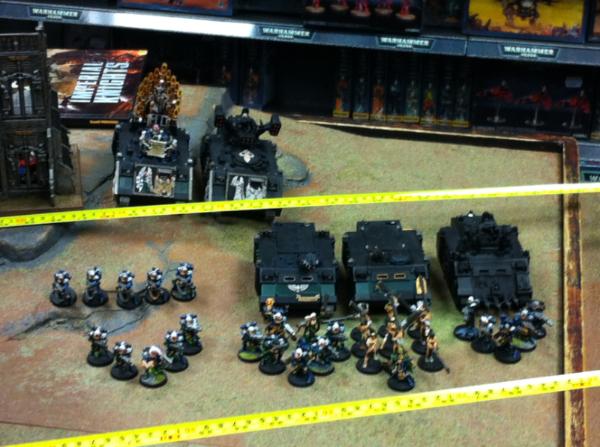
|
DA:80-S+G+M+B++I-Pw40k01++D+++A+++WD100R++T(T)DM+
Roronoa Zoro wrote:When the world shoves you around, you just gotta stand up and shove back. It's not like somebody's gonna save you if you start babbling excuses. - Bring on the hardship. It's preferred in a path of carnage.
Manchu wrote:
It's like you take a Space Marine and say "what could make him cooler?" Instead of adding more super-genetic-psycho-organic modification, you take it all away. You have a regular human left in power armor and all the armies of hell at the gates. And she doesn't even flinch. Pure. Badass. |
|
|
|
|
2015/01/12 15:55:53
Subject: Jump / Skyborn + high ground
|
|
One Canoptek Scarab in a Swarm
|
BlackTalos wrote:Oh, i understand the issue with the wall with a 45° angle.
Sorry i had not understood that part. The rules are indeed quite ambiguous.
You could take it as any Vertical has to be added to the horizontal (making it 8").
I would however recommend the interpretation that "climb" is only how it is defined: Ladder, Wall, Barrels, Boxes... etc.
If you are "scaling" a hill, or some stairs, you measure it as "flat ground", just a 45° flat ground. I mean anyone i've seen playing on the Hills Battleboards made by GW does not measure any vertical when going across those slopes.
Using the same example of the GW-made Battleboards: If a model were to "climb" those little stone ridges, then you would add that 1" vertical to your movement (per RaW)
Sorry for plugging my army, but on the left:
True, sounds reasonable to only apply this rule when climbing is involved. However, follow up question: Which is harder, climb a ladder with 90° angle or one with 70° angle? =)
Nice looking army =)
|
|
|
|
|
2015/01/12 16:03:27
Subject: Jump / Skyborn + high ground
|
|
Confessor Of Sins
|
jay_mo wrote:
True, sounds reasonable to only apply this rule when climbing is involved. However, follow up question: Which is harder, climb a ladder with 90° angle or one with 70° angle? =)
Nice looking army =)
Thanks! but it was only to show the table features. Also an example on the left is a building, that a Jump move could easily "ignore", even though it is 8-10" high.
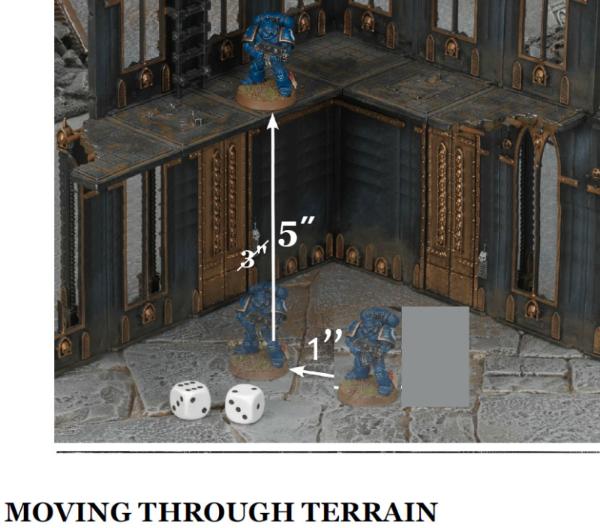
As for the ladder, the example in the rulebook shows a space marine "jumping" up a 3" platform, so which is harder:
- Climb a 90° or 70° ladder.
-The complete absence of any means to move vertically
I'm sure you can draw the same picture with the marine 1" away and the platform 2" higher... he'd still "make it up".
These rules are very abstract, but unless it is a "clear slope" like stairs, hills, 45° ladders, even, I'd say you measure the vertical.
|
DA:80-S+G+M+B++I-Pw40k01++D+++A+++WD100R++T(T)DM+
Roronoa Zoro wrote:When the world shoves you around, you just gotta stand up and shove back. It's not like somebody's gonna save you if you start babbling excuses. - Bring on the hardship. It's preferred in a path of carnage.
Manchu wrote:
It's like you take a Space Marine and say "what could make him cooler?" Instead of adding more super-genetic-psycho-organic modification, you take it all away. You have a regular human left in power armor and all the armies of hell at the gates. And she doesn't even flinch. Pure. Badass. |
|
|
|
|
2015/01/13 08:33:13
Subject: Jump / Skyborn + high ground
|
|
One Canoptek Scarab in a Swarm
|
BlackTalos wrote:jay_mo wrote:
True, sounds reasonable to only apply this rule when climbing is involved. However, follow up question: Which is harder, climb a ladder with 90° angle or one with 70° angle? =)
Nice looking army =)
Thanks! but it was only to show the table features. Also an example on the left is a building, that a Jump move could easily "ignore", even though it is 8-10" high.
As for the ladder, the example in the rulebook shows a space marine "jumping" up a 3" platform, so which is harder:
- Climb a 90° or 70° ladder.
-The complete absence of any means to move vertically
I'm sure you can draw the same picture with the marine 1" away and the platform 2" higher... he'd still "make it up".
These rules are very abstract, but unless it is a "clear slope" like stairs, hills, 45° ladders, even, I'd say you measure the vertical.
And by "making it up" there, you mean it still counts as flat ground? So you would ignore that 1" height difference when you play? But rather when something is slightly higher, say a bit taller that the marine himself, you would add the vertical height to the move, as he is climbing?
Did I get it sort of right, is this kind of how you play it? It makes sort of sense to me, you can usually tell by looking at the object and the model if it would cause any difficulties or not...
Also there is another aspect and that is difficult terrain. Normally when we play, passing little obstacle such as shelters requires you to roll for difficult terrain. I even think we normally do it for obstacles only 1" high. But for an obstacle 3" high we definitely do it.
In this way, not only do you need to spend 3" on your move up, you also lose move distance due to difficult terrain... sometimes it feels like double compensation ... but well you could argue that climbing vertically is hard. What is your take on that?
|
|
This message was edited 2 times. Last update was at 2015/01/13 08:36:17
|
|
|
|
|
2015/01/13 09:48:11
Subject: Re:Jump / Skyborn + high ground
|
|
Confessor Of Sins
|
No, by "making it up" i'm talking of the picture in the rulebook (added below). Does it look like that space marine has a ladder or something to climb?
with the marine 1" away and the platform 2" higher... he'd still "make it up"
As for difficult terrain, of course, all of this discussion is happening after you've rolled 2D6 for terrain, apart (possibly), from 5°-20° hills, but that is up to you and you opponent to decide.
|
DA:80-S+G+M+B++I-Pw40k01++D+++A+++WD100R++T(T)DM+
Roronoa Zoro wrote:When the world shoves you around, you just gotta stand up and shove back. It's not like somebody's gonna save you if you start babbling excuses. - Bring on the hardship. It's preferred in a path of carnage.
Manchu wrote:
It's like you take a Space Marine and say "what could make him cooler?" Instead of adding more super-genetic-psycho-organic modification, you take it all away. You have a regular human left in power armor and all the armies of hell at the gates. And she doesn't even flinch. Pure. Badass. |
|
|
|
|
2015/01/13 09:49:28
Subject: Re:Jump / Skyborn + high ground
|
|

!!Goffik Rocker!!
|
I thought you just measure it 1-dimensionally for jump units. One of a few reasons to actually take jump troops over bikers.
|
|
|
|
|
2015/01/13 09:55:35
Subject: Re:Jump / Skyborn + high ground
|
|
Confessor Of Sins
|
 koooaei wrote: koooaei wrote:I thought you just measure it 1-dimensionally for jump units. One of a few reasons to actually take jump troops over bikers.
No, you still measure Vertically if you move up. Measuring the Tangent rather than Vertical+Horizontal.
So, as i have seen some players do: a Tau stealth suit with 6" move and Jet pack cannot "jet-pack up" a 15" Tall building in 1 Turn.
|
DA:80-S+G+M+B++I-Pw40k01++D+++A+++WD100R++T(T)DM+
Roronoa Zoro wrote:When the world shoves you around, you just gotta stand up and shove back. It's not like somebody's gonna save you if you start babbling excuses. - Bring on the hardship. It's preferred in a path of carnage.
Manchu wrote:
It's like you take a Space Marine and say "what could make him cooler?" Instead of adding more super-genetic-psycho-organic modification, you take it all away. You have a regular human left in power armor and all the armies of hell at the gates. And she doesn't even flinch. Pure. Badass. |
|
|
|
|
2015/01/13 13:50:16
Subject: Re:Jump / Skyborn + high ground
|
|
One Canoptek Scarab in a Swarm
|
BlackTalos wrote: koooaei wrote:I thought you just measure it 1-dimensionally for jump units. One of a few reasons to actually take jump troops over bikers.
No, you still measure Vertically if you move up. Measuring the Tangent rather than Vertical+Horizontal.
So, as i have seen some players do: a Tau stealth suit with 6" move and Jet pack cannot "jet-pack up" a 15" Tall building in 1 Turn.
But if a 15" tall building was 5" thick, they could jump over it in 1 turn? (Or perhaps realistically it was 10" thick and the model was a jump infantry that moves 12")
|
|
This message was edited 1 time. Last update was at 2015/01/13 13:51:55
|
|
|
|
|
2015/01/13 14:06:46
Subject: Re:Jump / Skyborn + high ground
|
|
Longtime Dakkanaut
|
jay_mo wrote: BlackTalos wrote: koooaei wrote:I thought you just measure it 1-dimensionally for jump units. One of a few reasons to actually take jump troops over bikers.
No, you still measure Vertically if you move up. Measuring the Tangent rather than Vertical+Horizontal.
So, as i have seen some players do: a Tau stealth suit with 6" move and Jet pack cannot "jet-pack up" a 15" Tall building in 1 Turn.
But if a 15" tall building was 5" thick, they could jump over it in 1 turn? (Or perhaps realistically it was 10" thick and the model was a jump infantry that moves 12")
Yeah, it's simpler to assume skyborne allows level picking than to work out the implications if it doesn't.
|
|
|
|
|
2015/01/13 14:18:09
Subject: Re:Jump / Skyborn + high ground
|
|
Confessor Of Sins
|
jay_mo wrote: BlackTalos wrote: koooaei wrote:I thought you just measure it 1-dimensionally for jump units. One of a few reasons to actually take jump troops over bikers.
No, you still measure Vertically if you move up. Measuring the Tangent rather than Vertical+Horizontal.
So, as i have seen some players do: a Tau stealth suit with 6" move and Jet pack cannot "jet-pack up" a 15" Tall building in 1 Turn.
But if a 15" tall building was 5" thick, they could jump over it in 1 turn? (Or perhaps realistically it was 10" thick and the model was a jump infantry that moves 12")
Yes, but note my very first post:
BlackTalos wrote:Some players, however, will Houserule/Decide that you cannot exceed your movement in vertical distance, but that is only a decision between players, not a rule.
So as i said, the rules are: Jump infantry can "jump over" a 3 foot high building that is only 10" thick.
But a lot of players in my area, using "common sense" or other such idea, have decided that they can only jump over buildings that are 12" High. Also, i have only ever played once on tables with a building higher than 12". It made sense to everyone that not much could jump over. We even questioned if flyers had to avoid it, but decided they could ignore it.
|
DA:80-S+G+M+B++I-Pw40k01++D+++A+++WD100R++T(T)DM+
Roronoa Zoro wrote:When the world shoves you around, you just gotta stand up and shove back. It's not like somebody's gonna save you if you start babbling excuses. - Bring on the hardship. It's preferred in a path of carnage.
Manchu wrote:
It's like you take a Space Marine and say "what could make him cooler?" Instead of adding more super-genetic-psycho-organic modification, you take it all away. You have a regular human left in power armor and all the armies of hell at the gates. And she doesn't even flinch. Pure. Badass. |
|
|
|
|
|
|


