Forum adverts like this one are shown to any user who is not logged in. Join us by filling out a tiny 3 field form and you will get your own, free, dakka user account which gives a good range of benefits to you:
No adverts like this in the forums anymore.
Times and dates in your local timezone.
Full tracking of what you have read so you can skip to your first unread post, easily see what has changed since you last logged in, and easily see what is new at a glance.
Email notifications for threads you want to watch closely.
Being a part of the oldest wargaming community on the net.
If you are already a member then feel free to login now.
In the alpine grasslands of eastern Africa, Ethiopian wolves and gelada monkey are giving peace a chance. The geladas – a type of a baboon – tolerate wolves wandering right through the middle of their troops, while the wolves ignore potential meals of baby geladas in favour of rodents, which they can catch more easily when the monkeys are present.
The unusual pact echoes the way dogs began to be domesticated by humans (see box, below), and was spotted by primatologist Vivek Venkataraman, at Dartmouth College in New Hampshire, during field work at Guassa plateau in the highlands of north-central Ethiopia.
Even though the wolves occasionally prey on young sheep and goats, which are as big as young geladas, they do not normally attack the monkeys – and the geladas seem to know that, because they do not run away from the wolves.
"You can have a wolf and a gelada within a metre or two of each other and virtually ignoring each other for up to 2 hours at a time," says Venkataraman. In contrast, the geladas flee immediately to cliffs for safety when they spot feral dogs, which approach aggressively and often prey on them.
When walking through a troop, the wolves seem to take care to behave in a non-threatening way. They move slowly and calmly as they forage for rodents and avoid the zigzag running they use elsewhere, Venkataraman observed.
Deliberate association
This suggested that they were deliberately associating with the geladas. Since the wolves usually entered gelada groups during the middle of the day, when rodents are most active, he wondered whether the geladas made it easier for the wolves to catch the rodents – their primary prey.
Venkataraman and his colleagues followed individual wolves for 17 days, recording each attempted capture of a rodent, and whether it worked. The wolves succeeded in 67 per cent of attempts when within a gelada troop, but only 25 per cent of the time when on their own.
It's not yet clear what makes the wolves more successful when they hunt within gelada groups. It could be that the grazing monkeys flush out the rodents from their burrows or vegetation, Venkataraman suggests.
Mobile hide
Another possibility is that the monkeys, which are about the same size and colour as the wolves, distract the rodents and make it easier for the wolves to approach undetected. "I like to think of it as a mobile hide," says Claudio Sillero, a conservation biologist at the University of Oxford who studies the critically endangered Ethiopian wolves. "The wolves benefit from hiding in the herd."
Whatever the mechanism, the boost to the wolves' foraging appears to be significant enough that the wolves almost never give in to the temptation to grab a quick gelada snack. Only once has Venkataraman seen a wolf seize a young gelada, and other monkeys quickly attacked it and forced it to drop the infant, then drove the offending wolf away and prevented it from returning later.
The wolves may benefit from associating with other species as well. For example, Sillero has noted that they also tend to forage in the vicinity of herds of cattle, which may help them catch rodents. Other predators might also be doing this without anyone noticing, says Colin Chapman, a primatologist at McGill University in Montreal, Canada. "I don't think we've looked at it very much, because the predators are usually scared off by people. I think it could be pretty common," he says.
Journal reference: Journal of Mammalogy, DOI: 10.1093/jmammal/gyu013
Taming man's best friend
Wolves and primates hanging around together, gradually becoming tolerant of one another's presence: that sounds a lot like the first steps in the domestication of dogs by humans.
Dogs were domesticated between 40,000 and 11,000 years ago, and although the process remains shrouded in mystery, one hypothesis is that it started when wolves began following roaming human groups to take advantage of the large carcasses they left behind after hunts.
That may have encouraged other carnivores to keep their distance, offering a benefit for the humans, too. Eventually wolves may have even helped humans hunt better and outcompete other hominins, too.
Could something similar now be happening with Ethiopian wolves and geladas on African highlands?
The gelada case is comparable to what early domestication of dogs might have been like, says Claudio Sillero of the University of Oxford.
However, the geladas don't seem to get anything from the relationship, since the wolves are unlikely to deter other predators such as leopards or feral dogs, he says. Without a reciprocal benefit, Sillero doubts that the relationship could progress further down the road to domestication.
The poor man really has a stake in the country. The rich man hasn't; he can go away to New Guinea in a yacht. The poor have sometimes objected to being governed badly; the rich have always objected to being governed at all
We love our superheroes because they refuse to give up on us. We can analyze them out of existence, kill them, ban them, mock them, and still they return, patiently reminding us of who we are and what we wish we could be.
"the play's the thing wherein I'll catch the conscience of the king,
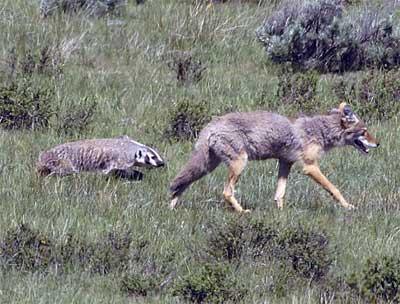
LordofHats wrote: Reminds me of the story of Coyotes and Badger working together to hunt;
Just more proof that;
TBone the Badger Dog finds the concept of badgers being permitted to live to be frank, insulting.
-"Wait a minute.....who is that Frazz is talking to in the gallery? Hmmm something is going on here.....Oh.... it seems there is some dispute over video taping of some sort......Frazz is really upset now..........wait a minute......whats he go there.......is it? Can it be?....Frazz has just unleashed his hidden weiner dog from his mini bag, while quoting shakespeares "Let slip the dogs the war!!" GG
-"Don't mind Frazzled. He's just Dakka's crazy old dude locked in the attic. He's harmless. Mostly."
-TBone the Magnificent 1999-2014, Long Live the King!