| Author |
Message |
 |
|
|
|
|
Advert
|
Forum adverts like this one are shown to any user who is not logged in. Join us by filling out a tiny 3 field form and you will get your own, free, dakka user account which gives a good range of benefits to you:
- No adverts like this in the forums anymore.
- Times and dates in your local timezone.
- Full tracking of what you have read so you can skip to your first unread post, easily see what has changed since you last logged in, and easily see what is new at a glance.
- Email notifications for threads you want to watch closely.
- Being a part of the oldest wargaming community on the net.
If you are already a member then feel free to login now. |
|
 |
2017/03/21 00:07:12
Subject: Modeling Advice - Hard Edges and Curing
|
|

Daemonic Dreadnought
|
Could use some modeling advice.
Have been running into issues related to fine details such as hard edges and smoothness. Starting to hit a wall, and figured the community may have some advice on how to correct!
Am using Greenstuff and Apoxie Sculpt, sometimes separately, sometimes in a 50 / 50 mix. When I model, I use a tiny bit of oil as a lubricant for tools. Not so much that I think it would affect the clay.
Or maybe it would. Could this be a problem with the clay, the technique, or something else I am not thinking about? How do you maintain smooth surfaces and hard corners?
It seems like my sculpts have so much more detail before they cure, and quickly lose it in the process of drying out. My Black Legion Chaos Biker Lord is a good example of what I am talking about.
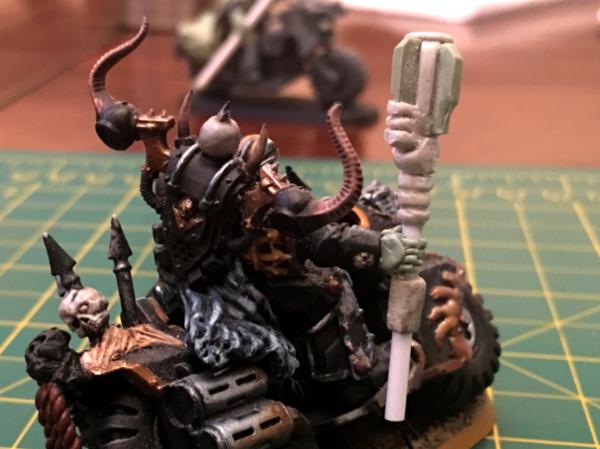
Notice the grooves on the back of the Black Mace. When it was ready to cure, the surfaces were smooth and the grooves were flat and clean. After curing, they look like stuffed sausages.
You can what I have been doing to solve it on this picture from another angle.
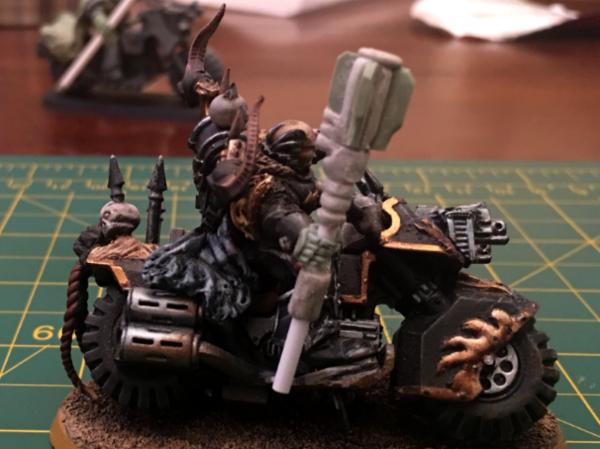
I have been sanding down the flat parts with a Dremel to get that flat surface look. The trouble with this approach is it takes a lot of time - would rather get the surfaces to stay as intended before curing.
The other thing I have been doing is laying a second, thin layer of clay on top of finished sculpts. Take a look at the top of the staff on my Chaos Sorcerer.
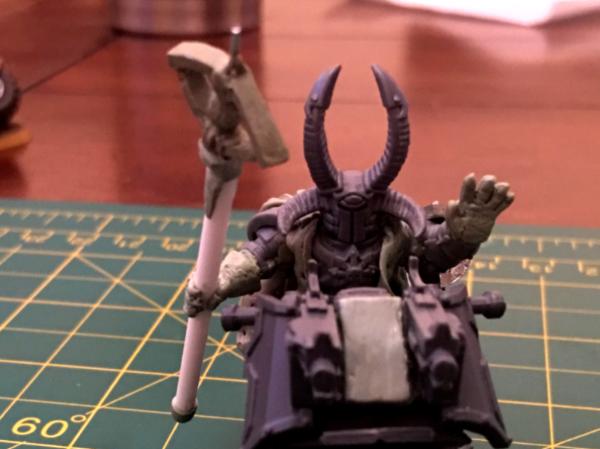
The surface there came out flat, and I was able to sand it easily with a chisel. But take a look at the back of the staff head.
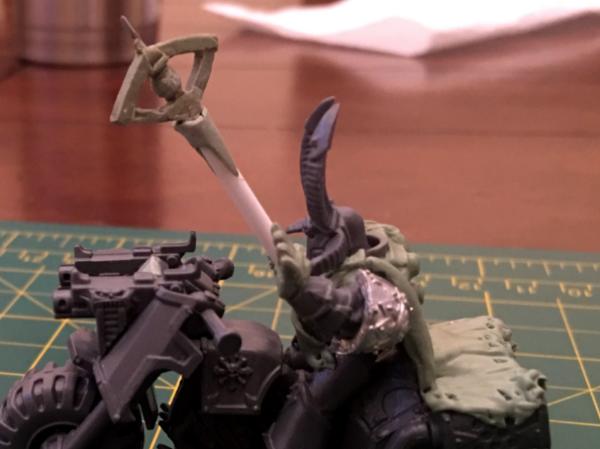
After sanding, enough clay had come off that there was not much left to sand.
I took a very thin layer of clay and squished it over the surface. In terms of thickness, the extra surface was down to millimeters. Looked great until it cured, then little cracks appeared and the thin layer started to fall off.
Sometimes, the distortion can be more pronounced. Look at the head of the axe I am working on for this Deamon Prince.
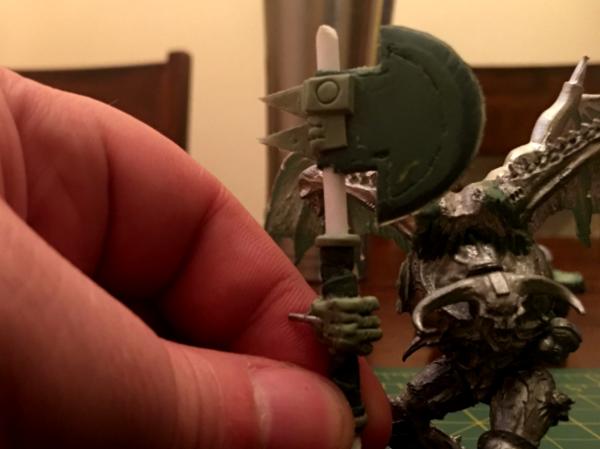
While the surfaces stayed smooth, the lines on the assembly at the back of the axe were all parallel when I set it to cure! I am not sure how much interest I have in sanding everything after it dries.
Would love any advice / tips / resources the community may have to share. Thank you in advance!
|
|
|
|
 |
|
2017/03/21 00:33:27
Subject: Re:Modeling Advice - Hard Edges and Curing
|
|

Posts with Authority
|
That's really odd! I've used a few different types of putty and I've never seen anything quite like that. The first two things that spring to mind are:
1 - the form memory of greenstuff making it spring back. But that's obviously not going to affect the grooves in your first pic.
2 - too-high temperatures used to quickly cure the putty. That can make green stuff bubble and swell, and apoxie sculpt can go very soft if only gently heated. You haven't mentioned how you let the putty cure - and with plastic parts to boot - so I don't want to jump to conclusions, but that'd be my main suspicion.
I just use water for lubrication myself, no oil or vaseline, so I don't know how apoxie sculpt in particular would react to it. I think it could have something to do with successive layers falling off, if you don't wash it off, but I'm not sure how it would cause the distortion. If you think that's the problem, I'd suggest washing off your sculpting tools and giving it a try without any oil.
|
|
|
|
|
|
2017/03/21 00:45:23
Subject: Modeling Advice - Hard Edges and Curing
|
|
Dakka Veteran
South Portsmouth, KY USA
|
Apoxie Sculpt is great for bulking out a figure or building a basic shape. Green stuff is good for filling, smoothing, and adding soft edged detail such as faces, clothes, muscle definition, and equipment worn on a figure.
In order to get a good edge use either brown Milliput, or my preference a grey colored clay called ProCreate, it is specially formulated for holding edges.
Another thing I would suggest is to NOT mix green stuff or any other putty with other brands, they have different properties and may adversely affect your final product.
Finally, it may be something with your technique or perhaps the tools you are using. Avoid petroleum jelly, it may be getting worked into your sculpts and having a less than desirable effect.
Water is the best lubricant for your tools, there are specific times that you would use petroleum jelly, but most of your sculpting should be done with water. Never use saliva or put those tools in your mouth, epoxy putties contain amine and other chemicals.
|
Armies: Space Marines, IG, Tyranids, Eldar, Necrons, Orks, Dark Eldar.
I am the best 40k player in my town, I always win! Of course, I am the only player of 40k in my town. 
Check out my friends over at Sea Dog Game Studios, they always have something cooking: http://www.sailpowergame.com. Or if age of sail isn't your thing check out the rapid fire sci-fi action of Techcommander http://www.techcommandergame.com
|
|
|
|
|
2017/03/21 01:32:07
Subject: Re:Modeling Advice - Hard Edges and Curing
|
|
Daemonic Dreadnought
|
 Vermis wrote: Vermis wrote:That's really odd! I've used a few different types of putty and I've never seen anything quite like that. The first two things that spring to mind are:
1 - the form memory of greenstuff making it spring back. But that's obviously not going to affect the grooves in your first pic.
2 - too-high temperatures used to quickly cure the putty. That can make green stuff bubble and swell, and apoxie sculpt can go very soft if only gently heated. You haven't mentioned how you let the putty cure - and with plastic parts to boot - so I don't want to jump to conclusions, but that'd be my main suspicion.
Air dry, no heat. That sorcerer you see is a rebuild, I used a space heater on the model last week and the bike melted along with half the model.
Vermis wrote:I just use water for lubrication myself, no oil or vaseline, so I don't know how apoxie sculpt in particular would react to it. I think it could have something to do with successive layers falling off, if you don't wash it off, but I'm not sure how it would cause the distortion. If you think that's the problem, I'd suggest washing off your sculpting tools and giving it a try without any oil.
Yeah, it's puzzling. I started using the Apoxie / GS mix after watching a Tom Mason video where he uses it for capes.
https://www.youtube.com/watch?v=hugr6VTl6NQ&t=357s
I like the mix, it keeps its shape while I am working with it. But it does lose detail.
|
|
|
|
|
|
2017/03/21 01:40:16
Subject: Modeling Advice - Hard Edges and Curing
|
|
Krazy Grot Kutta Driva
|
For hard edges I like Miliput. Dries rock hard and it's water soluble so smoothing is easy. Wet clayshapers are my go to tool for Miliput.
|
|
|
|
|
2017/03/22 09:53:33
Subject: Modeling Advice - Hard Edges and Curing
|
|
Daemonic Dreadnought
|
This has been great advice. Thank you to everyone for sharing your insights.
Going to treat this as a materials problem. Ordered Procreate, Milliput and the Milliput Superfine last night.
Let's see where this goes.
|
|
|
|
|
|
2017/03/22 11:36:05
Subject: Re:Modeling Advice - Hard Edges and Curing
|
|
Posts with Authority
|
 techsoldaten wrote: techsoldaten wrote:Air dry, no heat. That sorcerer you see is a rebuild, I used a space heater on the model last week and the bike melted along with half the model.
Yeah I had a feeling any heat source that'd affect the putty that way would do a number on the plastic too. Also, a sympathetic ouch.
I'm still stumped. I can find one person online saying it 'flattens out' as it cures, but I've been using it (still using from the same 4lb pack I got ten or more years ago) and mixing it with green stuff for years, with few apparent problems. (Sorry Xraytango) One thing I might suggest is to ask at the planetfigure.com forum, where a number of sculptors use apoxie sculpt or similar putties.
The other thing I'd suggest, you've done already - try another putty.  Just about all available to sculptors and hobbyists take edges better than green stuff. (Although it's not so bad if you take the manufacturer's advice to mix 3:2 yellow:blue) Just a heads-up about milliput: I use it and like it myself, but for a first-time user it might come as a minor shock. It's fairly sticky and messy when it's freshly mixed, and you're going to have it all over your fingers and tools. This is why I started twirling putty to mix it rather than pressing it, at least for the first stages. I think it benefits from a little green stuff mixed in, though others would disagree. Do an image search for 'Joaquin Palacios milliput'!
I agree with Xraytango here: Procreate is a great putty, takes both curves and edges very well. The only thing I'd say is that it's pretty much in the same 'rubbery putty' family as green stuff. In my experience it can be sanded and scraped as well as cured GS, i.e. not very.
If you're still looking after that, I might point out magic sculp. (Sculp. No T, despite what some retailers think) It's a popular claylike putty, that's IMO similar to apoxie sculpt, though I've seen some sculptors who prefer it to apoxie sculpt. And Aves have other products too - apoxie clay, fixit, etc. Man, there's a huge, confusing choice out there, and this lot mentioned, just scratches the surface.
|
|
This message was edited 1 time. Last update was at 2017/03/22 11:38:28
|
|
|
|
|
2017/04/06 11:02:39
Subject: Modeling Advice - Hard Edges and Curing
|
|
Daemonic Dreadnought
|
Thank you everyone for all the great advice.
Got a couple tubes of Milliput, Milliput Superfine, and Procreate. Have been playing around with them and getting good results. Leaving some comments about the experience here, for reference, and will upload photos at a later date.
First off, Procreate is my favorite of the bunch. When mixed, it's like a soft version of the plastic GW uses for it's models. I have found it holds fine details reasonably well, and it's a bit more resistant to pushing. The few times I worked with it and put my thumb over something I previously worked on, it did not entirely lose it's form.
The one drawback is when it firms, it firms fast. There were a few times I came back to work on a piece and found it had already hardened. I think it's something I could get used to by changing the mix.
Milliput Superfine works well. There's definitely an art to using it, which I am still getting the hang of. One of the things I noticed is it's important to keep your tools wet for to bond with the surface. Like the name says, it's good for fine details. I was able to create a raised relief on the front of a bike at a width of a few millimeters without too much trouble.
The main concern I have with it is moisture control. Too much water on your sculpting tool and it turns into a mush, too little and the clay moves out of position. It takes more getting used to than the Procreate, but it's fine for most surfaces. I am planning to try it mixed with a small amount of greenstuff to see if that makes it easier to use.
Milliput is fine, I used it to bulk out some models and ran into no problems. I did leave a residue on my hands, which was not really a bad thing - it created some friction that was useful in some circumstances. Where I ran into problems with it was over the curing process. It starts off really soft and I was unable to get a good read on how long it takes to firm up to a working consistency. With one batch, it took about 10 minutes, with the other batch, it took more like half an hour.
|
|
|
|
|
|
|
|
|


