Forum adverts like this one are shown to any user who is not logged in. Join us by filling out a tiny 3 field form and you will get your own, free, dakka user account which gives a good range of benefits to you:
No adverts like this in the forums anymore.
Times and dates in your local timezone.
Full tracking of what you have read so you can skip to your first unread post, easily see what has changed since you last logged in, and easily see what is new at a glance.
Email notifications for threads you want to watch closely.
Being a part of the oldest wargaming community on the net.
If you are already a member then feel free to login now.
Blastaar wrote: I don't know if Jervis went "corporate" or not- I dislike him because he only sees his way, has a very narrow view of things, and doesn't consider what anyone else might like in a game. And he has bad ideas. Like his hatred of points, or his focus solely on "telling a story" and what that means to him alone. It never seems to have crossed his mind that people, both competitive and casual, want a balanced game with meaningful decisions to make, and that points are a useful component of a balanced game. Or that whatever happens during the game is part of the story- making the game highly random and telling people to "forge the narrative" doesn't enhance gameplay in any way. As with Alan Merritt, GW (and the players) would be better off without him.
Agreed. And you can see his attitude seeping out into the narrative gaming community via the GW-adjacent bods in stuff like INQ28, where some folk seem actively hostile to the idea that games should have any functionality or complexity to them beyond "move your dudes around, RP a bit, and maybe chuck a 4+ now and again if you fancy getting spicy". Suggest that in fact structured force selection & crunchy rules are entirely compatible with - and in the opinion of many, substantially enhances - narrative play, and the sound of monocles shattering is loud enough you can practically hear it IRL.
And to be 100% clear - if your jam is making pew-pew noises and rolling on random tables all night long, have at it, you do you. The problem is Jervis & his acolytes cannot conceive that there are other ways to enjoy narrative gaming, and many are actively hostile to even the suggestion that other ways could exist at all.
I think you’re both projecting quite a lot here. Let’s not forget that he’s written a couple of books on the ‘crunch’ side of the rules, and is largely responsible for one of GWs most rules-tight and games systems - Blood Bowl.
It’s certainly true that he thinks there’s a place for a bit of randomness and imagination, and that it’s perfectly fine to come up with house rules or just ignore them when it’s cooler - the ‘RPG’ side of gaming. Maybe at some point he became the only one in the design studio who still wanted to make sure that stuff was there.
‘Hatred of points’
‘Actively hostile to alternative suggestions’
You wanna prove any of that or do you just prefer it to be that simple? The idea that he’s a nefarious anti-rules representative of a largely made-up ‘stupid casual gamer’ straw man is a load of over simplistic rubbish.
Blood Bowl might be their most random game. Random weather, fields, kick off events, cards, ect.
Most random game? BB is one of the few games were positioning really matters in ALL sixteen turns. On the other hand, in 40K just make sure you have buckets of dice with rerolls alpha striking the opponent asap and in AoS you pray to get the initiative for the game winning crucial charge.
A fun way to spend an evening with a group of friends who wanted to tell a story through a mini game. Your case is far from rested and not really a case at all.
Jervis was the designer of the original Adeptus Titanicus, not Rick.
And he was a co-designer of the Epic 40,000 system. (Along with Andy Chambers, who later borrowed the ruleset for Battlefleet Gothic.)
And the Epic 40K system itself was allegedly based on an older set of rules Jervis wrote way back, called Heresy.
Sorry I wasn't being clear. I don't consider Adeptus Titanicus as the predecessor of Epic. I consider that to be Space Marine which has both RP and JJ cited as authors. I don't disagree that AM was initially written by JJ but don't really consider it a major game in the same way Epic is/was. The point is that JJ has only one major game under his belt written in the majority by himself and, as pointed out, has significant other contributors in all other games he is generally associated with.
You were around for the launch of AOS, right? You were there when a ruleset was released that was so open ended that it gave birth to maybe a half dozen comps to try to fix it, right? You were there when the game almost tanked and was only salvaged by the release of the General's Handbook, which established points levels and attempted to fit structure back into the game (such as it is, currently), right?
THIS is Johnson in a nutshell, right there. Sip a beer and slide toy soldiers around, this should be the focus of the game. Look at all the rulesets he wrote himself, without committee. How many of those are tight rulesets? How many of those make it difficult or impossible to play competitively? If it's consistent, and he's applying the same methodology to the mainline games, then it most assuredly IS an attempt to make the part of the hobby he dislikes difficult or impossible to play.
I'm not sure whether this was a problem with JJ as game designer or whether it was a problem with him going 'corporate'. GW want to sell models and it needs to favour todays mass market and compete against computer games. Hence you need a quick to learn, fast to play, game. Things like points values actually inhibit this as both some units are valued more than others and it takes time. JJ was involved in a direction that caused the problems but whether that was because he designed it that way or accepted that he had to design it that way is another question.
This message was edited 1 time. Last update was at 2018/09/05 11:24:56
"Because while the truncheon may be used in lieu of conversation, words will always retain their power. Words offer the means to meaning, and for those who will listen, the enunciation of truth. And the truth is, there is something terribly wrong with this country, isn't there? Cruelty and injustice, intolerance and oppression. And where once you had the freedom to object, to think and speak as you saw fit, you now have censors and systems of surveillance coercing your conformity and soliciting your submission. How did this happen? Who's to blame? Well certainly there are those more responsible than others, and they will be held accountable, but again truth be told, if you're looking for the guilty, you need only look into a mirror. " - V
I've just supported the Permanent European Union Citizenship initiative. Please do the same and spread the word!
"It's not a problem if you don't look up." - Dakka's approach to politics
AoS was a corporate decision... Jervis said that the reason they had to cut soo much from his initial release is because from the upper management, they imposed that the game needed to be 4 pages long. No more, no less.
And I'm sure the "No points" was a management order, too.
Dakka does have White Knights and is also rather infamous for it's Black Knights. A new edition brings out the passionate and not all of them are good at expressing themselves in written form. There have been plenty of hysterical responses from both sides so far. So we descend into pointless bickering with neither side listening to each other. So posting here becomes more masturbation than conversation.
ERJAK wrote: Forcing a 40k player to keep playing 7th is basically a hate crime.
Dude, thanks so much for sharing that I remember this being a major theme in White Dwarfs of the late 1990s and early 2000s. That's also when terms like "beardy" and "cheese" came into vogue, I believe. There was this massive disconnect growing between the design studio and the player base. It was really evident in WFB 5th and 6th editions as hilariously overpowered combos were common as dirt. Of course they had always been - it's just that we, the players were changing. We felt so clever when we broke the game in all kinds of horrible fashions to humiliate our opponents. Game design staff were often mortified to see what we were doing to their brainchildren.
Over a decade later, matched play has become the norm as far as I can tell. I recently had the privilege of hosting a narrative campaign for half a dozen players at my local club. Several of them - notably the strongest tournament-style players - had a pretty hard time adapting to skewed scenarios, lopsided forces, surprise events and even objectives that were more important than "wipe out the other guy": one player managed to table his opponent, only to be quite puzzled when I informed him he hadn't achieved his objectives and thus had lost his part of that game.
Interesting stuff to think about. I've found my interest in matched play waning in favor of more narrative experiences. And I don't mean power levels instead of points values - I mean actual hand-crafted scenarios with backstories and such. I've been taking inspiration from strongly narrative board games like Star Wars Rebellion or Pandemic Legacy too. I'll explore this further and see who I can drag along down this rabbit hole
Andy Chambers (via FB) wrote:Plans are afoot to play a battle report against Jervis Johnson for White Dwarf next Wednesday. We're playing the new Kill Team game which Jervis designed and I've never played before, what do you think my chances are like?
You were around for the launch of AOS, right? You were there when a ruleset was released that was so open ended that it gave birth to maybe a half dozen comps to try to fix it, right? You were there when the game almost tanked and was only salvaged by the release of the General's Handbook, which established points levels and attempted to fit structure back into the game (such as it is, currently), right?
I don't want to get into this old argument again, but AoS wasn't broken. I've seen no real evidence that it was tanking (by GW's own admission, it was doing better than WHFB). It didn't need to be fixed.
It was just out of line with the expectations of contemporary gamers. That's not the game's fault. I don't like cilantro. Some people put it on everything. The people's tastes isn't cilantro's fault. With AOS, it was the best tasting game in the world to me. The General's Handbook realigned the game to be more palatable to a different audience, but even then, it explicitly states that there are three ways to play - so they haven't conceded on the no points thing, only allowed for alternatives. Heck, even Kill Team has the three ways to play, and matched play feels like an afterthought compared to the narrative/campaign stuff.
Pre General's Handbook, how would you describe AOS, which is one of Jervis' babies? I rest my case.
I GREATLY preferred pre-GHBAOS. I loved the big books with the narrative scenarios, the thematic but unbalanced abilities and battalions, the lack of points (loved the open war cards), and so on. AOS is now a broader toolbox, where you can create the type of game you want to play - but the way the community interacts with the game is much, much narrower. MongooseMatt has moved on, and we don't get his cool AOS battle diaries. No more campaign books. They add cool stuff to the game like land+air battles or siege battles, and I've never seen a single person mention them. People no longer play with different army compositions, like small, mixed faction armies with non-maxed size units, and instead focus on matched play, 1000pt (or higher) armies, playing the same half dozen scenarios over and over again.
AOS just isn't fun to talk about anymore. It's weird how the game is much bigger, but also much, much smaller than it used to be. Kill Team has become the experience that AOS used to be for me. I guess that was Jervis too, so I should pay more attention to which games he works on.
Whilst I’m currently rehydrating due to extreme salt poisoning from this thread, and don’t agree Jervis should QUIT NOW like some of the bizarre posts here, Jervis did write a quite famous article on why points were bunk and tournaments were anathema to the spirit of the game. Hoisted by his own petard, here. He’s still helped shepherd this universe we love for over 30 years and created some games we’ve played for that whole time. The hatred is silly.
Can this article be found online? Or can you tell me which magazine it was in? Not that I doubt you, I just want to read it.
You can see the sort of games he likes by the way he organised the official Warhammer / Warhammer 40,000 tournament in the mid 90s; points awarded for winning games, sportsmanship*, painting, army composition** and the Saturday night pub quiz. winning games was less than 50% of the final score.
* Each person nominated their favourite opponent out of the three they faced. 10 points awarded for each person that nominated you.
** As judged by the event organisers.
I like points, but I can’t disagree that slavishly following rules and points isn’t the exclusive route to fun. People forget this ‘fun’ component. That this article is constantly brought up and ridiculed is kinda sad.
Thanks for posting, was an enriching read.
This message was edited 1 time. Last update was at 2018/09/05 15:20:56
Is there a name for that, where instead of discussing someone's actual words or actions, you imagine a (usually nefarious) motive, and then attack the person for the motivation that you made up? People seem to do that a lot.
Albino Squirrel wrote: Is there a name for that, where instead of discussing someone's actual words or actions, you imagine a (usually nefarious) motive, and then attack the person for the motivation that you made up? People seem to do that a lot.
Albino Squirrel wrote: Is there a name for that, where instead of discussing someone's actual words or actions, you imagine a (usually nefarious) motive, and then attack the person for the motivation that you made up? People seem to do that a lot.
I don't think so. A straw man is a misrepresentation of opposing viewpoints, not the motivations of those who hold those viewpoints. So, saying Jervis wants to remove points from all GWs games would be a strawman, because it (falsely) attributes a view that isn't actually his and is easy to disagree with. Saying, for example, "whatever Jervis does is bad because he hates tournament players and is therefore a bad person" isn't really the same thing. I guess it's pretty similar, but there seems to be a distinction between disagreeing with an imagined argument (ie "points are bad for the game because they stifle creative play") and disagreeing with an imagined motivation (ie "I want to remove points from the game because I don't like tournament players and want them to suffer").
Albino Squirrel wrote: Is there a name for that, where instead of discussing someone's actual words or actions, you imagine a (usually nefarious) motive, and then attack the person for the motivation that you made up? People seem to do that a lot.
Social justice?
Yeah, I guess that sounds about right.
This message was edited 1 time. Last update was at 2018/09/05 16:23:37
Albino Squirrel wrote: Is there a name for that, where instead of discussing someone's actual words or actions, you imagine a (usually nefarious) motive, and then attack the person for the motivation that you made up? People seem to do that a lot.
Social justice?
No, that isn't what social justice is about. At all. It's about respect for other human beings, and equity.
Andy Chambers (via FB) wrote:Plans are afoot to play a battle report against Jervis Johnson for White Dwarf next Wednesday. We're playing the new Kill Team game which Jervis designed and I've never played before, what do you think my chances are like?
Andy Chambers (via FB) wrote:Plans are afoot to play a battle report against Jervis Johnson for White Dwarf next Wednesday. We're playing the new Kill Team game which Jervis designed and I've never played before, what do you think my chances are like?
Is Andy back at GW now?!?
I do not think so, but they are still old scumgrods*.
*Orkish for favored opponents with some translations being friends.
Support Blood and Spectacles Publishing:
https://www.patreon.com/Bloodandspectaclespublishing
I don't think so. A straw man is a misrepresentation of opposing viewpoints, not the motivations of those who hold those viewpoints. So, saying Jervis wants to remove points from all GWs games would be a strawman, because it (falsely) attributes a view that isn't actually his and is easy to disagree with. Saying, for example, "whatever Jervis does is bad because he hates tournament players and is therefore a bad person" isn't really the same thing. I guess it's pretty similar, but there seems to be a distinction between disagreeing with an imagined argument (ie "points are bad for the game because they stifle creative play") and disagreeing with an imagined motivation (ie "I want to remove points from the game because I don't like tournament players and want them to suffer").
Misrepresenting that viewpoint by exaggeration, and then inferring the arguer’s character based on those exaggerated views is definitely strawmanning by that definition, and there’s a fair amount of that going on.
I think I know what you’re talking about, though, and I’m not sure if there’s a different name f9r that or if it still counts.
This message was edited 1 time. Last update was at 2018/09/05 22:47:26
Inquisitor Gideon wrote:A fun way to spend an evening with a group of friends who wanted to tell a story through a mini game. Your case is far from rested and not really a case at all.
Wow, you totally missed the point of the comment. I'm guessing that's intentional as you also omitted the original post you were responding to. The basic gist of your comment is "It catered to my style of play, feth everyone else." in essence. That is pretty much what happened with AOS.
You were around for the launch of AOS, right? You were there when a ruleset was released that was so open ended that it gave birth to maybe a half dozen comps to try to fix it, right? You were there when the game almost tanked and was only salvaged by the release of the General's Handbook, which established points levels and attempted to fit structure back into the game (such as it is, currently), right?
I don't want to get into this old argument again, but AoS wasn't broken.
You DO want to get into this argument again as evidenced by your hard selling of AOS, and how perfect you apparently thought it was at launch.
Sqorgar wrote:I've seen no real evidence that it was tanking (by GW's own admission, it was doing better than WHFB). It didn't need to be fixed.
You must have been on different forms than me. Both on here AND on Warseer you saw reporting constantly of places where the starters were being clearanced, the LTD ED books didn't move, and in general the product simply wasn't moving. They were also comparing the performance numbers based NOT on End Times numbers, NOR on WFB numbers where they were doing well. That, and actual numbers were never produced, just corporate comfort speak. Reread the threads on both forums, they're still up.
I posit this: if it didn't need fixed, and was performing as well as you suggest, then they wouldn't have fixed it.
Sqorgar wrote:It was just out of line with the expectations of contemporary gamers. That's not the game's fault. I don't like cilantro. Some people put it on everything. The people's tastes isn't cilantro's fault.
Yet restaurants enable people to eat the food with or without cilantro. AOS at launch did NOT do that.
Sqorgar wrote:With AOS, it was the best tasting game in the world to me.
To you. So once again, like the poster above, it comes down to your preferred method of play being what matters and screw anyone else.
In essence. This kind of reminds me of a user from Warseer who also had that mindset. Thankfully they got banned, as they derailed DOZENS of threads even going so far as to report false activity in my region solely based on their desire to see the game take off.
Sqorgar wrote:The General's Handbook realigned the game to be more palatable to a different audience, but even then, it explicitly states that there are three ways to play - so they haven't conceded on the no points thing, only allowed for alternatives. Heck, even Kill Team has the three ways to play, and matched play feels like an afterthought compared to the narrative/campaign stuff.
It should have been that way from the get go. A structured game DOES facilitate three ways to play. Open sandbox sans points does NOT. How is this so difficult to understand?
Sqorgar wrote:
Pre General's Handbook, how would you describe AOS, which is one of Jervis' babies? I rest my case.
I GREATLY preferred pre-GHBAOS. I loved the big books with the narrative scenarios, the thematic but unbalanced abilities and battalions, the lack of points (loved the open war cards), and so on.
AOS is now a broader toolbox, where you can create the type of game you want to play - but the way the community interacts with the game is much, much narrower. MongooseMatt has moved on, and we don't get his cool AOS battle diaries. No more campaign books. They add cool stuff to the game like land+air battles or siege battles, and I've never seen a single person mention them. People no longer play with different army compositions, like small, mixed faction armies with non-maxed size units, and instead focus on matched play, 1000pt (or higher) armies, playing the same half dozen scenarios over and over again.
AOS just isn't fun to talk about anymore. It's weird how the game is much bigger, but also much, much smaller than it used to be. Kill Team has become the experience that AOS used to be for me. I guess that was Jervis too, so I should pay more attention to which games he works on.
So we again get to a preferred method of play as far as your opinion goes. Now take that mentality, and apply it to a games designer. THAT is my issue with Johnson. And Haines, Ward, and Thorpe as well.
This message was edited 1 time. Last update was at 2018/09/06 11:38:05
Sqorgar wrote: People no longer play with different army compositions, like small, mixed faction armies with non-maxed size units, and instead focus on matched play, 1000pt (or higher) armies, playing the same half dozen scenarios over and over again.
AOS just isn't fun to talk about anymore. It's weird how the game is much bigger, but also much, much smaller than it used to be. Kill Team has become the experience that AOS used to be for me. I guess that was Jervis too, so I should pay more attention to which games he works on.
Huh. That's an interesting point of view, and well put. Something to think about.
I've always liked to have points values as a "ready reckoner" - and for the fun of list building - but you're right, a lot of the time games go for "fixed points, straight up fight". And some of the best games I've played were the very opposite of that. Warhammer sieges, Battle of Orks Drift, multi-board games and Warhammer campaigns. So many Warhammer campaigns, with massive troop type restrictions!
And the existence of points values, and tournaments, really does seem to skew everything towards "this is the right way to play". I need to get out of that mentality more often.
The existence of points values doesn't kill that kind of gameplay, it helps it.
You want to create a scenario in which one side has an advantage but that scenario should still be winnable by the side with the disadvantage. Without some system of comparing the relative strength of both sides you are just guessing.
In the LOTR game it had a scenario for the Battle of the Last Alliance. Good side got all the big heroes and men and elves and the evil side got sauron and a lot of orcs. Pointswise the good side had 2000 and the evil had 3000. Good side had to kill sauron to win, evil just had to keep him alive and kill the good heroes. Although heavily skewed against the good side (just like the battle from the story) it was possible for them to win.
Without some means of knowing how much of an advantage one side has over the over, making skewed scenarios can easily become making a scenario one side has no hope of winning.
The Laws of Thermodynamics:
1) You cannot win. 2) You cannot break even. 3) You cannot stop playing the game.
Colonel Flagg wrote:You think you're real smart. But you're not smart; you're dumb. Very dumb. But you've met your match in me.
I don't know if it is possible to box up and sell a narrative gaming experience in a ready-to-use and re-usable format. It's always going to require some dedicated gamers to set it up and keep it going. AOS and 40K both give perfectly good frameworks for this style of play. But you need to get your hands dirty to do it. Instead of "hey let's play 1500 points tomorrow" you need to say "dude I'm writing this awesome scenario. You need to bring 1000 points of cavalry, a wizard, five push pins and a donkey cart."
Then you need to show up with your side of the game, namely, a well-written and interesting scenario and all the other bits and bobs it needs. And you need to talk your opponent(s) through it, explain what's going on, read out the dialogue in funny voices, adjudicate rules queries. Finally you need to ensure everyone has a good time, even if that means secretly throwing the game if it benefits the enjoyment and the progress of the story.
If you're lucky to have the right sort of opponent, they'll love it and will eagerly come back for more. And if you're very very lucky, next time you will be the one told to bring 500 points of snotlings, your new Arachnarok, three scatter dice and a bottle of scotch.
If you're lucky to have the right sort of opponent, they'll love it and will eagerly come back for more. And if you're very very lucky, next time you will be the one told to bring 500 points of snotlings, your new Arachnarok, three scatter dice and a bottle of scotch.
I like where this is going ... some of my most memorable games where survive for X turns in 40k against unlimited nids (Ala battle for Macrage polar fortress type game).... the siege of Terra done in 2nd Edition epic with awesome scratch built Imperial Walls and a effing awesome space port (which who ever controlled it got extra reinforcements from orbit) yeah some good times when GW staff where allowed to run their own sceneros and home brews.
A Town Called Malus wrote: The existence of points values doesn't kill that kind of gameplay, it helps it.
You want to create a scenario in which one side has an advantage but that scenario should still be winnable by the side with the disadvantage. Without some system of comparing the relative strength of both sides you are just guessing.
In the LOTR game it had a scenario for the Battle of the Last Alliance. Good side got all the big heroes and men and elves and the evil side got sauron and a lot of orcs. Pointswise the good side had 2000 and the evil had 3000. Good side had to kill sauron to win, evil just had to keep him alive and kill the good heroes. Although heavily skewed against the good side (just like the battle from the story) it was possible for them to win.
Without some means of knowing how much of an advantage one side has over the over, making skewed scenarios can easily become making a scenario one side has no hope of winning.
I agree with this to a large extent. And that seems to be what 40k's "Power levels" are. "Don't worry too much about the details, you'll probably need 3 of these power level 4 units to take down that power level 12 unit. Ish."
That looks perfect for scenario writing to me. One side has power 50, the other power 75. Does it matter how many storm bolters/rokkits the each side has?
Is that how you've observed 40k being played? Or is it generally played in a "refine the whole list to the nth degree, make the most efficient units you can 50 pts difference will be be critical" tournament style?
Because in my experience, the detailed points system absolutely directed people down the matched play route, even if unintentionally due to time constraints. Once something becomes so prevalent as "The Way Things Are Done", it gets ingrained into your thinking as "The Way Things Must Be" and it can be difficult to break out of that and bring a game group with you. Saying that the default doesn't prohibit other methods of play is true, but it can make it extremely difficult to overcome the inertia of tradition.
Graphite wrote: Because in my experience, the detailed points system absolutely directed people down the matched play route, even if unintentionally due to time constraints.
I'm not sure if "time constraints" is really fair here. "Time constraints" suggests an external factor, as if gamers just don't have the time, man! to sit down and bash out a scenario. I'd suggest it is more an issue of what some/many/most gamers want to spend their time on rather than how much time they have.
Even in the long-long ago when fantasy wargames were basically overgrown RPGs, you had GMs working their asses off to craft a narrative while the bulk of players could barely be bothered to bring their own pencils.
Just Tony wrote:
So we again get to a preferred method of play as far as your opinion goes. Now take that mentality, and apply it to a games designer. THAT is my issue with Johnson. And Haines, Ward, and Thorpe as well.
In fairness though, there is nothing specifically wrong with a designer wanting to write a specific type of game. I believe writers should be allowed to write the stories they want to write, I believe creatives should be allowed to create what they want to create.
If Johnson has a preferred method of play, and writes a game that caters to that, let him. If you don't like it, don't play it. There is no issue. He doesn't necessarily owe you or I anything, just as we owe him nothing in turn.
A Town Called Malus wrote:The existence of points values doesn't kill that kind of gameplay, it helps it.
You want to create a scenario in which one side has an advantage but that scenario should still be winnable by the side with the disadvantage. Without some system of comparing the relative strength of both sides you are just guessing.
Points won't necessarily be an accurate gauge of this though. Firstly, points aren't always equal. Points are often an arbitrary value, in and of themselves, and it can be easily shown that while x points of y might an accurately value in some circumstances. It's hopelessly off kilter in others. Points, and their accuracy is dependent on circumstance, rather than a universal constant. And even if you are using points as a metric of how much player x gets when compared to y, and want to give one an advantage over the other, are you not guessing there as well, just as often as not?
A Town Called Malus wrote:
In the LOTR game it had a scenario for the Battle of the Last Alliance. Good side got all the big heroes and men and elves and the evil side got sauron and a lot of orcs. Pointswise the good side had 2000 and the evil had 3000. Good side had to kill sauron to win, evil just had to keep him alive and kill the good heroes. Although heavily skewed against the good side (just like the battle from the story) it was possible for them to win.
Without some means of knowing how much of an advantage one side has over the over, making skewed scenarios can easily become making a scenario one side has no hope of winning.
This is often no different in 'equal' points based games either. One of my last games of mk2 warmaine had me taking a vlad3 list against goreshade bane spam. In one turn, I annihilated his army. Murder ponies on one flank, grapeshot winter guard and kovnik joe on the other. The lists were the same 'official' value, and his was certainly not a bad list - banes were one of the go-to 'incredibly nasty and ott' units of mk2. But he never stood a chance.
Points-based games have their value - certainly. But they also have their limitations, and I think too many people view points as some kind of infallible dogma that should not ever be questioned. Points don't necessarily make unit values 'accurate', they make them 'official'. That said, the game building involved in narratives gsmes is a learned skill, just like list-building. If you're bad at it, or new, you may very well end up 'guessing', as you say, but the more you do it, the more you understand the games you play and the 'relative' values of x v y, rather than the absolute values, the better you get. It takes time. And like minded opponents. Which aren't always available - sometimes you just want to throw down with a No- nonsense points based game and get on with it.
Just Tony wrote:You DO want to get into this argument again as evidenced by your hard selling of AOS, and how perfect you apparently thought it was at launch.
Not really. I just wanted an acknowledgement that AOS was a game for different tastes, not that it was a bad or broken game.
I posit this: if it didn't need fixed, and was performing as well as you suggest, then they wouldn't have fixed it.
But they didn't "fix" it. They grew it. Everything that was there before was STILL there, completely unchanged.
Yet restaurants enable people to eat the food with or without cilantro. AOS at launch did NOT do that.
The option is always there to simply not play it. AOS didn't need to be "yet another tournament match up" game, but that's ultimately what it became - and I don't really blame GW for it either. They made it one option of many, and rarely talk about it in terms of matched play, but the players made it the only option.
To you. So once again, like the poster above, it comes down to your preferred method of play being what matters and screw anyone else.
Look, I have to ask this. AOS already existed in a manner that I liked. Hell, I LOVED it. It was obviously designed to be an anti-tournament game, in line with Jervis' article posted above. What gives you the right to demand that it be changed to serve your tastes? Why do you think you are more deserving of it than me? What about AOS made it yours?
You call me selfish, but I was simply enjoying what was there, defended my enjoyment of it, and lamenting that it is gone. You are the one making demands for what it should be and how it should be changed. When AOS wasn't for me, I stopped playing and went somewhere else. When AOS wasn't for you, you just sat there and complained and whined and bitched until they made it in your image. And you call me selfish?
EDIT: More importantly, am I not allowed to have a game tailored to my tastes? Does every miniature game on the market have to be the same experience? I'm afraid to talk about the miniature games that I enjoy because I'm worried people like you will start to covet them, and then demand they be turned into something else.
It should have been that way from the get go. A structured game DOES facilitate three ways to play. Open sandbox sans points does NOT. How is this so difficult to understand?
It had structures available to build games - they just weren't points, and I guess, in your head, don't count.
General Helstrom wrote:I don't know if it is possible to box up and sell a narrative gaming experience in a ready-to-use and re-usable format.
Necromunda seems to be doing okay. Kill Team is more narrative than not. The Walking Dead: All Out War has a narrative campaign going through its four expansions. I hear GW's Middle Earth Strategy Battles game is pretty narrative based. Heck, a lot of board games like Arcadia Quest, Imperial Assault, Arkham Horror, etc are primarily narrative based. And of course, you know, every pen and paper RPG ever made.
I'd even go so far as to say that MOST board games are more narrative than competitive. Miniature gaming is the only tabletop game in which competitive play is dominant, and actively squeezing out alternative ways to play. Not playing tournament-style in miniature games is like saying "I play Call of Duty for the story" or "I read Playboy for the articles". People think you are lying or stupid.
If you're lucky to have the right sort of opponent, they'll love it and will eagerly come back for more.
Therein lies the rub. If you ask me, I think the PUG culture is what has come to define miniature gaming (with tournaments being the ultimate version of a PUG). You don't play Arkham Horror with a group of strangers, but for some reason, nobody seems to have a tight group of 40k players to play with. Miniature gamers aren't a family. They are swingers, with tournaments being their key parties.
This message was edited 1 time. Last update was at 2018/09/06 13:04:58
General Helstrom wrote:I don't know if it is possible to box up and sell a narrative gaming experience in a ready-to-use and re-usable format.
Necromunda seems to be doing okay. Kill Team is more narrative than not. The Walking Dead: All Out War has a narrative campaign going through its four expansions. I hear GW's Middle Earth Strategy Battles game is pretty narrative based. Heck, a lot of board games like Arcadia Quest, Imperial Assault, Arkham Horror, etc are primarily narrative based. And of course, you know, every pen and paper RPG ever made.
I'd even go so far as to say that MOST board games are more narrative than competitive. Miniature gaming is the only tabletop game in which competitive play is dominant, and actively squeezing out alternative ways to play. Not playing tournament-style in miniature games is like saying "I play Call of Duty for the story" or "I read Playboy for the articles". People think you are lying or stupid.
But I do play Call of Duty for the story :( Not Playboy though, Playboy is for boobies.
The examples you mention have stronger narrative potential to them but still rely on the player to craft a story, or on feeding the player a pre-built, single-use story. YMMV of course but I don't fancy playing Imperial Assault's campaign again after we finish the first one because all the twists and surprises will be spoiled. I'm enjoying it immensely as it unfolds, don't get me wrong, I just don't see much replay value in it.
Pen and paper RPGs occupy a special place here I think, because writing your own characters, scenarios and campaigns is the expected norm. There are ready-made campaigns for them of course, but those are not necessarily the default way to play. In fact I guess these types of RPG come closest to what I envision true free-form narrative wargaming to be like.
If you're lucky to have the right sort of opponent, they'll love it and will eagerly come back for more.
Therein lies the rub. If you ask me, I think the PUG culture is what has come to define miniature gaming (with tournaments being the ultimate version of a PUG). You don't play Arkham Horror with a group of strangers, but for some reason, nobody seems to have a tight group of 40k players to play with. Miniature gamers aren't a family. They are swingers, with tournaments being their key parties.
I totally agree. And I believe this means it's up to us, the players, to do something if this is the kind of gameplay we're after. They are not mutually exclusive. PUGers can PUG and narrators can narrate side by side. Narrators just have their work cut out for them to find and maintain a circle of like-minded players. It's hard work but worth it if you enjoy it. I've given it a go at my club and I do believe I have found three or four fellows who would like more of this style of gameplay. I would encourage anyone to do the same. Start up that short, story-driven campaign and see what happens. If you build it, they will come.








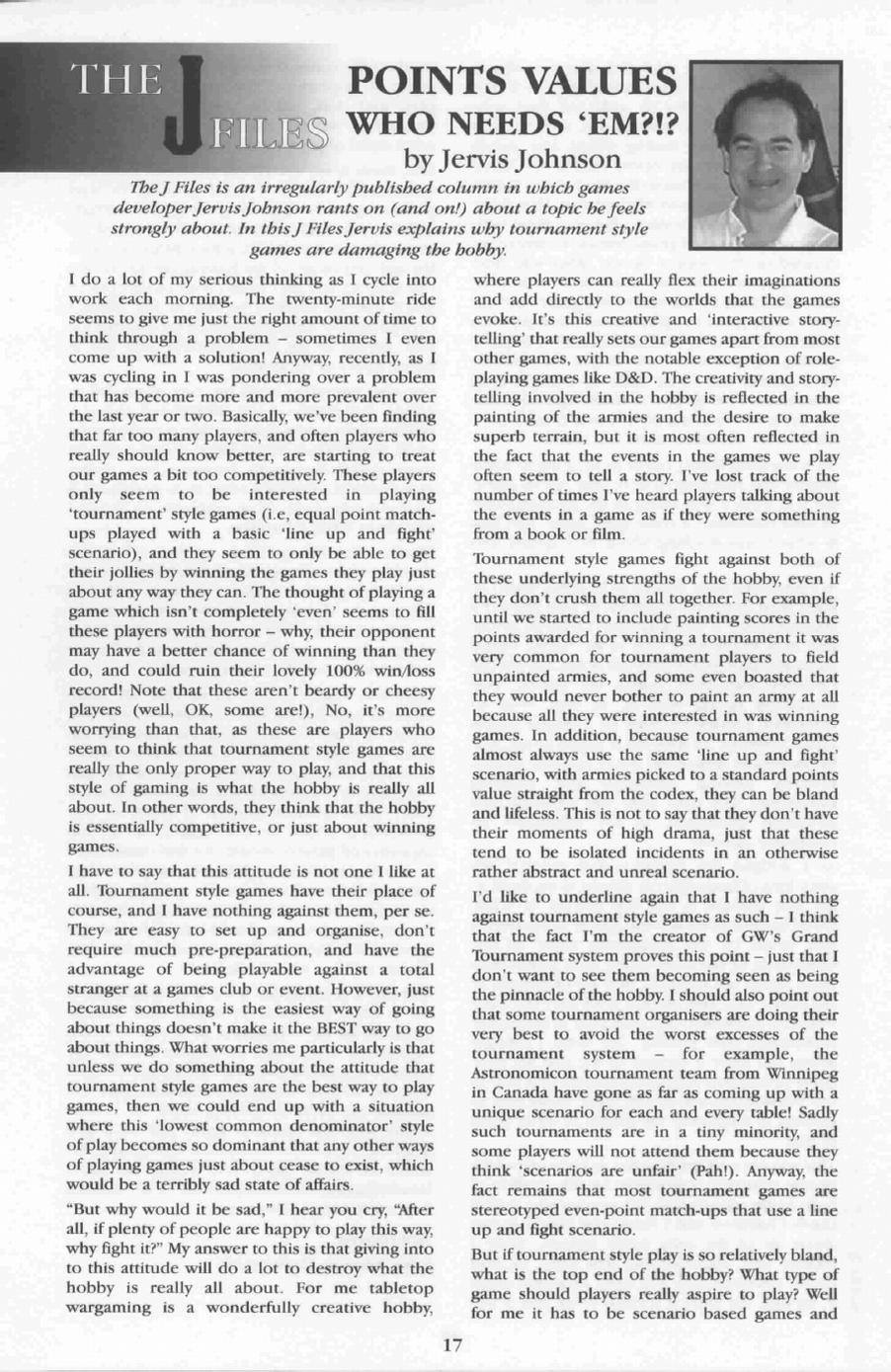

 I remember this being a major theme in White Dwarfs of the late 1990s and early 2000s. That's also when terms like "beardy" and "cheese" came into vogue, I believe. There was this massive disconnect growing between the design studio and the player base. It was really evident in WFB 5th and 6th editions as hilariously overpowered combos were common as dirt. Of course they had always been - it's just that we, the players were changing. We felt so clever when we broke the game in all kinds of horrible fashions to humiliate our opponents. Game design staff were often mortified to see what we were doing to their brainchildren.