Forum adverts like this one are shown to any user who is not logged in. Join us by filling out a tiny 3 field form and you will get your own, free, dakka user account which gives a good range of benefits to you:
No adverts like this in the forums anymore.
Times and dates in your local timezone.
Full tracking of what you have read so you can skip to your first unread post, easily see what has changed since you last logged in, and easily see what is new at a glance.
Email notifications for threads you want to watch closely.
Being a part of the oldest wargaming community on the net.
If you are already a member then feel free to login now.
2018/12/28 09:53:43
Subject: Looking to get into resin casting for the commission models I have had done.
I realise this may be a bit of a jump to just out here and ask how one would make resin figures, but I have the desire!! I might have the funds.
In short I've had maybe 10 commissions made over the last 2 years and I'm finding the casters a bit of a bottle neck for myself, as I'm wanting such a small number of models made for each commission.
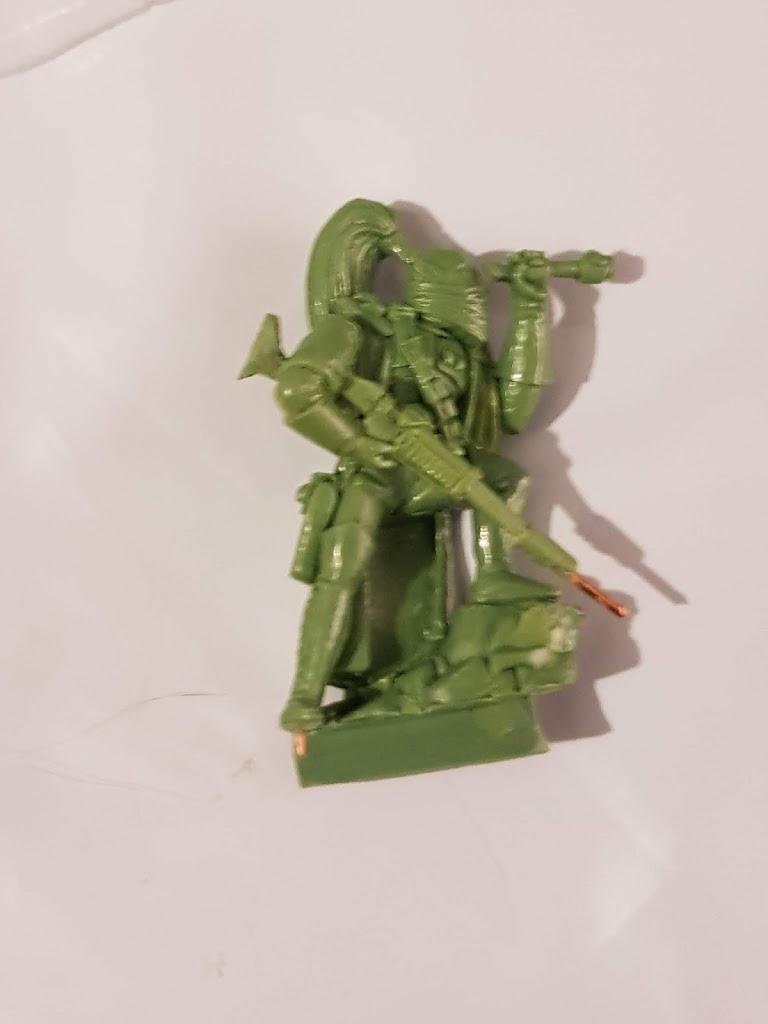
An example model:
I will admit I have almost no experience, so maybe a tutorial or at least some words on the items i might need would be enough to get me started.
Either way, just a point would be much appreciated to get me started.
Thanks guys
2018/12/28 12:32:32
Subject: Looking to get into resin casting for the commission models I have had done.
Its a long and tricky thing, best bet is one of the starter sets from Alumilite.
There is a forum dedicated just to casting that I found to be a terrific resource when I started;
They are good people with a lot of experience and I would highly recommend taking a browse.
One thing to bear in mind though is that you will probably make a lot of expensive mistakes until you gain experience, the learning curve is not an easy one.
On parle toujours mal quand on n'a rien à dire.
2018/12/28 13:16:52
Subject: Looking to get into resin casting for the commission models I have had done.
Wehrkind (another Dakka user) is an amazing resin caster and was local to me for a long time. Having watched him do it, I'd say you obviously don't want to start with an amazing original sculpt like the above. Casting a base is a very good starting point, though
It is really an art form - I was interested in learning until seeing him do it, after which I just asked him to cast things for me
To do it well, you'll need to learn how to make flexible silicone molds (a common trick is to use lego blocks to create a structure you can remove, then cut it in half or just cut a slit in the side to remove the master, since they're flexible), fill them with 2-part urethane to create the casts (the most widely used source is a company called Smooth On), and then put them in a vacuum pot to remove any air bubbles. You can pour the urethane into multiple molds and put them all into the vacuum pot... but creating the molds is the challenge.
There used to be a good tutorial on Dakka, I'll see if I can find it. There's quite a bit on Smooth On's site, as well, although it's not all applicable to hobby casting:
Like I said, the real art is making the molds, including sticking in some thin runners beforehand so that there will be a pour point for the urethane and a way for air to escape in the vacuum pot. It's really an endeavor, but if you're ready to make casting your hobby, could be well worth trying
2018/12/28 14:08:56
Subject: Re:Looking to get into resin casting for the commission models I have had done.
Casting need not be expensive, nor too difficult, although I suspect the method I use might not be durable enough for some of the finer unsupported components like the rifle in the picture you've posted.
The advantage of this method is that you do not need expensive equipment, the Bluestuff/Oyamaru moulds can be remelted and reused if you make a mistake creating your mould (and you will to begin with!) and the casting resin is pennies per cast. Additionally the resulting cast piece only takes about an hour in a two part mould to get firm enough to remove. An open one part mould can be demoulded in around 30 minutes, because evaporation is quicker.
The resulting casting is ceramic hard and can be drilled and sanded, although cleanup is marginally more involved because flash must be sanded off (I made the mistake of using the mouldline remover and cracked an earlier attempt!).
The blue stuff/oyamaru is good for undercuts if you don't make the mould too thick and therefore more flexible, although you with need to remake it sooner. If you have been careful to avoid undercuts you can make the mould thicker which makes it much more durable. I chose the later method and the mould is still fine after 10 castings.
Whether this method is suitable for casting the plasticky type resins, I do not know. I don't like forgeworld style resin so I have avoided it.
But I can say for certain that at around £20 for the blue stuff and the acrylic resin material, I can now cast most parts I need to modify my models and need only make a greenstuff/carved master once.
Edit: One more thing, the youtube tutorials for bluestuff/oyamaru are universally rubbish and wrong. It was only when I used the dakka casting box tutorial and decided on pourable acrylic resin did I get anything approaching acceptable results. There is too much shrinkage and distortion pressing materials like Milliput or green stuff into the moulds.
This message was edited 1 time. Last update was at 2018/12/28 14:20:11
2018/12/28 14:27:10
Subject: Re:Looking to get into resin casting for the commission models I have had done.
Casting need not be expensive, nor too difficult, although I suspect the method I use might not be durable enough for some of the finer unsupported components like the rifle in the picture you've posted.
The advantage of this method is that you do not need expensive equipment, the Bluestuff/Oyamaru moulds can be remelted and reused if you make a mistake creating your mould (and you will to begin with!) and the casting resin is pennies per cast. Additionally the resulting cast piece only takes about an hour in a two part mould to get firm enough to remove. An open one part mould can be demoulded in around 30 minutes, because evaporation is quicker.
The resulting casting is ceramic hard and can be drilled and sanded, although cleanup is marginally more involved because flash must be sanded off (I made the mistake of using the mouldline remover and cracked an earlier attempt!).
The blue stuff/oyamaru is good for undercuts if you don't make the mould too thick and therefore more flexible, although you with need to remake it sooner. If you have been careful to avoid undercuts you can make the mould thicker which makes it much more durable. I chose the later method and the mould is still fine after 10 castings.
Whether this method is suitable for casting the plasticky type resins, I do not know. I don't like forgeworld style resin so I have avoided it.
But I can say for certain that at around £20 for the blue stuff and the acrylic resin material, I can now cast most parts I need to modify my models and need only make a greenstuff/carved master once.
Edit: One more thing, the youtube tutorials for bluestuff/oyamaru are universally rubbish and wrong. It was only when I used the dakka casting box tutorial and decided on pourable acrylic resin did I get anything approaching acceptable results. There is too much shrinkage and distortion pressing materials like Milliput or green stuff into the moulds.
That tutorial is great, also;
https://www.dakkadakka.com/dakkaforum/posts/list/60/236631.page Is very informative.
For casting bits like weapons and shoulder pads the process you decribe is good but it is not the way to do whole models. Were I the OP I would probably look at getting them made in pewter or spun resin as that would be the best way to preserve the detail and not have to chop the figure up which would probably be neccessary for a two part mould.
Edit; Also highly recommend making a pressure pot or if the budget will stretch a vacuum pot, with the intricate detail and fineness it is pretty much needed to get rid of bubbles, the alternative is lots of vents and very delicate posing.
This message was edited 1 time. Last update was at 2018/12/28 14:30:25
2018/12/28 14:46:59
Subject: Re:Looking to get into resin casting for the commission models I have had done.
CodeKantorBlue wrote: Casting need not be expensive, nor too difficult, although I suspect the method I use might not be durable enough for some of the finer unsupported components like the rifle in the picture you've posted.
The advantage of this method is that you do not need expensive equipment, the Bluestuff/Oyamaru moulds can be remelted and reused if you make a mistake creating your mould (and you will to begin with!) and the casting resin is pennies per cast. Additionally the resulting cast piece only takes about an hour in a two part mould to get firm enough to remove. An open one part mould can be demoulded in around 30 minutes, because evaporation is quicker.
The resulting casting is ceramic hard and can be drilled and sanded, although cleanup is marginally more involved because flash must be sanded off (I made the mistake of using the mouldline remover and cracked an earlier attempt!).
The blue stuff/oyamaru is good for undercuts if you don't make the mould too thick and therefore more flexible, although you with need to remake it sooner. If you have been careful to avoid undercuts you can make the mould thicker which makes it much more durable. I chose the later method and the mould is still fine after 10 castings.
Whether this method is suitable for casting the plasticky type resins, I do not know. I don't like forgeworld style resin so I have avoided it.
But I can say for certain that at around £20 for the blue stuff and the acrylic resin material, I can now cast most parts I need to modify my models and need only make a greenstuff/carved master once.
Edit: One more thing, the youtube tutorials for bluestuff/oyamaru are universally rubbish and wrong. It was only when I used the dakka casting box tutorial and decided on pourable acrylic resin did I get anything approaching acceptable results. There is too much shrinkage and distortion pressing materials like Milliput or green stuff into the moulds.
Quick question. You know how you re created the space marine shoulders, would i be correct to say that your copys would be slightly ( even if very very small amount ) bigger?, and also wouldn't the detail ( even if its very very tiny amount ) be slightly ( very slightly ) less detailed?
Automatically Appended Next Post: So basicly, if i re created a whole space marine model and put it next to orginal. if i look very closely you will notice those things, as in it cant ever be 100% exactly like copy.
This message was edited 2 times. Last update was at 2018/12/28 14:48:06
2018/12/28 14:50:54
Subject: Re:Looking to get into resin casting for the commission models I have had done.
CodeKantorBlue wrote: Edit: One more thing, the youtube tutorials for bluestuff/oyamaru are universally rubbish and wrong. It was only when I used the dakka casting box tutorial and decided on pourable acrylic resin did I get anything approaching acceptable results. There is too much shrinkage and distortion pressing materials like Milliput or green stuff into the moulds.
I found the same thing, in a few, very limited tries myself, that results with green stuff or mulliput weren't great.
I realize you aren't located in the US, but do you perhaps know of any other source (hopefully US based) of that sort of water-based stuff beside GSW?
2018/12/28 16:19:32
Subject: Re:Looking to get into resin casting for the commission models I have had done.
Stormatious wrote:Quick question. You know how you re created the space marine shoulders, would i be correct to say that your copys would be slightly ( even if very very small amount ) bigger?, and also wouldn't the detail ( even if its very very tiny amount ) be slightly ( very slightly ) less detailed?
So basicly, if i re created a whole space marine model and put it next to orginal. if i look very closely you will notice those things, as in it cant ever be 100% exactly like copy.
In short, no. It's a very faithful duplicate. Once I sanded off the flash it has virtually the same dimensions with a very high degree of fidelity. The outside of my moulds even have the very fine seam gaps from my lego brick like building block mould box.
You might notice it if you had identical models side by side, but as most modellers tend to add all sorts of extra components for variety in their squads (think purity seals, tilting plates, ammo/grenade packs) and vary the poses you wouldn't notice. The weight is marginally heavier than a plastic component. However as I drill and metal pin parts even that isn't noticeable.
Edit: I should mention I only use this for modification of components. If your intent is to recast an entire army, it probably won't save you any money and will cost you a lot in time. For casting your own originals works, however, it's more cost effective than investing a lot of money in vacuum chambers, pumps, spinning moulds and two part silicones and resins with 6 month shelf lives OR paying someone else to do it for you. As a beginner moulding method I feel I have produced a superb result quickly and cheaply. Anyone wanting to build confidence in casting things would do well to try this first. The skills you learn with £20 worth of outlay are transferable as you gain confidence with each successful cast.
H wrote:
CodeKantorBlue wrote: Edit: One more thing, the youtube tutorials for bluestuff/oyamaru are universally rubbish and wrong. It was only when I used the dakka casting box tutorial and decided on pourable acrylic resin did I get anything approaching acceptable results. There is too much shrinkage and distortion pressing materials like Milliput or green stuff into the moulds.
I found the same thing, in a few, very limited tries myself, that results with green stuff or mulliput weren't great.
I realize you aren't located in the US, but do you perhaps know of any other source (hopefully US based) of that sort of water-based stuff beside GSW?
I'm sorry, I do not know. The material is somewhat similar to basing plasters that you might use to make dungeon tiles if that helps? In fact the product I used is meant for that, but I discovered it poured so well into moulds that it was worth a shot and it worked.
This message was edited 1 time. Last update was at 2018/12/28 16:58:48