| Author |
Message |
 |
|
|
|
|
Advert
|
Forum adverts like this one are shown to any user who is not logged in. Join us by filling out a tiny 3 field form and you will get your own, free, dakka user account which gives a good range of benefits to you:
- No adverts like this in the forums anymore.
- Times and dates in your local timezone.
- Full tracking of what you have read so you can skip to your first unread post, easily see what has changed since you last logged in, and easily see what is new at a glance.
- Email notifications for threads you want to watch closely.
- Being a part of the oldest wargaming community on the net.
If you are already a member then feel free to login now. |
|
 |
2022/12/26 01:48:13
Subject: What do the Departmento Munitorum's "in house" units look like?
|
|

Calculating Commissar
|
This is something I have been pondering for a while.
The Departmento Munitorum mainly draws manpower through the tithe system, where complete formations are drawn from Imperial worlds in the martial tradition of those worlds. Largely, they are trained and equipped by that world, although additional training and often additional equipment is supplied by the Departmento, as well as ongoing resupply in their destination warzone/garrison. This forms the majority of the Imperial Guard's fighting strength.
However, we know the Departmento Munitorum maintains its own formations that are not affiliated to the regimental structure, apparently organised into 'corps'. As far as I am aware, there is not a lot of information available about these and I would be interested to find out more. I am only aware of the engineer and pioneer corps deployed in the Third War for Armageddon, and the labour corps deployed to the Siege of Vraks.
The Departmento Munitorum also directly manages its recruits from the Schola Progenium (namely scions and commissars) but I'm not looking at those in this thread as they are comparatively well documented and also low in number.
What I know and extrapolate:
These formations fill supporting and logistical roles- engineering, pioneers, labourers. It is likely that the Departmento uses these to provide the 'tail' to the regimental 'tooth'. The labour corps on Vraks built and maintained the landing field and logistics system transporting supplies to the frontline, including hundreds of miles of new railway. It is unclear whether the engineer and pioneer corps complete those units in combat situations (i.e combat engineers etc), but it is likely as they are listed in the fighting strength on Armageddon. Many standard regiments include engineer units (such as the Semtexian Bombardiers and DKoK) so it is unclear how the Departmento Munitorum units interact with these. Presumably they are only assigned to regiments without organic engineers, and/or for specific high-priority operations like creating a breach or bolstering a key fortification.
These corps appear to be large- the single corps on Vraks was half a million men. If all such units are this size, we are talking sizeable numbers- at the end of the first Season of Fire on Armageddon, 5 engineering and 2 pioneer corps were deployed, which would be 3.5 million personnel. This is roughly in the same ballpark as the DKoK line corps, which appear to be ~1 million strong. Notably, Krieg is a world heavily influenced by the Departmento Munitorum and focuses on producing maximal military tithes.
The labour corps recruit from convicts on a penal world in the one example I am aware of. Where the enforcers are recruited from is less clear. I doubt specialised engineers are recruited from penal colonies and where these troops are recruited is one of my big questions (see below).
Unanswered questions and my suppositions:
How do they look? Based on the material stored at Vraks, the equipment will be drawn from similar Departmento Munitorum depots and will likely be some combination of patterns from the major exporters in the region- forge worlds, hive worlds, industrial worlds. A depot near Ryza is likely to stock a lot of Ryza-pattern equipment. Uniforms could be local, or could be based on regional standards in a manner more akin to the Imperial Navy. I suspect the latter. Equipment is going to be of a reasonable standard where supply lines are maintained.
Recruitment of the more skilled units. Again, I suspect this may be more akin to the Imperial Navy with units being recruited through various routes- both drafted and volunteering. There may be specific treaties in place to draw manpower from specified planets. Lots of options here, but no evidence beyond the labour corps.
What warzones warrant a deployment? Vraks is a moderately-sized war, Armageddon is colossal. It is unclear whether labour corps and other logistic units were deployed on Armageddon, but I think it is safe to assume they were deployed to support the operations there. The PDF (including rapidly drafted units during the war) on a heavily industrialised world like Armageddon probably also has a great deal of logistical capacity to add to the Imperial Guard logistics, reducing the amount of deployed Departmento Munitorum units. Are units smaller than a corps deployed to smaller warzones? Perhaps.
How are corps organised and the subunits deployed? No idea on this one.
Does anyone have any further thoughts or other sources?
|
 ChargerIIC wrote: ChargerIIC wrote:If algae farm paste with a little bit of your grandfather in it isn't Grimdark I don't know what is.
|
|
|
 |
|
2022/12/26 11:37:56
Subject: Re:What do the Departmento Munitorum's "in house" units look like?
|
|

Pyromaniac Hellhound Pilot
|
This is how I imagine it:
The two distinct types of Munitorium personnel are clerks and laborers. Clerks do the paperwork and they look exactly like your average Administratium paper-pusher, nothing overly special to see her. The laborers are all slaves, and the vast majority of them are lobotomized servitors. These laborers are "recruited" from literally anywhere and everywhere: if the Munitorium needs 4000 laborers then they just stroll into the nearest human settlement with a bunch of guardsmen and drag away the first 4000 imperial citizens they come across. No need for enforcers or anything like that, even those who don't get turned into servitors get brain-chipped so they work non-stop at a push of a button. Basically all the laborers are some kind of vegetable, some are just more aware of that than others.
So as a guardsman you can meet the usual robed scrawny dude with random bionics and a big love for red tape, the servitor that hardly classifies as a human anymore, and the poor chap who is skins-and-bones and wearing rags but still digging trenches like there is no tomorrow and his eyes tell you that they want to be anywhere but here.
Also, Munitorium personnel (clerks and laborers) should outnumber combat personnel (guardsmen) by 5:1, so an army of 50 million guardsmen has a Munitorium supporting staff of ~250 million. On this note, I doubt Munitorium personnel are organized separately from the 'Guard unit they are supporting, so the 3rd Laborer Corps is just a fancy way of saying "the laborers of the 3rd Imperial Guard Corps" and such - it just looks nicer on paper, and really that's all that matters.
|
My armies:
 14000 points 14000 points |
|
|
|
|
2022/12/26 11:44:05
Subject: Re:What do the Departmento Munitorum's "in house" units look like?
|
|

Servoarm Flailing Magos
|
I don't think that there is a lot of information about them outside of the stuff from FW campaign books you already mentioned.
That being said, they sound a lot like one of the lesser known nazi organisations, namely the 'Organisation Todt':
https://en.wikipedia.org/wiki/Organisation_Todt
That matches with commissars etc. being basically in nazi uniforms; maybe something like the 2nd edition storm troopers, basic combat fatigues, berets, maybe some greatcoats, with rank insignia mainly on armbands and headgear.

|
|
|
|
|
2022/12/26 11:55:02
Subject: Re:What do the Departmento Munitorum's "in house" units look like?
|
|

Longtime Dakkanaut
|
In real military, a corps (or army in Russian model) is not just a few regiments/divisions dumped together. Corps/army level command gets extra independent unattached units they use as they see fit, logistic ones, field hospitals, heavy artillery, AA units, recon, etc, etc. This is where such units would be deployed and commanded by senior general (though it's kinda weird 40K doesn't really distinguish between different grades of these, if normal general or brigadier would be in charge of regiment, you'd also need higher rank ones on higher levels like we do, possibly even more grades of these seeing 40K forces are bidder and you'd need a clear chain of command).
Then you have armies (or army groups/fronts in Russian model) which would be equivalent to 40K crusades - even more heavy independent units, like superheavy artillery, superheavy tanks, high level HQs and intelligence/signal warfare units, field factories, repair yards, supply depots, propaganda units and field newspapers, security and MP battalions, military prisons, special forces units, titans, etc, etc. Size of deployment of Departmento Munitorum items would be dictated by the size of said crusade, and could be theoretically of any size depending on needs and local resources. Though, modern armies usually need 2 to 5 (at least) people in 'tail' for every combat soldier and even with stuff like emphasis on energy weapons 40K armies would probably need even more. Say, generator companies running portable electric plants to charge spent lasgun packs 24/7 (or any other amenities they would logically need, like charging gas into plasma bottles or bionics installation and maintenance).
|
|
|
|
|
2022/12/26 14:48:40
Subject: Re:What do the Departmento Munitorum's "in house" units look like?
|
|
Preparing the Invasion of Terra
|
There are numerous offices within the Munitorum and each one will have an impact on what its manpower is made up of and how it operates.
Administratum Assay Corps - Going by assumption and googling word definitions, this office seems to be in charge of quality control. Probably doesn't have field divisions.
Commissariat - Recruits, trains, and oversees the activities of Commissars. Pretty self-explanatory.
Engineer Corps - This will be staffed by trained and likely experienced troops. If deployed to a battlefield they will at least have the basic training of a Guardsman and will be equipped similarly.
Field Enforcement Corps - MPs. Used by the Commissariat to guard military prisons. Equipped as a Guardsman would be and trained the same way, if not slightly better.
Labour Corps - Your basic poor schmuck brigades. Either through volunteering, forced conscription, or the use of prisoners these will be used to perform grunt work for the Munitorum such as trench digging, construction, or staffing logistics trains. Might get a pistol if they're lucky and on the front lines but will likely just have to use a shovel or pick as a weapon.
Questor - Supervises the distribution of discipline, work quotas, and equipment. Basically a bureaucratic Inquisitor without any of the gadgets.
Siege Auxillia Corps - Again, trained and experienced individuals likely drawn from the Officio Tactica.
Pioneer Corps - Similar to the Engineer Corps.
As for deployment, the Munitorum deploys to any theatre that Guard and Navy do. They might be a small group of logistics officers ensuring the correct weapons and equipment are gathered or it may be a large detachment consisting of specialists and labourers. The deployment will depend on the theatre.
With regards to position within the command structure, it's tricky as with all things Imperial. Munitorum officials have military ranks but a Major in a Munitorum Engineer Company likely wouldn't outrank a Captain of a Cadian Company because the former's forces would be assigned as mission specialists to ensure a specific task was completed rather than running the entire mission.
|
|
|
|
|
2022/12/26 15:04:07
Subject: Re:What do the Departmento Munitorum's "in house" units look like?
|
|
Calculating Commissar
|
Some further information from Imperial Armour volume 3- the Taros Campaign:
IA volume 3 wrote:The Departmento Munitorum, as well as raising and transporting regiments, could also provide assistance in the form of indentured engineering and labour corps. These were not combat troops but units for the rear area whose primary role was to dig in and build. It was hard, unforgiving work, but their presence helped release Imperial Guard infantry from such arduous and time consuming duties.
So they are all second-line units that are not intended for combat duties. I am sure they end up in combat occasionally, particularly when fighting very mobile enemies like Aeldari.
Incidentally, the same campaign also featured an army subdiveded into corps of 5 regiments each, but these are much smaller due to the smaller regiment sizes (the Tallarn corps is probably about 50000 strong based on the published muster strength of ~11000 for a Tallarn infantry regiment, vs ~1 million for the Krieg corps with a Krieg siege regiment being 200000 strong at muster). Whether Departmento Munitorum corps have a standard size or vary based on the needs of the warzone is unknown, but they probably vary. The number of corps deployed is probably based on how many discrete areas need support troops, rather than absolute numbers. Otherwise the Taros campaign, an objectively smaller war than the Siege of Vraks, would have 4x the supporting personnel with two labour corps and two engineering corps plus supply columns. The Vraks wars only required a single logistical node to supply the siege, so a large contigent of labourers organised into a single corps was likely sufficient , whereas Taros was a much more mobile war. Armageddon was a much bigger warzone with multiple fronts and types of combat, but likely could heavily draw on local manpower in a way the other two campaigns could not- reducing the number of Departmento Munitorum units required to be deployed.
 Irbis wrote: Irbis wrote:In real military, a corps (or army in Russian model) is not just a few regiments/divisions dumped together. Corps/army level command gets extra independent unattached units they use as they see fit, logistic ones, field hospitals, heavy artillery, AA units, recon, etc, etc.
Well, in 40k a corps is a subdivision of an army (more like in Western terminology), but it seems they are typically ~5 regiments in size. Seeing as regimental size varies wildly, this makes a corps a rather variable unit too. I strongly suspect that more adhoc battlegroups (analogous to a modern brigade) end up being the chief fighting units most of the time. Corps do get extra units attached, such as stormtrooper companies or independent artillery companies, and smaller battlegroups are also typically combined-arms units assembled from units from multiple regiments. Imperial Guard organisation actually looks to be remarkably flexible and a good general officer is probably able to use this to their advantage by crafting the right battlegroup for the right job. A bad one will probably use very different forces in the same way and waste manpower needlessly- this is a punishable offence by the Commissariat, so I suspect very bad commanders get weeded out relatively quickly (after plenty of deaths, of course...).
This is where such units would be deployed and commanded by senior general (though it's kinda weird 40K doesn't really distinguish between different grades of these, if normal general or brigadier would be in charge of regiment, you'd also need higher rank ones on higher levels like we do, possibly even more grades of these seeing 40K forces are bidder and you'd need a clear chain of command).
I am not sure where this has come from. The available canon information states there are a whole range of ranks between colonel and the lord commanders at the top, although it does not go into detail as a range of titles are in use and they rarely matter on the tabletop. Imperial Guard regiments are explicitly raised with twice the officers they need to command the line troops so that half the officers can be inducted into the warzone command staff once the regiment arrives. This often includes higher ranks, and is why you occasionally get a regiment commanded by a general directly when they are the only regiment in theatre- the general was raised with the regiment, but has formed their own command staff in a small war. Much lore just says "general", but technically this is accurate in real terminology too, where all general officers are general in shorthand, although general is also a specific rank. Regiments are commanded by a colonel because they are loosely based on British organisation- brigadiers command the next level up in brigades.
As you say, there are higher levels of command required than we need on Earth today- happily, these exist with subsector, sector, segmentum, and temporarily-appointed crusade commands, as well as the commander of the entire Imperial Guard on Terra (frequently a High Lord of Terra and a member of the Imperial Senate).
Then you have armies (or army groups/fronts in Russian model) which would be equivalent to 40K crusades - even more heavy independent units, like superheavy artillery, superheavy tanks, high level HQs and intelligence/signal warfare units, field factories, repair yards, supply depots, propaganda units and field newspapers, security and MP battalions, military prisons, special forces units, titans, etc, etc. Size of deployment of Departmento Munitorum items would be dictated by the size of said crusade, and could be theoretically of any size depending on needs and local resources. Though, modern armies usually need 2 to 5 (at least) people in 'tail' for every combat soldier and even with stuff like emphasis on energy weapons 40K armies would probably need even more. Say, generator companies running portable electric plants to charge spent lasgun packs 24/7 (or any other amenities they would logically need, like charging gas into plasma bottles or bionics installation and maintenance).
Armies just seem to be equivalent to, well, armies. A crusade is a huge affair more akin to an army group or a nation's entire armed forces with multiple armies fighting across multiple worlds at once.
The Imperial Guard is often on a defensive footing- I suspect it typically uses local logistics for much of its supply needs. A modern version of "living off the land" in keeping with the feudal nature of the Imperium. However, there seems to be a low tooth to tail ratio- Vraks suggests something like one labourer for every ten Guardsmen. The Imperium does use very advanced, often automated equipment, so it may be the case that their logistics are very efficient in comparison to modern Earth. We know their combustible fuel is more energy dense, their reactors are very powerful and portable, rations appear to be dense too, the primary weapon has rechargeable ammunition, and military logistics appear to be largely containerised based on the munitorum containers. Servitors are probably also counted as material rather than manpower. Only water needs seem to be largely unchanged- water is heavy and bulky to transport. Put together, and Imperial forces probably use (by our standards) heavily automated logistics with lower base needs due to the efficiency of their equipment.
Of course, the nature of Imperial tech means you will probably see a patchwork of heavily automated processes that are linked together by labourers doing back-breaking labour to shift the supplies from one system to the other... "The STC for the doohickey that connects this crane to this shuttle was never discovered, so 30 men have to drag the container 2 metres between them, day in day out".
|
ChargerIIC wrote:If algae farm paste with a little bit of your grandfather in it isn't Grimdark I don't know what is.
|
|
|
|
|
2022/12/26 15:23:11
Subject: What do the Departmento Munitorum's "in house" units look like?
|
|
Preparing the Invasion of Terra
|
Daresay there will be a brutal estimation of casualties when it comes to supplying rations and ammo. After all, the Munitorum isn't going to pack six months of supplies for a full army when half the troops will be dead by the third month.
|
|
|
|
|
2022/12/28 15:38:08
Subject: Re:What do the Departmento Munitorum's "in house" units look like?
|
|
Automated Rubric Marine of Tzeentch
|
speaking as someone who is.....professionally involved in war, and specifically the creation of headquarters and staff work, I can say with some degree of certainty that its pointless trying to extrapolate the requirements of the Guard form its unit titles: they bear no resemblance to the real world units of similar names. this partly stems form differences in how the Imperium classifies soldiers and civilians, and partly form the writers knowingly or unknowingly misusing real world titles for fun and rule of cool
A "regiment" as a echelon of combat command (as opposed to the British style "administrative" regiment that can be of any size, but is not a echelon of command) was, historically, about brigade sized, roughly ~3,000 strong, and directly subordinate to a division that controlled a lot of the supporting arms (ie arty, signals, engineers, logistic and medical, etc). The british system was/is battalions of less than 1,000, suborned to brigades of 3,000-5,000 (inc supporting arms), which are in turn suborned to divisions (which in this model have less "divisional troops" under direct control, as the brigades have their own support integrated)
A "regiment" of 11,000 men would, IRL, be the small end of the Division scale, and would be called as such (ie, the "22nd Tallarn infantry division").
A corps of 50,000 is in line with historical usages, including the corps assets like long range signals units, very heavy artillery, specialist engineering units, a shed load of logistics troops etc, etc.
a "regiment" of several million is, of coruse, totally bull. the only echelon of command that controlled that number of soldiers is "theatre", as in, "everyone involved in fighting on this continent" level.
I mentioned that the imperium does things differently, which can screw with the comparison quite a bit, especially at the higher levels. Form what i can tell, the published strengths of the Guard are almost all for combat arms strength. the vast majority of the supporting arms do not, it seems, fall under the Astra Militarum TLB*, but are Departmento Munitorum troops of the type this thread is about.
So, using the British army arms of service as a point of reference, the equivalent of the Royal Logistics Corps, The Adjutant Generals Corps, the Royal Signals, The Royal Army Medical Corps, the Royal Engineers, would all be "civilian" units under Munitorum control, not normally given weapons, and not counted as "soliders" by the Imperium, even if they would called soliders be by us today. In addition, you have the Royal Electrical and Mechanical Engineers, who'd be Admech in the imperium
These units, together, constitute about 60% of the workforce under the british army's Top level Budget, and assuming that the ebb and flow of "super tech reducing labour" and "grimdark inefficiency" cancel each other out, we can reasonably assume that any given Guard unit is being directly supported by a Munitorum force of AT LEAST equal size.
this, of coruse, discounts the distant support of Munitorum assets in the deep rear, which would likely add another unit sized body of men to the equation. these would be the workers in the sector warehouses, the starport workers, the tithe recruiting and training teams on the homeworlds, the legion of scribes needed to shuffle the paperwork needef for all this, etc, etc.
so, for any unit size, add at least 2 bodies into the supply chain for support when comparing it to a "real" unit size.
|
To be a man in such times is to be one amongst untold billions. It is to live in the cruelest and most bloody regime imaginable. These are the tales of those times. Forget the power of technology and science, for so much has been forgotten, never to be relearned. Forget the promise of progress and understanding, for in the grim dark future there is only war. There is no peace amongst the stars, only an eternity of carnage and slaughter, and the laughter of thirsting gods.
 Coven of XVth 2000pts Coven of XVth 2000pts
 The Blades of Ruin 2,000pts The Blades of Ruin 2,000pts  Watch Company Rho 1650pts Watch Company Rho 1650pts
|
|
|
|
|
2022/12/28 16:59:35
Subject: What do the Departmento Munitorum's "in house" units look like?
|
|

Shadowy Grot Kommittee Memba
The Great State of New Jersey
|
I think some of y'all may be misunderstanding the usage of the term "corps" here. While yes, a corps is a unit or echelon of command or an operational formation - sometimes referred to as a field corps - its also used more generically to refer to administrative organizations that are not actually organized into a corps (example "artillery corps", "medical corps", "armor corps", "adjutant generals corps", "acquisition corps", "civil affairs corps", etc.).
I'm pretty sure when these sources are referring to corps, they are referring to the latter usage, rather than the former. I.E. - they are not talking about a literal corps-sized formation being deployed to a warzone, but rather one or more formations that are being drawn from *the* engineering corps or *the* laborers corps.
|
|
This message was edited 1 time. Last update was at 2022/12/28 17:00:42
|
|
|
|
|
2022/12/28 17:01:01
Subject: Re:What do the Departmento Munitorum's "in house" units look like?
|
|
Calculating Commissar
|
xerxeskingofking wrote:speaking as someone who is.....professionally involved in war, and specifically the creation of headquarters and staff work, I can say with some degree of certainty that its pointless trying to extrapolate the requirements of the Guard form its unit titles: they bear no resemblance to the real world units of similar names. this partly stems form differences in how the Imperium classifies soldiers and civilians, and partly form the writers knowingly or unknowingly misusing real world titles for fun and rule of cool
A "regiment" as a echelon of combat command (as opposed to the British style "administrative" regiment that can be of any size, but is not a echelon of command) was, historically, about brigade sized, roughly ~3,000 strong, and directly subordinate to a division that controlled a lot of the supporting arms (ie arty, signals, engineers, logistic and medical, etc). The british system was/is battalions of less than 1,000, suborned to brigades of 3,000-5,000 (inc supporting arms), which are in turn suborned to divisions (which in this model have less "divisional troops" under direct control, as the brigades have their own support integrated)
A "regiment" of 11,000 men would, IRL, be the small end of the Division scale, and would be called as such (ie, the "22nd Tallarn infantry division").
A corps of 50,000 is in line with historical usages, including the corps assets like long range signals units, very heavy artillery, specialist engineering units, a shed load of logistics troops etc, etc.
a "regiment" of several million is, of coruse, totally bull. the only echelon of command that controlled that number of soldiers is "theatre", as in, "everyone involved in fighting on this continent" level.
I mentioned that the imperium does things differently, which can screw with the comparison quite a bit, especially at the higher levels. Form what i can tell, the published strengths of the Guard are almost all for combat arms strength. the vast majority of the supporting arms do not, it seems, fall under the Astra Militarum TLB*, but are Departmento Munitorum troops of the type this thread is about.
So, using the British army arms of service as a point of reference, the equivalent of the Royal Logistics Corps, The Adjutant Generals Corps, the Royal Signals, The Royal Army Medical Corps, the Royal Engineers, would all be "civilian" units under Munitorum control, not normally given weapons, and not counted as "soliders" by the Imperium, even if they would called soliders be by us today. In addition, you have the Royal Electrical and Mechanical Engineers, who'd be Admech in the imperium
These units, together, constitute about 60% of the workforce under the british army's Top level Budget, and assuming that the ebb and flow of "super tech reducing labour" and "grimdark inefficiency" cancel each other out, we can reasonably assume that any given Guard unit is being directly supported by a Munitorum force of AT LEAST equal size.
this, of coruse, discounts the distant support of Munitorum assets in the deep rear, which would likely add another unit sized body of men to the equation. these would be the workers in the sector warehouses, the starport workers, the tithe recruiting and training teams on the homeworlds, the legion of scribes needed to shuffle the paperwork needef for all this, etc, etc.
so, for any unit size, add at least 2 bodies into the supply chain for support when comparing it to a "real" unit size.
I think Imperial regiments are more in the British style as primarily an administrative unit. Typically they are broken up into combat battlegroups, although sometimes a regiment is deployed as a combat unit in its own right. Battlegroups are not rigidly structured and the size can vary based on the mission need and available troops. Technically a British-style regiment has no upper limit, the RTR had around 20 battalions at its peak and I think some Pakistani regiments have over 80. I agree that the system does not map all that well onto real military structures because the Imperium is trying to smush non-standard formations into a theoretically-standard framework to do a huge variety of roles from garrison peacekeeping to frontline infantry.
I have not come across a regiment in the millions yet. The Death Korps of Krieg have regiments about 200000 strong, with a line corps being ~1 million strong with 5 regiments. The biggest I have come across is the 50th Gudrunite Rifles at 750000 when raised- this regiment was divided into battalions.
Interesting trying to reconcile the published numbers of approximately 1/10th of personnel in theatre being logistics vs the maybe 50% it should be. I wonder how much of the discrepancy can be reasonably made up by filling the gap with servitors (which are definitely treated as equipment not personnel) and co-opting local logistics.
Regiments do include a small amount of logistical support organically- a small supply column, a recovery section if they are armoured, a signals unit, a medical unit etc, but they look pretty small for a regiment thousands strong. Automatically Appended Next Post: chaos0xomega wrote:I think some of y'all may be misunderstanding the usage of the term "corps" here. While yes, a corps is a unit or echelon of command or an operational formation - sometimes referred to as a field corps - its also used more generically to refer to administrative organizations that are not actually organized into a corps (example "artillery corps", "medical corps", "armor corps", "adjutant generals corps", "acquisition corps", "civil affairs corps", etc.).
I'm pretty sure when these sources are referring to corps, they are referring to the latter usage, rather than the former. I.E. - they are not talking about a literal corps-sized formation being deployed to a warzone, but rather one or more formations that are being drawn from *the* engineering corps or *the* laborers corps.
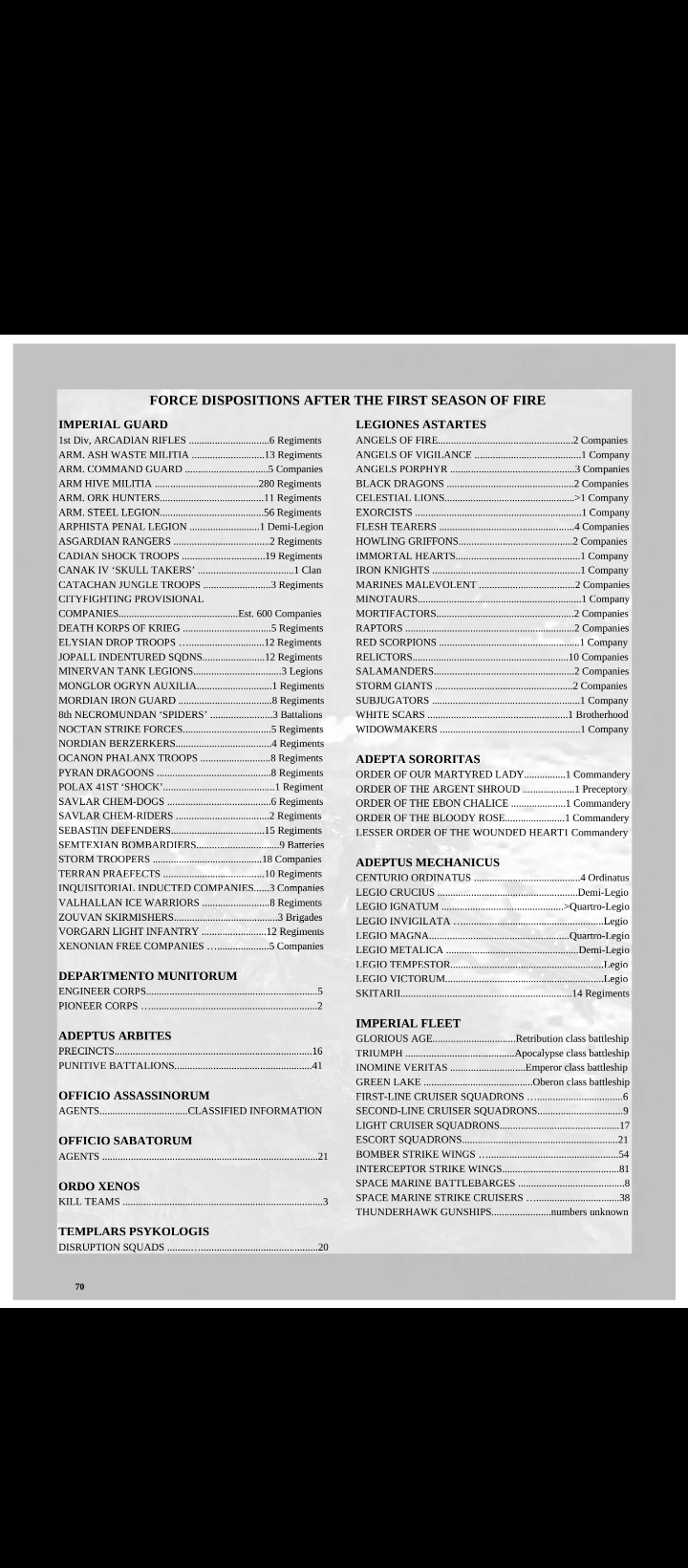
Possible, but they are described as multiple discrete units in two of the three examples I am aware of, with the third only describing a single unit.
For example, the Third War had 7 Departmento Munitorum corps deployed at the end of the First Season of Fire:
|
|
This message was edited 1 time. Last update was at 2022/12/28 17:15:40
ChargerIIC wrote:If algae farm paste with a little bit of your grandfather in it isn't Grimdark I don't know what is.
|
|
|
|
|
|
|
|


