Switch Theme:

D&D - "On AI-generated art and Bigby Presents: Glory of the Giants"  [RSS] Share on facebook Share on Twitter Submit to Reddit
»
Author Message
Advert


Forum adverts like this one are shown to any user who is not logged in. Join us by filling out a tiny 3 field form and you will get your own, free, dakka user account which gives a good range of benefits to you:
  • No adverts like this in the forums anymore.
  • Times and dates in your local timezone.
  • Full tracking of what you have read so you can skip to your first unread post, easily see what has changed since you last logged in, and easily see what is new at a glance.
  • Email notifications for threads you want to watch closely.
  • Being a part of the oldest wargaming community on the net.
If you are already a member then feel free to login now.


Made in us
Rogue Grot Kannon Gunna


 LordofHats wrote:
First off, IP != copyright.


Yes, and I am speaking generally about copyright as well as all other IP rights (such as if patent rights were involved). Maybe in your specific case you didn't do a standard work for hire contract but typically that is part of any serious commission work, such as D&D book art, and copyright goes to the company that paid for the work not the artist. See https://www.copyright.gov/circs/circ30.pdf for some more information on how it works under US law.

Correct, but underlying that notion is the idea that the human created the image. Copyright is essentially built on the notion of work product. Emphasis on work. None of these laws kick in until an expression has been created.


Except in other cases copyright protects things which have a similarly minimal level of work involved. The only reason AI is being treated differently is people anthropomorphizing it as "someone else doing the work for you" instead of a single human using a software tool to generate output.

The entire notion of IP rights from trademarks to copyrights is built on the notion that people have a right to the fruits of intellectual labor, including the right to sell it and control its distribution. The real world is messier but it's silly to think these issues are magically disconnected.


That may be the motivation behind IP rights existing but it is not a question in how those laws are interpreted. "Market impact" or "quality of work" are irrelevant in determining if a particular work is protected by copyright.

Generative AI will only get faster with time and it's already inexpensive for the user.


Not necessarily. This is what I've been saying about the current approach being a dead end. AI developers are currently eating a loss on public demo versions of their product to get people interested, and going beyond the toy demo version requires vast increases in cost. That's why ChatGPT, for example, has a length limit on the free version, to keep the costs below the point where exponential growth makes it prohibitively expensive. It's very cheap to have an AI write a short paragraph, it's expensive on the scale of "spend the entire national GDP on a server farm" to have it write an entire novel.

Love the 40k universe but hate GW? https://www.onepagerules.com/ is your answer! 
   
Made in us
Secret Force Behind the Rise of the Tau


USA

 ThePaintingOwl wrote:
Maybe in your specific case you didn't do a standard work for hire contract but typically that is part of any serious commission work, such as D&D book art, and copyright goes to the company that paid for the work not the artist.


There's a reason artists are credited in DnD books, and even Magic Cards give the artist's name. There's a reason you know their names at all (while you probably know no names of any given chemist who hasn't won a Nobel prize). Wizards buys rights, not copyright, to the individual image. This is true broadly of the entire publishing/illustration industry. This is the case of (2) in your link: "when a certain type of work is created as a result of an express written agreement between the creator and a party, specially ordering or commissioning the work." Note the bolded section and ask yourself why it's there and who probably owns the copyright lacking an express written agreement.

Or you could just read their clarification at the end of page one;

The work made for hire concept can be complicated and has serious consequences for both the individual who creates a work and the hiring party who is considered to be the author and copyright owner of that work. This circular draws on the Copyright Act and judicial interpretation to provide a general introduction to this topic and answer common questions.


Because there's a lot of law around work for hire and copyright, and it gets fucky because, as an example, I can own the copyright of the picture book The Amazing Mr. Mazy and the Fluffy Hat which has images in it, while at the same time, the illustrator owns the copyright to the images themselves (which is the norm for most picture books illustrated by one person but written by another). This is how you can, not so hypothetically, own the copyright to a comic book but not the copyright to the artwork within said comic book.

Most commission agreements expressly keep the copyright to the artists and only give commercial or fair use licenses to the commissioner. They expressly do not automatically infer copyright to the commissioner automatically. It's defined by agreement. Disney owns the copyright to the Avenger's movie, but you can bet that when Hans Zimmer makes a musical score for a movie, he still owns the copyright to the music which is why his name is on the albums credited as the artist (along with whatever orchestra did the playing).

I think you might be confusing it with other fields and industries, where this is often the case. Pharma for example, generally contracts the work to individual researchers, but explicitly owns their work product. Publishing can do the same thing, but market forces have generally resulted in artists having more leverage over keeping copyright than scientists in research fields hanging onto patents. That would define (1) in your link.

Consider Midjourney's TOS in this regard, which (aside from extreme weasel wording on 'assets' and 'ownership' that I'd point to and warn anyone using it about what they think their rights are) expressly tells you to consult a lawyer about the laws of your jurisdiction, and nowhere in the TOS is it expressly stated that you own any copyrights. That's a change from their original TOS, which did expressly state that, but they cut the difference as case law became complicated.

This is not me making a hypothetical argument by the way. That's literally what courts are saying, and their understanding of AI is actually surprisingly sophisticated in how they examined in use in the two cases I know of. The comic book case hinged on a very sophisticated ruling examing 'human effort' as it's defined in precedent.

The only reason AI is being treated differently is people anthropomorphizing it as "someone else doing the work for you" instead of a single human using a software tool to generate output.


You keep saying that and it still has nothing to do with what I'm talking about.

You don't have to anthropomorphize AI to accuse users on one end of not doing any work. Pressing ctrl+a, ctrl+c, and ctrl+v is not a creative process, which isn't the only way generative AI can be used, but it's the way some people have tried to use it only to find they have no copyrights since they didn't make anything. It could be sidestepped, hilariously, by putting in even a modicum of extra effort because of the way the law is written, though.

US Copyright laws actually cover that and there's case law precedent because image generation is a lot older than generative AI. This stuff goes back to the 90s, and even further back because of people like Andy Warhol and James Patterson and Tom Clancy leading the way on the question of 'who owns what and why do they own it?'

"Market impact" or "quality of work" are irrelevant in determining if a particular work is protected by copyright.


See the previously cited fair use/copyright case I linked. The SCOTUS decision hinged a lot on questions of why IP rights exist and what their express purpose is. Marketability and commercial use, as well as quality examinations, were all central to the case.

Legal interpretations are almost entirely about why a law exists past a certain point.

This is what I've been saying about the current approach being a dead end.


Consider that the current iteration is probably a dead end that has already reached its real limits in what it can practically do, but it won't end there. The models in use now will be used to develop more complex and sophisticated models later. Indeed, the current implementation is a necessary stepping stone to more advanced systems. Getting a computer to spit out coherent sentences and responses, even if they're often factually incorrect and start falling apart after about 750 words, is a necessary starting point for doing more than that.

I think people are overestimating what it can do now and how fast it'll develop (electric cars are 150 years old, they're still not market standard and are only just now becoming very common in the past decade, as an example) but the systems will keep developing so long as there's interest or money to be made.

Stuff like Stable Diffusion and Midjourney are probably dead ends, but integration like what Adobe is doing (and notably, Adobe is sidestepping basically all the obvious legal pitfalls around copyright and fair use) will become more sophisticated. Generative AI in a pure form is a dead end, but mixed and multimedia AI uses are going to keep advancing.

This message was edited 6 times. Last update was at 2023/08/08 03:42:41


Made in us
Incorporating Wet-Blending


> I'm saying that in the future, any Joe Schmo with a decent computer will be able to render their 40k movie in a matter of hours using public libraries and open-source materials.

Well, we got the first 45 seconds of the soundtrack done! https://tuna.voicemod.net/search/sounds?search=Warhammer%2040k&categoryFilter=music&tagFilter=warhammer

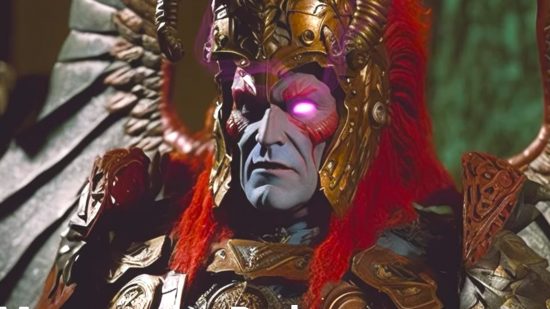
And, six months ago, "YouTuber TechMagelanic used image-making AI Midjourney to create stills from a 1980s Warhammer 40k film that never was, complete with big hair"

https://www.wargamer.com/warhammer-40k/film-1980s-style-created-by-ai
https://www.reddit.com/r/Sigmarxism/comments/zbkcdl/i_asked_midjourney_ai_to_generate_scenes_from/

Three years ago, AI wrote an intro to a 40K novel!
https://www.reddit.com/r/Warhammer/comments/gtsqp1/ai_writes_intro_to_warhammer_40000_story/


Crimson Scales and Wildspire Miniatures thread on Reaper! : https://forum.reapermini.com/index.php?/topic/103935-wildspire-miniatures-thread/ 
   
Made in us
The New Miss Macross!


Deep Fryer of Mount Doom

drbored wrote:

On the other hand, AI art, in its current form, is not ethical. It uses the work of uncredited artists to train their datasets, and if any money or fame is made from that art, the artists whose work was used unethically get none of that profit or credit.


That's the argument I don't get behind. Human artists do the exact same thing by organically studying and copying previous works and styles in order to develop new ones and always have. Are we going also going to restrict new art students from never studying what came before as well? It's not the training that is unethical but rather the use of AI to specifically blatantly copy the original artists' work in an effort to confuse others as to who made the new work.

I signed up for Midjourney for a month as a non-artist myself to see what could be possible when v4 came out and got alot of press. I tried making RPG character portrait art for various RPGs I've wanted to play and it's an incredibly powerful tool to get *something* that looks nice... but an incredibly frustrating tool to get a very specific thing you have in mind let alone that specific thing repeatedly in a consistent fashion. I suspect that this aspect will most improve over the next couple of years.

This message was edited 1 time. Last update was at 2023/08/09 12:17:34


Made in es
Dashing Super Valkyrie Flying Ace


Zenithfleet wrote:
What I'm getting from this (fascinating) thread is that AI is wraithbone and artists are about to become Eldar Bonesingers.

 ThePaintingOwl wrote:
Hardly anyone cares who made the illustrations in a D&D book because they exist to give you an idea of how to describe a character/building/whatever to the players, not because you really value the art and will ever look at it again once you're done with the game.


Nitpicking here, but that hasn't always been D&D's approach. Time was when they hired specific artists with distinctive and recognisable styles to differentiate each setting (e.g. DiTerlizzi for Planescape, Brom for Dark Sun). A lot of that art can be admired for its own sake.


This is still true of many games actually, where having a cohesive outlook and vibe is more important than other considerations. For example, The Troubleshooters RPG is designed to try and play as french-belgian comics, and the art style throughout is designed to replicate and emote that.

This message was edited 1 time. Last update was at 2023/08/12 09:01:02


Made in si
Foxy Wildborne


 warboss wrote:

That's the argument I don't get behind. Human artists do the exact same thing by organically studying and copying previous works and styles in order to develop new ones and always have.


But AI doesn't develop anything, it has no personal experience to apply to those previous works, it just blends them together into some sort of weighted average of a google image search.

The old meta is dead and the new meta struggles to be born. Now is the time of munchkins. 
   
Made in pl
Been Around the Block


I feel like most people can intuit the difference between the organic and imperfect process of learning and using man-made and entirely controlled "learning" by accessing and using data (images in this case) without permission of the owners.
   
 
Forum Index » News & Rumors
Go to: