Beyond Palpatine organizing it so he could take over and form the Empire?
The cover story was something about corruption in the Senate and Jedi Council. The Separatist worlds sought reform of the government whilst the Republic citizens saw the Separatists as conquerors and power mongers.
Manchu wrote: What I don't get is how that turned into a war.
Palpatine.
I know it seems like that's a cop out answer, but that's the reason. He ordered the Clones, he had Dooku put in charge of the Separatists, he had the attacks on Amidala organized so that Naboo would side with forming an army and declaring war.
War happened because he planned one and moved all the pieces into place to start it.
Declaring a war over what? When did it become an act of war to leave the Republic?
I think you might be missing the question here, which is not what did Palpatine do secretly.
Goliath wrote: They were blockading neutral planets to force them to join were they not? I believe that that was the reason the war on Naboo started at least.
The Trade Federation was a full member of the Republic during Episode I.
Declaring a war over what? When did it become an act of war to leave the Republic?
That's the thing, nothing I've read about it says. It mentions the attacks on Senator Amidala being part of the reason, but never expressly says why they declared war other than Palpatine wanted to.
Best I can find is the summary from Wikipedia, but there's absolutely no citations supporting it:
The war has different causes: the Republic's Chancellor Palpatine tells his people that the war began because of several different reasons such as the years of separation by the outer rim territories, as well as the separatists' capture of the Jedi and financing of rebellions by radical states within the Republic. While these are all true, Palpatine had covertly influenced and created these events with assistance from his secret apprentices.
There's also mention of the Separatist Crisis, which the Wookiepedia does mention some of the politics of, but again, LOTS of mentions about Dooku and Palpatine.
Secessionist movements are not generally well-received by the Government. See American Civil War, War of American Independence, the end of colonialism, etc.
Manchu wrote: What I don't get is how that turned into a war.
Palpatine.
I know it seems like that's a cop out answer, but that's the reason. He ordered the Clones, he had Dooku put in charge of the Separatists, he had the attacks on Amidala organized so that Naboo would side with forming an army and declaring war.
War happened because he planned one and moved all the pieces into place to start it.
This. The initial bid of the Trade Federation to take over Naboo (at Palpatine's needling) spilled over into a larger conflict that eventually became a war.
Kanluwen wrote: It's only a giant gaping plot hole if you don't have one person running both sides of the war.
That's not a sufficient explanation. Palpatine did not have the authority to simply decree a war into existence when the Clone War began, nor would doing so have suited any other part of his strategy that we see.
Same here. Just wondered if anyone else had noticed this giant gaping plot hole.
I noticed, I just put it down to Palpatine's ability to control people.
I mean, he made an entire planet forget there was a Super Star Destroyer buried on Coruscant, it's entirely plausible he could make the Senate declare war without actually knowing why they did it.
Look, you guys are trying to makes sense of a plot that doesn't exist. Just call it a trade dispute between the trade federation and Naboo. Has nothing to do with the republic or the senate, except that they are both members. Its a flimsy and weak plot full of wholes and crap....but so are all the prequels.
As for the war with the separatists. Thats basically a civil war, that we get thrown into the middle......without much of an explanation.
Jimsolo wrote: The initial bid of the Trade Federation to take over Naboo (at Palpatine's needling) spilled over into a larger conflict that eventually became a war.
That doesn't explain anything. The Trade Federation blockade collapsed before the Confederacy even existed.
The Clone Wars began with the Republic invasion of Geonosis. Me question is, what was the legal justification for that invasion?
Kanluwen wrote: It's only a giant gaping plot hole if you don't have one person running both sides of the war.
That's not a sufficient explanation. Palpatine did not have the authority to simply decree a war into existence when the Clone War began, nor would doing so have suited any other part of his strategy that we see.
I'm pretty sure that his "strategy" was to have the Separatists be more and more belligerent.
I mean, let's face facts here. The Trade Federation blockading Naboo is not the act of a populace wanting to "withdraw from the Republic".
Jimsolo wrote: The initial bid of the Trade Federation to take over Naboo (at Palpatine's needling) spilled over into a larger conflict that eventually became a war.
That doesn't explain anything. The Trade Federation blockade collapsed before the Confederacy even existed.
The Clone Wars began with the Republic invasion of Geonosis. Me question is, what was the legal justification for that invasion?
That the seperatists had imprisoned and were on the verge of excecuting a member of the senate along with two jedi? and that they had been constructing a huge droid army?
Kanluwen wrote: It's only a giant gaping plot hole if you don't have one person running both sides of the war.
That's not a sufficient explanation. Palpatine did not have the authority to simply decree a war into existence when the Clone War began, nor would doing so have suited any other part of his strategy that we see.
I'm pretty sure that his "strategy" was to have the Separatists be more and more belligerent.
I mean, let's face facts here. The Trade Federation blockading Naboo is not the act of a populace wanting to "withdraw from the Republic".
To be fair the blockade was originally in response to increased taxation on outer rim trade routes; you're conflating the Trade Federation (EP1) and the Confederation of Independent Systems (EP2/3). The Trade Federation wanted less taxes; the CIS wanted to seccede, but was created by Palpatine and executed terrorist attacks in order to push both sides towards a war.
Manchu wrote:The Clone Wars began with the Republic invasion of Geonosis. Me question is, what was the legal justification for that invasion?
That the seperatists had imprisoned and were on the verge of excecuting a member of the senate along with two jedi? and that they had been constructing a huge droid army?
You mean Jedi and a Senator who had illegally infiltrated sovereign territory for the explicit purposes of espionage? And we know it's not illegal to manufacture or operate a huge droid army.
kronk wrote: Papaltine was granted emergency powers by the senate to end the conflict with the trade federation.
The Trade Federation? Wha? No, the emergency powers were granted to deal with the secessionist crisis. Exactly how the response of TOTAL WAR was justified is what's at issue ITT.
Jimsolo wrote: The initial bid of the Trade Federation to take over Naboo (at Palpatine's needling) spilled over into a larger conflict that eventually became a war.
That doesn't explain anything. The Trade Federation blockade collapsed before the Confederacy even existed.
The Clone Wars began with the Republic invasion of Geonosis. Me question is, what was the legal justification for that invasion?
1. Yoda was bored. 2. Yoda's piles were acting up. 3. Yoda discovers he has an army to play with and jedi (who evidently rate on the moral equivalency scale at 1,000 clones for every Jedi or something totally immoral like that) and wants to see things go BOOM.
Otherwise don't see it. We have come guys saying "lets do this" then the Republic promptly stomps on two of them. I would have taken that as a hint and said...er...never mind.
Considering the way that the Trade Federation acted on Naboo, I assumed that the Separatists would have acted in a similarly brutal way against other planets. The Separatists seem to be made up of groups that are presented in such a way that it appears as if their motivations are greed and power - Trade Federation, Techno Union, Banking Clan, Genonosians etc etc All have substantial war making assets.
Palpatine just manipulates these groups that are already in tune with the Dark Side of the Force and gives them a little push. Their brutal actions then justify him creating his own personal army... er I mean "First Grand Army of the Republic".
We all know that Lucas is an absurdly gakky writer, right? You're not going to square this circle with anything provided in the movies. You need to invent something in your head, as with much, much, much, much, much of the Star Wars stuff. And I say that not having read an EU novel since I was 13.
I don't think any good reason for the war was ever given other than 'Palpatine made it happen.' But yeah. G Lucas wrote the story, so what did we expect?
LordofHats wrote: I don't think any good reason for the war was ever given other than 'Palpatine made it happen.' But yeah. G Lucas wrote the story, so what did we expect?
Its not that G Lucas wrote the story. Its that nobody questions him or improves his ideas anymore. The first draft for star wars was GAK, but other people reined him in. Anymore people just take his money and nod yes, hence the three prequels and that awful Indiana Jones movie.
Don't try to find reason in any of his films anymore. George has basically gone through the change like Anikin, falling to the dark easy path of effects.. He originally wanted stories with some cool effects, now all he wants is Effects with a little bit of story.
Also why is it named the clone wars? All wars in our own history are named for the years they were fought, the location they were fought, or maybe the reason they were fought. Wars are not named for the weapons used in them. We don't call World War 1 the mustard gas war. So why call it the clone wars the clones weren't fighting each other?
The answer is that the plot for the whole of the Clone Wars era is very poorly thought out. On the one hand, we are told that the Separatists are leaving the republic because of the corruption in the government. Except that government corruption is aided and abetted (and oft perpetrated) by monied interests (large businesses, rich people, banks, etc) and it is those same monied interest who are the leaders of the Separatist movement (Trade Fed, Banking Clans, and so on) which begs the question... who is corrupting the government and how, if the people with the money are the ones leaving in protest over corruption?
The clone army is built in secret, along with enough armor and guns to equip them and enough warships to transport them (and paid for how, exactly?) and all of it, ALL of it, is ready to go exactly when the Republic faces a war? A war that ten years ago, when the army was commissioned, it had no idea would be happening? And nobody says "wait a sec, guys... this seems awfully convenient here"..? Not to mention that the guy who was the template for the whole army is the personal bodyguard of the guy leading the Separatist movement... you're telling me nobody, not even the Jedi, thought that was too much of a coincidence?
Added to that is the sheer stupidity of the Republic not having an army in the first place. Someone has to defend the borders, stop pirates, and fight external threats. The Jedi alone cannot do that, since there are only 20,000 of them (as we are told in episode 2). Sure, one could argue that the Jedi are like Space Marines and are more powerful than their numbers suggest. Except all those dead bodies in brown robes lying in the sand at the end of episode 2 would suggest that they aren't all that butch, after all. So we have a government roughly the size of the IoM defending itself with a force only 2% of the size of the combined might of all SM chapters in existence, and nothing else? There is no way that government is going to survive a soccer riot, let alone a small border skirmish.
Then there is the fact that the Separatists don't actually start the war; the Republic does. The Republic started the war by sending the Jedi and the Clones to rescue a Senator and a pair of Jedi who were engaged in espionage on foreign soil. Y'know, during the Cold War, a lot of our spies got caught, and we caught a lot of their spies too, and we usually just imprisoned them or traded them back for our guys. I don't recall the U.S. launching an all-out attack on the Soviets because some CIA guys got caught where they shouldn't be, but maybe I'm just senile. What I'm trying to say is, there were a lot of ways to handle that situation, and the Republic screwed it up. Actually, no... the Jedi screwed it up, since they should've been pushing for negotiations (rather than being the ones to spearhead the attack... especially since it seems they didn't know Yoda was on his way with a surprise army).
The answer goes beyond the cop-out answer of "Palpatine!" He can plan all he wants, and he can manipulate all he wants, but at the end of the day, his plans only succeeded because literally every single character in those movies was dumber than a bag of doorknobs. Had even one character had a modicum of intelligence, they would've exposed the plot to start the war (if not Palpatine himself) about 2/3 the way through episode 2. And it isn't like Palpy was being subtle about it. If he had a moustache, he'd have been twirling that thing 24/7. I'm surprised we never saw him tying a woman to a set of train tracks, honestly.
The only way to explain the plot of the prequels in a rational way is to pretend that the prequel movies are actually Imperial propaganda created after the wars ended, to smear the Jedi and make them all look astoundingly stupid.
PS: I hate the fact that the prequel era is called the "Clone Wars" era... in fact, there are no wars, only a singular war. The Republic fights the Separatists for a few years. One war. Just one. Clone WarS implies multiples. Like "Boer Wars" (there were two) "World Wars" (there were two) or "Indian Wars" (there was one for every different tribe the U.S. tried to wipe out).
Automatically Appended Next Post:
FirePainter wrote: Also why is it named the clone wars? All wars in our own history are named for the years they were fought, the location they were fought, or maybe the reason they were fought. Wars are not named for the weapons used in them. We don't call World War 1 the mustard gas war. So why call it the clone wars the clones weren't fighting each other?
WHY WHY I SAY?
In this instance, I think the war is named for the participants in it (like the Boer Wars, the Zulu Wars, the French and Indian War, etc) rather than the weapons being used. Oddly enough, all wars that are named after one of the participants are named after the loser, by the winner. The English called them the Boer Wars (because they were fighting the Boers) and the Zulu Wars (because they were fighting the Zulus). Americans call it the French and Indian War because we were fighting the French, and their Native American allies (never mind that, at the time, we were still British and we had Indian allies of our own). But I guarantee you that the Boers, Zulus, and French call those wars something else.
So why did the side that won the war in Star Wars name the war after itself? The Clone Wars, by accepted historical naming conventions, should be a war by the Republic against an army of clones. The war we are subjected to in the prequels is not the Clone Wars, it is the Droid War.
When a defining scene of the franchise is undermined repeatedly by the prequels all SW fans should disregard them as the travesties they are. I like to think they never happened or that they are perhaps their own self contained thing. Connecting them to the original films hurts me a little.
Spoiler:
Vader doesn't deserve to be redeemed at the end of Jedi if you take the prequels into account.
Spoiler:
"I feel the good in you... and that you murdered a bunch of innocent children...?" doesn't quite work.
Medium of Death wrote: When a defining scene of the franchise is undermined repeatedly by the prequels all SW fans should disregard them as the travesties they are. I like to think they never happened or that they are perhaps their own self contained thing. Connecting them to the original films hurts me a little.
Vader doesn't deserve to be redeemed at the end of Jedi if you take the prequels into account.
"I feel the good in you... and that you murdered a bunch of innocent children...?" doesn't quite work.
Like I said, they are just Imperial propaganda designed to smear and discredit the Jedi.
Although, apropos of nothing, I run a dice n paper Star Wars RPG every week, and my victims... er, players, wanted me to set it in the Clone Wars era... I told them I would, but that I would be junking 95% of everything from the prequels (which is in stark contrast to how I run an OT campaign. I never contradict the movies in an OT campaign... I even show respect to as much of the EU as a sane man can). I have re-designed the Republic government, re-defined the role of the Jedi, re-cast several characters (Anakin is no longer played by whats-his-name, Morgan Freeman is Mace Windu, etc) and completely re-written the entire conflict. I've been running this campaign for four years of actual time, and the First Clone War only started about six months ago (actual time).
Manchu wrote: What I don't get is how that turned into a war.
Palpatine.
I know it seems like that's a cop out answer, but that's the reason. He ordered the Clones, he had Dooku put in charge of the Separatists, he had the attacks on Amidala organized so that Naboo would side with forming an army and declaring war.
War happened because he planned one and moved all the pieces into place to start it.
This is honestly the most accurate answer you'll get. The fun answer is because of Jar Jar Binks. It's widely (ok, maybe mildly) believed JJB was created as a hated character because a scapegoat for the destruction of the Jedi and republic was needed. He was the vote that put Palpatine in Imperial power.
If he hadn't taken Jar-jar with him in Episode 1 the Gungans would have killed him, and then he would never have become a representative, and never would have made that crucial vote.
I decided to ask this question after watching an episode of the Clone Wars TV show. It's the one where Padme knows a Separatist senator and they try to work out a peace vote on both sides.
I thought to myself, okay, what would it take to achieve peace here? What would each side want? And then it hit me: if any one knows why this war is going on in the first place, no one has ever bothered to tell the audience. But given Padme's and the Separatist senator's actions in the show, it seems much more likely that no one in-universe has any clue, either.
So basically in this episode, the war for which the show itself is named nearly ends in ~10 minutes' screen time because two people realize they have no reason whatsoever to actually be fighting at all. I mean, that's a big fething weakness in Palpatine's master plan: the fact that if any given person thinks about anything going on around them for more than a millisecond, they will realize it makes no sense and then attempt to do something that makes even a little sense.
Years and years ago, I realized that the prequels are basically the story of how the Jedi fethed everything up and deserved to be slaughtered. It turns out, however, that the Jedi were actually no more or less catastophically moronic than anyone living in those days.
What's really amazing to me is we have these shows, two seasons of traditional animation and what like five seasons of computer animation, plus all the comics, toys, novels, etc, etc, and it all has the phrase "CLONE WARS" plastered all over it. And yet none of this product can even manage to answer the simple question "what's this war about anyway?"
"Oh that's obvious it's about a secret evil wizard tricking every one with corporate tax reform," really doesn't cut it.
I think the idea was that there was really a large amount of disinformation about the different sides(explained by Palpatine's influence)
The Dark Side was clouding everything so that nobody could see what was going on.
The Separatists were leaving because of Corruption, ironically caused by many of the Separatists themselves. Although the Trade Federation was really just following the money and selling the services of their Droid army to the Separatists. Plus the leaders having a personal grudge against Padme.
The Naboo conflict was really just a small opening salvo.
I expect that Palaptine was really just playing both sides, he wasn't terribly concerned with what side won, just that the Jedi were destroyed in the process. He saw the opportunity to destroy the Jedi from within and took it, although frankly the ease with which the Jedi were destroyed was a little anti-climactic. That's probably the real plot hole. How did they manage to reduce the Jedi order from thousands of members to less than a dozen? I could see maybe getting rid of 2/3 of them, including everyone on Corescant, with the surprise attack, but you wouldn't be able to catch all of them with their pants down. Many of the best Jedi masters were easily shanked from behind and business carried on as usual.
Well, no, it's clear that the Republic was meant to win. That way, Palpatine could lord it over all the important banks and arms manufacturers to secure his Empire.
But anyway, the explanation "that no one knew what was going on the whole time" is super lame and totally unacceptable.
Automatically Appended Next Post:
Grey Templar wrote: frankly the ease with which the Jedi were destroyed was a little anti-climactic. That's probably the real plot hole.
This is actually the one thing that made perfect sense to me about the prequels. 'Cause, you know, I paid attention to the old movies.
So in said old movies, Kenobi and Yoda are constantly telling Luke the only way for things to work out is if he murders his dad. That's right: the wisest and best characters constantly pressure the main character to murder his dad. Hey guess what they were totally 100% wrong about that. Turns out, sons are probably correct to feel hesitant about murdering their dads. Turns out, telling someone to murder their dad is actually really bad advice. Maybe even evil advice.
They don't tell him to murder Vader. They want Luke to stay away from him because they don't want him to face him yet.
They talk about facing/confronting him, but they don't actively talk about killing him.
I'm not saying that the Jedi are right, they urge Luke to not fall into Vader's trap on cloud city fearing that he is not ready. Considering that his father fell to the dark side they do have a genuine reason for him not to go.
Luke does learn lessons on cloud city and strengthens his bond with his friends. This ultimately leads to his triumph in Jedi over Vader as his love for his friends and his new-found sister fill him with rage when he is provoked. Lukes anger is born out of good and noble intentions and couple that with the vision in Empire, of his head behind Vader's mask, and the similarity of their bionics pulls him back from giving in to his hate.
Yoda and Obi Wan aren't the morons that they are in the prequels. The advice they give is good given what we know in the original films, but it turns out Luke achieves a great outcome by doing things his own way.
The Galactic Senate by the time of Phantom Menace is corrupt and full of bureaucrats running it. Palpatine organised the Naboo Blockade by antagonising the Trade Federation with tax laws in the Senate and goading the Federation as Sidious into launching their blockade and invasion on the premise that he would protect the Federation's interests in the Senate. Palpatine was made Chancellor by manipulating Amidala. Then the invasion was foiled and the Viceroy taken into custody.
However, the Viceroy was still in charge of the Federation after his trial. At this time, Count Dooku had left the Jedi Order and under Sidious was provoking the Separatist movement by preying on the capitalist interests disadvantaged by the Republic's taxes and trade laws. The Jedi were working as ambassadors to negotiate with the Separatist planets, but hostility and terrorist attacks led to their breakdown and failure. It was then that the Senate realised that the Separatist movement could be a violent and retaliatory one, and with only the Jedi order, planetary militia, and a Judicial Force limited by a law forbidding the Republic having a significant military, they feared they may need to undo that law and raise an army to defend the Republic from attack.
The Trade Federation joined the Separatists and the Viceroy was out for Amidala's blood. Dooku suggested building a military force to attack Coruscant and remove the corrupt Senate and Jedi Order to enable seccession. The Viceroy agreed to build this army if something was done about Amidala. So the assassination attempt happens which leads to Obi-Wan discovering the Clone Army ready for the Republic, and then going to Geonosis to discover the Droid Army. With Obi-Wan, Anakin and Padme captured to be executed, the Jedi Order and the Senate both saw it a desperate time to give Palpatine emergency powers and utilise the Clone Army. The vote passed, and the Jedi and the Clones went to Geonosis. This is where the war really began. The Republic knew the Separatists had a Droid Army and were likely to use it to attack the Republic. With the act of invading Geonosis, they had initiated the conflict and begun the Clone Wars.
Luke: There is still good in him.
Obi-Wan: He's more machine now than man. His mind is twisted and evil.
Luke: I can't do it, Ben.
Obi-Wan: You cannot escape your destiny. You must face Darth Vader again.
Luke: I can't kill my own father.
Obi-Wan: Then the Emperor has already won. You were our only hope.
Luke: There is still good in him. Obi-Wan: He's more machine now than man. His mind is twisted and evil. Luke: I can't do it, Ben. Obi-Wan: You cannot escape your destiny. You must face Darth Vader again. Luke: I can't kill my own father. Obi-Wan: Then the Emperor has already won. You were our only hope.
They don't even say it once, never mind constantly.
Obi Wan isn't speaking for Yoda, he has taken the fall of Vader personally and sees it as his own failing. He wasn't as good as Yoda. Vader has changed so much from how Obi Wan knew him that he thinks he can't be redeemed.
He urges Luke to confront him, he needs to face Vader no matter the outcome. Luke interprets that as kill. He then says that the Emperor has already won because Luke doesn't want to face his father at all. Luke had to be prepared to have to kill Vader in order to defeat him. If Luke had remained passive in the final confrontation Vader would have killed him instead.
Manchu wrote: So in said old movies, Kenobi and Yoda are constantly telling Luke the only way for things to work out is if he murders his dad. That's right: the wisest and best characters constantly pressure the main character to murder his dad. Hey guess what they were totally 100% wrong about that. Turns out, sons are probably correct to feel hesitant about murdering their dads. Turns out, telling someone to murder their dad is actually really bad advice. Maybe even evil advice.
Manchu wrote: So in said old movies, Kenobi and Yoda are constantly telling Luke the only way for things to work out is if he murders his dad. That's right: the wisest and best characters constantly pressure the main character to murder his dad. Hey guess what they were totally 100% wrong about that. Turns out, sons are probably correct to feel hesitant about murdering their dads. Turns out, telling someone to murder their dad is actually really bad advice. Maybe even evil advice.
Wow, MoD, you have really misunderstood the script ... and seemingly the whole movie. Kenobi is speaking for Yoda, which is why he says Luke was "our" only hope. Indeed, Yoda has also just told Luke he must confront Vader, which is why the conversation with Kenobi is happening in the first place. Kenobi does suggest Luke kill Vader, not merely confront him -- although Kenobi is reticent to flat-out say it. He goes out of his way to depersonalize Vader to make the suggestion more palpable (just like Kenobi's larger lie about the issue). When Luke finally does flat-out say it, and says he cannot do it, Kenobi acknowledges that the issue is killing Vader by saying that the Emperor has already won because Luke can't kill Vader.
Also, we know that Luke isn't merely talking about not being able to confront Vader because he does so as soon as he has the opportunity. The ensuing scenes are in fact all about Luke confronting Vader but refusing to kill him. This in turn is how Vader is redeemed, turns on the Emperor, and saves his son. And if that wasn't clear enough for you, Vader's last words are "tell your sister you were right about me." And do you know who was totally wrong? Yoda and Kenobi.
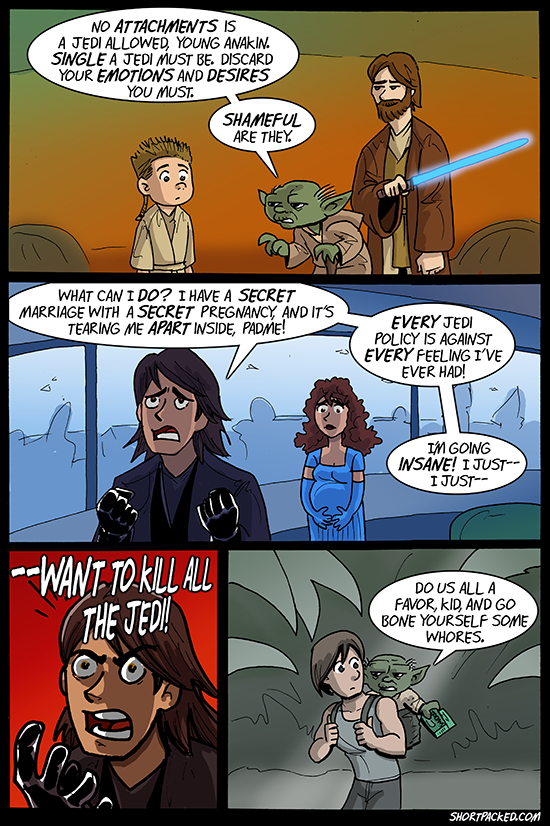
Now, take a look at the prequel Jedi. Just like in the original movies, they have pretty much zero insight into normal emotional experience. They forbid anyone to be in love, for example. And when it wreaks severe psychological havoc on Anakin, no one seems to understand or even be able to figure out what is going on -- even after Anakin goes to Yoda for advice on the matter.
Manchu wrote: They forbid anyone to be in love, for example. And when it wreaks severe psychological havoc on Anakin, no one seems to understand or even be able to figure out what is going on -- even after Anakin goes to Yoda for advice on the matter.
Here's David Willis saying the same thing in his own way.
Luke falls into his trap in Empire, rather than intentionally wanting to confront him, when he goes off to save his friends. Vader doesn't present any good in that encounter, he wants the Galaxy for himself and for Luke to join him.
Emotions/feelings aren't really taboo in the original trilogy. Yoda warns Luke of them when he hastily shoots off to Cloud City and says that it is a trap set by Vader, which he is correct about. Obi Wan says to Luke that his feelings "do him credit, but they could be made to serve the Emperor", which he is proved right on until he regains his composure. He subsequently looses control again when provoked by Vader.
Before he hands himself in to Vader on Endor he resolves not to kill Vader because he is his "father" and that he senses "good" in him. Vader does redeem himself and there was good in him but from Obi Wan and Yoda's perspectives they see somebody who betrayed them, hunted the Jedi to near extinction and helped in placing the Galaxy directly beneath the Emperor's boot heel. Luke is still grappling with the force as well as the revelation of his hidden past; they would be wise to doubt his feelings on the matter. Luke growing up not knowing his parents might have influenced him to see good aspects that aren't there. Resisting killing Vader only came with the realisation of what the Emperor was doing and from the experience in the Dagobah Cave and seeing his father's severed cybernetic hand. He fights Vader passionately because he cares about his friends and doesn't want them to come to harm, specifically Leia in that scene.
Luke being right in the end doesn't mean that Yoda or Obi Wan were moronic in their approach.
kronk wrote: Papaltine was granted emergency powers by the senate to end the conflict with the trade federation.
The Trade Federation? Wha? No, the emergency powers were granted to deal with the secessionist crisis. Exactly how the response of TOTAL WAR was justified is what's at issue ITT.
Meh. Trade federation, secessionists. Same thing. Papaltine created the crisis through Count Duku, then had newly named Darth Vader kill them on on Lava World after most of the jedi were killed and his power was solidified.
Manchu wrote: You mean Jedi and a Senator who had illegally infiltrated sovereign territory for the explicit purposes of espionage? And we know it's not illegal to manufacture or operate a huge droid army.
Even if caught in the act of espionage, you don't go about murdering agents of another government. You give them back, first because your own agents will want to be returned and not murdered when they are caught, and second because that kind of thing often leads to war.
And on the issue of making a robot army, we know there are situations in which it is legal to build robots, but we don't know that it is always legal to build your own droid army. It's entirely possible, plausible even, that you need permission to build your own army, and if you're caught making such an army without that permission, coupled with being in close contact with a cause that's arguing for secession, well that seems a pretty straight forward lead up to open war.
Exactly why they were investing vast sums of money in to a Droid army, and why the Jedi never questioned the Clone army they were just given (never mind that apparently you can order a Clone army on lay-by)... well who the hell knows.
Automatically Appended Next Post:
Manchu wrote: I decided to ask this question after watching an episode of the Clone Wars TV show. It's the one where Padme knows a Separatist senator and they try to work out a peace vote on both sides.
I thought to myself, okay, what would it take to achieve peace here? What would each side want? And then it hit me: if any one knows why this war is going on in the first place, no one has ever bothered to tell the audience. But given Padme's and the Separatist senator's actions in the show, it seems much more likely that no one in-universe has any clue, either.
Very true.
One of the oddest thing about the Star Wars prequels is that while the plotting and characters all play like right out of an old movie serial just like the original films, the background setting in the prequels is convoluted and hints at all kinds of complex background setting... entirely unlike the original trilogy, which had a perfectly simple good vs evil tale in the backgroun, with the only ambiguity being directly between the characters (Vader is villain, but also Luke's father etc).
It uh, obviously didn't work as well
Automatically Appended Next Post:
Sturmtruppen wrote: The Galactic Senate by the time of Phantom Menace is corrupt and full of bureaucrats running it. Palpatine organised the Naboo Blockade by antagonising the Trade Federation with tax laws in the Senate and goading the Federation as Sidious into launching their blockade and invasion on the premise that he would protect the Federation's interests in the Senate. Palpatine was made Chancellor by manipulating Amidala. Then the invasion was foiled and the Viceroy taken into custody.
Which was the first question I had, just reading the opening scrawl for the first movie. When you're annoyed about tax rates, why try and resolve that by placing an embargo on some random planet? You want to force tax concessions, you park your warships around the capital of the people putting the taxes in place.
Automatically Appended Next Post:
Manchu wrote: Now, take a look at the prequel Jedi. Just like in the original movies, they have pretty much zero insight into normal emotional experience. They forbid anyone to be in love, for example. And when it wreaks severe psychological havoc on Anakin, no one seems to understand or even be able to figure out what is going on -- even after Anakin goes to Yoda for advice on the matter.
Yeah, that was actually one of the parts of the prequels I liked, that the Jedi and their teaching was flawed, and played a large part in their downfall.
That said, it did lead me to wonder how if Jedi were banned from having relationships, exactly where all those great Jedi family came from.
I wouldn't argue that it is ethical or even prudential to execute captured spies but it's certainly plausible. It's something that spies and spy masters understand is a likely outcome of getting caught. And executing captured spies, much less their prospective execution, hardly supplies the state employing said spies with a justification for war. So none of that can form a legal basis for the Republic's invasion of Geonosis.
About the droid army thing, it's my mistake to have started talking about it as a matter of legality. Whether setting up a droid army under whatever circumstances might be illegal as far as the Republic is concerned is totally immaterial to the Republic declaring war on the Confederacy absent some arms limitation treaty between the parties. Even if such a treaty existed (and we have no reason to believe it did), the Republic would necessarily have violated it by having capacity to invade Geonosis. So that doesn't help us, either.
It seems the answer is something vague about terrorism. But that just raises other unanswered questions. At the beginning of Attack of the Clones we see an alleged act of Separatists terrorism when Senator Amidala's ship is blown up. But wait, isn't Amidala leading the charge against the Military Creation Act? Why would the Separatists target her? Wouldn't it be far more likely that Senator Amidala had been targeted by other senators who supported the bill? Again, we have another strand of Palpatine's plot that could be entirely unraveled by the briefest application of thought.
The more I think about it, the more convinced I am that the galaxy deserved the Empire. And given Bail Organa was the opposition leader, it's only fitting that Alderaan got blown up. If there was anyone with two brain cells to rub together on that planet, no one was electing them to the Senate.
Did the Empire even do anything evil in the films? I don't recall them doing anything out of the ordinary.
Sure, they blew up Alderaan. That was 1 planet, comparable to a single country or nation in a galaxy wide Empire.
Earth's Empires did much worse than that. Compared to the Romans and Conquistadors, The Galactic Empire was quite tame, imo.
CthuluIsSpy wrote: Did the Empire even do anything evil in the films? I don't recall them doing anything out of the ordinary.
Just from Episode IV
They tortured a diplomat with the ITO droid.
They performed an illegal search and seizure on Tantiv IV at the beginning of the movie, shooting a bazillion "body guards" that were lawfully "standing their ground" in the process.
They illegally detained a diplomat.
They performed another illegal search and seizure at the Uncle Owen and Aunt Beru compound on Tatooine.
They recklessly fired at a fleeing spaceship at Mos Eisly Spaceport without regard to the safety of unarmed citizens in the area.
They suspended a lawfully appointed congressional body (The Imperial Senate) without regards to the rights of the citizens.
They placed an illegal tracking device without an official warrant on a private citizen's spaceship.
The first thing to realize about the Empire is that it is not a government. It has no interest in governing anything. It just extorts resources out of the galaxy to perpetuate that selfsame extortion. That's why the Empire murders ~2 billion people at a stroke in A New Hope. If that doesn't strike you as evil, then I'm not sure we can have a meaningful conversation about evil.
What Manchu said. I've always found the "Empire wasn't evil at all. The Rebels were terrorists!" crowd perplexingly odd. The Rebel Alliance didn't blow up a planet and kill billions of people, hold an entire city hostage, or attempt genocide against space teddy bears.
CthuluIsSpy wrote: Did the Empire even do anything evil in the films? I don't recall them doing anything out of the ordinary.
Just from Episode IV
They tortured a diplomat with the ITO droid.
They performed an illegal search and seizure on Tantiv IV at the beginning of the movie, shooting a bazillion "body guards" that were lawfully "standing their ground" in the process.
They illegally detained a diplomat.
They performed another illegal search and seizure at the Uncle Owen and Aunt Beru compound on Tatooine.
They recklessly fired at a fleeing spaceship at Mos Eisly Spaceport without regard to the safety of unarmed citizens in the area.
They suspended a lawfully appointed congressional body (The Imperial Senate) without regards to the rights of the citizens.
They placed an illegal tracking device without an official warrant on a private citizen's spaceship.
In the original trilogy we don't see any signs of possible sympathy from within the Empire's ranks. Not a hint of perhaps "these guys are just following orders", certainly from the officers anyway.
They do their duty without hesitation and seem fine with it... when Vader isn't killing them.
This is my favourite choking. "He is as clumsy as he is stupid."
LordofHats wrote: I've always found the "Empire wasn't evil at all. The Rebels were terrorists!" crowd perplexingly odd.
My favorite are the folks who understand and concede that the Empire itself is bad but argue ad nauseum about how there are good Imperials. Grand Admiral Mary Sue Thrawn is a perfect example of the blinkered Noble Nazi fantasy. Soontir Fel is another one; a guy who defected from the Empire because, to quote Wookiepedia, he was "tired of the growing corruption after Palpatine's death." [my emphasis] LOLWUT. And of course he hopped back on the Imperial side after Thrawn showed him the Truth About What Must Be Done. EU is about 90% gak and a good portion of that comes down to justifying fascism.
Medium of Death wrote: In the original trilogy we don't see any signs of possible sympathy from within the Empire's ranks. Not a hint of perhaps "these guys are just following orders", certainly from the officers anyway.
They do their duty without hesitation and seem fine with it... when Vader isn't killing them.
This is my favourite choking. "He is as clumsy as he is stupid."
Heh, well there's your answer. They killed all the guys who hesitated.
Very Roman legion. Who coincidentally, weren't all that pleasant either.
Aren't the Stormtroopers clones though? I keep running into conflicting sources when it comes to them.
One source says their conscripts, others say they are remnants of the old clone army.
LordofHats wrote: I've always found the "Empire wasn't evil at all. The Rebels were terrorists!" crowd perplexingly odd.
My favorite are the folks who understand and concede that the Empire itself is bad but argue ad nauseum about how there are good Imperials. Grand Admiral Mary Sue Thrawn is a perfect example of the blinkered Noble Nazi fantasy. Soontir Fel is another one; a guy who defected from the Empire because, to quote Wookiepedia, he was "tired of the growing corruption after Palpatine's death." [my emphasis] LOLWUT. And of course he hopped back on the Imperial side after Thrawn showed him the Truth About What Must Be Done. EU is about 90% gak and a good portion of that comes down to justifying fascism.
Yeah, Thrawn was a dick.
I mean, the guy was exiled from his race for being aggressive. How is that a good thing?
Aren't the Stormtroopers clones though? I keep running into conflicting sources when it comes to them.
In the original trilogy its never stated if Imperial Troopers are or are not clones. In the EU, many Storm Troopers are clones from the Clone Wars and after, but the ranks are also open to all humans but very few aliens. The Fett Clones were phased out following the rebellion on Kamino where a clone army was raised to oppose the Empire. Only the 501st remained 'pure' Fett Clones.
Decreasingly so, after the formation of the Empire. The rationalization goes that clones are too expensive. They are actually really good, effective soldiers but the Empire doesn't really need good, effective soldiers because all it needs to do is bully the very few people who are not themselves corrupted by the Empire.
So by ANH, storm troopers are pretty much just mall cops minus a few special formations like Vader's 501st.
Decreasingly so, after the formation of the Empire. The rationalization goes that clones are too expensive. They are actually really good, effective soldiers but the Empire doesn't really need good, effective soldiers because all it needs to do is bully the very few people who are not themselves corrupted by the Empire.
So by ANH, storm troopers are pretty much just mall cops minus a few special formations like Vader's 501st.
Also in Episode II the Cloner stated the clones are age-accelerated which would mean they would be dying of old age by ANH/ESB
Decreasingly so, after the formation of the Empire. The rationalization goes that clones are too expensive. They are actually really good, effective soldiers but the Empire doesn't really need good, effective soldiers because all it needs to do is bully the very few people who are not themselves corrupted by the Empire.
So by ANH, storm troopers are pretty much just mall cops minus a few special formations like Vader's 501st.
Also in Episode II the Cloner stated the clones are age-accelerated which would mean they would be dying of old age by ANH/ESB
I always thought he just meant that was until adult hood. It seems silly that elite soldiers would be given such short life spans, especially when they are meant to fight in a galaxy wide war.
Manchu wrote: I dunno if they consistently age at an accelerated rate throughout their life spans or if the acceleration is just until a certain point.
Many clones from the Clone Wars era were still serving in the Post-Palpatine Empire, so presumably the acceleration stops.
Manchu wrote: I dunno if they consistently age at an accelerated rate throughout their life spans or if the acceleration is just until a certain point.
In the EU (The Dark Fleet Trilogy, specifically), Luke got a weird vibe from the few clones he ran across. Zahn makes a point of showing that the clones are different enough for Luke to be able to tell. To that end, if clones were still around from the Clone Wars and serving as Stormtroopers, Luke didn't encounter them until that point.
Of course, that's just EU propaganda and so forth.
Also, the Empire (whether under Thrawn or the Emperor), is a bunch of evil gets. Arguments to the contrary are dumb.
I think Joruus's clones were a completely different batch, however.
EDIT: Yep, those were Spaarti clones (one year to maturity; even less using ysalamiri) rather than Kaminoan clones (ten years to maturity). The Spaarti method was known to result in insane clones. So that might have been what Luke detected. The modifications Thrawn introduced, cloning under disconnection to the Force, may also have imprinted those clones such that they felt off to Luke.
Also, it appears the Empire filled out at least part of its storm trooper ranks with Spaarti-method Fett clones who were given next to no training compared with Kaminoan GAR Fett clones. So that helps to explain their mall copishness,
FirePainter wrote:Also why is it named the clone wars? All wars in our own history are named for the years they were fought, the location they were fought, or maybe the reason they were fought. Wars are not named for the weapons used in them. We don't call World War 1 the mustard gas war. So why call it the clone wars the clones weren't fighting each other?
WHY WHY I SAY?
IIRC the war was originally going to concern illegal cloning and clones weren't simply weapons, but the very reason the war was fought. The name was catchy and Lucas chose to keep it.
Harriticus wrote:Star Wars internal politics rarely make much sense. EU invariably ends up making it more complicated.
Assuming more complicated means flying rodent gak idiotic.
Seaward wrote:I find Star Wars only remains enjoyable if you ignore all but the original trilogy and anything Bioware/Obsidian put out.
It's even better if you pretend only A New Hope, The Empire Strikes Back, and The Sith Lords exist. Lucas' decision to replace Wookies with Ewoks marked the beginning of the end for quality Star Wars. Knights of the Old Republic is fun, but honestly, that game is not groundbreaking by any means. The story is the same cut and paste cheesefest that has appeared repeatedly in the EU since day one. Darth Malak is a one-dimensional antagonist and instantly forgettable. The game is massively over rated by those that think a plot twist reveal is somehow amazing writing.
Manchu wrote:The first thing to realize about the Empire is that it is not a government. It has no interest in governing anything. It just extorts resources out of the galaxy to perpetuate that selfsame extortion. That's why the Empire murders ~2 billion people at a stroke in A New Hope. If that doesn't strike you as evil, then I'm not sure we can have a meaningful conversation about evil.
Two billion people in an Empire of one thousand plus planets is pretty insignificant. The galactic population is in the quadrillions and the Galactic Empire rules over a populace numbering in the trillions. Losing a single planet is a minor event. Evil yes, but I think in terms of scale there have been comparable atrocities committed on Earth.
Manchu wrote:I think Joruus's clones were a completely different batch, however.
EDIT: Yep, those were Spaarti clones (one year to maturity; even less using ysalamiri) rather than Kaminoan clones (ten years to maturity). The Spaarti method was known to result in insane clones. So that might have been what Luke detected. The modifications Thrawn introduced, cloning under disconnection to the Force, may also have imprinted those clones such that they felt off to Luke.
Also, it appears the Empire filled out at least part of its storm trooper ranks with Spaarti-method Fett clones who were given next to no training compared with Kaminoan GAR Fett clones. So that helps to explain their mall copishness,
Different levels of canon. The EU is most likely going to be retconned when Episode VII is released. The explanation for Stormtroopers being mediocre soldiers is simple and doesn't require the explanation of them being inferior clones. It is simply plot armor.
Manchu wrote:The first thing to realize about the Empire is that it is not a government. It has no interest in governing anything. It just extorts resources out of the galaxy to perpetuate that selfsame extortion. That's why the Empire murders ~2 billion people at a stroke in A New Hope. If that doesn't strike you as evil, then I'm not sure we can have a meaningful conversation about evil.
Two billion people in an Empire of one thousand plus planets is pretty insignificant. The galactic population is in the quadrillions and the Galactic Empire rules over a populace numbering in the trillions. Losing a single planet is a minor event. Evil yes, but I think in terms of scale there have been comparable atrocities committed on Earth.
That's what I've was getting at. If you factor in scale, the destruction of a planet in Star Wars is comparable to the Roman Empire brutally putting down some revolt in a city. It's still horrific, but the sad truth is that's how empires operate. However, considering how the Galactic Empire isn't really an Empire but some guy's play pen, that comparison may not entirely be accurate.
That said, it did lead me to wonder how if Jedi were banned from having relationships, exactly where all those great Jedi family came from.
That's another thing I forgot to bring up earlier... In the prequels, we are told that the Jedi do not have relationships and families. Not everyone in Star Wars is Force Sensitive. Force Sensitivity is tied to biology (somehow... whether or not you accept Lucas' plagiarized Parasite Eve explanation) and the Jedi are being cut off from biological reproduction. The EU indicates that children with Force potential are taken from their families (this is how the Jedi replace their numbers) for training at a very young age. That means that a) Force Sensitivity is a recessive trait (instead of a dominant one) and b) both parents must have the trait before it can express itself in an offspring. If all of the people with the expressed trait pull themselves from the gene pool and don't reproduce, and the Force Sensitive trait is a recessive one, wouldn't the Force Sensitive gene eventually breed itself out of existence?
My understanding of biology is a little rusty, but wouldn't that sort of thing eventually happen? Wouldn't Force Sensitive births become less and less common? Sure, it would take time, but we are talking about an institution that has existed for 20,000 years. That's enough time for some kind of strain to show, right?
That said, it did lead me to wonder how if Jedi were banned from having relationships, exactly where all those great Jedi family came from.
That's another thing I forgot to bring up earlier... In the prequels, we are told that the Jedi do not have relationships and families. Not everyone in Star Wars is Force Sensitive. Force Sensitivity is tied to biology (somehow... whether or not you accept Lucas' plagiarized Parasite Eve explanation) and the Jedi are being cut off from biological reproduction. The EU indicates that children with Force potential are taken from their families (this is how the Jedi replace their numbers) for training at a very young age. That means that a) Force Sensitivity is a recessive trait (instead of a dominant one) and b) both parents must have the trait before it can express itself in an offspring. If all of the people with the expressed trait pull themselves from the gene pool and don't reproduce, and the Force Sensitive trait is a recessive one, wouldn't the Force Sensitive gene eventually breed itself out of existence?
My understanding of biology is a little rusty, but wouldn't that sort of thing eventually happen? Wouldn't Force Sensitive births become less and less common? Sure, it would take time, but we are talking about an institution that has existed for 20,000 years. That's enough time for some kind of strain to show, right?
Yes. Which is why linking the Force to biology was idiotic. It should have stayed a mystical, monk-like sort of thing.
It was pretty much laid out in ANH that the Empire didn't really care about actually governing much of anything:
Tarkin: The Imperial Senate will no longer be of any concern to us. I have just received word that the Emperor has dissolved the council permanently. The last remnants of the Old Republic have been swept away forever.
Tagge: But that's impossible! How will the Emperor maintain control without the bureaucracy?
Tarkin: The regional governors now have direct control over their territories. Fear will keep the local systems in line. Fear of this battle station.
So the crime syndicate line of thought really seems to apply. As long as the regional governors don't actively oppose the Emperor, they are pretty much free to govern their systems however they want.
That said, it did lead me to wonder how if Jedi were banned from having relationships, exactly where all those great Jedi family came from.
That's another thing I forgot to bring up earlier... In the prequels, we are told that the Jedi do not have relationships and families. Not everyone in Star Wars is Force Sensitive. Force Sensitivity is tied to biology (somehow... whether or not you accept Lucas' plagiarized Parasite Eve explanation) and the Jedi are being cut off from biological reproduction. The EU indicates that children with Force potential are taken from their families (this is how the Jedi replace their numbers) for training at a very young age. That means that a) Force Sensitivity is a recessive trait (instead of a dominant one) and b) both parents must have the trait before it can express itself in an offspring. If all of the people with the expressed trait pull themselves from the gene pool and don't reproduce, and the Force Sensitive trait is a recessive one, wouldn't the Force Sensitive gene eventually breed itself out of existence?
My understanding of biology is a little rusty, but wouldn't that sort of thing eventually happen? Wouldn't Force Sensitive births become less and less common? Sure, it would take time, but we are talking about an institution that has existed for 20,000 years. That's enough time for some kind of strain to show, right?
Lucas has failed to clarify is Force-Sensitive relationships occurred prior to the events of TPM. Within the EU Force-Sensitive relationships were relatively common at certain periods in time. It is also heavily implied and at times outright stated that the Jedi have been on a constant decline for the past several thousand years. The EU implies that the Jedi of the Old Republic (1000+ years prior to the events of TPM) were much greater in number and individually stronger than those that appear in the films.
Manchu wrote: I wouldn't argue that it is ethical or even prudential to execute captured spies but it's certainly plausible. It's something that spies and spy masters understand is a likely outcome of getting caught. And executing captured spies, much less their prospective execution, hardly supplies the state employing said spies with a justification for war. So none of that can form a legal basis for the Republic's invasion of Geonosis.
At some points in history then execution of spies was accepted, and even standard practice. At other times, such as the Cold War, spies were simply ordered to leave the country. We have no idea what was standard at that point in Star Wars history, so we really can't say whether execution was accepted or not.
About the droid army thing, it's my mistake to have started talking about it as a matter of legality. Whether setting up a droid army under whatever circumstances might be illegal as far as the Republic is concerned is totally immaterial to the Republic declaring war on the Confederacy absent some arms limitation treaty between the parties. Even if such a treaty existed (and we have no reason to believe it did), the Republic would necessarily have violated it by having capacity to invade Geonosis. So that doesn't help us, either.
But the Republic didn't recognise the Confederation as a seperate political body. To the Republic, they were just a bunch of worlds that were pressing a claim for secession, and so they would have still been expected to abide by whatever droid army manufacturing laws the Republic had.
At least, I always assumed that was the case, maybe there'd been some formal seperation between the movies that Lucas didn't bother to tell the audience about.
Automatically Appended Next Post:
CthuluIsSpy wrote: Did the Empire even do anything evil in the films? I don't recall them doing anything out of the ordinary.
Sure, they blew up Alderaan. That was 1 planet, comparable to a single country or nation in a galaxy wide Empire.
So compare the blowing up of that planet with the blowing up of a single country here on Earth... blowing up a whole country because it is believed that the planet may be harbouring a rebel force would be pretty damn evil.
Lucas has failed to clarify is Force-Sensitive relationships occurred prior to the events of TPM. Within the EU Force-Sensitive relationships were relatively common at certain periods in time. It is also heavily implied and at times outright stated that the Jedi have been on a constant decline for the past several thousand years. The EU implies that the Jedi of the Old Republic (1000+ years prior to the events of TPM) were much greater in number and individually stronger than those that appear in the films.
When debating Star Wars movies, I try to stick to evidence and facts shown on the screen. Lucas does not get a pass because other, better writers come after him and try to sort his gak out (and even then, most don't succeed).
But if we are going to use the EU as a source, It should go on record that SWTOR has the Jedi of 4000 years before ANH not having emotions or relationships. In fact, encouraging two people in love to have a relationship is a Dark Side choice in one quest...
Lucas has failed to clarify is Force-Sensitive relationships occurred prior to the events of TPM. Within the EU Force-Sensitive relationships were relatively common at certain periods in time. It is also heavily implied and at times outright stated that the Jedi have been on a constant decline for the past several thousand years. The EU implies that the Jedi of the Old Republic (1000+ years prior to the events of TPM) were much greater in number and individually stronger than those that appear in the films.
When debating Star Wars movies, I try to stick to evidence and facts shown on the screen. Lucas does not get a pass because other, better writers come after him and try to sort his gak out (and even then, most don't succeed).
But if we are going to use the EU as a source, It should go on record that SWTOR has the Jedi of 4000 years before ANH not having emotions or relationships. In fact, encouraging two people in love to have a relationship is a Dark Side choice in one quest...
And the Grandmaster of the Jedi Order is the ancestor of two Jedi...it was frowned upon, but it happened. A few hundred years before the events of KotOR Nomi Sunrider married Andur Sunrider, a prospective Jedi Knight.
Up to the Great Sith War, some Jedi did practice marriage and were known to have families of their own. There were even cases of families consisting entirely of Jedi, such as that of Andur Sunrider. The children of Jedi families were often gifted in the Force. Even later in the Order, such families existed—though the continuation of the line was through those family members who did not become Jedi. Famous Jedi families of the late Republic included the Koon family and the Diath family.
However, it appears that some Jedi might have been granted the right to marry, not as a special case, but as a norm. Several Corellian Jedi (Keiran Halcyon during the Old Republic, and Corran Horn in the time of the New Republic) were allowed to marry and raise children without repercussion. Whether this was due to an agreement between the Jedi and the planetary government—Corellia is known for its family-centric culture—or purely personal choices made against the Jedi Code is not known, except in the case of Nejaa Halcyon, who married his wife secretly without the approval of the Council. Corellian Jedi often had many other noticeable differences from the traditional Jedi ways, such as in clothing and a reluctance to take on missions outside of their home system.
trexmeyer wrote: It's even better if you pretend only A New Hope, The Empire Strikes Back, and The Sith Lords exist. Lucas' decision to replace Wookies with Ewoks marked the beginning of the end for quality Star Wars. Knights of the Old Republic is fun, but honestly, that game is not groundbreaking by any means. The story is the same cut and paste cheesefest that has appeared repeatedly in the EU since day one. Darth Malak is a one-dimensional antagonist and instantly forgettable. The game is massively over rated by those that think a plot twist reveal is somehow amazing writing.
I enjoy the original KotOR for giving us an era to play about in other than the five years or whatever it is of the original trilogy, which everybody else seemed to be trying to cram their stories into, even though the story itself may not be terribly original. KotOR II, on the other hand? I think it's the best Star Wars story told, largely because it deconstructs everything Lucas did.
Jedi positions on marriage shift on who is writing the timeline. Revan basically blackmailed the council to let him and Bastilla marry. Stelle on the other hand never married because the order didn't allow it. Though I suspect that given all the affairs in the EU, Jedi regularly engage in romantic relationships and just never marry as a general rule.
trexmeyer wrote: It's even better if you pretend only A New Hope, The Empire Strikes Back, and The Sith Lords exist. Lucas' decision to replace Wookies with Ewoks marked the beginning of the end for quality Star Wars. Knights of the Old Republic is fun, but honestly, that game is not groundbreaking by any means. The story is the same cut and paste cheesefest that has appeared repeatedly in the EU since day one. Darth Malak is a one-dimensional antagonist and instantly forgettable. The game is massively over rated by those that think a plot twist reveal is somehow amazing writing.
I enjoy the original KotOR for giving us an era to play about in other than the five years or whatever it is of the original trilogy, which everybody else seemed to be trying to cram their stories into, even though the story itself may not be terribly original. KotOR II, on the other hand? I think it's the best Star Wars story told, largely because it deconstructs everything Lucas did.
The Sith Lords is absolutely brilliant and a big middle finger to Lucas at the same time.
It was unfinished but there's a split in the fan base over the two games.
KotORII launched without being fully completed (at least as Obsidian planned). A fan patch was released that pulled a lot of the unfinished elements from the game code and put them into a playable format and of those who didn't like II and played that patch they mostly changed their minds (self included).
squidhills wrote: Really? I haven't played KotOR II, but I'd heard from fans of the first one that the second game seemed rushed and unfinished.
It definitely shipped unfinished (and Obsidian has quietly but convincingly blamed LucasArts for that), but even without the mod that restores everything Obsidian didn't have time to do, it's still a great game. It injects some much-needed ambiguity into the Force, the Jedi, the Sith...pretty much everything, really. I like that at least some of the writers for the Sith Warrior storyline in TOR seem to have picked up on that and used it, which is probably why SW is the only Force-using storyline in that game that I can stomach.
which is probably why SW is the only Force-using storyline in that game that I can stomach.
Well lets be honest. The two Jedi story lines, while serviceable, are dull as dirt. Compared to the awesome Imperial Agent and Sith Warrior stories, the others are just kind of mediocre. Okay for a play through, but mediocre.
LordofHats wrote: Jedi positions on marriage shift on who is writing the timeline. Revan basically blackmailed the council to let him and Bastilla marry. Stelle on the other hand never married because the order didn't allow it. Though I suspect that given all the affairs in the EU, Jedi regularly engage in romantic relationships and just never marry as a general rule.
I always figured that, at the time, it wasn't an actual rule. Just tradition that came out of the lifestyle not being favorable to romantic attachments, although that does fall apart when you consider Jedi+Jedi relationships.
So in the Old Republic, at least prior to the KOTR timeline, Jedi could have had families but it rarely happened and got phased out by the time the Prequels rolled around.
Now that I think of it, I can't think of any Jedi who were thrown out of the Order for, illicit relationships. They talk about it but I don't know that its ever happened in the EU to a character. All the Jedi who have relationships I know of, live in an order that allows it, kept it a secret, or blackmailed the masters into getting their way XD
Evil Lamp 6 wrote: It was pretty much laid out in ANH that the Empire didn't really care about actually governing much of anything:
Tarkin: The Imperial Senate will no longer be of any concern to us. I have just received word that the Emperor has dissolved the council permanently. The last remnants of the Old Republic have been swept away forever.
Tagge: But that's impossible! How will the Emperor maintain control without the bureaucracy?
Tarkin: The regional governors now have direct control over their territories. Fear will keep the local systems in line. Fear of this battle station.
So the crime syndicate line of thought really seems to apply. As long as the regional governors don't actively oppose the Emperor, they are pretty much free to govern their systems however they want.
Out of curiosity, how is the IoM considered to be an Empire then? Like the GE, it has a decentralized government where the rulers of each world are allowed to do their own thing, provided they pay taxes.
Is it because the IoM has a noticeable hierarchy and bureaucratic structure?
sebster wrote: They had written their own articles of secession, but the Republic still saw them as individual rebellious colonies.
On what basis? The Republic is a lot more like the UN than, for example, the US federal government. The Republic is seemingly completely uninvolved with the actual administration of any given system. Just take a look at Naboo. There is no Republic infrastructure reaching "downward"; just one senatorial delegation sent "upward." So I don't think the Republic has any claim on its member systems. It's more like its member systems have a claim on it. And if those systems decided to walk away ... well, it's not like they were ever actually colonies of the Republic in the first place. As I mentioned, there doesn't seem to be any legal basis to object to leaving the Republic.
I don't believe there is any actual legal reason that the Clone Wars was started. While I don't know whether this is actual canon I do recall people who have any sympathy for the CIS to be considered traitors. Being a "Separatist" seems to be a bad thing. So, it's possible that the reason the whole thing happened was that Palpatine and his government convinced everyone that the CIS was bad and that they should be destroyed using flimsy legal arguments and a hefty amount of propaganda. I do find it strange that the Jedi order went along with the whole thing without ever questioning the war but I guess that's Lucas for ya.
In addition to the Propaganda, the CIS committed several atrocities throughout the war which probably didn't help their case any. I don't think slavery and using native populations of a neutral war as test targets for your shiny new weapons isn't really the mark of a government that just wants to be free. Though, to be fair, the Republic used an entire army of slaves to defeat the droid army.
There's some handwavery about the Jedi foresight and vision being clouded by the Dark Side of the Force. The Jedi Order as a whole isn't exactly portrayed as having a great deal of common sense. They frequently border on Lawful Stupid and imo, occasionally take nice, long vacations in it.
Evil Lamp 6 wrote: It was pretty much laid out in ANH that the Empire didn't really care about actually governing much of anything:
Tarkin: The Imperial Senate will no longer be of any concern to us. I have just received word that the Emperor has dissolved the council permanently. The last remnants of the Old Republic have been swept away forever.
Tagge: But that's impossible! How will the Emperor maintain control without the bureaucracy?
Tarkin: The regional governors now have direct control over their territories. Fear will keep the local systems in line. Fear of this battle station.
So the crime syndicate line of thought really seems to apply. As long as the regional governors don't actively oppose the Emperor, they are pretty much free to govern their systems however they want.
Out of curiosity, how is the IoM considered to be an Empire then? Like the GE, it has a decentralized government where the rulers of each world are allowed to do their own thing, provided they pay taxes.
Is it because the IoM has a noticeable hierarchy and bureaucratic structure?
Pretty much. The IoM most certainly has its bureaucratic structure present on most worlds in some form or another. The IoM also has a greater presence on its worlds too.
Think back to ESB, Cloud City on Bespin didn't have any Imperial presence prior to Han, Leia & company showing up as tracked by Boba Fett. The Empire could give feth all care about how Bespin or Cloud City is actually governed and were only there to set a trap/capture Luke. Once the Emperor and Vader got what they came for, they were pretty much going to leave and business would continue as usual on Bespin.
Lando wrote:I've just made a deal that'll keep the Empire out of here forever.
The Empire never had, nor cared, for any real interest in Cloud City, as far as government control is concerned, except as a means to an end.
Vader wrote:Good. You know it would be unfortunate if I had to leave a garrison here.
Showing that there wasn't an Imperial garrison prior to the Empire's arrival, and most likely wouldn't be one after Vader and Co. left. Compare to the IoM where many worlds have some IoM presence whether in the Adeptus Ministorum or a PDF or actual IG garrison, or a SoB Convent or something.
Back to the OP's question though. Who would have the most to profit from the Clone Wars? I mean aside from Palpatine himself. Just as several prominent Separatist leaders were shown "plotting" on Geonosis, I can imagine several of the key players from the Republic getting together to discuss war plans and how best to profit from the conflict. I mean the Republic, or at least certain elements within it, should really want there to be a major war. Think of all the industries that would be involved in such an undertaking, that weren't part of the Separatists, that would actually benefit from the conflict. It is especially fortunate that the soldiers doing the actual fighting are conveniently supplied by clones so any of the workers involved in the industries of war would still be able to work without being subject to being drafted.
The IoM is certainly centralized. Everything that happens in the IoM is ultimately, if not practically, at the service of the Emperor and Holy Terra. The Galactic Empire is similarly centralized. But the IoM, unlike the Galactic Empire, actually does seem interested in governing as opposed to merely extorting resources.
Manchu wrote: The IoM is certainly centralized. Everything that happens in the IoM is ultimately, if not practically, at the service of the Emperor and Holy Terra. The Galactic Empire is similarly centralized. But the IoM, unlike the Galactic Empire, actually does seem interested in governing as opposed to merely extorting resources.
The EU, to some extent, offers a more plausible explanation for Palpatine's scheming.
It's long, so spoilers.
Spoiler:
My favorite Star Wars conspiracy is that the Emperor wasn't spending all those resources creating crazy superweapons like the Death Star and the Sun Crusher and putting together gigantic fleets of Star Destroyers wasn't to stop the Rebel Alliance, but rather in preparation of the Yuuzhan Vong Invasion that would happen about a quarter century after RoTJ ended.
Now the Emperor is a pretty smart guy. I mean, he got himself elected to Chancellor of the Republic, started a war, earned himself absolute control on both sides of the war, then managed to turn the galaxy against the guys who for a millennium had served as icons of peacekeeping, justice, and democracy. And that takes some serious strategizing! But here's the thing:
At this point, the Republic was falling apart, with or without a Sith-led Separatist movement to nudge them in the wrong direction. The senate was a clusterfeth where nothing ever got done. Corruption reigned supreme. Even the Jedi Council wasn't doing it's job properly. Ideally, Jedi are supposed to act as bastions of compassion and moderation. The way the Jedi would be tasked to deal with a situation is as a balancing influence between, say, two conflicting nation-states, or a particularly quarrelsome trade agreement. Everyone respected and would listen to a Jedi, and even without acting on behalf of the Republic, they should be able to arrive on a scene and be able to allow discussion and bureaucracy to flourish. Instead, the Jedi Council of the waning days of the Republic had grown inward and conservative, spending all their time meditating on the state of the galaxy and not enough time heading out there and fixing gak. This held throughout the war, when Jedi were surprisingly quick to jump to open combat as opposed to discussion.
In short, the Republic was completely and utterly unprepared for a real invasion, from a force that wasn't being controlled by a puppetmaster who was preventing either side from gaining an advantage until the moment was right. The kinds of fleets that were commonplace in the Empire would have been impossible for the Republic to even agree to create, let alone have the wherewithal to actually build. What Palpatine did was take a failing system and tear it out by the roots, replacing it with a brutally efficient, military-industrial focused society - one that could adequately prepare for an invasion of the scale of the Yuuzhan Vong were already beginning.
Second of all, if you think about it, creating a weapon that can destroy planets doesn't make a whole lot of sense when you're fighting a war against a well funded, but decentralized and scattered rebellion. The Rebel Alliance wasn't fighting a war of planets or borders or resources, they were fighting a war of attrition. What good is the ability to destroy a planet when your enemy doesn't even officially control any? The destruction of Alderaan, the only notable use of the Death Star, was a move made by Grand Moff Tarkin, whose Tarkin Doctrine, though it heavily influenced the way the Empire kept a tight grip on even the furthest systems, was not the ultimate purpose of the "ultimate weapon". Tarkin was convinced that the Death Star was his tool, one of intimidation and despotism, that he could use it to keep the Alliance, the biggest threat to his power, at bay. And we all know how that venture turned out.
No, the real purpose of the Death Star was to be able to fight a force that could completely terraform an entire planet into a gigantic, organic shipyard in a matter of months, and was backed by dozens of 100+ Kilometer across worldships. In fact, without the timely arrival of the seed of the original Yuuzhan Vong homeworld, Zonama Sekot, and a Jedi-influenced heretic cult that spurred a slave uprising, it's very unlikely that the denizens of the galaxy could have survived the war at all under the leadership of the New Republic. In fact, it's not really even fair to say that they "won" the war in any sense, with a sizable portion of the population of the galaxy eradicated, Coruscant, the former shining jewel at the heart of every major government for millennia, captured and terraformed beyond recognition, and the New Republic forced to reconstruct itself as the Galactic Alliance. Undoubtedly, for all it's flaws, the Empire could have hammered out a far less Pyrrhic victory over the Vong. And if Palpatine hadn't underestimated the abilities of both the rebellion he never considered a comparable threat, and one young Jedi, perhaps the galaxy could have avoided the deaths of uncountable sentients during the Yuuzhan Vong war years later.
TL;DR: The Emperor destroyed the Republic and built Death Stars to fight off an extragalactic invasion.
REPOST ADDENDUM: Since I didn't include this the first time around, there is ample evidence to suggest that Palpatine knew the Yuzhaan Vong were preparing an invasion. It's clearly outlined that the Chiss were aware of the Vong (Though perhaps not the threat they posed) at least as early as 27 years before the Battle of Yavin, along with Palpatine, who in Outbound Flight explains his purpose behind destroying the eponymous expedition was to prevent the discovery of an "immensely powerful and hostile alien empire" heavily hinted to be the Vong. So there you have it: Solid proof that Palpatine was aware of the Yuzhaan Vong as well as the threat they posed, 5 years before the Clone Wars even began (22 BBY).
And Yoda being in on it actually fits.
Unless you consider Yoda threw the fight deliberately, because it was his only way of setting the Empire in motion and allowing to prepare against the Vong without necessarily "changing sides". In which case, touche Yoda.
If this was the case, would he have still trained... wait... nevermind. If Yoda had his way, Luke would have stayed on Dagobah. The Allience would have fallen to the trap laid by the Emperor. The seed of the Jedi would have remained safe on an out-of-the-way swamp world, ready for when the war ended (doubly so if there was a female human down there on the planet somewhere), and the empire would have survived with its emperor.
Yoda and Obi-Wan weren't at all interested in overthrowing the emperor. They could have done so earlier on, what with Yoda's 900 years' life experience and the fething ghost of Qui-Gon able to serve as a very agile scout, not to mention Obi-Wan's abilities. They were only interested in preserving the Jedi through the war.
That theory would make sense, if Palaptine wasn't so overbearingly, moustache-twirling despotic.
I got more of "lets mess with the whole galaxy!" vibe than a "gotta prepare the galaxy before it gets invaded" vibe.
Or maybe he was turning senile. Channeling lightning through the finger tips tend to do that. That may explain why he didn't order his underlings to not waste the experimental world killers on rebel planets. Because the supposed enemy who you are building said world killers to fight against might just notice it.
Manchu wrote: On what basis? The Republic is a lot more like the UN than, for example, the US federal government. The Republic is seemingly completely uninvolved with the actual administration of any given system. Just take a look at Naboo. There is no Republic infrastructure reaching "downward"; just one senatorial delegation sent "upward." So I don't think the Republic has any claim on its member systems. It's more like its member systems have a claim on it. And if those systems decided to walk away ... well, it's not like they were ever actually colonies of the Republic in the first place. As I mentioned, there doesn't seem to be any legal basis to object to leaving the Republic.
Possibly. But we just don't know exactly what the formal process of becoming part of the Republic involves. I mean the exact operations of the Republic are almost entirely impossible to determine, and while Naboo and Tatooine seemed to get no protection or even Republic presence on the planet, we have no idea if that was true for more important or centrally located worlds. And we also have no idea what membership of the Republic actually entailed - a bloated, corrupt organisation could very well have offered membership terms that said 'we may or may not do anything useful for you, but understand you can't ever, ever leave the Republic'. Do we even know if planets were given a choice of entering the Republic or not, or if occupied planets were just put in the Republic, with no option of saying no?
What we do know is that when the Seperatists left, they formed articles of secession, and we also know that no-one seemed to claim the military response from the Republic was illegal, so while other facts lead us to sensibly conclude that planets and organisations ought to be able to come and go as they please, we have direct evidence in the film that that isn't true.
Ultimately, the whole thing just makes less and less sense the more you look at it. But then I think more than a few people on the internet have made that point in the last few years
Easily the stupidest part of the prequels is how none of the higher-ups gave a damn about the huge army that suddenly appeared on the Republic expenditure accounts. The actual meaning of the Clone Wars takes a backseat to that if you are looking at things logically.
Imagine if your country suddenly pulled thousands and thousand of troops out of their back pocket just in time for a war. Everyone would freak.
AegisGrimm wrote: Easily the stupidest part of the prequels is how none of the higher-ups gave a damn about the huge army that suddenly appeared on the Republic expenditure accounts.
There's nothing at all easy about determining the stupidest part of the prequels.
AegisGrimm wrote: Easily the stupidest part of the prequels is how none of the higher-ups gave a damn about the huge army that suddenly appeared on the Republic expenditure accounts.
There's nothing at all easy about determining the stupidest part of the prequels.
Thats because the whole Clone army was paid by Damask Holdings.
sebster wrote: we also know that no-one seemed to claim the military response from the Republic was illegal, so while other facts lead us to sensibly conclude that planets and organisations ought to be able to come and go as they please, we have direct evidence in the film that that isn't true
That's flat-out speculation; there is no direct evidence from any SW film that Separatist secession from the Republic was illegal or that no Separatists ever complained that the invasion of Geonosis was illegal. What we have in the movies is a tissue-thin justification formed by one assassination attempt on a Senator, perhaps (I can't quite remember) some throwaway line about this and other similar terrorist acts that Mace Windu directly says Count Dooku cannot be responsible for, and the prospective execution of the same Senator later, along with two Jedi, who were all caught in the act of espionage.
One minute, there is a standing diplomatic rift. The next minute, the Republic has a giant clone army and is invading Geonosis and starting a galactic war. No one bothers to explain why, except for that Palpatine secretly wanted to do it -- which can't very well be what he sold to the Senate. I can't believe that his emergency powers included "declare war with mysterious army for no reason."
Well I believe (and please feel free to correct me if I am wrong) that Lucas intended it be a heavy handed allusion to Bush's handling of the War on Terror. Palpatine promoted fear mongering and transformed the CIS into a boogeyman. After the fiasco on Naboo the remaining senators were more than happy to hand the reigns over to Palpatine and allow him to "protect them all." There is minimal information in the films concerning the history of the Galactic Republic, but in the EU it has been at relative peace for centuries. It won't take much to convince the corrupt Senators of a stagnant Republic that the Separatists represent a threat to their way of life.
trexmeyer wrote: Well I believe (and please feel free to correct me if I am wrong) that Lucas intended it be a heavy handed allusion to Bush's handling of the War on Terror. Palpatine promoted fear mongering and transformed the CIS into a boogeyman. After the fiasco on Naboo the remaining senators were more than happy to hand the reigns over to Palpatine and allow him to "protect them all." There is minimal information in the films concerning the history of the Galactic Republic, but in the EU it has been at relative peace for centuries. It won't take much to convince the corrupt Senators of a stagnant Republic that the Separatists represent a threat to their way of life.
This was my interpretation as well. Palpatine's big speech and Padmae's "This is how freedom dies" quote were very reminiscent of reactions fot the PATRIOT Act passed by Bush for the safety and security of the nation. I find it hard to take as anything other than a direct allusion not just to the War on Terror but Post 9/11 US Politics.
Manchu wrote: I think Joruus's clones were a completely different batch, however.
EDIT: Yep, those were Spaarti clones (one year to maturity; even less using ysalamiri) rather than Kaminoan clones (ten years to maturity). The Spaarti method was known to result in insane clones. So that might have been what Luke detected. The modifications Thrawn introduced, cloning under disconnection to the Force, may also have imprinted those clones such that they felt off to Luke.
Also, it appears the Empire filled out at least part of its storm trooper ranks with Spaarti-method Fett clones who were given next to no training compared with Kaminoan GAR Fett clones. So that helps to explain their mall copishness,
Spaarti clones vs. Kaminoan clones is one way of making them different. Sounds a little hand-wavy, though. It just seems odd that at no point the storm troopers in Episodes 4-6 were ever referred to as clones (Spaarti or Kaminoan), even by Han who went through training as an Imperial Officer.
Manchu wrote: The IoM is certainly centralized. Everything that happens in the IoM is ultimately, if not practically, at the service of the Emperor and Holy Terra. The Galactic Empire is similarly centralized. But the IoM, unlike the Galactic Empire, actually does seem interested in governing as opposed to merely extorting resources.
I don't know about that. All the IoM cares about is their Tithe. As long as they get that they really don't care.
Anyway, I seem to remember in KOTOR the explained the Old Republic was merely a loose trade block that had agreed to use a common currency so ya, don't see the big deal about succeeding from that. Would be like Ireland leaving the EU.
@Kronk: As trexmeyer mentioned, all of this is ex post facto rationalization and re-rationalization. By ANH, the storm trooper legions were made up of Kaminoan clones, Spaarti clones, and regular humans. Kaminoan Clone War vets were generally the best soldiers. I recently read in one of the Saga edition source books that their accelerated aging continued throughout their lives, essentially bleeding them out of active service, but I think someone else posted here that this is contradicted elsewhere in the EU.
@KC: The IoM cares about more than the tithe; every Imperial world is a potential front in a daemonic incursion (among other problems) if it is not governed correctly.
I might be remembering it wrong as I haven't done much in the EU in a long time. A quick look over at Wookiepedia doesn't have any references I can find to Republic era clones serving at the time of A New Hope. Boba is still alive but he was not modified like the others.
LordofHats wrote: A quick look over at Wookiepedia doesn't have any references I can find to Republic era clones serving at the time of A New Hope.
Ever heard of the 501st?
As to the other issues, my source is the aforementioned Saga edition source book (I cannot remember which: Force Unleashed? Galaxy At War?), which mentions Clone Wars vets serving during the Dark Times but rapidly aging out of service fitness.
Yeah. I know Vader kept them as Fett clones up until the fall of the Empire, but were there any who served in the Clone Wars?
In Battlefront 2 there was a Veteran that kept a journal of his actions from Geonosis to Hoth so we can assume that some did. Unless, of course, he died somewhere along the way and a new clone took up filling out the journal. I am not sure when they went out of active service but, at least this individual, seems to have retired after or shortly after the Battle of Hoth.
Seriously? I loved the campaign. Mostly because of Temuela Morrison's awesomesauce narration of the whole thing. That man can make anything sound badass.
More on topic, maybe the reason the senate never raised an eyebrow initially at the Clone Wars is that Palpatine spread a metric gak ton of propaganda that made the Clone Wars sound like this big important thing that you should support right after Geonosis. Patriotic fervor can be one of hell of a drug. However... I have no evidence that he did this.
I spent all my time in that game playing the Conquest game mode and multi-player XD.
I always assumed the Clone Wars was a mix of corruption, fear, and a little stupidity. Palpatine manipulated everything. In the films we're just to assume he convinced everyone he was right. The EU expands on it better... Somewhat.
There is no satisfying answer. It is one of many plot holes and inconsistencies. The only decent aspect of the prequels was the lightsaber battles, and even those are pretty terrible if you try and look at them as dudemen actually trying to kill each other, rather than doing an elaborate dance.
They even screwed up the space battles, which is particularly unforgivable.
Seaward wrote: The only decent aspect of the prequels was the lightsaber battles, and even those are pretty terrible if you try and look at them as dudemen actually trying to kill each other, rather than doing an elaborate dance.
I'm glad you mentioned this. For all of their visual flair, I found the lightsaber duels in Ep 1 and 2 (I skipped 3 entirely) to be very boring. I can't even remember much about the duel in Ep 1 (Maul has a double-bladed saber, but that was in all the trailers... somebody gets kicked in the chest I think) due to sheer disinterest. I have an equally hard time remembering the saber fights in Ep 2, but that is due more to the blind, foaming rage that overtakes me whenever I think of Yoda fighting anyone (especially Count Dracula) with a lightsaber. Why is it that the technically unimpressive saber duels in the OT have so much more emotion and power behind them?
Yes, it is, just as your claim that there is nothing more than a diplomatic stand off in place is speculation. Because all we have to work with is speculation, because the actual machinations of the secession are almost entirely unknown (as Lucas preferred to spend screen time on stupidly long action sequences through Coruscant and some nonsense in a robot factory).
But my speculation is based on what actually happened in the film - the invasion happened, and no-one said this was an out of the blue escalation or illegal. And so without any evidence otherwise, the most sensible thing is to conclude that the unknown background somehow justified the events we saw on screen.
To clarify, the issue with the Clone War is not that it contradicts itself, but that so little of the important elements of its build up actually happened on screen, so we are simply left to guess.
Well, seeing as how we're talking about a sci fi movie rather than a palantir-like window into some alternative history, the burden of explaining what is going on in the story is on the story tellers. When it comes to why the Clone Wars is happening, the story tellers (not just George Lucas) fail miserably. Put another way, the absence of evidence regarding the purely speculative notion that secession from the Republic is illegal is really not like the absence of evidence regarding a central part of the story -- the cause and justification for the definitive conflict.
Manchu wrote: Put another way, the absence of evidence regarding the purely speculative notion that secession from the Republic is illegal is really not like the absence of evidence regarding a central part of the story -- the cause and justification for the definitive conflict.
They are the same, because they are flip sides of the same question. One is speculation that the actions of the CIS were illegal in some way that justified war, the other is speculation that the actions of the CIS were not illegal in some way that justified war. Both have loose evidence (the former can be deduced from the fact that no-one said the attack on Geonosis was illegal or acted in any way that assumed the war was illegal), while the latter can be deduced from the fact that prior to Geonosis no-one appeared to acting like there was anything like a state of war.
And both sides of that speculation are really just dancing around the actual problem - that a key part of the story is simply not told. We should not be left to speculate as to why one of the key events in the fall of the Republic happened.
Seaward wrote: The only decent aspect of the prequels was the lightsaber battles, and even those are pretty terrible if you try and look at them as dudemen actually trying to kill each other, rather than doing an elaborate dance.
I'm glad you mentioned this. For all of their visual flair, I found the lightsaber duels in Ep 1 and 2 (I skipped 3 entirely) to be very boring. I can't even remember much about the duel in Ep 1 (Maul has a double-bladed saber, but that was in all the trailers... somebody gets kicked in the chest I think) due to sheer disinterest. I have an equally hard time remembering the saber fights in Ep 2, but that is due more to the blind, foaming rage that overtakes me whenever I think of Yoda fighting anyone (especially Count Dracula) with a lightsaber. Why is it that the technically unimpressive saber duels in the OT have so much more emotion and power behind them?
Because the one you think of best: (Vader vs. Luke in ESB) was directed by someone else, and its done like Luke is trying to cut Vader in half, or later, like he's trying not to die.
I will admit I liked the Darth Maul fight, up to Liam Neeson's death (then it becomes stupid). I'd make it #3 behind the above and then Vader / Alec Guinness. The SW duel is not actually very good, but the acting is excellent and the buildup, perfection. Plus the conversation in fight is bandido level macho.
Not at all. One of them, the explanation of why the war started, is necessary to the story. The other is just one of a thousand possible rationalizations for it. "Secession is illegal" is equivalent to "the senate is run by cyborg flamingos who don't ask questions."
Had a look at the title reel of Attack of the Clones to see if this issue became any clearer. If anything it just makes the Republic look bad and the Jedi like brutal enforcers.
I think we are meant to infer that the separatists are somehow violent or want to overthrow the Republic. Not really sure what the point would be as you pointed out that they don't really do anything. We do know that they have a Universal Monetary system so perhaps that has something to...
Oh feth it. The prequels are a disgrace and it just hurts thinking about them.
For anybody who hasn't seen these I recommend them.
Not at all. One of them, the explanation of why the war started, is necessary to the story. The other is just one of a thousand possible rationalizations for it. "Secession is illegal" is equivalent to "the senate is run by cyborg flamingos who don't ask questions."
If you think 'the reason why the war happened' is distinct from 'the reason why characters we are supposed to believe are good went to war' then okay, you do that.
KamikazeCanuck wrote: Why isn't succession itself not a good enough reason? Was good enough for Lincoln.
In the interest of fairness and accuracy, I feel I should point out that the South started the war. The Confederacy shelled a United States military base (Fort Sumpter). The response from Lincoln was war. Now, some may say that Lincoln wanted to go to war, and the South just handed him the excuse he needed to do it, but the fact remains. The South fired first.
Succession probably is a good enough reason. But it doesn't hurt when the other side is the initial aggressor.
If the South had not fired on the Fort, hostilities probably would have been staved off a little longer. There was a climate of negotiation in Congress prior to that event, but after it it was political suicide to suggest negotiating with the South.
Armed conflict was inevitable, but the timing of when it happened would have been different.
Don't want to get too sidetracked here with real history here but who shot first is faily irrelevant to my point. The point is the war was fought over succession.
Even setting aside the strange notion that faulty (or even accurate) conceptions of American history tell us anything about Star Wars, the movies provide no reason to believe that secession is a good enough reason to declare war. As mentioned earlier, the infrastructure of the Republic does not (necessarily) reach down to the system level. Put it another way, there is no evidence that the Republic is itself a sovereign polity or just a club for sovereigns. In fact, I'd argue that's potentially a significant point of tension surrounding the Military Creation Act.
Manchu wrote: Of course there is a difference between why a war is declared and why the soldiers and officers who fight in it do so.
Is there any suggestion that the main characters are following the path to war for any reasons other than the reasons for that war? No, in fact it is the main characters who initiate most of the actions that leads the Republic in to war. Trying to distinguish the reasons the Republic ended up in war from the reasons the Jedi ended up in war is not a thing.
All of which is just a pointless aside. You still think that you can see a series of events take place that led to war breaking out, observe that the film didn't spell out exactly why all that led to war, and conclude that therefore there shouldn't have been a war and think it's strange that there's no protest or complaint about that war.
But when it is suggested that given there was no protest or complaint, well then it is just as easy to conclude there must have been some background condition that justified that war and move on... you dismiss that as speculation.
What you continue to miss is that 'no reason is presented clearly therefore it was illegal' is just as speculative as 'no reason was presented clearly but there probably was one'. The problem of the prequels is not that we can speculate that the war was illegal... the actual problem is that we are left to speculate at all about the causes of the war. It is information that should have been presented clearly.
KamikazeCanuck wrote: Don't want to get too sidetracked here with real history here but who shot first is faily irrelevant to my point. The point is the war was fought over succession.
Secession guys, is secession, or as we call it here, the War of Northern Aggression. And yes, I'm one of those guys with family on both sides, even found the restign place of one at Shiloh.
Grey Templar wrote:Succession probably is a good enough reason.
KamikazeCanuck wrote:The point is the war was fought over succession.
I know you guys meant secession, but your misspelling may be MORE accurate. The war may in fact have been about the CIS gaining recognition as an independent state.
sebster wrote: you continue to miss is that 'no reason is presented clearly therefore it was illegal'
You are misstating my position or else simply clarifying that you don't understand it. I'm not concluding the war was illegal because no justification is presented. I am simply pointing out that no justification was presented and that justifications presented in this thread are speculative rather than based on evidence from the movies, books, etc. And further: this is something that really needed to be explained. Because given the lack of explanation, it is strange that there is no protest. That is, the story makes less sense because of this major plot hole.
This is because the Star Wars movies are not windows into an internally consistent alternate history where there are reasons for what happens even if those reasons are not apparent. No, Star Wars is a story not an independent world; what is not presented does not exist until it is presented. Please don't confuse my criticism of a story with some kind of multidimensional political opinion.
What you are doing, by contrast, is confusing a lack of evidence for evidence:
sebster wrote: 'no reason was presented clearly but there probably was one'
In fact, there is not one. Again, this is because Star Wars is just what we see on the screen or read in the books and comics; it is not an alternate reality. If, as I have found, no one writing these movies, books, comics, etc, bothers to create a justification for the Clone Wars then there simply isn't one.
To use another example, no one ever explains exactly how lightsabers work, either. Following your logic we'd have to say something like, well, they clearly nonetheless work so there must be an explanation as to how. In fact, there is not. This is because lightsabers are fictional. The point of lightsabers is completely narrative (i.e., to associate the Jedi with romantic knightly/samurai imagery) and therefore it is completely unnecessary to ever get into the nitty gritty of how they function.
The same cannot be said for the legality of the Clone Wars. The politics of the Clone Wars is of central importance to the story about how Palpatine transforms the Republic into the Empire, which is itself one of the main themes of the prequel movies. It is therefore narratively important to consider whether the Clone Wars actually had any legal basis or was merely an arbitrary act of a dictator. If it was the latter, which is all we have evidence for, then it is also important to consider why everyone -- seemingly, most of all the Jedi -- went along with it, which leads us right back to the question of a legal basis.
Like many aspects of the prequel story of Palpatine taking over the Republic and fooling the Jedi, this strikes me as a matter of Lucas & Co. "telling and not showing," so to speak. Just like Anakin and Padme's "love" for each other, the Clone Wars are just shoved down the audiences faces. Usually, some intrepid EU rationalizations come to the rescue here ... and in this case, we have two TV shows, tons of comics and novels, even some video games BUT none of them seem to bother. Or really can bother. It's a big question; I doubt the EU licensees are even allowed to deal with it, lest they offend George:
"Um, Mr. Lucas, there's a gaping plot hole my team would like to address ..."
Platuan4th wrote: The war may in fact have been about the CIS gaining recognition as an independent state.
By whom? The Republic seems to recognize them as such by virtue of the war, which is after all not described as a civil war just as the separatists are never described as rebels.
Platuan4th wrote: The war may in fact have been about the CIS gaining recognition as an independent state.
By whom? The Republic seems to recognize them as such by virtue of the war, which is after all not described as a civil war just as the separatists are never described as rebels.
Not necessarily. They never refer to the CIS as a nation or state in the movies. They tend to be referred to as the Separatists, like they were a movement within the government. It's much like calling the southern states as Secessionists. The entire reason for naming them the Confederacy of Independent States was to draw the parallel with the ACW.
A very weak parallel considering they are only called the CIS in the crawl and no one ever mentioned the much more significant terms "rebel" or "civil war." Furthermore, it is clear that they are not a faction within the Republic. They have no presence in the Galactic Senate and even have their own parliament.
One thing that confuses the issue even further is that, for the purposes of making them seem like aggressors and therefore bad guys in the show, they are shown invading non-Separatists planets. That would have been a great plot device in Attack of the Clones but unfortunately what actually happened was the Republic invaded a Separatist world.
Manchu wrote: Even setting aside the strange notion that faulty (or even accurate) conceptions of American history tell us anything about Star Wars, the movies provide no reason to believe that secession is a good enough reason to declare war. As mentioned earlier, the infrastructure of the Republic does not (necessarily) reach down to the system level. Put it another way, there is no evidence that the Republic is itself a sovereign polity or just a club for sovereigns. In fact, I'd argue that's potentially a significant point of tension surrounding the Military Creation Act.
The very fact war occured seems to be proof enough that secession is a good enough reason to declare war. Also, there is a galactic senate so there does seem to be a representatice goverment.
Grey Templar wrote:Succession probably is a good enough reason.
KamikazeCanuck wrote:The point is the war was fought over succession.
I know you guys meant secession, but your misspelling may be MORE accurate. The war may in fact have been about the CIS gaining recognition as an independent state.
Grey Templar wrote:Succession probably is a good enough reason.
KamikazeCanuck wrote:The point is the war was fought over succession.
I know you guys meant secession, but your misspelling may be MORE accurate. The war may in fact have been about the CIS gaining recognition as an independent state.
KamikazeCanuck wrote: The very fact war occured seems to be proof enough that secession is a good enough reason to declare war.
Not really. The Republic did not declare war upon the Separatists declaring secession, after all. But even so, that line of thought is based on confusing the lack of evidence with evidence.
KamikazeCanuck wrote: Also, there is a galactic senate so there does seem to be a representatice goverment.
KamikazeCanuck wrote: The very fact war occured seems to be proof enough that secession is a good enough reason to declare war.
Not really. The Republic did not declare war upon the Separatists declaring secession, after all. But even so, that line of thought is based on confusing the lack of evidence with evidence.
KamikazeCanuck wrote: Also, there is a galactic senate so there does seem to be a representatice goverment.
Like the UN?
So it's more that, like Han, the idea The Republic shot first that's tripping you up? Well according to this thing: http://starwars.wikia.com/wiki/Confederacy_of_Independent_Systems is was because the CIS sentenced our some Jedi to death which caused a big flare up and then war. Still the cause for all the tension was separatism.
Yes, like the UN. Or perhaps more like the EU Parlimanent. As I said before in KOTOR they describe The Republic as a loose confederation that only has agreed to use the same currency. However, that's like 4,000 years before episode 1. Imagine a scenario were 4,000 year from now the EU Pariliment has become more powerful than the national goverments. I think that's what happened to The Republic. Gradually, then suddenly. The sudden part being the Clone Wars themselves and the creation of the Grand Army of the Republic.
It is like America a bit. I believe early on many states thought of the federal goverment as something that doesn't have much power like the EU parliment but then they tested that and there was a big old civil war and the federal goverment's power was greatly increased after that.
I know real life comparisons irritate you but I'm not saying they are exact metaphors but I find it easier to explain what I'm saying with real life examples.
As already mentioned ITT, Padme, Anakin, and Obi-Wan were being executed because they were caught red-handed in the act of espionage. So if the Jedi Council and the Republic wanted to save these guys, well fine, but there's no pretending the prisoners were not engaged in belligerent actions. Also, total war is not a proportionate response to three spies being executed, especially on the part of the Jedi who say again and again that they are peace keepers and not soldiers.
As to the real life metaphors, we know (given the example of Naboo) that US federalism is not a good metaphor for the relationship between the Republic and its members.
Manchu wrote: As already mentioned ITT, Padme, Anakin, and Obi-Wan were being executed because they were caught red-handed in the act of espionage. So if the Jedi Council and the Republic wanted to save these guys, well fine, but there's no pretending the prisoners were not engaged in belligerent actions. Also, total war is not a proportionate response to three spies being executed, especially on the part of the Jedi who say again and again that they are peace keepers and not soldiers.
As to the real life metaphors, we know (given the example of Naboo) that US federalism is not a good metaphor for the relationship between the Republic and its members.
I said it wasn't. The point was The Republic's goverment had become more centralized.
It's been a while since I saw Phantom Menace but how were they engaged in belligerent espionoge?
Manchu wrote: As already mentioned ITT, Padme, Anakin, and Obi-Wan were being executed because they were caught red-handed in the act of espionage. So if the Jedi Council and the Republic wanted to save these guys, well fine, but there's no pretending the prisoners were not engaged in belligerent actions. Also, total war is not a proportionate response to three spies being executed, especially on the part of the Jedi who say again and again that they are peace keepers and not soldiers.
As to the real life metaphors, we know (given the example of Naboo) that US federalism is not a good metaphor for the relationship between the Republic and its members.
I said it wasn't. The point was The Republic's goverment had become more centralized.
It's been a while since I saw Phantom Menace but how were they engaged in belligerent espionoge?
Manchu wrote: As already mentioned ITT, Padme, Anakin, and Obi-Wan were being executed because they were caught red-handed in the act of espionage. So if the Jedi Council and the Republic wanted to save these guys, well fine, but there's no pretending the prisoners were not engaged in belligerent actions. Also, total war is not a proportionate response to three spies being executed, especially on the part of the Jedi who say again and again that they are peace keepers and not soldiers.
As to the real life metaphors, we know (given the example of Naboo) that US federalism is not a good metaphor for the relationship between the Republic and its members.
I said it wasn't. The point was The Republic's goverment had become more centralized.
It's been a while since I saw Phantom Menace but how were they engaged in belligerent espionoge?
You mean Attack of the Clones.
Ya, just realized that. Anyway, sticking with secession is a good enough reason for both sides.
Manchu wrote: As already mentioned ITT, Padme, Anakin, and Obi-Wan were being executed because they were caught red-handed in the act of espionage. So if the Jedi Council and the Republic wanted to save these guys, well fine, but there's no pretending the prisoners were not engaged in belligerent actions. Also, total war is not a proportionate response to three spies being executed, especially on the part of the Jedi who say again and again that they are peace keepers and not soldiers.
As to the real life metaphors, we know (given the example of Naboo) that US federalism is not a good metaphor for the relationship between the Republic and its members.
I said it wasn't. The point was The Republic's goverment had become more centralized.
It's been a while since I saw Phantom Menace but how were they engaged in belligerent espionoge?
You mean Attack of the Clones.
They sent operatives to a planet without that world's permission, with the purpose of gaining information on that world's military and industry.
Manchu wrote: As already mentioned ITT, Padme, Anakin, and Obi-Wan were being executed because they were caught red-handed in the act of espionage. So if the Jedi Council and the Republic wanted to save these guys, well fine, but there's no pretending the prisoners were not engaged in belligerent actions. Also, total war is not a proportionate response to three spies being executed, especially on the part of the Jedi who say again and again that they are peace keepers and not soldiers.
As to the real life metaphors, we know (given the example of Naboo) that US federalism is not a good metaphor for the relationship between the Republic and its members.
I said it wasn't. The point was The Republic's goverment had become more centralized.
It's been a while since I saw Phantom Menace but how were they engaged in belligerent espionoge?
You mean Attack of the Clones.
They sent operatives to a planet without that world's permission, with the purpose of gaining information on that world's military and industry.
Manchu wrote: As already mentioned ITT, Padme, Anakin, and Obi-Wan were being executed because they were caught red-handed in the act of espionage. So if the Jedi Council and the Republic wanted to save these guys, well fine, but there's no pretending the prisoners were not engaged in belligerent actions. Also, total war is not a proportionate response to three spies being executed, especially on the part of the Jedi who say again and again that they are peace keepers and not soldiers.
As to the real life metaphors, we know (given the example of Naboo) that US federalism is not a good metaphor for the relationship between the Republic and its members.
I said it wasn't. The point was The Republic's goverment had become more centralized.
It's been a while since I saw Phantom Menace but how were they engaged in belligerent espionoge?
You mean Attack of the Clones.
They sent operatives to a planet without that world's permission, with the purpose of gaining information on that world's military and industry.
Well, they were up to something...
Doesn't matter. They still did not have permission to land on that world, and they weren't at war with them (yet).
Was Genosis even part of the Republic's jurisdiction? I couldn't find anything that said they were part of the Republic.
It's also silly that the Republic invaded Genosis over their spies getting captured. Covert Ops are meant to be subtle and clandestine, after all, and galaxy wide wars tend to go against that. That would be like the US nuking Russia because Agent 232 was captured after tripping over his shoelaces in front of a Siberian Husky.
I think they invaded for the purpose of destroying that droid army. Not sure about Geonosis ever being a part of the Republic I have a feeling they never were.
The big problem with the Clone Wars being legal or not is that Lucas is an awesome idea man, but a horrible writer- and all his underlings are just yes-men. So you get a mess of a trilogy that has to rush towards the end to not only give tons of fan service, but awkwardly tie up all the loose ends before "a New Hope".
The two videos abut how the guy would re-write the first two prequel movies would have made for some really fun Star Wars movies.
IIRC, the Trade Federation was officially in control of Geonosis. And the Trade Federation did have representation on the Republic Senate, so I would think that the Senate would have every legal right to dispatch Jedi to that world.
Manchu wrote: You are misstating my position or else simply clarifying that you don't understand it. I'm not concluding the war was illegal because no justification is presented. I am simply pointing out that no justification was presented and that justifications presented in this thread are speculative rather than based on evidence from the movies, books, etc. And further: this is something that really needed to be explained.
Oh for feth's sake. Have you actually read what I've been typing?
"To clarify, the issue with the Clone War is not that it contradicts itself, but that so little of the important elements of its build up actually happened on screen, so we are simply left to guess."
"And both sides of that speculation are really just dancing around the actual problem - that a key part of the story is simply not told. We should not be left to speculate as to why one of the key events in the fall of the Republic happened."
"actual problem is that we are left to speculate at all about the causes of the war. It is information that should have been presented clearly."
So, to say it once again - the issue is not that we can conclude the war was illegal... the issue is that we have no clue as to the legal or moral basis for the war, leaving us to speculate on something that really should have been clearly presented in the film.
Frazzled wrote: Because the one you think of best: (Vader vs. Luke in ESB) was directed by someone else, and its done like Luke is trying to cut Vader in half, or later, like he's trying not to die.
I will admit I liked the Darth Maul fight, up to Liam Neeson's death (then it becomes stupid). I'd make it #3 behind the above and then Vader / Alec Guinness. The SW duel is not actually very good, but the acting is excellent and the buildup, perfection. Plus the conversation in fight is bandido level macho.
I think the direction probably has a lot to do with it.
And I liked the Darth Maul fight the first time I saw it, simply because it was unlike anything we'd ever seen before. The Jedi in their prime, the saberstaff, etc. Any time I've seen it since, I've liked it less. There's just way too many obvious misses, too many times when guys hold their sticks out to get it hit, and so on.
They need to copy Malgus' style from the TOR trailers. Dude's always trying to kill you. That's a duel I'd watch.
I suppose we could also assume that Lucas made a conscious decision to leave the legality of the Clone Wars ambiguous so as to further highlight the corruption of the Jedi and the Senate. The Jedi Council is clearly a creature of the Senate via the office of the Supreme Chancellor. Despite whatever personal misgivings certain Jedi may harbor as individuals, the institution of the Jedi takes for granted the legitimacy of the Supreme Chancellor and the Senate. Something similar can be said for the Senate, which is itself more and more the creature of the Supreme Chancellor -- so much so that by ANH, the Emperor can summarily disband the Senate. I guess Lucas could be trying to depict a suspicion of institutions and how they infringe on the individual capacity to act. It's not just the Jedi who fail to question the legality of the Clone Wars; we never hear a peep from Bail Organa, Mon Mothma, or Padme Amidala. Even though they eventually lobby for Palpatine to give up his emergency powers, they do not seem to seriously question how he uses them. And of course the most important evidence for this theory is that the Jedi are absolutely blind to Palpatine's identity as a Sith Lord precisely because of his other identities as a Senator and then as the Supreme Chancellor.
Platuan4th wrote: set in their ways, archaic, and disconnected from the modern galaxy at large
That's what I mean by corrupt.
KamikazeCanuck wrote: I don't think the Jedi being corrupt was Lucas' authorial intent even if that's how it comes off to some people.
There is textual evidence of it, however, all the way from Qui-Gon Jin's insistance on the Living Force and rift with the Jedi Council to Mace Windu's comment that the Jedi's ability to use the Force has diminished.
I mean corrupt in the sense of not being pure; they have lost their way. They don't seem to understand their own tradition because they have become part of an external tradition, that of galactic politics. They traded in being monks for being civil servants.
The Jedi have been intrinsically linked to The Republic through it's entire history. I don't think there were "good 'ole days" when they weren't involved in galactic affairs.
What exactly was the purpose of the Jedi Knights again?
*They're not security guards (Revenge of the Sith)
*They're not soldiers -aka don't fight wars (Phantom Menace)
*Yet they act as the senior officer corp for an army (AOTC)
*Negotiators but apparently have no skills or training in negotiation (Phantom Menace) and view killing as negotiation (ROTS) - how very Somali of you!
*They seem to like to investigate stuff, sort of, but without any technology. (AOTC)
Frazzled wrote: What exactly was the purpose of the Jedi Knights again?
*They're not security guards (Revenge of the Sith)
*They're not soldiers -aka don't fight wars (Phantom Menace)
*Yet they act as the senior officer corp for an army (AOTC)
*Negotiators but apparently have no skills or training in negotiation (Phantom Menace) and view killing as negotiation (ROTS) - how very Somali of you!
*They seem to like to investigate stuff, sort of, but without any technology. (AOTC)
What exactly do they do again?
They're the guardians of peace and justice in the galaxy. A bit like the UN...
Manchu wrote: I suppose we could also assume that Lucas made a conscious decision to leave the legality of the Clone Wars ambiguous so as to further highlight the corruption of the Jedi and the Senate. The Jedi Council is clearly a creature of the Senate via the office of the Supreme Chancellor. Despite whatever personal misgivings certain Jedi may harbor as individuals, the institution of the Jedi takes for granted the legitimacy of the Supreme Chancellor and the Senate. Something similar can be said for the Senate, which is itself more and more the creature of the Supreme Chancellor -- so much so that by ANH, the Emperor can summarily disband the Senate. I guess Lucas could be trying to depict a suspicion of institutions and how they infringe on the individual capacity to act. It's not just the Jedi who fail to question the legality of the Clone Wars; we never hear a peep from Bail Organa, Mon Mothma, or Padme Amidala. Even though they eventually lobby for Palpatine to give up his emergency powers, they do not seem to seriously question how he uses them. And of course the most important evidence for this theory is that the Jedi are absolutely blind to Palpatine's identity as a Sith Lord precisely because of his other identities as a Senator and then as the Supreme Chancellor.
I honestly think you are giving Lucas way too much credit. If this were true, I would expect the EU writers to have been told about it and developed it in their novels/shows/comics.