Grey Templar wrote: Hmm, I don't necessarily agree with Muskets being designed to defeat breastplates. Namely because at anything other than very close range they actually couldn't. They were more so adopted because they are relatively cheap and easy to train loads of unskilled conscripts with. And a man in armor on a horse might be immune to a single musket ball, but you're not just shooting him once and his horse definitely isn't immune.
Breastplates, and armor in general, went away not because they were useless vs guns at the time but because they were expensive to make. So armor slowly faded to disuse while guns became more powerful, mostly as a side effect of attempts to increase range and accuracy.
A flintlock musket, compared to a crossbow is cheaper. The gearing and springs are comparable, but the crossbow also requires very specific wood to make the arm and you need to manufacture the bolts. Bows require specially grown wood as well as craftsmen to make, meaning long lead times to make bows. A musket of course also requires an artisan to make, but its much more conducive to cranking out a lot of them. Ammo is also cheaper and easier to make for a musket than bolts or arrows. Bows also require years of training to make a soldier proficient.
So really the reason muskets rose to dominance was for logistical reasons more than specific mechanical advantages over the alternatives. Them being better than the alternatives arose after they had already replaced them.
I agree logistics was a huge factor. However, I think you are conflating late muskets with early muskets. As Catbarf pointed out upthread, they are practically different weapons.
Arquebus struggled to reliably penetrate good armour except at close range, and muskets were developed to deal with that and could penetrate armour at much greater ranges. These weapons were big- the ones that needed a stick to support the barrels. Later muskets were a convergence of musket and arquebus into one weapon in the middle.
Also, in the 16th century horses were often barded with proofed armour in heavy cavalry units. Shooting the horse was not likely to be any more effective against these units than shooting the rider. Hence muskets. In areas with greater use of armour (like Flanders) the proportion of early muskets vs arquebus increased.
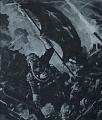
This example is in the Wallace collection, London, but probably isn't complete and is likely a composite of components from several suits of armour.
Bullet proof armor certainly existed, but it was very heavy. As firearms began to dominate the field, you saw it evolve. The Polish Winged Hussars were the most successful armored cavalry formation, and by the 1600s their armor was concentrated
Spoiler:
. That's what they needed to fight, and what they had was effective at stopping a good deal of gunfire of the time. They often employed firearms themselves, as they conducted mass charges through the enemy. Frankly, I think they used highly polished armor partially because it made for an easy aiming point, and if they were going to be shot, they wanted it to hit the armor.
They're not what we'd think of as knights, but a hybrid of armored cavalry that was effective in the early gunpowder era, up until about 1700.
Winged hussars were the most successful in the 17th century, but they were not even heavy cavalry by 16th century standards.
In the 16th century proofed plate was the norm for gendarme style cavalry (direct successor to earlier knights) such as the Count's armour above and for cuirassiers (full plate with pistols). Economic reasons caused the downfall of plate armour with the quality peak being around 1590-1600 or so. By this point the volume of quality plate is pretty low in proportion to the number of combatants, with really only the royal armouries at Greenwich or Innsbruck producing top grade gear. This stuff wasn't stupidly heavy, we are still talking a weight of around 25-30kg for proofed plate.
Now proofed means against pistols, and you could only reliably expect a close pistol shot to be bounced by the breastplate or helmet, but arquebus could be stopped at longer ranges and even muskets wouldn't be effective at long range against proofed plate. These will actually stop a modern .45.
Low grade proofed breastplates were heavy and is part of the reason troop armour contracted over the 17th century as only a couple of key, heavy items were worn. A pikeman breastplate and helmet from 1600 probably weighs close to an entire suit of full proofed harness from 1600 from one of the royal armouries. But you could easily produce a few thousand thick breastplates compared to high quality plate.
I don't think the shinyness is a combat thing. Armour for the wealthy has always been finely decorated, sometimes even to the detriment of armour integrity. Rich people like to show off.
Steel body armour is still a thing, but schrapnell and poorer energy repartition make it dangerous, even with coating, as far as I've read. Plus they are really heavy.
However, since I never had such a plate to test on, I wonder whether a musket bullet would actually shatter itself or the plate nonetheless. Anyone tried something akin by himself?
Lead is incredibly soft, so I assume it would most likely splatter against anything modern - that might make for some nasty splash though, even with spall protection. Definitely wouldn't shatter a steel plate.
And the major upside to steel, that makes it worth wearing despite the weight comparison to ceramic, is its ability to absorb repeated shots - that's been decided against by most first world powers - it's easier to convince soldiers to wear plates if they're light, and you shouldn't be taking multiple hits, anyways - your day has gone very badly wrong if you are.
Grey Templar wrote: Hmm, I don't necessarily agree with Muskets being designed to defeat breastplates. Namely because at anything other than very close range they actually couldn't. They were more so adopted because they are relatively cheap and easy to train loads of unskilled conscripts with. And a man in armor on a horse might be immune to a single musket ball, but you're not just shooting him once and his horse definitely isn't immune.
Breastplates, and armor in general, went away not because they were useless vs guns at the time but because they were expensive to make. So armor slowly faded to disuse while guns became more powerful, mostly as a side effect of attempts to increase range and accuracy.
A flintlock musket, compared to a crossbow is cheaper. The gearing and springs are comparable, but the crossbow also requires very specific wood to make the arm and you need to manufacture the bolts. Bows require specially grown wood as well as craftsmen to make, meaning long lead times to make bows. A musket of course also requires an artisan to make, but its much more conducive to cranking out a lot of them. Ammo is also cheaper and easier to make for a musket than bolts or arrows. Bows also require years of training to make a soldier proficient.
So really the reason muskets rose to dominance was for logistical reasons more than specific mechanical advantages over the alternatives. Them being better than the alternatives arose after they had already replaced them.
I agree logistics was a huge factor. However, I think you are conflating late muskets with early muskets. As Catbarf pointed out upthread, they are practically different weapons.
Arquebus struggled to reliably penetrate good armour except at close range, and muskets were developed to deal with that and could penetrate armour at much greater ranges. These weapons were big- the ones that needed a stick to support the barrels. Later muskets were a convergence of musket and arquebus into one weapon in the middle.
Also, in the 16th century horses were often barded with proofed armour in heavy cavalry units. Shooting the horse was not likely to be any more effective against these units than shooting the rider. Hence muskets. In areas with greater use of armour (like Flanders) the proportion of early muskets vs arquebus increased.
This example is in the Wallace collection, London, but probably isn't complete and is likely a composite of components from several suits of armour.
Spoiler:
Yes, there was barding which was also bullet resistant. But again, very expensive. So while these individual units were still useful, in the long run they were getting less and less effective due to cost.
I would also point out that the horse's neck and legs are conspicuously vulnerable. But of course we all know that horses legs aren't a weak spot at all...
Grey Templar wrote: Hmm, I don't necessarily agree with Muskets being designed to defeat breastplates. Namely because at anything other than very close range they actually couldn't. They were more so adopted because they are relatively cheap and easy to train loads of unskilled conscripts with. And a man in armor on a horse might be immune to a single musket ball, but you're not just shooting him once and his horse definitely isn't immune.
Breastplates, and armor in general, went away not because they were useless vs guns at the time but because they were expensive to make. So armor slowly faded to disuse while guns became more powerful, mostly as a side effect of attempts to increase range and accuracy.
A flintlock musket, compared to a crossbow is cheaper. The gearing and springs are comparable, but the crossbow also requires very specific wood to make the arm and you need to manufacture the bolts. Bows require specially grown wood as well as craftsmen to make, meaning long lead times to make bows. A musket of course also requires an artisan to make, but its much more conducive to cranking out a lot of them. Ammo is also cheaper and easier to make for a musket than bolts or arrows. Bows also require years of training to make a soldier proficient.
So really the reason muskets rose to dominance was for logistical reasons more than specific mechanical advantages over the alternatives. Them being better than the alternatives arose after they had already replaced them.
I agree logistics was a huge factor. However, I think you are conflating late muskets with early muskets. As Catbarf pointed out upthread, they are practically different weapons.
Arquebus struggled to reliably penetrate good armour except at close range, and muskets were developed to deal with that and could penetrate armour at much greater ranges. These weapons were big- the ones that needed a stick to support the barrels. Later muskets were a convergence of musket and arquebus into one weapon in the middle.
Also, in the 16th century horses were often barded with proofed armour in heavy cavalry units. Shooting the horse was not likely to be any more effective against these units than shooting the rider. Hence muskets. In areas with greater use of armour (like Flanders) the proportion of early muskets vs arquebus increased.
This example is in the Wallace collection, London, but probably isn't complete and is likely a composite of components from several suits of armour.
Spoiler:
Yes, there was barding which was also bullet resistant. But again, very expensive. So while these individual units were still useful, in the long run they were getting less and less effective due to cost.
I would also point out that the horse's neck and legs are conspicuously vulnerable. But of course we all know that horses legs aren't a weak spot at all...
The legs are definitely vulnerable, but they are relatively small, moving targets and early firearms usually fire high due to the way the powder burns slow (recoil kicks in before the shot leaves the barrel).
I've been fortunate enough to see this display in person at the Wallace Collection (well worth a visit if you are in London- free entry!). If I remember correctly, they think that some pieces of armour are missing, but this is still one of the most complete sets in the world (one of the others is in the same collection, an earlier set with mail on the neck). I can't find my pictures of the place though, so I'm going off my memory of the plaque. Even so, the horse would be ridden with the face down, so from the front that vulnerability is covered.
Fully agree that cost is why these full barding and harnesses faded away. Just not an economical troop type after the 16th century. Plus, all that investment is great against pike or arquebus, but means nothing to even a light field gun.
Automatically Appended Next Post: Edit: I do want to correct my statement above though. Barding was common at the beginning of the 16th century but it fell out of use much quicker than full plate for soldiers. It seems the loss of mobility on the battlefield and extra encumbrance of transporting barding was increasingly not worth it, especially as pikemen became more coordinated with shot.
Automatically Appended Next Post: Example of fuller neck barding:
Pretty much under no circumstances would a gun that size need extra cooling since you'd never have big enough magazines to get a gun hot enough to need that. Just the time it would take to reload and how many extra mags you could reasonably carry would pretty much eliminate the possibility.
It does look a bit like a Maxim 9 somewhat, which is a pistol with an integral suppressor. And you could do a similar thing to an SMG.
Haighus wrote: Later muskets were a convergence of musket and arquebus into one weapon in the middle.
Adding on to this a bit, that convergence coincided with the gradual disappearance of body armor from the battlefield during the mid-to-late 1600s. Even by the Thirty Years War of the early-1600s fire was the decisive element of infantry tactics and body armor was rarely more than a cuirass (which would eventually be the only surviving element of cavalry armor, as well, into the 1700s). There's a bit of a feedback loop here- the rising capability of the common arquebus made effective body armor prohibitively expensive and heavy, which in turn reduced the proportion of body armor used across fighting forces, which in turn lessened the requirement for a man-portable weapon uniquely capable of defeating it.
Here's an excerpt from a book written by a former British soldier in 1598. He lays out the contemporary reasons for the adoption of arquebus and musket- greater effective range, greater accuracy, an ability to score hits far beyond the maximum range of a bow, more immediate lethality, significant psychological effect, and better performance against armor though noting 'except it be of prooffe' (ie, it will pierce most armor better, but bulletproof armor still existed).
In fact, he doesn't commend gunpowder weapons for ease of logistics, procurement, or training- on the contrary, he caveats 'But you must note this by the way, that the fierie shot, either on horsebacke, or foote, being not in hands of the skilfull, may do vnto themselues more hurt then good', to which the interviewer (who I suspect may be a fictional contrivance) retorts 'but our countrey people are loth to be at the charges of so many costly weapons'. Lots and lots and lots of contemporary sources that say the same things, from different times and places all across the world, but those myths run deep.
Mad Doc Grotsnik wrote: If the image loads, a shooter spotted in an Outer Limits episode. Now I recognise the barrel cowling from somewhere else, but can’t think where.
It's a dressed-up Beretta handgun, first created as a prop for the film Timecop, but also used in Stargate (both SG-1 and Atlantis) by the Genii.
Falcor update, I've applied the last coat of oil (I think it'll be the last) the the woods, as already with the 4th coat it got shiny after the mandatory 48h dry.
No photos yet, as I just did it and didn't even wipe it yet. The stock bears very visible marks of abuse, that I probably wouldn't have been able to clean off at my skill level yet, and I'm thinking I should have dyed the handguard and the buttstock as the former is way clearer in colour.
But that'll protect them adequatly anyway, probably won't look "bad" although maybe strange at first, and most importantly, i've gained a lot of understanding of how this process is supposed to work and look forward to my next try.
Next up, I'll try taking care of the barrel. I also plan on stopping by at a gunsmith shop to try and buy another buttpad, as the original one is... uncomfortable to say the very least.
Seeing the pistols above jogged one thing in my head I had meant to ask. My experience with handguns is mostly dry firing them and annoying the small arms repository guys (interestingly enough such side arms are pretty much extinct in Ukraine, with carrying more ammo better regarded than a backup pistol).
For those that have fired pistols with a very low bore axis (I have seen one that is pretty much in line with the top of the hand) is there a radical difference? Is it just easy to train to? Or is it a miracle of accuracy?
And a side note on stating security related employment - best not. This article sums up the sorts of reasons that drives people to share stuff, but even innocently enough here revealing what you are about opens you up to targeting.
https://foreignpolicy.com/2024/06/22/loneliness-epidemic-national-security-espionage-russia-china/ Keep to open source or opinions/info that can be found in open source.
It's helpful. It feels like there is less recoil, sort of, but the real help is less muzzle rise so follow up shots can be quicker. Not so much better accuracy as faster accuracy.
I didn't think carrying pistols as a side arm whilst also carrying a rifle has ever been the norm for frontline troops? Special forces and veterans sometimes do it but on an individual level.
You are correct. At least in the US military, pistols are issued by default to officers and support personnel. So the guy with the LMG or DMR and the officers will have pistols, as will anybody who is not doing direct combat stuff, the riflemen will not. Of course at the same time I don't think there is a rule prohibiting them from having one either.
Lower bore axis does make for less muzzle flip. There are no miracles, it's just easier to keep on target under recoil. My Mauser C96 has considerable muzzle flip despite being just a 9mm (though also in part due to the suboptimal grip). Meanwhile my Mateba Unica 6, with very low bore axis, has negligible flip and is quite a soft shooter even in .357.
This can come at the cost of a sharper recoil impulse into the web of the hand; not an issue for typical service handguns or competition pistols but with higher calibers or smaller guns it can matter. My CZ82 is a controllable handgun but that low bore axis and straight blowback action really beat up my hand.
Grey Templar wrote: At least in the US military, pistols are issued by default to officers and support personnel. So the guy with the LMG or DMR and the officers will have pistols
Yeah, or at least, that's how it's supposed to work. A couple of times I've encountered (Army) machine gunners packing carbines as backup (or just nothing) because the limited number of handguns in inventory gets hoovered up by officers first. You'd think foot patrol would have higher priority over the TOC, but such is not always the case. In the Marines it's apparently so pervasive that Terminal Lance did a strip about it.
Either way, echoing you and Haighus, for riflemen a few extra mags (or more water, or just less weight...) is a lot more useful than an expensive secondary weapon ineffective at typical infantry engagement ranges. That has always been the case, really.
Doorkickers have a different mission profile and different needs.
I can think of the niche of soldiers scouting/trench raiding in WWI would sometimes be issued pistols, but a revolver or semi-auto pistol does have more firepower than a bolt action rifle when you drop into a shell crater or trench and find 5 enemies facing you. Those were typically issued specially for the raid or bought privately though.
Haighus wrote: I can think of the niche of soldiers scouting/trench raiding in WWI would sometimes be issued pistols, but a revolver or semi-auto pistol does have more firepower than a bolt action rifle when you drop into a shell crater or trench and find 5 enemies facing you. Those were typically issued specially for the raid or bought privately though.
Yeah, or at least, that's how it's supposed to work. A couple of times I've encountered (Army) machine gunners packing carbines as backup (or just nothing) because the limited number of handguns in inventory gets hoovered up by officers first. You'd think foot patrol would have higher priority over the TOC, but such is not always the case. In the Marines it's apparently so pervasive that Terminal Lance did a strip about it.
Either way, echoing you and Haighus, for riflemen a few extra mags (or more water, or just less weight...) is a lot more useful than an expensive secondary weapon ineffective at typical infantry engagement ranges. That has always been the case, really.
Doorkickers have a different mission profile and different needs.
I made a lot of friends as a HQ Company commander. I looked at the TOE and saw most of the staff ossifers were allocated a rifle. I refused to issue them a pistol and made them qualify on their assigned rifles.
Haighus wrote: I can think of the niche of soldiers scouting/trench raiding in WWI would sometimes be issued pistols, but a revolver or semi-auto pistol does have more firepower than a bolt action rifle when you drop into a shell crater or trench and find 5 enemies facing you. Those were typically issued specially for the raid or bought privately though.
Yeah, trench raiders usually brought pistols, grenades, shovels, knives, etc... There were actually smiths on the front lines making crude melee weapons for the trench raiders. Then the Americans showed up with shotguns...
Haighus wrote: I can think of the niche of soldiers scouting/trench raiding in WWI would sometimes be issued pistols, but a revolver or semi-auto pistol does have more firepower than a bolt action rifle when you drop into a shell crater or trench and find 5 enemies facing you. Those were typically issued specially for the raid or bought privately though.
Yeah, trench raiders usually brought pistols, grenades, shovels, knives, etc... There were actually smiths on the front lines making crude melee weapons for the trench raiders. Then the Americans showed up with shotguns...
And the Germans with MP18s. Those must have been terrifying.
Just Tony wrote:
Haighus wrote: I can think of the niche of soldiers scouting/trench raiding in WWI would sometimes be issued pistols, but a revolver or semi-auto pistol does have more firepower than a bolt action rifle when you drop into a shell crater or trench and find 5 enemies facing you. Those were typically issued specially for the raid or bought privately though.
Yeah, or at least, that's how it's supposed to work. A couple of times I've encountered (Army) machine gunners packing carbines as backup (or just nothing) because the limited number of handguns in inventory gets hoovered up by officers first. You'd think foot patrol would have higher priority over the TOC, but such is not always the case. In the Marines it's apparently so pervasive that Terminal Lance did a strip about it.
Either way, echoing you and Haighus, for riflemen a few extra mags (or more water, or just less weight...) is a lot more useful than an expensive secondary weapon ineffective at typical infantry engagement ranges. That has always been the case, really.
Doorkickers have a different mission profile and different needs.
I made a lot of friends as a HQ Company commander. I looked at the TOE and saw most of the staff ossifers were allocated a rifle. I refused to issue them a pistol and made them qualify on their assigned rifles.
You were the hero we needed and deserved.
It's always comical how non-infantry units regard weapons. When I became a cook after getting my permanent profile, I had an instance where rifles were handed out randomly to people to clean. The look of shock on the LT's face when I yanked my rifle out of her hand and said "Nobody cleans my rifle but me." will be a treasured memory for the rest of my life. I also had to clean the Supply Sergeant's rifle during this, and it drove home how people needed to be held responsible for their own weapon maintenance as an E6 should never have let things get THAT bad.
Brother, on my tank I set the headspace and timing on MY .50, and I cleaned and loved her and sang her lullabies before putting her in the arms room. Always cleaned my own weapon and helped with the crew serves.
CptJake wrote: Brother, on my tank I set the headspace and timing on MY .50, and I cleaned and loved her and sang her lullabies before putting her in the arms room. Always cleaned my own weapon and helped with the crew serves.
Heck, I also did maintenance on my vehicles.
I should have said "non-combat arms" instead of "non-infantry" as I know Tankers, Air Cav, and Artie will have the same pride of arms as we do. I meant no offense.
I'm trying to understand how an automatic revolver works.
So a single action just does one thing, sends the hammer forward to hit the firing pin. Ok fine.
Double action does two things, sends the hammer forward and recocks it so it's ready to fire without manually cocking it. Ok fine.
So how does an automatic revolver work? I'm assuming it uses the recoil to push the hammer back, but wouldn't that just make it a more complicated single action revolver, as the trigger pull would just send the hammer forward?
Why didn't they catch on? I know the prevalence of improved semi-automatic pistols are a factor (automatic revolvers were developed back when semi-autos were still pretty primitive, iirc), but were they just too expensive to make outside of some niche markets and designers?
In a single action revolver, the user must first manually cock the hammer, which also rotates the cylinder to the next position, then pull the trigger to fire. Single action trigger pulls are very short.
In a double action revolver, pulling the trigger both cocks the hammer and rotates the cylinder into position and at the very end of pull fires the hammer. Double action trigger pulls are long and more resistant.
An automatic(semi-automatic technically) revolvers uses the recoil energy of firing to both cock the hammer and rotate the cylinder instead of having the user do it so all they do is pull a very light trigger. The first shot of an automatic revolver would require the user to manually cock the hammer, much like you need to chamber the 1st round of any semi-auto pistol.
Exactly how the very few automatic revolvers do this depends on the specific one in question. I believe some are gas operated actually, but there are a few that are actually "direct blowback" analogous. I'd look up a video of the specific revolver in question for details.
The reason they didn't catch on was basically everything was wrong with them. They were expensive and overly complicated, prone to jamming occasionally just like semi-autos at the time, but no detachable magazines to make up for it.
It was basically a half-assed stop gap between semi-autos and revolvers with the disadvantages of both and only half the advantages of semi-autos.
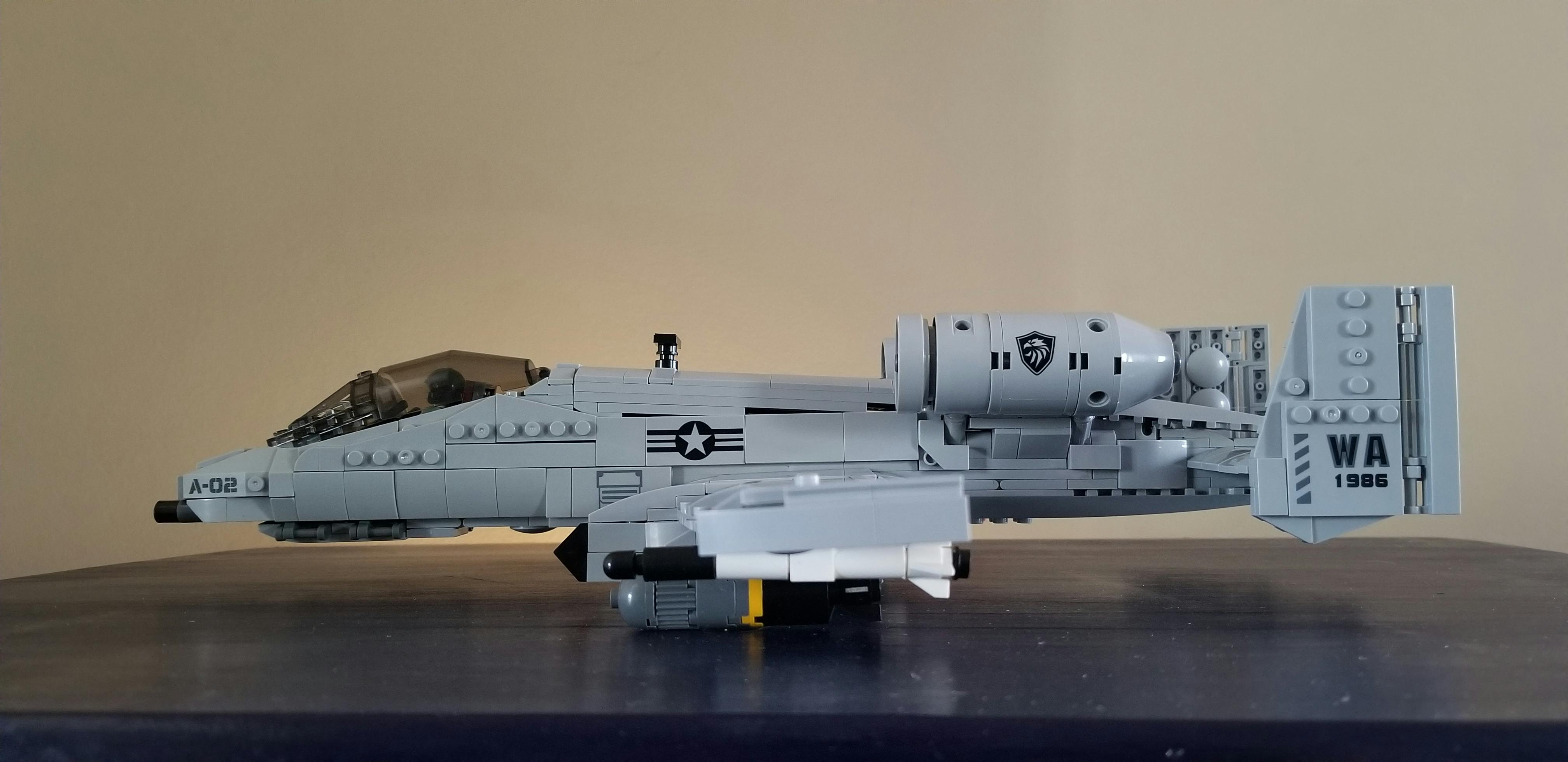
What good is the A-10 when no one drives tanks on a battlefield?
Quite as bit, as long as the enemy is actually *on* the battlefield.
I seem to recall the A-10 out performing the garbage that the Airforce wanted to replace it with in *all* CAS roles.
I'll grant, it may, in the future, be out of date, but it's fantastic for dealing with the threats of the 'here and now".
It's this sort of 'The Future' thought that led to Battleships being pulled repeatedly, and costing tens of thousands of servicemen their lives, when there was no equivalent platform present for fire support. A problem that has once again suddenly dawned on the USN that it once again has, and are scrambling to find any solution but the one that they know works.
What good is the A-10 when no one drives tanks on a battlefield?
Quite as bit, as long as the enemy is actually *on* the battlefield.
I seem to recall the A-10 out performing the garbage that the Airforce wanted to replace it with in *all* CAS roles.
I'll grant, it may, in the future, be out of date, but it's fantastic for dealing with the threats of the 'here and now".
It's this sort of 'The Future' thought that led to Battleships being pulled repeatedly, and costing tens of thousands of servicemen their lives, when there was no equivalent platform present for fire support. A problem that has once again suddenly dawned on the USN that it once again has, and are scrambling to find any solution but the one that they know works.
My understanding is that the A-10 is only functional in environments of air supremacy, and it is heavily outperformed by other platforms if forced into a stand-off role because it has longer sortie times (its slower so rearming takes longer). It has a role in counter-insurgency operations against massively inferior forces but they would never be able to use the gun in a conflict like Ukraine and it just becomes a slow, vulnerable strike craft in those conditions.
Battleships are another example where they were obselete against peer opponents long before they ceased to be useful against inferior opponents. They got pulled because they were very expensive to operate and vulnerable to air power and submarines. WWII was clear on this- battleships were used for shore bombardment mainly when the Allies had air superiority. They were useful in the Atlantic a bit later than the Pacific (the Atlantic is a stormier ocean and battleships could operate in bad weather that aircraft could not) and you could probably have made a practical AA/missile battleship but its too many eggs in one basket compared to a distributed defence spread out over smaller vessels.
If you just need shore bombardment and otherwise have naval and air superiority, monitors are much more efficient than battleships. If you don't have naval and air superiority battleships won't cut it either.
Haighus wrote: My understanding is that the A-10 is only functional in environments of air supremacy, and it is heavily outperformed by other platforms if forced into a stand-off role because it has longer sortie times (its slower so rearming takes longer).
That's also true of all rotary-wing aviation. The real issue with the A-10 is that in a near-peer conflict it would be highly vulnerable to modern MANPADS and SAMs, and the 30mm gun it's famous for was never the 'tank killer' it's made out to be. It's essentially a long-loiter missile bus that saw continued service as an unexpectedly capable COIN aircraft owing to a good integral anti-materiel armament and high survivability against light AAA and small arms.
The controversy over its replacement is because it's supposed to be replaced with the F-35, which would be perfectly reasonable for its original mission profile (anti-tank against a near-peer in contested airspace), but wholly inappropriate for the CAS role that the A-10 has been performing fairly well for the last two decades. The battleship is a good comparison; by Vietnam the Iowa-class was wholly obsolete in its intended role of naval surface superiority, but for the role of gunfire support it was reasonably well-suited and no better replacement existed.
AFSOC now operates the Super Tucano (A-29) in a light attack role, and USSOCOM recently selected the AT-802U Sky Warden for the Armed Overwatch program. I expect we'll see further development in that direction for low-intensity conflict while the main focus shifts to near-peer.
They basically want the F-35 to be able to do everything. Which isn't a bad idea on the face of it, buuuuut I personally don't think it is. Nothing wrong with a multi-role fighter, but the US military can afford to specialize.
IMO we should have 3-4 different fighters. F-22s for super stealth air superiority, F-35s for general stealth capable multi-role, a non-stealth CAS focused aircraft to actually replace the A10 and not shunt its role onto the F-35(basically a small ordinance truck to go with the B-52 big ordinance truck), and finally a non-stealth air-superiority fighter.
Stealth is strongest when you have distractions, so having some flashy non-stealth aircraft will enhance the capabilities of the stealthy ones.
And given the insane flight capabilities of the F-22, surely they had to make some compromises in performance to keep it stealthy. I just wonder how scary it would be if you took that away, go for pure performance. Give me a screaming freedom daemon that you can see coming but can't do anything about
I'd also point out we can differentiate between multi-role and all-role.
I think that, at least from the sidelines, there sure looks to be a case that an all-role fighter is kind of an absurdity. I understand the want but different roles have different needs and different needs demand different design considerations. A one-size-fits-all fighter is a tall order.
If I remember, the A-10 was gonna provide CAS even with a crap ton of SA-7s/14s and multiple 23mm ADA platforms at the Soviet tactical level. Hence the weight spent on armoring the cockpit and the ability to take lots of damage and get the pilot home. It was designed to take hits, but deliver more/stronger hits. I've had A-10s as air support, and I've had F-16s as air support. The A-10s ability to stay a bit and lay scunion is pretty nice. I'll also notice that an A-10 driver as a TACP was a dude who knew what it meant to provide support to ground pounders where the typical Zoomie was more concerned about hot showers (or the lack there of).
Can an F-35 provide the support? Maybe. But I'm guessing the pilots don't feel the love for the grunts that the A-10 guys do.
The conventional narrative is that the USAF has hated the A-10 since it was made but the Army loves it and every time the Air Force talks of scrapping them, the Army offers to take them over. This would of course break the rules over who gets what, so the A-10 trudges on.
The A-10's role has evolved a lot. It was designed in a Cold War CAS role when integrated air defenses were less sophisticated and it's purpose was to whizz overhead and obliterate Soviet tank concentrations.
It proved useful against the Iraqi Army a couple of times, and for COIN it works great because it can just loiter in a low-threat environment. It is also remarkably durable - my unit used to fly them and there's a chunk of an engine cowling on display showing where the SAM hit it.
Going back a bit to the longbow thing, I want to note that my post about sanitation and health is actually quite germane to the discussion because longbowmen need to be healthy to use their weapons. There are accounts of English armies that have no combat-effective bowmen (or very few) because everyone is sick. A sick guy can still load and fire a musket, though.
Word to the alive: be extremely careful with the pepperbox. When that was invented, it was using a much less powerful form of powder, you put an equal charge worth of current day power, and you are folding a stick of dynamite. Just be careful. Hate to see anyone make that mistake.
Automatically Appended Next Post:
Commissar von Toussaint wrote: The conventional narrative is that the USAF has hated the A-10 since it was made but the Army loves it and every time the Air Force talks of scrapping them, the Army offers to take them over. This would of course break the rules over who gets what, so the A-10 trudges on.
The A-10's role has evolved a lot. It was designed in a Cold War CAS role when integrated air defenses were less sophisticated and it's purpose was to whizz overhead and obliterate Soviet tank concentrations.
It proved useful against the Iraqi Army a couple of times, and for COIN it works great because it can just loiter in a low-threat environment. It is also remarkably durable - my unit used to fly them and there's a chunk of an engine cowling on display showing where the SAM hit it.
Going back a bit to the longbow thing, I want to note that my post about sanitation and health is actually quite germane to the discussion because longbowmen need to be healthy to use their weapons. There are accounts of English armies that have no combat-effective bowmen (or very few) because everyone is sick. A sick guy can still load and fire a musket, though.
Hey, as a line infantry officer, I hated that thing. It literally can't tell friend from foe in a shoot out, and it's main weapon is an area affect weapon with a kill radius of 50m. So that means if you have one on site, it's more likely to hit your guys than anything else.
Fun Fact: The A-10 has killed more friendly troops than any other weapon system in history. It was an incredibly stupid design by Pierre Spray and the Fighter Mafia, that wanted to get away from using "costly, advanced weapon systems, like Smart bombs, and go back to guns only".
FezzikDaBullgryn wrote: Word to the alive: be extremely careful with the pepperbox. When that was invented, it was using a much less powerful form of powder, you put an equal charge worth of current day power, and you are folding a stick of dynamite. Just be careful. Hate to see anyone make that mistake.
*Camera zooms in on .58 Duckfoot Pistol*. "Wait till he gets a load of me..."
Fun Fact: The A-10 has killed more friendly troops than any other weapon system in history. It was an incredibly stupid design by Pierre Spray and the Fighter Mafia, that wanted to get away from using "costly, advanced weapon systems, like Smart bombs, and go back to guns only".
This is complete bs, because "any other weapon system in history" would include chemical gas and biological weapons.
I will guarantee you that Chlorine alone has probably killed more friendlies.
And after the F-4, and the spectacular failure that was the Air Force's effort to go 'missiles only', they were absolutely right to start looking at guns again.
I am intrigued by the A10 concerns. I've done a bit of light googling, and while it appears they do have the highest number of casualties compared to other ground attack craft, its like 35 versus 19, so same order of magnitude.
It also looks like the incidents were primarily caused by miscommunication and misidentification of targets. The fact that the thing has a gun doesn't seem to be the main issue. If the ground controller and pilot have crossed purposes, then whatever platform in the area is going to struggle.
The primary weapon of many CAS aircraft is likely to have lethal effects out to 50m. A 2,000lb JDAM dropped in the wrong place is gong to wreck your day just as much as an A10 burst.
I've never been anywhere near anything like this in reality (and really hope I never have to), so not trying to deny anyone's experiences, just interested in what it is about the platform that appears to have made it more susceptible to this issue.
FezzikDaBullgryn wrote: Hey, as a line infantry officer, I hated that thing. It literally can't tell friend from foe in a shoot out, and it's main weapon is an area affect weapon with a kill radius of 50m. So that means if you have one on site, it's more likely to hit your guys than anything else.
That makes no sense. It's not like they have GI-seeking bullets. They also do deep interdiction with them where there are no friendlies around.
If mean, if they're that dangerous, why call them in?
Fun Fact: The A-10 has killed more friendly troops than any other weapon system in history. It was an incredibly stupid design by Pierre Spray and the Fighter Mafia, that wanted to get away from using "costly, advanced weapon systems, like Smart bombs, and go back to guns only".
Not even remotely close. I'm thinking of the heavies who killed 200+ GIs in the St. Lo. breakout in a single errant run would have that honor.
And if it was so beloved of the Air Force, why did it take so long to roll out the C-model upgrades? The fact was that the AF has hated them forever, tried to retire the fleet multiple times, and the upgraded C-models had superb sensors and effectively new cockpits with all the latest toys. They were basically used as ISR platforms with some teeth.
The Fighter Mafia is all about the F-22, and wishes the Warthog would just die already.
UPDATE: Interservice rivalries aside, the discussion of firepower sent me running to Battles and Leaders of the [American] Civil War, and short commentary by Henry Hunt, who commanded the reserve artillery of the Army of the Potomac at Gettysburg.
Apparently, prior to Lee's advance on the final day, Hunt gave strict orders that no batteries were to fire without his permission. Hancock countermanded this order, and guns in the II Corps area returned fire for a time.
Hunt's contention is that had II Corps followed his instructions, none of the Confederate troops would have made it past the road, and Hunt notes that the only point where this happened was where a pointless gun duel reduced the ammunition supply - II Corps.
I think artillery is a bigger deal that people give credit, and the development of rifled cannon so extended their range and accuracy as supersede any gains by rifles.
FWIW the 'Fighter Mafia' he's referring to is a defense contractor clique from the 60s-70s, of whom Pierre Sprey (e, not a) was a part, that is famous for A. bullshitting their level of involvement in the various weapons systems attributed to him/them, and B. being wrong about basically everything. They wanted the F-16 to be a radar-less gun-only fighter, for example, and Sprey was a vocal detractor of both the F-15 and the Abrams (for some reason). He also asserted credit for the A-10 program when all evidence points to him being, at most, an unwanted fly on the wall (he wasn't even working at the company that developed it). The Fighter Mafia would have hated the F-22 too; it's the opposite of the P-51-with-a-jet-engine that they thought would dominate the sky.
Anyways, the fact that the A-10 isn't suited for its intended role is a significant part of why the Air Force wants it gone. I remember reading a report from the 1980s estimating that in the event of a Soviet invasion of Europe, the entire A-10 fleet would be combat losses within two weeks. I know they've retrofitted newer variants with updated RWR and countermeasure capability but the general consensus is that it's not suited to contested airspace.
Edit: Oh yeah, and that 'it literally can't tell friend from foe in a shoot out' is categorically untrue. The A-10 has had LITENING pods since the early 2000s, providing the same IFF capability as any fast-mover, plus helmet cueing since the late-2010s for GPS validation. It can't easily identify infantry, but neither can anything else, so that's why you have FACs/JTACs/TACPs/CCTs/ALOs to manage your CAS mission.
So the IFF pods in modern smart attack aircraft have redunency to not let the pilot release a weapon IE, Yell "pickle" and drop a 2k JDAM on a troop transport of friendlies. The transponders and BFT beacons help with that. Guess what doesn't listen to transponder beacons and BFT IFF signals? The trigger of the A-10 main gun. If the pilot wants to, all they have to do is switch to ground attack, select the main gun, and pull the trigger. There is no IFF Lockdown system on the Gau-8. If an F-22 accidentally locks up a friendly, that pilot can't possibly let one of their AMRAAMs off, the plane won't let it off the rail. That's why the A-10 is a liability. There is no "OSHA" equivalent preventing A-10 pilots from making extremely stupid mistakes.
And I just want to say, as a bit of a snob, I think we need to stop ourselves every time we try to mimic something Russian. (The A-10 is the American Su-25). Althought, the Mig-29 gave us the F15, which still sets the bar for greatest F/A platform of all time.
LordofHats wrote: I could be wrong but isn't that the other way around?
The A10 came before the SU-25.
Yes, the A-10 was first.
Automatically Appended Next Post: And I would look at the Ruski's initial copy of the M-72 LAW as an example of how well they mimic/reverse engineer US tech.
FezzikDaBullgryn wrote: So the IFF pods in modern smart attack aircraft have redunency to not let the pilot release a weapon IE, Yell "pickle" and drop a 2k JDAM on a troop transport of friendlies. The transponders and BFT beacons help with that. Guess what doesn't listen to transponder beacons and BFT IFF signals? The trigger of the A-10 main gun. If the pilot wants to, all they have to do is switch to ground attack, select the main gun, and pull the trigger. There is no IFF Lockdown system on the Gau-8. If an F-22 accidentally locks up a friendly, that pilot can't possibly let one of their AMRAAMs off, the plane won't let it off the rail. That's why the A-10 is a liability. There is no "OSHA" equivalent preventing A-10 pilots from making extremely stupid mistakes.
And I just want to say, as a bit of a snob, I think we need to stop ourselves every time we try to mimic something Russian. (The A-10 is the American Su-25). Althought, the Mig-29 gave us the F15, which still sets the bar for greatest F/A platform of all time.
Mig 29 went into service in '83 with the first prototype making its test flight on Oct. 6th, 1977 while the f fifteen eagle went into service in '76 with the first prototype flying in July of 1972. Your information is flat out wrong.
I wouldn't want drag on the F-35 too much. Yes it went way way overbudget, what airforce project doesn't?
Sure, it isn't a great multi-role fighter, at least not if it wants to keep its stealth up. But it gets the job done. And despite the budget overrun the per unit price is actually very very cheap thanks to basically the whole western world moving to adopt them. In the long run its a fine aircraft that will make its budget back thanks to exports. It may even get competitive with the F-16 on per unit pricing eventually.
We should just design another aircraft purely to fit the ground attack role. A basic ground attacker that can bring ordinance to the field, as opposed to the F-35 which is a fighter that can do ground attack things.
But this probably merits its own thread, not to drag down this one off topic.
Pictures coming in an edit later on, but i've worked a fair lot on my Falcor today:
Edited with pics of my learning progress.
Flame blued all the screws and the swivel that need it.
Spoiler:
Waxed the stock and hand guard slightly
Spoiler:
Fitted the handguard's pieces in it
Reassembly and check to see if it seems to work.
Spoiler:
Made the rail on the barrels straight-ish.
Spoiler:
Preparing of the barrels for cold bluing, I'll do it tomorrow. It's currently, at 21:17 Ambrières time, taking a bath of vinegar to degrease. Witing a few hours and then i'll rinse it properly.
Spoiler:
Automatically Appended Next Post: Now tackling cold bluing proper
And closing this week end's session, the finished barrel.
Spoiler:
I hope it'll retain this colour, on close inspection with light it's not quite perfect, but that's actually better than what I thought I'd achieve. I'll see tomorrow if it has changed. I left a healthy dose of pil on the barrels and only slightly wiped the excess, just to avoid it dripping on the floor, but no more.
A theme park type attraction featuring historical firearm reproductions the visitors can shoot. A hands-on trip through time, even if some designs need extra, non-historical safety additions on account being sued for someone being blown up sucks.
I mean, I assume it sucks. I’ve never actually blown anyone up, nor do I hope to. But a safe assumption, I trust you’ll agree.
I'd imagine you'd have people around to make people actually shoot and intervene in case something goes wrong at every booth to avoid that. But depending on the country you live in, the moment any accident occurs, the anti gun mobs are going to come for your head no doubt.
Checked the barrels this morning before leaving for my construction site, everything still black like I hoped it too, I assume I managed it. Going to reassemble the whole gun next week and take it to the range to get my first rounds through it!
That would be awesome. Ideally with short lectures, possibly by QR code, on the different aspects of the weapons. Would be like an interactive version of forgotten weapons While modern firearm designs have succeeded in making them thoroughly dull to fire, the older ones are far better!
A theme park type attraction featuring historical firearm reproductions the visitors can shoot. A hands-on trip through time, even if some designs need extra, non-historical safety additions on account being sued for someone being blown up sucks.
I mean, I assume it sucks. I’ve never actually blown anyone up, nor do I hope to. But a safe assumption, I trust you’ll agree.
There used to be, back in the 1970s, something like this at Gettysburg.
Though they weren't reproductions and safety was a word that only was heard to follow 'release the'.
A theme park type attraction featuring historical firearm reproductions the visitors can shoot. A hands-on trip through time, even if some designs need extra, non-historical safety additions on account being sued for someone being blown up sucks.
I mean, I assume it sucks. I’ve never actually blown anyone up, nor do I hope to. But a safe assumption, I trust you’ll agree.
You could do that with the pneumatic simulators. Someone in my squadron did a drug deal with the Army post next door (he was prior Army), and we got trigger time on various weapons hooked up with cables and wall-size screens, so we could shoot the snot out of everything. I think it was described as "team building" rather than "bored Zoomies go on high tech shooter rampage."
The mission where a couple of us took M9s into the Hindu Kush was...absurd.
A theme park type attraction featuring historical firearm reproductions the visitors can shoot. A hands-on trip through time, even if some designs need extra, non-historical safety additions on account being sued for someone being blown up sucks.
I mean, I assume it sucks. I’ve never actually blown anyone up, nor do I hope to. But a safe assumption, I trust you’ll agree.
You could do that with the pneumatic simulators. Someone in my squadron did a drug deal with the Army post next door (he was prior Army), and we got trigger time on various weapons hooked up with cables and wall-size screens, so we could shoot the snot out of everything. I think it was described as "team building" rather than "bored Zoomies go on high tech shooter rampage."
The mission where a couple of us took M9s into the Hindu Kush was...absurd.
We got that in french army too but it doesn't see a lot of use.
Falcor progressing. This time, I had the bluing hold after immerging the final coat in water then thorough WD40 cleaning out and in the barrels. You can see a few blotchy marks here and there if you really get close, but overall, it looks about good enough.
I've refitted (partly) the buttplate, and that's when I did a gak up, heating it at one points from the ouside and killing hte varnish. No big problem as I plan on swapping that someday anyway, but stupid on my part nonetheless. I also widened the screw holes so the screw heads no longer protude and falme blued said screws. Tomorrow, i'll take it to the range and fingercrossed it shoots no problems.
Meanwhile, I'm already selecting my next target on naturabuy, that is, trying to find a cheap beaten up if needed side by side, that I plan to cut down to the minimal dimension I legally can.
That is, in french gunlaw terms, 80cm total lentgh of which 45cm barrel length. I'll then try my hand at reshaping, shortening, and refurbishing the stocks, at cutting down and rectifying the barrels, and if needed, the worst part, re soldering the middle rail...
I've played with C4, plenty of it. (P for Plenty if you know the formula!) And lots of det cord. Got to blow a live AT mine in place once and that was a BIG BOOM (like 20+ pounds of explosives in the mine, a 1 pound chunk of C4 with some det cord on top of it).
Depending on the door a 1/4 pound set correctly would blow out a bolt or hinges. In the movies when they blow up a whole building with a couple of pounds always makes me laugh. It don't work that.
The EOD/demining crew I tagged around with for a while had a variety of ways of blowing up potentially dangerous objects. Most memorably with half a chaps house - he had paid the labourers to collect the bomblets and piled them up against side of house and assumed we would take them away. I had to explain we didn't remove the items we destroyed them. In situ. He then wanted us to go (so he could get them all shifted no doubt), and had to explain that we were bound by the government to dispose of any items we found immediately. Had to get infantry support to ultimately move situation along.
I do remember in my induction we had the mickey mouse IED lesson where we got to use a glass bottle with nicely concave base to make an explosively formed penetrator and punch it through steel. Surprisingly effective.
An issue in recent operations when 'mouseholing' was so frequently used (making doors in walls), there were issues with people not liking the approved carry methods and placing explosive items in thigh pockets and similar. They could go off when struck by bullets.
Feel bad for him, but you did your job nonetheless, respect.
I had the chance to detonate my own pack of explosive the old way, pack laid on the ground, a piece of det cord, and a detonator I had to squeeze onto the piece of det cord. Unfortunately, as we were required to walk away once it was set up, we couldn't see anything and only heard the big explosion, that was quite impressive to here for such a small piece.
An issue in recent operations when 'mouseholing' was so frequently used (making doors in walls), there were issues with people not liking the approved carry methods and placing explosive items in thigh pockets and similar. They could go off when struck by bullets.
I'm really curious what explosives these were because I thought most modern explosives were stable enough that pretty much only the detonators or more explosives can set them off. C4, for example, doesn't go off if shot or burned.
Although if the bullet hit the detonator that could still be a bad day in a thigh pocket.
An issue in recent operations when 'mouseholing' was so frequently used (making doors in walls), there were issues with people not liking the approved carry methods and placing explosive items in thigh pockets and similar. They could go off when struck by bullets.
I'm really curious what explosives these were because I thought most modern explosives were stable enough that pretty much only the detonators or more explosives can set them off. C4, for example, doesn't go off if shot or burned.
Although if the bullet hit the detonator that could still be a bad day in a thigh pocket.
If the primer is with the c4 in the pocket, then the primer might detonate. Primers are relatively fussy.
If I had to guess they might have been carrying detcord, which would be a lot more unstable compared to C4.
C4 is practically inert unless you hit it with a primer. You can literally cook with it. And of course you don't want a primer anywhere near it unless you are prepping to boom.
I honestly can't remember if this particular problem is detailed in anything other than general terms in open source. Certainly it is in some medical reporting in terms of treating injured soldiers. But broadly easy access pockets and pouches save time and allow different items to be split up for easy selection, but carry their own risk.
But a bit of research and you will see all sorts of writings about the tension between the way you are mean to do things and the way they are done in the field and how that plays into uniform design, especially in the age of the overloaded soldier.
Back to firearms and a related note, and exemplified by the AR platform, its interesting how there seems to have been a big acceleration in customising small arms. Looking at the past 20 years it seems so different to the 60's through 90's when stock firearms abounded. Is it technology? Consumer driven change? Smaller militaries?
Grey Templar wrote: If I had to guess they might have been carrying detcord, which would be a lot more unstable compared to C4.
C4 is practically inert unless you hit it with a primer. You can literally cook with it. And of course you don't want a primer anywhere near it unless you are prepping to boom.
Thanks, that would make sense
Was it the Mythbusters who tried to set off C4 with iron thermite? That still wasn't energetic enough to make it go boom.
Back to firearms and a related note, and exemplified by the AR platform, its interesting how there seems to have been a big acceleration in customising small arms. Looking at the past 20 years it seems so different to the 60's through 90's when stock firearms abounded. Is it technology? Consumer driven change? Smaller militaries?
Probably multiple things, but small militaries is likely a factor.
The rifles used by the relatively-small British Expeditionary Force at the outset of WWI had volley sights fitted to allow for indirect suppressive fire, as well as sights out to something like a kilometre. Soldiers were trained to use them. This was quickly dropped for wartime production with the sights greatly simplified- none of it made any difference to the conscript with much more minimal training who was unlikely to be hitting much at 300m, let alone volley fire at 2000m.
I'd expect weapons to simplify rapidly if facing a scenario like Ukraine, with the gubbins reserved for specially-trained, elite, or veteran troops.That said there is a much greater industrial capacity for things like precision sights these days, so they probably wouldn't become as scarce as in previous time periods.
Newest is this little Sig .22. Had it about a month and it has already got 2 copperheads, a moccasin, and this egg thief (found in laying boxes in coop with 3 eggs in him).
Custom rifles are bot that often seen in France I find. Mostly because it is really expensive. Then because for the most difficult fits, finding a good gunsmith is not always easy. At least that what I think of if you ask me. Plus hunting rifles are not necessarily extremely modulars or stuff as frankly that's not truly a requirement for your average rifle.
I kind of customised my AK a bit though but that's really that kind of uneducated custom for giggles and comfort, I don't mean to become a good shooter with it.
Newest is this little Sig .22. Had it about a month and it has already got 2 copperheads, a moccasin, and this egg thief (found in laying boxes in coop with 3 eggs in him).
Nice! I was looking at those. How reliable are the mags\feeding? You can't really expect 100% with those rimfire mags, I'm curious if it is better or worse than similar guns.
Back to firearms and a related note, and exemplified by the AR platform, its interesting how there seems to have been a big acceleration in customising small arms. Looking at the past 20 years it seems so different to the 60's through 90's when stock firearms abounded. Is it technology? Consumer driven change? Smaller militaries?
I think its probably a combination of all of those things.
There have always been tinkerers leading the way with new innovations, and by the 90's there was a decent amount of "mainstream" customization going on. Modifications for SKS, Mini-14s and 10/22s were common, as well as high performance custom 1911s. There have always been people who disliked the Glock style sights, and night sights for every gun that could use them were popular. But overall I agree it really seems to have jump started in the early 2000's.
Speculating, companies like Magpul and Trijicon getting large govt contracts in the early GWoT era gave them the capital to expand their business and create a new market for gun accessories and in turn new competition chasing those contracts. The Picatinny Rail and later MLOK rails lessen the need to have dedicated mounts for specific guns. Laser sights went from the enormous versions seen in films like Cobra and Terminator to being small enough to be incorporated into a handgrip on a holdout pistol. GWoT era attempts to increase the lethality of short barrel AR-15s led to a cottage industry of new calibers usable in existing ARs with an upper receiver swap. Fixed power optics were proven effective and rapidly grew in popularity for both military and civilian use as entirely new products.
The internet/youtube/Leviathan Group provide small and large businesses marketing and exposure exponentially more effective than ads in Shotgun News ever could, and the popularity of shooter games with highly customizable guns has to be a factor as well. The barrier for entry is also much lower with the availability of garage scale CNC machines and even 3D printers.
The AR is probably the easiest gun to deeply customize, a highly proven design, and due to legal reasons and their fallout, the most readily available gun of its type in the US. Depending on what you want, it can be a good idea to just buy the lower receiver and build from there, which incentivizes the DIY aspect. And with the sheer amount of options the AR-15 or AR-10 can perform any role you'd want a rifle or SMG to perform, outside of extreme long range shooting. So not too surprising it is the #1 gun in terms of customization. For handguns, it seems to still be mainly driven by 1911s and Glocks, and new guns often come with some of those features standard. The expiration of the Glock patent in particular has led to an explosion of striker fired guns, some of which are just Glock clones with varying degrees of customization.
I'm all for it. My own AR only has a handful of original parts, with vastly superior performance. And most of my guns are customized to some degree, nothing that required a gunsmith.
People have always been customizing their stuff. I think the main difference is that in the last 20 years there has been an explosion in both the number of gun owners and the mass availability of parts to customize with. More and more accessory companies offering more stuff combined with a surge in interest with guns that accept those customizations.
The Fudds of yesteryear were as much into customization as everybody today, it was just more niche back then.
Newest is this little Sig .22. Had it about a month and it has already got 2 copperheads, a moccasin, and this egg thief (found in laying boxes in coop with 3 eggs in him).
Nice! I was looking at those. How reliable are the mags\feeding? You can't really expect 100% with those rimfire mags, I'm curious if it is better or worse than similar guns.
So far so good. Had a couple failures to cycle in the first 20-30 rounds, then no issues with the exception of trying out subsonic rounds. Those didn't seem to have enough oomph to cycle the next round. Currently loaded with high velocity hollow points and have not had any failures with the can on the front. The can does lower DBs enough that you can fire it in the coop and not have your ears ringing.
Have put maybe 150 rounds through it, most the first day as once it started its anti-egg thief role it only gets fired when actually needed.
My one complaint is though the stock sights are suppressor hight, they are all black and hard to see in some environments especially against a dark target. I got some glow sight paint and that fixed it though I'll probably splurge and get tritium and/or fiber optic sights at some point.
Grey Templar wrote: People have always been customizing their stuff. I think the main difference is that in the last 20 years there has been an explosion in both the number of gun owners and the mass availability of parts to customize with. More and more accessory companies offering more stuff combined with a surge in interest with guns that accept those customizations.
The Fudds of yesteryear were as much into customization as everybody today, it was just more niche back then.
This, and also the rise of e-commerce has made it much easier to produce and sell niche parts. If you want to make perfect reproductions of an obscure aftermarket AR grip from the 1980s, you don't need to take out advertisements in Soldier of Fortune asking people to mail for details, you can just create a webstore and post your work on Reddit.
And of course the development of parts standardization (eg M1913 rails, M-LOK) means that the market for accessories is broader than ever. You don't need to design for a specific platform, you can make optics or furniture that fit multiple platforms.
I'd underline standardisation, because I've always find it difficult, when you're new to it, to find what is compatible or not with you're rifle from a distance on the internet.
I feel standardisation means I am less prone to error and can more confidently give away money for parts I'm pretty sure should fit.
Of course the big deal is first and for most to be able to pick that handguard from the other side of the country without actually having to drive all the way there because no one in your neighborhood sells any... But if any of you ever did that, kudos, that's a testimony to your dedication!
At least you're not the maintenance guy on an aircraft carrier who ordered an Abrams turret by mistake Or the people along the way who let it get delivered without questioning it
I really hope they mounted it somewhere… that’s awesome. We had a famous case of the reverse in the UK a few years back when audits of MOD storage facilities identified that there where whole Harrier nose cone assemblies missing. Not sure if they ever got the the bottom of where they went, or how the supply system allowed them to be taken out of inventory.
I'm always amazed at how things disappear from military inventories while everything was registered and tracked and that. I can't see any other way than through acquaintances and accomplices that mask it somehow, but those would have to reach quite deep. Even saying it is lost doesn't always work as you would be made to search for it - or because it makes no sense in the case of a plane nose...
Maréchal des Logis Walter wrote: I'm always amazed at how things disappear from military inventories while everything was registered and tracked and that. I can't see any other way than through acquaintances and accomplices that mask it somehow, but those would have to reach quite deep. Even saying it is lost doesn't always work as you would be made to search for it - or because it makes no sense in the case of a plane nose...
I mean, ultimately your quality control and security are composed of 18-20ish soldiers. There's duty, and then there's this cool idea I had to make a beer cooler out of a harrier nose cone, and have a nose party. You know which way the enlisted folks are going.
And that's before any inventory paperwork is done wrong, and it's easier for something to vanish than figure out why the count is wrong, since it probably means telling a superior officer that they made a mistake.
Which, as we know, superior officer can't possibly have done. My aid in the optic stock I had to atten to as a "secondary job" as a maréchal des logis once managed to lose binoculars. They went out, never came back, and he never remembered who he gave it to. But we had ourselves borrowed it from the regiment's overall stock, so that got me into some trouble.
Maréchal des Logis Walter wrote: I'm always amazed at how things disappear from military inventories while everything was registered and tracked and that. I can't see any other way than through acquaintances and accomplices that mask it somehow, but those would have to reach quite deep. Even saying it is lost doesn't always work as you would be made to search for it - or because it makes no sense in the case of a plane nose...
I think someone mentioned it in the early portions of this thread, but it reminds me of a story of a guy who had a military surplus store.
He would regularly buy lots of stuff from military auctions. One time he bought a bunch of rifle crates. When he got them back to the store one of the cases was heavier than it should have been, upon opening he found the dozen M16s the case was designed for still inside.
He called and gave them back. I probably wouldn't have been so honest.
But yeah. "Hey, should we open these cases and make sure they are empty before sending them to auction? Nah, thats above our paygrade!" -some Private, probably
It also assumes everyone is firing on all cylinders all of the time.
We’ve all had duff days, I’m sure. Where due to hangover, distraction or just….whatever, Mr Brain doesn’t want to cooperate. And so we make daft little mistakes and errors we may not notice for a bit.
Put a crate in the wrong pile. Misread a number. Put a stencil on the wrong box. Shipping labels swapped. All teeny tiny seemingly inconsequential errors which can all add up to “I’m sure I had 127 Abrams in this particularly large garage” type stuff.
To be fair, the army works in a way that tires to prevent things getting meessed up by a bad day or a poorly gifted individual, as those are commonplace in the army. Not 100% proof though.
Besides, that's also partly thr point we try to get to in fireamrs courses.
Right, after I finished with my Falcor that is know well better looking, and fonctionnal, I'm buying this single shot 22lr. It needs a little filling on the front (I'll trust that I can manage that as a soon professionnal tig welder... maybe I shouldn't though as i usually weld stainless tubes for champagne or acid.). I'll then let my inner bubba loose somewhat and try to modify some things on it: mostly see if it were possible to cut and reweld the bolt lever straight for my left handiness. Again, trusting in the fact I'm 2 months away from being certified tig welder after all.
As for the rest, I'll see. This is a gun with little to no collector value, and affordable, perfect for me learning. Maybe try my hand at some reshaping of the front of the stock... In that case, I'll need both a new set of files and of course, appropriate welding rods. Brownells france seems to be shipping nickel/steel alloy rods, that are better suited than just steel rods. Besides, stainless steel rods are a no no, especially on the barrel as I'll have got to re blue it.
And, on the fence about also getting myself that relatively cheap beretta 92s. Yes, the price they pay me for working on construction site far from home rose, if you're wondering.
Maréchal des Logis Walter wrote: I'm always amazed at how things disappear from military inventories while everything was registered and tracked and that. I can't see any other way than through acquaintances and accomplices that mask it somehow, but those would have to reach quite deep. Even saying it is lost doesn't always work as you would be made to search for it - or because it makes no sense in the case of a plane nose...
Back in the 1990s, I seem to recall hearing of a base that discovered they had an inventory of wagon parts from the Mexican War still in inventory. There was this one place I worked that had a room set aside for equipment dating back the Eisenhower Administration. When you have a gakky grasp of the equipment you have, gak gets lost.
But I still keep praying to find a Willy's MB still in the box.
Right, after I finished with my Falcor that is know well better looking, and fonctionnal, I'm buying this single shot 22lr. It needs a little filling on the front (I'll trust that I can manage that as a soon professionnal tig welder... maybe I shouldn't though as i usually weld stainless tubes for champagne or acid.). I'll then let my inner bubba loose somewhat and try to modify some things on it: mostly see if it were possible to cut and reweld the bolt lever straight for my left handiness. Again, trusting in the fact I'm 2 months away from being certified tig welder after all.
As for the rest, I'll see. This is a gun with little to no collector value, and affordable, perfect for me learning. Maybe try my hand at some reshaping of the front of the stock... In that case, I'll need both a new set of files and of course, appropriate welding rods. Brownells france seems to be shipping nickel/steel alloy rods, that are better suited than just steel rods. Besides, stainless steel rods are a no no, especially on the barrel as I'll have got to re blue it.
And, on the fence about also getting myself that relatively cheap beretta 92s. Yes, the price they pay me for working on construction site far from home rose, if you're wondering.
I have nothing useful to add (having no skills or experience in this area) but following along with interest. Commenting so you don't feel you are posting into the void on this
Maréchal des Logis Walter wrote: I'm always amazed at how things disappear from military inventories while everything was registered and tracked and that. I can't see any other way than through acquaintances and accomplices that mask it somehow, but those would have to reach quite deep. Even saying it is lost doesn't always work as you would be made to search for it - or because it makes no sense in the case of a plane nose...
Back in the 1990s, I seem to recall hearing of a base that discovered they had an inventory of wagon parts from the Mexican War still in inventory. There was this one place I worked that had a room set aside for equipment dating back the Eisenhower Administration. When you have a gakky grasp of the equipment you have, gak gets lost.
But I still keep praying to find a Willy's MB still in the box.
The amount of random gak laying around because no one wants to deal with the paperwork, or knows why it was there, and if it's still needed or not, is ridiculous.
That being said, sometimes it's just accidental - "Huh, I'm at home with this controlled item in my pocket after an exercise - boss?" 'Uh, all the paperwork says I have all those, so give it here and pretend this didn't happen' is a thing at times.
Although there was a case of a disposals officer giving rocket launchers scheduled for destruction to organised crime to wipe his gambling debts, so anything can happen at any level.
We have the Abrams story as well, except for us it was torpedos going to a mechanic repair unit.
You'd most likely be looking at a carbine of some sort in 5.56. Short, lightweight, manoeuvrable, capable of reaching out to ~300m, minimal recoil.
It's downsides are going to be lack of punch compared to a heavier round, and that 300m range, but it'll do everything acceptably.
If you could only have ONE weapon, I don't think there's many people who'd take something else besides maybe putting a full length barrel on it, or a slightly different calibre.
I have a Sig MPX, basically a 9mm AR platform. Mine was built/sold as a pistol so has a 4.5 inch barrel and a collapsible brace instead of a stock. It hits easily at 100 yards/meters, has almost no recoil so followup shots are very quick. Up close it is just awesome, and fires personal defense ammo with no issues.
I wouldn't use it to hunt big game, but have taken smaller predators with it, it us one of the 'go to' guns in the house (kept with a full magazine in it, ready to go when the safety goes off). I trust it for home defense, in fact once my daughter thought we had an intruder on the property and it is what I took out to look for him.
It is FUN to shoot since it is no recoil, and cheap enough with 9mm ball ammo that it serves lots of target shooting days. I often use it in my introducing new shooters to the sport.
I have a triangle shaped courier bag designed to carry it, one that does not look military, so it can blend in with 'civil' society.
For me, that is my 'all rounder'.
Automatically Appended Next Post:
Farseer Anath'lan wrote: You'd most likely be looking at a carbine of some sort in 5.56. Short, lightweight, manoeuvrable, capable of reaching out to ~300m, minimal recoil.
It's downsides are going to be lack of punch compared to a heavier round, and that 300m range, but it'll do everything acceptably.
If you could only have ONE weapon, I don't think there's many people who'd take something else besides maybe putting a full length barrel on it, or a slightly different calibre.
Another of my Go To guns is a Maxim Defense 5.56 with a 10 inch barrel. The muzzle device almost eliminates muzzle rise, it is dependable as hell, and only a bit longer than the Sig mentioned above since it too has a collapsible brace. But for in the house defense, I don't like the penetration of 5.56, so the Sig wins there.
A smaller rifle of some kind, either a PCC(Pistol caliber carbine) or a 5.56/7.62/similar intermediate cartridge rifle of some flavor that has 30+ round detachable mags. These will do home defense with the fewest drawbacks and if you want a weapon that could also be used for hunting it can do that as well.
It would be a tough choice between my KP9(semi-auto clone of the Vityaz) and AUG for home defense situation. Prob the KP9 mostly because it has the Red dot and the AUG has a 4.5x on it(but it does have a laser sight too so...)
Maréchal des Logis Walter wrote: I remember SKSs being quite praised as a particularly great all rounder carbine a few years ago, don't know if there still is the same praise for it.
When they were surplus they were great, but the price has been steadily rising as supply dried up. It's also a fairly long rifle (40in overall length) so it might not be great for tighter spots.
An AR-15 with a 16in barrel is roughly 33in overall with a collapsing stock so it shaves off a decent amount while also being lighter and handier.
Aye, prices for SKSs also Rocketted through the roof in France, in like 2.years it went from an on average 200-300 euros rifle to a 800 euros rifle. That hurts. My brother would have loved to get one but now he can't afford it for the time being.
Probably effectiveness and versatility, but I've watched a video by James Reeves warning that using certain weapons, including short barreled AR 15, could result in the homeowner facing the court's prejudice, whereas the use of a shotgun is better received.
That's true on France as well although legitimate self defense is almost never granted no matter what. But the odds are better if using a shotgun rather than your pimped out AK as the court will then usually charge you with premeditated violence or overreacting and thus crossing the line between self defense and agression.
Édit: added paragraph
For that reason, it is also why a lot of french ready citizen choose black powder weapon, due to ease of buy, and the fact that you are legally allowed to keep them already fed at home instead of having to store them unavailable for use right away.
In a nutshell, considering the legal aspect you have got to deal with when it comes to firearms, it is definitely something to take into account to elect for a "best all rounder" I think
The_Real_Chris wrote: I thought stateside the traditional home defence weapon was a shotgun. Is the change to carbines driven by availability? Price?
Both, and a trend from some gun influencers (what a term) arguing that 5.56 is actually less risky for over-penetrating walls. The reasoning goes that 5.56 absolutely will go through house walls, but being a small light round it's more likely to start tumbling and lose energy faster afterwards.
Buckshot in contrast will keep going since it's a metal sphere, there's no aerodynamic effect to slow it.
It probably better as a whole separate thread, but the debate around home defence weapons is fascinating to watch as an outsider. All too often about platform, calibre, etc. Most peoples inability to hit anything man sized and moving, before even getting onto firing when stressed, is so rarely discussed or when it is many participants think it can't possibly be applicable to them...
But a side-line in supplying French blunderbuss sounds awesome! I also love the idea of a Frenchman defending his metaphorical castle with a brace of flintlock pistols stuffed into his pyjama trousers
For that reason, it is also why a lot of french ready citizen choose black powder weapon, due to ease of buy, and the fact that you are legally allowed to keep them already fed at home instead of having to store them unavailable for use right away.
Black ... powder weaponry? Please tell me you still got tricornes and or shakos around aswell
For that reason, it is also why a lot of french ready citizen choose black powder weapon, due to ease of buy, and the fact that you are legally allowed to keep them already fed at home instead of having to store them unavailable for use right away.
Black ... powder weaponry? Please tell me you still got tricornes and or shakos around aswell
"La Garde meurt mais ne se rend pas!"
Nah, has to be a floppy, wide-brimmed hat with a cocked feather Pop culture has informed me that is the attire of all French musketeers
Got the last parts today and finished up my AR10 build.
Was kinda not fun to shoot with the basic AR15 stock and muzzle device it came with. A proper stock and Apollo muzzle break should help make it very nice indeed.
The_Real_Chris wrote: I thought stateside the traditional home defence weapon was a shotgun. Is the change to carbines driven by availability? Price?
Both, and a trend from some gun influencers (what a term) arguing that 5.56 is actually less risky for over-penetrating walls. The reasoning goes that 5.56 absolutely will go through house walls, but being a small light round it's more likely to start tumbling and lose energy faster afterwards.
Buckshot in contrast will keep going since it's a metal sphere, there's no aerodynamic effect to slow it.
There is also just more awareness around the fact that shotguns are actually harder to use. More recoil, operator error under stress is more likely with a manually operated weapon, etc... The "spread" on a shotgun is not really a thing at the ranges you'd be involved in with a break in, so there isn't any greater accuracy with them either.
Really the only advantage a shotgun has over a rifle is that you will 100% down someone if you hit them(assuming buckshot), but 2-3 quick plugs with a rifle will do the same and have all the extra advantages of more ammo, easier to use, etc...
The home defense Fudd-lore around shotguns, while cute and funny, is ultimately not helpful. The only shotgun I would ever grab would be my DP12 or something like a Saiga or AR shotgun. DP12 at least gives me 2 shots on the first engagement before I need to pump, and a semi-auto shotgun will be much easier to use than a pump.
There is also just more awareness around the fact that shotguns are actually harder to use. More recoil, operator error under stress is more likely with a manually operated weapon, etc... The "spread" on a shotgun is not really a thing at the ranges you'd be involved in with a break in, so there isn't any greater accuracy with them either.
Really the only advantage a shotgun has over a rifle is that you will 100% down someone if you hit them(assuming buckshot), but 2-3 quick plugs with a rifle will do the same and have all the extra advantages of more ammo, easier to use, etc...
The home defense Fudd-lore around shotguns, while cute and funny, is ultimately not helpful. The only shotgun I would ever grab would be my DP12 or something like a Saiga or AR shotgun. DP12 at least gives me 2 shots on the first engagement before I need to pump, and a semi-auto shotgun will be much easier to use than a pump.
This is where I stand on things.
I compete in 3gun. I've seen far too many people flat out miss a target they're expecting and know the layout of with a shotgun that it isn't even funny.
Jamming them up from short stroking them, the speed of reloading them, killing them by getting the shells jammed in the loading gate, recoil management...
The fact shotguns can't (or shouldn't be) stored patrol ready because they aren't drop safe means you have to manipulate the shotgun in the most user sensitive way is it's drawback.
Shotguns are cheap. If you are on a super tight budget they can be a good thing. However they aren't pickup and go weapons. You need to know what your doing.
I personally like the 556 SBR with a suppressor and 20rd mags. Unfortunately this doesn't come cheap. You can switch it out for PCC for extra controllability but then you start sacrificing terminal effect. Quality JHPs can offset this a bit. If you need to reload a rifle it's quicker and easier than a tube fed shotgun. Also 20>6. While you probably won't NEED to reload either, it is a consideration.
I prefer semi auto rifles over pump shotguns because they can be used one handed and I've had kids that could need controlling in these situations.
I'm also good with a shotgun. This isn't just personal preference. I've won plenty of competitions or at least stages with shotguns. I've got a decent selection of guns in my safe and the last 3 I'll take out are my .22 pistol, my .454 Casual and then my 12 Guage. Any of my 9mms, my .45, my .22 AR, my 9mm PCC and my AK will be my go to.
You need to practice with whatever you decide. I'm confident I can teach a complete noob to run a rifle safer and more effectively than a shotgun and I'm sure they can be persuaded to practice more frequently with a rifle. I shot about 70 rounds of 12 Guage the other day, some light birdshot 26gram #7 and some heavy 3" 00. Like I say I enjoy 12G. I was reluctant to pull the trigger on the 71st round. I can burn 5.55 all day.
Edit - you = a generic one, not you I quoted specifically.
16 or 20 gauge would be awfully iffy on stopping power. Definitely no issue controlling it, but very hit or miss on actually working.
Even worse the vast majority of 16 or 20 gauge weapons are single or double shot break actions so thats your only chance. I don't actually ever recall seeing or hearing of semi-auto 16 or 20 gauge.
Was kinda not fun to shoot with the basic AR15 stock and muzzle device it came with. A proper stock and Apollo muzzle break should help make it very nice indeed.
That is sweet! I've been wanting to do that myself and have struggled with finding the right lower to fit with the upper I'd want as they aren't as standardized as AR-15s. Are yours both DPMS pattern? Do you have any tips on compatibility?
Great posts the past few days and I mostly agree with everything. A few thoughts:
There is definitely a tendency to focus on the guns themselves over actually shooting them. You can find a lot more discussion on that on arfcom but be advised it is pretty much 100% US centric.
I had been using semi auto shotgun for HD purposes (Mossberg 940 Tactical) but some discussions here and elsewhere have been persuasive. I added my Arsenal SAM7 AK loaded with 154g soft point hunting ammo to the HD lineup. That said, different areas have different kinds of threats. I think the shotgun would do the job 99.9% of the time where I am living. If I lived in Aurora CO right now I might be shopping for an M-249.
I agree that an ideal HD gun is either a short barrel rifle or a large format pistol with stabilizing brace. Daniel Defense Mk18 or KRISS Vector (loaded with 26 "flying ashtray" Gold Dots) would be my choice in a vaccuum if I wanted an NFA gun or had more faith in the long term legality of stabilizing braces.
For HD ammo, hollow points in pistol calibers and soft point rifle ammo are probably the best bet. Unless you want to make a high stakes bet on gimmick ammo, bullets/slugs/pellets from any firearm are going to go through multiple walls on a miss. On a hit the soft/hollow points will spend much of their energy inside the target medium where FMJ will icepick through. Rounds designed to tumble on impact might do so in unpredictable ways on a miss.
Using either hunting ammo or the same ammo law enforcement uses can defuse some of those potential legal issues as well. Fortunately in handgun calibers the LE specific ammo is among the best choices. And for .223/5.56, I am close to 100% sure that 62g Federal Fusion, 62g generic Federal "Law Enforcement" bonded soft points and 62g Speer Gold Dots are all the exact same ammo.
There are many low capacity semi-auto hunting shotguns smaller than 12g out there. Not exactly ideal for home defense but certainly better than nothing if thats what you have!
My lower is Aeroprecision. I don't remember where I got the upper, I think I bought it off Gunbroker and I do recall I got it like $100 cheaper than whoever was the mfgr(900 instead of 1k). But yeah they didn't fit at first. I had to grind a few milimeters off the buffer tube backstrap so the charging handle would work. Aeroprecision makes them much much thicker than everybody else it seems.
Also, I've been mucking around with Sim-x ammo lately(one of the local stores carries a lot of it). It's some pretty interesting stuff. Their 9mm hollow points basically ignore soft body armor entirely and just dump energy when they hit soft stuff.
Alright, picture heavy heads up from where i'm at regarding guns atm. I finished refurbishing my mosin nagant as best I could, for the story (can't remember whether I posted that earlier), varnish was scaling off, so I wanted to give a quick sanding to peel what wouldn't hold off, and then appeared that all the varnish peeled off. Which left me in a bit of trouble because either the woods aren't the same or i'm a slow and failed to notice some other cause (well, i'm a slow, that is, but could be just different woods, not quite expert in that regards). I then proceeded to blank the butt and to re oil it with the same oil. I forgot to make a before photo, but while they don't look completly similar now, at least their closer to matching... The thing is the stock itself is quite battered, and I'm not sure I could have got rid of the stains that blacken most of it. Need to consort with a retired woodworker of mine, sadly couldn't see him in time anyway.
Then, you've got the beretta. Shot it, every thing works as intended, except the sights ae just that dark and hard to make out. I'm trying to find fluorescent paint that would help but no luck so far. White, because PAMAS french army pistols had white dots and any other color feels cringe to me. Also, if I ever manage to get a chat with that elderly woodworker I mentionned earlier, I'll ask him for advice on what wood and how to make my own side grips. I waned wooden sidegrips for the style be since i've got a beretta 92 S, and not X nor FS, these are not available from the shelf as far as I looked it up on the internet. But with a bit of insight, pretty sure I can do it myself however meager my skills at wood working are. Besides, if I mess up, that's no big deal becasue the gun won't be damaged in any way. Purely cosmetic, reversible job right here.
Finally, and you can clearly see the scarred.. ahem filed down barrel, I'll have to take care of that 22 single shot rifle. Tired it, pleasure to shoot though. Exctraction is... Manly, to say the least. But joy to shoot nonehteless.
On the menu with that 100 euros training rifle:
fixing the filed area
reshaping the front of the stock that is a bit to square for my liking. Then refinish it because the finish is scarred any way and i'll mess it up while reshaping. Maybe try to make flutes while I'm at it because after all once I started butchering it... ya know.
bending or welding the lever straight (according to what goes best)
reblue the bolt and the barrel after they'll have suffered a session of tig welding or at least lots of heat.
fix the rearsight plate that can't seem to stay in place
That's also what I thought: in the end, nice thing the wood is a bit battered because that way even with brand new oil fisnishing it still looks true to the original.
Grey Templar wrote: 16 or 20 gauge would be awfully iffy on stopping power. Definitely no issue controlling it, but very hit or miss on actually working.
Even worse the vast majority of 16 or 20 gauge weapons are single or double shot break actions so thats your only chance. I don't actually ever recall seeing or hearing of semi-auto 16 or 20 gauge.
We have Beretta semi autos in 20 and 12 gauge. Matching Beretta Blue receivers we got ourselves for Christmas a few years ago (maybe 3). I pulled out the dumb limiter rod to increase capacity. They seem to perform flawlessly.
You can get 20 gauge personal defense rounds, I have a couple boxes for the Judge (cue the wrath of a certain Dakka-ite lol).
EDIT: Dumb and tired after working the chainsaw the last few days sun up to sun down. Obviously the Judge is .410 not 20 gauge.
I would have feared a 20 gauge might lack power for the action similar to how that sometumes happen with 22lr plinkers but that's probably a misconception of mine?
Grey Templar wrote: My lower is Aeroprecision. I don't remember where I got the upper, I think I bought it off Gunbroker and I do recall I got it like $100 cheaper than whoever was the mfgr(900 instead of 1k). But yeah they didn't fit at first. I had to grind a few milimeters off the buffer tube backstrap so the charging handle would work. Aeroprecision makes them much much thicker than everybody else it seems.
Also, I've been mucking around with Sim-x ammo lately(one of the local stores carries a lot of it). It's some pretty interesting stuff. Their 9mm hollow points basically ignore soft body armor entirely and just dump energy when they hit soft stuff.
Nice, that doesn't seem so bad actually. I was expecting something very hard to fix like the takedown pins being in slightly different spots. I've got a LaRue upper on my AR and couldn't be happier with it, I'd love to get the .308 version but don't want to spend $2700 on the PredatOBR complete rifle.
The ammo is interesting. In general I'm a fan of the monolithic copper stuff but I'm not yet sold on these lightweight varmint style pistol rounds. Those do seem better than the "Civil Defense" brand. On the plus side they seem to go fast enough to create permanent cavities. I'd like to see some drywall tests on them.
The Sim-x basically seems to "explode" on contact with softer tissue. It creates a hideously wide but shallow cavity. In ballistics gel it seems to make a 5-6 inch cavity where the jacket is spread across with a lot of laceration.
In a real target it would basically carve out a fist sized chunk about 3-4 inches deep. This might sound not as good as others, but it's also dumped its entire energy load into the target so there is going to be major internal bleeding 6-8 inches inside. And we're talking low end 5.56 levels of total energy being dumped by a 9mm, so its actual effect on target might be more than 5.56 as that tends to overpenetrate targets and waste a lot of its energy.
Automatically Appended Next Post:
Maréchal des Logis Walter wrote: I would have feared a 20 gauge might lack power for the action similar to how that sometumes happen with 22lr plinkers but that's probably a misconception of mine?
20 gauge is still reasonably powerful. .410 is the lightweight one. No reason either couldn't cycle a gun made for them. I think its more lack of interest than it being difficult to engineer.
You'd have the same challenges that 12 gauge has in semi-autos, but in less popular gauges. Semi-auto shotguns will always be a bit odd, its hard to make them well because shotgun ammo can vary so wildly in its chamber pressures.
I had it sighted in pretty good out of the box, but when I went to the range two weeks ago all the screws walked themselves out so I had to zero it all over again yesterday. Made sure to really crank it down this time with loctite.
Nice choice - I have a Viper 1-4 PST, but the older style with target rather than capped turrets, which suits the shooting I do better (rundowns from 500-400-300 yards for instance, need to change elevation as you go).
I have a question, from a thread discussing Lasguns.
How much does a standard, NATO 5.56, fully loaded magazine weigh? I’ve got the weight of the round at 12g from Google, but the rest is a bit too “it depends”.
How much does a standard, NATO 5.56, fully loaded magazine weigh? I’ve got the weight of the round at 12g from Google, but the rest is a bit too “it depends”.
A bit over a pound each, depending on mag type and specific round (30 rounds in the mag).
How much does a standard, NATO 5.56, fully loaded magazine weigh? I’ve got the weight of the round at 12g from Google, but the rest is a bit too “it depends”.
A bit over a pound each, depending on mag type and specific round (30 rounds in the mag).
*Does some mental translation* so about half a kilo.
Yeah, about a pound. Aluminum mags seem to be ever so slightly lighter than polymer mags, at least the ones I have. You wouldn't notice the difference unless they are empty though.
How much does a standard, NATO 5.56, fully loaded magazine weigh? I’ve got the weight of the round at 12g from Google, but the rest is a bit too “it depends”.
A bit over a pound each, depending on mag type and specific round (30 rounds in the mag).
*Does some mental translation* so about half a kilo.
How much does a standard, NATO 5.56, fully loaded magazine weigh? I’ve got the weight of the round at 12g from Google, but the rest is a bit too “it depends”.
A bit over a pound each, depending on mag type and specific round (30 rounds in the mag).
*Does some mental translation* so about half a kilo.
So a combat load of 7 mags is about 3.5kg.
You get 7 mags?!?
Apparently the standard ammo load for a US rifleman, yes.
How much does a standard, NATO 5.56, fully loaded magazine weigh? I’ve got the weight of the round at 12g from Google, but the rest is a bit too “it depends”.
A bit over a pound each, depending on mag type and specific round (30 rounds in the mag).
*Does some mental translation* so about half a kilo.
To be fair, exercices where we got our fuul load were few and far between. Most of the time, we'd actually take to any training field with maximum 4 magzines total, plus 1 for pistols that were intended as safety weapons during the exercices.
Grey Templar wrote: 410 is the lightweight one. No reason either couldn't cycle a gun made for them. I think its more lack of interest than it being difficult to engineer.
My great grandfather actually used a .410 pistol for self defense, but mostly as a back up for a pair of .38 revolvers. His take on it was to 'clear a path to the door'.
How much does a standard, NATO 5.56, fully loaded magazine weigh? I’ve got the weight of the round at 12g from Google, but the rest is a bit too “it depends”.
A bit over a pound each, depending on mag type and specific round (30 rounds in the mag).
*Does some mental translation* so about half a kilo.
So a combat load of 7 mags is about 3.5kg.
You get 7 mags?!?
Not all of us. I got three mags and 6 belts.
1 20 mag and another 3 20 mags...for 80 bullets but then again i'd rather have a STGW 90 for precision than an M platform but then again humans are habitual creatures
How much does a standard, NATO 5.56, fully loaded magazine weigh? I’ve got the weight of the round at 12g from Google, but the rest is a bit too “it depends”.
A bit over a pound each, depending on mag type and specific round (30 rounds in the mag).
*Does some mental translation* so about half a kilo.
So a combat load of 7 mags is about 3.5kg.
You get 7 mags?!?
Not all of us. I got three mags and 6 belts.
1 20 mag and another 3 20 mags...for 80 bullets but then again i'd rather have a STGW 90 for precision than an M platform but then again humans are habitual creatures
To be fair I was a machine gunner, so the mags were for my sidearm. 1911 when I was an M60 gunner, and Beretta M9 when I was a 240B gunner.
How much ammo were you supposed to carry for your support weapons? It has all been changed around now for the UK section, dropping the two Minimi and one of the sharpshooter rifles for a GPMG, bit from memory a section is meant to carry around 2000 rounds for the GPMG.
The_Real_Chris wrote: How much ammo were you supposed to carry for your support weapons? It has all been changed around now for the UK section, dropping the two Minimi and one of the sharpshooter rifles for a GPMG, bit from memory a section is meant to carry around 2000 rounds for the GPMG.
I had 6 belts on my person, but the ammo bearer had a rucksack that was full. Never bothered to count.
The_Real_Chris wrote: How much ammo were you supposed to carry for your support weapons? It has all been changed around now for the UK section, dropping the two Minimi and one of the sharpshooter rifles for a GPMG, bit from memory a section is meant to carry around 2000 rounds for the GPMG.
I had 6 belts on my person, but the ammo bearer had a rucksack that was full. Never bothered to count.
Was that enough? Because over here squad MG' gunners and ammo carriers usually start begging for more ammo ASAP in excercises
The_Real_Chris wrote: How much ammo were you supposed to carry for your support weapons? It has all been changed around now for the UK section, dropping the two Minimi and one of the sharpshooter rifles for a GPMG, bit from memory a section is meant to carry around 2000 rounds for the GPMG.
I had 6 belts on my person, but the ammo bearer had a rucksack that was full. Never bothered to count.
Was that enough? Because over here squad MG' gunners and ammo carriers usually start begging for more ammo ASAP in excercises
It depended on a mission. If we were laying an ambush? Then we'd probably neutralize enough targets to have ammo left. Movement to contact? Supporting fire on a fixed objective? Absolutely not. We'd have enough to finish that fight and need immediate resupply.
I always loved the look on my First Sergeant's face when I asked him why they couldn't put a bayonet lug on the M60...
The_Real_Chris wrote: How much ammo were you supposed to carry for your support weapons? It has all been changed around now for the UK section, dropping the two Minimi and one of the sharpshooter rifles for a GPMG, bit from memory a section is meant to carry around 2000 rounds for the GPMG.
I had 6 belts on my person, but the ammo bearer had a rucksack that was full. Never bothered to count.
Was that enough? Because over here squad MG' gunners and ammo carriers usually start begging for more ammo ASAP in excercises
Also, unsure how it is for you over there, here, they're bloody stingy with ammo on exercises, and you never carry even close to first line.
The_Real_Chris wrote: How much ammo were you supposed to carry for your support weapons? It has all been changed around now for the UK section, dropping the two Minimi and one of the sharpshooter rifles for a GPMG, bit from memory a section is meant to carry around 2000 rounds for the GPMG.
I had 6 belts on my person, but the ammo bearer had a rucksack that was full. Never bothered to count.
Was that enough? Because over here squad MG' gunners and ammo carriers usually start begging for more ammo ASAP in excercises
Also, unsure how it is for you over there, here, they're bloody stingy with ammo on exercises, and you never carry even close to first line.
Na, not really, it mostly ammounts to our MG's begging the tankers / apc for more ammo.
Right, finally got around to tackle that little 22 single shot. Srated by fixing the recess that was filed in the barrel, and by modifying the handle to better suit my lefthandedness...
Automatically Appended Next Post: Also got to fixing the ramp that seals the chamber and ejects the case, because it was bent, off center, and had a crack I needed to weld. I suspect it'll need some more adjusting when I put everything back together again, but that'll be in some time already. Next up, soldering of the sights and rebluing of the barrel. Trying to find something I'll be able to seal both ends of the barrel with though as I plan on using, as usual, vinegar bath.
The weld is actually mostly just filling up the gap, and indeed, I made sure to be quick and used a below average power setting to make sure I won't go though the barrel.
So, while the weld itself is nothing truly hard and just about pouring filler rod in and spreading it nicely, two thing were to take into acoount:
no wrapping the barrel. I cut 2 brass holders in a used case and clamped the barrel mad tight. I smeared heatproof paste liberally around the weld. Finally, I made it cool progressively, lightly warming it up from time to time using a torch. Then waited an hour and a half or so for it to be cooled down before setting it free.
As far as I can tell, it hasn't warped!
Afterward, I ground the excess material with a file, first to a flat, then making a round motion, until all traces of the weld had desappeared. Finally, I used finer and finer grit sand paper to smooth it up a bit, but I'll have to solder stuff yt so didn't go for full preparation before rebluing!
Quite comprehesnive explication of what I did, but I hope you find that interesting to learn about!
Besides, I used standard industry copper coated mild steel rod, ntohing fancy. I hope it will hold up to rust bluing good enough.
I just saw something....interesting. They called it the 1911 Super Long Slide. It's a Colt 1911, but with a 16 inch barrel and slide chambered in .460 Rowland. They were getting 1400 feet per second with 230 grain ammo. Unwieldy, but at least it packs a punch. Might be able to use it for boar/deer hunting in pistol season.
The_Real_Chris wrote: Given the patchwork of laws you have to contend with, would that fall afoul of any in any state? What about with a brace or stock?
Well, it's still a pistol at this point. If the barrel is actually 16 inches and not "15.99 inches, but we just say 16", then you could put a stock on it and say it's a rifle.
Rifles vs pistols are defined by if you are meant to use it shouldered or not shouldered. Pistols barrel length doesn't matter, what matters is them not having a stock. Rifles have stocks and if the barrel length is less than 16 inches they are Short Barrel Rifles and have to be registered.
If you have a pistol brace instead of a stock you can call it a Pistol instead of a rifle and not have to register it. But you can't have foregrips on it. Then it becomes an AOW
Nice looking musket, and that is a nice looking weld on the .22!
The_Real_Chris wrote: Given the patchwork of laws you have to contend with, would that fall afoul of any in any state? What about with a brace or stock?
I think it would be illegal to buy in California with their strict roster of handguns that can be legally purchased. It seems like you could buy one of the 1911s on the list and change the slide later, I don't live in CA.
You could make it legally a rifle by adding a stock, but you probably wouldn't as it is just a standard 1911 frame with a gigantic slide attached, with nowhere to grip it with your support hand. They do make 1911 carbine kits without that disadvantage.
Nationally, if you buy a rifle and want to make it into a pistol, you have to register it to turn it into a "weapon made from a rifle". If you buy a pistol or just a receiver, you can later make those into 16"+ barrel rifles without them becoming NFA guns.
The super long slide 1911 is interesting but seems like more of a novelty. While in theory a longer barrel, longer site radius and a heavier gun all translate into better inherent accuracy, the balance and the enormous amount of reciprocating mass probably cancels that out on the practical accuracy side. Is it better than a traditional hunting handgun with similar ballistic performance (.44 Ruger Blackhawk etc)? I tend to doubt it. It might be cheaper if you already have a 1911 though, and its still pretty cool.
I have to ask, why the square nut on the hammer screw? Is that normal for this model or was the screw or hammer replaced at some point?
Yeah, that's normal. I took the hammer screw off to show people on a different forum, as it's a point of interest for the P1842 - at some point in production they changed from a square shaft on the tumbler to a round one secured by a separate pin.
Yeah, that's normal. I took the hammer screw off to show people on a different forum, as it's a point of interest for the P1842 - at some point in production they changed from a square shaft on the tumbler to a round one secured by a separate pin.
Ok,. I just wondered. Usually when I see that on US made muskets it means they had to replace the screw and couldn't get one that matched, so they'ed use a nut or washer to tighten it up.
Right, blued the trigger guard and the barrel. I trained in making marks and filing as symmetrically as possible on that trigger guard, hence why I went for.... Hm. Artistic cuts into it. But should I only want to make it on the next rifle sleeker, than that would be piece of cake now.
Besides, I painted the front sight, after filing it into a new form because I discovered it was lead and it started melting when I tried to solder it into place... I'll secure it using two parts epoxy glue, worked perfectly on my Mosin nagant no reason that should not work on this tiny 22 rifle!
Mod edit - please do NOT attach non-wargaming images to your posts. Off-site hosting is fine, but I repeat, please do not attach non-wargaming images to your posts using the attachments system.
Our British "friends" (Major Hugh Reeves)developed the coolest piece of tiny firearm tech: The Welrod.
Used by the OSS, the CIA, the SAS... from World War II to the Gulf War in 1991... this suppressed pistol was the quiet weapon used by Western Allies during the Cold War.
Do you just mean the smallest firearm that technically functions, and is just a neat thing, or do you mean the smallest firearm that you would consider useful for what firearms are useful for besides "being cool".
There is an assortment of 2mm Pinfire guns, as well as this thing
which would fall into the first category of neat but useless outside of parlor tricks. I would be shocked if these were lethal to anything larger than a kitten, air guns will be more powerful.
Definitely the latter. As in something you might keep about your house or person in case of self defence. But not necessarily to kill. Though I guess a chunk of that depends on where the bullet(s) end up exactly.
Mad Doc Grotsnik wrote: Definitely the latter. As in something you might keep about your house or person in case of self defence. But not necessarily to kill. Though I guess a chunk of that depends on where the bullet(s) end up exactly.
I can't imagine keeping a gun for self defense that was not going to kill. You can get tasers or pepper spray, or even an ax handle, if you are looking for less than lethal choices.
I can't imagine keeping a gun for self defense that was not going to kill. You can get tasers or pepper spray, or even an ax handle, if you are looking for less than lethal choices.
I agree with most of this but then was baffled how an axe handle was 'less' lethal (my great grandfather was charged for beating a rapist to death with one) then I remember that people can come in 'small'.
I’m thinking more along the lines of intimidation, and not necessarily wanting to take a life.
Not going further there, and certainly not going for moral absolutes.
But I’m guessing where a situation involves guns being drawn, at least part of the hoped resolution is the aggressors thinks twice and legs it. The old “that’s not a knife” scenario. But with guns, and definitely not spoons.
We used axe handles in our reenactment society as safe sword replacements for sparring. Using an axe handle doesn’t require the target to be seriously injured or killed. It would have been much harder to do the same thing with guns.
Mad Doc Grotsnik wrote: I’m thinking more along the lines of intimidation, and not necessarily wanting to take a life.
In the US, drawing with intent to intimidate is called brandishing and is a crime, usually charged along with assault. You don't de-escalate a confrontation by escalating it to lethal force.
For self-defense 9mm is the common standard so the smallest practical handguns in that caliber are something like the Sig P238. Snubnose revolvers in .38Spl or semi-autos in .32ACP or .380ACP can get a bit smaller.
Flinty wrote: We used axe handles in our reenactment society as safe sword replacements for sparring. Using an axe handle doesn’t require the target to be seriously injured or killed. It would have been much harder to do the same thing with guns.
Which is funny, since in my reenactment society, we use guns.
I actually still have my deployment Tomahawk made by Gerber. Excellent for dislodging pesky eye/hook &/or dead locks from doors. Been a few "Here Johnny" moments.
As for home self-defense. 10mm Kimber. Easy patchwork on drywall and less blood to clean up unlike a trench sweeper.
Mad Doc Grotsnik wrote: I’m thinking more along the lines of intimidation, and not necessarily wanting to take a life.
Not going further there, and certainly not going for moral absolutes.
But I’m guessing where a situation involves guns being drawn, at least part of the hoped resolution is the aggressors thinks twice and legs it. The old “that’s not a knife” scenario. But with guns, and definitely not spoons.
I absolutely have zero desire to take another's life. I don't want to shoot anything but inanimate objects for training and practice. Having said that, in the extremely unfortunate situation that I have to defend myself with a firearm, I want one that will be the most effective. I carry a firearm everyday, andI I hope I never have to use it against another individual.
William
Automatically Appended Next Post:
Mad Doc Grotsnik wrote: I’m thinking more along the lines of intimidation, and not necessarily wanting to take a life.
Not going further there, and certainly not going for moral absolutes.
But I’m guessing where a situation involves guns being drawn, at least part of the hoped resolution is the aggressors thinks twice and legs it. The old “that’s not a knife” scenario. But with guns, and definitely not spoons.
Take this with a grain of salt due to it's original source. I took a class in order to obtain a license to carry a gun and the instructor advised us to never use our gun to try to intimidate. He instructed us that in a self defense situation, draw the weapon and shoot. He advised no actions in between. His reasoning for this was that any actions taken after drawing the gun other than firing represented a pause and showed that you weren't in immediate danger and also that you escalated the situation by introducing a gun when you may not have had to. I advised taking it with a grain of salt because the instructed also sold legal insurance in case you needed to use a firearm. I personally advise, use your own best judgement for what is right for you and your situation.
Gardensnake wrote: Take this with a grain of salt due to it's original source. I took a class in order to obtain a license to carry a gun and the instructor advised us to never use our gun to try to intimidate. He instructed us that in a self defense situation, draw the weapon and shoot. He advised no actions in between. His reasoning for this was that any actions taken after drawing the gun other than firing represented a pause and showed that you weren't in immediate danger and also that you escalated the situation by introducing a gun when you may not have had to. I advised taking it with a grain of salt because the instructed also sold legal insurance in case you needed to use a firearm. I personally advise, use your own best judgement for what is right for you and your situation.
I steer clear of what is presented over here as a legal morass of gun, self defence and similar laws in the US and would never comment on it one way or the other. Saying that I have seen a fair few commentators talk about it being a binary situation, the gun is safe and away or you have to kill the target. Anything else is potentially legally far worse for you.
Also for greater context, I’m here as an outsider. I don’t know much about guns, and don’t feel the need to own one etc.
But, I am interested in understanding the other side of the fence. Hence many of my questions are coming from well meaning naivety, and not angling for argument fuel
Mad Doc Grotsnik wrote: Also for greater context, I’m here as an outsider. I don’t know much about guns, and don’t feel the need to own one etc.
But, I am interested in understanding the other side of the fence. Hence many of my questions are coming from well meaning naivety, and not angling for argument fuel
I always see your questions as just curiosity, not pot stirring.
Mad Doc Grotsnik wrote: I’m thinking more along the lines of intimidation, and not necessarily wanting to take a life.
In the US, drawing with intent to intimidate is called brandishing and is a crime, usually charged along with assault. You don't de-escalate a confrontation by escalating it to lethal force.
For self-defense 9mm is the common standard so the smallest practical handguns in that caliber are something like the Sig P238. Snubnose revolvers in .38Spl or semi-autos in .32ACP or .380ACP can get a bit smaller.
Yeah. Basically the "proper way" to do self-defense is you go from 0-100.
I think I've mentioned this before, but "technically" in most places it's actually MORE illegal to try not to kill someone in a self-defense situation.
Using a firearm is always considered "use of deadly force" even if you don't mean it to be deadly. Here's the kicker though: If you shoot to wound (not to kill) it is you admitting that deadly force wasn't really needed, despite using (by definition) deadly force.
Ski-masked stranger with knife rushes you and you pop them in the forehead, it's totally justified. Intentionally shoot them in the leg as to not kill them, assault with a deadly weapon (although likely not charged).
Not sure I agree with it, but I can see how that precedent came about.
Only takes one wily lawyer after all. Akin to warning labels like “Warning, Contains Nuts” on peanuts.
Though it is worth noting that in terms of UK Car Insurance, it’s cheaper to compensate a family for a deceased loved one, than it is to compensate someone crippled for life. Not even close to being the same thing of course, but a similar principle, I guess. You kill someone and…it’s kinda done in terms of impact. You cripple or maim someone for life? That’s an ongoing impact.
As I said though, not exactly agreeing, but understanding where such a principle or precedent might arise.
Flinty wrote: Always makes me sad when “yeah you should just kill them” becomes the default position :(
I stop being sad when someone breaks into my house and puts my wife and children in danger. In fact, I think I'm pretty much gleeful to pull the trigger in that instance.
Flinty wrote:Always makes me sad when “yeah you should just kill them” becomes the default position :(
The precedent under US law isn't 'you should just kill any aggressor as a default'. It's 'unless potentially killing someone is justified, don't use a gun.'
You don't pull out a gun to intimidate, you don't shoot in the air to show you're super serious, you don't shoot him in the leg or shoulder because you want him to go away. A gun is not a compliance tool; going for trick shots to deliberately maim is a gross misuse of lethal force and a de facto admission that you were not in fear for your life.
You employ lethal force if it is the only reasonable option to avoid imminent injury or death. At that point you are shooting to stop the threat and no further, as executing an injured and no longer threatening assailant is murder and immediately invalidates any claim of self-defense. It isn't about lawyers or liability or insurance compensation, it's about only using lethal force in situations where it is truly justified and only to the degree necessary to defend oneself or one's family.
The precedent under US law isn't 'you should just kill any aggressor as a default'. It's 'unless potentially killing someone is justified, don't use a gun.'
You don't pull out a gun to intimidate, you don't shoot in the air to show you're super serious, you don't shoot him in the leg or shoulder because you want him to go away. A gun is not a compliance tool; going for trick shots to deliberately maim is a gross misuse of lethal force and a de facto admission that you were not in fear for your life.
You employ lethal force if it is the only reasonable option to avoid imminent injury or death. At that point you are shooting to stop the threat and no further, as executing an injured and no longer threatening assailant is murder and immediately invalidates any claim of self-defense. It isn't about lawyers or liability or insurance compensation, it's about only using lethal force in situations where it is truly justified and only to the degree necessary to defend oneself or one's family.
Eh, it's like that duty to retreat bs. I've seen instances where the family retreated upstairs, and so the guys breaking in burn the house down with everyone in it. Until they actually light the place up, you/re not allowed to shoot them, but once they have, it's too fething late.
One of my big gripes is the total misunderstanding of castle doctrine and stand your ground laws. Case in point the Marrissa Alexander case, who NEVER should have been able to use SYG for about half a dozen reasons.
The real issue is the few states where Duty to Retreat exists. Its total BS since it violates some of the basic tenants of common law. Its kinda presumption of guilt in that you are automatically going to be guilty unless you can prove you couldn't retreat, which hindsight is a hindrance to. It also violates your property rights since common law has always held that deadly force to protect property is acceptable.
Grey Templar wrote: The real issue is the few states where Duty to Retreat exists. Its total BS since it violates some of the basic tenants of common law. Its kinda presumption of guilt in that you are automatically going to be guilty unless you can prove you couldn't retreat, which hindsight is a hindrance to. It also violates your property rights since common law has always held that deadly force to protect property is acceptable.
It also gets you killed. I dunno about you, but I think that's a tad bit more important than property.
Possibly, but only being allowed to defend yourself or your property if you are trapped(a very very subjective question) it's wrong and immoral.
My property is of course less important than my life, but it is more valuable than the intruders life. And by breaking in he has also decided that my stuff is more valuable than his life.
Changed the extractor of my brother's Reina, found an alternative magazine, and I'll try to see if anything changes, using minimags and lubing it generously.
And made progress with the single shot rifle's stock, now clean and with rounded tip and a left side flute. Waiting still for it to dry fully, then onto drilling holes for sling attachments and varnishing.
It'll need a bit more sanding though.
Automatically Appended Next Post: To that, I add that in the evening, I've started looking for pirces and adresses where to have 3 of my guns sold: the Falcor I restored, the browning auto 5 I bought a while ago, and my manurhin revolver because i'm an awefully bad shooter with it. The money I'll get back from this would free some room in my safe, and bring back cash to help reinvest in further guns to tinker with! Next week i'll be making photos and carrying it around to gunsmiths around my block and see how much I can get. Got to play that competition, you know.
Grey Templar wrote: Possibly, but only being allowed to defend yourself or your property if you are trapped(a very very subjective question) it's wrong and immoral.
My property is of course less important than my life, but it is more valuable than the intruders life. And by breaking in he has also decided that my stuff is more valuable than his life.
There's lots to unpack in the various rules and terminologies. For a long time Michigan was a "duty to retreat" state, but that was defined is simply moving away from contact if possible. There were legally defined circumstances where that was recognized as impossible, such as in a hotel room or in your own car. What "stand your ground" did was simply eliminate second-guessing as to how far and how much one could retreat, which was always a crapshoot when a jury gets involved.
Michigan put Castle Doctrine in statute, but it was already established case law that retreat within one's home was unnecessary. I think prudence gets you most of the way there, along with the understanding that private citizens aren't the cops, have no duty to solve anyone else's problem and that in most cases retreat is the best possible option, especially if you have kids present. If folks are interested, I'll dig up the youtuber who pointed out that concealed carry is really just about breaking contact, not subduing a threat. Wise words.
Despite the cold I went out to the range with some friends today.
I got to shoot a braced pistol, which was surprisingly punishing on the shoulder. It could be that the owner was loading exclusively 147 grain ammo.
I also got to shoot a Beryl (Polish 5.56mm AK) and wow does that thing yeet brass. It was tossing spent cases a good 12 feet or so.
Lastly, I finally got to try out the 9x18 conversion barrel I bought for my Glock 42. It worked ok-ish, about half the time it had trouble feeding the first round then ran reliably. A few times it also failed to feed the last round which seems to be an issue with the followers in the mags. I'll tinker with those and possibly the extractor (since 9x18 has a thicker rim), hopefully that'll improve reliability.
ScarletRose wrote: Despite the cold I went out to the range with some friends today.
I got to shoot a braced pistol, which was surprisingly punishing on the shoulder. It could be that the owner was loading exclusively 147 grain ammo.
I assume this is 9mm parabellum? I've never shot that with a brace, so not sure what it would do to felt recoil.
Yeah, 9mm parabellum. It was definitely a strong recoil, and I think in addition to the round part of it was that the entire force was channeled down one little strut sticking off the back of the gun
Depends on the brace. If its one of those that are nothing more than a stick yeah its gonna make your shoulder sore. Not because of the recoil persay, but because its just poking a stick in the same spot repeatedly.
Zero handgun experience, but surprised any handgun brace would be punishing to shoulder with 9mm, regardless of loading. Was it all to do with where the brace was attached? Was the brace very short leading to a different sort of firing position? I don't know anyone who qualifies with a brace for a handgun so no one around me to ask.
My only point of comparison is the MP7SF and I imagine it is quite a different beast as using that with an uncomfortable brace didn't really have a noticeable shoulder effect, though part of firing it was to push forward on the front grip (I was only allowed to used it with the front grip down) which upon writing I realise makes this no reference point at all.
The_Real_Chris wrote: Zero handgun experience, but surprised any handgun brace would be punishing to shoulder with 9mm, regardless of loading. Was it all to do with where the brace was attached? Was the brace very short leading to a different sort of firing position? I don't know anyone who qualifies with a brace for a handgun so no one around me to ask!
My only point of comparison is the MP7SFm and I imagine it is quite a different beast as using that with an uncomfortable brace didn't really have a noticeable shoulder effect, though part of firing it was to push forward on the front grip (I was only allowed to used it with the front grip down) which upon writing I realise makes this no reference point at all!.
As Grey Templar points out, a brace ideally should distribute recoil, but a poor design might concentrate it in a very small area. Ouch!
Just to give an overview, with a handgun, you're using your grip to control the recoil with one (or both) arms extended in such a way that your joints act as shock absorbers.
With a brace, that element is gone, similar to the way you "pull" a rifle stock to create a solid firing stance.
The Mauser C96 shoulder stock/holster, works great in part because it does distribute the recoil, and as you pull it into you, you get phenomenal accuracy. It's a hot pistol round, but the stock is well-designed.
A brace firing far less powerful ammo (9mm has less dakka than 7.63 Mauser) might be far more painful becasue the design was less well done.
Oh, and before I forget: hold off on those purchases, the firearms market seems to be going south. I'm seeing significant cost reductions on ammo and weapons. Not sure where the bottom will be, but I'm holding off until March before making a move.
I've fired 5.56 from a braced pistol, and 9mm from a braced pistol. Didn't have any recoil issues with either. In fact the 9mm (a SIG MPX) had almost no felt recoil at all. The 5.56 (a gun from Maxim Defense) had an interesting muzzle device intended to mitigate muzzle rise and felt recoil, but even firing 62 grain ammo, no problems at all with recoil.
The following video is from Horrible Histories. One of the funniest shows ever made, and noted for, despite its comparatively tiny budget, excellent historical accuracy.
But here, rifles are bugging me. Specifically the muzzles and iron sight appearing over the main character’s left shoulder.
To me, they look terribly modern, and not vintage. But as always, that might be my General Ignorance coming to the fore.
Yeah, it's definitely not accurate. The way the actor holds it close against his side in some of those shots seems like they knew it wasn't accurate. Probably just whatever prop gun they could find.
We do see the body of the rifle, however fleetingly, in some shots. And it doesn’t look egregiously out of place. As in, it’s definitely not a fully automatic, has a wooden stock and is at least Lee Enfield looking.
But the barrel is definitely not Lee Enfield, which seems to not extend terribly far beyond the wooden bit.
I’d be interested if anyone might be able to chip in with a formal identification though. Not so I can crucify the show, because the show is superb. Just looking to expand my own range of largely pointless to my life knowledge.
Wait….hold on a second. From Wikipedia?
The Lee Enfield No. 5 looks a lot closer, but I don’t think is quite the full shilling?
Though given this is a show, perhaps it’s an “obviously wrong for safety” type thing? As in, a prop which couldn’t be mistaken for a live firing version to be used in a later scene?
Pretty sure the SMLE magazines were not removable, and there is no indication of one in the video so I’m pretty sure it’s not one. As noted above, most likely they just grabbed whatever wooden stocked thing was available from the BBC prop store.
Mad Doc Grotsnik wrote: We do see the body of the rifle, however fleetingly, in some shots. And it doesn’t look egregiously out of place. As in, it’s definitely not a fully automatic, has a wooden stock and is at least Lee Enfield looking.
If it's really some sort of M14, then it is full auto.
SMLE magazines are readily removable with no disassembly to the weapon, but it isn't a SMLE.
The muzzle setup and rear sight are very distinctive and do not match the SMLE, jungle carbine, or M14. I ran it by some knowledgeable friends and we're guessing they're FR-8 rifles. The front sight hood does not form a complete circle on the props, but otherwise it seems to line up, particularly the distinctive muzzle device, grenade launching rings, and aperture rear sight.
It does look pretty much like it. At2.13 in the video you get a pretty good look at the whole length of the weapon. The video one does seem to be missing a bolt handle though. Unless it was a lefty. It does seem a bit weird though that the production company managed to get 1950s era Spanish training rifle. I understand from Gun Jesus that a lot of them went to the US when the Spanish got rid of them the 80s and I guess UK prop companies might also have picked up a pile of them.
catbarf wrote: SMLE magazines are readily removable with no disassembly to the weapon, but it isn't a SMLE.
The muzzle setup and rear sight are very distinctive and do not match the SMLE, jungle carbine, or M14. I ran it by some knowledgeable friends and we're guessing they're FR-8 rifles. The front sight hood does not form a complete circle on the props, but otherwise it seems to line up, particularly the distinctive muzzle device, grenade launching rings, and aperture rear sight.
I concur. For those who don't know, the FR-8 was a Spanish contraption based on a Mauser Kar98k that was modified to resemble the CETME and chambered in 7.62mm NATO. They were dumped onto the surplus market in the 80s I think and prop guys probably snagged a few.
It's a weird choice because SMLEs are easy to find and the British seem to have endless supplies of them for various films.
Grey Templar wrote: Yeah, its definitely an odd choice. especially for a show that was somewhat actually historically accurate.
At the least, they could have gotten those .22 lr SMLE trainer rifles which to my understanding are one of the few guns Brits can actually get.
Those Spanish rifles certainly have a very modern looking break. It wouldn't look out of place on any AR today.
Yes, they were modeled after the CETME to facilitate the transition from the Kar90k (M43 in Spanish use) rifles to the CETMEs, so as many details as possible were brought over, which included the same grenade launching system.
The FR-7s, which were based on the M1916 pattern, did not get that upgrade. Externally they look the same at the regular M1916s, but have had their chamber tapped and are marked 7.62mm on the receiver.
I saw one on consignment at a local store and made something of an impulse buy. Had the Guardia Civil markings on it, and I think these were the last troops to use them.
The completionist in me wants an unmodified M1916 in 7x57mm.
The item itself is an oddity to me and is not something I am ever going to encounter outside of a show, and corporately I can't see it being offered to us. But the whole development cycle - 3D prototype and production run, simple iteration, big name manufacturer tie in - to provide essentially a very niche (prove me wrong if it is something the market cry's out for) capability. That type of 'home' mod I wonder if it will start to appear in films that want unique firearms (same internals, fancy externals). Also how many big companies will capitalise on this and offer say prizes to inventors that can convert one platform to another to increase sales. I get how its a little like the mil obsession with one platform that can do everything (carbine! Assault rifle! LMG! HMG! - just remove all these screws and add/subtract all these pieces), but really starting from a far lower development cost base. I wonder if any existing systems might find new leases of life if given this sort of glow up.
(It again highlighted the tangle of firearm laws in the US, and I await the firearm that prints 'not a gun' on it...)
Anyone got any experience with this sort of mod that veers into being really a new firearm?
The_Real_Chris wrote: Anyone got any experience with this sort of mod that veers into being really a new firearm?
They've been around for a very long time in various incarnations, from the screw-on shoulder stocks and swappable longer barrels of the Colt revolvers to the stock-holsters of the FNs, Lugers, and Mausers to the Beretta M93R to the various 1911 and Glock kits that were all the tacticool rage in the 00s. The modularity of the P320's design does lend itself better to this sort of conversion, but it is still fundamentally a stocked pistol and historically speaking there hasn't been a huge demand for those, particularly when limited to semi-auto.
Generally the limitation is that you are building something with a carbine-like profile, and no longer as convenient to carry as a handgun, but still limited to the ballistics of a handgun. Their biggest opportunity is really just exploiting the 'brace' loophole to sell it on the civilian market, where normally buying a semi-auto compact SMG as a range toy means buying a 'pistol' and then registering it as a short-barreled rifle to the tune of $200 and some non-negligible paperwork. For LE/mil, might as well just have a purpose-built select-fire system like a B&T MP9.
Cool, yes. Revolutionary, not really. And I don't think we'll see all that much in the way of 'chassis' that fit P320 internals. I'm actually a little annoyed that Flux discontinued their previous Glock-based brace system in favor of this; I really liked the form factor on that one.
So today I learned that Kel-Tec is making a stripper-clip fed handgun.
I love the Steyr-Hahn as much as the next guy, but this is next level. Also a lot cheaper, and in a caliber one can reliably find.
Obviously, by having a fixed magazine, it probably dances around a bunch of legal requirements, and I admire that. I never owned or wanted to own a Kel-Tec, but this does give me pause because top-feeds are cool.
Looking at it, I get the rationale. I just think it would be hard to prize consumers away from their film fantasies of dropping magazines and loading new ones while delivering effective relatively long range shots with their pistol of choice. Seeing some idiots with their 'carry rig' festooned with spare magazines (and I note no first aid kit), that idea of needing to reload lots would be hard for many to break away from. (Real life usage of firearms just seems to be constantly lost in hard selling noise.)
I wonder if their are any additional reliability of this approach. I have zero experience of internal magazine rifles beyond dry firing them. How does their reliability compare to ejectable magazine set ups?
It is almost certainly being made that way for people who live in bad states where that sort of thing is necessary to get around dumb laws. If that didn't exist I have no doubt this gun would not have been made that way.
The_Real_Chris wrote: I wonder if their are any additional reliability of this approach. I have zero experience of internal magazine rifles beyond dry firing them. How does their reliability compare to ejectable magazine set ups?
Even after rifles had detachable box magazines, there were options for stripper clips because they are cheap to manufacture.
Internal feed is almost always better than external because there are fewer variables. Magazine quality or damaged feed lips simply don't exist. In terms of reloading, clips may be faster since the action will lock open and all one does is slam the rounds into it and removing the clip (which no one needs to save) closes the action. Topping off may be harder, depending on the design.
Doing a true comparison is difficult because surviving examples are all nearly a century old. My C96 does not feed well because it is a spare parts build. Similarly a Steyr-Hahn is going to older than any living human.
And yes, this is clearly an exploit-style firearm.
Lots of interesting stuff popping up at SHOT Show, including a couple of .32s. Daewoos for the American market are also a thing.
What I want to see is the US 'repatriate' all those Korean M-1 Carbines. I think there are 1.5 million waiting to come home.
Maréchal des Logis Walter wrote: Svt 40 come to mind, I believe they were only issued among with one charger at times and the soldier got some stripper clips. Would need to check.
The SKS used them and the internet tells me that they were an option on the M-14. Modern US 5.56mm comes om stripper clips, which can be speed-loaded into a magazine. It's not by any means a bad idea, and one can argue that the modern civilian small arms market is has reached "luxury" status in what it considers baseline, acceptable weapons.
If you go back, revolvers and stripper-fed autoloaders were just less expensive to support and production methods led to individual fit an finish, which is why magazines were paired with the pistol they were issued with. Stripper clips got around that.
I remember when i was in Estonia I had a manoeuvre going in a training village against the english, and as we ran dry on blank bullets, we got more in these very stripper clips that I had to try and stuff into my famas magazine... that was a pain lol, had no speed loader readily available
Maréchal des Logis Walter wrote: I remember when i was in Estonia I had a manoeuvre going in a training village against the english, and as we ran dry on blank bullets, we got more in these very stripper clips that I had to try and stuff into my famas magazine... that was a pain lol, had no speed loader readily available
They generally come in the ammo can. It's a simple device,hooks on to the magazine and you can insert the clip and then slam the mag against a table or even a bit of wood. It was funny - during my final rifle qualification, we were told to load the magazines to certain amounts, and all the Airmen around me were prying them off the clips and sticking them in one by one. Without thinking, I did the same, and then stood up and walked to the range tower, rooted about the ammo cans and found the adapter, and began ramming them home. The range NCOs looked at my curiously.
I had the speed loaders in the cans as well! But the blank ammo on that exercise was carried by a lieutenant that already had stripped the cans and not taken the speed loaders, only the ammoo clips! Shame on her lol
Maréchal des Logis Walter wrote: I remember when i was in Estonia I had a manoeuvre going in a training village against the english, and as we ran dry on blank bullets, we got more in these very stripper clips that I had to try and stuff into my famas magazine... that was a pain lol, had no speed loader readily available
They generally come in the ammo can. It's a simple device,hooks on to the magazine and you can insert the clip and then slam the mag against a table or even a bit of wood. It was funny - during my final rifle qualification, we were told to load the magazines to certain amounts, and all the Airmen around me were prying them off the clips and sticking them in one by one. Without thinking, I did the same, and then stood up and walked to the range tower, rooted about the ammo cans and found the adapter, and began ramming them home. The range NCOs looked at my curiously.
"Prior Army," I said, and they nodded knowingly.
Just because someone is Army doesn't mean they know that trick. When I reclassed as a cook I was assigned to an Artillery battalion, and they looked at me like I parted water when I did that on the range. I looked at then and asked "Why is the sky blue?" to which a 1SG replied "Because God loves the Infantry."
I was also shocked none of them knew the Barbasol trick.
On that note of stripper clips, I do have got a couple for my Mosin nagant, but these are probably Chinese reproduction and they are utter trash that don't work reliably with.5 rounds, I need to load four only which is a shame because stripper clip charging your Mosin is badass
I tried stripper clips in my Mosin ( before I modded it). I didn't so much like it. Now that I have it in an archangel stock it's much better in my opinion. Detachable box mags ftw.
Yeah they are horrible, and I did try multiple time pushing slightly differently to see if anything got better but no, nothing helped. There might be a solution I'm not aware of obviously but to this day I fail to find it
Just Tony wrote: Just because someone is Army doesn't mean they know that trick. When I reclassed as a cook I was assigned to an Artillery battalion, and they looked at me like I parted water when I did that on the range. I looked at then and asked "Why is the sky blue?" to which a 1SG replied "Because God loves the Infantry."
I was also shocked none of them knew the Barbasol trick.
Ah, cannon cockers. That explains it. They do the OSUT thing. I went through Ft. Lost-in-the-Woods, so it was a grab bag of MOS and we all used the loaders. Several of our cadre were infantry.
As to Mosin stripper clips, there's a lot of things that can affect performance. I've had to tweak the ones I use with the C96.
In theory, Chinese clips should work with any Mosin, because the Soviets handed over the tooling to them. Chinese Kar98ks are parts interchangeable with German ones (mine came with a German stock and bolt, runs fine) so I assume the clips would work.
I think of reproductions because they look too brand new to me, but as they were received, ans not bought, I struggle to determine we're they're from. I suspect it comes done to quality of the stripper clips in the end but maybe when I'll done with my to many projects I'll try to make them work again
Been watching tv again. The A-Team to be specific. And there’s a scene which raised a question.
Face is loading a bolt action rifle. But he inserts the round whilst holding the rifle vertically, barrel toward the ceiling. He locks the bolt pretty quickly, but I’m wondering if the round would’ve been in danger of falling out?
I’m guessing the fit would be pretty snug, because gas pressure is the name of the chemical game. But snug enough to gently but firmly grip the round?
Mad Doc Grotsnik wrote: Been watching tv again. The A-Team to be specific. And there’s a scene which raised a question.
Face is loading a bolt action rifle. But he inserts the round whilst holding the rifle vertically, barrel toward the ceiling. He locks the bolt pretty quickly, but I’m wondering if the round would’ve been in danger of falling out?
I’m guessing the fit would be pretty snug, because gas pressure is the name of the chemical game. But snug enough to gently but firmly grip the round?
Depends on the individual gun. Most of the time a round will just barely hang into the chamber without falling out via gravity unless it's perfectly clean. And once its a little dirty it'll stick snugly. But some guns it might be loose enough to fall out without something else holding it or just a small shake.
The gas seal is accomplished by the casing flexing under the pressure of firing, outside of that its not gas tight so the cartridge can be extracted more easily. Basically when fired the casing flexes, creates the seal, and then it shrinks once the pressure drops and it can be extracted.
I know my Mosin Nagan wouldn't hold a round in the chamber like that. She's a worn out old girl
Mad Doc Grotsnik wrote: Been watching tv again. The A-Team to be specific. And there’s a scene which raised a question.
Face is loading a bolt action rifle. But he inserts the round whilst holding the rifle vertically, barrel toward the ceiling. He locks the bolt pretty quickly, but I’m wondering if the round would’ve been in danger of falling out?
I’m guessing the fit would be pretty snug, because gas pressure is the name of the chemical game. But snug enough to gently but firmly grip the round?
If he pressed the round down into the magazine, it would be visible, but also be under tension, so it wouldn't fall out. Closing the bolt would strip it and feed it into the chamber.
The round was loaded manually, so my assumption is it was a single round rifle. It was being used for a sniper shot, which let’s face it is qualifying info I should’ve put in the original post.
Mad Doc Grotsnik wrote: The round was loaded manually, so my assumption is it was a single round rifle. It was being used for a sniper shot, which let’s face it is qualifying info I should’ve put in the original post.
Certainly I didn’t see even a small magazine.
If it's a sporting rifle, the magazine would not be visible from outside. Lots of hunting rifles have an integral three-round magazine. Putting them into the top of the magazine makes them feed better as well. So you may have thought he was just setting it on a feed tray, but it was likely an integral magazine. Without that, just resting on the top, it would fall out.
Also: pushing a cartridge into the chamber would require the extractor to snap up over the cartridge base and that's not fun. By setting it in the magazine, the extractor will slip over the cartridge and slide easily into battery.
Seen at the SHOT show, Titus Arms is making a VZ61 Skorpion clone chambered in 32acp for an msrp of just $580. Real world price means you'll be able to snag one for well under $500. Is it stupid to get one so I can cosplay The Winter Soldier?
cuda1179 wrote: Seen at the SHOT show, Titus Arms is making a VZ61 Skorpion clone chambered in 32acp for an msrp of just $580. Real world price means you'll be able to snag one for well under $500. Is it stupid to get one so I can cosplay The Winter Soldier?
I never saw the film, but having one intrigues me.
cuda1179 wrote: Seen at the SHOT show, Titus Arms is making a VZ61 Skorpion clone chambered in 32acp for an msrp of just $580. Real world price means you'll be able to snag one for well under $500. Is it stupid to get one so I can cosplay The Winter Soldier?
I never saw the film, but having one intrigues me.
[adds another entry to the purchase list]
Yeah, I think I'd rather have one in 380 auto, just for commonality of ammunition. I don't need more oddball calibers.
cuda1179 wrote: Yeah, I think I'd rather have one in 380 auto, just for commonality of ammunition. I don't need more oddball calibers.
Everyone needs more oddball calibers! A serious collector should have a minimum of three 9mms.
When guns are offered in .380 and .32, I prefer the latter because they are typically more pleasant to shoot. A Skorpion in .32 would be a laugh machine.
cuda1179 wrote: Yeah, I think I'd rather have one in 380 auto, just for commonality of ammunition. I don't need more oddball calibers.
Everyone needs more oddball calibers! A serious collector should have a minimum of three 9mms.
When guns are offered in .380 and .32, I prefer the latter because they are typically more pleasant to shoot. A Skorpion in .32 would be a laugh machine.
Just a little factoid here: I found out that a full auto Skorpion has a cyclic rate so high you can mag-dump 20 rounds and have more than half a second before the first shell hits the ground.
Generally, how controllable a MG is an inverse bell curve. They are highly controllable at low cyclic rates and very high cyclic rates while in-between rates are less controllable.
The Scorpion also has the high cyclic rate combined with a fairly small magazine. You simply empty the mag before it has time to start bouncing around, and .32 has very little recoil anyway.
Flinty wrote: Do any of the bullets go where you want them though? I realise that’s not entirely the point…
Well, .32 ACP isn't going to set any long-range accuracy records, so it's mostly a bursts across the dining room table.
That does make a certain amount of sense because you're not hosing down so much as just tapping the trigger and sending a patter of lead to saturate an area.
The Skorpion doesn't have a particularly high cyclic rate. It's only 850RPM- very low for a machine pistol, actually. For comparison, an Ingram M11 has a normal cyclic rate of 1200RPM, while a Micro-Uzi has a cyclic rate of as high as 1500RPM. The Skorpion would be in the 1100-1200RPM range were it not for a rate reducer mechanism in the pistol grip that delays the travel of the bolt.
It's just that even at 850RPM, a 20rd magazine is gone in 1.4 seconds, and since the Skorpion ejects straight upwards the brass takes quite an arc before it hits the ground.
What's really funny is something like a Mauser M1932 'Schnellfeuer' with a standard 10rd magazine; at ~1000RPM it locks open while all the brass is still rising. It's firing a pretty hot round too, so it's nowhere near as controllable as the diminutive .32ACP and of extremely dubious practical utility in full-auto. The Skorpion is actually a reasonably controllable and competently designed little PDW.
In their book ("Shoot to Live" IRRC) Sykes and Fairbairn note that the C96 was regarded as the ne plus ultra of pistols in Shanghai. The "box cannon" was reputed to inflict horrific injuries compared to any other weapon, and merely drawing one could end a fight. According to internet videos, with its stock and a quick trigger, one can pull some tight burst groups.
The 7.63mm Mauser round was the basis of the 7.62mm Tokarev, and one reason why the Germans kept captured PPsh was that the Mauser ammo was compatible. The Tokarev is dimensionally the same, but too hot for the C96.
I see this said a lot and it's an oddly pervasive myth. The Soviets developed the Tokarev cartridge because they already had a significant number of C96s from the civil war (see: 'Bolo' or Bolshevik pistols); it never made sense that they would develop a successor round that can chamber in existing pistols but is too hot for the action. I've also heard it said that there is 'submachine gun ammo' that is a hotter loading, often attributed to Romania or Czechoslovakia, but I've never seen any evidence to back up such a thing ever existing (and it would go against the Soviet policy of ammo interchangeability among their vassal states anyways).
If you look at published specifications, the Soviets loaded their 7.62 to a peak pressure of around 30,000PSI, while CIP Pmax on 7.63 Mauser is actually higher. I suspect the myth may originate with down-loaded US civilian market 7.63 Mauser being compared to spam can surplus 7.62 Tok, in which case you will see a difference, particularly if powder decomposition on old Tok causes accelerated burn and abnormally high peak pressure. But original military 7.63 Mauser loadings are the same high velocity as 7.62 Tok- and in a context where most handguns were firing .25ACP, .32ACP, maybe a low-velocity .38, that 86gr screaming along at close to 1500fps is definitely on a different level.
I'm still not sold on .32ACP as a self-defense cartridge, on the basis of its performance against the standard FBI metrics. But the low recoil of the cartridge in conjunction with the rate reducer is key to making the Skorpion controllable, and I do think the metrics change a bit when you are looking at a select-fire PDW for military use rather than a carry pistol.
catbarf wrote: I see this said a lot and it's an oddly pervasive myth. The Soviets developed the Tokarev cartridge because they already had a significant number of C96s from the civil war (see: 'Bolo' or Bolshevik pistols); it never made sense that they would develop a successor round that can chamber in existing pistols but is too hot for the action. I've also heard it said that there is 'submachine gun ammo' that is a hotter loading, often attributed to Romania or Czechoslovakia, but I've never seen any evidence to back up such a thing ever existing (and it would go against the Soviet policy of ammo interchangeability among their vassal states anyways).
Why bother creating a new cartridge at all, then?
It makes more sense to me that rather than start from scratch, you come up with a better load and then design a pistol/SMG combo, which just about everyone else was doing.
If you look at published specifications, the Soviets loaded their 7.62 to a peak pressure of around 30,000PSI, while CIP Pmax on 7.63 Mauser is actually higher. I suspect the myth may originate with down-loaded US civilian market 7.63 Mauser being compared to spam can surplus 7.62 Tok, in which case you will see a difference, particularly if powder decomposition on old Tok causes accelerated burn and abnormally high peak pressure. But original military 7.63 Mauser loadings are the same high velocity as 7.62 Tok- and in a context where most handguns were firing .25ACP, .32ACP, maybe a low-velocity .38, that 86gr screaming along at close to 1500fps is definitely on a different level.
I suspect the 'myth' is that well-used C96s don't seem to stand up to the surplus loads, and whether this is due to deterioration or poor QC in Communist countries, when people run them on the clock, the Tok is much hotter. I'm planning on getting a Chronograph this spring and running some surplus to see where it stacks up in the real world. I will say that the recoil of Tok ammo in a Tok is far more punishing than Mauser in a Mauser. Part of that is the greater mass of the c96, but still.
I'm still not sold on .32ACP as a self-defense cartridge, on the basis of its performance against the standard FBI metrics. But the low recoil of the cartridge in conjunction with the rate reducer is key to making the Skorpion controllable, and I do think the metrics change a bit when you are looking at a select-fire PDW for military use rather than a carry pistol.
FBI metrics are iffy, and have always been based on "trust me, bro" rather than any kind of documentation. I mean these are the same people who said that calibers, not poor shot placement, bad leadership and training decided the Miami-Dade shooting. I guess .357 Magnum is just too weak to kill someone. (Well, it is if you miss.)
I get it, it's what is out there, that's what people use, a flawed standard is better than no standard, etc., but the fact is that .32 ACP was the most popular caliber in the world for a long time, and there's a reason for that.
I've heard some people say that pre-antibiotics, any gunshot was potentially lethal, so guns had much more deterrent power. Nowadays, people figure that unless they're killed outright, they'll make it and 'mouse guns' are unlikely to do that.
I do think that Americans are uniquely obsessed with big calibers and have convinced ourselves that a glancing hit with a .45 ACP will throw a perp to the ground while anything other hand a head shot from a .32 will do nothing. History proves otherwise: a lot of important people were killed by .32s.
Its not so much that smaller calibers aren't lethal. Its that they aren't lethal fast enough with less than perfect placement.
If you are in a life-or-death situation, if the attacker dies 5 minutes after you shot him it doesn't matter if he was able to kill you in those 5 minutes it took for him to die. The chance of that occurring is much higher the smaller the caliber. The more energy the target absorbs the more likely they will be stopped. Bigger slower rounds are better at that than smaller and faster, to a point. Rifle rounds will always dump far more energy than any pistol round even if a lot of it gets wasted simply because they have so much higher energy to start with.
This can be mitigated by better controllability, but that varies from person to person and can't be guaranteed when the adrenaline is pumping and you're scared out of your mind.
What I always say is use the biggest caliber you can control. Do NOT go down just because you feel like it.
Grey Templar wrote: Its not so much that smaller calibers aren't lethal. Its that they aren't lethal fast enough with less than perfect placement.
Instant kills are the stuff of action films. Absent a direct hit to the brain box, it is possible for people to function after taking lethal damage and there are ample stories of combat to prove the point.
It is also true that one need not kill in order to successfully defend oneself. There is very little data on the topic, but going back into the 1990s, crime victim surveys consistently found that around 98 percent of the time, a successful defensive gun use (DGU) did not require any shots be fired. Merely producing the weapon resolved the situation in the defender's favor. Slicing into that 2 percent, we find shots need not hit for the DGU to be effective and when we drill down into the by-caliber statistics (which are laughably inexact), we find that the biggest reason for DGU failure is that weapon could either not be drawn or fired in a timely manner. Stuck in the holster/couldn't get the safety off are the two biggest reasons DGUs fail.
There is no reliable data relating to calibers. I've seen data that weights 9mm and above as more effective than "mouse guns," but it packed with (as Paul Harrell liked to say) caveats and "yeah, buts." For example, the .32 caliber responses do not differentiate between the many subsets (short, long, ACP, magnum), so it tells us very little.
For another, we don't know what the platforms are, so while it seems intuitive that smaller calibers inflict less damage, it may also be true that people using heavier calibers simply have a higher skill level than someone using Grandpa's old police revolver.
This is why I consider caliber to be something of a distraction. It's a tiny sliver of the equation, but it is something we can control, and a lot of people fixate on that precisely because we can control it. The assumption is also that poor technique can be compensated for with bullet diameter and magazine capacity.
That's not actually true, as Miami-Dade vividly illustrated. There's simply no substitute for practice, training, and weapon familiarity, but people love to chase the tail of the probability curve.
There is also the question of comfort and program compliance and I think it is inarguable that a light pocket pistol is easier to carry than Dirty Harry's Model 29. As the old saying goes, that .25 in your pocket is better than the .45 in the gun safe.
.25 in your pocket is definitely better than the .45 in your safe, but people often carry far smaller than they need to. If you are an average build or higher you can carry a full size pistol just fine with the right holster.
Anyone can carry a 9mm, so I really find it tough to justify smaller outside of extreme situations. You just have to find one you like.
I'm one of those people that defended themselves without firing. I was carrying the daily deposit from my business around 10:30 at night, walking to my car. A couple young men started walking in my direction it was odd for anyone to even be in the area, as we're the last business to close, let alone ne walking in my direction. Then I saw the knife come out.
I carry a smaller pistol than I can. Why? Because it fits in my pocket, and the pocket holster looks like a wallet.
I'm honestly glad I never pulled the trigger. I know I would have been more than justified, the guy was within 15 feet. They say a lot of people, when it comes right down to it, can't make themselves pull the trigger even when they KNOW they need to. Would I have had they not immediately hightailed it out of there? I can't be for sure. What it felt like in the moment is hard to describe. It wasn't anger, and mostly not fear. Kind of a painful level or urgency, like getting hit with instant high-pressure diarrhea and knowing your about to gak in your pants. The hyperventilating came a couple minutes after that.
Edit: Yeah for my 5,000th post. Not the topic I was hoping to bust with this....
cuda1179 wrote: I'm one of those people that defended themselves without firing. I was carrying the daily deposit from my business around 10:30 at night, walking to my car. A couple young men started walking in my direction it was odd for anyone to even be in the area, as we're the last business to close, let alone ne walking in my direction. Then I saw the knife come out.
I carry a smaller pistol than I can. Why? Because it fits in my pocket, and the pocket holster looks like a wallet.
The facts are very much on your side. Again, the two biggest reasons self-defense fails is the failure to draw the weapon or bring it into operation.
It should also be noted that most (if not all) the literature regarding self-defense is written by people with police/military backgrounds, so when they use force, it is to compel, not to deter.
But if your goal is just to get out of the situation, the rules are completely different. Even a justified shooting will bring a massive upheaval to one's life, and considerable legal expenses. More energy should be expended in assuring calmness under pressure, ease of draw and use rather than worrying if one's caliber is heavy enough.
I've been carrying for a couple of decades, and there have been some tense moments. Only once did the weapon clear the holster, and that was ironically at a friends house while gaming. No, not a rules dispute, but a high-speed police chase that ended out in the street and the armed fugitive swung around and approached the back door (which I was covering) before veering off and getting apprehended.
No one was more relieved than me. This was just after shall-issue came into effect, and I was an early adopter. My friends thought me a bit paranoid until that night. Then they got their own permits.
In the end, it's all about your comfort level, and what works for you. There's also the fact that (as Paul Harrell used to say) velocity and grains are just numbers on a page. In real-world performance, things can be different. I like snubbie revolvers because they are simple and reliable. No safety, not magazine release, no carrying with a cocked/locked chamber, just good old fashioned Dakka by the half-dozen.
Right! Went to the range today, and so I could cjeck the fixes I attempted for my brother's Reina... and it worked. Sort of.
That is, after changes of magazine for a magazine at true dimensions, new extractor and more powerful ammo, it now ejects reliably.
However, it has got failures to feed at every subsequent round, the round chambering only halfway trhough.
I'll try giving the chamber a solid cleaning, moving parts and specifically the bolt head polishing or even slight, o slight filing. If that don't work, i'll try as slight a filing on the feeding ramp to lower the entering angle slightly.
But progress has been made, and i'm happy with it.
Besides, my single shot 22 is going forward as well as I carry on with the stock.
Maréchal des Logis Walter wrote: Right! Went to the range today, and so I could cjeck the fixes I attempted for my brother's Reina... and it worked. Sort of.
That is, after changes of magazine for a magazine at true dimensions, new extractor and more powerful ammo, it now ejects reliably.
However, it has got failures to feed at every subsequent round, the round chambering only halfway trhough.
Dummy rounds or snap caps are very useful for this kind of function testing. Also, look at the brass and see if there are any marks that indicate where it is hanging up.
When I built a replacement magazine block for a FR7, making sure it didn't change the angle of the feed was the hardest thing to get right. I don't think the bolt face would affect that.
Hmm, failure to fully feed the new round in a semi-auto could be a few things. Could be that it doesn't have enough left-over energy to fully cycle, so maybe ammo or spring.
Probably not the feed ramp being at a bad angle because that usually causes a round to either catch on the feedramp itself OR jam its nose somewhere other than the chamber.
I already use minimags (hardest stuff on the market in France) but funnily enough, it almost worked better when I gave it a try with standard 22 (geco rounds I believe.)
That still could be the spring, but you can't really just take it off and swap for some reason though I tried several times to figure that out. Would require a full new buffer.
Before I do this, I'll try all the stuff that may ease it first. Polishing, cleaning...
Since I swapped the extractor, which greatly helps with ejection now, I believe I noticed it is tighter hence why some polishing of the bolt face might help the round's back to fit in more smoothly.
Polishing all contact surfaces may help the bolt cycle a bit smoother too. Polishing the ramp might help the round slip into the chamber better as well.
I'll also tro swapping magazine springs, as while the new magazine is truer to fonctionnal dimension in terms of ejection, it is possible that the spring in it is a bit weak.
If none of this helps, I may try to buy a new buffer.
This gun is a nightmare but I'm having tremendous fun trimying to fix it and having made a little progress on this is encouraging.
Meanwhile, my single shot is waiting and... I sold the Falcor I reconstituted and will use the money to buy a new gun... On which I intend to drill and tap my own red dot! Would love to succeed at that and now I'll be able to try that out!
Its also tough since manually cycling the gun often won't show that it doesn't have the energy to cycle since you will always be pulling it back to the full extent of its cycle while a real cycle may not.
Hopefully polishing the bolt face works if the other things aren't really an option. Its especially tough since its only .22 so you're dealing with very little leeway in ammo power.
Just saw this. Springfield Armory is importing a gun called the Kuna. It's an MP5 looking subgun with reported incredible reliability. MSRP of under $650, $25 mags. 9mm, 40S&w, and likely 10mm coming later.
Grey Templar wrote: Its also tough since manually cycling the gun often won't show that it doesn't have the energy to cycle since you will always be pulling it back to the full extent of its cycle while a real cycle may not.
Hopefully polishing the bolt face works if the other things aren't really an option. Its especially tough since its only .22 so you're dealing with very little leeway in ammo power.
Just realised that I haven't still ordered new brushes for my Dremel, hope I won't need in for the polishing part and that thinner and thinner sandpaper will do the trick.