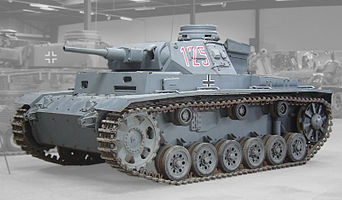
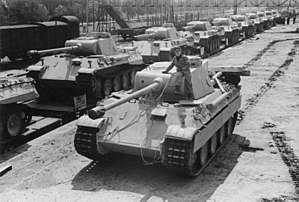
Obviously, these models are thought up by miniature sculptors - not weapons designers. However, if I my job description entailed sitting down and designing a model that is meant to be believably tank-like, I'd at least take the time to spare even Wikipedia a glance at how tanks are actually, well, designed.
My comparisons are made for the Leman Russ, which is the standard battle tank of the IG and the Baneblade - essentially the heavy tank to end all heavy tanks. I'm having to compare them to Second World War tanks, because modern tanks far outclass them in terms of effective armour and speed, but due to still being in service, little information is available regarding their armour. However, you can be assured that the disparity would be even greater.
Armour:
Now my figures are taken to mean 'The armour at it's thickest' - which would be the path of a shot through the hull glacis sloped at circa 30 degrees or through the turret mantle. For the most part, the mantle will be circa 50mm thicker on all of these designs, however (owing to their stupidly high silhouettes) you'd go for a hull shot 90% of the time. So:
Currently, the Leman Russ is figured by FW to have 150mm of Hull Armour. In comparison, the Second World War British Churchill tank had 152mm at it's best point (Turret Mantle) and, whilst a solid, reliable lump, it wasn't the best tank design of the all the participants in the war. Indeed, it wasn't even the best British design of the war - even we recognised that it was more of a 'make do and mend' sort of design. This disparity is particularly amusing considering that the Leman Russ is supposed to have been developed circa 28,000 years later (Great Crusade Era) than the Churchill and in a period of time where Technological regression is only just setting in. Yet for all that, the Leman Russ retains just under the same amount of armour as a 28,000 year old rushed stop-gap design, with a high silhouette and little sloping to increase effectiveness.
Next you have the Baneblade, the most heavily armoured tank the Imperium has produced (Even the Fellhammer/Glaive of the HH has lighter armour) - yet it only has 210mm of armour at it's very thickest point (the mantle). Naturally, the same question remains. The Jagdtiger of the Second World War had 250mm of armour, the IS-3 had 220mm and the Maus Super-Heavy Tank had 220mm of armour. So why is the Baneblade inferior to all of these.
Speed
You've read enough numbers so far, so I'll cut this down - both the Leman Russ and the Baneblade have very poor on-road and off-road speed. The Leman Russ, as a 'Universal tank', 'MBT', 'Tank of the Line' - call it what you will, is slower on-road than almost any MBT or Medium Tank I know of is off road, and is only marginally faster than most Heavy Tank designs. It's 35kph on-road speed measures up to the T-34's 53kph, the Sherman M4A3E2's 40kph and the Panzer V's 46kph speeds when they are all off road. So, the Leman Russ on average is slower than the main medium tanks used in a war 28,000 years previously even with the benefit of a hard surface.
The Baneblade is no better, however it's saving grace is that at 316 tonnes I'd rather expect it to be slow. However, the Leman Russ is only 60 tonnes and the Challenger II of the British Army at around 78 tons can operate on-road (62.5 tons with a further approx 15 tons of upgrade modules) at 59kph.
It seems the IoM (or GW) follows these rules when designing tanks:
A) Ignore 28,000 years worth of common sense and tactics that dictates you try to use cover to your advantage where possible/practical by creating a tank so tall you'd struggle to hide it anywhere outside of an urban area (Which, funnily enough, isn't tank country at all).
B) You then give said tank the same amount of armour as a tank that is 28,000 years older or in some cases less. Of course, you could opt for depleted uranium armouring, reactive armour or any of a host of upgrades - but no, you'd rather stick with plain plasteel. Riiiight...
C) In order to minimise the effectiveness of the armour, follow the trend of adding as many sponsons and protrusions as possible to create handy shell traps for incoming rounds. Any and all sloped armour should be broken up by the addition of outdated weaponry concepts.
D) Finally ensure the tank is as slow moving as possible by limiting on road speed to a trudge and off-road speed to a crawl.
So why are 40k tanks so badly conceived? Is it a conscious decision by GW to imitate technological decay? Willful ignorance so 'rule of cool' prevails (I'd dispute that almost any of the IG tanks are 'cool')? Or is it just plain bad choices and lack of any real thought?
I'd say that it's the latter. GW doesn't know anything about tanks, doesn't try to know anything about tanks, and doesn't give a rat's furry hindquarters about whether or not their tanks are realistic in any way. If they did any of these things, the tanks would likely be far more realistic than they are currently.
Because it's supposed to evoke a sense of WW1/WW2 in space. Hence, boxy, blocky tanks.
210mm of space-metal armor may be equivalent to 750 kilometers of WW2-era steel plate. Or more.
The Baneblade is actually a Light Tank, dating from the Golden Age of the Imperium. The Rhino, and all its variants, are based on a tractor from the same era.
40k tanks are slow, yes. Modern tanks are melted into a pile of steaming goo by any moron with a melta-pistol, Winner? 40k.
A problem a lot of sci-fi writers have is numbers especially if they aren't knowledgeable in the field they are talking about. The FW writing team probably looked up some WW2 tank speccs and based their numbers off of that. I guess they think armored warfare hasn't evolved since 1943. XD
If you want an in universe explanation for these numbers it could easily be that an Imperial meter is not the same as an SI meter.
The answer is simple, it is the reason most designs in science fiction are horrible from a practical point of view (it is not only 40k, just take a look at vehicles from Star Wars or Star Trek):
Rule of Cool
Also, IIRC, the deisgn for most IOM tanks is patterned off of tanks from WWI, the 1920s and 1930s. - most of which could barely keep out machinegun fire or keep up with a running human.
The mature designs that appeared during and after WWII are as a generational leap beyond these for comparison.
@dusara217 - I kind of suspected as much - but you never can tell with GW whether they really are that dumb or it's intentional, sarcastic dumb.
@Psienesis - Steel is steel whichever way you look at it. It's more believable to say 'Oh the armour is depleted-unobtanium from exotic whereveryness' because it acknowledges it's unrealistic characteristics. But to say - 'Yeah it's steel' is just a blatent cop out - we already know how resistant plain steel is and that's why real tanks are using ever more exotic alloys to combine metallic properties into something better than just steel.
Possibly I was just thinking too much about it, but I was trying to find some way I could make a Leman Russ more sensible - but It just irks me that GW are so lazy as to design a model (An ugly one at that), but not even bother to have it make a least the vaguest amount of sense, even from the in-universe perspective of my original post. Thought I'd just see what others thought about it.
The miniature designers wanted to recreate their own favourite tanks, but 1) without having to worry about rivet-counters pointing out their mistakes, 2) make their own adjustments for the sake of coolness and 3) in SPAAAAAAaaaace!.
A while ago there were some rogue-trader era print outs up on a wall in-between Bugmans and Warhammer World. The pictures were basically WWI tanks made from card, but with laser guns for coolness.
The first tank kit by GW, the old Rhino, was designed as it was because they only wanted to tool a single plastic frame, and had limited space to fit the components. As such they had to 'back of a napkin*' design a tank that was essentially reversible, so could be made out of 2 duplicates of the same sprue. Obviously the modern Rhino then adopted elements of this old design.
*read beermat, I am sure
Automatically Appended Next Post: Also, OP, don't forget Plasteel and ceramite are fictional supermaterials, that are 'yet' to be invented, but far surpass anything that exists in modern day times.
Automatically Appended Next Post: Furthermore, the IG tanks are psychological weapons and moving cover for the infantry. It doesn't need to be fast, it just needs to be big enough for meat sacks to hide behind and slow enough for them to keep up.
Automatically Appended Next Post: TLDR tanks were designed by rule of cool. Furthermore, they didn't want to recreate 'modern' designs of the era they were made, because 'modern' designs date very quickly, old designs are timeless.
You might as well ask why battles in the space-future are being fought with tanks at all, since most of the factions involved could easily nuke a tank platoon into dust from orbit.
If you look at some of the older tanks, such as the first predator, you'll see they did have some 'sensible' ideas such as sloped/rounded armour, less bullet traps and so on (see the forgeworld modern equivalents today), but these were ditched in later renditions as they were conceptually too 'advanced' for the backwards, grimdark setting that is 40k.
I have to say, I now feel like an idiot for having asked why 40k makes no sense - momentary lapse of reason. Oh well. I just figured that there had to be a reason for some of the design choices as most of 40k's concepts have a kernel of truth/practicality in them, but the IG tanks are appalling (IMHO). Nevermind - just ignore this fool
@Kap'n Krump - Sarcasm? If not, then I'd say 18kph is pretty slow. That's only 11mph which is just a little above running speed for most people. A man moving at that speed is hard to hit with an AT gun or ATGM - a tank is easy prey.
Here's why, from GW miniature designer Dave Andrews himself. This was in the WD when Spearhead was released.
What's interesting about he tanks of the 41st millennium... is that they're science fiction vehicles, but unlike any you'll see elsewhere. Take Imperial Guard tanks. In truth they share more in common with a tank from the interwar period of the 20th century than they do a modern battle tank or anything "futuristic". They have curiously misshapen hulls, riveted armour plates and absolutely no aesthetic concession to the technological advances we have nowadays. Imperial Guard tanks don't even have proper, sloped armour, and that's quite deliberate. Their design spawns from the thought process of what a fundamentally "backwards" tank would look like 38,000 years in the future in a place where technological understanding has collapsed and innovation is outlawed.
The Imperium is archaic and backwards, clinging the remnants of incredible technologies such as Plasma Cannons and Las-weapons. The image is so exciting and unusual because these misunderstood innovations embedded in fighting vehicles that make a modern tank look like a technical marvel.
Actually, 40k Imperial tanks do make sense if your intent is to invoke an early industrial era/pseudo steampunk vibe. The IOM does that at every turn.
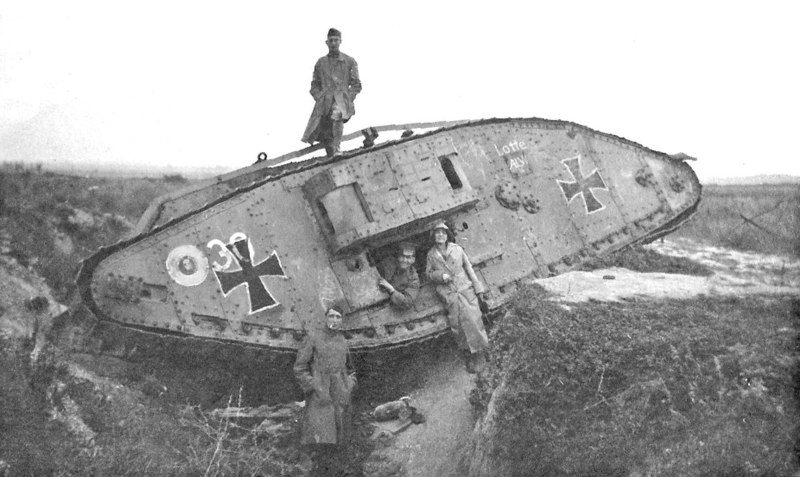
A Leman Russ rather deliberately invokes the Mark I Male tank of WWI with a turret slapped on top and an extra gun sprouting from the nose.
You could justify the design as something contained in STCs. In the beginning STC were the best commonly available designs. In the long run STC designs were intended to be built by new colonies with limited manufacturing capability. The result would be simple and functional, not the epitome of Imperial tank design and manufacture.
It would make sense to have the best units, such as Space Marines and Solar Auxilia, to get more advance equipment that was either never fully fielded or even designed due to the Horus Heresy. Maximus Power Armor would be a typical example.
Alternatively, more volatile, difficult to manufacture, temperamental or experimental systems such as Volkites may have fallen out of use in favor of simpler, more reliable STC designs after the Heresy. Advanced power plants, transmissions, armors and hull/turret designs could fall into the same category.
Or you could just shake your head about the retro look of IOM armored vehicles. If you want sleek, angled armor you could always go for the Eldar or Tau instead...
As for its speed being that of a heavy tank, that's because once upon a time it was: "This heavy tank is the mainstay of the Imperial Guard heavy tank formations." ~ Armies of the Imperium page 61 (1991), back then the Predator was the mainstay of the Imperial Guard, GW later dropped Predators from the IG arsenal without bothering to retcon the Leman Russ's capabilities to reflect its more generalist role.
Don't Hammerheads have a max recorded speed of 70kph as well?
And in comparison, Falcon Grav tanks? Max recorded speed of 800kph. I get that Eldar tanks are supposed to be the fastest of the bunch, but... that's a bit of a bigger speed advantage than you'd initially imagine. Just a tad.
Robin5t wrote:They didn't think the numbers through, I'd say.
Seems that's a general trend. I'll admit, the aesthetics don't fuss me a great deal - I can always convert those and head-canon it into a new variant, and the FW Mars Alpha kit is alright, a step in the right direction for my taste. I just amuses me that they actually sit down to write out an IA volume and the result is quite unrealistic even from an in-universe point of view (Of course, compared to real life most of 40k is totally mental). Not that it helps that each author seems to portray each bit of tech in a different way with no thought for consistency throughout all of BL's publications, indeed through out their own series.
If they'd said Leman Russ = 300mm Hull Armour, 500mm Turret Armour made out of Plasteel/Adamantium alloy. Speed = 40kph Off Road, 55kph On-Road - then I think that would be more fitting with how the LR is portrayed in most publications.
TheWaspinator wrote: You might as well ask why battles in the space-future are being fought with tanks at all, since most of the factions involved could easily nuke a tank platoon into dust from orbit.
Same reason we don't just nuke everything today.
An orbital bombardment is expensive, inaccurate, and it tends to obliterate everything in the area including what you were fighting over in the first place. Planets are valuable, you can't just go nuking and generally blowing them to pieces willy-nilly. On top of this, guardsmen and tanks are cheap. A guardsmen is worth less than the equipment he is wearing, LRBTs can be mass produced by the millions.
Also, in order for an orbital bombardment to take place you have to have space superiority over the target. The ship has to remain stationary in geo-synch orbit or you're gonna miss your target by hundreds of miles, and that leaves it vulnerable to both enemy ships and planet-side defense batteries. It will usually be safer and easier to land troops a few thousand miles away from the target and have them take it that way.
Tanks are very useful when fighting pitched battles with a roughly equal or inferiorly equipped foe. They are weak to aircraft, but that's why you support them with your own. If you have air superiority or at least are evenly matched your tanks can advance relatively safely, as either there are no enemy planes or they're too busy fighting with yours.
Not all combat vehicles are completely unreasonable in terms of visual design. As far as specs go, it's a science fiction/science fantasy game universe, based on the "Rule of Cool" and "heroic" scale models/minis. Things are not meant to make sense in that regard.
Some time back, I found this fun little comparison (from /tg/) between the current base Phobos Pattern Land Raider (which is actually an infantry fighting vehicle rather than a tank), and the real world Abrams family of main battle tanks. I figured that I would post it for the hell of it, since it kinda pertains to the topic.
Warpig1815 wrote: @dusara217 - I kind of suspected as much - but you never can tell with GW whether they really are that dumb or it's intentional, sarcastic dumb.
@Psienesis - Steel is steel whichever way you look at it. It's more believable to say 'Oh the armour is depleted-unobtanium from exotic whereveryness' because it acknowledges it's unrealistic characteristics. But to say - 'Yeah it's steel' is just a blatent cop out - we already know how resistant plain steel is and that's why real tanks are using ever more exotic alloys to combine metallic properties into something better than just steel.
Possibly I was just thinking too much about it, but I was trying to find some way I could make a Leman Russ more sensible - but It just irks me that GW are so lazy as to design a model (An ugly one at that), but not even bother to have it make a least the vaguest amount of sense, even from the in-universe perspective of my original post. Thought I'd just see what others thought about it.
Its not as simple as "steel is steel". There are tons of different grades of steel in modern use, all with (sometimes) very different properties. Who knows what other grades have been developed for use in 40k.
TheWaspinator wrote: You might as well ask why battles in the space-future are being fought with tanks at all, since most of the factions involved could easily nuke a tank platoon into dust from orbit.
For the same reason modern armies have tanks even though we can easily nuke entire tank divisions into dust from two continents away?
OP, you forgot adding the weapons sponsons in back of the landraider transport exits. Because why provide covering fire for disembarking troops when you can give them friendly fire instead.
How many Techpriests does it take to screw in a light bulb? At least one to utter the proper incantations, another to carry the incense censer, a third applies sacred unguents, and a fourth offers prayers and sacrifices to the Omnissiah. Oh, and a Servitor to actually screw in the light bulb.
Now, what were we saying about modern battle tank technology?
The Leman Russ isn't that slow... It's about as fast as a WW2 Pzkw 3, 4 and 6. The engine of it also has a very similar name as that of the Tiger.
Additionally, the dimensions of the engine fit very well into the Leman Russ Engine compartment, if the LR was scaled to realworld scale.
Apart from some "wonder-tech" like meltas, plasmaguns and lasguns etc, the IG is basically WW2, mixed with some WW1 and early cold war stuff in space. Just look at the Infantry Voxcaster that is almost as big as a small fridge... It's not "designed" to be technologically advanced. If it was, it would detract from the "grim darkness" of the setting.
Boggy Man wrote: OP, you forgot adding the weapons sponsons in back of the landraider transport exits. Because why provide covering fire for disembarking troops when you can give them friendly fire instead.
Which is precisely why I model them with the sponsons to the fore, and exit hatches to the rear.
Keep wrote: The Leman Russ isn't that slow... It's about as fast as a WW2 Pzkw 3, 4 and 6. The engine of it also has a very similar name as that of the Tiger.
Additionally, the dimensions of the engine fit very well into the Leman Russ Engine compartment, if the LR was scaled to realworld scale.
Apart from some "wonder-tech" like meltas, plasmaguns and lasguns etc, the IG is basically WW2, mixed with some WW1 and early cold war stuff in space. Just look at the Infantry Voxcaster that is almost as big as a small fridge... It's not "designed" to be technologically advanced. If it was, it would detract from the "grim darkness" of the setting.
Plus while the Imperium is more than capable of producing, and they do indeed produce, some obscenely advanced technology, that stuff is expensive. And you hit diminishing returns.
Sure, instead of making 1,000 LRBTs they could make 10 hover tanks each mounting twin turbo-lasers. But in a straight up fight the 1,000 LRBTs would win, and individually you don't care if they get wrecked. So its a much better use of your resources to make the cheaper stuff you can swarm the enemy with. Especially when the lives of your individual soldiers are a practically unlimited resource.
Superior armor and armament is good, but you also need numbers. The Germans would have been best served by flooding the field with Panthers, which they could produce in large quantities.
I believe the whole reason the Leman Russ was designed to look like an interwar period tank, has more to do with playing with our expectations of what a tank should look like, than any serious attempt at designing a credible sci-fi vehicle. The Leman Russ is supposed to be an ancient, outdated design, and the models and imagery communicates that by presenting us with a vehicle that already looks old.
You might view the Leman Russ design as the placeholder for a tank which would look futuristic to us, but at the same time would be no less archaic in the 41st millennium.
There's a possible parallel here with the Gothic language of 40k, which is presented to us as a form of Latin, even though we're told it's supposed to have evolved from from English, Chinese and so on. But to us, the audience, Latin does a better job of portraying tradition, pseudo-religious bureaucracy and extreme age. The Latin used in 40k is perhaps another placeholder for a different, futuristic language, which isn't really used except in names and certain words, such as "melta".
Another thing to consider when talking about the Russ and it'S design is Imperial Guard tactics. The Leman Russ isn't just a cheap vehicle to throw at the enemy in hordes (even though that works for the most part). Nor is it a "main battle tank" in the purest sense. The vanilla Leman Russ Battle Tank is basically an old fashioned "infantry tank". The main offensive arms of the Guard are the infantry and artillery. Tanks like the basic Russ are there to support the infantry. In that vein, it's more closely related to the Matilda Mark II than the Sherman or T-34.
For the most part, outside of armored fist companies, and units like the Steel Legion, mechanized warfare as we know it isn't the norm.
oldravenman3025 wrote: The vanilla Leman Russ Battle Tank is basically an old fashioned "infantry tank". The main offensive arms of the Guard are the infantry and artillery. Tanks like the basic Russ are there to support the infantry. In that vein, it's more closely related to the Matilda Mark II than the Sherman or T-34
It is faster then a Matilda and also boasts armament fit for anti-tank, anti-infantry and anti-fortification tasks. It's a multipurpose vehicle. Like i said, it's in the same speed range as german 1940 tanks. Therefore all the tactics they used during that time regarding battletanks should be perfectly possible. It can operate as "infantry tank" (due to heavy front armor), but also in full tank companies.
If there is one thing i find illogical in relation, then it has to be the chimera's speed. It weighs 2/3 of the Leman Russ (~40t) but has double the speed without significantly larger engine-compartments.
oldravenman3025 wrote: The vanilla Leman Russ Battle Tank is basically an old fashioned "infantry tank". The main offensive arms of the Guard are the infantry and artillery. Tanks like the basic Russ are there to support the infantry. In that vein, it's more closely related to the Matilda Mark II than the Sherman or T-34
It is faster then a Matilda and also boasts armament fit for anti-tank, anti-infantry and anti-fortification tasks. It's a multipurpose vehicle. Like i said, it's in the same speed range as german 1940 tanks. Therefore all the tactics they used during that time regarding battletanks should be perfectly possible. It can operate as "infantry tank" (due to heavy front armor), but also in full tank companies.
If there is one thing i find illogical in relation, then it has to be the chimera's speed. It weighs 2/3 of the Leman Russ (~40t) but has double the speed without significantly larger engine-compartments.
Speed really doesn't factor into whether or not a tank is classified as an "infantry tank". And the Matilda was also effective against armor and fortified positions during the peak years of it's service history. An infantry tank has to be something of a multipurpose vehicle to properly support the boots against various threats. That's all it has to be. "A jack of all trades, master of none" is good enough to back up the grunts taking real estate.
But as a line battle tank, in a setting with uber-powerful anti-armor weapons, the Russ is hurt by it's subpar defensive systems. Armor coverage in critical areas, in particular.
The Russ also suffers from the same issues plaguing the earlier marks of Sherman. In other words, "good enough" isn't always enough. That's why you have the variants to meet tactical needs that the base model just doesn't sufficiently cover. Fortunately. the Leman Russ chassis is versatile to allow that.
Superior armor and armament is good, but you also need numbers. The Germans would have been best served by flooding the field with Panthers, which they could produce in large quantities.
Or plain old Panzer IVs (which IIRC were the real workhorses of the Panzer divisions in any case). These somewhat weaker-armored tanks could mount the same gun as the Panther while maintaining mobility and having the largest pool of spare parts available. As a somewhat irritated Ferdinand Porsche said, the Führer demanded Tigers and Panthers when he could have had four or two reasonably powerful Panzer IVs for every one of the shinier models.
The IoM is in a similar bind as the great powers of WW2. It needs a lot of stuff, it needs it now and everything should be common enough that it can be repaired in the field by cannibalizing parts from units that can't be repaired. Kind of like the Nazis tried to do with the different PZ III and IV Stug/Jagd versions, cheaper fixed-gun variants based on the most common chassis they had available. They just didn't streamline production enough, not that they had the means to win anyway but it would have taken longer for them to fall.
Yes, in real life people tend to not want to use nukes on enemy armies for many reasons. I question whether those motivations apply to the 40K Imperium, since they are willing to and DO exterminate all life on entire planets.
Zingraff wrote: I believe the whole reason the Leman Russ was designed to look like an interwar period tank, has more to do with playing with our expectations of what a tank should look like, than any serious attempt at designing a credible sci-fi vehicle. The Leman Russ is supposed to be an ancient, outdated design, and the models and imagery communicates that by presenting us with a vehicle that already looks old.
You might view the Leman Russ design as the placeholder for a tank which would look futuristic to us, but at the same time would be no less archaic in the 41st millennium.
There's a possible parallel here with the Gothic language of 40k, which is presented to us as a form of Latin, even though we're told it's supposed to have evolved from from English, Chinese and so on. But to us, the audience, Latin does a better job of portraying tradition, pseudo-religious bureaucracy and extreme age. The Latin used in 40k is perhaps another placeholder for a different, futuristic language, which isn't really used except in names and certain words, such as "melta".
TheWaspinator wrote: Yes, in real life people tend to not want to use nukes on enemy armies for many reasons. I question whether those motivations apply to the 40K Imperium, since they are willing to and DO exterminate all life on entire planets.
The Imperium has no moral qualms about any WMDs, but they are extremely pragmatic and big picture orientated.
Their most abundant resource is human lives. So if you can buy anything with human lives it will be bought, because that can save you more valuable assets.
Exterminatus is a move of last resort. Its only done when there is no other option. Something so dangerous it needs to be utterly destroyed to save something more valuable. The Imperium will exterminates a dozen worlds in the path of a tyranid hive fleet to starve it and prevent its further advance across a sector. They'll destroy a Forge World about to fall to an Ork Waaagh to prevent the greenskins from turning its technology against them.
Keep wrote: If there is one thing i find illogical in relation, then it has to be the chimera's speed. It weighs 2/3 of the Leman Russ (~40t) but has double the speed without significantly larger engine-compartments.
Never in the context of an amphibious tracked vehicle
Automatically Appended Next Post:
oldravenman3025 wrote: Speed really doesn't factor into whether or not a tank is classified as an "infantry tank". And the Matilda was also effective against armor and fortified positions during the peak years of it's service history. An infantry tank has to be something of a multipurpose vehicle to properly support the boots against various threats. That's all it has to be. "A jack of all trades, master of none" is good enough to back up the grunts taking real estate.
Mid to late WW2 medium and heavy tanks, apart from certain silly designs, are all almost always effective against basically everything on the ground, unless there is a "bigger something" that is pitted against them. So "jack of all trades, master of none" can not be a definition for infantry tank, otherwise the majority of WW2 tanks would have to be categorized as "infantry tanks".
But as a line battle tank, in a setting with uber-powerful anti-armor weapons, the Russ is hurt by it's subpar defensive systems. Armor coverage in critical areas, in particular.
By that definition the only tank not beeing supbar in the setting would be the land raider... It's the quantity of everything on the field that matters.
Also, it has better "defensive systems" then other tanks, simply because it can cover 180° field of fire with sponson weapons.
oldravenman3025 wrote: Speed really doesn't factor into whether or not a tank is classified as an "infantry tank". And the Matilda was also effective against armor and fortified positions during the peak years of it's service history. An infantry tank has to be something of a multipurpose vehicle to properly support the boots against various threats. That's all it has to be. "A jack of all trades, master of none" is good enough to back up the grunts taking real estate.
Mid to late WW2 medium and heavy tanks, apart from certain silly designs, are all almost always effective against basically everything on the ground, unless there is a "bigger something" that is pitted against them. So "jack of all trades, master of none" can not be a definition for infantry tank, otherwise the majority of WW2 tanks would have to be categorized as "infantry tanks".
That wouldn't be all that incorrect of a definition for a lot of them.
Early tank doctrine had been the "Land Ship" strategies where tanks were treated and moved much like naval warships. But Blitzkrieg quickly showed that tanks were best when used in support of infantry. That was actually almost the entirety of US tank doctrine, which resulted in a somewhat panicked rush to get 76mm guns onto Shermans because the Germans had rolled out Panthers and the 75mm shermans couldn't handle them.
Grey Templar wrote: That wouldn't be all that incorrect of a definition for a lot of them.
Early tank doctrine had been the "Land Ship" strategies where tanks were treated and moved much like naval warships. But Blitzkrieg quickly showed that tanks were best when used in support of infantry. That was actually almost the entirety of US tank doctrine, which resulted in a somewhat panicked rush to get 76mm guns onto Shermans because the Germans had rolled out Panthers and the 75mm shermans couldn't handle them.
Actually, quite the opposite is true. As of United States Field Manual 100-5, the M4 Sherman was initially intended to fulfill roughly the same role as the British termed a 'Cruiser' tank, in that it would be utilised as part of a highly mobile striking force intended to strike into and operate within the enemy rear ala Blitzkrieg tactics, with the infantry supporting the armour rather than the opposite. It was only with America's entry into the North African and Italian theatres that they learnt that in fact instances of armour vs armour warfare and infantry support far outweighed the intended breakthrough actions they had foreseen. Accordingly, the emphasis was only switched later on to the infantry support and AT roles.
I'd also argue that the rush to arm US Shermans with 76mm guns wasn't actually all that great. Whilst the British rapidly ramped up production of the Firefly armed with the Ordnance QF 17 pdr, to such a point that by the War's conclusion at least 50% of all British Sherman's were Fireflys, in comparison the US M1 76mm, although being superior to the 75mm M3 in terms of AT capabilities, wasn't produced nearly as much due to it's inferior HE round. Combined with the fact that the US rejected the British 17pdr (a gun with vastly superior AT properties), this is indicative of the nature of the enemy that the US faced. In the north of France, the British contended with 6 1/2 Panzer Divisions, of which one was the premier Panzer Lehr division and there were at least two heavy tank battalions including Tiger II's present. In comparison, in the south and west, the US Army faced only 1 1/2 Panzer Divisions. Hence, the US Army actually had a far smaller need for AT guns than the British as the majority of the force that they engaged was infantry based. As such, the need for the HE 75mm becomes evident as it proved more useful in the average style of infantry based combat than the 76mm M1.
Zingraff wrote: I believe the whole reason the Leman Russ was designed to look like an interwar period tank, has more to do with playing with our expectations of what a tank should look like, than any serious attempt at designing a credible sci-fi vehicle. The Leman Russ is supposed to be an ancient, outdated design, and the models and imagery communicates that by presenting us with a vehicle that already looks old.
.
Boggy Man wrote: OP, you forgot adding the weapons sponsons in back of the landraider transport exits. Because why provide covering fire for disembarking troops when you can give them friendly fire instead.
Which is precisely why I model them with the sponsons to the fore, and exit hatches to the rear.
Deviant! Obviously you need more time studying the works of our spiritual liege!
And with that i have nothing more to say about the elegant, fresh and above all incredibly functional design that is the Leman Russ Battle Tank. You sir, win this thread, I consider myself beaten.
Zingraff wrote: I believe the whole reason the Leman Russ was designed to look like an interwar period tank, has more to do with playing with our expectations of what a tank should look like, than any serious attempt at designing a credible sci-fi vehicle. The Leman Russ is supposed to be an ancient, outdated design, and the models and imagery communicates that by presenting us with a vehicle that already looks old.
.
The idea that I'm trying to put forward is that the Leman Russ probably should look very different, but in order for the design to appear ancient to us, they've "replaced" the "real" Leman Russ with the design we've now got. In that way the Leman Russ will look as outdated to us, the 21st century audience, as the theoretical "real" Leman Russ would appear to someone from the 41st millennium. If the "real" Leman Russ was to exist, it would boggle our 21st century minds.
WW2 churchill built with steel. Leman Russ with plasteel, aka, fictional material that has X endurance, where X is whatever it needs to be. In comparison, the front armour of a leman russ is as tough comparatively as a Land Raider which is Adamantium, a near-indestructable supermetal by our standards.
This is also the realm where you use non-conventional weaponry for anti-tank purposes. Melta, Lance, Haywire, Destroyer weapons, its irrelevant for the most part if you have 150mm or 200m. For these tanks the lighter armour and profiles must be the most conveniant to make using processes and materials they have access to, while it's still sufficient to cover conventional AT weapons like Autocannons and Krak Missiles. Plus the materials are different and density is different. Plus the game and model designers are not mechanics or engineers and make models that easily fit into sprues and look cool.
Deadshot wrote: as a Land Raider which is Adamantium, a near-indestructable supermetal by our standards.
Near-inderstructable my ass, you saw the comparision picture on the last page? 98mm of Adamantium is worth about 300mm of steel. That's not even a quarter to a third of the protection afforded by the M1 Abrams (depending on the round being fired at the armor)
Deadshot wrote: as a Land Raider which is Adamantium, a near-indestructable supermetal by our standards.
Near-inderstructable my ass, you saw the comparision picture on the last page? 98mm of Adamantium is worth about 300mm of steel. That's not even a quarter to a third of the protection afforded by the M1 Abrams (depending on the round being fired at the armor)
The Landraider is not the main battle tank of the space marines, that's the Predator's job.
Exalted Pariah wrote: I heard that Leman Russ Battle Tanks looked like that because the IOM found a complete STC for tractors and modified it with weapons....
That sounds really familiar, I think that this might actually be true. Where did I read this before? I swear, it's right there, the words just escape me.
Deadshot wrote: as a Land Raider which is Adamantium, a near-indestructable supermetal by our standards.
Near-inderstructable my ass, you saw the comparision picture on the last page? 98mm of Adamantium is worth about 300mm of steel. That's not even a quarter to a third of the protection afforded by the M1 Abrams (depending on the round being fired at the armor)
Different metals. Let's have a look at another example of Adamantium within fiction, which is not only the most common and popular example of the stuff but also likely the origin of the idea in 40k, which is Marvel's Wolverine. Given that 40k was originally a parody of popular culture, its not unreasonable to assume that the writrrs ripped Adamantium from Marvel. And in Marvel, Wolverine's adamantium is practically indestructable to 21st century processes and weapons.
Its a fictional metal with X protection, and X is fluid. A comparison is worthless because you don't know how dense or protective adamantium is compared to steel. For all you know, 1mm of Adamantium is worth 10000mm of steel in 2016. You are trying to find X when you don't know W, V, Y, Z or any of the other variables.
Deadshot wrote: as a Land Raider which is Adamantium, a near-indestructable supermetal by our standards.
Near-inderstructable my ass, you saw the comparision picture on the last page? 98mm of Adamantium is worth about 300mm of steel. That's not even a quarter to a third of the protection afforded by the M1 Abrams (depending on the round being fired at the armor)
Different metals. Let's have a look at another example of Adamantium within fiction, which is not only the most common and popular example of the stuff but also likely the origin of the idea in 40k, which is Marvel's Wolverine. Given that 40k was originally a parody of popular culture, its not unreasonable to assume that the writrrs ripped Adamantium from Marvel. And in Marvel, Wolverine's adamantium is practically indestructable to 21st century processes and weapons.
Its a fictional metal with X protection, and X is fluid. A comparison is worthless because you don't know how dense or protective adamantium is compared to steel. For all you know, 1mm of Adamantium is worth 10000mm of steel in 2016. You are trying to find X when you don't know W, V, Y, Z or any of the other variables.
Gobbla wrote: 85,000 T-34's + 50,000 M-4's vs 5000 Pz-IV's. You do the math.
A reason the Imperium has different vehicles in different organizations is to make it difficult for one organization to go rogue.
That's a big part of it.
But it hasn't entirely worked out that way, with the number of warships,Chapters, and Regiments that turned traitor (sometimes at the worst possible time) since Rawbutt's reforms. It's minimized the damage, to be sure. However, those policies have hurt the Imperium on occasion.
Bobthehero wrote: No, they literally say 98mm of Land Raider armor is the same as 300mm of steel, normal steel not plasteel or something made up, normal boring steel
What kid of steel though? Damascus steel, that is seemingly indestructable by medieval standards (and is only outperformed by the highest quality chemical steels that the modern world can produce), or the crap that you'll find in a 5$ pocket knife? The properties of these two steels differ immensely, even though both are just "boring old steel." The former will be capable of surviving battle after battle after battle in seemingly endless campaigns of sheer attrition, while the latter likely couldn't even survive a single scrap without breaking.
Exalted Pariah wrote:I heard that Leman Russ Battle Tanks looked like that because the IOM found a complete STC for tractors and modified it with weapons....
The only one i remember that of is the Rhino and the tiny Centaur. Doesn't make alot of sense in case of the Rhino however...
Bobthehero wrote:No, they literally say 98mm of Land Raider armor is the same as 300mm of steel, normal steel not plasteel or something made up, normal boring steel
Option 1) Everything in the imperium is made of plasteel - and they just use steel as a synonym
Option 2) It's a special steel with superior capabilities they use as standard for armor
Option 3) It's regular "armour steel" like we have now
Something to consider: Iirc this figure is very old. The stats of the vehicles (of Leman Russ, Chimera, etc) are also very old. FW did not invent them, they just added additional info. Those figures might be around since the days of the Inferno magazine.
Whatever the case may be - the amount of armor is clearly enough to be very resistant against the most common AT weapons fielded in 40k.
The amount of armor has to be measured relative to the power of anti tank weapons, instead of comparing it to the amount of armor in the realworld, presentday. If you think at WW2 technology level, 300mm armored steel would be almost impenetrable.
Bobthehero wrote: No, they literally say 98mm of Land Raider armor is the same as 300mm of steel, normal steel not plasteel or something made up, normal boring steel
What kid of steel though? Damascus steel, that is seemingly indestructable by medieval standards (and is only outperformed by the highest quality chemical steels that the modern world can produce), or the crap that you'll find in a 5$ pocket knife? The properties of these two steels differ immensely, even though both are just "boring old steel." The former will be capable of surviving battle after battle after battle in seemingly endless campaigns of sheer attrition, while the latter likely couldn't even survive a single scrap without breaking.
The image posted on the previous page states that the 98mm armor of the Land Raider is equivalent to 300mm of conventional steel. Now the term conventional steel is a pretty broad term but commonly refers to steel typically used in construction so I suppose one could say it's construction steel... Which still broadly covers several different types of steel. However, I can assure you that Damascus steel or RHA (rolled homogeneous armor) steel do NOT fall under the category of "conventional" steel.
King Pariah wrote: However, I can assure you that Damascus steel or RHA (rolled homogeneous armor) steel do NOT fall under the category of "conventional" steel.
If you are talking about armor of a vehicle then you would generally not be talking about construction steel ... that would be pretty idiotic to compare construction steel as armor to anything, as it isn't used as armor...
King Pariah wrote: However, I can assure you that Damascus steel or RHA (rolled homogeneous armor) steel do NOT fall under the category of "conventional" steel.
If you are talking about armor of a vehicle then you would generally not be talking about construction steel ... that would be pretty idiotic to compare construction steel as armor to anything, as it isn't used as armor...
Just saying that the image on the first page compares Land Raider armor to conventional steel. Which I suppose is very much in the vein of all that is GW.
King Pariah wrote: However, I can assure you that Damascus steel or RHA (rolled homogeneous armor) steel do NOT fall under the category of "conventional" steel.
If you are talking about armor of a vehicle then you would generally not be talking about construction steel ... that would be pretty idiotic to compare construction steel as armor to anything, as it isn't used as armor...
Just saying that the image on the first page compares Land Raider armor to conventional steel. Which I suppose is very much in the vein of all that is GW.
Which is one source from one source of one facet of GW. Its fictional supermaterial, its values are X, Y, Z, where X, Y and Z are whatever they need to be and variable.
Bobthehero wrote: No, they literally say 98mm of Land Raider armor is the same as 300mm of steel, normal steel not plasteel or something made up, normal boring steel
And this is something we can freely ignore since,
1) GW is composed of idiots.
2) Fluff shows the armor accomplishing feats which disprove it only being equivalent to 300mm of steel, such as a Land Raider surviving multiple nuclear detonations unscathed during the Rynn's World Disaster and then going on to severely cripple the invading orks by itself with just its Machine Spirit.
Bobthehero wrote: Or ignore the nuke one in favor of hard numbers. But heeeeeeeeeeey.
Given that the nuke actually happened, while numbers are just gibber jabber on a page... I'll go with the demonstrated durability instead of what is obviously an incorrect assertion.
Unfortunately, surviving a nuclear blast doesn't mean a tank has exceptional defensive qualities.
In 1952, a British built, Australian operated Centurion Tank (Developed in the closing days of the Second World War and one of the most successful tank designs of the post-war period) was involved in a nuclear test. The tank was placed 500 yards from a 9.1 kiloton nuclear explosion with the engine running and a full ammunition load. After detonation, it was found the tank had moved slighly to the left, the engine had stopped running due to the fuel running out (Presumably evaported in the blast) and it had suffered minor abrasion and the cloth mantlet had been incinerated. The most substantial damage had been the armoured side skirts and antenna had been blown off. the tank was then driven from the site.
The tank was then sent to Vietnam with the Australian Army and engaged in combat. During this service it was struck by an RPG and the turret crew (3 members) were injured, with one necessitating evacuation.
TLDR: A tank can survive a nuclear blast, as the Atomic Tank was, but despite serving for another 23 years afterwards still have it's armour compromised by a weapon with explosive qualities that are incredibly smaller. Explosive power isn't all that great against armour - hence why AT, APCR and APDS rounds are designed to maximise penetrative power over explosive power.
Take all the coolest parts of WWI, WWII, mad max, dune, judge dress, aliens, etc.,etc. and mix it together. Then sprinkle everything with skulls and gothic arches for effect.
An army of Rambo clones fighting space orcs with chainsaw swords. Geiger-esque aliens fighting WWI trench fighters. Etc. etc.
And that odd mix of aesthetics is what is so appealing about it.
Land raiders, leman Russ tanks and so forth are cool BECAUSE they are so fugly and archaic looking.
I don't want hi-tech nor ultra- realistic in my 40k.
I want to drive my WWI-ish tank closer to those "Egyptian robot T-1000s" so my guy dressed like a space Hessian can jump out and hit the enemy robot with a civil war inspired power saber!!!
If you don't love that imagery, you just don't "get" 40k...
Warpig1815 wrote:Unfortunately, surviving a nuclear blast doesn't mean a tank has exceptional defensive qualities.
Exactly! A nuke does damage due to the pressure wave and the sudden heatspike. The heatspike is way too short to melt armour.
Wikipedia wrote:Trials with nuclear weapons showed that a T-54 could survive a 2–15 kt nuclear charge at a range of more than 300 metres (980 ft) from the epicentre, but the crew only had a chance of surviving at 700 metres (2,300 ft). It was decided to create an NBC (nuclear, biological, and chemical) protection system which would start working 0.3 seconds after detecting gamma radiation.
A landraider with "just" 300mm armoured steel equivalent would be a lot sturdier then a T-54
Even if it was RHA, it's still laughably low compared to the Abrams armor
You have read nothing of this thread apparently... It's not designed to be better then everything that exists in the realworld.
CT GAMER wrote:If you don't love that imagery, you just don't "get" 40k...
It's probably rather unfair to say that if you don't love one tiny aspect of 40K you don't get all of 40k. I'm not keen on the Leman Russ, but I like the Shadowsword and Macharius (and the Land Raider for that matter). I rather dislike Logan Grimnar's hover-sleigh, but I think the Arjac Rockfist sculpt is great. I like the Nephelim Jetfighter, but I dislike the Land Speeder Vengeance. I don't have to like absolutely everything associated with 40k in order to like 40k as a whole.
Really, I started this thread as more of an intellectual discussion on the merits and failures of 40k tank design and a genuine question as to why they are as they are from an in-universe point of view - especially when compared to designs of the previous 28,000 years. I certainly didn't start it so that anybody can deride or call into question somebody else's taste simply because they have a different opinion...
CT GAMER wrote:If you don't love that imagery, you just don't "get" 40k...
It's probably rather unfair to say that if you don't love one tiny aspect of 40K you don't get all of 40k. I'm not keen on the Leman Russ, but I like the Shadowsword and Macharius (and the Land Raider for that matter). I rather dislike Logan Grimnar's hover-sleigh, but I think the Arjac Rockfist sculpt is great. I like the Nephelim Jetfighter, but I dislike the Land Speeder Vengeance. I don't have to like absolutely everything associated with 40k in order to like 40k as a whole.
Really, I started this thread as more of an intellectual discussion on the merits and failures of 40k tank design and a genuine question as to why they are as they are from an in-universe point of view - especially when compared to designs of the previous 28,000 years. I certainly didn't start it so that anybody can deride or call into question somebody else's taste simply because they have a different opinion...
Your taste is your own, never questioned it, but you're preferences don't fit the 40k aesthetic. Personally if everything looked like Halo or Infinity I'd have zero interest in 40k.
However the sometimes jarring and illogical mix of pseudo-historical//real world aesthetics is FULLY intentional and is what defines the "40k aesthetic". If someone says 40k tanks need to be sleeker/more hi-tech/ more realistic, then no I don't think you "get" the very intentional aesthetic of the setting...
So to answer your original question: "why are 40k tanks so "poorly" designed? Because old clunking WWI/WWII monstrosities are ridiculously cool looking and the designers wanted an archaic looking tech base for various stylistic/fluff reasons. That's why.
@CT GAMER - Fair enough, but yet again you assume that somebody doesn't 'get' something quite complex, based on a rudimentary text-based internet forum. I fully understand the concept of 40K tanks - they are designed to appear 20th century archaic as an analogy to 41st Century archaic. I 'get' that. Perhaps it's simply personal preference and it's just that I like a little Science, with my Science-Fiction, where you may prefer a lot more Fiction, with your Science-Fiction. Furthermore, if I didn't 'get' the intentional aesthetic of the setting, then why would I bother myself to A) Spend an inordinate amount of money on models I don't like, B) Immerse myself in a setting I don't understand and C) Sign up to a forum to interact with people who apparently don't share the same interest. Plainly I do 'get' the setting, as I'm here enjoying it - I simply disagree on certain finer points.
All in all, perhaps it was an ill-worded question considering it's so subjective and I respect your position upon it so for that matter I'm going to leave it there. We'll agree to disagree.
Warpig1815 wrote: Unfortunately, surviving a nuclear blast doesn't mean a tank has exceptional defensive qualities.
In 1952, a British built, Australian operated Centurion Tank (Developed in the closing days of the Second World War and one of the most successful tank designs of the post-war period) was involved in a nuclear test. The tank was placed 500 yards from a 9.1 kiloton nuclear explosion with the engine running and a full ammunition load. After detonation, it was found the tank had moved slighly to the left, the engine had stopped running due to the fuel running out (Presumably evaported in the blast) and it had suffered minor abrasion and the cloth mantlet had been incinerated. The most substantial damage had been the armoured side skirts and antenna had been blown off. the tank was then driven from the site.
The tank was then sent to Vietnam with the Australian Army and engaged in combat. During this service it was struck by an RPG and the turret crew (3 members) were injured, with one necessitating evacuation.
TLDR: A tank can survive a nuclear blast, as the Atomic Tank was, but despite serving for another 23 years afterwards still have it's armour compromised by a weapon with explosive qualities that are incredibly smaller. Explosive power isn't all that great against armour - hence why AT, APCR and APDS rounds are designed to maximise penetrative power over explosive power.
Except this wasn't just a piddly little 20th century nuke.
This was dozens of 41st millennium nukes, plus all the munitions in the Fortress Monastary getting detonated. And the Land Raider was inside the Fortress when it happened, it wasn't 500 yards away.
To be fair to Grey Templar, he is right in the respect of the munitions going off. However, it wasn't many nukes, it was just one.
One nuke malfunctioned and fell back on the Fortress-Monastary, detonating in the main magazine. Whether or not there were other nukes in the magazine I cannot say, but the initial detonation was one nuke going off deep in the bowels of the fortress if you're going the account presented in Rynn's World by Steve Parker. Going from an in-universe point, if it was many nukes how could Pedro Kantror, Alessio Cortez and a few others have survived when they were on the walls of the fortress? If one nuke and the magazine went off, they could have survived (As 3 men did in the Second World War when the magazine of HMS Hood detonated), but if so many nukes had gone off it would have torn the mountain apart and nobody could possibly have survived through any credible means.
IIRC there were several missiles which fell back into the Monastary, not just one.
And I highly doubt the Crimson Fists fired their entire arsenal of missiles in one volley. That would indicate they didn't have an adequate stockpile of munitions, which doesn't make any sense at all. So there had to have been more missiles in storage or getting loaded into the launch bays.
I remember the book as they fire all the missiles off and then one malfunctions and targets the monastary. That's how I remember it, but I'm not going to argue as I don't have the book in front of me to provide a direct quote and I'm going by memory. What I will post is the Lexicanum extract, which I consider to be accurate:
Lexicanum wrote:Warboss Uzrog then attacks Rynn's World directly and during the Orkish invasion, there is a trillion to one chance malfunction and a rogue missile from the chapter's surface-to-space defence system flies off course and hits the main arsenal of the fortress-monastery.
That's directly from Lexicanum 'The Invasion of Rynn's World' page, with no edits. Please not the use of the phrase 'A rogue missile'. Take from it what you will.
Robin5t wrote: Don't Hammerheads have a max recorded speed of 70kph as well?
And in comparison, Falcon Grav tanks? Max recorded speed of 800kph. I get that Eldar tanks are supposed to be the fastest of the bunch, but... that's a bit of a bigger speed advantage than you'd initially imagine. Just a tad.
They didn't think the numbers through, I'd say.
No one is talking about Tau and Eldar Tanks.
These two factions would realistically out perform all imperium tanks - from 1d4chan
Design-wise, it's interesting to note that while the Russ looks like (as the Russ's 1d4chan article says) "A drunken three-way between an old British Mark-V, a M3 Lee, and a T-34", the Hammerhead looks more like the love child conceived after a night of red wine between an M1 Abrams and the U.S. Navy rail gun program. And then the child was spoiled rotten by Grandma Attack Helicopter.
Much like a cold war tank, the Hammerhead is low to the ground with good (if the model is any indication) gun depression (said to be from -10° to +28°) , with a main gun that can be either anti-tank or anti-infantry depending on its firing mode, while being blisteringly fast. Further, its role is more akin to a U.S. tank than a Soviet one, as western tanks were built to take on lots and lots of Soviet tanks at once. As mentioned, Hammerheads are almost always drastically outnumbered by Leman Russes. (Who are the communists supposed to be here, again?)
Tactically they fill the same niche as a modern tank, an element supporting mechanized infantry advancing very, very quickly, and taking out armor while using its machine guns on infantry, and The ion cannon fills a role similar to a Bradley's chain gun by taking out infantry and (if a modern military ever faced power armor) heavy infantry. While it does have rather fine armor, Hammerhead rely more on evasive maneuvers, disruption pods and straight up outranging it's opponents to survive, so it can potentially withstand twice to trice more anti-tank fire than most imperial tanks. The Leman Russ, on the other hand, is a World War II tank and it shows; it's much slower and has a much broader silhouette, but it's bristling with guns and relying purely on it's thick armor, while lacking more sophisticated defense systems.
"Shas'ui, I have spotted the Gue'la tanks sitting on the horizon line, twelve kilometers downrange! Engaging now!"
Three seconds later* CLANG, KA-BOOM! The leman russ spontaneously explodes
It still would have cooked off all the other missiles that were still yet to be fired, so we still have multiple close range nuclear detonations on top of a lot of conventional ones.
@Grey Templar - Possibly. IMHO I disagree, but if that is the case, I think one thing we can agree upon is that Pedro Kantor's plot armour is significantly more powerful than a Land Raider's 98mm
The one negative I would say about the Xenos Tanks are that they have highly exposed engines and large intakes that are juicy targets. But if they're over twice as fast as imperium tanks and can descend from orbit or drop off cliffs, jump obstacles and have optics and fire control systems lightyears ahead of the Imperiaum, its a design flaw that can be overlooked...
*Stats: Imperium armored vehicles are decent to very good depending on the edition.
If you desire to see how IOM vehicles really rock-look to EPIC. They are very tough with a substantial offensive punch.
*Models: models are designed to invoke the weird steampunkest vision they started with. Plus this separates them from other sci designers who have clearly more advanced vehicles.
One thing I'd say about using that Land Raider statistic (and a few other low ones) is that it makes every other faction look bad as well. If even the Tau, Eldar and Necrons struggle to consistently penetrate Land Raider with non-Titan level weapons then a lot of their technology lags behind us too. The toughness of their armour is generally worse than Imperial armour too which would lead to Hammerheads unable to penetrate an Abrams and being penetrated by weaponry far less powerful than the Abrams' main cannon.
Naaris wrote: The one negative I would say about the Xenos Tanks are that they have highly exposed engines and large intakes that are juicy targets. But if they're over twice as fast as imperium tanks and can descend from orbit or drop off cliffs, jump obstacles and have optics and fire control systems lightyears ahead of the Imperiaum, its a design flaw that can be overlooked...
If the Tau railgun had the firepower of real life railguns and the range it would quickly make short work of pretty much the entire Imperiums tank force. Sadly GW are derps who have no idea just how powerful a railgun is.
Naaris wrote: The one negative I would say about the Xenos Tanks are that they have highly exposed engines and large intakes that are juicy targets. But if they're over twice as fast as imperium tanks and can descend from orbit or drop off cliffs, jump obstacles and have optics and fire control systems lightyears ahead of the Imperiaum, its a design flaw that can be overlooked...
If the Tau railgun had the firepower of real life railguns and the range it would quickly make short work of pretty much the entire Imperiums tank force. Sadly GW are derps who have no idea just how powerful a railgun is.
It would also have recoil that would make putting it on a hovering platform a bad idea. Plus the Hammerhead railgun isn't capable of firing in parabolic arcs due to its mount, so that artificially limits its maximum range.
A battalion of LRBTs will take losses as it approaches a HH, but their guns are just as capable of destroying it as it is of destroying them. And they are far cheaper to mass produce.
It doesn't matter if a Hammerhead will destroy 10 LRBTs before its destroyed if the IG can field 100 LRBTs for every Hammerhead they face.
The only problem with rules vs fluff and stats, is that it won't ever match up as a few other posters have said. Say, if we go by the novel's and fluff in codexes, a company of Space Marines is a world conquering force, and Terminators are walking gods who laugh at orbital blasts... Except it doesn't work out that way.
I feel that using the model's table top stats are not going to be that good of a reflection of how the tanks really operate. They can't be as good as they should be if GW wants to be able to sell more than one tank per army. It isn't a bash on GW, but the truth that they are a business. Has anybody ever seen the "Movie Marines" article in White Dwarf? They had essentially made a mini codex that represented Marines as they are in the fluff. You could pretty much run a Tactical Squad against a 2,000 point army and still have a very good chance of coming out on top. Now imagine adding an accurate representation of a Land Raider or Dreanaught to that.
But, I will add one thing, the biggest advantage I feel that Imperial vehicles have is that they can run on essentially anything put in their tank. I think it is in Titanicus or Double Eagle by Dan Abnett that a tank commander pretty much just throws whatever he can find in the tank to keep his squad moving. Not even an Abrams or any other 21st century vehicle can claim that. A Leman Russ might not be the heaviest armored vehicle with the most badass sci fi weaponry available, but anything that can be cheaply and quickly built and fixed by the barely trained and fueled by whatever in the galaxy that's a liquid is a winner in my book.
Automatically Appended Next Post: But, sadly the tabletop stars are really the only thing we can use to compare the vehicles because it's the closest thing to a standard grading system.
Also, sorry to keep ranting, but I showed my buddies the cutaway Land Raider poster with stats and stuff that I saw during 3rd Edition (Google is great) and they laughed so hard. One was a tanker in the army (he's part of my D&D group), and my other buddy is a mechanic (he's in my Warmachine group). So, they at least understand the proposed mechanics of the thing better than I do (I was Infantry, I just break machines haha). They both instantly noticed that there is no way the guys at GW know anything about how to construct a vehicle built for war. So the printed stats I think are hard to use for comparison as well when comparing how durable the vehicle is as well because even though guys here might know something about metallurgy, can guarantee GW doesn't. Rule of cool I think is what designed these vehicles.
Which is really only useful in Symmetrical warfare, or Asymmetrical warfare where its asymmetrical in your favor.
How so? If the HH's both out-range them, and can move back faster than the LR's can, combined with tau's inherent mobility and lack of concern for losing ground, it give them a great advantage. It's why HH's are often said to be taking out dozens of imperial tanks.
Which is really only useful in Symmetrical warfare, or Asymmetrical warfare where its asymmetrical in your favor.
How so? If the HH's both out-range them, and can move back faster than the LR's can, combined with tau's inherent mobility and lack of concern for losing ground, it give them a great advantage. It's why HH's are often said to be taking out dozens of imperial tanks.
Lack of concern for losing ground is an entirely moronic way of fighting. The Tau doctrines as outlined by GW are textbook examples of how to lose a war. A force that not only cannot take and hold ground but actively avoids doing so will always lose against a force that does.
Eventually you're going to run out of ground to fall back from. And you still need to resupply from fixed positions. Their mobility means nothing when the Imperium takes out their supply lines, which cannot be made mobile.
It also doesn't matter if a HH can kill dozens of LRBTs, the Imperium has thousands upon thousands for every Hammerhead.
I think you took that lesson the wrong way Grey. Nothing says they don't care for land or else they wouldn't fight and contest over planets. Duh. Common sense.
What it means is they are fluid and adaptable. They designate an area to fight in but they don't necessarily have to hold it from only one single spot of the designated battlefield but will move around to gain better ground or to flank and whittle away soldiers.
So if the Tau are losing they don't make some desperate last stand unless they have no option they would rather fallback, regroup, and find a better spot to attack or defend. In real life war we fight the same way. We need to take or defend ground but that doesn't mean we have to fight a static slow war like in WW2. We have mechanized infantry, high speed tanks, beyond visual range combat, and bombs so big they could wipe out thousands of people with a single bomb if they were clustered up 40k style. We have to spread out due to blast ranges of weapons. It's just common sense. If we know about incoming fire we move to avoid it. So yes war is about taking or defending land but that doesn't necessarily mean you have to plant your ass in one single spot and get shot to gak. A dynamic offense and defense is better than a static one any day of the weak.
Gamgee wrote: I think you took that lesson the wrong way Grey. Nothing says they don't care for land or else they wouldn't fight and contest over planets. Duh. Common sense.
What it means is they are fluid and adaptable. They designate an area to fight in but they don't necessarily have to hold it from only one single spot of the designated battlefield but will move around to gain better ground or to flank and whittle away soldiers.
So if the Tau are losing they don't make some desperate last stand unless they have no option they would rather fallback, regroup, and find a better spot to attack or defend. In real life war we fight the same way. We need to take or defend ground but that doesn't mean we have to fight a static slow war like in WW2. We have mechanized infantry, high speed tanks, beyond visual range combat, and bombs so big they could wipe out thousands of people with a single bomb if they were clustered up 40k style. We have to spread out due to blast ranges of weapons. It's just common sense. If we know about incoming fire we move to avoid it. So yes war is about taking or defending land but that doesn't necessarily mean you have to plant your ass in one single spot and get shot to gak. A dynamic offense and defense is better than a static one any day of the weak.
Except that's not how the Tau fight at all. Anybody who knows anything about modern military tactics can see the absurdity of the Tau doctrine. As opposed to the Imperium, who contrary to popular belief actually approach warfare closer to the way a modern military does. Just on a large scale.
The difference between our modern military forces and the Imperium is that the Imperium has unlimited manpower and doesn't care about casualties. That's very liberating in terms of strategic options, it makes attrition a very viable way of winning. And if you can do it its the most reliable way of winning.
The Tau of course can only fight the way they do because they'd lose horribly due to being outnumbered. It still in the grand scheme of things isn't a winning strategy, the Tau only continue to exist because they have more plot armor than anybody else in the setting. Its really just an illusion that their tactics are superior, when in reality they're not that good at all. its just favorable window dressing.
Yeah in real life we don't fight to attrition anymore. If we have to it is an option but we also fight smarter while also having attrition.
Nothing says we can't do both.
In real life if you proposed a massive scale attack with no regard to preserving lives for later battles the brass would laugh your incompetent ass out of the door into a court marshall.
The Imperium is stupid on a whole new level. Just because you have numbers doesn't mean preserving them isn't a good idea for later fights. It's downright stupid and wasteful if you can accomplish both and they could easily do it.
There has been no modern warfare to test out all the new strategies and warfare that have been developed "in theory" so that tells me you already have no experience with anything modern war or strategy. Terrorists are not a war. There hasn't been one between two large countries with cutting edge tech to test out because of nukes and generally we get along.
So if your claiming to be some expert in modern warfare your already wrong. There have been small skirmishes here and there during modern history that showcase modern armies fighting each other but the problem is the data is only one small set we have no idea to its veracity or how accurate future warfare is.
So much of what anyone in modern warefare talks about is theory since we other than wargames we have no modern way to test out our militaries.
In modern warfare we developed BVR (beyond visual range) fighter weapons because it was safer and more reliable to use them than fighting in dogfights. It also allows a small amount of fighters shoot down far more smaller weaker fighters.
On top of this in the gulf war the Abrhams a technologically superior tank wooped the utter gak out of the opposing forces old outdated soviet tanks.
In lore for the Tau their HH is described much the same as an Abrahams. It out ranges and is faster than the enemy combatant. Meaning it gets the first shot and can move out of distance of attack from enemy tanks well before they could ever even hope to retaliate. On top of this its gun is far stronger and is usually seen one shotting tanks. Only when enemies get close do the weaker armor become a hindrance to the Tau tanks.
On top of this Tau typically dominate the skies and provide anti tank fire support so there will be more tanks lost. There will also usually skyrays firing from out of line of sight with their seeker missiles like real life ATGM's. Again fast and mobile they can dictate the field.
In most tank battles range and speed are the most frequent factors in battle to determine how badly the enemy is going to get wrecked. I've watched a documentary where a tank crew said during the Gulf war all they had to do was pull the trigger like a video game since anything they hit was vaporized. They were outnumbered
In real life weapons are constantly advancing one way. Longer range, more accurate, faster firing, and more destructive. Why? Because its more cost effective. Why produce 100000 bombs to carpet bomb an area to kill a few thousand soldiers and many more civilians and possibly friendly fire when you can make 1-5 that won't be wasted and WILL hit their targets.
Tanks are faster, more accurate, and more well armored today than in the past. Why? Because these are important to have. With this increase in mobility new strategic, operational, and tactical levels have arisen on the battlefield. This allows you to better take advantage of terrain with your longer range guns. Or like Abrams tanks you can make armor that's better against projectiles at long range and keep your enemy there by being faster.
Your thinking in such an antiquated form of warfare I have to simply laugh at what you consider modern. Hollywood movies?
During the second Gulf War the Abrams tank had no losses. Not one. At the time the Iraqi army was the 4th largest in the entire world with T55, T65, and t-75 russian tanks. The americans suffered more damage (but not losses) to accidental friendly fire than the enemy.
The Iraqi tank brigades were wiped off the face of the earth. Okay you might say poor tactics played a role. Well we have reports the American tanks were struck sometimes multiple times to no effect. It's a joke to say superior numbers did anything this day.
Oh and what did the US do? Stay outside of their range, control the air and destroy their air force and bomb the gak out of them, and then once they were in retreat advance all the way across the border massacring tanks along the way.
This sounds familiar. Oh... Mont'ka the new book that came out. The Tau held their airforces in reserve for the decisive victory at the end. In Kauyon they used it form the start to on Prefectia to get air control and start fire support. Sure enough as soon as they were back on the offensive they started bombing IG troops, hounding them with mechanized infantry, HH tanks, missiles strikes, and crisis suit attacks.
One of the largest Imperium vs Tau tank engagements happened on the planet as well. The Tau took losses because the IoM manage to cut them off and get close so their armor was to their advantage, but overall on a strategic scale they got their gak kicked in as the Tau won the battle. Maybe not a curb stomp battle like the Gulf War but the losses were simply staggering. The IG forces were said to be a crusade so large they would send to retake a sector.
Wooped. Granted the Tau suffered heavy losses because of the sheer attrition, but the smarter tactics won through the day and it helped their technology allowed them to use those smarter tactics.
Imagine if they had the numbers as well as tech and tactics?
Back to the Gulf War lets talk losses. The famous battle of Easting 73 Over a dozen Us Bradey's and 9 Abrams tanks went on to wipe out 83 Iraqi tanks. It helps the US tanks have GPS so they can preplan movements and engagements. Something the IoM never does and you see the Tau doing. The Americans suffered a dozen losses and the Iraqi about 600. So the Iraqi suffered 50x the losses of the Americans in that one battle alone.
Of the few Abrams tanks that have been damaged or destroyed (it can happen) in all of their operational history most of them have been repaired or recovered. I think only like 3 ever out of thousands had to be scuttled and blown up or were beyond repair.
Oh but the Tau must be so stupid you say. When you call the Tau style of warfare dumb your calling the US modern Fullspectrum Warfare (they teach this at academies) dumb since its clearly based on it with some Sci-Fi stuff thrown on top.
I didn't even get into how wrecked the Iraqis got in terms of airpower and why that allows you to fight outside their range. The US had the largest military in the world and it still chose to fight smart. Works great. I might not love America all the time and I can be critical of it, but one thing I do know is they have one of the most potent militaries in the world for a reason.
Preserving your troops for battles increases your morale of your entire army and civilians to see successful battles with minimum losses. It also allows soldiers to get a lot more experience who will then go on to fight better or even rise up the ranks to pass on knowledge. If you have a vast huge army you also preserve that mass while causing the smaller army to have less so your advantage is now even greater. Further since the army is mostly intact it allows for them to continue to rapidly respond in the field instead of being wiped out and needing to be replaced.
I await your counter point. I swear to god if I wrote all of this just for you to start going into a logical fallacy I'm going to be pretty triggered. Laugh but be triggered.
I know, the Tau's approach to warfare is nothing like successful militaries have used on earth. Forces that consistently fall back and keep their distance until they can bring about a weakness in their enemy rarely do well.
Just ask the Huns and the Mongols.
It's not that the Tau don't care about real estate at all, they just refuse to get sucked into putting the effort into holding a place when. They know holding it is doomed to failure. Likewise they won't attack a position that is strongly defended until they have taken actions to draw some of those defenders away to killing grounds of the Tau's choosing.
I think the tanks of 40k are fantastic, as, despite their poor design, they face up to alien warmachines with railguns, directed energy weapons, disintegration beams and conventional shells and win.
You need to work backward from the perceived effect instead of working forward from what you perceive the design to be.
The effect is that they blow up falcon grav tanks and hammerheads whilst taking autocannon and plasmacannon rounds on the nose with no damage.
We can see that autocannon is a catch all term for self loading solid shot antitank guns of a variety of calibers.
A predator autocannon is clearly a large AT gun and while it is effective enough to destroy most alien tanks, it cannot damage the front armour of humanity's leman russ.
In return, the base leman russ fires a shell more destructive and with a very large area of effect while a hit from the AT variant is akmost a guaranteed kill.
Granted, the twin lascannon variant of the predator is more effective- but then that's just comparing 40k's offensive weaponry to our weaponry, and again, the Russ is rugged enough to take a lascannon hit and live.
Autoguns and cannons exist so we have a useful baseline against which to measure how effective 40k weapons are.
If the Tau railgun had the firepower of real life railguns and the range it would quickly make short work of pretty much the entire Imperiums tank force. Sadly GW are derps who have no idea just how powerful a railgun is.
I like how people seem to think that the RL railgun in current testing (stored in a hanger with shelfes of capacitors) is an indicator for how powerfull the railgun on the Tau Hammerhead is...
Railgun just means it magnetically accelerates projectiles. And weapon size, strength of the magnetical field and projectile properties DO matter.
Witness the firepower of this fully armed and operational battlestation https://www.youtube.com/watch?v=Vo2-Qb3fUYs
Well, magnetically accelerated with a pair of rails (hence railgun).
I will say that the in-game version is sort of under-powerd compared to how it is in fluff, but that's more to do with the weirdness of game mechanics making med S, high RoF weapons better. In fluff it's... suitably impressive. There's a blub of a time when one over-penetrated, and the pressure ended pulling everything not nailed down (including the crew) out of the exit hole. That also points to one of it's main weaknesses, unlike conventional shells, which explode, over-penetration is a real issue. Although less of an issue for the tau with their targeting and tracking tech.
Gamgee wrote: Yeah in real life we don't fight to attrition anymore. If we have to it is an option but we also fight smarter while also having attrition.
Nothing says we can't do both.
In real life if you proposed a massive scale attack with no regard to preserving lives for later battles the brass would laugh your incompetent ass out of the door into a court marshall.
The Imperium is stupid on a whole new level. Just because you have numbers doesn't mean preserving them isn't a good idea for later fights. It's downright stupid and wasteful if you can accomplish both and they could easily do it.
There has been no modern warfare to test out all the new strategies and warfare that have been developed "in theory" so that tells me you already have no experience with anything modern war or strategy. Terrorists are not a war. There hasn't been one between two large countries with cutting edge tech to test out because of nukes and generally we get along.
So if your claiming to be some expert in modern warfare your already wrong. There have been small skirmishes here and there during modern history that showcase modern armies fighting each other but the problem is the data is only one small set we have no idea to its veracity or how accurate future warfare is.
So much of what anyone in modern warefare talks about is theory since we other than wargames we have no modern way to test out our militaries.
In modern warfare we developed BVR (beyond visual range) fighter weapons because it was safer and more reliable to use them than fighting in dogfights. It also allows a small amount of fighters shoot down far more smaller weaker fighters.
On top of this in the gulf war the Abrhams a technologically superior tank wooped the utter gak out of the opposing forces old outdated soviet tanks.
In lore for the Tau their HH is described much the same as an Abrahams. It out ranges and is faster than the enemy combatant. Meaning it gets the first shot and can move out of distance of attack from enemy tanks well before they could ever even hope to retaliate. On top of this its gun is far stronger and is usually seen one shotting tanks. Only when enemies get close do the weaker armor become a hindrance to the Tau tanks.
On top of this Tau typically dominate the skies and provide anti tank fire support so there will be more tanks lost. There will also usually skyrays firing from out of line of sight with their seeker missiles like real life ATGM's. Again fast and mobile they can dictate the field.
In most tank battles range and speed are the most frequent factors in battle to determine how badly the enemy is going to get wrecked. I've watched a documentary where a tank crew said during the Gulf war all they had to do was pull the trigger like a video game since anything they hit was vaporized. They were outnumbered
In real life weapons are constantly advancing one way. Longer range, more accurate, faster firing, and more destructive. Why? Because its more cost effective. Why produce 100000 bombs to carpet bomb an area to kill a few thousand soldiers and many more civilians and possibly friendly fire when you can make 1-5 that won't be wasted and WILL hit their targets.
Tanks are faster, more accurate, and more well armored today than in the past. Why? Because these are important to have. With this increase in mobility new strategic, operational, and tactical levels have arisen on the battlefield. This allows you to better take advantage of terrain with your longer range guns. Or like Abrams tanks you can make armor that's better against projectiles at long range and keep your enemy there by being faster.
Your thinking in such an antiquated form of warfare I have to simply laugh at what you consider modern. Hollywood movies?
During the second Gulf War the Abrams tank had no losses. Not one. At the time the Iraqi army was the 4th largest in the entire world with T55, T65, and t-75 russian tanks. The americans suffered more damage (but not losses) to accidental friendly fire than the enemy.
The Iraqi tank brigades were wiped off the face of the earth. Okay you might say poor tactics played a role. Well we have reports the American tanks were struck sometimes multiple times to no effect. It's a joke to say superior numbers did anything this day.
Oh and what did the US do? Stay outside of their range, control the air and destroy their air force and bomb the gak out of them, and then once they were in retreat advance all the way across the border massacring tanks along the way.
This sounds familiar. Oh... Mont'ka the new book that came out. The Tau held their airforces in reserve for the decisive victory at the end. In Kauyon they used it form the start to on Prefectia to get air control and start fire support. Sure enough as soon as they were back on the offensive they started bombing IG troops, hounding them with mechanized infantry, HH tanks, missiles strikes, and crisis suit attacks.
One of the largest Imperium vs Tau tank engagements happened on the planet as well. The Tau took losses because the IoM manage to cut them off and get close so their armor was to their advantage, but overall on a strategic scale they got their gak kicked in as the Tau won the battle. Maybe not a curb stomp battle like the Gulf War but the losses were simply staggering. The IG forces were said to be a crusade so large they would send to retake a sector.
Wooped. Granted the Tau suffered heavy losses because of the sheer attrition, but the smarter tactics won through the day and it helped their technology allowed them to use those smarter tactics.
Imagine if they had the numbers as well as tech and tactics?
Of the few Abrams tanks that have been damaged or destroyed (it can happen) in all of their operational history most of them have been repaired or recovered. I think only like 3 ever out of thousands had to be scuttled and blown up or were beyond repair.
Oh but the Tau must be so stupid you say. When you call the Tau style of warfare dumb your calling the US modern Fullspectrum Warfare (they teach this at academies) dumb since its clearly based on it with some Sci-Fi stuff thrown on top.
I didn't even get into how wrecked the Iraqis got in terms of airpower and why that allows you to fight outside their range. The US had the largest military in the world and it still chose to fight smart. Works great. I might not love America all the time and I can be critical of it, but one thing I do know is they have one of the most potent militaries in the world for a reason.
Preserving your troops for battles increases your morale of your entire army and civilians to see successful battles with minimum losses. It also allows soldiers to get a lot more experience who will then go on to fight better or even rise up the ranks to pass on knowledge. If you have a vast huge army you also preserve that mass while causing the smaller army to have less so your advantage is now even greater. Further since the army is mostly intact it allows for them to continue to rapidly respond in the field instead of being wiped out and needing to be replaced.
I await your counter point. I swear to god if I wrote all of this just for you to start going into a logical fallacy I'm going to be pretty triggered. Laugh but be triggered.
I never claimed to be an expert. I just claimed to be moderately knowledgeable, which is all it takes to see the Tau method of fighting isn't at all analogous to modern tactics. The Tau have more in common with an insurgency than the modern military.
The Tau do not have air superiority. Their fighters are individually better than Imperial fighters, but not by a significant margin(its not F22 vs a Spitfire. Its more like a Mustang vs a Zero, a minor advantage). Certainly not enough to counter the Imperial Navy vessals being superior to theirs, in all factors(range, speed, armor, and firepower). Tau doctrine actually states to never engage Imperial ships unless they have an overwhelming advantage. Sure, they'll have an advantage if they control the skies but that's true no matter what type of fighters you have. And in a straight up fight the Tau are not going to have it, it will be contested and the Imperium's numbers will show.
Back to the Gulf War lets talk losses. The famous battle of Easting 73 Over a dozen Us Bradey's and 9 Abrams tanks went on to wipe out 83 Iraqi tanks. It helps the US tanks have GPS so they can preplan movements and engagements. Something the IoM never does and you see the Tau doing. The Americans suffered a dozen losses and the Iraqi about 600. So the Iraqi suffered 50x the losses of the Americans in that one battle alone.
They have equipment which is completely analogous to GPS and long range scanners(Auspexes, Surveyers, etc...) to engage the enemy out of line of sight. Except in most of the novels its convenient for the plot line to show some sort of interference which prevents these from working fully.
You also act as if they do zero planning and just charge head long into the enemy, which is simply not true. Go read some of the novels, I recommend Gunheads. As well as the beginning of Titanicus.
Titanicus in particular shows what the tanks do when they are caught flat footed(in this case by a Titan, which uses its technology to evade the sensors of the tanks). The react by spreading out to evade its fire and engage the titan, it doesn't save them of course but it was the best possible course of action.
You're thinking the advantage gap between a Hammerhead and a LRBT is far larger than it actually is, you are envisioning it being Abrams vs some cheap T-72 knockoff. When its actually more like the difference between an M4 Sherman and a Panther. They're a lot closer than you are giving credit.
I can forgive you for this, the Tau are never portrayed in a bad light(again, ridiculous plot armor) so its easy to gloss over this.
Grey Templar wrote:
Lack of concern for losing ground is an entirely moronic way of fighting. The Tau doctrines as outlined by GW are textbook examples of how to lose a war. A force that not only cannot take and hold ground but actively avoids doing so will always lose against a force that does.
Eventually you're going to run out of ground to fall back from. And you still need to resupply from fixed positions. Their mobility means nothing when the Imperium takes out their supply lines, which cannot be made mobile. .
Jeffar wrote:I know, the Tau's approach to warfare is nothing like successful militaries have used on earth. Forces that consistently fall back and keep their distance until they can bring about a weakness in their enemy rarely do well.
I'm not so sure that losing ground = defeat. Admittedly, an army may have to make a stand sooner or later, but it is a viable tactic to avoid contact and slowly but surely pick off ones enemies. A couple of examples of armies, not insurgencies, that have used this very successfully:
A) Battle of Cannae, 216 BC.
Spoiler:
This is a classic example of attrition warfare vs hit and run style warfare. Hannibal Barca's forces were numerically inferior to Romes and as such he avoided pitched battles whenever and wherever he could, instead striking at supply routes and vulnerable positions. By the time the Battle of Cannae comes about, Hannibal had already decisively defeated a numerically superior Roman Army at Trebia (30,000 to 42,000) and annihilated a smaller Roman Army at Lake Trasimene (55,000 to 30,000). After this, the Romans were so frustrated by Hannibal's success they raised an unprecedented number of troops against him. Higher estimates put it at circa 90,000 to Hannibals 50,000 of which many of his men were mercenaries. Undeterred, Hannibal drew the Roman army onwards and onwards, granting them small victories to promote overconfidence whilst simultaneously attacking supplies and water sources to reduce the Roman's effectiveness. Finally, when battle was joined between the two armies, Hannibal allowed his, mainly mercenary and lower quality, centre to be pushed back by the Romans. Spurred on, they pushed deeper into Carthage's ranks. Then Hannibal struck. He snapped both flanks round and sealed the entire roman army in. Then, his flanks pressing in and the centre pushing back, he slaughtered almost the entire Roman Army. Of the 90,000, barely 14,000 cut their way out.
B) Battle of the Teutoburg Forest, 9 AD.
Spoiler:
Publius Quinctilius Varus takes 3 legions and their accompanying auxiliaries (roughly 20-36,000 men) into the forests of Magna Germania to pacify the German Tribes. However, the German tribes under Arminius assembled and caught his army on the march. Despite being outnumbered (The Germans numbered 12-20,000) the Germans utilised hit and run attacks to gain local superiority of the Romans. The result was that the Romans were completely annihilated.
C) Chevauxchee, 14th-15th Century, Hundred Years War.
Spoiler:
Without going into the various reasons for war, the year is 1356 and England is locked in war with France for the French Crown. The French have a vastly superior army in terms of numbers, equipment and in the ratio of elite fighting men (Knights or Men at Arms). Rather than fight them toe-to-toe, the English launch devastating raids into France never with the intention of seizing ground, but rather to destroy vital supplies, lower French morale and to deplete the number of fighting men in France by whittling them away. In the main, this tactic achieves all of this and more.Finally, the french are forced to counter this and pursue the English army with superior numbers - roughly 6000 english to 11,000 French. This English dismantle the French utterly, with at least 4500 French being killed, wounded or captured, including the French King. This example is particularly interesting as it too (As with The Tau vs IoM) features 'superior' tech and smaller numbers beating larger numbers and heavier armour (English Longbow vs French Knight). Similar in terms of the campaign waged before the battlelead up, the Battle of Agincourt featured (The numbers are highly contested) roughly 6,000 English against roughly 15-20,000 French. Again, the English won as a result of similar circumstances.
E) The Peninsular War - 1808-1814.
Spoiler:
In this War, the British, Portuguese and spanish fought to remove the Frenchfrom Portugal and Spain as part of the wider Napoleonic Wars. the Duke of wellington conciously avoided any battle that wasn't on his terms, retreating numerous times over the course of seven years to enable him to fight the French on his own terms. He is widel regarding as a General and further more was never defeated in a field action or campaign.The end result was that primarily through the efforts of the British Army and Spanish Guerrillas, the French were expelled from Iberia. Further more, the Peninsular War was vital to defeating Napoleonic France as it tied down vast numbers of troops that could have quite conceivably been used to finish off any of the Coalition powers and knock them out of the war permanently.
D) Finally, a modern example. The Winter War of 1939-1940.
Spoiler:
This war has cemented the Finns as being one of the most tenacious and hard-fighting peoples in modern history. When the Soviet Union invaded in 1939, the Finns knew they couldn't hope to counter the Soviets head on. Hence, they resorted to hit and run tactics, dividing the Soviet columns up with fast mobile troops (often on skis) flanking and enveloping the Soviets and decimating them time and again. Naturally, Finland couldn't hope to completely halt the Soviets, but they gave it a damn good try and despite being forced to sign an unfavourable peace treaty, the Finns inflicted up to 5 times as many casualties on a technologically and numerically superior enemy as they suffered themselves.
In each of these examples it has not been an insurgency waging war this type of warfare, but a unified army. Similarly, in each of these battles, the 'winner' has typically been numerically inferior. I'd also point out, that in a time of VTOL and STOVL aircraft, air-to-air refueling and a time when technology is becoming more and more efficient in terms of power consumption, I'd suggest that it is becoming more and more likely that a force could remain almost entirely mobile whilst prosecuting asymmetrical warfare. In this instance it's only fixed supply point would be where it procures it's supplies from, however the ability to raid enemy supplies or procure them from a neutral dealer would massively extend endurance.
Grey Templar wrote:attrition a very viable way of winning. And if you can do it its the most reliable way of winning.
First World War. Those three words sum up absolutely every single thing you need to know about how 'viable' attrition warfare is. It is not the most reliable way of winning because A) It is incredibly costly and results in all participants being worse off than when they started. B) There is no clear winner and no end in sight with traditional attrition tactics and B) It requires mobile tactics (as show by the British via their invention of Tanks or by the Germans by their use of Stormtroopers) to break the stalemate.
I'm not going to engage in a Tau vs Imperium debate, but I will say that attrition and numbers do not rule warfare. There are a billion factors to warfare and if just one of them is unexpected, if just one soldier gets it into his mind to do something extraordinary, then it could result in something that changes not just the course of a battle, but the course of history.
Grey Templar has the strategic acumen of France in the opening battles of WW1 where they marched their armies into machine gun fire and lost basically thousands of men in a few short minutes.
The irony of the opening battles of WW1 for France is when they finally wised up and retreated it prevented them from being enveloped by German attacks and being eradicated and completely removed as a factor in WW1. Oh but maybe we should just keep charging in like Grey Knight suggests.
@Gamgee - Well everybody has an opinion I guess and Grey Templar is of course entitled to his.
The thing about attrition is that it relys on brute force. Hence, larger countries tend to use it more than smaller countries as they have the manpower for it. However, you often find that countries with a smaller pool of manpower resort to smarter tactics or better tech to compensate for the numbers. Strange as it sounds, it's often the smaller person or the smaller countries that are the ones who often make the most profound difference in the world. Those that are born strong take it for granted and their arrogance proves to be their undoing. Those who start weak strive to be strong and in doing so, have greater experience of how to deal with setbacks when they occur. Perhaps 'The weak shall inherit the earth' isn't as sentimental as some would deride it as being.
If you've ever studied a martial art such as Ju-Jitsu you quickly come to understand that the strong man isn't always the winner. It's one of the most lauded martial arts and it's core ethos is evasion of the enemy's blows and using his own weight against him. The same can be applied to warfare. It's not about who has the biggest stick, but how they use the stick they have.
Co'tor Shas wrote: I will say that the in-game version is sort of under-powerd compared to how it is in fluff, but that's more to do with the weirdness of game mechanics making med S, high RoF weapons better. In fluff it's... suitably impressive. There's a blub of a time when one over-penetrated, and the pressure ended pulling everything not nailed down (including the crew) out of the exit hole. That also points to one of it's main weaknesses, unlike conventional shells, which explode, over-penetration is a real issue. Although less of an issue for the tau with their targeting and tracking tech.
I'd rather propose the opposite: The effects described by the author are totally unrealistic, no matter how superficially strong the weapon would be. If a projectile "pulls" so much air behind it, that it can suck every loose object inside a tank through the tiny exit hole, it would have ridiculously bad air resistance. If you want to accelerate a projectile to high velocity you need to optimize airresistance / drag of the projectile.
I've seen this "sucked through exit hole" as one of the silly myths about realworld kinetic penetrators and i'd think this is where this comes from.
Gamgee wrote: Grey Templar has the strategic acumen of France in the opening battles of WW1 where they marched their armies into machine gun fire and lost basically thousands of men in a few short minutes.
The irony of the opening battles of WW1 for France is when they finally wised up and retreated it prevented them from being enveloped by German attacks and being eradicated and completely removed as a factor in WW1. Oh but maybe we should just keep charging in like Grey Knight suggests.
Attrition is not viable in modern warfare because lives have a value. Attrition is viable in 40k because they don't. Men of the IG have more use when they are costing the enemy ammunition and resources than as actual soldiers. The Tyranids do the exact same thing and win often. IG are able to the do the same because they breed at such a phenomenal rate that losses are not important. 50,000 men is like dropping pennies when you pay cash for your new private island.
Co'tor Shas wrote: I will say that the in-game version is sort of under-powerd compared to how it is in fluff, but that's more to do with the weirdness of game mechanics making med S, high RoF weapons better. In fluff it's... suitably impressive. There's a blub of a time when one over-penetrated, and the pressure ended pulling everything not nailed down (including the crew) out of the exit hole. That also points to one of it's main weaknesses, unlike conventional shells, which explode, over-penetration is a real issue. Although less of an issue for the tau with their targeting and tracking tech.
I'd rather propose the opposite: The effects described by the author are totally unrealistic, no matter how superficially strong the weapon would be. If a projectile "pulls" so much air behind it, that it can suck every loose object inside a tank through the tiny exit hole, it would have ridiculously bad air resistance. If you want to accelerate a projectile to high velocity you need to optimize airresistance / drag of the projectile.
I've seen this "sucked through exit hole" as one of the silly myths about realworld kinetic penetrators and i'd think this is where this comes from.
Oh, certainly. It's generally best to put examples like that in the outlier pile. I just chose the most over the top example to illustrate my point.
Warpig1815 wrote: @Gamgee - Well everybody has an opinion I guess and Grey Templar is of course entitled to his.
The thing about attrition is that it relys on brute force. Hence, larger countries tend to use it more than smaller countries as they have the manpower for it. However, you often find that countries with a smaller pool of manpower resort to smarter tactics or better tech to compensate for the numbers. Strange as it sounds, it's often the smaller person or the smaller countries that are the ones who often make the most profound difference in the world. Those that are born strong take it for granted and their arrogance proves to be their undoing. Those who start weak strive to be strong and in doing so, have greater experience of how to deal with setbacks when they occur. Perhaps 'The weak shall inherit the earth' isn't as sentimental as some would deride it as being.
If you've ever studied a martial art such as Ju-Jitsu you quickly come to understand that the strong man isn't always the winner. It's one of the most lauded martial arts and it's core ethos is evasion of the enemy's blows and using his own weight against him. The same can be applied to warfare. It's not about who has the biggest stick, but how they use the stick they have.
I agree with all of this and already knew it but good to hear none the less. Also yeah your right I should simmer down.
Edit
Also your also right for telling my to simmer down Entyme.
Grey Templar wrote: I can forgive you for this, the Tau are never portrayed in a bad light(again, ridiculous plot armor) so its easy to gloss over this.
Ha. Good one. You obviously haven't read much bolter porn. The kind where they can be ambushed in open terrain by bright blue Space Marines, or where a single squad of White Scars can secure planetfall, mow down hundreds of Fire Warriors, and pull apart Crisis Suits with their bare hands.
First World War. Those three words sum up absolutely every single thing you need to know about how 'viable' attrition warfare is. It is not the most reliable way of winning because A) It is incredibly costly and results in all participants being worse off than when they started. B) There is no clear winner and no end in sight with traditional attrition tactics and B) It requires mobile tactics (as show by the British via their invention of Tanks or by the Germans by their use of Stormtroopers) to break the stalemate.
The Imperium has unlimited manpower, in a very literal sense. So yes, attrition is a completely viable method of warfare for the Imperium. Of course its not the only viable way, and the Imperium doesn't only use it. They use many strategies, as dictated by the situation. And they have various forces which can be used in different ways. They have line regiments, scout regiments, armor regiments, special forces, etc... Everything a well rounded modern military force has.
WW1 is not a good example because none of the participants are in the same situation as the Imperium. They don't have unlimited manpower and they actually valued the lives of their soldiers. The Imperium doesn't need to worry about either of those things.
The Imperium has unlimited manpower, in a very literal sense. So yes, attrition is a completely viable method of warfare for the Imperium. Of course its not the only viable way, and the Imperium doesn't only use it. They use many strategies, as dictated by the situation. And they have various forces which can be used in different ways. They have line regiments, scout regiments, armor regiments, special forces, etc... Everything a well rounded modern military force has.
WW1 is not a good example because none of the participants are in the same situation as the Imperium. They don't have unlimited manpower and they actually valued the lives of their soldiers. The Imperium doesn't need to worry about either of those things.
The other major difference is political will. IG regiments are shipped from neighboring worlds, even sectors, sometimes across the galaxy to fight on worlds they've never stepped on before.
Communication is slow and unreliable.
There are no massive mothers and wives groups bombarding the Governors offices with requests to stop the war and resume diplomacy with the Ork. Their son/husband stepped onto a transport, was whisked into orbit and warped out of system to glory, like every other guardsman.
When you have 5 regiments of guard with attached artillery and they have a few devilfish full of fishmen and supporting suits, you can afford to lose a few thousand grunts to expend their pulse ammo. You may even conscript the local prison population for this task, and get them high on slaught or frenzon.
And have you ever considered that getting the guardmen killed might be part of the plan? Like recycling certain materials, it may well be cheaper to raise a new regiment than to process, transport, feed and rearm the existing regiment.
First World War. Those three words sum up absolutely every single thing you need to know about how 'viable' attrition warfare is. It is not the most reliable way of winning because A) It is incredibly costly and results in all participants being worse off than when they started. B) There is no clear winner and no end in sight with traditional attrition tactics and B) It requires mobile tactics (as show by the British via their invention of Tanks or by the Germans by their use of Stormtroopers) to break the stalemate.
The Imperium has unlimited manpower, in a very literal sense. So yes, attrition is a completely viable method of warfare for the Imperium. Of course its not the only viable way, and the Imperium doesn't only use it. They use many strategies, as dictated by the situation. And they have various forces which can be used in different ways. They have line regiments, scout regiments, armor regiments, special forces, etc... Everything a well rounded modern military force has.
WW1 is not a good example because none of the participants are in the same situation as the Imperium. They don't have unlimited manpower and they actually valued the lives of their soldiers. The Imperium doesn't need to worry about either of those things.
Also want to mention that the Russians had the same tactics in WW1 as the IG do, and for the most part they had reasonable success given their limited munitions. The issue modern regimes, or WW1 Russia, faced that the Imperium doesn't is that
A) democracy means unhappy civilians remove government from power
B) civilians actually get a say and say that lives are worth something
C) the governments have to worry about being voted out or strung up by their testicles by arlngry mobs.
The Imperium doesn't have to worry about political backlash, revolution (except on a massive massive scale), they don't care about people's feelings and lives. The lives of IG soldiers is worth less than the 28mm models of those soldiers we play games with, and those soldiers being killed has less significance than "killing" the models, because where the models are out for the duration of the game, never to be seen again, the IG can send in 3 men for every one that dies and still suffer no loss. The dead and logistics are literally just numbers on a screen and no more.
That removal of logistics and all other associated issues we experience in modern day does make attrition viable. Imagine if 40k games went on until one side was wiped out, and the IG simply redeploy every unit that was destroyed up to 10 times. Eventually the enemy would be crushed under weight of numbers no matter what they do.
Take all the coolest parts of WWI, WWII, mad max, dune, judge dress, aliens, etc.,etc. and mix it together. Then sprinkle everything with skulls and gothic arches for effect.
An army of Rambo clones fighting space orcs with chainsaw swords. Geiger-esque aliens fighting WWI trench fighters. Etc. etc.
And that odd mix of aesthetics is what is so appealing about it.
Land raiders, leman Russ tanks and so forth are cool BECAUSE they are so fugly and archaic looking.
I don't want hi-tech nor ultra- realistic in my 40k.
I want to drive my WWI-ish tank closer to those "Egyptian robot T-1000s" so my guy dressed like a space Hessian can jump out and hit the enemy robot with a civil war inspired power saber!!!
If you don't love that imagery, you just don't "get" 40k...
First World War. Those three words sum up absolutely every single thing you need to know about how 'viable' attrition warfare is. It is not the most reliable way of winning because A) It is incredibly costly and results in all participants being worse off than when they started. B) There is no clear winner and no end in sight with traditional attrition tactics and B) It requires mobile tactics (as show by the British via their invention of Tanks or by the Germans by their use of Stormtroopers) to break the stalemate.
The Imperium has unlimited manpower, in a very literal sense. So yes, attrition is a completely viable method of warfare for the Imperium. Of course its not the only viable way, and the Imperium doesn't only use it. They use many strategies, as dictated by the situation. And they have various forces which can be used in different ways. They have line regiments, scout regiments, armor regiments, special forces, etc... Everything a well rounded modern military force has.
WW1 is not a good example because none of the participants are in the same situation as the Imperium. They don't have unlimited manpower and they actually valued the lives of their soldiers. The Imperium doesn't need to worry about either of those things.
Never play a list with a strategic advantage in a tactical game, because you never get to use that advantage. It's why Vikings suck in ancients war games.
First World War. Those three words sum up absolutely every single thing you need to know about how 'viable' attrition warfare is. It is not the most reliable way of winning because A) It is incredibly costly and results in all participants being worse off than when they started. B) There is no clear winner and no end in sight with traditional attrition tactics and B) It requires mobile tactics (as show by the British via their invention of Tanks or by the Germans by their use of Stormtroopers) to break the stalemate.
The Imperium has unlimited manpower, in a very literal sense. So yes, attrition is a completely viable method of warfare for the Imperium. Of course its not the only viable way, and the Imperium doesn't only use it. They use many strategies, as dictated by the situation. And they have various forces which can be used in different ways. They have line regiments, scout regiments, armor regiments, special forces, etc... Everything a well rounded modern military force has.
WW1 is not a good example because none of the participants are in the same situation as the Imperium. They don't have unlimited manpower and they actually valued the lives of their soldiers. The Imperium doesn't need to worry about either of those things.
I must admit, I do have a hard time countering this one. Not so much on the how 'viable is it' front, I still feel the same, but rather on the way it is presented in the books. The fluff is at complete odds with itself. The Imperium is supposedly on the brink of breakdown. The 'two-minutes-to-midnight' theme runs through nigh on all the books and I don't have a problem with that. However, if the Imperium was under siege to the extent it is portrayed to be under, with several Tyranid incursions (and small compared to what's coming), Necrons rising up everywhere, the Green Kroosade and 3rd War for Armageddon alongside the 13th Black Crusade, then you'd think the Imperium would be trying to conserve manpower as much as possible - especially considering the general distance and unreliability of getting said troops there. Hence, in these scenarios, you'd expect each General to be nursing his forces to the greatest extent he can, because of the overall scale of the threat to the Imperium. Furthermore, you would expect that the HloT, who see all, know all and operate through the Commissars and Inquisition, would be able to enforce the use of proper tactics to nurse the forces of mankind as best as possible. However, in the next breath the Imperium can afford the likes of Chenkov and the utilise maximum loss attrition tactics - running completely counter to the general theme of the brink of disaster. Obviously, it's all to add a bit of grimdarkness, (which is fine) but there are other ways to add grim darkness without sacrificing common sense. The likes of Creed, Macharius and Gaunt are engaging not because the achieve victory through slaughtering thousands of their own men, but because the achieve victory through careful husbandry of their resources and winning despite the odds. It's the same reason Arthur Wellsley is a celebrated general and Douglas Haig gets a bad press (To be fair to him, he was trying to make the best of a bad job). If the Imperium had so many men it could afford to throw them away with attrition tactics it would be winning. Plainly, this isn't the case as there is a large percentage of fans who feel that to move beyond 999. M41 would be to spoil it's 'on the brink of disaster theme'.
Deadshot wrote:
Also want to mention that the Russians had the same tactics in WW1 as the IG do, and for the most part they had reasonable success given their limited munitions.
I don't dispute the rest of you post pertaining to the Imperium not caring for troops, so if you excuse me, I'll skip over that. One thing I would like to point out is that Russia did not have anything approaching reasonable success in the First World War. From start to finish that war for Russia was a shambles. To summarise: In 1914, Russia invaded Galicia and was beaten back. Then in 1914 Germany invaded Poland and gained ground despite failing to take Warsaw. By 1915, germany renewed it's offensive and took Warsaw and the rest of poland and Galicia, forcing Russia to retreat. Come 1916, the Russians performed two failed offensives against the Germans (the Lake Naroch and Baranovichi Offensives) before undertaking the Brusilov Offensive against the Austro-Hungary Empire. By 1917, the Bolsheviks had risen up and overthrown the Monarchy (with one of the causes for the Revolution being the cost of the war). After the failed July Offensive, the Bolsheviks signed a peace treaty with large territorial concessions. To sum it up, WW1 for the Russians was a shambles. I have enormous respect for the soldiers themselves for the mere fact that they even stood and fought (not that they had a choice) despite only one in three men having a rifle, few having adequate winter clothing and rations being poor in the extreme. But for the overall performance of the Russians - not even close to successful IMHO.
A note on the Brusilov Offensive: It marked the only campaign during the war in which Russia was genuinely successful. The key reasons it was so successful is that it deviated from standard tactics of prolonged barrages and massed hordes of infantry. The breakthrough was achieved by a short but accurate barrage (More like a modern fire-mission) followed by mobile shock troops to exploit weaknesses. Only when a breakthrough had created a gap did the rest of the infantry and cavalry exploit that gap (In other words - economy of force) In fact, the Russian shock troops would end up being the inspiration for German shock troops in the final stages of the First World War, who would in turn inspire the Western Allies. By 1917-18, the British standard training was essentially analagous to that of the German Shock Troops. If that type of thinking can even remotely be considered standard 'attrition' tactics then I'll eat my hat.
First World War. Those three words sum up absolutely every single thing you need to know about how 'viable' attrition warfare is. It is not the most reliable way of winning because A) It is incredibly costly and results in all participants being worse off than when they started. B) There is no clear winner and no end in sight with traditional attrition tactics and B) It requires mobile tactics (as show by the British via their invention of Tanks or by the Germans by their use of Stormtroopers) to break the stalemate.
The Imperium has unlimited manpower, in a very literal sense. So yes, attrition is a completely viable method of warfare for the Imperium. Of course its not the only viable way, and the Imperium doesn't only use it. They use many strategies, as dictated by the situation. And they have various forces which can be used in different ways. They have line regiments, scout regiments, armor regiments, special forces, etc... Everything a well rounded modern military force has.
WW1 is not a good example because none of the participants are in the same situation as the Imperium. They don't have unlimited manpower and they actually valued the lives of their soldiers. The Imperium doesn't need to worry about either of those things.
I must admit, I do have a hard time countering this one. Not so much on the how 'viable is it' front, I still feel the same, but rather on the way it is presented in the books. The fluff is at complete odds with itself. The Imperium is supposedly on the brink of breakdown. The 'two-minutes-to-midnight' theme runs through nigh on all the books and I don't have a problem with that. However, if the Imperium was under siege to the extent it is portrayed to be under, with several Tyranid incursions (and small compared to what's coming), Necrons rising up everywhere, the Green Kroosade and 3rd War for Armageddon alongside the 13th Black Crusade, then you'd think the Imperium would be trying to conserve manpower as much as possible - especially considering the general distance and unreliability of getting said troops there. Hence, in these scenarios, you'd expect each General to be nursing his forces to the greatest extent he can, because of the overall scale of the threat to the Imperium. Furthermore, you would expect that the HloT, who see all, know all and operate through the Commissars and Inquisition, would be able to enforce the use of proper tactics to nurse the forces of mankind as best as possible. However, in the next breath the Imperium can afford the likes of Chenkov and the utilise maximum loss attrition tactics - running completely counter to the general theme of the brink of disaster. Obviously, it's all to add a bit of grimdarkness, (which is fine) but there are other ways to add grim darkness without sacrificing common sense. The likes of Creed, Macharius and Gaunt are engaging not because the achieve victory through slaughtering thousands of their own men, but because the achieve victory through careful husbandry of their resources and winning despite the odds. It's the same reason Arthur Wellsley is a celebrated general and Douglas Haig gets a bad press (To be fair to him, he was trying to make the best of a bad job). If the Imperium had so many men it could afford to throw them away with attrition tactics it would be winning. Plainly, this isn't the case as there is a large percentage of fans who feel that to move beyond 999. M41 would be to spoil it's 'on the brink of disaster theme'.
Deadshot wrote:
Also want to mention that the Russians had the same tactics in WW1 as the IG do, and for the most part they had reasonable success given their limited munitions.
I don't dispute the rest of you post pertaining to the Imperium not caring for troops, so if you excuse me, I'll skip over that. One thing I would like to point out is that Russia did not have anything approaching reasonable success in the First World War. From start to finish that war for Russia was a shambles. To summarise: In 1914, Russia invaded Galicia and was beaten back. Then in 1914 Germany invaded Poland and gained ground despite failing to take Warsaw. By 1915, germany renewed it's offensive and took Warsaw and the rest of poland and Galicia, forcing Russia to retreat. Come 1916, the Russians performed two failed offensives against the Germans (the Lake Naroch and Baranovichi Offensives) before undertaking the Brusilov Offensive against the Austro-Hungary Empire. By 1917, the Bolsheviks had risen up and overthrown the Monarchy (with one of the causes for the Revolution being the cost of the war). After the failed July Offensive, the Bolsheviks signed a peace treaty with large territorial concessions. To sum it up, WW1 for the Russians was a shambles. I have enormous respect for the soldiers themselves for the mere fact that they even stood and fought (not that they had a choice) despite only one in three men having a rifle, few having adequate winter clothing and rations being poor in the extreme. But for the overall performance of the Russians - not even close to successful IMHO.
A note on the Brusilov Offensive: It marked the only campaign during the war in which Russia was genuinely successful. The key reasons it was so successful is that it deviated from standard tactics of prolonged barrages and massed hordes of infantry. The breakthrough was achieved by a short but accurate barrage (More like a modern fire-mission) followed by mobile shock troops to exploit weaknesses. Only when a breakthrough had created a gap did the rest of the infantry and cavalry exploit that gap (In other words - economy of force) In fact, the Russian shock troops would end up being the inspiration for German shock troops in the final stages of the First World War, who would in turn inspire the Western Allies. By 1917-18, the British standard training was essentially analagous to that of the German Shock Troops. If that type of thinking can even remotely be considered standard 'attrition' tactics then I'll eat my hat.
You misunderstood what i was trying to say. What I meant was that the Russians did have a shambolic WW1, but taking into consideration their poor equipment, training and tactics, they did much better than they had any right to. Any other force with those kind of limitations would not have last 3 year, closer to 3 weeks
They only lasted because of their numbers. That's why its called attrition. So what was the point? Nothing but loss of lives and the war, oh but they sure lasted a long time to lose a lot of soldiers and gear.
Attrition is never well depicted in a tactical game. That's why everyone jizzes over themselves to play Germans at the tactical level and then they all are in for a rude awakening in a strategic level game as the Germans are systematically pounded into paste.
Oh in strategic level games I'm excellent at dealing with mass rushes and small elite force warfare. I would actually say I'm far better at strategy than tactics.
In real life there are three levels to any war from macro to micro. Strategy > Operations > Tactics.
Something like Crusader Kings 2 and that line of games is strategy with a focus on the big moves. Then an operations (a modern level) level would be the Wargame series, and finally a perfect example of a tactics game is Company of Heroes 2.
Those are broadly the different levels of warfare. I'm exceptional at strategy, okay at operations level, and great at tactics.
The operations level of warfare is tough for me to manage in games because I want to micro my units a lot but it's not as important at that level so much as having them there working as one big force over the map. The logistics also slow me down a lot more at that scale when I'm the guy who has to manage fuel, weapons, and repairs. I'm getting better though.
Gamgee wrote: They only lasted because of their numbers. That's why its called attrition. So what was the point? Nothing but loss of lives and the war, oh but they sure lasted a long time to lose a lot of soldiers and gear.
The comparison was to the Imperium, to show that even having only 1 rifle per 3 people, low rations, no winter clothes, etc, the Russians still lasted 3 years againsts a tactically and technologically superior foe through weight of numbers, and were only brought down by political revolution. The Imperium don't need to worry about any of those logistical issues of rations and clothes because the Guardsmen only last a few days, they can produce enough rifles for everyone, and political backlash is just not a thing unless its a full scale mutiny. That's why attrition outright works for the Imperium and is a 100% viable option.
You misunderstood what i was trying to say. What I meant was that the Russians did have a shambolic WW1, but taking into consideration their poor equipment, training and tactics, they did much better than they had any right to. Any other force with those kind of limitations would not have last 3 year, closer to 3 weeks
In that case - apologies, I quite agree. On an individual level, considering the general condition of Russia and it's serfs, it's something of a miracle that they lasted as long as they did. As you rightly point out, it was nothing to do with equipment, tactics, strategy or, to be brutally honest, their whole way of waging war. The only reason they lasted as long as they did was down to the fact that the Russian soldiers were damned if they did and damned if they didn't, although the same can be said of all the participants.
@Gamgee - Have you had a go at Europa Universalis IV? Whole different kettle of fish to CKII as it cuts out all the Dynasty building and focuses more on nation building, but if you like CKII then you'll like EUIV. Personally, I prefer CKII, but EUIV is worth every penny.
I didn't like CK2 and didn't hate it. It was okay. My go to series is Total War, Civ 5 (all expansions), and Endless Legends. The only Operations level game I know and play is Wargame Red Dragon. Then I play Company of Heroes 2 for tactics level but 4v4 with my IRL friends vs random people I'm good with the Brits and Americans. Of all these my most often played right now is CoH2 and Wargaem due to their quicker nature. Though I have more hours in Civ 5, Total War Shogun 2/Rome2, and Endless Legends.
I'm looking forward to their game set during the world wars though. The new one coming out I forget its name. I was also looking at EUIV to play a Natives faction and show some pride.
Ah. The less said there, the better. In EUIV I headed straight to Newfoundland and promptly colonised it for the British Empire. Nothing personal you know... Never played any of the Civ series or Endless Legends, but I've got all the Total War series (Although after Rome: II I'm not sure I like the direction they're taking).
Rome 2 got a lot better and is great now, but only if you liked it at its core. Does that make sense? If you didn't like its faster style of play from the get go it may not be for you even though its been patched and made way better.
Also if I had EUIV I would go and conquer everyone as the Ojibwe if they are available lol. So no worries we all have our little prides. As long as they don't get to our heads.
Well, seeing as this is long OT, might as well continue...
The main bits I wasn't keen (hesitant to say dislike) about on Rome II was the lack of Diplomacy options, especially when compared to previous titles, the inability to 'liberate' provinces and turn them into protectorates (Key part of Roman policy) and the inability to split armies into smaller units. I enjoyed the pace of the game and the host of new features for the most part, but I felt that they cut back on the older features that (arguably) worked better than the new counterpart. I thoroughly enjoyed it for the most part, but it does have minor irksome things that, when collected, make me shy away from saying it was 'great'. I think people made a bigger deal about the patches than needed to be made. The patches were free and not too big to download. People just needed to be more graceful.
Yeah, the diplomacy was a little more lean. Though a counter-point I think is that the AI was a little less belligerent in terms of diplomacy. So the few options you had were usable.
Previously you'd never be able to make someone a vassal state, even if you'd kicked their butts and knocked them down to a single province. And the only way top make any diplomatic agreement work was money, alliances and trade agreements were practically worthless in getting them to agree to something. Rome2 it was much easier to get trade agreements set up, and they were actually profitable to have.
I find the opposite (and I'm not just saying this for bad Grey Templar ) - I really struggle to make somebody a vassal in Rome II. I find even beating them right back to their home province, they still don't give up! As I was playing Macedon, I wanted to get together a sort of League of Corinth (All the Hellenic states), but I couldn't get them to go peacefully and as you can't control your allies actions, by the time I fought down Athens for arguments sake, my ally Epirus comes in and destroys them. If the diplomacy was a little more balanced, Athens would have woken up to it's impending doom and signed off to me. Truly a first world problem.
I suppose it depends on some variables. I've gotten some successful vassal offers. You do have to stack the effects in your favor though. Cultural animosity is one thing I don't think its possible to overcome, and IIRC the greek cultures all have animosity to each other.
GW doesn't understand vehicle design so they missed suspension and ground clearance on most of their vehicles.
The miniatures also suffer from being in 28mm Heroic scale instead of true scale. They'd all be about 20% large in all dimensions(except weapons would remain the same size) which would give them more realistic proportions.
Engine of War wrote: Im curious if anyone has attempted to make an example of a tank for 40k that follows some semblance of mechanical and logical sense.
Like anyone build a Russ or a tank to replace the Russ that has some engineering ideas behind it? A Predator? Baneblade? etc.
Grey Templar wrote: The miniatures also suffer from being in 28mm Heroic scale instead of true scale. They'd all be about 20% large in all dimensions(except weapons would remain the same size) which would give them more realistic proportions.
Well yes, but enlarging everything but the weapons by 20% is far less practical than doing the opposite... yes, shrink the weapons instead.
As for your question, Engine of War, yes, there's conversions aplenty about the web. I've always liked the idea of using an autocannon turret to represent a battle cannon (Predator or Chimera from FW) on a Chimera chasis, myself. That seems to go half way into making a decent MBT.
Psienesis wrote: Because it's supposed to evoke a sense of WW1/WW2 in space. Hence, boxy, blocky tanks.
210mm of space-metal armor may be equivalent to 750 kilometers of WW2-era steel plate. Or more.
The Baneblade is actually a Light Tank, dating from the Golden Age of the Imperium. The Rhino, and all its variants, are based on a tractor from the same era.
40k tanks are slow, yes. Modern tanks are melted into a pile of steaming goo by any moron with a melta-pistol, Winner? 40k.
You summed it up nicely. Armor thickness doesn't automatically equal better armor, modern tank design isn't an arms race in armor thickness as much anymore. Now it is who can come up with better reactive armor to slap on top of that traditional armor. Also armor is only as good as the metallurgical techniques that produce it. No matter how stagnant the Grimdark Future is, I still believe they can produce metals far in advance of what we can make.
GW doesn't understand vehicle design so they missed suspension and ground clearance on most of their vehicles.
The miniatures also suffer from being in 28mm Heroic scale instead of true scale. They'd all be about 20% large in all dimensions(except weapons would remain the same size) which would give them more realistic proportions.
I agree. Part of the problem is that the Leman Russ is essentially designed as an infantry support tank, but is fluff portrayed as an MBT. Here's what I would like to see changed.
1. Suspension like you said. Right now the LR looks like it couldn't even handle a pot hole. The outer skirts would did into the ground. Ditch the skirts, rework the suspension, and give it additional ground clearance.
2. Ditch the sponsons. They're blood stupid ideas and force you to have the tracks go high. The weapons would be better mounted on the turret. Sponson mounts have less range of motion and view.
3. take the tracks off the top of the tank so they're less exposed. Remove the current skirts, replace them with some removable panels.
4. Shrink the main gun to a more reasonable size, firing a high explosive shell. Have a secondary lascannon mount for armored targets. Lascannons are small and portable, so this shouldn't be a problem, and the LR already typically includes one so its obviously got the power capacity.
5. Increase the size of the turret, this will offer more room for the crew and additional ammo capacity.
6. Move all secondary weapons to the turret for better firing position. Switch the heavy bolters to remote fire multi-lasers like the chimera to conserve ammunition.
The problem with the excuse GW has given that 40k tanks were designed by backward idiots that "forgot" how basic tank design principles, is that tanks evolved dramatically in history over the span of a few years in World War 2.
Design ideas like using welded armor instead of riveted armor caught on within the span of a few years. Similarly, ideas like increasing the length of the gun barrel to impart a higher velocity, or using tungsten core ammunition with ballistic caps, or using sloped armor, or wider tracks, or lower silhouettes/profiles was something that was adopted within the span of 5 years in World War 2.
Just look at German tanks.
When they invaded France in 1940, Germany was using Panzer IIs, but their intended mass produced design was actually the Panzer III and IV.
You can see riveted armor on the Panzer IV - the main front plate is completely flat. The barrel is both short and small caliber, leading to poor anti-armor performance. The main gun of the Panzer IV was large caliber (75mm), but it was designed to be short as an infantry support gun so that it could fire a larger, low velocity projectile into fortifications or buildings.
The Germans realized both designs were crap when they encountered the French Char B1 heavy tank. Yes, the French actually had superior armor to the German panzers in the outset of World War 2. They realized quickly that the Char B1 actually had better armor and a better gun than either of their tanks, but fortunately the French armor tactics were backwards compared to the German massed Panzer formations and they really never experienced much opposition.
When they invaded Russia in 1941, they encountered the Russian KV-1 heavy tank - their Panzer IV and Panzer III shells bounced harmlessly off of the thick armor.
Similarly, their anti tank weapons were even useless against the Russian T-34 tank, with its thick welded armor, heavily sloped at 60 degrees on both the front and side armor, and long, high caliber 76-mm gun. It's wide tracks enabled it superb mobility in thick mud and heavy snow.
Consequently, the Germans designed the Tiger I heavy tank, with wide tracks, that incorporated the only gun in their arsenal that could defeat the KV-1 frontally at any range - their 88mm anti aircraft battery.
They also designed the Panther tank, which utilized a thick front glacis modeled on the T-34, and a long, high velocity barrel with a substantial 75mm caliber gun designed for armor penetration. Both tanks were available one year later, in 1942, in time for the Battle of Kursk, where they both saw action in 1943.
This is over the span of 3 years of war - huge technological improvements and rollouts within 2 years. How, in 3,000 years of warfare, would the Imperium not be able to recognize simple concepts like welded armor being superior to riveted armor, or sloped armor being superior to vertical plates?
One simple answer tednugent and that is the admech think older is better and to mess with anypart is sacralige and punishiable by death.
So if it ain't broke don't fix it.
Keep in mind that "it works" doesn't mean the same as "it's effective"
A type writer certainly works, but would you rather use a type writer to write a paper, or a computer?
The timescale of the 40k universe is indeed insane. Ten thousand years is an unimaginable amount of time. That's the whole point. It's meant to be alien, overwhelming and horrifying. The tanks are bad, the weapons are bad, the tactics don't make sense. Rushing into laser gun fire and fighting hand-to-hand with swords is foolish and entire armies making high-tech swords for that purpose is ridiculous. Space Wolves et al should have been wiped out ages ago due to their laughably inferior understanding of how to wage war.
This is all part of the theme of 40k. It's flavourful but nonsense. Giant robots would sink through the ground as they collapsed under their own weight yet they're integral to entire genres of entertainment. Space combat in Star Wars is based on WW1 dogfights and naval battles and have no connection whatsoever to how actual space warfare would work.
didn't a quote get mentioned early in the thread saying that the designers of 40k tanks were using WW1-era designs to convey to us the backward-ness of the technology, but they would still, in reality, be ridiculously futuristic-looking in real life? Basically, the LRBT doesn't actually look like they portray it to, they just make it look that way because they want to convey how stagnated the tech is, even if it's significantly better than anything we've got.
but they would still, in reality, be ridiculously futuristic-looking in real life? Basically, the LRBT doesn't actually look like they portray it to
No, that's not what has been said. The LRBT looks like it looks. There is nothing along the lines of "but this is not it's true form".
This is over the span of 3 years of war - huge technological improvements and rollouts within 2 years. How, in 3,000 years of warfare, would the Imperium not be able to recognize simple concepts like welded armor being superior to riveted armor, or sloped armor being superior to vertical plates?
Religion... Ad Mech is a religious cult. Not a design bureau full of engineers. Sloped armor is already used. They use plasteel as armor. How would you know if that is even weldable? If it isn't, it makes perfect sense to rivet it...
Skullhammer wrote: One simple answer tednugent and that is the admech think older is better and to mess with anypart is sacralige and punishiable by death.
So if it ain't broke don't fix it.
In the warhammer universe, windows XP was the height of operating systems. It was hailed as the glorious gold standard and used up until the machine spirit and all that crazy jazz was discovered. Guess that also explains why they have knives, and not fancy light saber plasma blade.... super... vibro tech.. shenaniginizer weapons as their CC weapons. simple knife will do for just about everyone. Chainswords are OK, but knives are somehow just as good!
Skullhammer wrote: One simple answer tednugent and that is the admech think older is better and to mess with anypart is sacralige and punishiable by death.
So if it ain't broke don't fix it.
In the warhammer universe, windows XP was the height of operating systems. It was hailed as the glorious gold standard and used up until the machine spirit and all that crazy jazz was discovered.
Skullhammer wrote: One simple answer tednugent and that is the admech think older is better and to mess with anypart is sacralige and punishiable by death.
So if it ain't broke don't fix it.
In the warhammer universe, windows XP was the height of operating systems. It was hailed as the glorious gold standard and used up until the machine spirit and all that crazy jazz was discovered. Guess that also explains why they have knives, and not fancy light saber plasma blade.... super... vibro tech.. shenaniginizer weapons as their CC weapons. simple knife will do for just about everyone. Chainswords are OK, but knives are somehow just as good!
If it aint broke, don't fix it, works for me!
I would consider Windows XP the height of operating system.
Skullhammer wrote: One simple answer tednugent and that is the admech think older is better and to mess with anypart is sacralige and punishiable by death.
So if it ain't broke don't fix it.
In the warhammer universe, windows XP was the height of operating systems. It was hailed as the glorious gold standard and used up until the machine spirit and all that crazy jazz was discovered. Guess that also explains why they have knives, and not fancy light saber plasma blade.... super... vibro tech.. shenaniginizer weapons as their CC weapons. simple knife will do for just about everyone. Chainswords are OK, but knives are somehow just as good!
If it aint broke, don't fix it, works for me!
I would consider Windows XP the height of operating system.
Not sure if you're being sarcastic or serious... friggin' internet text can't convey tone of voice
Skullhammer wrote: One simple answer tednugent and that is the admech think older is better and to mess with anypart is sacralige and punishiable by death.
So if it ain't broke don't fix it.
In the warhammer universe, windows XP was the height of operating systems. It was hailed as the glorious gold standard and used up until the machine spirit and all that crazy jazz was discovered. Guess that also explains why they have knives, and not fancy light saber plasma blade.... super... vibro tech.. shenaniginizer weapons as their CC weapons. simple knife will do for just about everyone. Chainswords are OK, but knives are somehow just as good!
If it aint broke, don't fix it, works for me!
I would consider Windows XP the height of operating system.
Not sure if you're being sarcastic or serious... friggin' internet text can't convey tone of voice
Have you seen what came after? I would take XP any day over 10 and 8.
7 is pretty good though. Probably the last good microsoft OS.
but they would still, in reality, be ridiculously futuristic-looking in real life? Basically, the LRBT doesn't actually look like they portray it to
No, that's not what has been said. The LRBT looks like it looks. There is nothing along the lines of "but this is not it's true form".
Well... its clear that there is some translation convention going on with Gothic. We keep seeing stuff like 'Ultramarines' 'Adamant' 'Retribution' spelled on banners and transfers, and Gothic is not English or Latin, its just shown that way to us to communicate the difference between gothic and high gothic.
Which brings us to Iconography, because the seal of Ultramar is a U. Its unlikely the Gothic language includes a word for blue that also incorporates the idea of soldiery and superiority AND that word starts with a U, or that gothic even uses the Latin Alphabet.
So the seal of Ultramar is probably some other letter.
If such basic iconography is being 'translated' to make sense to us, why not the forms of the vehicles?
Of course the simplest solution is that gothic actually is English, albeit a futuristic derivative.
This is over the span of 3 years of war - huge technological improvements and rollouts within 2 years. How, in 3,000 years of warfare, would the Imperium not be able to recognize simple concepts like welded armor being superior to riveted armor, or sloped armor being superior to vertical plates?
Religion... Ad Mech is a religious cult. Not a design bureau full of engineers. Sloped armor is already used. They use plasteel as armor. How would you know if that is even weldable? If it isn't, it makes perfect sense to rivet it...
Sloped armour is best against modern weapons.
Have you considered that blocky, squared armour is superior against directed energy weapons? That the advent of blasters and lasguns, multilasers and lascannons necessitated a different type of reactive armour, one that could dissipate energy rapidly?
'Reflec' armour, from inquisitor, incorporates reflective elements designed to lessen the power of lasbolts (the most common weapon in the Imperium) by reflecting the light and heat energy away.
Consider that as a tradeoff, they may be leaving themselves more vulnerable to conventional attacks of AT missile and shell (which the Eldar don't really use) to defeat the more common energy weapons of the day.
Note that plasmaguns and plasmacannon (which should in theory tear through tank armour) are only slightly more effective than autocannon shells.
Missile launchers fire exotic 'krak' implosive missiles and not heat or sabat.
Sloped armour would actually expose a greater surface area to energy weapons, which I suppose would cause more absorption of energy instead of allowing the beam to pass straight through with minimal absorption thus damage.
Furthermore, with reflective armour, vertical plates would send the beam back at the firer instead of sending it up towards the barrel of the main gun. That said, I've never seen a description of such a thing in 40k!
=Angel= wrote:Which brings us to Iconography, because the seal of Ultramar is a U. Its unlikely the Gothic language includes a word for blue that also incorporates the idea of soldiery and superiority AND that word starts with a U, or that gothic even uses the Latin Alphabet.
So the seal of Ultramar is probably some other letter. If such basic iconography is being 'translated' to make sense to us, why not the forms of the vehicles?
If somebody wants to believe that something displayed is something else entirely... feel free. But that is not canon. Gothic developed from 20th century languages, which means it uses letters we know for the most part. Heck, even in actual Gothic (300 AD) there are many words that sound very similar/ are recognizable if you know german. If the vehicles looks where not real, then how do you explain that the interactions with those vehicles described in novels match their look and feel? If you go and argue that they are just written so we can understand, the entire construct of 40k just falls apart... what's the purpose of creating the narrative/ doing the world building then, if nothing is actually how it would be?
But yes, IG tanks are actually flying bananas crewed by tiny monkeys. It's just that our 21th century knowledge hinders us to understand this logic.
Furthermore, with reflective armour, vertical plates would send the beam back at the firer instead of sending it up towards the barrel of the main gun.
Reflective armor could maybe work in space. But not on a tank. All the dust and dirt on the tank would render it ineffective. The laserbeam would heat up the dirt and destroy / blacken the mirror, which makes it even more vulnerable. It's also a pretty poor idea in terms of camoflage... you would see the sun's reflection on the tanks from very far away
=Angel= wrote:Missile launchers fire exotic 'krak' implosive missiles and not heat or sabat.
Is that your assumption or is that canon? Missile launchers shooting sabot would be pretty silly btw
Furthermore, with reflective armour, vertical plates would send the beam back at the firer instead of sending it up towards the barrel of the main gun.
Good critique. Perhaps the mirrored surface could be coated in a futuristic super material that prevents dirt from settling on it? I'm pretty sure such things exist in the present day (used on those 'don't get dirty easy' clothes), so I see no reason why a much more advanced version could be incorporated into reflective armour in a fictional far future.... not that I've seen much suggestion it is done so in the far future.
I'm pretty sure such things exist in the present day (used on those 'don't get dirty easy' clothes)
Even expensive cars still get dirty windscreens, so no - not really. And keeping the mirrors inside a laser perfectly clean to prevent evaporating the coating is very important. If the Laser's housing is compromised by dust it will destroy it's own mirrors. Even with military tech (polished beryllium). So trying to coat an entire vehicle with perfect mirror surface AND trying to keep it perfectly clean is a ludicrous amount of efford. It'd be easier to just use ablative ceramic armor for heat protection...(not HEAT in this case). Failing that , it would Ipropably be "easier" to just use void shields or something like that then to try and keep an entire tank in perfect 99.999% reflective condition, with the added benefit that it also protects against other stuff.
And apparently the front of a Leman russ can still withold the most common AT lasweapons to a certain extend. You don't need complete immunity to survive a weapons shot.
Keep wrote: Even with military tech (polished beryllium). So trying to coat an entire vehicle with perfect mirror surface AND trying to keep it perfectly clean is a ludicrous amount of efford. It'd be easier to just use ablative ceramic armor for heat protection...(not HEAT in this case). Failing that , it would Ipropably be "easier" to just use void shields or something like that then to try and keep an entire tank in perfect 99.999% reflective condition, with the added benefit that it also protects against other stuff.
Aye. There might be a Forge World (or some Xeno species) that can produce a tank that will always stay 99.999% reflective, but why? The plain old Leman Russ works perfectly well in massed formations, trunding forward and annihilating the opposition with battlecannons. Many 40K vehicles also have shields for some sort, even some pretty cheap-looking xeno things. Not being shot in the first place is usually preferable to tanking the shot, according to many perfectly sane (and living) tank commanders.
Inquisitor wrote:Inquisitor SPECIAL ARMOUR TYPES
Ceramite
This is a ceramic-based armour which is
made to absorb and reflect heat. Armour
with a ceramite coating counts as being
D6 higher against the following weapon
types: plasma, melta and flamer (Roll
for each time the location is hit).
Reflective
Often called reflec armour, this contains
micro-crystals which help to redirect
and dissipate laser bolts, lessening the
intensity of their impact. Such armour
counts as being D6 higher against las
weapons (rolled each time a location is
hit).
Ablative
Usually layered on top of other armour,
this shatters or burns easily, dissipating
the energy of a blow or shot. Ablative
armour points are taken from the
Damage roll against that location like
normal armour, but each ablative point
only works once, and Armour points
deducted from Damage rolls are taken
off the locationís Armour value. Eg, a
location has 6 pts of armour, 3 pts of
which are ablative. It takes 7 pts of
damage, allowing 1 pt through. The
ablative armour is destroyed and the
location now only has 3 pts of armour.
Bonded
It is possible to have armour that
combines the effects of more than one
special armour type (eg, reflective &
ceramite). In this case all additional
effects are used. The extra properties of
bonded ablative armour are lost when its
last Armour point is destroyed.
Reflective armour isn't mirrored or shiny (necessarily) - it contains 'micro-crystals'. When the paint/dirt/dust is burned through by the energy weapon, the crystals come into play and the laser energy is both reflected and dissipated. Note that the above are all infantry armour upgrades that are available to units in inquisitor that might be used by guard infantry (Space marines have ceramite plates in the power armour as standard) and so are almost certainly used in vehicles.
Amusingly, shooting a leman russ at close with a lasgun might be fatal for the lasgunner, depending on how that energy is reflected!
That probably applies to bullet ricochets too, so I suppose I shouldn't be too excited.
=Angel= wrote:Note that the above are all infantry armour upgrades that are available to units in inquisitor
Those are upgrades for armor of special individualls (the name of the game is Inquisitor...). NOT an entire army. Inquisitors can also have power weapons, artifacts and other fancy weapons. Infantry... not. Maybe important Officers.
Ceramite and adamantium is the main feature of Space Marine armor powerarmor and vehicle armor). As SM vehicle armor is superior to IG vehicles for the same armor thickness, IG are unlikely to use either of those special armor things in their bulkware vehicles.
Also, crystals acting as reflector below a destroyed metal plate seems pretty bogus to me. Not only that, it's also kinda inferior to ceramics which protect against all weapons that cause heat damage. In addition - depending on HOW the ceramics are implemented they can protect against kinetic penetrators.
When the paint/dirt/dust is burned through
That is the point - if you heat something up, it doesnt just dissappear (it would need aloooot of energy for that). It heats up the surrounding and damages it that way. Doesnt matter if its crystals or a mirror... same deal. If surface is caked with dust/ remnants of burnt material - no reflection will happen.
=Angel= wrote:Which brings us to Iconography, because the seal of Ultramar is a U. Its unlikely the Gothic language includes a word for blue that also incorporates the idea of soldiery and superiority AND that word starts with a U, or that gothic even uses the Latin Alphabet.
So the seal of Ultramar is probably some other letter. If such basic iconography is being 'translated' to make sense to us, why not the forms of the vehicles?
If somebody wants to believe that something displayed is something else entirely... feel free. But that is not canon. Gothic developed from 20th century languages, which means it uses letters we know for the most part. Heck, even in actual Gothic (300 AD) there are many words that sound very similar/ are recognizable if you know german. If the vehicles looks where not real, then how do you explain that the interactions with those vehicles described in novels match their look and feel? If you go and argue that they are just written so we can understand, the entire construct of 40k just falls apart... what's the purpose of creating the narrative/ doing the world building then, if nothing is actually how it would be?
But yes, IG tanks are actually flying bananas crewed by tiny monkeys. It's just that our 21th century knowledge hinders us to understand this logic.
That would be High Gothic (an Imperial term for the lingua franca of Humanity's ancient galactic federation) that is derived from old Earth languages. Low Gothic is just a catch-all term for the countless numbers of tongues in the Imperium, many of which (but not all) are bastardized dialects of High Gothic.
The language has changed so much just from the time of the Great Crusade, that it's considered an almost mystical and arcane language to the average joe, even if he/she is educated enough to understand even part of it.
It's also been stated that Low Gothic would be completely alien to a modern speaker of old Earth languages. And because of linguistic drift over tens of thousands of years, I suspect High Gothic wouldn't be completely understood, except in bits and pieces.
oldravenman3025 wrote: And because of linguistic drift over tens of thousands of years, I suspect High Gothic wouldn't be completely understood, except in bits and pieces.
Icelandic is already pretty much drifted off from the other Scandinavian groups just from it being an isolated place that was hard to reach for so long. With my Swedish I understand almost nothing of it, though a bit more writing than spoken Icelandic. Hungarian is also related to my Finnish but that is from longer ago - you have to be a professor in linguistics to even explain how those two can possibly have a common root. And it's still not tens of thousands of years. High Gothic would be totally alien yabbering to us.
oldravenman3025 wrote: And because of linguistic drift over tens of thousands of years, I suspect High Gothic wouldn't be completely understood, except in bits and pieces.
Icelandic is already pretty much drifted off from the other Scandinavian groups just from it being an isolated place that was hard to reach for so long. With my Swedish I understand almost nothing of it, though a bit more writing than spoken Icelandic. Hungarian is also related to my Finnish but that is from longer ago - you have to be a professor in linguistics to even explain how those two can possibly have a common root. And it's still not tens of thousands of years. High Gothic would be totally alien yabbering to us.
You make a good point. High Gothic was a combination of (or possible future dialects of) English, various European, and Asian-Pacific languages. Even if there was minimum drift, unless you spoke multiple modern languages, it would be mostly incomprehensible. With linguistic drift, the lack of understanding you mention would definitely be there.
I've read The Canterbury Tales in the original Late Middle English. It is (mostly) understandable to a speaker of Modern English (and it's dialects) if you read it carefully, but it's a good indication of how much English (as a whole) had changed in just over 650 years, even though it was written in what was called the London Dialect.
In just the last 60 years alone, thanks to the rise in mass communication and rapid transit, General American (neutral) is becoming the dominate dialect in American English. The New England, New Yorker, Midwestern, and Southern dialects are slowly dying out. That's not counting the various American Indian tongues, the Appalachian dialect, Creole, and Cajun French (all of which are also dying out). And you see a large influence of other languages in American English.
So, you are correct that it wouldn't necessarily take tens of thousands of years.
It's been mentioned that during Mankind's Dark Age of Technology, High Gothic was a second language for most during that period, rather than a first language. If people still spoke the old languages, they would also be evolved beyond what we have now. Japanese in the Third Millennium, for example, would be light years different than Japanese in the 25th Millennium (if Japanese isn't a dead language by then).
oldravenman3025 wrote: It's been mentioned that during Mankind's Dark Age of Technology, High Gothic was a second language for most during that period, rather than a first language.
Hmm... That is ofc also a point to consider. If it was a second language in the sense of Latin (or Greek) for the learned it might not have changed very much during that era - or at least not the written form.
Psienesis wrote: Because it's supposed to evoke a sense of WW1/WW2 in space. Hence, boxy, blocky tanks.
210mm of space-metal armor may be equivalent to 750 kilometers of WW2-era steel plate. Or more.
The Baneblade is actually a Light Tank, dating from the Golden Age of the Imperium. The Rhino, and all its variants, are based on a tractor from the same era.
40k tanks are slow, yes. Modern tanks are melted into a pile of steaming goo by any moron with a melta-pistol, Winner? 40k.
Hits the nail on the head. Remember that most tanks use ceramite, which for all intents and purposes is far superior to anything we have. The Rhino is actually made to be constructed by several types of material as well - steel to ceramite.
oldravenman3025 wrote: And because of linguistic drift over tens of thousands of years, I suspect High Gothic wouldn't be completely understood, except in bits and pieces.
Icelandic is already pretty much drifted off from the other Scandinavian groups just from it being an isolated place that was hard to reach for so long. With my Swedish I understand almost nothing of it, though a bit more writing than spoken Icelandic. Hungarian is also related to my Finnish but that is from longer ago - you have to be a professor in linguistics to even explain how those two can possibly have a common root. And it's still not tens of thousands of years. High Gothic would be totally alien yabbering to us.
Actually opposite, it's the mainland Scandinavians that have drifted - Icelanders speak Norse almost as it was a thousand years ago. Our languages resemble older Dutch due to trade in the 14th century.
Who says they are poorly designed? They are clearly effective in the environment they are in and against the adversaries they have so that sounds like they are well designed no?
TheWanderer wrote: Who says they are poorly designed? They are clearly effective in the environment they are in and against the adversaries they have so that sounds like they are well designed no?
Except they contradict huge amounts of known principles of tank design and the environments and adversaries they encounter are fully fictional. Sure, if something is stupid and works then it isn't stupid but that it works in this case is entirely made up and not supported by empirical evidence.
TheWanderer wrote: Who says they are poorly designed? They are clearly effective in the environment they are in and against the adversaries they have so that sounds like they are well designed no?
Except they contradict huge amounts of known principles of tank design and the environments and adversaries they encounter are fully fictional. Sure, if something is stupid and works then it isn't stupid but that it works in this case is entirely made up and not supported by empirical evidence.
Do you have much empirical evidence of the alien weapons technology used against tanks? Why do you think any of todays principles of tank design would apply? just look at how much those principles have changed in 60 years!
I don't really see how we can say they are poorly designed.
They work on a huge host of different fuel sources with little or no issues - do any MBTs today?
They work with no really concern in ridiculous sub zero environments and arid desert environments both well beyond the conditions we experience on earth - can any MBTs today operate at the north pole one day and in the sahara the next?
They need to most rudimentary maintenance - seriously they get a whallop from a wrench and a new purity seal and some incense and they start working again
They can take hits from weird black hole creating super weapons and keep going a fair amount of the time.
but most importantly they are being made in a time when technological advancement and innovation is considered a religious crime and STILL do the job!
Those are upgrades for armor of special individualls (the name of the game is Inquisitor...). NOT an entire army. Inquisitors can also have power weapons, artifacts and other fancy weapons. Infantry... not. Maybe important Officers.
Ceramite and adamantium is the main feature of Space Marine armor powerarmor and vehicle armor). As SM vehicle armor is superior to IG vehicles for the same armor thickness, IG are unlikely to use either of those special armor things in their bulkware vehicles.
Well, you say that, but guardsmen don't just use some standard issue flak. There are uniforms with ballistic weave and the heavier flak armour of the cadians. There are the exotic crystalline armour of the Vitrian Dragoons.
Inquistor just codifies (some) of the armour types available in the Imperium. Inquisitor deals with characters from High Magi of the Mechanicus to gutter scum and you get granularity that 40k doesnt provide. There's a difference between quality carapace armour and shoddy carapace armour.
That is the point - if you heat something up, it doesnt just dissappear (it would need aloooot of energy for that). It heats up the surrounding and damages it that way. Doesnt matter if its crystals or a mirror... same deal. If surface is caked with dust/ remnants of burnt material - no reflection will happen.
The crystals are within the metal itself. When struck by laser energy, that energy is reflected and dissipated. The laser energy vaporises the dust, paint whatever in less than a millisecond and thereafter the reflec both distributes the laser energy within the whole surface (like an aluminium heat sink disperses heat) and redirects laser energy away from the tank (and not on the other side of the armour, you'd hope) robbing the las blast of killing power.
I'm not arguing that every guard tanks use relec specifically either- I'm stating that in a universe where direct energy weapons are commonplace and countermeasures exist, you can bet that the Imperium haven't simply strapped advanced laser weapons on a WW1 style tank. The Russ and its fellows follow patters laid down for millenia, designed by men and machines who did know what they were doing.
Another thing to consider is the limited technology Games Workshop had when they were making their first tank designs.
They only had the money for one medium size plastic frame when designing the Rhino, requiring lots of empty space on the sprue and largely 2d components. The consequence of this is a visual design that is very boxy and a tank that was made from two duplicates of the same sprue.


 Oh well.
  I just figured that there had to be a reason for some of the design choices as most of