52812
Post by: Tiger9gamer
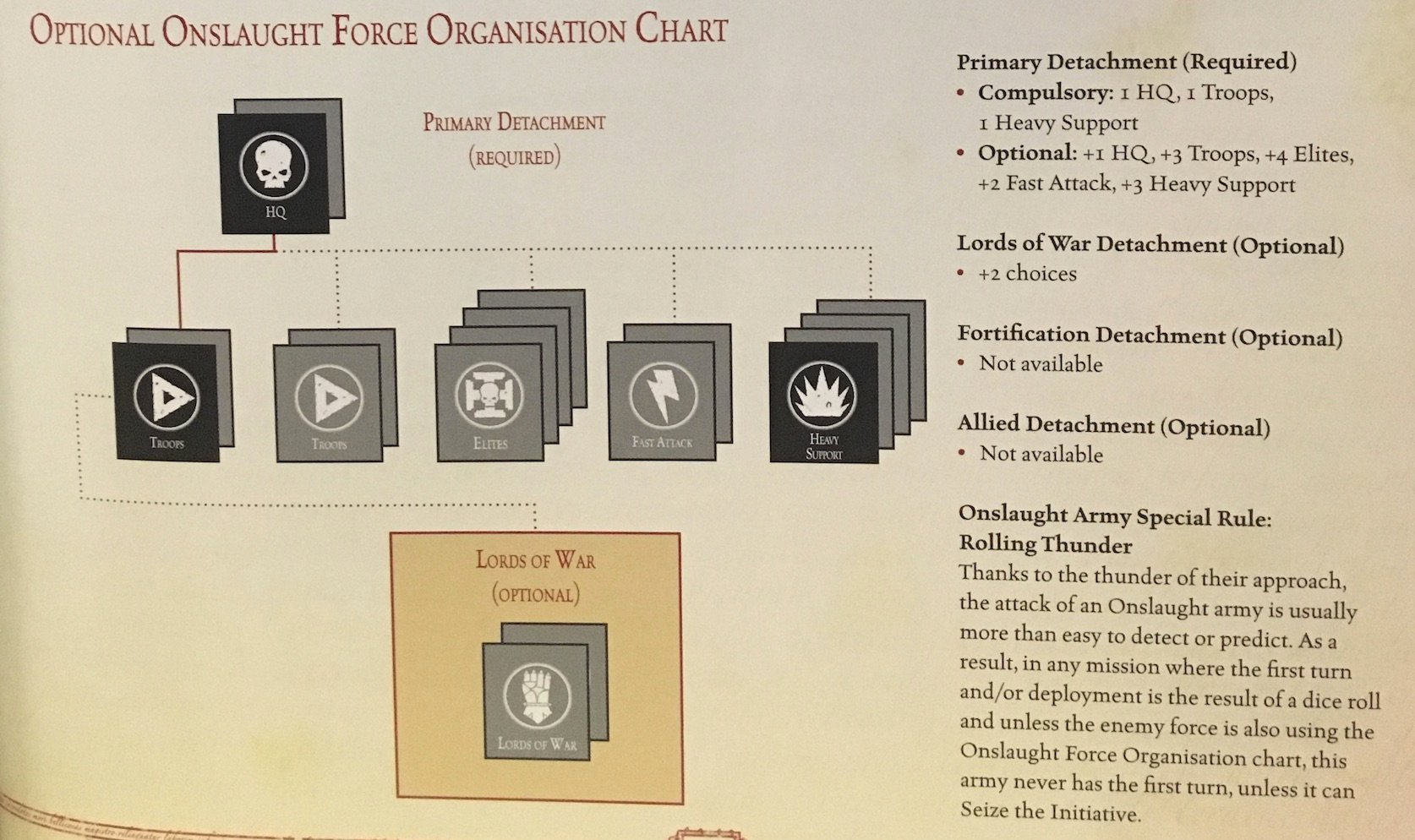
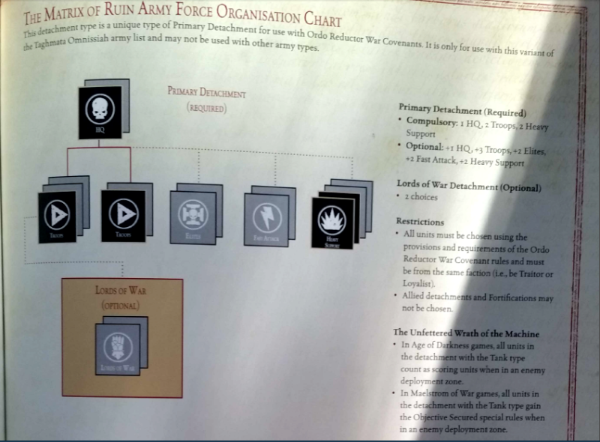
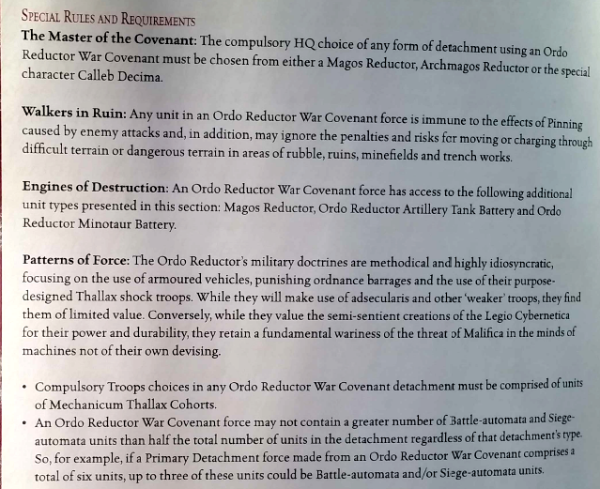
So a topic I don’t really see about 40K is the force organization chart. For something that’s been around for whole editions, its recent loss in mainstream 40K is noticeable for me.
What are other people’s opinions on it?
107281
Post by: LunarSol
I think the limits make sense but the Troops requirement was always a one size fits all deal that didn't really fit everyone well. Similarly, the categories are neat, but also inconsistently applied, creating a lot of odd limitations on armies that don't have a good spread of roles.
I think its a fine idea, but ultimately Rule of 3 is a fine replacement. I really don't miss FOC.
76888
Post by: Tyran
Made sense for some armies, in particular Space Marines and their extremely rigid and limited Chapter system. Didn't make much sense for more adaptable factions.
Moreover there was a have and have not escalation of ways to ignore it that started all the way back from the very beginning.
62565
Post by: Haighus
I preferred it on the whole, especially when different game types had different FoCs. Missions with asymmetric FoCs really helped with the narrative feel.
99475
Post by: a_typical_hero
Good idea that never saw its potential fully developed. I'm not a fan of the recent direction GW is going in regards to army composition. I think I saw a legal army list consisting of only multiple character models somewhere and I rather have some more restriction.
62565
Post by: Haighus
 Tyran wrote: Tyran wrote:Made sense for some armies, in particular Space Marines and their extremely rigid and limited Chapter system. Didn't make much sense for more adaptable factions.
Moreover there was a have and have not escalation of ways to ignore it that started all the way back from the very beginning.
It generally represented resource allocation, so even for armies like Tyranids there was some logic. This is bearing in mind that the basic FoC was for balanced, take all comers forces in a meeting engagement, which is a very rare scenario in the lore. The alternate FoCs represented how forces would shift in different mission roles.
The early campaign systems (3rd and 4th) definitely followed this resource allocation paradigm- if a veteran unit accrued too much experience during the campaign, it would become an elites choice if it wasn't already. The reduced availability was to represent such a valuable unit being frequently requisitioned for other fronts/missions by higher command.
FoC altering shenanigans were very rare in 3rd, they started to take off in 4th. The ones that did exist in 3rd generally came with some kind of restriction. For example, Cult Chaos Marines were only troops (and therefore less restricted) if the Chaos HQ matched them in mark, which required taking the army down a certain path; or Imperial Guard platoons, which allowed for large numbers per FoC slot but also required significant minimum investments reducing flexibility.
73177
Post by: morganfreeman
FoC was much better than the ‘take whatever’ garbage we had now.
The main issue was with troops across codexes. Some were cheap while others cost as much as 10%+ of your points total. Some were good and others overwhelmingly useless, and rarely would you see expensive and good.
62565
Post by: Haighus
 morganfreeman wrote:FoC morganfreeman wrote:FoC was much better than the ‘take whatever’ garbage we had now.
The main issue was with troops across codexes. Some were cheap while others cost as much as 10%+ of your points total. Some were good and others overwhelmingly useless, and rarely would you see expensive and good.
That is more of a balance issue than FoC issue though. Without FoC those units still wouldn't be taken.
76888
Post by: Tyran
 Haighus wrote: Haighus wrote: Tyran wrote:Made sense for some armies, in particular Space Marines and their extremely rigid and limited Chapter system. Didn't make much sense for more adaptable factions. Moreover there was a have and have not escalation of ways to ignore it that started all the way back from the very beginning.
It generally represented resource allocation, so even for armies like Tyranids there was some logic. This is bearing in mind that the basic FoC was for balanced, take all comers forces in a meeting engagement, which is a very rare scenario in the lore. The alternate FoCs represented how forces would shift in different mission roles. The early campaign systems (3rd and 4th) definitely followed this resource allocation paradigm- if a veteran unit accrued too much experience during the campaign, it would become an elites choice if it wasn't already. The reduced availability was to represent such a valuable unit being frequently requisitioned for other fronts/missions by higher command. FoC altering shenanigans were very rare in 3rd, they started to take off in 4th. The ones that did exist in 3rd generally came with some kind of restriction. For example, Cult Chaos Marines were only troops (and therefore less restricted) if the Chaos HQ matched them in mark, which required taking the army down a certain path; or Imperial Guard platoons, which allowed for large numbers per FoC slot but also required significant minimum investments reducing flexibility.
The issue then is what is the difference bewteen Elite, Heavy Support and Fast Attack lore wise? Representing scarcity of something is fine, but then you only need Troop, Elite and Super Elite (and maybe Super Duper Elite (and arguably Super Cheap Fodder for stuff like Termagants)). At least for Tyranids it felt very arbitrary why some units, in particular monsters, were Elite or FA or HS. Specially as the Elite slot was often overcrowded with all the good options.
73177
Post by: morganfreeman
Double post, my bad.
102719
Post by: Gert
 a_typical_hero wrote: a_typical_hero wrote:Good idea that never saw its potential fully developed. I'm not a fan of the recent direction GW is going in regards to army composition. I think I saw a legal army list consisting of only multiple character models somewhere and I rather have some more restriction.
Legal doesn't mean playable though. Battleline is needed to secure objectives and wiping out your opponent doesn't get you a win in 10th. So while you can do the Super Friends, the chances of winning the game are minimal unless you aren't playing the actual missions.
99475
Post by: a_typical_hero
Tyran wrote:The issue then is what is the difference bewteen Elite, Heavy Support and Fast Attack lore wise?
I think this is fine to be a gameplay first, lore second element. Broadly speaking:
HQ - The leaders of your army.
Troops - The type of unit that is most common in your army.
Elite - Units with strong/exotic gear/stats, alternative deployment option fit in here like deep strike or infiltration.
Fast Attack - Everything that goes fast but doesn't carry heavy weapons.
Heavy Support - Units with multiple heavy weapons; single tough models with heavy weapons.
The differentiation serves as a natural limit on how much your army may skew in one direction.
 Gert wrote: Gert wrote:Legal doesn't mean playable though. Battleline is needed to secure objectives and wiping out your opponent doesn't get you a win in 10th. So while you can do the Super Friends, the chances of winning the game are minimal unless you aren't playing the actual missions.
I assumed so, but I prefer the opposing army to look like one, instead of a Kill Team.
102719
Post by: Gert
I mean the chances of that are going to be pretty rare. In the entire time since Unbound was introduced in 7th and now I've never actually played against a Super Friends army.
In terms of force orgs, I think that the way 40k is in terms of army size, it's not really important anymore because the chances of you reaching that are pretty slim.
Things like 6 of each Battleline, a minimum of 1 Hero, and the rule of 3 work fine because the chances of you having to actually put those rules into effect are pretty rare.
As long as there is a base to work off i.e. not just unbound like 7th had, then most people are going to stick to normal army composition anyway because to do otherwise isn't going to actually let them win the game.
76888
Post by: Tyran
a_typical_hero wrote: I think this is fine to be a gameplay first, lore second element. Broadly speaking: HQ - The leaders of your army. Troops - The type of unit that is most common in your army. Elite - Units with strong/exotic gear/stats, alternative deployment option fit in here like deep strike or infiltration. Fast Attack - Everything that goes fast but doesn't carry heavy weapons. Heavy Support - Units with multiple heavy weapons; single tough models with heavy weapons. The differentiation serves as a natural limit on how much your army may skew in one direction.
Part of the issue is that such system kinda stops working once the roster is big enough. Again I'm looking at my Tyranids and half of the faction is a monster, meaning in 9th I could put a monster in each slot outside of troops and skew hard into nidzilla. In fact, Tyranids have been able to do that since 4th that allowed Carnifexes in Elite and Hive Tyrants have always been HQ. Or look at Imperial Guard that has been able to flood the table with vehicles since 5th. It does feel as one of those things that made sense when everyone was limited to a dozen units of which only 2-3 were tough models instead of the current game in which everyone (outside of the most newest armies) has 50+ units to choose from.
91640
Post by: Wyldhunt
I disliked the old FOC. It was basically a way to force you to pay the troop tax, and the troop tax was more expensive/inefficient for some factions than others. In 5th-7th edition, I fielded guardians because I *had* to. In 10th edition, I field guardians because I *want* to. Going hand-in-hand with that, the FOC frequently felt like it was an excuse for the designers to make troops bad for their points because they knew people would be forced to take them anyway. Whereas now, "troops" have to be designed in a way to make them innately desirable.
And what was and wasn't a troop is a whole rant unto itself.
The FOC was also an attempt at reigning in spam. In theory, your opponent can't load all their points into a bunch of long-ranged artillery pieces if all the artillery is in the Heavy Support slot. But in practice, only allowing three heavy support hammerheads doesn't mean much when you can still take three elite riptides.
And then conversely, the FOC could actually get in the way of pretty reasonable combinations. If a Saim-Hann list wanted to field a couple units of shining spears backed up by fire support from vypers, they were kind of out of luck because they only had 3 fast attackslots for their spears and vypers to share. And Isha forbid they want to run some swooping hawks too!
Basically, the Force Org Chart suffered from painting with too broad a brush. It was an attempt to deter skew and spam that failed at the former and was only about as successful at the latter as the rule of 3 is today.
62565
Post by: Haighus
Tyran wrote: Haighus wrote: Tyran wrote:Made sense for some armies, in particular Space Marines and their extremely rigid and limited Chapter system. Didn't make much sense for more adaptable factions.
Moreover there was a have and have not escalation of ways to ignore it that started all the way back from the very beginning.
It generally represented resource allocation, so even for armies like Tyranids there was some logic. This is bearing in mind that the basic FoC was for balanced, take all comers forces in a meeting engagement, which is a very rare scenario in the lore. The alternate FoCs represented how forces would shift in different mission roles.
The early campaign systems (3rd and 4th) definitely followed this resource allocation paradigm- if a veteran unit accrued too much experience during the campaign, it would become an elites choice if it wasn't already. The reduced availability was to represent such a valuable unit being frequently requisitioned for other fronts/missions by higher command.
FoC altering shenanigans were very rare in 3rd, they started to take off in 4th. The ones that did exist in 3rd generally came with some kind of restriction. For example, Cult Chaos Marines were only troops (and therefore less restricted) if the Chaos HQ matched them in mark, which required taking the army down a certain path; or Imperial Guard platoons, which allowed for large numbers per FoC slot but also required significant minimum investments reducing flexibility.
The issue then is what is the difference bewteen Elite, Heavy Support and Fast Attack lore wise?
Representing scarcity of something is fine, but then you only need Troop, Elite and Super Elite (and maybe Super Duper Elite (and arguably Super Cheap Fodder for stuff like Termagants)).
At least for Tyranids it felt very arbitrary why some units, in particular monsters, were Elite or FA or HS. Specially as the Elite slot was often overcrowded with all the good options.
It doesn't seem particularly complicated?
HQ: leaders
Elites: powerful, versatile units
Troops: basic units
Fast attack: fast units
Heavy support: slow but hard-hitting units
In 3rd edition, this was pretty logical for Tyranids IMO. Here are some good examples from the mutable genus rules:
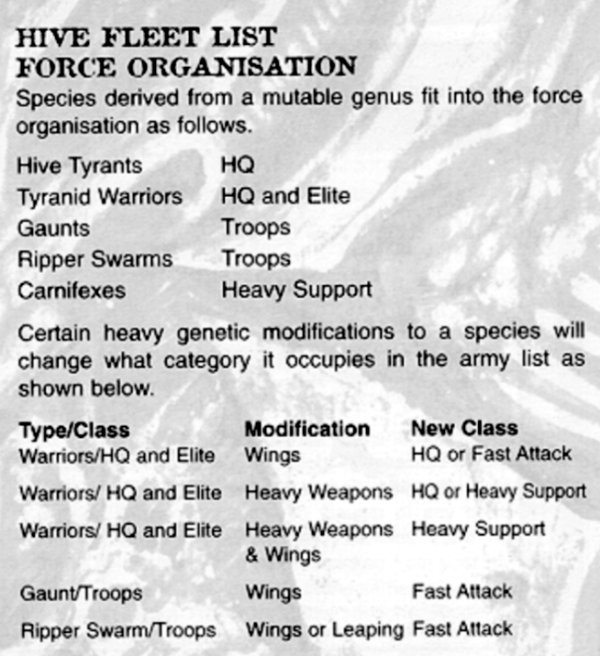
I think it only started to get wonky once GW decided to add loads of monstrous creatures and didn't want them to all be Heavy support, when most of the ones marked as Elites should've been Heavy support. Would that constrain unit choices? Yes. But a swarm with large numbers of really big bugs is one that has invested an awful lot of resources and isn't your typical meeting-engagement force, it is more like a specialised siege swarm.
91640
Post by: Wyldhunt
Tyran wrote:
Part of the issue is that such system kinda stops working once the roster is big enough.
Again I'm looking at my Tyranids and half of the faction is a monster, meaning in 9th I could put a monster in each slot outside of troops and skew hard into nidzilla.
In fact, Tyranids have been able to do that since 4th that allowed Carnifexes in Elite and Hive Tyrants have always been HQ.
Or look at Imperial Guard that has been able to flood the table with vehicles since 5th.
It does feel as one of those things that made sense when everyone was limited to a dozen units of which only 2-3 were tough models instead of the current game in which everyone (outside of the most newest armies) has 50+ units to choose from.
100%. The broad strokes approach of the FOC made sense enough when every faction was basically just their army's equivalent of tacticals, assault marines, devastators, dreadnaughts, predators, and rhinos. But once you get enough variety, it stops making sense as an approach. And that's without going into rules that change force org roles .
"Fielding more than 3 bike units would be broken and needs to be disallowed by the rules... Unless you put an extra special boy on a bike; then it's totally fine if you have 6 units instead. Also, here's a dreadnaught that's an HQ for your space wolves, and here's a "master of the forge" that lets you field 6 dreadnaughts instead of 3." Automatically Appended Next Post: Haighus wrote:
I think it only started to get wonky once GW decided to add loads of monstrous creatures and didn't want them to all be Heavy support, when most of the ones marked as Elites should've been Heavy support. Would that constrain unit choices? Yes. But a swarm with large numbers of really big bugs is one that has invested an awful lot of resources and isn't your typical meeting-engagement force, it is more like a specialised siege swarm.
I don't know. I think my shining spears/vypers example illustrates that the roles were pretty vague and confused before that. Are a short-ranged partially melee unit made up of T4 bikers and a vehicle unit that wants to shoot heavy weapons from the other side of the table really competing for the same role even though they both happen to move fast? The FOC was *trying* to identify the general job of units and force you to diversify, but it just wasn't very good at that. My falcon was just as fast as my vyper and only had a single extra gun defensively. If HS is defined by firepower and FA is defined by speed, then it seems like you could easily put either of those units in either category.
There's also a discussion to be had about whether specialized force like a "siege swarm" or oops-all-terminators or oops-all-wraith-constructs should be a thing. If so, the FOC just kind of created an obstacle to any list that didn't revolve around "troops", and past editions had to make special rules to circumvent the FOC for such armies.
62565
Post by: Haighus
 Wyldhunt wrote: Wyldhunt wrote:I disliked the old FOC. It was basically a way to force you to pay the troop tax, and the troop tax was more expensive/inefficient for some factions than others. In 5th-7th edition, I fielded guardians because I *had* to. In 10th edition, I field guardians because I *want* to. Going hand-in-hand with that, the FOC frequently felt like it was an excuse for the designers to make troops bad for their points because they knew people would be forced to take them anyway. Whereas now, "troops" have to be designed in a way to make them innately desirable.
And what was and wasn't a troop is a whole rant unto itself.
The FOC was also an attempt at reigning in spam. In theory, your opponent can't load all their points into a bunch of long-ranged artillery pieces if all the artillery is in the Heavy Support slot. But in practice, only allowing three heavy support hammerheads doesn't mean much when you can still take three elite riptides.
And then conversely, the FOC could actually get in the way of pretty reasonable combinations. If a Saim-Hann list wanted to field a couple units of shining spears backed up by fire support from vypers, they were kind of out of luck because they only had 3 fast attackslots for their spears and vypers to share. And Isha forbid they want to run some swooping hawks too!
Basically, the Force Org Chart suffered from painting with too broad a brush. It was an attempt to deter skew and spam that failed at the former and was only about as successful at the latter as the rule of 3 is today.
This is why I think the 3rd edition approach worked best with FoCs- generally, rather than shifting FoC options round, you had new lists instead. Those lists had different restrictions to make up for the unusual composition.
As a great example, the Eldar biker list:
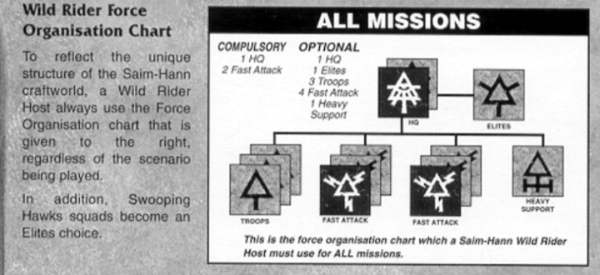
Extra Fast Attack, but two are compulsory. Elites are much more limited to compensate, with Swooping Hawks changed to Elite. Bikers were also pricey in 3rd, so being forced to take some would mean a smaller army.
This is much better, IMO, than the later paradigm of "leader on bike makes bikes troops". I think 3rd understood the FoC better.
91640
Post by: Wyldhunt
Haighus wrote: Wyldhunt wrote:I disliked the old FOC. It was basically a way to force you to pay the troop tax, and the troop tax was more expensive/inefficient for some factions than others. In 5th-7th edition, I fielded guardians because I *had* to. In 10th edition, I field guardians because I *want* to. Going hand-in-hand with that, the FOC frequently felt like it was an excuse for the designers to make troops bad for their points because they knew people would be forced to take them anyway. Whereas now, "troops" have to be designed in a way to make them innately desirable.
And what was and wasn't a troop is a whole rant unto itself.
The FOC was also an attempt at reigning in spam. In theory, your opponent can't load all their points into a bunch of long-ranged artillery pieces if all the artillery is in the Heavy Support slot. But in practice, only allowing three heavy support hammerheads doesn't mean much when you can still take three elite riptides.
And then conversely, the FOC could actually get in the way of pretty reasonable combinations. If a Saim-Hann list wanted to field a couple units of shining spears backed up by fire support from vypers, they were kind of out of luck because they only had 3 fast attackslots for their spears and vypers to share. And Isha forbid they want to run some swooping hawks too!
Basically, the Force Org Chart suffered from painting with too broad a brush. It was an attempt to deter skew and spam that failed at the former and was only about as successful at the latter as the rule of 3 is today.
This is why I think the 3rd edition approach worked best with FoCs- generally, rather than shifting FoC options round, you had new lists instead. Those lists had different restrictions to make up for the unusual composition.
As a great example, the Eldar biker list:
Extra Fast Attack, but two are compulsory. Elites are much more limited to compensate, with Swooping Hawks changed to Elite. Bikers were also pricey in 3rd, so being forced to take some would mean a smaller army.
This is much better, IMO, than the later paradigm of "leader on bike makes bikes troops". I think 3rd understood the FoC better.
I never played in 3rd, but I do see the appeal of that. However, isn't that approach notorious for the "false downside" of not letting you take slots you weren't planning to take anyway? I.e.
"Oh gosh. Is it really worth taking this fourth predator if it means I can't field that fast attack unit I wasn't planning on taking anyway? And two of the heavy support slots in this detachment for people who want to field lots of heavy supports are mandatory? Really twisting my arm here, GW."
EDIT: Which is to say, bespoke detachments that change how much of what you can field aren't a bad idea, but there probably needs to be some additional restriction or change in playstyle to make the downsides an actual trade-off. 9th edition's approach of letting you spam a certain slot, but only at the cost of CP was far from perfect, but the downsides of spamming FA or HS and not having to pay the troop tax were apparent.
123984
Post by: Gnarlly
I preferred the FOC over what we have now.
The FOC provided a sense of structure when collecting and building an army, helping out newer players (start with 1 HQ and 2 Troops, and build out from there) and leading to an overall nicer and more varied collection of units for modeling and painting in my opinion.
Gameplay-wise, I think it helped reduce unit spam and encouraged fielding a wider variety of units. Things started to go off the rails a little bit around the time of 5th edition I think, but there were some issues with 3rd codexes as well, when some codexes allowed bringing in Elite or Heavy units as "troops" or other categories leading to problems with heavy artillery/tank spam. I seem to recall issues with the Iron Warriors in the Chaos 3.5 codex allowing more Heavy units, and the 5th edition Imperial Guard codex being another example, with that codex allowing a lot more leman russ tanks and artillery than what was previously permitted under the normal rules of the FOC.
62565
Post by: Haighus
Wyldhunt wrote: Haighus wrote:
This is why I think the 3rd edition approach worked best with FoCs- generally, rather than shifting FoC options round, you had new lists instead. Those lists had different restrictions to make up for the unusual composition.
As a great example, the Eldar biker list:
Extra Fast Attack, but two are compulsory. Elites are much more limited to compensate, with Swooping Hawks changed to Elite. Bikers were also pricey in 3rd, so being forced to take some would mean a smaller army.
This is much better, IMO, than the later paradigm of "leader on bike makes bikes troops". I think 3rd understood the FoC better.
I never played in 3rd, but I do see the appeal of that. However, isn't that approach notorious for the "false downside" of not letting you take slots you weren't planning to take anyway? I.e.
"Oh gosh. Is it really worth taking this fourth predator if it means I can't field that fast attack unit I wasn't planning on taking anyway? And two of the heavy support slots in this detachment for people who want to field lots of heavy supports are mandatory? Really twisting my arm here, GW."
EDIT: Which is to say, bespoke detachments that change how much of what you can field aren't a bad idea, but there probably needs to be some additional restriction or change in playstyle to make the downsides an actual trade-off. 9th edition's approach of letting you spam a certain slot, but only at the cost of CP was far from perfect, but the downsides of spamming FA or HS and not having to pay the troop tax were apparent.
I think there are two things here.
Firstly, I think the "false downside" thing is overblown. Sure, some taking a Heavy support-focussed Iron Warriors list or a Fast attack-focussed Night Lords list probably wasn't planning on taking much Fast attack or Heavy support respectively, but that is because it is part of the theme of the force. They do lose out for not having that flexibility, unless they only play one mission type. The missions in 3rd and 4th often played around with deployment and reserves based on FoC, so a force focussed on one part of the FoC could find itself really disadvantaged in some missions. For example, the defender in a Bunker Assault mission had to put their Fast Attack, Elites, and Heavy support in reserve. So if they didn't have enough Troops to hold the line, they were likely to have an uphill battle. Heavy support was also less likely to be useful the turn it arrived from reserves so was especially problematic in that mission.
Secondly, this is somewhat an issue of internal balance. If the Heavy support is obviously better than the Fast attack choices in most scenarios, then one alt list will be better most of the time. That isn't a problem with the FoC though. Without the FoC you would also see one of those units taken much more than the other.
77922
Post by: Overread
One benefit of what we have now with the "rule of three" is that its so simple even GW don't really mess with it. Collection wise this can be a boon because you basically have a hard-cap on most units. You know you can only take 3 so you know not to buy more than 3 for gameplay purposes.
The FOC however was a more refined tool and if GW approached rules from a more structured approach and allowed them to last more than 3-6 years it had a chance. I think what simply happened is that GW doesn't allocate resources not have the focus on rules that allows a FOC system to actually flourish.
Especially in modern times where armies have a LOT more choices than in the past. In 2-3rd edition the FOC worked well because most armies didn't have a vast number of options to draw from so the limits still let you take a good portion of your army variety and collection.
However it steadily got worse and worse. Tyranids, for example, gained a lot of specialists which were all put into the Elite slot. Suddenly having only 3 different elite units gets really limiting when you've lots of specialists that each have a purpose and place in the army. Esp when you've got specific counters becoming more and more a thing in the game with more niches (eg remember early aircraft that needed AA units to counter them). The more niches, the more requirements the harder it is to make a choice or to take a good representation of the army.
Now GW tried toget around that at one time by just letting you take more FOC's per side. However with no limit on subfactions that led to the messy era where things got confusing as one army might be 3 or 4 different sub-armies and things like "Well actually your paint scheme matters now and each sub army should be different" started to rear their heads.
The FOC needed an overhaul but it also needed a stable long term game to have that overhaul. Especially because I think part of it is that it needed to be more varied for different styles of army and different factions.
In the end games DO have a problem in general with trying to encourage people to take varieties of units to create diverse armies; when many times spamming one unit or units of the same kind can often be very powerful in a common setting. Or when focusing on a very specific tactic can.
It becomes even more challenging as armies get wider in model diversity and creators find more and more challenge in filling in the niches whilst gamers have more diverse collections and honestly want to bring those models to the table.
This leans into army size in general, which directly impacts army composition constructs. Systems that can work for a 1K point game might break on a 2 or 3K. Meanwhile systems designed for a 3K might not have the right design to really function at 1K etc...
I'd love to see the FOC return, but at the same time I think with how GW as a firm approaches balance and rule writing right now (and historically); I don't think we'd necessarily benefit from it. Indeed having unit limits jumping around could be a nightmare. You buy that 3rd monolith for a cool army and then BOOM GW restructures it to only 1 per army. Then the next edition its up to 2 then back to 1 then infinite etc....
That leads to unsure gamers; confusion and such.
105694
Post by: Lord Damocles
Like most of GW's good ideas, they managed to ruin it eventually and then just gave up and replaced it with an inferior bodged fix to a problem of their own making (the Rule of Three).
 Overread wrote: Overread wrote:One benefit of what we have now with the "rule of three" is that its so simple even GW don't really mess with it. Collection wise this can be a boon because you basically have a hard-cap on most units. You know you can only take 3 so you know not to buy more than 3 for gameplay purposes.
Until GW re-consolidate units which are currently just different weapon configurations...
62565
Post by: Haighus
 Lord Damocles wrote: Lord Damocles wrote:Like most of GW's good ideas, they managed to ruin it eventually and then just gave up and replaced it with an inferior bodged fix to a problem of their own making (the Rule of Three).
Pretty much.
77922
Post by: Overread
Lord Damocles wrote:Like most of GW's good ideas, they managed to ruin it eventually and then just gave up and replaced it with an inferior bodged fix to a problem of their own making (the Rule of Three).
Overread wrote:One benefit of what we have now with the "rule of three" is that its so simple even GW don't really mess with it. Collection wise this can be a boon because you basically have a hard-cap on most units. You know you can only take 3 so you know not to buy more than 3 for gameplay purposes.
Until GW re-consolidate units which are currently just different weapon configurations...
I feel like that's a slightly different aspect.
As a Tyranid player I'm certainly not happy that GW took something like all the Tyranid Warrior close combat weapons and broke them down into 1 close combat profile.
At the same time I can see where GW are kind of potentially going with some of those choices. In the past, certainly well into 3rd edition - many armies had few models but a LOT of toolbox options. Tyranids were famous for it - Carnifex, Warriors and Hive Tyrant could each pull multiple battlefield roles depending on what upgrades and weapon choices you made. You could go from a close combat monster to artillery to anti tank ranged to anti infantry ranged and so forth. It worked because all those roles had a place on the battlefield and there were no other Tyranids in those slots that could do those roles.
Today the army is VASTLY bigger and there are lot more specialists kicking around. Eventually the toolbox models start to have an issue that they are tripping over the specialist choices. This becomes a balancing nightmare (even if GW were really good at it and didn't obliterate it every 3-6 years).
So one approach is to limit the toolbox models into specialist slots; creating new gaps that new models can fill.
It is not ideal for those with existing models and there are some choices kicking around that don't feel quite right. Some of this might just be GW making outright bad choices; others might just be that they are good choices, but they need more years so that GW can plug the gaps that the simplifications have created. Eg what if we lose lots of closecombat warrior options but then in 2 or 3 years we gain the "Tyranid Slasher" a close combat devil that has loads of close combat blades and is an anti-infantry scything monster; filling the slot warriors used to have when equipped for that role.
76888
Post by: Tyran
I mean isn't that just a Ravener/Leaper/Lictor/Trygon/Mawloc/Screamer-killer/Haruspex/Toxicrene/WowThatRoleisAlreadyOvercrowded?
77922
Post by: Overread
Tyran wrote:I mean isn't that just a Ravener/Leaper/Lictor/Trygon/Mawloc/Screamer-killer/Haruspex/Toxicrene/WowThatRoleisAlreadyOvercrowded?
Hah yes somewhat already! It's the same for the Carnifex as well - though after the Screamerkiller model and Lictor models I wonder if we might see GW doing things like dedicated Thornback and other "named" carnifex variation kits in the future; and if they let whoever did the lictor kit at those named carny kits they could even have a decent amount of pose variety (Which the current screamer killer certainly lacks - though likely mostly because it was designed for a push-fit structure)
76888
Post by: Tyran
At least for the Carnifex there is more design space for anti-tank roles both at long range but also in melee. Specially for anti-super-heavy.
E.g. a return of the Stonecrusher variant to kill super-resilient stuff like Knights and C'tan shards.
77922
Post by: Overread
Yeah for a while the carny felt kind of in a bit of a tough spot in terms of being overshadowed, but having played some games I agree there's a very valid slot for it to be anti-tank; both close combat and ranged wise as you say. Anti-heavy/super armour is a weakness for Tyranids right now.
The Tyrannofex is the best at it, but its also very big and very costly; Zoanthropes are good but they don't have the best range and are very slow to move so can have issues getting into the right position.
Tyranids seem to have almost an over-abundance of marine/medium armour level counters, but heavy and superheavy is a gap (even more so now that the Hirodules are both gone from formal events)
128517
Post by: johnpjones1775
Some level of restrictions on what you take beyond rule of 3 made the game more interesting imho.
Limiting the number of elite/specialist units was good and meant that units like intercessors actually filled a role in the army list
106383
Post by: JNAProductions
johnpjones1775 wrote:Some level of restrictions on what you take beyond rule of 3 made the game more interesting imho.
Limiting the number of elite/specialist units was good and meant that units like intercessors actually filled a role in the army list
You should take units because the units fill a role, not because you just can’t take what you actually want to.
118765
Post by: A.T.
 Tiger9gamer wrote: Tiger9gamer wrote:So a topic I don’t really see about 40K is the force organization chart. For something that’s been around for whole editions, its recent loss in mainstream 40K is noticeable for me.
What are other people’s opinions on it?
It helped with pick-up games in older editions as one of the limits on how much of a skew list you could created compared to take-all-comers lists. The idea for instance that you would never face more than three heavy tanks / heavy artillery pieces / heavy weapon units, or that you would never have to deal with more than three units starting right up in your face, or that your opponent would be entirely bereft of basic infantry units.
Much more important with the paper/scissors/stone-like design of older editions.
91640
Post by: Wyldhunt
 JNAProductions wrote: JNAProductions wrote:johnpjones1775 wrote:Some level of restrictions on what you take beyond rule of 3 made the game more interesting imho.
Limiting the number of elite/specialist units was good and meant that units like intercessors actually filled a role in the army list
You should take units because the units fill a role, not because you just can’t take what you actually want to.
Yep. Agree with JNA. If intercessors are supposed to be the heart of a marine army, give them rules that make you *want* them at the heart of a marine army. Like I said earlier, I took guardians in 4th-7th edition because I had to. Now I take them because I want to because GW finally took a minute to figure out how to make them useful as something other than an expensive heavy weapon platform or direct competitor for dire avengers.
Plus, there's the whole conversation of armies that don't/shouldn't have to put conventional troops at the heart of their armies. (Iyanden, Death Wing, White Scars, etc.) But we've had that conversation plenty of times before.
4042
Post by: Da Boss
The FOC worked well in 3e and 4e, but started to crack under the strain as GW upped the scope of the game with more superheavies and elite units.
It just wasn't designed with the increase in unit types that some armies had in mind. Which is a shame. Also, I think you can see that the idea was to have different FOC for different missions, but in practice nobody played the non-standard missons (sadly) and they were eventually dropped.
Imo the issue is with the bloating of the game and I liked the variant foc missions. But I am obviously in the minority there!
98914
Post by: Jammer87
Troop tax is the first thing that comes to mind. When you have to buy units that you don’t want to buy to play the game it makes it harder to get into. It also made it harder to convince other people to play. Off the rip they had to buy $100 worth of miniatures just to play with the miniatures they actually wanted to play with.
77922
Post by: Overread
Game bloat is hard to deal with
People often lock into specific armies as a finance/time constraint of reality. Not just for collecting but also for playing,
So people want more models for the army they have, which leads that to bloat. Now GW can get around some of it by updating sculpts because they can justify the re-investment; but even so people still want new things.
Warmachine hit the same issue and grew their armies and then tried to make a skirmish system work for a wargame and it never really quite worked. Then they went for theme lists which people didn't like because it was kind of like trying to fragment 1 army into many sub-armies.
Bloat is tough.
52812
Post by: Tiger9gamer
the critisisms are fair, but what is confusing me is the talk like you needed to max out the two troops required. I know min-maxxing tac squads or guardian squads where much maligned back then, but you could still just take two min squads to unlock everything else.
77922
Post by: Overread
Tiger9gamer wrote:the critisisms are fair, but what is confusing me is the talk like you needed to max out the two troops required. I know min-maxxing tac squads or guardian squads where much maligned back then, but you could still just take two min squads to unlock everything else.
I think some people just in general hate any kind of mandated unit, esp when many armies often only had one "troop" choice or one or two options.
That said I agree, in most GW games the troops component never feels too limiting to me and honestly feels sensible that armies have troops.
134248
Post by: StudentOfEtherium
in theory, i like what 7th edition was doing with each army having its own FOC options, and for some detachments to be based around formations instead of rote FOC slots. i think there's a lot of potential in a system like that, even if the execution as it existed then was messy and problematic
93557
Post by: RaptorusRex
I actually think the difference between FOC and the 'new' system, at least for some armies, is fairly minor. I take maybe 2-3 Battleline every time due to them having OC2.
IDK. It wouldn't be too onerous.
551
Post by: Hellebore
There were two aspects to it.
It reflected tangible limits on what you could draw on and it was used as a rough balancing tool.
If you're using it too much for balance, then it means units in different parts of your org are not balanced internally very well and the only way to combat it is to restrict how many you can take.
ignoring the game play aspect, i did enjoy the background aspect. No general gets to pull together exactly what they want when they want in whatever quantity they want.
Considerations like 'we only have X of the new supa blasta and need to deploy it only in strategically important situations' are real, but with no restrictions 40k lets you pile on far more equipment than the general would willingly use just because you can.
I don't see unrestricted unit selection any different to unrestricted unit equipping - if you can take nothing by an army of terminator librarians, why can't i take nothing but an army of guardsmen with lascannons?
Rather than dividing at an organisational level, you're dividing at a unit level. taking it down to equipment is just one more level down.
Or to put it another way, why is it ok to restrict equipment on units, but not units themselves?
The more abstracted 40k gets, the less flavour it has and the less connected to the setting it becomes. Feels bad is sometimes necessary and too many people are trying to make a game with no feelsbad and turning it into something that doesn't actually reflect the battles in the background. Hence the enduring love for 2nd ed.
55178
Post by: Gibblets
They're a necessity to promote reasonable list structure. There are lots of ways to make this flavourful. Have detachments or HQ's grant troop keyword to their underlings to unlock more of them. It seems better than increasing the cost for models that get benefits of detachments. It allows you to take bunch of them without incurring penalties or making them OP from extra rules interactions.
105713
Post by: Insectum7
FOC was great, and people maligning a "troops tax" are just wrong. 
Honestly though? 7th ed Formations is more where it's at. Prescribed army structures that are different depending on faction, not enforced as a hard rule, but encouraged through bonus.
Not that 7th did it well. . . Oh no no no.
722
Post by: Kanluwen
Utter trash. They worked for maybe a quarter of the armies post-3rd edition and were nothing but an outdated relic by the time 7th rolled around.
106383
Post by: JNAProductions
 Insectum7 wrote:FOC Insectum7 wrote:FOC was great, and people maligning a "troops tax" are just wrong.
Honestly though? 7th ed Formations is more where it's at. Prescribed army structures that are different depending on faction, not enforced as a hard rule, but encouraged through bonus.
Not that 7th did it well. . . Oh no no no.
Explain why they’re wrong. Don’t just assert it as fact-actually take the time to articulate why a troop tax is good for every single army.
121430
Post by: ccs
I didn't hate the 3e-7e FoC format.
I don't hate it in HH2.0 either.
I could (and still do in HH) make armies I enjoyed playing just fine.
But after having played with it for 20 years?
I'm perfectly fine making armies the current way.
In fact, I've been able to field a few forces that were completely impossible with the FoC. For that? My local shops thank GW as it meant me spending even more $....
And nothing is stopping me from making FoC style armies here in 10th if I want to.
91640
Post by: Wyldhunt
Overread wrote: Tiger9gamer wrote:the critisisms are fair, but what is confusing me is the talk like you needed to max out the two troops required. I know min-maxxing tac squads or guardian squads where much maligned back then, but you could still just take two min squads to unlock everything else.
I think some people just in general hate any kind of mandated unit, esp when many armies often only had one "troop" choice or one or two options.
That said I agree, in most GW games the troops component never feels too limiting to me and honestly feels sensible that armies have troops.
Yeah. It wasn't actually that big a deal. It was just really, really frustrating because it managed to do a lot of things wrong all at once:
* You had to spend points on troops you might not want to field.
* Depending on faction, you might be forced to spend more points than your opponent on that troop tax.
* Depending on faction, your mandatory troop units might be less cost-effective than your opponent's.
* What was and wasn't a "troop" was extremely arbitrary. Terminators had to be troops instead of elites for the sake of game balance, but apparently they were fine as troops if your army was lead by Lysander or if they were all psychic and armed with force swords.
* It was actively unfluffy for subfactions who canonically used non-troops in place of troops. Ex: my Iybraesil army which is known for using howling banshees where other crafworlds might use avengers or guardians.
So the troop tax wasn't helping game balance, it wasn't helping forge the narrative, and it wasn't impacting factions equally.
I'm not eager to return to the force org chart, but if we did, it would be improved immensely by just taking away the troop requirements. It would still have a bunch of problems though. Automatically Appended Next Post:  RaptorusRex wrote: RaptorusRex wrote:I actually think the difference between FOC and the 'new' system, at least for some armies, is fairly minor. I take maybe 2-3 Battleline every time due to them having OC2.
IDK. It wouldn't be too onerous.
The key here is that you want to take those battleline units. Now imagine if the rules of the edition made you not want to take them but forced you to take them anyway. And also your opponent's troop tax is 100 points cheaper than yours, so he functionally has 100 more points to spend on stuff he's excited about than you do.
121430
Post by: ccs
Wyldhunt wrote:
RaptorusRex wrote:I actually think the difference between FOC and the 'new' system, at least for some armies, is fairly minor. I take maybe 2-3 Battleline every time due to them having OC2.
IDK. It wouldn't be too onerous.
The key here is that you want to take those battleline units. Now imagine if the rules of the edition made you not want to take them but forced you to take them anyway. And also your opponent's troop tax is 100 points cheaper than yours, so he functionally has 100 more points to spend on stuff he's excited about than you do.
Now imagine you actively dislike the models that comprise a factions "troops".
Models =/= rules.
I will deal with bad rules.
But I will not waste my $ buying models I dislike. I will not own them.
This always prevented from making a Drukhari army as I dislike all the model options for the troops. I still don't like them (though theyve improved).
Without the old FoC?
I can now field a force using just the models I do like.
105713
Post by: Insectum7
JNAProductions wrote: Insectum7 wrote:FOC was great, and people maligning a "troops tax" are just wrong.
Honestly though? 7th ed Formations is more where it's at. Prescribed army structures that are different depending on faction, not enforced as a hard rule, but encouraged through bonus.
Not that 7th did it well. . . Oh no no no.
Explain why they’re wrong. Don’t just assert it as fact-actually take the time to articulate why a troop tax is good for every single army.
Aside from the optics of framing a "typical" army, they weren't a tax. People claiming they were usually just didn't know how to use their troops effectively. And if we're being honest, I think this is primarily a Space Marine thing. The mantra for Orks was "Boys before toys", Tyranids had a bunch of good options, Guard had their own build structure via Platoons, DE got double Bright Lances in their troops, etc. etc. The popular hangup was the Tactical Squad, which was a trickier unit to get the value out of, but still very worthwhile.
98914
Post by: Jammer87
In my opinion you’re completely wrong when you assert that the troop tax wasn’t a troop tax.
I played Eldar with guardians, rangers, and dire avengers as our troop choices. None of those thematically fit with how I played my army.
I ran three squads of striking scorpions in flacons and pushed them around the battlefield quickly striking and then running.
My troop choices usually sat in a corner and did nothing until they died. When the wave serpent got super OP I used them for the free transport and that was about it. I
109034
Post by: Slipspace
I prefer a FOC over what we have now. I think it promotes armies that look like armies and provides another balancing tool. As ever with GW, I think the idea was good but the execution pretty terrible.
Troop tax was a problem, but I don't think that's an intrinsic issue with the FOC. I think it's just GW not bothering to provide good reasons to take Troops other than them being required. The current Pariah Nexus missions go some way to trying to encourage Battleline by making them actually useful, which I think is the right way to do it and I don't see any reason why that wouldn't also work under a FOC. With all units now having some kind of ability you can also use those to make Troops attractive. We can see this with units like CSM Legionaries, or Intercessors, who have useful abilities and are pretty competitively priced.
12991
Post by: Apologist
The force organisation chart was a great idea that was not properly exploited. I would love to see its return in a future edition, but modified for each army.
The old Force Org chart suffered from being hung around the Space Marines' particular way of working. As noted by posters above, it didn't serve Tyranids or Eldar well at all – their specialists rarely fitting the arbitrary Troops/Elite/Heavy Support distinctions.
Likewise, as an Imperial Guard player, the rules forced me to jump through all sorts of hoops that basically bypassed the chart anyway.
+++
The various versions of Epic did army building much better, with unique ways of army building that better reflected the particular faction. For example, Imperial forces in Space Marine second edition (SM2) were built around Company cards of large numbers of 'core' forces (e.g. Tactical, Assault, Predators etc.) For each Company card, you were allowed a number of Support cards (additional platoons of troops, squadrons of tanks) and Special cards (more unusual or rare stuff like Librarians).
There was thus a nice balance, and while there was flexibility you ended up with a Space Marine army like you read about in the background.
Importantly, the other armies were built differently. Orks, for example, were built in a broadly similar way, but you could never take more than six Clans (the Company card equivalent). However, you could always expand these with more boyz – which were in addition to those bought as Support or Special cards. The result was fewer, larger, more unwieldy (but virtually unstoppable!) formations on the battlefield.
Eldar worked in a similar way again, but their leaders weren't included as part of the Company cards. They were rare and tus you had to buy them separately, resulting in more brittle but flexible forces.
Some armies were completely different – the Tyranids in particular had a fantastically characterful method of army building. Their cards were hexagonal (as you can see in Filbert's Specialist Game Blog here on Dakka), with arrows on. You chose a synapse creature, which had a number of outward facing arrows. You then tessellated other creatures to those arrows.
Synapse creatures lower down than the hierarchy would allow you to open out the army, so attaching one to your leader would give you more options, which you could string out.
+++
Anyway, why do I bring this up? Well, the whole thing was wonderfully characterful and fun – and there's absolutely no reason at all why it couldn't be used in 40k, too.
You could have the 'rule of three' as a very basic army building method in the main rulebook, but include unique and characterful army-building methods in the Codex supplements. It'd be a hell of a lot more interesting than just re-buying the same lightly reworded material from the previous edition...
These rules could use the HQ/Troops/Elites/Heavy Support/Fast Attack paradigm, but equally you could have unique terms and structures.
Consider orks having Bosses/Boyz/Runtz/Karts and Kans/Orky-know-wotz – with Boyz being the restricting feature: each mob of orks allows you to take X other choices; so you're never restricted on the number of Boyz you take – but equally you can't have all the weird stuff without the Boyz.
Likewise, Eldar could have a much simpler and more flexible Leaders/Hosts/Support structure, with 'Hosts' covering all the Aspects along with Guardians – but you'd need Guardians to take Leaders and Support units.
... the point is that every army functions differently in the background, and the force org chart could serve that; giving more flavourful armies overall.
91640
Post by: Wyldhunt
Insectum7 wrote: JNAProductions wrote: Insectum7 wrote:FOC was great, and people maligning a "troops tax" are just wrong.
Honestly though? 7th ed Formations is more where it's at. Prescribed army structures that are different depending on faction, not enforced as a hard rule, but encouraged through bonus.
Not that 7th did it well. . . Oh no no no.
Explain why they’re wrong. Don’t just assert it as fact-actually take the time to articulate why a troop tax is good for every single army.
Aside from the optics of framing a "typical" army, they weren't a tax. People claiming they were usually just didn't know how to use their troops effectively. And if we're being honest, I think this is primarily a Space Marine thing. The mantra for Orks was "Boys before toys", Tyranids had a bunch of good options, Guard had their own build structure via Platoons, DE got double Bright Lances in their troops, etc. etc. The popular hangup was the Tactical Squad, which was a trickier unit to get the value out of, but still very worthwhile.
That wasn't my experience. Marines were an obvious example because most infantry units aside from tacticals were just tacticals with better gear. Plus marines (like many factions) had units that were basically just +1 versions of their troops (see: sternguard). My experience with eldar was similar to Jammer's. Even when eldar had a wide variety of troop options, they mostly just hid and tried not to die right away while contributing very little. With the possible exception of dire avengers whose oldschool bladestorm power made them hit somewhat hard. But even then, they mostly just unlocked wave serpents or made transports scoring depending on the edition. Chaos marines infamously spammed cultists for quite a while because they were simply the cheapest option. Tau fire warriors had their moments (especially when annoying super overwatch was a thing), but generally tau builds have leaned towards wanting to spam suits as much as possible. Some armies didn't mind investing in troops! But plenty of armies did.
The armies you use for examples mostly either avoid the troop tax or had useful/efficient/diverse enough troops to not mind it. Orks, from what I recall, generally focused on hitting the enemy with lots of waves of boyz, especially in truk rush editions, so you didn't mind fielding some boyz because they were a relatively cheap way to hurl something across the table and tie up the enemy in melee. Tyranids had a wide variety of troops ranging from dirt cheap minimal investments (gaunts, rippers) to killy outflankers (genestealers) to multi-wound warriors. So you could either pay one of the cheapest troop tax in the game, or you could invest in one of several very different units if they supported your overall game plan. Depending on the edition, guard also had one of the cheaper troop taxes in the game in the form of either infantry squads (if the multi-squad platoon rules weren't in play) or veteran squads. Vets, notably, were also able to cram a relatively high ratio of special weapons into their cheap units if they were so inclined. So you could either keep your tax low or you could get a relatively efficient unit for your troop tax. Dark eldar are complicated and vary a lot from edition to edition, but generally their troops are actually decent and tend to be an exception to the troop tax thing. You usually don't mind having an extra blaster or raider (unlocked by a warrior squad) floating around your army. Although notably, no one was going out of their way to take more warriors until after they'd maxed out their true born in 5th-7th edition.
The issue wasn't that people needed to git gud and learn to use their troops or whatever. We knew how to use them. We also knew that troops were frequently worse version of non-troop units or were just kind of inefficient or badly designed. Or just not particularly fluffy for my army.
105713
Post by: Insectum7
 Jammer87 wrote: Jammer87 wrote:In my opinion you’re completely wrong when you assert that the troop tax wasn’t a troop tax.
I played Eldar with guardians, rangers, and dire avengers as our troop choices. None of those thematically fit with how I played my army.
I ran three squads of striking scorpions in flacons and pushed them around the battlefield quickly striking and then running.
My troop choices usually sat in a corner and did nothing until they died. When the wave serpent got super OP I used them for the free transport and that was about it. I
I rest my case!
That's more or less what I saw a lot of people do, pay for them but not put them to use. "5 Tacs sitting in the backfield with a missile launcher." type stuff. Imo it's wasting capability. Sometimes that's an ok thing to do, but a lot of the time they're better served comitting them to the midfield to lend a hand when advantageous.
And you had three choices! Rangers at least made it their role to camp. Guardians in 3rd of course had the Starcannon when it had three shots. Avengers came into their own in 4th with the 18" Catapult (and Rending, maybe? I forget) Automatically Appended Next Post: Wyldhunt wrote:
That wasn't my experience. Marines were an obvious example because most infantry units aside from tacticals were just tacticals with better gear. Plus marines (like many factions) had units that were basically just +1 versions of their troops (see: sternguard).
Sternguard only came about in 5th edition. But even then, of course you're spending more for the unit, when Tacticals are giving you wounds for fewer points, and basic Marine bodies were valuable on their own if you leaned into "punch the shooty, shoot the punchy", and the fact that, starting in 5th, Frag and Krak were standard equipment.
92298
Post by: Dolnikan
Insectum7 wrote: Jammer87 wrote:In my opinion you’re completely wrong when you assert that the troop tax wasn’t a troop tax.
I played Eldar with guardians, rangers, and dire avengers as our troop choices. None of those thematically fit with how I played my army.
I ran three squads of striking scorpions in flacons and pushed them around the battlefield quickly striking and then running.
My troop choices usually sat in a corner and did nothing until they died. When the wave serpent got super OP I used them for the free transport and that was about it. I
I rest my case!
That's more or less what I saw a lot of people do, pay for them but not put them to use. "5 Tacs sitting in the backfield with a missile launcher." type stuff. Imo it's wasting capability. Sometimes that's an ok thing to do, but a lot of the time they're better served comitting them to the midfield to lend a hand when advantageous.
And you had three choices! Rangers at least made it their role to camp. Guardians in 3rd of course had the Starcannon when it had three shots. Avengers came into their own in 4th with the 18" Catapult (and Rending, maybe? I forget)
Automatically Appended Next Post:
Wyldhunt wrote:
That wasn't my experience. Marines were an obvious example because most infantry units aside from tacticals were just tacticals with better gear. Plus marines (like many factions) had units that were basically just +1 versions of their troops (see: sternguard).
Sternguard only came about in 5th edition. But even then, of course you're spending more for the unit, when Tacticals are giving you wounds for fewer points, and basic Marine bodies were valuable on their own if you leaned into "punch the shooty, shoot the punchy", and the fact that, starting in 5th, Frag and Krak were standard equipment.
To be fair, Marines also had their Veterans in 3rd. But no one even noticed them because they were Tacticals who cost more and had another pip of Leadership. Oh, and they could buy an extra attack but absolutely no one ever did that.
101163
Post by: Tyel
A lot of competitive modern lists would fit neatly into the FOC, so I feel complaints about how its all unbound now are a bit artificial.
I don't really care about the FOC as the FOC. For me the desire to have "some Troops" is the idea that armies should have sufficient bulk in them "to be armies". In that respect a lot of the definitions felt arbitrary. The issue isn't whether you have a certain number of units of troops - or take "troops+1".
The issue is that it feels weird to me if one player brings a "standard force" - say Marine Company based on a vaguely codex compliant concept. I.E. here's some tactical squads, an assault marine unit, some devastators, maybe some tanks or dreads or terminators led by 2-3 characters etc.
Now lets see what they are fighting... two mega-tanks, Seal Team 6 and Darth Vader?
To my mind the Marine Army, as an Army, should just go occupy the area - whatever that is - and consequently "win". It can do that because it has a "meat" element that the above list doesn't. In practice however its often been inferior - which is why people talk about troops taxes etc.
40k as "cinema" doesn't really care. I don't know where it would leave Knights as currently conceived etc. But I'm not a fan of armies which are say 4 Ctan or 5 Greater Daemons plus some chaff. At its core, I just like seeing lots of models on the table.
118765
Post by: A.T.
Slipspace wrote:Troop tax was a problem, but I don't think that's an intrinsic issue with the FOC. I think it's just GW not bothering to provide good reasons to take Troops other than them being required.
For a while they were the only scoring units in the game.
The FoC and compulsory troops ensured that when one played turned up with a list to play objectives they weren't met with 2000pts of static artillery - at least until GW started releasing factions like renegades and heretics.
122989
Post by: VladimirHerzog
Current complaints about the lack of FoC really feel like theyre coming from people theorycrafting a boogeyman list that is not actually being played.
I find the current system to work muuuch better, with missions encouraging you to bring troops for their OC2 and now having some victory points achievable specifically by them.
The only thing currently missing is to have more stuff like the Troope master where having one as a warlord turns some units into battleline (and make these abilitites also give them OC x2).
134248
Post by: StudentOfEtherium
 VladimirHerzog wrote: VladimirHerzog wrote:Current complaints about the lack of FoC really feel like theyre coming from people theorycrafting a boogeyman list that is not actually being played.
I find the current system to work muuuch better, with missions encouraging you to bring troops for their OC2 and now having some victory points achievable specifically by them.
The only thing currently missing is to have more stuff like the Troope master where having one as a warlord turns some units into battleline (and make these abilitites also give them OC x2).
I was really hoping that they would play around more with conditional battleline, after seeing it show up a few time in the indexes, but there's another two years of the edition, so maybe we'll see some more of it
91640
Post by: Wyldhunt
Insectum7 wrote:
Avengers came into their own in 4th with the 18" Catapult (and Rending, maybe? I forget)
In 4th and 5th, avengers had Bladestorm (the exarch power) which gave you +1 shots for one turn, then kept you from shooting at all on the next turn. But the biggest, best, most infamous use for avengers around that time was the Dire Avengers Vehicle Upgrade where you'd leave them inside wave serpent or (better yet) falcon with holofields so they'd make the vehicle scoring. That was the optimal meta troop choice in 5th edition: take the cheap guys so they can sit in a tank and make it scoring.
Automatically Appended Next Post:
Wyldhunt wrote:
That wasn't my experience. Marines were an obvious example because most infantry units aside from tacticals were just tacticals with better gear. Plus marines (like many factions) had units that were basically just +1 versions of their troops (see: sternguard).
Sternguard only came about in 5th edition. But even then, of course you're spending more for the unit, when Tacticals are giving you wounds for fewer points, and basic Marine bodies were valuable on their own if you leaned into "punch the shooty, shoot the punchy", and the fact that, starting in 5th, Frag and Krak were standard equipment.
For context, I didn't really play until 5th edition.
Sitting back on the objective didn't really have much value until 8th(?) because scoring was generally done end of game. Having a tac squad on an objective turns 1-4 didn't matter; what you cared about was having them there turn 5, 6, or 7 depending on when the game randomly ended. And if you really need a cheap objective sitter, scouts were usually the better choice because they were cheaper and could take sniper rifles. And don't forget that if you gave your tac marines a heavy weapon, they couldn't shoot it at a tank unless they wanted to waste their bolter shots against it too. Whereas a specialist squad like devastators or sternguard could take 4 weapons that wanted to shoot at that tank.
People are telling you that they didn't enjoy being forced to take troops. And rather than accepting that the "troop tax" sentiment was common enough to have a nick name, you're insisting that you simply knew how to play everyone's army better than they did and that everyone just needed to git gud. You see how that comes off as insulting and arrogant, right?
"No. See. I know multiple people are telling me that their personal experiences line up with the idea that the "troop tax" was real. But the thing is, I know every single army better than everyone else, and I can assure you that everyone should love being forced to take units they don't like regardless of whether those units fit their fluff or playstyle. People who don't agree with me are just wrong because they suck and can't be trusted to know how to play their own armies." Automatically Appended Next Post: A.T. wrote:Slipspace wrote:Troop tax was a problem, but I don't think that's an intrinsic issue with the FOC. I think it's just GW not bothering to provide good reasons to take Troops other than them being required.
For a while they were the only scoring units in the game.
The FoC and compulsory troops ensured that when one played turned up with a list to play objectives they weren't met with 2000pts of static artillery - at least until GW started releasing factions like renegades and heretics.
Leafblower existed as early as 5th edition. Automatically Appended Next Post: VladimirHerzog wrote:
I find the current system to work muuuch better, with missions encouraging you to bring troops for their OC2 and now having some victory points achievable specifically by them.
Yeah, that's the thing. People are still taking troops now that they're not mandatory. Maybe it's just the "everybody gets a special rule" approach 10th is taking, but it kind of feels like the first edition that troops weren't mandatory and didn't cost you CP if you left them on the shelf, GW realized they had to give you a reason to want to field troops. And a lot of battle line units have had a glowup as a result. Now, it should always have been possible to make troops desirable even when they're mandatory, but the glowup of so many troops adds to the feeling that the force org chart was being used as an excuse to leave troops languishing.
"Come up with a mechanic that makes tactical marines and guardians actually function as the backbone of an army? No need. They're mandatory, so people will take them anyway."
10th edition shows that you can get people to field troops without making them mandatory.
118765
Post by: A.T.
As early as 3rd edition with Iron Warriors.
Setting a three heavy support slot limit to prevent game-wrecking alpha strikes didn't work when armies were fielding more than twice that. Though some of the 'planet bowling ball' table setups didn't help.
62565
Post by: Haighus
A.T. wrote:As early as 3rd edition with Iron Warriors.
Setting a three heavy support slot limit to prevent game-wrecking alpha strikes didn't work when armies were fielding more than twice that. Though some of the 'planet bowling ball' table setups didn't help.
Iron Warriors could take 4 Heavy support slots, not 7+? How are you getting more than twice other forces without multiple detachments?
Sticking to basic missions also didn't help.
118765
Post by: A.T.
Haighus wrote:Iron Warriors could take 4 Heavy support slots, not 7+? How are you getting more than twice other forces without multiple detachments?
Obliterators were mis-slotted heavy support units.
That said 4e marines could take devastators in elite slots which I always thought was rather missing the point of having an FoC in the first place.
93557
Post by: RaptorusRex
ccs wrote: Wyldhunt wrote:
RaptorusRex wrote:I actually think the difference between FOC and the 'new' system, at least for some armies, is fairly minor. I take maybe 2-3 Battleline every time due to them having OC2.
IDK. It wouldn't be too onerous.
The key here is that you want to take those battleline units. Now imagine if the rules of the edition made you not want to take them but forced you to take them anyway. And also your opponent's troop tax is 100 points cheaper than yours, so he functionally has 100 more points to spend on stuff he's excited about than you do.
Now imagine you actively dislike the models that comprise a factions "troops".
Models =/= rules.
I will deal with bad rules.
But I will not waste my $ buying models I dislike. I will not own them.
This always prevented from making a Drukhari army as I dislike all the model options for the troops. I still don't like them (though theyve improved).
Without the old FoC?
I can now field a force using just the models I do like.
Those are both fair critiques of the lone grand FOC, though I feel they can be solved with something like Bolt Action's platoon system (which might as well be the descendant or evolution of the FOC, game design wise).
Lemme explain my viewpoint.
Personally, I've always been a mixed hobbyist and gameplayer. I don't do tournaments, but I've also never played anything but matched play of various points levels.
My 'faction fantasy', so to speak, is largely Marines on foot with melee and close-range weapons, with some supporting armor. I like my Troops. I am the freak who likes Intercessors. Obviously, a White Scar player's 'faction fantasy' would be different, as would an Iron Hands player. And of course, an Imperial Guard player or Biel-Tan player (to use a alien example) might want to field either an armored company, an infantry-heavy force, or mechanized infantry with armor support.
This can be accounted for fairly readily, while limiting how much and in what proportions you can take things. I feel the 10th system is a compromise between that and the freedom we would typically associate with Unbound armies. Obviously, you currently take 1 detachment, from 1 faction, with a limit on how many duplicates you can take. A good evolution, in my mind, would be to set a limit on how much of each non-Battleline you can take. However, we could also remove the limit on detachments from a single faction you can take if you fill out the minimum 'slots'.
Of course, there are some problems - I remember the era of soup and the ensuing complaints well. An allies matrix or something like it might thusly need to be reinvented.
91640
Post by: Wyldhunt
RaptorusRex wrote:
Lemme explain my viewpoint.
Personally, I've always been a mixed hobbyist and gameplayer. I don't do tournaments, but I've also never played anything but matched play of various points levels.
My 'faction fantasy', so to speak, is largely Marines on foot with melee and close-range weapons, with some supporting armor. I like my Troops. I am the freak who likes Intercessors. Obviously, a White Scar player's 'faction fantasy' would be different, as would an Iron Hands player. And of course, an Imperial Guard player or Biel-Tan player (to use a alien example) might want to field either an armored company, an infantry-heavy force, or mechanized infantry with armor support.
It's cool that you like troops. I like troops in some of my armies too! But as you point out, players' "faction fantasies" don't always involve troops. Mandatory troops (be it with or without an FOC) basically just interferes with a bunch of faction fantasies while also introducing the problems resulting from different degrees of troop tax described above.
Or put another way, it's cool that you like eating carrots. Some people hate carrots or at least don't want to have to eat carrots for every single meal, and you can see why they were miffed about the law making carrots a mandatory part of all meals.
This can be accounted for fairly readily, while limiting how much and in what proportions you can take things. I feel the 10th system is a compromise between that and the freedom we would typically associate with Unbound armies. Obviously, you currently take 1 detachment, from 1 faction, with a limit on how many duplicates you can take. A good evolution, in my mind, would be to set a limit on how much of each non-Battleline you can take. However, we could also remove the limit on detachments from a single faction you can take if you fill out the minimum 'slots'.
I'm not fully following. Can you elaborate on that? By "each non-Battleline," do you mean the old force org slots? ( FA, HS, Elites, etc?) If so, how do you address the issue of thematic, not-broken combinations being prevented by that sort of limitation? See previous example about vypers and shining spears competing for FA slots in a Saim-Hann list. And what are the "minimum slots" we're talking about in this context? Are we just talking about unlocking additional duplicates of the FOC if you take even more troops?
Of course, there are some problems - I remember the era of soup and the ensuing complaints well. An allies matrix or something like it might thusly need to be reinvented.
I feel like there should probably be an explicitly not-for-tournament-use version of Matched Play and that allies should be a part of that. Let people bring allies. Give them their own detachmente rules and strats or don't. And just acknowledge that bringing allies could possibly result in some relatively unbalanced lists and encourage people to only use allies in friendly, thematic games rather than in tournaments.
101163
Post by: Tyel
I think you are going to have to accept that if you have the FOC, you are going to have to disappoint some people.
I mean it seems a bit silly to say you want restrictions - but then if someone wants to run a Space Marine armoured company, which is all Repulsors and Gladiators, (or Predators etc) then fine they can do that.
And why not? It seems silly to say "We decided 30+ years ago that certain army types are fluffy. So if Guard want to bring 10 tanks they can, but other factions can't".
The problem is "that's not fluffy" is always going to be subjective.
The real issue I had with the old FOC is that it often felt irrelevant outside of Heavy Support (okay not for all factions). I mean who was going "nooo, Eldar cannot bring more Vypers or Shining Spears, that's going to break the game." Which is arguably the same with the rule of 3. So many more units could be Battleline without it "really" mattering.
93557
Post by: RaptorusRex
Wyldhunt wrote: I'm not fully following. Can you elaborate on that? By "each non-Battleline," do you mean the old force org slots? ( FA, HS, Elites, etc?) If so, how do you address the issue of thematic, not-broken combinations being prevented by that sort of limitation? See previous example about vypers and shining spears competing for FA slots in a Saim-Hann list. And what are the "minimum slots" we're talking about in this context? Are we just talking about unlocking additional duplicates of the FOC if you take even more troops?
I would say that by 'non-battleline', I mean the various support assets - FA, HS, Elites - as a category. You can have X of that, or you can swap what is Battleline. I'm sorry I'm not communicating my ideas well, but I do think the new platoon system for Bolt Action 3E does it pretty well.
99475
Post by: a_typical_hero
In our homebrew we use the old FOC and have a rule that says that at least 25% of your army's total points must be filled out with troops. Any kind of unit upgrades count towards the limit, dedicated transports do not.
Most factions have access to something I coined "Archetypes", which let players move units around in the FOC at the cost of restricting the army composition.
Example 1:
Example 2:
I feel this is a good compromise between the freedom to play with themed lists and keeping a uniform look on the table.
91640
Post by: Wyldhunt
Tyel wrote:
The real issue I had with the old FOC is that it often felt irrelevant outside of Heavy Support (okay not for all factions). I mean who was going "nooo, Eldar cannot bring more Vypers or Shining Spears, that's going to break the game." Which is arguably the same with the rule of 3. So many more units could be Battleline without it "really" mattering.
Well put. I think what the FOC, the 8th and 9th detachment systems were going for was basically just to keep people from either spamming all the most efficient options OR perhaps to discourage skew. Can't field nothing but shooty tanks if all your shooty tanks are Heavy Support. But both systems failed at this a long time ago. Some units that are fast also shoot big guns. Some troops are sneaky like stealthy elites. Some armies "troops" are more powerful and few in number than other armies "elites."
The FOC represents a vague sentiment that armies should be well-rounded without actually forcing armies to be well-rounded. And without acknowledging whether skew armies actually should be a thing.
In our homebrew we use the old FOC and have a rule that says that at least 25% of your army's total points must be filled out with troops. Any kind of unit upgrades count towards the limit, dedicated transports do not.
Most factions have access to something I coined "Archetypes", which let players move units around in the FOC at the cost of restricting the army composition.
Your examples look cool and absolutely seem like rules I'd enjoy playing with! But if you take a step back, aren't you functionally just creating a roundabout way of acknowledging that a lot of units are perfectly fine being "troops" or "battleline"?
Like, we all know that spamming bikes without spamming tactical marine sprobably doesn't break the game. We all know that fielding four flavors of chaos in the same army is fine. We all know that an entire list consisting of nothing but Fire Prisms and Night Spinners would be game-breaking. We all know that it's perfectly fluffy for some subfactions to not field troops.
Instead of arbitrarily deciding that a handful of units are fine to spam while others aren't and then forcing some of the non-spammable options to compete for limited slots based on broad and questionable categories... What if we just marked units as "spicy."
Go through your codex. Look at each datasheet. Would the game break if your opponent fielded more than 3 of those? If so, that's a spicy unit. Otherwise, leave it alone and let your opponent field as many as he wants. Make a rule saying that only X% of your army can be made up of spicy units. And then add some sort of rule to address horde skew and vehicle skew and you're golden.
No forcing Death Wing to field green marines. No forcing Iybraesil to field guardians instead of banshees because no one thought to add an Archetype or named character that makes banshees troops. Just figure out which units get out of hand if you field a bunch of them.
4042
Post by: Da Boss
I don't think the decision for what were troops and what were not was arbitrary, it was supposed to repesent units which were most common in the fictional universe of 40k. That is clearly the rationale.
I always liked it because it matched what I imagined fairly well, most of the time. Stuff like Nidzllla I found a bit sad to play against.
But it's not so bad that they got rid of it. The free for all approach has a lot of advantages too.
91640
Post by: Wyldhunt
 Da Boss wrote: Da Boss wrote:I don't think the decision for what were troops and what were not was arbitrary, it was supposed to repesent units which were most common in the fictional universe of 40k. That is clearly the rationale.
Right, except they didn't always account for subfactions that explicitly use non-troops in place of troops. So if you wanted to field a Death Wing or Iybraesil army, you had to hope they remembered to add an exception to let you field terminators or banshees as troops. So in terms of fluff, the FOC failed because it didn't always account for perfectly fluffy options.
And in terms of gameplay, something like banshees as troops is probably less disruptive than things like armored companies or even just bikes as troops. So in effect, the FOC was preventing fluffy armies rather than facilitating them (nothing would have stopped UM players from fielding tactical marines for the sake of fluff if you removed the troop tax).
And also you had armies like Grey Knights or Imperial Fists who could field terminators (normally non-troops) as troops. So it's obvious that they didn't think spamming terminators was actually a problem, but they opted to only make it available to grey and yellow marines.
So the FOC was preventing fluffy armies rather than facilitating them, and it was preventing you from fielding the units you wanted for reasons that were divorced from gameplay.
62565
Post by: Haighus
Which edition didn't allow for complete Deathwing or Ravenwing armies? Even 3rd, the edition that introduced the FoC, had the ability to do that. The restrictions that accompanied such armies was the loss of non-Deathwing or non-Ravenwing troops respectively.
106383
Post by: JNAProductions
Haighus wrote:Which edition didn't allow for complete Deathwing or Ravenwing armies? Even 3rd, the edition that introduced the FoC, had the ability to do that. The restrictions that accompanied such armies was the loss of non-Deathwing or non-Ravenwing troops respectively.
Two things.
1) That really feels like an acknowledgment that the force org chart doesn’t work for all armies.
2) What if your subfaction doesn’t get direct support? Ibryaesil (I probably spelled that wrong, but I’m phone posting) the Craftworld that uses Banshees as troops?
91640
Post by: Wyldhunt
Haighus wrote:Which edition didn't allow for complete Deathwing or Ravenwing armies? Even 3rd, the edition that introduced the FoC, had the ability to do that. The restrictions that accompanied such armies was the loss of non-Deathwing or non-Ravenwing troops respectively.
Not saying that DW weren't allowed to go sans power armor. I was using them as an example of an iconic army that doesn't use conventional troops. They illustrate how terminators-as-troops is fine actually, so why only allow terminator troops for some marines and not others?
And given that a lot of other non-troop units would probably be perfectly fine as troops, why create a system that prevents people from using the units they want to use? If banshees-as-troops is fluffy for Iybraesil and not broken, then why are banshees elites? If someone writes lore about their homebrew craftworld that favors the use of striking scorpions over guardians, and if scorpions-as-troops isn't broken, why aren't scorpions troops?
If you want to play a non-vanilla version of an army, you're left hoping that someone at GW bothered to grace you with an exception to the FOC rules. And whether or not you get an exception doesn't seem to have much to do with game balance. Because if it did, you'd have troop banshees, and you probably wouldn't have 5th edition leaf blower guard.
EDIT: JNA ninja'd me and made my point more elegantly.
62565
Post by: Haighus
Wyldhunt wrote: Haighus wrote:Which edition didn't allow for complete Deathwing or Ravenwing armies? Even 3rd, the edition that introduced the FoC, had the ability to do that. The restrictions that accompanied such armies was the loss of non-Deathwing or non-Ravenwing troops respectively.
Not saying that DW weren't allowed to go sans power armor. I was using them as an example of an iconic army that doesn't use conventional troops. They illustrate how terminators-as-troops is fine actually, so why only allow terminator troops for some marines and not others?
And given that a lot of other non-troop units would probably be perfectly fine as troops, why create a system that prevents people from using the units they want to use? If banshees-as-troops is fluffy for Iybraesil and not broken, then why are banshees elites? If someone writes lore about their homebrew craftworld that favors the use of striking scorpions over guardians, and if scorpions-as-troops isn't broken, why aren't scorpions troops?
If you want to play a non-vanilla version of an army, you're left hoping that someone at GW bothered to grace you with an exception to the FOC rules. And whether or not you get an exception doesn't seem to have much to do with game balance. Because if it did, you'd have troop banshees, and you probably wouldn't have 5th edition leaf blower guard.
EDIT: JNA ninja'd me and made my point more elegantly.
I think this shows how a good idea got gradually diluted though. I keep referring to 3rd because I think it did the FOC best, which does make sense given it was the edition that introduced it. In 3rd, significant FOC shifts generally came with significant restrictions. To continue with the Deathwing example, in 3rd taking Terminators as Troops required massively restricting the list to only Terminators, Dreadnoughts, and Landraiders. So to get that specialised force, you had to go all in. If you wanted a balanced force, well, Terminators aren't Troops in a balanced force.
5th edition is really a different beast and shows a different method of using the FOC that I think was much more flawed. This was very much the era of "XYZ character allows ABC unit to be Troops", which does undermine the FOC and generally had minimal restrictions. This trend started in 4th with only a couple of exceptions in 3rd. I prefer the approach generally used in 3rd of different army lists for different styles of force, which is relatively close to the current system of detachments but with more structure.
I don't think the FOC is purely for game balance or lore, I think it provides a bit of both. When done well it means most armies look like a structured force from that faction you would find in the lore. It isn't perfect, but most of the issues are with codex choices over the FOC itself.
JNAProductions wrote: Haighus wrote:Which edition didn't allow for complete Deathwing or Ravenwing armies? Even 3rd, the edition that introduced the FoC, had the ability to do that. The restrictions that accompanied such armies was the loss of non-Deathwing or non-Ravenwing troops respectively.
Two things.
1) That really feels like an acknowledgment that the force org chart doesn’t work for all armies.
2) What if your subfaction doesn’t get direct support? Ibryaesil (I probably spelled that wrong, but I’m phone posting) the Craftworld that uses Banshees as troops?
1) Well, no more so than different armies using different units in different roles. Scouts are a basic unit for Marines but are as elite as Imperial Guard Stormtroopers on a broader scale.
2) That was accounted for at one point. You could run an Eldar army with most Aspect Warriors as Troops in 3rd. It made Guardians into Elites and flipped the rarity on those unit types.
73177
Post by: morganfreeman
I see a lot of commentary on thr FOC’s failings and, personally, I think there are two fairly valid points.
First and foremost, being able to reorganize the FOC by some armies invalidated it with false negatives, ergo the ‘my jet bike army only has one elite slot, oh noooooo’ when someone wasn’t planning on running elites.
Secondly, the slots bring a little nonsensical sometimes. Why are shining spears and wind riders in different slots when they’re both fast, that kinda thing.
As an oldish 40k player, I still have my 3rd and 4th edition BRBs, as well as the Battle Missions book, and I’ve been leading through them. And quite frankly they both solve and answer these problems, specifically because the old FOC wasn’t a stand alone balancing factor.
Many of the missions in these books have restrictions on what can be deployed and how. Between restrictions forcing particular slots into reserves (usually heavy support and fast attack), as well as some missions straight up not allowing certain sides to be placed into reserves by choice, it’s made abundantly clear that the various slots on the force org chart are as much to restrict deployment as they are to restrict list choices. Sure, the Iron Warriors could load up on heavy support slots, but a solid 50% of missions they’d could play would result in all that heavy support starting off the table, losing out on multiple turns of participation. Like wise the Eldar could run a full bike list, but if they got Bunker Assault they’d start with nothing on the table, or if they got last stand they’d all start in the middle of the table and be forced to play static defense.
The FOC was never meant to be the sole gatekeeper of army composition balance; it was meant to be part of a system which encouraged people to build varied TAC lists with a mixture of slots and roles, which in turn allowed for heavy specialization but at the cost of quite a few missions making those specialized great in some cases, but truly awful in just as many.
In turn this also makes some of the troop disparities make sense. Tactical marines were far from good in 3rd and 4th edition, being a mish-mash of various roles and not amazing at any of them. But when viewed through the lense of that kind of mission variety, it suddenly becomes much more advantageous to have a squad of troops that can hold its own in assault, is resistant to most weapons in the game, and won’t run off the table if it gets hit by the big stuff.
52812
Post by: Tiger9gamer
I agree that the FOC was not perfect, but I personally prefer it. HH2 feels like a happy medium atm, with 1 FOC most of the time, but with rites of war or equivalents allowing more unit to be troops or more slots to be taken. Or, alternatively, allows a specific unit to be scoring or "Line".
as it stands, I think it is more of a failure of the rules writers than it is a failure of the concept itself. As written by Wyld a lot, the fact that you cannot substitute in striking scorpions or banshees instead of guardians is a failure of the person writing the rules when it is clearly stated as what some factions do.
Then again, the loss of it means a loss of speciality among factions. If every space marine chapter, from the newest fresh founding to the ancient legions where able take terminators, what makes dark angels special as an organization?
105713
Post by: Insectum7
Wyldhunt wrote: Insectum7 wrote:
Wyldhunt wrote:
That wasn't my experience. Marines were an obvious example because most infantry units aside from tacticals were just tacticals with better gear. Plus marines (like many factions) had units that were basically just +1 versions of their troops (see: sternguard).
Sternguard only came about in 5th edition. But even then, of course you're spending more for the unit, when Tacticals are giving you wounds for fewer points, and basic Marine bodies were valuable on their own if you leaned into "punch the shooty, shoot the punchy", and the fact that, starting in 5th, Frag and Krak were standard equipment.
For context, I didn't really play until 5th edition.
Sitting back on the objective didn't really have much value until 8th(?) because scoring was generally done end of game. Having a tac squad on an objective turns 1-4 didn't matter; what you cared about was having them there turn 5, 6, or 7 depending on when the game randomly ended. And if you really need a cheap objective sitter, scouts were usually the better choice because they were cheaper and could take sniper rifles. And don't forget that if you gave your tac marines a heavy weapon, they couldn't shoot it at a tank unless they wanted to waste their bolter shots against it too. Whereas a specialist squad like devastators or sternguard could take 4 weapons that wanted to shoot at that tank.
All of those arguments are pretty standard reasoning, I get it.
The counter example I'll give will start coming from 3rd and 4th because of how the points worked out, and it makes the case clearer. In 3rd and 4th, a Lascannon for a Tactial Squad cost 15, while for a Devastator Squad it was 35. This is because of the sacrificed utility you mention because of the "wasted bolter shots". This meant relative costs were:
5 man Tactical w/Lascannon - 90
5 man Devastators/w 4 Lascannons - 215
10 Man Devastator Squad with 4 Lascannons - 290
To put it another way:
5 wounds, 5 attacks, 1 bolter, 4 Lascannons 215 - can shoot one target, is a juicy target for the opponent
10 wounds, 10 attacks, 8 bolters, 2 Lascannons 180 points - can shoot two targets
10 wounds, 10 attacks, 6 bolters, 4 Lascannons 290 points - can shoot one target
15 wounds, 15 attacks, 12 bolters, 3 Lascannons 270 points - can shoot three targets
20 wounds, 20 attacks, 16 bolters, 4 Lascannons 360 points - can shoot four targets
For the cost of 5 bodies with four Lascannons you get 10 bodies and two Lascannons that can fire at different targets. The 5 Marines with four Lascannons is a very juicy target for your opponent, and each of those Lascannon wielding Devastators is 50ppm, for a T4 3+ 1W model. You can bulk the Devastator Squad for extra protection, but then you're paying 290 points for 10 bodies for four Lascannons, which is 20 more points than three 5 man Tac Squads giving you 15 bodies wielding 3 Lascannons that can operate independently. As a bonus, in the 3rd-4th paradigm those independent Lascannons were quite helpful because of the reasonable chance that a single solid hit against a vehicle would grant a sustained effect like Shaken, Stunned or better, and you were free to choose whether you wanted to focus fire further on the same target, or switch fire to attempt to suppress further vehicle targets. But of course, if the battle called for focusing on attacking infantry, you have more bolters, wounds and attacks as well. If you were purely looking at AT firepower, the Devs were better point for point, but if you were counting on the fact that your models will actually get shot at, the Tacticals actually compete quite well. But of course they also brought more flexibility in both target selection with AT and mission selection in terms of which job you give them game to game and turn to turn, as they bring more Bolter fire and CC attacks. Not to mention being more likely to be in a position to leverage the spectacular ATSKNF rules as well, which shined in close quarters.
In truth how this ideally manifested is you have your Devastators or other fire support units in the Heavy slots anyways, but you use the Tacs to make a lot of overlapping firing lanes, hopefully starting to get flanking shots, and fire them in the most advantageous order in the firing phase to capitalize on the random damage results that occur. But that's against armor. Against horde armies, or in the moment of battle where it's more necessary to target infantry, the Tacs only spend 15 points on their Lascannon, so it's not nearly as problematic if you're pointing it at Orks or whatever instead.
5th edition changed the scenario a bit. It dropped the cost of a Devastator Lascannon to 20(or 25?), while also equipping every Marine with Frag, Krak and a Bolt Pistol by default. The price cut obviously helped the Devs, but the extra equipment favored Tacs, because getting into the mix of things is more their style of mission. Another important thing 5th did was bring back Combat Squads, which basically allowed you to rearrange your squads before the battle, optimizing for Drop Pod offense, 10-man unit defensive builds, or whatever you wanted. This change was also better for Tacticals because their mission is inherently more flexible, whereas the Devs were likely to deploy the same way every battle to maximize their weaponry.
Automatically Appended Next Post: Haighus wrote:A.T. wrote:As early as 3rd edition with Iron Warriors.
Setting a three heavy support slot limit to prevent game-wrecking alpha strikes didn't work when armies were fielding more than twice that. Though some of the 'planet bowling ball' table setups didn't help.
Iron Warriors could take 4 Heavy support slots, not 7+? How are you getting more than twice other forces without multiple detachments?
Sticking to basic missions also didn't help.
Iron Warriors unlocked the ability to take more than one squad of Obliterators, which I think were Elite. So 4 Support slots, plus 3 squads of Obliterators, which were technically Elites, but played like HS choices.
Space Marines using the 4th ed codex got an option to take Veteran Devastators as an Elite choice, so essentially also 6 HS choices.
128669
Post by: waefre_1
Wyldhunt wrote:...What if we just marked units as "spicy."
Go through your codex. Look at each datasheet. Would the game break if your opponent fielded more than 3 of those? If so, that's a spicy unit...
This is an interesting idea, but I'm not sure how we'd go about determining whether a unit is reliably "game-breaking". There would be some units that have general consensus as "spicy", of course, but there would also be lots of edge cases - units that are only "spicy" with a given equipment loadout, or because of a buff from another unit, or are generally mild but reeeaaallly spicy against a certain type of list (not to mention the subjectivity of players who might consider a unit "spicy" because it's a hard-counter to their preferred units or playstyle or they had a bad experience with them). How would we determine such cases?
Not gonna lie, I love how close that is to the old 3.5e/5e IG Platoon layout. Brings back memories, that does.
99475
Post by: a_typical_hero
Wyldhunt wrote:Your examples look cool and absolutely seem like rules I'd enjoy playing with! But if you take a step back, aren't you functionally just creating a roundabout way of acknowledging that a lot of units are perfectly fine being "troops" or "battleline"?
Like, we all know that spamming bikes without spamming tactical marine sprobably doesn't break the game. We all know that fielding four flavors of chaos in the same army is fine. We all know that an entire list consisting of nothing but Fire Prisms and Night Spinners would be game-breaking. We all know that it's perfectly fluffy for some subfactions to not field troops.
Instead of arbitrarily deciding that a handful of units are fine to spam while others aren't and then forcing some of the non-spammable options to compete for limited slots based on broad and questionable categories... What if we just marked units as "spicy."
Go through your codex. Look at each datasheet. Would the game break if your opponent fielded more than 3 of those? If so, that's a spicy unit. Otherwise, leave it alone and let your opponent field as many as he wants. Make a rule saying that only X% of your army can be made up of spicy units. And then add some sort of rule to address horde skew and vehicle skew and you're golden.
No forcing Death Wing to field green marines. No forcing Iybraesil to field guardians instead of banshees because no one thought to add an Archetype or named character that makes banshees troops. Just figure out which units get out of hand if you field a bunch of them.
For context: With one notable exception where you have to reach your opponents deployment zone to score, we only play missions with mission objectives. Some of them include "destroy enemy units and get 50% of their value as Victory Points" on top. Everything can secure and score, but only troops get "sticky objectives". So there are two advantages to being a troop selection in our system. You can fill your mandatory 25% with better units and you don't have to park an expensive unit forever on an objective in order to hold it.
I have made the experience that allowing other units as troops don't lead to the desired outcome. For a long time players could take Bikers and Outriders as troops without any further restriction. But instead of seeing "White Scars" or "Ravenwing" armies, you would see that one bike unit the player was fielding anyway all the time as a troop selection. I'm a little fluffbunny at heart and this just didn't sit well with me and that is why I put more restriction into it. -> If you want to make "Fast" a core flavour of your army, it should be represented accordingly by bringing a minimum amount of these models.
While I agree that some units are completely safe to be spammed like Banshees (low resilience, slow on its own, melee only), some others like Bikes (fast, tough, decent ranged and melee potential) are completely outshining something like an infantry squad for Guard, even at equal points spent. It is just that the combination of traits make for a better synergy than the other. -> The other reason for the comp restriction.
So it is not just about the "who can be troops" but the "how can they be troops" as well for me.
(By the way, since you keep mentioning it: Our Eldar are able to pick the Archetype "Aspect Focus" to make Aspect warriors a troop selection at the cost of moving every other troop choice to Elite. I did some background search for all factions when I implemented the first bunch of types )
morganfreeman wrote:As an oldish 40k player, I still have my 3rd and 4th edition BRBs, as well as the Battle Missions book, and I’ve been leading through them. And quite frankly they both solve and answer these problems, specifically because the old FOC wasn’t a stand alone balancing factor.
Many of the missions in these books have restrictions on what can be deployed and how. Between restrictions forcing particular slots into reserves (usually heavy support and fast attack), as well as some missions straight up not allowing certain sides to be placed into reserves by choice, it’s made abundantly clear that the various slots on the force org chart are as much to restrict deployment as they are to restrict list choices. Sure, the Iron Warriors could load up on heavy support slots, but a solid 50% of missions they’d could play would result in all that heavy support starting off the table, losing out on multiple turns of participation. Like wise the Eldar could run a full bike list, but if they got Bunker Assault they’d start with nothing on the table, or if they got last stand they’d all start in the middle of the table and be forced to play static defense.
The FOC was never meant to be the sole gatekeeper of army composition balance; it was meant to be part of a system which encouraged people to build varied TAC lists with a mixture of slots and roles, which in turn allowed for heavy specialization but at the cost of quite a few missions making those specialized great in some cases, but truly awful in just as many.
In turn this also makes some of the troop disparities make sense. Tactical marines were far from good in 3rd and 4th edition, being a mish-mash of various roles and not amazing at any of them. But when viewed through the lense of that kind of mission variety, it suddenly becomes much more advantageous to have a squad of troops that can hold its own in assault, is resistant to most weapons in the game, and won’t run off the table if it gets hit by the big stuff.
We recently played through those asymmetric 3rd and 4th edition missions and while I agree that mission objectives in general serve as a balancing factor, rolling them randomly without adjusting your army afterwards leads to a lot of miserable experiences. Bunker assault is a prime example. If the defender brings a gunline and the attacker only slow moving units, you may as well shake hands and roll again for another mission to play.
62565
Post by: Haighus
a_typical_hero wrote:
morganfreeman wrote:As an oldish 40k player, I still have my 3rd and 4th edition BRBs, as well as the Battle Missions book, and I’ve been leading through them. And quite frankly they both solve and answer these problems, specifically because the old FOC wasn’t a stand alone balancing factor.
Many of the missions in these books have restrictions on what can be deployed and how. Between restrictions forcing particular slots into reserves (usually heavy support and fast attack), as well as some missions straight up not allowing certain sides to be placed into reserves by choice, it’s made abundantly clear that the various slots on the force org chart are as much to restrict deployment as they are to restrict list choices. Sure, the Iron Warriors could load up on heavy support slots, but a solid 50% of missions they’d could play would result in all that heavy support starting off the table, losing out on multiple turns of participation. Like wise the Eldar could run a full bike list, but if they got Bunker Assault they’d start with nothing on the table, or if they got last stand they’d all start in the middle of the table and be forced to play static defense.
The FOC was never meant to be the sole gatekeeper of army composition balance; it was meant to be part of a system which encouraged people to build varied TAC lists with a mixture of slots and roles, which in turn allowed for heavy specialization but at the cost of quite a few missions making those specialized great in some cases, but truly awful in just as many.
In turn this also makes some of the troop disparities make sense. Tactical marines were far from good in 3rd and 4th edition, being a mish-mash of various roles and not amazing at any of them. But when viewed through the lense of that kind of mission variety, it suddenly becomes much more advantageous to have a squad of troops that can hold its own in assault, is resistant to most weapons in the game, and won’t run off the table if it gets hit by the big stuff.
We recently played through those asymmetric 3rd and 4th edition missions and while I agree that mission objectives in general serve as a balancing factor, rolling them randomly without adjusting your army afterwards leads to a lot of miserable experiences. Bunker assault is a prime example. If the defender brings a gunline and the attacker only slow moving units, you may as well shake hands and roll again for another mission to play.
The defender in Bunker Assault only deploys with HQ and Troops. Unless all their firepower is in those slots, they will really struggle with most gunline builds because they are stuck in reserve, and may not even be able to fire when they come on from reserves.
The mission is supposed to be an enemy assault on a previously-quiet section of the line with reinforcements rushing in to counter attack any breach.
4042
Post by: Da Boss
If you wanted an all Banshee force in 3e you would use the Craftworld codex that allowed a Biel Tan Swordwind Host where Guardians were Elite and Aspect Warriors were troops.
All terminators, use Dark Angels. And so on.
76888
Post by: Tyran
If you are hoping there if a fluffy list that allows you to bypass the FOC, it makes you wonder why you need the FOC in the first place.
62565
Post by: Haighus
morganfreeman wrote:I see a lot of commentary on thr FOC’s failings and, personally, I think there are two fairly valid points. First and foremost, being able to reorganize the FOC by some armies invalidated it with false negatives, ergo the ‘my jet bike army only has one elite slot, oh noooooo’ when someone wasn’t planning on running elites. Secondly, the slots bring a little nonsensical sometimes. Why are shining spears and wind riders in different slots when they’re both fast, that kinda thing. As an oldish 40k player, I still have my 3rd and 4th edition BRBs, as well as the Battle Missions book, and I’ve been leading through them. And quite frankly they both solve and answer these problems, specifically because the old FOC wasn’t a stand alone balancing factor. Many of the missions in these books have restrictions on what can be deployed and how. Between restrictions forcing particular slots into reserves (usually heavy support and fast attack), as well as some missions straight up not allowing certain sides to be placed into reserves by choice, it’s made abundantly clear that the various slots on the force org chart are as much to restrict deployment as they are to restrict list choices. Sure, the Iron Warriors could load up on heavy support slots, but a solid 50% of missions they’d could play would result in all that heavy support starting off the table, losing out on multiple turns of participation. Like wise the Eldar could run a full bike list, but if they got Bunker Assault they’d start with nothing on the table, or if they got last stand they’d all start in the middle of the table and be forced to play static defense. The FOC was never meant to be the sole gatekeeper of army composition balance; it was meant to be part of a system which encouraged people to build varied TAC lists with a mixture of slots and roles, which in turn allowed for heavy specialization but at the cost of quite a few missions making those specialized great in some cases, but truly awful in just as many. In turn this also makes some of the troop disparities make sense. Tactical marines were far from good in 3rd and 4th edition, being a mish-mash of various roles and not amazing at any of them. But when viewed through the lense of that kind of mission variety, it suddenly becomes much more advantageous to have a squad of troops that can hold its own in assault, is resistant to most weapons in the game, and won’t run off the table if it gets hit by the big stuff.
I very much agree with this post. I think it would be illustrative to show how FOC and unit type fits into those missions. I will be using the 4th edition versions of the missions, but the 3rd edition versions are mostly identical with the common exception of how infiltrators work. Standard FOC: 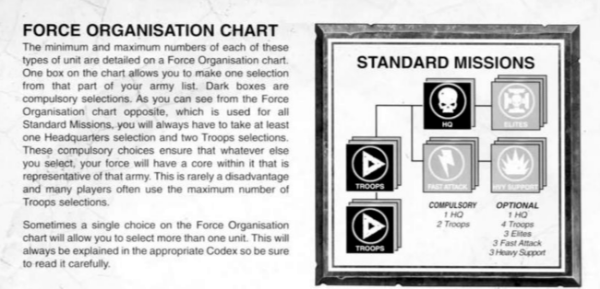 Standard missions (all use the standard FOC): Standard missions (all use the standard FOC): Cleanse: players alternate deploying units to the board, but they have to deploy their units in the following order- Heavy support, Troops, Elites, HQ, Fast attack. This means that Heavy support is the easiest unit type to counter via deployment and Fast attack is the hardest. The mobility and flexibility of the units is broadly reflected in their FOC role. Secure and Control: as above. Seek and Destroy: as above. Recon: as above. Take and Hold: as above. Special missions (also use the standard FOC): Night Fight: as above. Rescue: only Troops deployed at the start with at least one Troops unit required to start, other units are in reserve. Patrol: one unit of Troops each, everything else in reserve (technically units with the Scouts USR can also deploy). Alternative FOCs: 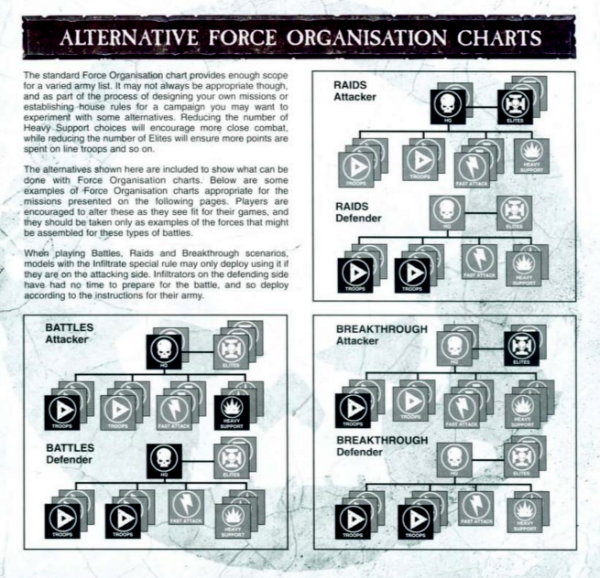 Battle missions (use the battles FOC): Battle missions (use the battles FOC): Bunker Assault: defender can only deploy HQ and Troops, other units in reserve. Attacker deploys entire army. Hold at All Costs: defender can only deploy Troops and Heavy support, others in reserve. Attacker moves onto board in first turn (note this prevents most heavy weapons from firing in the first turn). Meat Grinder: players alternate deploying units to the board, but they have to deploy their units in the following order- Heavy support, Troops, Elites, HQ, Fast attack (as per the standard missions). Raid missions (use the raids FOC): Sabotage: sentries deployment for the attacker (can deploy any units, but vehicles and bikes immediately raise the alarm), units move on in the first "turn". Defenders can place Troops and HQ, other units in reserve. Ambush: no deployment restrictions by unit type. Approximately half of the attacker's army is in reserve with the other half using hidden set up deployment, the defender has to escape off the opposite board edge favouring fast-moving units. Strongpoint Attack: defender deploys Troops, HQ, and Heavy support, other units are in reserve. Attacker deploys entire army, but with the sentry deployment mentioned above. Breakthrough missions (use the breakthrough FOC): Rearguard: no unit type restrictions. Defender only has about half of their army available for the game, deployed with hidden set up. The attacker has half their army move on in the first turn (affecting heavy weapons), and the other half in reserve. Blitz: defender deploys Troops, HQ, and Heavy support, other units in reserve. Attacker deploys entire army. Breakout: attacker deploys all forces in their deployment zone (middle of the board) with no reserves. Defender splits their force in two, deploys on either side of the attacker. The defender deploys their Elites units last, and have freedom over where they are placed so long as they are at least 18" away from any enemy unit. This mission gives Elites a bit more flexibility to punish deployment decisions by the attacker. As a little bonus, Cities of Death missions from 4th edition: Firesweep: players alternate deploying units to the board, but they have to deploy their units in the following order- Troops, Heavy support, Elites, HQ, Fast attack (Troops and Heavy support swap in this mission compared to the standard ones above). High Ground: as above. Domination: as above. Maximum Attrition: as above. Urban Assault: as above. Hit and Fade FOC: 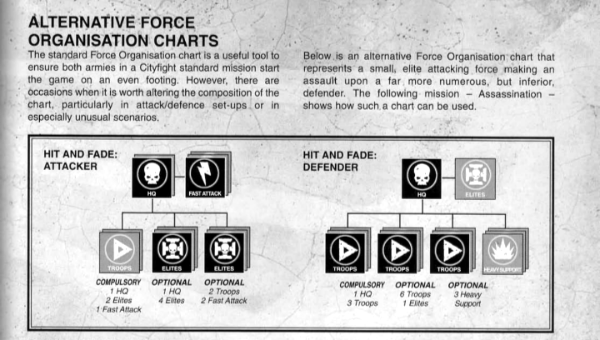 Special missions (use the standard FOC except the last one): Special missions (use the standard FOC except the last one): The Gauntlet: defender can only deploy Troops, HQ, and Heavy support, others in reserve. Attacker moves onto board in first turn (note this prevents most heavy weapons from firing in the first turn). Total Devastation: players alternate deploying units to the board, but they have to deploy their units in the following order- Troops, Heavy support, Elites, HQ, Fast attack (Troops and Heavy support swap in this mission compared to the rulebook standard missions). Relief Force: defender deploys Troops, other unit types are in reserve. Attacker deploys entire army. Grand Assault: no specific unit restrictions, all units from both sides are deployed. This is very much a set piece battle. Thunder Run: defender has no reserves, all units deployed. No specific unit type restrictions. Attacker can use reserves. Assassination (uses the hit and fade FOC): defender deploys only compulsory units (a HQ, which is the mission target, and 3 Troops), other units in reserve. Attacker deploys Fast attack and Elites, other units in reserve. There were also some missions tucked away in codices in 3rd and a few in Chapter Approved (using the standard FOC if not otherwise specified), not an exhaustive list: Army of Death (Chapter Approved): no unit role restrictions, all units deploy onto the board. Assassins (Chapter Approved): defender must deploy HQ, and Fast attack must be in reserve, other units can be deployed or in reserves. Attacker deploys entire force. Battle at the Camp (Chapter Approved): this is a complicated 3-way fight between 3 erstwhile allies. Unit FOC role is important but I can't be bothered to explain it here... Capture the Hulk (Chapter Approved): essentially an early version of what later became known as zones mortalis, so largely restricted to infantry and walkers. Units are otherwise deployed as per the standard missions above. Carnage (Chapter Approved): as per standard missions above, except there are up to 4 players rather than just 2. Dawn Assault (Chapter Approved): as per standard missions above Planetfall (Space Marine codex): defender uses hidden set up, all Space Marines deploy via deep strike on the first turn (will affect heavy weapons use for most units). Hostage Situation (Tau codex): Tau deploys entire army via deep strike on the first turn (will affect heavy weapons for some units, although a lot of Tau heavy weapons are on platforms that can move and fire). The other player has all units in reserves and moves on as normal (only units with the deep strike rule can deepstrike). Frontal Assault (Blood Angels codex, uses the battles FOC and is supposed to be their version of Meat Grinder): defender deploys first, Blood Angels second. Only Blood Angels units that can deep strike can be held in reserve, no defender reserves. No unit type restrictions. Tomb Raid (Necrons codex, uses the raids FOC): attacker deploys entire force. Infantry without bikes, jump packs, or transports can deploy a bit closer to the objective. Defender (Necrons) are all in reserve and move on from the board edges. Slave Raid (Dark Eldar codex): defender can deploy Troops and up to one non-Troops unit of their choice, other units are in reserve. Dark Eldar deploy entire army. Defend the Shrine (Witch Hunters codex, uses the raids FOC): defender (Witch Hunters) deploys one Troops and one Heavy support choice around shrine and one HQ choice in the shrine, other units in reserve. Attacker deploys in two forces either side of the defender, no unit type restrictions. Stop the Ritual (Daemonhunters codex, uses the raids FOC): sentry deployment, but no unit type restrictions beyond this. Terminate the Daemonvessel (Daemonhunters codex, uses the raids FOC): defender deploys one Elites choice, one Heavy support choice, and two Troops choices, and one character (the daemonvessel for the mission) deploys in turn one; other units are in reserve. Attacker moves on from a table edge. Assassination (Assassins codex, different to the Cities of Death mission above): both players deploy armies without unit type restrictions. Death by Moonlight (Dark Angels codex, this is a "historical scenario" more than a mission type, uses the breakthrough FOC): the Dark Angels deploy on a ridge, the Orks deploy any infantry on the board with vehicles, bikes, boarboyz, dreadnoughts (deff dreads in later editions) and support weapons entering the board in the first turn. In addition, as previously mentioned, an Eldar Wild Riders force always uses the following FOC, which can interact very poorly with some missions above if they are forced into them: Note that several of the missions above also have the Sustained Assault rule for one of the players- this allows Troops units to be recycled, except vehicles. Generally speaking, the scenarios above highlight how Troops options are what a given faction has widespread access to and can be used for tasks like holding the line, basic patrols into no-mans-land, and as replaceable bodies in sustained assaults. The more specialised units are in shorter supply but can be husbanded for attacks and raids or rushed in as counter-attacks to save the beleaguered Troops units. I think, as a system, this holds a lot of lore validity and also works for balance purposes as pointed out above, but encouraging units that can cope with a wide variety of deployment and mission mechanisms. This system started degrading in 4th with FOC swapping becoming widespread, and essentially collapsed in 5th with the paucity of mission types in the main rulebook. Edit: blimey, including Combat Patrol (which I didn't mention above), that is 45 missions!  I know I've missed some too, like the missions from the Armageddon global campaign of which there are at least five for 40k.
4042
Post by: Da Boss
The idea was to have trade offs for those lists, and still to have your army have a structure rather than being a free for all. I sort of agree that it didn't always work.
People are always going to have different views on what is appropriate for armies in a wargame. Probably the only way to be completely happy is to do it all yourself.
62565
Post by: Haighus
A.T. wrote: Haighus wrote:Iron Warriors could take 4 Heavy support slots, not 7+? How are you getting more than twice other forces without multiple detachments?
Obliterators were mis-slotted heavy support units.
That said 4e marines could take devastators in elite slots which I always thought was rather missing the point of having an FoC in the first place.
I can sort of see the argument with Obliterators, but they are very versatile units that are essentially beefy Terminators. Versatility is usually a hallmark of Elite units and I can see why they ended up there, especially when looking at the unit role interactions in the missions above. Obliterators being able to deep strike alone makes them more mobile than most Heavy support style units in the Chaos roster.
From a game balance perspective Iron Warriors losing the 0-1 restriction on Obliterators as well as gaining an extra HS slot does equal a lot of firepower, so probably they should have not removed the breaks so hard. Perhaps even 0-2 for Obliterators would have been enough.
99475
Post by: a_typical_hero
Tyran wrote:If you are hoping there if a fluffy list that allows you to bypass the FOC, it makes you wonder why you need the FOC in the first place.
I think there are a few nuances inbetween "I would like to take more of x, because there is some fluff blurb that says some armies form their core with it" and "take whatever you want, but not more than 3 of the same".
It helps with world building/immersion as well as creating design space if there is a default guideline that everybody follows, while providing notable exceptions.
A really good example of this is the first White Scars army list in 3rd edition. You can play an all biker army and even get some additional wargear on top, but you have a limitation of ( iirc) 5 man as the minimum size for troop bikes. I think infantry had to get a transport as well, but my memory is fuzzy on that part.
A bad example, but one that follows more closely your line of thought of "why bother with a FOC at all", would be SM Captains on bike in 5th edition. "Your bikes are now even better if you give your melee beatstick the option to be fast as well".
102719
Post by: Gert
I understand what folks are saying with regard to some missions in 3rd making the force org work but doesn't that kind of not prove the point that it's not actually needed?
If force org only works as a balancing factor if changes are made to the standard chart depending on the mission, then why does a force org chart need to be a thing?
Army and unit restrictions can still be implemented without a chart telling you how many bikes or tanks you can take in a list.
On the other hand, the force org can allow for interesting ways in army building such as with Solar Auxilia in HH with Tercios or for you 40k types Guard platoons.
But even then Tercios are more than just taking multiple units in one slot, they have different interactions between those units and other special rules or wargear all of which would still work without a force org.
40k isn't a historical game that follows real examples of military units and while there are examples such as Astartes Companies or T'au Cadres, there are also as many exceptions to those examples with Chapters like the Dark Angels or White Scars with Biker Companies, or Guard where playing by the background would result in players not being able to use units from their army due to the split nature of Regiments.
There's also the imbalance between choices in armies themselves. Some armies have six Battleline/Troop choices while others have two. Some have more Hero choices than they do other units in the Codex while others struggle not to bring duplicates.
What good is a force org restricting the number of Heroes a player can take if they only have two generic options anyway while another army has special rules that allow the force org to be bypassed?
When 40k was much smaller and didn't have the range of units and armies it does now force org worked to a degree but times have changed and force org is just something that doesn't work with modern 40k.
99475
Post by: a_typical_hero
Gert wrote:There's also the imbalance between choices in armies themselves. Some armies have six Battleline/Troop choices while others have two. Some have more Hero choices than they do other units in the Codex while others struggle not to bring duplicates.
What good is a force org restricting the number of Heroes a player can take if they only have two generic options anyway while another army has special rules that allow the force org to be bypassed?
When 40k was much smaller and didn't have the range of units and armies it does now force org worked to a degree but times have changed and force org is just something that doesn't work with modern 40k.
I have to disagree with that statement. While not following official rules, we do use all modern units alongside the classic FOC. It fits for Space Marines with their dozens of units just as well as it does for GSC. One thing we do is to allow 1 of each "Elite" character models to be taken for each regular HQ selection. This mimics older codizes where you were allowed to bring a Command Squad for your HQ without taking up any kiind of slot. So for each Captain you may take 1 Apothecary, 1 Ancient, 1 Techmarine and so on.
62565
Post by: Haighus
Gert wrote:I understand what folks are saying with regard to some missions in 3rd making the force org work but doesn't that kind of not prove the point that it's not actually needed?
If force org only works as a balancing factor if changes are made to the standard chart depending on the mission, then why does a force org chart need to be a thing?
Army and unit restrictions can still be implemented without a chart telling you how many bikes or tanks you can take in a list.
On the other hand, the force org can allow for interesting ways in army building such as with Solar Auxilia in HH with Tercios or for you 40k types Guard platoons.
But even then Tercios are more than just taking multiple units in one slot, they have different interactions between those units and other special rules or wargear all of which would still work without a force org.
40k isn't a historical game that follows real examples of military units and while there are examples such as Astartes Companies or T'au Cadres, there are also as many exceptions to those examples with Chapters like the Dark Angels or White Scars with Biker Companies, or Guard where playing by the background would result in players not being able to use units from their army due to the split nature of Regiments.
I think the first thing to say is that of course the FOC isn't needed. No army composition measures are, as amply demonstrated by many new players using whatever stuff they happen to have until they start to build larger forces and/or pay more attention to the wider rules.
The FOC is a way to provide a more structured playstyle in which, at its best, armies tend to look like something in the lore whilst still providing a lot of player choice and flexibility in what units they take. It has some restrictions, partly for balance and partly for lore, not strictly either of those. The variety of missions show how forces might adapt to different scenarios and how you might expect certain types of unit to respond (basic Troops being more likely to be present when the enemy attacks, for example). This is very much just a framework, 3rd and 4th both have sections with advice on creating your own missions and FOCs to expand on this. It is intended to be narrative driven and collaborative. I think this gives it a flaw in pick-up game environments because many players never see the variety and essentially specialise their playstyle to a small subset of missions.
The current system is undoubtedly more flexible with less restrictions. Many people obviously prefer that, and I think it particularly benefits pick-up games for variety. But I think it provides less of a framework for understanding how the forces tend to fight in different scenarios and it has less-precise tools for describing how units might fit into different roles during more-narrative missions. It is harder to quickly describe how an attack bike squadron and a devastator squad might behave differently/have different availability when defending a bunker vs conducting a decapitation assault, despite both being firepower platforms in a meeting engagement.
There's also the imbalance between choices in armies themselves. Some armies have six Battleline/Troop choices while others have two. Some have more Hero choices than they do other units in the Codex while others struggle not to bring duplicates.
What good is a force org restricting the number of Heroes a player can take if they only have two generic options anyway while another army has special rules that allow the force org to be bypassed?
When 40k was much smaller and didn't have the range of units and armies it does now force org worked to a degree but times have changed and force org is just something that doesn't work with modern 40k.
I think this operates under the assumption that a force can or should use most/all of those choices. Should a force of ~20-150 soldiers have 8 leaders? There are always units that cannot be taken at 40k scale games (outside massive Apocalypse-type games), the FOC just provides a structure to how those units are selected. I see no reason the classic FOC doesn't work in general with modern unit variety, although it would be a problem with armies designed around multitudes of different characters, for example. That isn't an issue due to number of choices though.
118765
Post by: A.T.
Haighus wrote:I can sort of see the argument with Obliterators, but they are very versatile units that are essentially beefy Terminators.
They were three lascannons for marginally less than a four lascannon devastator squad, the ability to move and shoot alone probably made them the stronger option.
Though we didn't play many 'special' missions locally so the FoC always felt like something that tried to counter excessive skew and alpha-strike lists, with varying success.
With how many poorly-distributed ways there were to bypass restrictions GW could probably have just lumped the fast and elite units together and let players pick any one (non character/monster/vehicle) from the set to be an extra troops choice, with just the heavy slot locked down. Still a restriction of course but even one extra heavy slot or a way to circumvent them back then could be telling.
105713
Post by: Insectum7
A.T. wrote: Haighus wrote:I can sort of see the argument with Obliterators, but they are very versatile units that are essentially beefy Terminators.
They were three lascannons for marginally less than a four lascannon devastator squad, the ability to move and shoot alone probably made them the stronger option.
Weren't they restricted to "one of each weapon" or something like that back then? Or maybe, different weapon each turn? I feel like saying they were three mobile Lascannons isn't quite accurate.
A.T. wrote:With how many poorly-distributed ways there were to bypass restrictions GW could probably have just lumped the fast and elite units together and let players pick any one (non character/monster/vehicle) from the set to be an extra troops choice, with just the heavy slot locked down. Still a restriction of course but even one extra heavy slot or a way to circumvent them back then could be telling.
I think the separation (elites and fast attack) came from the right place. I'm not sure being able to spam even more Necron Destroyers or Immortals (back when they were Elite) would have been a net positive for pick-up games.
I also think the way that the FOC restrictions came down a bit differently for different factions helped instill more flavor. Like the way Eldar Jetbikes, Shining Spears and Vypers were distributed about the FOC. They were all "fast" units, but because they weren't all "Fast Attack" it meant that Eldar could lean into their speed in a faction appropriate manner.
76888
Post by: Tyran
a_typical_hero wrote:
I think there are a few nuances inbetween "I would like to take more of x, because there is some fluff blurb that says some armies form their core with it" and "take whatever you want, but not more than 3 of the same".
After 37 years of novel and codexes releases, not really. You can find lore blurbs to justify pretty much every army composition outside of spamming some super unique units.
I mean, IG Tank spam? Armoured companies have been part of the lore since forever.
Tyranid Nidzilla? Crusher Stampede but also we do have lore about at least one Behemoth splinter fleet that really likes spamming monsters.
Eldar wraith construct spam? Iyanden.
So either you have a dozen lists for each army in the game, or you recognize the FOC is antiquated even from a lore wise pov and the few units that shouldn't be spammed lore wise would be better served with some bespoke limitations.
105713
Post by: Insectum7
Tyran wrote:
So either you have a dozen lists for each army in the game, or you recognize the FOC is antiquated even from a lore wise pov and the few units that shouldn't be spammed lore wise would be better served with some bespoke limitations.
I think the issue is more of a balance and gameplay experience one rather than a lore one. Sure, those extreme armies can exist in the lore, but when the habit is pick-up-games, it's nice not to be blindsided by some horrible skew. And if you're just playing with friends, then you're more free to go wild with the force org anyways.
Though of course, in the current setup Marines can build a list of 9 Land Raiders or whatever the points fit.
107700
Post by: alextroy
RaptorusRex wrote: Wyldhunt wrote:
I'm not fully following. Can you elaborate on that? By "each non-Battleline," do you mean the old force org slots? ( FA, HS, Elites, etc?) If so, how do you address the issue of thematic, not-broken combinations being prevented by that sort of limitation? See previous example about vypers and shining spears competing for FA slots in a Saim-Hann list. And what are the "minimum slots" we're talking about in this context? Are we just talking about unlocking additional duplicates of the FOC if you take even more troops?
I would say that by 'non-battleline', I mean the various support assets - FA, HS, Elites - as a category. You can have X of that, or you can swap what is Battleline. I'm sorry I'm not communicating my ideas well, but I do think the new platoon system for Bolt Action 3E does it pretty well.
This strongly reminds me of the Helix Army construction system used by Firestorm Planetfall. A combination of required units and optional units taken as groups is an excellent way to balance a game since it make it harder to avoid "bad" units while taking only "good" units. It's not unlike 7th ed Formations of Formations. The big difference is you don't get advantages in this type of army construction, just requirements.
If a more structured, but still free-form structure is desired, one need only look at the new Age of Sigmar army construction rules. Regiments of units structured around thematic heroes gives you few very specific abilities/advantages in the game that are not extra rules tied to units/models.
118765
Post by: A.T.
Insectum7 wrote:Weren't they restricted to "one of each weapon" or something like that back then? Or maybe, different weapon each turn? I feel like saying they were three mobile Lascannons isn't quite accurate.
3.0 obliterators had the one weapon each limit, had to remain stationary to use heavy weapons and couldn't ever charge. 0-1 heavy support slot, 3-6 models - didn't even have plasmaguns back then.
3.5 moved them to elites, dropped all the restrictive rules and made them toughness 5 and 5++, though later errata-ed back down to T4(5).
8042
Post by: catbarf
Insectum7 wrote:I think the issue is more of a balance and gameplay experience one rather than a lore one. Sure, those extreme armies can exist in the lore, but when the habit is pick-up-games, it's nice not to be blindsided by some horrible skew.
Especially in a game where your list is built in a vacuum, without any knowledge of what your opponent or the mission will be. If you wanted to play a scenario with your friends where one side consists of eight Marine characters and a half-dozen Thunderfire cannons, you were always free to do so, but such an army composition wasn't appropriate for pick-up games. The FOC had a couple of functions, but one of them was to limit how far you could skew your list away from the core structure of a reinforced infantry company.
The fact that the game didn't allow you to take an armored company didn't mean it was failing to appropriately model its lore, it just meant that that type of list was outside the intended scope of the game, no different from how Epic won't let you take all aircraft or how Kill Team won't let you take tanks. When they did write a bespoke list that let you play an armored company in 40K, it came with a laundry list of special rules intended to curb the obvious advantage such a heavy skew represented.
'It exists in the lore' does not automatically mean 'it should be an option for pick-up games and competitive play'. Restrictions are important for balance, and are the easiest thing to ignore when playing narrative games with like-minded friends.
52812
Post by: Tiger9gamer
 catbarf wrote: catbarf wrote:The fact that the game didn't allow you to take an armored company didn't mean it was failing to appropriately model its lore, it just meant that that type of list was outside the intended scope of the game, no different from how Epic won't let you take all aircraft or how Kill Team won't let you take tanks. When they did write a bespoke list that let you play an armored company in 40K, it came with a laundry list of special rules intended to curb the obvious advantage such a heavy skew represented.
Thank you.
this concept that "because it exists in the fluff and you can't bring it, therefore FOC bad and bring what you want" is tiring, but some people won't let it go.
The limitations offered bring a challenge to list building in itself, and gives structure to armies and games. If you filled out your Heavy supports in a heavy themed army, then you have to find other things to provide firepower, whether in elites, heavy support or troops.
The extra FOC's can even offer fluffy rules and specialties for an army represented in the game too, such as the 7th ed skitarii FOC that provided scouting and crusader USR's, or the cult mechanicus FOC that provided extra canticle choices.
128517
Post by: johnpjones1775
JNAProductions wrote:johnpjones1775 wrote:Some level of restrictions on what you take beyond rule of 3 made the game more interesting imho.
Limiting the number of elite/specialist units was good and meant that units like intercessors actually filled a role in the army list
You should take units because the units fill a role, not because you just can’t take what you actually want to.
sure let’s take an army full of terminators and VGVs! Makes total sense for nothing but the 1st company to make up an entire strike force….
But otherwise a lot of people have been complaining that terminators don’t feel ‘special’ (whatever that means) and I think most of it has to do with the lack FOC, when your whole army is made up elites/specialists, why would terminators feel special in your own army? Why would they feel special against your opponent’s army when it too is also full of elite/specialist units?
105
Post by: Sarigar
FOCs were gamed and there were always armies that fared more efficient within the FOC structure.
Personally, I prefer the rule of 3 and one model must be a Warlord to build a current army. Armies on the table really look and feel like 40K armies which initially surprised me.
128517
Post by: johnpjones1775
Sarigar wrote:FOCs were gamed and there were always armies that fared more efficient within the FOC structure.
Personally, I prefer the rule of 3 and one model must be a Warlord to build a current army. Armies on the table really look and feel like 40K armies which initially surprised me.
What does a ‘ 40K army’ look like exactly?
43573
Post by: vict0988
Flawed implementation of a decebt idea, Troops should be the backbone of most armies. I think the biggest flaw might be bad balance with some slots having several undercosted units and other slots having none, leading to always filling out Elites or Heavy Support for a faction in every list and overcosted units in the competitive slots feeling even worse because you aren't replacing your B team from Fast Attack with your C team from Elites but your A team from Elites with your C team Elites.
I don't think cheating the force org makes sense, you might as well not have it at all, if White Scars can spam bikes then why can't my custom Necron Dynasty spam bikes? It's not like these themed options were limited for balance reasons as they weren't really tested properly, so might as well let the cat all the way out of the bag instead of having just a dozen ways to break the rules and only for select factions (mostly Space Marines).
I don't think units were in the right places a lot of codexes and it being based on fluff seems wrong. Instead, I think there should be hard and reasonable rules for what makes a unit what, like Heavy Support being vehicles and monsters, Fast Attack being jump pack and bike units, Elites being expensive infantry, Troops being cheap infantry. There should not be 50pt Terminators in Troops for Custodes and 40pt Terminators in Elites for Space Marines. The force org should prevent spamming vehicles, it cannot do that if you have vehicles in both Elites, Fast Attack and Heavy Support.
Themed armies like vehicle columns should require consent from the opponent since it's very likely to create a skewed unfun game.
121430
Post by: ccs
johnpjones1775 wrote:Sarigar wrote:FOCs were gamed and there were always armies that fared more efficient within the FOC structure.
Personally, I prefer the rule of 3 and one model must be a Warlord to build a current army. Armies on the table really look and feel like 40K armies which initially surprised me.
What does a ‘ 40K army’ look like exactly?
I guess it depends on wich faction & the player behind it.
Ex: The most recent force I put on the table was Custodes:
Shield Capt on dawneagle x2
Dawneagle bikes x3
Dawneagle bikes x2
Dawneagle bikes x2
Culexus Assassin x1
Hellverin knight x1
Guardian Drone (legends, Unaligned) x1
Looks like a jetbike mounted force with several supporting units to me....
21358
Post by: Dysartes
If I may, I think the general concept of a FOC is a good one - but over time I've become less wedded to the idea that it needs to be a one-size-fits-all approach.
As has been previously mentioned, the HQ/Elites/Troops/FA/HS(/Fortification/Aircraft/LoW) structure works well enough for Space Marines, but can lead to issues with other factions. Over time, the Elites area for most armies grew at a high rate, as it served as a bit of a dumping ground for units that didn't fit in Troops/FA/HS.
As a result, I think I'd like to propose something that returns structure to army-building, but doesn't try to force armies into a structure that doesn't work for them.
Come up with categories that suit an individual army - we might keep the existing paradigm for SM, but maybe Tyranids have Synapse/Vanguard/Swarms/Big Bugs (very rough, off the cuff idea). Even for SM, I might want to add "Specialists" as a unit category, so things which aren't true Elite units could be shunted sideways into this new category. I seem to recall Scouts are in Elites now for C:SM, which doesn't make much sense for the trainees - but they'd make sense in a Specialist slot.
Keep Battleline off the datasheets, however, and have that as a USR that doubles how many of that unit you can take and increases the OC by 1 (assuming OC sticks around).
Some categories (like Fortification and Lord of War) might end up being universal. I've not got a problem with that.
Keep the detachment idea from 10th, but give each a FOC that uses the slots/categories for that particular Codex, and specifies which units are Battleline in that detachment.
This way you're getting armies that look more like what a given detachment is "meant" to look like, without binding everyone to a FOC structure that doesn't necessarily work for that army.
Someone is likely to complaint about "muh agency" now - well, restrictions on what you can do are good for a game, compared to it being an out-and-out free-for-all on army construction.
+ + +
Unrelated point, but I seem to recall that the rule of 3 doesn't scale any more. You can take 3 of something at 1k, and still only 3 of something at 3k (if we just look at the scale of games actively covered in the rulebook). I'd much rather see that return to a sliding scale, so for every full thousand points you're building your list towards, you can take one additional unit - so 2 at 1k, 3 and 2k & 4 at 3k, with Battleline doubling that limit.
105
Post by: Sarigar
johnpjones1775 wrote:Sarigar wrote:FOCs were gamed and there were always armies that fared more efficient within the FOC structure.
Personally, I prefer the rule of 3 and one model must be a Warlord to build a current army. Armies on the table really look and feel like 40K armies which initially surprised me.
What does a ‘ 40K army’ look like exactly?
Hard to explain. If you played during 6th and 7th, it became clear what a 40K army did not look like.
At one point, my Eldar army would also include a Riptide and Imperial Bastion which was quite common during that time period. That is what I would describe as an Eldar army not looking like an Eldar army, thus, not look like a 40K army. This was a time where GW was still using the FOC but expanded it a bit.
Seeing Azrael lead a blob of Imperial Guardsmen with attached Wolves from the Space Wolf codex is what I would describe as not looking like a 40K army. However, folks gamed the FOC which concocted such a unit combination.
112701
Post by: Kothra
Sarigar wrote:johnpjones1775 wrote:Sarigar wrote:FOCs were gamed and there were always armies that fared more efficient within the FOC structure.
Personally, I prefer the rule of 3 and one model must be a Warlord to build a current army. Armies on the table really look and feel like 40K armies which initially surprised me.
What does a ‘ 40K army’ look like exactly?
Hard to explain. If you played during 6th and 7th, it became clear what a 40K army did not look like.
At one point, my Eldar army would also include a Riptide and Imperial Bastion which was quite common during that time period. That is what I would describe as an Eldar army not looking like an Eldar army, thus, not look like a 40K army. This was a time where GW was still using the FOC but expanded it a bit.
Seeing Azrael lead a blob of Imperial Guardsmen with attached Wolves from the Space Wolf codex is what I would describe as not looking like a 40K army. However, folks gamed the FOC which concocted such a unit combination.
These examples have nothing to do with the force organization chart and everything to do with broken, ill-thought-out allies rules.
93557
Post by: RaptorusRex
 Kothra wrote: Kothra wrote:Sarigar wrote:johnpjones1775 wrote:Sarigar wrote:FOCs were gamed and there were always armies that fared more efficient within the FOC structure.
Personally, I prefer the rule of 3 and one model must be a Warlord to build a current army. Armies on the table really look and feel like 40K armies which initially surprised me.
What does a ‘ 40K army’ look like exactly?
Hard to explain. If you played during 6th and 7th, it became clear what a 40K army did not look like.
At one point, my Eldar army would also include a Riptide and Imperial Bastion which was quite common during that time period. That is what I would describe as an Eldar army not looking like an Eldar army, thus, not look like a 40K army. This was a time where GW was still using the FOC but expanded it a bit.
Seeing Azrael lead a blob of Imperial Guardsmen with attached Wolves from the Space Wolf codex is what I would describe as not looking like a 40K army. However, folks gamed the FOC which concocted such a unit combination.
These examples have nothing to do with the force organization chart and everything to do with broken, ill-thought-out allies rules.
Well, you have to look at army building holistically...
128517
Post by: johnpjones1775
 vict0988 wrote: vict0988 wrote:Flawed implementation of a decebt idea, Troops should be the backbone of most armies. I think the biggest flaw might be bad balance with some slots having several undercosted units and other slots having none, leading to always filling out Elites or Heavy Support for a faction in every list and overcosted units in the competitive slots feeling even worse because you aren't replacing your B team from Fast Attack with your C team from Elites but your A team from Elites with your C team Elites.
I don't think cheating the force org makes sense, you might as well not have it at all, if White Scars can spam bikes then why can't my custom Necron Dynasty spam bikes? It's not like these themed options were limited for balance reasons as they weren't really tested properly, so might as well let the cat all the way out of the bag instead of having just a dozen ways to break the rules and only for select factions (mostly Space Marines).
I don't think units were in the right places a lot of codexes and it being based on fluff seems wrong. Instead, I think there should be hard and reasonable rules for what makes a unit what, like Heavy Support being vehicles and monsters, Fast Attack being jump pack and bike units, Elites being expensive infantry, Troops being cheap infantry. There should not be 50pt Terminators in Troops for Custodes and 40pt Terminators in Elites for Space Marines. The force org should prevent spamming vehicles, it cannot do that if you have vehicles in both Elites, Fast Attack and Heavy Support.
Themed armies like vehicle columns should require consent from the opponent since it's very likely to create a skewed unfun game.
For that last paragraph I don’t think there’s a problem with spamming vehicles.
I don’t see any problem with ‘spamming’ vehicles, spamming tanks and super heavies gets problematic fast though.
I don’t think anyone is going to complain about 6 scout sentinels, 6 armored sentinels, and 6 tauroxes. Now 6 russes, and 2 or 3 baneblades most would agree is a problematic list for casual games without a heads up.
73177
Post by: morganfreeman
Gert wrote:I understand what folks are saying with regard to some missions in 3rd making the force org work but doesn't that kind of not prove the point that it's not actually needed?
If force org only works as a balancing factor if changes are made to the standard chart depending on the mission, then why does a force org chart need to be a thing?
Army and unit restrictions can still be implemented without a chart telling you how many bikes or tanks you can take in a list.
On the other hand, the force org can allow for interesting ways in army building such as with Solar Auxilia in HH with Tercios or for you 40k types Guard platoons.
But even then Tercios are more than just taking multiple units in one slot, they have different interactions between those units and other special rules or wargear all of which would still work without a force org.
This kinda feels like the point I was making, about the force org not being the sole method which balanced unit slot selection, but taking kind of the 'opposite' lesson from it. Where as I see it as simply one of the levers which balanced what people took in lists (units have a points cost, units have a slot cost, and in addition units may not be able to deploy in initially to have advantageous positions / may be forced onto the table rather t1 and exposed to attack before they can act / may not be able to use their deep-striking and such to get where they want to go).
My question to this is, how do you feel the force org failed in this regard?
In a simple example, as stated, quite a few missions restricted your ability to deploy the Heavy Support slot, meaning your big guns lost at least one turn of shooting due to not being on the table and probably 2+ due to not being where you wanted them to be and much heavier restrictions on firing heavy weapons while moving. That was a factor of balance, using the force org to restrict which units could deploy when and how. Imo that's good balance, making players have to recognize various opportunity costs in relation to their list building.
Furthermore, how would you elumate that without a force org chart? Restricting Heavy Support the slot is easy, anything there gets restricted. But without it you'd just have to list every single unit that used to be heavy support to get the same effect, and that wouldn't be future proof.
Now whether or not those kind of deployment restrictions are good is another discussion in and of itself, though I'd posit they're unquestionably beneficial given the decade-or-so of extreme lethality we've had.
21358
Post by: Dysartes
In theory, you could give every unit that used to be Heavy Support a specific keyword that a scenario could target - but at that point, why not have the slot?
62565
Post by: Haighus
 Dysartes wrote: Dysartes wrote:In theory, you could give every unit that used to be Heavy Support a specific keyword that a scenario could target - but at that point, why not have the slot?
This would be the modern 40k version- units get a role keyword like battleline (which I think is broadly the Troops equivalent). I'd expect things to be a bit more vague though, you could have Character, Battleline, Strike, and Support keywords or something. That would provide a lot of the functionality of the old FOC in combination with the rule of 3.
To make it worthwhile GW would need to put more effort into mission design though, and actively want to reduce game lethality.
101163
Post by: Tyel
I'm not really sure mission based limitations work practically.
Maybe in a Tournament with people who are really serious about trying to win the whole thing.
But I can't have been alone in meeting up for a game, rolling up a mission, going "that doesn't work for my list/my opponent's list. Lets just play another".
Its a bit like the whole "why do people insist on symmetrical boards, L-shaped ruins, etc etc". Mainly because it works.
I've played a lot of asymmetrical scenarios - but often one player has an overwhelming advantage to the point where they can't lose unless they deliberately try. If the dice are not on the underdog's side, its often a complete rout. After you've done it a few times, it just isn't fun.
Back in 8th (a little more recent) I think you had that mission that turned off invuls in the centre of the map (or all objectives, I can't quite remember). You might say that's just an interesting quirk - but since it had massive effect on some armies, and almost none on others, it didn't really feel very good.
"Don't pick a unit because there's a 1/X chance you'll roll up a mission where they are bad" isn't compelling to me - or I imagine most other people. I can just concede those games and then set up for a "real" game of 40k.
105
Post by: Sarigar
Kothra wrote:Sarigar wrote:johnpjones1775 wrote:Sarigar wrote:FOCs were gamed and there were always armies that fared more efficient within the FOC structure.
Personally, I prefer the rule of 3 and one model must be a Warlord to build a current army. Armies on the table really look and feel like 40K armies which initially surprised me.
What does a ‘ 40K army’ look like exactly?
Hard to explain. If you played during 6th and 7th, it became clear what a 40K army did not look like.
At one point, my Eldar army would also include a Riptide and Imperial Bastion which was quite common during that time period. That is what I would describe as an Eldar army not looking like an Eldar army, thus, not look like a 40K army. This was a time where GW was still using the FOC but expanded it a bit.
Seeing Azrael lead a blob of Imperial Guardsmen with attached Wolves from the Space Wolf codex is what I would describe as not looking like a 40K army. However, folks gamed the FOC which concocted such a unit combination.
These examples have nothing to do with the force organization chart and everything to do with broken, ill-thought-out allies rules.
Clearly not related.
[img]
1
62565
Post by: Haighus
Tyel wrote:I'm not really sure mission based limitations work practically.
Maybe in a Tournament with people who are really serious about trying to win the whole thing.
But I can't have been alone in meeting up for a game, rolling up a mission, going "that doesn't work for my list/my opponent's list. Lets just play another".
Its a bit like the whole "why do people insist on symmetrical boards, L-shaped ruins, etc etc". Mainly because it works.
I've played a lot of asymmetrical scenarios - but often one player has an overwhelming advantage to the point where they can't lose unless they deliberately try. If the dice are not on the underdog's side, its often a complete rout. After you've done it a few times, it just isn't fun.
Back in 8th (a little more recent) I think you had that mission that turned off invuls in the centre of the map (or all objectives, I can't quite remember). You might say that's just an interesting quirk - but since it had massive effect on some armies, and almost none on others, it didn't really feel very good.
"Don't pick a unit because there's a 1/X chance you'll roll up a mission where they are bad" isn't compelling to me - or I imagine most other people. I can just concede those games and then set up for a "real" game of 40k.
Firstly, I think casual pick-up games are the main reason 40k drifted away from having all those missions included in the main rulebook. It doesn't work well unless your area tends to bring more than just a single 1500pt or 2000pt army,as you point out. If a force is built to the standard FOC and the player has no extra units, then switching to a different FOC on the fly to play a different mission type may be impossible without dropping the points total a lot. But if you plan ahead a bit (say as part of a campaign), that is a completely different kettle of fish and you might be able to select the most appropriate units from a larger force. Here, flexible units are genuinely more useful if there is uncertainty over the mission type and your campaign roster is relatively limited.
But for your second point, if you look at those missions from 3rd and 4th, a lot of thought has clearly gone into making actual asymetric scenarios work, by doing things like reducing alpha strike lethality for the player with first turn or making the side with a tougher time have easier win conditions. For example, in the rearguard mission, the defender wins if they have any surviving units greater than 12" from a board edge, whereas the attacker has to kill all those units and have at least one scoring unit left on the board. This is to balance that the attacker gets twice the units in rearguard (note half the attackers force starts in reserve and only arrives on turn 4). The attacker also gets first turn, but has to move their army onto the board (reducing firepower in 3rd/4th) and the enemy has hidden deployment with obstacles and a bunch of booby traps or minefields. It is a neat example of an asymmetric mission.
91640
Post by: Wyldhunt
catbarf wrote: Insectum7 wrote:I think the issue is more of a balance and gameplay experience one rather than a lore one. Sure, those extreme armies can exist in the lore, but when the habit is pick-up-games, it's nice not to be blindsided by some horrible skew.
Especially in a game where your list is built in a vacuum, without any knowledge of what your opponent or the mission will be. If you wanted to play a scenario with your friends where one side consists of eight Marine characters and a half-dozen Thunderfire cannons, you were always free to do so, but such an army composition wasn't appropriate for pick-up games. The FOC had a couple of functions, but one of them was to limit how far you could skew your list away from the core structure of a reinforced infantry company.
The fact that the game didn't allow you to take an armored company didn't mean it was failing to appropriately model its lore, it just meant that that type of list was outside the intended scope of the game, no different from how Epic won't let you take all aircraft or how Kill Team won't let you take tanks. When they did write a bespoke list that let you play an armored company in 40K, it came with a laundry list of special rules intended to curb the obvious advantage such a heavy skew represented.
'It exists in the lore' does not automatically mean 'it should be an option for pick-up games and competitive play'. Restrictions are important for balance, and are the easiest thing to ignore when playing narrative games with like-minded friends.
This is a good point to keep in mind. That said, it does feel like there are a lot of units that didn't need to be restricted by the FOC that were (my Iybraesil/banshees example again). And if you tackle those units by making exceptions, then it opens up the, "Why can marines spam bikes but necrons can't," can of worms.
In the past, we had Matched VS Narrative play. That didn't work out great because it created this sort of false dichotomy of matched play being basically tournament-style games while narrative play was loosy goosy and sort of implied that GW wasn't really making an effort to balance it or make it useful for pickup games. I think a lot of us want something that is structured enough to have a pickup game, but flexible enough to let us play flavorful armies.
So in theory, you could have a stricter style of play intended for tournaments and whatnot that would require armies stick to more structured rules, pay a troop tax, prevents skew, etc. And then you could have a looser style of play similar to what we have now where someone might show up with a skew list, but it's fine because it's understood that you're not looking for a Super Serious tournament style game. The stricter format would be nice for tournaments and possibly as a way for strangers doing a PUG to ensure they're offering eachother a reasonable matchup. The latter is what I'd want to feel free to do if I were just messing around with people I'm comfortable with.
So something like an armored company would be the domain of the looser style of play while a tournament IG list would have to feature more of a mix of guardsmen, some elites, have a limited cap on the number of vehicles, etc.
76888
Post by: Tyran
Wyldhunt wrote:
In the past, we had Matched VS Narrative play. That didn't work out great because it created this sort of false dichotomy of matched play being basically tournament-style games while narrative play was loosy goosy and sort of implied that GW wasn't really making an effort to balance it or make it useful for pickup games. I think a lot of us want something that is structured enough to have a pickup game, but flexible enough to let us play flavorful armies.
So in theory, you could have a stricter style of play intended for tournaments and whatnot that would require armies stick to more structured rules, pay a troop tax, prevents skew, etc. And then you could have a looser style of play similar to what we have now where someone might show up with a skew list, but it's fine because it's understood that you're not looking for a Super Serious tournament style game. The stricter format would be nice for tournaments and possibly as a way for strangers doing a PUG to ensure they're offering eachother a reasonable matchup. The latter is what I'd want to feel free to do if I were just messing around with people I'm comfortable with.
So something like an armored company would be the domain of the looser style of play while a tournament IG list would have to feature more of a mix of guardsmen, some elites, have a limited cap on the number of vehicles, etc.
That's going to lead to the same scenario the Matched vs Narrative did. Pickup games with random people will always favor tournament rules because, well you are having a game with a random person you likely aren't very familiar with, that's borderline the same environment as a tournament.
The level of trust and familiarity required with "highly flavourful" rules is something you have with friends, but not random pickup games.
122989
Post by: VladimirHerzog
Tyran wrote:
So in theory, you could have a stricter style of play intended for tournaments and whatnot that would require armies stick to more structured rules, pay a troop tax, prevents skew, etc. And then you could have a looser style of play similar to what we have now where someone might show up with a skew list, but it's fine because it's understood that you're not looking for a Super Serious tournament style game.
or or or, hear me out: We could have the same level of restrictions baked into the rule for both scenario, with the option of you choosing to build a fluffy narrative list as you wish.
91640
Post by: Wyldhunt
Tyran wrote: Wyldhunt wrote:
In the past, we had Matched VS Narrative play. That didn't work out great because it created this sort of false dichotomy of matched play being basically tournament-style games while narrative play was loosy goosy and sort of implied that GW wasn't really making an effort to balance it or make it useful for pickup games. I think a lot of us want something that is structured enough to have a pickup game, but flexible enough to let us play flavorful armies.
So in theory, you could have a stricter style of play intended for tournaments and whatnot that would require armies stick to more structured rules, pay a troop tax, prevents skew, etc. And then you could have a looser style of play similar to what we have now where someone might show up with a skew list, but it's fine because it's understood that you're not looking for a Super Serious tournament style game. The stricter format would be nice for tournaments and possibly as a way for strangers doing a PUG to ensure they're offering eachother a reasonable matchup. The latter is what I'd want to feel free to do if I were just messing around with people I'm comfortable with.
So something like an armored company would be the domain of the looser style of play while a tournament IG list would have to feature more of a mix of guardsmen, some elites, have a limited cap on the number of vehicles, etc.
That's going to lead to the same scenario the Matched vs Narrative did. Pickup games with random people will always favor tournament rules because, well you are having a game with a random person you likely aren't very familiar with, that's borderline the same environment as a tournament.
The level of trust and familiarity required with "highly flavourful" rules is something you have with friends, but not random pickup games.
That hasn't necessarily been my experience. When Narrative play was a thing, the biggest factor keeping people from using it was probably just Power Level. Generally, my experience has been that people are fine with and even excited to see thematic armies during pickup games. But maybe I'm wrong. It just seems like having a form of play where it's understood that
A.) we can have cool, fluffy things.
B.) Having cool, fluffy things sometimes leads to weaker balance.
... could be good for the game. Instead of trying to make tournament rules also work for casual games.
VladimirHerzog wrote:
or or or, hear me out: We could have the same level of restrictions baked into the rule for both scenario, with the option of you choosing to build a fluffy narrative list as you wish.
Sure. I'm all for it. But as we've been discussing in this thread, things like armored companies or spamming certain units can be thematic but also present challenges to game balance. But if you can give us army-building rules that facilitate flavorful lists (that wouldn't have worked under the FOC) and also don't result in balance problems, I'm all for it.
122989
Post by: VladimirHerzog
Wyldhunt wrote:
Sure. I'm all for it. But as we've been discussing in this thread, things like armored companies or spamming certain units can be thematic but also present challenges to game balance. But if you can give us army-building rules that facilitate flavorful lists (that wouldn't have worked under the FOC) and also don't result in balance problems, I'm all for it.
armored company was not prevented from existing by the FoC either.
I'm not sure where the "balance issues from listbuilding" are coming from, Rule of 3 rarely matters anyway, even in the top competitive lists.
722
Post by: Kanluwen
VladimirHerzog wrote:
armored company was not prevented from existing by the FoC either.
I'm not sure where the "balance issues from listbuilding" are coming from, Rule of 3 rarely matters anyway, even in the top competitive lists.
Just to nitpick a lil', but the Armored Company/Battlegroup was a FW list.
That meant it might as well not exist.
62565
Post by: Haighus
 Kanluwen wrote: Kanluwen wrote: VladimirHerzog wrote:
armored company was not prevented from existing by the FoC either.
I'm not sure where the "balance issues from listbuilding" are coming from, Rule of 3 rarely matters anyway, even in the top competitive lists.
Just to nitpick a lil', but the Armored Company/Battlegroup was a FW list.
That meant it might as well not exist.
Armoured company was a GW list in Chapter Approved in 3rd edition, and had an updated 4th edition Chapter Approved list that was still available on the GW website in 5th edition. The 4th ed list had doctrines too, to match the 3.5th Guard book. This straddled the fairly redundant 1st version of the FW armoured battlegroup. It was only in late 5th onwards that the updated FW list became the only option for an all-tank list.
722
Post by: Kanluwen
Haighus wrote: Kanluwen wrote: VladimirHerzog wrote:
armored company was not prevented from existing by the FoC either.
I'm not sure where the "balance issues from listbuilding" are coming from, Rule of 3 rarely matters anyway, even in the top competitive lists.
Just to nitpick a lil', but the Armored Company/Battlegroup was a FW list.
That meant it might as well not exist.
Armoured company was a GW list in Chapter Approved in 3rd edition, and had an updated 4th edition Chapter Approved list that was still available on the GW website in 5th edition. The 4th ed list had doctrines too, to match the 3.5th Guard book. This straddled the fairly redundant 1st version of the FW armoured battlegroup. It was only in late 5th onwards that the updated FW list became the only option for an all-tank list.
And when people talked about running "Armoured Company", it was practically never about the CA list.
Hence why I said Armoured Company/Battlegroup, because players treated the terms as interchangeable and it was a kind of "I know what you meant" thing.
91640
Post by: Wyldhunt
VladimirHerzog wrote: Wyldhunt wrote:
Sure. I'm all for it. But as we've been discussing in this thread, things like armored companies or spamming certain units can be thematic but also present challenges to game balance. But if you can give us army-building rules that facilitate flavorful lists (that wouldn't have worked under the FOC) and also don't result in balance problems, I'm all for it.
armored company was not prevented from existing by the FoC either.
I'm not sure where the "balance issues from listbuilding" are coming from, Rule of 3 rarely matters anyway, even in the top competitive lists.
Your post seemed to be suggesting we just "have it all" by allowing flexible army creation but also sidestepping problems like skew lists or units being too powerful when spammed. Generally, allowing people to field any units they want in whatever number they want risks allowing skew/spam, which are balance issues.
So I'm saying that the idea of more-freedom-less-problems sounds nice, but how do you pull it off?
52812
Post by: Tiger9gamer
Honestly, Looking back at the confusing mess FOC's became in late 7th with formation FOC's, and then the command point awarding / cost in 8th and 9th, I can see the move away and the stigma against them nowadays. I don't agree with it, but I can see why. In truth, the FOC has never really been expanded upon to it's full potential in mainline 40k, which I am thankfully seeing from this thread.
I agree that they could have been handled a lot better, and allowed more flexibility while keeping in line of "this is what the generic army of X faction looks like", but that seems to be a bigger problem with games workshop army building as a whole. There was a lot of missteps in terms of army comp, but as other stated they served to allow pick up games become a lot easier to manage.
Honestly, what really kills me is the idea we had something good going on with them in early 7th.
Lets take, for example, the Dark Eldar's realspace raiders detachment:
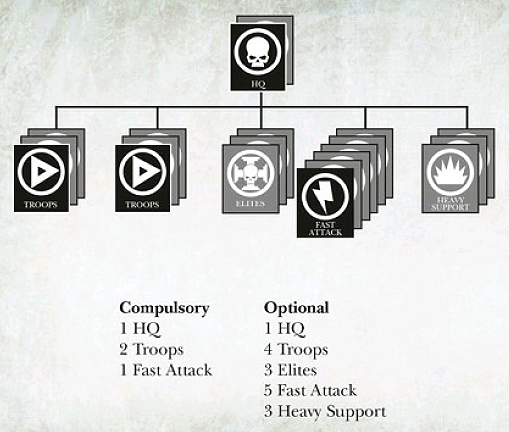
Rules:
Hunt from the Shadows: During the entire first game turn, and during any turn in which the Night Fighting rules are in effect, all Troops units from this Detachment have a 5+ cover save, and all other units from this Detachment have a 6+ cover save.
Realspace Raider: If this Detachment is your Primary Detachment, you can re-roll the result when rolling on the Warlord Traits table in Codex: Dark Eldar.
Going off of this, you see that a Dark Eldar force focuses on fast attack choices, and gives ample room to play with all the units within that slot. I do not know the effectiveness of this FOC because I didnt play eldar, but I can appreciate how it helps provide what an average Dark Eldar player would really want to play over the standard FOC.
If we are just looking at army building with no rules attached, then something like this FOC from HH1 shows how a heavily stacked army leaning towards heavy tanks and vehicles could be balanced, namely making sure that said tanks have a disadvantage for taking so much armor by being more susceptible to an alpha strike. (spoilered for size)
more recently, in HH2 we have a singular FOC again, but with rites of war, legacy of battle and other such customization we see how it can be expanded and altered while giving limitations that can handicap your forces in return for flavor, with my favorite example being the Sky Hunter Phalanx:
------
Effects:
Legion Sky-hunter Squadrons and Legion Proteus Land Speeder Squadrons may be taken as Troops choices in a Detachment using this Rite of War.
Any Legion Sky-hunter Squadrons selected as Troops choices in a Detachment using this Rite of War gain the Line Sub-type (Allowing bikes to score points, but speeders still cannot)
Limitations:
Models with the Vehicle Unit Type included in a Detachment using this Rite of War must have one of the following Unit Sub-types: Flyer, Fast, or Skimmer.
All units in a Detachment using this Rite of War composed entirely of models with the Infantry Unit Type must begin the battle Embarked upon a model with both the Flyer and Transport Sub-types.
A Detachment using this Rite of War may not include any models with the Dreadnought Unit Type.
An Allied Detachment may not use this Rite of War.
A Detachment using this Rite of War may not select any Fortification choices.
------------
With this, your army is focused on fast hitting and striking units without having to specialize the legion / chapter. This way you can have a world eater or imperial fist fast attack army just as much as you can play them as white scars.
I kind of wish we had more of this style of army building in the past editions of 40k where it mattered, where the FOC helps focus in on what army you're trying to create rather than just being limited.
122989
Post by: VladimirHerzog
Wyldhunt wrote:
Your post seemed to be suggesting we just "have it all" by allowing flexible army creation but also sidestepping problems like skew lists or units being too powerful when spammed. Generally, allowing people to field any units they want in whatever number they want risks allowing skew/spam, which are balance issues.
So I'm saying that the idea of more-freedom-less-problems sounds nice, but how do you pull it off?
Right now : by having the rule of 3
Ideally : by adding a stat to the datasheet that says how many copies you can bring in your lists
62565
Post by: Haighus
Kanluwen wrote: Haighus wrote: Kanluwen wrote: VladimirHerzog wrote:
armored company was not prevented from existing by the FoC either.
I'm not sure where the "balance issues from listbuilding" are coming from, Rule of 3 rarely matters anyway, even in the top competitive lists.
Just to nitpick a lil', but the Armored Company/Battlegroup was a FW list.
That meant it might as well not exist.
Armoured company was a GW list in Chapter Approved in 3rd edition, and had an updated 4th edition Chapter Approved list that was still available on the GW website in 5th edition. The 4th ed list had doctrines too, to match the 3.5th Guard book. This straddled the fairly redundant 1st version of the FW armoured battlegroup. It was only in late 5th onwards that the updated FW list became the only option for an all-tank list.
And when people talked about running "Armoured Company", it was practically never about the CA list.
Hence why I said Armoured Company/Battlegroup, because players treated the terms as interchangeable and it was a kind of "I know what you meant" thing.
Really? Because I have generally seen people referring to the official GW list in 3rd edition, where it was sufficiently powerful that it got toned down a couple of years later in the second armoured company list in 3rd edition (not even discussing the 4th edition list that iterated further). The list actually called armoured company, not armoured battlegroup which, as you point out, was a niche FW list.
Also you did say that as a nitpick, when there was a far more available GW list before the FW list ever got published.
722
Post by: Kanluwen
I have NEVER heard someone refer to the Chapter Approved lists. It was always the FW one.
121430
Post by: ccs
Kanluwen wrote:I have NEVER heard someone refer to the Chapter Approved lists. It was always the FW one.
Well surprise, they did. And still do.
At my local shops in the 3/4e era? Very few picked up, used, or in a few cases even knew about the FW list. Almost everyone picked up the CA volumes when they'd come out though. Because those were on the store shelves. So CA Armored Companies were the norm - both in conversation & on the table.
Now and then a few of us would switch things up & use the FW list. And you know what? Almost no one noticed/cared.
91640
Post by: Wyldhunt
I *do* like Rites of War. They seem to be willing to add enough changes (positive and negative) to how you build your army to be flavorful and impactful.
The only downside to them is that you're stuck hoping that GW decides to create a Rite of War that fits whatever army theme you're going for.
101163
Post by: Tyel
VladimirHerzog wrote:I'm not sure where the "balance issues from listbuilding" are coming from, Rule of 3 rarely matters anyway, even in the top competitive lists.
Yeah. To be clear my issue is "aesthetics" rather than balance.
To pick on Necrons, because list was top of a recent Goonhammer Article last week:
Is this list spamming anything? No. Would it fit fairly in a standard FOC? I guess no real troops - unless Flayed Ones got demoted (and tbh, they almost certainly should be.)
The issue isn't therefore the FOC. My issue is that you have the "king of the faction", another monstrous character, 2 more characters, 3 "tanks" (including one super heavy), a buffer of tanks, and just 20 infantry.
You can all it the "Guilliman is on every battlefield problem" - but how is the Silent King "there"? Where is his army?
To a degree this battle has been lost. Players I think like these models - for a variety of reasons. GW wants to sell them, which means allowing you to use them. I can't see them bringing in rules to the tune of "if you take the leader of your faction, you must also take a proscribed 1k points worth of meat to act as bodyguards". I'm not even sure I really want to impose that on people.
But I think there's always going to be a subjective divide between "this is a fluffy force that you'd expect to see in the lore of 40k". And "this random grab-bag of units happens to be really good at current 40k missions. Who cares if it makes sense".
Age of Sigmar seems to have taken steps in this direction - although I suspect most armies will fold into the new regiment system without undue difficulty. But I always disliked how often armies felt unnatural there. "Here's the king of the faction on monster, here's another monster, here's some smaller buffing characters, here's a tough hammer unit that gets buffed up and here's a couple of fast chaff for scoring/denying/blocking." How has this force ever come together organically?
I don't want to buff troops so all you see is hordes of them as they are more efficient than elite options (8th edition had a period of this). I guess I want rules such that you should really want around 1/4 to 1/3 of your points in some sort of regular infantry. (And I'm not married to old definitions of troops. A lot of "elites" could easily be troops on this basis.) If you don't, that's fine, but you are somehow now at a significant tactical disadvantage.
99475
Post by: a_typical_hero
Kanluwen wrote:I have NEVER heard someone refer to the Chapter Approved lists. It was always the FW one.
The CA list was the only one I knew and saw being used at the time.
62565
Post by: Haighus
Tyel wrote: VladimirHerzog wrote:I'm not sure where the "balance issues from listbuilding" are coming from, Rule of 3 rarely matters anyway, even in the top competitive lists.
Yeah. To be clear my issue is "aesthetics" rather than balance.
To pick on Necrons, because list was top of a recent Goonhammer Article last week:
Is this list spamming anything? No. Would it fit fairly in a standard FOC? I guess no real troops - unless Flayed Ones got demoted (and tbh, they almost certainly should be.)
The issue isn't therefore the FOC. My issue is that you have the "king of the faction", another monstrous character, 2 more characters, 3 "tanks" (including one super heavy), a buffer of tanks, and just 20 infantry.
You can all it the "Guilliman is on every battlefield problem" - but how is the Silent King "there"? Where is his army?
To a degree this battle has been lost. Players I think like these models - for a variety of reasons. GW wants to sell them, which means allowing you to use them. I can't see them bringing in rules to the tune of "if you take the leader of your faction, you must also take a proscribed 1k points worth of meat to act as bodyguards". I'm not even sure I really want to impose that on people.
But I think there's always going to be a subjective divide between "this is a fluffy force that you'd expect to see in the lore of 40k". And "this random grab-bag of units happens to be really good at current 40k missions. Who cares if it makes sense".
Age of Sigmar seems to have taken steps in this direction - although I suspect most armies will fold into the new regiment system without undue difficulty. But I always disliked how often armies felt unnatural there. "Here's the king of the faction on monster, here's another monster, here's some smaller buffing characters, here's a tough hammer unit that gets buffed up and here's a couple of fast chaff for scoring/denying/blocking." How has this force ever come together organically?
I don't want to buff troops so all you see is hordes of them as they are more efficient than elite options (8th edition had a period of this). I guess I want rules such that you should really want around 1/4 to 1/3 of your points in some sort of regular infantry. (And I'm not married to old definitions of troops. A lot of "elites" could easily be troops on this basis.) If you don't, that's fine, but you are somehow now at a significant tactical disadvantage.
GW used to tie some special characters to points limits: "Yarrick can only be taken in an Imperial Guard army of 2000 points or greater" and so on. This somewhat had the effect you are looking for of ensuring important characters aren't leading a combat patrol. However, that worked a lot better before 500+ of the points can be taken up by a single super heavy...
27903
Post by: Leo_the_Rat
I think the rule of 3 has been broken since its inception. Let's take a look at Imperial Guard. . They can take 3 Punishers and 3 Plasma tanks, 3 MBTs and 3 of each of 2 other variants not to mention Tank commanders and their tank commander character. A chaos player can take 3 predators and 3 vanquishers and that's it (because for some odd reason changing the turret on a Leman Russ makes it different but changing the turret on a Predator doesn't. GW just doesn't do consistency and they definitely don't do things equally between the various factions. While there's always going to be some inequality in the game GW just doesn't care enough to make it smaller than it is now.
118765
Post by: A.T.
VladimirHerzog wrote:I'm not sure where the "balance issues from listbuilding" are coming from, Rule of 3 rarely matters anyway, even in the top competitive lists.
Squad sizes in some cases - the limit pushes you to have three units of five rather than fifteen units of one for example.
76888
Post by: Tyran
...
May I ask which particular unit is both good enough to be spammed and can be taken both as units of one and units of five?
52812
Post by: Tiger9gamer
Wyldhunt wrote:I *do* like Rites of War. They seem to be willing to add enough changes (positive and negative) to how you build your army to be flavorful and impactful.
The only downside to them is that you're stuck hoping that GW decides to create a Rite of War that fits whatever army theme you're going for.
yea, it's a problem no matter the games workshop game. I would say homebrew is the answer, but good luck trying to get people to run homebrew
134248
Post by: StudentOfEtherium
Kanluwen wrote: VladimirHerzog wrote:
armored company was not prevented from existing by the FoC either.
I'm not sure where the "balance issues from listbuilding" are coming from, Rule of 3 rarely matters anyway, even in the top competitive lists.
Just to nitpick a lil', but the Armored Company/Battlegroup was a FW list.
That meant it might as well not exist.
there was an AC list from WD/chapter approved in the 00s
105
Post by: Sarigar
a_typical_hero wrote: Kanluwen wrote:I have NEVER heard someone refer to the Chapter Approved lists. It was always the FW one.
The CA list was the only one I knew and saw being used at the time.
That is my experience as well. I cannot recall a FW list being used, only CA.
8824
Post by: Breton
Tiger9gamer wrote:So a topic I don’t really see about 40K is the force organization chart. For something that’s been around for whole editions, its recent loss in mainstream 40K is noticeable for me.
What are other people’s opinions on it?
The generic FOC was a failure, even more so when you had to pay/got paid for using one.
It made theme armies virtually impossible to field with the odd exception being a named special who did some FOC shenanigans like Belial/Sammael - which was then limited to that particular sub-faction. The new system is two steps forward, one step back. We can now make our theme armies, but we have even fewer theme HQ/Characters to lead them.
52812
Post by: Tiger9gamer
Breton wrote: Tiger9gamer wrote:So a topic I don’t really see about 40K is the force organization chart. For something that’s been around for whole editions, its recent loss in mainstream 40K is noticeable for me.
What are other people’s opinions on it?
The generic FOC was a failure, even more so when you had to pay/got paid for using one.
It made theme armies virtually impossible to field with the odd exception being a named special who did some FOC shenanigans like Belial/Sammael - which was then limited to that particular sub-faction. The new system is two steps forward, one step back. We can now make our theme armies, but we have even fewer theme HQ/Characters to lead them.
I agree with paying cp thing, but I consider it an vital part of the game's history that was mishandled utterly in late editions. it's a valid oppinion though, can't argue with the anti-theming.
107281
Post by: LunarSol
8th was definitely GW learning how resource economies work in real team
105713
Post by: Insectum7
Sarigar wrote: a_typical_hero wrote: Kanluwen wrote:I have NEVER heard someone refer to the Chapter Approved lists. It was always the FW one.
The CA list was the only one I knew and saw being used at the time.
That is my experience as well. I cannot recall a FW list being used, only CA.
Yup, same here. It's the only one I remember too, despite having at least a couple FW books at the time. IA1 and 2iirc.
8042
Post by: catbarf
I've repeatedly referenced the CA Armored Company originally in White Dwarf (I have the issue it was first in) and have no familiarity with the Forge World list.
109034
Post by: Slipspace
catbarf wrote:I've repeatedly referenced the CA Armored Company originally in White Dwarf (I have the issue it was first in) and have no familiarity with the Forge World list.
Same here. Whenever I hear "Armoured Company" I always think of the CA list for WD (or possibly one of the CA annuals, not sure).
I also remember how dreadfully dull any games were involving it. That just reinforces why the FOC was a good idea - it pushes armies to follow certain broad construction rules, which should lead to more engaging, varied armies on the board than just spamming the best thing, or one specific type of thing. Of course, GW can still get the specific balance wrong within that system, but that doesn't seem to be a systemic issue.
107700
Post by: alextroy
Between the balancing issues with FOC roles and the desire to let players play the models they want to play, I think the 40k Design Studio abandoned the FOC and is unlikely to go back to it.
Instead, they seem to be trying to design the rules in a way to get you to play thematic elements if not thematic armies. Terminator characters join Terminator units and similar things for all characters. Detachments that favor certain types of units to encourage you to bring more of them even if they are not the best units outside of that detachment.
53939
Post by: vipoid
I'm in a similar boat to Tyel in that I like it when armies actually look like armies - not just a grab-bag of vehicles and/or monsters, with maybe a small infantry squad or two buried somewhere in the middle.
Same reason I don't like army-building in Age of Sigmar, where an "army" can be four airships. Or, much like the example above, a special-character monster with a few more monsters and maybe, just maybe, the occasional unit of infantry.
Say what you want about WHFB, at least armies looked like actual armies. You might have large dragon or demon or such, but you'd still have lots of rank-and-file infantry or cavalry supporting them.
In 40k, it would seem that the FOC did serve a legitimate function in this regard, even if its restrictions weren't always appreciated. I would certainly prefer it if troops were good enough to not feel like a tax. However, there is a lot of evidence to suggest that many lists will happily eschew troops even when they are good. Thus, perhaps it is best to ensure that taking at least some troops is not entirely optional?
I also find it rather strange that people complain about the old FOC not allowing fluffy lists, yet don't appear to see anything wrong with Marine Captains apparently being 7x as common as IG Veterans. 
Now, I'll freely say that the FOC probably needed some tweaks to make it suitable for current editions (e.g. the old one wasn't built for fliers or to cope with the unprecedented Marine Bloat). I'm honestly not sure whether this was best done with something like the 8th-9th system of multiple, different detachments to pick from or with something more like 7th, with armies having unique detachments to better reflect their fluff (that Tyranid idea from a few pages looks fantastic). However, I do think that some sort of FOC is needed to bring some structure back and to make armies look like armies again. 
8042
Post by: catbarf
 vipoid wrote: vipoid wrote:Now, I'll freely say that the FOC probably needed some tweaks to make it suitable for current editions (e.g. the old one wasn't built for fliers or to cope with the unprecedented Marine Bloat). I'm honestly not sure whether this was best done with something like the 8th-9th system of multiple, different detachments to pick from or with something more like 7th, with armies having unique detachments to better reflect their fluff (that Tyranid idea from a few pages looks fantastic). However, I do think that some sort of FOC is needed to bring some structure back and to make armies look like armies again.
I like how Epic Armageddon handles force organization. The general pattern is that you have a choice of core detachments with specified contents, each able to take additional units as upgrades. Where it gets interesting is how each army does it differently.
For Marines, you have your choice of a whole bunch of small core detachments (eg 6 stands of Tacticals, or 4 of Devastators, or 4 Land Raiders), and then any of these can be reinforced with a commander or a little bit of armor support. A Marine army ends up consisting of a bunch of small, independent detachments with organic support, and you can mix-and-match as you like.
Then you look at Steel Legion, the default Imperial Guard list. They're arranged around companies, so your basic choices are a commander with 12 stands of infantry, or a company of 10 Leman Russes, or 3 Baneblades. These are bigger, more expensive formations. And they also get add-on upgrades for additional units (Ogryns, fire support teams, Hydras, etc), but then each company you take unlocks up to two support companies, which are things like a formation of 6 stands of Stormtroopers, or a trio of Basilisks, or a single superheavy. So the Imperial Guard revolve around these big blunt-force core formations, with smaller support formations for more specialized units.
Orks are taken as mobs, with three size levels that multiply the number of units in each mob, and then have access to additional units as formation upgrades. An Ork army consists of several hodgepodge hordes of various sizes, encouraged to go big or go home due to a special rule that gives large units a bonus to rallying.
Biel-Tan Eldar build their formations around either Guardians or Aspect Warriors, each capable of taking some organic support, and each unlocking up to three independent specialist formations. So a little like Imperial Guard, but comprised of smaller units with less organic support, and with a much higher ratio of specialists-to-core.
And then different subfactions generally use the same units, but shift around where they fit in the force organization (and how many are taken in a single formation), which makes for armies that look and function pretty differently without needing a slew of bespoke subfaction special rules. Going back to Eldar, if you play as Alaitoc, your core units become Guardians and Rangers. If you play Iyanden, your core units are Wraith constructs.
Overall it's a straightforward system that shapes both what each faction can take and how it fits into their overall command-and-control scheme. That latter part might be unsuitable for 40K, but I think there's a lot of merit to giving each faction their own approach to force org, structuring it around unlocking units rather than limiting them, and having subfactions alter where a given unit fits into the paradigm.
53939
Post by: vipoid
catbarf wrote: vipoid wrote:Now, I'll freely say that the FOC probably needed some tweaks to make it suitable for current editions (e.g. the old one wasn't built for fliers or to cope with the unprecedented Marine Bloat). I'm honestly not sure whether this was best done with something like the 8th-9th system of multiple, different detachments to pick from or with something more like 7th, with armies having unique detachments to better reflect their fluff (that Tyranid idea from a few pages looks fantastic). However, I do think that some sort of FOC is needed to bring some structure back and to make armies look like armies again.
I like how Epic Armageddon handles force organization. The general pattern is that you have a choice of core detachments with specified contents, each able to take additional units as upgrades. Where it gets interesting is how each army does it differently.
For Marines, you have your choice of a whole bunch of small core detachments (eg 6 stands of Tacticals, or 4 of Devastators, or 4 Land Raiders), and then any of these can be reinforced with a commander or a little bit of armor support. A Marine army ends up consisting of a bunch of small, independent detachments with organic support, and you can mix-and-match as you like.
Then you look at Steel Legion, the default Imperial Guard list. They're arranged around companies, so your basic choices are a commander with 12 stands of infantry, or a company of 10 Leman Russes, or 3 Baneblades. These are bigger, more expensive formations. And they also get add-on upgrades for additional units (Ogryns, fire support teams, Hydras, etc), but then each company you take unlocks up to two support companies, which are things like a formation of 6 stands of Stormtroopers, or a trio of Basilisks, or a single superheavy. So the Imperial Guard revolve around these big blunt-force core formations, with smaller support formations for more specialized units.
Orks are taken as mobs, with three size levels that multiply the number of units in each mob, and then have access to additional units as formation upgrades. An Ork army consists of several hodgepodge hordes of various sizes, encouraged to go big or go home due to a special rule that gives large units a bonus to rallying.
Biel-Tan Eldar build their formations around either Guardians or Aspect Warriors, each capable of taking some organic support, and each unlocking up to three independent specialist formations. So a little like Imperial Guard, but comprised of smaller units with less organic support, and with a much higher ratio of specialists-to-core.
And then different subfactions generally use the same units, but shift around where they fit in the force organization (and how many are taken in a single formation), which makes for armies that look and function pretty differently without needing a slew of bespoke subfaction special rules. Going back to Eldar, if you play as Alaitoc, your core units become Guardians and Rangers. If you play Iyanden, your core units are Wraith constructs.
Overall it's a straightforward system that shapes both what each faction can take and how it fits into their overall command-and-control scheme. That latter part might be unsuitable for 40K, but I think there's a lot of merit to giving each faction their own approach to force org, structuring it around unlocking units rather than limiting them, and having subfactions alter where a given unit fits into the paradigm.
These all sound like cool ideas.
One of my favourite themes regarding detachments is an army being made up of some mini-armies, like in the SM example you gave or Coteries from the best codex ever written.
Always seemed like a fun idea and an organic way of scaling up.
551
Post by: Hellebore
E:A's method also allows you to balance larger chunks of an army at once, rather than on a unit by unit basis.
It means you can change the relative value of the same unit in two different formations.
It also has built in theme without preventing you making army choices. It's my preferred method for army building, but it's easier because the smallest element is a unit, rather than a model.
89797
Post by: totalfailure
vipoid wrote:
Say what you want about WHFB, at least armies looked like actual armies. You might have large dragon or demon or such, but you'd still have lots of rank-and-file infantry or cavalry supporting.
Well, WHFB and by extension Old World achieve this by having what is effectively a FOC. In a 2000 point army, you must spend at least 25% or more of your points on what are labeled as ‘core’ choices for the army. So that’s at least 500 points or more of basic units. Characters are capped at no more than 50%, etc.
65352
Post by: SirDonlad
Just thought id plonk this stuff here to add to the variety ITT....
The 'detriments' aren't really detrimental or even particularly restrictive - the bit about automata means you could still have a force compromised of an HQ, two Thallax Cohorts and NINE Thanatars (three maniples of 3)
Oh no, i have to take two units of Thallax...
52812
Post by: Tiger9gamer
 SirDonlad wrote: SirDonlad wrote:Just thought id plonk this stuff here to add to the variety ITT....
The 'detriments' aren't really detrimental or even particularly restrictive - the bit about automata means you could still have a force compromised of an HQ, two Thallax Cohorts and NINE Thanatars (three maniples of 3)
Oh no, i have to take two units of Thallax...
yea, my mind went to that as a fellow mechanicum player, but that list was pretty overpowered from what I heard and With people already complaining it wasn't the best example imo. Really most of the HH1 FOC's are the prime examples of how they could be used.
65352
Post by: SirDonlad
Tiger9gamer wrote:
yea, my mind went to that as a fellow mechanicum player, but that list was pretty overpowered from what I heard and With people already complaining it wasn't the best example imo. Really most of the HH1 FOC's are the prime examples of how they could be used.
The problem was people were using it to play a taghmata army with Ordo Reductor rules.
This is a sticking point for me that usually i hold my tongue over, because "who am i to say what models are 'right' or not?" but i really despise an Ordo Reductor list which has krios venators or more than one automata.
The ones id see around basicly didnt use ORAT or Minotaurs and that is Tech-Heresy in my eye.
Same with the secondary HQ choice, essentially turning the army into a taghmata/cybernetica hybrid with Magos Ordinator or Magos Dominus.
The only type of Dominus that should be in an Ordo Reductor Cohort is a "Dominus Triple-Bombard" artillery tank!

/Rant
Spot on and agreed regarding the HH force org stuff- it was really well done; the extra elite and HQ choice over the normal 40k FOC was perfectly judged for the intention for the setting.
|
|