Prepare for a wall of text. Here is the inital runthrough of the fluff for my
IG force, mostly background on the planet itself.
The planet of Caleston
Similar to Terra, the majority of the surface of the planet is covered by water (approximately 75%). Large land-masses on the North and South poles of the planet are present as a result by volcanic activity and shifts in tectonic plates forming mountains. Erosion from coastal waters has created shallow plains near the coastlines, with mountainous terrain further inland. This topography is relatively consistent throughout Caleston.
The planet of Caleston has a markedly slow rotation of its nearby star and spins on an axis which is nearly perpendicular to that of its orbit. This causes very little seasonal change in the weather. Typical seasons last 2 years and are only marked by the longest and shortest day of the year. As a result, the weather in Caleston is also relatively consistent throughout the habitable areas, averaging between -25 F to 25 F with moderate snow fall. Average temperatures drop rapidly as one moves further inland, toward the poles. Volcanic discharge and the orientation of the planet also limit the amount of light on the surface. The day-cycle of Caleston will not exceed the light levels at dusk on other planets.
Government and Economy
The planet is separated into self-governing city-states which span the coastlines of the northern and southern land masses. The northern city-state (Trymar) and the southern city-state (Sylsalto) are each ruled by a seven-person counsel, elected by the populace. Each city-state is divided into seven districts, each of whom will elect a counsellor. Meetings between of the counsels of Trymar and Sylsalto occur once a year, but only address global issues.
Numerous underwater volcanic vents on Caleston release a great deal of minerals into the ocean waters and provide sustenance for many of the smaller life-forms on the planet. Seaweed and these small organisms provide the bottom of the food chain in Caleston’s ecosystem. The oceans of Caleston are rich with fish, sea-snakes, crustaceans, and other animals, ranging in size from microscopic to comparable to a Leman Russ Battle Tank. This aquatic life provides the basis of one largest industries in Caleston. In order to prevent over-fishing, commercial licenses are sold to eligible corporations on a yearly basis. Licenses are auctioned at the beginning of each year and allow for a certain number or poundage per species over the course of the year. Many of the more exotic species are considered delicacies, making them a large component of Caleston’s exports.
The mountainous regions far from the coastline, especially loss on the northern landmass, are rich sources of minerals. These areas have been sectioned off and the mining rights sold at auction to wealthy trade houses. The operations at these mineral claims vary based on the wealth and ideology of the owners. On the high end, some claims are operated almost entirely through the use of servitors and remotely-controlled machinery. This approach takes a larger capital investment, but requires less upkeep and personnel management. Less sophisticated operators utilize hand-held seismic survey devices and mining equipment to access the mineral deposits. The local population provides a plentiful supply of workers willing to risk the cold and danger of the mining work, in exchange for the mandated hazard pay.
The other major component of Caleston’s economy is the drilling, refinement, and exportation of promethium. The majority of drilling is done off-shore, where oil rigs operate as self-sufficient communities. Workers and supplies are flown in via VTOL craft for month-long shifts.
Raw promethium is transported by barges to one of the coastal refineries owned by one of the major trade houses. The product is refined, packaged for sale, and transported by mag-rail to the starport for off-world distribution. There are no property rights to off-shore oil wells, but the cost of the initial investment dissuades all but the wealthiest trade houses.
Military Organization
Like many worlds under Imperial rule, the Imperial Guard institutes a conscription of eligible males for service in the military. Upon completion of the state-mandated education, a random selection are enrolled for military service and presented a Military Obligation Bond (MOB). The MOB requires a 20-year service in the Imperial Guard and is only satisfied by death or special circumstances. In order to avoid the selection of personnel with other talents, the MOB is treated an an negotiable instrument. Duty may be transferred to any qualifying person and will satisfy the MOB. The wealthy trading houses will often pay great sums to relieve their sons of this obligation. The lower classes will look to acquire an other’s MOB in exchange for cash, commercial fishing licenses, or a mining claim.
For defense of the plant and general peace-keeping activities, a “Second Detachment” is drafted for one out of every ten companies (1st, 11th, 21st, etc.) This company is organized in identical fashion to the combat detachments, but will only operate planet-side.
Due to the low-light conditions and volcanic ash, all military personnel are equipped with re-breathers and light-amplifying lenses during their initial training. By the end of basic training, infantry from Caleston are accustomed to fighting in these conditions.
Veterans of the Caleston are assigned to dedicated “Javelin” squads and receive special training and equipment. These units are focused on the destruction of enemy armor and operate at short distances. Equipped with meltaguns and mounted in Chimera APCs, “Javelin” squads look to perform hit-and-run strikes, disabling or destroying enemy armour. For this role, veterans are also equipped with the M8C Assault Rifle and improved combat optics. The M8C Assault Rifle is solid-munitions rifle and is easier to maintain in colder climates than a las-weapon. The weapon boasts a quicker rate-of-fire and comparably stopping power as the standard las-rifle, but is ineffective at range.
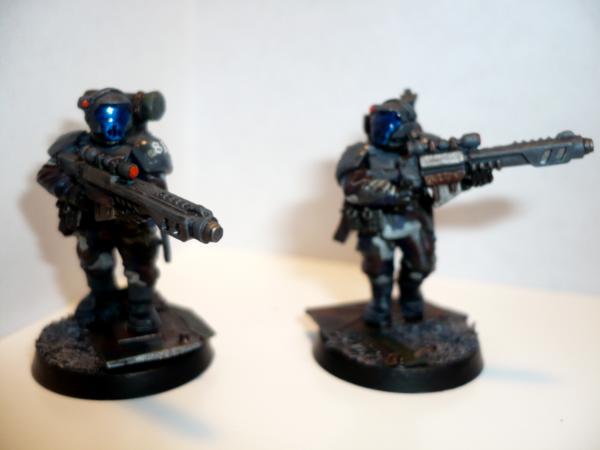
Automatically Appended Next Post: Here are some completed pics of my first five veterans. I am using the "closed visor" heads from Pig Iron and Hasslefree guns as count-as-shotguns for my veterans.
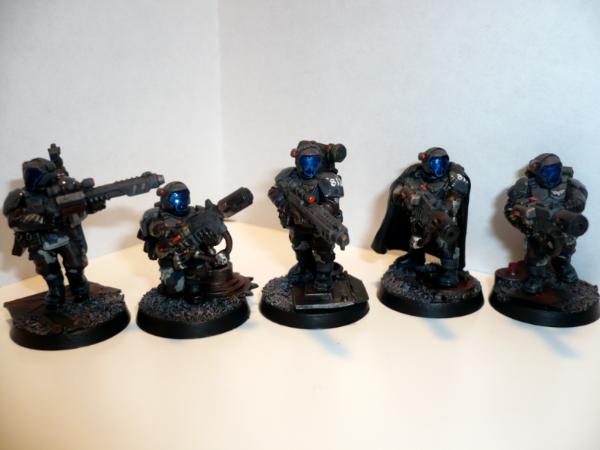
As part of my hobby ocd, I have an obsession with making sure that each trooper has equipment that is consistent with their weapon loadout. As such, I have clipped off the las-rifle cell part of the webbing. I am using the large
SM pouches for ammo containers on then shotgun veterans and Kroot ammo for the melta-gunners (I envision reloading the involve replacing a core from the cylinder portion of the gun). The bases are made from tearing apart some old Tamiya WWII kits for parts, inspired by Migsula.
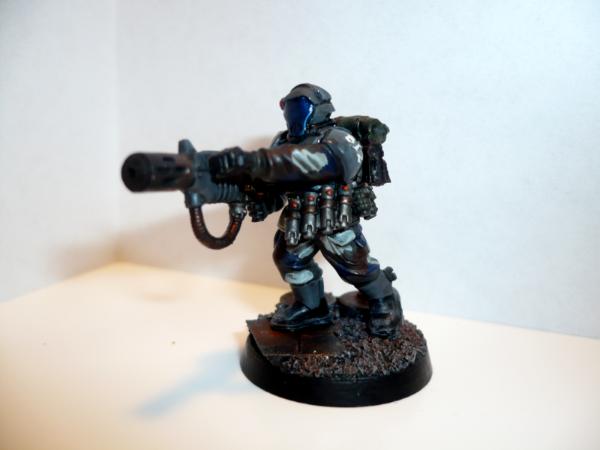
The Melta-gunners
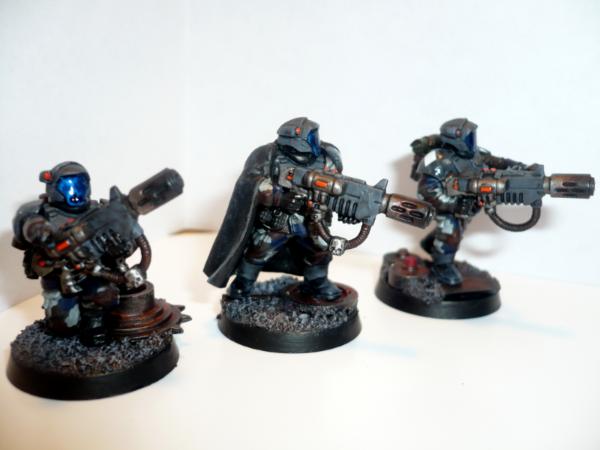
Close up of Kroot Ammo Accessory as "melta" ammo
Count-As-Shotgun Vets
Comments and criticism welcome. I've just mocked up the remaining 5 of this squad and hope to have them completed shortly.


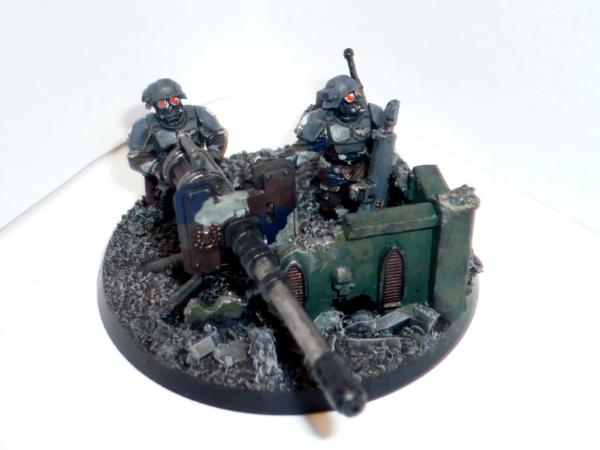
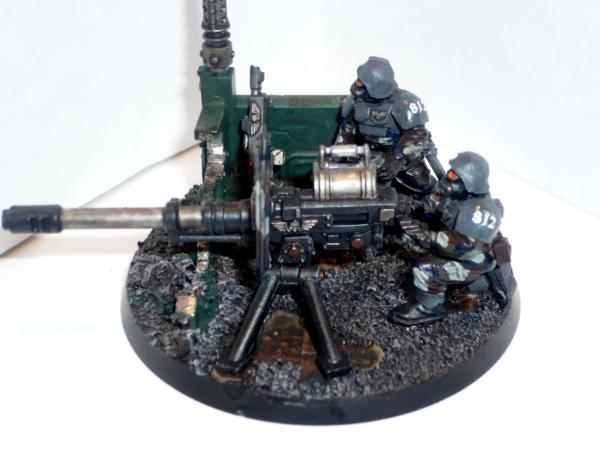
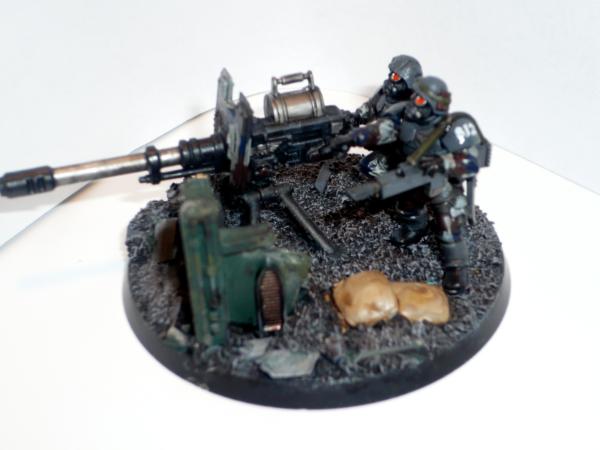
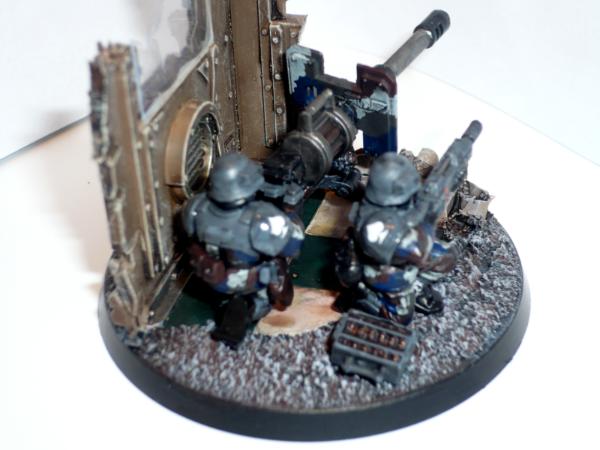


 Four coats of Yellow later... Still brushstrokes.... sigh


 Cadre Coronal Afterglow w1;d0;l0
