Forum adverts like this one are shown to any user who is not logged in. Join us by filling out a tiny 3 field form and you will get your own, free, dakka user account which gives a good range of benefits to you:
No adverts like this in the forums anymore.
Times and dates in your local timezone.
Full tracking of what you have read so you can skip to your first unread post, easily see what has changed since you last logged in, and easily see what is new at a glance.
Email notifications for threads you want to watch closely.
Being a part of the oldest wargaming community on the net.
If you are already a member then feel free to login now.
2012/07/16 06:38:38
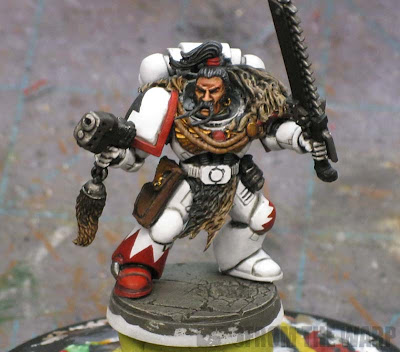
Subject: Really Need Some Help With White. Now with more Pics!
Hello, thanks for taking an interest to help a struggling painter.
Let me begin by saying that i'm not an expert painter, on a good day I can paint just above table top quality. I had a grand mal seizure several years ago leaving me color blind and a tremor in my hands that refuses to go away. Its not a true color blind btw, its more akin to a shade blind and difficulty distinguishing contrasting colors.
However i can still see that my white skills aren't up to par.
And i'm a White Scar Player...
So i've tried a myriad of approaches, watering down and doing multiple coats etc. I just bought an air brush but am having difficulty making it look deeper than a white primer.
I'm currently priming Grey and airbrushing several coats of white over that. But then i just get solid block of white with no depth, zero shading/highlighting. Whenever i attempt to wash or ink model, it really comes out just looking dirty no matter how much i water it down. Don't even get me started on my reds!
Does anyone have any suggestions on how to improve white painting techniques? How do i shade around knee pads, etc. What about highlighting?
Thanks so much. I'll update with some pictures tomorrow.
This message was edited 1 time. Last update was at 2012/07/17 03:42:39
priming in a light grey is a good start if your using an airbrush!
after that, just spray the model with white from the top at a 40 degree angle, so you wont hit the parts that wont be hit by direct sunlight.(be sure to hit the toes though and give him a full blow of white in the face!)
hit him with a heavy coat of gloss (dont worry) and then apply your wash. be quick about it though and as soon as you covered it with the wash take a paper tower or even better a piece of cloth and rub off the wash from all large flat area's
once the wash that remains in the crevices is dry seal it in with a coat of matte varnish
for the reds, i suggest to use a dark color like scab red as a base color. then use blood red to fill it in (only on the white area's, leave the reds on the grey area's scrab red. and finally give the reds that will be hit by the light a edge highlight with a nice orange
that should get you a nice, shaded, clean looking white scar
This is one of the best tutorials for white scars that I know of.
I don't really know about airbrushes, but I think they might be working against you here. Painting white tends to need leaving small traces of the underlying grey near recesses and joins, and I don't know if that's doable with an airbrush.
In any case, as has been said so many times before, white is all about multiple light coats and well thinned down paint. (and lots of patience)
I must say i had lots of trouble and avoided white where possible but the WD a few episodes back had an awesome tutorial on painting white scars which i've used along with the new GW paints and it was really easy to get a good result.
if you wanna use an airbrush i thnk my technique would do really well!
you wont have to do any layering (with your visual disability to identify contrast) and it will have grey shaded area's, white area's where the light will hit and shading in the crevices due to the wash over the gloss coat!
You can't really wash late in the game when you are painting white because everything turns out muddy. You need to create the shadows early in the process. ( I have never tried a gloss varnish coat and then a wash though).
This is how I paint my white scars, undercoat black- Deneb stone basecoat - heavy devlan mud wash - dry brush Deneb stone - drybrush bleached bone - drybrush 1:1 bleached bone: skull white - highlight skull white. This gives a fairly warm to e to the white but you could go through space wolves grey to get a cooler tone if that is what you are after.
I've tried lining in the shadows with wash but you really need a steady hand and I thought it looked a bit too cartoony.
DijnsK wrote:priming in a light grey is a good start if your using an airbrush!
after that, just spray the model with white from the top at a 40 degree angle, so you wont hit the parts that wont be hit by direct sunlight.(be sure to hit the toes though and give him a full blow of white in the face!)
hit him with a heavy coat of gloss (dont worry) and then apply your wash. be quick about it though and as soon as you covered it with the wash take a paper tower or even better a piece of cloth and rub off the wash from all large flat area's
once the wash that remains in the crevices is dry seal it in with a coat of matte varnish
for the reds, i suggest to use a dark color like scab red as a base color. then use blood red to fill it in (only on the white area's, leave the reds on the grey area's scrab red. and finally give the reds that will be hit by the light a edge highlight with a nice orange
that should get you a nice, shaded, clean looking white scar
That sounds terrible...
Playing chess doesn't require skill, it just requires you to be good at chess...
One thing to remember when painting white (assuming you want "white" and not just bone or grey or dirty brown) is that you want the majority of the model to be, well, white. Often when we learn to paint we go base colour, shade and highlight. White you aren't going to highlight, so you need to put more emphasis on doing a good shade.
With ceramite white it might be possible to start from a dark colour in the crevices and work up to a white that covers the whole model, but I haven't really tried that.
Typically white has poor coverage, so if you want a nice clean looking white, you're best off starting with a white undercoat and the shading down by painting into the crevices, leaving most of the model white.
What colour you shade with depends on what effect you want. On my Templar style Bretonnians I used a 3 stage shade, mixed 50/50 white/deneb stone and painted that into the "shaded" areas, then did a pure deneb stone in mostly the deep crevices, then in the really deep crevices I mixed a bit of Khemri Brown into the Deneb Stone to give a deeper shade.
I used those colours as I wanted the shading to be on the brown/bone end of the scale. If you want a more pure white, you'd probably use greys instead.
You could also use washes, but don't just wash the entire model, paint the wash into the crevices and leave most the model white, or else if you do wash the entire model you'll have to go over and pick out the white bits again. Washes pool in the crevices, but they also stain the high regions, so if you want a cleanish looking white, you need to have it actually white and not stained with a wash.
You might even be tempted to mix your own wash, since Nuln Oil may be too dark, you could mix your own out of something like Codex Grey or Shadow Grey.
I would do dirty white. Just prime white and then do some heavy washes of black/brow and then go back over the model with white on the parts that you don't want as dirty. Looks nice.




 Playing chess doesn't require skill, it just requires you to be good at chess...
 4k and rising
 almost 2k
 3k
3k
 1k
1k
 planning 2k


 ]
]