Tonight saw a couple of steps forwards and one step backwards...
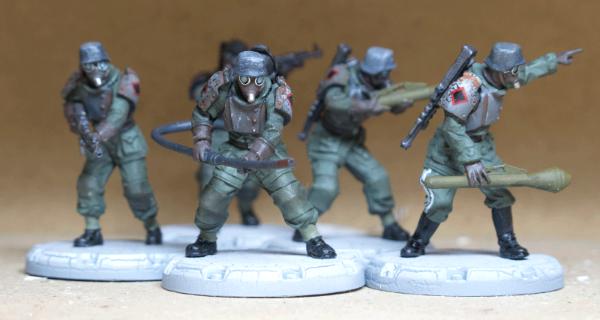
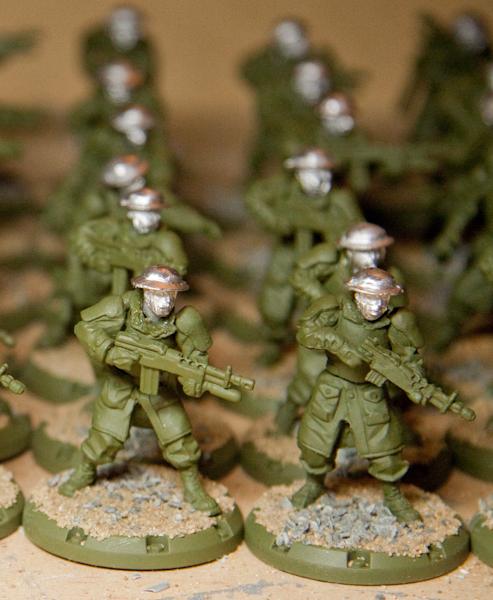
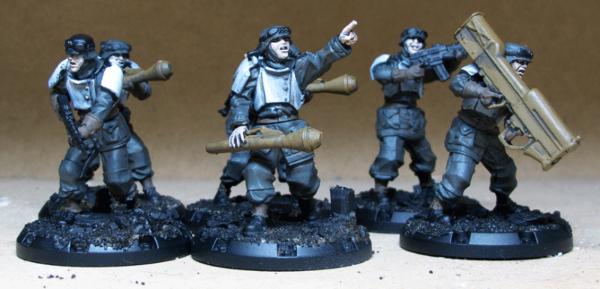
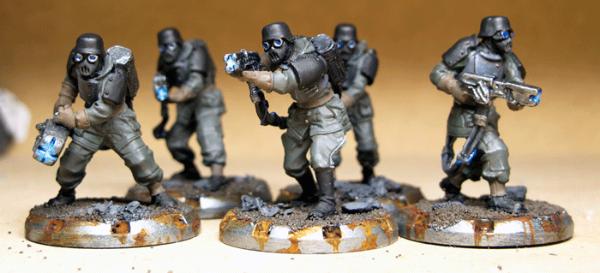
The first step forwards was improving the colours being used for the germans. Originally I had the rifles and the gasmask canisters as bare metal... this looked a bit rubbish to be honest and, looking at some ww2 historicals painting guides, wrong. I've used a different shade of green (VMC German Fieldgrey WW2) to do the canisters, rifle grips and handles. This is all being shaded with the USA Olive as well. So far, this is looking much better. When I go back and do the chipping on the armour, I'll beat up these bits as well.
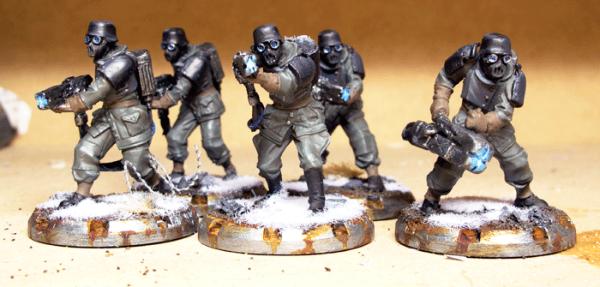
Next step forwards is part 1 of the great Snow experiment. I bought the
GW winter effects pack as I want to have all of these guys fighting in a winter environment. Interestingly, or not, the pack doesn't explain how to use the snow effect. I tried looking in the Forgeworld Masterclass books too as the second one contains a few vehicles and dioramas that use snow, but that's fairly sparse on information as well. It has two different opinions; only one of which uses the
GW snow and all it says is "we attached some
GW snow effect with pva glue". Gee.. thanks for that :/
So. I need to see if I can work out how this
GW snow reacts with different mediums; in this case, white glue (
WG), MIG acrylic resin (R) and
GW Ardcote gloss varnish (V). The image is a little tricky to see some of the differences; zooming in does help a bit.
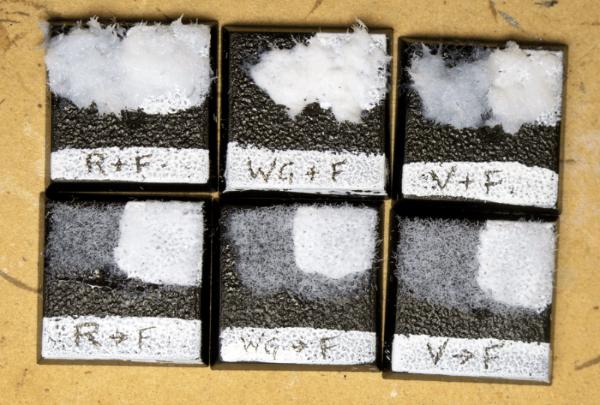
Going left to right we've got each medium either mixed (+), or used to stick the flock on (-&
gt
. For example top left is a mixture of the Vallejo resin and the snow flock (R+F) and bottom left is a layer of resin painted onto the base, with some flock over the top (R->F).
As you can see, in all the cases where the flock is laid over the top of the sticky medium it's fairly transparent so you can see a difference between the colours underneath. Whichever medium is chosen, you get light, fluffy looking snow that looks fresh, but thin. If you're doing this, white glue is probably your best (and cheapest) bet.
Mixing the flock with the different mediums is where we start to get some more interesting effects. In each case I've not been overly careful on quantities, but I did learn that mixing a small batch and applying it, then mixing a little bit more works better than trying to do a larger batch in one go.
Gloss varnish and the resin seem to give very similar effects. The snow is quite thick, but slightly shiny so it looks wet, as if it's slowly melting in the sun, or under foot. Mixing the snow effect with the pva glue gives a very matt, almost paper-ish looking snow, which is good for very dense, compacted snow.
I've also seen mention of using water effects for snow, but I don't have any of this... I'm not sure if I'll bother looking into that as the resin and white glue give some good effects without spending any more money.
Part 2 will look at the other regularly used snow effect, bicarbonate of soda. I suspect this will give a better, more realistic snow as the
GW effect is just fine white flock. The other Forgeworld snow tip uses a powdered snow effect, so I'll try that tip when I get to the bicarb experiments.
Aaaaand then there's the down side. While I was waiting for the resin to dry for the photo, I looked up
british uniform colours in WW2 and started a test figure... unfortunately it's using exactly the same colour as the panzerfausts and looks *really* odd with a snow camo jacket over the top. I'll finish the test model just to make sure, but so far I'm not convinced it works all that well. We shall see...
I'm unlikely to post again before the end of tonight, so happy new year to all three of you reading