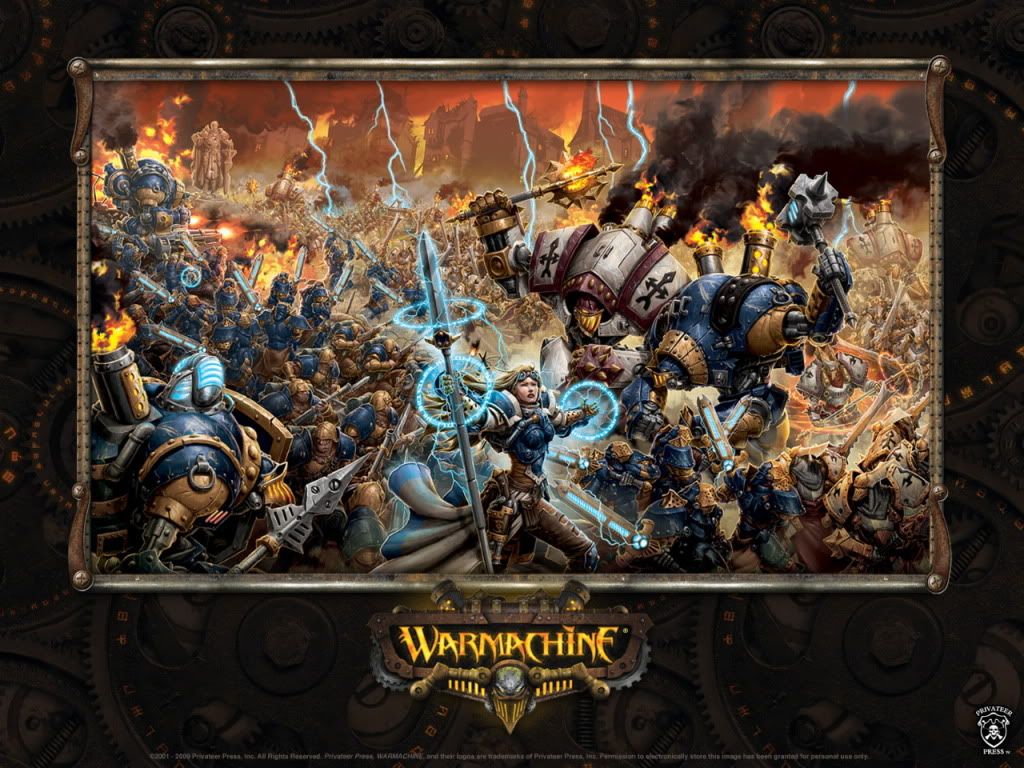
Welcome to the world of steam-powered combat! This guide will give you a few basic idea’s on how the game works, what the hobby scene is like, and a few tips and tricks to help you start collecting! I’ll be assuming that most people here are coming from a
40k background, so this guide will aim to give you a grounding on the rules, the background, the play style and the models. Firstly, know that you can get a copy of the quick-start rules for free, which can give you an idea of how things work, before you buy the game. We’ll also be talking about Hordes – the sister game to Warmachine. Both games integrate fully, though there are different game mechanics for the Warcasters and Warbeasts that occupy Hordes than for WarJacks that are the backbone of Warmachine armies. We’ll talk mainly about Warmachine for this guide, though we’ll add information about hordes as we go along.
The rules: Download the Quick-start rules from Privateer Press for free.
Warmachine Quick-start rules. Hordes Quick-start rules.
The Game:
Overview of the game: Warmachine is a small skirmish game, with average sized games having anything from a handful of models up to usually 30-40 – generally far fewer than your average
40k game. The focus of the game is usually on your powerful Warcaster – the general of your army, and a powerful model in its own right, who controls and powers the Warjacks using Focus and commands the infantry of your force. An average game is usually 35-50 points, with 50 points being the standard full tournament army. Smaller games of anywhere between 10-25 points are still hugely fun, and make for a quick and casual game. When playing a game, I would equate a 50 point army to 2000 point
40k game - a full sized game, where you can fit in a lot of stuff - a 35 point game to a 1500pt
40k game, and 25pt game to a 1000 pt game - quick and fun.
Stats: Each model comes with its own card that gives you the stats, cost, special rules, and lets you track their remaining hitpoints. No more looking through endless pages for the special rules, they’re right there on the card and you put together an army just by getting out all the cards, and mixing and matching your force. For example:

The main stats are:
SPD (Speed) - How far a model can move in inches (doubled when running, +3 when charging)
STR (Strength) - Factored into melee attacks and power attacks
MAT (Melee Attack skill) - like
WS in
40k RAT (Ranged Attack skill) - Like
BS in
40k DEF (Defence skill) - How hard a model is to hit
ARM (Armour) - How tough a model is to damage, closest to T in
40k Weapons also have stats, with ranged weapons having a
RNG (Range) and POW (Power) stat, and melee weapons having a P+S (Power+Strength) stat - note that the POW stat on melee weapons isn't used, except for some special rules.
All the little Icons have meanings for general special rules, sort of like
USRs. For instance

denotes a shield, which gives you +2
ARM when attacked from the front arc. The back of the card shows any special rules associated with the model - in this case, it's special shield has the power to push models that hit it away, preventing them from making follow-up attacks - A very useful defensive ability!
Finally, Warcasters have a
FOC (Focus) stat, which represents their magical ability. Each turn a caster gets as many
FOC tokens as his stat, and can use them in various ways - Boosting his or his warjacks rolls, or giving them extra attacks, casting spell, or increasing his armour level.
The Core Mechanics: The mechanics are deceptively simple, and free flowing, and you’ll find follow a far less rigid structure than
40k. Like
40k, the game is split into player turns and Rounds (game turns). During a player turn, there are three phases – the maintenance turn, during which you work out any ongoing or random effects, the control phase, where your warcaster gains and allocates his focus for the turn, and the Activation phase – the main phase of the game. During the Activation phase, you get to activate your units in whatever order you wish – you are not set into movement/shooting/assault phases, you do everything for one model/unit at a time, before moving onto the next. When a unit activates, you can move with it up to its
SPD value (or run/charge for extra distance) and then attack or activate any of its special abilities.
While you can charge enemies, it’s important to remember that models do not become locked in combat like in
40k. Each model has a melee range of ½” or 2” (for reach weapons), and models are free to just walk into or out of combat – though they’ll take free strikes from enemies if they move away or past them! It's also the case that squads move together, but still attack as individuals, and can be killed as individuals, and even individual models with multiple attacks can apply them to different targets - you aren't locked in with what you can attack. As I said, it's a bit more free flowing than
40k.
When attacking, you first roll to hit using your relevant Attack Skill (Either
RAT or
MAT) +
2d6 against your opponents
DEF stat – if your roll equals or beats his score, you hit. For example, if our
MAT 6 Revenger swings against a
DEF 13 Reaper, you have to roll at least a 7 to hit on your
2d6. You then roll to damage, which is the POW (or P+S for your melee weapons) of your weapon +
2d6 against his Arm value, and for every point over, you do one damage to your opponent. WarJacks and casters have many hit-points, while most infantry have only 1 wound, or a handful of wounds for some. Once you work out the damage, you can mark it off on the models hit boxes, until its dead. WarJacks have special hit-box grids, where you roll a dice to determine where the damage goes, and which might mean the warjack has one of its systems damaged, such as an arm or it’s movement, which can impair it.
These attack and damage rolls can be helped along by using focus, or various abilities to “boost” the roll, to make it more likely that you’ll hit or do damage. When you boost a roll, you get to roll 3 dice for the roll, and there are other abilities that allow you to add even more dice, for when you really need to smash something. The ability to add an extra dice to your roll is, of course, a huge benefit, and only Jacks and Warcasters can do it reliably by spending Focus to gain a boost, other models need to have a special effect to gain them, or can get a boosted damage roll when charging.
The Pieces: Warcaster: Like the queen in chess, he is one of your most powerful pieces, but like a king, losing him or her will lose the game. The Warcaster has many abilities and spells for supporting your army, and choosing which Warcaster you use will be a major defining part of how your army plays on the tabletop, and which game pieces you’ll use in your army. Each warcaster has a certain amout of Focus – representing their magical ability –, with most casters having about 6-7 focus. They use this focus to cast spells, boost their attacks or power up their warjacks. Their focus also determines their control distance – the distance out to which they can give focus to their jacks.
Casters also each have a Feat – a special effect that can be used once per game, and which can drastically alter the course of a game. Effects can be just about anything, from a feat that makes all your enemies knocked down, to a feat that allows a unit to come back from the dead, to a feat that makes opponents in your control range move half a foot in any direction you choose. These feats help define a caster, and make for great, dramatic moments in the game.
WarJacks: WarJacks are the steam powered, mechanical monstrosities that form the core of a Warmachine army, and are a defining element in the game. They come in two sizes, light and heavy, which come on medium and large bases respectively. Generally, heavies tend to be more beat-stickish, while lights tend to have more finesse or specialised uses. While Jacks can do things on their own, they are reliant on the warcaster to give them focus to truly shine. Each warjack comes with a range of weaponry to attack with, or the ability to use “Power Attacks”, which allow them to do things such as picking up and throwing other jacks, body slamming them across the field, putting their opponents in a lock, or trampling over smaller infantry. With the use of focus, their accuracy and damage can be boosted, and they do many fancy things, such as ignoring knockdown or freeze effects than can incapacitate others, which gives them far more versatility than infantry. Because of the limits of focus on each caster, you’ll generally find most armies have about 2-3 Jacks in them, though anywhere between 1 and 5 can be seen in lists depending on the caster, and how well they can run jacks.
Units: Units usually form the bulk of the army, in numbers of models at least. Units can be infantry, multi-wound/heavy infantry, cavalry or artillery. Infantry can always be useful, and many of the units in Warmachine have some aspects that make them shine at some part of combat. A unit of combat infantry usually costs as much as a ‘Jack, and often has options to include a unit attachment (usually an officer who brings some fancy rules), or weapon attachments (such as rocket troops or flamethrowers) to customise the unit. There are other units that can be small, cheap support units, such as the Choir of Menoth, or kriel-stone bearers for Trollbloods.
Solos: Solos are single model warriors who support your army – weather as a fighter, such as a paladin or dragoon, or buffing/healing your units, such as a Mechanik, or even as an assassination piece, such as a Mage Hunter assassin.
The Factions: There are 6 factions in Warmachine, including Mercenaries, and 5 in Hordes, including Minions, which makes for 11 factions in the game that all seem to hate each other. Each faction has its own strengths and weaknesses and its own idiosyncrasies that make them feel different when putting together your armies. Factions will be covered in the factions thread.
The Hobby:
Just Starting: If you’re just starting, I would strongly recommend picking up a battle box to try first. Battleboxes start you off with a warcaster and some jacks, so you can start with a 10 point game straight away. Only the 4 main factions of warmachine (Menoth, Khador, Cryx and Cygnar) have battleboxes in plastic, and the 4 main factions in Hordes have battleboxes in metal. Simply having battle-box games against each other is a great way to start in the hobby, it teaches you the core rules, and they’re actually really fun and extremely well balanced starting forces. They’re about $50 each, and come with a Warcaster and 2-4 Jacks or beasts (usually 1 heavy, 2 lights). Mostly these make a good point to start a force from, but it’s easy enough to start by choosing an
There is also the new 2-player battle game coming out soon, which gives you the equivalent of a battle box each for Khador and Menoth, along with a a unit of heavy infantry for each, a full rules book (akin to the Black Reach rules book), and dice and templates. Considering the price of it ($100), it’s a brilliant and cheap way to get into the system if you’re looking to get either of those armies, and you have a friend to split the box with.
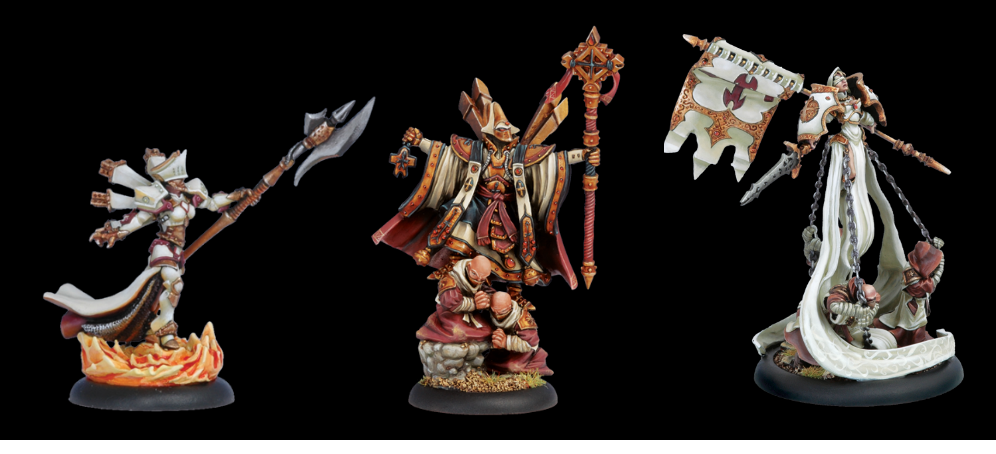
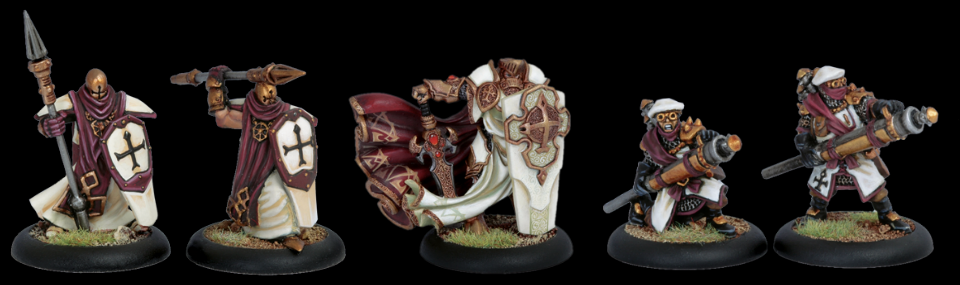
The models: Some example models:
Some of the new Gargantuans:
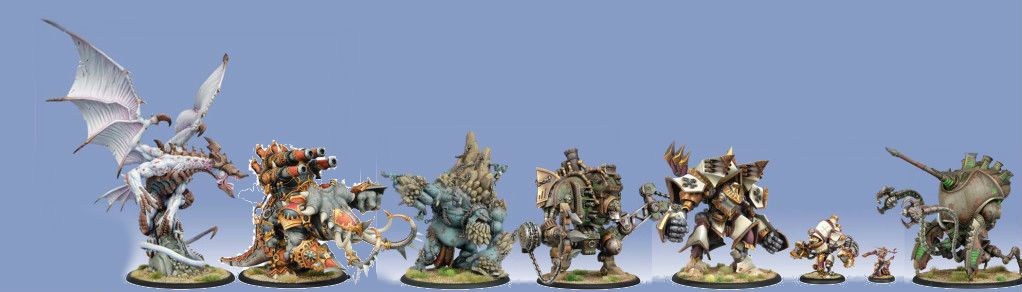
Privateer Presses range is still mostly metal, though there are quite a few plastic pieces these days, and more plastic pieces are in the pipeline. The plastics are generally pretty good quality, though they come with some annoying mold lines, and tend to be more like resin to work with than
GWs grey plastic – they need super glue, and are a bit harder to cut and model. To find all the current models, go to the
warmachine or
Hordes galleries.
Because of the nature of the game and the models, conversions tend to be a bit more rare. The general rule on conversions for tournaments is that they have to be recognisably the model you're trying to portray, they have to be armed with the same types of weapons, and they have to be on the base they came with - this, along with a mostly metal line-up, limits a lot of conversion work, though it certainly doesn't rule it out completely weapon swaps, extra detail, head swaps and reposing can all be done.
The Fluff: Warmachine/Hordes has an awesome, living storyline, which moves along as new books are released, and as armies march back and forth across the lands. Each Warcaster is a unique character in the storyline, with powers in the stories that match those on the table. It’s not a generic fantasy setting, but rather a unique blend of fantasy, steampunk and some original mythology. From the dragons who are near invincible and evil power mongers and control armies (Cryx and Everblight), to religious fanatics crusading across the lands, to Trolls who are simply trying to stake their own place in the world, to angry elves who are trying to save their dying gods, trapped in the mortal relm, to a council of druids who are trying to bring about the downfall of civilization. There is a lot of backstory, and a lot of detail to fill in the world, and the best part is getting to see it evolve as a series over time.
Support and resources: Battle College – Great information on and tactics for different models ()
Privateer Press Forums – Privateer Presses own forums, good if you need advice on a list ()
Army Gizmo – decent little army builder ()
Forward Kommander – Another army builder ()


 224th Astra Legion (main army)
 628th Praetorian Guard Cohort (wife's army)
 827th Auxilia Cohort (ad mech fun)
 825th Foderati Cohort (in the beginning army)
 1212th Foederati Cohort - Jokaero (cause I like apes with guns)
 Come along and play Warmachine, 40k, boardgames or anything else!