Forum adverts like this one are shown to any user who is not logged in. Join us by filling out a tiny 3 field form and you will get your own, free, dakka user account which gives a good range of benefits to you:
No adverts like this in the forums anymore.
Times and dates in your local timezone.
Full tracking of what you have read so you can skip to your first unread post, easily see what has changed since you last logged in, and easily see what is new at a glance.
Email notifications for threads you want to watch closely.
Being a part of the oldest wargaming community on the net.
If you are already a member then feel free to login now.
Swastakowey wrote: I am very sure the Cavalry Sabre is made for stabbing. They had to be aimed at the target and you dug into them with the point using the speed of the horse to force it in deep. I dont know how useful a Sabre is while not being on a horse.
Most swords are better for stabbing most of the time anyway. Whacking with a sword is a fast way to ruin it or break the blade. At the same time it gets them stuck in people and they dont usually get very deep. Unless you are decapitating someone in a controlled environment.
So I cant actually think of any sword that would be good for attacking on the draw. Id imagine it would simply be better to simply draw your sword and fight normally than try attack straight from the hilt.
Umm... no. Cavalry sabres are curved, like a katana... you stab someone on horseback, and now you got no sword.
And frankly, something with a "straight" edge, like a long sword, or bastard sword is still not a "Stabbing" weapon.... When properly used, the particular slashing motion used with a longsword is similar to cutting meat for food, and can do some serious fething damage. (basically, think the person swinging the sword wants to make contact with their blade nearish the pommel, and as they are drawing back, they are rotating the wrists/arms so that the point of the sword flicks off of their victim in the follow through.
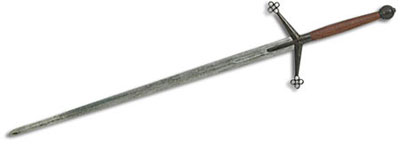
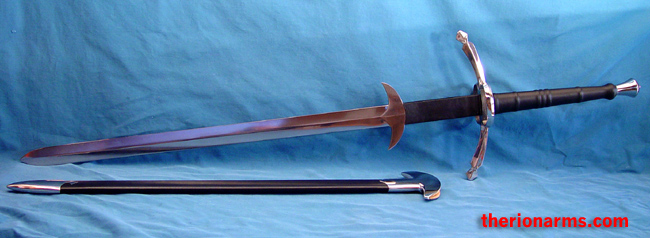
One of the few "chopping" swords out there, is actually the scottish claymore and similarly sized Swiss/German Zweihander weapons. But in this case, they are using the weight of the weapon in much the same way as an ax-wielder is; It's the weight of the weapon doing much of the damage... Though, in the case of the Zweihander, in the hands of a Doppelsoldner (sorry, I don't know the key command for an umlaut) were used more for breaking pike formations than against individual or groups of people for the simple fact that a large swing leaves you very vulnerable to a quicker opponent.
Now, when it comes to a curved blade, like Katana, saber, or even Shamshir, many of the Japanese manuals do have the stance/move that is designed for a "kill on the draw" but, especially in Japanese swordsmanship, nearly everyone was taught this AND how to defend against it, so while the technique was there, it was rarely a combat effective thing to do.
No I think 99% of swords are made and more efficient for stabbing. I know in games and movies and fake duels they whack all the time, but that's purely for looks and for being non lethal.
Of course im not 100% sure since im no expert, but whacking with a sword is a fast way to break it, fast way to die and fast way to not penetrate armour.
Sabres are most definitely stabbing weapons. Slicing is not good for swords. Sabre being a cutting weapon is a myth.
No, they are simply NOT stabbing weapons. I will agree with you on games and movies having people "whacking" with a sword... Yeah, that's gonna do damage to yourself if you do that.
Spoiler:
Check out that video, starting at around 1:40 or so... they have an expert talking about the "proper" usage of a sword in combat, particularly the longsword. The thing with fighting in full plate is, there are still weak spots, which are aimed for... Not to mention there are records of a longsword being used to kill men, where the blade punctured through a plate steel helmet, through the padding, through the skull of the guy, and was only stopped by the poor sods teeth.
Thing to also keep in mind, the type of steel used was actually quite flexible, designed, particularly if it was a European blade, to take a hit from another blade and not break.
As to sabers, again, yes it's a slashing weapon... The technique, especially if we're talking about 1700s and later Western militaries (England, France, Prussia), the thing with a saber, aside from being used to issue commands, was that if a mounted soldier or mounted officer was riding in to battle, their goal wasn't to go against other cavalry, it was to go against the infantry. The particular tactics called for the rider to hit the infantry line inbetween two soldiers, and, with his blade trailing towards the rump of the horse, slash the infantryman as he was riding by. Again, if you stab someone with a curved blade, you're going to lose it. Plain and simple.
I've done reports on this stuff, plus I collect books on these very subjects. Hell, just the other day I hung out with a swordsmith in my town for about an hour and just talked metal and how different swords and different purposed require different metals (which is going to affect the prices he charges you)
They best weapons for penetrating plate armor are things like hammers, maces, and picks. As well as all Polearm type weapons. You either have enough penetrating power to actually penetrate the plate OR you have enough kinetic energy to simply shatter bones and pulp organs without bothering to penetrate.
It's actually quite interesting (to me anyway) that some of the earliest hammers used in battle against plate weren't "warhammers" and so didn't have the large spike on one end.... But they were still extremely useful against a fully plated combatant, because that blunt instrument was good for bending or altering the shape of armor. As such, the hammer wielder would be aiming for joints (elbows, shoulders, etc) to immobilize his enemy. The other plus being what you mentioned: the sheer force of a blow breaking bones well beneath the armor.
Besides the ones you mentioned, one of, if not THE best weapon for puncturing plate was the bodkin tipped arrow
The sort of "mix" between all these was the vikings preferred weapon: the axe. The "hook" on the bottom of the axe blade was useful for removing a shield, while the blade had some good cutting power, with the weight of the rest of the head having power enough to punch through many different types of armor.... Not to mention, once the battle is over, and you're feasting, it's a bit hard to chop wood for the feast fire with a sword
This message was edited 1 time. Last update was at 2015/02/06 22:57:38
Grey Templar wrote: If you want a sword that was a pure stabbing weapon, thats what the Gladius was. It was short and had a very sharp tip.
IIRC, the Irish adapted the Gladius into more of a "leaf blade" sword, though it had much the same effect (not the Irish, the sword)
And, not a sword, but one of the most purely "stabby" weapons was the Misericorde... the dagger used to put armored foes out of their misery. Basically, it was an ice pick long enough to go from under the arm pit through the heart
Japanese steel used for the Katana was, to put not too fine a point on it, crap.
That's what all the folding was about, it was getting the impurities out.
They are not a magic wand, and they are absolutely not armour piercing.
This is similar in nature to "Viking swords".... If you came across a sword that was made of Nordic iron, it came from the peat bogs. The process used to "mine" it from the peat was kind of cool... You'd make your fire with a "bowl" or hollow spot well beneath it, put a bunch of peat on it, and keep feeding the peat for a day or two (or however long you wanted/needed). Once you were done feeding the fires, and it had died down, the craftsman would sift through the ashes for the rocky lump of iron that had literally melted out of the peat and take it to his forge or to the smith if he wasn't the local smithy.... The smith would then begin the process of heating it, hammering it into a square shape, cooling it, then heating and hammering some more, etc.... This process was literally cooking the impurities out of the iron, and he knew he was done with the process when he no longer had flakes coming out of, or off of the surface of his "rock" (having seen this done, in the beginning stages it's like cracking the thin ice layer off a puddle or small pond, that's how big the chunks are relative to the piece). Once the Iron was cleaned up, he'd continue in the forging process by beating it into a rectangular or square shape before letting it sit for a couple days.
This process led to actually having higher quality metal than what was found on the European Continent (German/Italian, etc craftsmen), BUT, most of the viking sword makers had to make due with less metal, so what they'd do is take 2 pieces of their long iron bars to make the sword. The first piece they'd fold in half, then twist it like a braid. This formed the "blood groove", while the second piece would be wrapped around that twist to form the blade.
The problem with that process is that the twist left some "air pockets" in it, making the blades more susceptible to breaking than mainland blades were. This, combined with how difficult it was to get suitable amounts of iron, is one of the prime reasons why only the best warriors, or the Chief's favored warriors had swords, and most Vikings had axes.
Grey Templar wrote: I imagine it takes a lot of personal skill to do that. That much could be applied to any weapon, and frankly its a fairly useless skill at that as far a battlefield weapon. And that is what is important, not that it was a fancy execution tool.
But that is the point of MY DEBATE. I choose to my the claim that it has the best cutting power and control. You disagree with me and I keep making my points on this key Cutting and Control.
Every time I finally proof a point, you brush my proof aside with ... well it is useless in battlefield weapon. The point which was never part of the discussion is battlefield weapon. Katana was not a battle field weapon, why use a Katana when Odachi is longer and also two handed?
I mentioned that it is like a scalpel and you dismiss it. At least I hope you can just accept it as the best scalpel sword with control ability.
Yes, all sword can do this with the right luck and skill.. but we are picking the best tool for the job right? I can use a baseball bat to play golf, but why?
Ultimately, YOU yourself said to the effect of "I dont want this to be a fanboy vs. haters argument" and yet YOU have personally turned it into exactly that. EVERY. SINGLE. POST. You have made comes across as a fanboy under siege.
You originally asked if there were any other edged weapons that had a "quick draw attack" like the Katana, we replied in kind that, yes, there are other swords that can do that.
Sure, the Katana was best in it's "niche".... in the vacuum that was feudal Japan. Yes, it's a cutting weapon. Yes, it's "razor sharp" which, as has been pointed out numerous times, is actually a BAD thing on a BATTLEFIELD. That little video with R. Lee Ermey a few pages back was laughably funny because, as I personally pointed out, there is archeological/historical record of soldiers being hit with an overhand blow to the head wherein a European Longsword punctured through the steel plate helm, through the padding, through the skull, and the cut was finally stopped by the victim's top row of teeth.
You want to talk about accuracy and control? Fine... during a typical fight in which knights were wearing a full suit of plate armor, if they were both wielding swords, they knew their best chance of winning was to exploit the small gaps in the armor. Strike in a gap, and you are cutting flesh. Cut the flesh and you are going to eliminate that limb (cutting tendons, etc) or you are going to significantly alter that opponents' fighting style (he's most likely going to go on the defensive, and protect what's already been hit)... And we have tons of records of THAT sort of thing happening.
Every weapon, whether it's a sword, mace, axe, polearm, etc. has a set of attributes, strengths and weaknesses in them. In Europe, near constant warfare meant constant innovation and improvement, which is why we see variations to basic designs based on successes and failures:
Spoiler:
Scottish claymore vs. Swiss/German Zweihander
Each had it's "prefered" uses, but you can see the similarities in the basic design.... Each ended up in vastly different places though
You should know, I am a historian..... Im not a katana "hater", I find their blades, when properly made to be among the most beautiful in the world.... But, I'm not a fanboy either, the katana does have some rather glaring weaknesses, and it seems that in post after post, you are more than willing to look past those weaknesses to say, "LOOK!!! I told you, you're ALL haterrrrzz!!!" Many of the points made here have been spot on... Viking swords made in Scandinavia were incredibly expensive to make, and weren't of as good a quality as an Ulfberht sword. In fact, the Elfberht sword/blade was so prized and so incredibly valuable, that it was the de facto most counterfeited item in all of scandinavia... The fact that we still have many of these "forgeries" should tell you the length that the forgers went to creating a quality blade to attempt to rival and Ulfberht.
As to your bit about "luck and skill"... well, that's a bunch of BS, because the best swordsmen, regardless of where they're from aren't going to have "luck" to rely on... William Marshall didn't survive and serve under 5 English kings because he was lucky. He did so because he was good and proved his value as a living weapon.
A Katana by european standard is a short sword using two hands.
No. Just, no... not even fething close.
The blade of a Katana is only about 2.5 feet long and using two had of this short sword is why I keep saying it has great cutting control. You want a short two-handed sword, it is a Katana. The Katana blade is heavy for such as short weapon. The blade is thick and cause more impact cut hit. The saber is a thinner blade and much lighter than a Katana.
No, the Katana having a thicker profile on the back end means that if the wielder misjudges his strike/cut, the weapon can get lodged in the target, creating a situation where he leaves himself vulnerable while removing it, or he needs to get rid of the blade and go to another weapon. The saber, by virtue of being thinner, and again, a cavalry weapon, means that there's much less risk of that happening. But then, when you're discussing 18th and 19th century cavalry sabers, you are talking about men whose "armor" is a wool jacket. This means the force of the strike doesn't need to be as great, and so long as the blade makes contact and the "drawing" motion happens, there's going to be some significant damage happening.
You keep bring other weapons that outshine katana in one aspect but lack other aspect. This is why I keep stating that Katana has it's niche and is the king of blades at that niche.
No... people keep bringing up weapons that outshine the Katana in all the aspects that YOU say make it the "king".... the Katana's "niche" exists purely in a vacuum... Feudal Japan did not have much contact with outside peoples, and they were quite content to just kill each other for a long time.... This basically created a situation where warfare became "ritualized" and as such, you see little to no development in weapons and armor, until European people showed up.
Kilijis is a contender, but lack the two handed control.
Gladius is not even comparable weapon. Not saying it is bad. The cutting power of Gladius is a joke compare to Katana. Which agin, the KING of Best Cutting Blade with control I keep claiming.
Control. control... you keep using this word, but I don't think it means what you think it does. Again, keep up your fanboy-ism here.
Also, the best weapons for slashing are large two-handed weapons such as the Zweihander.
Yes and no.... The Zweihander in particular was designed to counter the pike formations popular in 16th-17th century warfare. The Swiss mercenaries would use the Zweihander not so much against the infantry block, but rather to behead the enemy pike, leaving him with basically a quarterstaff or big stick.
This message was edited 1 time. Last update was at 2015/02/08 19:29:23
Go back to page 2 or 3 mate... I've been here since basically the beginning
I don't think you're some kind of fanboi... but you sure as heck are coming across as one.
Automatically Appended Next Post: And again... control is down to the user, not the damn weapon... it's such a ridiculous argument for you to be taking.
And if you really, reeeaaaallly want to turn this into a contest here goes...
The Crusades, The Hundred Years' War, The Battle of Hastings, The Viking incursions/battles. The Roman Empire.... I can keep on going here. ALL of these wars, and battles prove, beyond a shadow of a doubt that European weapons are superior at killing an armored foe. No, not everyone died by sword in those wars and battles, but the death tolls were much, much higher than much of what has existed in Japan.
We have also pointed out to you that the razor sharpness of a Katana, is actually a detriment because it will become dull in fewer cuts/slices than most other weapons.
This message was edited 1 time. Last update was at 2015/02/08 19:42:40
Basically I am declaring that we are having a discussion on what would be the best sword
No... THIS is your OP:
david choe wrote: I was wondering if there are any western swords that can do a quick draw attack like the Katana.
I can't think of any.
And THAT is what we're discussing... If you wanted a discussion on best sword, which many, many of us have pointed out better swords, you should have put it in the OP.
And the hubris of declaring what we are discussing.
The Katana is a decent weapon, made of inferior materials. AGAIN, it is good within the vacuum that was feudal Japan.... If the Samurai had had to face the armies of the HRE, or Swiss Mercenaries, they would have been soundly defeated. Period. End of. The reason for that is the combined arms and armor of Europeans.
Your claim is that Katanas are the uber-most-precisest weapon evar!!!
What I am saying, is that in all the things that I listed, armor is generally involved... As such, when using a sword Europeans absolutely MUST be more precise than you seem to think possible for them.
The Katana, as a weapon of Japanese warriors, who, were by and large extremely isolationist until Europeans arrived on their island, never had to progress or change. A sword is meant to kill. Plain and simple. And I think many of us have shown, and proven time and again, that there are other blades that are better at it.
Again, that the Japanese craftsmen could get the kind of quality they did out of the materials they had is amazing, and some of the antique pieces you can see in museums are quite beautiful to look at. But to claim that it's the BEST is simply wrong.
Control is down to the user. Done. I have done exactly ZERO training with a Katana, but I have done some with European style swords (my only "battle ready" sword that I own is a true Hand and a Half Sword/ aka, Bastard Sword). As such, if it were me personally being the "guinea pig" in a pig cutting, card cutting, etc. type "test" the results would probably favor the European sword.
If we're demonstrating how different swords cut through, say, a flattened cardboard box, the one thing the Katana will do, is cut through cleaner than many other straight blades.
IIRC, many of the 18th and 19th century cavalry sabers were designed off of examples taken from Japan, the ME, India, etc. and refined in ways that "only" Europe can do. As such, I think that a saber from that period COULD give the Katana a run for the money.
But, all of these lab tests are only so useful. Swords, with few exceptions are designed for killing. And we've pointed out there are plenty that do it better than a Katana. Sure, you can butcher a million pigs, or bamboo rolls to prove how sharp a blade is, but that doesn't mean it's effective anywhere else.
And if we want to be technical, ALL of this is completely OT. As I reposted your own OP earlier in this page.. you asked a question "are there other swords that have the quick draw ability" To which, we answered you. THAT should have been the end of discussion. It was you who turned this into a "katana vs X" debate.
david choe wrote: I was wondering if there are any western swords that can do a quick draw attack like the Katana.
I can't think of any.
Well then.. you made a bit of mistake.
The OP was best sword for the quick draw.
I left your OP quoted there... No where in that does it say "best". you say, and I'll quote again: "I was wondering if there are any western swords that can do a quick draw attack like that Katana"
There's not even a hint of a "best at" discussion here. If that is really what you wanted, you should have put that in the OP.
This message was edited 2 times. Last update was at 2015/02/08 20:31:59
What I am saying is that all sword has functions and niche... but for you guys ... it is just unacceptable that a Katana can have it's niche and excel at it too.
However, I am here to claim that Katana out shine other swords in its cutting ability.
Excelling and being the Best are two different things.
How about this as a test, since you love them so much... Let's line up 60 pigs. Take one man. For 30 pigs, he gets a sharpened, expertly crafted Katana. For the other 30, he gets an expertly crafted, sharpened "European Sword" (longsword, hand/half sword, claymore, whatever). He then takes one swing at each pig, without any sharpening whatsoever in between. See how long that Katana holds up. You are correct in that most straight bladed European swords aren't AS sharp as a Katana, but the quality of steel that goes into them means they hold what edge they do have longer than something like the Katana with it's razor thin blade.
It's the same reason why you're supposed to sharpen you kitchen knives before or after each use: the blade/cutting edge is so thin for greater sharpness, but the trade off is that the cutting edge gets dull quicker.
The quick draw attack weapon, what weapon can do this beside a Katana? I mean a real training method for this to be effective.
I don't think there was ever an example that can be given. So I think Katana stands alone in this category.
It was pointed out by another user that you CAN do this with things like a Cavalry saber, however you are correct in that there was little to no "formal training" for such a move among Western Swordsmen wielding a saber. This is because the danger presented that would necessitate a quick draw type of strike wasn't present in Europe, while it was in Japan.
This is neither a bad thing nor a good thing. It's just a thing. Basically, just because there's no "textbook maneuver" that is practiced with a saber for a quick draw strike doesn't mean it can't do it. It simply means that there wasn't a use for such a maneuver among Europeans and as such, such techniques were lost to history.
Control cutting comment. You are a train Bastard swordsmen, can you choose to make your bastard sword cut like hacking an arm just enough where the arm will still hang? I know this is weird, but the design of Bastard sword is not design for control slice , it is design as a tool to what ever it hit.. cut in half or enough to kill it.
A Katana is design to have control of your cut. That is the control that I am talking about. It is not a "clumsy" weapon. Yes control cut comes with training, but if you must and you want to ... can you design a Bastard Sword with control cutting?
I think there is some fault in your premise here... I think, and I could be wrong on this, that you are coming from a false notion that longswords, hand/half swords, etc. are "hacking" weapons. Thing is, they are slicing weapons very similar in line with the Katana. The "perfect" strike with a longsword isn't the same motion as a butcher's knife, it's using the arc of the swing combined with the straight edge of the blade to create the cut... Most videos I've seen on the Katana techniques are the opposite, ie, using the curve of the blade along with a more "straight" swing to use the curve of the blade to create the cutting motion. the cutting motion, or target of the cut, in an ideal situation, the longsword should make contact with the target closer to the hand guards, with the blade drawing along it's length until the complete strike ends with the point of the sword leaving the target.
Now, the techniques for claymores and other very large swords will differ, but then their uses and purpose were often different from the "standard" longsword.
A katana is a fine weapon, a scalpel like sword.
Katanas are fine weapons indeed. I wouldn't go so far as to compare them to scalpels. Yes, they have very precise techniques, and in the little reading I've done on the subject, the true test of the swordsman in Japan, particularly in a duel, was in reading his opponent's technique and being able to react quicker. Miyamoto Musashi comes to mind here, as he is widely regarded as the absolute best duelist in all of Japan in his age. He realized that most of the duel was not in the metal, it was between the ears of the combatants.
I think that the processes used to make Katanas are fascinating, but to downplay the quality of European weapons, IMO, severely discredits the masters who made them, whether you're talking damascus steel or Toledo steel, creating a good sword took months or even years.
Also I feel kinda stupid since I train with this type of sword. I know its purely an English weapon but why do they call it a "bastard" sword?
Firstly, because it's quicker to say than "hand and a half sword"
But also, and more importantly, because of it's properties. It wasn't as large as a claymore, nor was it as small/light as a longsword. Many had blades that, from the guard were as long as a single-handed long sword. But, the grips/pommel were lengthened to allow for a two-handed grip. So, it's kind of a "bastard" between a single hand, and two hand weapon.
Artorias the Abysswalker wrote: Whatever weapon, whatever warrior, nothing beats a group of Roman legionaires in a testudo/phalanx formation. It's like walking through an oversized food processor.
Except the Scots... there's a reason the Romans built a wall, and put a sign up that read "You shall not pass" on the Roman side of it
Artorias the Abysswalker wrote: okay, but one has to admit, they were a formidable fighting force, the Roman Legions. I always have that image in my head, after a battle and you see this centurion covered in gore with blood dripping from the horsehair plume on his helm.
Also, what do you thing is the coolest looking real-life helm of any time? My votes go to the crusader greathelm or centurion helm with sideways crest.
Yes, the Romans were fierce, when they were prepared. Look up the Battle of Teutoburg Forest for what I'm talking about
As for helmets, there's too many for me to choose from... I love the looks of the Corinthian helm with transverse crest (many actual Spartans wore this, particularly those in leadership roles)
but I have worn kubato, great helms...bucket helms..sallet, viking goggle helm..and roman..and I will say I prefer the roman..you can hear..see and most importantly breath in it, it is open faced but thats why you have a nice big shield.
the hussar helm has alot in common with a roman legionaire helmet.
Im sure you know, but I should point out, that most Viking helms were actually quite open, and quite breathable.. For instance with this one:
Spoiler:
I'd be more worried getting my beard caught in the chain mail
Ohh... and this is totally not historical, but I thought it was too awesome not to share:
As Soo perfectly pointed out: peripheral vision is the absolutey key to winning a battle.
Depends. Things like the Froghelm or Sallet would certainly see battle, (less the froghelm, and more the Sallet), but they would be used exclusively by mounted knights. As such, the damage they do on the charge is important, and they don't "need" as much peripheral vision as someone who started on foot. Of course, if that knight gets unhorsed, then its a different ball game....
Soo'Vah'Cha wrote: Frogmouth helms were primarily for jousting tournys..to minimize the chance a sliver of wood could get stuck in your eyes...
Yes, though it wasn't unheard of for them to be used in battle... I would say that ANY helm that was fastened to the shoulders in a fixed manner was primarily a jousting/parade/tourney piece and not really designed for battle use.
I would think, that many of the fighting techniques for the straight blades would be similar to actual European techniques (hitting near the guard, drawing the blade along the target, using the rotation of the swing to create a greater cutting surface)
But then again, it's China, so Crouching Tiger, Hidden Dragon could very well be a documentary for all we know
It's a difficult weapon to talk about, because so many examples of the Flamberge that remain, are purely ceremonial weapons. Quite often, You'll see them with a squiggly central ridge, which isn't as strong as a straight central ridge. Most of those are going to be your ceremonial types. I have seen some examples were the "waves" are more pronounced, and the blade almost looks more like a sword breaker than it does a sword.
I actually don't think they look "silly" I think that, when properly made, they are absolutely gorgeous weapons. I'm saving up for a pair to hang on the walls of my "living room" (the floor plan calls it that, but it's where my pool table is)
Speaking of practical weapons - morning star flail - cool looking. Practical? Maybe on horseback, but definitely not on foot. Also, did knights use their lances in open combat, or were they mostly used for jousting?
Flails CAN be practical, but they do have downsides... 1. you have to use it's momentum. 2. it's only really good use is as a "disarming weapon", which leads to 3. You still need other weapons to fight.
The lance and heavy cavalry charge was definitely an "in vogue" thing for a long long time after 1066... It largely fell out of use with the rise of gun powder, however IIRC, the "last" lance wielding cav charge was in the Franco-Prussian war? (or it was in the 1800s with Napoleon's armies... sometimes things get jumbled in my brain)
Now, as discussed earlier, certain forms of armor were definitely a "mostly for tournaments" item, such as the frogmouth helmet.
You aint lying there.. Lol, in modern times we tend to be "surprised" that people are beaten to death by Baseball bats, or pipes... Back then the guys at the pub would be sayin, "amateurs.. pfft. I once kill't a man with me sheep shears"
And the fact that they have manuscripts and fighting styles for ANYTHING that could be held in the hand shows this. I've often been fascinated by the various Italian "duelling" styles... Rapier and dagger, or rapier and cloak, etc.
Artorias the Abysswalker wrote: Interesting, I was thinking about this, does anyone have knightly roots, or is descended from a medieval order?
As I've found my family arms, I KNOW there's some nebulous form of "nobility" in my lineage... But I can't make any claims like some folks do, that I'm related to some Emperor from the HRE or King Richard III or anything like that....
My family arms are: Argent, two bendlets sinister sable, of the first, a cross patee double (something unreadable) sable, bordered argent....
In layman's terms: It's a white shield with two black stripes going "sinister" (from top right to bottom left), with a "fancy" iron cross within the top stripe (its a white iron cross, with four triangles outlining a "second" cross in the middle)
From further research the "sinister" bends tend to mean either that there was a bastard in the family line (who was knighted), but in everything I've read, bastards tend to only get a single line/mark. The other use was for a knight who hadn't been granted arms yet who showed himself particularly awesome in a defensive situation, and in this case, multiple "bends" or multiple marks tends to mean that a knight in this family, or of that arms, had made many defensive actions.
Sadly, at my current state I would mayhaps be equivalent to a merchant's son and might have a glimmer of hope, that I might be a squire and not go to battle with a pitchfork
You'd actually be fairly lucky even if you weren't a squire. Merchants had to fight too, but as they had money(often more than some knights) they could afford decent equipment on par with the nobility.
Indeed... It was part of a knight's "duty" to arm and armor himself. If he couldn't afford to, he would enter the service of his liege and become a "house knight"... In this way he went into battle wearing his liege's arms until such a time as he could afford his own, then he was allowed his own "decorations"
This message was edited 1 time. Last update was at 2015/02/09 23:59:11
Artorias the Abysswalker wrote: Then I Shan't despair. Hmm, how would you equip yourselves for battle, given your respective place in the medieval world?
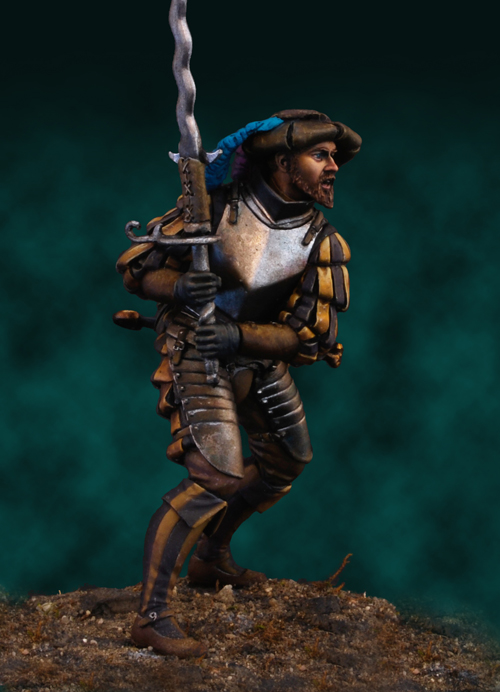
Depending on timeframe... and given that my "family line" comes from areas where Landsknechts were typically from, I'd probably have:
Half-plate mail
Zweihander or Pike
a silly hat,
codpiece (it's seriously important!)
like this:
Spoiler:
Although, I would love to be kitted out like this:
Iron_Captain wrote: Historically, the main advantage of the flail was its easy availability. Every medieval grain farmer would have had one and known how to use it. Flails were thus mostly a weapon for peasants, rather than knights. Knights used 'noble' weapons, mostly swords, maces and lances.
The lance was a knight's most important weapon, because the main use of cavalry is the charge. The lance is extremely deadly in a charge. After the charge, the lance would be dropped in favour for a close combat weapon.
One point of contention for me there IC... In all my reading, the ONLY "noble" weapons were the lance and the sword/shield. Maces started off as basically clubs found through necessity during fighting. Eventually, enough guys had experienced the weapons and so they began to hire smiths to make "better" and fancier maces. It's kind of the same thing with hammers. Often times, the peasants would be armed with a bow (either a crossbow or "regular" type bow, depending on locale) and whatever else they were carrying. And it was from the peasant fighters that the hammers and maces came until, again, the nobility began to have them made.
I think it goes without saying that "chivalry" goes out the window when your own survival depends on it
Ensis Ferrae wrote: The lance and heavy cavalry charge was definitely an "in vogue" thing for a long long time after 1066... It largely fell out of use with the rise of gun powder, however IIRC, the "last" lance wielding cav charge was in the Franco-Prussian war? (or it was in the 1800s with Napoleon's armies... sometimes things get jumbled in my brain.
The Polish cavalry used lances in WW2, and achieved a number of notable successes with it. The very last cavalry charge using lances was during the battle of Schönfeld on 1 March 1945.
That sounds like the one I was thinking of. I knew I had heard of it before, I just couldn't remember the name of the battle, etc.
You aren't comprehending what he's saying about IMPROVISED weapons.
No farmer, if he was part of a revolt/uprising would take his scythe into battle without some alterations.
Also, having manuscripts for a fighting style doesn't prove nor disprove that scythes or other weapons saw actual combat.... It shows that someone somewhere along the line thought about how such a weapon would be used, if the need arose and developed a fighting style based on it.
I mean we are men right, lets just accepted that you made an error and you don't know about this part of the history and stand corrected.
Your lazy, half-arsed researched youtube video doesn't "prove" anything though. Having looked at a couple of his videos, he really REALLY comes across as someone who doesn't know gak about what he's talking about... case in point, watch the "mace" video. I'm sorry, but "spiky bit" is NOT an actual name for part of a mace or hammer.
I never said the scythe was an outstanding weapon. I agreed with others, that in a real pinch, it would do.
Let's put together a scenario... We're all a group of rather disgruntled peasants, and we band together to revolt against our "lawful" lord. So we all grab what implements we have; Pitchforks, hammers, scythes and the like.... The local lord rounds up his couple dozen knights to meet us on the battle field... He's going to pummel us into the dirt.... Well, thing is, we have a sizeable numbers advantage, so we're going to "clump" up and swarm knights, get them on the ground via hitting them, kill them and... holy crap!!!! now a couple of us can drop our pitchforks or scythes, or whatever, and get a real fething weapon, like a sword!
Yeah.... ALL of the books that I have MUST be wrong. All those PhDs and Masters of History don't know what the feth they are talking about when they say..
"In the middle ages the scythe was frequently used as a weapon, the blade being mounted in ling with a long, straight shaft. It does not appear to have given rise to any important modification, especially adapted for fighting. It was used as an improvised weapon by peasants as late as the end of the 18th century."
-A Glossary of the Construction, Decoration and Use of Arms and Armor in all countries and in all times. (together with some closely related subjects) by, George Cameron Stone
And that's just the first, most available book that I have on my shelf.
I am not talking hollywood. I am not saying that the scythe is a great, or even good weapon. I am merely stating that Historical Record and facts show that there is no myth that they were in fact, used in battle.
There really is nothing to debate here. None of us is saying that a scythe is any sort of great weapon, just that it has been used in the past.
Automatically Appended Next Post: Also... when did Iron_Captain move to the UK?? (as im looking at the screen his flag is the union jack )
This message was edited 1 time. Last update was at 2015/02/10 14:20:36