Forum adverts like this one are shown to any user who is not logged in. Join us by filling out a tiny 3 field form and you will get your own, free, dakka user account which gives a good range of benefits to you:
No adverts like this in the forums anymore.
Times and dates in your local timezone.
Full tracking of what you have read so you can skip to your first unread post, easily see what has changed since you last logged in, and easily see what is new at a glance.
Email notifications for threads you want to watch closely.
Being a part of the oldest wargaming community on the net.
If you are already a member then feel free to login now.
I've spent a lot of time reading all sorts of periods.
I was greatly interested in WWII when I was young. First it was Dinosaurs, then Star Wars, then right into WWII. I was fascinated with tanks and planes, but also with the Germans themselves. It wasn't until much much later did I really dive into the reasons and politics of the whole thing. Even to this day, you wont find a greater variety of how messed up humanity can be than during that time period.
I have grown interested in WWI overtime too. It gets overshadowed by WWII and rightly so, but there are still a lot of interesting reading in it.
I also love the US War of Independence, even though its a little comical compared to other wars. And I mean comical by the means as which it was fought. But I have great admiration for Washington, and many of the fore fathers, despite the criticisms they get in modern PC times.
I also will read on just about anything on the American Civil War. Some of the best reading I did was on things you wouldn't think of, like the cotton trade in the south, and how southern farmers grew crops to make money and not support the war, therefore depriving their armies the things it needed to fight. And how there was actual trade with the north (due to northern armies capturing southern ports), because after all, there was still money to be made. Or there were areas of the south that were against succession, and were considered no-go areas for even confederate troops.
Civil War literature tends to narrow the focus on why the war was fought and the battles involving Lee and Grant, but the war was very, very complex before, during, and after. Actually, I would say after WWII, the American Civil War is the second most complex war I can think of.
In recent years I have read a lot on Korea, and wow that war should get a lot more attention than it should. Its a great example of rushing into a conflict that you are not prepared to fight. And the worst is towards the end, by not actually calling it a war, and trying to find a way to end it, asking US soldiers to not lose, but also not to win too much, because we don't want to escalate things, was a terrible thing to ask from young men. I would have been very bitter.
The world might give the US a lot of slack for some of the wars it has fought, but very few seem to understand the great amount of guilt and unease our society has for going to war and winning one. I can assure you that whatever issues the world has with us now, will be comical if the attitudes in the US should ever change. The greatest thing holding back the US in any war it has fought, has been the US. When we go all in, our opponents get crushed. When we screw around by trying not to look or act like a war to appease all sides, it ends poorly.
I've read a great deal on other eras too, like Napolean and Alexander, but haven't found those as interesting. I guess I am interested in the events surrounding the wars as much as I am the battles, and some have better drama than others.
This message was edited 4 times. Last update was at 2017/11/29 15:36:54
I also love the US War of Independence, even though its a little comical compared to other wars. And I mean comical by the means as which it was fought. But I have great admiration for Washington, and many of the fore fathers, despite the criticisms they get in modern PC times.
In my last year of undergrad, I finally took a class on AWI, as at that point I still had intentions of becoming a teacher, and figured it would be good to have more of a knowledge base on stuff I'd undoubtedly be teaching.
I was pleasantly surprised to find that much of the current scholarship and historical work being done on this period is either a harsh (but fair) criticism of FFs, or deals with subjects rarely encountered in studies of the period (such as native tribes, Southern campaigns in what is now Georgia, Alabama, Mississippi, etc), rather than the usual seeming hero worship that we get in K-12 schooling.
As for ACW. . . I personally avoid it like the plague for one simple reason: Lost Cause Doctrine. I've just personally found that in almost any setting, I will come across someone in discussing the ACW who believes that hot steaming pile of mess, and it's incredibly prevalent in many people's views in the US.
1. Central Europe vs. the Mongols/Turks. 2. New World: indian Empires (Aztec, Inca, Comanche) and Plains Wars (including vs. the US/Texas). 3. Pacific Theater: WW2. A family affair.
This message was edited 1 time. Last update was at 2017/11/29 19:19:22
-"Wait a minute.....who is that Frazz is talking to in the gallery? Hmmm something is going on here.....Oh.... it seems there is some dispute over video taping of some sort......Frazz is really upset now..........wait a minute......whats he go there.......is it? Can it be?....Frazz has just unleashed his hidden weiner dog from his mini bag, while quoting shakespeares "Let slip the dogs the war!!" GG
-"Don't mind Frazzled. He's just Dakka's crazy old dude locked in the attic. He's harmless. Mostly."
-TBone the Magnificent 1999-2014, Long Live the King!
Ensis Ferrae wrote: As for ACW. . . I personally avoid it like the plague for one simple reason: Lost Cause Doctrine. I've just personally found that in almost any setting, I will come across someone in discussing the ACW who believes that hot steaming pile of mess, and it's incredibly prevalent in many people's views in the US.
Yeah I try to look at it objectively. I don't look to the Lost Cause for the main reason the war was fought anymore than accept that the war was fought over slavery. It easy, and sometimes seemingly necessary, to try to explain why something happens in a brief sentence, and 'Slavery' summed it up easiest for a long time. But Abraham Lincoln didn't call up 100,000 volunteers to invade the South to free the slaves, he called them up because the South was breaking away from the North and the country was falling apart. There was really no road map for ending slavery, which is why the Emancipation Proclamation took 2 years into the war to be delivered. From Lincoln himself, he had “no purpose, directly or indirectly, to interfere with slavery in the States where it exists.”
To argue that all Southerners who seceded from the North to keep slavery is ridiculous. The vast majority of Southerners did not own slaves, only the rich farmers and plantation owners did. As a matter of fact, many such slave owners, many who supported seceding from the Union, were granted exceptions to being drafted to fight, who many ironically, didn't grow the kind of crops needed to support the war effort, as I mentioned in my previous post. And Maryland, a Union state, allowed slavery. So why did so many fight? That's really the question I have found the most interesting question to try and answer over the years, and quite often it varied from soldier to soldier.
Keep in mind that back in the mid-1860s, people didn't move around much in the south. You were a Virginian, a Georgian, a Floridian, or whatever. Many confederates simply fought because in their view, they were the ones being invaded. And white northerners were not signing up en mass to free black slaves either. Lets be real about racism in the 1860s. Even Lincoln in his wildest dreams ever thought the freed slaves would remain in the US, he felt they would just move back to Africa.
Unfortunately many times wars are started by the rich and fought by the poor, and the Civil War is no exception. There is no doubt that powerful slave owners influenced South Carolina to secede, as well as those in other states that followed, and the war was a disaster for the South and left it in economic ruin for decades.
I think in the end, the Lost Cause doesn't just try to deal with the shame of what the war was fought over, or the fact it was lost, but the guilt of the war itself and the state the South was left in for years after the war. The South went through really tough economical times until, well, really recently. It wasn't until manufacturing left the North (to escape the unions) and moved to the South, or even air conditioning became widely available in the last century, did the South begin to grow again. So you had a lot of people who were going through tough economic times looking back at what they thought were better years, I think psychologically it was a way for some to try and move forward. Also keep in mind many of these people had fathers, brothers, sons, and so on who fought and died, and developing something like a Lost Cause narrative would mean those that lost their lives lost it for something more noble than what the historians were saying.
In the end, it was one hell of a vicious, hateful war. If you think about the animosity Americans had for the Japanese, Germans, Koreans, and Vietnamese in those wars and imagine that directed inward, you can imagine the way the war was fought. And then, with an amazing stroke of a pen, Grant began the healing process by allowing Lee's troops to just. . . go home. Not a lot of civil wars end like that.
It really was an incredible time, and transforming for our country. The surrender at Appomattox Court House reflected those times too. You had a old Southern general, very much a product of his age, surrendering to a group of younger generals who many would be instrumental in expanding the country and bringing it into the 20th century.
This message was edited 2 times. Last update was at 2017/11/29 20:25:09
World War 2. Even after years of studying it, I still find new things. If you delve into the period leading up to the war there is even more interesting material.
Another thing that makes World War 2 fascinating is the technological and tactical progression from 1939 to 1945. By the end of the war equipment used a mere few years earlier (some of which was WWI era) was often rendered obsolete. All of it is absolutely fascinating.
You say Fiery Crash! I say Dynamic Entry!
*Increases Game Point Limit by 100*: Tau get two Crisis Suits and a Firewarrior. Imperial Guard get two infantry companies, artillery support, and APCs.
KTG17 wrote: Yeah I try to look at it objectively. I don't look to the Lost Cause for the main reason the war was fought anymore than accept that the war was fought over slavery. It easy, and sometimes seemingly necessary, to try to explain why something happens in a brief sentence, and 'Slavery' summed it up easiest for a long time. But Abraham Lincoln didn't call up 100,000 volunteers to invade the South to free the slaves, he called them up because the South was breaking away from the North and the country was falling apart. There was really no road map for ending slavery, which is why the Emancipation Proclamation took 2 years into the war to be delivered. From Lincoln himself, he had “no purpose, directly or indirectly, to interfere with slavery in the States where it exists.”
I think the issue is that generally people engage this dumbly, and if you're cynical enough hilariously. To say briefly that the Civil War was about "slavery" is true, but people for some baffling reason never listen/read/think past that sentence and just knee jerk. They'll bring up states rights, missing that at the time slavery was at the center of the "states rights" debate (accounting for "states rights" being coined by Jefferson Davis after the war). They'll bring up economics, missing that in 1860 the value of slaves dwarfed the invested value of American industry, live stock, banking, and was the backbone of cash crop farming. Sure Lincoln didn't set out to free the slaves, but wealthy southerns didn't care. They thought he wanted to. You can't really escape the central importance of slavery in late Antebellum politics and the Civil War but the phrase "it was about slavery" is brief, summed up, and extremely basic. Yet it's almost impossible to get past it in public discourse because there's a huge swathe that seems completely intent on not listening past that one word and the Lost Cause narrative is a big part of that.
It's a massive showcase of otherwise intelligent human beings acting stupidly. You either get really sad or you just start laughing.
Unfortunately many times wars are started by the rich and fought by the poor, and the Civil War is no exception. There is no doubt that powerful slave owners influenced South Carolina to secede, as well as those in other states that followed, and the war was a disaster for the South and left it in economic ruin for decades.
I think you can go farther with that. Certainly much like there are poor and middle class Americans today who idolize the wealthy there were poor and working class Southerners who idolized slave owners. Many of them even if they didn't own slaves were employed by people who did or had businesses that serviced them. Someone had to transport cotton, rice, sugar, and tobacco to ports. Someone had to load the ships. Someone had to sail those ships. The southern economy was built around a system in which slaves were a pivotal labor source and even if you didn't own any your business, or the business of someone you knew, likely hinged on slavery. It was the social order. The way the world was.
Find me any place or time where people aren't terrified by the idea that their world as they know it might fall apart. For good or ill, it just scares people.
I think in the end, the Lost Cause doesn't just try to deal with the shame of what the war was fought over, or the fact it was lost, but the guilt of the war itself and the state the South was left in for years after the war. The South went through really tough economical times until, well, really recently. It wasn't until manufacturing left the North (to escape the unions) and moved to the South, or even air conditioning became widely available in the last century, did the South begin to grow again. So you had a lot of people who were going through tough economic times looking back at what they thought were better years, I think psychologically it was a way for some to try and move forward. Also keep in mind many of these people had fathers, brothers, sons, and so on who fought and died, and developing something like a Lost Cause narrative would mean those that lost their lives lost it for something more noble than what the historians were saying.
I think this is very well summed up. I'd add that I think the North also plays a big role in generating the Lost Cause narrative. In the wake of the Radical Republican Era, many just wanted to put the war behind them. People in Union states bowed and accepted many of the stereotypes and myths of the Lost Cause as part of establishing and keeping the peace of the newly reunited states, especially when freed slaves started migrating north and everyone up there realized that if they weren't slaves anymore than they'd have to live with them.
Haighus wrote: I love conversations like this Following with interest. I think the combat in WW1 is much maligned in modern day popular history.
I'd hazard a guess that's to do with the portrayal of it and WW2 in the media. WW1, at least in popular history, is almost always considered the 'pointless' war, the 'waste' of life and to most people, consisted of 4 years sitting around in trenches in France doing sod-all. It's a messy war to talk about and arguably parts of that assessment aren't too far off the truth. With WW2, you have a clear cut case of 'Good vs Evil' (at least with the Western-front-centric view that comes up in most popular history and media) that allows it to be talked about a little more directly.
For instance, take the D-day landings. Hugely costly, a direct assault into defended positions and sheer hell and madness for anyone on those beaches. But because those defensive positions were manned by Nazis and the assault led directly to a campaign of liberation, you can have the celebratory media and talk of heroes, you can have Saving Private Ryan, you can have the various Call of Duty and Medal of Honour ect games that cover it.
Meanwhile, consider the battle of, say, the Somme. Same situation, ultimately the same approach (throw men at defences until they break through) but because of the context, no one talks about the bravery of heroism of the men who went over the top, just the callousness of the commanders who sent them and the lack of tangible achievement. You wouldn't get a SPR-esque film about a British officer trying to rescue a comrade from No Man's Land on the Somme in the days after the offensive (I'm sure it's been done, but nothing on a level with SPR or Band of Brothers).
The American infantryman on Omaha charging the German machine guns is a hero and a patriot, the British soldier on the Somme or at Ypres or Amiens is a pawn of a man sacrificed and betrayed by the Melchett-esque commanders behind the lines. In reality, both situations are much more complicated, but as far as the popular narrative goes, it's far easier to talk about WW2 in simple terms. To contextualise WW2, you just have to say 'Nazi's are bad, okay?' which (you'd think) everyone would be pretty happy with accepting. To do the same for WW1, you have to dig into domestic and international politics, the role of ideology and empire, the constructs of alliances and balances of power, and obviously that's a barrier to presenting any individual detail objectively (basically, you'd have to run a documentary about why the war happened before the documentary about whether or not the British fought it well).
The consequence of that is that (in terms of popular history) it's very difficult to look at, for example, the successes the 1918 British and Canadian forces had in essentially inventing and implementing a Combined Arms doctrine (a major achievement that shaped warfare for the next few decades) without also talking about the millions who died in the mass offensives of 1916 and 1917 to reach that point. Not that this is necessarily a bad thing, certainly the tragedy that preceded the success has to be looked at and discussed lest we forget its lessons, but in the case of WW1 especially I feel it can get in the way of an objective assessment of the conduct of the war itself.
With academic history it's not so bad, the revisionist school has been gaining a lot of ground in the last couple of decades as the war passed out of living memory and the focus shifted from finding someone to blame to asking why things were done the way they were (put simply, the traditionalists are trying to judge the conduct of the war, revisionists are trying to understand it), but in terms of the popular history and TV/films/games/books, the traditionalist view is still the one that is firmly entrenched in the public consciousness.
If I were to talk to other students or lecturers on my Military History course, we'd probably all come to the conclusion that at least to some extent, the British command in WW1 was not a succession of callous incompetents and not every offensive was a massive and pointless waste of life, but if I were to have that same conversation with my family or friends outside the course, or anyone whose only knowledge of the period is from high school and popular media, I'd probably find myself a lone voice with that particular argument (really hope that doesn't sound elitist, it's not meant to be at all, just an illustration of the point that the popular understanding of the period is still entrenched in the traditional view).
Well... that went on waaaay longer than intended... I think I've written more in a few posts in this thread than I have on the rest of Dakka over the last month!
AAAArrrgh, the can is open and the worms are everywhere!
With the benefit of hindsight, and taking a fairly simplistic view, probably yes to both.
However, the point I like to highlight here is that when Britain entered the Second World War, they were not aware of the true horror of the Nazi regime, and just a few years previously were considering Hitler's Germany the preferable partner to Stalin's Russia. They entered the war to protect Polish independence. Similarly, in 1914, they entered the First World War to protect Belgian independence. Of course, in both cases they were unable to actually mobilise in time to achieve that goal, but nonetheless it worth noting that the causus belli presented by the British government was the same, however hollow it might appear in hindsight.
I'd also mention that in both cases, the British and its allies were the defensive party, at least in terms of the initial disposition, and their shift to the offensive in both cases was a consequence of the nature of the emergence of Total War, you could no longer push the enemy over the border and expect them to instantly capitulate without threatening their own nation. Likewise, in both cases the war was fought to protect allies from an openly expansionist power; in 1914 and 1939, Germany was the aggressor and primary mover that instigated the conflict (see the Blank Cheque of 1914; the Austrians technically kicked off the war but it was the guarantee of German support that let them do it).
I don't like to get into counterfactual history too deeply, but let's suppose for a moment that Germany in 1939 is not a fascist state, it is a parliamentary democracy with a constitutional monarch as in 1914. It still invades Poland then moves onto France. The war from then on goes as before, with the invasion of Russia and the entry of Japan and the US. In 1945, it ends, and millions, both military and civillian, are dead on all sides. Is Britain's entry into that war justified on the basis that it was attempting to protect and then restore the independence of a sovereign ally?
Personally, I'd still say so; it's hard to justify not defending an ally against an expansionist power that seeks to assimilate it and it's even harder to justify the actions of the aggressor. Of course, the waters are muddy when you consider Britain spent the last few centuries being equally expansionist across the rest of the world. but those are different wars and in those cases, the same approach applies; the actions of any nation that attempts to protect itself or an ally from an expansionist power are justified almost by default.I fully accept that the British Empire was, by and large, the Bad Guy for most of its history outside of Europe. Taking cases in isolation, the British entry into both World Wars might be more than a little hypocritical, but equally they are justified.
The easier thing to criticise would be the conduct of the war, but even there, I think the traditional narrative goes too far. The war aims of Britain and France in WW1 were to force the Germans out of their occupied territory, exact reparations and restore the nations that were taken over, and to do that, they had to attack. The battles of 1915/16/17 might have been highly costly and gained very little, but what alternative was there? To achieve anything on occupied territory, you have to take an offensive posture and that necessitates attack. The scale of the war necessitates that those attacks be immense in scale and the nature of war means that such attacks are going to be highly costly. But to go back to the argument of justification, when your options are to pay the cost to keep fighting or to capitulate entirely, I think only one option is justified there.
LordofHats wrote: Many of them even if they didn't own slaves were employed by people who did or had businesses that serviced them. Someone had to transport cotton, rice, sugar, and tobacco to ports. Someone had to load the ships. Someone had to sail those ships. The southern economy was built around a system in which slaves were a pivotal labor source and even if you didn't own any your business, or the business of someone you knew, likely hinged on slavery. It was the social order. The way the world was.
I definitely agree with this to some degree. The irony about the South is, most white southerners actually made it clear they opposed secession in the winter elections of 1860-61. It was the conventions dominated by the slaveholders that pushed for secession. So if 3/4s of white southerners opposed secession, why did so many still fight? That's the giant grey area for me, and not easily summed up when trying to explain why the war was fought, let alone lasting 4 years.
BTW, you might want to check this site out: http://www.essentialcivilwarcurriculum.com/. I doubt you'll learn any more on the subjects you do know, but there are a lot of articles on a lot of lesser known subjects that you probably aren't aware of that are really just fascinating. It wont take long for you to realize how much of a complicated mess the South was, especially in the last two years of the war.
At the time of the war, little attention had been given to children and youth— their insights into the war and their place in social history. [33] Emmy Werner in her work Reluctant Witnesses chronicled the insights of Civil War children, especially the combatants. Her primary resources were diaries, journals, letters, and reminiscences of the children and, when relevant, eyewitness accounts of family members. [34] An example given was from the siege of Vicksburg, from twelve-year-old Fred Grant.
Suddenly a small boy, no larger than himself, came running from the front, the blood streaming from a wound in his left side, crying: “General, our regiment is out of ammunition.” Noted Fred: “The little fellow, becoming weak from the loss of blood looked up and said, “Caliber 68,” and as he tottered he was seized by two soldiers and carried to the rear. I went up to my father…and found to my surprise that his eyes were suffused with tears of sympathy for the brave boy.” [35]
This message was edited 2 times. Last update was at 2017/11/30 15:19:26
If I were to talk to other students or lecturers on my Military History course, we'd probably all come to the conclusion that at least to some extent, the British command in WW1 was not a succession of callous incompetents and not every offensive was a massive and pointless waste of life, but if I were to have that same conversation with my family or friends outside the course, or anyone whose only knowledge of the period is from high school and popular media, I'd probably find myself a lone voice with that particular argument (really hope that doesn't sound elitist, it's not meant to be at all, just an illustration of the point that the popular understanding of the period is still entrenched in the traditional view).
You'll be telling me Blackadder isn't an accurate representation of WW1 next!
Paradigm wrote: AAAArrrgh, the can is open and the worms are everywhere!
With the benefit of hindsight, and taking a fairly simplistic view, probably yes to both.
However, the point I like to highlight here is that when Britain entered the Second World War, they were not aware of the true horror of the Nazi regime, and just a few years previously were considering Hitler's Germany the preferable partner to Stalin's Russia. They entered the war to protect Polish independence. Similarly, in 1914, they entered the First World War to protect Belgian independence. Of course, in both cases they were unable to actually mobilise in time to achieve that goal, but nonetheless it worth noting that the causus belli presented by the British government was the same, however hollow it might appear in hindsight.
I'd also mention that in both cases, the British and its allies were the defensive party, at least in terms of the initial disposition, and their shift to the offensive in both cases was a consequence of the nature of the emergence of Total War, you could no longer push the enemy over the border and expect them to instantly capitulate without threatening their own nation. Likewise, in both cases the war was fought to protect allies from an openly expansionist power; in 1914 and 1939, Germany was the aggressor and primary mover that instigated the conflict (see the Blank Cheque of 1914; the Austrians technically kicked off the war but it was the guarantee of German support that let them do it).
I don't like to get into counterfactual history too deeply, but let's suppose for a moment that Germany in 1939 is not a fascist state, it is a parliamentary democracy with a constitutional monarch as in 1914. It still invades Poland then moves onto France. The war from then on goes as before, with the invasion of Russia and the entry of Japan and the US. In 1945, it ends, and millions, both military and civillian, are dead on all sides. Is Britain's entry into that war justified on the basis that it was attempting to protect and then restore the independence of a sovereign ally?
Personally, I'd still say so; it's hard to justify not defending an ally against an expansionist power that seeks to assimilate it and it's even harder to justify the actions of the aggressor. Of course, the waters are muddy when you consider Britain spent the last few centuries being equally expansionist across the rest of the world. but those are different wars and in those cases, the same approach applies; the actions of any nation that attempts to protect itself or an ally from an expansionist power are justified almost by default.I fully accept that the British Empire was, by and large, the Bad Guy for most of its history outside of Europe. Taking cases in isolation, the British entry into both World Wars might be more than a little hypocritical, but equally they are justified.
The easier thing to criticise would be the conduct of the war, but even there, I think the traditional narrative goes too far. The war aims of Britain and France in WW1 were to force the Germans out of their occupied territory, exact reparations and restore the nations that were taken over, and to do that, they had to attack. The battles of 1915/16/17 might have been highly costly and gained very little, but what alternative was there? To achieve anything on occupied territory, you have to take an offensive posture and that necessitates attack. The scale of the war necessitates that those attacks be immense in scale and the nature of war means that such attacks are going to be highly costly. But to go back to the argument of justification, when your options are to pay the cost to keep fighting or to capitulate entirely, I think only one option is justified there.
For the US, WWII started as a war against truly evil powers. The evil of the Nazis were known, and the evil of the Japanese had been known for more than a decade (hence why the embargoes occurred, and then of course the Japanese going apeshit and attacking everything in the Pacific.
Korea is similar in that you had a dictatorship outright attacking a US occupied territory.
Vietnam was twitchier, but then again, the Vietnamese communists proved to be very oppressive for a period of time as well. Obviously Pol Pot was head and shoulders in Hitler/Stalin/Manson territory.
LordofHats wrote: Many of them even if they didn't own slaves were employed by people who did or had businesses that serviced them. Someone had to transport cotton, rice, sugar, and tobacco to ports. Someone had to load the ships. Someone had to sail those ships. The southern economy was built around a system in which slaves were a pivotal labor source and even if you didn't own any your business, or the business of someone you knew, likely hinged on slavery. It was the social order. The way the world was.
I definitely agree with this to some degree. The irony about the South is, most white southerners actually made it clear they opposed secession in the winter elections of 1860-61. It was the conventions dominated by the slaveholders that pushed for secession. So if 3/4s of white southerners opposed secession, why did so many still fight? That's the giant grey area for me, and not easily summed up when trying to explain why the war was fought, let alone lasting 4 years.
BTW, you might want to check this site out: http://www.essentialcivilwarcurriculum.com/. I doubt you'll learn any more on the subjects you do know, but there are a lot of articles on a lot of lesser known subjects that you probably aren't aware of that are really just fascinating. It wont take long for you to realize how much of a complicated mess the South was, especially in the last two years of the war.
At the time of the war, little attention had been given to children and youth— their insights into the war and their place in social history. [33] Emmy Werner in her work Reluctant Witnesses chronicled the insights of Civil War children, especially the combatants. Her primary resources were diaries, journals, letters, and reminiscences of the children and, when relevant, eyewitness accounts of family members. [34] An example given was from the siege of Vicksburg, from twelve-year-old Fred Grant.
Suddenly a small boy, no larger than himself, came running from the front, the blood streaming from a wound in his left side, crying: “General, our regiment is out of ammunition.” Noted Fred: “The little fellow, becoming weak from the loss of blood looked up and said, “Caliber 68,” and as he tottered he was seized by two soldiers and carried to the rear. I went up to my father…and found to my surprise that his eyes were suffused with tears of sympathy for the brave boy.” [35]
One has to remember, in the ACW, whether or not the average Southern soldier was for it, the draft was a thing (as occurred in the North just slightly later). With the Emancipation Proclamation, it became a holy crusade. God decided to pick a team and the righteous won that one, freeing an entire people.
This message was edited 1 time. Last update was at 2017/11/30 17:14:11
-"Wait a minute.....who is that Frazz is talking to in the gallery? Hmmm something is going on here.....Oh.... it seems there is some dispute over video taping of some sort......Frazz is really upset now..........wait a minute......whats he go there.......is it? Can it be?....Frazz has just unleashed his hidden weiner dog from his mini bag, while quoting shakespeares "Let slip the dogs the war!!" GG
-"Don't mind Frazzled. He's just Dakka's crazy old dude locked in the attic. He's harmless. Mostly."
-TBone the Magnificent 1999-2014, Long Live the King!
I definitely agree with this to some degree. The irony about the South is, most white southerners actually made it clear they opposed secession in the winter elections of 1860-61.
Yep. Lots of competing ideas about how the South went from a general lack of popular support for secession to general support for the Confederacy. How strong was it, what role did it play in the war. It's really hard to figure out in large part I think because the people with the answers we need for those questions didn't leave a lot behind. Literacy was significantly lower in the Southern states than the northern, and more heavily concentrated in the upper class. A lot of our written record reflects the more well off people of Southern states. The average Joes left a lot less.
BTW, you might want to check this site out: http://www.essentialcivilwarcurriculum.com/. I doubt you'll learn any more on the subjects you do know, but there are a lot of articles on a lot of lesser known subjects that you probably aren't aware of that are really just fascinating. It wont take long for you to realize how much of a complicated mess the South was, especially in the last two years of the war.
That looks like a nice collection. I don't personally like the Civil War, but you can't go to school 45 minutes from Gettysburg and get away from it. I tried. I even took a class on the history of Hajj in Muslim history. Wrote my final paper about westerners who experienced it or watched pilgrims travel on their way to mecha. Guess who I found? William Wing Loring. I took a class on Middle Eastern history and still managed to fething find a primary source written by a Civil War general
One has to remember, in the ACW, whether or not the average Southern soldier was for it, the draft was a thing (as occurred in the North just slightly later). With the Emancipation Proclamation, it became a holy crusade. God decided to pick a team and the righteous won that one, freeing an entire people.
I think its Gary Gallagher, a major historian for Robert Lee and the Army of Northern Virginia, who has a rather compelling theory that Confederate Patriotism evolved rapidly as part of the break down of relations following the Secession of the first few Southern States. That as Lincoln and the Union became increasingly adamant in maintaining the integrity of the United States Southerners felt increasingly threatened, and when Lincoln finally put in the call for troops everyone realized there would be no peaceful solution. Opposition to secession in Southern states collapsed as war became the new future. States started falling in line with secession as a matter of course. Once the lines became drawn, defense of the Confederacy became a matter of survival/protection and sentiment rapidly shifted to loyalty to the new government. It's the most convincing theory in my opinion.
TLDR;
Spoiler:
For example, this is the timeline of secession; Link.
South Carolina, seceded almost as soon as it possibly could in late 1860. Mississippi, Florida, Alabama, Georgia, Louisiana, and Texas rapidly followed within a little over a month. The skirmish at Fort Sumter occurs nearly four months after South Carolina declared secession in April, and three days after Fort Sumter Lincoln put out the call for troops on April 15. Kentucky and North Carolina quickly refuse to send troops. Virginia refuses a few days later and declares it too will secede on April 17. Following Virginia, Arkansas, Tenesse, and North Carolina declare secession.
An important note in that lag is two things. One is that four of the Confederate States only seceded after it became clear there would be a war and part of their decision was pure practicality. If North Carolina and Arkansas did not secede, they'd be Union states surrounded by the enemy. Tenessee likely thought the same thing as initially it appeared that Kentucky would also secede from the Union (but ultimately it did not obviously). Virginia is notable as the seceding state that had it's western portion secede in turn and return to the Union as West Virginia. A lot of Historians think that Virginia's decision to secede was influenced by the desire to avoid becoming the front line of the war, but personally I'm unconvinced of that because Virginia was gonna be the front line either way.
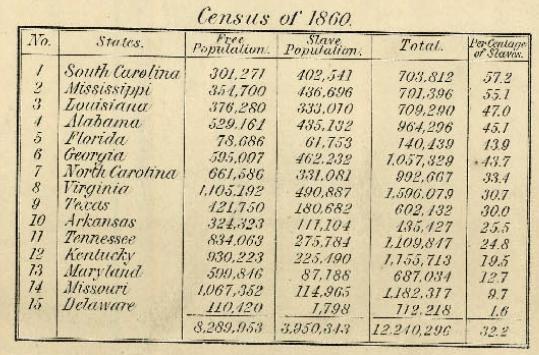
The second note is that you can almost draw a direct parallel between how many slaves were in a state, and when that state seceded;
Notice the Free Population vs the Slave Population. With the exception of Texas the states that were in the first round of secession are also the states with the highest slaves per capita. South Carolina, and Mississippi in particular had more slaves than free persons! Florida and Louisiana are nearly 50-50, and Georgia about 60-40. In comparison, the second wave of seceding states have less than 1/3 of their population in bondage. Damn I am bad at math. Just look at the last column above. That's better XD
I think these two facts are strong indicators that the second wave of secession occurred because those states lost hope for a peaceful resolution and chose to throw their lot in with fellow slave states rather than the free states, but these states I think were clearly not as committed to slavery as those in the first wave of secession. You can see this a bit in their secession statements, which are more defensive and kind of ring of "we don't really have much choice here" as opposed to the first wave of secession which generally directly references opposition to the federal government, Lincoln, northern oppression, or the desire to protect slavery (usually all four).
Following the second wave of secession, Northern states remained uncertain toward the war, but early battles like Bull Run showed that the Southern military could defend the South in battle. Charismatic and bold generals captured the Southern imagination and helped drive weak necessary support for the Confederacy toward a new patriotic loyalty. Further victories and successful repulsions of Northern armies further spurned a belief the war could be won, helped along by the very open and public debate in DC between Copperheads and Radical Republicans lead to a strong belief that if the Confederacy just held out there would be a peaceful solution. This eventually became the ground bed for the Lost Cause narrative, as it really looked like the South could win the war in 1862 and 1863.
It was only following the Emancipation Proclamation and the Battle of Gettysburg that Northern states really fell into line behind the war. Public support swelled. New recruits and draftees flooded Union ranks, and the Union Army finally got its gak together. The South was cut in half at Vicksburg, and Sherman's March to the Sea completely crushed the faith Southerners had in the Confederacy to defend the Southern states. As the states fell and became unable to defend themselves internal tensions between poorer Southern farms and rich slave holders erupted. Support for the Confederacy collapsed and the will to fight rapidly faded. The final nail was Lee's surrender which was rightly seen as the final blow. The South could no longer defend itself.
This message was edited 1 time. Last update was at 2017/12/01 01:07:00
sebster wrote: Its the boring answer, but for me its WW2. It's because there was such diversity in the various conflicts, which were spread across the globe but all interconnected. It's just amazing to see how individual operations in one theatre could have ramifications half way across the globe.
Also tanks.
Same, the naval side is fascinating to me most of all. The pre-war conflicts are also quite interesting like the Winter War and the Russo-Japanese War.
Homosexuality is the #1 cause of gay marriage.
kronk wrote: Every pizza is a personal sized pizza if you try hard enough and believe in yourself.
sebster wrote: Yes, indeed. What a terrible piece of cultural imperialism it is for me to say that a country shouldn't murder its own citizens
BaronIveagh wrote: Basically they went from a carrot and stick to a smaller carrot and flanged mace.
The European Dark Ages, from the Fall of the Western Roman Empire right up to the Norman Conquest of England.
I'm playing Attila Total War atm as WRE on Hard difficulty. I got over-confident and over-extended trying to defend my northern and eastern borders, and now Stilicho my best general is trapped under siege with a battered legion in Pannonia, a rampaging horde keeps destroying the Legions I'm raising in northern Italy to go save him, my full strength Legions are bogged down in Gaul making a fighting withdrawal against the Jutes, Saxons, Franks and Suebians, and my entire empire is about to spontaneously implode with famine, public unrest, rebellions and plagues.
I need to save Stilicho and withdraw all my armies to Italy but I just can't reach him.
When the WRE falls in Attila, it falls FAST.
And I'm only 20 or so turns in!
This message was edited 5 times. Last update was at 2017/12/01 01:21:05
KTG17 wrote: But Abraham Lincoln didn't call up 100,000 volunteers to invade the South to free the slaves, he called them up because the South was breaking away from the North and the country was falling apart. There was really no road map for ending slavery, which is why the Emancipation Proclamation took 2 years into the war to be delivered. From Lincoln himself, he had “no purpose, directly or indirectly, to interfere with slavery in the States where it exists.”
This is the two card trick of the claim that the war wasn't about slavery. Focus on the North committing to the war to maintain the union, and just avoid the question of why the South was looking to leave in the first place.
Reality is the South to leave because with Lincoln's election it was clear political power had shifted to the North. If it wasn't going to be Lincoln, then sooner or later there was going to be a President that wanted abolition, and the South had just seen a president elected without carrying a single state in the South.
To argue that all Southerners who seceded from the North to keep slavery is ridiculous.
Honestly that's something of a false question. Rank and file soldiers aren't inherently motivated by the political causes of the state. Not particularly many soldiers went to Iraq believing in a rapid transformation in to a liberal democracy that would trigger a democratic domino across the middle east, most probably weren't even aware of that idea. They fight because it pays, because they got drafted, or because their homes annd their nation/state are under threat.
The vast majority of Southerners did not own slaves, only the rich farmers and plantation owners did.
The value of slaves isn't just in their incomes, its also in their impact on the social order. Many poor white people found their status much more tolerable as long as there were black slaves beneath them. Add in some fear about what those 'wild black men' might do if they were freed, and you have more than enough motivation for people who gained nothing from slaves to support slavery.
Many confederates simply fought because in their view, they were the ones being invaded. And white northerners were not signing up en mass to free black slaves either. Lets be real about racism in the 1860s.
That's definitely true. When the draft riots in New York broke out, did they go to the wealthy parts of the city to attack the people buying their way out of the draft? No, they went and found some black people to torture.
There was definitely racism in the North as well as the South. There still is. But that doesn't really address the larger political issues of why the South chose to try and leave the Union.
In the end, it was one hell of a vicious, hateful war. If you think about the animosity Americans had for the Japanese, Germans, Koreans, and Vietnamese in those wars and imagine that directed inward, you can imagine the way the war was fought. And then, with an amazing stroke of a pen, Grant began the healing process by allowing Lee's troops to just. . . go home. Not a lot of civil wars end like that.
That's a really good point, and one that probably isn't talked about often enough.
“We may observe that the government in a civilized country is much more expensive than in a barbarous one; and when we say that one government is more expensive than another, it is the same as if we said that that one country is farther advanced in improvement than another. To say that the government is expensive and the people not oppressed is to say that the people are rich.”
Adam Smith, who must have been some kind of leftie or something.
I've gotta say I've got a lot more interest in "what-if" scenarios - a thing mostly prevalent in scale modelling, where you pretty much imagine what tanks, planes or soldiers would look like if WWII hadn't stopped in 1945, or other alternate scenarios. I've seen a Jagdpanther upgraded with night vision kit, a post-war cannon and MGs, painted in swedish colours, the various german supertanks are amazing (Ratte, Maus) and I'm currently building a diorama of a Panzer IV on the shores of a suburb of Stockholm in 1940.
Paradigm wrote: I'm afraid have to disappoint you there, I don't own the book, I just got given that chapter as reading for a lecture a few months ago!
If anyone wants, I can make a call, if you're willing to write a book, I've got a pal with a cache of WW1 aerial photography, including things that supposedly don't exist, like aircraft in combat.
There's one nice shot that's of a German plane crash, supposedly by the French pilot who shot it down. There are men and staff cars gathered around it as they try to get the pilot out.
Fate is in heaven, armor is on the chest, accomplishment is in the feet. - Nagao Kagetora
Lone Cat wrote: [
Really? Did the battles in the Enlightenment Era fights that way where either sides may just simply quit the battle only because of boredon rather than a hardcore bayonet charge and serious Hussars hot pursiuts?
This was the era of stagnation of military art. Generals were more worried about wigs being powdered . Changes began with the revolutionary army of France, which simply could not afford to just stand and die. They did not have weapons and provisions for this, so used column rush tactics. In Russia, the tactics revival started by Suvorov. At that time the concentration of forces in the main direction and a decisive assault - it was something unusual. Such a decline was in tactics. And yes, some generals stopped the battle when they got tired. Don't know much about the cavalry. I know, that in 18th Russia there were no good horses, so it used mainly by dragoons, without typical cavalry fightings. But it changed a lot just before Napoleonic wars
1. And Generals in the 18th C. were mainly bluebloods (Princes and other noblemen... like Prince Charles of Lorraine who's always a nemesis to Frederick II of Prussia), and Revolutionary France discarded Wigs (and longhairs) in favor or Roman-style clean cut (AFAIK). so there's no wigs for French Revolutionary Generals (Napoleon Bonaparte included) to worry about.
2. Didn't the Russians at that time have Cossacks as their signature cav units? (which were a race of horsemen) were Russians horse not good enough to make Hussars or slasher-type light cavalry to do similar Hussars job?
3. Did George Washington also cares about wigs powdering?
The trenchfoot was one or more diseases that creates or raise concerns on the 'personal hygiene'. I've saw WW1 posters that instruct frontline troops to keep their feets clean and dry whenever possible. (and wipe dry once a a day or so).. and even Sunlight soap ad that has a WW1 foot soldier as a brand ambassador.
Early Roman Legion transition to Late Roman Legion
The development of mechanized armored warfare from 30's to present
OIF to OEF start till end (ongoing but less involvement). Basically from peace time footing to war footing with development of vehicles and gear.
Proud Member of the Infidels of OIF/OEF
No longer defending the US Military or US Gov't. Just going to ""**feed into your fears**"" with Duffel Blog Did not fight my way up on top the food chain to become a Vegan...
Warning: Stupid Allergy
Once you pull the pin, Mr. Grenade is no longer your friend
DE 6700
Harlequin 2500
RIP Muhammad Ali.
Jihadin, Scorched Earth 791. Leader of the Pork Eating Crusader. Alpha


 Following with interest. I think the combat in WW1 is much maligned in modern day popular history.
















 ~2800 points





 Member of
  DKoK Blog:
 Have a look, I guarantee you will not see greyer armies, EVER! Now with at least 4 shades of grey
