Not that this is a surprise as the media is controlled by a few very wealthy individuals that have no interest in a left wing more social agenda. At some point the media is going to have to be legislated to ensure it proves balanced coverage as at the moment we can massive front page articles that deliberately mislead the public and then post apologies in tiny writing on a page no one is going to read after the event such as the attached
As for the nationalising rail networks its not such a bad idea anymore to make more effective services. A lot of things publicly owned in the 80/90's were simply more expensive as private companies could provide the same service cheaper as they didn't have to provide all the benefits the state would have to. However these state benefits have now all been eroded to point where in fact they are similar or less beneficial than the private sector provide (for example access to private healthcare etc). On top of this the private sector want to make a 15-20% profit on everything they do. So in reality state run operations now have the ability to operate these services much more cost effectively (for the same service) for the consumers. The real risk to state run operations is what I consider "sticky fingers" where basically politicians don't like something and therefore feel the need to change because of their electorate. That then means the operations get tied up with ever less efficient modes of operation because that is what the MP of the day wants. In my view the best method of operation would be for the state to award a contract on a similar basis to a state owned business with an aim of limiting the overall profit but still act like it is a business. So for example if you nationalised the energy services the state companies remit would be to make a profit of say £0.5billion that is fed straight back to the government to support new infrastructure whilst ensuring that the service is still efficient whilst not hammering the average consumer for the benefit of shareholders that may have no real interest in the Country. The French have the right idea for example EDF are mostly (completely?) owned by the French state, which in effect means they profit from our energy needs.
I agree that press coverage towards Corbyn has been hostile since day 1, but he's not helping himself by making massive blunders.
First blunder was wanting trident renewed without the warheads, which was obviously caving into the Unions,
and second blunder was calling for a remain vote when he's been anti-EU for years.
He wants to spend £200 billion on renewing Trident, then he wants to scrap it sometime down the line...
Sweet mother of God...
Please Mods, let me swear...this has to be the most stupidest bat gak insane idea I have heard in years...
You are completely taking it out of context. What he is saying is that he supports world disarmament of nuclear weapons but that it has to be done as a global initiative. However given current world insecurities (Rogue states, China and Russia making land grabs etc) with each other doing it right now might be a bad thing (although on the other hand as a country you can make a stand and fully disarm and then challenge others why they still need them, after all you can always argue that the only use of Nuclear weapons is for mass murder on potentially millions of people that are not responsible for their direct governments actions, but that's another debate). Hence we need them now, but globally push to not need them in the future (and also that is easier for us as we only hire, maybe with a refund if returned unused, the nukes from the US). That can't be a bad thing surely?
If he was really anti-nuclear weapons, he'd be saying that we shouldn't spend the money on them in the first place, instead of wasting billions on a white elephant.
Gordon Brown tried nuclear disarmament and he got nothing, nada, zilch...
I would make it a rule that every correction an dretraction a newspaper makes (and they would *have* to make them if proven demonstrably false), would have to be made in the same text size and font as the original article...
Yes, however the only problem is that if the retraction occurs after the event it affects. So if you put misleading claims in your paper before the referendum and then retract it afterwards people have possibly been swayed to vote in a certain fashion and regardless of the retraction you still get the result you want. Unfortunately the only way these companies will get the message is place such large fines over their head that it makes them significantly pause before applying it. So you could have your idea plus a £500k fine minimum dependent on the potential impact.
I agree that press coverage towards Corbyn has been hostile since day 1, but he's not helping himself by making massive blunders.
First blunder was wanting trident renewed without the warheads, which was obviously caving into the Unions,
and second blunder was calling for a remain vote when he's been anti-EU for years.
His principles went out the window...
But then do we really know this or just what the media have been telling us and misquoting because we haven't been to all his talks all his discussions on the issue. It is easy to take one sentence outside of the full conversation and present it as his view. That's the point of the article for the most part JC has been completely mis-portrayed so do we really know his views or just what we have been fed because I know I have never sat down and watched all his interviews and discussions (and even if he was he is allowed to change his mind, otherwise Skoda would still be car we ridiculed 30 years ago).
Do_I_Not_Like_That wrote: If he was really anti-nuclear weapons, he'd be saying that we shouldn't spend the money on them in the first place, instead of wasting billions on a white elephant.
Gordon Brown tried nuclear disarmament and he got nothing, nada, zilch...
The argument being that the existing Trident is not a white elephant? You can still be anti-nuclear weapons but begrudgingly accept their need for time being. I'm anti cars being driven by humans (because in most cases deaths and injuries are from human error) and would prefer cars that drive themselves; but that doesn't mean that I don't buy a car, don't drive to work etc because there is a current need for them. It doesn't mean that I don't promote that view and over time hopefully change things overtime.
Yes Gordon Brown did have that view but he had three years. Full disarmament is only going to happen over 50 years or so because it not only requires a change in our mindset but it needs one globally and aggressive actions by some countries will make people pause for thought. We are by nature a tribal creature and for the most part the default reaction of other aliens is fear and defensive. It is an evolved position from when we are apes and we fought neighbours for resources, those evolved instincts are still there and any push against them will always be a long slow progress. Any thoughts that we could have disarmed in three years is just naïve.
Smith's up there with Jeremy 'nuclear subs without nuclear warheads' Corbyn...
what a pair of buffoons.
From a purely cost effective standpoint, it makes more sense to have a load of conventional warheads than nukes in those submarines for the simple reason that the only time those nukes will be used, the entire UK would be completely fethed anyway as would the country which fethed us thanks to our treaties with the US and other nuclear equipped NATO members.
In contrast if we instead just had high explosive warheads then they at least could be used in conventional warfare.
Nuclear deterrence is not a valid reason for the UK to have nukes as we are already allied to many nuclear equipped nations. Neither Russia nor China are going to launch nuclear weapons at anyone as it is suicide, both due to the potential retaliation from the US but also from the economic impact. North Korea cannot launch them with any accuracy and if it were to then its targets would be South Korea and other far eastern countries. Iran would go after Israel who have their own nukes to defend themselves with.
The only semi-likely scenario for a nuclear attack on the UK is if a terrorist cell manage to get their hands on a portable device, in which case having a load of nukes is no deterrent at all as you can't launch a counter strike against individuals.
Well JC agreed with Farage in that article 50 should be triggered, calling for it on the morning of 24th June.
The only two politicians to do so. Did JC understand the consequences or does he agree that we should leave the EU?
JC also doesn't talk of winning the next election. He avoids it like the plague in interviews. Why?
He wants to build a movement. Give us some specifics Jeremy.
No wonder MPS are worried about his leadership.
Nuclear deterrence is no longer a valid theory. Neither Russia nor China are going to launch nuclear weapons at anyone as it is suicide.
Isn't that the very definition of Nuclear Deterrence?
Just to clarify, I'm saying that the UK no longer, in fact never, needed its own deterrent as long as we and the US have NATO membership and agreements to defend each other from nuclear attack. Our push for our own "independent" nuclear deterrent was just a vanity project.
So I'm saying that deterrence from a UK standpoint is not a valid reason to have nukes as we are already allied with countries with way more (the US, for example has 14 subs carrying 24 missiles each compared to the UK's 4 subs with 16 missiles each, and that is ignoring the USA's other nuclear weapons such as ICBMs) and our past enemies who we got the nukes to defend against are now somewhat reliant on us to continue existing in order to contribute to their economies.
Also, if there were some country with nukes it would more likely target nuclear equipped nations to strike against rather than a non-nuclear equipped nation with strong links to those nuclear nations in order to attempt to minimise the nuclear counter attack.
Nuclear deterrence is no longer a valid theory. Neither Russia nor China are going to launch nuclear weapons at anyone as it is suicide.
Isn't that the very definition of Nuclear Deterrence?
Just to clarify, I'm saying that the UK no longer, in fact never, needed its own deterrent as long as we and the US have NATO membership. Our push for our own "independent" nuclear deterrent was just a vanity project.
So I'm saying that deterrence from a UK standpoint is not a valid reason to have nukes as we are already allied with countries with way more (the US, for example has 14 subs carrying 24 missiles each compared to the UK's 4 subs with 16 missiles each, and that is ignoring the USA's other nuclear weapons such as ICBMs) and our past enemies who we got the nukes to defend against are now somewhat reliant on us to continue existing in order to contribute to their economies.
So we should stay allied to the US whilst they have a nuclear deterrent?
Nuclear deterrence is no longer a valid theory. Neither Russia nor China are going to launch nuclear weapons at anyone as it is suicide.
Isn't that the very definition of Nuclear Deterrence?
Just to clarify, I'm saying that the UK no longer, in fact never, needed its own deterrent as long as we and the US have NATO membership. Our push for our own "independent" nuclear deterrent was just a vanity project.
So I'm saying that deterrence from a UK standpoint is not a valid reason to have nukes as we are already allied with countries with way more (the US, for example has 14 subs carrying 24 missiles each compared to the UK's 4 subs with 16 missiles each, and that is ignoring the USA's other nuclear weapons such as ICBMs) and our past enemies who we got the nukes to defend against are now somewhat reliant on us to continue existing in order to contribute to their economies.
So we should stay allied to the US whilst they have a nuclear deterrent?
Considering that I cannot see the US giving up its nukes any time soon, nor them severing ties with us, yes. Let the US and other nuclear equipped NATO members be our deterrent, make ourselves a lower priority target and save some money.
And if the US did get rid of its nukes I doubt some super nationalistic Russia looking to start a nuclear war would balk at our comparatively tiny nuclear arsenal.
Nuclear deterrence is no longer a valid theory. Neither Russia nor China are going to launch nuclear weapons at anyone as it is suicide.
Isn't that the very definition of Nuclear Deterrence?
Just to clarify, I'm saying that the UK no longer, in fact never, needed its own deterrent as long as we and the US have NATO membership. Our push for our own "independent" nuclear deterrent was just a vanity project.
So I'm saying that deterrence from a UK standpoint is not a valid reason to have nukes as we are already allied with countries with way more (the US, for example has 14 subs carrying 24 missiles each compared to the UK's 4 subs with 16 missiles each, and that is ignoring the USA's other nuclear weapons such as ICBMs) and our past enemies who we got the nukes to defend against are now somewhat reliant on us to continue existing in order to contribute to their economies.
So we should stay allied to the US whilst they have a nuclear deterrent?
Considering that I cannot see the US giving up its nukes any time soon, nor them severing ties with us, yes. Let the US be our deterrent, make ourselves a lower priority target and save some money.
And if the US did get rid of its nukes I doubt some super nationalistic Russia looking to start a nuclear war would balk at our comparatively tiny nuclear arsenal.
So basically you're saying we should not take responsibility for the defence of our nation, and instead rely on the good graces of a foreign power indefinitely?
So basically you're saying we should not take responsibility for the defence of our nation, and instead rely on the good graces of a foreign power indefinitely?
Thats very short sighted and irresponsible.
Defence of our nation from whom? Who is a military threat to us with access to nuclear weapons?
If we want to defend our nation then we should invest more into missile intercept systems so that we can actually protect our nation in the event of a nuclear attack, rather than just strike at the person who killed us after we're all dead.
So basically you're saying we should not take responsibility for the defence of our nation, and instead rely on the good graces of a foreign power indefinitely?
Thats very short sighted and irresponsible.
Defence of our nation from whom? Who is a military threat to us with access to nuclear weapons?
Again, you are still being very short sighted.
There no direct threats in the immediate future, so we should scrap our weapons? What about unforseen threats? We do not know and cannot reliably predict what will happen geopolitically in the next year, nevermind the next 50 years or century. Scrapping Trident because there are no immediate threats right now is short sighted and irresponsible.
After scrapping our existing nuclear weapons, it'll be very hard if not impossible to start up a new weapon programme if a new threat should appear in the future.
What if another economic depression hits Europe hard enough to the point that NATO members cut back on defence spending and NATO begins to crumble? What if the US economy tanks, and an isolationist President is elected who wants to scale back American involvement in NATO? As I understand it, the current administration already wants to reduce the American contribution to NATO and wants European members to increase their contributions (or at least meet the targets on defence spending they have been set but failed to achieve).
What if Russia or a new superpower decides to take advantage of a weakened NATO some decades into the future?
Who will we turn to for a nuclear deterrence against an aggressor, if all our allies are in a weak position themselves?
I don't know about you, but I do not want the defence of my nation to be decided by a foreign Head of State (POTUS).
I don't know about you, but I do not want the defence of my nation to be decided by a foreign Head of State (POTUS).
So the solution would be to ensure there is no state to be head of? That would be the reality of the situation. It's called Mutually Assured Destruction for a reason. There's only one outcome from following MAD principles because eventually you get a MAD outcome. What you really want is everyone to disarm so that this would not become an issue.
However in the mean time the preferable solution is to build defences that mean that the MAD principle is undermined as the weapons to instigate it will be worthless. That's why Russia doesn't like the expansion of the anti-missile system because it effectively neutralises its deterrent.
Whirlwind wrote: So the solution would be to ensure there is no state to be head of? That would be the reality of the situation. It's called Mutually Assured Destruction for a reason.
There's only one outcome from following MAD principles because eventually you get a MAD outcome. What you really want is everyone to disarm so that this would not become an issue.
However in the mean time the preferable solution is to build defences that mean that the MAD principle is undermined as the weapons to instigate it will be worthless. That's why Russia doesn't like the expansion of the anti-missile system because it effectively neutralises its deterrent.
The human race will NEVER disarm. The genie is out of the bottle, we've opened Pandora's box and its too late to close it. The idea that the human race will ever disarm is an idealistic Utopian fantasy.
And if countries starting unilaterally disarming, without the participation of every single nuclear state on the planet, then MAD will have failed. You've just given a massive advantage to the few countries that refuse to disarm.
And how will you stop countries re-arming in the future?
The only realistic course of action is to maintain the status quo, maintaining the balance of power between states (which means not trying to undermine your rival's nuclear deterrence like NATO is doing with Russia, which I too disagree with and consider to be a bad idea).
The human race will NEVER disarm. The genie is out of the bottle, we've opened Pandora's box and its too late to close it. The idea that the human race will ever disarm is an idealistic Utopian fantasy.
And if countries starting unilaterally disarming, without the participation of every single nuclear state on the planet, then MAD will have failed. You've just given a massive advantage to the few countries that refuse to disarm.
And how will you stop countries re-arming in the future?
The only realistic course of action is to maintain the status quo, maintaining the balance of power between states (which means not trying to undermine your rival's nuclear deterrence like NATO is doing with Russia, which I too disagree with and consider to be a bad idea).
Having an idealistic goal is gives something to aim for over accepting the status quo. Even if you accept you never get there at least everyone can understand the goal.
On the other hand if you shared the anti-nuc capability so that every country could get access to it then desire to develop these types of MAD weapons is reduced because they aren't worth the money invested. If countries want to rearm what benefit does it bring them? Weapons that are effectively useless because they will get knocked out the sky before they hit anything. If there is no ability to use them effectively then there is no point having them. It's the reason the Kremlin is unhappy with them; it effectively renders their MAD systems useless whilst NATOs are still viable. If both sides have these defensive weapons then it will encourage both sides to disarm as neither side can achieve anything other than having a lot of expense reduced to rusting scrap metal.
Australia has called for a free trade deal with Britain as it plans its withdrawal from the European Union following June's referendum result.
The move is a boost to new Prime Minister Theresa May who described the call as "very encouraging" and insisted it showed Brexit could work for the UK.
She spoke to her Australian counterpart Malcolm Turnbull who said he wanted to open up trading between the two Commonwealth countries.
Mrs May has told International Trade Secretary Liam Fox to begin exploring options but admitted Britain could not sign any deals while it was still a member of the EU.
She has vowed to embrace "the opportunities to strike free trade deals with our partners across the globe".
She added: "It is very encouraging that one of our closest international partners is already seeking to establish just such a deal.
"This shows that we can make Brexit work for Britain, and the new Secretary of State for International Trade will be taking this forward in the weeks and months ahead."
Dr Fox, who backed Brexit, has claimed a number of non-EU countries have already asked Britain for a trade deal.
He said he was "scoping about a dozen free trade deals outside the EU to be ready for when we leave".
He claimed Britain has opened "very fruitful" trade talks with Canada.
And he is preparing to visit the US to make sure Britain is not at the back of the queue in trade talks as President Barack Obama suggested before the referendum.
He told the Sunday Times: "We've already had a number of countries saying, 'We'd love to do a trade deal with the world's fifth biggest economy without having to deal with the other 27 members of the EU'."
Mrs May has told Scottish First Minister Nicola Sturgeon she would not trigger Article 50 to leave the EU before getting UK-wide agreement.
But this could prove a challenge as Scotland voted overwhelmingly to remain in the EU and Mrs Sturgeon has vowed to stay in it.
According to the British government's website, Australia is the UK's 12th biggest export market, ahead of Canada and India.
Australia is also the UK's eighth largest source of foreign direct investment.
In 2014, the top 10 UK exports to Australia were:
1. Road vehicles
2. Medicines and pharmaceuticals
3. General industrial machinery
4. Specialised machinery
5. Professional and scientific instruments and apparatus
If you thought Labour were a bunch of idiots, then it looks like the Tories are trying to steal their crown.
Trident vote is on Monday...
Given that tensions are high in Scotland over the EU vote, and given that the vast majority of people and political parties in Scotland oppose having Trident subs in Scotland, you would think the Tories would put this on the back burner for a while...
Don't get me wrong, I'm delighted that the Tories are doing this, it only boosts the pro-Indy side, but I do wonder if May has taken leave of her senses...
I would make it a rule that every correction an dretraction a newspaper makes (and they would *have* to make them if proven demonstrably false), would have to be made in the same text size and font as the original article...
Yes, however the only problem is that if the retraction occurs after the event it affects. So if you put misleading claims in your paper before the referendum and then retract it afterwards people have possibly been swayed to vote in a certain fashion and regardless of the retraction you still get the result you want. Unfortunately the only way these companies will get the message is place such large fines over their head that it makes them significantly pause before applying it. So you could have your idea plus a £500k fine minimum dependent on the potential impact.
I agree that press coverage towards Corbyn has been hostile since day 1, but he's not helping himself by making massive blunders.
First blunder was wanting trident renewed without the warheads, which was obviously caving into the Unions,
and second blunder was calling for a remain vote when he's been anti-EU for years.
His principles went out the window...
But then do we really know this or just what the media have been telling us and misquoting because we haven't been to all his talks all his discussions on the issue. It is easy to take one sentence outside of the full conversation and present it as his view. That's the point of the article for the most part JC has been completely mis-portrayed so do we really know his views or just what we have been fed because I know I have never sat down and watched all his interviews and discussions (and even if he was he is allowed to change his mind, otherwise Skoda would still be car we ridiculed 30 years ago).
Do_I_Not_Like_That wrote: If he was really anti-nuclear weapons, he'd be saying that we shouldn't spend the money on them in the first place, instead of wasting billions on a white elephant.
Gordon Brown tried nuclear disarmament and he got nothing, nada, zilch...
The argument being that the existing Trident is not a white elephant? You can still be anti-nuclear weapons but begrudgingly accept their need for time being. I'm anti cars being driven by humans (because in most cases deaths and injuries are from human error) and would prefer cars that drive themselves; but that doesn't mean that I don't buy a car, don't drive to work etc because there is a current need for them. It doesn't mean that I don't promote that view and over time hopefully change things overtime.
Yes Gordon Brown did have that view but he had three years. Full disarmament is only going to happen over 50 years or so because it not only requires a change in our mindset but it needs one globally and aggressive actions by some countries will make people pause for thought. We are by nature a tribal creature and for the most part the default reaction of other aliens is fear and defensive. It is an evolved position from when we are apes and we fought neighbours for resources, those evolved instincts are still there and any push against them will always be a long slow progress. Any thoughts that we could have disarmed in three years is just naïve.
Can't blame the media for this one - Corbyn backed a remain vote for Labour, despite being anti-EU since the 1970s.
Smith's up there with Jeremy 'nuclear subs without nuclear warheads' Corbyn...
what a pair of buffoons.
From a purely cost effective standpoint, it makes more sense to have a load of conventional warheads than nukes in those submarines for the simple reason that the only time those nukes will be used, the entire UK would be completely fethed anyway as would the country which fethed us thanks to our treaties with the US and other nuclear equipped NATO members.
In contrast if we instead just had high explosive warheads then they at least could be used in conventional warfare.
Nuclear deterrence is not a valid reason for the UK to have nukes as we are already allied to many nuclear equipped nations. Neither Russia nor China are going to launch nuclear weapons at anyone as it is suicide, both due to the potential retaliation from the US but also from the economic impact. North Korea cannot launch them with any accuracy and if it were to then its targets would be South Korea and other far eastern countries. Iran would go after Israel who have their own nukes to defend themselves with.
The only semi-likely scenario for a nuclear attack on the UK is if a terrorist cell manage to get their hands on a portable device, in which case having a load of nukes is no deterrent at all as you can't launch a counter strike against individuals.
You misunderstand the point I was making - Corbyn wasn't getting technical on nuclear warheads or conventional warheads, he was just proposing a crazy, half-way house plan to keep the Unions on side...and it made him look silly.
So basically you're saying we should not take responsibility for the defence of our nation, and instead rely on the good graces of a foreign power indefinitely?
We already do, our conventional forces are quite frankly pitiful and we can't afford a military capable of acting unilaterally anyway. We may as well save ourselves a truly gigantic amount of money by not renewing Trident and spend the money on something actually useful.
Dear everyone who has asked me what my problems are with Corbyn's leadership,
Here is my experience.
Mr Corbyn appointed me and press released this without my knowledge or consent whilst I was in the middle of cancer treatment. He then sacked me the next day when he realized he had given away part of someone else's role. But didn't bother to tell me that either. By then my office had been besieged by press and the story was out that I was Shadow Minister. I decided to make the best of it and to serve. I worked on his Arts policy whilst I was still having treatment but in Bristol..
When I went back to Westminster, I discovered that he had sacked me but hadn't told me and did not have any ideas for how I was supposed to explain it to Bristol West members or constituents. I was then faced with the choice of telling the truth - that he had made a series of errors, and inevitably thereby face a pile of criticism from his supporters - or say I had changed my mind about accepting the role - and thereby face a pile of criticism from.his supporters. And I knew the pile would arrive because I had seen how it went for others who had resigned. And because Corbyn supporters had already piled into me for disloyalty when I had had to miss votes for cancer treatment.
I then, contrary to the story he keeps giving on TV, found it near on impossible to get to talk to him about this problem
Eventually I did get to meet him and he had nothing to say. No idea what to do. It took my boss Maria Eagle to explain to him that as he was leader he could re appoint me if that was what he wanted.
I then worked hard for him on his Arts policy, loyally didn't go to the press about the above, got stuck in and worked. And yes, I enjoyed the role, it is one of my dream jobs in parliament and I believe I did Corbyn and the Labour Party a great service, as millions of people work in the arts and culture sectors and they valued being involved in policy-making. So it was never my intention to resign.
However, I kept hearing from other colleagues on the front bench just how difficult or impossible it was to get a decision out of him on important policy issues - the very thing Corbyn is supposed to be good on. I also noticed that the policy making process through the National Policy Forum was being slowed down by lack of decisions from Corbyn's office.
But then he was missing in action during the EU referendum, including going on a week's holiday three weeks before the day. I found that unforgivable. I had re-started campaigning in this campaign, phone-canvassing to conserve my energy, and kept hearing Labour voters saying 'but your leader wants out, doesn't he?' His team didn't send anyone to the EU Campaign meetings in Westminster and his lack of enthusiasm showed.
On the day after the referendum he asked for an early Brexit. My constituents want exactly the opposite and were telling me so in their hundreds, and voted 85% to remain.
That was the tipping point for me - it is not allowed to remain on the front bench whilst taking an opposing view to the leader in something so important.
I therefore had to resign.
The reason I then voted no confidence in him as leader is because I have no confidence in him as leader. See above. Plus I had found out from other front bench women how unwilling and unable Corbyn is to communicate with, listen to or work with anyone outside his narrow group.
Since then he has stated publicly that he isn't prioritizing winning elections. How can I support a Labour leader who doesn't want to form a Labour government above everything? When working people, the old, the young, the poor, the country, need a Labour government above everything?
I want a Labour government more than anything, because that is how we change the world and how we help millions of people, just as the 1997-2010 Labour government helped millions of people, my own family included.
I profoundly wished I never had to say all this publicly, but people keep asking, and I believe they have a right to know the truth about what Corbyn's leadership is like.
We cannot win general elections with a leader who is unable and unwilling to learn how to communicate with, listen to and persuade people with whom he doesn't already agree - we need to convince swing voters who voted Tory last year in Southern seats to vote Labour next time and we need Labour voters in Wales and the North to continue to vote Labour - without this we can't win a general election.
all that is what's at stake. Not having a Labour government again is unbearable. I will do anything I can to help to ensure this. It's the constitutional duty of all Labour MPs, especially the leader, to try to secure a better life for working class people through parliamentary means. And that's what I will continue to do.
I hope that's clear.
You're right, the Blairites need to come out of their Tory closet, and be honest about who they actually are rather than dragging the Labour party down with them.
Once they leave, the UK can reclaim a proper, left wing opposition instead of a bastardised half way house.
And hopefully the Blairites in the Conservative party will follow suit.That way, we could once again have a clear dividing line between the Left and the Right, instead of the awful amorphous blob Parliament has become. And the Blairites would hold the centre ground vacated by the Liberal Democrat vanishing act.
Corbyn is no Harry Perkins, that must be said. But no Harry Perkins is available. And this is where the anti-Corbyn arguments begin to collapse, and where it becomes clear that defending Corbyn against his opponents on the right is essential to the future of the British left if it is to have any interest in parliamentary affairs at all.
While his opponents are keen to point to polls demonstrating how Labour voters and the general public consider Corbyn unelectable, they invariably fail to point out the same holds even more true for his direct rivals: whether Kendall last year or Eagle and Smith this year. The reality is that under present conditions no Labour Party worth having is likely to win the next general election, whenever that may ultimately happen.
Corbyn is no Harry Perkins, that must be said. But no Harry Perkins is available. And this is where the anti-Corbyn arguments begin to collapse, and where it becomes clear that defending Corbyn against his opponents on the right is essential to the future of the British left if it is to have any interest in parliamentary affairs at all.
While his opponents are keen to point to polls demonstrating how Labour voters and the general public consider Corbyn unelectable, they invariably fail to point out the same holds even more true for his direct rivals: whether Kendall last year or Eagle and Smith this year. The reality is that under present conditions no Labour Party worth having is likely to win the next general election, whenever that may ultimately happen.
I think most would agree that the Labour party isn't liable to win a general election anytime soon. The left doesn't have a voice in Smith, Eagle or Corbyn, defending JC is really just defending a particularly dire approach to politics.
Automatically Appended Next Post: Trident renewal has been backed.
The Trident choice was really only ever a choice about international diplomacy. Do we keep our seat at the "Have Nukes" table or do we accept our decline in status and go sit with the "Need your Nukes"?
It's more than just pride or vanity its power politics on an international scale. The UK may in reality rely on many of its allies for actual military protection but without trident it loses a seat at the top table. It's not about actual nukes (accept this time it actually is!) it's about negotiating position. Just like bombing Syria isn't about stopping international terror its about negotiating with France. Same vote in favour of that too as I recall, fat lot of good it did anyone!
Dreams of former glory play a significant part as well.
Every Scottish MP, aside from the solitary Tory, voted against renewal. The cracks in the Union are getting a bit too wide to paper over at this stage.
Dreams of former glory play a significant part as well.
Every Scottish MP, aside from the solitary Tory, voted against renewal. The cracks in the Union are getting a bit too wide to paper over at this stage.
I'm a bit curious, what is the publics opinion on Trident?
Dreams of former glory play a significant part as well.
Every Scottish MP, aside from the solitary Tory, voted against renewal. The cracks in the Union are getting a bit too wide to paper over at this stage.
But that's more political manoeuvring than anything else. According the BBC News last night their polls indicate the actual populace are split 50:50 on the issue (and is probably similar to rest of the UK). In this case SNP are potentially not reflective of the population as a whole but it is giving them another angle for them to be a separate nation.
Anyway still think a UN controlled global anti-nuclear system is the way to go. No need for them at all then, but as ever the political discussions are polarised into whether we 'should' or 'should not' rather than looking at all the alternatives.
Dreams of former glory play a significant part as well.
Every Scottish MP, aside from the solitary Tory, voted against renewal. The cracks in the Union are getting a bit too wide to paper over at this stage.
But that's more political manoeuvring than anything else. According the BBC News last night their polls indicate the actual populace are split 50:50 on the issue (and is probably similar to rest of the UK). In this case SNP are potentially not reflective of the population as a whole but it is giving them another angle for them to be a separate nation.
Anyway still think a UN controlled global anti-nuclear system is the way to go. No need for them at all then, but as ever the political discussions are polarised into whether we 'should' or 'should not' rather than looking at all the alternatives.
And I'll trust BBC polls as far as I can throw them (figuratively). The BBC is heavily biased against that particular party, or are we forgetting the falsified articles they created during the indie ref a few years ago?
I am of course also biased against that particular propaganda company too of course (at least they're not as bad as RT though).
I have zero issue with a left wing party. Wouldn't vote for it, but it would be far better than this centre ground, everybody agreeing with each system we have know. The difference between Blair Labour and the Fake Tories is almost non-existent.
Who would notice? Almost everybody in parliament may as well merge into one gigantic party - they all believe in, and vote for, the same things, anyway...
Dreams of former glory play a significant part as well.
Every Scottish MP, aside from the solitary Tory, voted against renewal. The cracks in the Union are getting a bit too wide to paper over at this stage.
I'm a bit curious, what is the publics opinion on Trident?
"..Poll: 25% of Brits and 48% of Scots think UK should scrap Trident.."
That's a high level but is it clouded by recent activity?
I think we need a nuclear deterrent because it means you're listened to internationally - check out the old BBC documentary called 'a very British bomb' which details our struggle to attain nuclear capability.
My primary concern is we are moving out of a trident era and into a hypersonic delivery vehicle era - the only fly in the ointment being laser defenses. Of course, that brings in the pandoras box of weather modification...
edit: or is it 75% of brits and 52% of scots want to keep trident?
angelofvengeance wrote: Annnd Angela Eagle has quit the Labour leadership race. Which means It's Owen Smith and Jeremy Corbyn going head to head lol.
More hilarity ensues!
I suppose the intent is to cement the opposition votes into one bloc. I suspect Corbyn will win this regardles sof the various obstacles they've attempted to put in his way.
What happens after that is anyone's guess. Will the Labour MP's go quiet and wait for the electoral defeat in 4 years to try and remove him again? Or will they just obstinately ignore him and set up a parallel shadow cabinet? Or will they break off and go solo or join the lib dems?
Meanwhile, will Corbyn accept being a powerless opposition leader, or accept the helping hand of the radical left and end up a puppet in a transformed Labour party?
I'll be getting a lot of popcorn in over the next few months I suspect.
Having looked over his history, this Owen Smith bloke is an absolute nobody, much like Corbyn. Nothing notable in achievements, experience, or well, anything. I'm disappointed that the party of Clement Attlee has fallen so low. It's a sad day for the left.
Feels like they'll split, with Corbyn running the Labour Party into the ground and the majority of the PLP and any loyalist members joining the Lib Dems or becoming a new Social Democrats party.
Dreams of former glory play a significant part as well.
Every Scottish MP, aside from the solitary Tory, voted against renewal. The cracks in the Union are getting a bit too wide to paper over at this stage.
But that's more political manoeuvring than anything else. According the BBC News last night their polls indicate the actual populace are split 50:50 on the issue (and is probably similar to rest of the UK). In this case SNP are potentially not reflective of the population as a whole but it is giving them another angle for them to be a separate nation.
Anyway still think a UN controlled global anti-nuclear system is the way to go. No need for them at all then, but as ever the political discussions are polarised into whether we 'should' or 'should not' rather than looking at all the alternatives.
If by "political maneuvering" you mean "holding consistently to a principled position", sure. The SNP are anti-nuclear, ideologically - many of the MPs who spoke in that debate are CND members and opposition to Trident renewal was in their manifesto(on which basis they were voted in). I know it's a mostly alien concept to Westminster, but it is actually possible to be a politician without entirely giving up your principles.
I do wonder about Trident. There's a lot of people that work at Fazlane, or something tangentially related to Fazlane and I imagine a lot of people from the Glasgow-ish area has a friend or a close friend of a friend working on something related to it.
I mean, think of it this way it's a £20bn pound project where the VAST majority of the work, due to its nature is going to come from employees holding a British passport.
Compel wrote: I do wonder about Trident. There's a lot of people that work at Fazlane, or something tangentially related to Fazlane and I imagine a lot of people from the Glasgow-ish area has a friend or a close friend of a friend working on something related to it.
I mean, think of it this way it's a £20bn pound project where the VAST majority of the work, due to its nature is going to come from employees holding a British passport.
The other argument is how many more jobs could brits have if that money was put somewhere else.
Building and maintaining nuclear missiles, warheads and submarines requires a variety of high-tech skills. A nation that wants to be competitive in the worlds ought to be sustaining such engineering and science prowess.
Something that is puzzling me, why are some Brexit supporters determined to have article 50 enacted now? I've seen demonstrations of people arguing for it to be enacted immediately, but that seems like the most ridiculously destructive thing, apart from a leave vote of course, that the UK could do.
Are they so afraid that their position is so tenuous, and their argument so flawed, that they feel that they must push us into an irreversible sh1t spiral without the least bit of preparation?
Anyone on the forum here who supports an immediate enactment care to explain their reasoning?
Automatically Appended Next Post:
Shadow Captain Edithae wrote: If the Scots don't want Trident and the economic benefits and local employment that it brings, then move it to an English port and everyones happy.
Well, besides the Scots who lost their jobs of course, but I suppose theyre not s priority for the SNP?
I read that there is no deep water port in England suitable to do this at this time. At the moment, it's Scotland, or don't bypass the language filter like this. Reds8n
Probably just fear that people will find an excuse to 'weasel ' out of it otherwise. I'm more inclined to go with the idea that precisely when is the best card that May has in her hand.
Kilkrazy wrote: The UK doesn't need weather modification. We have the most diverse weather in the world already.
Laser defences lose energy through cloud, mist and fog so weather modification would deffo be on the 'laser defenses' discussion agenda given our climate!
(i am thoroghly against weather modification - feth with nature too much and she hits back)
I think Compel is right.
If may is smart she'll see that we have to have a proper plan before we trigger article 50 - the markets dont like randomness and uncertainty so the more predictable and planned the exit is, the happier the markets will be about the whole thing.
That's a high level but is it clouded by recent activity?
It has been a fairly hot issue in Scotland for years, to the extent that the majority of Scottish political parties are officially opposed to it, IIRC the sole exception are the Tories.
Polling consistently suggests that the scrapping of trident is the majority view, followed by its replacement with something cheaper and then with renewing it. Link
Kilkrazy wrote: Of course it's much easier to hold to a principled position when it isn't going to be tested.
welshhoppo wrote:
The other argument is how many more jobs could brits have if that money was put somewhere else.
That's a complicated subject when it comes to money moving around. Yes, money spent locally is money injected back into the economy, but economically speaking, it's dead money, it doesn't generate further growth particularly well. All defence spending is. If they spent that money on a dozen other different things, they could stimulate the economy in far more efficient ways. The flip side is a) national defence, b) the maintenance of a specific set of skill sets in the population that could be required for conflict at any point, and c) technological spinoff from military developments.
r_squared wrote:
I read that there is no deep water port in England suitable to do this at this time. At the moment, it's Scotland, or
There's at least two others that I recall which could be modified, and Portsmouth is one of them. In both cases though, it would take a large amount of capital expenditure to make appropriate facilities available, and naturally, the MoD is loathe to undertake something on that basis when a perfectly good facility already exists. And I'm inclined to agree with them there, national defence is a burden shared by all for the good of the nation. It's a collective responsibility, and the Government gets to do things like compulsory purchase in favour of it. The minute you start subjecting things like that to decisions by civilian committee, you're doing it wrong.
Otherwise you end up with no-one wanting to have an airfield nearby because it scares their cat or keeps them awake in their midday nap, and storing munitions out in the sticks where it costs ten times as much to move it about because no-one likes the idea of shells being stored in the depot down the road. If there are genuine safety concerns, it's something to take into account, but if everyone raised the sorts of concerns the SNP have done about Trident, we'd literally have nowhere to put it and have to get rid of it.
Because the SNP have never been in a position where their vote actually would get rid of Trident. They have never been in a position where they could decide to get rid of Trident on their own account (independent Scotland) and lose the jobs. They've certainly never been in a position where they might have to make the decision whether to launch or not (which the UK government does.)
I don't entirely see it a binary thing. The issue with Trident is the nuclear warheads, not the naval base. There's absolutely no reason we'd ever fire a nuclear warhead where it'll make any difference, so why not just replace them with something conventional which will be (a) cheaper (b) usable (so actually result in some threat) and (c) keep all of the jobs?
I mean, we can do plenty damage with regular missiles these days without having to vaporize and irradiate cities. The cold war and notion of MAD is long over.
Whilst Trident is responsible for some jobs, as I understand it the warheads are American anyway, so the money is currently leaving the country.
It is true that SNP don't have enough clout in Westminster to achieve anything other than annoy the Tories, but it just goes on to highlight another major political difference between Scotland and England, which highlights how farcical the union is from a political point of view.
Herzlos wrote: I don't entirely see it a binary thing. The issue with Trident is the nuclear warheads, not the naval base. There's absolutely no reason we'd ever fire a nuclear warhead where it'll make any difference,
That's a fundamental misunderstanding as to the point of nuclear deterrence, i.e. to deter. The point is to have them, so that you have to no use for them, because the possession guarantees their uselessness. If you don't have them, you're in a point where you might need them.
I can completely agree with people who say, 'We wouldn't need them right now'. I'm inclined to agree with people who say, 'We aren't going to be in a position where they would matter in five years'. I can even see them not being an issue within the next ten years.
The problem is, it takes four years to build a deterrent when the skill set is right there. It takes longer if you the deterrent has been gone for a longer period of time (you have to build appropriate facilities, re-acquire the construction skillsets, bring the technology up to modern standards, and so on). So whilst we might not be in a position where they have any relevance for the next ten years, if we decommissioned them tomorrow, we might well end up in a position in twenty five years where we have no nukes, and we end up staring down a conflict of some sort with someone who does and is a lot less humane.
In that position, we're eight years away from having an effective deterrent. And if that somewhat less humane opponent says, 'Do as we say or London vanishes', what do we do then? The stakes are so high in the nuclear game that we might well not get a chance for Round 2.
That means we effectively have three choices. One, we keep a deterrent. Two, we disarm, and accept the above risk. Three, we disarm, tie ourselves completely to American foreign policy, and accept that we can never take a seriously contrary position to them, as we require their protection.
Personally, I'm in favour of number one. YMMV though.
That's a fundamental misunderstanding as to the point of nuclear deterrence, i.e. to deter. The point is to have them, so that you have to no use for them, because the possession guarantees their uselessness. If you don't have them, you're in a point where you might need them.
But is it a deterrent if everyone knows we won't use them? It's not as if we have enough to actually scare any foreign states. I'm all for a deterrent that actually deters, but I don't think a nuclear warhead is the tool to do that any more.
In that position, we're eight years away from having an effective deterrent. And if that somewhat less humane opponent says, 'Do as we say or London vanishes', what do we do then? The stakes are so high in the nuclear game that we might well not get a chance for Round 2.
Anyone likely to do that is likely to do so every if we have nukes. Nukes only really hold off the Russians, and we don't have the capability to do them any real damage. I'm also sure that if we're still part of NATO then we've still got all of NATOs nukes as a deterrent (we could potentially chip in towards the upkeep of, say, French nukes). We'd have the same deterrent level if we had conventional missiles aimed at them from somewhere hidden in the sea, with the added bonus that we might even use them.
Our real threats at the moment and for the forseeable future are all from groups that won't be worried about being nuked. We can't nuke a suicide bomber. We can't nuke insurgents. We can't nuke ISIS (because by destroying the local infrastucture we'd only create a new threat).
There's never going to be anyone we can nuke, so why not just concede that and move on?
There's nothing wrong with us keeping up to date on the ability to re-arm with nukes should the world climate every change in a way that would require it (and other than the cold war heating up again, I can't think of any). Plus, anti-missing technology is advancing the point that potentially we couldn't hit anyone with a nuke even if we fired it.
It's not as if we have enough to actually scare any foreign states.
Trident missiles have an accuracy of 80 metres, and each submarine carries 48 missiles. Each missile has a detonating power several times larger than Hiroshima. We have four such submarines.
I don't know about you, but that sounds like enough missiles to me to wreck a country. You wouldn't kill everyone, but I'm pretty certain wiping out 160 of the largest cities/towns, combined with the fallout would end any immediate conventional menace.
Anyone likely to do that is likely to do so every if we have nukes.
Are they? Even if they were just bluffing, could you take the chance, when the stakes are literally the lives of everyone in Britain? I'm going to shoot for a 'No' on that one.
Nukes only really hold off the Russians
Currently. The atom bomb is a seventy year old physics problem, it's really not hard to replicate by modern standards. Most of the difficulty comes from sourcing the equipment, generating the materials, and working out a viable delivery system.
and we don't have the capability to do them any real damage.
See above. If that's not an estimation of 'real damage', I'm not certain what is.
I'm also sure that if we're still part of NATO then we've still got all of NATOs nukes as a deterrent (we could potentially chip in towards the upkeep of, say, French nukes).
Like I said, sure, that's one option. Rely on the spending on foreign powers, and hope that they a) keep on spending it on nukes, and b) maintain current alliances with you.
Our real threats at the moment and for the forseeable future are all from groups that won't be worried about being nuked. We can't nuke a suicide bomber. We can't nuke insurgents. We can't nuke ISIS (because by destroying the local infrastucture we'd only create a new threat).
Forseeable. Sure. But who foresaw ISIS? Not many. The Falklands? Nobody. Conflicts have a habit of popping up where you least expect them. And on the day Marine Le Pen somehow influences a facist French coup, nobody will have seen that coming either. Not that I think that's likely, but that's kind of the point. If you've been disarmed of nukes for fifteen years and realise you suddenly need them, that's the point it's too late.
There's nothing wrong with us keeping up to date on the ability to re-arm with nukes should the world climate every change in a way that would require it (and other than the cold war heating up again, I can't think of any). Plus, anti-missing technology is advancing the point that potentially we couldn't hit anyone with a nuke even if we fired it.
In order to keep up to date though, you have to maintain production at a certain level. I mean, I suppose you could take us down to one sub, but then all that means is that a potential enemy has to start crap when it's being refitted. Not to mention that as you yourself point out, anti-missiles are getting better, and one payloads worth might not be sufficient. It would still take another four years of construction in order to build additional subs, so we wouldn't really be much better off than if we didn't bother.
Frankly, I think that the half-way house option is the most pointless of them all. Either have them or don't, you know?
I'm not talking about getting rid of the subs, I think the current sub strategy is a good approach as there's (theoretically) always 1 out and 2 'ready'. We can keep up to date with some production, without having to actually arm the subs. But since (as I understand it) the warheads are pretty much bought in anyway, and whoever is developing them will still be developing them (Lockheed Martin, California) for other nations, do we really need to be keeping up to date personally? I've no idea how long they'd take to deliver a stock (it's up to 320 warheads per sub [8 missiles*, 40 warheads each], so 1280 in total).
Whilst May said she would fire them, I believe she still needs parliamentary approval for it, and would parliament agree?
*I don't think they've carried the full 8 missile compliment in years, it's normally 4/6.
Herzlos wrote: I'm not talking about getting rid of the subs, I think the current sub strategy is a good approach as there's (theoretically) always 1 out and 2 'ready'. We can keep up to date with some production, without having to actually arm the subs. But since (as I understand it) the warheads are pretty much bought in anyway, and whoever is developing them will still be developing them (Lockheed Martin, California) for other nations, do we really need to be keeping up to date personally? I've no idea how long they'd take to deliver a stock (it's up to 320 warheads per sub [8 missiles*, 40 warheads each], so 1280 in total).
So just to clarify, are you talking about maintaining 4 subs appropriately equipped to fire the relevant missiles, without actually buying the missiles, on the assumption that we can purchase them if we think we're going to need them?
I'll be frank, I don't think that would work on the basis that we'd still be incurring the majority of the cost and that it would still take sufficient time to rearm as to be potentially irrelevant if we needed them.
We do purchase them in (which is unwise in my opinion), but we're still reasonably involved in the design and development process, it's not quite as simple as us buying them off the shelf. British nuclear technology has been tied to America since we sent our research over in WW2, we've co-operated very closely at every stage.
Whilst May said she would fire them, I believe she still needs parliamentary approval for it, and would parliament agree?
There are sealed orders regarding nuclear strikes in every submarine from the PM which are valid upon receiving the appropriate signal from her office. In the event of her or her office being uncontactable and no signal received, there are a few more names (in order of command priority), and then instructions for the course of action to be pursued if none of them can be reached. Parliament is completely uninvolved in the process. The responsibility and authority derives from May and her chosen appointees, and them alone.
Sure, should Parliament disappear the subs have orders to follow. But by that point we'd be fethed anyway. Would parliament agree to launching the warheads if we haven't already been attacked and not yet working in a retaliation mode? Your London under threat example, for instance (which I assume requires some state to be pointing a nuke at London, and we have the option of eradicating them first, assuming of course the nuke is in a position that we'd disarm it at the same time, and our missile defense systems weren't likely to handle it).
So just to clarify, are you talking about maintaining 4 subs appropriately equipped to fire the relevant missiles, without actually buying the missiles, on the assumption that we can purchase them if we think we're going to need them?
No I'm talking about maintain 4 subs with conventional warheads, but configured such that we could re-arm them with nuclear should that ever be required. We can pose just as much of a deterrent, and still dish out enough damage, but without the radiation part which everyone seems to dislike. It means we don't risk mutating Glaswegians any further than they already are*, and we don't need to worry about turning anywhere else into a nuclear wasteland.
Whilst I agree that Hiroshima was the best available option at the time, because of it we're never going to do the same thing. The political fallout would be too severe, nevermind the radiation.
Herzlos wrote: Sure, should Parliament disappear the subs have orders to follow. But by that point we'd be fethed anyway. Would parliament agree to launching the warheads if we haven't already been attacked and not yet working in a retaliation mode? Your London under threat example, for instance (which I assume requires some state to be pointing a nuke at London, and we have the option of eradicating them first, assuming of course the nuke is in a position that we'd disarm it at the same time, and our missile defense systems weren't likely to handle it).
It depends really. I provided one scenario, but there are plenty of others. If we were a month into a conventional conflict or an air war for example, the Prime Minister wouldn't even consider consulting Parliament.
Generally speaking, the Cabinet only consults Parliament on matters of conflict when it feels like it, they derive their authority in such circumstances from the royal prerogative as opposed to the chamber. Thatcher didn't have a parliamentary vote over the Falklands, for example. She simply informed the house of the proceedings after authorising the formation of the task force. There is no law compelling any Prime Minister to consult the Commons over anything to do with hostilities or a shift in foreign policy. And historically, they generally don't bother to do so in any matter of import (which I would consider Nukes to qualify as).
No I'm talking about maintain 4 subs with conventional warheads, but configured such that we could re-arm them with nuclear should that ever be required. We can pose just as much of a deterrent, and still dish out enough damage, but without the radiation part which everyone seems to dislike. It means we don't risk mutating Glaswegians any further than they already are*, and we don't need to worry about turning anywhere else into a nuclear wasteland.
Whilst I agree that Hiroshima was the best available option at the time, because of it we're never going to do the same thing. The political fallout would be too severe, nevermind the radiation.
If we're remaining just as involved in the development process, still building all the submarines, maintaining storage facilities in case we do have to buy them, and remain willing to buy nukes anyway, it seems strange to me to refuse to just buy the things anyway on the basis that people don't like storing them in Britain. It sounds like putting in all the money and effort whilst reaping few of the rewards in an actual nuclear crisis.
I think most peoples objection to Trident is the fact it's nuclear, over the fact it's expensive. If you made them non-nuclear (powertrain excepting) there'd be a lot less issue with them.
I admittedly don't know how the cost would compare, but I'm pretty confident non-nuclear weapons must be cheaper to buy, store and maintain.
welshhoppo wrote: Except you might not have time to restock or rearm the submarines.
If we get hit by an attack, I'm fairly certain they'll knock out Farslane in the opening minutes, thus removing our threat.
But wouldn't that happen anyway? I mean, even nuclear armed a single hit to Faslane would knock out 3/4trs of our sub force and re-arming capability, as well as irradiating most of Western Scotland.
Herzlos wrote: I think most peoples objection to Trident is the fact it's nuclear, over the fact it's expensive. If you made them non-nuclear (powertrain excepting) there'd be a lot less issue with them.
To put it in perspective, it's like spending the money to develop a new incendiary bomb, deliberately building half a dozen extra squadrons on an airframe deliberately modified to take those bombs, building all the appropriate storage facilities for them, training all your crew on their handling and usage. And then not buying any, but assuming you can buy them from a factory in America if you want them whilst being aware that it'll take several months to build them (longer in quantity).
It's not unreasonable, wouldn't you agree, to ask whether or not it would be worth going through all that effort when you're not actually going to have them to hand?
But wouldn't that happen anyway? I mean, even nuclear armed a single hit to Faslane would knock out 3/4trs of our sub force and re-arming capability, as well as irradiating most of Western Scotland.
We don't keep three subs parked normally, we usually only have one in for servicing. In a conflict or anticipated nuclear stress point, three would be at sea without question, and the fourth would be kitted back out, leave cancelled, and launched within a day or two.
Herzlos wrote: I think most peoples objection to Trident is the fact it's nuclear, over the fact it's expensive. If you made them non-nuclear (powertrain excepting) there'd be a lot less issue with them.
To put it in perspective, it's like spending the money to develop a new incendiary bomb, deliberately building half a dozen extra squadrons on an airframe deliberately modified to take those bombs, building all the appropriate storage facilities for them, training all your crew on their handling and usage. And then not buying any, but assuming you can buy them from a factory in America if you want them whilst being aware that it'll take several months to build them (longer in quantity).
It's not unreasonable, wouldn't you agree, to ask whether or not it would be worth going through all that effort when you're not actually going to have them to hand?
Except I'm not talking about running them empty. I'm talking about running them with conventional warheads with the ability to re-fit nuclear. They'll still be capable of raining down death and destruction, but the friendly approved kind.
We don't keep three subs parked normally, we usually only have one in for servicing. In a conflict or anticipated nuclear stress point, three would be at sea without question, and the fourth would be kitted back out, leave cancelled, and launched within a day or two.
1 out long term, 1 on training, 1 parked in standby, and 1 in service. Except when 1 breaks and you have 1 in service, 1 waiting on service, 1 standby and 1 in the field. Training one unlikely to be carrying live warhead, so once you take out the reloading facility, you're still left with 1 useful sub which could be anywhere, but probably far away from Europe.
Herzlos wrote: I think most peoples objection to Trident is the fact it's nuclear, over the fact it's expensive. If you made them non-nuclear (powertrain excepting) there'd be a lot less issue with them.
To put it in perspective, it's like spending the money to develop a new incendiary bomb, deliberately building half a dozen extra squadrons on an airframe deliberately modified to take those bombs, building all the appropriate storage facilities for them, training all your crew on their handling and usage. And then not buying any, but assuming you can buy them from a factory in America if you want them whilst being aware that it'll take several months to build them (longer in quantity).
It's not unreasonable, wouldn't you agree, to ask whether or not it would be worth going through all that effort when you're not actually going to have them to hand?
Except I'm not talking about running them empty. I'm talking about running them with conventional warheads with the ability to re-fit nuclear. They'll still be capable of raining down death and destruction, but the friendly approved kind.
I'm fully aware of that. Seriously, I understand what you're saying. But just because I keep those aircraft in my analogy equipped with other explosives as a standard is kind of irrelevant to the analogy made. Just because it's capable of firing /something other than the incendiary bomb has no bearing on the costs invoked in developing and designing the capability to use that incendiary bomb.
1 out long term, 1 on training, 1 parked in standby, and 1 in service. Except when 1 breaks and you have 1 in service, 1 waiting on service, 1 standby and 1 in the field. Training one unlikely to be carrying live warhead, so once you take out the reloading facility, you're still left with 1 useful sub which could be anywhere, but probably far away from Europe.
How long do you think it takes a sub on standby to reactivate? The answer is, normally as long as it takes to get the crew on board and out to sea. The order for which would be given as soon as a crisis with a nuclear country began. Submarines on training also carry warheads. They don't 'train' an entire crew every time they do a training run, or we'd be overrun with qualified submariners! It's usually just a handful of crew. A Vanguard has a complement of 135, you might find a sixth of the crew are on training, and for many it won't be their first run/time in a submarine. Submarine crew are heavily cross-trained on different functions throughout the sub in case something happens to the bloke manning a particular post, so that someone else can take it over and operate just as well.
Seriously, our submariners are pretty hardcore, the training course has one of highest standards in the world. I considered taking it for a while when I weighing up my post-uni options. Just because a sub is out on 'training' doesn't mean it's full of fumbling rookies they aren't going to let near a live weapons system.
The problem with "non nuclear warheads" is that, if someone sees you launch a missile from a submarine they're going to assume, by default, that it's a nuke.
Now, if they or their friends have nukes, it doesn't matter how much you get on the phone and tell them "That missile we just shot at your capital isn't nuclear", they simply won't believe you. And therefore they will not unreasonably launch their actual nuclear weapons at you.
Non-nuclear-warhead armed subs aren't a good idea. It's either nukes, or nothing. In between is like pulling a pistol on someone armed with a machine gun and then complaining that it was only armed with blanks after they shoot you.
Do_I_Not_Like_That wrote: If anybody wants to start a thread on the value/practicality/military worth of Trident, rather than the politics behind it, I'm happy to contribute...
Point taken.
Boris seems to be trying to pass himself off as a serious statesman. If he keeps it up for four or five years, he might even be able to do it convincingly.
I haven't heard much out of May's office beyond generalities. I suspect any major announcements are being saved for the Autumn budget, and much will become clear then. The lull feels a little strange if anything, after several weeks of major politicking. I've gotten used to interesting updates every hour and a half!
Herzlos wrote: I think most peoples objection to Trident is the fact it's nuclear, over the fact it's expensive. If you made them non-nuclear (powertrain excepting) there'd be a lot less issue with them.
I admittedly don't know how the cost would compare, but I'm pretty confident non-nuclear weapons must be cheaper to buy, store and maintain.
welshhoppo wrote: Except you might not have time to restock or rearm the submarines.
If we get hit by an attack, I'm fairly certain they'll knock out Farslane in the opening minutes, thus removing our threat.
But wouldn't that happen anyway? I mean, even nuclear armed a single hit to Faslane would knock out 3/4trs of our sub force and re-arming capability, as well as irradiating most of Western Scotland.
But the important thing is they would miss the last one which would be able to counterattack.
Besides, it's only Scotland. You wouldn't notice the difference (I kid)
Do_I_Not_Like_That wrote: If anybody wants to start a thread on the value/practicality/military worth of Trident, rather than the politics behind it, I'm happy to contribute...
Point taken.
Boris seems to be trying to pass himself off as a serious statesman. If he keeps it up for four or five years, he might even be able to do it convincingly.
I haven't heard much out of May's office beyond generalities. I suspect any major announcements are being saved for the Autumn budget, and much will become clear then. The lull feels a little strange if anything, after several weeks of major politicking. I've gotten used to interesting updates every hour and a half!
Wasn't having a go at you Ketara, trying to spare you from the mods' wrath.
Herzlos wrote: I think most peoples objection to Trident is the fact it's nuclear, over the fact it's expensive. If you made them non-nuclear (powertrain excepting) there'd be a lot less issue with them.
I admittedly don't know how the cost would compare, but I'm pretty confident non-nuclear weapons must be cheaper to buy, store and maintain.
welshhoppo wrote: Except you might not have time to restock or rearm the submarines.
If we get hit by an attack, I'm fairly certain they'll knock out Farslane in the opening minutes, thus removing our threat.
But wouldn't that happen anyway? I mean, even nuclear armed a single hit to Faslane would knock out 3/4trs of our sub force and re-arming capability, as well as irradiating most of Western Scotland.
But the important thing is they would miss the last one which would be able to counterattack.
Besides, it's only Scotland. You wouldn't notice the difference (I kid)
Do_I_Not_Like_That wrote: If anybody wants to start a thread on the value/practicality/military worth of Trident, rather than the politics behind it, I'm happy to contribute...
Point taken.
Boris seems to be trying to pass himself off as a serious statesman. If he keeps it up for four or five years, he might even be able to do it convincingly.
I haven't heard much out of May's office beyond generalities. I suspect any major announcements are being saved for the Autumn budget, and much will become clear then. The lull feels a little strange if anything, after several weeks of major politicking. I've gotten used to interesting updates every hour and a half!
To be honest I think everyone needs a couple of weeks of less drama and more time to think. Theresa May is off to tour Europe. BoJo needs to see if he can get all of his gak into one sock. The Labour Party needs to work out what it is or isn't. (As Her Majesty's Loyal Opposition, this is an important constitutional function.)
And most of all, I need to decide if I am going to continue with Pimms this afternoon, or switch to Golden Hen summer ale, or red wine.
I worry that red wine will put me in a coma well before bed time, but it will go much better with the DIY pizza I am having for my dinner tonight. However if I lapse into a coma, how can I finish watching Tales of the Gold Monkey?
r_squared wrote: Something that is puzzling me, why are some Brexit supporters determined to have article 50 enacted now? I've seen demonstrations of people arguing for it to be enacted immediately, but that seems like the most ridiculously destructive thing, apart from a leave vote of course, that the UK could do.
Are they so afraid that their position is so tenuous, and their argument so flawed, that they feel that they must push us into an irreversible sh1t spiral without the least bit of preparation?
Anyone on the forum here who supports an immediate enactment care to explain their reasoning?
Because until Article 50 is enacted, we haven't actually initiated the legal process of withdrawal. I.e. its not really happening until the button is pressed. Until then, I will remain skeptical that a Prime Minister who opposed Brexit, heading a government that consists mostly of Remain campaigners, and a Parliament which is largely in favour of EU membership...will actually respect the result of the referendum.
It has nothing to do with any self doubt and lack of convictions in our arguments, and everything to do with a healthy distrust of the pro-EU Elite (whether in Britain or across Europe) and their reputation for ignoring inconvenient votes when referenda don't go their way or forcing a second referendum years later.
I still do not believe we will actually withdraw from the EU, I'm expecting some sort of dirty tricks or a political fudge, or the Government will simply spend the next several Parliaments debating, prevaricating and stalling and nothing will ever actually be done. I will believe Brexit when I see it.
Such is my lack of faith and trust in the British political classes.
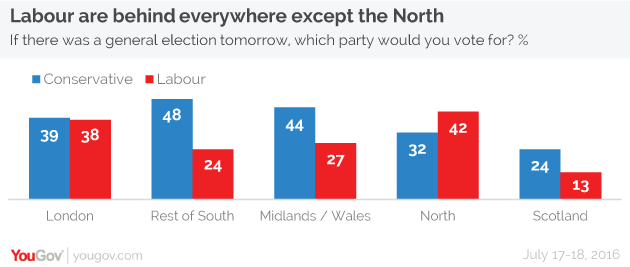
The results of the poll, carried out over the first full weekend since Theresa May announced her cabinet, show a heavy swing towards the Conservatives since our last voting intention poll in April, in which Labour led by three points.
The boost for the Conservatives could be the first sign of a “new leader bounce” – parties under new leadership tend to poll relatively higher in the weeks and months following the appointment of a new leader. The results could lead to renewed calls from Conservatives for Theresa May to capitalise on her initial popularity and call a general election - as Gordon Brown famously failed to do when he was experiencing his own new leader bounce.
However, it could be part of a longer term trend towards the Conservatives as swing voters are put off Labour by the party's constant infighting. Currently 90% of 2015 Conservative voters plan to vote for them again, compared to 76% of 2015 Labour voters.
Worryingly for Labour, the Conservatives are now ahead of them in every region of the country except the North, as well as among Labour's key C2DE voter demographic.
Obviously some of this is UKIP people (re)turning to the Tory party after the ref.
doesn't paint an optimistic future for Corbyn though eh ?
..I'll also point people to page#10 of the latest issue of Private Eye --- think that's called karma perhaps ?
The results of the poll, carried out over the first full weekend since Theresa May announced her cabinet, show a heavy swing towards the Conservatives since our last voting intention poll in April, in which Labour led by three points.
The boost for the Conservatives could be the first sign of a “new leader bounce” – parties under new leadership tend to poll relatively higher in the weeks and months following the appointment of a new leader. The results could lead to renewed calls from Conservatives for Theresa May to capitalise on her initial popularity and call a general election - as Gordon Brown famously failed to do when he was experiencing his own new leader bounce.
However, it could be part of a longer term trend towards the Conservatives as swing voters are put off Labour by the party's constant infighting. Currently 90% of 2015 Conservative voters plan to vote for them again, compared to 76% of 2015 Labour voters.
Worryingly for Labour, the Conservatives are now ahead of them in every region of the country except the North, as well as among Labour's key C2DE voter demographic.
Obviously some of this is UKIP people (re)turning to the Tory party after the ref.
doesn't paint an optimistic future for Corbyn though eh ?
..I'll also point people to page#10 of the latest issue of Private Eye --- think that's called karma perhaps ?
Jeremy is quite happy building his movement, whether through grass roots support or a high fibre diet. You'll all see, something spectacular will come to fruition and cast the Tories from number 10 in a wave of popular support.
Honestly it really isn't surprising considering the shambles Labour are making of post brexit politics.
Also, is anyone else getting sick of hearing of hearing the word comrade bandied about by Labour MP's regarding this leadership contest?
I still do not believe we will actually withdraw from the EU, I'm expecting some sort of dirty tricks or a political fudge, or the Government will simply spend the next several Parliaments debating, prevaricating and stalling and nothing will ever actually be done. I will believe Brexit when I see it.
As an outsider, I really think Brexit was a horrible idea, but that's your business.
The results of the poll, carried out over the first full weekend since Theresa May announced her cabinet, show a heavy swing towards the Conservatives since our last voting intention poll in April, in which Labour led by three points.
The boost for the Conservatives could be the first sign of a “new leader bounce” – parties under new leadership tend to poll relatively higher in the weeks and months following the appointment of a new leader. The results could lead to renewed calls from Conservatives for Theresa May to capitalise on her initial popularity and call a general election - as Gordon Brown famously failed to do when he was experiencing his own new leader bounce.
However, it could be part of a longer term trend towards the Conservatives as swing voters are put off Labour by the party's constant infighting. Currently 90% of 2015 Conservative voters plan to vote for them again, compared to 76% of 2015 Labour voters.
Worryingly for Labour, the Conservatives are now ahead of them in every region of the country except the North, as well as among Labour's key C2DE voter demographic.
Obviously some of this is UKIP people (re)turning to the Tory party after the ref.
doesn't paint an optimistic future for Corbyn though eh ?
..I'll also point people to page#10 of the latest issue of Private Eye --- think that's called karma perhaps ?
I would take that with a huge pinch of salt, it would appear that Stephan Shakespeare maybe a Tory outrider. Also, the Tories more popular than Labour in Scotland? That hardly seems right. Even with the drubbing they've been taking over the last few years, that seems unlikely.
I still do not believe we will actually withdraw from the EU, I'm expecting some sort of dirty tricks or a political fudge, or the Government will simply spend the next several Parliaments debating, prevaricating and stalling and nothing will ever actually be done. I will believe Brexit when I see it.
As an outsider, I really think Brexit was a horrible idea, but that's your business.
You are an American, yes? Would you be in favour of a political union with Canada and Mexico comparable to the European Union?
Amusingly enough, the Conservative vote in Scotland has been steadily increasing the last few elections. They've gone from 360,000 under William Hague in 2001 to 434,000 in the last election.
Labour meanwhile, has dropped from 1,017,000 votes to 707,000 in the same time period. Not a good showing.
r_squared wrote: Also, the Tories more popular than Labour in Scotland? That hardly seems right. Even with the drubbing they've been taking over the last few years, that seems unlikely.
And yet they have exactly the same number of Scottish MP's... Why is it so hard for you to believe?
I still do not believe we will actually withdraw from the EU, I'm expecting some sort of dirty tricks or a political fudge, or the Government will simply spend the next several Parliaments debating, prevaricating and stalling and nothing will ever actually be done. I will believe Brexit when I see it.
As an outsider, I really think Brexit was a horrible idea, but that's your business.
You are an American, yes? Would you be in favour of a political union with Canada and Mexico comparable to the European Union?
You mean like NAFTA, but we call get Monopoly money?
I still do not believe we will actually withdraw from the EU, I'm expecting some sort of dirty tricks or a political fudge, or the Government will simply spend the next several Parliaments debating, prevaricating and stalling and nothing will ever actually be done. I will believe Brexit when I see it.
As an outsider, I really think Brexit was a horrible idea, but that's your business.
You are an American, yes? Would you be in favour of a political union with Canada and Mexico comparable to the European Union?
You mean like NAFTA, but we call get Monopoly money?
No, NAFTA is not a political union.
I mean a political Union with a shared government.
Do you want Mexican and Canadian politicians and judges to have influence over the laws that your country must enact?
Do you want your country to give up its seat on the WTO and share a seat with Canada and Mexico?
Do you want to scrap border controls with Mexico and give all Mexicans (even criminals, like the Cartels) the legal right to enter the USA, simply because you have the same passports?
Do you want a shared currency with Canada and Mexico, with Canadian and Mexican politicians having a say in deciding monetary policy?
Labour meanwhile, has dropped from 1,017,000 votes to 707,000 in the same time period. Not a good showing.
That's because the SNP is an actual left wing party, at least in tone, rhetoric and Manifesto, unlike the Labour party. If the rUK had a real and credible left wing party then the Labour vote would evaporate there as well. The humiliating and near complete eradication of Scottish Labour MPs (and coming third behind the Tories in Holyrood) is the perfect illustration of what is in store for Labour if it doesn't become a genuinely progressive party.
JC is a positive step but his lack of magnetism and the continual sabotage of the Labour right (I'm still amazed that there is such a thing) is all but certain to put the Tories in power for yet another 5 years of 'living within our means' while splashing out billions of gak.
It will take a long time before the Tories are anything like a serious threat to the SNP because it would require a sea change in Scottish political thought.
I mean a political Union with a shared government.
Do you want Mexican and Canadian politicians and judges to have influence over the laws that your country must enact?
Do you want your country to give up its seat on the WTO and share a seat with Canada and Mexico?
Do you want to scrap border controls with Mexico and give all Mexicans (even criminals, like the Cartels) the legal right to enter the USA, simply because you have the same passports?
Do you want a shared currency with Canada and Mexico, with Canadian and Mexican politicians having a say in deciding monetary policy?
Do you want to have influence over the laws enacted in Canada and Mexico?
Do you want to be part of a shared common market with your immediate neighbours?
Do you want freedom of movement?
You could have a shared currency, but only if you really really want one.
I still do not believe we will actually withdraw from the EU, I'm expecting some sort of dirty tricks or a political fudge, or the Government will simply spend the next several Parliaments debating, prevaricating and stalling and nothing will ever actually be done. I will believe Brexit when I see it.
As an outsider, I really think Brexit was a horrible idea, but that's your business.
You are an American, yes? Would you be in favour of a political union with Canada and Mexico comparable to the European Union?
You mean like NAFTA, but we call get Monopoly money?
No, NAFTA is not a political union.
I mean a political Union with a shared government.
Do you want Mexican and Canadian politicians and judges to have influence over the laws that your country must enact?
Do you want your country to give up its seat on the WTO and share a seat with Canada and Mexico?
Do you want to scrap border controls with Mexico and give all Mexicans (even criminals, like the Cartels) the legal right to enter the USA, simply because you have the same passports?
Do you want a shared currency with Canada and Mexico, with Canadian and Mexican politicians having a say in deciding monetary policy?
What cartels are you worried about entering the UK?
I still do not believe we will actually withdraw from the EU, I'm expecting some sort of dirty tricks or a political fudge, or the Government will simply spend the next several Parliaments debating, prevaricating and stalling and nothing will ever actually be done. I will believe Brexit when I see it.
As an outsider, I really think Brexit was a horrible idea, but that's your business.
You are an American, yes? Would you be in favour of a political union with Canada and Mexico comparable to the European Union?
You mean like NAFTA, but we call get Monopoly money?
No, NAFTA is not a political union.
I mean a political Union with a shared government. Do you want Mexican and Canadian politicians and judges to have influence over the laws that your country must enact? Do you want your country to give up its seat on the WTO and share a seat with Canada and Mexico? Do you want to scrap border controls with Mexico and give all Mexicans (even criminals, like the Cartels) the legal right to enter the USA, simply because you have the same passports? Do you want a shared currency with Canada and Mexico, with Canadian and Mexican politicians having a say in deciding monetary policy?
What cartels are you worried about entering the UK?
Answer my question, don't evade it.
Are these things desirable to you?
As for Silent Puffin...as Kronk himself already pointed out, the USA already has a free trade agreement / zone with Canada and Mexico. A political union is not a pre-requisite for free trade.
I still do not believe we will actually withdraw from the EU, I'm expecting some sort of dirty tricks or a political fudge, or the Government will simply spend the next several Parliaments debating, prevaricating and stalling and nothing will ever actually be done. I will believe Brexit when I see it.
As an outsider, I really think Brexit was a horrible idea, but that's your business.
You are an American, yes? Would you be in favour of a political union with Canada and Mexico comparable to the European Union?
You mean like NAFTA, but we call get Monopoly money?
No, NAFTA is not a political union.
I mean a political Union with a shared government. Do you want Mexican and Canadian politicians and judges to have influence over the laws that your country must enact? Do you want your country to give up its seat on the WTO and share a seat with Canada and Mexico? Do you want to scrap border controls with Mexico and give all Mexicans (even criminals, like the Cartels) the legal right to enter the USA, simply because you have the same passports? Do you want a shared currency with Canada and Mexico, with Canadian and Mexican politicians having a say in deciding monetary policy?
What cartels are you worried about entering the UK?
Answer my question, don't evade it.
We don't need any of that gak, as we get to be the Big Spoon in the great spooning that is NAFTA, so your questions aren't really irrelevant and a poor comparison. I would like more colorful Monopoly money, though.
However, you are but a fork in the drawer that is the European Kitchen, to extend the metaphor. If you really want to go to the back of the line in all things trade related...great?
So is it the German leidenhausen cartel that worries you, or the Spanish Bull Fighter Brigade?
If none of that "gak" (as you put it) is desirable to you, then why the feth do you think its in our interest? Why should America be a free independent country but not Britain?
Shadow Captain Edithae wrote: If none of that "gak" (as you put it) is desirable to you, then why the feth do you think its in our interest? Why should America be a free independent country but not Britain?
I already answered that. Comparison wise have the biggest...car on the block. Not a Vespa.
So, really. Is it the Greeks? It's the Greeks, isn't it?
Edit: although, after this election, we might have to revisit the above to get us out of any whole President KnuckleHead puts us in...
Shadow Captain Edithae wrote: If none of that "gak" (as you put it) is desirable to you, then why the feth do you think its in our interest? Why should America be a free independent country but not Britain?
I already answered that. Comparison wise have the biggest...car on the block. Not a Vespa.
So, really. Is it the Greeks? It's the Greeks, isn't it?
Shadow Captain Edithae wrote: If none of that "gak" (as you put it) is desirable to you, then why the feth do you think its in our interest? Why should America be a free independent country but not Britain?
I already answered that. Comparison wise have the biggest...car on the block. Not a Vespa.
So, really. Is it the Greeks? It's the Greeks, isn't it?
Edit: although, after this election, we might have to revisit the above to get us out of any whole President KnuckleHead puts us in...
Size is irrelevant, its how you use it that counts...
Seriously though, the relevant size of the USA to the UK really is irrelevant. National Sovereignty and self determination is important for any country, no matter its size.
kronk wrote: But if being part of that Union makes you stronger economically, isn't it something to consider?
As I said, it's your business, not mine.
Thats an argument for free trade deals and economic zones, not a full blown political Union that will one day become a new State in its own right, thereby diminishing your own country to the status of a province.
r_squared wrote: Something that is puzzling me, why are some Brexit supporters determined to have article 50 enacted now? I've seen demonstrations of people arguing for it to be enacted immediately, but that seems like the most ridiculously destructive thing, apart from a leave vote of course, that the UK could do.
Are they so afraid that their position is so tenuous, and their argument so flawed, that they feel that they must push us into an irreversible sh1t spiral without the least bit of preparation?
Anyone on the forum here who supports an immediate enactment care to explain their reasoning?
Because until Article 50 is enacted, we haven't actually initiated the legal process of withdrawal. I.e. its not really happening until the button is pressed. Until then, I will remain skeptical that a Prime Minister who opposed Brexit, heading a government that consists mostly of Remain campaigners, and a Parliament which is largely in favour of EU membership...will actually respect the result of the referendum.
It has nothing to do with any self doubt and lack of convictions in our arguments, and everything to do with a healthy distrust of the pro-EU Elite (whether in Britain or across Europe) and their reputation for ignoring inconvenient votes when referenda don't go their way or forcing a second referendum years later.
I still do not believe we will actually withdraw from the EU, I'm expecting some sort of dirty tricks or a political fudge, or the Government will simply spend the next several Parliaments debating, prevaricating and stalling and nothing will ever actually be done. I will believe Brexit when I see it.
Such is my lack of faith and trust in the British political classes.
I agree with you entirely; I think the politicians are desperately trying to find a way out of it. But one thing to bear in mind if they don't honour it, is that it was non-biinding; they don't need to honour it.
As an outsider, I really think Brexit was a horrible idea, but that's your business.
50% of the UK population tend to agree, but the vote was won by a whisker (and probably within a statistical uncertainty).
Despite everything I for one hope that parliament is brave enough to decide against an exit because I don't think it is a good thing for the Country (I never thought a referendum on the issue was a good idea either). Parliament is there to do what is best for the Country (in theory) and if that means not following every whim of the populace so be it.
Was disappointed with both May and Corbyn in PMQ today. May acted like a school yard bully in a posh school in a completely unsubtle way (completely ignoring any questions she didn't want to answer) whereas Corbyn just took it on the chin. That's the problem with Corbyn he doesn't want to get down in the gutter (fair play PMQs show the worst of our leaders in my view in the way it goes) but it doesn't give anything for Labour to get behind. He could have easily turned May's catcalling on being a boss on it's head by saying that his boss are the people that put him charge as part of a democratic process, whereas May's was a trial by stabbing each other in the back which is more akin to a coup and a dictatorship. Alternatively he could have acted like the 'Head Teacher' he sometimes comes across and 'shame her' for trying to that bully in the playground and maybe if she put more energy into answering questions rather than throwing sticks she would get more work achieved.
I still do not believe we will actually withdraw from the EU, I'm expecting some sort of dirty tricks or a political fudge, or the Government will simply spend the next several Parliaments debating, prevaricating and stalling and nothing will ever actually be done. I will believe Brexit when I see it.
As an outsider, I really think Brexit was a horrible idea, but that's your business.
48.1% of our oters agree with you. Just for context. It's not as if the country is all behind it. It's probably the most divisive issue we'll encounter.
As an outsider, I really think Brexit was a horrible idea, but that's your business.
50% of the UK population tend to agree, but the vote was won by a whisker (and probably within a statistical uncertainty).
Despite everything I for one hope that parliament is brave enough to decide against an exit because I don't think it is a good thing for the Country (I never thought a referendum on the issue was a good idea either). Parliament is there to do what is best for the Country (in theory) and if that means not following every whim of the populace so be it.
Was disappointed with both May and Corbyn in PMQ today. May acted like a school yard bully in a posh school in a completely unsubtle way (completely ignoring any questions she didn't want to answer) whereas Corbyn just took it on the chin. That's the problem with Corbyn he doesn't want to get down in the gutter (fair play PMQs show the worst of our leaders in my view in the way it goes) but it doesn't give anything for Labour to get behind. He could have easily turned May's catcalling on being a boss on it's head by saying that his boss are the people that put him charge as part of a democratic process, whereas May's was a trial by stabbing each other in the back which is more akin to a coup and a dictatorship. Alternatively he could have acted like the 'Head Teacher' he sometimes comes across and 'shame her' for trying to that bully in the playground and maybe if she put more energy into answering questions rather than throwing sticks she would get more work achieved.
You mean Corbyn reading a letter from a constituent asking that MP's answer questions that are put to them rather than throwing sticks..
I am more and more of the opinion that JC has nothing in his locker except this groundswell of support. He won't comment on opposition policies because he doesn't have any of his own. Or is so up himself that its beneath him to broach them with anyone.
You mean Corbyn reading a letter from a constituent asking that MP's answer questions that are put to them rather than throwing sticks..
I am more and more of the opinion that JC has nothing in his locker except this groundswell of support. He won't comment on opposition policies because he doesn't have any of his own. Or is so up himself that its beneath him to broach them with anyone.
It's fine asking questions from constituents but there's not really any pressing of the issue. Nothing to make the Tories sweat under the collar. They just brush it off with a slur, pat themselves on the back for being clever playground bullies and move on and go yar,yar to each other.
And it isn't true that he doesn't have policies but he is much more comfortable speaking at rallies and people there than in parliament. He is passionate about some issues but I get the impression he pretty much loathes the way the institution works and doesn't want anything to do with it. The problem being of course that this when most people see him, not at this rallies etc which the media don't really show apart from a few clips. I'd actually recommend to him that he stops doing PMQs, let him do what he is best at which is rally the grass roots and let others apply the pressure at PMQ, someone that is willing to get in the gutter with the Tories. If(when) they then get in power then they can change the system for the better.
I don't think Corbyn has any intention of being an effective leader or winning an election and forming a Labour government. He's trying to reclaim the Labour party for the traditional Left and purge it of the Blairites. I'm no fan of Corbyn or the Left and I doubt I'll ever vote for a Left Wing Labour party, but good luck to him I say because feth those people.
Now, if only someone could do the same with the Conservative party...
r_squared wrote: Also, the Tories more popular than Labour in Scotland? That hardly seems right. Even with the drubbing they've been taking over the last few years, that seems unlikely.
And yet they have exactly the same number of Scottish MP's... Why is it so hard for you to believe?
Because for generations Scotland has been a Labour heartland, and the Tories were responsible for decimating communities and industry in Scotland. I lived there for a while, and I still have many friends and family north of the border and most of them would rather stick their knackers in a vice than vote Tory.
The SNP have hoovered up Labour, but if they get their act together it's conceivable that they could return to be a significant political force in Scotland. However, I believe the conservatives are only ever likely to have a handful of MPs, at least for the next generation, maybe 2.
I'm not sure there's anybody who could make Labour win an election so if Corbyn just wises up and cleans the party out that is honestly everything one could demand of him under these circumstances. It isn't like the left reclaiming Labour would be an insignificant thing, either.
Although not sovereign states, England, Scotland, Wales and Northern Ireland are referred to as separate countries, which collectively form the sovereign state known as the United Kingdom.
Although not sovereign states, England, Scotland, Wales and Northern Ireland are referred to as separate countries, which collectively form the sovereign state known as the United Kingdom.
Shadow Captain Edithae wrote: National Sovereignty and self determination is important for any country, no matter its size.
So you will be supporting Yes in Indyref 2 then?
No. Scotland is not a country. And neither is England for that matter. They are both former countries that willingly chose to unite.
We might have different takes on "willingly". Being told to unite or you lose all of your English lands doesn't seem like a fair choice.
Scotland was an independent country until 1707 when the English parliament, using a mixture of quite open blackmail and less open bribery, persuaded a powerful
group of Scottish aristocrats to vote for the union of the English and Scottish parliaments
malamis wrote: One component which doesn't see much discussion is the Darien Disaster, which effectively brought the country to bankruptcy shortly before the AoU.
I know that its massively OT but its interesting none the less. William Paterson, essentially the founder of the Bank of England, was also largely responsible for the Darien scheme.
That happens anyway does it not? Being in the EU doesn't exempt you form customs charges if a purchases warrants it.
The destination country imposes the tariff on received goods.
Caveat Emptor!
No you don't; that's the point of free trade in the EU. There's no tariffs or VAT applied on importing the goods from the EU . Any taxes are levied by the country you are buying from. The only exception is if you buy goods from a restricted area like canaries or Channel Islands. If you've bought it from day Germany should be no extra tax or duty paid. However if you bought it from a German seller who then had shipped from say Hong Kong then you would have to pay.
I wonder if Miss May said to Hollande when she got to France, 'One of the reasons I want to delay is in case you lose your job and I can deal with someone friendlier to us'?
At least Softbank of Japan impelled by a weak GBP and strong JPY has managed to swoop on ARM Technoligies and buy up one of the world's best computer design companies.
Yep, look how well the Cadbury sale went for the UK, tax contributions moved to Switzerland and closure of facilities days afterwards when they said that wouldn't happen.
Although not directly a Brexit issue as the sale would have probably happened which ever way the vote went Softbank almost certainly were laughing all the way to the bank by Brexit devaluing the company by 15%. I'm definitely for legislating that sales of such companies should be agreed by the government and that sales are agreed on the impact of population as a whole (so if they say they aren't going to close somewhere they can't for an agreed period of time). Otherwise they are just buying the value in the name and then screwing over the country that brought it forward.
On the other hand it's probably not what the Tories want...
I now see why Boris is FS because his role suit what the government want to do:-
Yep. Businesses can deal with any kind of environment, but they hate uncertainty. Wait and see will be the word until the final Brexit dust settles and that will be the anchor on the economy, as well as the ripple effects thereof. I'm personally betting on US$-GBP of $1.20+/- as a target, then it's Forge World time.
Here's just another bit I saw on my side of the pond.
Kilkrazy wrote: At least Softbank of Japan impelled by a weak GBP and strong JPY has managed to swoop on ARM Technoligies and buy up one of the world's best computer design companies.
That's got to be a good thing for Britain?
If I recall correctly, the last time Japan seriously invested in British Industry it was the Scottish Shipyards, and specifically the metallurgy resources.
Belt? can't afford one - piece of rope around the waist for me
Automatically Appended Next Post:
Kilkrazy wrote: At least Softbank of Japan impelled by a weak GBP and strong JPY has managed to swoop on ARM Technoligies and buy up one of the world's best computer design companies.
That's got to be a good thing for Britain?
The perception is that once again, the Tories have allowed the family silver to get flogged off.
Considering May's previous comments on blocking the Cadbury take-over if she had been in charge, it's egg on face time for May.
I don't believe in Corbyns new style of politics nor do I think that this new wave of support he is getting will be anything other than disappointed in JC Style premiership. However this is just bonkers:
...Anti-Corbyn plotters in the parliamentary Labour party (PLP) have vowed to hold annual leadership challenges against the Labour leader in what they call a “war of attrition”, if he wins again in September – proving they are willing to hand the Conservative another election victory to topple their own leader....
Just, you know, just stand down, go independent or start another party or back the leader that is elected.
If one faction within a party decides to subvert the party's mechanisms in order to achieve a different objective to what the leader wants, and they succeed, then they succeed, boot out the former "leader" and restructure the party as they want.
Obviously at the same time, other factions within the party are likely to be aiming at different objectives.
Have you ever played Steve Jackson Games's Illuminati card game?
Its not dead. What will probably happen is that JC will win the leadership contest which will force some of the PLP to accept his leadership, 2 consecutive leadership wins would be hard to ignore after all. The hard right MPs like Hilary Benn (whose father must be spinning in his grave so fast he could be used to generate electricity) will probably beak off to form a short lived and largely irrelevant party like the SDP.
If Owen Smith wins its possible that the Labour party would remain in its left of centre stance although I have my doubts. If it moves back to the right it will return to the unenviable position it was in where Ed Milliband left it.
Irrespective of what happens in the short term the UK will be stuck with yet another Tory government in 2020, unless some miracle occurs of course.
Can a JC led party ever be seen as credible? Even with a convincing win last last year and the possibility of a greater win this time around?
Corbyn needs to flesh out his policies and get the message about those out. Whilst he is sure of support from Momentum or whatever, he needs to convince voters like me, that he can cut it if given the keys to power.
He will have 3 years to attempt just that. Provided that the PLP get the message
He hasn't really had a lot of time in the leadership position when he hasn't been fighting off civil war so hopefully he can start engaging more fully with the wider voting public at the end of the year.
This report was out on 14th July, so it's a bit old. I don't know why I missed it at the time, probably was too busy with "stuff".
Anyway, the core point is that a leading Business Brexiteer says it is unrealistic and damaging to try to reduce immigration to under 100,000 per year, but that's OK because immigration was not the no.1 concern for most Leave voters.
I am forced to ask what the fething hell this whole referendum thing was all about.
On mature reflection, it was the most ill-judged and badly enacted socio-political process of I don't know how long, decades? Both sides are to blame. It never should have happened, and everyone is going to be worse off as a result.
Yesterday I met a 20-year-old student studying industrial design. He had been trying to line up a year in Germany for his industrial placement, working on production machinery design. It was under an EU cooperative programme. I told him he ought to still apply, because some chance is better than to give up.
This report was out on 14th July, so it's a bit old. I don't know why I missed it at the time, probably was too busy with "stuff".
Anyway, the core point is that a leading Business Brexiteer says it is unrealistic and damaging to try to reduce immigration to under 100,000 per year, but that's OK because immigration was not the no.1 concern for most Leave voters.
I am forced to ask what the fething hell this whole referendum thing was all about.
Spoiler:
On mature reflection, it was the most ill-judged and badly enacted socio-political process of I don't know how long, decades? Both sides are to blame. It never should have happened, and everyone is going to be worse off as a result.
Yesterday I met a 20-year-old student studying industrial design. He had been trying to line up a year in Germany for his industrial placement, working on production machinery design. It was under an EU cooperative programme. I told him he ought to still apply, because some chance is better than to give up.
Maybe he can get to go to China or India instead.
It was about ensuring that the laws we are beholden to are made by the people we can vote out - the fact that when you spot that something needs to change, you have at least two ways of having your point discussed in parliment and potentially have your point enshrined in law.
It doesn't sound as emotive, evocative or polarising as the many bs arguments which flew all over the place during the 'debate' but it's the most poinigant by a country mile.
Anything else is smoke and mirrors utilised by activists on both sides who had a vested interest in obfuscating and convoluting the real reason why you would want to vote 'leave' - politicians know that peoples votes are based on lies, irrationality and good ol' ignorance and the lowest common denominator wins.
Any sensible points were going to get sidelined during the 'debate' and picking through the statements which were made and poking holes in it is a bit late now.
"Never argue with the stupid; they'll just drag you down to their level and then win the argument with nothing but 'experience'."
Of course, if you don't like this country any more you can move freely to an EU country in the meantime yeah?
On the migration thing - finally we can have a FAIR migration policy; it had been skewed to allow for the EU free movement fantasy to exist: a bunch of peeps i know at uni who came from india and pakistan won't have to jump through flaming hoops to live and work here when the people from Europe can come and go as they please.
I want equality - GENUINE equality. Not the EU preferential migration fantasy.
Of course, if you don't like this country any more you can move freely to an EU country in the meantime yeah?
That's exactly what I intend to do
I find UK politics as a whole repugnant alongside the attitudes of an unfortunately large percentage of the population. Around the time of the next GE I will be somewhere in the EU or Scotland depending on the result of Indyref2 so soon to be in the EU.
On the migration thing - finally we can have a FAIR migration policy; it had been skewed to allow for the EU free movement fantasy to exist: a bunch of peeps i know at uni who came from india and pakistan won't have to jump through flaming hoops to live and work here when the people from Europe can come and go as they please.
I want equality - GENUINE equality. Not the EU preferential migration fantasy.
Right, the UK is NOT part of Schengen, Therefore your friends from outside the EU are not applying for Schengen Visa's, just UK Visa's. NOTHING, literally NOTHING will change for them. Ironically if the UK remains in the free market, we will still have to accept 'free migration' from the EU.
On the migration thing - finally we can have a FAIR migration policy; it had been skewed to allow for the EU free movement fantasy to exist: a bunch of peeps i know at uni who came from india and pakistan won't have to jump through flaming hoops to live and work here when the people from Europe can come and go as they please.
I want equality - GENUINE equality. Not the EU preferential migration fantasy.
Right, the UK is NOT part of Schengen, Therefore your friends from outside the EU are not applying for Schengen Visa's, just UK Visa's. NOTHING, literally NOTHING will change for them. Ironically if the UK remains in the free market, we will still have to accept 'free migration' from the EU.
Logically, if immigration from the EU is/can be reduced, surely that will allow the Government to relax measures on non-EU immigrants by mere virtue of everybody being treated the same with no special treatment for EU citizens and no
When we've got severe shortages in housing, hospitals, education, policing etc and we can't keep up with the levels of immigration, the Government needs to try to restrict that immigration somehow, even if its just a meaningless futile exercise to keep up appearances and placate the electorate. Currently they cannot restrict EU immigration because Freedom Of Movement, but they can restrict non-EU immigration and so they treat non-EU citizens with disproportionate harshness.
All we're asking for is for that change and everybody be treated equally. Relatively, non-EU citizens would/should find it easier to immigrate, whereas EU citizens will find it more difficult. A level playing field.
On the migration thing - finally we can have a FAIR migration policy; it had been skewed to allow for the EU free movement fantasy to exist: a bunch of peeps i know at uni who came from india and pakistan won't have to jump through flaming hoops to live and work here when the people from Europe can come and go as they please.
I want equality - GENUINE equality. Not the EU preferential migration fantasy.
Right, the UK is NOT part of Schengen, Therefore your friends from outside the EU are not applying for Schengen Visa's, just UK Visa's. NOTHING, literally NOTHING will change for them. Ironically if the UK remains in the free market, we will still have to accept 'free migration' from the EU.
Which is good, because foreign students are absolutely ripped off by the university system in regards to fees. The University of Kent (the one I went too) loved have forge in students because the fees were £15,000 a year, compared to £9,000 for a regular student (or £3,000) for me because I was Welsh. Maybe if they stopped coming, the University's might actually lower their fees.
And here we have immigration classically being blamed for the failings of UK governance. All those issues you describe are a symptom of the government cutting back on services, failing to invest in a future generation of NHS workers, failing to deal with the economic shift to London and other large powerhouses such as Birmingham while much of North lies deserted.
My comment was designed to show that students such as his friends from Pakistan and India will still be at a disadvantage, more than likely a greater one now that May has set her sites on a quota of 100,000.
The only thing stopping the world becoming a level playing field is because the world is still hung up on nationalist principles. If you really want a level playing field, why not support the experiment that is the free movement of people rather than trying to isolate yourself from it? With any luck, free movement of people may be a concept that can apply to the whole world. Just imagine that aye, being a citizen of planet earth rathern then a random area you was born into on the face of it.
It was about ensuring that the laws we are beholden to are made by the people we can vote out - the fact that when you spot that something needs to change, you have at least two ways of having your point discussed in parliment and potentially have your point enshrined in law.
Not this again. We do vote for the people that have a say over EU legislation. As a population we just decide that in our wisdom as a whole that we don't really turn up at these elections and then we end up with a nutcase party MEPs that has a self interest in ensuring they cause as much disruption as possible in the EU parliament and tend not to turn up when they want to formulate new policies (like fisheries).
In fact most of what the EU puts in place are generic rules (Directives) and it is up to the UK to implement them (they draft the actual how it is going to work legislation). There is relatively few actual EU pieces of legislation that come into force automatically.
In some ways the EU has put a lot of sensible Directives in place.
For example limits on fishing quotas to avoid our seas becoming like the Grand Banks disaster zone, but the people that actually allocate and legislate the allowances is the UK government - it is not the EUs fault that the UK gives 90% of rights to large shipping companies several not based in the UK whilst leaving the one vessel 'fleets' out in the cold; the UK government doesn't have to do this.
...Or maybe EU chemical directives ensuring companies test the substances that consumers can use so that it isn't causing cancer, burns or breathing problems etc. Take the original creosote for example, absolutely nasty stuff that can poison the soil, plants, burn people, kill pets and the unlucky frog, badger or falcon that passes by; the UK was never going to ban this chemical. The same goes for the neonicotinoid pesticides that are devastating our bee population, banned by the EU but utterly opposed by the Tory government despite the (non-biased) evidence.
...Or maybe that ensured our waste sites weren't dumping tonnes of toxic chemicals into the environment each year or the limits on air pollution.
The argument that EU legislation does not provide benefits to the UK is exaggerated. Yes it provides some limits but it does restrain our government from allowing anything as long as it benefits the few. The risk by leaving the EU is all this will be torn up and those that have less say will suffer; waterways could become like they were in the 70's; polluted quagmires of agricultural and industrial run off because it is in the best interest of the economy to remove this 'red tape'. It won't be the well off few living the high life in the countryside it will be the less well off that will suffer the consequences as they have to deal with poorer air quality etc etc etc.
SirDonlad wrote: I want equality - GENUINE equality. Not the EU preferential migration fantasy.
The only true fair immigration policy would be open doors for everyone (or closed doors for everyone) else you are always going to have a selection method that's going to be biased against someone because of their upbringing, education, wealth etc.
Lower foreign attendance is going to mean less students. Less students mean's universities struggling to make ends meet and having to increase fees as a result. Universities such as Kent will then just raise their own fees to match as it puts them at no disadvantage.
Which is good, because foreign students are absolutely ripped off by the university system in regards to fees. The University of Kent (the one I went too) loved have forge in students because the fees were £15,000 a year, compared to £9,000 for a regular student (or £3,000) for me because I was Welsh. Maybe if they stopped coming, the University's might actually lower their fees.
That's not going to happen. In fact quite the converse as to provide the same level of quality they are going to have increase their fees or the variety of courses and the quality will have to drop as universities make redundant lecturers because they need to balance their books. Universities rely a lot on foreign students to make them viable. It's not the other-way round; in fact foreign students effectively allow subsidising of UK students - especially for the sciences where the actual cost of providing the course is about 30% higher than the actual fees they get per UK student.
Wleshhoppo, have you ever heard of Aberystwyth? A quick search of the local media will provide you with an example of a university already struggling due to the government policies towards tuition fees. Brexit has literally already made this significantly worse with 100 EU students pulling out. Several of the Departments are world renowned and receive many applications from outside of the EU. If it becomes even harder for those students to attend, I think you will quickly see the university being wiped out. It would also take much of the town with it.
On the migration thing - finally we can have a FAIR migration policy; it had been skewed to allow for the EU free movement fantasy to exist: a bunch of peeps i know at uni who came from india and pakistan won't have to jump through flaming hoops to live and work here when the people from Europe can come and go as they please.
I want equality - GENUINE equality. Not the EU preferential migration fantasy.
Right, the UK is NOT part of Schengen, Therefore your friends from outside the EU are not applying for Schengen Visa's, just UK Visa's. NOTHING, literally NOTHING will change for them. Ironically if the UK remains in the free market, we will still have to accept 'free migration' from the EU.
People from the EU don't apply for visa's - Here's the way the EU guys gain right to live/work..
https://www.gov.uk/eea-registration-certificate Its a single form and £65 - all the visa stuff is handled automatically and it also states that...
You don’t need a registration certificate if you are a ‘qualified person’, ie you’re working, studying, self-employed, self-sufficient or looking for work or have a ‘family member’ who is a qualified person
So it doesn't matter that we didn't sign up to the shengen agreement, we basically have free migration for EU citizens currently anyway.
The hypocritical EU beuaracracy in full swing there!
The quantity of stuff required for people outside the EU is vast - heres the main index for all the stipulations; i was intending on linking to the relevant bit for my mates at uni, but theres way more than a single page to cover it all.
https://www.gov.uk/guidance/immigration-rules
On the migration thing - finally we can have a FAIR migration policy; it had been skewed to allow for the EU free movement fantasy to exist: a bunch of peeps i know at uni who came from india and pakistan won't have to jump through flaming hoops to live and work here when the people from Europe can come and go as they please.
I want equality - GENUINE equality. Not the EU preferential migration fantasy.
Right, the UK is NOT part of Schengen, Therefore your friends from outside the EU are not applying for Schengen Visa's, just UK Visa's. NOTHING, literally NOTHING will change for them. Ironically if the UK remains in the free market, we will still have to accept 'free migration' from the EU.
People from the EU don't apply for visa's - Here's the way the EU guys gain right to live/work..
https://www.gov.uk/eea-registration-certificate Its a single form and £65 - all the visa stuff is handled automatically and it also states that...
You don’t need a registration certificate if you are a ‘qualified person’, ie you’re working, studying, self-employed, self-sufficient or looking for work or have a ‘family member’ who is a qualified person
So it doesn't matter that we didn't sign up to the shengen agreement, we basically have free migration for EU citizens currently anyway.
The hypocritical EU beuaracracy in full swing there!
The quantity of stuff required for people outside the EU is vast - here's the main index for all the stipulations; i was intending on linking to the relevant bit for my mates at uni, but theres way more than a single page to cover it all.
https://www.gov.uk/guidance/immigration-rules
What? How the EU guys gain access to an EU identity/citizenship e.t.c is completely besides the point here. If someone from outside the EU wants to apply to access a country in Shengan area, they have to go through a totally different process than to the one they would find for applying for a Visa in the UK. The UK Visa process is controlled by the UK. The EU has diddly squat to do with it.
On the migration thing - finally we can have a FAIR migration policy; it had been skewed to allow for the EU free movement fantasy to exist: a bunch of peeps i know at uni who came from india and pakistan won't have to jump through flaming hoops to live and work here when the people from Europe can come and go as they please.
I want equality - GENUINE equality. Not the EU preferential migration fantasy.
Right, the UK is NOT part of Schengen, Therefore your friends from outside the EU are not applying for Schengen Visa's, just UK Visa's. NOTHING, literally NOTHING will change for them. Ironically if the UK remains in the free market, we will still have to accept 'free migration' from the EU.
People from the EU don't apply for visa's - Here's the way the EU guys gain right to live/work..
https://www.gov.uk/eea-registration-certificate Its a single form and £65 - all the visa stuff is handled automatically and it also states that...
You don’t need a registration certificate if you are a ‘qualified person’, ie you’re working, studying, self-employed, self-sufficient or looking for work or have a ‘family member’ who is a qualified person
So it doesn't matter that we didn't sign up to the shengen agreement, we basically have free migration for EU citizens currently anyway.
The hypocritical EU beuaracracy in full swing there!
The quantity of stuff required for people outside the EU is vast - here's the main index for all the stipulations; i was intending on linking to the relevant bit for my mates at uni, but theres way more than a single page to cover it all.
https://www.gov.uk/guidance/immigration-rules
What? How the EU guys gain access to an EU identity/citizenship e.t.c is completely besides the point here. If someone from outside the EU wants to apply to access a country in Shengan area, they have to go through a totally different process than to the one they would find for applying for a Visa in the UK. The UK Visa process is controlled by the UK. The EU has diddly squat to do with it.
I was pointing out the disparity in the requirements for migration for eu and non-eu citizens - are you refusing to acknowledge the added complexity?
When we finally have equality for both groups it will be far easier for those outside the eu than it is currently because the rules will not need to be as restrictive for them.
We can finally recognise the part indian people have played in our culture with closer business ties and easier access between us - huzzah!
You are still missing the point SirDonlad. The difference between access from the EU and access from outside is irrelevant. It is the UK government that sets the complexities for Visa applications from Non-EU countries. We have the power to turn around to all the commonwealth countries and say you can come here with no Visa's if you wish...
As for Business ties, the Indian Prime Minister was part of the long list of head of states strongly advising the UK to stay in the EU.
There's no reason why it will become easier for non-EU citizens to apply for visas for working and living in the UK if it becomes harder for EU citizens.
If it did, what was the point of Brexit? Did we hate the Swedes and Italians so much that we want to make it easier for Chinese and Syrians to get working visas for the UK and keep out those ghastly Europeans?
But seriously, foreign students should be charged the same. Not five times what I was paying for no reason.
The reason foreign students are charged more is because the majority of them get their degree, then go home and never pay any tax into the UK system, whereas the majority of British students work in the UK after graduation.
The reason why foreign students are willing to pay more is that UK universities are some of the best in the world. We've got four or five universities that regularly appear in the top 10 in the world. China doesn't have a single university in the top 200! Most of the rest of the top universities are American and much more expensive.
The language of tuition is English, which is the world's most important language for business, science, and so on. Lastly, Britain is a bloody nice country to live in for a few years, with loads of culture and history and easy access to the rest of Europe for going on interesting trips.
I really don't know how much it costs to put a student through Experimental Psychology or Civil Engineering, etc, but if British born students are forced to compete on equal monetary terms with the princeling sons of Chinese army slave labour camp millionaires, Russian oligarchs and Indian and Brazilian plutocrats, I think we are fethed. Well, you younger lot are. I've got my degree, and my daughter is just starting International Baccalaureate and can get through university before everything goes down the pan.
Optio wrote: You are still missing the point SirDonlad. The difference between access from the EU and access from outside is irrelevant. It is the UK government that sets the complexities for Visa applications from Non-EU countries. We have the power to turn around to all the commonwealth countries and say you can come here with no Visa's if you wish...
As for Business ties, the Indian Prime Minister was part of the long list of head of states strongly advising the UK to stay in the EU.
so let me get this straight - i say i want equality of process for all migrants to this coutry; you then say that leaving the EU wont change the situation for my indian friends (??) whereupon i showed the current disparity between the two groups brought about by EU stipulations and you then claim that it is irrelavent?
SirDonlad wrote: whereupon i showed the current disparity between the two groups brought about by EU stipulations and you then claim that it is irrelavent?
Those stipulations aren't brought about by the EU; domestic UK law is what governs immigration from outside the EU so the difficulty surrounding emigrating to the UK from somewhere like India is entirely on the UK government.
SirDonlad wrote: whereupon i showed the current disparity between the two groups brought about by EU stipulations and you then claim that it is irrelavent?
Those stipulations aren't brought about by the EU; domestic UK law is what governs immigration from outside the EU so the difficulty surrounding emigrating to the UK from somewhere like India is entirely on the UK government.
You're still wilfully missing the point. The Government can control immigration from outside the EU, but not immigration from the EU. Therefore, when a government wishes to look tough on immigration, who do you think bears the brunt?
What point am I missing? If the UK government want's to "appear tough on immigration" by making immigration difficult then that's entirely its own fault.
Immigration certainly has become more difficult. It was much harder for my wife to get her permanent leave to remain the second time, in 2012, than the first time, in 1994.
To be honest Sir Donlad, I have somewhat lost track of what you want.
Do you want more immigration overall, or less, or more or less from specific regions?
You seem to want less immigration from the EU and more from India. Why is that a good thing?
In terms of Cameron's 100,000 target, it was a figure he pulled out of his arse because it sounds a nice round sensible figure, to please people who dislike immigration. It wasn't based on any kind of analysis, or feasibility, though. There was no attempt to find out how many "skills" the UK needs to import per year because our education system can't produce them by itself, such as nurses and doctors, and also seasonal agricultural workers.
Secondly to that, the 100,000 target was massively busted. Immigration last year was over 330,000.
Thirdly, more than half the immigrants came from non-EU countries.
This implies if we shut off the EU immigration route, we probably would still be bringing in 200,000 or more people a year anyway, because we need those workers. There's no reason to suppose it will become easier for Indians to come in if we make it more difficult for Rumanians. In some cases -- seasonal agricultural labour, for example -- we will have to hope for EU workers (if they don't find better work easier elsewhere in the EU after Brexit) because people aren't going to come from India for three months to plant, grow and pick all our strawberries.
Turning 65 in the U.K. used to mean mandatory retirement and a future of endless holiday. But in 2016 it has come to signify a very different cut-off: membership in the single most pro-Brexit age group in the June 23 European Union referendum.
About 60 percent of Britons 65 and older voted to leave the world’s largest trading bloc in the recent vote, the most of any age group, according to two separate exit polls. The glaring irony is that senior citizens are also the most reliant on pensions, which face a worsening funding gap since the Brexit vote.
The combined deficits of all U.K. defined-benefit pension schemes, normally employer-sponsored and promising a specified monthly payment or benefit upon retirement, rose from 820 billion pounds ($1.1 trillion) to 900 billion pounds overnight following the referendum, according to pensions consultancy Hymans Robertson. Since then, it has grown further to a record 935 billion pounds as of July 1.
A sharp drop in U.K. government bond yields to record lows, and a similar decline in corporate bond yields, is largely to blame for the uptick in defined-benefit pension liabilities. That’s because fixed income represented 47.5 percent of total 2014 assets for corporate pensions funds, of which about three-quarters were issued by the U.K. government and/or sterling-denominated, according to the 2015 Investment Association Annual Survey.
And the slump may not be over yet. While the Bank of England held off on cutting rates or increasing asset purchases at its July 14 meeting, early signals point to serious pain ahead for the U.K. economy. If additional quantitative easing is ultimately required to offset growing uncertainty, this would suggest “that bond yields are going to fall, which makes pensions a lot more expensive to provide,” former pensions minister Ros Altmann told Bloomberg. “Deficits would be larger if gilt yields fall further.”
Beyond gilt yields, Altmann said that anything that damages the economy is also bad news for pensions. The country’s gross domestic product is now expected to grow by 1.5 percent this year and just 0.6 percent in 2017, according to a Bloomberg survey of economists conducted July 15-20. That’s down from 1.8 percent and 2.1 percent, respectively, before the Brexit vote.
A weaker economy means companies will be less able to afford extra contributions precisely when pension schemes face a growing funding gap, possibly threatening future payouts to pensioners and creating a vicious feedback cycle. “If companies have got to put even more into their pension schemes than they have previously while their business is weakening, then clearly their business will be further weakened,” Altmann said.
Bad news, in other words, for Brexit’s biggest supporters.
Natwest and Royal Bank of Scotland (RBS) have warned businesses they may have to charge them to accept deposits due to low interest rates.
The move, if enacted, would make them the first UK banks to introduce negative interest rates, in effect, charging to deposit money.
"Global interest rates remain at very low levels... this could result in us charging interest on credit balances," it wrote in a letter to customers.
Personal customers are not affected.
A spokesperson for Royal Bank of Scotland, which owns Natwest, told the BBC the letter was sent to just under 1.3 million of the combined business and commercial customers of the two banks.
"We will consider any necessary action in the event of the Bank of England base rate falling below zero, but will do our utmost to protect our customers from any impacts," they said.
Mike Amey, a managing director at Pimco, the world's largest bond investor, told the BBC: "They are giving themselves wiggle room in the very unlikely event that the Bank of England did put the official [interest] rate negative.
"The Bank of England sets the interest rate next week, so the fact they put this out this week... is possibly a bit of a reminder to the Bank of England there are negative consequences."
'Easing'
UK interest rates have been unchanged since the Bank of England cut them to a record low of 0.5% in March 2009 at the height of the financial crisis.
The Bank kept them on hold earlier this month, despite speculation it would cut rates further.
But Bank governor Mark Carney has said it is likely "some monetary policy easing" will be required to boost the UK economy in response to the Brexit vote.
However, he has said he does not favour rates falling any lower than 0.25%.
Nevertheless, some economists believe that rates could still be cut to zero or lower later this year.
When the rate goes below zero, the normal relationship between banks and customers is reversed. Instead of the lender getting paid interest by the bank for allowing it to use their money, the lender has to pay the bank for holding their money.
The underlying idea is much the same as cutting interest rates in more normal times. The aim is to encourage more borrowing and spending by firms and less saving.
In 2014, the European Central Bank was the first major central bank to introduce negative interest rates, with the aim of encouraging banks to lend to businesses rather than hold on to money.
Martin Boon
In the latest ICM Unlimited poll, the Labour Party share of the vote continues to drop steeply, now down to 27% – a figure not seen (in the ICM/Guardian) series since October 2009. It drops 2-points from our most recent published poll (13-15th July) with the Conservatives up +4 on the same poll, and again at a level not seen since the same October 2009 poll.
Clearly, the relative calm associated with the handover of power from David Cameron to Theresa May, allied to the current Labour leadership challenge weighs heavily on electors’ minds.
The shares are:
Conservative 43% (+4)
Labour 27% (-2)
UKIP 13% (-1)
Liberal Democrat 8% (-1)
SNP 4% (nc)
Green 4% (nc)
Plaid Cymru 1% (nc)
Other *% (-1)
Ed Milliband's worst ever polling was -6, at a comparable stage in his leadership he was 8-9 points ahead.
... sure this'll just be written off as a conspiracy or something.
Kilkrazy wrote: Immigration certainly has become more difficult. It was much harder for my wife to get her permanent leave to remain the second time, in 2012, than the first time, in 1994.
To be honest Sir Donlad, I have somewhat lost track of what you want.
Do you want more immigration overall, or less, or more or less from specific regions?
You seem to want less immigration from the EU and more from India. Why is that a good thing?
Spoiler:
In terms of Cameron's 100,000 target, it was a figure he pulled out of his arse because it sounds a nice round sensible figure, to please people who dislike immigration. It wasn't based on any kind of analysis, or feasibility, though. There was no attempt to find out how many "skills" the UK needs to import per year because our education system can't produce them by itself, such as nurses and doctors, and also seasonal agricultural workers.
Secondly to that, the 100,000 target was massively busted. Immigration last year was over 330,000.
Thirdly, more than half the immigrants came from non-EU countries.
This implies if we shut off the EU immigration route, we probably would still be bringing in 200,000 or more people a year anyway, because we need those workers. There's no reason to suppose it will become easier for Indians to come in if we make it more difficult for Rumanians. In some cases -- seasonal agricultural labour, for example -- we will have to hope for EU workers (if they don't find better work easier elsewhere in the EU after Brexit) because people aren't going to come from India for three months to plant, grow and pick all our strawberries
.
I want all migrants to be bound by the same rules - a level playing Field for all and then a re-evaluation of our migration policy with the new data we would gain.
I strongly suspect that my friends from india etc will find it easier to gain the right to live/work here afterwards.
Heres a link which shows how many people migrated here from where...
http://www.migrationwatchuk.org/statistics-net-migration-statistics 270000 from the EU, 277000 from the rest of the world.
Population of the EU 742.5 million, population of the rest of the world ~6.8 billion That's positive discrimination toward EU nationals in my book.
So it's looking like there will be an initial reduction in migrant levels (i'm a level 3 migrant!) which will probably go back up very quickly as the rest of the world cottons on to the easing of our migration policy.
I don't think thats a bad thing - in fact we'll get more higher quality people from the increased selection pool the rest of the world has to offer.
he UK economy grew 0.6% in the three months to the end of June, a period that ended one week after the vote to leave the European Union.
Growth in gross domestic product was stronger than expected in the quarter, and was up from 0.4% growth in the previous three months, the Office for National Statistics (ONS) said.
Any uncertainty ahead of the referendum seemed to have a "limited" effect, the ONS said.
On an annual basis, growth was 2.2%.
ONS chief economist Joe Grice said: "Continued strong growth across services, particularly in retailing, reinforced by healthy growth in the manufacture of cars and pharmaceuticals, boosted output in the second quarter.
"Any uncertainties in the run-up to the referendum seem to have had a limited effect. Very few respondents to ONS surveys cited such uncertainties as negatively impacting their businesses."
Economic growth was strongest in April before easing off in May and June, the ONS figures show.
Construction output grew 2.1% in April, while the services sector, the largest part of the UK economy, grew 0.6% that month.
'Position of strength'
This is the first calculation of second-quarter economic activity and is based on less than half the data that will give the eventual figure.
Economists, including those at the Bank of England, had estimated second-quarter growth would be about 0.5%.
"It's always difficult to tell where you're going by looking in the rear-view mirror, and as such today's GDP figures can't be taken as evidence of the current climate," said Ben Brettell, senior economist at Hargreaves Lansdown.
"However, what they do show is an absence of pre-Brexit concerns, meaning that if the forecast downturn does materialise, at least we start from a position of relative strength.
A business survey last week suggested there had been a sharp fall in economic activity in the weeks after the referendum.
Do_I_Not_Like_That wrote: Bah, this mass of conflicting economic data is confusing the hell out of me!
Should I be running for the hills or should I be basking in the UK's new dawn of economic prosperity?
One minute it's all BREXIT will kill us all, then it's hey it's not to bad, and now we seem to be middle of the road!
I'm just trying to earn an honest living here!!!
At the moment, everyone of note is holding their breath and waiting to see what emerges at the end of EU negotiations. Despite all the talk about the damage the delay could cause, most corporate types view two to three years wait as a relative blip and are carrying on as normal in the meantime.
Personally, I suspect that it's all swings and roundabouts, economically speaking, whatever we eventually lose as a result of Brexit we should be able to gain back as an equivalent level of economic activity elsewhere. It'll be a bit turbulent, and people will be talking about the pound yoyoing for the next five years, but not much damage or benefit of lasting impact will occur.
The good data referred to above comes from the period before the referendum. I speculate to mention that until the last two weeks, the polling was pro-Remain, and this may have affected business confidence.
The bad data comes from the period after the actual Leave result reduced business confidence.
It's worth noting that official UK GDP and economic activity figures are nearly always estimated pessimistically and usually get revised upwards a bit after three to six months -- exactly as has happened in this case. Hopefully the poor estimates of the post-Referendum economy will after a few months be seen to have improved from where they are now.
The down side is that the World Bank data isn't subject to the same biases as the official UK figures, so their forecasts of growth are not so likely to improve, and are rather pessimistic.
The unfortunate thing is that economic growth builds over time like compound interest on a bank account. (Something we won't be getting for long as we head into negative interest rate territory.)
Thus if the size of the UK economy was 100 in 2007, and the UK achieved average 2% growth per year for 20 years, then by 2027 the economy would be 145.7. Whereas if average growth was 1.5% -- which doesn't sound a huge difference -- then by 2027 the economy would be 132.7. That missing 13 comes out of people's pockets in some form or other.
The bad thing for the UK is that our economy shrank 5% in 2008-9 (World Bank figures), so that in 2010 we were at 95 rather than the 106 we ought to have reached. We've had average growth since, and we are well behind where we should be. This is why people are feeling the pinch.
Some bad news for Britain - the EU have appointed Michel Barnier to head up their negotiating team for BREXIT.
I'm not going to post a link (it's in the The Guardian) becuase my phone is fiddly with that sort of thing,
but this isn't good news for Britain.
Barnier is the scourge of the City of London, and is reckoned to be shrewd and hard-nosed. And he's French. No disrespect to French dakka members, but there's a lot of history there.
Normally, I'd be the first to dish out a boot up the rear to London finance, but I don't think this bodes well for us.
Looks like the EU might play hardball, which I suppose, is to be expected.
Automatically Appended Next Post:
Kilkrazy wrote: The good data referred to above comes from the period before the referendum. I speculate to mention that until the last two weeks, the polling was pro-Remain, and this may have affected business confidence.
The bad data comes from the period after the actual Leave result reduced business confidence.
It's worth noting that official UK GDP and economic activity figures are nearly always estimated pessimistically and usually get revised upwards a bit after three to six months -- exactly as has happened in this case. Hopefully the poor estimates of the post-Referendum economy will after a few months be seen to have improved from where they are now.
The down side is that the World Bank data isn't subject to the same biases as the official UK figures, so their forecasts of growth are not so likely to improve, and are rather pessimistic.
The unfortunate thing is that economic growth builds over time like compound interest on a bank account. (Something we won't be getting for long as we head into negative interest rate territory.)
Thus if the size of the UK economy was 100 in 2007, and the UK achieved average 2% growth per year for 20 years, then by 2027 the economy would be 145.7. Whereas if average growth was 1.5% -- which doesn't sound a huge difference -- then by 2027 the economy would be 132.7. That missing 13 comes out of people's pockets in some form or other.
The bad thing for the UK is that our economy shrank 5% in 2008-9 (World Bank figures), so that in 2010 we were at 95 rather than the 106 we ought to have reached. We've had average growth since, and we are well behind where we should be. This is why people are feeling the pinch.
Thanks for explaining that, but I get the feeling that there are parts of the UK, the old industry heartlands, that wouldn't have been affected by a BREXIT or Remain vote, either way.
These are the areas that need help, and have done so for a long time. Let's hope they don't get ignored and abandoned again.
Kilkrazy wrote: These are the heartlands that have been getting 100s of millions of Euros of EU development aid that will now be lost.
True, but a serious economic plan is badly needed. A few years ago, the SNP mooted the idea of a 'tartan triangle' that would involve high speed rail linking Edinburgh, Glasgow, and Newcastle. Obviously, the main focus was Scotland's central belt, where most of the population live, but as an off-shoot, the rail links and cross-border trade, could have boosted the North east of England, and would have linked in the ferry services to Europe, plus better air routes.
Even with the possibility of Scottish independence, it was still a credible idea, and although it has flaws, examples like this, plans like this, are badly needed to shift the focus away from London and the south-east.
Sadly, the Tories seem to have adopted this business as usual approach...
Do_I_Not_Like_That wrote: Some bad news for Britain - the EU have appointed Michel Barnier to head up their negotiating team for BREXIT.
I'm not going to post a link (it's in the The Guardian) becuase my phone is fiddly with that sort of thing,
but this isn't good news for Britain.
Barnier is the scourge of the City of London, and is reckoned to be shrewd and hard-nosed. And he's French. No disrespect to French dakka members, but there's a lot of history there.
Normally, I'd be the first to dish out a boot up the rear to London finance, but I don't think this bodes well for us.
Looks like the EU might play hardball, which I suppose, is to be expected.
What it comes down to is what influence he'll ultimately have on things. He's Juncker's catspaw, but that's double-edged, it means he has no more power/influence than Juncker necessarily does. Something that needs to be remembered here is that Europe is not one amorphous blob with a single view and motive. The battlelines aren't just being drawn between Britain and Europe, but rather, across Europe in about three different directions and then us.
Juncker, his lad Barnier, the EU institutions, and France are measuring up as the ones out taking a more ideological stance. To Juncker, we're quite literally as he said, 'traitors'. We deserve to be punished, both as a deterrent, and because we are now considered ideologically opposed and should therefore suffer hardship as a result.
In the middle, the moderates are shuffling into line, the ones who want to quickly do a deal that works for everyone, headline it as everyone getting something, quietly pretend nothing else has changed in the EU, and move on with affairs asap. The Germans, and as of today, the Italians, appear to be in this camp.
On the other side, you have the Eastern European and Scandinavian countries who fear being shut out of the inner EU circles, with the hesitant support of Ireland (due to being closely linked) and the self interested support of the existing outsiders (Switzerland & Norway) who are keen to reform the Union itself along lines that would be far more favourable to us.
Ultimately, it comes down right now to a) If Hollande is still there next year (a big if) or who replaces him, and b) if so, whether or not France and the institutional EU influence of the federalists is capable of outweighing the interests/power of the other two blocs within the EU.
I would suspect that they'll lose out generally, but will insist on a specific condition weighted against Britain in whatever agreement is made as their symbolic pound of flesh, which will most likely be freedom of movement. We'll either have to accept it (to their glee), or reject it and potentially everything positive as well (also to their delight). Their goal is to see Britain fail, or forced into line and humbled. Nothing less will satisfy them.
Right now, Spain and the Netherlands haven't particularly swung into one camp or the other. If they fall in line with Germany, I suspect we'll be alright, France and Juncker alone can't face down the rest of the EU. Between them, Germany, and Italy, they represent the largest and most powerful economies/countries of the EU outside France. With our friendly bloc on top, that would be sufficient pull to get a good deal, I should think, with any symbolic pound of flesh just that, symbolic.
I'll be watching the next French elections with interest. If Sarkozy gets in again or Alain Juppé, Juncker's hopes of punishing perfidious Albion go down the toilet altogether. And the odds of that are actually pretty decent.
Tl;dr Watch the French elections and the Dutch/Spanish governments to see how our deal is going to turn out.
Well, I wish I shared your optimism, Ketara, but as some once said, a week is a long time on politics.
I would have more faith if it weren't for the fact that we have two major liabilities involved in this - Fox and Johnson.
Johnson, is a buffoon, and no amount of people saying he's actually quite clever, it's all just an act, will convince me otherwise.
He will feth up with something, either running his mouth off and upsetting people, a scandal, or blundering badly. It's a question of when, not if IMO.
Fox on the other hand, is competent, I've never doubted that, but I don't trust him an inch. His loyalty is suspect in my book. He sails close to the wind, and his past scandals suggest a man that is working to somebody else's agenda, and not necessary in the national interest.
I don't mean treason by this, but he does come across as a stooge for vested interests.
Do_I_Not_Like_That wrote: Well, I wish I shared your optimism, Ketara, but as some once said, a week is a long time on politics.
I would have more faith if it weren't for the fact that we have two major liabilities involved in this - Fox and Johnson.
Johnson, is a buffoon, and no amount of people saying he's actually quite clever, it's all just an act, will convince me otherwise.
He will feth up with something, either running his mouth off and upsetting people, a scandal, or blundering badly. It's a question of when, not if IMO.
I agree Johnson is a buffoon. I don't think he's as big a buffoon as he publicly appears, but that's not exactly hard now, is it?
Luckily, Johnson has nothing to do with it, they've literally split the staff in foreign office down the middle, with Johnson being given the rest of the world and Davis the Brexit negotiations. Whilst he might make the occasional visit over the channel, he'll have nothing to do with the process, so rest your mind there.
Fox is a corrupt motherfether, and I dislike him intensely. That said, his career has barely survived to this point, and I don't think he'll want to take chances, especially under Davis' eye. He can be disposed of just as easily as he was resurrected.
Generally speaking, the odds of us getting a good deal go up the less europhiles in positions of power there are on the other side, and there actually aren't all that many. If Hollande goes, what ones there are left will be impotent, the office of EU President is actually reasonably powerless. Ergo, I'm actually reasonably optimistic right now, as Hollande's fighting for his political life at home at the moment(most unpopular president on the records).
We may well find our exiting is the catalyst the spurs the EU into a two tier solution, leaving us to reap the benefits of tier 2 membership whilst retaining our sovereignty. And that, I think, would be good for everyone.
Luckily, Johnson has nothing to do with it, they've literally split the staff in foreign office down the middle, with Johnson being given the rest of the world and Davis the Brexit negotiations. Whilst he might make the occasional visit over the channel, he'll have nothing to do with the process, so rest your mind there.
So we leave Johnson responsible for trying to get the rest-of-world trade we desperately need, despite the fact he's already annoyed most of the rest-of-world in some capacity?
Luckily, Johnson has nothing to do with it, they've literally split the staff in foreign office down the middle, with Johnson being given the rest of the world and Davis the Brexit negotiations. Whilst he might make the occasional visit over the channel, he'll have nothing to do with the process, so rest your mind there.
So we leave Johnson responsible for trying to get the rest-of-world trade we desperately need, despite the fact he's already annoyed most of the rest-of-world in some capacity?
He'll schmooze and make the right noises whilst civil servants prior to and post meetings and photo ops hammer out details. So long as he can act diplomatically now his previous faux pas do not matter that much.
Johnson is capable of being charming and very personable.
Furthermore, diplomatic protocol and also pragmatism will help to smooth his path so long as he doesn't pull any massive bloopers like slagging off the king of Thailand or making rude comments about the sacred cattle wandering around New Delhi and so on.
Besides, Johnson is the admiral of the ship of state, not its captain and crew. The real work will be done by a number of hopefully capable and enthusiastic civil servants and of course the professional diplomatic corps. Part of Johnson's job will be to inspire these people and keep them on side.
Luckily, Johnson has nothing to do with it, they've literally split the staff in foreign office down the middle, with Johnson being given the rest of the world and Davis the Brexit negotiations. Whilst he might make the occasional visit over the channel, he'll have nothing to do with the process, so rest your mind there.
So we leave Johnson responsible for trying to get the rest-of-world trade we desperately need, despite the fact he's already annoyed most of the rest-of-world in some capacity?
Eh. He just needs to keep his mouth shut, make soothing, reassuring noises, and wave. A bit like the Queen. If he actually handled the detail of negotiations, I'd be more worried.
That said, I don't even necessarily have faith he's capable of that much, but hopefully he can pull it off. I would have buried him in the Home Office, Health, or the Education portfolio to watch his political career wither personally, but I don't think May wanted him messing with the department she's so lovingly built up over the years and regards the others as too important. He had to be given something though, and since he'd look an absolute tit in Defence, Justice, or the Treasury, she settled on giving him the foreign office, but splitting it in two.
Kilkrazy wrote: Johnson is capable of being charming and very personable.
Furthermore, diplomatic protocol and also pragmatism will help to smooth his path so long as he doesn't pull any massive bloopers like slagging off the king of Thailand or making rude comments about the sacred cattle wandering around New Delhi and so on.
Besides, Johnson is the admiral of the ship of state, not its captain and crew. The real work will be done by a number of hopefully capable and enthusiastic civil servants and of course the professional diplomatic corps. Part of Johnson's job will be to inspire these people and keep them on side.
Bojo's silver tongue may work on sycophantic newspaper columnists, mates in the media, and sections of the British public, but in the world of diplomacy, when you're dealing with hard-nosed diplomats who've seen it all, I suspect that Bojo's approach will go down like the Titanic.
There are capable people at the FO, I don't doubt that, but during his London years, Johnson had a habit of taking the credit for other people's hard work. The FO does have a reputation for leaking poison to the media, so again, Bojo's approach may prove to be unpopular.
Automatically Appended Next Post:
Mr. Burning wrote: You are forgetting that its David Davis and his Brexit Dept sitting in on negotiations.
He is quite a capable chap.
Davis is one of the very few Tory politicians I like, and although he's had good working relationships with Fox and Bojo in the past, tension and rivalry (they are sharing the same building) could put a spanner in things.
I suspect though that if May has to choose between Davis and Bojo, it will be Bojo who gets his marching orders.
The International Monetary Fund’s top staff misled their own board, made a series of calamitous misjudgments in Greece, became euphoric cheerleaders for the euro project, ignored warning signs of impending crisis, and collectively failed to grasp an elemental concept of currency theory.
This is the lacerating verdict of the IMF’s top watchdog on the Fund’s tangled political role in the eurozone debt crisis, the most damaging episode in the history of the Bretton Woods institutions.
It describes a “culture of complacency”, prone to “superficial and mechanistic” analysis, and traces a shocking break-down in the governance of the IMF, leaving it unclear who is ultimately in charge of this extremely powerful organisation.
The report by the IMF’s Independent Evaluation Office (IEO) goes above the head of the managing director, Christine Lagarde. It answers solely to the board of executive directors, and those from Asia and Latin America are clearly incensed at the way EU insiders used the Fund to rescue their own rich currency union and banking system.
Spoiler:
The three main bail-outs for Greece, Portugal, and Ireland were unprecedented in scale and character. The trio were each allowed to borrow over 2,000 percent of their allocated quota – more than three times the normal limit – and accounted for 80pc of all lending by the Fund between 2011 and 2014.
In an astonishing admission, the report said its own investigators were unable to obtain key records or penetrate the activities of secretive "ad-hoc task forces".
Mrs Lagarde herself is not accused of obstruction.
“Many documents were prepared outside the regular established channels; written documentation on some sensitive matters could not be located. The IEO in some instances has not been able to determine who made certain decisions or what information was available, nor has it been able to assess the relative roles of management and staff," it said.
The report said the whole approach to the eurozone was characterised by “groupthink” and intellectual capture.
Called it.
The EU will be desperate to keep the funds and resources flowing to try and deal with this gak storm - i recon that gives us an edge in the future brexit negotiations despite the economic problems/issues we have.
The EU will be desperate to keep the funds and resources flowing to try and deal with this gak storm - i recon that gives us an edge in the future brexit negotiations despite the economic problems/issues we have.
The EU will be desperate to keep the funds and resources flowing to try and deal with this gak storm - i recon that gives us an edge in the future brexit negotiations despite the economic problems/issues we have.
What has this got to do with the EU?
The fact that the IMF is propping up the Euro and by extension the EU?
I'll defer to others on this when it comes to the technical aspects, but what the feth is happening at Hinkley point? What a shambles!!
The costs involved, the taxpayer picking up the tab for like, 50 years, and the involvement of the Chinese in a sensitive area of national interest/security...
And now they may pull the plug...
Words fail me...
Energy policy has been so badly botched in this country for the past 40 years, as to be almost bordering on treasonous activities...
I think they should pull the plug, and the accession of the new PM is a great opportunity to do so.
I've never understood why granting ownership of huge bits of vital national infrastructure to the Chinese and French was a good idea, especially when it also involves further reduction of the UK nuclear engineering industry which once led the world.
All to be paid for by the UK energy consumer being forced to pay a levy on our bills for 30 years.
For all the above we buy an untried new reactor design that the French still haven't got to work in the other two plants currently under assembly, which are years behind schedule and massively over budget.
The only plus point of the deal is that if it took say 15 years instead of 10 to build, and cost double the estimate, the French would have to bear the cost, and might go bankrupt. But the UK needs reliable energy within a proper spectrum of supply and demand, not a long term risky bet. The energy market has changed since the Hinkley B project was first thought up, and will continue to change in ways that invalidate the concept of this kind of massive project.
Considering the amount of opposition with EDF to this whole project, a lot of them would thank us in secret for releasing the company from the risks.
Do_I_Not_Like_That wrote: I'll defer to others on this when it comes to the technical aspects, but what the feth is happening at Hinkley point? What a shambles!!
The costs involved, the taxpayer picking up the tab for like, 50 years, and the involvement of the Chinese in a sensitive area of national interest/security...
And now they may pull the plug...
Words fail me...
Energy policy has been so badly botched in this country for the past 40 years, as to be almost bordering on treasonous activities... .
That last sentence is essentially the issue. Energy policy has been kicked into the long grass in the country for such a long period of time, it's become a rolling disaster. But because the lights still switch on, very few people who aren't involved in it are aware of the magnitude of the problem.
As things stand, we've been slowly closing down obsolete power plants that run off nasty, but efficient materials such as coal for quite a long time now, but the political will to open new ones has always been completely hamstrung by environmental concerns, and a desire to avoid the capital expenditure involved. Meanwhile, renewables (whilst not doing too badly from a general view of things) have consumed vast amounts of subsidies and resources whilst not replacing the reliable energy generation capacity from decommissioned plants. Our nuclear plants , which have always produced a tremendous amount of power for relatively cheap raw material input, and small space, have been slowly going out of use, most of them quite recently. Hinkley Point.Dungeness/Sizewell A, Oldbury, Wylfa, and so on have all closed in the last fifteen or so years.
This has left us in an awkward position where the National Grid actually doesn't always generate enough power for our consumption 24/7 (accounting for peaks), and we've been forced to import power from foreign grids through interconnectors more and more often as those older plants are subsequently closed. So many have closed now, in fact, that we're in full scale crisis mode behind the scenes. We need more power generating capacity, and we need it asap. The more years go by, the more plants which close, and the more the grid generation capacity is diminished.
Whilst we remained with the EU, opening a tonne more coal/gas plants breached EU enviromental legislation/targets. That left us with nuclear. So that's what the government has been chasing. Sadly, when EDF's competitors pulled their offers out, we were left effectively with one bidder, which means that EDF could charge whatever they like. As EDF actually doesn't have the financial resources to undertake a serious bid (they're having to borrow heavily from the French government), the only way in which they're prepared to undertake the project is if we guarantee them a ridiculous repayment level and underwrite every risk and cost.
Our government though, has few other options. They can:
a) turn them down, keep buying power abroad, and kick the problem into the long grass for another ten years whilst it gets worse.
b) do as EDF wants by signing a horribly one sided agreement, breach a dozen odd laws regarding public sector contracting, and then start on more in a decade built on a similar model of nuclear plant at less disadvantageous contract terms to the state.
c) open up a bunch of old school coal, oil, and gas plants and ignore all prior commitments to the environment.
d) kick it into the long grass temporarily whilst passing a law seizing the use of all nuclear plant patents for the crown, and start up a state owned nuclear industry again to undertake the project (flying in the face of all previous privatisation in this field and tory ideology).
Those are our options, lads. Naturally, May and her predecessors all plump for number 2, as it causes the least publicity and cost whilst still doing something about it.
Ketara, Kilkrazy, I have no idea what has happened to the governance of this nation. If May has any sense, she'll pull the plug on HS2 as well.
Hinckley point, PFI hospitals and schools...damn them all!!!
Up here in Scotland, we at the least, have wind and tidal schemes we can tap into (the potential is huge) so at least we won't be saddled with white elephants like this.
Reduction of consumption in the UK due to the loss of heavy industry and the increase of green technology such as low energy light bulbs means that UK demand is now lower than in the mid 1960s, despite the increase in population and non-heavy-industrial use.
The many billions of £ proposed to be put into building and running Hinkley could instead be put into a variety of other generation schemes such as geo-thermal and tidal power, small scale nuclear reactors, and of course the encouragement of use of green technology in businesses and homes.
Reduction of consumption in the UK due to the loss of heavy industry and the increase of green technology such as low energy light bulbs means that UK demand is now lower than in the mid 1960s, despite the increase in population and non-heavy-industrial use.
The many billions of £ proposed to be put into building and running Hinkley could instead be put into a variety of other generation schemes such as geo-thermal and tidal power, small scale nuclear reactors, and of course the encouragement of use of green technology in businesses and homes.
Far too sensible for the government of the day, and knowing the Tories, if their mates in the City aren't benefitting, it'll be kicked into the long grass.
Remember when I called for a bold vision for Britain in the 21st century a few pages back? |Well, energy policy is one of those areas I had in mind. The status quo won't cut it in the 21st century, especially with BREXIT.
Reduction of consumption in the UK due to the loss of heavy industry and the increase of green technology such as low energy light bulbs means that UK demand is now lower than in the mid 1960s, despite the increase in population and non-heavy-industrial use.
The many billions of £ proposed to be put into building and running Hinkley could instead be put into a variety of other generation schemes such as geo-thermal and tidal power, small scale nuclear reactors, and of course the encouragement of use of green technology in businesses and homes.
Oh, certainly. It's why we're still able to actually keep the lights on! If our consumption was still what it was, we'd be suffering power outages these days.
That said, the problems with renewables remain as they have always been. Many of them (wind and solar) don't generate reliable levels of energy, require massive financial investment for comparably little energy created (tidal), and there are still problems with storing the power generated from them, making it difficult to match the energy generated to the appropriate peaks/spikes in usage. We've made some massive steps in renewable energy, and it's really something to proud of, but the fact that we still need a backbone of reliable, controllable power generation sadly still remains.
Automatically Appended Next Post:
Do_I_Not_Like_That wrote: Ketara, Kilkrazy, I have no idea what has happened to the governance of this nation. If May has any sense, she'll pull the plug on HS2 as well.
Hinckley point, PFI hospitals and schools...damn them all!!!
Up here in Scotland, we at the least, have wind and tidal schemes we can tap into (the potential is huge) so at least we won't be saddled with white elephants like this.
The problem itself is down to a lack of coherent long term vision by successive governments, as you say. Hinkley is essentially the government throwing money at the problem to make it go away.
It may well actually work if subsequent stations can utilise the experience gained in building this one to generate power cheaply in the future. If the idea is to build another five identical plants fifteen years down the line, we won't have to put up with the disadvantageous contract terms, because all the operational parameters and teething issues will have been worked out. In a situation like that, EDF would find itself competing against other firms, which the State can take advantage of as a monopsonist.
Alas, to get that outcome, we have to prepare for a good 'seeing to' by EDF over the course of building this one.
Don't forget the whole "Carbon Capture and Storage! That's a brilliant idea! Lets do that, become pioneers in the technology and sell our expertise around the world to people who can't or won't get rid of their coal power stations! Or we could, y'know, cancel everything at the last minute" debacle.
notprop wrote: The payments were to EU nations, presumably at the behest of the EU........
Yes but they are now historical payments. Short of another global financial implosion or a complete collapse of the Greek economy I fail to see how this will have any noticeable impact on Brexit negotiations.
notprop wrote: If the debt has not been paid then they are current.
Indeed but that particular article was all bout irregularities in setting up and authorising the bailouts. It will have little to no real world impact on current loans, only on potential future ones.
May has been making very interesting noises so far, now we're a couple of weeks into her tenure as Prime Minister. To recap:-
-Her speech upon accepting the position was about social equality/communities (as opposed to Dave's "we're all in it together").
-She's spent virtually the entire last two weeks jetting about the place. Her priority visits were to the other parts of the UK, the capitals of France, Italy & Germany, and Eastern Europe.
-Her stated policy priorities so far have been cracking down on executive pay, pushing for worker representation in big firms, and prosecuting modern slavery to the full extent of the law.
-She's explicitly tied the right and conditions of EU foreigners to stay here to that which our own expats receive after brexit.
-She's called an immediate review of Hinkley.
-The commitment to eliminating the budget deficit has removed.
-She booted out the old Etonians for the most part from Cabinet, and replaced them with more female and middle class background MP's.
-She's backed Trident.
-The grammar schools have been mooted as making a comeback.
This is all very interesting. It's certainly a very different government to that which Cameron was running, and it clearly has very different priorities. I know we're still in the honeymoon period, but I'm starting to feel cautiously optimistic. I'm starting to wonder if she might well end up being the first effective Prime Minister since Thatcher. 'Cause sure as beans is beans, Major and Cameron were placeholders, Blair an act, and Brown a disaster.
Shadow Captain Edithae wrote: My uncle and cousins attended Jeremy Corbyn's rally in York this week. My cousin had her photo taken with the man himself.
Ketara wrote: May has been making very interesting noises so far, now we're a couple of weeks into her tenure as Prime Minister. To recap:-
Lets just hope that she isn't as bad as Thatcher....
Thatcher caused a lot of pain in this country, it's why she was utterly demonised to the extent that fully grown men thought it appropriate to rejoice at her death.
That said, from a wider perspective, much of that pain was necessary, the country was barely functioning any more. That's not to say I agree with everything she did, I think she focused on the mid-term far too much over the short or long term. After five short-term vision only PM's though, I'd celebrate any Cabinet capable of planning more than a year in advance.
Ketara wrote: May has been making very interesting noises so far, now we're a couple of weeks into her tenure as Prime Minister. To recap:-
-Her speech upon accepting the position was about social equality/communities (as opposed to Dave's "we're all in it together").
-She's spent virtually the entire last two weeks jetting about the place. Her priority visits were to the other parts of the UK, the capitals of France, Italy & Germany, and Eastern Europe.
-Her stated policy priorities so far have been cracking down on executive pay, pushing for worker representation in big firms, and prosecuting modern slavery to the full extent of the law.
-She's explicitly tied the right and conditions of EU foreigners to stay here to that which our own expats receive after brexit.
-She's called an immediate review of Hinkley.
-The commitment to eliminating the budget deficit has removed.
-She booted out the old Etonians for the most part from Cabinet, and replaced them with more female and middle class background MP's.
-She's backed Trident.
-The grammar schools have been mooted as making a comeback.
This is all very interesting. It's certainly a very different government to that which Cameron was running, and it clearly has very different priorities. I know we're still in the honeymoon period, but I'm starting to feel cautiously optimistic. I'm starting to wonder if she might well end up being the first effective Prime Minister since Thatcher. 'Cause sure as beans is beans, Major and Cameron were placeholders, Blair an act, and Brown a disaster.
She's making some of the right noises,
however the review of the Hinkley point deal needed to come with a guarantee that if she decides not to go forward with it an alternative will be started within a year or two at most as we NEED the energy security it will provide (even if she decides to dump the climate change targets and go for a fossil fuel solution we need to make the decision and get started)
She also singularly failed to block (or even investigate) the Softbank takeover of ARM which is just the sort of jewel in the crown company she's previously said she would not approve of being taken out of UK ownership so it's clear that what she says and what she does is going to be no better than any other politician
I have a bad feeling about the May government. At a time when we need to be staying attractive to buisnesses, she seems to be doing her level best to annoy them. As much pain as it causes, bringing back a balanced book was an essential task. Accusing Cameron/Osbourne of only thinking in the short term there is very unfair. To me, May abandoning this is a sign she is only thinking of the short term herself. All the noises she is making are again only a short term thing to keep the populace happy ready for another election. When article 50 hits the country needs to do all it can to keep buisness here. To me, what she is doing is going to have quite the oppisite effect. The sad thing is, without Brexit, I would fully support her desire to bring some sense to the corporate world. Now is not the time though.
In some ways it's better to have a bad long-term plan you can change than a plan every afternoon to optimise tomorrow morning's newspaper headlines, which is how the Blair and Cameron governments tended to operate.
Automatically Appended Next Post: Here is an interesting piece on the Hinkley Point project and how it relates to Brexit and the Chinese.
In the days after the Brexit vote, a favourite taunt of Leavers was to tell those who were warning of the difficulties of Brexit that such critics were “in denial” and were indulging in “wishful thinking”. Brexit meant Brexit and it was now inevitable. But it is now evident that it is the Brexiteers who are denying the challenges of reality and wishfully thinking away the problems they now face.
The Canadian diplomat Jeremy Kinsman has a scathing phrase for the predicament of the pro-Brexit UK government. The Brexiteers, the former high commissioner to the UK and ambassador to the EU, observed, “are the dog that caught the bus: they hadn’t thought what to do next”.
The UK government does not know what to do about Brexit. This is not a rhetorical exaggeration, it is a statement of fact. As the foreign affairs parliamentary select committee reported recently (paragraph 19):
“The previous Government’s considered view not to instruct key Departments
including the [Foreign and Commonwealth Office] to plan for the possibility that the electorate would vote to leave the EU amounted to gross negligence. It has exacerbated post-referendum uncertainty both within the UK and amongst key international partners, and made the task now facing the new Government substantially more difficult.”
(The committee, at paragraph 17, also generously adopted the view of this blog that it is not so much that the UK government does not have a plan for Brexit — it does not even know what is to go into a plan.)
The scale of the Brexit task ahead is becoming plain, even if there is still shapelessness in policy. Many would say the job is impossible, at least in the short to medium term.
Take for example the need for an exit agreement with the EU. In the memorable example of Gus O’Donnell, former cabinet secretary and head of the civil service: Greenland, population less than Croydon, one issue — fish, and it still took three years for it to leave what was then the EEC. There is no sensible reason to believe that the UK could extract itself from the EU (a more complex entity than the EEC) in the two years envisaged by Article 50.
This is no surprise: Article 50 was never intended to be a practical provision. It was there just for decoration. It was an ornament, not an instrument. According to Reuters, the former Italian prime minister Giuliano Amato is quoted as saying:
“I wrote Article 50, so I know it well,” Amato told a conference in Rome, saying he had inserted it specifically to prevent the British from complaining that there was no clear cut, official way for them to bail out of the Union.
“My intention was that it should be a classic safety valve that was there, but never used. It is like having a fire extinguisher that should never have to be used. Instead, the fire happened.”
Another person claiming credit for Article 50 (you would think no one would want to admit to authoring the provision) is the British diplomat Lord Kerr. He explains that it was inserted into the Lisbon treaty as a sop to the Eurosceptic media.
Regardless of who wrote the provision, no one can say that it provides a feasible process: the departing member state may have the immense advantage of setting the timing of the notification; but then the see-saw reverses dramatically, giving the remaining member states a near-absolute advantage in negotiating position. Any extension of the two-year period cannot be taken for granted, and so unless an agreement can be reached in less than two years, the member state is ejected. It would be a weird and unworkable way to deal with a complex negotiation of the nature required. Article 50 may have “worked” as a work-around negotiation ploy for Amato and Kerr but it does not work as a legal framework.
This is why any Brexit may perhaps be by a new treaty rather than by the unfit-for-purpose Article 50. But this would create new problems. Most notably, it could require a fresh referendum in the UK. It would also need unanimity by the remaining member states.
Then there are the international trade agreements that the Brexiteers say the UK should enter with the rest of the world. There are many difficulties here. The UK has no trade negotiators; the rest of the world will want to see what the UK-EU arrangement is before committing to a trade deal; and Britain has a weak and needy negotiating position. Such negotiation is as hard-headed an exercise as one can imagine, and the inexperienced UK ministers and officials will be lambs wandering into a slaughterhouse.
The competency of the British government to negotiate high-value complex commercial agreements on important matters at speed and under media pressure against unsentimental counter-parties can be summed up in three letters: PFI. The deals are disasters waiting to happen.
It cannot even be taken for granted that the UK will have an easy ride becoming a World Trade Organisation member in its own right. As former WTO staffer Peter Ungphakorn points out, there is nothing simple about the UK gaining WTO status post-Brexit.
In the face of these stark problems, what has marked the first month since the referendum result is a certain lack of seriousness by the Brexit government. The new international trade secretary, Liam Fox, is reduced to boasting of the opening of three one-person trade kiosks in the US, while his remarks about the UK leaving a customs union had to be “clarified” by the prime minister. Neither the US nor the Canadians are in any hurry to commence negotiations before they can see what Brexit looks like. There is confusion in Whitehall about the remits of the three Brexit departments. There are desperate (and possibly unlawful) demands that trade deals be tied to overseas aid. In an important post, Charles Grant has detailed the six deals the UK government has to do. Serious issues such as the status of EU nationals in the UK and what will happen to “acquired rights” on Brexit have still not been addressed.
No one in government has a clue. Pro-Brexit supporters demand a sudden Brexit without any regard to these problems: see this Bernard Jenkin piece in the FT, and the comments beneath are perhaps the most brutal you will see on this website.
In the meantime, the hurdles to Brexit are accumulating. Theresa May, the new prime minister, has spoken of there being a need for a UK-wide approach, and she now also wants to consult British dependencies. Politicians in Scotland and Northern Ireland (majorities in both of which voted to remain in the EU) are alert and agile in turning the fall-out from Brexit to their benefit. As with the (now seemingly abandoned) British Bill of Rights, the devolution settlements and the Good Friday Agreement are not mere after-thoughts for Westminster politicians, but things that shape what can and cannot be done easily by the supposedly sovereign parliament.
None of this is to say Brexit is impossible. It can be conceivably brought about if there is sufficient political skill and will-power. In its rewriting of domestic law and policy and its refiguration of foreign and trade policy, Brexit will be the single biggest exercise by any UK government in peace time — and all this on top of governing a country in a period of austerity with limited public spending and a small majority. And it is for an objective that few in Westminster and Whitehall genuinely want.
The 52 per cent vote for Leave in a non-binding referendum will increasingly seem flimsy against the sheer magnitude of the task ahead. If Leave politicians were candid and realistic about the years, sweat and tears ahead, you could believe they were up to it. But they maintain it is easy, and unless their attitude changes, it is this complacency that will defeat them. Denialism and wishful thinking are not enough.
David Allen Green, a lawyer and journalist, writes the law and policy blog for FT.com.
I'll be frank, that article reads somewhat tilted towards the old 'doom and gloom' aspect.
For example, declaring 'Serious issues such as the status of EU nationals in the UK have not been addressed' is somewhat inaccurate, considering they've been deliberately tied to British expat rights as a negotiating ploy, and it would have been bad strategy to give anything away on the matter before that. Liam Fox 'is reduced' when he's only been in the position two and a half weeks, no-one in the Government has announced anything about the Brexit negotiating intent as of yet, and nothing major can be announced until we do start to leave. WTO membership in our own right is apparently difficult (it really isn't or Zimbabwe wouldn't be a member). I daresay we could have something in place ready to sign before we left the EU, there's no 'you can only discuss it once the article for leaving the EU has been triggered' aspect of the situation. It's probably already under discussion.
There are some good points in there, but they feel a trifle buried under the hyperbole and end of the world schpiel.
This subject has been talked to death on this forum, but if the Tories are really serious about a bright future for the UK, sorting this problem with a long term plan, should be a national priority.
I predict that we'll just muddle along, and it'll be business as usual...
It's easier said than done, but If I were Prime Minister, this would be my vision for the UK. Let's pretend I'm not a Scottish independence supporter
If you're looking for specific detail, you've come to the wrong place
1) Start building more bloody houses!
2) Energy and food security another top priority.
3) Security against climate change. A lot of our food is grown in East Anglia, but this is an area vulnerable to flooding...
4) To hell with Trident and start spending money on conventional things we do need, like destroyers to protect this island, and the army. Seeing as we're more likely to be in a conventional war than a nuclear one, this makes perfect sense to me.
5) Scrap the Lords. Elected senate, and at long last, some kind of federal system
6) Put an end to that black home that is London, which sucks the life out of the rest of the UK, and start re-balancing the UK's economy away from London.
In short, I'm calling for new trade deals, a Britain that builds our way out of our problems with massive infrastructure and public works programs, a coherent foreign policy, an education system fit for the 21st century, and so on...
I would agree. Particularly more council and social housing projects. It is also time to look again at high rise buildings especially in areas where space is at a premium.
There should be some consideration towards redevelopment of brown field sites and the renovation of existing near derelict housing stock.
The problem with house building is that infrastructure needs to be developed in order to cope. The last 40 or so years has seen infrastructure falling way behind even the mediocre pace of home building.
Can't I say I agree with the economics, but it's more coherent than Corbyn has been so far.
I’ve recounted several times, already, that despite the media suggestions I did not, as such, write Corbynomics. It’s true that a significant number (but not all) of the ideas in Jeremy’s economic manifesto (which has now gone from his website, and of which I never seemed to keep an electronic copy (NB: now located)) were written by me, but not for Jeremy per se, and certainly not in the way in which he presented them.
The three main ideas are summarised here. They were more progressive taxation to create greater equality both as a matter of fact and to deliver justice in the way that the deficit was tackled. Second, the tax gap was to be tackled to provide funding and to create a level playing field for business. And third, People’s Quantitative Easing was, in combination with a National Investment Bank, to be used to fund a new industrial strategy. What the document did not say was what the overall vision was: it focussed on policies not philosophies but it rattled the mainstream media and much of Labour nonetheless.
A year on it’s hard to see why. Progressive taxation was hardly a surprising proposal from a left wing politician whilst closing the tax gap is just about everyone’s aim: the only problem was Jeremy used my £120 billion figure and did not make clear that not all of it could be collected. And People’s Quantitative Easing now looks as if it will be delivered by the Tories. All were issues on which I had written extensively: of course I was going to support a politician who said they were going to use them.
So why didn’t things work out? There are four fundamental reasons.
The first was a lack of conviction. John McDonnell became shadow chancellor and the first thing he said was he would sign up to George Osborne’s bizarre, and now abandoned, fiscal charter, guaranteeing a balanced budget. It was lunacy. I told him so. He still put it in his conference speech only to have to U turn on it. But the damage was done, and has remained done. The message was clear: a Corbyn / McDonnell opposition was going to do economic policy on Tory ground. Radicalism disappeared and never returned. Labour’s own fiscal charter is evidence of that: it was re-heated neoliberals Balls at best. If this was meant to be what left wing economics was meant to deliver then it looked very much more like a lot more of the same failed policies to me based on a total misunderstanding of what the role of the government in the economy actually is..
Second, Corbynomics disappeared. PQE, which had been the defining economic and industrial symbol of Jeremy’s election campaign – the policy that was going to deliver growth, jobs, new industry and hope – might well have never happened. It’s taken Stephen Crabb and Theresa May to revive it. In its place nothing was offered at all; just vague words at best for months and then reference to a National Investment Bank on occasion but nothing else.
Third, I had the opportunity to see what was happening inside the PLP. The leadership wasn’t confusing as much as just silent. There was no policy direction, no messaging, no direction, no co-ordination, no nothing. Shadow ministers appeared to have been left with no direction as to what to do. It was shambolic. The leadership usually couldn’t even get a press release out on time to meet print media deadlines and then complained they got no coverage.
Fourth, and critically, there was no vision. A team of economic advisers were set up, but never properly consulted, let alone listened to. Three enquiries, into the Treasury, Bank of England and HM Revenue & Customs were established and given far too long to report: none has as yet. I gather the tax report is in draft: I have not seen it. Whether it will be presented is anyone’s guess. The Bank of England study has collapsed with the departure of Danny Blanchflower. Of the Treasury report I haven’t a clue. The point is though that for coming on for a year now policy has been on hold for these reports and the world has moved on. That’s just not competent.
The same problem has been seen around Brexit and so many other issues. If Jeremy and John had known what they were doing these impasses would not have happened. The impression left is that they have created a movement that hates what’s happening in the world and can get really angry about it, but then has not a clue what to do about it.
If this movement was really visionary that would not be the case. Vision is about having a guiding principle that directs your actions. It is about what you want to achieve. It is positive. It can never be negative. So the Tories know they want to make the market ever friendlier for a limited number of businesses: that is apparent in all their policies, like it or not. All that I have got so far from the Labour left is a message of what it is opposed to. That’s something. But it’s a long way from being enough. Vision is about knowing what goes in something’s place and this is what I cannot see coming from Momentum or supporters like Paul Mason, whose book Post Capitalism in many ways typifies anti-visionary thinking by offering nothing of substance at the end of a long analysis.
Vision in required on the economy and what it is for; about the role of the private sector, and its banks; on tax and benefits and social justice; on health and so much more.
It would not have been hard: try this knocked up in minutes.
The UK economy exists to meet the needs both material and personal of people in this country and should be organised so that all get just rewards for their efforts, a chance for personal development and the opportunity to work how they wish to meet their needs.
The state partners with private enterprise in fulfilling this goal: each is vital, both add value and have a role to play. In particular the private sector must adhere to the rules of fair markets established by the state and pay its taxes. Finance is the servant of markets, and not otherwise. It must therefore be kept in a proportionate role.
We need a tax and benefits policy that integrates with macroeconomic goals for growth and inflation whilst being consistent with the government’s goals for social and economic justice, including in tackling inequality and overcoming disadvantage in all its forms.
Health must be available for all at lowest possible cost and highest efficiency. This requires considerable integration of resources and leaves no room for fractured supply in quasi markets which do not reflect the diverse and vey real health needs of people or populations as a whole.
It would be easy to write more: if anyone had shadow ministers would ave had a clue what they were meant to be doing. But no one offered anything like that. There was no idea what policy was for, no big ideas and so not many small ones either. The result was a mess and that’s because it seems like Corbynism is an empty shell that opposes capitalism for the sake of the oppressed but has no clue as to what to yet in its place. And that’s not responsible, it’s not electable and it’s not going to work.
So what’s next? It’s not my job to tell Labour. If anyone wants to listen they’re welcome to do so though. I suggest five things.
First, a clear policy for growth that is intended to end a recessionary environment. This involves borrowing, state spending, lower taxes for the time being, the creation of jobs in every constituency (which is one of the primary goals of the Green New Deal) and the bank up of PQE if required to manage debt, if required. Nothing is more important than this. New housing has to be at the heart of this programme, as is the creation of a sustainable foundation for a twenty first century economy. This is building for the next generation.
Then some key obstacles to progress need to be tackled. PQE has to be used to end PFI to end the burden it creates on public services. It could also be used to cancel student debt, liberating large numbers who can never dream because of the debt burden they suffer, and which drags down the economy with them. And the crushing blows to so many imposed over the last years – from attacks on those with disabilities to the bedroom tax – need to be reversed, and could be.
Third, health has to become universal and all vestiges of the internal market have to be swept away.
Fourth, education has to be free. Corporation tax increases can address part of this: growth and the tax gap the rest, with ease.
And as to Brexit? Nothing should be agreed without a second referendum: the EU has allowed them before. It should do for the UK. Implicit in that is discussion on migration, and the creation of a positive programme for the role it can play in the UK both economically and socially which does not, however, ignore the social constraint on the rate of change any society can manage to handle successfully.
Is this enough? No, of course not (there is nothing on defence, corporate reform, the environment per se and much more) but I offer it to show a vision can be matched to policy that could deliver costed and affordable change that economic theory can show should deliver growth with manageable debt in a way that provides a coherent and deliverable alternative to anything this government is offering, and which provides people with real hope.
I have not seem or heard a hint of much of anything like this from Jeremy Corbyn since last summer – and then I was doing all the running for him. I would like to hear it form another candidate for Labour leader now. If we don’t I will despair about the vision of so many people engaged in politics with no clear idea as to why.
Labour and the left teeter on the brink of disaster. There, I said it. I’ll explain why. But first, it has become increasingly common in politics to reduce disagreements to bad faith. Rather than accepting somebody has a different perspective because, well, that’s what they think, you look for an ulterior motive instead. Everything from self-aggrandisement to careerism to financial corruption to the circles in which the other person moves: any explanation but an honest disagreement. It becomes a convenient means of avoiding talking about substance, of course. Because of this poisonous political atmosphere, the first chunk of this blog will be what many will consider rather self-indulgent (lots of ‘I’ and ‘me’, feel free to mock), but hopefully an explanation nonetheless of where I’m coming from. However long it is, it will be insufficient: I can guarantee the same charges will be levelled.
There are some who expect me to mount an uncritical defence of Jeremy Corbyn’s leadership and leave it at that, suppressing any fears that I have. The Establishment media have criticisms of his leadership more than covered, after all. The duty of one of the few left-wing journalists with a public platform is simply to rebut this onslaught, and keep reservations to a minimum. My failure to do so has led to a number of charges being levelled against me.
One: the Guardian have gagged me, or I have spent so long there I have succumbed to ‘Guardianitis’: a liberal disdain for the radical left, essentially. The Guardian have never gagged me, I am free to say exactly what I want; and I’m not staff — I barely even go in to The Guardian. I spend far more of my life at left-wing rallies and with left-wing activists than I do associating with any members of the media world. Second: that I am a careerist. If you drew a Venn diagram of Corbyn supporters and people who read my articles, buy my books, or turn up to my talks, well, the results would be pretty obvious. From a career perspective, the best approach would be to suppress any fears and simply uncritically defend the leadership. Third: that I have never really been left-wing at all. Spending my life agitating for left-wing causes and movements seems like a slightly odd choice in hindsight, in that case. And if I’m not really left-wing, where does that leave most of Britain’s population? Fourth: that I am shifting politically to the right. Some of this is coming from people with — let’s just say — an eclectic political history. Some of the people who, 18 months ago, were berating me for believing the best bet for the left was through the Labour party (they would mockingly reduce my political strategy to “Join Labour!” — they have now joined Labour) are now berating me for insufficient loyalty to the Labour leadership. But my beliefs on how to win change in Britain — and what that change should look like — have remained stubbornly static: a left-led Labour Party that convinces enough people to win power, backed up by broader social movements and mobilisation. Fifth: that I support the coup against Corbyn. But I have repeatedly damned it, not least as a disgrace at a time of national crisis and effectively shutting down the functioning of the Opposition when all the scrutiny should be focused on the Tories.
Some are claiming that Labour’s current plight is like the Miners’ Strike. You just have to pick sides. You may have reservations with the strategy being pursued, but voicing those concerns achieves nothing but playing into the hands of the enemy. But there is no comparison between an industrial struggle on the one hand, and building enough popular support for a political party to win power on the other.
As a multitude of producers can attest, over the last few weeks I’ve turned down every request to do TV and radio because I didn’t think I had anything helpful or constructive to say. To criticise is to join in a chorus of media attacks, goes the argument. There’s a difference: the vehement media attacks on Corbyn come from those who do not want the left to succeed. But my starting point is exactly the opposite. I worry about the left failing, and even disappearing forever. You may disagree with me, and passionately so, but what I say and write is genuinely and entirely based on what I consider to be the left’s best interests. You may think I’m completely wrong, but that is my sole motive, and it is genuinely in good faith. Mock me with pictures of tiny violins if you want, but I cannot even begin to put into words how much I’ve agonised over Labour’s terrible plight.
Here is my political background. When I left university in 2005, I worked in the office of the now Shadow Chancellor John McDonnell for two-and-a-half years, and helped to run his (abortive) leadership campaign in 2006–07. My Parliamentary badge sponsor was Katy Clark, then a Labour MP who it turned out knew my uncle as a fellow party activist in the 1980s, and who is now Corbyn’s political secretary. My colleague was Andrew Fisher, now Jeremy Corbyn’s director of policy. Friends who were fellow Parliamentary ‘bag-carriers’ included Cat Smith, Jeremy Corbyn’s researcher and now an MP in the Shadow Cabinet. Other Shadow Cabinet members I’ve known for years include my friend Clive Lewis, who I campaigned for years before the election, and Richard Burgon, whose house I stayed at when I did talks in Leeds. Seumas Milne is my friend and colleague at The Guardian. Team members like ex-New Economics Foundation economist James Meadway I’ve long known through political activism. Much of the leadership team are my personal friends, and some I have known for a decade or more. And as for Corbyn himself — well, I’ve known him for years, and shared a platform with him many a time. During the leadership campaign, I was at the first Corbyn campaign meeting, and the last campaign meeting, too. I not only spoke at Jeremy Corbyn leadership rallies: I introduced him at the final one. I helped choose the name for Momentum. This isn’t a milieu that I know well: it’s a milieu I’m part of.
When Corbyn stood for the leadership, the expectation — including Corbyn himself — was that he would lose, but do well enough to shift the terms of debate. When it became increasingly clear he was likely to win, I was not alone in worrying about the phenomenal odds that would be stacked against him, but I wanted to be constructive about dealing with them. To say that I was desperate for it to work is an understatement. Some berate me for failing to give sufficient weight to how damaging attacks from the Establishment have been. I know how the Establishment treat their opponents: I literally wrote the book on it. A year ago, I wrote a piece for The New Statesman entitled ‘If Jeremy Corbyn wins, prepare for a firestorm.’ Here’s an excerpt:
“I would never underestimate the ruthlessness and effectiveness of the PLP and media establishment linking hands to turn victory into an opportunity for organisational and ideological destruction of the left,” one Labour MP tells me. “The PLP will do whatever makes them look best and makes us look worse. And they may be happy to endure a split until Corbyn is deposed.” Hostile MPs will obsessively leak to the media; they will cite Corbyn’s rebellious record as justification to refuse to tow the line; their strategy will be to bleed a Corbyn leadership to death.
As Chris Mullin — the ex-Labour minister and writer of A Very British Coup, which explores the fate of a left-wing Labour Prime Minister at the hands of the Establishment — puts it: “The media will go bananas, of course. Every bit of his past life will be raked through and every position he has ever taken will be thrown back under him.” People Jeremy Corbyn has met, or has been close to, will be scrutinised in great deal. Quotes will be taken out of context and twisted. His political positions will be ruthlessly distorted. The media will seek to portray Labour as being in a state of chaos (a narrative fuelled by right-wing MPs); and Corbyn as dangerous or ridiculous or both.
This article has recently gone viral again and been described by many passionate Corbyn supporters as prophetic. It wasn’t. It was entirely obvious what was going to happen. The issue is how such an onslaught is dealt with, unless you adopt a defeatist approach and believe that the general public are sheep and will simply be instructed what to do by the Establishment.
In the weeks before Corbyn’s victory, I wrote a long detailed suggested strategy for his leadership to follow. Was it all right? No, I am just one flawed human being with my own flawed ideas. I do think it was essentially the right strategy (well duhh, that’s why I wrote it). When it became clear such a strategy was not going to be put into practice, I fell into despondency. The most important advice I could give was that first impressions were critical: most people are not losers like me who take a daily interest in politics. They might look up at their TV sets, see who this new leader of the Labour party is, and if they don’t like what they see: well, a bad first impression is very difficult to shift. If you do not define yourself, you will be defined by your opponents. Or as I said at the time:
Corbyn’s leadership acceptance speech the day he won — his first real opportunity to speak to the country — was not, let’s say, a classic in the genre of reaching out to a wider audience. The appointment of the Shadow Cabinet was a PR disaster. For the first few days, the new leader was barely on TV, even as the full force of the British media was deployed to define him in the most negative way imaginable: one exception being a disastrous encounter in which he remained silent as he was pursued by Sky News journalists yelling questions at him. I wrote what were pretty desperate columns pleading for a media strategy. As Corbyn was defined as a threat to national security by the Conservative Party — a claim laughed at on Twitter, but all too poisonously effective in the real world — he infamously failed to sing the national anthem at a Battle of Britain event in a country where supporters of an elected head of state (like me) are in a small minority. A speech to the TUC a few days after his victory similarly failed to reach out to the country. Jeremy Corbyn began his term in office as the first Leader of the Opposition ever to have a negative personal rating. His ratings slid from there.
After a few days, I was in a pit of despair. And, funnily enough, it was Neale Coleman — Corbyn’s newly hired policy director — who tried to drag me out of it. I went round to his house a week after the leadership contest, and (frankly) was not in a good place. You always talk about hope in public, he told me. Now you have to help put that into practice and help make this work. So, through Coleman, I suggested ideas for his speech. (Just so we’re clear: I was open about my role from the very beginning).
The team didn’t have a speechwriter, and normally speeches like this are months in the making: the final speech was pretty messy and lacked a clear coherent structure. What I thought was critical was for the leadership to come out of its comfort zone and address the weaknesses his enemies were honing in on. This point stands today. In particularly, I wanted them to go hard on patriotism (given he was being defined as someone hostile to his own country) and (almost obsessively) policies focusing on the burgeoning ranks of the self-employed (which is how the speech was initially trailed); to make the case that, rather than simply being anti-austerity, Labour was pro-something else; as well as building a coalition of middle-income and low-income people and addressing issues like immigration. I genuinely thought — and think — it is possible for a left-led Labour Party under concerted attack to cut through with an inspiring alternative that would resonate with millions of people.
The last few months have been a story of relentless Establishment hostility towards Corbyn’s leadership. Personally, I repeatedly tried to challenge it myself: see here or here for example. But it was faced with an utterly ineffective strategy to deal with it and cut through with a popular message. I’ve already said that my own preference was somebody would take over from Jeremy Corbyn from the new intake like Clive Lewis in, say, 2018: Brexit, the Labour coup (launched disastrously at a time of national crisis), and the looming threat of a snap election clearly complicate that.
Let me put this in stark terms. As Jeremy Corbyn is surrounded by cheering crowds, Labour generally, and the left specifically, are teetering on the edge of looming calamity. I’m not apportioning blame: there are lots of factors at play. But that’s how I genuinely feel, and it would be as dishonest as it would be irresponsible for me to suppress my actual views to try and maintain popularity among the people who read my work. I would happily sacrifice all of that if it was helpful for the things I believe in. Saying things I do not believe to be true for personal gain would reduce me to the status of a conman. All the things I do are motivated by a desire — however misplaced or wrong-headed — to make a positive contribution to politics; I can’t facilitate something harmful, even if that means saying things the people reading my work do not wish to hear.
There are those cheering now because — finally — ideas that haven’t been on the agenda for decades are finally back. But when I was growing up, to even mention left-wing ideas was to inevitably invite derision: oh here we go, back to Michael Foot, Labour’s 1983 electoral disaster. If Labour ends up being routed, then there’s a very good chance those ideas will once again be associated with calamitous defeat for a generation. A snap election is entirely plausible, and — as things stands, thanks to the actions of all sides of the Labour party — Labour faces electoral oblivion. And that’s why it feels like I’m at a party on the edge of a crumbling cliff. ‘Enjoy the party, stop being on such a downer!’ they’re all yelling. But all I can see is the cliff. And I’m desperate, at all costs, for us all not to fall off that cliff.
And that is why the questions below need answers. Not just for my own sanity, but for the future of the Labour party — the only means the left in this country has ever had to wield influence through national government — and the left as a whole. These answers deserve clear, coherent, detailed answers. Not answers which just make true believers feel good about themselves. Not political alchemy. There’s too much at stake for that.
How can the disastrous polling be turned around?
Labour’s current polling is calamitous. No party has ever won an election with such disastrous polling, or even come close. Historically any party with such terrible polling goes on to suffer a bad defeat.
Don’t take my word for it: listen to John McDonnell. During the leadership election last year he wrote: “It is inarguable that no modern party leader can win an election if behind in the polls on economic competence.” This is actually untrue: you can be behind on the economy and ahead on leadership and still win. It is when you are behind on both — as they are for the current leadership — that history says you are heading for disaster. According to ICM in mid-July, “on the team better able to manage the economy,” 53% of Britons opted for Theresa May and Philip Hammond, while 15% opted for Jeremy Corbyn and John McDonnell. Labour’s polling has deteriorated badly ever since Brexit and the botched coup. But it was always bad and far below what a party with aspirations for power should expect. Corbyn started his leadership with a net negative rating. (Ed Miliband — who went on to lose — started with a net 19% positive approval rating); it has since slumped to minus 41%. At this stage in the electoral cycle, Ed Miliband’s Labour had a clear lead over the Tories — and then went on to lose. But Labour have barely ever had a lead over the Tories since the last general election. When there is a slim lead, it is seized on with much excitement on social media: but it was the norm throughout the entire last Parliament for Labour to be ahead, often by a big distance. The Tories have now opened up a lead of up to 14 points — yes, undoubtedly partly caused by the destabilisation of the party by Corbyn’s opponents, but there it is. Numerous polls show that most Labour supporters are dissatisfied with his leadership, even if they show little faith in any alternative. One poll showed that one in three Labour voters think Theresa May would make a better Prime Minister than their own party leader and — most heartbreakingly of all — 18 to 24 year olds preferred May.
The response to this normally involves citing the size of rallies and the surge in Labour’s membership. There is no question that Jeremy Corbyn has inspired and enthused hundreds of thousands of people all over Britain. But Michael Foot attracted huge rallies across the country in the build-up to Labour’s 1983 general election disaster. When Neil Kinnock saw the huge crowd at the infamous Sheffield rally in 1992, he was undoubtedly convinced he was going to become Prime Minister. It did not happen. I’ve spent a considerable portion of my life speaking at rallies: I would not mistake what I saw before me as representative of the nation as a whole, which is why I have often urged that those attending protest rallies went out into their communities. The enthusiasm of a minority is not evidence that the polls are wrong. There are 65 million people in Britain. If a total of 300,000 turn up to supportive rallies, that means, 99.5% of the population have not done so. There are those who do argue the polls are wrong, of course. But unfortunately the evidence to date is that when the polls are wrong — as they were in 2015 — it is not in Labour’s favour.
Yes, it’s true that Labour has won all its by-elections since Jeremy Corbyn became leader, and increased majorities. But in his first year, the picture was the same with Ed Miliband. Neither did Corbyn do as badly in the local elections as was predicted. But Labour still lost seats — unprecedented for an the main opposition party for decades — and as Jeremy Corbyn said at the time: “the results were mixed. We are not yet doing enough to win in 2020.”
So my question is: how is this polling turned around? There is no precedent for a turnaround for such negative figures, so it needs a dramatic strategy. What is it? How will the weaknesses that existed before the coup be addressed, and how will confidence be built in him and his leadership?
2. Where is the clear vision?
Labour under Ed Miliband jumped around from vision to vision. The ‘squeezed middle’, ‘One Nation Labour’, ‘the British promise’, ‘predistribution’ (catchy). All of them were abstract. There was a lack of message discipline. Random policies were thrown into the ether but nothing brought them together with a clear overall vision. On the other hand, it is very easy to sum up the Cameron and Osborne’s Tories’ vision. Clearing up Labour’s mess. Long-term economic plan. Balancing the nation’s books. Reforming welfare. Taking the low-paid out of tax. Reducing immigration. Giving freedom to schools. All sentiments and slogans repeated ad infinitum. Labour canvassers would literally find voters repeating Tory attack lines back at them almost word for word on the doorstep.
What’s Labour’s current vision succinctly summed up? Is it “anti-austerity”? That’s an abstraction for most people. During the leaders’ debates at the last general election, the most googled phrase in Britain was ‘what is austerity?’ — after five years of it. ‘Anti-austerity’ just defines you by what you are against. What’s the positive vision, that can be understood clearly on a doorstep, that will resonate with people who aren’t particularly political?
When I asked Jeremy Corbyn what Labour’s vision under his leadership is, here was his response:
“An economy that doesn’t cut public expenditure as a principle, that instead is prepared to invest and participate in the widest economy in order to give opportunities and decency for everyone. A welfare system that doesn’t punish those with disabilities but instead supports people with disabilities. A health service that is there for all, for all time, without any charges and without any privatisation within that NHS. And a foreign policy that’s based on human rights, the promotion of democracy around the world.”
I’m not at all convinced that this is a vision which will resonate with the majority of people. Compare and contrast to the Tories’ messaging. So what is a clear vision for Labour that will resonate beyond those who, on social media and in rallies, show their enthusiasm for Corbyn now? This is a critical question and it needs an answer.
3. How are the policies significantly different from the last general election?
The Labour leadership effectively has the same fiscal rule as Ed Balls in the last election: balance the nation’s books, not to borrow for day-to-day spending, but do borrow in order to invest. The leadership proposes a British investment bank: again, in the last manifesto. The key policy at the launch of Corbyn’s leadership campaign were equal pay audits. That was also in the last manifesto.
Yes, the Labour leadership now says it’s anti-austerity: Corbyn told me in my interview that they weren’t pledging cuts, unlike Ed Balls. But as I say, their fiscal rule is effectively the same, including a focus on deficit reduction “Deficit denial is a non-starter for anyone to have economic credibility with the electorate,” wrote John McDonnell. Labour would renationalise the railways, he says: but this, again, beefs up Labour’s pledge under Miliband’s leadership. Labour would reverse NHS privatisation: again, Labour at the last election committed to repealing the Health and Social Care Act and regretted the extent of NHS private sector involvement under New Labour. Corbyn opposed the Iraq war: so did Miliband. The Labour leadership’s policy was to vote against the bombing of Syria, as it was under Miliband.
I’m somebody who campaigned for Corbyn, I’m a left-wing journalist. But I’m genuinely not clear on the policies being offered. It seems as though Ed Miliband presented his policies as less left-wing than they actually were, and now the current leadership presents them as more left-wing than they actually are. It’s presentation, style and sentiment that seem to differ most. The same people alienated by a similar offer are now the most enthusiastic about it. But surely the aim should be to develop radical policies and present them as being commonsense and moderate — not as super radical in a way the substance doesn’t justify. The danger is similar policies are being offered by a leadership regarded as less competent, more “extreme” and less popular.
It’s less than a year in to Corbyn’s already embattled leadership: there hasn’t been the time to develop clear new policies. Fine: but surely there needs to be a clear idea of what sort of policies will be offered, not least given what is at stake?
4. What’s the media strategy?
Yes, the media are always going to demonise a left-wing leader. But, again, if we just believe the public are robots who can be programmed what to think, then we might as well all give up. Sadiq Khan was not standing on a radical left programme in his London Mayoral bid. Nonetheless he was remorselessly portrayed as the puppet of extremists by his opponent and his ally — the capital’s only mass newspaper, as well as several national newspapers. He managed to counteract it, and won. His ratings are extremely favourable. The press lost.
Yet there doesn’t seem to be any clear media strategy. John McDonnell has actually made regular appearances at critical moments, and proved a solid performer. But Corbyn often seems entirely missing in action, particularly at critical moments: Theresa May becoming the new Prime Minister, the appointment of Boris Johnson as Foreign Secretary, the collapse of the Government’s economic strategy, the abolition of the Department of Energy and Climate Change, soaring hate crimes after Brexit, and so on. Where have been the key media interventions here? When Theresa May became Prime Minister, Labour’s initial response (via a press release from a Shadow Cabinet member) was to call for a snap general election, which (to be generous) seems politically suicidal. As Andrew Grice in the Independent points out, press releases are often sent out so late that they become useless.
Many of Corbyn’s key supporters will not recognise this picture, because they follow his social media accounts. The polling last year showed a huge gap between Corbyn supporters and the rest of the public when it comes to getting news off social media. Look: I could hardly be a more avid user of social media. Without sounding like bragging, my social media following isn’t insubstantial — I have 489,000 followers on Twitter, for example, and in June I had over 4 million profile visits and 46.3 million impressions. I set up a Facebook page last year and have 225,000 likes; I use YouTube, Instagram and Snapchat. Social media takes up all too much of my life.
But social media is no substitute — at all — for a coherent media strategy. Only a relatively tiny proportion of the population use Twitter, for example, to talk about or access political news: disproportionately those who are already signed up believers. Take Facebook. At the last general election the Tories used targeted Facebook ads very effectively. There are a few points here. This is very different from people joining Facebook groups or sharing Facebook memes. This is online advertising. As one of Labour’s social media team put it to me, Labour actually may have had higher levels of reach than the Tories on Facebook at the last election. But the Tories paid money to work out who they need to target, and with clear messages tailored for specific audiences, repeated ad infinitum. Labour had lots of different messages, didn’t target them at the right people, had a more diffuse audience, and many of the people targeted would only have seen a Labour post once. You end up with huge engagement amongst people who are already engaged — and you end up repeating messages that get the most engagement, because those are the ones that get your most dedicated supporters most enthused. You energise your core supporters (and end up sticking to the messages that energise them most), but fail to reach out — you actually do the opposite.
I sometimes do Facebook videos that get millions of views. Wow! I think. Unfortunately it takes three seconds to qualify as a view. People are mostly just scrolling past. The same with Facebook posts: you’re told they’ve reached however many people, but the number who are genuinely engaging is much smaller. I’ll get a million user reach on Facebook on a given day: but that’s mostly people just scrolling past on their feed. They’re not meaningfully engaged. Those who are engaged are overwhelmingly those who are already supportive.
The point about the Tories’ social media strategy is it was not a substitute, but just a complement to a wide-ranging overall package. They weren’t relying on social media at the expense of the mainstream media — where their message dominated; they had a clear overall message they repeated over and over and over again.
There are, as I say, 65 million people in Britain. Most people do not spend their times discussing politics (or seeking out political content) on social media. That’s just an obvious fact. Millions of people do get their information about what’s going on in politics, say, from watching a bit of the 10 O’Clock News, or listening to news on radio. Radio 2, for example, has 15 million listeners, four million more than voted Conservative at the last general election. A study in 2013 found that 78% of adults used television for news; just 10% opted for Twitter. Things have not changed dramatically since then (indeed Twitter has been stagnating). The study found that people had poor trust in Twitter as a news source. Most people hear a bit of news about politics on the TV or radio.
Yes, social media has a role — but as a complement. An effective media strategy means appearing on TV and radio at every possible opportunity, and lobbying for appearances when they are not offered; reacting swiftly to momentous events like a change in Prime Minister; having message discipline underpinning a coherent vision; planning ahead, so that you are always one step ahead; sending press releases in good time so they can be reported on, and so on. Such a strategy does not seem to be in place.
So what could a coherent media strategy look like? How would it genuinely reach millions of people who aren’t trawling through Facebook for political content with an appealing coherent vision?
5. What’s the strategy to win over the over-44s?
Britain has an ageing population. Not only are older Britons the most likely to turn out to vote, but they are increasingly likely to vote Conservative. At the last general election, the Tories only had a lead among people aged over 44. Labour had a huge lead among 18 to 24 year olds, but only 43% voted; but nearly eight out of ten over the age of 65 voted, and decisively for the Tories. Labour’s poll rating among older Britain is currently catastrophic, particularly the leadership’s own ratings. Unless Labour can win a higher proportion of older voters, the party will never govern again.
When I asked Jeremy Corbyn in my recent interview what his strategy was, he came up with some sensible starting points: respect for older people (this needs fleshing out in policy terms), dealing with pensioner poverty, and social care. The problem is — that’s the first I’ve heard of it. Where’s the strategy to relentlessly appeal to older Britons who are so critical in deciding elections? There’s no point having a vision unless it is repeated ad infinitum, rather than being offered after being prompted: it will go over everyone’s head.
6. What’s the strategy to win over Scotland?
This was identified as a key priority during Corbyn’s last leadership campaign. It is difficult, currently, to see how Labour can win a general election without winning a considerable number of seats North of the Border. At the last Holyrood elections, Scottish Labour came a disastrous third. That’s not to blame Corbyn: here was the manifestation of problems that long predate his leadership. But polling in Scotland really is beyond awful. Just 19% of people who voted Labour in 2015 think Corbyn is doing well: and while Scottish Tory leader Ruth Davidson has a +58 net rating among Scottish Labour voters, Jeremy Corbyn languishes on -47% among Scottish Labour voters. It no longer seems as though Scotland is any kind of priority. Where is the strategy to win back Scotland?
7. What’s the strategy to win over Conservative voters?
The evidence strongly suggests that — to have a chance of forming a government — Labour needs to make some inroads into the Conservative vote. When I asked Corbyn about how he’d win over Tory voters, he spoke of dealing with the housing crisis, decreasing student debt, promoting new industries like solar panels, and asking them if they were comfortable with rising inequalities not least the declining share of income going to wages compared to dividends and executive pay. This does not seem like a convincing strategy for persuading Conservative voters who didn’t want to plump for Labour under Ed Miliband. It does not seem like much thought has been put into this. So what strategy could be developed to win over Conservatives?
8. How would we deal with people’s concerns about immigration?
Britain just voted to leave the European Union in what, above all else, was a vote on immigration. Some of the communities who most strongly voted Leave were working-class Labour constituencies in the North. The ward I grew up in voted to leave: it was obvious to me what was going to happen before the result. Labour has to at least engage with where people are at. In my proposed strategy blog last year, I suggested Labour offer an ‘immigration dividend’: ringfencing the extra money EU immigrants put into the economy and using it to invest in communities with higher levels of immigration. To his credit, Corbyn has occasionally spoken about reinstating the Migrant Impacts Fund, abolished by Cameron’s government — but only intermittently, to the extent where I doubt the vast majority of the electorate are even aware of this position. So how could the leadership devise a strategy to respond on immigration?
9. How can Labour’s mass membership be mobilised?
I wrote about this in my recent Guardian column. Having a mass membership is a real achievement, and one that should be lauded. But unless it can be mobilised in the wider community to reach those who are not already convinced, then its role in winning over the wider public will be limited. There are other dangers, too. Because the leadership is so vilified and attacked by the media, it is easy to become defensive. But that defensiveness can turn into intolerance towards any criticism. Look: I’ve spent my entire adult life in socialist politics, and trying to popularise it as best as possible, and I campaigned for Jeremy Corbyn, and I’m now being attacked as a Blairite, crypto-Tory and Establishment stooge. The gap in values, outlooks and priorities between members and the wider public becomes ever harder to bridge. A movement becomes united by a total loyalty to the leadership, rather than over policies and beliefs. But a movement will only win over people by being inclusive, optimistic, cheerful even, love-bombing the rest of the population. A belief that even differences of opinion on the left can’t be tolerated — well, that cannot bode well. So how can the enthusiasm of the mass membership be mobilised, to reach the tens of millions of people who don’t turn up to political rallies? What kind of optimistic, inclusive message can it have to win over the majority?
Conclusion
Labour faces an existential crisis. There will be those who prefer me to just to say: all the problems that exist are the fault of the mainstream media and the Parliamentary Labour Party, and to be whipped up with the passions generated by mass rallies across the country. But these are the facts as I see them, and the questions that have to be answered. There are some who seem to believe seeking power is somehow ‘Blairite’. It is Blairite to seek power to introduce Blairite policies. It is socialist to seek power to introduce socialist policies. As things stand, all the evidence suggests that Labour — and the left as a whole — is on the cusp of a total disaster. Many of you won’t thank me now. But what will you say when you see the exit poll at the next general election and Labour is set to be wiped out as a political force? What will you say when — whenever you mention anything vaguely left-wing, you’re mocked for the rest of your life, a throwback to the discredited Labour era of the 2010s? Will you just comfort yourself by blaming it on the mainstream media and the PLP? Will that get you through a lifetime of Tory rule? My questions may strike you as unhelpful or uncomfortable. I’m beyond caring. Call me a Blairite, Tory, Establishment stooge, careerist, sellout, whatever makes you feel better. The situation is extremely grave and unless satisfactory answers are offered, we are nothing but the accomplices of the very people we oppose.
I would agree. Particularly more council and social housing projects. It is also time to look again at high rise buildings especially in areas where space is at a premium.
There should be some consideration towards redevelopment of brown field sites and the renovation of existing near derelict housing stock.
The problem with house building is that infrastructure needs to be developed in order to cope. The last 40 or so years has seen infrastructure falling way behind even the mediocre pace of home building.
Last year there a homeless charity on BBC news, and they said some things about derelict houses and poor management of existing houses, and if this was sorted properly, it would go a long way to help people.
Up here in Scotland, right to buy has been scrapped by the Scottish Parliament, and more social housing is planned.
Perhaps the rest of the UK might follow suit?
Automatically Appended Next Post: Ketara, I think that article misses one crucial point: tax avoidance.
These days, it doesn't seem to matter what the tax rates are - the wealthy are actively taking steps to hide their cash. Recent scandals such as Panam, prove this.
HMRC IMO, are not doing enough to counter this.
Corbyn has many faults, and I'm a big critic, but attacking his taxation plans, whilst failing to acknowledge the scale of tax avoidance, is a poor argument.
Tax avoidance is contributing to a revenue shortfall.
Tax avoidance by the rich and by big companies. The Treasury has started to make some moves against companies like Amazon and Google, who make billions in the UK while paying almost no tax. It needs to go further. They need to cough up a fair share of the money they make, not shelter it by exploitation of technical accounting rules.
The second article, by the left-wing journalist, was very interesting. The impression I got was that without saying it out loud, he thinks Corbyn's heart is in the right place but not his head. He wants Corbyn to get a grip.
Kilkrazy wrote: Tax avoidance by the rich and by big companies. The Treasury has started to make some moves against companies like Amazon and Google, who make billions in the UK while paying almost no tax. It needs to go further. They need to cough up a fair share of the money they make, not shelter it by exploitation of technical accounting rules.
The second article, by the left-wing journalist, was very interesting. The impression I got was that without saying it out loud, he thinks Corbyn's heart is in the right place but not his head. He wants Corbyn to get a grip.
Not having a go at you, Kilkrazy, but I'll sleep soundly tonight knowing that the treasury are going after tax avoiders!
I remember John Major promising to sort this...
Recent efforts have proven to be ineffective, and Osborne didn't exactly rock the boat. The problem for the Treasury and the HMRC is that the super rich can pay accountant and lawyers to run rings around her majesty's government.
Example: compare how much benefit fraud costs this country, and how many people are employed to catch those people, and then compare it to how many people are tacking the mick with tax avoidance and how many people are paid to catch them.
The gulf is huge, which leads me to conclude that HMRC are bullies going after the little guy...
I would agree. Particularly more council and social housing projects. It is also time to look again at high rise buildings especially in areas where space is at a premium.
There should be some consideration towards redevelopment of brown field sites and the renovation of existing near derelict housing stock.
The problem with house building is that infrastructure needs to be developed in order to cope. The last 40 or so years has seen infrastructure falling way behind even the mediocre pace of home building.
Last year there a homeless charity on BBC news, and they said some things about derelict houses and poor management of existing houses, and if this was sorted properly, it would go a long way to help people.
Up here in Scotland, right to buy has been scrapped by the Scottish Parliament, and more social housing is planned.
Perhaps the rest of the UK might follow suit?
..................
The public also have to get real and see past political lines.
New housing inevitably means breaking ground on sites not previously used for building. It also means infrastructure doing the same. It also means taking a long hard look at what we already have in place and to realise that some of it isn't fit for purpose and needs to be remade or rebuilt.
We've got to be careful with that, though. I live in a very attractive mainly Georgian-Victorian market town whose central street layout is mediaeval. Traffic is a constant nightmare and parking is also dire.
You couldn't reconfigure the town for modern expansion and traffic without blitzing it to the ground and rebuilding it entirely. Obviously this isn't going to happen. There are over 600 listed buildings and architectural features, and the aggregate value of people's properties is many millions of pounds.
Yet, government has forced an expansion of housing that will add about 12% to the population in the next 15 years.
It could be planned to build out into the countryside, but this is one of the most rural counties in Britain and prime agricultural land.
We've got to be careful with that, though. I live in a very attractive mainly Georgian-Victorian market town whose central street layout is mediaeval. Traffic is a constant nightmare and parking is also dire.
You couldn't reconfigure the town for modern expansion and traffic without blitzing it to the ground and rebuilding it entirely. Obviously this isn't going to happen. There are over 600 listed buildings and architectural features, and the aggregate value of people's properties is many millions of pounds.
Yet, government has forced an expansion of housing that will add about 12% to the population in the next 15 years.
It could be planned to build out into the countryside, but this is one of the most rural counties in Britain and prime agricultural land.
There needs to be some real talk about redevelopment and building for the future.
Do we want an efficient, safe and cost effective transport network for the 21st century? Some eggs need to be broken and billions spent.
Otherwise we'll keep the tried and tested sticking plaster method of infrastructure and route planning.
New housing inevitably means breaking ground on sites not previously used for building. It also means infrastructure doing the same. It also means taking a long hard look at what we already have in place and to realise that some of it isn't fit for purpose and needs to be remade or rebuilt.
As a lot of current housing in built on flood planes the future is not looking good for home ownership.
As increased house building would mean that house prices would decrease I can't see the right wing press being on board and the cost would be high. I can't see anything positive happening on this issue until the whole system breaks, as usual.
New housing inevitably means breaking ground on sites not previously used for building. It also means infrastructure doing the same. It also means taking a long hard look at what we already have in place and to realise that some of it isn't fit for purpose and needs to be remade or rebuilt.
As a lot of current housing in built on flood planes the future is not looking good for home ownership.
As increased house building would mean that house prices would decrease I can't see the right wing press being on board and the cost would be high. I can't see anything positive happening on this issue until the whole system breaks, as usual.
As a home owner I would like to ensure that my property can pay for my retirement and inevitable decline, my house makes up what my pension cannot.
We need to reconsider the green belt. It is treated as sacrosanct, but is now out of date. It is strangling cities and leading to gridlock. They also need to restrict building work much more on existing houses. A whole layer of small homes is being striped out. Both these planning laws are massively in favour of those who already own a home, and designed to keep house prices going up and up. We need to build more houses where people want them and stop people turning 2 and 3 bed houses in to 4 and 5 beds. But this won't happen as long as the red tops hold so much sway. We need house prices to go down, but too many people are reliant on their homes to provide income or just prop up unaffordable mortgages. it will never happen.
For the record, I am a home owner, and I accept the need to lose value on my house to sort out the problems. But then I got a house to live in, not as an investment.
Another possible solution is to create prosperity in cities like Liverpool which have been massively depopulated in the past 30 or so years. There's plenty of empty housing in lots of places. The problem is that everyone wants to live in the SE because that is where the jobs are.
As a home owner I would like to ensure that my property can pay for my retirement and inevitable decline, my house makes up what my pension cannot.
Yes but the housing market has already priced out a significant segment of the population and its only going to get worse. There needs to be a fundamental rebalancing.
I hear that the EU is demanding that we continue to pay for the pensions of the British commissioners/meps etc after Brexit. I hope May draws a line in the sand on that. Simple reason is, especially for the Commissioners, when they joined the EU they had to take an oath of allegiance to the EU that places it above their home nation. So, they're apparently European rather than British, except when it comes to footing the bill for them. It's another example of the bare faced cheek of the EU.
That and their pensions are overly generous anyway. It's one reason why we left.
Kilkrazy wrote: Another possible solution is to create prosperity in cities like Liverpool which have been massively depopulated in the past 30 or so years. There's plenty of empty housing in lots of places. The problem is that everyone wants to live in the SE because that is where the jobs are.
What employer should be encouraged to move there? What incentives are you going to give a business and what guarantees?
Automatically Appended Next Post:
Steve steveson wrote: We need to reconsider the green belt. It is treated as sacrosanct, but is now out of date. It is strangling cities and leading to gridlock. They also need to restrict building work much more on existing houses. A whole layer of small homes is being striped out. Both these planning laws are massively in favour of those who already own a home, and designed to keep house prices going up and up. We need to build more houses where people want them and stop people turning 2 and 3 bed houses in to 4 and 5 beds. But this won't happen as long as the red tops hold so much sway. We need house prices to go down, but too many people are reliant on their homes to provide income or just prop up unaffordable mortgages. it will never happen.
For the record, I am a home owner, and I accept the need to lose value on my house to sort out the problems. But then I got a house to live in, not as an investment.
I would actually agree here. The 'green belt' is used as a mysterious block on development, going far beyond its original purpose.
As a home owner I would like to ensure that my property can pay for my retirement and inevitable decline, my house makes up what my pension cannot.
Yes but the housing market has already priced out a significant segment of the population and its only going to get worse. There needs to be a fundamental rebalancing.
There certainly does. But i'm not sure any government really has the balls to do anything other than pay lip service to the idea.
Maybe there needs to be a complete social turnaround, regarding the notion of home ownership as well?
New housing inevitably means breaking ground on sites not previously used for building. It also means infrastructure doing the same. It also means taking a long hard look at what we already have in place and to realise that some of it isn't fit for purpose and needs to be remade or rebuilt.
As a lot of current housing in built on flood planes the future is not looking good for home ownership.
As increased house building would mean that house prices would decrease I can't see the right wing press being on board and the cost would be high. I can't see anything positive happening on this issue until the whole system breaks, as usual.
Flood plains are easily sorted with some geo-engineering, but it takes time, hard work, and a lot of money. Seeing as there's always billions to spend on Trident, perhaps flood plain management could also get a cash injection of that magnitude?
We know it rains In Britain, we know that flooding is on the increase, is getting worse by the year, and we know what areas are effected. An infastructure project of this scale is exactly what is needed post BREXIT.
Automatically Appended Next Post:
Kilkrazy wrote: Another possible solution is to create prosperity in cities like Liverpool which have been massively depopulated in the past 30 or so years. There's plenty of empty housing in lots of places. The problem is that everyone wants to live in the SE because that is where the jobs are.
It's what people have been saying for years - London and the SE are a black hole which sucks up jobs and investment, thus creating a vicious circle where they have to keep running just to stand still = more jobs and investment.
If the Tories start re-structuring the economy away from London, then I know they're serious about building a UK fit for the 21st century, but knowing the Tories, it'll be business as usual for them...
Automatically Appended Next Post:
Future War Cultist wrote: I hear that the EU is demanding that we continue to pay for the pensions of the British commissioners/meps etc after Brexit. I hope May draws a line in the sand on that. Simple reason is, especially for the Commissioners, when they joined the EU they had to take an oath of allegiance to the EU that places it above their home nation. So, they're apparently European rather than British, except when it comes to footing the bill for them. It's another example of the bare faced cheek of the EU.
That and their pensions are overly generous anyway. It's one reason why we left.
I can see the argument for not paying them, but I think we should honour the deals we signed up to...
Kilkrazy wrote: Another possible solution is to create prosperity in cities like Liverpool which have been massively depopulated in the past 30 or so years. There's plenty of empty housing in lots of places. The problem is that everyone wants to live in the SE because that is where the jobs are.
What employer should be encouraged to move there? What incentives are you going to give a business and what guarantees?
Automatically Appended Next Post:
Steve steveson wrote: We need to reconsider the green belt. It is treated as sacrosanct, but is now out of date. It is strangling cities and leading to gridlock. They also need to restrict building work much more on existing houses. A whole layer of small homes is being striped out. Both these planning laws are massively in favour of those who already own a home, and designed to keep house prices going up and up. We need to build more houses where people want them and stop people turning 2 and 3 bed houses in to 4 and 5 beds. But this won't happen as long as the red tops hold so much sway. We need house prices to go down, but too many people are reliant on their homes to provide income or just prop up unaffordable mortgages. it will never happen.
For the record, I am a home owner, and I accept the need to lose value on my house to sort out the problems. But then I got a house to live in, not as an investment.
I would actually agree here. The 'green belt' is used as a mysterious block on development, going far beyond its original purpose.
As a home owner I would like to ensure that my property can pay for my retirement and inevitable decline, my house makes up what my pension cannot.
Yes but the housing market has already priced out a significant segment of the population and its only going to get worse. There needs to be a fundamental rebalancing.
There certainly does. But i'm not sure any government really has the balls to do anything other than pay lip service to the idea.
Maybe there needs to be a complete social turnaround, regarding the notion of home ownership as well?
There are plenty of incentives to encourage employers to move away from London. Give them free tax for 2 years, or a dividend for every skilled worker they hire from that area etc etc
Mr. Burning wrote: We need to encourage industry. This goes beyond financial inentives to move.
Which comes back around to what the country needs and if we have a government that will start the wheels turning.
The only language that industry understands is money.
On a serious note, what would industry have against say, Liverpool? Great port facilities, plenty of universities in that neck of the woods for R & D, skilled graduates, and it's close to major urban areas such as Manchester, Leeds, Birmingham, and of course, Liverpool itself...
There are plenty of solid foundations for growth in other parts of the UK, so in my book, there's no excuse for industry not moving from London and the SE.
Automatically Appended Next Post: Will add the following to my post about Liverpool.
I think the reason why the Tories have 'abandoned' the north and the mid-lands, and are reluctant to send industry up there, is purely for political reasons.
The Tories power base is in the Home Counties and the South East, whilst places like Liverpool, which we know the Tories tried to abandon in the 1980s, are Labour heartlands, or are switching to UKIP.
It is not the geographical centre of the UK. Its relative proximity to the continent helps explain that, being a few hours from Paris. Historically this came about partly because the River Thames granted sea traffic an easy route from the continent to the Port of London, and from London onwards by barge and boat on rivers and canals.
London is the centre of the rail and road communication system, the centre of government, finance, law, publishing and media, and a major population centre. Considered as part of the south-east, I think there's about 20 million people within 2 hours commute of central London. Also in this area are three of the world's best universities -- London, Oxford and Cambridge -- and their associated science parks and publishing industries, plus several other well-regarded universities (Reading, Brunel, and others) and the M4 tech corridor. Then you've got the museums, art galleries, theatres and many tourist attractions both ancient and modern.
All of this really depends on network effects that create a mutually supporting environment for business.
Kilkrazy wrote: It is not the geographical centre of the UK. Its relative proximity to the continent helps explain that, being a few hours from Paris. Historically this came about partly because the River Thames granted sea traffic an easy route from the continent to the Port of London, and from London onwards by barge and boat on rivers and canals.
London is the centre of the rail and road communication system, the centre of government, finance, law, publishing and media, and a major population centre. Considered as part of the south-east, I think there's about 20 million people within 2 hours commute of central London. Also in this area are three of the world's best universities -- London, Oxford and Cambridge -- and their associated science parks and publishing industries, plus several other well-regarded universities (Reading, Brunel, and others) and the M4 tech corridor. Then you've got the museums, art galleries, theatres and many tourist attractions both ancient and modern.
All of this really depends on network effects that create a mutually supporting environment for business.
Agree with every word of this, but a similar case could be made for the north west and midlands. Liverpool, Manchester, Leeds, Birmingham, and even Bristol and Wales, are pretty close to each other, could be better linked up with new motorways, have universities and industry, and are pretty good for things like culture and finance.
And of course, Liverpool is a major port and gateway to the Atlantic, which could play an important part if we're serious about trading with the world in a post-BREXIT UK.
So, the question is this: why hasn't the potential been acted upon, and my answer is this: because of incompetence, and/or Tories happy to keep their powerbase in the South happy at the expense of the rest of the UK.
Yes, regional transport infrastructure development is key, hence the proposal for a new trans-pennine tunnel.
As for why this kind of stuff hasn't been done before, I think there are various reasons.
The south-east power base idea has some truth in it. The influence of the City of London financial industry has been too powerful for too long.
I don't think incompetence is necessarily the right word. Any of these kind of schemes take many years to work out, build, and to have an effect, which doesn't encourage national politicians to put a lot of effort into them since they probably won't see the benefits of the results.
Also I think there has been too much reliance on business to do this kind of stuff, under the general mantra of the Thatcher and post-Thatcher era that private industry is better than government at investing, managing, and creating industries and jobs. It turns out private industry hasn't been much good at this, but it has taken decades for this to become clear.
Of course the south east is not the gold-pavemented wonderland it might seem. While there are jobs here, housing is increasingly expensive and commuting is over-crowded, expensive and unreliable.
Compel wrote: Isn't a whole bunch of these last posts basically arguments for HS2?
That's what I was thinking.
Surely one of the best things to do would be to build high speed rail infrastructure across the country, and make a huge push towards public transport. It's got a double effect - less reliance of foreign oil & cars, flights benefits to our ecnomy.
Take Japan for instance - you can get really high speed (just under 200mph) trains from pretty much any city to any other city every half hour or so. I'm not saying we should try and beat that, but we should at least be trying to get a bit closer.
Imagine what we could do if it was possible (and affordable) to get from Glasgow to London in about 2 hours, with stops at (for instance) Liverpool, Manchester, Birmingham.
Birmingham doesn't need a fast train to London. It needs fast trains to the north. Coupled with a fast trans-pennine link this would help to form a midlands-north and east triangle of power that would be separate to London.
Bringing Birmingham into the south-east is likely simply to absorb it into the Greater London SE power locus, which would concentrate things even more.
By the way, I don't think NIMBYism should be sneered at automatically. The whole of the country is not merely a dormitory for workers, and a transport system to get them to their jobs. There are other, I dare to say better things in life than wage slavery.
Compel wrote: Isn't a whole bunch of these last posts basically arguments for HS2?
That's what I was thinking.
Surely one of the best things to do would be to build high speed rail infrastructure across the country, and make a huge push towards public transport. It's got a double effect - less reliance of foreign oil & cars, flights benefits to our ecnomy.
Take Japan for instance - you can get really high speed (just under 200mph) trains from pretty much any city to any other city every half hour or so. I'm not saying we should try and beat that, but we should at least be trying to get a bit closer.
Imagine what we could do if it was possible (and affordable) to get from Glasgow to London in about 2 hours, with stops at (for instance) Liverpool, Manchester, Birmingham.
nimbys!
More seriously every urban conurbation remotely near to the proposed route wants a slice if the action.
HS2 just caused a ruckus when talks landed in Sheffield. They want to be part of it too! With the proposed line redrawn (again).
Even more seriously. KK gets it. A HS trans pennine route makes a lot more sense especially if you are serious about economic prosperity beyond the South East.
It still collapses under the weight of NIMBYism and the town of Barnackle & Whelk wanting to be a stop on the route.
Graphite wrote: Yeah, the major problem with HS2 is that, as designed, it seems intended purely to allow people who live further away to commute to London.
Something much more ambitious, basically linking every major city, would have more of a decentralising effect.
THAT is needed anyway since there can be no real expansion of services in any of the major UK train hubs. Stations are in the wrong places. Points are in the wrong places and cannot be moved.
My vision would be something like a Birmingham-Liverpool-Manchester-Leeds-Sheffield-Birmingham high speed network, with stops or good branch lines to all the important nearby towns.
The point about Barns and Whelks wanting to be on the network is that connection to the national rail network is an important factor for prosperity. There is evidence that towns which lost their railway in the Beeching reforms, have become clearly less prosperous than similar nearby town which kept their stations.
Kilkrazy wrote: My vision would be something like a Birmingham-Liverpool-Manchester-Leeds-Sheffield-Birmingham high speed network, with stops or good branch lines to all the important nearby towns.
The point about Barns and Whelks wanting to be on the network is that connection to the national rail network is an important factor for prosperity. There is evidence that towns which lost their railway in the Beeching reforms, have become clearly less prosperous than similar nearby town which kept their stations.
Which is all well and good if it means new branch lines. My god do we need a decent train network.
But if HS2 is anything to go by smaller towns like Stoke. Stafford. Warrington. Stockport. Rochdale. Huddesfield. Barnsley. Mansfield. Bradford et al may want to be on the HS link. And you better believe that if x has it, concerned citizens of y are going to ask pointed questions of their representatives as to why THEY are not involved in it.
You then have to consider the smaller towns and villages in the way of any proposed route. Landowners. wildlife, geography.
Then you can consider establishing or re-establishing branch and connecting lines.
Decades on you'll maybe have a vague idea of a plan worked out.
Let's put infrastructure plans to one side for a moment, because we have a new political civil war on our hands - UKIP
I doubt Kilkrazy is the least surprised by this, but UKIP's NEC is acting like a bunch of amateurs.
We always wondered what UKIP would do after the referendum, but I believe they still have a role in holding the government to account over Article 50.
The Tories must be laughing up their sleeves. Labour a shambles, UKIP a shambles, the Lib-Dems reverting back to their non-entity status, and the only seriosus and effective opposition, the SNP, obviously limited in how much support they could gain.
I'm not opposed to the Greenbelt, because I think that maintaining the environment for future generations to enjoy is vital in and of itself. That being said, I also don't view it as an either-or scenario with new housing.
There are two other alternatives, namely accepting that London has built as far out as it can go and pouring future redevelopment funds into areas outside it, or building upwards (much like Japan). I accept that people would rather live in a house than a flat, but all building on green belt land ultimately does is shuffle the problem two or three generations down the line. It doesn't fix anything. Once the Greenbelt has been tarmacked over, our descendants will be in exactly in the same scenario fifty years from now. More sustainable and effective planning is required than 'Let's put some concrete on those fields'.
I think a main problem with redevelopment funds is that they tend to get spread out, which reduces the effectiveness. In order to make a town or city an economically viable and self-sustaining hub, you need to reach a certain critical mass, and it always seems to fall short of that. I'm of the opinion that two city locations should be selected, one in the Midlands and one in the North, and all funds focused there for the next five to ten years. Build a rail link between those two and London, renovate the town centres, open up a handful of grammar schools, pour funding into the local universities for large scale expansion, and, this is a big one, shuffle Parliament to an appropriately built venue for a term. The House of Commons is already crumbling and needs to be relocated for a period of five to ten years in order to effect repairs.
Once you've done all that, I would wager six-seven years from now, those two cities would be doing just grand. Then you can identify another two cities and move on to them. I'd probably pick Birmingham and Newcastle for the first two. Then I'd stretch out to Sheffield, Edinburgh, and Bristol probably (Bristol and Edinburgh both do alright for themselves, so you could spread the investment around a bit more). Then Manchester, Cardiff, and Glasgow. Then Leeds, Liverpool, & Swansea. If you keep adding good rail links between them, and substantial local investment as mentioned above each time, in twenty years we'd have a much more decentralised economy. It would also help to tone down this 'Westminster doesn't care for the rest of the country' rhetoric.
I think the problems with building up is that the solutions tend to be either absolutely crap tower blocks, or absolutely eyewatering luxury apartments, with no sensible middle ground for normal families.
There must be an option somehow to build a condo-style development that still allows some outdoor space for families within a sane budget and minimal footprint.
I'm thinking about things like having the ground floor being service facilities, car parking, utility rooms, shops, communal gardens, and then a couple of floors above with large apartments and private outdoor spaces. potentially stagger them so that their garden is open to the sky.
I mean, I like having a garage/shed, a private garden, and a reasonable amount of floor space, but I certainly don't require it to be on the ground with no-one above me. All the multi-dwelling spaces here are a huge compromise.
There must be hundreds of possibilities if we can think outside of the box a bit further.
I like the idea of moving Parliament for five or 10 years. Also the idea of concentrating development in specific areas.
My Peak District Ring Railway is more of a national level infrastructure project. However when designing that, you could prepare a development plan for the Leeds-Bradford-Huddersfield triangle. This would be linked into the high-speed network by the station at Leeds. I'm just throwing these names out half at random. I don't know how populous that area is, or what infrastructure and industry they have got now.
I bet we could learn something about building "mansion" type apartment buildings from the Scandis and the Japanese. There are some nice modern developments around Reading, which has a lot of post-industrial brownfield sites on its edges. The problem is the cheap ones are £250,000 for a 2LDK type of unit.
Herzlos wrote: There must be an option somehow to build a condo-style development that still allows some outdoor space for families within a sane budget and minimal footprint.
Well the budget might not necessarily be sane, but Highbury (the old Arsenal stadium) probably isn't a bad example of what you're talking about.
The reason for the concentration of wealth in the south is very simple. Thatcher did it. She remodelled the countries infrastructure to favour services and banking and stripped manufacturing and industry to the core.
In order to rebalance, money needs to stop being invested in the south, and used to revitalise our industries once again.
The infrastructure outside of the south east has been overwhelmingly neglected for decades, there are less dual carriageways in the whole of Lincolnshire than in my home town of Crawley, for example. In fact, stroll outside the London, West coast corridor and it's common to find virtually every county struggling with infrastructure built and suitable only for the 1950s.
East Anglia, East Midlands, the north east and west, Wales, and the south west have been ignored and have had to go cap in hand to the EU to fund basics like bus routes and communications. It's not right, and these areas are stifled and strangulated by this lack of investment.
r_squared wrote: The reason for the concentration of wealth in the south is very simple. Thatcher did it. She remodelled the countries infrastructure to favour services and banking and stripped manufacturing and industry to the core..
Not quite. The manufacturing and industrial sectors were utilising highly out of date equipment and infrastructure, and had only survived to her tenure through massive government subsidies. They were no longer competitive in a globalised economy, sadly, and couldn't match the technological edge brought by countries investing in our traditional manufacturing sectors for the first time (like South Korea in shipbuilding). Our infrastructure had decayed and ceased functioning effectively in an economic sense before she arrived.
What she did do, was accept that we couldn't compete in those areas any more, and funnelled all those subsidies and all that funding into areas where she felt we still could compete. As it turned out, she was right, the banking sector is one we're still very dominant in, as is the high tech and educational sectors. New Labour reaped the benefits of that remodelling you're referring to, and since it seemed to have worked, carried on with it as their strategy for growth.
Sadly, now that leaves 3/5 of the country wallowing in high unemployment, decaying infrastructure, and as of 2016 following vast overspending under New Labour and subsequent Tory cuts to adjust for it, less public services to compensate. Clearly something needs to be done, simply carrying on with business as usual is unjust and disproportionate to the rest of the country. The question is, what? We'll see what happens next, but my suspicion is that May's economic focus will be on Brexit. What comes after that will be left until the last minute.
I want to see a new project to create an entirely new motorway network specifically for freight between cities. (not railways, they're screwed)
Take the trucks off the current motorway, thus alleviating the congestion problem.
I think that 'tunnel through the pennines' idea should be for that - i like the drive up to scotland because of the views!
I'm very much in agreement with the suggestions to promote business growth further north than the M25.
My argument is that even though those industries were in decline, it was neo-liberal ideology that decided that subsidies for industry should be stripped in favour of "subsisdies" for the financial sector. By remodelling our political environment, and investing in fashionable city ideas the govt has decided to concentrate wealth in one corner.
I like to compare the idea that neo-liberals were happy to collapse industry and destroy communities throughout the country, but fell over backwards to ensure that when banking imploded it didn't wipe out their corner of the world. They were more than happy to use taxpayers money to subsidise failed banks, but not any other industry.
That idea cannot survive now. Outside of the EU, the UK needs a diverse portfolio to survive economically, to be more self reliant, and to improve the quality of life for all. Outside of the EU, we cannot maintain a specialisation as we have in the past.
r_squared wrote: The reason for the concentration of wealth in the south is very simple. Thatcher did it.
Historically south east England has been the economic and cultural centre of England from the Normans onwards. Its a little on the simplisitc side to suggest that it was all thatchers fault.
r_squared wrote: The reason for the concentration of wealth in the south is very simple. Thatcher did it.
Historically south east England has been the economic and cultural centre of England from the Normans onwards. Its a little on the simplisitc side to suggest that it was all thatchers fault.
To be fair, when travel takes a long time by land, and you're invaders from Northern France, South East England seems like the best place to be settling.
Now that we can travel the length of the country in a couple of hours rather than weeks, and can communicate instantly round the world, there should be a lot less requirement to be within walking distance of the channel
Automatically Appended Next Post:
SirDonlad wrote: I want to see a new project to create an entirely new motorway network specifically for freight between cities. (not railways, they're screwed)
Take the trucks off the current motorway, thus alleviating the congestion problem.
I think that 'tunnel through the pennines' idea should be for that - i like the drive up to scotland because of the views!
I'm very much in agreement with the suggestions to promote business growth further north than the M25.
Why are railways screwed? They are ideal for freight if you're not in a rush*. I regularly see freight trains passing with ~1200 tons of load on them, which you'd need in the region of 30 trucks to deal with. Freight railways would need to use less space than a roadway would, should allow higher speeds and be entirely electrified. You'd still need distribution hubs and trucks from there, but you'd likely need to do the same thing with a haulage motorway.
I'd be all for a massive boost to the rail network, rather than the motorway network, with the aim of moving as many drivers into trains as possible. If done properly, you should be able to avoid having to upgrade the motorway network at all.
*If you're really not in a rush, then canals are even better. Being able to move hundreds of tons of stuff with a <4hp engine is amazing.
Kilkrazy wrote: It's not so simple as just to blame Thatcher. Heavy industry in the UK had already been in decline for 100 years by the time Thatcher arrived.
This is a response to r_squared's point as well (I'm linking them both in)
Now, I don't expect you guys to know everything about this, but I could be wrong, as I'm going to use Aberdeen as an argument that wealth has been deliberately concentrated in the South East of England, and this has been government policy for decades...
Aberdeen as you know, is the oil capital of the UK, thanks to the boom we had in the 1970s and 1980s...
And yet, Aberdeen has been waiting for a new city by pass for decades, needs a new airport, and has generally poor infastructure.
And yet, billions of pounds has flowed through Aberdeen over the years..
Where did the money go? Why doesn't Aberdeen have a skyline to match Dubai?
For sure, oil workers have been paid, house prices have been high, but it's not hard to feel that money was siphoned off from Aberdeen by the Thatcher government and spent elsewhere...
The Scottish parliament recommenced in 1999, so they can't be blamed for the 1980s, and although local political factors such as planning permission could explain delays, it's not hard to conclude that money was taken from Aberdeen and spent on the London area...
People will rightfully argue that's how it works, but the excuse that the money has never been there to help areas outside of London and the South East, is shot down by the example of Aberdeen - a city that could have been so much more, and boasted world class infastructure...
Automatically Appended Next Post:
r_squared wrote: The reason for the concentration of wealth in the south is very simple. Thatcher did it. She remodelled the countries infrastructure to favour services and banking and stripped manufacturing and industry to the core.
In order to rebalance, money needs to stop being invested in the south, and used to revitalise our industries once again.
The infrastructure outside of the south east has been overwhelmingly neglected for decades, there are less dual carriageways in the whole of Lincolnshire than in my home town of Crawley, for example. In fact, stroll outside the London, West coast corridor and it's common to find virtually every county struggling with infrastructure built and suitable only for the 1950s.
East Anglia, East Midlands, the north east and west, Wales, and the south west have been ignored and have had to go cap in hand to the EU to fund basics like bus routes and communications. It's not right, and these areas are stifled and strangulated by this lack of investment.
The Aberdeen point was addressed to you as well to agree with what you were saying about the lack of investment outside London. Aberdeen has shown that even when the money is there, you still don't get the investment
Speaking as a resident of a (former) 'don't bother voting unless you vote labor' district in Scotland (which became a ghost town in 2000~ thanks to what local council members called punitive development in our near neighbour) I'll re-emphasise the political component - Aberdeen has 3 general electoral constituencies, and since Thatchers era until 2015~ it's been solidly red in the industrial sector, and only blue under Thatcher.
'Punitive spending' isn't beneath anyone in our nation's government, and using Scotland as an example pour les autres works well as the height, weight and general fragility of established industry is such that even small changes show results very quickly.
so , you've seen the BoE has cut interest rates, as things are looking somewhat wobbly economy wise.
The Brexit backing, Diana conspiracy loving, Maddie and weather obsessed Daily Express -- whose staff haven't had a pay rise for 8 years ran the following
Spoiler:
sounds great !
shall we see what the BoE said :
don't know about you but that doesn't sound too similar actually ?
TBF one doesn't expect much from this title , it's been terrible since dirty Desmond too it over.
Last week they finally pulled an article which was a list of 11 things we'd get back if we left the EU
because 4 out of the 11 items they claimed were ..."wrong"
I mean it's an easy mistake to say that you can only buy eggs by weight not number and you can't buy bananas in more than 3s --- assuming you never, ever go into an actual fething shop or something anyway eh ?
The M4 was blocked as well as the trams in Nottingham.
Well, I put it in here since its 'politics', not sure if it deserves its own thread though (maybe not). Are there still major problems of inequality? Living and working in Birmingham I see a wide range of races in a great number of positions from poor to CEO. Is it really that bad?
So.... we have someone in politics called Cromwell. Does said cat get to hunt and behead the Queen? Because the pay-per-view rights to that will get our economy back on track BY ITSELF.
The M4 was blocked as well as the trams in Nottingham.
Well, I put it in here since its 'politics', not sure if it deserves its own thread though (maybe not). Are there still major problems of inequality? Living and working in Birmingham I see a wide range of races in a great number of positions from poor to CEO. Is it really that bad?
There still are problems of inequality in the UK. I don't know how bad, and/or how much it affects black fellow citizens as opposed to other non-white people like my wife.
One thing is the UK police shoot so very few people that the number of black or white or other people they shoot cannot be evaluated statistically. From that angle, Black Lives Matter doesn't have anything to worry about in the UK. However I think they have broadened away from the narrow issue of US police shooting too many black people into a more general civil rights campaign for many minorities.
The M4 was blocked as well as the trams in Nottingham.
Well, I put it in here since its 'politics', not sure if it deserves its own thread though (maybe not). Are there still major problems of inequality? Living and working in Birmingham I see a wide range of races in a great number of positions from poor to CEO. Is it really that bad?
There still are problems of inequality in the UK. I don't know how bad, and/or how much it affects black fellow citizens as opposed to other non-white people like my wife.
One thing is the UK police shoot so very few people that the number of black or white or other people they shoot cannot be evaluated statistically. From that angle, Black Lives Matter doesn't have anything to worry about in the UK. However I think they have broadened away from the narrow issue of US police shooting too many black people into a more general civil rights campaign for many minorities.
I may have to do some research as I am pretty ignorant of black issues within the UK.. I mean, are they any different to issues facing africans, asians, and eastern Europeans? (those groups I have had the most dealings with, professionally and personally.
The argument is that black people are discriminated against in many ways. Which is fair enough. It irritates me that they decide to cause such disruption though, every other minority talking about persecution and inequality manages to do it without shutting down a city centre in rush hour. I know they want their five minutes in the press, but if every group with an axe to grind took that approach, the country wouldn't function.
I'm sure everybody stuck on the motorway, about to miss their flights and therefore their holidays, be late for some business trip, or just trying to get home; are feeling very sympathetic for the BLM cause. What better way to endear yourself and promote your cause than by cheating a family out of the holiday they've spent a year saving for.
Shadow Captain Edithae wrote: I'm sure everybody stuck on the motorway, about to miss their flights and therefore their holidays, be late for some business trip, or just trying to get home; are feeling very sympathetic for the BLM cause. What better way to endear yourself and promote your cause than by cheating a family out of the holiday they've spent a year saving for.
If you don't disrupt people's life, they will never even notice the issue in the first place. Hence the point of protest.
Shadow Captain Edithae wrote: I'm sure everybody stuck on the motorway, about to miss their flights and therefore their holidays, be late for some business trip, or just trying to get home; are feeling very sympathetic for the BLM cause. What better way to endear yourself and promote your cause than by cheating a family out of the holiday they've spent a year saving for.
If you don't disrupt people's life, they will never even notice the issue in the first place. Hence the point of protest.
Political Protest 101.
So? Its not enough to just get people to notice, you need their sympathy and support too. Which you won't get by pissing them off and making them miss their flights.
Shadow Captain Edithae wrote: I'm sure everybody stuck on the motorway, about to miss their flights and therefore their holidays, be late for some business trip, or just trying to get home; are feeling very sympathetic for the BLM cause. What better way to endear yourself and promote your cause than by cheating a family out of the holiday they've spent a year saving for.
If you don't disrupt people's life, they will never even notice the issue in the first place. Hence the point of protest.
Political Protest 101.
That's a poor understanding of advertising, and if it were simple, terrorism would be the de facto way of gaining support.
There are many, many ways to gain publicity. Think Fathers 4 Justice climbing the House of Commons. Gay Pride Parade. There are plenty of alternatives that don't involve screwing up the day for tens of thousands of people.
I think it's kinda a word thing for the UK. As far as I know at least. - Not being English. There are really very few black people in the UK that are not in London or Birmingham. Maybe some other places I don't know very well, like Manchester or Liverpool or Newcastle.
For example, in my home town, I knew of literally one family that was black. It was a relatively large extended family but still one family that kind of had a clear Patriarch and so on. - Though it's worth saying the Patriarch situation was a very normal thing in my town in general.
Overall though, in my personal experience the greatest BME presence in the UK has been for most of my life Indian, particularly in Scotland, with my experience of England being more Eastern Europe-ish.
Labour's Bath branch made significantly more money in 2015 than the entirety of Scottish Labour link
Labour’s branch in Bath earned more money last year than the entire Scottish party.
New figures from the Electoral Commission reveal that the Bath Constituency Labour Party received an income of more than £1.6million in 2015.
In comparison, Scottish Labour pulled in just over £1million – despite Scotland having almost 30 times the number of residents.
Bath and North East Somerset has a population of around 180,000, compared to the more than 5.3million who reside north of the border.
This is why Labour needs to change, If there was a credible left wing alternative to Labour in the rUK then the Labour party as a whole would be as shattered as the Scottish Labour party is.
Silent Puffin? wrote: Labour's Bath branch made significantly more money in 2015 than the entirety of Scottish Labour link
Labour’s branch in Bath earned more money last year than the entire Scottish party.
New figures from the Electoral Commission reveal that the Bath Constituency Labour Party received an income of more than £1.6million in 2015.
In comparison, Scottish Labour pulled in just over £1million – despite Scotland having almost 30 times the number of residents.
Bath and North East Somerset has a population of around 180,000, compared to the more than 5.3million who reside north of the border.
This is why Labour needs to change, If there was a credible left wing alternative to Labour in the rUK then the Labour party as a whole would be as shattered as the Scottish Labour party is.
It's not as simple as this though because reading a bit further we have:-
The majority of the Bath Constituency Labour Party’s income came from property, according to the Electoral Commission figures.
Bath is an expensive area so they probably only need a few properties in the very expensive parts of town (quite possible) and be renting these out to get a significant boost to their income (£4000pcm+ for some properties is quite feasible). In reality you would want to exclude rental/property/estate income to allow a better comparison.
It's not as simple as this though because reading a bit further we have:-
Indeed not but only managing to scrape together £1million from an entire country (which would also include property) is pretty dire from what is apparently Her Majesty's Opposition. It's a terrible performance no matter how you look at it.
The M4 was blocked as well as the trams in Nottingham.
Well, I put it in here since its 'politics', not sure if it deserves its own thread though (maybe not). Are there still major problems of inequality? Living and working in Birmingham I see a wide range of races in a great number of positions from poor to CEO. Is it really that bad?
There still are problems of inequality in the UK. I don't know how bad, and/or how much it affects black fellow citizens as opposed to other non-white people like my wife.
One thing is the UK police shoot so very few people that the number of black or white or other people they shoot cannot be evaluated statistically. From that angle, Black Lives Matter doesn't have anything to worry about in the UK. However I think they have broadened away from the narrow issue of US police shooting too many black people into a more general civil rights campaign for many minorities.
I may have to do some research as I am pretty ignorant of black issues within the UK.. I mean, are they any different to issues facing africans, asians, and eastern Europeans? (those groups I have had the most dealings with, professionally and personally.
One person who I always enjoy listening to regarding colour inequality is John Barnes. Very interesting to listen to on the subject, especially concerning his specialist subject of football.
As to BLM UK, I find myself torn. The original cause for the movement seems noble and worthy of sympathy, but I've just read an article and two things instantly stand out.
http://www.bbc.co.uk/news/uk-36982748
1) "Dr Tony Sewell, from the Youth Justice Board, told BBC Radio 4's Today programme that in England and Wales 21% of young men under 18 in custody were black - though black people only made up 4% of the general population.
Conversely, he said, 60% of men under 18 in custody were white, when that racial group made up 82% of the population.
"That is a scandal, that's what we should really be looking at," he said."
Statistics don't work as simple as this. Non-whites in the UK do not have the same spread in wealth as whites. Blacks in particular have much lower wealth than whites. According to http://www.poverty.org.uk/06/index.shtml ethnic minorities live in low income households at twice the rate of whites. People who are from low income backgrounds are more likely to be convicted of a crime. So it's almost certain there will be more blacks in prison than whites. I'm not saying that there isn't a degree of inherent racism in the system, we have the same problems as the US with regards the higher conviction rate for non-whites, but it isn't as simple as all that.
2) "The protests come the day after the fifth anniversary of the fatal shooting of Mark Duggan by police in north London, sparking riots which spread to several English cities."
So many legitimate cases you can attach your cause to - Duggan is not one of them. Either they chose the anniversary of Duggan's death on purpose, which raises questions over their credibility, or the date is a coincidence, which raises questions about their competence. You're not going to win converts to your cause through this association.
Statistics don't work as simple as this. Non-whites in the UK do not have the same spread in wealth as whites. Blacks in particular have much lower wealth than whites. According to http://www.poverty.org.uk/06/index.shtml ethnic minorities live in low income households at twice the rate of whites. People who are from low income backgrounds are more likely to be convicted of a crime. So it's almost certain there will be more blacks in prison than whites. I'm not saying that there isn't a degree of inherent racism in the system, we have the same problems as the US with regards the higher conviction rate for non-whites, but it isn't as simple as all that.
The real question then is why more blacks live in low-income households.
Statistics don't work as simple as this. Non-whites in the UK do not have the same spread in wealth as whites. Blacks in particular have much lower wealth than whites. According to http://www.poverty.org.uk/06/index.shtml ethnic minorities live in low income households at twice the rate of whites. People who are from low income backgrounds are more likely to be convicted of a crime. So it's almost certain there will be more blacks in prison than whites. I'm not saying that there isn't a degree of inherent racism in the system, we have the same problems as the US with regards the higher conviction rate for non-whites, but it isn't as simple as all that.
The real question then is why more blacks live in low-income households.
A non-trivial proportion of them will be 2nd generation repatriates from former British territories some of whom's parents would be considered refugees. The massive majority of those will in turn be in the major population centers, i.e. London, where the wealth gaps are much more stark and even more entrenched. The two together makes inheriting wealth a non-event, which in turn makes personal investment in either education or business an even more dangerous prospect than it is for the already rather tenuous situation we of the lower classes face in this country.
In Scotland the situation is a bit different since we have only just over half of 1% of the population , a mighty 30,000~ people, reporting themselves as of African ethnicity according to the census. It's generally been my admittedly limited experience that they're either 1st generation refugees, foreign students, or established professionals.
To be honest I had not thought of the factor of black people being arrested and roughed up or left unattended in gaol and suffering medical problems as a result.
Five new Labour Party members have won a High Court battle over their legal right to vote in the leadership contest between Jeremy Corbyn and Owen Smith.
Good for them. I might not be keen on Corbyn, but I'm actually inclined to agree that the restrictions the NEC placed on voting were in breach of contract/false advertising. Even if there's a small print that says 'the NEC can change the terms of your membership', these people paid their money in expectation of receiving certain rights, and they should get them.
.....Five new Labour Party members have won a High Court battle over their legal right to vote in the leadership contest between Jeremy Corbyn and Owen Smith.
Labour's NEC had ruled that party members who joined after 12 January could not vote in the contest.
The group that brought the legal challenge argued this amounted to a breach of contract, saying they had "paid their dues" for a right to vote.....
I was torn on this. Eager supporters would flock to ensure a vote for Corbyn, distorting the results, but on reflection if they have paid their dues they should be eligible to vote. Labour are happy to have their coin swelling their coffers so they should accept that these supporters want their choice to count too.
Still, the party for the people is in the news for the wrong reasons.
Mr Burning wrote:Labour are happy to have their coin swelling their coffers so they should accept that these supporters want their choice to count too.
Definitely. I think reducing membership to Big Brother style voting was a mistake, and it may well end up trashing the Labour party. But they took the money, they need to deliver on the obligations.
Meanwhile, the anti-semitism inquiry into Labour appears to have been a whitewash. The human rights lawyer Chakrabarti, supposedly neutral, has joined the Labour party immediately after concluding that there's no anti-semitism, and been offered a peerage and a position in Labour. I could post a link, but it's everywhere right now. One of Corbyn's blokes (Mills?) has also broken ranks to say he got an anti-semitic rant in the ear by Corbyn's senior aide Milne, it was in the Times yesterday. He'll no doubt be getting death threats in the mail tomorrow.
Mr Burning wrote:Labour are happy to have their coin swelling their coffers so they should accept that these supporters want their choice to count too.
Definitely. I think reducing membership to Big Brother style voting was a mistake, and it may well end up trashing the Labour party. But they took the money, they need to deliver on the obligations.
Meanwhile, the anti-semitism inquiry into Labour appears to have been a whitewash. The human rights lawyer Chakrabarti, supposedly neutral, has joined the Labour party immediately after concluding that there's no anti-semitism, and been offered a peerage and a position in Labour. I could post a link, but it's everywhere right now. One of Corbyn's blokes (Mills?) has also broken ranks to say he got an anti-semitic rant in the ear by Corbyn's senior aide Milne, it was in the Times yesterday. He'll no doubt be getting death threats in the mail tomorrow.
But how big a problem is anti-semitism in the Labour party?
Personally, I think there are one or two unsavory characters who deserve to be booted out of the Labour party for this, but on the other hand, I think the right-wing press have been milking it for all its worth, and exaggerating a minor, but unwelcome problem, into something it isn't.
And for the record, I believe that antisemitism should be rooted out and treated with the contempt it deserves, in case anybody is thinking I'm trying to let Labour off the hook here.
But how big a problem is anti-semitism in the Labour party?
That's a very interesting question. Judaism and socialism/the labour movement were very interlinked in many cases around the start of the twentieth century. If you look at the Labour Party under Attlee or Wilson, for example, you'll spot a number of Jewish MP's, like Leo Abse or Lewis Silkin. A number of Jewish politicians broke away in the shift to the SDP, but just as many remained. Ever since the shuffle across to New Labour though, the number of Jewish links within the party has diminished generally, Mandelson was the most prominent one in recent times.
In the meantime, the rise of 'anti-zionism' within the Labour Party has been a very real thing, and I think that regularly crosses over the line into anti-semitism. As I said before:-
Spoiler:
To be honest, 'anti-Zionism' often is the disguised cloak for anti-semitism these days. Not all anti-zionists are anti-semites, but it's not surprising that all the anti-semites are anti-zionists. It's the more politically acceptable way of expressing anti-semitic views for them. The number of times I've read 'All the Jews' should just get out of Israel' or 'Israelis are the new Nazis' or somesuch line briefly followed by 'I'm not anti-semitic, I'm just an anti-zionist/against Israel' is unreal.
I think the proof in the pudding tends to be the fact that for every ten 'Free Palestine/Boycott Israeli products/Cut ties with Israeli Universities/Protest against the Zionist occupier' movements, you see maybe one equivalent protest relating to the horrendous oppression carried out in Zimbabwe, or Saudia Arabia or somewhere just as bad. There are more such movements based against Israel than I've had nice dinners this year. And yet when you question why Israel deserves such special attention in a world full of perfect examples of war, oppression and hunger, you get some vague justifications about being 'anti warmongering Nazi zionists'.
Please note here, that I'm not saying what Israel does in that part of the world is necessarily right and just. I abhor many of the actions taken by the Israeli state. As should any self-respecting person of sound moral judgement (I'm aware that's entirely subjective). But I temper that abhorrence with a sound knowledge of the issues and challenges that the region faces, and the awareness that quite frankly, the Palestinians are just as bad in many respects, and so is a good chunk of the rest of the world. Your average rabid 'Anti-Zionist' protestor seems to lack that.
I suspect it's because the majority of people who drum up/organise these movements tend to be pulling funding from the Middle-East (whose neighbours give a lot of money away each year to cause trouble for Israel) and possessed of something of an inculcated cultural hatred of Israel, or they're descendants of the anti-semitic political tradition (which is also reasonably inculcated). They both have an interest in keeping up the political pressure and keeping tensions against Israel high, and frankly, Israel gives no end of morally questionable actions to publicise and rage against.
The result is that naturally, your average leftie/liberal at University ends up being extremely well-exposed to Israel's individual perfidies and ill-actions specifically over and over to the point where they consider it the very embodiment of evil, with no real contextual knowledge. Those that then go on to join the Lib Dems/Labour party take that attitude with them. Those that become journalists write about it extensively. And so forth. These people then often raise their own children in similar political beliefs/priorities (as indeed, all parents do).
That's how I'd hypothesize the 'Anti-Israel/Zionist' movement is so large (as opposed to say, the anti-Sudanese Goverment movement). The result, naturally though, is a hardline stance towards Israel specifically, which is ultimately predicated upon anti-semitism as much as it is any actions by Israel. But good luck getting any 'Anti-Zionist' to admit that, of any stripe!
I don't think anyone in the Labour party has a 'Burn the Jews' mentality, but I think that many are virulently 'anti-zionist' as a political doctrine, and that often rather sloppily turns into a kind of general weak anti-semitism due to the conflation of 'Jews' and Israel'.
I agree that Labour's traditional support for the Palestinian cause does encourage this element within the party, but I also believe there has been a coordinated effort in the right-wing press to use this issue to attack Corbyn with.
There is a problem, you'll get no argument from me, but I think the combination of both these factors is making this appear more serious than it actually is.
I don't think anyone in the Labour party has a 'Burn the Jews' mentality, but I think that many are virulently 'anti-zionist' as a political doctrine, and that often rather sloppily turns into a kind of general weak anti-semitism due to the conflation of 'Jews' and Israel'.
Alternatively the anti zionism of the Labour party is a convenient target for the right wing media who yet again attempt to conflate anit zionism with anti semitism.
I wonder how much low level Torys have been saying anti Islamic things on facebook?
Alternatively the anti zionism of the Labour party is a convenient target for the right wing media who yet again attempt to conflate anit zionism with anti semitism.
I think there's been enough documented cases of the overspill from Livingstone onwards that it would be foolish to deny it exists or try and ascribe it all to media spin. Yes, the media is paying a lot of attention to it right now specifically as a means to attack Corbyn and co, but as he's shared a lot of platforms with people with anti-semitic views over the years, and as a darker side of the Labour party, it's fair political game in my view. In the same way the media focused on Cameron for being a toff, the media always tries to focus on the negative/slightly more unsavoury aspects of politicians backgrounds, and Corbyn doesn't get a free pass on that.
After all, they do it to every other politician, why shouldn't it happen to him? I'm sure Clinton would have liked it if the media hadn't focused on his bedroom, and UKIP would have been happy if the media had passed over every racist nutjob who got revealed. Labour isn't so special that they get to be ignored.
I wonder how much low level Torys have been saying anti Islamic things on facebook?
Probably quite a few.
There's probably quite a few that say anti-semitic things as well. In the Tories case though, I'm inclined to suspect that theirs descends more from the upper class anti-semitic tradition. In the Labour Party's case, it's more from anti-zionist overspill and the influx of people from foreign backgrounds with an anti-semitic root.