How well would each of these starcraft 2 races do if they were put into the 40k galaxy? The terran, zerg, and protoss's numbers are increased to the levels of the Tau to make this more fair. The zerg and terrans are just tyranid lite and space marine lite so it won't be that interesting but protoss and hybrids/amon seems like they could stand out as solid new races in the galaxy.
Terran
Protoss
Zerg
Amon and Hybrid.
Terran is already based on the 40k Space marines ( or the older Alien colonial marines, or Starship troopers )
The Zerg had the same base as tyranids ( Aliens the movie )
Protoss, i aint sure what their inspiration were, but i think its based on the aliens from indepenence day among other things.
Anyway this would be it in 40k:
Terran would be a mix of Imperial and Space marines where space marines are basically like crisis suits for Tau, but that officers gets to wear a power armor as a sign of his rank.
Protoss and Tau would be best friends forever.
Zerg & Tyranids would forever fight in a ethernal struggle for food and domination.
IIRC Star and Warcraft was both inspired by warhammer as it was originally going to be a 40k/fantasy game but when GW decided to can the project, instead of getting rid of all the work they fudged it a bit and released star and warcraft.
the obvious is space marine: terrain Zerg: nidz Protoss: Eldar
newer stuff could be mixed in with jean stealer cults i suppose
Edit: Oh but game wise Terrain would probably wither out quickly as they are basicly guardsman in power armor. Zerg still act like nids and will probably fight and evolve like nids. if the nidis dont stop em Protoss duno:
Non of them has FTLT and would mostly be stuck, as well if anyone of the other races decided to stomp them they would probably be stomped.
Terrans=Space marine wannabes with cardboard ships. The Imperial Navy should swat them down and exterminatus them until they surrender if the guard doesn't drown them first.
Protoss=Eldar wannabes with only one major planet that is now lost to them. Their tech is nice but their numbers are abysmally low. They'd make for a neat minor faction though.
Zerg=Tyranid wannabes who'd be eaten up by their bigger brothers in a heart beat through sheer numbers. Oh and gargoyles adapting to be proof against ship grade Ion weapons. Lulz.
Xel'Naga=Old One wannabes who are pretty much just as dead.
Minor races=Much like 40k, do you really care for the minor races in Starcraft outside of splatbooks for spinoffs?
Kain wrote: Terrans=Space marine wannabes with cardboard ships. The Imperial Navy should swat them down and exterminatus them until they surrender if the guard doesn't drown them first.
But what good would the IG massive manpower do for them, when Terrans in contrast to IG are so much more mobile and adaptable to their surroundings? The IG can’t make full use of their power on airless worlds, whereas Terrans thrive in such hostile conditions, duo to their superior gear.
Kain wrote: Protoss=Eldar wannabes with only one major planet that is now lost to them. Their tech is nice but their numbers are abysmally low. They'd make for a neat minor faction though.
Protoss resembles the Necrons in many ways, without possessing the numbers of course.
Kain wrote: Zerg=Tyranid wannabes who'd be eaten up by their bigger brothers in a heart beat through sheer numbers. Oh and gargoyles adapting to be proof against ship grade Ion weapons. Lulz.
The Zerg have the numbers too, you know.
Kain wrote: Xel'Naga=Old One wannabes who are pretty much just as dead.
An army of Hybrids led by Amon would be spelling the doom for any galaxy, including 40k.
Think about the common hybrid as a Swarmlord, now imagine an entire army of them. Yeah you done goofed boy.
Kain wrote: Terrans=Space marine wannabes with cardboard ships. The Imperial Navy should swat them down and exterminatus them until they surrender if the guard doesn't drown them first.
But what good would the IG massive manpower do for them, when Terrans in contrast to IG are so much more mobile and adaptable to their surroundings? The IG can’t make full use of their power on airless worlds, whereas Terrans thrive in such hostile conditions, duo to their superior gear.
Kain wrote: Protoss=Eldar wannabes with only one major planet that is now lost to them. Their tech is nice but their numbers are abysmally low. They'd make for a neat minor faction though.
Protoss resembles the Necrons in many ways, without possessing the numbers of course.
Kain wrote: Zerg=Tyranid wannabes who'd be eaten up by their bigger brothers in a heart beat through sheer numbers. Oh and gargoyles adapting to be proof against ship grade Ion weapons. Lulz.
The Zerg have the numbers too, you know.
Kain wrote: Xel'Naga=Old One wannabes who are pretty much just as dead.
An army of Hybrids led by Amon would be spelling the doom for any galaxy, including 40k.
Think about the common hybrid as a Swarmlord, now imagine an entire army of them. Yeah you done goofed boy.
And the Imperium met a species they had trouble with on the ground but lackluster naval capacity, you know what they did? Nuked them from orbit.
The Protoss don't have the numbers to do anything.
The Zerg are a sector wide problem, ho hum. The Tyranids have devoured entire galaxies and void whales, whom as planet sized organisms, would about as much biomass as an entire galaxy's worth (one earthlike planet weighs 6 sextillion tons give or take, one planet has 3 trillion tons of biomass, so you would need 2 trillion tons of biomass)
The Zerg would be eliminated by a single hive fleet without so much as a footnote other than "this swarm ate the smaller swarm and crapped out more of itself."
And you exaggerate, heavily, especially considering Amon has no space fleet and things like the Culture (10^6 times more energy than supernovas as standard weapons!) and the Strike legion (You too can replicate the exterminatus of Typhon Primaris, with pistols and a grenade and some space vans) exist.
Kain wrote: And the Imperium met a species they had trouble with on the ground but lackluster naval capacity, you know what they did? Nuked them from orbit.
Why do you think the Terran naval assets are weak?
Kain wrote: The Protoss don't have the numbers to do anything.
They have numbers enough to; as you put it, deal with a sector wide problem.
Kain wrote: And you exaggerate, heavily, especially considering Amon has no space fleet
Where did you get this idea from? Where does it say he has no fleet?
Kain wrote: And the Imperium met a species they had trouble with on the ground but lackluster naval capacity, you know what they did? Nuked them from orbit.
Why do you think the Terran naval assets are weak?
Kain wrote: The Protoss don't have the numbers to do anything.
They have numbers enough to; as you put it, deal with a sector wide problem.
Kain wrote: And you exaggerate, heavily, especially considering Amon has no space fleet
Where did you get this idea from? Where does it say he has no fleet?
Lack of shielding and being routinely put down by megaton to kiloton (or even subton) weaponry against an Imperial cruiser's ability to take on and dish out teraton firepower (a single Lunar class cruiser for example, could solo both fleets in Mass effect's battle of earth without losing one void shield).
Yes, and they can revel in their nonimportance until Daemons eat them for rampant usage of psychic powers.
Where is it shown he has one?
And Hybrids are perfectly killable even by normal starcraft weapons. The Necrons with their "overpenetrate a mountain" shenanigans would find them most amusing fodder. And of course Chaos would eat them for unrestricted usage of psychic abilities.
Also, concession accepted on Strike Legion and the Culture kicking Amon's ass.
Kain wrote: Lack of shielding and being routinely put down by megaton to kiloton (or even subton) weaponry against an Imperial cruiser's ability to take on and dish out teraton firepower (a single Lunar class cruiser for example, could solo both fleets in Mass effect's battle of earth without losing one void shield).
Well you seem to know (and care) lot more about this than me. Though I grant you that a war of attrition would see the Terran ships lose quickly to the imperium, as their ships obviously have been built to take a pounding.
If the Terrans want to win, they need to avoid head to head battles and instead make hit and run attacks. Their ships are faster, more mobile and their smaller ships even possess cloaking devices.
Kain wrote: Yes, and they can revel in their nonimportance until Daemons eat them for rampant usage of psychic powers.
Please, protoss would be the bane of daemons everywhere. Protoss are after all the top of the cream when come to mastery of their psychic powers. Think of them as Grey knights with the added advantage of much better technology.
Well he kind of had to have one, you know. How else would he move around the universe with his hybrids then? Unless of course it turns out they don’t even needs such things as ships for space travel.
Kain wrote: And Hybrids are perfectly killable even by normal starcraft weapons. The Necrons with their "overpenetrate a mountain" shenanigans would find them most amusing fodder. And of course Chaos would eat them for unrestricted usage of psychic abilities.
Hybrids are incredibly resilient and can use their psychic powers to shield themselves from harm.
Surviving exterminates shouldn’t be beyond their ability.
Kain wrote: Also, concession accepted on Strike Legion and the Culture kicking Amon's ass.
I don’t even have the slightest clue as to what these two things are supposed to be.
There is no sci-fi universe that takes itself seriously that can compete with 40k.
You need to be getting into seriously silly sci-fi for anything to beat 40k with.
Halo, Star Wars, Star Trek, Starcraft, etc...
All get swatted by 40k so easily its not even funny. Nothing can compete with an empire that can afford to throw billions of soldiers at a problem and not care.
Grey Templar wrote: There is no sci-fi universe that takes itself seriously that can compete with 40k.
You need to be getting into seriously silly sci-fi for anything to beat 40k with.
Halo, Star Wars, Star Trek, Starcraft, etc...
All get swatted by 40k so easily its not even funny. Nothing can compete with an empire that can afford to throw billions of soldiers at a problem and not care.
Ahem. The Dark matter Photino birds and their routine usage of galaxies as time traveling projectile weapons to fight sapient black holes and cosmic strings with handguns that can destroy stars would like to disagree with you.
Grey Templar wrote: Never heard of it. And that is most definitely on the silly side of things.
It's literary science fiction and not an easy read, but essentially the tech is bending real world physics to their logical extreme for crazy stuff. Like aforementioned birds made of dark matter using gravity to toss entire galaxies to disrupt megastructures made by sapient defects in space and time.
There was no place. There was no time. A human observer would have recognized nothing here:
no mass, energy, or force. There was only a rolling, random froth whose fragmented geometry
constantly changed. Even causality was a foolish dream.
The orderly spacetime with which humans were familiar was suffused with vacuum energy, out
of which virtual particles, electrons and quarks, would fizz into existence, and then scatter or
annihilate, their brief walks upon the stage governed by quantum uncertainty. In this
extraordinary place whole universes bubbled out of the froth, to expand and dissipate, or to
collapse in a despairing flare.
This chaotic cavalcade of possibilities, this place of nonbeing where whole universes clustered
in reefs of foamy spindrift, was suffused by a light beyond light. But even in this cauldron of
strangeness there was life. Even here there was mind.
Call them monads.
This would be the label given them by Commissary Nilis, when he deduced their existence. But
the name had much deeper roots.
In the seventeenth century the German mathematician Gottfried Leibniz had imagined that
reality was constructed from pseudo-objects that owed their existence solely to their relation to
each other. In his idea of the "monad," Leibniz had intuited something of the truth of the
creatures who infested this domain. They existed, they communicated, they enjoyed a richness of
experience and community. And yet "they" didn't exist in themselves; it was only their
relationships to each other that defined their own abstract entities.
No other form of life was possible in this fractured place.
Long ago they had attended the birth of a universe.
It had come from a similar cauldron of realities, a single bubble plucked out of the spindrift. As
the baby universe had expanded and cooled, the monads had remained with it. Immanent in the
new cosmos, they suffused it, surrounded it. Time to them was not as experienced by the
universe's swarming inhabitants; their perception was like the reality dust of configuration space,
perhaps.
But once its reality had congealed, once the supracosmic froth had cooled, the monads were
forced into dormancy. Wrapped up in protective knots of spacetime, they dreamed away the long
history of their universe, with all its empires and wars, its tragedies and triumphs. It had been the
usual story—and yet it was a unique story, for no two universes were ever quite the same. And
something of this long saga would always be stored in the monads' dreaming.
The universe aged, as all things must; within, time grew impossibly long and space stretched
impossibly thin. At last the fabric of the universe sighed and broke—and a bubble of a higher
reality spontaneously emerged, a recurrence of the no-place where time and distance had no
meaning. Just as the universe had once been spawned from chaos, so this droplet of chaos was
now born from the failing stuff of the universe. Everything was cyclic.
And in this bubble, where the freezing of spacetime was undone, the monads awoke again; in
their supracosmic froth, they were once more briefly alive.
The monads considered the bubbling foam around them.
They dug into a reef of spindrift, selected a tangle of possibilities, picked out one evanescent
cosmic jewel. This one—yes. They closed around it, as if warmed by its glow of potentialities.
And, embedding themselves in its structure, they prepared to shape it. The monads enriched the
seedling universe with ineffable qualities whose existence few of its inhabitants would even
guess at.
The new universe, for all its beauty, was featureless, symmetrical—but unstable, like a sword
standing on its point. Even the monads could not control how that primordial symmetry would be
broken, which destiny, of an uncountable number of possibilities, would be selected.
Which was, of course, the joy of it.
For the inhabitants of this new cosmos, it began with a singularity: a moment when time began,
when space was born. But for the monads, as their chaotic Ur-reality froze out once more into a
rigid smoothness, the singularity was an end: for them, the story was already over. Encased in
orderly, frozen spacetime, they would slumber through the long ages, until this universe in turn
grew old and spawned new fragments of chaos, and they could wake again.
But all that lay far in the future.
There was a breathless instant. The sword toppled. Time flowed, like water gushing from a tap.
History began.
The balancing sword tipped and fell. The primordial simplicity of the new universe was lost.
From the broken symmetry of a once-unified physics, two forces emerged: gravity, and a force
humans would call the GUT force—"GUT" for Grand Unified Theory, a combination of
electromagnetic and nuclear forces. The separating-out of the forces was a phase change, like
water freezing to ice, and it released energy that immediately fed the expansion of the seedling
universe.
Gravity's fist immediately clenched, crushing knots of energy and matter into black holes. It was
in the black holes' paradoxical hearts that the sleeping monads huddled. But the black holes were
embedded in a new, unfolding spacetime: three dimensions of space and one of time, an orderly
structure that congealed quickly out of the primitive chaos.
Yet there were flaws. The freezing-out had begun spontaneously in many different places, like
ice crystals growing on a cold window. Where the crystals met and merged, discontinuities
formed. Because the spacetime was three-dimensional, these defects were born in two
dimensions, as planes and sheets—or one dimension, as lines of concentrated energy scribbled
across spacetime's spreading face—or no dimensions at all, simple points.
Suddenly the universe was filled with these defects; it was a box stuffed with ribbons and strings
and buttons.
And the defects were not inert. Propagating wildly, they collided, combined, and interacted. A
migrating point defect could trace out a line; a shifting line could trace out a plane; where two
planes crossed, a line was formed, to make more planes and lines. Feedback loops of creation
and destruction were quickly established, in a kind of spacetime chemistry. There was a time of
wild scribbling.
Most of these sketches died as quickly as they were formed. But as the networks of interactions
grew in complexity, another kind of phase shift was reached, a threshold beyond which certain
closed loops of interactions emerged—loops which promoted the growth of other structures like
themselves. This was autocatalysis, the tendency for a structure emerging from a richly
connected network to encourage the growth of itself, or copies of itself. And some of these loops
happened to be stable, immune to small perturbations. This was homeostasis, stability through
feedback.
Thus, through autocatalysis and homeostasis working on the flaws of the young spacetime, an
increasingly complex hierarchy of self-sustaining structures emerged. All these tangled knots
were machines, fundamentally, heat engines feeding off the flow of energy through the universe.
And the black holes, drifting through this churning soup, provided additional points of structure,
seeds around which the little cycling structures could concentrate. In the new possibilities opened
up by closeness, still more complex aggregates grew: simple machines gathered into cooperative
"cells," and the cells gathered into colonial "organisms" and ultimately multicelled "creatures"...
It was, of course, life. All this had emerged from nothing.
In this universe it would always be this way: structures spontaneously complexified, and
stability emerged from fundamental properties of the networks—any networks, even such
exotica as networks of intersecting spacetime defects. Order emerging for free: it was wonderful.
But it need not have been this way.
Deep in the pinprick gravity wells of the primordial black holes, the feeding began.
The universe inhabited by the spacetime-defect fauna was quite unlike that of humans. There
was no light, for instance, for the electromagnetic force which governed light's propagation had
yet to decouple from the GUT superforce. But the spacetime-flaw creatures, huddled around
their black holes, could "see" by the deep glow of the gravity waves that crisscrossed the
growing cosmos.
To them, of course, it had always been this way; to them the sky was beautiful.
The basis of all life in this age was the chemistry of spacetime defects, an interconnected
geometric churning of points and lines and planes. Most life-forms were built up of "cells,"
tightly interconnected, and very stable. But more complex creatures, built from aggregates of
these cells, were not quite so stable. They were capable of variation, one generation to the next.
And where there is variation, selection can operate.
On some of the black-hole "worlds," fantastic ecologies developed: there were birds with wings
of spacetime, and spiders with arms of cosmic string, even fish that swam deep in the twisted
hearts of the black holes. "Plants" passively fed on energy flows, like the twisting of space at the
event horizons of the black holes, and "animals," exploiters, fed on those synthesizers in turn—
and other predators fed onthem. Everywhere there was coevolution, as species adapted together
in conflict or cooperation: "plants" and "animals," "flowers" and "insects," parasites and hosts,
predators and prey. Some of this—the duets of synthesizers and exploiters, for instance—had
echoes in the ecologies with which humans were familiar. But there were forms like nothing in
human experience.
The creatures of one black hole "world" differed from the inhabitants of another as much as
humans would differ from, say, Silver Ghosts. But just as humans and Ghosts were both
creatures of baryonic matter who emerged on rocky planets, so the inhabitants of this age,
dominated by its own dense physics, had certain features in common.
All life-forms must reproduce. Every parent must store information, a genotype, to pass on to its
offspring. From this data is constructed a phenotype, the child's physical expression of that
information—its "body."
In this crowded young universe the most obvious way to transmit such information was through
extended quantum structures. Quantum mechanics allowed for the long-range correlation of
particles: once particles had been in contact, they were never truly separated, and would always
share information.
Infants were budded, unformed, from parents. But each child was born without a genotype. It
was unformed, a blank canvas. A mother would read off her own genotype, and send it to her
newborn daughter—by touch, by gravity waves. In the process, depending on the species, the
mother's data might be mixed with that of other "parents."
But there was a catch. This was a quantum process. The uncertainty principle dictated that it was
impossible to clone quantum information: it could be swapped around, but not copied. For the
daughter to be born, the mother's genotype had to be destroyed. Every birth required a death.
To human eyes this would seem tragic; but humans worked on different assumptions. To the
spacetime fauna, life was rich and wonderful, and the interlinking of birth and death the most
wonderful thing of all.
As consciousness arose, the first songs ever sung centered on the exquisite beauty of
necrogenesis.
As the young universe unfolded, some of the spacetime-chemistry races developed high
technologies. They ventured from their home "worlds," and came into contact with each other.
Strange empires were spun across galaxies of black holes. Terrible wars were fought.
Out of the debris of war, the survivors groped their way to a culture that was, if not unified, at
least peaceable. A multispecies federation established itself. Under its benevolent guidance new
merged cultures propagated, new symbiotic ecologies arose. The endless enrichment of life
continued. The inhabitants of this golden time even studied their own origins in the brief
moments of the singularity. They speculated about what might have triggered that mighty
detonation, and whether any conscious intent might have lain behind it.
Time stretched and history deepened.
It was when the universe was very old indeed—ten billion times as old as it had been at the
moment of the breaking of its primordial symmetry—-that disaster struck.
Light itself did not yet exist, and yet lightspeed was embedded in this universe.
At any given moment, only a finite time had passed since the singularity, and an object traveling
at lightspeed could have traversed only part of the span of the cosmos. Domains limited by
lightspeed travel were the effective "universes" of their inhabitants, for the cosmos was too
young for any signal to have been received from beyond their boundaries. But as the universe
aged, so signals propagated further—and domains which had been separated since the first
instant, domains which could have had no effect on each other before, were able to come into
contact.
And as they overlapped, life-forms crossed from one domain into another.
For the federation, the creatures that suddenly came hurtling out of infinity were the stuff of
nightmare. These invaders came from a place where the laws of physics were subtly different:
the symmetry-breaking which had split gravity from the GUT superforce had occurred
differently in different domains, for they had not been in causal contact at the time. That
difference drove a divergence of culture, of values. The federation valued its hard-won
prosperity, peace, and the slow accumulation of knowledge. The invaders, following their own
peculiar imperatives, were intent only on destruction, and fueling their own continuing
expansion. It was like an invasion from a parallel universe. Rapprochement was impossible.
The invaders came from all around the federation's lightspeed horizon. Reluctantly, the
federation sought to defend itself, but a habit of peace had been cultivated for too long;
everywhere the federation fell back. It seemed extinction was inevitable.
But one individual found a dreadful alternative.
Just as the cosmos had gone through a phase change when gravity had separated from the GUT
force, so more phase changes were possible. The GUT force itself could be induced to dissociate
further. The energy released would be catastrophic, unstoppable, universal—but, crucially, it
would feed a new burst of universal expansion.
The homelands of the invaders would be pushed back beyond the lightspeed horizon.
But much of the federation would be scattered too. And, worse, a universe governed by a new
combination of physical forces would not be the same as that in which the spacetime creatures
had evolved. It would be unknowable, perhaps unsurvivable.
It was a terrible dilemma. Even the federation was unwilling to accept the responsibility to
remake the universe itself. But the invaders encroached, growing more ravenous, more
destructive, as they approached the federation's rich and ancient heart. In the end there was only
one choice.
A switch was thrown.
A wall of devastation burned at lightspeed across the cosmos. In its wake the very laws of
physics changed; everything it touched was transformed.
The invaders were devastated.
The primordial black holes survived—and, by huddling close to them, so did some
representatives of the federation.
But the federation's scientists had not anticipated how long this great surge of growth would
continue. With the domain war long won, the mighty cosmic expansion continued, at rates
unparalleled in the universe's history. Ultimately, it would last sixty times the age of the universe
at its inception, and it would expand the federation's corner of spacetime by a trillion, times a
trillion, times a trillion, times a trillion. Human scientists, detecting the traces of this great burst
of "inflation," the single worst catastrophe in the universe's long history, would always wonder
what had triggered it. Few ever guessed it was the outcome of a runaway accident triggered by
war.
As the epochal storm continued the survivors of the federation huddled, folding their wings of
spacetime flaws over themselves. When the gale at last passed, the survivors emerged into a new,
chill cosmos. So much time had passed that they had changed utterly, and forgotten who they were,
where they had come from. But they were heirs of a universe grown impossibly huge—a
universe all of ten centimeters across.
The monstrous swelling of the age of inflation was over.
The universe continued to expand, more sedately than before, but relentlessly. Still phase
changes occurred, as the merged forces broke up further, and with each loss of symmetry more
energy was injected into the expansion.
The release of the electromagnetic force from its prison of symmetry was particularly
spectacular, for suddenly it was possible for light to exist. The universe lit up in a tremendous
flash—and space filled immediately with a bath of searing radiation. So energetically dense was
this first exuberant glow that it continually coalesced into specks of matter—quarks and
antiquarks, electrons and positrons—that would almost as rapidly annihilate each other. There
were no atoms yet, though, no molecules. Indeed, temperatures were too high for the quarks to
combine into anything as sedate as a proton.
The primordial black holes, surviving from the age of spacetime chemistry, again provided some
structure in this seething chaos; passing through the glowing soup they would gather clusters of
quarks or anti-quarks. Though the quarks themselves continually melted away, the structure of
these clusters persisted; and in those structures were encoded information. Interactions became
complex. Networks and loops of reactions formed, some were reinforced by feedback loops.
Certain consequences inevitably followed. For this universe it was already an old story—but it
was a new generation of life.
But this was a universe of division. For every particle of matter created there was an antimatter
twin. If they met they would mutually annihilate immediately. It was only chance local
concentrations of matter, or antimatter, that enabled any structures to form at all.
In these intertwined worlds of matter and antimatter, parallel societies formed. Never able to
touch, able to watch each other only from afar, they nevertheless made contact, exchanging
information and images, science and art, reciprocally influencing each other at every stage.
Mirror-image cultures evolved, each seeking to ape the achievements of the unreachable other.
There were wars too, but these were always so devastating for both sides that mutual deterrence
became the only possible option. Even a few impossible, unrequitable parity-spanning love
affairs were thrown up.
The fundamental division of the world was seen as essentially tragic, and inspired many stories.
The various matter species, meanwhile, were not the only inhabitants of this ferocious age. They
shared their radiation bath with much more ancient life-forms. To the survivors of the spacetime-
chemistry federation, this age of an endless radiation storm was cold, chill, empty, the spacetime
defects which characterized their kind scattered and stretched to infinity. But survive they had.
Slowly they moved out of their arks and sought new ways to live.
Among the cultures of matter and antimatter, clinging to their evanescent quark-gluon islands in
a sea of radiation, a crisis approached.
As the universe cooled, the rate of production of quarks and anti-quarks from the radiation soup
inevitably slowed—but the mutual destruction of the particles continued at a constant rate.
Scientists on each side of the parity barrier foresaw a time when no more quarks would coalesce
—and then, inevitably,all particles of matter would be annihilated, as would the precisely equal
number of particles of antimatter, leaving a universe filled with nothing but featureless,
reddening light. It would mean extinction for their kinds of life; it was hardly a satisfactory
prospect.
Slowly but surely, plans were drawn up to fix this bug in the universe. At last an empire of
matter-cluster creatures discovered that it was possible to meddle with the fundamental
bookkeeping of the cosmos.
Human scientists would express much of their physics in terms of symmetries: the conservation
of energy, for instance, was really a kind of symmetry. And humans would always believe that a
certain symmetry of a combination of electrical charge, left- and right-handedness, and the flow
of time could never be violated. But now quark-gluon scientists dug deep into an ancient black
hole, which had decayed to expose the singularity at its heart. The singularity was like a wall in
the universe—and by reaching through this wall the quark scientists found a way to violate the
most fundamental symmetry of all.
The imbalance they induced was subtle: for every thirty million antimatter particles, thirty
million and one matter particles would be formed—and when they annihilated, that one spare
matter particle would survive.
The immediate consequence was inevitable. When the antimatter cultures learned they were to
be extinguished while their counterparts of matter would linger on, there was a final, devastating
war; fleets of opposing parity annihilated each other in a bonfire of possibilities.
Enough of the matter cultures survived to carry through their program. But it was an anguished
victory; even for the victors only a fraction could survive.
Another metaphorical switch was pulled.
Across the cooling cosmos, the mutual annihilation continued to its conclusion. When the storm
of co-destruction ceased, when all the antimatter was gone, there was a trace of matter left over.
Another mystery was left for the human scientists of the future, who would always wonder at the
baffling existence of an excess of matter over antimatter.
Yet again the universe had passed through a transition; yet again a generation of life had
vanished, leaving only scattered survivors, and the ruins of vanished and forgotten civilizations.
For its few remaining inhabitants the universe now seemed a very old place indeed, old and
bloated, cool and dark.
Since the singularity, one millionth of a second had passed.
The universe was expanding at half the speed of light. It was small and ferociously dense, still
many times as dense as an atomic nucleus.
At least quarks were stable now. But in this cannonball of a cosmos the matter familiar to
humans, composed of protons and neutrons—composites of quarks, stuck together by gluons—
could not yet exist. There were certainly no nuclei, no atoms. Instead, space was filled with a
soup of quarks, gluons and leptons, light particles like electrons and neutrinos. It was a
"quagma," a magma of quarks, like one immense proton.
As time wore inexorably away, new forms of life rose in the new conditions.
The now-stable quarks were able to combine into large assemblies; and as these assemblies
complexified and interacted, the usual processes of autocatalysis and feedback began. The black
holes were still there to provide structure, but larger clumps of matter also served as a stratum for
life's new adventures, and there was energy for free in the radiation bath that still filled the
universe.
Among the new kinds, ancient strategies revived. There were exploiters and synthesizers.
"Plants" fueled their growth with radiant energy—but there were no stars yet, no suns; rather the
whole sky glowed. "Animals" evolved to feed off these synthesizers, and learned to hunt each
other.
As always the variation in life-forms across the cosmos was extraordinarily wide, but most
shared certain basics of their physical design. Almost all of them stored information about
themselves in their own complicated structures, rather than in an internal genetic data store, as
humans one day would: for these creatures their genotypewas their phenotype, as if they were
made wholly of DNA.
Their way of communicating would have seemed ferocious to a human. A speaker would
modify its listener's memories directly, by firing quagma pellets into them; it was a message
carried in a spray of bullets. They even reproduced rather like DNA molecules. They opened out
their structures, like flowers unfolding, and constructed a mirror-image version of themselves by
attracting raw material from the surrounding soup of loose quarks. These "quagmites" were not
quite like the creatures humans would one day encounter in the Galaxy's Core, but they were
their remote ancestors.
There was little in common in the physical basis of human and quagmite; a quagmite was not
much bigger than an atomic nucleus. But the largest of the quagma creatures were composed of a
similar number of particles to the atoms which would comprise a human body. So humans and
quagmites were comparable in internal complexity, and their inner lives shared a similar
richness. Many humans would have appreciated the best quagmite poetry—if they could have
survived being bombarded by it.
Meanwhile, the quagmite creatures shared their universe with older forms of life.
The ancient spacetime-chemistry creatures, having survived yet another cosmic transition,
gradually found ways to accommodate themselves to the latest climate, even though to them it
was cold and dark and dead. In their heyday there had been no "matter" in the normal sense. But
now they found they could usefully form symbiotic relationships with creatures formed of
condensate matter: extended structures locked into a single quantum state. A new kind of being
ventured cautiously through the light-filled spaces, like insects with "bodies" of condensate and
"wings" of spacetime defects. It was the formation of a new kind of ecology, emerging from
fragments of the old and new. But symbiosis and the construction of composite creatures from
lesser components were eternal tactics for life, eternal ways of surviving changed conditions.
In the unimaginably far future humans would call the much-evolved descendants of these
composite forms "Xeelee."
The proto-Xeelee were, meanwhile, aware of another species of matter born out of this turbulent
broth. This would one day be called dark matter by human scientists, for it would bond with
other types of matter only loosely, through gravity and the weakest nuclear force. There was a
whole hierarchy of particles of this stuff, even a sort of chemistry. This faint stuff passed through
the quark-cluster cities and the nests of the proto-Xeelee alike as if they didn't exist. But it was
there—and, like the Xeelee, this dark matter was going to be around for good.
As the endless expansion continued, the quagmites swarmed through their quagma broth,
fighting and loving and dying. The oldest of them told their legends of the singularity. The young
scoffed, but listened in secret awe.
It seemed to the quagmites that the ages that had preceded their own had been impossibly brief,
a mere flash in the afterglow of the singularity. But it was a common error. The pace of life
scaled to temperature: if you lived hot, you lived fast. The quagmites did not suspect that the
creatures who had inhabited earlier, warmer ages had crammed just as many experiences—just
as much "life"—into their brief instants of time. As the universe expanded, every generation,
living slower than the last, saw only a flash of heat and light behind it, nothing but a cold dark
tunnel ahead—-and each generation thought that it was only now that a rich life was possible.
The comfortable era of the quagmites couldn't last forever; nothing ever did. It was when the
universe was thirty times older than it was at the end of the matter-antimatter conflict that the
first signs of the quagmites' final disaster were detected.
The trouble started in the most innocuous, most mundane of ways: problems with waste.
For many quagmite kinds, eliminated waste was in the form of compressed matter, quarks and
gluons wadded together into baryons—protons and neutrons. You could even find a few simple
nuclei, if you dug around in there. But the universe was still too hot for such structures to be
stable long, and the waste decayed quickly, returning its substance to the wider quagma bath.
Now, as the universe cooled, things changed. The mess of sticky proton-neutron cack simply
wouldn't dissolve as readily as it once had. Great clumps of it clung together, stubbornly
resistant, and had to be broken up to release their constituent quarks. But the energy expenditure
was huge.
Soon this grew to be an overwhelming burden, the primary task of civilizations. Citizens voiced
concerns; autocrats issued commands; angry votes were taken on councils. There were even wars
over waste dumping. But the problem only got worse.
And, gradually, the dread truth was revealed.
The cooling universe was approaching another transition point, another phase change. The
ambient temperature, steadily falling, would soon be too low to force the baryons to break up—
-and the process of combination would be one way. Soon all the quarks and gluons, the
fundamental building blocks of life, would be locked up inside baryons.
The trend was inescapable, its conclusion staggering: this extraordinary implosion would wither
the most bright, the most beautiful of the quagmite ecologies, and nobody would be left even to
mourn.
As the news spread across the inhabited worlds, a cosmic unity developed. Love and hate, war
and peace were put aside in favor of an immense research effort to find ways of surviving the
impending baryogenetic catastrophe.
A solution was found. Arks were devised: immense artificial worlds, some as much as a meter
across, their structures robust enough to withstand the collapse. It was unsatisfactory; the
baryogenesis could not be prevented, and almost everything would be lost in the process. But
these ships of quagma would sail beyond the end of time, as the quagmites saw it, and in their
artificial minds they would store the poetry of a million worlds. It was better than nothing.
As time ran out, as dead baryons filled up the universe and civilizations crumbled, the quagma
arks sailed away. But mere survival wasn't enough for the last quagmites. They wanted to be
remembered.
The universe was now about the size of Sol system, and still swelling.
And even before baryogenesis was complete, another transition was approaching. The new
baryons gathered in combinations of two, three, four, or more. These were atomic nuclei—-
although nothing like atoms, with their extended clouds of electrons, could yet exist; each
nucleus was bare.
These simple nuclei spontaneously formed from the soup of protons and neutrons, but the
background radiation was still hot enough that such clusters were quickly broken up again. That
would soon change, though: just as there had been a moment when matter could no longer
evaporate back to radiant energy, and a moment when quarks no longer evaporated out of
baryons, soon would come a time when atomic nuclei became stable, locking up free baryons.
This was nucleosynthesis.
For the last quagmites, huddled in their arks, it was hard to imagine any form of life that could
exploit such double-dead stuff, with quarks locked inside baryons locked inside nuclei. But from
a certain point on, such nuclear matter must inevitably dominate the universe, and any life that
arose in the future would be constructed of it.
The quagmites wanted to be remembered. They had determined that any creatures of the remote
future, made of cold, dead, nuclear stuff, would not forget them. And they saw an opportunity.
At last the moment of nucleosynthesis arrived.
The universe's prevailing temperature and pressure determined the products of this mighty
nucleus-baking. Around three-quarters of the nuclei formed would be hydrogen—simple protons.
Most of the rest would be helium, combinations of four baryons. Any nuclei more complex
would be—-ought to be—vanishingly rare; a universe of simple elements would emerge from this
new transition.
But the quagmites saw a way to change the cosmic oven's settings.
The fleet of arks sailed through the cosmos, gathering matter with gauzy magnetic wings. Here a
knotted cloud was formed, there a rarefied patch left exposed. They worked assiduously,
laboring to make the universe a good deal more clumpy than it had been before. And this
clumpiness promoted the baking, not just of hydrogen and helium nuclei, but of a heavier
nucleus, a form of lithium—three protons and four neutrons. There was only a trace of it
compared to the hydrogen and helium; the quagmites didn't have enough power to achieve more
than that. Nevertheless there was too much lithium to be explained away by natural processes.
The scientists of the ages to follow would indeed spot this anomalous "lithium spike," and
would recognize it for what it was: a work of intelligence. At last cold creatures would come to
see, and the quagmite arks would begin to tell their story. But that lay far in the future.
With the subatomic drama of nucleosynthesis over, the various survivors sailed resentfully on.
There were the last quagmites in their arks, and much-evolved descendants of the spacetime-
condensate symbiotes of earlier times yet, all huddling around the primordial black holes. To
them the universe was cold and dark, a swollen monster where the temperature was a mere
billion degrees, the cosmic density only about twenty times water. The universe was practically a
vacuum, they complained, and its best days were already behind it.
The universe was three minutes old.
The impoverished universe expanded relentlessly.
Space was filled with a bath of radiation, reddening as the expansion stretched it, and by a thin
fog of matter. Most of this was dark matter, engaged in its own slow chemistry. The baryonic
matter—"light" matter—was a trace that consisted mostly of simple nuclei and electrons. Any
atoms that formed, as electrons hopefully gathered around nuclei, were immediately broken up
by the still-energetic radiation. Without stable atoms, no interesting chemistry could occur. And
meanwhile the ionic mist scattered the radiation, so that the universe was filled with a pale,
featureless glow. The cosmos was a bland, uninteresting place, endured with resentment by the
survivors of gaudier eras.
Nearly four hundred thousand years wore away, and the universe inflated to a monstrous size,
big enough to have enclosed the Galaxy of Pirius's time.
Then the epochal cooling reached a point where the photons of the radiation soup were no
longer powerful enough to knock electrons away from their nuclear orbits. Suddenly atoms,
mostly hydrogen and helium, coalesced furiously from the mush of nuclei and electrons.
Conversely, the radiation was no longer scattered: the new atomic matter was transparent.
The universe went dark in an instant. It was perhaps the most dramatic moment since the birth
of light itself, many eras past.
To the survivors of earlier times, this new winter was still more dismaying than what had gone
before. But every age had unique properties. Even in this desolate chill, interesting processes
could occur.
The new baryonic atoms were a mere froth on the surface of the deeper sea of dark matter. The
dark stuff, cold and gravitating, gathered into immense wispy structures, filaments and bubbles
and voids that spanned the universe. And baryonic matter fell into the dark matter's deepening
gravitational wells. There it split into whirling knots that split further into pinpoints, that
collapsed until their interiors became so compressed that their temperatures matched that of the
moment of nucleosynthesis.
In the hearts of the young stars, nuclear fusion began. Soon a new light spread through the
universe. The stars gathered into wispy hierarchies of galaxies and clusters and superclusters, all
of it matching the underlying dark matter distribution.
Stars were stable and long-lasting fusion machines, and in their hearts light elements were baked
gradually into heavier ones: carbon, oxygen, nitrogen. When the first stars died, they scattered
their heavy nuclei through space. These in turn were gathered into a second generation of stars,
and a third—and from this new, dense material still more interesting objects formed, planets with
rocky hearts, that swooped on unsteady orbits around the still-young stars.
In these crucibles life evolved.
Here, for instance, was the young Earth. It was a busy place. Its cooling surface was dotted with
warm ponds in which a few hundred species of carbon-compound chemicals reacted furiously
with each other, producing new compounds which in turn interacted in new ways. The networks
of interactions quickly complexified to the point where autocatalytic cycles became possible,
closed loops which promoted their own growth; and some of these autocatalytic cycles chanced
upon feedback processes to make themselves stable; and, and...
Autocatalysis, homeostasis, life.
Shocked into awareness, humans mastered their environment, sailed beyond the planet of their
birth, and wondered where they had come from.
It seemed to the humans that the ages that had preceded their own had been impossibly brief, a
mere flash in the afterglow of the singularity, and they saw nothing but a cold dark tunnel ahead.
They thought that it was only now that a life as rich as theirs was possible. It was a common
mistake. Most humans never grasped that their existence was a routine miracle.
But they did learn that this age of stars was already declining. The peak of star formation had
come, in fact, a billion years before the birth of Earth itself. By now more stars were dying than
were being born, and the universe would never again be as bright as it had in those vanished
times before.
Not only that, humans started to see, but other forces were at work to accelerate that darkening.
For humans, the universe suddenly seemed a dangerous place.
In this age of matter the proto-Xeelee found new ways to survive. Indeed, they prospered. They
formed new levels of symbiosis with baryonic-matter forms. The new form—a composite
of three ages of the universe—-was the kind eventually encountered by humans, who would come
to call them by a distorted anthropomorphic version of a name in an alien tongue: they were, at
last, Xeelee.
But soon the new Xeelee faced an epochal catastrophe of their own.
They still relied on the primordial black holes, formed in the earliest ages after the singularity;
they used the holes' twisted knots of spacetime to peel off their spacetime-defect "wings," for
instance. But now the primordial holes were becoming rare: leaking mass-energy through
Hawking radiation, they were evaporating. By the time humanity arose, the smallest remaining
holes were the mass of the Moon.
It was devastating for the Xeelee, as if for humans the planet Earth had evaporated from under
their feet.
But a new possibility offered itself. New black holes were formed from the collapse of giant
stars, and at the hearts of galaxies, mergers were spawning monsters with the mass of a million
Sols. Here the Xeelee migrated. The transition wasn't easy; a wave of extinction followed among
their diverse kind. But they survived, and their story continued.
And it was the succor of the galaxy-center black holes that first drew the Xeelee into contact
with dark matter.
There was life in dark matter, as well as light.
Across the universe, dark matter outweighed the baryonic, the "light," by a factor of six. It
gathered in immense reefs hundreds of thousands of light-years across. Unable to shed heat
through quirks of its physics, the dark material was resistant to collapse into smaller structures,
the scale of stars or planets, as baryonic stuff could.
Dark and light matter passed like ghosts, touching each other only with gravity. But the pinprick
gravity wells of the new baryonic stars were useful. Drawn into these wells, subject to greater
concentrations and densities than before, new kinds of interactions between components of dark
matter became possible.
In this universe, the emergence of life in dark matter was inevitable. In their earliest stages,
these "photino birds" swooped happily through the hearts of the stars, immune to such
irrelevances as the fusion fire of a sun's core.
What did disturb them was the first stellar explosions—-and with them the dissipation of the
stars' precious gravity wells, without which there would be no more photino birds.
Almost as soon as the first stars began to shine, therefore, the photino birds began to alter stellar
structures and evolution. If they clustered in the heart of a star they could damp the fusion
processes there. By this means the birds hoped to hurry a majority of stars through the
inconvenience of explosions and other instabilities and on to a dwarf stage, when an aging star
would burn quietly and coldly for aeons, providing a perfect arena for the obscure dramas of
photino life. A little later the photino birds tinkered with the structures of galaxies themselves, to
produce more dwarfs in the first place.
Thus it was that humans found themselves in a Galaxy in which red dwarf stars, stable, long-
lived and unspectacular, outnumbered stars like their own sun by around ten to one. This was
hard to fit into any naturalistic story of the universe, though generations of astrophysicists
labored to do so: like so many features of the universe, the stellar distribution had been polluted
by the activities of life and mind. It would not be long, though, before the presence of the
photino birds in Earth's own sun was observed.
The Xeelee had been troubled by all this much earlier.
The Xeelee cared nothing for the destiny of pond life like humanity. But by suppressing the
formation of the largest stars, the birds were reducing the chances of more black holes forming.
What made the universe more hospitable for the photino birds made it less so for the Xeelee. The
conflict was inimical.
The Xeelee began a grim war to push the birds out of the galaxies, and so stop their tinkering
with the stars. The Xeelee had already survived several universal epochs; they were formidable
and determined. Humans would glimpse silent detonations in the centers of galaxies, and they
would observe that there was virtually no dark matter to be observed in galaxy centers. Few
guessed that this was evidence of a war in heaven.
But the photino birds turned out to be dogged foes. They were like an intelligent enemy, they
were like a plague, and they were everywhere; and for some among the austere councils of the
Xeelee there was a chill despair that they could never be beaten.
And so, even as the war in the galaxies continued, the Xeelee began a new program, much more
ambitious, of still greater scale.
Their immense efforts caused a concentration of mass and energy some hundred and fifty
million light-years from Earth's Galaxy. It was a tremendous knot that drew in galaxies like
moths across three hundred million light-years, a respectable fraction of the visible universe.
Humans, observing these effects, called the structure the Great Attractor—-or, when one of them
journeyed to it, Bolder's Ring.
This artifact ripped open a hole in the universe itself. And through this doorway, if all was lost,
the Xeelee planned to flee. They would win their war—or they would abandon the universe that
had borne them, in search of a safer cosmos.
Humans, consumed by their own rivalry with the Xeelee, perceived none of this. To the Xeelee
—as they fought a war across hundreds of millions of light-years, as they labored to build a
tunnel out of the universe, as stars flared and died billions of years ahead of their time—humans,
squabbling their way across their one Galaxy, were an irritant.
Sounds like the Warp. It's stilly. That is a word which is an amalgamation of "still" and "silly". Stilly. It's some pseudoscience and literary tropes blended together to create a parallel dimension housing Lovecraftian sentiences.
It's further stilly because throwing galaxies around disrupts the gravitic fields of the entire universe which would, rather soon, cause the destabilization of basically everything.
Psienesis wrote: Sounds like the Warp. It's stilly. That is a word which is an amalgamation of "still" and "silly". Stilly. It's some pseudoscience and literary tropes blended together to create a parallel dimension housing Lovecraftian sentiences.
It's further stilly because throwing galaxies around disrupts the gravitic fields of the entire universe which would, rather soon, cause the destabilization of basically everything.
Which is kind of what the Photino birds want, the destabilization of "normal" matter to create nothing but a universe with dying red dwarf stars where they can breed and where the annoying baryonic matter life forms will all die and leave them in peace. The Xeelee, being only able to breed in black holes, cosmic strings, horizon walls, and other stresses in reality, need big stars that can form them to breed, and so try to stop the Photino birds in a war across time and space, as all FTL sends you back in time.
The Xeelee can't win because the Photino birds are virtually invulnerable due to not interacting with normal matter save through gravity, and the Photino Birds ridiculously outnumber the Xeelee, so the Xeelee instead start compressing matter into vast cosmic strings over many universal life times, going back in time to get the last project done, making a vast ring a million light years wide that slices a hole in the universe to provide them and other baryonic life forms (like us) a way out with an infinite selection of other universes, with which the Xeelee give each fleeing polity a choice of a new home from the multiverse before they leave themselves. (All while the Photino birds attack the ring of course)
Even though we in our ignorance made war against the Xeelee because we by comparison were so tiny we couldn't even guess at what they were actually doing. In Baxter's words "An ant has a better chance of understanding the going ons of the United Nations than humanity does at comprehending the Xeelee."
As I said, it's not a light read and requires an understanding of fairly advanced physics and cosmology to really get.
Grey Templar wrote: And my point that you have to get a sci-fi universe bordering on the ridiculous to compete with 40k stands.
Still, did you like the read?
And 40k has always been a touch ridiculous, being the evolution of what was started as essentially a parody of all the sci-fi (and a good bit of the fantasy) created up til the late 80s. Although now you can say it's matured to be a good deal more serious.
Strike Legion is essentially 40k but also parodying scifi made in the 90s and 2000s, including 40k itself. Up to the point of having an Imperium of Man as the enemy with a God Empress who's an immortal psyker with unfathomable power.
Grey Templar wrote: And my point that you have to get a sci-fi universe bordering on the ridiculous to compete with 40k stands.
Still, did you like the read?
It was ok.
I like hard sci-fi, but I get the impression the writer was trying too hard. It reads more like a theoretical physicist who had too much time on his hands wanted to write some gobbledy [see forum posting rules] of a book with his theories mashed in.
Fiction should be written to entertain. That wasn't really entertaining.
Redcruisair wrote: Has anyone here tried to make rules for Protoss/Terran/Zerg? Would be pretty cool if someone had done it.
Well Terran would pretty much be the same as PA henchmen. there guns are pretty much auto guns(lasgun stats)
Siege tanks would probably be a lemon russ that in a turn it doesn't move it can shoot what is a basilisk or something similar.
protoss:
zealots would be fleet with a pair of power swords or somthing similar.
templar would be psykers with multiple powers or somthing.
Psienesis wrote: Sounds like the Warp. It's stilly. That is a word which is an amalgamation of "still" and "silly". Stilly. It's some pseudoscience and literary tropes blended together to create a parallel dimension housing Lovecraftian sentiences.
It's further stilly because throwing galaxies around disrupts the gravitic fields of the entire universe which would, rather soon, cause the destabilization of basically everything.
Which is kind of what the Photino birds want, the destabilization of "normal" matter to create nothing but a universe with dying red dwarf stars where they can breed and where the annoying baryonic matter life forms will all die and leave them in peace. The Xeelee, being only able to breed in black holes, cosmic strings, horizon walls, and other stresses in reality, need big stars that can form them to breed, and so try to stop the Photino birds in a war across time and space, as all FTL sends you back in time.
The Xeelee can't win because the Photino birds are virtually invulnerable due to not interacting with normal matter save through gravity, and the Photino Birds ridiculously outnumber the Xeelee, so the Xeelee instead start compressing matter into vast cosmic strings over many universal life times, going back in time to get the last project done, making a vast ring a million light years wide that slices a hole in the universe to provide them and other baryonic life forms (like us) a way out with an infinite selection of other universes, with which the Xeelee give each fleeing polity a choice of a new home from the multiverse before they leave themselves. (All while the Photino birds attack the ring of course)
Even though we in our ignorance made war against the Xeelee because we by comparison were so tiny we couldn't even guess at what they were actually doing. In Baxter's words "An ant has a better chance of understanding the going ons of the United Nations than humanity does at comprehending the Xeelee."
As I said, it's not a light read and requires an understanding of fairly advanced physics and cosmology to really get.
If you read that from an objective standpoint, you realize how over-the-top that all sounds, right?
Psienesis wrote: Sounds like the Warp. It's stilly. That is a word which is an amalgamation of "still" and "silly". Stilly. It's some pseudoscience and literary tropes blended together to create a parallel dimension housing Lovecraftian sentiences.
It's further stilly because throwing galaxies around disrupts the gravitic fields of the entire universe which would, rather soon, cause the destabilization of basically everything.
*SNIP*
As I said, it's not a light read and requires an understanding of fairly advanced physics and cosmology to really get.
If you read that from an objective standpoint, you realize how over-the-top that all sounds, right?
^Agreed, it sounds ridiculous...any writer that expects you to have advanced knowledge of some pretty heavy science and then suspend hard logic to believe in his over the top space drama is writing less for a wider audience and more in an exercise in intellectual elitism – Just my 2 cents though, no issue if you enjoy it!
This thread went odd places...
OT: As stated earlier the races in starcraft are knockoffs of the equivalent in 40K, so if placed in the 40K unvierse I imagine the Terrans being one division of the IG (as Elysians are storm trooper/drop specialists - Terrans would be similar in human PA), the Zerg being either a splinter fleet of Tyranids/a new type of Genestealer cult or just plain absorbed by the nids for some of their handy genetics. the Protoss would be a minor race sitting somewhere between Eldar and Tau.
Desubot wrote: IIRC Star and Warcraft was both inspired by warhammer as it was originally going to be a 40k/fantasy game but when GW decided to can the project, instead of getting rid of all the work they fudged it a bit and released star and warcraft.
the obvious is
space marine: terrain
Zerg: nidz
Protoss: Eldar
newer stuff could be mixed in with jean stealer cults i suppose
Edit: Oh but game wise
Terrain would probably wither out quickly as they are basicly guardsman in power armor.
Zerg still act like nids and will probably fight and evolve like nids. if the nidis dont stop em
Protoss duno:
Non of them has FTLT and would mostly be stuck, as well if anyone of the other races decided to stomp them they would probably be stomped.
Warcraft was never going to be a warhammer fantasy game, just as starcraft was never going to be a 40k game. Starcraft at first was going to be a licensed starwars game before the starwars deal fell through. Warhammer did give the original warcraft team a great deal of inspiration though.
Starcraft was originally an RTS version of 40k, but it dropped out of development and Blizzard liked the marine and space bug idea, so they "tweaked" them and made Starcraft.
Terran = Marines, literally. The Siege Tank and the Flier options (in both SC games) are the only oddballs, every other unit can be pieced into a Space Marine codex (would be weird to have a siege tank in 40k though...take a turn to deploy then shoot a crazy strong weapon but you take a turn to undeploy to get away)
Zerg = Nids, nothing surprising here. They do have significant differences though. Zerg are a bit more swarm heavy while Nidz are big bug heavy. Also zerg have air that actually works lol (lookin at you Harpies...)
Protoss...some people are saying Eldar but actually i think theyre closer to Tau even though i think this race was (note, personal opinion i know nothing on this fact-wise) entirely made up by blizzard to be the "little green alien" we all think of. Every time i look at my tau i keep thinking i should remodel them to be protoss lol...make the drones look like Probes, Devilfish into a Shuttle, Pirhana into a Phoenix, or Hammerhead into a Dragoon/Immortal (depending on weapon). Riptide could be an Archon i guess. My only issue is wtf would Firewarriors be lol because they are NOT zealots.
Vineheart01 wrote: Starcraft was originally an RTS version of 40k, but it dropped out of development and Blizzard liked the marine and space bug idea, so they "tweaked" them and made Starcraft.
Terran = Marines, literally. The Siege Tank and the Flier options (in both SC games) are the only oddballs, every other unit can be pieced into a Space Marine codex (would be weird to have a siege tank in 40k though...take a turn to deploy then shoot a crazy strong weapon but you take a turn to undeploy to get away)
Zerg = Nids, nothing surprising here. They do have significant differences though. Zerg are a bit more swarm heavy while Nidz are big bug heavy. Also zerg have air that actually works lol (lookin at you Harpies...)
Protoss...some people are saying Eldar but actually i think theyre closer to Tau even though i think this race was (note, personal opinion i know nothing on this fact-wise) entirely made up by blizzard to be the "little green alien" we all think of. Every time i look at my tau i keep thinking i should remodel them to be protoss lol...make the drones look like Probes, Devilfish into a Shuttle, Pirhana into a Phoenix, or Hammerhead into a Dragoon/Immortal (depending on weapon). Riptide could be an Archon i guess. My only issue is wtf would Firewarriors be lol because they are NOT zealots.
EDIT: Crisis Suits into Stalkers
This is just a false rumor, starcraft was going to be a starwars game.
Everyone copies everyone and Nids solo all of the above.
Really? more like:
Myths>Lord of the rings>Fantasy/scifi books>Warhammer fantasy> then goes to branches:
Starship Troopers (the book) > Space Marines > Terran > Master Chief
Starship Troopers (the Book) > aliens/nids > zerg > flood/headcrabs from halflife
Elves > Eldar/DE > Protoss (are you kidding me!!! ARchons with "shadow fields" and all, psychic powers, reviving the dead in pods (ie wraiths), hover crafts), Reavers, Zealots are obviously banshees, Dark Templars: Harlies duh) > covenant
qballony wrote: Protoss (are you kidding me!!! ARchons with "shadow fields"
Starcraft had Archons with Shadowfields in 1998, the same year Dark Eldar were released. it's pretty much impossible either influenced the other - neither development team would have shared notes. It's merely coincidence.
Metroid Space pirates>Eldar>Protoss>The Ceph from Crysis>Covenant>Yajuta Empire>Movie Chitauri
What matters here is how much firepower you can take and dish out and how many creature you can pump out. The Protoss have impressive firepower but pitiful numbers, the Tyranids grotesquely outnumber and out reproduce everyone else, but the Metroids beat them out by being able to not only reproduce at ant like rates with their queens, but being able to undergo mitosis in beta radiation and being nearly invulnerable to anything that isn't a cold based weapon, oh and attacking via devouring your life force.
Samus Aran grew up on a 4.6 teraton planet (that's over eight hundred times more massive than earth) after being orphaned and evidently wasn't squished, so she can not only withstand enough gravity to crush a tank flat, but she showed the ability to vault over a cliff on it without her suit. with her suit the stated energy yields (multi-terawatts) are equivalent to a small nuclear bomb (kiloton range), this is one of the most basic weapons in the game and barely does diddly to her shields. The space pirates can withstand close to twenty shots from this weapon, and she? Hundreds.
Samus Aran grew up on a 4.6 teraton planet (that's over eight hundred times more massive than earth) after being orphaned and evidently wasn't squished, so she can not only withstand enough gravity to crush a tank flat, but she showed the ability to vault over a cliff on it without her suit. with her suit the stated energy yields (multi-terawatts) are equivalent to a small nuclear bomb (kiloton range), this is one of the most basic weapons in the game and barely does diddly to her shields. The space pirates can withstand close to twenty shots from this weapon, and she? Hundreds.
That right there is absurd.
800 times the mass of the Earth is about 4.7776 times 10 to the 27th which is more than Jupiter and less than the sun.
This thread was always going to be a pissing contest between various sci-fi domains. Essentially most sci-fi borrows or steals ideas and concepts from other sci-fi domains, some get a bit clever and steal from fantasy domains but there is very little in fiction that hasn't been done in some form.
Grey Templar wrote: Nothing can compete with an empire that can afford to throw billions of soldiers at a problem and not care.
Sure they can. Throwing billions of soldiers at a problem doesn't necessarily mean you're going to do anything besides get billions of soldiers killed. For example, the Star Wars Empire would just bomb a billion guardsmen from orbit and move on to the next target. The war of attrition strategy only works if your opponents can't beat you in space and/or have silly moral standards about not resorting to WMDs.
And of course a single Culture GSV could take on all of 40k at once, and the only question would be whether it gets bored and leaves the problem for a lesser ship to deal with.
Protoss...some people are saying Eldar but actually i think theyre closer to Tau even though i think this race was (note, personal opinion i know nothing on this fact-wise) entirely made up by blizzard to be the "little green alien" we all think of. Every time i look at my tau i keep thinking i should remodel them to be protoss lol...make the drones look like Probes, Devilfish into a Shuttle, Pirhana into a Phoenix, or Hammerhead into a Dragoon/Immortal (depending on weapon). Riptide could be an Archon i guess. My only issue is wtf would Firewarriors be lol because they are NOT zealots.
EDIT: Crisis Suits into Stalkers
To me Protoss feels more like a mishmash of Eldar and Necron. They can live for thousand years, are lacking in numbers and they are all psykers (just like the Eldar.) Protoss technology is also super advanced, to point where they can pull of all kinds of shenanigans (very reminiscence of the Necrons.)
“But Necrons have like super death ray laser and stuff, Protoss doesn’t have anything like that!” 'Excessive Whining.'
Well, Protoss actually do have all those things and more. Luckily for us, portoss considers such silly things as instant win buttons for cowardly and unmanly…
They would much rather cut us to pieces with psi powered blades, or blast us to atoms with their mind powers.
Daba wrote: An Archon in SC is more analogous to an Avatar than a DE Archon.
Do avatars of Khaine also run on timers?
Basically, but the scale of a 40k game wouldn't show it. If they don't get destroyed, they will get back to the webway and go back to his throne on the Craftworld. The other Eldar don't and indeed can't order it around so it'll go as it pleases.
The Spartans/Master Cheif does not belong in that list. The are actually left overs from Homeworld, which may predate 40k, but are ripped from the original Starship Trooper novel.
Terrans - Based on the largest depictions of armour size in SC2, they rival Terminator armour for size. They can also poop out flying dreadnoughts and knight-sized heavy mechs with gay abandon. While the average life span of aTerran marine in combat is tagged at 9 seconds, they onyl take 25 seconds to produce
Also most of the SC2 unit types can be direectly compared into 40k. Some of my SC2 based Deathwing force:
Flinty wrote: Terrans - Based on the largest depictions of armour size in SC2, they rival Terminator armour for size. They can also poop out flying dreadnoughts and knight-sized heavy mechs with gay abandon. While the average life span of aTerran marine in combat is tagged at 9 seconds, they onyl take 25 seconds to produce
Also most of the SC2 unit types can be direectly compared into 40k. Some of my SC2 based Deathwing force:
Grey Templar wrote: Nothing can compete with an empire that can afford to throw billions of soldiers at a problem and not care.
Sure they can. Throwing billions of soldiers at a problem doesn't necessarily mean you're going to do anything besides get billions of soldiers killed. For example, the Star Wars Empire would just bomb a billion guardsmen from orbit and move on to the next target. The war of attrition strategy only works if your opponents can't beat you in space and/or have silly moral standards about not resorting to WMDs.
And of course a single Culture GSV could take on all of 40k at once, and the only question would be whether it gets bored and leaves the problem for a lesser ship to deal with.
And as has been proven countless times in said threads, 40k has space superiority. The smallest 40k ship is the same size as a Star Destroyer, which is supposedly a capital ship.
Only a Super Star Destroyer is on the same size range as 40k ships, and they were pretty darn rare.
And the Imperium is certainly not adverse to using WMDs. In fact many of their "conventional" weapons would be classified as WMDs by our standards.
Daba wrote: An Archon in SC is more analogous to an Avatar than a DE Archon.
Do avatars of Khaine also run on timers?
Kind of. they are fuelled by the spirit of the sacrifice used to awaken the shard of Khaine. Once the event has been resolved and the geenral anger level of the Avatar drops away, or if the spirit loses focus the Avatar will dissipate.
Grey Templar wrote: Nothing can compete with an empire that can afford to throw billions of soldiers at a problem and not care.
Sure they can. Throwing billions of soldiers at a problem doesn't necessarily mean you're going to do anything besides get billions of soldiers killed. For example, the Star Wars Empire would just bomb a billion guardsmen from orbit and move on to the next target. The war of attrition strategy only works if your opponents can't beat you in space and/or have silly moral standards about not resorting to WMDs.
And of course a single Culture GSV could take on all of 40k at once, and the only question would be whether it gets bored and leaves the problem for a lesser ship to deal with.
And as has been proven countless times in said threads, 40k has space superiority. The smallest 40k ship is the same size as a Star Destroyer, which is supposedly a capital ship.
Only a Super Star Destroyer is on the same size range as 40k ships, and they were pretty darn rare.
And the Imperium is certainly not adverse to using WMDs. In fact many of their "conventional" weapons would be classified as WMDs by our standards.
Size can be deceptive. Especially with Culture GSVs (hell, even the ROUs are lethal enough on their own and they're pretty small) and their ability to channel antimatter into targets via hyperspace (positive or negative) at the same time as rewriting the neurons in the target's brain to make them shoot themselves in the head.
Daba wrote: An Archon in SC is more analogous to an Avatar than a DE Archon.
Do avatars of Khaine also run on timers?
Kind of. they are fuelled by the spirit of the sacrifice used to awaken the shard of Khaine. Once the event has been resolved and the geenral anger level of the Avatar drops away, or if the spirit loses focus the Avatar will dissipate.
Grey Templar wrote: Nothing can compete with an empire that can afford to throw billions of soldiers at a problem and not care.
Sure they can. Throwing billions of soldiers at a problem doesn't necessarily mean you're going to do anything besides get billions of soldiers killed. For example, the Star Wars Empire would just bomb a billion guardsmen from orbit and move on to the next target. The war of attrition strategy only works if your opponents can't beat you in space and/or have silly moral standards about not resorting to WMDs.
And of course a single Culture GSV could take on all of 40k at once, and the only question would be whether it gets bored and leaves the problem for a lesser ship to deal with.
And as has been proven countless times in said threads, 40k has space superiority. The smallest 40k ship is the same size as a Star Destroyer, which is supposedly a capital ship.
Only a Super Star Destroyer is on the same size range as 40k ships, and they were pretty darn rare.
And the Imperium is certainly not adverse to using WMDs. In fact many of their "conventional" weapons would be classified as WMDs by our standards.
Size can be deceptive. Especially with Culture GSVs (hell, even the ROUs are lethal enough on their own and they're pretty small) and their ability to channel antimatter into targets via hyperspace (positive or negative) at the same time as rewriting the neurons in the target's brain to make them shoot themselves in the head.
And again, you've reached into the silly realm of sci-fi.
Grey Templar wrote: Nothing can compete with an empire that can afford to throw billions of soldiers at a problem and not care.
Sure they can. Throwing billions of soldiers at a problem doesn't necessarily mean you're going to do anything besides get billions of soldiers killed. For example, the Star Wars Empire would just bomb a billion guardsmen from orbit and move on to the next target. The war of attrition strategy only works if your opponents can't beat you in space and/or have silly moral standards about not resorting to WMDs.
And of course a single Culture GSV could take on all of 40k at once, and the only question would be whether it gets bored and leaves the problem for a lesser ship to deal with.
And as has been proven countless times in said threads, 40k has space superiority. The smallest 40k ship is the same size as a Star Destroyer, which is supposedly a capital ship.
Only a Super Star Destroyer is on the same size range as 40k ships, and they were pretty darn rare.
And the Imperium is certainly not adverse to using WMDs. In fact many of their "conventional" weapons would be classified as WMDs by our standards.
A culture GSV not only shoots at you from the safety of hyperspace and fights and reacts at superluminal speeds and has some crazy weapons, but can also devastate entire fleets by just braking really hard and using the wake of it's passing to wreck gak.
It can also use something called Gridfire which essentially utilizes the fact that there is an anti-matter equivalent to our universe, kept separate by a dimension called the grid, the gridfire essentially slips the rug keeping the two apart and everything goes boom to the tune of 10^44 joules (a supernova is 10^38 if I'm not mistaken).
Oh and they're run by benevolent fun loving AIs called minds that have such vast processing power that they can hax into electronics and brains to make you do what they want. From across the solar system.
Of course the Culture is a benevolently hedonistic society, the kind that Slaanesh loves to corrupt.
washout77 wrote: This is basically a war of "I have more over the top Sci Fi than you!"
These discussions always are, which is why I don't participate in them any more beyond pointing out inaccuracies in other fandoms when I know and recognize them.
The Culture series is actually more about how the Culture, constrained by it's sense of morality, tries to "better" other societies, in a way like a nicer America in modern politics, and also how it's agents operate in the wider universe. The Culture itself is usually kept in the background, but we do get the implication that the Culture is crazy happy fun times, with all labor (including intellectual) being eliminated by mechanization and scarcity being wiped away by energy to matter converters and access to nigh unlimited energy. So the minds who run the culture tell all of it's citizens to "have fun".
Think prefall Eldar with more dakka and a smaller populace (only 30 trillion) and more idealized.
King Pariah wrote: I thought it was shown that the Protoss did have significant numbers, just that a vast majority of them lived in neighboring galaxies.
Yes you are correct on that note. The Zerg invasion of their home world Aiur caused the surviving Protoss to scatter all over the milky way. Protoss civilization is fractured, not dyeing.
King Pariah wrote: I thought it was shown that the Protoss did have significant numbers, just that a vast majority of them lived in neighboring galaxies.
Starcraft like 99% of scifi is for whatever reason an explicitly one galaxy only setting.
I'll never understand why. Is a galaxy just the biggest structure where writers can still somewhat use compass rose directions? (Which is not totally accurate, even disc and spiral galaxies still have depth)
The Culture series is actually more about how the Culture, constrained by it's sense of morality, tries to "better" other societies, in a way like a nicer America in modern politics, and also how it's agents operate in the wider universe. The Culture itself is usually kept in the background, but we do get the implication that the Culture is crazy happy fun times, with all labor (including intellectual) being eliminated by mechanization and scarcity being wiped away by energy to matter converters and access to nigh unlimited energy. So the minds who run the culture tell all of it's citizens to "have fun".
Think prefall Eldar with more dakka and a smaller populace (only 30 trillion) and more idealized.
It's still super-silly sci-fi. The Culture has made more than one appearance in 40K vs X threads on these forums. It's completely OTT.
Probably because even a single galaxy is frakking huge.
Honestly, most sci-fi where they travel across a galaxy could easily be contained within an area only a thousand light years square. They are guilty of making a galaxy seem like a small place.
Like Star Wars. you have a galaxy spanning republic, with only a couple thousand planets? And you can fit all the senators in a single building? And the Clone armies are numbering only in the millions?
Distorted senses of scale are a problem in most sci-fi. 40k at least has the decency of saying most of the galaxy is unexplored.
The Culture series is actually more about how the Culture, constrained by it's sense of morality, tries to "better" other societies, in a way like a nicer America in modern politics, and also how it's agents operate in the wider universe. The Culture itself is usually kept in the background, but we do get the implication that the Culture is crazy happy fun times, with all labor (including intellectual) being eliminated by mechanization and scarcity being wiped away by energy to matter converters and access to nigh unlimited energy. So the minds who run the culture tell all of it's citizens to "have fun".
Think prefall Eldar with more dakka and a smaller populace (only 30 trillion) and more idealized.
It's still super-silly sci-fi. The Culture has made more than one appearance in 40K vs X threads on these forums. It's completely OTT.
If you want really OTT, see Strike Legion, which can be summed up as "out 40king 40k."
As I said before, 40k is essentially the blending of all scifi and much of the fantasy made up until the late eighties put through a cynic's filter.
Strike Legion goes two decades better and instead of a cynic's filter, puts it through a cocaine addict's viewpoint.
Sillyness includes a fleet of space vans with pistols and one grenade being able to replicate the Exterminatus of Typhon Primaris, the Imperium (with it's own immortal super psyker god empress of mankind) churning out more ships than the 40kIoM has in it's entire navy every day and losing them all and saying "feth it, send the next wave", things like Tyranid and Flood expies being at full power and still being small bio weapons, Psykers I mean Masters being able to warp reality and retcon things out of existence, the Culture expy just being one good guy expy faction that's not even that powerful, oh and the standard measure of a warship's durability is "Can I ram this planet at just under light speed and win?"
And space squirrels are a major part of the setting.
It's silly, goofy, and over the top and it is delightfully awesome. It's like 40k when it was still in the silliness of the Rogue Trader-2e era. Expect it to crystallize either into even more sillyness or grimdarkness as the RPG evolves.
So let me guess, "silly sci-fi" is defined as "anything that can beat 40k", therefore you can just dismiss anything that beats 40k as silly and irrelevant?
Automatically Appended Next Post:
Grey Templar wrote: And as has been proven countless times in said threads, 40k has space superiority. The smallest 40k ship is the same size as a Star Destroyer, which is supposedly a capital ship.
Size is irrelevant, what matters is firepower and durability. 40k ships are huge because they're giant flying cathedrals with idiotic design features like chemical-propellant cannons with slave crews pulling on chains to load the shells and aim the guns instead of more sensible automated systems. The star destroyer, on the other hand, doesn't have all that wasted space and inefficiency.
Or, an even better example: Culture warships are usually only single-digit kilometers in length (mostly because building anything bigger is considered the kind of thing that only barbarians with no aesthetic sense would do), but one of them could effortlessly beat the combined fleets of every 40k faction.
And the Imperium is certainly not adverse to using WMDs. In fact many of their "conventional" weapons would be classified as WMDs by our standards.
Of course they're reluctant to use WMDs. That's why you have stories with millions of guardsmen making human wave attacks and not just getting killed pointlessly by nuclear weapons, or Tyranids existing at all.
Since this seems to have devolved into a discussion about different races/species/empires in comparison to 40K I would like to hear peoples opinions how well the Forerunners, Precursors and Primordial flood would do in the 40K verse.
DxM Scotty MxD wrote: Since this seems to have devolved into a discussion about different races/species/empires in comparison to 40K I would like to hear peoples opinions how well the Forerunners, Precursors and Primordial flood would do in the 40K verse.
Well were at it... how bout Borg, Xenomorphs and Tribbles.
If you did incorporate Sc2 into 40k, then probably protoss would have the best chances, because if we assume a chaos-proof psychic network(with the pylons and everything) then the high templar would be around equal to the hq choice psykers of the imperial guard, with groups probably being able to make severe dents in the three of the most common enemies(tyranids/orks/IG).
They also have the war machine economy, presumably, given that a colossus can be hit by anti-air missles, so at least the size of a skyscraper probably(not exactly sure the minimum size) and the troopers are all given what I'd equate to power weapons.
The terrans I'm not sure about, and the zerg would just get destroyed by all the psychic *donkey-procreating* that gets thrown around. Primal zerg might have a chance though, if they got a good enough start against nids or orks.
Heh, your comment on the Colossus made me actually think about the size it would be. We all think the Wraithknight is big for a nonapoc game....it would probably be close to 1.5-2x that....
Omg i would hate to build that because i bet it would be Finecast, those 4 spidery legs would not support that thing.
From the fluff POV, I always thought of Star Craft 2 Terran forces as comparable to specialized Imperial Guard, or simple Skitarii.
The Zerg sounds to me like the 'locust swarm' concept that grew into the Tyranid.
The Protoss don't strike me as having counterparts from the mainstream 40k races. They are not Elves in space. I suppose I could view them as similar to the Eldar from the War in heaven era or perhaps Kinesbach, but none of that fits well.
Vineheart01 wrote: Heh, your comment on the Colossus made me actually think about the size it would be. We all think the Wraithknight is big for a nonapoc game....it would probably be close to 1.5-2x that....
Omg i would hate to build that because i bet it would be Finecast, those 4 spidery legs would not support that thing.
Now imagine your standard 'toss deathball.
Another thing, if you go by the cinematics, the battlecruisers would be HUGE(compared to the rest of the models). Also, the Ultralisks would be 2-4 times the size of a stormtalon/dreadnought(if we assume they're about the side of the viking).
Finally, I would call the protoss necrons with the 'dying race' theme, rather than the 'returning overlords' theme.
DxM Scotty MxD wrote: Since this seems to have devolved into a discussion about different races/species/empires in comparison to 40K I would like to hear peoples opinions how well the Forerunners, Precursors and Primordial flood would do in the 40K verse.
The halo verse suffers from horrible weapons and equipment. the Forerunners basic infantry "Hard Light rifle" is weaker then a rifle that fires a 7.62x51mm bullet that pretty weak for a guardians of the galaxy race. Seeing as the Didact would probably had the strongest ship in the forerunner fleet (he was their supreme commander), it was penetrated by a Mac round fired from the infinity, said mac gun is pretty weak compared to 40k counterparts. the forerunners would get slaughtered pretty dam fast.
Precursors are currently an unknown.
Now we get to the flood. and the tyranids are a much larger threat than the flood. to travel in space the Flood require infected persons and their ships. other than that they are stuck on a planet and get blown away by said 40k fleet.
If anything Protoss would be a mixture of Eldar and Necrons due to their Robotic, Teleportation and Psy technology. And for the hybrids, i saw earlier in the thread they are basically like swarmlords.
To be quite honest, in how the imperium handle their tactics and outdated tech a lot of Sci-fi races, imperiums, factions and etc could easily just anahilate them.
What the 40k universe have in its favor is basically that the imperium have almost the whole galaxy, but their declining tech, their reliance on warp, and so on, they only really have the "fan-armor" ( basically a fan-boy can constantly make up scenarios that they will win regardless ) and with their limited communication system they will NEVER gather their full number of the entire galaxy to wipe out another main faction from a sci-fi series that at least have the control of entire sectors ( see: Tau ) But if they amassed their entire military power in one place, against another race without the inter-faction problems, without the multitude a entire galaxy would face and the spread of its problem, they will lose by default against the nids in the same setting ( as they most likely already eaten a whole galaxy already, or more )
Even tho i like the whole "gothic" thing 40k have, the imperium is far from "glorious" and superior, and that is not even trying to add "sense" or "realistic" measures to it, its just a shadow of its former self, in rapid decline against a world that hates it, and i will put my Cash on Tyranids, Tau, or the forces of Chaos to remain in the end over the imperium at any rate.
Dracoknight wrote: they only really have the "fan-armor" ( basically a fan-boy can constantly make up scenarios that they will win regardless )
And not even that all of the time. You can't make up any scenario where 40k beats a Culture ship, at least without resorting to childish things like "the emperor wins because the emperor is cool!!!!!!!!!!!".
Vineheart01 wrote: Heh, your comment on the Colossus made me actually think about the size it would be. We all think the Wraithknight is big for a nonapoc game....it would probably be close to 1.5-2x that....
Omg i would hate to build that because i bet it would be Finecast, those 4 spidery legs would not support that thing.
Now imagine your standard 'toss deathball.
Another thing, if you go by the cinematics, the battlecruisers would be HUGE(compared to the rest of the models). Also, the Ultralisks would be 2-4 times the size of a stormtalon/dreadnought(if we assume they're about the side of the viking).
Finally, I would call the protoss necrons with the 'dying race' theme, rather than the 'returning overlords' theme.
To me the Capital Ships would be reserved for apoc. 40k scales arent exactly perfect but theyre way closer than SC2 is non-cinematic wise (which technically the BC shouldnt ever be on the battlefield its so big, or for that matter the Leviathan since its the size of a small moon lol). I think the Ultralisk, Colossus, and Thor would be as big as they get, and they'd probably have to scale the Ultra/Thor down or give it its own base (Colossus is just a tall mofo it aint that wide really). And i imagine your comparison of an ultra to a dreadnought is probably spot on (damn thats big lol).
So let me guess, "silly sci-fi" is defined as "anything that can beat 40k", therefore you can just dismiss anything that beats 40k as silly and irrelevant?
Automatically Appended Next Post:
Grey Templar wrote: And as has been proven countless times in said threads, 40k has space superiority. The smallest 40k ship is the same size as a Star Destroyer, which is supposedly a capital ship.
Size is irrelevant, what matters is firepower and durability. 40k ships are huge because they're giant flying cathedrals with idiotic design features like chemical-propellant cannons with slave crews pulling on chains to load the shells and aim the guns instead of more sensible automated systems. The star destroyer, on the other hand, doesn't have all that wasted space and inefficiency.
Or, an even better example: Culture warships are usually only single-digit kilometers in length (mostly because building anything bigger is considered the kind of thing that only barbarians with no aesthetic sense would do), but one of them could effortlessly beat the combined fleets of every 40k faction.
And the Imperium is certainly not adverse to using WMDs. In fact many of their "conventional" weapons would be classified as WMDs by our standards.
Of course they're reluctant to use WMDs. That's why you have stories with millions of guardsmen making human wave attacks and not just getting killed pointlessly by nuclear weapons, or Tyranids existing at all.
'
Size in this case is also an indicator of power.
A single capital ship has enough fire power to level a continent.
And the bits about using chains to load the guns is not true. Its only present in a couple books and is not what is actually happening.
Metroid Space pirates>Eldar>Protoss>The Ceph from Crysis>Covenant>Yajuta Empire>Movie Chitauri
What matters here is how much firepower you can take and dish out and how many creature you can pump out. The Protoss have impressive firepower but pitiful numbers, the Tyranids grotesquely outnumber and out reproduce everyone else, but the Metroids beat them out by being able to not only reproduce at ant like rates with their queens, but being able to undergo mitosis in beta radiation and being nearly invulnerable to anything that isn't a cold based weapon, oh and attacking via devouring your life force.
Samus Aran grew up on a 4.6 teraton planet (that's over eight hundred times more massive than earth) after being orphaned and evidently wasn't squished, so she can not only withstand enough gravity to crush a tank flat, but she showed the ability to vault over a cliff on it without her suit. with her suit the stated energy yields (multi-terawatts) are equivalent to a small nuclear bomb (kiloton range), this is one of the most basic weapons in the game and barely does diddly to her shields. The space pirates can withstand close to twenty shots from this weapon, and she? Hundreds.
Oh I wasn't saying who would win, I was saying what came first.
Here’s a question for ya fine folks. What would happen, if a High Templer used feedback on an imperial battle ship (of any kind) with an active warp engine, or a Stormblade with the huge plasma cannon on?
As for the scenario with the Battle ship, let’s just simplify things and pretend the Gellar shields are down, or the Templar resides within the ship’s hull.
Redcruisair wrote: Here’s a question for ya fine folks. What would happen, if a High Templer used feedback on an imperial battle ship (of any kind) with an active warp engine, or a Stormblade with the huge plasma cannon on?
As for the scenario with the Battle ship, let’s just simplify things and pretend the Gellar shields are down, or the Templar resides within the ship’s hull.
I think functionally feedback would work on a lot of things, given the basic premise, in my mind, is that it overloads the power fields(conventional or psychic) or channels the energy into a blast, therefore it could severely devastate anything with some form of shielding or similar.
Argh, now I'm imagining the possible destruction on an eldar craftworld with a large group of templars, given that they are mostly psychic power field.
EDIT: As an answer to the actual question: big, -ing explosion.
Void Shields are also "psychic" in nature. In that they use the Warp to protect the ship somehow.
They're also up all the time from what I gather.
We can't be sure how that would interact with a Templar using Feedback. It could cause him to self-implode for all we know. And the thickness of the ships hull could also provide a measure of protection.
Grey Templar wrote: Void Shields are also "psychic" in nature. In that they use the Warp to protect the ship somehow.
They're also up all the time from what I gather.
We can't be sure how that would interact with a Templar using Feedback. It could cause him to self-implode for all we know. And the thickness of the ships hull could also provide a measure of protection.
Void shields work by shunting the energy of an enemy attack into the immaterium.
When they are activated anyway, iirc they take a fair amount of time to fully activate.
How would feedback work in a 40k game? None friendly psyker hit with a feedback, takes x number of wounds equal to the x number of warp charges he currently possess?
Seems workable, but what about none psykers?
I think you could actually make a good fanfiction with any of the starcraft races in 40k. Lets say for excample you take zerg just start them out on some backwater world and they will most likely be a huge threat to the universe before you know it because it ussually takes a millenium or 2 before anybody notices anythings gone wrong (at least they make it seem that way in the books). If you take the terrans just make sure they bring couple of thousand resoc tanks, and they will be churning out trained troops real quick from local popualation centers. As for size descrepencys of capital ships everyone who has played starcraft 1 know size isnt everything (just think back to those crazy flying suicide units). And the terran commanders would be smart enough probally to make robotic versions of them probally very similar to their vulture spider mines. Also I think The terrans have better tech in general. With tiomk being so supersticious and everything their tech is very low for sc2 standerds in most departments.
starraptor wrote: I think you could actually make a good fanfiction with any of the starcraft races in 40k. Lets say for excample you take zerg just start them out on some backwater world and they will most likely be a huge threat to the universe before you know it because it ussually takes a millenium or 2 before anybody notices anythings gone wrong (at least they make it seem that way in the books).
The problem with zerg is the psychic connection they rely on(refer to one of the later missions of the HOTS campaign, there was a shield that just killed any zerg by disrupting the connection). This means that with the tyranid Shadow, the eldar, chaos, etc, the conection would get destroyed very easily when they fight anything more than the PDF of their corresponding worlds
EDIT:Although, Primal zerg are a entirely different kettle of ravening space-horrors, given the lack of the psychic connection. They could become a very real threat in the surrounding area if they get a strong enough leader for unified 'government' and encounter a dying splinter hive fleet or fledgling waagh. This being because they are the power organic races, so they can be assimilated, so you would get access to all the tasty tyranid strains or get the ork regeneration/combat evolution. Imagine the generation time on ork-including zerglings.
If you take the terrans just make sure they bring couple of thousand resoc tanks, and they will be churning out trained troops real quick from local popualation centers. As for size descrepencys of capital ships everyone who has played starcraft 1 know size isnt everything (just think back to those crazy flying suicide units). And the terran commanders would be smart enough probally to make robotic versions of them probally very similar to their vulture spider mines. Also I think The terrans have better tech in general. With tiomk being so supersticious and everything their tech is very low for sc2 standerds in most departments.
With terran it is sheer armament discrepancies that would kill them. As for the ground forces, refer to the opening cinematic of HOTS campaign, that is the capital world(I think) of the terran, and the zerg force is really not comparable to anything fluffwise the orks, IG, or 'nids can put out. In space it's even worse. The laser batteries have difficulties with mutalisks(referring to the escape from the first planet cinematic, WOL) which are akin to 2, maybe 3 gargoyles strapped together. And the Yamato cannon, which shuts down most other systems to fire, basically destroys a minor fortification, such as a bunker or similar.
As I detailed earlier in the thread, the only SC race I think could make a reasonable impact would be the Protoss
PhrycePhyre wrote: With terran it is sheer armament discrepancies that would kill them. As for the ground forces, refer to the opening cinematic of HOTS campaign, that is the capital world(I think) of the terran, and the zerg force is really not comparable to anything fluffwise the orks, IG, or 'nids can put out.
Anything nids, orks and the imperium can put out there can also be put down with a few well-placed tactical nukes. The biggest flaw with 40k is, that it just love to have those epic wars of apocalyptic proportions, with massive armies concentrated in the same small area, going all out on each other. Well sorry, but any army who fight in such a way just begs to have a big stupid bomb dropped on them. I’m just saying.
PhrycePhyre wrote: In space it's even worse. The laser batteries have difficulties with mutalisks(referring to the escape from the first planet cinematic, WOL) which are akin to 2, maybe 3 gargoyles strapped together.
That cinematic (like all other WOL cinematic) are what you call very “cinematic.” The battle cruiser had to have a hard time against the mutalisk, so to make it all seem more dramatic than it actually is. Battle cruisers generally eat mutalisks for dinner.
PhrycePhyre wrote: And the Yamato cannon, which shuts down most other systems to fire, basically destroys a minor fortification, such as a bunker or similar.
The in-game yamato cannon’s firepower has been massively scaled down duo to game balance, and is therefore not an accurate display of its power. The yamato cannons in their fluff are described using a “magnetic field to focus a small nuclear explosion into a cohesive beam of energy.” See the ST terran ending cinematic, for a more accurate display of the yamato cannon’s firepower.
PhrycePhyre wrote: As I detailed earlier in the thread, the only SC race I think could make a reasonable impact would be the Protoss
Again I have to disagree with you. Terrans are what the imperium could be, if it chose quality over quantity and innovation over narrow-mindedness.
On 40k vs Star Wars, the Imperium and GE are matched in terms of space firepower, both are in the gigatons for small anti-cap ship to petatons for really big prow mounted gun range.
The difference is that whereas the GE only has a few dozen super star destroyers/star dreadnoughts, the Imperium hands SSD sized battleships out like candy.
While the GE's Hyperdrive system is faster, it does not work without using preset routes made literally thousands of years ago because things in hyperspace that so much as brush against the gravitational fields of real space objects go splat and sensors in the SWverse don't work in hyperspace.
Redcruisair wrote: Anything nids, orks and the imperium can put out there can also be put down with a few well-placed tactical nukes. The biggest flaw with 40k is, that it just love to have those epic wars of apocalyptic proportions, with massive armies concentrated in the same small area, going all out on each other. Well sorry, but any army who fight in such a way just begs to have a big stupid bomb dropped on them. I’m just saying.
In a Universe where Carnifexes can survive Cyclonic torpedos a nuclear bomb isn't going to do much. And are Nukes even common in the Starcraft universe? it seems that if they were the terran would be using them out their wazo when fighting anyone. Are the large ground battles in 40k silly? somewhat. you forget that while these ground battles are happenening each sides fleet are up above them pounding away at each other. At leasts its not as Silly as "UNSC win most of the ground battle agianst the covenant.. while the covenant have full air and space supremacy".
Redcruisair wrote: That cinematic (like all other WOL cinematic) are what you call very “cinematic.” The battle cruiser had to have a hard time against the mutalisk, so to make it all seem more dramatic than it actually is. Battle cruisers generally eat mutalisks for dinner.
The in-game yamato cannon’s firepower has been massively scaled down duo to game balance, and is therefore not an accurate display of its power. The yamato cannons in their fluff are described using a “magnetic field to focus a small nuclear explosion into a cohesive beam of energy.” See the ST terran ending cinematic, for a more accurate display of the yamato cannon’s firepower.
The Terran battle cruiser(.5km in length) is no threat what soever to any faction in 40k. when your smallest Escort ship in the imperium is 1.4 KM in length and regularly shoots weapons that are stronger than a charged single shot cannon. you really cant do that much.
Redcruisair wrote: Again I have to disagree with you. Terrans are what the imperium could be, if it chose quality over quantity and innovation over narrow-mindedness.
I'll take a cadian shocktrooper over a Terran marine anyday of the week. a life time of combat experience with the best equipment a guardsmen needs vs a guy in powerarmor (crappy armor at that) given a rifle that has little to no training what so ever.
Ninjacommando wrote: In a Universe where Carnifexes can survive Cyclonic torpedos a nuclear bomb isn't going to do much.
There is absolutely no possible way you could ever convince me that a carnifex would be able to survive a fracking nuclear strike, when this dumb creature can die to a single frack grenade.
Ninjacommando wrote: And are Nukes even common in the Starcraft universe? it seems that if they were the terran would be using them out their wazo when fighting anyone.
Nuclear weaponry has been banned in Terran colonise, after the Confederate used them in mass against one of its revolting colonies (terran’s version of exterminatus.) Small tactical nukes are still employed by those Terrans, who have the facilities necessary to produce such weaponry.
Ninjacommando wrote: Are the large ground battles in 40k silly? somewhat. you forget that while these ground battles are happenening each sides fleet are up above them pounding away at each other. At leasts its not as Silly as "UNSC win most of the ground battle agianst the covenant.. while the covenant have full air and space supremacy".
It’s silly because at no point would an army ever be needed for anything other than as an occupation force. A large ground force serves no purpose when you have big ships that can blast entire world to ashes. All this is made even worse when these ships’ godly firepower is all the suddenly made obsolete by the enemy doing something as trivial as digging underground, or hiding inside a city with unbreakable void shields… Don’t get me wrong I’m not hating on 40k, but a lot its fluff is very silly IMO.
Ninjacommando wrote: The Terran battle cruiser(.5km in length) is no threat what soever to any faction in 40k. when your smallest Escort ship in the imperium is 1.4 KM in length and regularly shoots weapons that are stronger than a charged single shot cannon. you really cant do that much.
On this point I have to agree with you, Terran ships can’t compete with the big fishes of the 40k. Through I vaguer that Terran ships could operate very well as pirates in 40k.
Ninjacommando wrote: I'll take a cadian shocktrooper over a Terran marine anyday of the week. a life time of combat experience with the best equipment a guardsmen needs vs a guy in powerarmor (crappy armor at that) given a rifle that has little to no training what so ever.
Of course you would pick them over the Terran militia. Cadian shocktroopers are after all the finest soldiers of the imperium, equipped with the best weapons and armour available to humans.
The sad part here is that the common gear of the Terran militia is in all aspects superior to the shocktrooper's (bare protection perhaps.) Marines can operate under extreme conditions (deep space etc.) Shocktrooper can’t, therefore Terran marines wins by default.
I'm also pretty sure in some of the sc fluff the resoc tanks can be used to train troops as well as make people you want to do whatever you say do do it. If i remeber correctly from one of the books i've read the resoc tanks train both your mind and muscle memory at a rapid pace while you bascily sleep. So when you come out of it you are effectivly trained as good as if you trained your entire life in whatever they set the program for. It just tends to have the bad side effect that if you use the resock tanks to make people into your mindless army drones they may be highly trained but they end up having very little inmagination and intiative witch is how the confedarates and dominion liked it. But it make for poor troops because they tend to be very literal when given orders. Also bigger does not equal better nessacarily. Yes the imperials will most likely out match them in fire power but because they are so big and they also have worse sensors i will bet the terrans could most likely keep there capital ships out of harms way and send in their banshees and whatever thier original cloaked fighter ship is called in to cripple the huge capital ships then they can come in and yahmoto blast the crap out of them. And because they are so huge they would not be able to manuver out of the way. Also terran science vessals can use emp blast as weapons to cipple ships also. Also 40k psykers and sc pychics draw their powers from differnt places, terran psychic are your classic psychics who friggin use thier brains to cook yours, while 40k psychers draw thier powers from the immatreium or warp as they call it. so i doubt the terrans would have to much problems with chaos.
Terran is obviously Space Marines, or Imperial Guard, but closer to SM
Zerg is obviously Tyranids
Protoss is a mix of Tau and Eldar, but closer to Eldar in fluff and design
Xel'naga could be like the old ones, an ancient creator race
and I know nothing about the new races.
I myself always thought there should be more races in Starcraft anyhow. Starcraft was originally made to be warhammer 40k based anyway. If they made a 40k version of Starcraft it would be the best thing ever (and not that Dawn of War )
Ninjacommando wrote: In a Universe where Carnifexes can survive Cyclonic torpedos a nuclear bomb isn't going to do much.
There is absolutely no possible way you could ever convince me that a carnifex would be able to survive a fracking nuclear strike, when this dumb creature can die to a single frack grenade.
Tyranid 4th edition codex. World scoured clean by Cyclonic Torpedos, not a single living thing should be left. Adeptus Mechanicus explorer teams found a living Carnifex regenerating, and had to kill it with a lance strike from an orbiting ship.
If you're disregarding official fluff, then you've already conceded the argument.
Not to mention, it's not possible to kill a Carnifex with a single grenade (even a melta bomb wouldn't do it), though I'm sure some Black Library book has done it (let me guess, the Commisar Cain books, where none of it should be taken seriously as it's him embellishing his own story?).
-Loki- wrote: Tyranid 4th edition codex. World scoured clean by Cyclonic Torpedos, not a single living thing should be left. Adeptus Mechanicus explorer teams found a living Carnifex regenerating, and had to kill it with a lance strike from an orbiting ship.
That just means it didn't take a direct hit from a torpedo. That might mean it could survive a nuke with sufficient distance, but a direct hit is still going to vaporize it.
Ninjacommando wrote: Are the large ground battles in 40k silly? somewhat. you forget that while these ground battles are happenening each sides fleet are up above them pounding away at each other. At leasts its not as Silly as "UNSC win most of the ground battle agianst the covenant.. while the covenant have full air and space supremacy".
It’s silly because at no point would an army ever be needed for anything other than as an occupation force. A large ground force serves no purpose when you have big ships that can blast entire world to ashes. All this is made even worse when these ships’ godly firepower is all the suddenly made obsolete by the enemy doing something as trivial as digging underground, or hiding inside a city with unbreakable void shields… Don’t get me wrong I’m not hating on 40k, but a lot its fluff is very silly IMO.
A.) Agian while these large engagements are happening most of the time the Fleet is up their fighting the enemy fleet aswell.
B.) These large battles happen on planets that said factions wants to control
C.) blowing up every planet an enemy appears on would leave very few planets left in the galaxy
D.) all the pictures you see of the "large 40k ground battles" are on planets that the sides are fighting for control off. planets that they dont want to make into an ash heap.
E.) when the enemy has no fleet the conflict ends pretty gosh darn fast in 40k.
take a look at the Space marine video game. the orks appeared and where engaging the enemy fleet but loosing. the Ork ground forces were using anti aircraft weaponary to keep ships (and the large ships that can enter the atmopshere) at bay. Why didnt the Imperium take a contienent sized Chunk out of the planet? oh that right because the entire planet is a factory and some of the factories on the planet they have no idea how to rebuild them. so send in Men which are a Resource the imperium will throw at what ever they want.
I'd heard blizzard had spent a year or so combing through GW's IP (back before they had the lawyers and guidelines regarding use of the IP) only to declare there was no games to be made there before sneaking off and making Warcraft orc's and humans and starcraft respectively.
edit: next time I should notice there's more than 1 page of posts so this doesn't seem so out of place.
Ninjacommando wrote: In a Universe where Carnifexes can survive Cyclonic torpedos a nuclear bomb isn't going to do much.
There is absolutely no possible way you could ever convince me that a carnifex would be able to survive a fracking nuclear strike, when this dumb creature can die to a single frack grenade.
Tyranid 4th edition codex. World scoured clean by Cyclonic Torpedos, not a single living thing should be left. Adeptus Mechanicus explorer teams found a living Carnifex regenerating, and had to kill it with a lance strike from an orbiting ship.
If you're disregarding official fluff, then you've already conceded the argument.
Not to mention, it's not possible to kill a Carnifex with a single grenade (even a melta bomb wouldn't do it), though I'm sure some Black Library book has done it (let me guess, the Commisar Cain books, where none of it should be taken seriously as it's him embellishing his own story?).
Pretty sure its in the Space Wolf fluff somewhere. It may even be Ragnar jamming a krak grenade into a carnifex's mouth and detonating it before swinging off into the next target. To my knowledge Cain has never been described as directly facing off against a Carnifex.
-Loki- wrote: Not to mention, it's not possible to kill a Carnifex with a single grenade (even a melta bomb wouldn't do it), though I'm sure some Black Library book has done it (let me guess, the Commisar Cain books, where none of it should be taken seriously as it's him embellishing his own story?).
No, it came from the ultramarine codex. Tyranid war veterans used grenades as improvised weapons against the larger nids (Carnifex and anything bigger.)
-Loki- wrote: Not to mention, it's not possible to kill a Carnifex with a single grenade (even a melta bomb wouldn't do it), though I'm sure some Black Library book has done it (let me guess, the Commisar Cain books, where none of it should be taken seriously as it's him embellishing his own story?).
No, it came from the ultramarine codex. Tyranid war veterans used grenades as improvised weapons against the larger nids (Carnifex and anything bigger.)
And yet they survive Cyclonic torpedoes with just a bit of dirt between them and the crust slagging detonation, go figure.
Ninjacommando wrote: A.) Agian while these large engagements are happening most of the time the Fleet is up their fighting the enemy fleet aswell.
And when said fleet won, it could then freely go about destroying the opponent’s ground force at its own leisure.
Ninjacommando wrote: B.) These large battles happen on planets that said factions wants to control
Hench why I said you needed an occupation force. Those who control sky have free reign, as long as there is no big guns on the planet that could shoot the fleet down. In such cases you would obviously need boots on the ground.
Ninjacommando wrote: C.) blowing up every planet an enemy appears on would leave very few planets left in the galaxy
D.) all the pictures you see of the "large 40k ground battles" are on planets that the sides are fighting for control off. planets that they dont want to make into an ash heap.
You don’t have to blow the planet up. You could instead destroy targets of military worth – Barracks, industry, supply depots, airfields. A blockade would also be an effective way of getting the planet to surrender. Destroying crops, livestock and vaporise the rivers and seas would effectively result in the planet’s population starving from lack of food and water. All this done without a single lasgun shot fired.
Ninjacommando wrote: E.) when the enemy has no fleet the conflict ends pretty gosh darn fast in 40k.
Not always. Two times Fenris has been invaded by an opposing force with a vastly superior fleet. In both of those wars the wolves had no ships of their own and the fighting lasted years before the conflict finally ended.
-Loki- wrote: Not to mention, it's not possible to kill a Carnifex with a single grenade (even a melta bomb wouldn't do it), though I'm sure some Black Library book has done it (let me guess, the Commisar Cain books, where none of it should be taken seriously as it's him embellishing his own story?).
No, it came from the ultramarine codex. Tyranid war veterans used grenades as improvised weapons against the larger nids (Carnifex and anything bigger.)
And yet they survive Cyclonic torpedoes with just a bit of dirt between them and the crust slagging detonation, go figure.
Ay, this is why I refuted the notion of a Carnifex surviving a direct hit form a nuke. If a grenade can kill the beast, then a bomb with the power of 500,000 tons of TNT should be able to do it as well.
I've seen this argument once, and someone did the numbers based of fluff to see who wins.
Turns out the entire SC universe, if they all join forces and form an unquestionable alliance, would be stomped.
As in, a complete one-sided victory being obliterated an any battlefield with ease.
By the tau.
Alone.
So any of the bigger factions will have an even easier time.
Point is, as much as some of the things in SC are badass, the things in 40K are outright insane, brake the rules of physics in half, and overkill is the norm.
SC universe is just heavily outnumbered, outgunned, outteched, out everything. they are not even on the same scale.
Even mere lasguns are stronger then the terran rifles, and they are considered among the worst guns in 40K.
Ninjacommando wrote: A.) Agian while these large engagements are happening most of the time the Fleet is up their fighting the enemy fleet aswell.
And when said fleet won, it could then freely go about destroying the opponent’s ground force at its own leisure.
Ninjacommando wrote: B.) These large battles happen on planets that said factions wants to control
Hench why I said you needed an occupation force. Those who control sky have free reign, as long as there is no big guns on the planet that could shoot the fleet down. In such cases you would obviously need boots on the ground.
Ninjacommando wrote: C.) blowing up every planet an enemy appears on would leave very few planets left in the galaxy
D.) all the pictures you see of the "large 40k ground battles" are on planets that the sides are fighting for control off. planets that they dont want to make into an ash heap.
You don’t have to blow the planet up. You could instead destroy targets of military worth – Barracks, industry, supply depots, airfields. A blockade would also be an effective way of getting the planet to surrender. Destroying crops, livestock and vaporise the rivers and seas would effectively result in the planet’s population starving from lack of food and water. All this done without a single lasgun shot fired.
Ninjacommando wrote: E.) when the enemy has no fleet the conflict ends pretty gosh darn fast in 40k.
Not always. Two times Fenris has been invaded by an opposing force with a vastly superior fleet. In both of those wars the wolves had no ships of their own and the fighting lasted years before the conflict finally ended.
-Loki- wrote: Not to mention, it's not possible to kill a Carnifex with a single grenade (even a melta bomb wouldn't do it), though I'm sure some Black Library book has done it (let me guess, the Commisar Cain books, where none of it should be taken seriously as it's him embellishing his own story?).
No, it came from the ultramarine codex. Tyranid war veterans used grenades as improvised weapons against the larger nids (Carnifex and anything bigger.)
And yet they survive Cyclonic torpedoes with just a bit of dirt between them and the crust slagging detonation, go figure.
Ay, this is why I refuted the notion of a Carnifex surviving a direct hit form a nuke. If a grenade can kill the beast, then a bomb with the power of 500,000 tons of TNT should be able to do it as well.
GW = derp
The beauty about the fluff is that you can take any figures you want as canon. So if someone just goes with all high end all the time, SC gets obliterated.
Redcruisair wrote: Ay, this is why I refuted the notion of a Carnifex surviving a direct hit form a nuke. If a grenade can kill the beast, then a bomb with the power of 500,000 tons of TNT should be able to do it as well.
GW = derp
So what about the people who survived ground Zero at Hiroshima and Nagasaki? seeing as those are the only 2 nuclear weapons ever used on living targets and the data recovered from said uses goes like this
Of the people who died 60% from the blast, 30% from Debris, 10% from unknown. Just because its a nuke doesnt mean it will automatically kill everything.
You don’t have to blow the planet up. You could instead destroy targets of military worth – Barracks, industry, supply depots, airfields.
And Agian when you live in a time where you don;t know how everything works. blowing up industry is a very bad idea. you need to read more in 40k to understand that alot of their tech they dont know how it works or how to make more of said item. And I want you to name one race in 40k that would surrender. and no the Tau won't surrender because they would just be killed. And
A blockade would also be an effective way of getting the planet to surrender. Destroying crops, livestock and vaporise the rivers and seas would effectively result in the planet’s population starving from lack of food and water. All this done without a single lasgun shot fired.
who in 40k would surrender? you apparently think that humans are only fighting other humans in this universe. and that once said humans surrender they will be treated fine and not butchered. oh wait this is 40k planet A helped Xenos and decides to leave the imperium. Imperium doesn't like this and sends a fleet to blockade the planet. They planet surrenders a few weeks later. the imperium kills everyone on the planet and brings in new colonists. So what was the point of surrendering agian? your going to die anyways.
The beauty about the fluff is that you can take any figures you want as canon. So if someone just goes with all high end all the time, SC gets obliterated.
Them fluff Radicals, they so cray.
Automatically Appended Next Post:
Ninjacommando wrote: So what about the people who survived ground Zero at Hiroshima and Nagasaki? seeing as those are the only 2 nuclear weapons ever used on living targets and the data recovered from said uses goes like this
Of the people who died 60% from the blast, 30% from Debris, 10% from unknown. Just because its a nuke doesnt mean it will automatically kill everything.
The Japanese, who stood at the epicentre of the explosion, got instantly vaporized. The same thing would also happen to a Carnifex.
Ninjacommando wrote: And Agian when you live in a time where you don;t know how everything works. blowing up industry is a very bad idea. you need to read more in 40k to understand that alot of their tech they dont know how it works or how to make more of said item.
So what you’re saying is that because there are some important forgeworlds out there we can’t bomb the other planets? Maybe you should do some reading, as you clearly think that such rare worlds make up 99,9% of the planets in the galaxy. 40k consists of millions of different kinds of planets and on many of them would orbital bombardment be an acceptable tool of conquest.
Ninjacommando wrote: who in 40k would surrender? you apparently think that humans are only fighting other humans in this universe. and that once said humans surrender they will be treated fine and not butchered. oh wait this is 40k planet A helped Xenos and decides to leave the imperium. Imperium doesn't like this and sends a fleet to blockade the planet. They planet surrenders a few weeks later. the imperium kills everyone on the planet and brings in new colonists. So what was the point of surrendering agian? your going to die anyways.
Human or Xeno, it doesn’t matter. They will have to give up, or die a slow and agonising death from famine and starvation.
Why would a lasgun be more powerful then an impaler rifle of a marine in sc universe? the impaler rifle is is desined to kill light to medium armor in sc universe with relative ease. it friggin shoots 6-8 mm spikes at extremly high velocity at 3 seperate settings single shots for sniping, semi- auto to conserve bullets and full auto when you need that succer dead fast. Its also can be held 2-handded by a non power armored terran or 1-handed by a marine in armor. and its their standard issue military weapon. I'm just sayin obviusly if you take 40k as is and duke them out against sc as is 40k wins, but if you give any faction in sc any reasonable amount of time to build up forces in 40k universe they will have more than a fighting chance.
Kain wrote: Necron Gauss weapons have an energy limit of "Don't be silly, you can't even understand the principles of how this works."
From the 3rd ed. Necrodex: "If a mechanical trigger is used to deliver the pulse, the moment the firing mechanisms come into contact, microscopic irregularities in the material will dissipate o much energy as to b completely vapourised."
So, the gun is so powerful if you use a trigger or have any imperfection whatsoever, the gun evaporates.
EDIT: Oh yes, also I would take the 'nid codex over the space marines one on the carnifex issue, seeing as also in te space marines codex there is Calgar taking the Avatar's sword at stabbing it with it, and if I remember correctly a marine cutting a wraithlord in half.
We worked out a minimum of 4.4 gigawatts for a single shot(based on minimum energy to destroy 1/4 of the human body)
Just because something needs that much energy to destroy 1/4 of the human body does not make it a stronger weapon it makes it a very innefecient weapon that should probally be replaced and the imperium would save a lot of money, to build more killy things. 1 shot from an impaler rifle can pretty much burst a human head as if it was a rotten tommato. Power consumption does not always equate to how powerful a weapon is. 40k is all about huge over kill infefecient weapons. Sc universe is filled with a bunch of money grubbin rather save money and have something get killed just as good peeps. except arcturas mengst but at least in sc 2 he actually has generals that know what they are doing instead of of that ass edmund duke.
A catagory 5 hurricane can launch a piece of straw thru a tree trunk and thats wind speeds of roughly 157mph, the c-14 impaler gauss rifle fires at super sonic (actually i reread the fluff it says hyper sonic not super sonic with hyer sonic being 5 time faster than super sonic) speeds. which means greater than the spead of sound . Since the speed of sound is roughly 750 mph in a dry atmoshere the basic infantry rifle of sc marines should actually shred just about anything. I think the desine team under estimated what an 8 milimeter steel spike can do at that speed since this is how they desribe the weapons basic ability. The C-14 Impaler gauss rifle is a terran standard issue marine weapon of the Confederate and Dominion Marine Corps. It is very common in the Koprulu Sector.[1]
n use by 2478,[2] the C-14 fires hypersonic 8 mm armor-piercing metal "spikes"[3][1] which can penetrate up to two inches of steel plating.[4]
The Impaler is fully automatic with a fire rate of 30 rounds per second,[5] although fully automatic fire is discouraged under most circumstances. A capacitor system is used to fire the weapon in short bursts, conserving ammunition and minimizing power requirements.[1] Due to this, the C-14 rifle has high recoil; CMC armor is designed to suppress this.[2] The armor can also supplement the rifle's power supply.[5]
The C-14 has been used as automatic base defense weapon, mounted on a tower.[6]
The C-14 should not be confused with the AGR-14 rifle. Both are referred to as "assault rifles"[5] but the latter may be a scaled down version of the former.[7]
actually it says hypersonic not supersonic so that means it's 5 times the speed of sound, hy·per·son·ic
/ˌhīpərˈsänik/
Adjective
1.Relating to speeds of more than five times the speed of sound (Mach 5).
2.Relating to sound frequencies above about a thousand million hertz.
Sorry about that i forgot to edit it a little after i had reread the fluff on the weapon it actually states it at hyper sonic speeds which is mach 5 or 5 times the speed of sound. I re-edited the post.
I'm pretty sure the 4.4 gigawatts was the output rather than the input.
Anyway, the marine rifle does 6 damage to a marine's 45 hp. This means it takes 8(6*8=48) hits to kill a marine. If we assume terran armour is the same as imperium power armour and that the rifle does not penetrate armour, then this means that 3 shots need to statistically wound. Thus, the to-wound chance is 3/8 statistically, or 0.375, this is closer to the 0,33 of str3 than the 0.5 of str 4 therefore I would call it str 3.
PhrycePhyre wrote: I'm pretty sure the 4.4 gigawatts was the output rather than the input.
Anyway, the marine rifle does 6 damage to a marine's 45 hp. This means it takes 8(6*8=48) hits to kill a marine. If we assume terran armour is the same as imperium power armour and that the rifle does not penetrate armour, then this means that 3 shots need to statistically wound. Thus, the to-wound chance is 3/8 statistically, or 0.375, this is closer to the 0,33 of str3 than the 0.5 of str 4 therefore I would call it str 3.
You are comparing one gaming mechanism used for a real time strategy game to another for a turn based tactical game. This is not a valid comparison.
Automatically Appended Next Post: Another way of looking at it would be to say that a marine firing their rifle will always kill another marine in 6.45 seconds. This is definately at the lower end of the assumed time scale of a 40k turn and therefore all Terran marines are BS5 with plasma weapon grade kit
Flinty wrote: You are comparing one gaming mechanism used for a real time strategy game to another for a turn based tactical game. This is not a valid comparison.
Automatically Appended Next Post: Another way of looking at it would be to say that a marine firing their rifle will always kill another marine in 6.45 seconds. This is definately at the lower end of the assumed time scale of a 40k turn and therefore all Terran marines are BS5 with plasma weapon grade kit
It's the only way we can really compare it, unless someone made a working bolter and marine rifle? Also, point out where I am invalid please.
Flinty wrote: You are comparing one gaming mechanism used for a real time strategy game to another for a turn based tactical game. This is not a valid comparison.
Automatically Appended Next Post: Another way of looking at it would be to say that a marine firing their rifle will always kill another marine in 6.45 seconds. This is definately at the lower end of the assumed time scale of a 40k turn and therefore all Terran marines are BS5 with plasma weapon grade kit
It's the only way we can really compare it, unless someone made a working bolter and marine rifle? Also, point out where I am invalid please.
The representation in Starcraft is to have the unit fire at a certain speed. My understanding is that the weapons fire always hits and causes the damage specified to the weapon. Therefore you end up with a damage per second type approach which is fine for a real time strategy game.
40k is turn based and therefore the time taken per turn is not defined. There was a discussion on this on Dakka a while back and there were estimates of a few seconds to a few minutes given as to how long a turn is, but this definiiton is not fixed and could theoretically vary even betwen turns. The abstraction in the 40k rules for firing weapons is designed to indicate how effective a particular troop type is at damaging/killing the enemy over the undetermined time of the turn, not the precise power and accuracy of an individual shot from a weapon.
They are 2 different methods of abstraction to fit the effects of weapons fire into 2 different kinds of game and are therefore impossible to compare. With the information provided my interpretation of BS5 plasma toting Terran marines is just as valid as yours, but I'm not saying that mine is right.
Rather than looking at the game effects, which are subject to abstraction to fit the framework of the individual games, I think we have to go by the background fluff for each of the weapons. The Starcraft Wikia page indicates the fire rate and penetrating power of the C14 rifle. This can be compared to similar stats for 40k weapons and the relative merits discussed.
You actually can test a marines rifle out in real life because it gives you real world stats. It says in the marine rifles stats that the ammo is a 8 mm long steel spike for their normal ammo, it also says it is fired at hypersonic speed. Hypersonic meaning 5 times spead of sound which ends up being roughly 3750 mph. Now we just need the myth busters to figure out what kind of damage this will do. Me personly I like to think just because of the speeds this spike is travaling at if you shot at some ones head it would be a bloody mist and the tank behind the person will have a whole in it and posibly the concrete wall behind the tank. I also think the Sc stats under estimate what kind of damage it can do by what they tell you the muzzle velcity and type of ammo it uses.
But I am not comparing the time, I am comparing the number of shots. Taking 8 hits to kill is more than the ~6 hits less than a bolter. However, it is less than the ~9.2 required from a lasgun. As the rate of fire is going to be roughly similar, as both app.ear in cinematics/fluff to be semi-automatic, the marine rifle is less powerful than the bolter measured in time it takes to kill a marine, assuming that terran and imperial power armour is the same
Well luckily for the dominion there marines are actually their basic throw away troops so to speak. The marines to the dominion are what the imperial guard are to the imperium. And in numbers in fluff the marines in sc heavily out number marines in 40k. So i think Sc marine win in a fight against 40k marines.
PhrycePhyre wrote: But I am not comparing the time, I am comparing the number of shots. Taking 8 hits to kill is more than the ~6 hits less than a bolter. However, it is less than the ~9.2 required from a lasgun. As the rate of fire is going to be roughly similar, as both app.ear in cinematics/fluff to be semi-automatic, the marine rifle is less powerful than the bolter measured in time it takes to kill a marine, assuming that terran and imperial power armour is the same
But you can't compare the number of shots becuase the roll of one dice to hit in 40k does not equal the firing of a single round from a particular weapon during a turn. The to-hit, to-wound and armour save rolls in 40k are abstractions to see if one unit has damaged their target over an unspecified time.
starraptor wrote: Well luckily for the dominion there marines are actually their basic throw away troops so to speak. The marines to the dominion are what the imperial guard are to the imperium. And in numbers in fluff the marines in sc heavily out number marines in 40k. So i think Sc marine win in a fight against 40k marines.
Yes, but do they outnumber the IG? Hell no.
The Imperium has billions of guardsmen to throw at a conflict. Starcraft would get out-attritioned pretty quickly. Assuming the Navy doesn't just nuke the problem from orbit.
I don't think some people on here understand the basic principle of Tactics, (Besides what they think are tactics from RTS games.) It's just come down to a pissing contest now....
you just can't beat 40k because the story doesn't progress.
starraptor wrote: Well luckily for the dominion there marines are actually their basic throw away troops so to speak. The marines to the dominion are what the imperial guard are to the imperium. And in numbers in fluff the marines in sc heavily out number marines in 40k. So i think Sc marine win in a fight against 40k marines.
Yes, but do they outnumber the IG? Hell no.
The Imperium has billions of guardsmen to throw at a conflict. Starcraft would get out-attritioned pretty quickly. Assuming the Navy doesn't just nuke the problem from orbit.
starraptor wrote: Well luckily for the dominion there marines are actually their basic throw away troops so to speak. The marines to the dominion are what the imperial guard are to the imperium. And in numbers in fluff the marines in sc heavily out number marines in 40k. So i think Sc marine win in a fight against 40k marines.
Yes, but do they outnumber the IG? Hell no.
The Imperium has billions of guardsmen to throw at a conflict. Starcraft would get out-attritioned pretty quickly. Assuming the Navy doesn't just nuke the problem from orbit.
Nuking the problem is exactly what SC would do.
I'd just file the C-14 as being an AP 5 lasgun since bolters can go through 8 or so inches of steel (so a space marine could kill any tank in the second world war with just his assault rifle and laugh off everything they had).
Kain wrote: I'd just file the C-14 as being an AP 5 lasgun since bolters can go through 8 or so inches of steel.
Ay, that seems accurate enough. Terran marines use weight of fire to bring down their pray, so their guns would likely be AP 5 strength 4.
No S3, a Bolter can go clean through a Tiger tank and turn the crew inside into mush while the Space marine would shrug off the 88mm gun. A terran marine could fire at a Tiger tank all day and would never penetrate the frontal armor. And I'm fairly sure that after getting hit by an 88mm anti-tank round you'd need to pick the Terran marine out of his suit with a spoon.
Kain wrote: I'd just file the C-14 as being an AP 5 lasgun since bolters can go through 8 or so inches of steel.
Ay, that seems accurate enough. Terran marines use weight of fire to bring down their pray, so their guns would likely be AP 5 strength 4.
No S3, a Bolter can go clean through a Tiger tank and turn the crew inside into mush while the Space marine would shrug off the 88mm gun. A terran marine could fire at a Tiger tank all day and would never penetrate the frontal armor. And I'm fairly sure that after getting hit by an 88mm anti-tank round you'd need to pick the Terran marine out of his suit with a spoon.
No its strength 4. Terran marries got explody ammunition too, so strength 4.
Kain wrote: I'd just file the C-14 as being an AP 5 lasgun since bolters can go through 8 or so inches of steel.
Ay, that seems accurate enough. Terran marines use weight of fire to bring down their pray, so their guns would likely be AP 5 strength 4.
No S3, a Bolter can go clean through a Tiger tank and turn the crew inside into mush while the Space marine would shrug off the 88mm gun. A terran marine could fire at a Tiger tank all day and would never penetrate the frontal armor. And I'm fairly sure that after getting hit by an 88mm anti-tank round you'd need to pick the Terran marine out of his suit with a spoon.
No its strength 4. Terran marries got explody ammunition too, so strength 4.
Please tell me switching out armor piercing rounds for less penetrative high explosive rounds will help the C-14 kill the Tiger Tank better when a basic explosive bolter round can go one end of a tiger tank and out the other without needing special penetrative ammunition.
Kain wrote: I'd just file the C-14 as being an AP 5 lasgun since bolters can go through 8 or so inches of steel.
Ay, that seems accurate enough. Terran marines use weight of fire to bring down their pray, so their guns would likely be AP 5 strength 4.
No S3, a Bolter can go clean through a Tiger tank and turn the crew inside into mush while the Space marine would shrug off the 88mm gun. A terran marine could fire at a Tiger tank all day and would never penetrate the frontal armor. And I'm fairly sure that after getting hit by an 88mm anti-tank round you'd need to pick the Terran marine out of his suit with a spoon.
No.
A bolter would NOT be able to hurt a Tiger tank. Certainly not at range. Maybe at close range shooting at vulnerable areas. But at that point it would be much easier to just run up and plant a krak grenade, or rip the hatch off and toss in a frag.
PA might be able to resist the 88 shell, but it could certainly break bones and would send the marine flying. On a direct hit anyway. A HE shell that hit anywhere but directly on his armor would accomplish nothing. Thats marginal though, I think the 88 could just as easily crack the armor.
Yeah I know it sounds crazy, but the F grenade is described as an anti-personal weapon, yet is powerful enough to blast armoured vehicles apart and pound solid rock to powder. Thought I guess we could remove the blast part to make it more game balanced.
Hmm another viable option would be to reduce its strength to 4, AP to 5 and then give it armour bane.
Grey Templar wrote: So a simple conventional explosive device is almost as strong as the small thermo-nuclear device known as a meltabomb?
Nah, it ain’t that strong. You should remember that the rules for the M bomb don’t display its power properly. Just like C-14 rifles should be somewhere in the middle between 3 and 4.
But alas, no such thing as 3,5 strength exist, so we have to make due with 3. Take it all with a grain of salt.
Well technicly the very fluff of the c-14 rifle is weird. It describes its penatrating power only being able to go thru 2 inchs of steel in the same sentence as it fireing at hypersonic speeds. To anolog with a current day real life weapon the only one we have at that speed is the railgun you know the weapon so massive its only platform is a battle cruiser. Also if it were to fire its depleted uranium rounds at that speed it would be the equivelent force of a hiroshima size bomb for every shot. Yah I think they need to readjust their shooting speeds alittle.
starraptor wrote: Well technicly the very fluff of the c-14 rifle is weird. It describes its penatrating power only being able to go thru 2 inchs of steel in the same sentence as it fireing at hypersonic speeds. To anolog with a current day real life weapon the only one we have at that speed is the railgun you know the weapon so massive its only platform is a battle cruiser. Also if it were to fire its depleted uranium rounds at that speed it would be the equivelent force of a hiroshima size bomb for every shot. Yah I think they need to readjust their shooting speeds alittle.
Yeah its penetration power should actually be higher than that. I got the “2 inches of steel” quote from the old original SC game manual, and I honestly think it’s safe to say, that the C-14 rifle has gone through some notable changes since then.
I'm not gonna bring up the bolter vs. marine rifle again, but would we be able to get a comparison between terran and imperial power armours going? I'm not sure about the terran, but it probably isn't as powerful as the imperial stuff, given that a combat shield brings up it's effectiveness by 1/5.
Well technicly the very fluff of the c-14 rifle is weird. It describes its penatrating power only being able to go thru 2 inchs of steel in the same sentence as it fireing at hypersonic speeds. To anolog with a current day real life weapon the only one we have at that speed is the railgun you know the weapon so massive its only platform is a battle cruiser. Also if it were to fire its depleted uranium rounds at that speed it would be the equivelent force of a hiroshima size bomb for every shot. Yah I think they need to readjust their shooting speeds alittle.
Especially given the rifle would have to deal with plasma or very near it exiting the barrel 10 or so times a second(random estimate based on the fire rate in the game/cinematics)
Kain wrote: I'd just file the C-14 as being an AP 5 lasgun since bolters can go through 8 or so inches of steel.
Ay, that seems accurate enough. Terran marines use weight of fire to bring down their pray, so their guns would likely be AP 5 strength 4.
No S3, a Bolter can go clean through a Tiger tank and turn the crew inside into mush while the Space marine would shrug off the 88mm gun. A terran marine could fire at a Tiger tank all day and would never penetrate the frontal armor. And I'm fairly sure that after getting hit by an 88mm anti-tank round you'd need to pick the Terran marine out of his suit with a spoon.
No.
A bolter would NOT be able to hurt a Tiger tank. Certainly not at range. Maybe at close range shooting at vulnerable areas. But at that point it would be much easier to just run up and plant a krak grenade, or rip the hatch off and toss in a frag.
PA might be able to resist the 88 shell, but it could certainly break bones and would send the marine flying. On a direct hit anyway. A HE shell that hit anywhere but directly on his armor would accomplish nothing. Thats marginal though, I think the 88 could just as easily crack the armor.
With 8 inches of steel equivalent penetration, a German Tiger tank would go down in a a few shots. Given that PA can withstand multiple shots from a bolter which has superior penetration than an 88mm, then the 88mm would do little to the space marine.
Redcruisair wrote: Yeah its penetration power should actually be higher than that. I got the “2 inches of steel” quote from the old original SC game manual, and I honestly think it’s safe to say, that the C-14 rifle has gone through some notable changes since then.
So we have two possible solutions:
1) The velocity number is the correct fluff, and the gun should use the high-end firepower value.
2) The armor penetration number is the correct fluff, and the gun should use the low-end firepower value.
So far I don't really see a compelling argument for picking #1 over #2 besides a desire to have the biggest firepower number possible, while taking the lower value has the advantage of making a lot more sense for an infantry rifle.
Kain wrote: With 8 inches of steel equivalent penetration, a German Tiger tank would go down in a a few shots. Given that PA can withstand multiple shots from a bolter which has superior penetration than an 88mm, then the 88mm would do little to the space marine.
Armor penetration isn't everything. A weapon can penetrate armor very well but fail to do very much once it does (for example, a very focused laser weapon that penetrates a section of armor that isn't covering anything important), and a weapon can fail to penetrate armor but still kill everything inside (for example, the marine's armor might stop the 88 from penetrating, but the blunt force impact will still kill the marine inside).
A full clip from a bolter should probably turn the Nazi center of a tiger tank into mush if not gut the engines or detonate the ammunition. And the 88mm, I'd agree with you and say it seems to be in the same situation as a 40k autocannon salvo on a space marine, the shells can't pierce the armor, but they hit hard enough to usually injure if not kill the marine outright.
As for the C-14 Peregrine, I think there may be an answer. At a high enough velocity, rounds don't penetrate any more so much as they outright explode. Which is why against those ridiculously fast little projectiles in space, the best shield is simply jut a thin expendable layer of matter that the hypervelocity projectile explodes against while doing little damage to anything of value.
So the C-14's velocity is simply so high that it actually hampers it's penetration power, but has a bit of a boost against soft targets at the cost of being largely useless against anything with armor worth a damn.
Given the bouncing and bucking recoil seen in the cutscenes, the likelihood of the C14 hitting the same spot multiple times to deepen penetration is negligible.
Dakkamite wrote: A bolter can penetrate 8" of steel, yet won't kill a guardsman with a hit 33% of the time?
Nah, that sounds too ridiculous to be true.
The 40k game and the 40k fluff are such abstractions of one another that trying to argue one because of something that happens in the other is like wondering how so many people can fit in a barracks in an RTS game.
Also on the fire rate of the marine rifle, you can hear the individual shots being fired in game and in the cinematics. This is compared to the bolter where the fire rate is always(in my experience) described as a roar. Thus if a marine rifle is 30 r/s then the bolter will fire more.
we were not actually debating the rounds of fire per sec but at what velocity the rounds leave the barrell at. So if you were to compare a bb gun that can shoot at 20 rps and an actual hand gun that fires lets say 9 rps i'm putting my bet on the hand gun over the bb gun on winning a shoot out. I think the only comparrison that the c-14 impaler gauss rifle can be made to in 40k power wise is probally the new broadside railguns. Because at the speads we are talking about shot at once the depleted uranium rounds hit anything the molecueles will be split causing a nuclear explosion.
starraptor wrote: I think the only comparrison that the c-14 impaler gauss rifle can be made to in 40k power wise is probally the new broadside railguns.
Which is silly because the recoil of firing a weapon like that (especially at the claimed 30 shots per second) would knock you off your feet.
Because at the speads we are talking about shot at once the depleted uranium rounds hit anything the molecueles will be split causing a nuclear explosion.
starraptor wrote: I think the only comparrison that the c-14 impaler gauss rifle can be made to in 40k power wise is probally the new broadside railguns. Because at the speads we are talking about shot at once the depleted uranium rounds hit anything the molecueles will be split causing a nuclear explosion.
And this is why it is silly, because are you suggesting armour that can be afforded on at least the scale of a space marine chapter can take 6 broadside hits before it goes down? And that one hundred of these can be taken down by something with purely biological weaponry? This I cannot see working, because in the videos of the railgun firings, the fire at the barrel end is the gases heated to levels of almost plasma by friction, this would be exiting the barrel up to 30 times a second, if we continue to use all the fluff. I'm not sure anything we could comprehend would take that load for the frugality required.
Also, it wouldn't cause a nuclear explosion, hit is very hard yes, not cause a nuclear explosion.
PhrycePhyre wrote: Also on the fire rate of the marine rifle, you can hear the individual shots being fired in game and in the cinematics.
You can hear the individual shots because the C-14 rifle is under most circumstances always fired in short burst.
PhrycePhyre wrote: This is compared to the bolter where the fire rate is always(in my experience) described as a roar. Thus if a marine rifle is 30 r/s then the bolter will fire more.
I see it differently. You can’t hear the shots of the bolter over all the sound it makes. The fact that the rounds also detonate on impact doesn’t help diminishing the noise either.
PhrycePhyre wrote: Also on the fire rate of the marine rifle, you can hear the individual shots being fired in game and in the cinematics.
You can hear the individual shots because the C-14 rifle is under most circumstances always fired in short burst.
PhrycePhyre wrote: This is compared to the bolter where the fire rate is always(in my experience) described as a roar. Thus if a marine rifle is 30 r/s then the bolter will fire more.
I see it differently. You can’t hear the shots of the bolter over all the sound it makes. The fact that the rounds also detonate on impact doesn’t help diminishing the noise either.
Nope, don't hear the individual shots even when Ermey is firing them in bursts.
PhrycePhyre wrote: Also on the fire rate of the marine rifle, you can hear the individual shots being fired in game and in the cinematics.
You can hear the individual shots because the C-14 rifle is under most circumstances always fired in short burst.
PhrycePhyre wrote: This is compared to the bolter where the fire rate is always(in my experience) described as a roar. Thus if a marine rifle is 30 r/s then the bolter will fire more.
I see it differently. You can’t hear the shots of the bolter over all the sound it makes. The fact that the rounds also detonate on impact doesn’t help diminishing the noise either.
Nope, don't hear the individual shots even when Ermey is firing them in bursts.
Regardless, if you think the bolter can fire over 30 rounds per second, then you need to find a quote in 40k specifically stating the bolter being able to do so
Are bolters even fully automatic? I have never read about a bolter firing anything but short burst or a single round at a time.
Automatically Appended Next Post: Oh look what i found
dunk dunk dunk. not hard to hear the rounds here.
Heavy bolters should fire faster than a bolter right? I can still hear the rounds being puked out of it.
Even in movies, shall bolter rounds be heard by everyone.
The practical limit of a gyrojet's rate of fire is six rounds a second per barrel.
But given that a single bolter round is so destructive it doesn't need a spectacular rate of fire, and given that bolts are giant honking pieces of ammunition you'd want to conserve them anyway.
Additionally, an MG42 shoots at 1200 rounds per minute, a 30mm autocannon only fires at about 250 rounds per minute.
Except, these are 3rd party games, thus whether or not they are taken as canon is debatable.
Also, not being able to hear the shots over the sound of the weapon? That makes no sense whatsoever. If you can't hear the individual shots, it means that it is firing so fast it is translated by the mind as a single noise, thus creating the 'ripping canvas' sound of the MG42. I don't know about you, but I'm taking the codices and similar over DOW.
Kain wrote: The practical limit of a gyrojet's rate of fire is six rounds a second per barrel.
But given that a single bolter round is so destructive it doesn't need a spectacular rate of fire, and given that bolts are giant honking pieces of ammunition you'd want to conserve them anyway.
Additionally, an MG42 shoots at 1200 rounds per minute, a 30mm autocannon only fires at about 250 rounds per minute.
Which is the more destructive gun?
The bolter is of course the more powerful weapon of the two. I already explained earlier how the C-14 is a weapon used to drown enemies in bullets, not pulp them to red mush. .
Automatically Appended Next Post:
PhrycePhyre wrote: Except, these are 3rd party games, thus whether or not they are taken as canon is debatable.
Also, not being able to hear the shots over the sound of the weapon? That makes no sense whatsoever. If you can't hear the individual shots, it means that it is firing so fast it is translated by the mind as a single noise, thus creating the 'ripping canvas' sound of the MG42. I don't know about you, but I'm taking the codices and similar over DOW.
I don't think the writers at GW know anything at all about guns, or how they sound when fired. They properly thought to themself "how do we make this gun sound cool? Ooh I know! Let’s make it sound like it was spewing out thunder. These are after all weapons used by demi-gods." Again I’m waiting for written confirmation of the bolter firing as fast as you claim, guesswork won't be enough.
Redcruisair wrote: I don't think the writers at GW know anything at all about guns, or how they sound when fired. They properly thought to themself "how do we make this gun sound cool? Ooh I know! Let’s make it sound like it was spewing out thunder. These are after all weapons used by demi-gods." Again I’m waiting for written confirmation of the bolter firing as fast as you claim, guesswork won't be enough.
Except this argument works against blizzard as well, because we are talking about, if we go by everything, 30 hypersonic projectiles per second that penetrate 2 inches of steel plating.
Another thing, if you took a rocket launcher firing sound and extended the first portion(as if it was semi- to fully automatic), then it could feasibly be called a roar. I can't put forward actual canonical firespeeds because I have none, I cannot find any of the gun's specifications anywhere, maybe I didn't read the rulebook hard enough, I don't know. I just run off the descriptions of the effects and the in-game values.
There's no point using anything in-game as it's all changed for game balance. Unless you seriously believe a heavy bolter can only fire 3 shots a turn...
Redcruisair wrote: I don't think the writers at GW know anything at all about guns, or how they sound when fired. They properly thought to themself "how do we make this gun sound cool? Ooh I know! Let’s make it sound like it was spewing out thunder. These are after all weapons used by demi-gods." Again I’m waiting for written confirmation of the bolter firing as fast as you claim, guesswork won't be enough.
Except this argument works against blizzard as well, because we are talking about, if we go by everything, 30 hypersonic projectiles per second that penetrate 2 inches of steel plating.
Another thing, if you took a rocket launcher firing sound and extended the first portion(as if it was semi- to fully automatic), then it could feasibly be called a roar. I can't put forward actual canonical firespeeds because I have none, I cannot find any of the gun's specifications anywhere, maybe I didn't read the rulebook hard enough, I don't know. I just run off the descriptions of the effects and the in-game values.
I think i did say that the people who made the sc fluff for the weopons didnt know what they are talking about because either the weapon has the penetration power to go thru 2 inches of steel (which by the way the gattling gun from the american civil war can do that also) or it fires the bullet at hypersonic speeds and from the only things i could find to compare it to in real life is the rail gun or as its also called death by speed. If it fire projectiles ate the same speed as a rail gun it would have to have an extermely powerful electromagnet as a propulsion device, which if you think about it its over 500 years in the future its possible. The thing is though as i read up on rail guns though is at the speeds of the ammo gets shot at the molecules in it start to become extremely unstable and start to rip them selves apart so by the time they hit the target they explode. So if the most common replacement ammo the marines use is depleted uranium that would not pierce a target it would cause small nuclear explosin. Also the ammo they use are solid spikes and real life railguns use solid projectiles also.
starraptor wrote: I think i did say that the people who made the sc fluff for the weopons didnt know what they are talking about because either the weapon has the penetration power to go thru 2 inches of steel (which by the way the gattling gun from the american civil war can do that also) or it fires the bullet at hypersonic speeds
So we have two conflicting sources. Why do we have to take the one that gives the bigger number for firepower instead of assuming that 2" penetration through steel is the correct one?
The thing is though as i read up on rail guns though is at the speeds of the ammo gets shot at the molecules in it start to become extremely unstable and start to rip them selves apart so by the time they hit the target they explode. So if the most common replacement ammo the marines use is depleted uranium that would not pierce a target it would cause small nuclear explosin.
Stop using science fiction as a source for how things work. None of this is even remotely correct.
starraptor wrote: I think i did say that the people who made the sc fluff for the weopons didnt know what they are talking about because either the weapon has the penetration power to go thru 2 inches of steel (which by the way the gattling gun from the american civil war can do that also) or it fires the bullet at hypersonic speeds
So we have two conflicting sources. Why do we have to take the one that gives the bigger number for firepower instead of assuming that 2" penetration through steel is the correct one?
The thing is though as i read up on rail guns though is at the speeds of the ammo gets shot at the molecules in it start to become extremely unstable and start to rip them selves apart so by the time they hit the target they explode. So if the most common replacement ammo the marines use is depleted uranium that would not pierce a target it would cause small nuclear explosin.
Stop using science fiction as a source for how things work. None of this is even remotely correct.
He is correct on that at a high enough speed projectiles explode rather than penetrate. But he's wrong about why they do it.
Yeah, you'd have to be shooting something at a velocity approaching the speed of light for the object's impact to cause a nuclear reaction. And then it would happen regardless of the material used.
And Depleted Uranium is the wrong kind of Uranium anyway.
Grey Templar wrote: Yeah, you'd have to be shooting something at a velocity approaching the speed of light for the object's impact to cause a nuclear reaction. And then it would happen regardless of the material used.
And Depleted Uranium is the wrong kind of Uranium anyway.
Well actually at hypersonic speeds a great deal of things disintegrate and explode rather than penetrate on impact because they're simply not strong enough to remain together in the face of that much kinetic energy. At escape velocity and beyond? Well even trillion ton asteroids can't hold themselves together after the impact.
It's decidedly a physical and not a nuclear reaction though.
Kain wrote: Well actually at hypersonic speeds a great deal of things disintegrate and explode rather than penetrate on impact because they're simply not strong enough to remain together in the face of that much kinetic energy. At escape velocity and beyond? Well even trillion ton asteroids can't hold themselves together after the impact.
Right, but the point of the quoted post was that depleted uranium is uranium that has been reduced in effectiveness in nuclear reactions. Even if the magic "nuke on impact" thing existed you'd want to use enriched uranium for your bullets.
Kain wrote: Well actually at hypersonic speeds a great deal of things disintegrate and explode rather than penetrate on impact because they're simply not strong enough to remain together in the face of that much kinetic energy. At escape velocity and beyond? Well even trillion ton asteroids can't hold themselves together after the impact.
Right, but the point of the quoted post was that depleted uranium is uranium that has been reduced in effectiveness in nuclear reactions. Even if the magic "nuke on impact" thing existed you'd want to use enriched uranium for your bullets.
True, and I'm fairly sure even gun type fission bombs were a tad more complex.
Most of the 'fluff' from the Codexes tend to be the type that makes peoples eyes bleed with how crazy OTT it is. I would rather believe a novel or game in being more appropriate in terms if general fluff like weapons.
Unlike most of the other Universes depicted in this converation, 40k has an absoutely terrible time agreeing with itself let alone standing up with a solid enough fact to present to competition.
I give this to the SW universe, based on naval superiority. This is not due to numbers nor even the hitting power of their weapons (I believe 40k has numbers slightly and weapon power appears equivalent) but because of resistance, countermeasures and fire control (though for some reason SW severely limits their weapon ranges compared to just about ANY genre...).
Most of the 'fluff' from the Codexes tend to be the type that makes peoples eyes bleed with how crazy OTT it is. I would rather believe a novel or game in being more appropriate in terms if general fluff like weapons.
Unlike most of the other Universes depicted in this converation, 40k has an absoutely terrible time agreeing with itself let alone standing up with a solid enough fact to present to competition.
I give this to the SW universe, based on naval superiority. This is not due to numbers nor even the hitting power of their weapons (I believe 40k has numbers slightly and weapon power appears equivalent) but because of resistance, countermeasures and fire control (though for some reason SW severely limits their weapon ranges compared to just about ANY genre...).
The Necrons would quite likely obliterate anything seen in Star Wars in space, but the Necrons punch way above the weight class of 40k as a whole.
War in Heaven Era Necrons would probably not even notice any of the SW factions as a threat given their crazier projects.
Grey Templar wrote: Yeah, they have a room somewhere that has self-destruct buttons for every star in the galaxy.
"Halo rings? Pssh, that's something sissies would make."
"Charging up the superlaser? 'Ain't nobody got time fo' dat"
Oh yes, can someone give me a way to get a gun the size of a standard sidearm that could take 30 railgun shots per second that we could agree is not utterly stupid?
I never said it wasnt stupid. And sorry if i got confused about the exploding, and I was not quoting a fictious source i was actually quoting the U.s. navys explanation on how the railgun system works. I might have gotten confused about the nuclear explosin part though so sorry. It was kinda of diffacult reading thru alot of the science terms. I figured when it said the progectiles molecules started to break down causing explosion at that speeds, I thought it meant at an atomic lv. Obviously it did not. Because i do know atomic weapons work by splitting the atoms of an unstable element like uranium.
Grey Templar wrote: Yeah, they have a room somewhere that has self-destruct buttons for every star in the galaxy.
"Halo rings? Pssh, that's something sissies would make."
"Charging up the superlaser? 'Ain't nobody got time fo' dat"
Oh yes, can someone give me a way to get a gun the size of a standard sidearm that could take 30 railgun shots per second that we could agree is not utterly stupid?
Well in Strike Legion you could reenact the Exterminatus of Typhon Primaris with some space vans, pistols, and a grenade.
But Strike Legion is a parody of Scifi as a whole, and 40k is one of the most heavily parodied elements in it.
Really the only way I could feasibly see railguns working is torus-shaped magnetic fields, to stop the barrel from melting, but I cannot see how we could get that on a semi-automatic sidearm scale. This being because the gun would have to completely seal the ammunition, meaning that it would take stupid amounts of energy to turn it off and on 30+ times per second. Also the size issue get brought into play, when you consider the minimum sizes that would be needed to prevent the gases from cooking the gun barrel.
Something I was wondering in this discussion. Where did the steel penetration depth for bolt rounds come from? I've checked out some references but it hasn't come up.
PhrycePhyre wrote: Really the only way I could feasibly see railguns working is torus-shaped magnetic fields, to stop the barrel from melting, but I cannot see how we could get that on a semi-automatic sidearm scale. This being because the gun would have to completely seal the ammunition, meaning that it would take stupid amounts of energy to turn it off and on 30+ times per second. Also the size issue get brought into play, when you consider the minimum sizes that would be needed to prevent the gases from cooking the gun barrel.
Well we are pretty close to a practical working railgun for mounting on ships.
From there its just a matter of miniaturizing the components.
It may only ever be something like a man-portable anti-tank weapon and not a submachine gun.
Flinty wrote: Something I was wondering in this discussion. Where did the steel penetration depth for bolt rounds come from? I've checked out some references but it hasn't come up.
I was wondering this myself. Lexicanum’s quite extensive article on the boltgun does not mention anything about how good the bolts are at penetration things.
If a bolt is able to penetrate up to ten inches of steel plating, then it isn’t reflected in its AP.
Yaknow, the whole "high scale-low scale" argument looses some meaning when you realize that the highest scale SC sources are still nowhere near as powerful as the lowest scale 40K sources.
You know what a starcraft class railgun can do? it can go through a PLANET and exit from the other side, and this is the weakest main faction of 40K building these in armadas.
If we take the higher end, necrons can make suns blow up be simply pushing a button on a computer in one of their worlds, regardless of where it is, without any projectile, any means to stop it, or in fact any requirements to use it except not being too willing to do so because of the insane uncalculateable side effects.
To be honest... the fluff and crunch of 40k is segregated in many places. Slaying characters one shouldn't be able to spay, daemons don't flicker in and out teleporting across the battlefield, Nid armies don't have waves of rippers crawling between them all, orks don't have FNP to represent shoving their head back on, by crunch soldiers always die from the front, las , bolter guns, etc don't run out of ammo, and more have blatant idiosyncrasies. Super Powerful sword of Horus? Doesn't boost him that dramatically. And bolter guns can only fire 24 inches and if even slightly outside that range cannot even hope to hit you.
As a daemon player, I can point to two of them as well as a few other oddities. The fluff for Bloodcrushers goes on about armour that can stop many a shot and is durable. Armour save? 6+. Invuln? Daemon special rule 5++. Toughness? 4. W? 3. Not so touch eh?
Flamers of Tzeentch. Fluff mentions mutating the foe horridly rarely healing the foe as well. In the game, the flamers usually give the enemy FNP healing them.
I’m curies to see how the allies matrix would look like, if the three races from starcraft was a part of 40k. Who would be allied with whom? Which factions of 40k could theoretically make dealings with the Zerg/Terrna/Protoss?
What would the nature of these dealings be? And lastly, who of 40k would be totally opposed to them?
In the eyes of the imperium the terran would simply be heretics, so no alliances there, same with chaos, due to the unprotected psykers and possible unbendingness to the dark powers. And being just humans means it is likely that no alliances with the eldar variants, necrons and orks, so, the only real ally option I could see is Tau, but Terran in the Mengsk period might not bow to the Tau ideals.
The protoss would be in much the same boat as the Terran, except they might have a better relationship with the eldar due to being in a similar situation. The only real Battle Brothers option I could see again is the Tau, except they would probably be more willing to join, given their current situation.
Overmind zerg are exactly the same as the tyranids allies-wise, although Kerrigan or Primal zerg possibly could form small scale alliances with the liberal minded empires(read: Tau), such as Non-Aggression pacts, although I'm not sure they'd be allowed to fully join).
PhrycePhyre wrote: In the eyes of the imperium the terran would simply be heretics, so no alliances there, same with chaos, due to the unprotected psykers and possible unbendingness to the dark powers. And being just humans means it is likely that no alliances with the eldar variants, necrons and orks, so, the only real ally option I could see is Tau, but Terran in the Mengsk period might not bow to the Tau ideals.
The imperium would likely try and subvert the Terrans on their first meeting with them, once that fails they would hardly be in a position to open up another front against a new enemy. I think they could end up being pressured into making a deal with at least some elements of the Terran faction. The dominion and Mengsk with his crafty diplomacy skills could end up being allies of IG and SM; it would of course be an alliance where both the Terrans and the imperium in secret plot their partner’s demise. Terrans liberals like the Raynor’s raiders would be shot on sight for their super hereticness .
In my mind IG and Terrans would be allies of convenience and SM and Terrans would be battle brothers.
The rest goes like this
Battle brother: Tau.
Allies of convenience: Orks, Eldar, CSM, Daemons of chaos.
Desperate allies: Dark Eldar, Necron, Grey Knights
Come the apocalypse: Sister of battle, Tyranids.
I’m will address your other two points when I get back later.
Are you sure about that? Protoss use strong close combat units, backed up with powerful shooting and psychics. Tau on the other hand is all about the shooting and nothing else.
Are you sure about that? Protoss use strong close combat units, backed up with powerful shooting and psychics. Tau on the other hand is all about the shooting and nothing else.
Well the shooting aspects of Tau and like the combat and psychic aspects of Eldar.
Redcruisair wrote: In my mind IG and Terrans would be allies of convenience and SM and Terrans would be battle brothers.
The rest goes like this
Battle brother: Tau.
Allies of convenience: Orks, Eldar, CSM, Daemons of chaos.
Desperate allies: Dark Eldar, Necron, Grey Knights
Come the apocalypse: Sister of battle, Tyranids.
I’m will address your other two points when I get back later.
Hrm, I would chuck space marines down to the same as the IG, chuck Daemons down, maybe Grey knights and SOB up, otherwise seems pretty good.
Redcruisair wrote: In my mind IG and Terrans would be allies of convenience and SM and Terrans would be battle brothers.
The rest goes like this
Battle brother: Tau.
Allies of convenience: Orks, Eldar, CSM, Daemons of chaos.
Desperate allies: Dark Eldar, Necron, Grey Knights
Come the apocalypse: Sister of battle, Tyranids.
I’m will address your other two points when I get back later.
Hrm, I would chuck space marines down to the same as the IG, chuck Daemons down, maybe Grey knights and SOB up, otherwise seems pretty good.
I could see vanilla SM be battle brothers with Terrans for two reasons. 1. Vanilla marines are battle brothers with Tau, who despite their alliance with SM, still actively seek to undermine the imperium. 2. Unlike other factions in 40k, Terrans wouldn’t really have a reason to wage war against the imperium. They will defend their own interests, but otherwise remain neutral towards the imperium of man.
On the note of starcraft is warhammer 40k, you know what is really fun to do to mess with non-warhammer players? Give them the "everything is warhammer" debate, but specify first that 'nids are xenomorphs, because alien did it first. (there's always an exception)
DxM Scotty MxD wrote: Since this seems to have devolved into a discussion about different races/species/empires in comparison to 40K I would like to hear peoples opinions how well the Forerunners, Precursors and Primordial flood would do in the 40K verse.
Forerunners Stomp.
Precursors and Primordial flood Curbstomp.
DxM Scotty MxD wrote: Since this seems to have devolved into a discussion about different races/species/empires in comparison to 40K I would like to hear peoples opinions how well the Forerunners, Precursors and Primordial flood would do in the 40K verse.
The halo verse suffers from horrible weapons and equipment. the Forerunners basic infantry "Hard Light rifle" is weaker then a rifle that fires a 7.62x51mm bullet that pretty weak for a guardians of the galaxy race.
Wrong, Forerunners Ground combat isn't based on basic infantry, it is based on deploying swarms of Sentinels with War Sphinxes/Seekers. 40k doesn't has anything compared to those in ground combat.
Seeing as the Didact would probably had the strongest ship in the forerunner fleet (he was their supreme commander), it was penetrated by a Mac round fired from the infinity, said mac gun is pretty weak compared to 40k counterparts. the forerunners would get slaughtered pretty dam fast.
Wrong again, the Didact's ship tanked everything the UNSC throw at it, and while individually UNSC MACs are far weaker than the 40k counterparts, still it is 50 gigatons each 5 seconds per ODPs, which we don't know the total number, plus the entire UNSC fleet. Also it wasn't the strongest ship in the Forerunner fleet, or even if it was, then it was heavily disarmed. It lacked an ancilla, and we only see 4 anti ship weapons, that while were one-shooting UNSC ships, were minuscule compared with the size of the ship, also we didn't see things like suppressors or War Sphinxes/Seekers. Compare it with the largest know Forerunner warship, the Fortress Class, 100km large, and armed to the teeth with very big guns. Also the Forerunners prefer to rely more on technobabble than in firepower, the best example was their suppressors (do not confuse with the rapid fire weapon of same name), capable of hacking and turning off enemy technology and even personnel.
And that is without considering their better assets, both the Halo array and their insane industry.
Precursors are currently an unknown.
We know very little of them, but what we knew put them above 40k, by a lot.
Now we get to the flood. and the tyranids are a much larger threat than the flood. to travel in space the Flood require infected persons and their ships. other than that they are stuck on a planet and get blown away by said 40k fleet.
Game Flood, yeah you are right, but I believe Scotty was referring to Ancient Flood, which had infected a considerable portion of the Milky way and had both Forerunner Ships and Precursor Artifacts at its disposal. Ancient Flood is far more dangerous than the Tyranids, they are more dangerous than anything in 40k with the exception of the Chaos Gods.










 'Excessive Whining.'


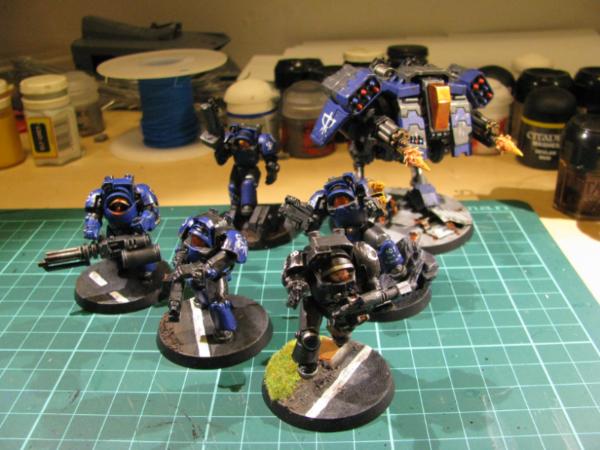

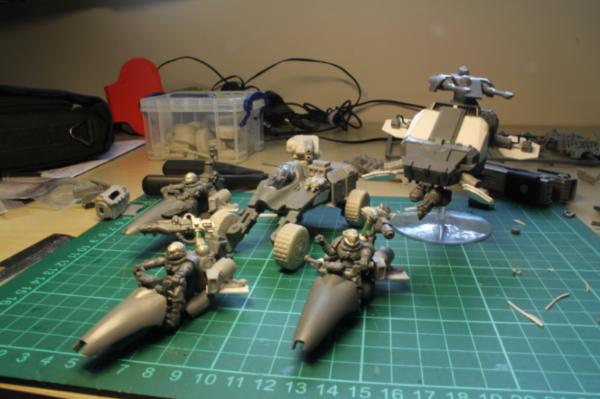
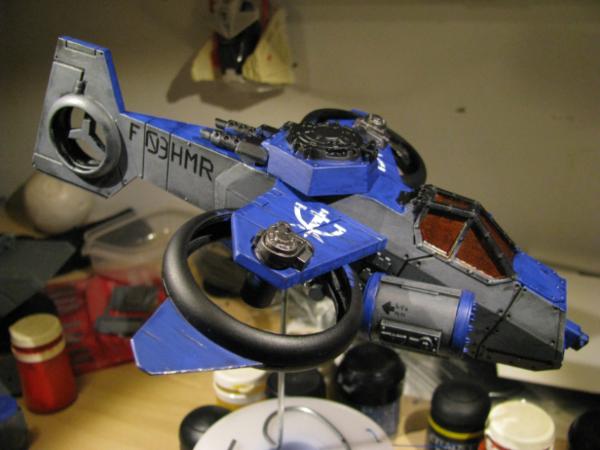
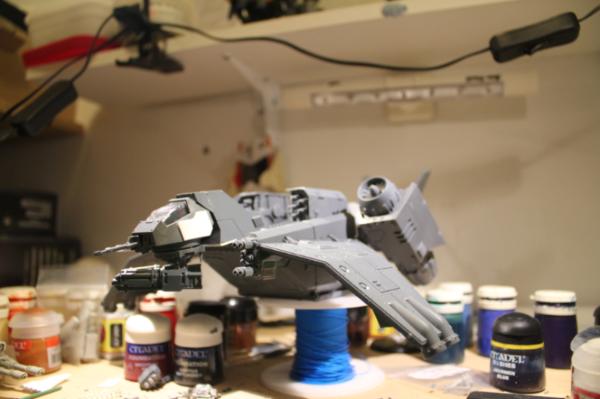




 -ing explosion.
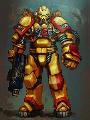



 .
.


 .
.